Case of the Day – Friday, December 26, 2025

WRONGFUL TREES

camelnose141003

For all of the Latin phrases, hidebound traditions, and libraries full of precedent, the law at its essence is nothing more than a codification of policies generally accepted by society. The law doesn’t always get it right – some laws aren’t carefully drafted, others do exactly what the legislature intended but pursue foolish or even repugnant policies – but by and large, the law tries to lay out rules for conduct based on policies generally accepted to be important.

Keeping an eye on the prize – the societal goals to be achieved – often helps courts from going overboard. It’s how the camel’s nose can be allowed into the tent without getting the whole camel in the process.

A good example of this is the “wrongful life” lawsuit. States all allow a “wrongful death” action, in which the survivors of someone killed, say, in a car accident or from medical malpractice sue for damages. This makes good sense. But in the last decade or so, some “wrongful life” suits have been brought, where – for example – a physician misdiagnoses and tells prospective parents that their fetus is healthy, but the doctor is wrong. The child is born with severe birth defects. The “wrongful life” suit claims that but for the physician’s negligence, the child would have been aborted.

Very few courts have permitted such a lawsuit for several very good public policy reasons. The first is that society does not recognize, as a matter of policy, that anyone is better off not having been born, no matter how severe the burdens of congenital disability. Second, the whole idea of tort law is to place the injured party in the same position as he or she would have been in had the negligence not occurred. But for the negligence, the injured party wouldn’t have been born. What can be done to put a living plaintiff in that position, or, ­for that matter, to compensate for having been born instead of never being?

And what would have made Ms. Lewis happy? Perhaps if the Krussels had only clearcut their property ...

Just what would have made Ms. Lewis happy? Perhaps if the Krussels had clearcut their property …

All right, that’s pretty heady stuff, but what does that have to do with tree law? Simply this: in today’s case, the plaintiff, Ms. Lewis, suffered from having a tree belonging to her neighbors Gary and Nancy Krussel fall on her house. Her suit simply claims: the tree fell on her house; the neighbors knew they had a tree; therefore, the tree was a nuisance; and the neighbors were negligent in failing to keep the tree from falling on the house. There was no evidence that the Krussels had any inkling this particular hemlock was going to fall. There was no evidence any reasonable person would have had such an inkling. In fact, there was no evidence that the tree was diseased or damaged. Reduced to its essence, Lewis’s claim was that the tree existed and the tree later fell, and those facts made it a nuisance. The tree was alive, the argument seems to say, and that fact wronged Ms. Lewis.

Fortunately, the Washington state courts made short work of this claim. Ms. Lewis was trying to advance a negligence claim as a nuisance claim, probably because she had no evidence of negligence. But, the courts ruled, public policy was not ready to declare a tree a nuisance merely because it was growing, nor was it prepared to hold that property owners were liable for what became of any naturally-growing, healthy trees on their land.

Without keeping one eye on public policy, the courts’ development of the law might go like this: First, landowners are responsible for damage caused by trees on their property that are diseased or damaged, and about which condition they are actually aware or reasonably ought to be aware. The next step would be for the courts to rule that owners must inspect their trees to avoid liability. Finally, landowners would be strictly liable for any damage caused by their trees, whether they were aware of a problem with the trees or not.

camelnose140310Largely, the law has stopped short of such a draconian rule, because the courts recognize that public policy favors the natural growth of trees, and eschews requiring property owners to devote substantial time and money to inspect trees, where there is no concomitant benefit to the public. By and large, courts have enough policy sense to let the camel’s nose into the tent while keeping the rest of the dromedary outside.

It is this kind of analysis that is illustrated in today’s case.

Lewis v. Krussel, 101 Wash.App. 178, 2 P.3d 486 (Ct.App. Wash. 2000). During a windstorm, two large healthy hemlock trees fell on Dawn Lewis’s house. She sued Gary and Nancy Krussel, who owned the property on which the trees had been growing.

Krussel acknowledged that windstorms had knocked down other trees on his property and other properties nearby in previous years. About a week after the windstorm at issue here, another windstorm knocked a tree onto his mother’s mobile home. But the trees that damaged the Lewis house were natural growth, and Krussel had no reason to believe that they were any more dangerous than any other trees on his property under normal conditions. After the damage to the Lewis house, Krussel cut down other hemlock trees located near his house upon the recommendation of the local utility district.

After Lewis sued for nuisance and negligence, Krussel moved for summary judgment. He supported the motion with evidence from a professional forester who inspected the stump of one of the fallen trees and found no evidence of rot. The forester concluded the tree that fell on the Lewis house was no more dangerous than any other tree standing on the Krussels’ property, and there was no way for the Krusselses to determine beforehand whether any one of their trees would fall over. The trial court dismissed the Lewises’ claim, and Lewis appealed.

Held: The appeals court upheld the dismissal of Lewis’s claim.

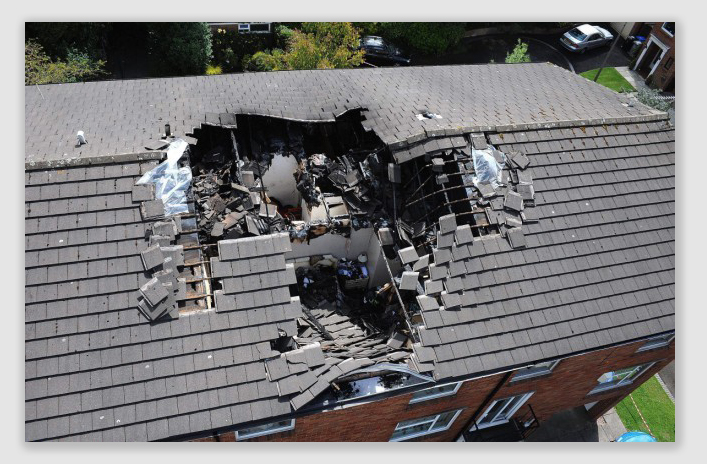
Sure Ms. Lewis's house was crushed ... but gravity did not turn the healthy tree that toppled onto her roof into a nuisance.

Sure Ms. Lewis’s house was crushed … but gravity did not turn the healthy tree that toppled onto her roof into a nuisance.

A homeowner is not obligated to remove healthy trees because they might topple in a storm. The Court of Appeals said that just because a negligence claim was disguised as a nuisance suit didn’t mean that the trial court had to consider it as such. Instead, in situations where the alleged nuisance is a result of what is claimed to be negligent conduct, the rules of negligence are applied.

The elements of a negligence cause of action, of course, are (1) the existence of a duty to the plaintiff, (2) a breach of the duty, and (3) injury to the plaintiff flowing from the breach of duty. An owner of property located in an urban or residential area who has actual or constructive knowledge of defects affecting his or her trees has a duty to take corrective action. However, the same is not the case when the tree is healthy. In that case, the owner does not have a duty to remove healthy trees merely because the wind might knock them down.

In this case, the Court agreed, there was no evidence that Krussel had any reason to believe that the hemlock trees posed a hazard, and a professional forester who had inspected the stump of the fallen tree had found that the tree was free of defects. The mere possibility of harm does not mean the probability of harm.

– Tom Root

TNLBGray

Case of the Day – Tuesday, December 2, 2025

IN THE VAST WORLD OF LAW…

… there’s plenty of half-vast lawyering going on.

I found myself thinking that in connection with a case I was reviewing yesterday, one that had nothing to do with trees (but a lot to do with plants, those being Cannabis sativa, and involving trucks and conspiracies and the pesky Controlled Substances Act).

Potheads or not, I thought, the defendants deserved better lawyering than they got. There’s a lot of that substandard, just-barely-enough-to-prevent-a-malpractice-suit representation, not only in the criminal courts but in civil practice as well.

Today’s case is an excellent example of phone-it-in representation on both sides of the courtroom. The plaintiff’s lawyer seems to simply have loaded a civil action blunderbuss and fired away. It was evident that the defendant’s tree roots were destroying the boundary wall by pushing against it from the defendant’s side of the edifice. Therefore, the roots were located on the defendant’s property. So why would the lawyer include a trespass count? Any first-year law student could tell you that the roots were not on his client’s land, and being on someone else’s land without permission is the sine qua non of trespass.

And before the defendant starts to feel smug about the plaintiff’s pleading miscue, she should look at her counsel’s performance. That lawyer spent the defendant’s money on a couple of experts, who may or may not have rendered solid, helpful opinions. We’ll never know – because the defendant’s lawyer did not bother to put the expert’s opinions in affidavit form – a pure rookie mistake.

The defendant might have walked away from this lawsuit relatively inexpensively by getting the plaintiff’s entire complaint dismissed. But she never had a chance to make her substantive argument because her lawyer overlooked something everyone knows – that statements by experts and witnesses must be in affidavit form.

Half-vast lawyering all around…

1212 Ocean Ave. Housing Development Corp. v. Brunatti, 50 A.D.3d 1110, 857 N.Y.S.2d 649 (Sup.Ct.N.Y. 2008). 1212 Ocean Avenue Housing Development Corp., a soulless, faceless corporation, if ever there was one, owned property next to Debbie Brunatti’s place. The two properties are separated by a 10-foot-high retaining wall built in 1924 when an apartment building was constructed on 1212’s premises. The heartless corporate suits alleged that an elm tree planted on Debbie’s property more than 40 years ago grew over time so that its trunk came to rest atop the retaining wall. The roots of this tree also damaged the retaining wall, causing it to crack and curve. In December 2004, the New York City Department of Buildings issued a summons to 1212, requiring it to fix the defective retaining wall. Shortly later, 1212 sued Debbie to recover damages for nuisance, trespass, and negligence.

Debbie had the tree removed about four months after being sued. She argued, among other things, that the defective condition of the retaining wall had not been caused by tree roots, and that 1212 could not maintain an action for damages because it had not engaged in self-help to remedy the situation. The trial court denied Debbie’s motion.

Debbie appealed.

Held: The trial court properly denied Debbie’s motion to dismiss for nuisance and negligence.

The unsworn reports from two engineers she submitted in support of her application were insufficient to establish, as a matter of law, that the tree roots did not damage 1212’s retaining wall. “Furthermore,” the court said, “while it has been recognized that a property owner may resort to self-help to remove tree roots encroaching upon his or her property and that this may constitute a sufficient remedy in some circumstances, the defendant failed to demonstrate that self-help would have been practicable here, where it is undisputed that the tree roots rested entirely on her property.”

However, the Court said, the trial judge should have granted that part of Debbie’s application for summary judgment on the trespass count. Since the tree roots rested entirely upon Debbie’s property, there was no intentional intrusion or entry onto the 1212’s property, which could constitute trespass.

– Tom Root

TNLBGray140407

Case of the Day – Wednesday, October 15, 2025

MULLIGAN SEASON


I may slip over the border (the border between the U.S.A. and our neighbor to the north) to enjoy turkey and all the fixings. My favorite holiday of the year is Thanksgiving, and thanks to a cultural quirk, our Canadian cousins celebrate it way before we do. Monday may have been Indigenous Columbus Day in the United States, but it’s turkey day in the provinces. Well, turkey and Jiggs’ Dinner and butter tarts.

And then, we get a mulligan, a do-over, on Thanksgiving in 45 days. Life is good. And after that, we’ll get Thanksgiving Day over, and over and over until the leftovers are either eaten or spoil.  As Yogi Berra might have said, today’s case and Thanksgiving dinner will both be déjà vu all over again.

It seems there was trouble in Randolph County, Alabama, up near the Georgia line. The Ledfords had purchased a nice vacation home on a lake, next to a place owned by the Youngs. While the Youngs appreciated the natural setting, the Ledfords were more concerned that nature’s bounty – specifically one large pine tree on the boundary between the Ledford’s land and the Young property – was going to fall on their house. They wanted the tree cut down. The Youngs refused. The matter ended up in court.

Of course, regular treeandneighborlawblog readers know how that should have turned out: if the tree really sits on the boundary line, both landowners have to agree before it can be cut down. The trial court reasoned otherwise. Under the Massachusetts Rule, a landowner can trim parts of a tree that overhang or grow under his or her property, all the way from the center of the earth to the sky. So that meant the Ledfords could cut out half of the tree, the court mused. That would kill the tree, but the court interpreted the Massachusetts Rule to mean that since you’re allowed to hack at the roots and branches of a tree without regard to the damage you cause, then you can take down the whole boundary tree if you like. The trial court gave the Ledfords the go-ahead to take down the tree.

The Youngs appealed, and common sense prevailed. The Court of Appeals explained the proper boundary tree rule, reversing the trial court’s errant ruling. But in so doing, a few judges on the appeal panel wondered aloud (or at least, in the written opinion) why the Ledfords hadn’t argued that they had the right to cut down the pine tree because it was a nuisance. Remember Fancher v. Fagella? One judge went so far as to say that if the record held evidence of nuisance, he would have upheld the trial court, wrong though its reasoning was.

Do we have to spell it out? The trial court was just plain wrong.

Do we have to spell it out? The trial court was plain wrong.

Well, the Ledfords could take a hint. When the case went back to the trial court “for proceedings consistent with this opinion,” as appellate decisions like to say, they asked for a do-over, a second hearing, this one on nuisance. ‘Hold the phone!’ the Youngs cried. ‘The Court of Appeals said the Ledfords lost. The tree stays standing. Game over.’

The trial court gave the Ledfords their mulligan. It ordered a second hearing and afterward found the pine tree to be a nuisance. The Ledfords were told they could cut it down. Again.

The Youngs went back to the Court of Appeals for a writ of mandamus, essentially a request that the Court issue an order telling the trial court that it couldn’t hold the second hearing. The appellate court refused to do so. Applying an obscure rule called the “law of the case” doctrine, the appellate court held that while the trial court was required to apply the ruling the court of appeals had issued, that ruling was just that the Ledfords could not cut down a boundary tree without the agreement of their neighbors. The court of appeals did not say the tree had to remain – just that if it was to be cut down, it couldn’t be on the basis originally articulated by the trial court.

The lessons here? The Ledfords’ attorney should have argued nuisance to begin with. It should have been clear that arguing that his clients could cut down a boundary tree was a loser. Besides, in civil litigation, you argue as many alternative theories as possible to get your clients where they want to end up. Who knows which one will be a winner?

Of course, the Ledfords ended up winning, and the pine tree lost. But as an old judge once cautioned us, you should never dig up more snakes than you can kill. Why buy a second trip to a court of appeals by leaving out an argument, and asking for a mulligan later?

A few too many snakes? The Ledford's lawyer courted procedural trouble.

A few too many snakes dug up here? The Ledfords’ lawyer courted procedural trouble.

Ex parte Young, 79 So.3d 656 (Ala.Civ.App. 2011): The Ledfords owned a vacation house with a pine tree located slightly over 10 feet from Ledford’s house, on the boundary between their property and that of the Youngs. Fearing that [a] strong wind against the tree could cause it to fall on the home and could cause damage to the [house] as well as serious injury to any occupants,’ the Ledfords wanted a court order that they could cut it down.

The Youngs argued that the pine tree was ‘a true boundary line tree’ and contended that it could not be cut down by either property owner without permission of the other. After a hearing in which the Ledfords, the Youngs, and a forester hired by the Youngs all gave testimony, the trial court held that Ledford and her husband could remove the tree at their convenience, taking steps to minimize damage to the Youngs’ lot. The trial court held that because Alabama law let a landowner remove any trees on his or her property up to the property line, and that the right extended to the center of the earth and into the sky, the Ledfords were free to hack into the pine tree up to the property line and then cut from that point down to hell and up to heaven. The Court said that “[s]ince [the Ledfords] unquestionably has the right to remove any portion of the tree that is located on [their] side of the property line and since doing so would likely kill the tree, the Court is of the opinion that [they] should be allowed to completely remove the tree to ensure” that the property and the health of anyone there are protected.

When the case got to the Court of Appeals the first time, it was promptly reversed. Rejecting the trial court’s tortured “center of the earth to the sky” analysis, the appellate court ruled that “[i]n the special case of a boundary-line tree, … each adjacent landowner has ownership rights that cannot be trumped by the other’s desires in the manner suggested by the trial court’s judgment” and that the Ledfords – contrary to the trial court’s judgment – could not properly “‘cut into the tree to the property line and then cut from that point to the center of the earth and into the sky'” without incurring liability to the Youngs.

But the appellate court went a little further. In a concurring opinion, two of the judges on the appellate panel observed that the action had been argued on the basis of the Ledfords’ contention that they were entitled to remove the boundary-line tree at issue merely because its trunk was located in part on their property. The judges noted that whether the “boundary-line tree at issue in this case constituted a nuisance for which an exception to the general rule set forth in the main opinion might apply” had not been litigated. A third judge on the panel said that had the record contained evidence indicating that the tree at issue posed a danger to the Ledfords’ house,” he would have voted to affirm the judgment instead of reverse it.

After the appellate judgment issued, the Ledfords asked the trial court for another hearing to consider whether the pine tree was a nuisance. The Youngs argued that the appeals court had decided in their favor, and the case should be closed. But the trial court had another hearing, and afterward it decided that the tree was a nuisance and that the Ledfords could remove it on that basis.

The Youngs filed a petition for a writ of mandamus, asking the appeals court to order the trial court to enter judgment for them and end the proceeding.

Held: The Ledfords could cut down the tree. A court will issue a writ of mandamus only when the petitioner has a clear legal right to the order sought; the respondent has an imperative duty to perform, accompanied by a refusal to do so; there is no other adequate remedy at law; and the court has jurisdiction of the court.

Mulligan140206Here, the Court of Appeals said, the only real question was whether the trial court had the right to hold a second trial in this matter. The Youngs contended that the prior appellate court’s decision was final as to all matters before it and that the trial court, after that initial appeal, was not allowed to hold another hearing and take additional testimony without permission of the appellate court to do so. The court of appeals agreed with that statement of the law but said that only the particular issue that had formed the basis of the trial court’s judgment – whether Ledfords could unilaterally remove the boundary-line tree simply because the majority of it was located on their side of the common boundary – was addressed. Based upon that conclusion, the court of appeals had reversed the trial court’s judgment letting the Ledfords unilaterally remove the tree,” and remanded the cause “for further proceedings consistent with [that] opinion.”

Because of the limited scope of the trial court’s previous judgment, no one had ruled on whether the boundary-line tree posed a danger to Ledford’s home or amounted to a nuisance. While the prior decision was thelaw of the case,” nothing in the prior opinion limited the trial court from ruling on the nuisance question, which the court of appeals admitted remained open for decision. Deciding to examine the nuisance question did not put the trial court in the position of doing something contrary to what the court of appeals had ordered.

– Tom Root

TNLBGray140407

Case of the Day – Thursday, October 9, 2025

ONE CROWDED HOUR

A British army officer and poet, Thomas Osbert Mordaunt, wrote in his poem, “The Call,” a line now misattributed to Sir Walter Scott: “One crowded hour of glorious life is worth an age without a name.”

It’s so much fun to be nasty. Even for just one glorious, crowded hour. It’s just not so much fun when the age without a name knocks on the door, seeking payment. Just ask John and Anne Estes.

Everything started when John and Anne tried to extend the Massachusetts Rule to cut some branches from their neighbors’ trees. The problem was that the trees and branches were both on the neighbors’ properties.

Then they built a fence. So far, so good, at least until the fence they built was on their neighbors’ property, too. The neighbors, Matt and Rachel Milcic, objected. After mediation, the Estes fence was removed.

Obviously, John and Anne were sore at having been upbraided for their brazen trespasses. So they rebuilt the fence, and on the Milcics’ side, painted in large block letters, “PULL YOUR WEEDS.”

“Hah!” You can imagine John and Anne giving each other high-fives at their in-your-face cattiness. They sure showed those jerk neighbors, who thought they were so cool that they could stop John and Anne from trespassing. Their snickers and winks lasted for one crowded hour of glorious fun.

Maybe the neighbors really did need to weed. It’s hard to say. Certainly, Matt Milcic did some landscaping in response to the fence. After he had done so, and after he asked John to remove the sign, John said he might. But petulantly, he did not.

Cute, John… at least until the Milcics sued. Then, John offered to paint out the words if the Milcics would drop the suit. But that horse had left the barn…

The Esteses’ conduct was brazen enough that the trial court granted the Milcics summary judgment. But then, the battle continued over damages. By the time the court was done, the Esteses’ cruel prank had cost them northward of $10,000.00. Not nearly what the Milcics wanted, the award nevertheless undoubtedly deterred the juvenile conduct.

You’d better find your checkbook, John. You and Anne enjoyed your crowded, glorious hour. The age without a name (but with a dollar sign) has now arrived.

Milcic v. Estes, 2018 Wash. App. LEXIS 1798 (Ct. App. Wash., Aug. 6, 2018). The Milcics and Estes are next-door neighbors. In 2013, the Estes cut branches off trees located on the Milcics’ property and began to build a fence along the parties’ common boundary.

When a dispute regarding fence encroachments arose, the parties submitted it to mediation. In April 2014, the parties executed a settlement agreement in which the Estes agreed, among other things, to remove both the excess dirt from the Milcics’ property and portions of fence footings that were visible above ground.

In July 2014, the Estes painted the words “PULL YOUR WEEDS!” in white, 10-inch block letters on the Milcics’ side of the Estes’ fence. The Milcics threatened a lawsuit unless the Esteses removed the sign. The words remained, and the Milcics sued.

The Milcics’ complaint alleged private nuisance, trespass, timber trespass, spite fence, quiet title and damages to land and property. Shortly after the Milcics filed, the Estes offered to remove the painted message if the Milcics dismissed their complaint. The Milcics rejected the offer, telling the Estes, “If you were willing to do so voluntarily… you could have removed the sign at any time for the past nine months.”

The Milcics moved for partial summary judgment, alleging there were no issues about the Estes’ branch cutting, fence encroachments, and dumping of fill dirt on the Milcics’ property. The trial court granted relief, including ordering the Estes to the fence encroachments. The court awarded the Milcics some but not all, of their requested damages, but denied them reimbursement of their legal fees.

The Milcics appealed the adverse ruling on damages and fees.

Held: The appeals court upheld the damage award, and sent the case back to the trial court for a legal fee award.

In January 2017, the matter proceeded to trial solely on the issues of damages and attorney fees and costs. Rachel Milcic testified that the Estes cut branches off their trees and put fill dirt on their property without their permission. She said the branch removal ruined the beauty and privacy of the Milcics’ property. The loss of the branches upset her and she did not sleep well. She also testified that the Milcics were not sure where the property line was when the branches were cut.

She also testified that she was “shocked,” “horrified,” and “scared” when the Estes painted the “PULL YOUR WEEDS!” message on the fence facing the Milcics’ property. She had trouble sleeping and no longer felt that she and her children were safe. She testified that before the painted message appeared, her family spent around 12 hours per week in her yard. After the message appeared, they spent less than an hour a week in the yard. She valued her use of the yard at $40 per day. She testified that the message was visible for 922 days.

Matt Milcic testified that after the painted sign on the fence, the Milcics installed a surveillance system to “protect our property” and to “capture any trespasses by the Esteses on our land.” Matt also testified that the fence message could be seen from roughly a quarter of their property and prevented the Milcics from enjoying their yard. Their dreams and aspirations for landscaping the yard “got instantly crushed into a reminder of, you don’t get to enjoy this part of your property that you had hopes and dreams for.” He estimated that the affected portion of his property had a market value of $152,500.

Matthew conceded that he had not seen a doctor or any medical professional for his emotional distress and had no medical bills related to that distress. Matthew also conceded that he did not accept the Estes’ April 2015 offer to remove the fence message.

John Estes testified that he painted the “PULL YOUR WEEDS!” message to protest the “weeds and invasive vegetation coming onto my property.” He conceded that Matt told him in August 2014 that he had pulled the weeds and that he wanted the message removed, but he did nothing for nine months, at which time John offered to remove the message if the Milcics dismissed the lawsuit.

The court ruled that the Milcics were entitled to some, but not all, of their alleged damages. It awarded them $3,557, which it trebled to $10,673. However, it denied damages for the installation of the surveillance system, for lost enjoyment of property, for emotional distress, and for legal fees.

On appeal, the Milcics argued the court erred in awarding no damages for their alleged lost enjoyment of their property on their trespass and private nuisance claims. They claim they were entitled to such damages due to the significant length of time — 922 days — that the fence message remained in place. But the Court of Appeals held that the trial court was free to discount or reject the Milcics’ testimony regarding their alleged lost enjoyment. “On this record, and in light of our deference to the trial court’s view of the weight and credibility of the evidence,” the Court held, “we cannot say the court abused its discretion in declining to award damages for the Milcics’ claimed lost enjoyment of their property.”

The Milcics also contended that the trial court abused its discretion in failing to award them damages for emotional distress caused by the Esteses’ fence message and branch cutting. A plaintiff who proves liability for intentional wrongful conduct is entitled to damages for emotional distress upon a showing of actual anguish or emotional distress. The distress need not be severe and a plaintiff “need not demonstrate objective symptomology, medical bills, or a medical diagnosis.”

Here, the trial court found the Esteses engaged in intentional wrongful conduct, including nuisance, timber trespass, and a spite fence. The trial court also found, however, that the Milcics “have not provided sufficient evidence to establish that they have suffered emotional distress.” The Milcics pointed to their testimony that they suffered initial shock and distress, trouble sleeping for a week, and ongoing feelings of insecurity and fear of further invasions. “But,” the Court of Appeals held, “the trial judge’s evaluation of the sufficiency of the evidence includes determinations as to the weight and credibility of the evidence – matters that require our deference.”

The Milcics also contended the trial court erred in concluding that the Estes’ conduct was not the legal cause of their purchase and installation of a surveillance system. To determine if legal causation exists, a court considers whether “‘as a matter of policy, the connection between the ultimate result and the act of the defendant is too remote or insubstantial to impose liability.” The Court said that the judge’s determination rests on ”mixed considerations of logic, common sense, justice, policy, and precedent.”

Here, the Court of Appeals ruled, “the Milcics offer no relevant precedent supporting their argument regarding legal causation. Nor do they advance any persuasive arguments supporting their claim that logic, common sense, justice, and policy favor the imposition of liability for the surveillance system. There was never any doubt as to who had trespassed onto the Milcics’ property. The Estes readily admitted cutting the branches, painting the message, and installing the fence. There was therefore no need for a surveillance system to catch the perpetrators, and no reason to believe that a surveillance system would act as a deterrent to future incursions. In addition, except for the branch cutting, the trespasses were de minimis incursions. Thus, the trial court did not err in concluding that the Estes’ conduct was not a legal cause of the Milcics’ surveillance system expenses.”

– Tom Root

TNLBGray140407

Case of the Day – Monday, October 6, 2025

UNSKILLED LABOR

W.C. Fields once quipped, “He’s a self-made man – which shows the horrors of unskilled labor.”

When Farmer Wilson decided to sue his neighbor, demanding after 50 years of not bothering to enforce an agreement on keeping trees bordering his field trimmed that the neighbor clear-cut a 40-foot wide swath, he decided to represent himself. After all, it seemed that the lawyering business was just so much talk. Anyone ought to be able to do it…

Well, not just anyone. It turned out that as a lawyer, Farmer Wilson was more a son of the soil than he was a barrister. The heart of Farmer Wilson’s nuisance beef was that the trees cut down the crop yield on his land, because they shaded the field. Reduced to its essence, that was just a claim that he had a right to light, that is, a right to the sun being shaded by his neighbor’s trees. What he was claiming was the easement known as “ancient lights,” the Court said, and “ancient lights” was a doctrine that had been run out of West Virginia.

If that weren’t enough, the Court threw even more shade on Farmer Wilson’s lawsuit. The prior owner of Farmer Wilson’s land had had a deal with the former owner of the next-door property on keeping the bordering trees trimmed. Farmer Wilson candidly admitted he had not tried to enforce the contract for a half-century, confidently asserting that this meant his damages had really accumulated.

But what it really meant was that under the West Virginia statute of limitations that applied to nuisance suits, his lawsuit was about 48 years too late.

Farmer Wilson may not have been a self-made man, but his lawsuit was an excellent illustration of the horrors of unskilled labor.

Wilson v. Polino Enterprises, Inc., 2018 W. Va. LEXIS 413, 2018 WL 2277812 (Supreme Ct. of Appeals W.Va., 2018). Farmer Wilson and Polino Enterprises own adjacent properties in Upshur County, West Virginia. The Wilson property borders the Polino land’s western and southern boundaries. Farmer Wilson sued Polino, complaining that the Company had created a nuisance on the western boundary of its property that was damaging his farmland.

Farmer Wilson claimed that trees on Polino’s side of the property line were nuisances because of “[d]amage to the production (yield and quality) of crops as a result of invasion by roots and shading.” For this alleged crop damage, Farmer Wilson asked for $100 per year for a total of $4,500 from May of 1969 through 2014 when he originally filed the action. He also sought unspecified “labor and equipment cost[s] of removing branches and limbs of trees fallen” on his farmland. Finally, he wanted Polino to remove deer stands placed in trees near the property line because he had “no way of policing the killing of deer” on his property.

Polino filed a motion for summary judgment in the trial court. The Company showed the court letters between the parties regarding the care of boundary areas between the properties. In the letter, Farmer Wilson noted that Polino had previously agreed to his “cutting overhanging limbs and dragging them back to the wooded area” of the Wilson property, but that the proposal would restrict his cutting of tree limbs to those “no higher than 25 to 30 feet from the ground level.” Consequently, Farmer Wilson requested that Polino “clear-cut all the area 40 feet from our fenced border to remove the encroaching limbs and roots of trees from your forested land.” His letter explained that ‘I have neglected enforcement of the agreement between Mr. Robert Woofter[, a previous owner of the Polino property,] and my father. As a result, [I] have suffered economic loss during the past 50 years and [am] suffering economic loss each year in the form of forage crops harvested from the cultivated fields involved.’

In its motion for summary judgment, Polino argued that assuming all of Farmer Wilson’s allegations were true, it was nevertheless entitled to judgment as a matter of law on the nuisance claim. The trial court agreed.

Farmer Wilson appealed.

Held: Polino’s trees were no nuisance.

A private nuisance is a substantial and unreasonable interference with the private use and enjoyment of another’s land.

Abe Lincoln could have been talking about Farmer Wilson, who has a real dummy for a client.

The lower court properly ruled that Farmer Wilson’s nuisance claim was barred by the statute of limitations under West Virginia Code § 55-2-12(a). That section gave a party claiming a nuisance only two years from the time the claim arose to sue.

The Supreme Court even considered the statute of limitations, because it determined that Farmer Wilson’s rather opaque and do-it-yourself nuisance claim was fatally flawed. His contention, as best the Court could surmise, was that insufficient sunlight caused by overhanging trees on the respondent’s property had resulted in his farmland yielding fewer crops. That claim, the Court said, “fails as a matter of law… The common law doctrine of ancient lights has been abolished in West Virginia… Though an adjoining property owner may still establish an easement implied by necessity to light and air, such an easement does not exist here because there is no prior common ownership of the parties’ properties.”

In Cobb v. Daugherty, the court discussed easements of necessity, also called easements by necessity or ways of necessity. Such easements are typically implied to provide access to a landlocked parcel. Easements implied from quasi-easements, also called implied easements or easements by implication, are based on a landowner’s prior use of part of the landowner’s property (the quasi-servient tenement) for the benefit of another portion of the property (the quasi-dominant tenement). Three elements – common ownership, transfer of part of the land (severance), and necessity of some kind – are required in both cases. The fundamental distinction is that easements implied from quasi-easements are based on prior use.

While Cobb recognized that a certain type of easement to light and air still exists in West Virginia, the Court said, Farmer Wilson did not meet the legal requirements. He had not previously owned the Polino property. Therefore, the Court ruled, “We conclude that the circuit court did not err in awarding respondent judgment as a matter of law with regard to petitioner’s nuisance claim.”

– Tom Root

TNLBGray

Case of the Day – Friday, October 3, 2025

DO YOU HAVE A POINT?

More than one reader wondered where I was headed yesterday when I wrote about the New Hampshire law of animals ferae naturae. Other than showing you a picture of my dog – always a worthwhile goal, in my book – the blog may not have seemed all that relevant. After all, neighbors, especially urban neighbors, are seldom overrun with wild animals intent on committing mayhem in your backyard.

But, yes, I had a point. As that great philosopher Elvis once said, “I said all that to say all this…” The law of animals ferae naturae translates a bit into “plants ferae naturae.”

In today’s case, the afflicted neighbor, Linda Pesaturo, claimed that her neighbor’s trees were overhanging her property, making her driveway unusable, and collapsing her fence. The trees, she complained, were a private nuisance.

The New Hampshire Supreme Court nixed the claim. It pointed out that just as the law of animals ferae naturae required human interference with the animal before making a property owner liable for a resulting nuisance, it was not enough that Linda said the trees caused damage. Unless she could somehow show that neighbor Robbin had somehow interfered with nature in the planting or growth of the pine and maple, the lush and fecund trees.

Tree’s gonna tree.

Pesaturo v. Kinne, 161 N.H. 550, 20 A.3d 284 (Supreme Ct. N.H., 2011). Linda Pesaturo brought a small claims action against her neighbor, Robbin Kinne, seeking more than $2,000 in damages because two of Robbin’s trees overhung her property; one limited Linda’s use of her driveway, while the other one damaged her fence.

Robbin moved to have the claim dismissed, arguing that Linda failed to state a claim upon which relief could be granted. The trial court agreed, dismissing Linda’s negligence and nuisance claims.

Linda appealed.

Held: Linda had adequately raised a claim for negligence with respect to one tree, but she failed on the other. Her claim of private nuisance was properly rejected.

It is the common law rule that a landowner is under no affirmative duty to remedy conditions of purely natural origin on his or her land, even though they are dangerous or inconvenient to his neighbors. In order to create a legal nuisance, a human act must have contributed to its existence, just as under the law of animals ferae naturae, as held in Belhumeur, a landowner cannot be held liable for the acts of wild animals occurring on his property unless the landowner has actually reduced indigenous wild animals to possession or control, or introduced non-indigenous animals into the area.

But ferae naturae does not apply to plants, such as trees. Instead, the Court ruled, a duty exists on the part of a landowner when it is foreseeable that an injury might occur as a result of the landowner’s actions or inactions. A landowner’s liability may extend beyond the borders of his or her property, and a duty may be present if the landowner’s acts or omissions create a sufficiently foreseeable risk of harm in such a case, where it can be found that the landowner did not use reasonable care in the maintenance and operation of his or her property.

Because there is a foreseeable risk of injury when a tree is decayed or defective, a landowner who knows or should know that his tree is decayed or defective has a duty to maintain the tree to eliminate this dangerous condition. Thus, a landowner who knows or should know that his tree is decayed or defective and fails to maintain the tree reasonably is liable for injuries proximately caused by the tree, even when the harm occurs outside of his property lines. However, a landowner does not have a duty to consistently and constantly check all trees for non-visible decay. Rather, the manifestation of the tree’s decay must be readily observable in order to require a landowner to take reasonable steps to prevent harm.

To recover for negligence, a plaintiff must demonstrate that the defendant has a duty, that he or she breached that duty, and that the breach proximately caused injury to the plaintiff. In this case, Linda’s complaint failed to allege a cause of action for negligence because she had not alleged that Robbin’s trees were decayed or defective, or that Robbin knew that the trees were in such a condition but failed to eliminate the danger to Linda.

But when Linda amended her complaint, which she did after Robbin filed his defense of failure to state a claim, she sufficiently alleged that Robbin knew her oak tree had “swinging, dead limbs” and, thus, that the tree was decayed or defective, thereby imposing a duty upon him to eliminate the condition. The amended complaint also sufficiently alleged that Robbin breached his duty by failing to act and that this breach caused Linda injury by denying her use of her driveway.

But Linda’s claim that Robbin’s pine tree damaged her fence was insufficient. She claimed the tree failed because of “rain, wind, ice and snow,” and because of Robbin’s “insufficient management” of his pine tree, and that limbs broke off and damaged her fence. Her claim was insufficient to establish that the tree was decayed or defective.

– Tom Root

TNLBGray

Case of the Day – Tuesday, September 23, 2025

SHIPS PASSING IN THE NIGHT

When Al Mattikow finally tripped and fell on a walkway outside of his rented townhouse, all because of a hickory tree that dropped twigs, nuts, leaves, and sap all over the common area, he sued the condo association for negligence and for maintaining a nuisance.

The condo folks defended themselves, showing that they had maintained the tree carefully, using the services of an arborist, to prevent it from becoming a hazard. Because they were so dutiful, the condo folks argued, they could not possibly be negligent. And that meant that the tree couldn’t be a nuisance, either.

“Whoa,” you’re thinking, “that’s so-o-o wrong!” And you are right. The defendant condo association’s arguments and Al’s complaint were like ships passing in the night. It’s laudable that the condo folks took care of the hickory so that it didn’t fall on Al’s pad some dark and stormy midnight. But that was hardly Al’s point. It wasn’t the tree’s falling that bothered Al. It was the falling leaves, twigs, nuts, and sap that covered the walkways, making Al’s perambulation difficult.

Negligence and nuisance both start with “n,” but they’re not synonyms. You can be negligent without creating a nuisance, and you can create and harbor a nuisance without ever being negligent. The condo association conflated the two terms, as well as conflating “safe tree” with “well-behaved tree.”

Viva la difference!

Mattikow v. West Lyon Farm Condominium Association, 2019 Conn. Super. LEXIS 2296; 2019 WL 4344368 (Superior Ct of Connecticut, Aug. 20, 2019). Al and Nina Mattikow rented a condominium unit in which they had lived for a number of years. They had complained to West Lyon Farm Condominium Association, the condominium association that managed the common areas of the property and enforced the regulations, about the extent to which leaves, hickory nuts, pollen, and sap continually fell onto the surface of the common deck near their unit, making walking hazardous. The Mattikows contended that their complaints explained that Al walked with a cane, making him more vulnerable to the conditions of the surface upon which he was walking.

Eventually, Al fell because of the droppings, he claimed, seriously injuring his ankle.

The Mattikows sued, alleging negligence and nuisance. The Association argued that pursuant to the bylaws and rules of the association, to which the Mattikows were bound by their lease agreement, the deck was considered to be a “limited common element.” A “limited common element” benefited one condo unit over the others, due to its location, and the condo unit that most benefited was responsible for maintenance, including clearing leaves and other debris. The Association claimed that under the bylaws, it had no duty to maintain the surface of the deck.

The Association moved for summary judgment, claiming there was no issue of fact – it simply had no duty to maintain the premises upon which Al fell, and conversely, Al had the obligation to maintain the deck surfaces himself.

Held: The Association’s motion for summary judgment was denied.

In addition to claiming negligence, Al claimed that the Association is liable under a theory of nuisance. The Association was dismissive of the claim, arguing that it is derivative of the negligence claim such that if the Association wins on the negligence count, it will necessarily win on nuisance as well. But that ain’t necessarily so.

The Court noted that “the elements of nuisance are different—otherwise it wouldn’t be a distinct cause of action. Simplistically, private nuisance is based on a theory of invasion of property rights rather than a breach of the duty to use reasonable care to avoid causing harm to others. Thus, even if there were no duty to maintain the deck on the part of the defendant, as the defendant vigorously argues, the lack of any duty of maintenance or control over the deck would have no automatic consequence for the nuisance claim… Generally speaking, a duty of maintenance or right of control over the affected premises is irrelevant to a claim of nuisance, which focuses on the conduct of a party external to the affected property and the effect of that conduct on the use of the affected property.”

The Court noted that there were at least a few allegations of negligence that focused on the tree depositing debris, rather than a claimed duty to clear the debris. The main focus, however, is the common area owner’s responsibility, including the hickory tree, for the debris constantly being rained down on the deck. The Association, the Court complained, paid more attention to the clearer issue of lack of duty to maintain and less attention to possible liability emanating from the claimed negligence relating to the tree, for which the defendant was responsible.

Factually, the Court said, the evidence showed the Mattikows had lodged numerous complaints about the tree. The Association called in a licensed arborist, and he had inspected the tree on a number of occasions, repeatedly giving the tree a clean bill of health as long as it was properly pruned and had sufficient cables to ensure stability. The focus of the inspections by the arborist was on whether the tree was likely to fail. He also focused on the tree’s stability, given the apparent shallowness of the root system. The Association did not ask the arborist to evaluate the extent to which nuts, leaves, sap, and branch detritus were being deposited on the deck of the Mattikows’ condominium unit or whether anything could or should be done in that regard.

The Mattikow complaint claimed the Association was negligent “[i]n that it failed to trim, remove or maintain the hickory tree or to prevent the deposit of materials on the subject deck in that it failed to remedy the condition of the deck as described in paragraph four in the deck although it or should have known that such a condition(s) existed.” In turn, the condition described in paragraph four is that there was “an accumulation of materials, including but not limited to sap, mold, liquids and acorns from a large hickory tree, whose branches and limbs hung directly over said deck.”

The Association argued that it had undertaken to trim and maintain the hickory tree. Specifically, the arborist had been called in 2013, and his recommendations had been promptly followed. He was again called to inspect the tree in 2015, and his recommendations were implemented promptly. He came again in 2018, at which time his assessment was that as long as the Association “continued to prune and monitor the tree, the tree posed no hazard.”

And there was the problem, the Court said. The Association focused on whether the tree was a “hazard,” that is, not viable and likely to fall. But, the Court said, these conditions “are irrelevant to the claims being made” by Al and Nina.

The Court noted that the Association’s evidence said nothing about whether the tree should have been removed, for reasons unrelated to its viability or likelihood of toppling or shedding large branches, despite the fact that removal was the Mattikows’ stated goal. The Association did not address the issue of the existence or nonexistence of a duty to “prevent the deposit of materials on the subject deck.”

The Court compared the situation to Connecticut General Statute § 13a-149. In the absence of an ordinance enacted pursuant to General Statutes § 7-163a (and limited to snow/ice conditions), a municipality is liable for the maintenance of sidewalks and the abutting property owner cannot be held responsible for any injuries caused by a failure to maintain the sidewalk, even if there is an ordinance directing the abutting property owner to maintain the sidewalk. However, if a property owner is responsible for creating the condition on the sidewalk — and that often is a result of depositing snow on the sidewalk or having a drain/downspout releasing water onto the sidewalk which subsequently freezes — then despite the absence of any legal duty to maintain the sidewalk, an abutting property owner may be held responsible for injuries resulting from a condition causally related to the conduct of that owner of the abutting property.

The Association is in a similar role here, the Court said. “It is in control of the common areas abutting the condominium unit for which the occupant of the condominium unit has primary responsibility of maintenance. It is a situation on property over which the defendant had no control [that emanates] from property within the control of the defendant, with an ability of control implicating the condition causing an injury to the plaintiff.”

Returning to the nuisance claim, the Association rather perfunctorily asserted that if it is right with respect to the claim of negligence, then necessarily the nuisance claim must also be a matter for which the defendant is entitled to judgment as a matter of law. This is wrong. To succeed under a nuisance theory, a plaintiff need not establish the predicate for a negligence claim. An invasion of a person’s interest in the private use and enjoyment of land by any type of liability-forming conduct is a private nuisance. The invasion that subjects a person to liability may be either intentional or unintentional.

The generation of malodorous smells offensive to neighbors can form the basis for a private nuisance, and the location of the odor-generating activity is an appropriate factor to be considered. The odors do not have to be formed negligently. “The benchmark,” the Court said, “is the reasonableness or unreasonableness of the interference with the ability of another (the plaintiff) to enjoy his/her property.”

The Court ruled that it could not grant summary judgment in favor of the Association on the nuisance claim, particularly given the court’s focus on the negligence claims that did not implicate possession and control over the deck, but rather control over the tree on the property, which was within the defendant’s control. Those claims, the Court said, were closely aligned with the possible existence of a private nuisance.

– Tom Root

TNLBGray140407