
INJUNCTION JUNCTION
To a nonlawyer, nothing sounds as enticing as running to a judge who will immediately express shock and dismay at a plaintiff’s shoddy treatment by issuing a thundering injunction to stop the defendants in their tracks.
 OK, we’re wrong. To a nonlawyer, a lot of things sound more enticing… a cold beer after a long, hot day of work, the only winning ticket in a $140 million Powerball drawing, watching your neighbor wrap his new Porsche – a car you lust after but could never afford – around a utility pole.
But when a person feels wronged, the urge to have his or her lawyer blast the defendants with both barrels right out of the gate is almost irresistible. So let’s get a temporary restraining order, followed by a preliminary injunction, followed by a first-class trial and a hanging.
But getting a preliminary injunction is not all that easy a thing. First, you have to show that without it, you will be irreparably harmed. That’s not easy, because almost any harm can be repaired, usually by a liberal application of money. Then, you have to show that you’re “likely to succeed on the merits,” a fancy term for proving that you’re going to win when you go to trial. Inasmuch as a trial is when you put on all of your evidence, winning a preliminary injunction means you have to try the case twice, and at the injunction stage, you have not had the benefit of perusing your opponent’s files and harassing him or her in a deposition.
 Finally, you have to show that equity is on your side. That’s a fairly squishy concept, but generally, it measures how big a pain it’s going to be for the other party if the injunction is granted. If the injunction is, for example, do not cut down my trees in your easement before we work out whether you have the right to do so, that’s not tough. The cost to the other guy of not cutting them down is not that great, and the cost to you if he does certainly is great, probably irreparable harm.
On the other hand, if – like plaintiff John Haverland in today’s case – you want a mandatory injunction, one which does not prevent something from happening but instead orders that the other guy do something, that’s a much taller order.
Two things to remember: First, getting a preliminary injunction does not mean that you’re going to win the case. We have no idea how John Haverland made out after the trial, or even if there was a trial. Second, because this is New York State, where everything is upside down, the “Supreme Court” is a trial court. New York’s highest court is the New York Court of Appeals.
Go figure.
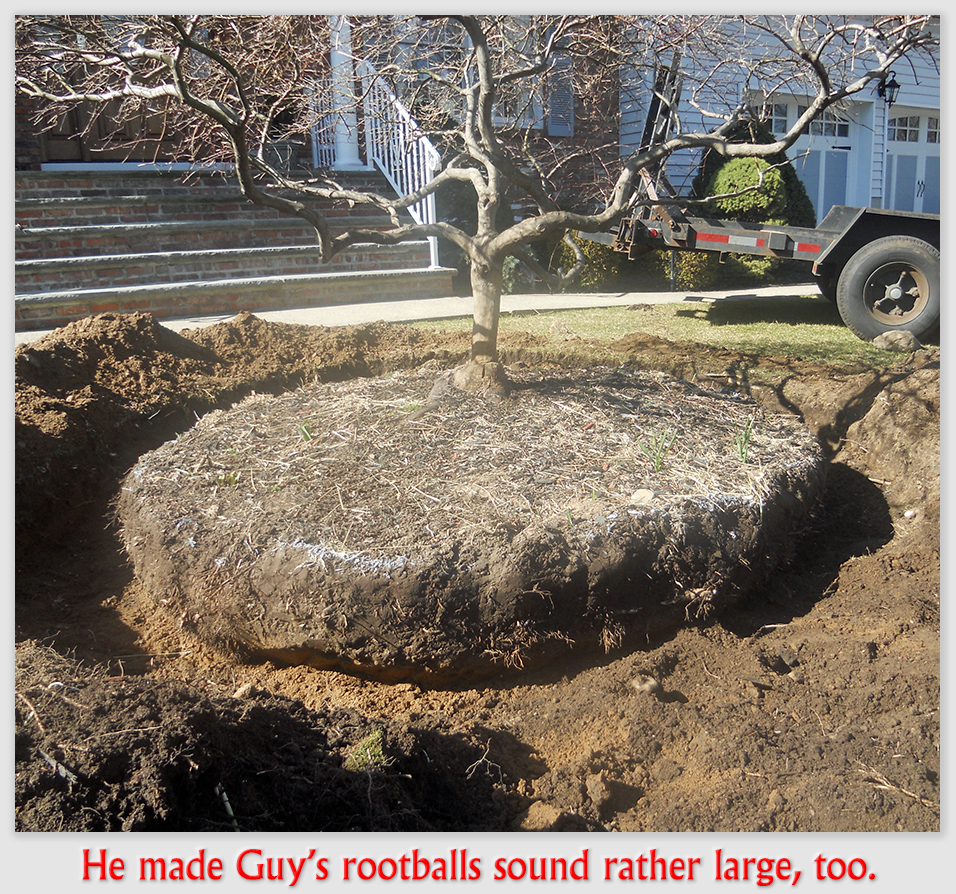
Haverland v. Lawrence, 800 N.Y.S.2d 347 (Supreme Ct. Suffolk Co., Dec. 1, 2004): Mike Haverland sued his neighbor, Guy Lawrence, and his landscaper. The suit was brought because Guy had his landscaper plant an 80-foot line of 13’ tall pine trees along the boundary between the two homes. Mike said the trees were so close to the boundary line that, although their trunks did not cross the line, the root balls (which of course were well buried) did.
 Mike complained that, besides the root balls, the trees had been staked, and some of the stakes were in his yard. He said Guy’s contractor crossed onto his land while planting the trees and knocked down five of his oak trees and construction stakes marking the site of his new house. Finally, he argued that the pine trees changed the grade slightly, so that water accumulates and floods in a 22-foot strip of his property after a hard rain. This, Mike said, would result in a foot of standing water, making this part of his land unusable.
Mike’s real complaint was that this flooding and the fast-growing roots of the trees would undermine the integrity of the foundation of his house, which had not yet been built. He asked for a preliminary injunction directing that Guy Lawrence and East Hampton Bayberry, Inc., his contractor, remove the pine trees, rootballs and stakes from his land, and restore the previous natural grade and surface water flow on Mike’s property.
Mike’s surveyor, David L. Saskas, said he had placed surveyor stakes on Mike’s property to enable Mike’s general contractor to mark the location of the foundation of Mike’s new house. In the course of this survey, he determined that ten large evergreen trees had been planted very near the boundary line with Mike’s property. The trunks of five of these trees were within six inches of the line. and the holes and root balls for these trees extended up to 2½ feet onto Mike’s land. Only two of these ten trees were planted entirely on Guy’s property. The metal stakes and guy wires for the trees extended as much as four feet into Mike’s property. Finally, David said, the planting of the new trees created a small berm that raised the grade of the land extending into Mike’s yard. David offered his opinion that the change of grade altered the run-off pattern of surface water and “contributed” to the flooding on Mike’s land.
 Mike’s first cause of action in the complaint was for trespass and the second alleged commission of a nuisance based on a violation of the East Hampton Town Code Section 255-10-50. Mike also wanted a permanent injunction forcing Guy to restore the old grade so as to return the runoff to its prior state, and to remove all trees, stakes and rootballs that were encroaching on his land.
Guy’s contractor argued there was no trespass because Mike’s own surveys showed that all of the tree trunks were on Guy’s land. The contractor said it was conjectural to believe that the tree roots would someday undermine the foundation of Mike’s house. The contractor said any flooding that might occur did not constitute irreparable injury. Instead, the condition was minor and easily remedied.
Guy agreed that the tree trunks did not encroach, and argued Mike was just guessing as to the size of the buried rootballs. He said Mike’s claims of flooding were exaggerated, and Mike had no proof that the newly planted trees were responsible for it. He also argued that Mike failed to show how any of the East Hampton Town Code had been violated and that equity is not balanced in Mike’s favor “since removal of the trees and re-grading of the land is a drastic remedy and there are other and less drastic remedies available.” Guy alleged that Mike never said anything about the grade or flooding, but only brought it up after he hired an attorney.
Mike responded that this is a case where the planting of the trees, as opposed to their natural growth, caused the encroachment. Self-help is not an appropriate remedy, Mike argued, because trimming the encroaching part of the trees would kill them. He said it was hardly unfair to make Guy and his contractor “pay for what they would have had to pay originally but for their illegal trespass.”
Held: The Court denied Mike his preliminary injunction.
 For a preliminary injunction, Mike had to show (1) a likelihood of ultimate success on the merits; (2) irreparable injury unless the preliminary injunction was granted; and (3) that a balancing of equities favors Mike’s position.” Preliminary injunctive relief is a drastic remedy that will not be granted unless a clear right to the injunction is established under the law and the undisputed facts. The burden to show that undisputed right rests upon the movant.
The Court held that Mike’s allegation that Guy’s contractor drove across his yard, tore out construction stakes and killed five oaks was enough to show he was likely to prevail on a trespass action. Any unauthorized entry upon the land of another constitutes trespass. The Court said that Mike, to the extent he has alleged (and Guy admitted he had told the contractor to drive over Mike’s land) that the contractor drove over Mike’s land and destroyed property, “has established the likelihood of success on the merits. However, as to the remainder of the complaint, defendants’ submissions in opposition to the application raise numerous and significant triable issues of fact which preclude such a finding.”
Mike’s real problem, the Court ruled, was that he had not shown that he would suffer an irreparable injury if the preliminary injunction was not granted. Mike’s claim that the newly-planted trees have fast growing roots that will undermine the foundation, “lacks specific evidentiary support and is merely speculative and conclusory.” His claim that the foundation will suffer irreparable damage should the flooding continue is contradicted by his admission that the integrity of that foundation will be gradually undermined. The fact that Mike claimed he was temporarily deprived of the use of part of his property because of flooding after heavy rain was not an irreparable injury. Anyway, the Court said, “there is also a sharp factual dispute with regard to the cause of the flooding as well as the frequency and extent of the flooding.”
 Finally, the Court held, Mike did not show that equity was on his side. First, the Court said, Mike was seeking a preliminary injunction directing not that Guy abstain from some conduct, but rather that he and his contractor actively do something: remove planted trees and re-grade Mike’s property to restore the previous pattern of surface water runoff. As a general rule, the Court observed, “mandatory injunctions are not favored and will be granted in only the most extraordinary circumstances.” This is especially so where, as here, Mike sought to get the same injunctive relief he sought in the final, permanent injunction. In such a case, “a preliminary injunction will not be granted unless the plaintiff demonstrates, upon clear and undisputed facts, that such relief is imperative and because without it, a trial would be futile.”
The Court weighed the drastic nature of the relief sought against Mike’s conjecture that the tree roots might eventually reach his foundation, as well as the “sharply disputed claim” that Guys’ planting of the trees and re-grading of his property caused extensive flooding, is not enough to prove the existence of the “extraordinary circumstances which would tip the balance of equity in his favor.”
– Tom Root





 Tree and Neighbor Law For Homeowners and Professionals