Case of the Day – Thursday, March 19, 2026

I CAN SEE CLEARLY NOW…

It’s easy to dismiss the belly-aching of people who claim that their view of the ocean, the mountains, the lake, whatever, has been ruined by someone else’s construction, or even – as we have seen all too often – by trees that grow too tall. But it’s a different matter when your own 0x is the one being gored.

Thanks to the nosy people at Google Earth, we can clearly see the problem that resulted in today’s case from 435 miles out in space. The parties to the kerfuffle – the Ceynars and the Barths – are clearly more than one missed paycheck away from a cardboard box. And for a lot of people, it’s hard to muster up a lot of sympathy for someone who claims a diminished view of the prairie reduced their home value by an amount that would buy almost half the average U.S. home.

Still, it’s easy enough to understand—if not to empathize—with the consternation you must feel when you spend a big chunk of money in expectation that you’ll enjoy watching the sun set on the prairie while you sip Mai Tais, or whatever the 1% in North Dakota like to sip.

Clearly, the Ceynars were sufficiently exercised about this that they spent lavishly on lawyers, all the way through the North Dakota Supreme Court. It did not do them much good, because it turns out that a property owner’s right to perpetually enjoy the view that existed on his and her property on move-in day is simply too contingent, too mushy, too prone to generate litigation rather than progress, for any court to infer its existence – at least absent a well-written easement signed by everyone involved that establishes the right.

Ceynar v. Barth, 904 N.W.2d 469 (N.D. 2017). The Ceynars and the Barths are neighbors at The Ridge at Hawktree, a Bismarck subdivision (that appears not to be Section 8 housing) near a golf course. Both families are members of the homeowners’ association. Before the Ceynars purchased their home, Mr. Barth won approval from the Association to build a “pool house” on his property, connected to his house with a breezeway. After the Ceynars occupied their place, the Barths commenced construction, whereupon the Ceynars complained to the Association. They claimed the pool house would block their view to the north and west toward the Hawktree Golf Club.

After the Association did nothing, the Ceynars sued the Barths and the Association, alleging breach of contract and nuisance. They claimed the pool house violated restrictive covenants and unreasonably interfered with the enjoyment of their property and diminished its value. Mr. Barth and the Association moved for summary judgment dismissing the action. The district court granted the motion, concluding the pool house did not violate any of the Association’s restrictive covenants. As well, the trial judge said, under N.D.C.C. § 42-01-01, “a nuisance consists in unlawfully doing an act or omitting to perform a duty,” and the Barths’ construction of the pool house was completely lawful.

The Ceynars appealed.

Held: It’s party time at the Barths’ pool house.

The Ceynars argued that the “pool house” violated the restrictive covenants governing the Hawktree development, because Section 4 of those rules – entitled Nuisances: Construction Activities – stated that “no other nuisance shall be permitted to exist or operate upon any Lot or other property so as to be offensive or detrimental to any other Lot in the vicinity thereof or to its occupants.” The Supreme Court, however, found that the restrictive covenant clearly related in context to construction activities “rather than the finished product.” At any rate, the Court said, the homeowners association has the authority in its sole discretion to determine whether a nuisance exists for purposes of the covenant. The Association approved the Barths’ construction plans and found no nuisance exists.

But, the Ceynars complained, there was an implied covenant that prohibited the pool house because it “destroys the open prairie look and overall theme of the community in the subdivision.” The Ceynars relied on a text message sent by, and deposition testimony of, the Association’s secretary indicating fences, outbuildings, and trees were not allowed in order to preserve an “open prairie look” in the subdivision, and on the Association president’s deposition testimony that the covenants require an “overall theme of the community.”

The Court made short work of that claim, holding that implied covenants are not favored by the courts and that, at any rate, the Ceynars could point to no evidence that these vague statements had anything to do with the developer’s plans or that the Barths were aware of a policy favoring the “open prairie look.” North Dakota precedent clearly holds that covenants will be given effect only “when clearly established,” and this implied covenant was as solid as Jello.

The meat of the Ceynars’ claim was that the district court erred in dismissing their statutory private nuisance claim against the Barths. Section 42-01-01, N.D.C.C., defines a nuisance as “unlawfully doing an act or omitting to perform a duty, which act or omission… annoys, injures, or endangers the comfort, repose, health, or safety of others; or in any way renders other persons insecure in life or in the use of property.” The Ceynars complained that before the pool house, “we enjoyed the open prairie look and feel. Not only have we also lost views of the Burnt Creek Valley and the golf course because of the pool house, the size and scope of the pool house and breezeway towers over our property, depriving us of anything that could be considered an open prairie look.” In fact, they presented an appraisal of their property indicating the obstructed view lowered its value by $140,000. They also presented photographs taken before and after construction of the pool house, demonstrating their obstructed view.

The district court dismissed the statutory nuisance claim, reasoning that the construction of the Barths’ pool house was lawful, so there could be no statutory nuisance. The Supreme Court agreed with the Ceynars that this holding was wrong, but any sense of victory they experienced was short-lived.

The Ceynars argued the district court failed to engage in the required balancing test, “a balancing of the utility of defendant’s conduct against the harm to the plaintiff, plaintiff’s attempts to accommodate defendant’s use before bringing the nuisance action, and plaintiff’s lack of diligence in seeking relief.” The Supreme Court acknowledged that while “scenic views may enhance the value of a tract of land… [and] such a benefit, while intangible may enhance market value, with buyers willing to pay extra for the view,” that did not translate to a legally protectable interest. “Traditional American property law fails to protect access to light over neighboring land,” the Court held, at least “in the absence of an express easement or covenant, advantageous views are unprotected.” Because a landowner has no right to an unobstructed view, the size and shape of a neighboring structure cannot be a nuisance, even if it causes a material reduction in market value.

This rule is necessary, the Court observed, because

extending the law of nuisance to encompass obstruction of view caused by lawful construction of a neighboring building would unduly restrict a landowner’s right to the free use of property, interfere with established zoning ordinances, and result in a flood of litigation. Because every new construction project is bound to block someone’s view of something, every landowner would be open to a claim of nuisance. If the first property owner on the block were given an enforceable right to unobstructed view over adjoining property, that person would fix the setback line for future neighbors, no matter what zoning ordinances provide. The practical implication of such a right would be the need of every ‘servient’ owner to obtain a waiver of the easement of view created in the “dominant” landowner. Such obstacles to land ownership and development, for the sake of a clear view, hardly commend themselves.”

Inasmuch as the Ceynars had no cognizable right to an unobstructed view from their property, the Barths’ construction of the pool house as a matter of law did not unreasonably interfere with the Ceynars’ use and enjoyment of their property.

– Tom Root

TNLBGray140407

Case of the Day – Thursday, March 12, 2026

EVEN THE PARANOID HAVE ENEMIES

Those tin hats really work -- it's just that THEY want you to think there's something wrong with wearing 'em ...

Those tin hats really work — it’s just that THEY want you to think there’s something wrong with wearing ’em …

Could you say that “it’s not paranoia if they’re really out to get … your trees?” Put on your tin foil hat, conspiracy enthusiasts! Or not, if you think that’s an aluminum industry conspiracy.

In this case, the Riehl family had what could be fairly described as a mania for not trimming their trees and bushes. Their preoccupation with the natural look made it tough for the neighbors to use a common roadway. As a result, the Riehls were sued in the 1970s, and while the neighbors were found to have an easement, the court didn’t force the Riehls to trim the trees.

About 15 years later, the City of Rossford passed a nuisance ordinance targeting people who didn’t trim their trees along streets. And suddenly, the odor of conspiracy wafted through the town, spread by black UN helicopters …

The City sued the Riehls in 1997 but then cut a deal with them by dismissing the action and trimming the Riehls’ trees itself. But in subsequent years, aided no doubt by the Illuminati and Council for Foreign Relations, the City cited the Riehls almost annually, hired contractors to cut the trees down, and then billed the Riehls for the trimming. Finally, the Riehls had had enough, and — proving that a man who acts as his own lawyer has a fool for a client — they filed their own complaint, alleging everything from fraud to contract breaches to infliction of emotional distress to multiple Constitutional law violations. And they sued the City, the prosecutor and all of their neighbors.

The trial court (probably in the pockets of the Deep State) threw out the suit even with respect to the defendant who didn’t answer. The Court of Appeals agreed, expressing bafflement as to why the neighbors were even named, and finding that the City’s 1997 deal didn’t mean it couldn’t come back every year thereafter.

Time for the Riehls to raise their own militia … and maybe set them to work trimming the bushes.

conspiracyalert140321 Riehl v. City of Rossford, 2007-Ohio-3824, 2007 Ohio App. LEXIS 3498, 2007 WL 2164158 (Ct. App. Ohio, July 27, 2007). This case is the latest installment in the ongoing dispute between property owners in Eagle Point Colony about an undedicated access road/alley commonly known as Thirwal Drive. The Riehls owned property along Thirwal Drive, and their perpetually untrimmed trees and bushes encroached on the road, to the detriment of other property owners who use it, as well as delivery and trash trucks serving all of the owners along the road. In 1977, a number of the other residents sued the Riehls seeking to enjoin them from clogging, choking or narrowing the width of Thirwal Drive. The court ruled that the other owners had an easement by prescription over the Riehls’ land in the form of Thirwal Drive and permanently enjoined the Riehls from clogging, narrowing, or impeding the use of Thirwal Drive.

But when the neighbors filed a contempt motion because the Riehls weren’t cooperating, the trial court determined that the Riehls didn’t have the obligation to remove or trim the bushes and trees, or otherwise to repair or maintain the easement.

Thereafter, in 1995, Rossford City Council passed Ordinance No. 94-045, which held that “[e]very occupant of land shall maintain his property so that no brush, trees, bushes or obstructions extend into, on or over any public or private way generally used for the passage of persons or vehicles so as to obstruct or interfere with the passage of such persons or vehicles, or with the ingress and egress of emergency, maintenance, repair or service vehicles or equipment.” Pursuant to the ordinance, the City cited the Riehls in 1997 but later dismissed the case. Thereafter, it cited the Riehls virtually every year, trimmed the trees and bushes itself, and billed the Riehls for the cost.

Finally, in 2005, the Riehls sued the City, the prosecutor, and all of the other neighboring property owners. The poorly drafted complaint alleged the City had breached a contract by passing an ordinance charging the Riehls for the trimming, committed fraud, violated the Riehls’ property rights, and retaliated against them by enforcing the nuisance ordinance. The trial court dismissed the action on all counts as to all defendants. The Riehls appealed.

Held: The dismissal was affirmed. The Court said the current litigation, reduced to its essence, was simple: it involved the Riehls’ continuing violation of Rossford’s nuisance ordinance, enacted after the 1978 decision. Nothing in the trial court’s prior decision affected the ordinance subsequently passed. And, the Court held, the Rossford nuisance ordinance had a real and substantial relation to the safety and general welfare of the public and is neither unreasonable nor arbitrary. It seeks to prevent Rossford property owners from obstructing any public or private way used for the passage of persons or vehicles, including emergency, maintenance, repair, or service vehicles or equipment. The nuisance ordinance applies equally to the Riehls and all other residents of Rossford.

At its heart, the Riehls’ complaint alleged that the 1997 judgment granting the city’s motion to dismiss the first nuisance action filed against the Riehls, amounted to a res judicata determination that the Riehls never again had an obligation to trim their bushes and trees and prevent them from obstructing Thirwal Drive. However, the Court held, a political subdivision or an employee of a political subdivision is immune from liability in a civil action for injury or loss to property when the claims are in connection with the political subdivision’s or employee’s performance of legislative or quasi-legislative functions, or the enforcement or nonperformance of any law. What’s more, the Supreme Court of Ohio has expressly stated that “[t]here are no exceptions to immunity for the intentional torts of fraud and intentional infliction of emotional distress …”

Because the Riehls’ claims against the city arose out of the city’s performance of governmental functions, and because no exceptions to immunity apply with regard to the Riehls’ claims against the city for fraud and intentional infliction of emotional distress, the city was entitled to summary judgment on those claims.

The city’s immunity doesn’t extend to contracts. The Riehls argued that in 1997 the city of Rossford entered into a settlement agreement with the Riehls, approved by Judge Dwight Osterud. They claim that the city agreed to trim the Riehls’ bushes and trees that encroached on Thirwal Drive. Nevertheless, in 2003 and 2004, the city of Rossford passed ordinances assessing the costs of trimming against the Riehls’ real estate. The Riehls claim that the February 1997 judgment entry constituted a contract and that, through their actions, the governmental defendants breached that contract.

blackhelicopter140321 The Court rejected their argument. It held that there was no enforceable plea agreement. The City got no benefit and the Riehls suffered no detriment from the deal. Thus, the Court held, there was no consideration for the contract, and thus there could be no contract. The Riehls also argued that assessing them for trimming their trees constituted an unconstitutional taking of their property without compensation. But the Ohio Supreme Court has held that the government must pay just compensation for total regulatory takings “except to the extent that ‘background principles of nuisance and property law’ independently restrict the owner’s intended use of the property.” That’s all that was happening here. There was evidence that the nuisance ordinance had been enforced against other residents as well, so the Riehls’ claim of disparate treatment failed as well. Finally, there was no evidence that the city had enforced the tree nuisance ordinance against the Riehls as punishment for their voicing their views pursuant to their First Amendment rights.

Just like everyone else in Rossford, the Riehls must keep their bushes and trees trimmed at their own expense.

– Tom RootTNLBGray140407

Case of the Day – Wednesday, March 11, 2026

POUND ON THE TABLE

The sun setting in the east?

The sun setting in the east?

Will Mark and Elizabeth Heil be having their neighbors Stewart and Christina Hines over to enjoy margaritas and the sun set over the ocean? Don’t bet on it for two reasons, neither of which is more likely than the other: First, the Heils and Hines are neighbors on beautiful Hilton Head Island, South Carolina, and thus, it’s physically impossible for them to watch the sun set in the east over the Atlantic. The second reason is that they’re pretty clearly NILOs (neighbors in location only). They may have homes next to each other, but there’s no love lost between them.

The Heils had a vacation home on the Island, next to a house owned by the Hines (who, being more frugal, perhaps, rented it out to tourists). One November, the Heils visited their Shangri-La, only to notice branches from one of the Hines’ healthy oak trees overhanging the house’s roof. They observed no roof damage and saw nothing to suggest the tree was diseased or failing. Nevertheless, the Heils asked the Hines to do something about it.

The Hines were good neighbors, albeit thrifty ones. They asked the Heils to get some bids from tree services, and the Heils complied with bids in the thousands. The Hines found Sam’s Tree Service, a guy with no insurance, an undocumented worker (guess ICE hadn’t gotten to him yet), and probably a beat-up truck, too, for all we know. But he was properly licensed and had no record of complaints. More importantly for the Hines, Sam did the job for a mere $500.00.

hole161117

Just a little hole…

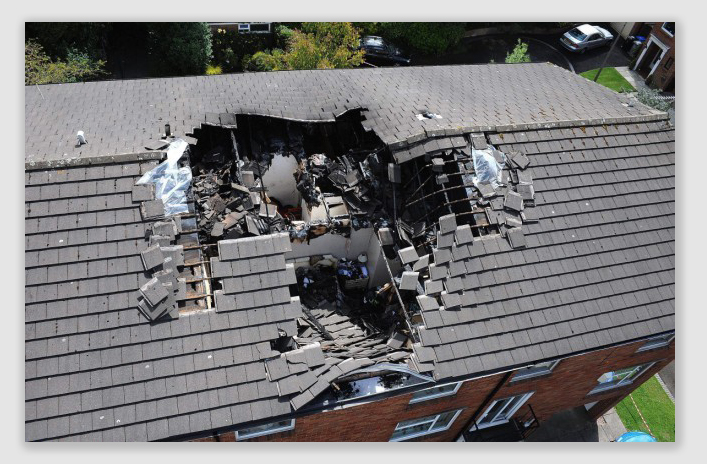
Many months later, when the Heils next visited their house, they found a hole in the roof and water damage everywhere. Their insurance carrier denied coverage because inspectors determined that the Hines’ tree had rubbed against the roof, causing the hole. (That alone is worth a whole blog, but we’ll pass on that issue). The Heils demanded that the Hines and Sam pay for the damage, but both declined.

Sam said his climber performed the limb removal while he supervised from the ground, and never stood on the roof. Instead, he was suspended above the roof on a safety harness. The encroaching limbs were tied off, cut and lowered down to the ground. While performing the trimming, Sam’s man noticed only a dented shingle, nothing that would affect the roof’s integrity, so he did not pass on the information about the shingle.

The Heils, of course, sued. They fired a negligence blunderbuss at the Hines, saying they were negligent for not inspecting the tree, for hiring Sam, for paying so little to have the work done, and even for letting an undocumented worker do the trimming. The trial court found no evidence that the Hines had breached any duty to the Heils by failing to inspect and maintain their tree, or by negligently hiring Sam’s Tree Service.

The court gave Heils short shrift, upholding the standard that homeowners have no duty to repair damage caused by their healthy trees. The Hines hired a tree service within a month of being asked to do so, and no evidence explained why – let alone showed that – Sam’s low price, lack of insurance, or undocumented worker status led to the hole that the Heils found in their roof.

The real problem here was that the Heils, apparently unaware of the Massachusetts Rule or too chary to care, left it to well-meaning neighbors to remedy a problem that belonged to them. The Hines’ principal mistake was in not telling the Heils to pound sand to begin with, and to trim the branch themselves.

Sure, you say, but how about the Hawaii Rule? Fancher v. Fagella? To that we say, even if the Heils could have shown that the tree was a nuisance – which, on verdant Hilton Head Island (where the vegetation grows prodigiously), might be a real stretch – the costs borne by both parties probably would have been less. The branch was healthy, the cost of remediation was slight, and the Heils were consenting adults who should look after the integrity of their own house.

broketable161117There’s an old legal aphorism that when your case is weak on the law, pound on the facts. When your case is weak on the facts, pound on the law. When your case is weak on both the law and the facts, pound on the table.

The Heils broke the table.

Heil v. Hines, Case No. 2015-001988 (Court of Appeals of South Carolina, Nov. 9, 2016).  Mark and Elizabeth Heil had a vacation home on Hilton Head Island, next to a rental house owned by the Stewart and Christina Hines. One fall, the Heils observed branches from a healthy oak tree owned by the Hines overhanging their house roof. They saw no roof damage, and no disease or decay on the tree. The Heils asked the Hines to trim the tree.

At the Hines’s request, the Heils provided bids from tree services, but the Heils hired a local company, Sam’s Tree Service. Sam’s was licensed but not insured, and he had used a worker who was (horrors of horrors!) an illegal alien. Sam’s charged $500.00 to trim the tree.

The following spring, the Heils found substantial water damage in their home from a hole in the roof. Their insurance company denied them coverage because inspectors found the damage was from a roof hole caused by the Hines’ tree.

blunderbuss161117

   The blunderbuss – a crude but destructive weapon. Likewise, the blunderbuss complaint… Sam’s was negligent because its trimmer lacked a green card? Really?

The Heils sued, contending that the Hines were negligent for not inspecting the tree and for hiring Sam’s, who must have caused the damage and was too cheap, too uninsured and too willing to hire people who were in the country illegally). The trial court granted summary judgment to the Hines, finding that the Heils lacked evidence either that the Hines had neglected their healthy tree or that Sam’s removed the branch in a negligent manner.

The Heils, of course, appealed.

Held: The Court of Appeals ruled that the Heils “produced no evidence from which an inference could be made that [the Hines] breached their duty of care.” The Court held that to make out a claim for negligence, the Heils had to allege facts showed (1) a duty of care owed by the defendant; (2) a breach of the duty by a negligent act or omission; and (3) damage proximately caused by the breach.

Here, the Court said, the oak tree was a live, healthy tree, and the Heils – who didn’t see any roof damage themselves – presented no evidence that the Hines “could have observed, by reasonable inspection, the damage possibly caused by the tree limb.” Note the word “possibly” – the plain fact was that the Heils had no evidence that the tree limb caused the hole, or even when the hole was formed.

What’s more, the Court said, when the Hines were notified the tree needed to be trimmed because it was encroaching on the Heils’ roof, the Hines hired Sam’s Tree Service and the work was completed within a month of notice. The Heils had no explanation – let alone evidence – for their claim that Sam’s Tree Service’s use of an undocumented worker and its low fee somehow constituted a breach of the Hines’ duty to the Heils.

The Heils had no proof that Sam’s Tree Service performed its work in a negligent way or that “another tree service company would have known or communicated that a single dented shingle was cause for structural concern – if the dented shingle was the cause of the damage.”

– Tom Root

TNLBGray140407

Case of the Day – Wednesday, January 7, 2026

TREES GONE WILD

Emily Dickinson had something to say about today’s case. The Belle of Amherst wrote,

The Wind does not require the Grass
To answer Wherefore when He pass
She cannot keep Her place.

Today’s problem was slow to develop, but like a winter storm undergoing bombogenesis, it just got bigger and bigger. Marie’s property was separated from her charming neighbor Ed’s by a 100-foot-long cinder block retaining wall. In about 2004, “a mulberry tree and some shrubs began growing” – note the passive voice, as though the growth was mere happenstance, not brought on by anyone’s actions – in Marie’s property near the retaining wall.

Everyone agreed that Marie had nothing to do with the mulberry tree. She didn’t plant it, mulch it, stake it, or fertilize it. It just grew. And grew. And grew. About eight years later, its roots began toppling Ed’s beautiful wall.

To be sure, Marie diligently trimmed the mulberry branches every year, but unsurprisingly, she did not excavate around it to trim the tree’s roots. Who does that? When the wall began showing damage in 2012, Ed wrote Marie a letter (evidence enough that their relationship must have been too frosty for him just to mosey on over and say something), expressing concern about the damage. Marie, ever the good neighbor, hired some guys to trim back the trees and bushes. That wasn’t good enough for Ed, who then sent Marie a certified letter complaining that her tree was tipping over his wall but warning that she better not let any of her workers step on his property in an attempt to fix it unless they were insured and had permits.

At this point, Marie’s interest in jumping through Ed’s hoops appeared to have waned. She did nothing more, and Ed sued.

He accused Marie of carelessness, negligence, and gross negligence, complaining that the “maintenance of her property” – which is to say, suffering the tree to grow – caused the damage to the retaining wall. Of course, he wanted money.

At trial, Marie said Ed’s wall had been installed by morons and thus was falling down of its own accord. Ed said that Marie should have taken care of the tree to ensure that it did not crumble his wall. The court, it turns out, did not care about either argument: instead, it held that a tree growing near the wall is a naturally occurring condition. As such, Marie is not liable for what the tree does.

We are constrained to note that this is not the law everywhere. The Hawaii Rule, as brought up to date by decisions such as Fancher v. Fagella, holds that when a naturally occurring tree becomes too much of a nuisance, the owner can be forced to do something, regardless of how the tree got there or how little the owner’s role in nurturing it. But not in New Jersey.

Like Emily’s grass, Marie’s mulberry could not keep its place. And the court, like Emily’s wind, did not require Marie to answer for the tree’s peripatetic roots. Oh, the poetry of it…

Scannavino v. Walsh, 445 N.J. Super. 162 (Superior Ct. N.J., 2016). Marie’s naturally growing mulberry tree got big enough that its roots started causing her neighbor’s retaining wall to tilt and collapse. Neighbor Ed sued her for damages the tree caused to the wall, but the trial court held she was not responsible for the naturally occurring growth of a tree she had not planted.

Ed appealed.

Held:  The Superior Court sided with Marie. It held that a cause of action for private nuisance derives from the defendant’s “unreasonable interference with the use and enjoyment of the plaintiff’s property.” Under the Restatement (Second) of Torts, “neither a possessor of land, nor a vendor, lessor, or other transferor, is liable for physical harm caused to others outside of the land by a natural condition of the land,” which includes the natural growth of trees, weeds, and other vegetation “upon land not artificially made receptive to them.” Similarly, “a possessor of land is not liable to persons outside the land for a nuisance resulting solely from a natural condition of the land,” including “trees, weeds, and other vegetation on land that has not been made artificially receptive to it by act of man.”

New Jersey courts have held that injury to an adjoining property caused by the roots of a planted tree can be actionable as a nuisance. The rationale for the property owner’s liability in that case was not because of the natural process of the growth of the tree roots, but instead due to the affirmative act of the property owner in planting the tree that caused the damage. But here, Marie did not plant the tree, and while she trimmed it from time to time, she engaged in no positive acts like fertilizing or maintenance to encourage growth. Had she done so, that might have converted a naturally growing tree into one for which the landowner was liable. However, the Court said, “simply cut[ting] back the trees above the ground” was not a positive act to encourage growth.

The record contained no evidence that Marie’s trimming had improved the tree’s health or accelerated the growth of the roots. As well, the trial court found that Ed had failed “to demonstrate that any actions undertaken by [Marie] or her agent caused the damage to the wall.” Finally, even Ed himself told the Court he was not asking the judges to infer that cutting back the trees had increased root growth.

Instead, all that Ed argued was that by cutting back the trees, Marie became liable for the damage caused by the roots. That is contrary to the law, the Court said, and seeks unfairly to “impose liability upon a property owner for hazardous conditions of his land which he did nothing to bring about just because he happens to live there.” Because Marie’s cutting back of the tree did nothing to “bring about” the root growth, neither the trees nor the damage was “brought about” or “precipitated by the property owner’s affirmative act.”

The Court observed that Ed’s argument would lead “to the anomaly of imposing liability upon one who cuts back wild growth while precluding liability of an adjacent landowner who allows the natural condition of his property to ‘run wild’.” What’s more, some of Marie’s trimming was in response to Ed’s belly-aching, and the Court was not about to sandbag Marie because she tried to be a good neighbor.

Ed suggested that if Marie was not held to be liable, then landowners like Ed might have to use self-help and trespass on her land to cut down the tree himself. The Court dismissed the argument. Ed’s own letter suggested he could abate the nuisance from his side of the property line, which is consistent with the Massachusetts Rule (which fully applies in New Jersey). At any rate, the Restatement (Second) of Torts provides that “entry onto a neighboring property to abate a private nuisance is permissible under certain circumstances.”

Notably, the Restatement (Third) of Torts might have held Marie liable if she failed to exercise reasonable care by allowing the tree’s roots to damage the retaining wall. But the Supreme Court of New Jersey has directed that the Restatement (Second) of Torts is the law, and until that changes, Marie’s tree is on its own.

– Tom Root

TNLBGray140407

Case of the Day – Friday, December 26, 2025

WRONGFUL TREES

camelnose141003

For all of the Latin phrases, hidebound traditions, and libraries full of precedent, the law at its essence is nothing more than a codification of policies generally accepted by society. The law doesn’t always get it right – some laws aren’t carefully drafted, others do exactly what the legislature intended but pursue foolish or even repugnant policies – but by and large, the law tries to lay out rules for conduct based on policies generally accepted to be important.

Keeping an eye on the prize – the societal goals to be achieved – often helps courts from going overboard. It’s how the camel’s nose can be allowed into the tent without getting the whole camel in the process.

A good example of this is the “wrongful life” lawsuit. States all allow a “wrongful death” action, in which the survivors of someone killed, say, in a car accident or from medical malpractice sue for damages. This makes good sense. But in the last decade or so, some “wrongful life” suits have been brought, where – for example – a physician misdiagnoses and tells prospective parents that their fetus is healthy, but the doctor is wrong. The child is born with severe birth defects. The “wrongful life” suit claims that but for the physician’s negligence, the child would have been aborted.

Very few courts have permitted such a lawsuit for several very good public policy reasons. The first is that society does not recognize, as a matter of policy, that anyone is better off not having been born, no matter how severe the burdens of congenital disability. Second, the whole idea of tort law is to place the injured party in the same position as he or she would have been in had the negligence not occurred. But for the negligence, the injured party wouldn’t have been born. What can be done to put a living plaintiff in that position, or, ­for that matter, to compensate for having been born instead of never being?

And what would have made Ms. Lewis happy? Perhaps if the Krussels had only clearcut their property ...

Just what would have made Ms. Lewis happy? Perhaps if the Krussels had clearcut their property …

All right, that’s pretty heady stuff, but what does that have to do with tree law? Simply this: in today’s case, the plaintiff, Ms. Lewis, suffered from having a tree belonging to her neighbors Gary and Nancy Krussel fall on her house. Her suit simply claims: the tree fell on her house; the neighbors knew they had a tree; therefore, the tree was a nuisance; and the neighbors were negligent in failing to keep the tree from falling on the house. There was no evidence that the Krussels had any inkling this particular hemlock was going to fall. There was no evidence any reasonable person would have had such an inkling. In fact, there was no evidence that the tree was diseased or damaged. Reduced to its essence, Lewis’s claim was that the tree existed and the tree later fell, and those facts made it a nuisance. The tree was alive, the argument seems to say, and that fact wronged Ms. Lewis.

Fortunately, the Washington state courts made short work of this claim. Ms. Lewis was trying to advance a negligence claim as a nuisance claim, probably because she had no evidence of negligence. But, the courts ruled, public policy was not ready to declare a tree a nuisance merely because it was growing, nor was it prepared to hold that property owners were liable for what became of any naturally-growing, healthy trees on their land.

Without keeping one eye on public policy, the courts’ development of the law might go like this: First, landowners are responsible for damage caused by trees on their property that are diseased or damaged, and about which condition they are actually aware or reasonably ought to be aware. The next step would be for the courts to rule that owners must inspect their trees to avoid liability. Finally, landowners would be strictly liable for any damage caused by their trees, whether they were aware of a problem with the trees or not.

camelnose140310Largely, the law has stopped short of such a draconian rule, because the courts recognize that public policy favors the natural growth of trees, and eschews requiring property owners to devote substantial time and money to inspect trees, where there is no concomitant benefit to the public. By and large, courts have enough policy sense to let the camel’s nose into the tent while keeping the rest of the dromedary outside.

It is this kind of analysis that is illustrated in today’s case.

Lewis v. Krussel, 101 Wash.App. 178, 2 P.3d 486 (Ct.App. Wash. 2000). During a windstorm, two large healthy hemlock trees fell on Dawn Lewis’s house. She sued Gary and Nancy Krussel, who owned the property on which the trees had been growing.

Krussel acknowledged that windstorms had knocked down other trees on his property and other properties nearby in previous years. About a week after the windstorm at issue here, another windstorm knocked a tree onto his mother’s mobile home. But the trees that damaged the Lewis house were natural growth, and Krussel had no reason to believe that they were any more dangerous than any other trees on his property under normal conditions. After the damage to the Lewis house, Krussel cut down other hemlock trees located near his house upon the recommendation of the local utility district.

After Lewis sued for nuisance and negligence, Krussel moved for summary judgment. He supported the motion with evidence from a professional forester who inspected the stump of one of the fallen trees and found no evidence of rot. The forester concluded the tree that fell on the Lewis house was no more dangerous than any other tree standing on the Krussels’ property, and there was no way for the Krusselses to determine beforehand whether any one of their trees would fall over. The trial court dismissed the Lewises’ claim, and Lewis appealed.

Held: The appeals court upheld the dismissal of Lewis’s claim.

Sure Ms. Lewis's house was crushed ... but gravity did not turn the healthy tree that toppled onto her roof into a nuisance.

Sure Ms. Lewis’s house was crushed … but gravity did not turn the healthy tree that toppled onto her roof into a nuisance.

A homeowner is not obligated to remove healthy trees because they might topple in a storm. The Court of Appeals said that just because a negligence claim was disguised as a nuisance suit didn’t mean that the trial court had to consider it as such. Instead, in situations where the alleged nuisance is a result of what is claimed to be negligent conduct, the rules of negligence are applied.

The elements of a negligence cause of action, of course, are (1) the existence of a duty to the plaintiff, (2) a breach of the duty, and (3) injury to the plaintiff flowing from the breach of duty. An owner of property located in an urban or residential area who has actual or constructive knowledge of defects affecting his or her trees has a duty to take corrective action. However, the same is not the case when the tree is healthy. In that case, the owner does not have a duty to remove healthy trees merely because the wind might knock them down.

In this case, the Court agreed, there was no evidence that Krussel had any reason to believe that the hemlock trees posed a hazard, and a professional forester who had inspected the stump of the fallen tree had found that the tree was free of defects. The mere possibility of harm does not mean the probability of harm.

– Tom Root

TNLBGray

Case of the Day – Tuesday, December 2, 2025

IN THE VAST WORLD OF LAW…

… there’s plenty of half-vast lawyering going on.

I found myself thinking that in connection with a case I was reviewing yesterday, one that had nothing to do with trees (but a lot to do with plants, those being Cannabis sativa, and involving trucks and conspiracies and the pesky Controlled Substances Act).

Potheads or not, I thought, the defendants deserved better lawyering than they got. There’s a lot of that substandard, just-barely-enough-to-prevent-a-malpractice-suit representation, not only in the criminal courts but in civil practice as well.

Today’s case is an excellent example of phone-it-in representation on both sides of the courtroom. The plaintiff’s lawyer seems to simply have loaded a civil action blunderbuss and fired away. It was evident that the defendant’s tree roots were destroying the boundary wall by pushing against it from the defendant’s side of the edifice. Therefore, the roots were located on the defendant’s property. So why would the lawyer include a trespass count? Any first-year law student could tell you that the roots were not on his client’s land, and being on someone else’s land without permission is the sine qua non of trespass.

And before the defendant starts to feel smug about the plaintiff’s pleading miscue, she should look at her counsel’s performance. That lawyer spent the defendant’s money on a couple of experts, who may or may not have rendered solid, helpful opinions. We’ll never know – because the defendant’s lawyer did not bother to put the expert’s opinions in affidavit form – a pure rookie mistake.

The defendant might have walked away from this lawsuit relatively inexpensively by getting the plaintiff’s entire complaint dismissed. But she never had a chance to make her substantive argument because her lawyer overlooked something everyone knows – that statements by experts and witnesses must be in affidavit form.

Half-vast lawyering all around…

1212 Ocean Ave. Housing Development Corp. v. Brunatti, 50 A.D.3d 1110, 857 N.Y.S.2d 649 (Sup.Ct.N.Y. 2008). 1212 Ocean Avenue Housing Development Corp., a soulless, faceless corporation, if ever there was one, owned property next to Debbie Brunatti’s place. The two properties are separated by a 10-foot-high retaining wall built in 1924 when an apartment building was constructed on 1212’s premises. The heartless corporate suits alleged that an elm tree planted on Debbie’s property more than 40 years ago grew over time so that its trunk came to rest atop the retaining wall. The roots of this tree also damaged the retaining wall, causing it to crack and curve. In December 2004, the New York City Department of Buildings issued a summons to 1212, requiring it to fix the defective retaining wall. Shortly later, 1212 sued Debbie to recover damages for nuisance, trespass, and negligence.

Debbie had the tree removed about four months after being sued. She argued, among other things, that the defective condition of the retaining wall had not been caused by tree roots, and that 1212 could not maintain an action for damages because it had not engaged in self-help to remedy the situation. The trial court denied Debbie’s motion.

Debbie appealed.

Held: The trial court properly denied Debbie’s motion to dismiss for nuisance and negligence.

The unsworn reports from two engineers she submitted in support of her application were insufficient to establish, as a matter of law, that the tree roots did not damage 1212’s retaining wall. “Furthermore,” the court said, “while it has been recognized that a property owner may resort to self-help to remove tree roots encroaching upon his or her property and that this may constitute a sufficient remedy in some circumstances, the defendant failed to demonstrate that self-help would have been practicable here, where it is undisputed that the tree roots rested entirely on her property.”

However, the Court said, the trial judge should have granted that part of Debbie’s application for summary judgment on the trespass count. Since the tree roots rested entirely upon Debbie’s property, there was no intentional intrusion or entry onto the 1212’s property, which could constitute trespass.

– Tom Root

TNLBGray140407

Case of the Day – Wednesday, October 15, 2025

MULLIGAN SEASON


I may slip over the border (the border between the U.S.A. and our neighbor to the north) to enjoy turkey and all the fixings. My favorite holiday of the year is Thanksgiving, and thanks to a cultural quirk, our Canadian cousins celebrate it way before we do. Monday may have been Indigenous Columbus Day in the United States, but it’s turkey day in the provinces. Well, turkey and Jiggs’ Dinner and butter tarts.

And then, we get a mulligan, a do-over, on Thanksgiving in 45 days. Life is good. And after that, we’ll get Thanksgiving Day over, and over and over until the leftovers are either eaten or spoil.  As Yogi Berra might have said, today’s case and Thanksgiving dinner will both be déjà vu all over again.

It seems there was trouble in Randolph County, Alabama, up near the Georgia line. The Ledfords had purchased a nice vacation home on a lake, next to a place owned by the Youngs. While the Youngs appreciated the natural setting, the Ledfords were more concerned that nature’s bounty – specifically one large pine tree on the boundary between the Ledford’s land and the Young property – was going to fall on their house. They wanted the tree cut down. The Youngs refused. The matter ended up in court.

Of course, regular treeandneighborlawblog readers know how that should have turned out: if the tree really sits on the boundary line, both landowners have to agree before it can be cut down. The trial court reasoned otherwise. Under the Massachusetts Rule, a landowner can trim parts of a tree that overhang or grow under his or her property, all the way from the center of the earth to the sky. So that meant the Ledfords could cut out half of the tree, the court mused. That would kill the tree, but the court interpreted the Massachusetts Rule to mean that since you’re allowed to hack at the roots and branches of a tree without regard to the damage you cause, then you can take down the whole boundary tree if you like. The trial court gave the Ledfords the go-ahead to take down the tree.

The Youngs appealed, and common sense prevailed. The Court of Appeals explained the proper boundary tree rule, reversing the trial court’s errant ruling. But in so doing, a few judges on the appeal panel wondered aloud (or at least, in the written opinion) why the Ledfords hadn’t argued that they had the right to cut down the pine tree because it was a nuisance. Remember Fancher v. Fagella? One judge went so far as to say that if the record held evidence of nuisance, he would have upheld the trial court, wrong though its reasoning was.

Do we have to spell it out? The trial court was just plain wrong.

Do we have to spell it out? The trial court was plain wrong.

Well, the Ledfords could take a hint. When the case went back to the trial court “for proceedings consistent with this opinion,” as appellate decisions like to say, they asked for a do-over, a second hearing, this one on nuisance. ‘Hold the phone!’ the Youngs cried. ‘The Court of Appeals said the Ledfords lost. The tree stays standing. Game over.’

The trial court gave the Ledfords their mulligan. It ordered a second hearing and afterward found the pine tree to be a nuisance. The Ledfords were told they could cut it down. Again.

The Youngs went back to the Court of Appeals for a writ of mandamus, essentially a request that the Court issue an order telling the trial court that it couldn’t hold the second hearing. The appellate court refused to do so. Applying an obscure rule called the “law of the case” doctrine, the appellate court held that while the trial court was required to apply the ruling the court of appeals had issued, that ruling was just that the Ledfords could not cut down a boundary tree without the agreement of their neighbors. The court of appeals did not say the tree had to remain – just that if it was to be cut down, it couldn’t be on the basis originally articulated by the trial court.

The lessons here? The Ledfords’ attorney should have argued nuisance to begin with. It should have been clear that arguing that his clients could cut down a boundary tree was a loser. Besides, in civil litigation, you argue as many alternative theories as possible to get your clients where they want to end up. Who knows which one will be a winner?

Of course, the Ledfords ended up winning, and the pine tree lost. But as an old judge once cautioned us, you should never dig up more snakes than you can kill. Why buy a second trip to a court of appeals by leaving out an argument, and asking for a mulligan later?

A few too many snakes? The Ledford's lawyer courted procedural trouble.

A few too many snakes dug up here? The Ledfords’ lawyer courted procedural trouble.

Ex parte Young, 79 So.3d 656 (Ala.Civ.App. 2011): The Ledfords owned a vacation house with a pine tree located slightly over 10 feet from Ledford’s house, on the boundary between their property and that of the Youngs. Fearing that [a] strong wind against the tree could cause it to fall on the home and could cause damage to the [house] as well as serious injury to any occupants,’ the Ledfords wanted a court order that they could cut it down.

The Youngs argued that the pine tree was ‘a true boundary line tree’ and contended that it could not be cut down by either property owner without permission of the other. After a hearing in which the Ledfords, the Youngs, and a forester hired by the Youngs all gave testimony, the trial court held that Ledford and her husband could remove the tree at their convenience, taking steps to minimize damage to the Youngs’ lot. The trial court held that because Alabama law let a landowner remove any trees on his or her property up to the property line, and that the right extended to the center of the earth and into the sky, the Ledfords were free to hack into the pine tree up to the property line and then cut from that point down to hell and up to heaven. The Court said that “[s]ince [the Ledfords] unquestionably has the right to remove any portion of the tree that is located on [their] side of the property line and since doing so would likely kill the tree, the Court is of the opinion that [they] should be allowed to completely remove the tree to ensure” that the property and the health of anyone there are protected.

When the case got to the Court of Appeals the first time, it was promptly reversed. Rejecting the trial court’s tortured “center of the earth to the sky” analysis, the appellate court ruled that “[i]n the special case of a boundary-line tree, … each adjacent landowner has ownership rights that cannot be trumped by the other’s desires in the manner suggested by the trial court’s judgment” and that the Ledfords – contrary to the trial court’s judgment – could not properly “‘cut into the tree to the property line and then cut from that point to the center of the earth and into the sky'” without incurring liability to the Youngs.

But the appellate court went a little further. In a concurring opinion, two of the judges on the appellate panel observed that the action had been argued on the basis of the Ledfords’ contention that they were entitled to remove the boundary-line tree at issue merely because its trunk was located in part on their property. The judges noted that whether the “boundary-line tree at issue in this case constituted a nuisance for which an exception to the general rule set forth in the main opinion might apply” had not been litigated. A third judge on the panel said that had the record contained evidence indicating that the tree at issue posed a danger to the Ledfords’ house,” he would have voted to affirm the judgment instead of reverse it.

After the appellate judgment issued, the Ledfords asked the trial court for another hearing to consider whether the pine tree was a nuisance. The Youngs argued that the appeals court had decided in their favor, and the case should be closed. But the trial court had another hearing, and afterward it decided that the tree was a nuisance and that the Ledfords could remove it on that basis.

The Youngs filed a petition for a writ of mandamus, asking the appeals court to order the trial court to enter judgment for them and end the proceeding.

Held: The Ledfords could cut down the tree. A court will issue a writ of mandamus only when the petitioner has a clear legal right to the order sought; the respondent has an imperative duty to perform, accompanied by a refusal to do so; there is no other adequate remedy at law; and the court has jurisdiction of the court.

Mulligan140206Here, the Court of Appeals said, the only real question was whether the trial court had the right to hold a second trial in this matter. The Youngs contended that the prior appellate court’s decision was final as to all matters before it and that the trial court, after that initial appeal, was not allowed to hold another hearing and take additional testimony without permission of the appellate court to do so. The court of appeals agreed with that statement of the law but said that only the particular issue that had formed the basis of the trial court’s judgment – whether Ledfords could unilaterally remove the boundary-line tree simply because the majority of it was located on their side of the common boundary – was addressed. Based upon that conclusion, the court of appeals had reversed the trial court’s judgment letting the Ledfords unilaterally remove the tree,” and remanded the cause “for further proceedings consistent with [that] opinion.”

Because of the limited scope of the trial court’s previous judgment, no one had ruled on whether the boundary-line tree posed a danger to Ledford’s home or amounted to a nuisance. While the prior decision was thelaw of the case,” nothing in the prior opinion limited the trial court from ruling on the nuisance question, which the court of appeals admitted remained open for decision. Deciding to examine the nuisance question did not put the trial court in the position of doing something contrary to what the court of appeals had ordered.

– Tom Root

TNLBGray140407