Case of the Day – Wednesday, July 2, 2025

WHOSE TREES ARE THEY?

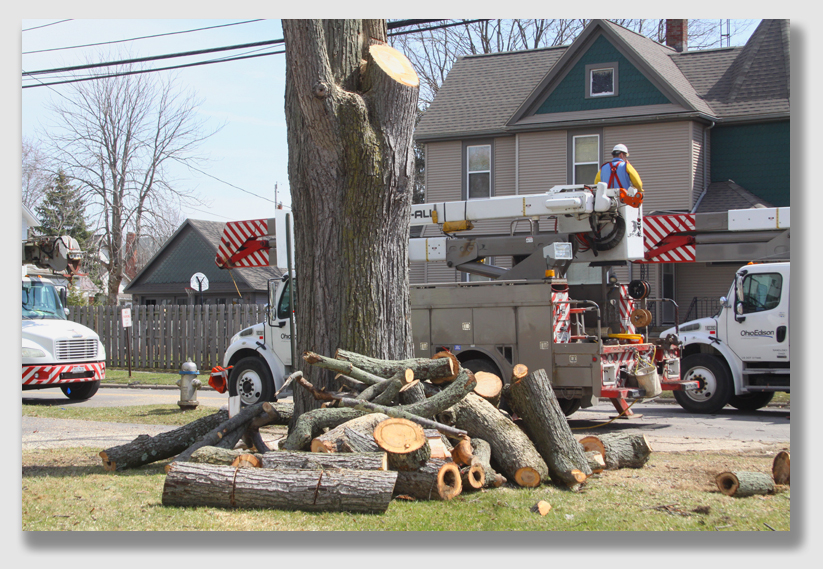
treelawn150217I was writing about your tree lawn recently, that strip of grass between the sidewalk and street. With the big parade tomorrow, you might be anticipating (or fearing) dozens of strangers in their lawn chairs squatting on your strip of domain.

But is it your domain? No issue of property ownership may be more misunderstood than the question of who owns the tree lawn, sometimes called the boulevard lawn, that strip of land between your front sidewalk and the street.

The confusion was illustrated recently by our reader Joel, who wanted the city to remove a dead tree on his tree lawn. He had always just understood that the tree lawn wasn’t his and that he couldn’t cut or trim the trees growing there. We straightened him out, but a lot of uncertainty remains.

In today’s case, homeowners Gene and Joan Foote knew the tree lawn was theirs, but their failure to appreciate the limits of their rights led to a suit against the city. It seems that the city was improving the street, and its plan included the removal of four trees from the Foote tree lawn. The homeowners demanded compensation, arguing that the city’s removal of the beautiful trees amounts to a “taking” of property under the 5th Amendment, a “taking” for which they must be paid. A trial court agreed with them.

The Minnesota Supreme Court reversed the decision. It explained that the Footes, like any owners, were entitled to use all of their property right to the centerline of the street. However, the property was owned subject to a public easement (that’s why a deed always says “subject to all legal highways, easements and other restrictions of record”). In other words, the owner’s use of the land had to yield to the public easement of the highway.

Here, the city was merely using more of its highway right-of-way by expanding the street. As long as it remained within the bounds of its easement — which usually extends beyond pavement for a distance — the city could remove trees and other of the owner’s property to the extent needed for the public’s enjoyment of the easement. The removal of the trees let the public enjoy the easement, and no money was due to the property owner because of it.

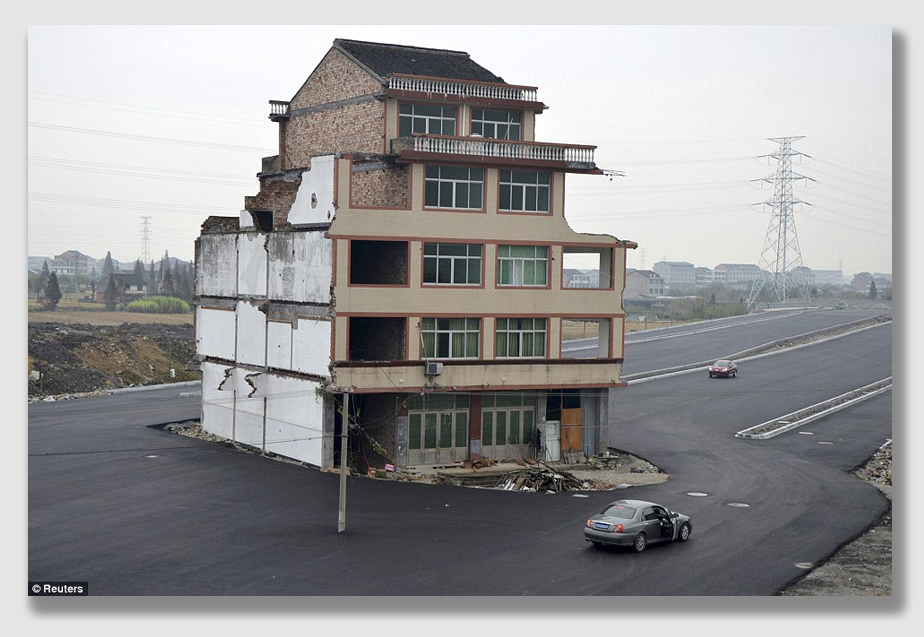
Some road-widening projects can get quite close to buildings. Be sure to check on the width of the highway easement before you build.

Some road-widening projects can get quite close to buildings. Be sure to check on the width of the highway easement before you build.

How wide is the right-of-way? It depends on the state you live in and the size of the street. If you have questions, you could check with your local government’s engineering department. Or ask your lawyer.

Lawyers love to answer questions. Usually for a fee.

Foote v. City of Crosby, 306 N.W.2d 883 (Supreme Court of Minn. 1981). Gene and Joan Foote owned a home in the City of Crosby. The platted right-of-way of the street in front of the home, Cross Avenue, was 80 feet wide and extended to approximately 6 inches from the front steps of the house.

The center 32 feet of the right-of-way was paved. Next to the pavement is a 10-foot wide grassy boulevard, and then a 4-foot sidewalk. On the boulevard were four large healthy elm trees which had been maintained by the Footes. Although the trees had cracked and heaved the sidewalk, there had been no complaints that the trees impeded foot travel, nor had the trees interfered with motorized travel.

The city began an extensive municipal improvement project prompted by the need for storm sewers, including a new lateral line under Cross Avenue. To provide a proper grade for drainage, Cross Avenue would be torn up entirely, a plan which called for the removal of the four trees, because any root cutting necessary to accommodate the change in grade and repositioning of the curb and sidewalk would likely kill them. The Footes sued for an injunction, arguing the city couldn’t cut the trees without paying them compensation. The district court granted the injunction, and the city appealed.

sign150217Held: The injunction was dissolved. The Court observed that the owner of property abutting a right-of-way for public travel had the right to use his half of the roadway in any manner compatible with the use by the public of its easement. Any encroachment on the public right-of-way must be clearly an obstruction to the public easement before the municipality may remove it without an adjudication that it was in fact an obstruction.

The Footes were not entitled to compensation for the removal of trees within the public right-of-way, the Court ruled. Although the Footes had a property right in the trees, because the taking was pursuant to a project which was a proper exercise of police power and encompassed a public purpose, and because removal of trees was necessary to the implementation of the project, the Footes could not recover anything for their removal. After all, the Court said, the removal of the boulevard trees within the platted right-of-way was necessary for the street improvement project, and if not removed, the trees would clearly obstruct the public’s easement of travel.

– Tom Root

TNLBGray140407

Case of the Day – Wednesday, June 25, 2025

TRUST US … WE KNOW WHAT WE’RE DOING

Anyone who hasn’t been living in a cave the past decade knows that sunny California has been just a little too sunny. The state and local governments have begged, pleaded, and cajoled homeowners to save water. Some rather severe measures have been implemented.

Maybe so, but you're not the only people around with a law degree. Some folks at the gas company have them, too.

Maybe so, but you’re not the only people around with a law degree. Some folks at the gas company have them, too.

This is not a particularly new story, but the drought persists. That’s why we recall the story that broke a few years ago that the California rich – like the rich everywhere – aren’t exactly like you and me. At least, not like me.

Sure there’s a severe shortage. And sure people should cut back. But not rich people. “We pay significant property taxes based on where we live,” one uber-wealthy property owner once complained to the Washington Post. “And, no, we’re not all equal when it comes to water.”

Ah, yes, we know what entitlement must feel like. It’s sort of like how the Andrewses, high-powered and sophisticated lawyers both, must have felt when they bought their house. You see, Mr. and Mrs. Andrews weren’t your typical blundering homebuyers. He was a tax attorney – one of the high priests of the legal profession – and she was an appellate specialist. So when they settled on a beautiful homestead in the Ohio countryside next to a hillside covered with pine trees, they figured that they understood all those ‘thences’, distances and bearings to PK nailsets, and ‘principal places of beginning’, you know, the stuff other lesser lawyers put in deeds. So how could they have missed the easement that the prior owner had granted to the gas company for two pretty big gas transmission lines buried on the place?

We’re sure they must have read it. But these legal beagles apparently never dreamed the easement meant what it said.

About four years after they moved in, the gas company came along and said the pine trees on the hill were encroaching on the easement and had to go. Being frugal as well as sharp, the Andrewses sued in a local court, acting as their own attorneys. They argued the gas company was stuck with the trees because it had let them grow there in the first place, and anyway, it hardly needed to clear-cut a swath 80 feet wide (25 feet on either side of the two pipelines and 30 feet in the middle).

FoolOl’ Abe Lincoln was right: the Andrews had a pair of fools for clients.

As it turned out, Columbia Gas had a few lawyers, too, and these guys knew easements like Mr. Andrews knew taxes. Maybe even better. The gas company removed the case to federal court, where, after a trial, the Andrewses had their heads handed to them. The Court of Appeals affirmed the defeat.

The court held that Columbia Gas hadn’t acquiesced to the trees, because they weren’t there when the pipeline was built (but were planted by a later homeowner). The fact that the gas company hadn’t cut a swath of trees from the easement in 55 years didn’t matter, nor did it matter that the gas company was cutting such a wide right-of-way on neighboring easements. The court gave credence to the Columbia Gas and state utilities commission witnesses, who carried the day by carefully explaining all of the safety, economic, and reason for the gas company to want the trees removed.

The Court ruled that absent evidence to the contrary, a judge should presume that the parties contemplated that normal development would result in some changes in the use of the easement, even if it is unlikely that the parties anticipated specific developmental changes. New technology permitting aerial inspection, new federal regulations on pipeline safety and security, and new techniques of internal pipeline inspection were all such “developmental changes,” arguing for the gas company to take a heightened interest in keeping its easement clear.

Andrews v. Columbia Gas Transmission Corporation, 544 F.3d 618 (6th Cir., 2008). In 1947, Ruby W. Davies owned the piece of land in Licking County, Ohio, where the Andrews family now lives. She granted The Ohio Fuel Gas Company an easement to build and maintain a pipeline and to “lay, maintain, operate, repair, replace and remove other lines of pipe at any points on said premises upon the payment of like consideration” and the right of “ingress and egress to and from the same” over and across the property. Ohio Fuel agreed to “pay any damages which may arise to crops and fences from the laying, maintaining, operating and final removal of said pipeline.” The agreement did not specify the width of the easement.

pipe2Pursuant to the agreement, Ohio Fuel installed two large high-pressure underground natural gas transmission pipelines through the property. The first, Line K-170, is 16 inches wide and was installed in 1947. The second, Line K-205, is 24 inches wide and was installed in 1957. The two pipelines run parallel to each other about 30 feet apart. Columbia Gas succeeded to Ohio Fuel’s interest in the right of way and still operates and maintains the pipelines. The property changed hands several times over the past 50 years. In the late 1960s, the owner built a house on it and planted pine trees on the hillside behind the house for aesthetics and erosion control. The owner was unaware that he had planted the trees within 25 feet of Line K-170.

In March 2000, the Andrewses bought the property with notice of the 1947 right-of-way agreement. By then, the pine trees had matured. The Andrewses’ decision to purchase the property was motivated in large part by the rural setting and the hillside landscaping.

Columbia Gas made no efforts to clear a right of way around the pipelines until 2004, when a work crew told the Andrewses that the location of the pipeline required them to remove the stand of pine trees. Columbia Gas claimed the right to remove the trees and to maintain a right of way totaling approximately 80 feet, 25 feet on each side of the two pipelines and the 30 feet between the two pipelines. The Andrewses sued Columbia Gas, seeking an injunction and asking for damages if the trees were cut. After trial, the court entered judgment in favor of Columbia Gas, relying on the testimony of Timothy Seibert, a long-time Columbia Gas employee responsible for overseeing the inspection and maintenance of the pipelines running through Andrewses’ property, and Paul Hollinger, an investigator for the Public Utilities Commission of Ohio, the state agency responsible for overseeing natural gas transmission lines. Based on their testimony, the Court concluded that a 50-foot right of way for each pipeline was “necessary and convenient and consistent with the language of the 1947 Davies easement.” The court declined to apply the doctrines of laches, estoppel, or waiver, noting that those doctrines do not apply to expressly granted easements under Ohio law. Finally, the Andrewses were not entitled to compensation for the removal of the trees because the right-of-way agreement only provided recovery for damage to crops and fences. The Andrewses appealed.

NHE-16006_300Held: Columbia Gas was entitled to the 80’ wide right-of-way, and the Andrewses were not entitled to damages for the lost trees. Under Ohio law, an easement is an interest in the land of another, created by prescription or express or implied grant, that entitles the owner of the easement to limited use of the land in which the interest exists. The owner of the land subject to an easement has the right to use the land in any manner not inconsistent with the easement but has no right to interfere with or obstruct the reasonable and proper use of the easement. The owner of an easement has the right to remove objects within it that unreasonably interfere with or obstruct its reasonable and proper use.

Where the terms of an expressly granted easement are ambiguous, the Court held that a judge must determine its scope from the language of the grant, the circumstances surrounding the transaction, and what is reasonably necessary and convenient to serve the purposes for which the easement was granted. Absent contrary evidence, a judge should presume that the parties contemplated that normal development would result in some changes in the use of the easement, even if it is unlikely that the parties anticipated specific developmental changes. Acquiescence for a long period of time in a certain construction of a grant of an easement estops the assertion of a different construction.

EasementsThe Andrewses argued that Columbia Gas never cleared any area within its claimed right of way, and never objected when the prior owner planted the pine trees in the late 1960s. But lack of action prior to this time did not stop the gas company from asserting its rights now. If Columbia Gas had consistently cleared only 10 feet on each side of its pipelines, the Court said, the Andrewses’ argument would have more force. But the fact that the company did nothing is not fatal to its claim. Besides, the Court said, Columbia Gas did not acquiesce to the trees. No trees were growing there in 1947, making it reasonable for the trial court to conclude that the conduct of Columbia Gas after the trees were planted did not evidence the original intent of the parties.

The Andrewses also argued that Columbia Gas acquiesced by allowing trees near its pipelines on other properties. But the original intent of the parties is the primary inquiry and only the conduct of the parties regarding the particular property at issue is relevant. The fact that the gas company may or may not have enforced its easement to its fullest width elsewhere has absolutely no bearing at all on whether it may enforce its easement to its fullest width on the Andrews property.

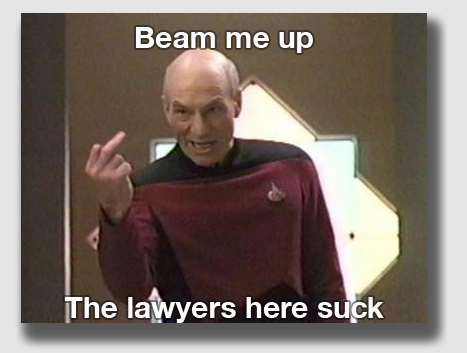
Capt. Picard may well have landed at the plaintiff's table in this case ...

Capt. Picard may well have landed at the plaintiff’s table in this case …

Relying on testimony by expert witnesses, the lower court ultimately concluded that a 50-foot easement was reasonably necessary and convenient for the inspection, operation, and maintenance of each of the pipelines. The factual findings upon which he based that conclusion were not clearly erroneous. Although each easement case is factually unique, almost every court that has construed an easement with similar language as the one at issue here has concluded that a 25-foot right of way on both sides of the pipeline was reasonably necessary and convenient. And it is beside the point to argue that federal regulations do not require natural gas companies to clear rights of way around their pipelines. Assuming that to be true, the regulations do not prohibit gas companies from clearing rights of way. Although federal law may be helpful in construing certain ambiguous easements, the rights granted in an easement ultimately flow from a private agreement. The difficulties Columbia Gas might face in conducting pipeline inspections was a primary ground for the lower court’s conclusion that a 50-foot right of way was reasonably necessary and convenient for each of the pipelines on the Andrews property.

Columbia Gas offered evidence that the trees hindered the company’s ability to conduct both aerial and close-interval pipeline inspections. According to an expert witness, the presence of trees within the right-of-way interfered with aerial inspections. Additionally, trees within 25 feet of the center of a pipeline could hinder the company’s ability to conduct close-interval surveys and to excavate the pipeline in the event of an anomalous inspection or an emergency, such as a leak or rupture.

The Andrewses argued that Columbia Gas had safely maintained its pipelines for decades without removing the trees and that if an emergency ever arises, it can remove the trees quickly enough at that time. The trial court recognized this as well, but also reasoned that there were some circumstances in which the additional time to remove the trees could impose a substantial hardship on customers who would be without natural gas service during the excavation, and the delay to remove the trees could unnecessarily jeopardize public safety. There was ample support in the record for the conclusion that a cleared right of way was reasonably necessary to ensure a safe, timely, and efficient excavation. The trial court also considered evidence that a 50-foot right-of-way is standard in the gas pipeline industry.

Finally, the Andrewses challenged the trial court’s determination that they are not entitled to damages for the removal of the trees. Because the trees were inconsistent with the easement rights of Columbia Gas, the company was authorized to remove them.

Thomas L. Root
TNLBGray140407

Case of the Day – Tuesday, May 27, 2025

SPIDERS AND SNAKES

spiders150520Jim Stafford and Greg Barnett have something in common — neither one likes spiders or snakes. In Greg’s case, he doesn’t think much of Southern California Edison, either.

The utility had an easement along one side of his yard, where he and his neighbor had parallel fences. The easement was to maintain power lines, but when Greg cleaned up some debris between the fences, a big ol’ spider bit him. Arachnophobia reared its ugly head, followed close on by a lawsuit.

Greg said Edison had a duty to maintain its easement, and it should be liable to him for the spider bite. The trial court disagreed, and the Court of Appeals concurred. It found Greg’s argument, like the spider of waterspout fame, just an “itsy bitsy” bit light on common sense. The easement was a kind known as an easement “in gross,” meaning that it was limited, in this case to activities related to delivering electricity. Edison could (and had) trimmed and cut down trees that interfered with its lines, but it had no duty to Barnett to do things unrelated to the right for which the easement was granted. Such as killing spiders.

itsybitsy150520The Court rightly concluded that to make the utility liable would be a major burden on a public utility given the thousands of miles of easement territory the company had. Nothing except the fact that the cleanup job bites kept Barnett from cleaning up his own land.

Barnett v. Southern California Edison Co., 2007 Cal. App. Unpub. LEXIS 7648, 2007 WL 2751874 (Cal.App. 4 Dist., Sept. 21. 2007). Gregory J. Barnett owned a place on Hayes Avenue. Edison held a six-foot-wide easement on the west side of the property to “construct, lay, install, use, maintain, alter, add to, repair, replace, inspect and/or remove, at any time and from time to time, aerial and underground electric lines and communication lines, consisting of poles, guys and anchors, cross-arms, wires, cables, conduits, manholes, vaults, pull boxes, markers[,] and other fixtures and appliances, for conveying electric energy to be used for light, heat, power, telephone[,] and/or other related uses …”

Barnett’s neighbor built a fence along the western boundary separating Barnett’s property from the neighbor’s, and Barnett had installed his own fence which overlapped the neighbor’s fence. There was a small gap of land between the two fences measuring two feet wide and four feet long. The gap was located within Edison’s easement. One day, Barnett was bitten by a spider while cleaning the area between the two fences of small pieces of concrete, branches, leaves, and old paper trash. He said he was trying “to abate the infestation of rats, spiders, and other vermin …” that Edison had ignored.

Barnett claimed Edison told him that he could not close the gap or take other remedial measures because Edison’s lineworkers needed access to the utility pole located between the two fences. Barnett sued Edison for negligence and premises liability, arguing it had the duty to clean up the space and eradicate the spiders.

Edison argued it owed no duty of care to prevent the spider bite. Barnett argued Edison exerted exclusive control over the area and, therefore, had a duty to maintain the premises in a safe condition. The trial court agreed that Barnett could not establish the duty element of his cause of action for negligence. Instead, there was merely a nonexclusive easement for the maintenance of electric facilities that burdened Barnett’s property. Barnett’s alleged injury from a spider bite was unconnected to Edison’s use of the property pursuant to its easement. Therefore, as a matter of law, Edison did not owe Barnett a duty of care to prevent spiders from nesting behind his fence. Barnett appealed.

socallines150520Held: The easement did not create a duty for Edison toward Barnett. An easement such as this one – called an easement in gross – is not attached to any particular land as a dominant tenement but rather belongs to a person individually. Here, it is undisputed there was just a parcel of property owned exclusively by Barnett. Edison held an easement in gross, limited to the purpose of conveying electricity to its customers. Edison owed no general duty of care for all purposes on its easement in gross, or more specifically, any duty to rid the area of spiders, rats, and other vermin.

The easement owner’s possessory right is limited to the use of the land granted by the easement. Accordingly, an easement holder has a duty to act reasonably under the circumstances in its use of the servient estate, but the duty does not extend beyond the scope of that use. Barnett didn’t cite a single case where an easement holder was held to have a duty to guard against a risk of harm unrelated to the scope of the interest represented by the easement. The Court said that to impose such an unlimited duty “would impose a tremendous burden on Edison, its customers, and all other utilities in California.

Barnett argued he presented evidence Edison exerted exclusive control over the easement property and therefore assumed the duty of care typically held by a landowner. The Court held he had failed to provide relevant admissible evidence to support his claims. Although Barnett claimed Edison had once removed a rat-infested palm tree, he admitted he had told Edison the palm tree was growing up into Edison’s lines, and Edison had an obligation to maintain a certain clearance between its trees and electric lines. Trimming trees and removing trees were part of the express terms of its easement right. The eradication of the rats was merely incidental.

– Tom Root
TNLBGray140407

Case of the Day – Friday, May 9, 2025

PYRRHIC VICTORIES, THE SEQUEL

A few weeks ago, we talked about the Murrells of Rancho Palos Verde, California, a sordid tale of wealth, arrogance, clever lawyers, and Pyrrhic victories. Today’s case may lack money, power, hubris, and clever attorneys, but – like the Murrells – Leslie MacCardell won a hollow victory.

This case starts as a tale of lawyers screwing up. Yes, the very idea that a trained legal professional who exercises the utmost care could err taxes one’s credulity. But just for the sake of argument, let’s imagine for a moment that such a thing is possible…

The mistake was made by the professionals in the Massachusetts Land Court way back in the 1940s. Visualize the plot… two lots located next to each other, a power line easement granted way back in antiquity that didn’t describe the corridor of the easement at all, and… well, like a sophomoric sitcom, you can see where this is heading. When the Land Court issued certificates of title (a Massachusetts thing) it recorded the easement on Lot 2. The problem is that the power lines went across Lot 1. Hilarity ensued.
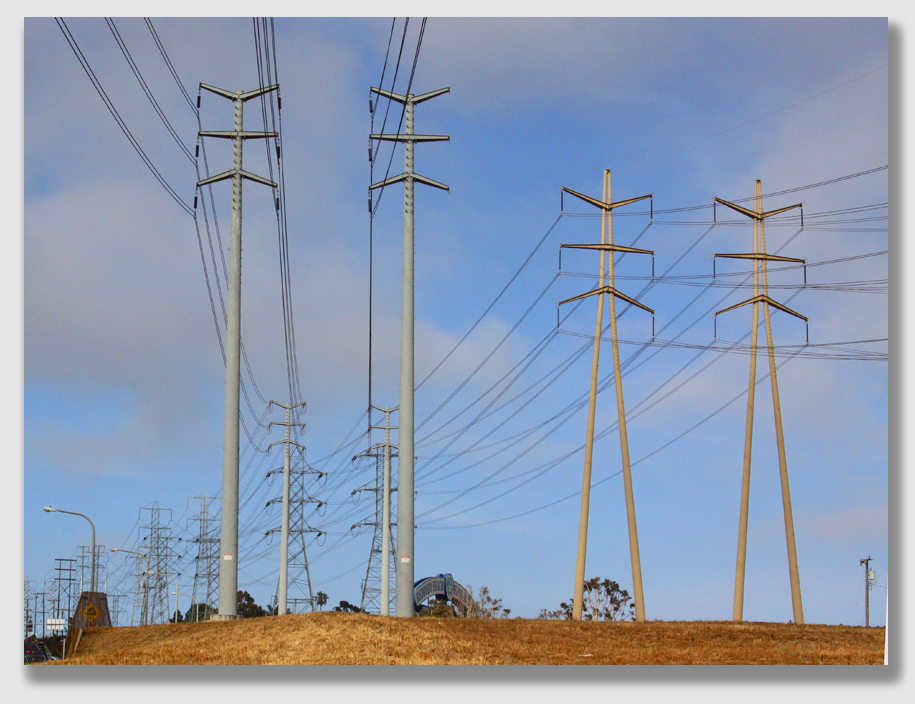
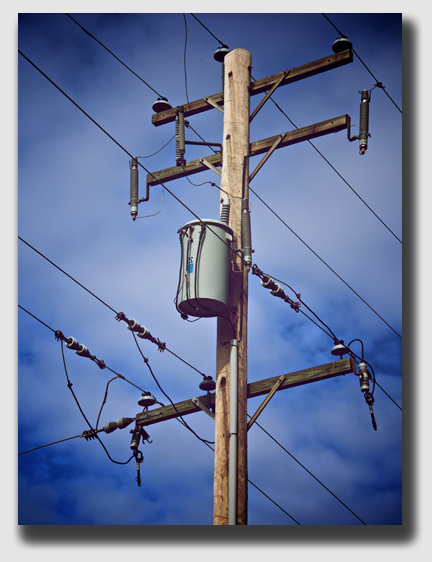
power-line-1

No one really notices power line poles – they’re just there. So it’s no surprise that nobody noticed the blunder until the neighbor on Lot 2 wanted to increase the size of his electrical service. The power company needed to install a transformer, and as a matter of course, it checked land records to verify its easement. Lo and behold, it found that the easement had been recorded on the wrong land. “No probalo,” the power company said, and it sued Leslie MacCardell — on whose land the power lines were located — to have the easement sort of eased on over to Leslie’s lot.

Not so fast, Leslie exclaimed. She fought back, arguing that she was a purchaser in good faith, and nothing in the records she had searched when she bought the place revealed a power company easement. “Good faith, indeed!” hooted the power company. She had actual knowledge of the easement when she bought the place. After all, the poles were there and her lights turned on (yeah, the utility actually said this) and she got a bill. How’d she think all of that happened if not for an easement?

Well, said Massachusetts’s highest court, in any of several ways. Despite the power company’s rather arrogant suggestion that it was just inconceivable that it would not have a proper easement, the Court said the poles could have been there permissively, or maybe — as it turned out — it was nothing but a trespass. Whatever it was, the Court held, it wouldn’t just assume that a landowner had actual knowledge. Rather, it was up to the power company to prove she did. And it didn’t.

We’re guessing that, just like the Murrells in yesterday’s case, this turned out to be kind of a Pyrrhic victory for our plucky heroine. Clearly, the power company’s poles had been on her property, openly and notoriously and continuously and adversely for many years. The utility probably had an open and shut case for a prescriptive easement, and it seems curious that it didn’t plead that as an alternate cause of action.

Commonwealth Elec. Co. v. MacCardell, 450 Mass. 48, 876 N.E.2d 405 (Sup.Jud.Ct. Mass. 2007). Thomas Murray owned two parcels of land. He granted an easement to the electric company for the installation of transmission lines. The easement didn’t provide compass directions, but instead mentioned that the land was located in Duxbury and that the pole lines could “enter from land now or formerly of Plum Hill Avenue and cross to land now or formerly of Chester L. Churchill.” In 1944, the Murray estate filed an action in the Land Court to register and confirm the title to the two parcels. Both the certificate of title and the Land Court decree of registration mistakenly said that Lot 2 was subject to the pole easements when in fact it was Lot 1. MacCardell owns Lot 1, the lot that contains the actual poles (which supply electricity to both her place and the adjacent property). Neither MacCardell’s title nor the next-door neighbor’s title mentions the utility easement. When her neighbor asked for increased electrical service, the power company decided it had to install a transformer.

oopsDuring its routine check on its easement, the utility found that there was an easement on Lot 2 but no easement on Lot 1. The utility petitioned the Land Court to amend MacCardell’s title for Lot 1 to include the easement. MacCardell argued that in 1944, the Court’s decree imposed the easement on Lot 2, not Lot 1. She claimed she purchased a title with no encumbrances, and allowing the electric company to amend her title would impair her property. The Land Court entered judgment in favor of MacCardell. The utility appealed, but the Appeals Court affirmed the Land Court’s judgment. Thereafter, the electric company appealed to Massachusetts’ highest court.

Held: MacCardell owned her land free of the easement. Massachusetts law is settled that titleholders and subsequent purchasers of registered land for value and in good faith take “free from all encumbrances except those noted on the certificate.” With respect to easements, the general rule is that in order to affect registered land as the servient estate, an easement must appear on the certificate of title. There are two exceptions to the general rule: (1) if there were facts described on the certificate of title that would prompt a reasonable purchaser to investigate further other certificates of title, documents, or plans in the registration system; or (2) if the purchaser had actual knowledge of a prior unregistered interest. In this case, no one disputed that the easement was not recorded anywhere in MacCardell’s chain of title. However, the utility argued that she had actual knowledge of the easement.

Who even notices utility poles?

Who even notices utility poles?

The “actual knowledge” exception means that for a titleholder to benefit from the protections afforded by the land registration system, the titleholder must not possess actual knowledge of unregistered easements. The burden of proof lies with the party seeking to encumber an owner’s registered land, in this case, the electric company. Unfortunately for the utility, the Court said, it had presented no proof that MacCardell had actual knowledge of the easement.

All the utility was able to argue was that Leslie had utility poles on her property, she could turn her lights on every morning, and she received a monthly utility bill. What that proved was that she had knowledge, the utility claimed, because it was “inconceivable that a utility company’s installation and use of poles” would ever be permissive rather than a claim of right.

The Court rejected this argument, suggesting that the poles, the power, and the bill equally suggested that the use may be adverse (which does not create an easement under the law), or a registered owner might have granted permissive use. What’s more, the Court said, the mere presence of a utility pole didn’t automatically place a registered landowner on notice that her property might be encumbered, because the actual owner of a utility pole isn’t readily ascertainable, and the average person may be unaware of the exact boundaries of the land. To meet the actual knowledge exception, the Court held,  there must be some intelligible oral or written information that indicates the existence of an encumbrance or prior unregistered interest.

– Tom Root

TNLBGray

Case of the Day – Wednesday, March 19, 2025

SOMEBODY OWES ME MONEY

Donald Westlake could have used Lisa Huff for the dust cover model...

Donald Westlake could have used Lisa Huff for the dust cover model…

Recall the recent creative lawsuit we covered, in which Corrections Officer Johnson went after area cellphone carriers for having recklessly built towers close to a prison. Some of the inmates obtained contraband cell phones. The towers ensured they had excellent 4G service. Of course, the towers also ensured excellent coverage to the motorists on I-20, only a half-mile from the prison. The Court’s tallest order was addressing all the ways that Mr. Johnson’s lame attempt to find someone with a deep pocket was simply vibrating nonsense.

“OK,” you say, “but that was just some ambulance chaser’s attempt to shake down a phone company (an attempt most of us applaud once a month when the cell bill arrives). But that cannot happen in the staid world of arboriculture law.”

In response to that sentiment, we give you the Huffs. After a tree broke off in a storm and hit Lisa Huff on the noggin, she had little to go on other than the abiding sense that someone owed her money. But who? Sure she could sue the property owner. Any regular reader of this blog knows that. But the Huffs needed a deep pocket. After all, Lisa had been injured. Someone had to pay.

That was when some canny lawyer noticed that the tree was located near power lines. Sweet! Power lines suggested the electric company, and everyone knows that the electric company has lots of money. Just look at how much we send them every month.

Problem: the tree wasn’t exactly inside the Ohio Edison easement. But that was a mere technicality to the Huffs, who argued that Ohio Edison hired Asplundh Tree Service to keep the trees trimmed away from the power lines and that both the power company and the tree service must have known the tree that fell on Lisa was dangerous. This was the tort claim, and it might have merit if Lisa could prove they had actual or constructive notice of the tree.

But never stop with just alleging a tort, where you can pile on other legal theories as well. The Huffs’ attorney suggested a contract count, too. The Huffs, so the legal theory went, were the intended third-party beneficiaries of the contract between Ohio Ed and Asplundh. A third-party beneficiary can sue for a contract breach just as if she had signed the document herself. Asplundh had a contractual obligation to inspect and trim the trees so as to keep the public safe, the Huffs argued, and that included the passing public, which included the walking public, which included Lisa. Anything to get Ohio Edison and Asplundh to open their checkbooks!

deeppocket140507It was a novel theory, but the Ohio Supreme Court shot it down. The Ohio Edison – Asplundh agreement was intended to secure services that would keep the power lines clear. While the agreement did require that Asplundh perform the trimming in a safe manner so as not to hurt anyone while it was doing it, that requirement only lasted as long as Asplundh was trimming. The Court wasn’t about to interpret the contract so broadly as to grant contract causes of action to millions of people who were never intended by the signatories to gain party status to a contract. You think the courts are busy now (and insurance premiums are high)? Just wait …

The takeaway here is a passing observation by the Court that parties to a contract can avoid the litigation spawned here by the Huffs simply by stating clearly that their contract is intended to benefit no one but each other. Including such a provision is a cheap preventative to the kind of nonsense lawsuit decided here.

If you think this case is on the outer fringes of causation – like the suit against the cellphone towers – just wait…

Huff v. FirstEnergy Corp., (2011), 130 Ohio St.3d 196 (Supreme Court of Ohio). During a heavy thunderstorm, a large sugar maple tree split about 25 feet above the ground. A large limb from the tree hit Lisa Huff, who was walking along a country road, causing serious and permanent injuries. Lisa G. Huff was injured during a walk along a country road.

Ohio Edison maintained an easement near the tree, but the tree was outside the easement. The tree did not present a hazard or threat to the power lines owned by the utility. Ohio Edison had hired Asplundh Tree Expert Company to inspect trees and vegetation along its power lines in this area and to remedy any situation in which trees or vegetation might affect the lines. Ohio Edison and its contractors carry out this work to ensure that adequate clearance is maintained around electric lines. Generally, Ohio Edison deferred to Asplundh’s decisions regarding tree and vegetation maintenance and would perform an overview inspection only to determine whether any vegetation was growing into the electrical wires or equipment. Asplundh had last been in the area where Huff’s injury occurred three years before.

Huff sued Ohio Edison and Asplundh, as well as Ohio Edison’s parent company, FirstEnergy, and the people who owned the land on which the tree was located. She alleged that Ohio Edison and Asplundh were liable for her injuries based upon their failure to inspect, maintain, and remove the tree or to warn the landowner and the public of the danger raised by the tree.

Ohio Edison and Asplundh filed motions for summary judgment. Ohio Edison argued that it didn’t know that the tree was dangerous, that it owed and assumed no duty to Huff regarding the tree, and that it was not negligent and did not proximately cause or contribute to Huff’s injuries. Asplundh argued that it owed no duty to Huff and that its activities did not proximately cause the injury to Huff.

The Huffs argued that Ohio Edison had contracted with Asplundh to inspect and maintain trees within the easement and that Asplundh failed to recognize that the tree in question was diseased and a hazard, and failed to remove the tree when it was on site in May 2001. The Huffs also argued that Ohio Edison was responsible for maintaining trees within and around its easement, that Ohio Edison was aware of the tree, based on its location within an inspection zone, and that Ohio Edison had a duty to remove the diseased tree.

The trial court found that while the tree leaned about ten degrees away from the power lines, “there is absolutely no credible evidence about when the tree began to lean or if it was leaning because of the way it grew.” It also noted that the Huffs admitted that no one knew when the tree became a hazard. With no proof that Ohio Edison or Asplundh actually inspected the tree or removed any branches, the court held that the Huffs failed to show that either company ever had actual or constructive notice of any decay of the tree. Due to the tree’s location – leaning away from the power lines with no limbs near the power lines – Ohio Edison and Asplundh owed no duty to the Huffs.

After examining the contract between Ohio Edison and Asplundh, it concluded that the Huffs were not third-party beneficiaries under the contract. It accordingly granted summary judgment to Ohio Edison and Asplundh.

The Court of Appeals cited the portion of the contract providing that “[Asplundh] shall plan and conduct the work to adequately safeguard all persons and property from injury” could be read in two ways: (1) a narrow reading that provides Asplundh must protect all persons from injury while Asplundh works on the site or (2) a broad reading that requires Asplundh to protect all persons from injury at all times, regardless of when the work is done. The court found the contract to be ambiguous and reversed the trial grant of summary judgment to Ohio Edison and Asplundh.

The companies appealed to the Ohio Supreme Court.

Held: Summary judgment was granted.

The Court found that the contract between Ohio Edison and Asplundh did not create any duty to the Huffs as third-party beneficiaries. The Court employed an “intent to benefit” test. Under this analysis, if the promisee intends that a third party should benefit from the contract, then that third party is an “intended beneficiary” who has enforceable rights under the contract. If the promisee has no intent to benefit a third party, then any third-party beneficiary to the contract is merely an “incidental beneficiary,” who has no enforceable rights under the contract.

The law generally presumes that a contract’s intent resides in the language the parties chose to use in the agreement. Only when the language of a contract is unclear or ambiguous, or when the circumstances surrounding the agreement invest the language of the contract with a special meaning will extrinsic evidence be considered in an effort to give effect to the parties’ intentions. For a third party to be an intended beneficiary under a contract, there must be evidence that the contract was intended to directly benefit that third party. Generally, the parties’ intention to benefit a third party will be found in the language of the agreement.

dwntree140507In this case, the Court ruled that nothing in the agreement between Ohio Edison and Asplundh showed any intent to benefit the Huffs. The Huffs pointed to a part of the contract that they argue shows such an intent: an attachment to the agreement entitled “FirstEnergy Vegetation Management Specifications” that provided  the “Contractor shall plan and conduct the work to adequately safeguard all persons and property from injury.” The Huffs contended that this statement assigns to both Ohio Edison and Asplundh clearly defined duties – to safeguard the public – for the Huffs’ benefit.

The Court held, however, that the contract wasn’t entered into for the general benefit of the public walking on public roads, but instead was designed to support Ohio Edison’s electrical service. The purpose of the contract is to ensure that Ohio Edison’s equipment and lines are kept free of interference from trees and vegetation. The remainder of the contract sets forth how this work is to be carried out, including the standards by which Asplundh is to perform its work, the limits on liability for the performance of the work, and the necessary qualifications for the Asplundh employees who were to perform the work. The contract contains no language establishing an ongoing duty to the general public on behalf of either Ohio Edison or Asplundh.

The vegetation management provision incorporated into the contract provides that “[t]he objective of all work covered by these documents is to maintain reliable and economical electric service, through effective line clearance and satisfactory public relations.” The Court observed that working near electrical lines has its inherent hazards, and it was thus “clear that this portion of the agreement establishes safety guidelines designed to protect persons and property from injury while the contractor performs its work. This period is finite: until the work has been completed … [T]he agreement cannot be plausibly read to require Ohio Edison or Asplundh to safeguard all persons from injury at all times, regardless of when the work is completed.”

The Supreme Court concluded that the Huffs thus failed to qualify as intended third-party beneficiaries of the Ohio Edison ­– Asplundh agreement.

– Tom Root

TNLBGray140407

Case of the Day – Thursday, February 20, 2025

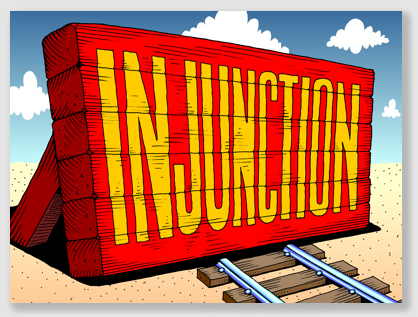
INJUNCTION JUNCTION

Pipelines are tubes through which money flows. There are barrels of revenue and gallons of net income in building those capital-intensive projects.

Yesterday, we read how Buckeye Pipeline Co., got whupped by local tree owner Bob Pichulo. And that was no mean feat. Buckeye is not just a couple of guys in a rusty Reading work truck. Instead, it is a subsidiary of Buckeye Partners, L.P. a master limited partnership that in turn is owned by IFM Investors, a global fund manager owned by 27 Australian pension funds. The IFM bought Buckeye in 2019 in a deal valued at $10.3 billion. At the time, Buckeye had prior year revenue of $4 billion and about $400 million in net income. Buckeye’s assets included 6,000 miles of pipeline, with over 100 delivery locations and 115 liquid petroleum products terminals with aggregate tank capacity of over 118 million barrels, and a network of marine terminals located primarily in the East and Gulf Coast regions of the United States, as well as in the Caribbean.

So Bob was a problem, but not much of one. Or it would not have been if Buckeye had just gone ahead and cut down the 13 maple trees, and paid the $50,000 Bob’s expert said the trees were worth. Buckeye would have had the clear view and open space it wanted for the pipeline. Cut the check, Buckeye. It’s only money. And by your metric, not much money at that.

But Bob’s backwoods Wolverine lawyer had one final trick up his rumpled sleeve. Bob did not ask for money. Instead, he asked for and got a permanent injunction. So Buckeye no longer had the option of cutting the trees and tendering a check to Bob.

Injunctions are extraordinary remedies, generally reserved for cases where the harm is irreparable, that is, not compensable with dollars.

On appeal, Buckeye whined that the trial judge should not have granted an injunction, because Bob’s own expert said the trees were worth $50K. The very fact that Bob could assign a dollar value to his trees, Buckeye argued, meant that the harm was not irreparable.

Everyone knew what Buckeye meant. What it meant was that if it lost, it would trespass anyway, cut the trees it wanted removed, and then remedy its trespass with a checkbook. The trial court did not intend to let that happen.

Pichulo v. Buckeye Pipeline Co., 2019 Mich. App. LEXIS 261 (Ct.App. Michigan, Feb. 14, 2019). Bob Pichulo bought some property in Mount Morris Township back in 1992. Thirty-three years before the sale, the previous owners had granted Buckeye Pipeline an easement to construct and maintain an oil pipeline across the property.

Bob knew about the easement when he bought the place. Yet it hardly affected him for about 23 years. Then, in 2015, Buckeye sent him a letter informing him of Buckeye’s intent to remove 13 Norway maple trees that were on the easement. Buckeye asserted that the trees had to be removed because they obstructed aerial surveillance of and access to the pipeline in case of an emergency or for repairs. In response, Bob sued seeking a temporary restraining order and permanent injunction against cutting the trees.

After an evidentiary hearing on the preliminary injunction motion, the trial court ordered that all underbrush be removed from the easement and the branches on the Norway maples be trimmed to provide a 10-foot clearance.

Buckeye later moved for summary disposition of Bob’s complaint, arguing that it was entitled to remove the trees as a matter of law. Bob responded that there was a real question whether the removal was reasonably necessary for Buckeye’s use of the easement. The trial court agreed with Bob.

Over the course of the four-day trial that followed, the trial court heard Bob’s testimony about the value of the trees to him; pilots’ testimony about the visibility of the pipeline easement after the clearing of underbrush and pruning of the trees; testimony from an expert who estimated that the trees were older than the pipeline, grew shallow roots, and had a monetary value of nearly $50,000; and testimony from experts in oil pipeline regulation, maintenance, and safety who disagreed about whether Buckeye’s proposed plan to remove the trees was reasonably necessary for its enjoyment of the easement.

The trial found Bob’s evidence to be more credible and convincing, ruling that the removal of the Norway maples was not reasonably necessary. Consequently, it permanently enjoined Buckeye from removing them.

Buckeye appealed.

Yesterday, we discussed how Bob’s experts, perhaps with the help of a judge inclined to find the home team a little more believable, steamrolled Buckeye. What we did not talk about was the permanent injunction.

Buckeye complained that the trial court abused its discretion by issuing a permanent injunction against it cutting down Bob’s trees. It claimed the injunction was not a proper remedy because Bob had a legal remedy available, the loss of Bob’s trees was not irreparable, and a weighing of the harms between the parties and the risk to public safety should have favored Buckeye.

It is true, the Court said, that injunctive relief is an extraordinary remedy that “issues only when justice requires, there is no adequate remedy at law, and there exists a real and imminent danger of irreparable injury,” and that he grant of such injunctive relief is within the sound discretion of the trial court. The general rule is that a court will balance the benefit of an injunction to the plaintiff against the inconvenience and damage to the defendant, and grant an injunction or award damages “as seems most consistent with justice and equity under all the circumstances of the case.”

“While an injunction may lie when a tort is merely threatened,” the Court said, “a cause of action for damages will not.”

Buckeye argued that the trial court should not have granted injunctive relief in favor of Bob because the harm to him could be remedied by the payment of money damages. Bob’s expert did testify that the Norway maples had an established value based on their health and age. However, the Court said, just because an object has monetary value does not rule out a permanent injunction. Permanent injunctions are permitted not only “[w]hen an injury is irreparable,” but also when “the interference is of a permanent or continuous character, or the remedy at law will not afford adequate relief”

Thus, the Court ruled, proof that monetary damages would not be adequate or that there would be a permanent interference also could warrant an injunction. Here, the trial court credited testimony from the plaintiff that the trees had a sentimental value to him and that no amount of money would satisfy his loss. Further, the trial court noted that removal of the trees would have been permanent, because they reasonably could not be replaced, considering the arborist’s testimony that the trees were quite old and took over 70 years to grow.

Additionally, the Court noted that when a tort merely is threatened, the proper remedy is for an injunction, not for damages. “The trial court did not clearly err in determining that removal of the trees was not reasonably necessary to the defendant’s use of the easement,” the Court of Appeals ruled. Bob showed that Buckeye was threatening to commit a trespass or, in other words, a tort. Consequently, the Court said, injunctive relief was the proper remedy.

In a last gasp, Buckeye argued that the trial court did not weigh potential harm to the plaintiff, the defendant, and the public. Buckeye is correct that, typically, a trial court is required to “balance the benefit of an injunction to plaintiff against the inconvenience and damage to defendant,” and only issue an injunction if it would be “consistent with justice and equity under all the circumstances of the case.” However, such balancing is not required where a trespass could result from an intentional or willful act. Here, Buckeye made no secret of its intent to remove the 13 Norway maples. “Therefore,” the Court held, “defendant’s proposed action was intentional and willful.”

Even assuming that the trial court did not properly balance the harms, the error would have been inconsequential, because the trial court was not required to do so.

– Tom Root

TNLBGray140407

Case of the Day – Wednesday, February 19, 2025

PRIDE GOETH BEFORE A FALL

Rural lawyers are quite familiar with the not-so-legal but all-too-real concept of being “homered,” a problem I mentioned a week or so ago.

Being “homered” is a phenomenon that occurs when an out-of-town client, especially one represented by big-city out-of-town lawyers, appears in a small rural county courthouse on the opposite side of a case against a local resident represented by a local lawyer.

As a matter of law, it means nothing that the judge plays golf with the local lawyer, or that the local litigant had been sitting in the next pew over from the judge’s family for two decades or more. The law does not countenance favoritism, and the judge has taken an oath.

That’s the law. But it is not real life. As a matter of fact, you can be sure that Vicki Lawrence was wrong when she warned you not to “trust your soul to no backwoods southern lawyer.” Indeed, if your case against a big pipeline company is being heard in the local courthouse, there’s no one to whom you would be better advised to trust your soul, or at least your case, than that shambling wreck of an attorney who needs a haircut and is wearing his lunch on his jacket lapel.

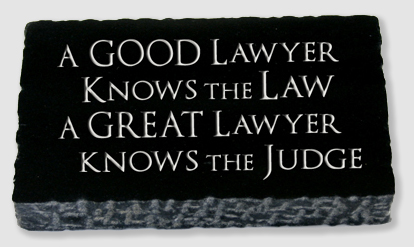
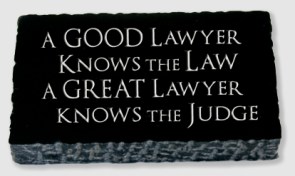
The other side might have good lawyers, indeed, very good lawyers from very good law firms from the big city. But that clownish local yokel with the battered briefcase is a great lawyer… because he knows the judge.

When you’re actively homering your opponent, luck is on your side. Of course, as my beloved 2nd-grade teacher Minta Newmeyer taught me a few years ago, “luck” is defined as the result of preparation meeting opportunity. So having a couple of good-old-boy experts won’t hurt, and neither will not accepting everything the smarty-pants experts from the pipeline company say at face value.

In today’s case, there is simply no way a longtime local landowner should have won against the big pipeline operator. When Buckeye Pipeline showed up at Bob Pichulo’s door after 25 years of silence wanting to clear-cut its easement, the company’s judgment that the trees should be removed should normally have been sufficient to carry the day. But Bob and his hometown legal talent found some experts of their own and – perhaps benefitting as well from the fair winds and following seas that result from homering the other side –  pretty much beat the brakes off the haughty pipeline people.
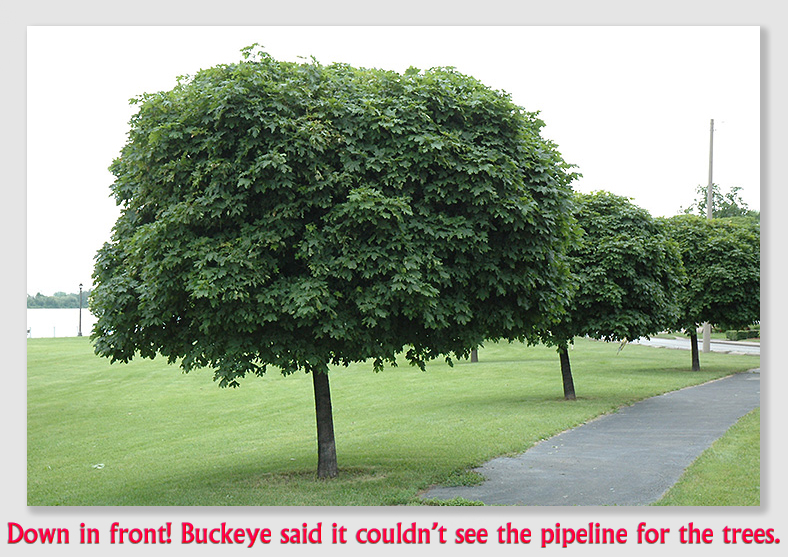
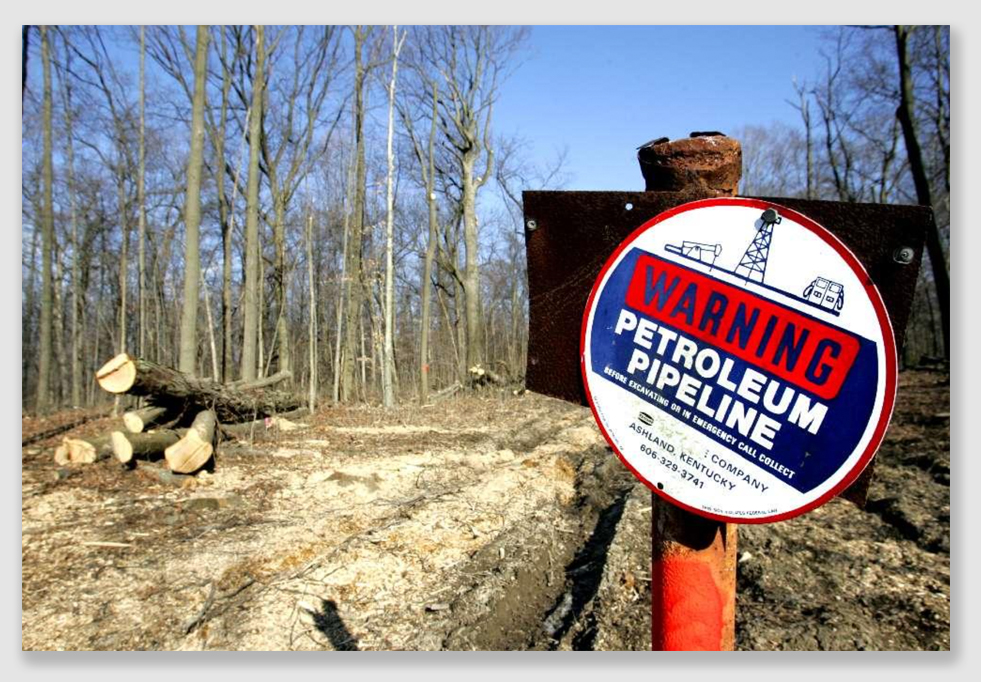
It hardly helped Buckeye’s cause that its case was largely one of ipse dixit. The pipeliner’s case could charitably be summarized as “we own the easement, and the trees need to be cut because we say so.” Even after being called on it, Buckeye continued to spin, saying the tree roots were dangerous to the pipeline because they said so, and the trees could make lightning strike the pipeline because they said so. It’s a bad idea to make outrageous claims that you cannot back up.

The moral: When you’re Goliath going up against David, try a little humility. And duck when he slings that stone.

Pichulo v. Buckeye Pipeline Co., 2019 Mich. App. LEXIS 261 (Ct.App. Michigan, Feb. 14, 2019). Bob Pichulo bought some property in Mount Morris Township back in 1992. Thirty-three years before the sale, the previous owners had granted Buckeye Pipeline an easement to construct and maintain an oil pipeline across the property.

Bob knew about the easement when he bought the place. Yet it hardly affected him for about 23 years. Then, in 2015, Buckeye sent him a letter informing him of Buckeye’s intent to remove 13 Norway maple trees that were on the easement. Buckeye asserted that the trees had to be removed because they obstructed aerial surveillance of and access to the pipeline in case of an emergency or for repairs. In response, Bob sued seeking a temporary restraining order and permanent injunction against cutting the trees.

After an evidentiary hearing on the preliminary injunction motion, the trial court ordered that all underbrush be removed from the easement and the branches on the Norway maples be trimmed to provide a 10-foot clearance.

Buckeye later moved for summary disposition of Bob’s complaint, arguing that it was entitled to remove the trees as a matter of law. Bob responded that there was a real question whether the removal was reasonably necessary for Buckeye’s use of the easement. The trial court agreed with Bob.
Over the course of the four-day trial that followed, the trial court heard Bob’s testimony about the value of the trees to him; pilots’ testimony about the visibility of the pipeline easement after the clearing of underbrush and pruning of the trees; testimony from an expert who estimated that the trees were older than the pipeline, grew shallow roots and had a monetary value of nearly $50,000; and testimony from experts in oil pipeline regulation, maintenance, and safety who disagreed about whether Buckeye’s proposed plan to remove the trees was reasonably necessary for its enjoyment of the easement.

The trial found Bob’s evidence to be more credible and convincing and held that the removal of the Norway maples was not reasonably necessary. Consequently, it permanently enjoined Buckeye from removing them.

Buckeye appealed.

Held: Bob was entitled to his permanent injunction.

Buckeye argued that it was entitled to judgment as a matter of law. Its argument, in essence, was that it had the easement for the purpose of maintaining its pipeline and cutting down the trees was maintenance. No one could question Buckeye’s judgment that the trees should go.

An easement is a right to use the land burdened by the easement rather than a right to occupy and possess the land, as does an estate owner. The use of an easement must be confined to the purposes for which it was granted, including any rights incident to or necessary for the reasonable and proper enjoyment of the easement, which rights are to be exercised with as little burden as possible to the owner of the land.

When considering the scope of an easement, a court must discern the parties’ intent as shown by the plain language of the document granting the easement. “Where the language of an easement is plain and unambiguous,” the Court said, “it is to be enforced as written and no further inquiry is permitted… Under our well-established easement jurisprudence, the dominant estate may not make improvements to the servient estate if such improvements are unnecessary for the effective use of the easement or they unreasonably burden the servient tenement.”

There was no question the easement gave Buckeye a “right of way” and “free ingress and egress,” for the purpose of constructing, maintaining, operating, altering, repairing or removing the pipeline. And “maintenance” in an easement generally includes the right to clear “the property [of trees] to ensure maintenance and inspection,” the term “maintenance including maintaining the property in the appropriate condition so that it is accessible in the event that repair of the pipeline is required.” What Buckeye proposed to do by removing the trees was undoubtedly encompassed by the right of maintenance.
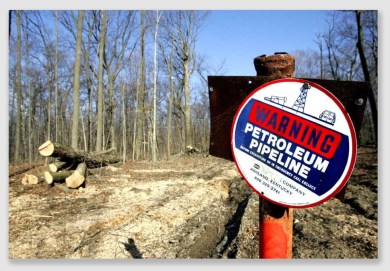
Buckeye argued that this conclusion required the trial court to grant it summary disposition. But a trial court also is required to consider “(1) whether the tree removal is needed for Buckeye’s effective use of the easement and (2) whether the tree removal unreasonably burdens Bob’s servient estate.” Those questions, the Court wrote, are in regard to the extent and scope of the easement, and generally are questions of fact.

Bob and Buckeye presented competing testimonial and documentary evidence regarding whether aerial surveillance of or access to the pipeline was unreasonably obstructed by the trees. Thus, the Court concluded, there remained a question of fact as to the extent of the burden presented by the trees and their roots with respect to potential emergencies and repairs. In light of such questions of fact to be decided at a trial, Buckeye was properly denied summary judgment.

That was especially true because the trial court made reasonable findings of fact that undercut Buckeye’s claims. Buckeye said the trees had to go in order to give Buckeye access to the right-of-way and the pipeline, to respond to emergencies as they arise, and to remove the risks that the tree roots posed to the pipe. Buckeye’s expert, William Byrd, testified that the trees and their roots inhibited Buckeye’s access to the pipeline because excavation equipment could not reach the pipeline in an emergency. Byrd opined that the removal of the trees was reasonably necessary for future maintenance and that such actions were common in the oil pipeline industry. Bob contradicted that evidence with testimony from his own expert Richard Kuprewicz. Rich concluded that the removal of the trees was not reasonably necessary in anticipation of potential maintenance. He said federal regulations did not declare a set width for pipe excavation and opined that removal of the trees to access the pipeline when the time for such maintenance came would not significantly extend the time required to perform such excavation, should the need arise.

The trial court found Bob’s expert to be more credible when he said there was already adequate space to access the pipeline and that the potential requirement to remove the trees before performing any excavation, if needed, would not cause a significant delay. The appellate court gave deference to the trial court’s findings of fact.

Buckeye also argued that the trial court clearly erred by finding that it is not permitted to remove the trees in anticipation of a future emergency. Buckeye introduced testimony that the Norway maples would present a significant burden both in identifying an emergency and accessing the pipeline in case of an emergency. Buckeye’s patrol pilot testified and provided photographs showing that his aerial view of the pipeline and easement was obstructed by the trees. Buckeye’s agent also testified that the trees would significantly delay Buckeye’s ability to properly access the pipeline. He noted that federal regulations required Buckeye to prepare an emergency plan. Buckeye already has such a plan, but to carry it out, it argued, it must remove the trees in question.

Mark Twain says there are none of these …

Bob’s evidence contradicted Buckeye’s claims. He elicited testimony from another pilot that the easement around the pipeline plainly was visible when flying past the property at the proper angle. Bob also provided photographs showing an unobstructed view of the pipeline, which is identified in the photographs by the presence of yellow tape. His expert Rich, meanwhile, testified that in cases of emergency, it would be entirely improper and unsafe to rush to the scene of the leak with large machinery and to begin excavation. Instead, he testified, the s pipeline had internal sensors that allowed for the identification of leaks in general areas, which could then be isolated and the flow of oil through that area stopped. This effectively reduced the amount of environmental contamination without having to rush in with dangerous machinery.

While Rich agreed that federal regulations required an emergency plan, he pointed out that the regs did not require the removal of any trees.

The trial again found Bob’s expert to be more credible. With respect to locating an emergency via aerial surveillance, the trial court relied on the pilot’s photographs and testimony establishing that the pipeline was visible. Because the trial court’s decision on this issue relied on admissible and compelling evidence in the record, the Court of Appeals said, it was not clearly erroneous and thus carried the day.

The Court said, “Given our deference to the trial court’s credibility determinations and [its] decision to believe [Rich] instead of Buckeye[‘s] expert and the trial court’s reliance on admitted evidence, the record presented does not provide any reason for us to be “left with a definite and firm conviction that a mistake has been made. Thus, based on the facts as found by the trial court, Buckeye’s request to remove the Norway maple trees was not reasonably necessary for Buckeye to prepare for an emergency.

Finally, Buckeye argued that the trees had to be removed because their roots presented a danger to the pipeline. In support of that, its expert testified that tree roots acted as conduits for electricity, so they could cause lightning to strike the pipeline. In addition, Buckeye presented evidence that the roots potentially could grow toward and eventually chip away at the pipes, and its expert testified that the tree roots could entangle the pipeline, causing damage. On cross-examination, however, he acknowledged that he was aware lightning strikes could happen but did not know of any specific examples. Bob countered with expert testimony from an arborist who testified that the root system of a Norway maple stays in the top 10 inches of soil, which is above the pipeline. As to the tree roots and potential pipeline erosion, Bob’s expert explained that the pipeline’s cathodic protection would be able to provide a timely alert that a tree root was encroaching on the pipeline and, if that failed, other tools could be used to identify external corrosion of the pipeline.

The trial court again found Bob’s evidence more credible, weighing the fact that Buckeye’s expert could not identify any particular instance where a lightning strike on a pipeline had been conducted by a tree root. Considering that evidence in light of the arborist’s testimony that the tree roots did not go as deep as the pipeline and Rich’s testimony that Buckeye would be alerted to any encroaching root in a timely manner, the trial court found that removal of the trees was not reasonably necessary for Buckeye’s maintenance of the pipeline. The Court of Appeals held that the trial judge’s conclusion was not clearly wrong and thus had to be accepted.

In sum, the Court of Appeals said,

Buckeye asserted that the Norway maple trees had to be removed because they were a danger to the pipeline and an obstruction to surveillance and access. Buckeye’s contentions rely on a misapplication of the law in Michigan with regard to easements. Buckeye, under the terms of the easement at issue here, does not have the right to ensure freedom from any and all obstructions or dangers to the pipeline. That simply is not the standard for such inquiries. Instead, Buckeye’s rights under the easement are limited to freedom from unreasonable obstructions or dangers. The extent, or reasonableness, of the obstruction presented by the trees is a fact question for the trial court to decide and it did so here. The trial court, after considering all of the evidence and weighing the credibility of the witnesses, decided that removal of the Norway maple trees was not reasonably necessary for Buckeye’s maintenance, operation, or repair of the pipeline.

– Tom Root

TNLBGray140407