Case of the Day – Wednesday, December 3, 2025

WHEN IS FEE SIMPLE NOT SIMPLE?

Potatotruck140220Nothing light today, boys and girls. We have work ahead of us. Sure, Thanksgiving is a memory (except for all of the leftovers stacked in the refrigerator), but the Christmas season is here, Black Friday and Cyber Monday have come and gone, and as that great educator M.C. Hammer once said, “Yo, sound the bell, school is in, sucker …

So listen up. When land is conveyed from one party to another without any limitations whatsoever, the conveyance is done in “fee simple absolute,” or just “fee simple” for short. The conveyance usually says that the land is conveyed “unto the said party of the second part and its successors and assigns forever,” or words to that effect.

At the time the railroad came through a part of Idaho (think “Famous Potatoes”) in the late 19th century, a lot of landowners thought they were conveying their land to the railroad in fee simple. But their deeds had not just the magic “fee simple” language, but also a “habendum clause.” A “habendum clause” is a clause in a deed that defines the extent of the interest being granted and any conditions affecting the grant.

Legal mumbo-jumbo? Not when the facts changed.

Legal mumbo-jumbo? Not when the facts changed.

In the case of the Idaho deeds, the conveyance language transferred title to the railroad “to have and to hold all and singular the tenements, hereditaments and appurtenances as a perpetual right of Way for said second party’s Rail Way Line unto the said party of the second part and its successors and assigns forever.” Yeah… yadda, yadda, yadda, how lawyers like to natter on and on… None of this gibberish seemed important for a century, during which time the trains puffed up and down the track. But when the rail line was torn up, suddenly the old documents became very interesting.

Under the National Trails System Act, the government can convert an old railroad right-of-way into a recreational trail without the rail line being deemed to be abandoned. That’s what happened in Idaho. But some of the landowners whose properties were transected by the abandoned right-of-way talked to a smart lawyer. She told the owners, “These old documents aren’t deeds; they’re just easements for a railroad.” That was an important distinction: the easements weren’t for the benefit of some granola-munchers, but rather for rolling stock.

The Federal Court of Claims had a tough task ahead of it. The Idaho Federal District Court had already ruled that such deeds were conveyances in fee simple, meaning that the owners abutting the railroad had no means to reclaim the land. The problem was that the interpretation of the deeds was a matter of Idaho law, and the Idaho Supreme Court had never reached the precise issue. The Court of Claims carefully parsed other Idaho decisions and decided that, based on its treatment of other cases, the Idaho Supreme Court would rule — if it had been asked to  — that the references in the deeds to the “perpetual right of Way for said second party’s Rail Way Line” limited the purpose of the conveyance, and therefore made the deed a grant of a mere easement, not perpetual ownership.

With two federal courts disagreeing on what Idaho jurists would say if asked, it’s likely that the state courts themselves ultimately will have to resolve the issue by ruling definitively on the question.

Abandoned right-of-way

Abandoned right-of-way

Blendu v. United States, 79 Fed.Cl. 500 (2007). Owners of land abutting or traversing an abandoned railroad right-of-way contested the government’s using the right-of-way as a recreational trail pursuant to the National Trails System Act, claiming that the government’s action effected a taking of their property without just compensation in violation of the Fifth Amendment.

The predecessor landowners had deeded land to the railroad about a hundred years before, with deeds that contained language in the granting clauses that convey all estate, right, title and interest in the property to the railroad, but also contained habendum clauses “to have and to hold all and singular the tenements, hereditaments and appurtenances as a perpetual right of Way for said second party’s Rail Way Line unto the said party of the second part and its successors and assigns forever.” Under the Act, the government could convert abandoned railroad rights-of-way to trails without the use constituting an abandonment of the right of way. However, Blendu and the plaintiff property owners argued that under their deeds, they had really just given easements – not a deed in fee simple – and the cessation of rail service did not permit the government to use the easement of a trail. They moved for summary judgment in the U.S. Court of Claims, and the government cross-moved for summary judgment, arguing that the deeds were a conveyance of the property in fee.

Held: Under Idaho law, a deed which contained a granting clause that quitclaimed certain real estate to the railroad and a habendum clause stating that the railroad held the real estate “as a perpetual right of Way for said second party’s Rail Way Line unto the said party of the second part and its successors and assigns forever,” the deed only conveyed an easement and not fee simple title.

The easement was for rolling stock, not for Birkenstocks.

The easement was for rolling stock …

... not for Birkenstocks.

… not for Birkenstocks.

The Court said that the use of the term “right of way” in the habendum clause unambiguously reflected an intention to convey an easement, overcoming Idaho’s statutory presumption in favor of a fee simple interest. The Court of Claims concluded the distinction between the granting clause and the habendum clause had not been made by the Supreme Court of Idaho, but the Court of Claims believed that the Idaho Supreme Court cases found the presence of the term “right of way” in any substantive part of the deed to be determinative. The deeds in this case contained the term “right of way” in the habendum clause, thus unambiguously reflecting an intention to convey an easement and overcoming Idaho’s statutory presumption in favor of a fee simple interest.

As further evidence of the conveyance of an easement, the Court said, the deeds contained a designation for use of the right of way for the Railroad’s “railway line.”

The easement was for rails, not trails.

– Tom Root

TNLBGray140407

Case of the Day – Tuesday, November 25, 2025

LOOKING FOR SOMEONE TO BLAME

No matter how rational and discerning television juries might be, in real life, the decisions that the finders-of-fact make can be a crap shoot, especially with a roomful of parties.

I recall an old, wise lawyer telling me years ago that cases with multiple defendants were a headache for defense counsel, because jurors naturally assumed with so many people accused of damaging the poor plaintiff, someone must be at fault. “So they listen to the poor plaintiff’s sob story,” the wizened old barrister said, “and they start looking around the courtroom for someone to blame.”

A cautionary note to plaintiffs: Sometimes that backfires, because when so many parties with differing, interlocking relationships cram the defendant’s dock, convincing the jury that one or more of the defendants owes a duty to your poor, injured plaintiff can be like trying to catch a greased pig. Such as in today’s case.

The tree was rotten. It had been rotten for a long time. It collapsed onto a passing cyclist, out enjoying a country ride on a dedicated bike path. An electric utility owned by a mega-power holding company (imagine a corporation with buckets full of cash) held an easement over the bike path and adjacent land to trim the trees away from its lines, and that utility had a thundering herd of contractors signed up to do the hazard tree analysis and trimming for it.

Shouldn’t be too hard to get the money flowing to the plaintiff, right? Well, let’s see…

Rossetti v. American Electric Power Co., 2004-Ohio-118, 2004 Ohio App. LEXIS 109 (Ct.App. Licking County, Ohio, Jan. 12, 2004). Rosemarie Rossetti and her husband, Michael Leder, were riding bicycles on the T.J. Evans Bike Trail in Licking County when a Linden tree collapsed and fell onto an Ohio Power line and across the bike path. The tree then hit Rosemarie, seriously injuring her.

The Linden tree that fell was located about 51 feet off of the bike trail on land adjacent to the bike trail owned by Karen Matz and John Skowronski. The tree, which was about 80 years old and 101 feet tall, leaned over the power lines. According to the Rossetti’s expert, Dr. Sydnor, there was a huge cavity in the base of the tree, and the “tree was hollow for… three, four feet up.” The tree had been hollowed out at the base for over 20 years, and there was decay around the base that had existed for almost the entire life of the tree. Both the decay and the hollowed-out part of the base faced away from the bike path. According to Dr. Sydnor, the tree was rooted in the stump and the “root had actually grown through the stump and was growing up the hill. The root is – the failure of that root was what caused the failure of the tree. That was the only thing that was actually holding the tree up.”

Ohio Power had an easement over Karen & John’s property and the bike trail for trimming or removing trees along the trail that interfered with its power lines. The Linden tree was not located within Ohio Power’s easement but instead was about 51 feet from the trail and 25 feet from a wire fence marking the edge of the trail property.

Ohio Power trims and removes the trees in and around its easement on a three-to-five year trimming cycle. Under this cycle, the trees next to the bike trail were inspected and maintained in 1988-1989, between 1990 and 1992 and in 1995. As part of its tree trimming program, Ohio Power contracted with both ACRT and Nelson Tree. ACRT, under its contract with Ohio Power, hired work planners who, as part of the trimming/removing cycle patrolled the electric lines and identified easement trees needing trimming or removal. Nelson Tree Service would then perform the actual trimming or removal for the 1995 cycle.

Sticking a defendant with a duty to the plaintiff was a greased pig of a task…

Rosemarie and Michael sued everyone, including Ohio Power, ACRT, Nelson Tree, and Karen and John. Everyone responded with motions for summary judgment.

The trial court granted the defendants’ motions for summary judgment, holding that “it was not foreseeable that the Linden tree would fall onto the bicycle path and cause a person physical harm” and that “given the lack of evidence beyond mere inference indicating the Linden tree was trimmed by the utility Defendants under the tree-trimming program, Plaintiffs cannot establish proximate cause.”

Rosemarie and John appealed.

Held:  The defendants’ motions for summary judgment were properly granted.

In a negligence case, the Court said, a plaintiff must prove that: (1) the defendant owed the plaintiff a duty; (2) the defendant breached that duty; (3) the plaintiff suffered harm; and (4) the harm was proximately caused by defendant’s breach of duty. The existence of a duty depends on the foreseeability of the injury. The test for foreseeability is whether a reasonably prudent person would have anticipated that an injury was likely to result from the performance or nonperformance of an act.

Here, the Court said, it was not reasonably foreseeable that the tree would fall onto the bicycle path and cause a person physical harm. John, who owned the private property on which the tree was located, testified there was no reason to notice the tree before it fell because “it looked healthy. I mean, there was no reason to notice it. It wasn’t as if the crown was brown or the bark was peeling.” Dr. Sydnor, Rosemarie’s and Michael’s ‘ own expert, agreed that “earlier on in the growth of this tree it would have been more readily identified as a hazard tree than later on.” While he testified that the tree would have been identified as a hazard in the 1980s, Dr. Sydnor admitted that it was not reasonably foreseeable in 1980 that the linden tree was going to fall within the next 18 years.

“Looks fine to me…”

What’s more, Dr. Sydnor testified that the Linden tree was leaning for its entire life and that the tree had been hollowed out at its base for over 20 years, and that the decay around the tree’s base had been there “well in excess of 20 years, probably 40… maybe 80” years. Using the formula generally accepted in his field, Dr. Sydnor said the linden tree had a live crown ratio of 66%, which was “good.” According to Dr. Sydnor, the tree was either the dominant or co-dominant tree in the canopy, which indicates that it, at some point, had to have been fairly healthy. Thus, Dr. Sydnor said, even if Ohio Power, ACRT, and Nelson Tree Service actually examined and trimmed this specific linden tree in 1995, and observed the decay, hollowed cavity, and poor root structure, it was still not reasonably foreseeable the tree would fall in the next four years, which would have brought Ohio Power and its contractors to the next trimming cycle. Dr. Sydnor did testify that the tree would fall someday, but, the Court of Appeals said, “such testimony does not create a genuine issue of material fact since most trees will eventually fall.”

Others, including a Right-of-Way Program Developer with Davey Resource Group formerly employed by ACRT as a supervisor to the Utility Forestry Pre-Planner, and a Licking County Park District Ranger who saw the tree shortly after it fell, both agreed that the “crown, the top of the tree, was full of leaves…it looked like a healthy tree.”

Furthermore, the Court said, Nelson Tree – as part of its contract with Ohio Power – had no duty to inspect the trees on and adjacent to Ohio Power’s easement. Instead, its job was merely to trim or remove trees that were marked by ACRT. Nelson had no discretion with respect to which trees were to be trimmed or removed.

Based on all of that, the Court held, it was not reasonably foreseeable that the tree would fall, according to Rosemarie’s and Michael’s own expert evidence, and thus, “no duty arose on behalf of Defendants to take any action with regard to the Linden tree.”

– Tom Root

TNLBGray140407

Case of the Day – Monday, November 17, 2025

GOTTA LOVE THE INTERNET

Time was that the older you got, the more your early memories morphed into wispy tendrils that may have been true, may have been dreams, may have been whole-cloth fiction, but could never be verified.

Not with the Internet around. When I was reading today’s case, something caused me to think I remembered an old ditty from Captain Kangaroo about a railroad running through the middle of a house. I’ve recalled it before, thinking about what kind of an ironclad easement must have let the Capital Limited thunder between the sofa and Barcalounger. But I never really knew whether I recalled the song, imagined the song, or made it up one night 60 years ago.

But the Internet never forgets. It only took about 60 seconds to find “The Railroad Runs Through The Middle of the House,” a 1956 hit written by Bob Hilliard and recorded by Rusty Draper and Vaughn Monroe (independently of each other).

To be sure, the song is imprecise. The railroad probably did not buy the land, but instead simply got a right-of-way through the house. The premise is undoubtedly apocryphal, but the nature of a right-of-way – which is an easement on steroids – confuses a lot of people. Just ask the woman in the street who owns the gap of grass between the sidewalk and street (we Midwesterners call it a “tree lawn”).

Most people think the city or county owns it. Not so. The abutting landholder owns all of the land to the centerline of the street, subject to the government owning the right-of-way and doing pretty much whatever the hell it likes within the right-of-way (consistent with the purpose of said R-O-W).

In today’s case, county employees cut down trees standing in the right-of-way of a road, because overhanging branches were affecting motorists. The landowner complained that those were his trees, and the county had no right to destroy them. Imagine a track crew rolling through your family room and removing a chandelier because it hit the tops of boxcars. That’s how Jeff felt.

Alas, the trees were within the county’s R-O-W, and – while the Court did not state the obvious – overhanging branches interfered with the use for which the R-O-W was granted, which was a highway.

Alberhasky v. Johnson County, 670 N.W.2d 430 (Iowa App. 2003). The owner of the property abutting a county road brought an action against the County following the removal of trees from his property in order to improve the road right-of-way. The county engineer claimed that the trees formed a canopy over the road that obstructed larger vehicles and kept the dirt road from drying out.

All of the trees removed from Alberhasky’s side of the road were within the county’s right of way. The trial court told the jury that if trees were removed outside the county’s right-of-way, jurors should return a verdict for Alberhasky.

The jury found for Johnson County, and Alberhasky appealed.

Held: The county acted within its rights under Iowa Code § 314.7.

The Court acknowledged that Jeff, as an abutting landowner, owned the land to the centerline of the road subject to the easement rights of the defendant. It agreed that county employees in charge of maintenance work on a county road cannot enter property adjoining the right of way to remove or injure trees located on that property without the landowner’s permission, but they may lawfully remove trees in the right of way or branches of trees that overhang the right of way.

Despite a state policy in favor of trees expressed in Fritz v. Parkison, the facts submitted to the jury established that tree branches regularly struck the equipment used to maintain the road, breaking mirrors, antennas, lights and scraping paint. School buses could not go down the road because tree branches scraped the yellow warning lights off the tops. In one case, a fire truck was unable to use the road, requiring an extra 4-mile trip and resulting in the loss of a building. The trees removed included dead elms, mulberries, cedars and others of varying sizes.

The Court of Appeals held that trimming back the branches offered an inadequate solution, since branches grew back and had to be trimmed frequently. Removal of the trees, it said, was the only long-term solution.

– Tom Root

TNLBGray140407

Case of the Day, Tuesday, November 4, 2025

FREE GIFT

Some expressions just bug me. “Free gift” is one of them. Of course it’s free. It’s a gift, you knucklehead. What kind of gift would it be if it were not free?

“Free gift” is redundant, a stupid expression, like “past history” and “foreign imports.” And speaking of ‘stupid,’ sometimes you wonder how someone can have so much money and so little else to do that he or she can afford to fritter time and money away on a stupid lawsuit.

Southern California Edison Co., the company responsible for the Dixie Fire in California, has easements all over southern California for transmission and distribution lines. In today’s case, it had a 10-foot wide easement across Steve Severns’ property for maintaining its lines in such a way as not to set all of LA County aflame.

No problem there. But the easement was vague on how SCE was to get to the easement. The language just said “free access,” and for 77 years, the utility and a succession of property owners understood that a route the owner and the company had agreed upon shortly after the easement was granted was the access easement SCE was entitled to use.

But then Steve bought the place. When SCE needed to replace a pole (and, Steve, you can see what happens when California electric utilities don’t maintain their lines), Steve decided he didn’t like the access route SCE had used for 77 previous years. Trying to be accommodating, SCE agreed to a different route, one so vertical it had to pull its trucks to the easement with bulldozers. But then Steve, who believed without any evidence to back him up, that SCE had agreed to restore the route (where the old route had always been left in place), sealed up his property. He told SCE to use a helicopter to get to its easement.

When SCE sued, demanding the “free access” the easement promised, Steve said, “Oh no, that ‘free access’ just means SCE is free to move around inside its 10-foot easement.”

The law has developed many useful laws of statutory and contract construction over the years. One of the principal canons is to give purpose to every part of the contract so that no clause is redundant, surplusage or meaningless.

The court put that canon to good use here. Steve’s interpretation of “free access” to mean SCE had free access only within the described 10-foot easement was just plain stupid. It’s SCE’s easement. Of course it had free access within it.

But that being the case, and the canon of construction instructing us to give meaning to every term, then “free access” must mean something else.

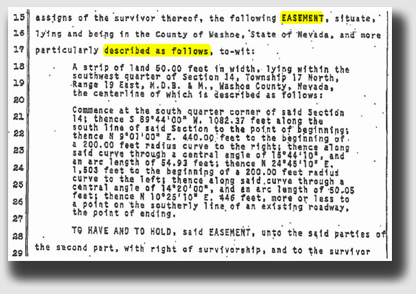
Southern California Edison Co. v. Severns, 39 Cal. App.5th 815 (Ct.App. Cal., 2nd Dist., Sept. 10, 2019). Steve Severns owns a 16-acre parcel of property which is subject to a public utility easement granted to Southern California Edison Company. SCE maintains electrical power lines and supporting structures within a 10-foot-wide strip along the eastern boundary of the property. That strip is described by metes and bounds in the recorded conveyances. Each conveyance also grants SCE “free access” to its electrical facilities.

Steve did not dispute that SCE was entitled to use the 10-foot-wide strip described in the easement for utility purposes, but the parties disagree as to whether SCE has the right to gain access to its easement by traversing other portions of the property. For nearly 80 years, until Steve came along, the property owners allowed SCE crews such access. But not Steve.

Steve bought the property in 2006. In 2008, SCE needed to replace three poles. SCE employees discussed the routes that could be used to reach the poles. Steve objected to SCE’s use of the route historically utilized to access pole 5, because he said that SCE trucks had damaged pipes along the route and that it was too close to the back of his house. The parties agreed that SCE would build an alternative route. The newly created route was steep and, during the work on the poles, the trucks had to be pulled up the steepest stretch with a bulldozer.

Steve complained the new 2008 route was to be temporary. While there was no written agreement, Steve testified that George Perez, an SCE representative, told him that after the pole was replaced SCE would put the property back in the same condition that it was in prior to the pole installation. SCE denied the existence of any such agreement and refused to do so.

Because of the dispute, Steve changed the gate access code/tumbler box and took other steps to prevent SCE’s access. He told SCE to use adjacent properties or helicopters to access its electrical facilities. SCE sued for interference with the easement and declaratory relief. Steve cross-complained, seeking damages for nuisance, trespass and ejectment.

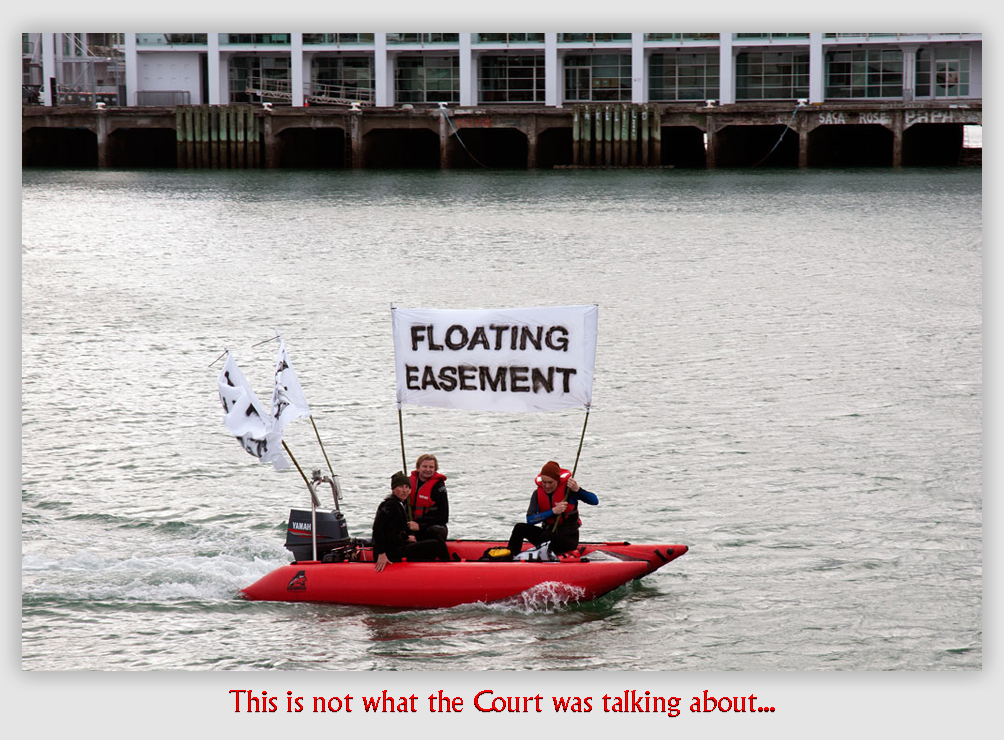
The trial court found, based on the easement language, that SCE had been granted “floating easements” over the property to access its electrical facilities. The floating easements became “fixed” easements when SCE and the property owners agreed on the access routes years before. At that point, SCE became “the owner of an easement of reasonable width” over each agreed-upon access route. The trial court allowed SCE “‘free’ (i.e. unimpeded) access” to those routes.

The trial court further found that SCE and Steve had agreed by acquiescence to abandon the original route to pole 5 and to change the location of that access easement to the 2008 route. The court concluded that while SCE may not construct a new access route or use portions of the property falling outside the 10-foot-wide strip and the delineated access routes, it may perform geotechnical testing incident to repairs and improvements on those routes and trim or remove interfering trees.

Steve appealed.

Held: SCE held a floating easement to cross the property.

A basic rule of interpreting real estate conveyances, including easements, holds that the intent of the parties to the easement is the paramount consideration. The Court noted that it is not the intent of the grantor that governs in such cases. It is the joint intent of the grantor and the grantee. Grants are to be interpreted in like manner with contracts in general. The interpretation of an easement, which does not depend upon conflicting extrinsic evidence, is a question of law.

Recorded conveyances must be interpreted as a whole, with each clause aiding the interpretation in the attempt to give purpose to every part, and the interpretation should, where possible, give effect to every part so that no clause is redundant.

The Court observed that some expressly granted easements – commonly known as floating easements – are not specifically defined as to location by the creating conveyance. These easements are nonetheless fully valid and enforceable by their holders. An easement granted in general terms, nonspecific as to its particular nature, extent or location, is perfectly valid, the Court said, entitling the holder to choose a reasonable location and to use such portion of the servient tenement as may be reasonably necessary for the purposes for which the easement was created.

What’s more, the actual use made by the holder over a period of time fixes the location and the nature and extent of the use. Such an easement necessarily carries with it not only the right but also the duty to maintain and repair the structure or facility for which it was created.

Where an instrument conveys or reserves an unlocated, floating easement, it is presumed that the parties intended to establish a reasonably suitable and convenient route in view of the anticipated needs of both parties. The easement right cannot be exercised over the entire servient tenement, but until the easement is located by agreement of the parties, it is a cloud on the title to all of the property.

In this case, the Court said, SCE’s recorded conveyances do not identify the portion or portions of the property that the company may use for “free access” to its electrical facilities. Steve argued the “free access” language in the conveyances simply means SCE is entitled to move freely within the 10-foot-wide metes-and-bounds easement area. Steve’s interpretation made no sense. “It is undisputed,” the Court observed, “that the recorded conveyances, taken together, grant SCE easements over the 10-foot-wide strip for utility purposes. This grant would be meaningless if SCE could not move freely within that strip to construct, replace, inspect and maintain its electrical power poles, lines and equipment.” Because SCE’s right to move freely within the 10-foot area is not dependent upon the ‘free access’ language, the Court ruled, “the only reasonable interpretation is that the grantors of the easement intended, through that language, to grant SCE some right of access over the property to reach its electrical facilities. Under Severns’ interpretation, the “free access” language would be both redundant and unnecessary.”

Even if the Court were to assume the “free access” language was ambiguous, the extrinsic evidence established the grantors understood the recorded conveyances granted SCE the right to traverse the property to access the 10-foot-wide strip. “It is a cardinal rule of construction that when a contract [or conveyance] is ambiguous or uncertain,” the Court held, “the practical construction placed upon it by the parties before any controversy arises as to its meaning affords one of the most reliable means of determining the intent of the parties.” Here, the evidence confirmed that for decades the grantors freely allowed SCE to drive over the property to access its electrical facilities. Even Steve permitted access until the dispute arose over the restoration of the 2008 route. “This historical usage of the property is consistent with our interpretation of the conveyances,” the Court ruled.

The exception to the historical easement involved the route to pole 5. The route changed in 2008 when Steve asked SCE to construct an alternative route to that pole. Because substantial evidence supported the trial court’s finding that “the original route across the north side of the house has been abandoned and that the road along the east side of the house has been established as the new access route,” the new route because SCE’s new easement route. “We are not persuaded,” the Court said, “by Severns’s argument the 2008 route was meant to be temporary. The court heard conflicting testimony on this issue and ruled in SCE’s favor. Such credibility determinations are the province of the trial court.”

– Tom Root

TNLBGray140407

Case of the Day – Thursday, August 21, 2025

EASEMENT CREEP

A pipeline runs through it ... but how wide is the easement?

A pipeline runs through it … but how wide is the easement?

It’s a common enough problem when a deal gets cut by people who later leave the company, retire, pass on, whatever. Over the years, newer and younger Turks come along who redefine the deal to suit the newer aims and needs of the company.

So it was with some gas line easements in the Mohican forest area of eastern Ohio. We’ve discussed previously why a careful description of the bounds of an easement is such a good idea. Here’s another example. When the easements for these three gas pipelines were written, they didn’t contain any description of the width of the right-of-way being provided to the easement holder. Over the first 40 years or so, the gas company kept the right-of-way cleared to 10 or 15 feet. But in 2003, the company suddenly decided it required 20 to 25 feet, and it began cutting accordingly. Even that wasn’t enough, and so in 2006, the gas company sued a church camp and some other recreational landowners for a declaratory ruling that the easement was really 50 feet wide.

The Federal district court denied summary judgment to the gas company. Reduced to its essence, the gas company’s argument was that it must obey new, stiffer federal laws and regulations in the wake of 9/11, and those require a 50-foot-wide easement. The court wasn’t buying it. Finding no language to help it in the easements themselves, the court looked at other factors. It seemed pretty clear that nothing in the way the gas company had operated for approximately 40 years supported a finding that the parties understood all along that they were dealing with a 50-foot-wide easement. The gas company’s arguments that its operations required 50 feet failed — the court said the best it could justify based on the evidence was 29 feet wide. And the court was troubled that the gas company had met with the church in 1965, when the church was buying the campground, and told church representatives that it was looking at a 10-15 foot right-of-way. Thirty-eight years later, it told the church it needed a 20-25 foot wide easement.

Sometimes, you have to dance with the girl who brung ya …

Sometimes the little guy really does win ...

Sometimes the little guy really does win …

None of this meant that after a full trial, the court might not feel differently. But for the moment, it was David 1, Goliath 0. And – reading the handwriting on the wall – Columbia Gas Transmission Corp. ended the litigation several months later.

Columbia Gas Transmission Corp. v. First Congregational Church, Case No. 1:07-cv-00661, Dkt. 74 (N.D. Ohio, Dec. 11, 2007). Columbia Gas owned three gas pipelines that traverse the Church’s camping retreat property. Two of the easements had been granted by the Muskingum Conservancy District, the Church’s predecessor-in-interest, providing the right to ingress and egress, the right to lay, maintain, operate, repair, replace and remove the pipe, provided the pipe would be buried so as not to interfere with the cultivation of the land. A second easement had been granted for the sole purpose of drilling for oil and gas and to use the premises for pipelines, water lines, pumps, tanks, structures and stations necessary or convenient in connection with drilling, provided that the pipelines be buried and the easement holder pay for all damages to growing crops and trees.

When the Church bought the campground in 1965, gas company representatives showed the clergymen the clearings for the pipelines, which were between 10 and 15 feet wide. In 2003, the gas company expanded its cleared right-of-way to 20 to 25 feet. Three years later, the gas company told a church member it owned a 50-foot right of way, and asserted that the Department of Homeland Security required this for gas pipelines. The gas company cleared all the trees within 50 feet of one of the pipelines without informing the church of its intention. The gas company dumped brush piles in excess of 55 feet from the centerline of the pipeline, needlessly changing the topography of the area. Shortly thereafter, the gas company sued the church for injunctive relief that its easement entitled it to clear a 50-foot right-of-way on a second pipeline. The church wasn’t alone: several other landowners were sued as well, and the court consolidated all of the cases. The Church filed a counterclaim seeking declaratory judgments and injunctive relief that Columbia Gas was not entitled to a 50-foot right-of-way in its easements for its pipelines, and sought damages from the previous tree clearing along the one pipeline. Columbia Gas moved for summary judgment.

Held: The gas company’s motion was denied. Under Ohio law, the granting of an easement includes a grant of all things necessary for the use and enjoyment of the easement. Where the complete terms of the easement are not expressed in the instrument granting it, the extent and limitation of the easement are ascertained from the language of the grant, from the circumstances surrounding the transaction, and by what is reasonably necessary and convenient to serve the purpose for which the easement was granted. The holder of an easement may not increase the burden upon the servient estate by engaging in a new or additional use of the easement. However, without specific language to the contrary, an easement holder is entitled to vary the mode of enjoyment and use of the easement by availing himself of modern inventions if by doing so he can more freely exercise the purpose for which the grant was made.

Easements should be very specific - because the people who wrote them won't always be around.

Easements should be very specific – because the people who wrote them won’t always be around.

Here, the easement agreements were ambiguous at best and provided no basis for determining what the parties had intended. As to what is reasonable, it is true that the gas company has a duty to maintain its storage pipelines in accordance with federal law. It has a policy of not allowing any growth more than five feet tall within the right-of-way. However, its evidence of use of the easement and of hazard to pipelines from tree roots supports a clearing of only about 29 feet at most. Furthermore, Ohio courts have also looked to use and acquiescence and have refused to extend easements to fifty feet where the gas company has allowed mature trees to remain growing within 50 feet of the pipeline.

Here, even if the regulations suggested a 50-foot-wide clearing was necessary, the Court said, the parties never contemplated such a right-of-way at the time of the granting of the easement. The gas company argued that 50 feet is necessary for it to conduct aerial patrol. The Court presumed that the parties contemplated normal developmental changes in the use of the easement, but nothing in the evidence ever suggested that anyone contemplated a 50-foot right-of-way.

The parties’ experts’ discussions of the relevant safety issues were only one issue among many that the Court was willing to consider in determining the dimensions and scope of the easement. The Court also considered the language of the grants and the circumstances surrounding the transactions. Neither of those entitled the gas company to a judgment as a matter of law.

Finally, the Church argued that the Plaintiff should be estopped from arguing a larger easement than 25 feet is reasonably necessary and convenient, because it not only used a small right-of-way in the past, but its representative affirmatively showed the Church’s employees the clearing of the trees so that the Church would know what to expect — showing them clearings of 10 feet, occasionally increasing to 15 feet in width. Further, in 2003, the gas company told a member of the Church it needed 25 feet, not 50. The Court said these conversations and interactions, coupled with the gas company’s failure to remove mature trees until now, might demonstrate enough evidence of use and acquiescence to estop the gas company from arguing for 50 feet.

– Tom Root

TNLBGray140407

Case of the Day – Monday, August 18, 2025

GIVE ‘EM AN INCH …

fence150722We continue our tour through the House of Bad Neighbor Horrors today (see our post from Wednesday) with a look at neighbors Paula A. Luckring and Christopher Blair.

An old legal adage holds that “a bad settlement is better than a good lawsuit.” Paula Luckring sued her neighbor, arguing that branches from his trees overhung her property, and that they were doing all the kinds of things trees do – you know, dropping twigs and leaves, leaking sap, growing roots, just normal tree stuff. Paula insisted that she was entitled to something north of $13,000 because the trees were “trespassing” on her property, making claims that sounded a lot like her lawyer had read Fancher v. Fagella.

Neighbor Chris Blair counterclaimed, pointing out that if Paula wanted to really get technical, her deck – which she claimed was being damaged by his trees – was built partly on his property, and it should be removed.

The case looked like the trial would be the Saturday night main event, but alas … before trial, the parties settled. There’s nothing wrong with that. Civil actions are just a formalized means of settling disputes, a little more complex and fact-driven than “rock, paper, scissors,” but often, it seems, just as random. When the parties find a means short of a full-blown trial to resolve things, time and money are saved, and people are able to get on with their lives.

That must be what Chris thought, because he settled the case with Paula before trial. He agreed to give Paula title to an 11-foot strip of his own land and to build, at his own expense, a fence marking the new boundary line between their properties.

appease150722We have to hand it to Chris. He apparently was a Bible scholar, and remembered Matthew 5:39 – 40: “But I say to you, do not resist an evil person; but whoever slaps you on your right cheek, turn the other to him also. If anyone wants to sue you and take your shirt, let him have your coat also…” For that matter, Neville Chamberlain thought that giving Hitler Czechoslovakia would keep the brown shirts out of Paris.

We’re not saying Ms. Luckring was evil, nor would we ever equate her territorial ambitions with those of the Third Reich. For a concession to be effective, however, the party being appeased has to be acting in good faith. This is rarely the case. Rather, the problem is that the party being appeased has probably acted in bad faith in order for affairs to get to the point that appeasement is necessary. Hitler had the “Anschluss.” Without it, Chamberlain wouldn’t have needed to make a deal. Putin started by taking South Ossetia from Georgia. Then, he grabbed Crimea, and now he is busy trying to take Ukraine (if not Moldova, Estonia and the other Baltic states as well). History has shown us that appeasement doesn’t work because appeasement only convinces the appeased party that bad conduct pays. And just two years ago today, notwithstanding years of negotiations, the Taliban just went ahead and took it all.

Ask Chris Blair about appeasement. Chris thought he had bought peace by giving away a piece of this land. But when Chris hired a fence company to build the agreed-upon fence along the new boundary, Paula Luckring refused to let the contractor set foot on her property during the construction process. It’s hard to build a fence from one side only. To further appease Ms. Luckring, the contractor built the fence 13 inches into Chris’s side of the boundary. After that, when Chris’s caretaker (Chris himself had severe Parkinson’s, a condition that undoubtedly only goaded Ms. Luckring into further predations) would try to use a weed whacker on the grass growing in the 13-inch space between the new boundary and the fence, Ms. Luckring demanded that he do the cutting without setting foot on her property. However, she magnanimously conceded, she would cut the grass on the 13-inch strip… if Chris gave her an easement for the 13 inches of space.

nomans150722The trial court was drawn back into what it called the “predictable drama” that arose from Ms. Luckring’s demands. It told Paula that she had to pay to have the fence moved and reinstalled right along the boundary. No 13-inch “no man’s land.” No easements. No more trespassing actions.

Naturally, Ms. Luckring appealed. The appellate panel was having none of it. It held that “a mere cursory review of the Plaintiff’s pleadings and her own testimony … adduces an ongoing pattern of bullying of a Defendant who granted her the moon and the stars in acquiescing to her unceasing demands, and yet was confronted with demands for more …” It’s not unheard-of for a plaintiff to cripple her case by her own testimony, but to prove yourself to be a bully?

Under the circumstances, making Paula pay to relocate the fence seemed to the court to be a lot like justice. Approximate justice, but still justice.

Luckring v. Blair, 2014 Pa. Dist. & Cnty. Dec. LEXIS 3 (Com.Pl.Ct. Pennsylvania, Dec. 3, 2014). Paula Luckring sued neighbor Christopher Blair, alleging that his pine and sycamore trees trespassed onto her property, causing public safety issues that had been presented to the local township authorities. She additionally complained of damage caused by “tree sap, needles, branches, cones, roots” constituting a “nuisance” because the trees overhung, fell upon, and grew under her property which caused damage such as a broken window, damage to a deck and stamped concrete, as well as clogging a sewer line and causing landscape damage. She demanded $13,369 for cutting down or trimming the offending trees and restoring her property to its previous condition.

trespass150722Blair countered that he had given Luckring permission to trim the sap-dripping white pine tree all the way back to its trunk, but her trimming caused the sap to drip excessively because there were no tree branches remaining to catch and absorb its flow. He also said that she had previously accepted his written permission and cut down the encroaching white pine tree at her own expense. He argued she should not now be able to renegotiate that contract. He also counterclaimed, alleging that Luckring was trespassing on his property with her deck and retaining wall.

The parties settled the case before trial by signing a settlement agreement that called for Blair to grant title to Luckring, free of charge, to an 11-foot strip of his own land and to build, at his own expense, a fence marking the new boundary line between their respective parcels. Nevertheless, the parties were back in court a year later seeking to resolve the predictable drama ensuing from the Plaintiff’s abject and literal refusal to allow the fence company to set foot on her newly acquired property in order to erect the structure. The contractor then built the fence thirteen inches inside the Blairs’ side of the new property line in order to appease the Plaintiff in that regard. Adding further insult to injury to Blair, who suffered from severe Parkinson’s Disease, Luckring demanded that when Blair cut the tall grass and weeds on the 13-inch strip of his property on Luckring’s side of the fence, such work must be accomplished without setting foot on her land. She offered to cut the grass and weeds herself, but only if Blair granted her an easement to that additional piece of his property.

The appellate court enforced the settlement agreement by ordering Luckring to move the fence to the boundary line of the respective properties at her own expense.

Luckring appealed.

Held: The enforcement of the settlement agreement was upheld.

The appellate panel noted with disdain that after Blair applied for a building permit for the fence in May 2013, Luckring made multiple calls to Haverford Township officials to note her opposition to the fence despite having agreed in the settlement not to oppose in any manner the erection of the fence and to waive any and all objections thereto. She also erected signs on her property pointing in the direction of Blair’s residence that said “No Trespassing,” and put up a sign on her property ordering the fence company not to install the fence all the way to the sidewalk, contrary to Blair’s instructions. She also initiated a verbal confrontation with Mary Blair, in which she accused the Blairs of being “too cheap to get their own survey”, even though the settlement agreement required Luckring to bear the expense; and she hammered stakes into the ground on Blair’s property and – after the fence was built – she entered Blair’s property to “wash” the brand new fence.

Whatever Ms. Lucking might do for a living, we're betting it's not driving the Welcome Wagon.

Whatever Ms. Lucking might do for a living, we’re betting it’s not driving the Welcome Wagon.

The Court noted that when Luckring was asked at the hearing to expound upon her belief that the parties must strictly adhere to the terms of their settlement agreement regarding the need to care for the portion of the Blairs’ land outside the fence line and abutting her property, she replied that if the caretaker stepped on her property during this process, he would be trespassing and that she would sue.

The Court concluded that a “mere cursory review of the Plaintiff’s pleadings and her own testimony at the Hearing on the Defendant’s Petition to Enforce Settlement adduces an ongoing pattern of bullying of a Defendant who granted her the moon and the stars in acquiescing to her unceasing demands, and yet was confronted with demands for more. The parties’ Settlement Agreement and Release provided for a fence to be built by the Defendant on his side of the new boundary line of the neighboring properties, albeit without trespassing on the Plaintiff’s land. A reasonable interpretation of this requirement would result in the edge of the fence being placed on the edge of the Plaintiff’s new property line and not crossing this point of demarcation. Moreover, the momentary intrusion involved in its construction would be of no concern whatsoever with regard to the fence contractor’s presence on the Plaintiff’s side of the boundary line in order to complete the effort. However, the Plaintiff took the extreme position that enforcement of these provisions must be strict, and refused to permit the fence installer to step on her property to undertake its construction in the place designated by the Defendant in express accordance with the parties’ stipulated Agreement. As a result, the fence contractor took it upon itself to erect the structure thirteen inches inside the Defendant’s side of the boundary line, instead of on the line itself, in order to placate the Plaintiff. The Plaintiff then added to this mix of unreasonableness and bad faith by complaining that the Defendant’s landscaper was stepping on her property when clearing weeds and high grass growing on the 13-inch strip on her side of the fence that remained in the ownership and possession of the Defendant.”

Calling Luckring’s conduct “obdurate and [in] bad faith,” the Court concluded that Luckring had not acted in good faith, and the trial court’s order that she pay to move the fence “was warranted and necessary to achieve justice in this case.”

– Tom Root

TNLBGray140407

Case of the Day – Wednesday, July 23, 2025

GIVE ‘EM AN INCH, THEY’LL TAKE A MILE

outhouse141229Seems like it was only 80 years ago or so when Grandpaw emerged from his outhouse one day to find a couple of duded-up flatlanders standing on his little piece of Tennessee hillside. They had some kind of deed full of fancy writin’, and they told him if he signed it, they’d string some wires on poles across the place, and he’d have electric lights just like the big city folks.

That sounded like a pretty good deal to Grandmaw, who was good and tired of hand-pumping well water, cooking on a wood stove, and buying ice whenever the iceman decided to come. She made Grandpaw put his ‘x’ on the dotted line.

The flatlanders were as good as their word. They ran some wooden poles and a couple of wires over the homestead, and pretty soon, Grandmaw had her Frigidaire and electric stove, Grandpaw had an electric light in the privy, and life was grand. The flatlanders from the Tennessee Valley Authority sold Gramp power at dirt-cheap rates, and only appeared once every couple of years or so and trimmed back a few trees under the wires.

Much later, in the 1960s, crews came in and replaced the poles with gigantic steel truss transmission towers on concrete pads. They cut a bigger swath of timber, removing trees under the towers and a few feet to either side. Grandpa and Grandma were pretty unhappy about it, but they were quite old and didn’t know what to do. You checked things with a lawyer, who told you that TVA had an easement from your grandparents and was within its rights.

Time marched on. Your grandparents went to their reward and you inherited the old place. You tore down the rambling farmhouse and replaced it with a beautiful log home, a rustic but modern weekend getaway. You like sitting on the porch and looking out over the hills and woods. Every so often, a TVA tree trimming crew would stop by and trim back a few trees near the power lines. You assured them that they didn’t have to worry about the mature trees beyond about 25 feet, because you’d look after them yourself.

Then, about 500 miles north-northeast of your idyllic retreat, an overtaxed transmission line sagged in the August Ohio heat and arced to a nearby tree. The cascading errors and failures that followed plunged the northeastern United States into a darkness that lasted in some places for several days.

Blackout141229Several years after the blackout, the North American Electric Reliability Corporation (NERC) – a government-certified industry organization that sets reliability standards for the transmission of electricity – established tougher rules for vegetation management around electric transmission lines.  Electric utilities faced hefty fines if they did not maintain their rights of way under transmission lines vigorously.  In 2012, you received a letter advising you, among other things, that TVA would no longer allow taller, incompatible trees within its rights-of-way even if landowners say they will control tree height, and that it would be removing – sometimes extensively – incompatible species from its rights-of-way. Any tree that could grow more than 15 feet high at maturity would have to go.
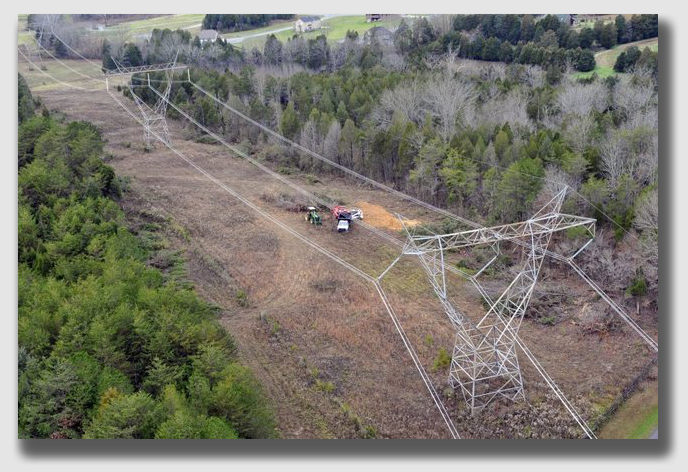
When you found out that the new vegetation management policy would result in TVA cutting down more than 200 trees, you decided to take action.

That’s what Donna Sherwood and a host of neighbors did, suing TVA in U.S. District Court. They argued that TVA had improperly classified the so-called 15-foot rule as routine maintenance which was exempt from the National Environmental Policy Act. In fact, Ms. Sherwood contended, the new 15-foot rule would essentially denude 260,000 acres, a square of land over 20 miles to a side. Besides, Ms. Sherwood argued, TVA didn’t have the right to remove trees in its right-of-way that did not interfere with or endanger the transmission lines.

The District Court threw out the case, holding that TVA had complied with the NEPA and that the easements clearly encompassed the removal of timber. The plaintiffs asked the court to submit the easement interpretation issue to the Tennessee Supreme Court, a procedure known as certifying a question. The District Court ruled that it didn’t need to certify the question because state law was well settled. The easements pretty clearly gave TVA the right to clear trees from its right-of-way.

The Court of Appeals reversed the District Court, but the decision didn’t give the neighbors much comfort. The appellate court held that the record did not demonstrate that TVA had complied with NEPA, so the case was remanded to the District Court to compile the record. But on the crucial issue, the Court held that substantial Federal interests, as well as Tennessee law, supported a reading of the old easement Grandpaw created to encompass the 15-foot rule and clear-cutting a swath as wide as the limits of the easement (in some cases, 200 feet).

The likelihood that NEPA would stop TVA is about as likely as your electric bill falling by 50%. That being the case, Ms. Sherwood is undoubtedly scratching her head with gleeful puzzlement that TVA announced, after the appellate decision , that it would abandon the 15-foot rule without further litigation.

nopruning141229

The neighbors thought they had won… but the matter wasn’t settled in court. Later this week, we’ll see what that meant when the chainsaws came out again.

Sherwood v. Tennessee Valley Authority, 590 Fed.Appx. 451 (6th Cir. 2014). The Tennessee Valley Authority (TVA) provides electric power to consumers in seven states across the Southeast. To reliably deliver that power, TVA maintains the vegetation under and around its power line structures. Historically, TVA has removed all trees directly under its power lines, but did not cut down all of the trees in what TVA called buffer or border zones, the edges of the easements TVA possesses.

Over the years, TVA acquired easements that are typically between 75 and 200 feet wide. Built within those easements are approximately 15,900 miles of power transmission lines. Those easements permit the TVA “the perpetual right to enter” and “to erect, maintain, repair, rebuild, operate, and patrol” electric power transmission lines and all necessary appurtenances. Additionally, the TVA is granted the “right to clear said right-of-way” and is allowed to maintain the right-of-way clear, including the removal of brush and trees. TVA has established a vegetation-management program for its easements. TVA maintains the easements by keeping the area beneath the transmission lines clear while leaving a narrow buffer zone on either side of the easement. The sectors are on five-year cycles for tree removal and three-year cycles for mowing or spraying the undergrowth.

Although the TVA has been maintaining the vegetation in its easements for more than seventy years, it has not removed all of the taller, mature trees located within its rights-of-way. Its right-of-way specialists have been afforded discretion in deciding which – if any – trees to remove. Budget constraints have further restricted the discretion afforded the specialists. As a result, many tall trees remain standing within TVA’s easements. TVA has also made exceptions when landowners have promised to control the height of the trees.

After the August 2003 Northeast U.S. blackout, the wisdom of allowing these taller trees to grow within electric transmission line easements was called into question. In 2007, NERC established rules for vegetation management around electric transmission lines.

TVA altered its vegetation-management practices to comply with the new NERC rules and to avoid paying fines and penalties. TVA may allow low-growing species (less than 15 feet at mature height) to be planted within the right-of-way but not directly under transmission lines, with express TVA approval required in each case. It would no longer allow taller, incompatible trees (species that exceed 15 feet mature height) within its rights-of-way, even if landowners promise to control tree height. TVA would remove all incompatible species from its rights-of-way.

A TVA spokesman said TVA would have a “zero tolerance policy,” explaining that “we’re going to remove trees that can grow 15 feet or more. We’re also going to clear the full width of the easement.”

Donna Sherwood and her neighbors sued, arguing that TVA’s new policy would result in the removal of millions of taller, older, mature trees from TVA’s rights-of-way. They argued that TVA had failed to conduct the required NEPA studies before implementing this new rule. The plaintiffs have submitted evidence showing that TVA identified more than 200 trees for removal from plaintiffs’ properties. The plaintiffs submitted evidence of the environmental consequences of removing tall, mature trees from the easements.

The district court granted TVA’s motion to dismiss the plaintiffs’ claim that TVA had exceeded the scope of the easements, denying the plaintiffs’ motion to certify a question to the Tennessee Supreme Court. After reviewing the record, the district court held that TVA had not established a new policy, instead acting consistent with the maintenance policy that had been in place for the past fifteen years. Finally, the district court held that TVA’s 2012 vegetation-maintenance policy was not arbitrary or capricious.

The plaintiffs appealed.

Held: The plaintiffs’ request that the District Court certify a question of state property law to the Tennessee Supreme Court was rejected. However, the record showed that TVA had not adequately considered the environmental consequences of its new 15-foot policy, so the case had to be sent back to the District Court.

Easement141229As for the NEPA claim, the Court of Appeals held that the administrative record submitted by TVA did not consider the environmental consequences of the 15-foot rule. The Court held that the plaintiffs were alleging that TVA’s alteration of its vegetation-maintenance practice – the removal of all trees over 15 feet, as well as those trees that will grow to a height over fifteen feet – constituted a major federal action under NEPA. The TVA must compile an administrative record for the decision it made that is being challenged by the plaintiffs, in order for the court to evaluate the decision’s propriety under NEPA.

As for the scope of the easements, the Court of Appeals agreed with the District Court that “[b]ecause federal interests are sufficiently high in this matter, the easements are governed by federal law, not state law.” When the United States is a party to a lawsuit, and the underlying activities arise from a federal program, the federal interests implicated may warrant the protection of federal law.

The Court also agreed that the unambiguous language in the easements gave TVA the perpetual right to remove trees. Although state law was not determinative when applied to a Federal easement, the Court said, under Tennessee law the scope of an easement created by a grant is determined by the language of the grant. The easements involved here unambiguously give the United States three rights: (1) the right to enter and to construct electric transmission line structures, (2) the right to clear the easements of brush, trees, and timber, and (3) the right to remove danger trees from the surrounding land. In describing the rights granted, the easements use the plural “purposes,” not the singular “purpose.”

The Court said that nothing in the language of the easements, explicitly or implicitly, limited TVA’s right to clear trees from the right-of-way.

Thus, although the NEPA issue remained to be litigated on remand, the easements were broad enough to clear-cut the full width of the easements, regardless of prior practices or the landowners’ opinions as to what was necessary to protect the transmission lines.

– Tom Root