Case of the Day – Tuesday, April 28, 2026

IF I OWE HIM, YOU OWE ME, AND SOMEONE ELSE PROBABLY OWES YOU…

One of the beauties of American tort law (if we’re even allowed to use that phrase, which is doubtful) is that if you’re a defendant, you often can daisy-chain as many other people or entities to share your pain as your creative lawyer can find.

The tragic death of young but substantial teenager Tyre Sampson at a cut-rate Florida amusement park provides a case in point. Tyre, only 14 years old but already a sought-after football lineman (at 6’2″ and 300 lbs) fell to his death from a “Free Fall” ride, billed as the world’s tallest free-standing drop tower. When the tower brakes engaged, Tyre – who exceeded the maximum size for the ride – slipped out of his seat and fell 100 feet.

Tire’s parents sued the park, which in turn will no doubt sue the owners of the ride (who lease the contraption to the park).  They will sue the ride’s installers, who will sue the ride’s builders, who will sue the designers.  At some point, Sir Isaac Newton may become a third-party defendant: if not for him, there’d be no gravity. It’s a tort lawyer’s dream: a daisy chain of defendants, all with deep pockets.

Another example arose several years ago when a mid-air explosion of a Southwest Airlines 737 engine killed one passenger and – but for some serious flying by an unflappable Navy fighter pilot turned airline captain – could have killed hundreds. Let’s say Joe Doaks, a passenger on board who had the scare of his life, sues Southwest for negligence in maintaining the airplane. Southwest could be both the defendant and a third-party plaintiff, in turn suing the maintenance company that inspected the engine last without finding a crack in a turbine blade. The maintenance company could then bring in the engine maker for selling a defective engine, and the engine maker could sue the company that made the blade for defective manufacture, and the blade maker could sue the metal supply company for selling a nickel-based high-performance alloy that did not meet specifications, and the metal supply company can, in turn, sue the company making the test equipment that gave faulty readings that the metal was within limits… Before you know it, Joe Doaks has a chain of six defendants, each pointing the finger at the next guy and claiming that any liability they may have is shared among all of them.

This is generally a good thing for the plaintiff, because the more defendants, the deeper the collective pocket from which to collect. But the daisy-chained defendant has to have a duty to the injured party before it is liable, and the lure of finding someone else with a checkbook to stand in the defendant’s dock with you can lead to some fairly strained interpretations of “duty.”

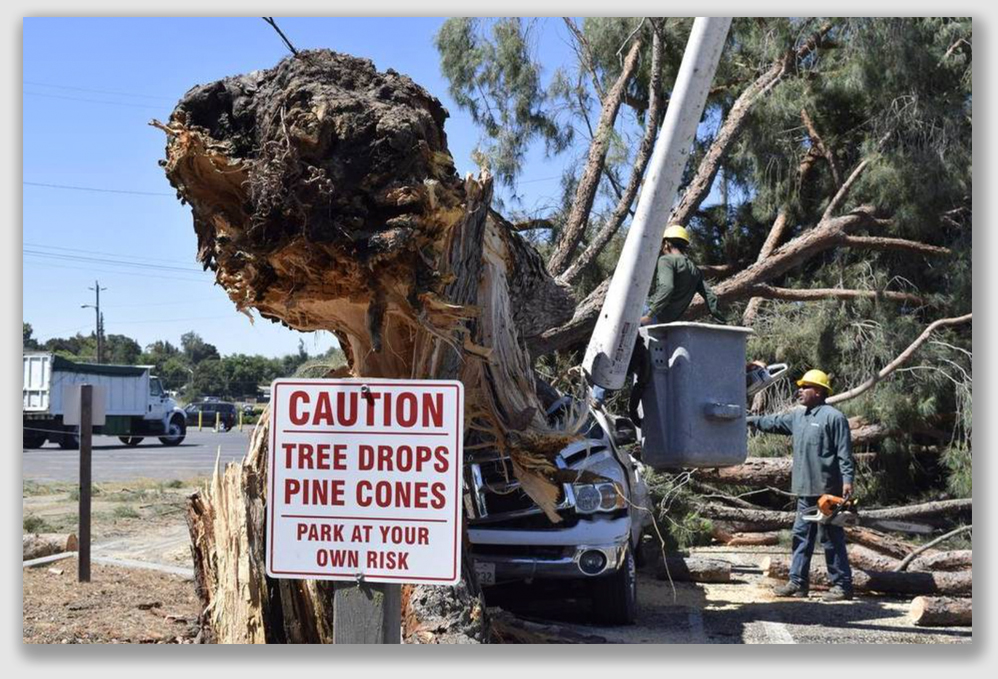
In today’s case, a landlord’s tree dropped a limb onto the heads of two of his tenants. They sued, complaining that the landlord company failed to fulfill its duty to maintain the tree. No argument there – of course it did. But the landlord, looking for someone to share its pain, went after the electric company. Dominion Virginia Power had an easement across the property, the landlord argued, and the defective tree stood within it. The power people, the landlord claimed,  had a duty to keep the trees in the easement trimmed, and thus shared any liability the landlord had to the injured tenants.

Well, yes, the court said, there is a duty there, but there is also some fine print regarding the extent of that duty. And, as the lawyers like to say, the details are where the devil resides

Vaughan v. S.L. Nusbaum Realty Co., Case No. CL15-5895-00/012016 (Virginia Circuit Ct., Nov. 30, 2016), Va. Cir. LEXIS 183. Travis Vaughan and Alexander Goldenberg were injured when the “wind picked up” and they were struck by a falling limb from a tree located at an apartment complex owned and managed by S.L. Nusbaum Realty Co. Travis and Alex sued Nusbaum, who in turn sued Dominion Virginia Power, the electric company. It seems the tree that dropped the limb was located on a utility easement held by Dominion, and Nusbaum argued Dominion had a duty to maintain the tree.
The easement granted Dominion “the right, privilege and easement of right of way, to construct, operate and maintain a pole line for the transmission and distribution of electricity,” and, with respect to the issue before the Court, “the right to trim, cut and keep clear all trees, limbs and undergrowth and other obstructions along the lines or adjacent thereto that may in any way endanger or interfere with the proper and efficient operation of the same.” Nusbaum argued that as holder of the easement, Dominion had the same rights and responsibilities that Nusbaum did, and had “the duty to maintain the easement, including by maintaining any trees growing on the easement.”

Dominion argued it owed no contractual duty to Travis and Alexander to maintain trees located within the easement.

Held: The Court held that Dominion had no duty toward Travis and Alex.

The trial court said the relevant question was whether the duty to maintain the easement right of way imposes a concomitant duty upon Dominion — as the owner of the dominant estate—to maintain all aspects of the tree.

The right to use an easement comes with a duty to maintain it in a manner consistent with the allowed use. Although Virginia courts have apparently not articulated the extent of a power company’s duty under an easement, at least one other jurisdiction has. In a case stemming from a property owner’s personal injury when his heel struck a metal shield on a guy wire supporting a pole bearing equipment of defendants, a New Jersey court held that, as owners of the dominant estate, “defendants were under an affirmative duty to make reasonable inspections of their easement upon plaintiff’s property and to use due care to keep the guy wires and metal shield in good repair.”

Here, the trial court said, the easement does not impose an affirmative duty on Dominion, as owner of the dominant estate, to tend to the tree beyond those actions necessary to maintain the easement in a manner consistent with the use allowed. Dominion has the duty to inspect the easement and make repairs as necessary, including trimming, cutting, and clearing trees, but only to the extent that such trees, or parts thereof, “endanger or interfere with the proper and efficient operation” of the “wires, poles, attachments, equipment and accessories.”

The court said Dominion nevertheless could be liable if Travis’s and Alex’s injuries were caused by its improper maintenance of the easement consistent with its use by, for example, failing to clear portions of the tree from the vicinity of power lines when necessary, trimming the tree in a way that the public was placed in danger, or compromising the health of the tree through improper trimming. Stated differently, the court said, Dominion “must take necessary actions to properly maintain the pole line and its accessories and, if Dominion exercises its right to ‘trim, cut and keep clear all trees, limbs and undergrowth and other obstructions along said lines or adjacent thereto that may in any way endanger or interfere with the proper and efficient operation of the same’ [which is what the easement specified], it must exercise reasonable care in doing so.”

The duty arises from the easement, so the complaint must allege facts to support a breach of that duty. It was not enough for the landlord to say the tree was on the easement and a limb fell to justify bringing the electric company into the lawsuit.

– Tom Root

TNLBGray140407

Case of the Day – Friday, February 27, 2026

THINGS ARE SELDOM WHAT THEY SEEM

Buttercup:        Things are seldom what they seem,
                                Skim milk masquerades as cream;
                           Highlows pass as patent leathers;
                                Jackdaws strut in peacock’s feathers.

Captain:           Very true,
                                So they do.

Things are Seldom What They Seem
(duet with Buttercup and Capt. Corcoran)
Gilbert & Sullivan, H.M.S. Pinafore

Pinafore140317So property rights are as dry as toast? Well, maybe, depending on whether it’s your ox that’s getting gored. Consider Marvin Brandt. This hard-working son of a hard-working lumberman is a Wyoming rancher. His father, who started in the 1930s as a lowly sawmill worker, ended up owning the place. Marvin worked at his Dad’s mill as a youth, and he ended up running the mill himself.

The year of our Lord 1976 was an important year. It was the America’s Bicentennial. I had this hot little Datsun 240Z, a rust bucket if ever there was one, but she screamed. Marvin bought the sawmill from his father. Congress repealed the General Railroad Right-of-Way Act of 1875. And Marvin bought a nice chunk of land for his sawmill – not to mention plenty of standing timber – from the U.S. Forest Service. He obtained it through a procedure known as a land patent, in which the Government deeds its rights in land to private property holders.

It was a pretty good deal, sold to Marvin without many restrictions. There was an easement for the Laramie, Hahn’s Peak and Pacific Railroad, but that wasn’t much of a problem for him. Easements weren’t such an impediment, he thought. But then, things are seldom what they seem…

Buttercup:    Black sheep dwell in every fold;
                        All that glitters is not gold;
                     Storks turn out to be but logs;
                        Bulls are but inflated frogs.

Captain:     So they be,
                        Frequentlee.

The Union Pacific had tracks running through the property that Marvin bought. He wasn’t alone in this: some 30 other people bought Government land subject to the UP’s railroad right-of-way. The right of way originally was obtained by LHP&P in 1908, pursuant to the 1875 Act. The 200-foot-wide right of way meanders south from Laramie, Wyoming, through the Medicine Bow-Routt National Forest, to the Wyoming-Colorado border.

After the railroad line was abandoned, the Government claimed that the land underlying the old track bed had reverted to Uncle Sam. The Washington bureaucrats had plans to turn the route into a hiking trail. When the Government sued to quiet title on the right-of-way, it named all 31 landowners as defendants. None of them owned more than 3 acres affected by the right-of-way, and none of them mounted a defense. They all threw up their hands, folded quietly, and let the U.S. of A. have its way.

Except Marvin.

Marvin may be one of your rugged Wyoming individualists. He may be ornery. But one thing was for sure – unlike the others, Marvin had over 85 acres affected by the old roadbed. Nearly a half-mile stretch of the right of way crossed Marvin’s land, covering ten acres of his parcel and affecting 75 more. In other words, this wasn’t chump change.

The Government, as administrations of either political party are wont to do, tried to steamroll Marvin. The Feds claimed that the LHP&P had owned the land under its rails, subject only to a reversionary interest in the Government if it ever abandoned the line. Therefore, Uncle Sam claimed, when the tracks came out, ownership of the property reverted to the U.S. Forest Service.

The District Court agreed that the 1875 Act and the land patent were not models of clarity, but the Government won anyway. The Court of Appeals reversed. The Government, seeing its Golden Goose about to be slaughtered, appealed to the Supreme Court.

The Supremes, by a resounding 8-1 decision, held that “things are seldom what they seem.” The right-of-way granted to the railroad might seem like a transfer of the land in fee simple, subject only to being returned to the Government if the rail line was abandoned. But it was really only an easement, meaning that the land patent to Marvin had transferred all ownership to him, subject only to the easement. When the easement vanished, the land was all his.

Marvin stood to lose a big chunk of land to the Government.

Marvin stood to lose a big chunk of land – a 200′ wide strip along the north-south road on the west side of his property – to the Government.

The Government’s insurmountable hurdle was its own cuteness. Back in the 1920s, the railroad had planned to drill for oil along the right-of-way (remember Teapot Dome?). The Government had opposed it, claiming that it owned the oil. The railroad, Uncle Sam claimed, only owned an easement. The land (and the wealth under it) belonged to the Feds. The case ended up in the Supreme Court, where the Government won.

But now, the Government argued that things aren’t what they seem to be, and – for that matter – what they seemed to be back in 1942. The Forest Service never owned the land under the railroad when it gave Marvin the land patent. Instead, the railroad did, and the Government didn’t get it back until well after it had sold the rest to Marvin. The 1942 decision must be wrong, to the extent it applied to anything other than oil rights. Thus, the railroad right-of-way reverted to the U.S. Forest Service in 1988, 12 years after the rest of the land was sold to Marvin.

The Supreme Court was not amused. Applying the ancient legal principle that “you dance with the one that brung ya,” the Justices ruled that the Government persuaded the Court in 1942 that the railroad right-of-way was just an easement, and it wasn’t going let the Government change its position now just because it suited it to do so. Alas, the Justice Department (and this is a fault that has belonged to predecessor administrations, Republican or Democrat) all too often has no compunction about changing its arguments for convenience when it should adhere to them for principle. This time, it didn’t work.

Only Justice Sonia Sotomayor dissented, in an opinion that seemed peculiarly strained. Anxious to serve the back-to-nature folks who enjoyed Federally-funded hiking and biking trails, she argued that the 1942 case was only about subsurface rights – which seems to us to be a distinction without a difference – and, anyway, the Brandt decision would hurt the rails-to-trails movement and result in a lot of litigation as private landholders sought to get what was rightfully theirs. This may be so, but cost and inconvenience shouldn’t drive Supreme Court opinions. The law should.

So the right-of-way that the Government once said was an easement but now seemed to be something else, really was just an easement … as it had been all along.

Buttercup:    Drops the wind and stops the mill;
                        Turbot is ambitious brill;
                    Gild the farthing if you will,
                        Yet it is a farthing still.

Captain:     Yes, I know.
                        That is so.


Marvin M. Brandt Revocable Trust v. United States
, 572 U.S. 93, 134 S.Ct. 48, 186 L.Ed.2d 962 (2014): The General Railroad Right-of-Way Act of 1875 provides railroad companies “right[s] of way through the public lands of the United States,” 43 U.S.C. § 934. One such right-of-way, created in 1908, crosses land that the Government conveyed to the Brandt family in a 1976 land patent. That patent stated that the land was granted subject to the right of way, but it did not specify what would occur if the railroad relinquished those rights.

Little Buttercup was right - things are seldom what they seem ...

Little Buttercup was right – things are seldom what they seem …

A successor railroad abandoned the right of way with federal approval. The Government sought a declaration of abandonment and an order quieting its title to the abandoned right-of-way, including the stretch across the Brandt patent. Brandt argued that the right of way was a mere easement that was extinguished upon abandonment.

The district court quieted title in the government. The Tenth Circuit affirmed.

The Supreme Court reversed.

It held that the right-of-way was an easement terminated by abandonment, leaving Brandt’s land unburdened. The Court noted that in the 1942 Supreme Court decision in Great Northern R. Co. v. United States,  the Government had argued a position – that the right-of-way was an easement, not a grant of ownership in fee simple subject to a reversionary interest – which was exactly opposite to its position in this case. In Great Northern R. Co. v. United States, the Court found the 1875 Act’s text “wholly inconsistent” with the grant of a fee interest.

Thingsareseldom140317Now, the Government was asking the Court to limit Great Northern’s characterization of 1875 Act rights-of-way as easements to the question of who owns the oil and minerals beneath a right of way. But nothing in the 1875 Act’s text supports that reading, and the Government’s argument directly contravenes the very premise of Great Northern: that the 1875 Act granted a fundamentally different interest than did its predecessor statutes. Nor do the Court’s decisions in other cases support the Government’s position, and – to the extent that they could be read that way – the Court said clearly that any such implication did not survive its unequivocal statement to the contrary in Great Northern. Later enacted statutes, such 43 U.S.C. §§ 912 and 940, and 16 U.S.C. § 1248(c), do not define or shed light on the nature of the interest Congress granted to railroads in their rights-of-way in 1875. Instead, those statutes purport only to dispose of interests the United States already possesses.

The land patent Marvin Brandt obtained in 1976 included ownership of the land under the railroad company easement. When that easement was abandoned, Mr. Brandt obtained the exclusive right of possession to the land he already owned.

– Tom Root
TNLBGray140407

Case of the Day – Friday, February 13, 2026

CAREFREE MOBILE HOME LIVING

Everything's big in Texas ... don't get stung.

Everything’s big in Texas … don’t get stung.

Texas is a pretty big place. So when Scott, who was selling a little 175-acre spread to Bill and Julie Coales, reserved to himself the right of ingress and egress — basically, a license to use a road through the land — we’re not talking a jungle trail. We’re talkin’ big. And we’re talking about moving a lot of mobile homes.

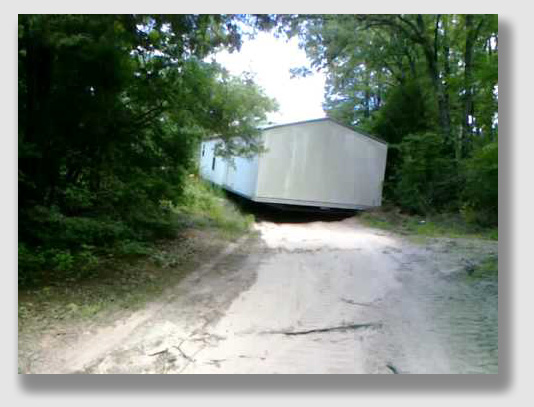
At least, that’s what the defendants said in today’s case. After they bought the place, the Coales decided move Julie’s parents onto the place and to do it in style. So they hauled in some house trailers, no doubt to let the old folks live in luxury. But by doing that, they constricted the 100-foot-wide path, making it harder for the Scotts to haul through … well, whatever big stuff the Scotts had to haul through.

The Scotts sued, claiming that they couldn’t get their own trailers in, drive through with their 18-wheelers, and turn off the road wherever they wanted to with their 4x4s. The Coales disagreed, contending that no one needed more than the small path down the center to get to their properties. Even in Texas.

The trial court disagreed with the Coales, and the Court of Appeals explained with some care why the unambiguous grant of the right of ingress and egress — coupled with the evidence that the Scotts needed the whole width of the former airstrip for moving in their own 18-wheelers, garbage trucks, and, yes, even their own mobile homes — meant that the neighbors’ use of the 100-foot wide, 31⁄2-acre right was “reasonably necessary and convenient.”

The Coales didn't leave the Scotts much space to haul in their mobile home.

The Coales didn’t leave the Scotts much space to haul in their mobile home.

Everything’s big in Texas. Even 100-foot wide driveways.

Coale v. Scott, 2007 Tex. App. LEXIS 7171, 2007 WL 2428631 (Tex.App. Aug. 28, 2007). A 175-acre tract of Texas land was conveyed to Bill and Julie Coale in 2004, reserving to some other landowners “the right of ingress and egress on the part of all landowners” a roadway, which happened to be a 100-foot wide abandoned airstrip. After the Coales bought the property, they started placing two mobile homes on the north side of a trail that runs down the middle of the airstrip. They also installed a storage unit on the south side of the trail, as well as fencing, a ranch gate, and a septic system.

The Coales planned to move their parents into the trailer homes. They contended that “neither of these structures prevented the [other owners] from using the old trail that they and others before them had always used to get to their properties.” The property owners who had the right of ingress sued the Coales. The case went to the trial court jury on the issue of the width and location of the “passageway” across the land. The jury found in favor of the plaintiffs, deciding they had the right to use the entire 100-foot-wide tract for ingress and egress to their adjoining properties.

The Coales filed a rambling appeal, arguing that the plaintiffs were only entitled to a way across the Coales’ property that was reasonable and necessary for them to have passage to and from their property and  imposed the least burden on the Coales’ property.

The Scotts thought their right of egress was fairly wide.

The Scotts thought their right of egress was fairly wide.

The jury’s finding was upheld. The Court noted that under Texas law, the terms ingress and egress indicate rights inherent in the owners of the dominant estate to pass through the servient estate. They do not imply the right to linger for recreational purposes. The owners of the dominant estate are entitled to the rights granted by the deed or grant instrument, and no more.

A grant or reservation of an easement in general terms implies a grant of unlimited use such as is reasonably necessary and convenient, and imposes as little burden as possible on the servient owner. As for the extent of the right, in the case of an unambiguous written instrument, courts will give effect to the intention of the parties as expressed by or as apparent from the writing.

Here, the Court said, the grant expressly provided “[t]his roadway is subject to the right of ingress and egress on the part of all landowners in the above described 173.45 acres tract.” No mention was made of any other rights of use, and none may be implied. The Court saw no reason to go outside of the clear language of the express grant. There was no dispute that the 3.629-acre tract was 100 feet wide. Instead, the dispute centered on what the Coales believed the plaintiffs actually needed to use for their rights of ingress and egress. The Coales argued the plaintiffs were only entitled to a way across the Coales’ property that was reasonable and necessary for them to have passage to and from their property, and that the dirt or gravel road that ran down the middle of the airstrip.

The Coates planned to install their parents in a nice, carefree mobile home.

The Coates planned to install their parents in a nice, carefree mobile home.

The Court, however, held that the plaintiffs were entitled to the rights granted by the instrument, and no more or less. A grant or reservation of an easement in general terms implies a grant of unlimited reasonable use such as is reasonably necessary and convenient and as minimally burdensome as possible to the servient owner.

Here, the jury considered the language in the deed, a survey depicting the properties, the legal description of the properties in the tax records, photographs, and other testimony. One witness testified that for the past 20 years, he had turned into his property from any point on the airstrip. There were no gates or fences. He said the trailers the Coales placed on the airstrip impeded his access to his land, and if he were still driving his 18-wheeler, he would possibly drive over the Coales’ plumbing lines. Another witness testified she had used the whole width of the airstrip to bring her trailer into her land. Another witness testified that because of the Coales’ trailers, “you can only go one way. And if you want to pass two ways, you can forget it.”

Previously, cars going in the opposite direction could travel simultaneously by using the entire width of the airstrip. Now, one has to pull over to let the other one pass. Based on the evidence, the Court said, there was legally sufficient evidence to support the jury’s finding that the use of the entire 100 feet of the airstrip was reasonably necessary for the plaintiffs’ right of ingress and egress.

– Tom Root

TNLBGray140407

Case of the Day – Wednesday, January 28, 2026

CLIPPING

The Super Bowl® brand football game (which, as my old friend David Oxenford has made clear, is a registered trademark of the  NFL) will be upon us before we know it. Everyone I know is already excited beyond all reason that the Seattle Seahawks – who brought us one of the worst Super Bowl® brand football games in history the last time they appeared – are willing to risk being deflated by the Belichick-less New England Patriots.  Already, the commercial teasers are airing.

Alas, if Bill Belichick attends the game, he’ll need tickets. The Grumpy Lobster Boat Captain didn’t have a stellar season at the helm of the North Carolina Tar Heels and probably longs for the days of secret video and soft footballs.

But we both honor and follow the rules here at treeandneighborlawblog.com. Today, I review the old 15-yard standby, clipping. The clipping in today’s case was done not by a offensive player, but rather by an electric utility.

Tree trimming along and under an easement to protect power lines is typically done according to standards set by the North American Electric Reliability Corporation, known as NERC. Standards for tree trimming sound dry to you? Maybe a little looting, people trapped in elevators, and a power outage affecting 50 million people will get your attention. The great blackout of August 2003 had many contributing causes, but it all started when power lines – sagging in the heat of the day and under the load put on the system – became entangled in poorly-trimmed trees.

blackout140131OK, tree trimming is important work. And so it was in Louisiana. It seems that a road was widened, and power lines were relocated as a result. The electric utility came along to clip vegetation along the route, but ran into Mr. James, who objected to the vigorous removal of trees and brush. He kept running the crews off, until the utility sued for a ruling that it had an agreement with the city that superseded Mr. James’ complaints.

That’s where things got interesting. Mr. James and the utility signed an agreement that permitted the utility to trim back to the historical trim limits or to an established limit according to the kind of tree. No sooner was the ink dry but Mr. James argued that the utility had violated the deal. He sought all sorts of damages — even emotional distress — for the alleged violations.

The utility of course loaded up at trial with three of four experts, who carefully showed that the trees were cut back to their historical trim point and no more. The trial court found for the utility. On appeal, the Court agreed that despite all of the tort theories and general complaints alleged by Mr. James, because he had signed the deal with the utility, the only question was whether the deal had been kept. And as for that, the utility’s thundering herd of experts trumped Mr. James’ speculation.

With the new NERC reliability standards requiring more aggressive vegetation management, it is likely that clashes as to the extent to which utilities may trim will be more frequent and substantial. Thus, there are likely to be more Mr. James v. Entergy battles throughout the country.

Entergy Louisiana, Inc. v. James, 974 So.2d 838 (La.App. 2 Cir. 2008). In 1991, Highway 143 — located next to Tupaw Manor Apartments — was widened. Entergy’s distribution lines ran along Highway 143 and with the widening of the highway, several poles were relocated. Three poles were placed so that the lines crossed the highway diagonally to the southeast corner of the apartment complex. The distribution lines at issue were contained within what Mr. James, the owner of the apartments, characterized as a “green zone” that buffers the apartment complex from the highway traffic, adding to the aesthetic value of the complex.

Tree trimming - boring. Mass panic - not so boring.

Tree trimming – boring. Mass panic – not so boring.

Entergy hired West Tree Service to trim vegetation encroaching on electrical distribution lines, the work to be done in compliance with Entergy’s “Distribution Vegetation Management Line Clearance Specifications” (“Clearance Specifications”) on file with the Louisiana Public Service Commission. During August 2004, another subcontractor sprayed the area with herbicide. Then, West cleared vegetation that had been sprayed and performed additional trimming on Mr. James’ property as per Entergy’s contract. Mr. James objected, but the West crews made several additional attempts to trim vegetation on the property. Unable to obtain consent from Mr. James, Entergy filed a petition asserting that it had an agreement with the city of West Monroe to operate electric facilities within the city and had a right-of-way easement onto Mr. James’ property for maintenance purposes. Mr. James answered and demanded damages in excess of $410,000. He claimed that Entergy engaged in the clear-cutting of trees, harvesting and removing over 200 trees, far in excess of the allowed or agreed upon width of trimming.

Prior to trial, the parties entered into a stipulated declaratory judgment in which they agreed that Entergy has the right to maintain all of its electric distribution lines and poles by trimming any encroaching trees, limbs, shrubs and other vegetation within 10 feet of Entergy’s lines in accordance with modern arboretum standards and as specifically outlined in Entergy’s Clearance Specifications, and as long as Entergy complied in good faith with the vegetation maintenance standards, Mr. James would have no right to prohibit with Entergy’s reasonable and necessary trimming of encroaching trees, limbs, shrubs and other vegetation along its distribution lines.

The Clearance Specifications provided that at a minimum, all trees would be trimmed back to the previous trim point or according to a table, whichever was greater. The table provided that slow-growth trees in rural settings would be trimmed to 10 feet and fast-,growth trees in rural settings would be trimmed to 15 feet. An exception would be made where there was a customer refusal where procedures outlined in the Clearance Specifications have been followed, provided that the exception would not result in unsafe conditions or jeopardize reliability.

Mr. James argued Entergy could only trim to an indefinite width depending on the extent to which it had actually claimed and used a right-of-way in the past or 10 feet under the Clearance Specifications. Mr. James alleged that Entergy exceeded the allowable width, causing damage to the aesthetic value of the “green zone” around the apartment complex. Mr. James filled out a Tree Cutting Refusal Form expressing his objection to having any trees removed, which he contended requires Entergy to then seek a court order to continue trimming. Entergy’s letter to Mr. James noted that the trimming was necessary to ensure safe, reliable electrical service to the area, including the apartment complex.

Entergy sued to get the court order. At trial, Entergy provided detailed testimony regarding the existence of a prior trim point, and that all trimming was within that point. Mr. James provided testimony that there were log trucks being loaded with cut trees coming and going from the property, which was contradicted by West employees. The trial court framed the issue as whether Entergy had complied with its Clearance Specifications in performing the trimming and found that Mr. James failed to carry his burden of proof and was, therefore, entitled to no damages. He appealed.

Held: Entergy had the right to trim the vegetation. The Court concluded that the stipulated declaratory judgment signed by the parties prior to trial controlled the allowable trimming width of the vegetation on the James property. Thus, the issue was whether Entergy complied with its Clearance Specifications. Entergy produced several qualified witnesses, whose testimony was thoroughly outlined by the trial judge, who found strong evidence of re-sprouts and prior trim points. The Court found no abuse of discretion. Although the Court noted that the Clearance Specifications might, in certain circumstances, lead to unauthorized, increased and unchecked trimming on private property, it concluded that under the specific facts of the case, Mr. James was bound by the stipulated declaratory judgment.

– Tom Root

TNLBGray140407

Case of the Day – Thursday, January 22, 2026

SMALL SQUABBLES, BIG PRINCIPLES

We like to deal in broad pronouncements of property law here, but the sad fact is that a lot of litigation about property rights is pretty small-minded. The parties today, Steve and Maggie, had a fairly common arrangement. Steve’s house was landlocked, but he owned an easement to cross Maggie’s place on a driveway.

The easement was 50 feet wide, but the drive itself was only 12 feet wide. We cannot tell who started the sniping. Maybe it was Steve, who piggishly demanded dominion over all 50 feet of the easement, whether he used it or not, banning Maggie from landscaping even where it did not interfere with the driveway. Maybe Maggie set out to harass Steve by installing fences, placing ornamental boulders and planting trees to crowd the driveway.

Clearly, however, things devolved to the point that both Steve and Maggie felt it was worth it to pay lawyers to slug it out in court. Not that we think that’s all bad: lawyers have to eat, too. But the law was pretty settled, and it seems that the lawyers should have dragged their respective clients by the ear into a conference room, where the facts of life (and litigation) could be explained.

Still, there’s a worthwhile principle here for the many homeowners who complain to us every year about various utilities coming through their yards, trimming or removing trees, tearing up bushes and laying waste to landscaping. The utilities invariably wave their easements at the homeowners and say, “Read it and weep.”

The homeowners angrily ask, “Can they do that?”

Then, we have to explain that the homeowner holds what is called a “servient estate,” which is as subordinate and groveling to the easement holder (the “dominant estate)” as the names imply. The utilities and their marauding contractors can do what is reasonable to permit them to get the benefit of the easement for which they bargained.

As well, there’s a second worthwhile principle in today’s case. If you get into a kerfuffle as a property owner or an easement holder, try to work it out. The old legal aphorism is true: a bad settlement is better than a good lawsuit.

Campbell v. Sullivan, Case No. FSTCV166028793S (Superior Ct. of Connecticut, Dec. 11, 2017) 2017 Conn. Super. LEXIS 5104: Maggie Sullivan is the homeowner at 1 Lennon Lane in Wilton. Steve Campbell owns the abutting property at 2 Lennon Lane. Steve has an easement for a 50-foot-wide strip across Maggie’s property to be used as “a right of way for all lawful purposes of ingress and egress, including public utilities.” The easement is the only way Steve has to get from the street to his property.

The fifty-foot-wide right-of-way described by this easement contains a paved driveway about 12 feet wide known as Lennon Lane.

Steve sued Maggie, claiming that over time, she had placed rocks and erected fencing within the 50-foot right of way, as well as “allowing” trees and other overgrowth to impede ingress and egress through the easement. Maggie argued that any actions she has taken to encroach into the easement are minimal, reasonable, and do not impede Steve’s access to 2 Lennon Lane. For her part, Maggie complained that Steve had trimmed trees and other plants within the 50-foot right-of-way, which are actually located on her property, without her consent. Steve responds that he is entitled to the entire 50-foot right-of-way granted by the easement, and that anything Maggie places within the 50 feet violates his rights.

Held: Steve and Maggie couldn’t work things out for themselves, so the court did it for them, giving each a little and taking from each a little.

To figure out the nature of Steve’s rights, the court started with the deed itself and then looked at the situation of the property and the surrounding circumstances, all in order to “ascertain the intention of the parties…” The language of the grant is given its ordinary meaning in the absence of anything in the situation or surrounding circumstances which indicates a contrary intent.

The principle is that the “holder of an easement… is entitled to use the servient estate in a manner that is reasonably necessary for the convenient enjoyment of the servitude.” This means that the easement holder can use the easement in any way reasonably necessary to fulfill the intent of the parties. The court held that the “right of way is for ingress and egress. This is broad enough to include the ability to turn around, reverse, and enter and exit safely. It does not include the right to park on the right-of-way. On the other hand, merely because the defendant owns the fee in the right of way, she does not have the right to obstruct the plaintiffs’ right for all lawful purposes of ingress and egress.”

The court said it was Steve’s job to maintain the easement, but his maintenance had to be reasonable. “The holder of an easement,” the court said, “is not entitled to cause unreasonable damage to the servient estate or interfere unreasonably with its enjoyment. The law is settled that the obligation of the owner of the servient estate, as regards an easement, is not to maintain it, but to refrain from doing or suffering something to be done which results in an impairment of it.

Under these circumstances, the court said, Steve has no right to compel Maggie to maintain it for his benefit. He had to do it, and do it “in a reasonable fashion.”

Steve spun a tale about expecting “prefabricated modules” that would be used as additions to his house. He said he would need at least 30 feet of the 50-foot easement for the trucks. It turned out, however, that Steve had not exactly ordered the prefabs yet, did not know when he would order them and when he would pay for them. The court was unimpressed, saying, “As of the time of this decision, the plaintiff’s plans to remodel his home are not definitive reasons as to why… he would need access to the entire fifty-foot right-of-way.

The court ordered some of the rocks, fencing and bushes removed. It prohibited Steve from parking in the easement and limited tree trimming to one area where the branches interfered with ingress.

– Tom Root

TNLBGray140407

Case of the Day – Tuesday, January 13, 2026

BOB AND TED’S EXCELLENT ADVENTURE

In these days, when so many people do the bare minimum needed to get by, it’s refreshing to read about a pair of go-getters like Bob and Ted. When the Weisslers built their dream home on the Finger Lakes in Palmer, Alaska, they arranged for electric coop Matanuska Electric Association to provide electric power. They signed off on an easement with MEA for a 4-foot-wide easement, a matter of some importance to the Weisslers, who wanted the maintain their privacy by cutting as small a swath through the trees as possible.

A work order was drawn up for the electric installation, noting “R2-4, 80 ft,” which in MEA-speak meant a four-foot right of way, 80 feet long. MEA dispatched Bob and Ted to clear the path on Weissler’s property. Ted admitted that they knew the clearing was to be four feet wide, 80 feet long, but the boys were energetic and looking for a chainsaw adventure. They cleared the stately pines from the road all the way to the northeast corner of the house and then, spying the meter box on the southeast corner of the building, decided to continue to clear to that corner as well. Ted knew the Weisslers wanted electrical service as soon as possible, and he and Bob figured they were exceeding expectations by enlarging the clearance to get the lights turned on that much quicker.

Their enthusiasm was as unbridled as their chainsaws were sharp. Bob and Ted cut a swath that, instead of being four feet wide, was up to 21 feet wide. The cutting cleared about 1,200 square feet, some four times what the work order called for and what the Weisslers wanted.

The Weisslers sued MEA for breach of contract and trespass, claiming treble damages for loss of timber under Alaska Statute 09.45.730. Punitive statutes mandating double or triple damages for wrongful cutting of timber are common in virtually all states, on the theory that merely requiring a wrongdoer to pay the value of the tree was insufficient deterrence when the cutting was reckless or intentional.

There is always a tension in calculating damages when the trees cut were not for commercial timber. It’s straightforward where the stand of timber is kept for sale. The plaintiff does some timber cruising, and the stumpage value is set. The trial court then trebles it and sometimes (depending on the state) dumps in attorneys’ fees, too. But what happens when the loss is of trees that lack much commercial value but are of great value to the homeowner… say, like the Weisslers, the homeowners love the privacy a stand of trees affords. Here, as the proper measure of damages, the court chose the cost of restoring the property to its approximate pre-cutting condition. The judge awarded compensatory damages of $5,250.00 ($4,050.00 restoration costs and $1,200.00 for maintenance) and then applied the treble damages provision of AS 09.45.730, ultimately ordering payment of $15,750.00, as well as attorney’s fees of $2,200.00 and interest of $6,300.00, for a total judgment of about $25,000.00.

MEA argued vigorously that the treble damages statute did not apply to cases like this one, where it was lawfully on the property but just sort of exceeded its brief. The statute provides that treble damages apply unless “the trespass was casual… or the defendant had probable cause,” in which case, only actual damages may be recovered. But the appellate court said ‘nothing doing.’ “Casual” means, essentially, negligent entry onto the property, such as if a car swerved off the road and hit a tree. MEA’s crew intentionally went beyond the easement and meant to cut down the trees.

As for “probable cause,” the court said that means “an honest and reasonable belief.” Ted and Bob knew the easement limits. They went beyond them, and – good intentions aside – they were trespassers, and not casual ones, either.

Matanuska Electric Association v. Weissler, 723 P.2d 600 (Alaska 1986). A couple of overzealous electric utility workers cleared a swath of up to 21 feet wide to bring electric service to a new home, even though the homeowner had given the utility only a 4-foot wide easement. The homeowners sued for trespass and asked that Alaska’s treble damages statute for wrongful timber cutting be applied.

The trial court agreed and trebled the damages, which were based in the first instance on the cost of restoration of the property. The homeowners won a $25,000 judgment. The utility, MEA, appealed.

Held: MEA was liable for treble damages. The utility argued that the treble damage statute’s primary purpose was to deter those who pursue their own objectives on a public right of way from disregarding the adjacent landowner’s interest. The Alaska Supreme Court rejected that argument, pointing out that “MEA’s construction of the statute would allow the most willful of trespassers, i.e., those who enter onto timber land to cut and sell another’s merchantable timber, to be liable for only single damages.”

MEA also argued that urges the court to apply common law principles governing punitive damages. Punitive damages require malice, MEA argued, and there was none here. The Supreme Court looked to Oregon’s treble damages statute (the law on which Alaska’s version was based). The Oregon courts had held that the legislature properly exercised its prerogative to define when single damages should apply and when treble damages should apply. The legislature abrogated common law here, and the statute is reasonable.

The statute requires that the trespass be without lawful authority, and MEA argued that it did not trespass because it had the Weisslers’ permission to be there. But, harkening to the Restatement (Second) of Torts § 168 comment d (1965), the Court held that the rule is well recognized that “one who has a private easement of way becomes a trespasser when he goes beyond its boundaries.” MEA exceeded the scope of the easement that the Weisslers granted and thus trespassed without lawful authority.

But, MEA asserted, any trespass it committed was “casual,” and hence only single damages should be awarded. MEA contended the trial court “found MEA’s excessive cutting to be the result of negligence and mistake,” but the Alaska Supreme Court disagreed. While the trial judge said that this was not a case where people were “recklessly cutting down other people’s trees without regard for them,” she nevertheless described MEA’s conduct as negligence “verg[ing] on recklessness.” At any rate, “casual” does not mean negligent. Instead, it comes from a 19th-century New York statute, in which “casual” meant “casualty” or “involuntarily,” contrasted with “designedly and under a claim of right.”

“Casual,” the Court said, “does not include a mistaken belief in the authority to cut trees.” A trespass committed under a negligently mistaken belief in the right to cut would not be “casual,” the Court said, because “the trespasser intends to cut.” Only where the trespass is unintended is it “casual.” Once a trespasser forms an intent to enter the land, the trespass becomes “willful,” and the plaintiff may recover treble damages.

The Court said, “MEA’s negligent decision to exceed the scope of the Weisslers’ permission to cut cannot qualify as ‘casual’ negligence. MEA’s agents intended to cut the trees under a mistaken belief that Weissler would approve. Since MEA’s agents intended to cut, their actions were not ‘casual’.”

Finally, MEA lacked probable cause to cut the Weisslers’ trees. The statute awards only single damages where a defendant had probable cause to believe that the land on which the trespass was committed was the defendant’s own or that of the person in whose service or by whose direction the act was done. The Court said that probable cause means “an honest and reasonable belief.” By definition, the Court ruled, “a negligent mistake as to authority cannot qualify as probable cause since negligence involves unreasonable conduct.

The Alaska Supreme Court concluded that the tree damages statute “mandates treble damages unless the trespasser exempts him or herself” by proving, as an affirmative defense, that single damages apply.

– Tom Root

TNLBGray140407

Case of the Day – Monday, December 22, 2025

WHEN THE GAS COMPANY COMES A CUTTIN’

I’ve told you before to beware of what lurks in the dark and malevolent corners of your deed. Today, we’re going to look at a cautionary tale.

No one really thinks about the wording of easements when the power company or the gas folks come by with some standard form clipped to a dollar bill. The utility reps tell you that it’s no big deal because the language is standard, no one can change it, and anyway, all your neighbors have signed off on the same form, so what’s the big deal?

I’m not a public utility, so I’ll tell you what the big deal is. Or, better yet, show you.

Consider New Jersey. Please. Just for right now. In East Brunswick, New Jersey (city motto: “We’re located at Turnpike Exit 9″), a gas transmission company had acquired an easement for a 3-1/2 foot wide natural gas transmission pipe through some unimproved land back in 1967. The property – once used only for mob hits and toxic waste dumping (just kidding) – was sold sometime after the easement was granted. At some point, a housing development was over a 42” high-pressure gas line the company had buried inside the easement.

The utility had always patrolled its pipeline and was well aware of the 19 oak trees growing along the street, 40 inches above the pipe. But when new evidence showed that tree roots could cause catastrophic pipeline failures, the gas utility announced it intended to cut down the trees.

newjersey150908

The property owners, who probably had never bothered to read all of the boring stuff in their deeds that followed the “Know all Men by These Presents …” part, were outraged. They complained that the gas utility shouldn’t be allowed to cut the trees now because it hadn’t ever bothered to before. This argument is called “laches,” based on the old legal maxim that “equity aids the vigilant.” Or, as some like to say, “Don’t sit on your rights.” The owners argued that the gas company had never tried to remove the trees before, and – 40 years after obtaining the easement – it should not be allowed to do so now.

What’s more, the owners contended, the gas company couldn’t really prove the 19 trees were hurting anything.

Horrors! Imagine buying land subject to an easement, only to have the easement holder actually try to exercise the easement rights! As they say in New Jersey, “Oh, the humanity!” The gas utility carefully showed how new techniques had determined that tree roots could weaken high-pressure supply lines and, in fact, had caused some spectacular failures. The property owners could only muster an expert who opined that the tree roots in question probably wouldn’t grow that deep.

The Court of Appeals agreed with the trial judge. The gas company didn’t have to show that the tree roots were damaging the line, only that it had a reasonable basis for keeping roots away from its pipe. The evidence easily did that. As for the laches argument, the Court agreed that the nonuse of an easement in New Jersey didn’t result in the loss of the right. Plus, the Court said, the gas company had a good reason for not seeking to remove the trees until it did, as science had only recently determined that tree roots and gas pipelines didn’t mix.

Township of East Brunswick v. Transcontinental Gas Pipeline Corp., 2008 N.J. Super. Unpub. LEXIS 27, 2008 WL 2627688 (N.J.Super.A.D., July 7, 2008). Transcontinental (“Transco”) operates an interstate natural gas transmission system that runs from the southern Atlantic seaboard to New York City. One of its main lines, the Lower Bay Line, runs across East Brunswick and along Timber Road. This 42″ high-pressure gas line was built in 1967.

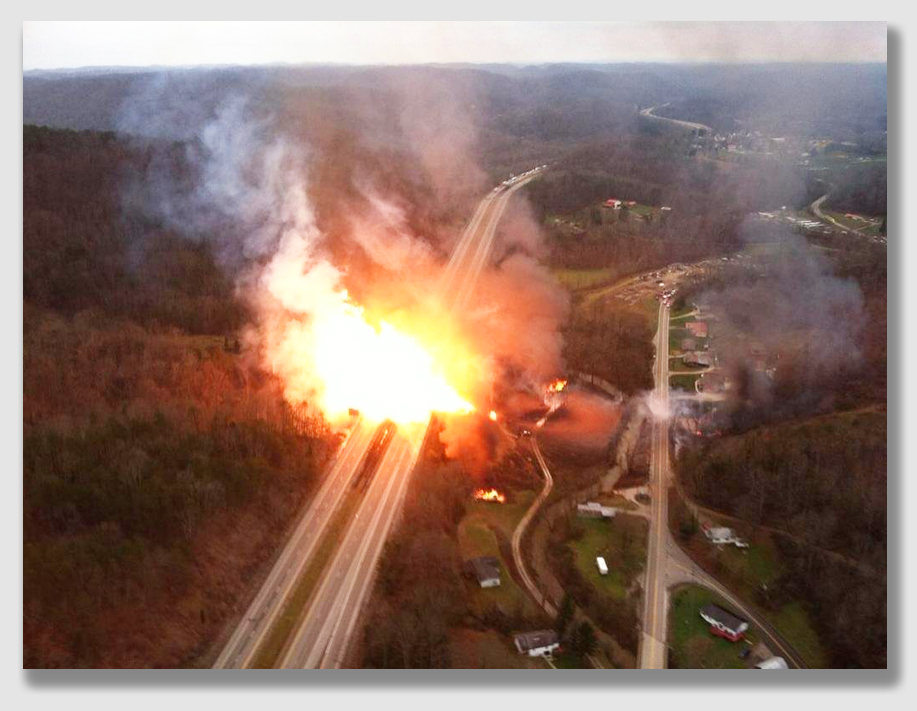
When trees fall on power lines, the lights go off for a few hours. When gas transmission lines are breached by tree roots, the misadventure that follows is usually much more energetic.

When trees fall on power lines, the lights go off for a few hours. When gas transmission lines are breached by tree roots, the ensuing misadventure is usually much more energetic.

Transco held a 100′ wide easement for the pipeline under a right-of-way agreement “for the purposes of laying, constructing, maintaining, operating, repairing, altering, replacing and removing from time to time one or more pipelines … together with such other rights as may be necessary or convenient for the full enjoyment or use of the rights herein granted [including] the right to enter upon the right of way and easement … at such times as Grantee may elect … and the right from time to time to keep said right of way free from trees, undergrowth and all other obstructions that may endanger or interfere with the construction, operation and maintenance of Grantee’s pipe lines[.]”

The owner sold the property subject to the easement, and in the 1980s, it was developed into a residential community of single-family homes. The easement covered the width of Timber Road, the sidewalks, and portions of residents’ front yards. The pipeline was buried 40″ deep and runs along one side of the street in the public space between the sidewalk and the curb.

Nineteen shade trees were planted sometime in the 1980s between the sidewalk and the curb, so they were growing directly above the pipeline. Transco knew of these shade trees because it regularly inspected and monitored the pipeline.

Natural gas pipelines must be properly maintained and monitored because any rupture can cause severe damage. Transco monitored the pipeline and conducted an extensive on-site inspection program of the Lower Bay Line pipeline right-of-way. An inspector walked directly over the pipeline at least once a year to perform ground tests to determine if natural gas was leaking. The right-of-way was patrolled almost daily by vehicle. It was inspected weekly by air to determine if any unauthorized excavation occurred in the area and to detect early signs of leakage.

Concerned about damage to the pipeline’s protective coating by tree roots, maintaining a clear line of sight along the pipeline, and preventing any delays in reaching the pipeline in an emergency, Transco tried to remove the 19 trees above the pipeline as part of a larger effort to remove trees above all of its pipelines in the area. The residents sued for a temporary restraining order enjoining Transco from removing the trees. Transco argued it had an absolute legal right to remove the trees under the right-of-way easement. Plaintiffs argued there was a genuine issue of material fact whether the trees endangered the pipeline and whether their removal was reasonably necessary for Transco’s enjoyment of its easement right. No evidence was adduced that the tree roots were currently damaging the pipeline, but there was evidence of potential harm.

A 2004 investigation revealed metal losses in the pipe walls ranging from 6% to 15% at various locations along Timber Road. Additional testing in 2005 uncovered pipeline coating defects or interruptions at some of the same places where the metal anomalies were discovered, but neither inspection definitively determined that tree roots caused the damage. Finding that Transco need not wait for actual damage to its pipeline before exercising its express easement rights, the judge concluded, “the record indicates that tree roots may damage the protective coating of the pipeline …. [and][f]urther, efforts to keep the protective coating of the pipe intact [are] part of the necessary maintenance program for a pipeline.” The judge also reasoned that while the pipeline’s path was marked with yellow markers, the trees detracted from the area’s appearance as a right-of-way and may lead to third-party interference with the pipeline, a major cause of pipeline accidents. The Court granted summary judgment for Transco.

The plaintiffs appealed.

easement150908Held: Transco had the right to remove the trees. The Court said the primary rule of construction is that the intent of the conveyor is normally determined by the language of the conveyance read as an entirety and in the light of the surrounding circumstances. Here, the easement plainly and expressly gave Transco the right to remove trees when they may endanger or interfere with the construction, operation or maintenance of the pipeline. The language specifically stated the grantee had “the right from time to time to keep said right of way free from trees, undergrowth and all other obstructions that may endanger or interfere with the construction, operation, and maintenance of Grantee’s pipelines….” The easement also clearly gave Transco the right to remove trees if they interfered with Transco’s immediate access to the right-of-way. The plain language of the easement gave Transco the express right to remove trees and did not require actual damage to or interference with pipeline operations before the trees were cut. The easement permitted preventive action to avoid potential harm, disruption, or interference with the operator’s pipeline.

The uncontroverted evidence showed that the pipeline and its coating along Timber Road had been damaged. Although there was no proof that the damage was caused by tree roots, other sections of Transco pipelines and their coatings in New Jersey had been damaged by tree roots. The Plaintiff had no proof to the contrary, but instead, their expert only posited that “the roots are not likely to interfere in any way with the pipeline;” the root systems are “generally non-invasive;” and root growth is “typically” confined to the upper two to two-and-one-half feet beneath the ground surface. The proof didn’t foreclose the possibility that the tree roots may grow deep enough to interfere with the pipeline, as they had in other sections of Transco’s pipeline.

Plaintiffs also contended Transco was barred from taking affirmative action by the equitable doctrine of laches because it waited so long to exercise its easement rights. But the mere nonuse of an easement cannot destroy the rights granted by it. Rather, clear and convincing evidence of the intent to abandon the easement rights must be shown. In this case, there was no evidence that Transco intended to abandon its easement rights; therefore, any reliance placed by plaintiffs on Transco’s inaction was unreasonable. Also, there was reasonable justification for Transco’s inaction over the years, as it was unaware of the potential danger posed by the tree roots at the time the trees were planted.

The evidence showed that since the trees were planted, there have been three accidents nationwide involving natural gas pipeline ruptures and three incidents in New Jersey in which Transco has discovered that tree roots have damaged pipelines. The Court said that the fact that action had not been taken earlier did not preclude preventive action now, nor did it require waiting for actual damage to occur.

The Plaintiffs did not demonstrate how their interest in preventing the removal of the trees outweighed Transco’s taking preventive measures in the public interest.

– Tom Root

TNLBGray140407