Case of the Day – Wednesday, November 27, 2024

TRIFLES

There is a wonderful doctrine in the law – and the law is a place where we do not really expect to find anything wonderful – that is known as the rule of de minimis.

Mentioning de minimis gives me an excuse for another shout-out to my sainted Latin teacher from days of yore, Emily Bernges (who instilled in me a love of, if not fluency in, that grand Mother of Languages). But more to the point, the de minimis rule is a necessity: if it didn’t exist, we would have to invent it. Simply put, the rule of de minimis holds that some wrongs we suffer are so slight to be unworthy of recompense.

De minimis is the shortened form of “de minimis non curat lex,” which Emily would have told us means that “the law does not concern itself with trifles.” Queen Christina of Sweden, who occupied the throne in the mid-17th century – and who may have studied under Emily, too, for all we know – favored the more colorful adage, “aquila non captat muscas,” that is, “the eagle does not catch flies.”

We sometimes think too many plaintiffs want to sue over trifles. The plaintiffs in today’s case, the Bandys, sure did. The neighbors’ trees dropped sap and leaves on their property, and their roots clogged a sewer line. The Bandys did not find that dandy, and so they sued.

The court was aghast. A tree dropping leaves and sap! Who had ever heard of such a thing?

Besides everyone, that is. Trees drip sap and drop leaves and grow roots all the time. It’s just what trees do. Once the law starts making tree owners pay for that, there will be no end to the litigation.

The neighbor’s leaves fell in your yard? Here’s a rake. Deal with it.

Bandy v. Bosie (1985), 132 Ill. App. 3d 832, 477 N.E.2d 840. Edith and Chuck Bandy sued their neighbors, Jim and Becky Bosie, complaining that the Bosies’ maple and elm trees dropped sap and leaves on the Bandy’s property, and roots from the trees had damaged the Bosies’ sewer line, causing water to back up in their basement.

The Bosies moved for dismissal, arguing that the Bandys had no cause of action. The court agreed and dismissed the complaint.

The Bandys appealed.

Held: The Bandy complaint failed to allege a nuisance. The court found the Bosies were entitled to grow trees on any or all of their land and their natural growth reasonably resulted in the extension of roots and branches into the adjoining property.

The Bandys argued first that the Bosies should be made to cut down the trees because there was no adequate remedy at law, and the trees were a nuisance. Bosies rejoined that the trees did not constitute a nuisance and that, in any event, the Bandys were not entitled to equitable relief.

Illinois courts have previously held in Merriam v. McConnell (1961), 31 Ill. App. 2d 241, 175 N.E.2d 293, that equity could not be used to control or abate natural forces as if they were a nuisance. Illinois follows the Massachusetts Rule, and holds that an owner is entitled to grow trees on any or all of the land, and their natural growth reasonably will result in the extension of roots and branches into adjoining property. The effects of nature such as the growth of tree roots cannot be held within boundaries; the risk of damage from roots on other lots is inherent in suburban living, and to allow such lawsuits as this one would create litigation over matters that should be worked out between the lot owners.

But in another Illinois decision,  Mahurin v. Lockhart (1979), 71 Ill. App. 3d 691, 390 N.E.2d 523, the plaintiff sued an adjoining lot owner for damages resulting from a dead limb falling from the defendant’s tree onto the plaintiff’s property, injuring the plaintiff. The defendant contended she had no liability for damages occurring off of her land resulting from the existence of natural conditions on her land. The appellate court rejected that view, holding that defendant’s theory arose in an era when most land was heavily wooded and sparsely settled, and when the burden of inspecting those larger properties for natural defects would have been unreasonable. In a more modern urban setting, the court considered the burden of inspecting for unsound trees which might injure persons off of the owners’ property to be reasonable.

Here, the complaint is silent as to when and how the trees gained life. That is one reason, the Court said, why the complaint failed to allege a nuisance.

In addition, the Court said, even if counts I and II had stated that the defendant had planted the trees, the counts would still have failed to state a cause of action for injunctive relief. The Court said, “We do not consider trees that drop leaves on neighboring lands or trees that send out roots that migrate to neighboring lands and obstruct drainage to necessarily constitute a nuisance. We recognize that some decisions in other States are to the contrary. We agree with the Merriam court that, under the circumstances here, to permit the falling of leaves or the migration of the roots to give rise to injunctive relief would unduly promote litigation over relatively minor matters. Usually, the damage from the offending leaves would be minimal, and the accurate locating of the source of the offending roots would be difficult and expensive.”

– Tom Root

TNLBGray

Case of the Day – Tuesday, November 26, 2024

WHEN LIFE GIVES YOU LEMONS …

lemonsup160302Lemon and Curington were neighbors. Things were neighborly when Curington planted a pair of poplar trees — fairly fast-growing and tall things — near the property line.

Over the years, things became less so, as several legally significant events occurred. First, the trees got big. As they did, the trunks ended up crossing the boundary line so that the trees were growing on both Curington’s and Lemon’s land. Second, the root systems expanded and began putting the squeeze on Lemon’s foundation. Third, Lemon discovered that if he used self-help, trimming back the roots and topping off the trees, he would make them unstable, turning the poplars into topplers. So Lemon — who was completely soured on the trees by this point — sued Curington, asking that the trees be declared nuisances and that Curington be made to remove them.

Life had given Curington a Lemon, but he tried to make lemonade. He argued that the Massachusetts Rule gave Lemon no aid and that he was limited to self-help. However, the court relied on the Idaho nuisance statute (noting in passing that the Massachusetts Rule didn’t really apply to a tree growing in both properties at once, a fascinating observation we wish it had explained a bit better), ruling that the trees were nuisances for having damaged Lemon’s foundation. It also seemed important to the Court that Lemon couldn’t trim the tree and roots himself without making the poplar a “danger” tree that was likely to fall.

founda160302This case is a gallimaufry of issues — the interplay of nuisance statutes with common law and the interplay of boundary trees with encroachment — as well a rather poorly-thought out dismissal of the Massachusetts Rule for reasons that were unnecessary. After all, the Massachusetts Rule was specific in its limitation to non-nuisance encroachment, twigs and leaves and that sort of thing. The Lemon decision, remarkably similar to the Hawaii Rule (but decided 14 years before the Hawaii Rule was adopted), is also quite similar in its fact pattern to Fancher v. Fagella, a 2007 Virginia Supreme Court decision. In fact, a real argument can be made that this Idaho case was entirely unnecessary in its treatment of the venerable Massachusetts Rule.  Michalson v. Nutting, in our view, is a “big tent” with enough room for all of the poplars, sweet gums and banyan trees that followed.

Lemon v. Curington, 78 Idaho 522, 306 P.2d 1091 (1957). Lemon and Curington owned adjoining land with a common boundary, on which two poplar trees had been planted over 50 years ago. The trees had grown to approximately four to five feet in diameter at the base, and the trunks and branches extended across the boundary line. The roots were surface feeders and, in one case, extended from the boundary line to and against the foundation of Lemon’s house, cracking the house’s foundation. pushing the wall of the plaintiffs’ house inward.

lemondown160302If Lemon topped the trees and cut the roots extending onto his land, the trees are likely to fall over. Lemon sued, alleging the trees to be a nuisance, and asked for the authority to remove the offending trees.

The trial court authorized the destruction of the tree damaging the foundation but held the other tree was healthy and mature, and thus not a nuisance. Curington appealed, arguing that the Massachusetts Rule limited Lemon’s remedies to self-help, that is, to Lemon’s trimming the tree and roots himself.

Held: The tree is a nuisance, and the Court may order Curington to remove it. The Supreme Court held that the Massachusetts Rule was not dispositive where a nuisance had been shown to exist.

roots160302The Court said, “[w]e think the condition here shown to exist constitutes a nuisance under the provisions of Idaho Code § 52-101.”  That statute defined a nuisance to be “[a]nything which is injurious to health … or an obstruction to the free use of property, so as to interfere with the comfortable enjoyment of life or property.” Here, not only had the tree made a mess of Lemon’s foundation, but the evidence showed that if Lemon cut the roots and topped the tree, the whole thing was likely to fall over. The Court said that the statute authorized an action by any person “whose property is injuriously affected or whose personal enjoyment is lessened by the maintaining of a nuisance to have it abated.”

Without explaining its reasoning very far, the Court also said that the fact the tree was a boundary tree, on the properties of both parties, made the Massachusetts Rule inapplicable. So while Lemon reserved the right of self-help, the courts were also available to him to abate the nuisance tree.

– Tom Root

TNLBGray

Case of the Day – Thursday, November 7, 2024

YOU’RE BLOCKING THE VIEW I MAY SOMEDAY HAVE

From the annals of neighborly chutzpah comes this tale of unmitigated gall. (Is there ever mitigated gall? Perhaps a question for another time…)

Implied view easements get a deservedly tough rap in this country. You can grant such a view easement to a neighbor, and the courts will enforce it. But that is hardly ever the case, except in planned communities, where restrictive covenants control from the color of your house to whether you can have kids that aren’t cute.

Usually, it is a case where the neighbors have an expectation that nothing will ever change once they buy their property. Trees won’t grow, new buildings won’t go up, a new Dollar General won’t be built across the street… When life goes on, making a mockery of their expectations, they respond with a lawsuit alleging that life is spoiling the view.

But today’s case takes the cake. Here, the neighbors were accused of spoiling the view that the plaintiffs anticipated someday having if they ever got around to building a patio from which to have a view. In other words, you can’t have it because I might want it someday.

There’s a good reason (besides slamming down uppity neighbors) such implied easements are never found to exist. Imagine the confusion. A buyer could identify all of the written easements on the land, but he or she could never know what unwritten easements in favor of presumptuous neighbors might be lurking out there. And the lenders could not be sure, either. Pretty soon, getting financing would be much tougher, finding willing buyers would be much more complex, and before you know it, progress grinds to a halt.

It may seem crass and commercial, but recall the real estate market of 15 years ago. No one is served by a return to that.

Kruger v. Shramek, 5 Neb.App. 802 (Neb.App. 1997). Eric and Ann Kruger bought a lot in the Eagle Run West subdivision of Omaha in late 1991. Two years later, John and Tammy Shramek bout the lot next door. The Krugers preferred to savor the thought of building a house, while the Shrameks – a pair of go-getters – got right on it.

Both lots abut the picturesque 18th hole of the Champions Golf Course. When the Shrameks started building, they reviewed their plans with the subdivision developer, who approved them. The Krugers were another story. They complained about a change in water flow caused by the Shramek’s regrading. They complained about the fence. Mostly, they complained that the Shramek’s landscaping would ruin the view of the 18th hole from their yet-to-be-constructed patio.

The Shrameks tried to accommodate their would-be neighbors. They moved their downspouts underground and ran them to the golf course. They removed a berm, transplanted trees closer to their house, and removed some of the fill dirt near the property line between their lot and the Krugers’ place. Nothing worked. The Krugers remained dissatisfied with the potential obstruction of the view from their hypothetical house caused by the Shrameks’ backyard improvements.

This being America, they sued for an injunction to stop the Shrameks’ from developing their property, seeking an order requiring the Shrameks to restore the rear of their property to its original grade, remove the present fence, and remove the trees. They claimed the Shrameks’ improvements were a private nuisance. The district court denied the Krugers any relief, holding that the change in grade on the Shrameks’ property actually improved the Krugers’ view of the golf course, and at any rate, the improvements made to the Shrameks’ property were not so substantial an invasion of the Krugers’ use of their property to justify the injunctive relief requested and that due to Horgan’s approval of the Shrameks’ construction.

The Krugers appealed.

Held: The Krugers got no injunction.

An injunction is an extraordinary remedy and ordinarily will not be granted except in a clear case where there is actual and substantial injury. Such a remedy should not be granted, the Court said, unless the right is clear, the damage is irreparable, and the remedy at law is inadequate to prevent a failure of justice.

The Court said a private nuisance is a nontrespassory invasion of another’s interest in the private use and enjoyment of his or her land. Nebraska follows § 822 of the Restatement (Second) of Torts, which provides that “one is subject to liability for a private nuisance if, but only if, his or her conduct is a legal cause of an invasion of another’s interest in the private use and enjoyment of land and the invasion is intentional and unreasonable. With respect to a nuisance in the context of an action in equity, the invasion of or interference with another’s private use and enjoyment of land must be substantial.”

The general rule is that a lawful building or structure cannot be complained of as a private nuisance merely because it obstructs the view of neighboring property. This rule flowed from the repudiation of the traditional English doctrine of ancient lights. Under that doctrine, a landowner acquired an easement for light across an adjoining landowner’s property and could prevent the adjoining landowner from obstructing the light once the easement was established by the passage of time. The ancient lights doctrine as applied to claims involving views has been repudiated by every state considering it. One basis for the doctrine’s repudiation is that “it is not adapted to the conditions existing in this country and could not be applied to rapidly growing communities without working mischievous consequences to property owners.” The doctrine essentially created an unwritten negative prescriptive easement over a neighbor’s property, which would frustrate the purpose of the recording statutes, one objective of which is to ensure that all property rights are recorded and discoverable by a diligent title search.

The Court adopted the majority rule that a lawful building or structure, including landscaping improvements associated with any such building or structure, cannot be complained of as a private nuisance merely because it obstructs the view of neighboring property. “Based upon this proposition of law and our determination that the improvements made by the Shrameks were lawful,” the Court ruled, “we conclude that the district court did not err in denying the Krugers injunctive relief based on their private nuisance theory.”

– Tom Root

TNLBGray140407

Case of the Day – Wednesday, October 30, 2024

YOUR RESPONSE STINKS

aspirin140917This case is the septic equivalent to the old doctor’s advice of “take two aspirin and call me in the morning.”

Mrs. Hubbell was a resident of Xenia, a small city in southeastern Ohio (Motto: One of America’s only cities to start with ‘x’). One unfortunate day, Mrs. Hubbell discovered that ‘x’ didn’t just stand for “Xenia.” It stood for ‘x’crement, too.

When Mrs. Hubbell’s basement, bathroom and kitchen all started filling up with some pretty nasty effluent from the sewer line, she called the emergency helpline the City of Xenia maintained for homeowners with such smelly problems. But it was the weekend, and the sewer department worker on duty wasn’t too keen on going out in the rain to check out her problem. He figured that it was just the rain backing things up, and if it were really bad, Mrs. Hubbell would call again.

Well, it was really bad, and Mrs. Hubbell did call again an hour later, to catalog all of the types of malodorous waste bubbling into rooms all over her house. That time, the worker did come. When he and his assistants pulled a manhole cover off the sewer main around the corner, a fountain of filth erupted and the liquid waste in the Hubbell home started draining away. It turned out that tree roots had jammed up the sewer main, and the City’s maintenance program hadn’t gotten around to clearing them away.

Mrs. Hubbell was unhappy at the Sewer Department’s lackadaisical response to her problem, so she sued. The City claimed it was immune under Ohio’s governmental immunity statute because its inspection program was an exercise in discretion. True, the Court agreed, but there was nothing requiring any special expertise in the lazy worker’s refusal to respond when Mrs. Hubbell reported a problem. The problem, the Court said, is that almost everything required some discretion, and to accept the City’s argument meant that everything a governmental entity did would be immune.

Erupting effluvient …

Here, the City had a kind of a contract with its residents. The City offered an emergency number, and the implied deal was that if a local taxpayer called, the City would respond. The worker’s decision to let the stink build — and to be sure, it was a real problem worthy of his attention on a Sunday afternoon — could easily be negligence. The Court said Mrs. Hubbell was entitled to her chance to prove that to a jury.

Hubbell v. Xenia, 175 Ohio App.3d 99, 885 N.E.2d 290 (Ct.App. Ohio 2008). Water and sewage began flowing into Mrs. Hubbell’s home through drains in a shower, a toilet, and a bathroom sink. Believing that the stinking problem was likely caused by a malfunction in the sewer system maintained by the City of Xenia. She called the City’s emergency services, and the call automatically transferred to the Xenia Police Department. The police paged an on-call sewer and waste maintenance worker, but he refused to do anything, suspecting that the problem was likely the result of heavy rainfall that day.

The sewage and dirty water continued to flow into Mrs. Hubbell’s home, and she desperately placed a second call for help several hours later. This time, the on-call worker decided to respond and investigate the problem, and a service crew was brought in.

Hubbell’s home is located at the intersection of Monroe and Home Avenues. The house is connected to the sewer main on Home Avenue, which in turn connects to the main on Monroe Avenue. The service crew examined the Home Avenue main line and found it was flowing freely, but when they removed the Monroe Avenue manhole cover, the backup into Hubbell’s house promptly subsided. The crew removed tree roots that had invaded the main. Sewer Department officials conceded that the roots may have contributed to the blockage.

Hubbell sued, alleging that Xenia was negligent in maintaining and operating its sewer line because it failed to inspect the Monroe Street main, allowing the line to become obstructed and clogged by tree roots and collected refuse, causing the back-up into her home. She also said the sewer condition constituted a nuisance for which Xenia was liable. Xenia claimed it was immune from liability under the Political Subdivision and Tort Liability Act.

The trial court refused to throw the case out, and Xenia appealed.

Held: The City was not entitled to have the case dismissed without trial. Generally, the Court said, where a municipal corporation assumes the management and control of a sewer, it is required to exercise reasonable diligence and care to keep the system in repair and free from conditions that will cause damage to private property. The municipality’s failure to do so may make it liable for damages caused by its negligence.

However, a municipal corporation’s liability is nevertheless subject to the defense of governmental immunity provided by §2744.01 of the Ohio Revised Code, if any of the five exceptions or one of the defenses to immunity set out in the statute apply.

digging140917Here, the Court ruled, Xenia’s ongoing inspection and cleaning of its sewer lines were entitled to governmental immunity because the execution of the program involved judgment and discretion as to how extensive and in what manner the program would be executed. However, routine decisions requiring little judgment or discretion and which, instead, portray inadvertence, inattention, or neglect, are not covered by the statute’s grant of immunity.

The City maintenance worker’s decision not to respond to Mrs. Hubbell’s call regarding the sewer backup incident, due to his belief that her problem resulted from excess rainfall, wasn’t an act of judgment or discretion for which the city was entitled to governmental immunity. Instead, the City’s contractual agreement with its residents to provide emergency services to those to whom it provided sewer services gave rise to a duty to perform such emergency services with ordinary care.

When one undertakes a duty to perform an act, and another reasonably relies on that undertaking, the act must generally be performed with ordinary care. A genuine issue of material fact existed, the Court said, as to whether the City was negligent in its performance of its duty to provide emergency services to Mrs. Hubbell, and that matter could only be settled at trial.

– Tom Root

Case of the Day – Thursday, October 24, 2024

YOU’RE BREATHING MY AIR

I recently undertook a home construction project (imagined and ramrodded by my wife of 45 years, of course). I found myself trimming back some gargantuan arborvitae belonging to my neighbor, whom I will call “John” because that’s his name. The arborvitae were just puny little bushes when planted by Andy and Allwyn, next-door residents two neighboring homeowners ago, but in the 25 years since they were mere shrubs planted a foot or so on John’s side of the property line, the arborvitae have grown into towering, misshapen monsters.

On my side of the property line, they have swollen well into my airspace.

My airspace? Sounds a bit pretentious, doesn’t it? But that’s what we’re really talking about when we discuss overhanging branches and limbs. We all know about adverse possession – in which a sufficiently brazen squatter can gain title to your property if he or she waits you out – and even prescriptive easements, where the same trespasser can acquire rights to use your property.

What if my neighbor had stalked out his back door last weekend and claimed his branches had been overhanging my property (and messing up the roof of my shed) for more than 21 years, giving him a prescriptive easement to my airspace? So while it’s still my air, he gets to use it. And breathe it. And there is nothing I can do about it? Whither the Massachusetts Rule?

A prescriptive easement over your neighbor’s airspace is a novel argument, indeed. Fortunately for me, if my neighbor stalks out of his backdoor, he is much more likely to confront me with a basket of zucchini or a big butternut squash than he is with a wacky airspace easement argument. He is a pretty fine neighbor.

But not everyone is blessed with a neighbor as congenial as mine. That’s lucky for me in a sense because – as the Kansas Court of Appeals observed – when neighbors cannot get along, the courts protect property rights. And when courts do that, I have something to write about. Neighbor disputes that end up in court happen frequently enough to keep me going five days a week. And there are plenty of cases I never get to.

But how about that airspace argument? In today’s case, the owner of a tree that leaned over his neighbor’s yard claimed his 75-year-old pecan tree had acquired a prescriptive easement over his neighbor’s airspace. Take that, Massachusetts Rule!

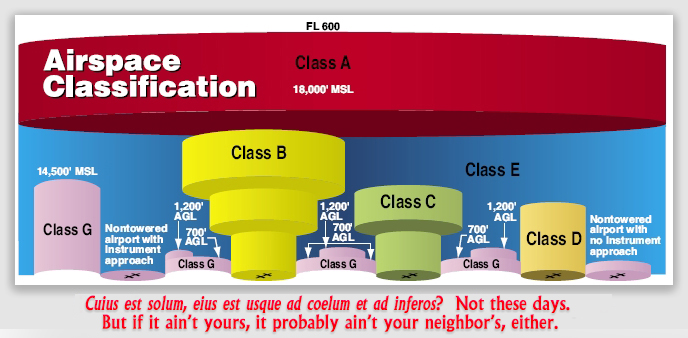
Cuius est solum, eius est usque ad coelum et ad inferos (Latin for “whoever’s is the soil, it is theirs all the way to Heaven and all the way to Hell”), a principle of property law, holds that property holders have rights to not only to the plot of land itself, but also the air above and (in the broader formulation) the ground below. (Note to self: insert here a nod of thanks to my sainted Latin teacher of yore, Emily Bernges, or else I couldn’t translate that). The principle is often referred to in its abbreviated form as the ad coelum doctrine. So was the airspace claim clever lawyering, or just a lot of hot air? Let’s see whether the Court abrogated the ad coelum doctrine or instead brought the defendant back down to earth.

Pierce v. Casady, 11 Kan.App.2d 23, 711 P.2d 766 (Kansas Ct.App. 1985). Jim Pierce and Paul Casady are adjoining landowners with a 75-year-old pecan tree between them. The pecan trunk and root flare are on Paul’s land – but only a foot from the property line – and the tree leans toward Jim’s place. In fact, according to Jim, about three-quarters of the tree overhangs his land, rather ominously, given the substantial split in the tree’s fork (which also overhangs Jim’s property).

The length of the split on one limb is four feet and on the other about two feet. If the tree fell due to the split, it would fall on Jim’s house, garage, and any cars in the driveway. Trimming the tree at the property line is not practical – unless one does not mind killing the tree in the process – because of the tree’s location and the angle at which it leans.

Jim sued for a declaratory judgment that he had the right to cut the overhanging branches back to their property line or, in the alternative, to declare the tree a nuisance to be abated by removal. Paul claimed he had acquired a prescriptive easement to Jim’s airspace. The trial court disagreed, ruling that Paul had no prescriptive right to the airspace the tree occupied and that the tree constituted a nuisance that rightly caused Jim to fear for his safety. Paul was ordered to abate the nuisance by removing the tree either at its base or at the point where it crosses plaintiffs’ property line.

Paul appealed.

Held: An easement by prescription cannot be acquired by overhanging tree branches. Furthermore, a landowner has a right to trim branches that overhang the landowner’s property even though the trunk of the tree is on a neighbor’s land, although the landowner may not go on a neighbor’s land and remove any part of a tree without the neighbor’s permission.

Trees constitute a nuisance if overhanging branches do substantial harm or the overhanging branches create an imminent danger. If a tree is a nuisance, a landowner may compel a neighbor to abate the nuisance or, if an injury occurs, look to the neighbor to pay any damages allowable by law.

The court of appeals rejected Paul’s argument that he had acquired an easement through Jim’s airspace, because such cannot be gotten by prescription, that is, by simply occupying the airspace without permission for a long enough period of time.

Jim argued that the tree could not be a nuisance. That did not affect Paul’s right to trim branches that were overhanging his property even though the trunk of the tree was on Paul’s land. The landowner may not, the Court said, go on the neighbor’s land and remove the tree or any part thereof absent his neighbor’s permission.

If the tree is a nuisance, the landowner may compel the neighbor to abate the nuisance or, if an injury occurs, look to the neighbor to pay any damages allowable by law. In this case, the Court observed, it appeared that if the tree is trimmed at the property line it would be killed. The trial court recognized this and gave Paul the option to trim back to the property line or simply remove the whole tree.

The Court held that whether the tree constituted a nuisance was a question of fact. Generally, a tree is a nuisance when it constantly drops branches and requires constant maintenance. Or, a tree is a nuisance when there is a statute so defining it. Finally, a tree becomes a nuisance when it does substantial harm or creates an immediate danger of causing harm, the Court held, relying on Whitesell v. Houlton, the case that defined the Hawaii Rule.

Kansas recognizes that trees constitute a nuisance if the overhanging branches do substantial harm or the overhanging branches create an imminent danger.

Here, the Court said, the tree was a danger to Jim, reasonably causing him to fear for his safety. The evidence supported the reasonableness of his apprehension: the split in the fork of the tree located above his property, the squeaking sound when the wind blows, the angle at which the tree leans toward Jim’s property, and the testimony of the experts.

Paul argued that the tree could be made safe by cables and bolts. The Court was unimpressed, holding that even that work would have to be done in Jim’s airspace. Paul had no right to go on Jim’s property to do that work for the same reasons Jim had no right to go on Paul’s property to trim or cut down the tree.

Paul was thus ordered to cut the tree off at the property line or remove it altogether.

The Court admitted that “the result reached here will be distasteful to all who treasure trees. The philosophy of the law is simply that whenever neighbors cannot agree, the law will protect each property owner’s rights insofar as that is possible. Any other result would cause landowners to seek self-help or to litigate each time a piece of vegetation starts to overhang their property for fear of losing the use or partial use of their property as the vegetation grows.”

– Tom Root

TNLBGray

Case of the Day – Tuesday, October 15, 2024

I CAN’T SEE FOR MILES AND MILES…

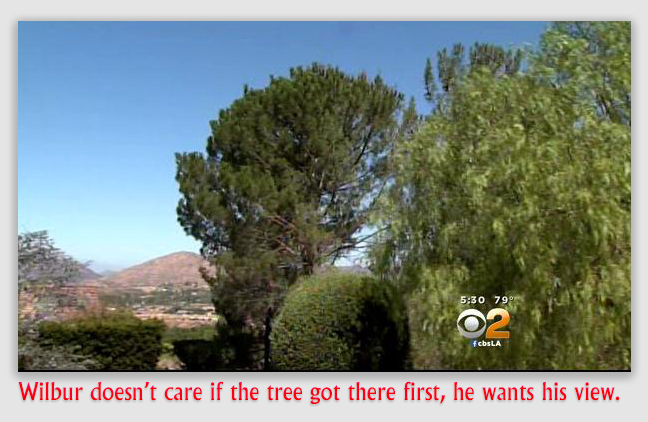
Here’s a strange little case from Big Sky Country. Landowner Wilber (who, if we read between the lines correctly, was an impatient man who preferred to reap that which he did not sow, if you get our meaning) was unhappy that his downhill neighbor had a tree that had grown tall, and thus interfered with his view.

Wilbur found a lawyer, to whom he complained, “I can’t see for miles.” The lawyer, Who was happy enough to take Wilbur’s money, whispered delusions of legal grandeur in Wilbur’s ear. “If the neighbors’ tree kept you from seeing the July 4th fireworks,” the attorney whispered, “then the tree is a nuisance. And if the neighbors did not remove the tree to suit you, then they’re malicious! If the tree is overhanging your yard, your neighbors are trespassers!”

Believing his highly paid but under-informed counsel, Wilbur sued. The trial court bounced the suit, because (1) Wilbur had no common-law right to a view; (2) a naturally growing tree cannot be a nuisance; and (3) the neighbors are not trespassers because their tree’s roots and branches have encroached.

Wilbur appealed, and at last, the Montana Supreme Court heard the case. And that’s where the strangeness arose. The Supreme Court agreed that Wilbur had no right to a view and that the healthy, naturally growing tree was no nuisance. But it held that Wilbur’s trespass claim because the tree was encroaching, had been adequately pled and would survive early dismissal.

We tend to think that the Court agreed only that Wilbur’s claim that the neighbors had caused the tree to encroach was, if true, a good claim. If Montana suggests that a tree’s encroachment itself constitutes a trespass if an owner does not take active steps to stop the encroachment, the holding goes far beyond even the Hawaii Rule or Fancher v. Fagella.

If, on the other hand, Montana suggests that such encroachment, if not halted by an owner with knowledge of the encroachment and damage to the property of another, is trespass, this may be not a lot different than the Hawaii Rule, just worded differently. After all, an encroaching tree that damages the neighbor’s property may well be a nuisance. Trespass or nuisance, the responsible landowner is liable for the damage. That is how the Hawaii Rule operates.

Martin v. Artis, 366 Mont. 513 (Mont. 2012). Wilbur Martin resides in the South Hills subdivision in Missoula. Keith and Gloria Artis’s property lies immediately below and abuts Wilbur’s property, with a boundary fence separating the properties.

The Artises had a tree, a nice large tree that had grown over the years so that it blocked a substantial portion of Wilbur’s view of the city, valley and mountains. In fact, horror of horrors, on Independence Day 2010, for example, Wilbur and his guest could see virtually none of the South Gate Mall fireworks display solely because of the Artis tree blocking the view. Wilbur said the tree’s obstruction of his views was “offensive to his senses, was an infringement upon the free use of his property, interfered with his comfortable enjoyment of his property, and diminished the aesthetic and monetary value of his property.” He said the tree was a nuisance, and in fact, the Artises intended that it be a nuisance.

If that were not enough, Wilbur alleged that the tree’s roots were encroaching onto his property and were starting to buckle the boundary fence. What’s more, he claimed, branches from the tree encroached onto his property, overhanging the common boundary fence. He declared the encroachment to be a trespass.

The Artises had tried to accommodate. Wilbur admitted that after he contacted them about the tree, they had “cut a few branches from the tree,” but he nonetheless asserted that Artises “know their tree is growing over the fence onto Wilbur’s property and is buckling his fence, but refuse to do anything to stop it; that such trespass is continuing.”

Finally, alleging that Artises had notice and knowledge of the alleged facts, Wilbur accuses them of actual malice and demands punitive damages.

Artises filed a motion to dismiss the complaint, arguing that a naturally growing tree is not a nuisance or trespass as a matter of law. The district court agreed and dismissed Wilbur’s feverish litany of abuse.

Wilbur appealed, ending up in Montana’s Supreme Court.

Held: Wilbur had no right to an unobstructed view, and a naturally growing tree cannot constitute a nuisance. However, Wilbur had adequately pled a trespass because he claimed the tree was encroaching and the Artises knew it.

The statutory definition of nuisance provides that anything which is injurious to health, indecent or offensive to the senses, or an obstruction to the free use of property, so as to interfere with the comfortable enjoyment of life or property, is a nuisance.” Section 27-30-101(1), MCA (2009). While it is possible under § 27-30-101(1), MCA, for anything to constitute a nuisance, a nuisance claim must nonetheless plead a factual foundation that satisfies governing legal standards. “A nuisance action may be based upon conduct of a defendant that is either intentional, negligent, reckless, or ultrahazardous,” the Court said. A nuisance may either be a nuisance per se or a nuisance per accidens. A nuisance per se or at law is an inherently injurious act, occupation, or structure that is a nuisance at all times and under any circumstances, without regard to location or surroundings. A nuisance per accidens or in fact “is one which becomes a nuisance by virtue of circumstances and surroundings.”

Likewise, the Court said, a nuisance may also be classified as either absolute or qualified. An absolute nuisance is ” a nuisance, the substance… of which is not negligence, which obviously exposes another to probable injury.” A qualified nuisance, on the other hand, is a nuisance dependent on negligence that consists of anything lawfully but so negligently or carelessly done or permitted as to create a potential and unreasonable risk of harm, which, in due course, results in injury to another.

Montana law has never held that a nuisance claim would lie for any obstruction of view whatsoever. Here, Wilbur alleges that a tree, in the course of its natural growth, has risen tall enough to obstruct his view. Although the complaint broadly claims that Artises’ tree has reduced the aesthetic and monetary value of Wilbur’s property, interfered with his comfortable enjoyment of his property, and offended his senses, the entire factual basis of the claim is that a tree has obstructed his view because of natural growth. The assertion that Artises’ naturally growing tree has obstructed Wilbur’s view does not constitute, as a matter of law, “conduct of a defendant that is either intentional, negligent, reckless, or ultrahazardous,” the Court said, or “an inherently injurious act or a condition which “obviously exposes another to probable injury.” The District Court properly granted the Artises’ motion to dismiss Martin’s nuisance claim.

The trespass is another matter, the Court held. Trespass is “the entry of another person or thing that obstructs a property owner’s exclusive possession. A party need not establish actual harm or damages in a traditional trespass action.” One is subject to liability to another for trespass, irrespective of whether he thereby causes harm to any legally protected interest of the other, if he intentionally (a) enters land in possession of the other, or causes a thing or third person to do so, or (b) remains on the land, or (c) fails to remove from the land a thing which he is under a duty to remove.

The “intent” element of trespass is fulfilled when an actor desires to cause the consequence of his act, or when he believes that the consequences are substantially certain to result from his act. Here, the Court said, Wilbur’s complaint alleges a trespass because the Artises’ tree extends over the shared fence and the roots grow onto his property. The complaint alleges that the roots of the tree have damaged Wilbur’s property. Regarding intent, Wilbur claims alleges that the Artises “know their tree is growing over the fence onto the property and is buckling his fence but refuse to do anything to stop it,” that Artises’ conduct is motivated by malice or is in willful, wanton and reckless disregard of Wilburs’ rights,” and that Artises are guilty of actual malice “because they had notice and knowledge of the alleged facts.”

Although the Artises argue that Wilbur’s complaint fails to plead an intention to trespass by way of their tree, the Supreme Court concluded that “for purposes of an M.R.Civ.P. 12(b)(6) motion to dismiss, intent was adequately pled.”

– Tom Root

TNLBGray

Case of the Day – Thursday, September 19, 2024

RIGHT THING, WRONG REASON

The right things usually get done for the wrong reasons. The Internet, which knows all (or soon will) attributes the aphorism to James Carville, but I remember the exact line being penned by Washington columnist Drew Pearson in a political potboiler of his, The President, which I read as a lad in the summer of 1971.

Sorry, James, When it comes to credit for this particular witticism, you didn’t build that.

Today’s case is a reminder to all the states that claim the Massachusetts Rule, the Hawaii Rule, the Virginia Rule and so on that there is nothing new under the sun. Well before those rules came into being, the Washington State Supreme Court grappled with the encroachment issue and reluctantly decided an early version of the Hawaii Rule: where there is encroachment that causes “sensible harm,” the adjoining landowner may either trim back the offending growth or sue to force the tree’s owner to do it.

Ironically, settling the law (the right thing to do) probably got done for the wrong reason (bad blood between neighbors). We have seen how the Massachusetts Rule began in Michigan. Now, it seems the Hawaii Rule may have started in Washington.  Sorry, Hawaii, you didn’t build that.

Truly, there’s nothing new under the sun.

Gostina v. Ryland, 116 Wash. 228, 199 P. 298 (Supreme Ct. Wash. 1921). A.L. Ryland had owned his place for many years when new neighbors, the Gostinas, moved in next door. A.L. had a Lombardy poplar tree growing about two feet from the Gostina property and a fir tree in the rear of the property, also about two feet from the division fence. On top of that, A.L. maintained a creeping vine, growing in a rustic box on top of a large stump, a few feet from the division fence, and some raspberry bushes and a rosebush growing near the property line.

About a year after they moved in, the Gostinas had their lawyer write to A.L. to tell him the branches of his fir tree were overhanging the Gostina property and dropping needles and that A.L.’s ivy was running under the fence and onto the Gostinas’ lawn. The lawyer demanded that A.L. cut off the fir tree branches at the point where they crossed the boundary line, remove the ivy from the Gostinas’ property, and keep the tree and ivy from encroaching ever again.

A.L. was unimpressed, so the Gostinas brought a suit for abatement of a nuisance. (And we thought frivolous litigation was a recent phenomenon!) A.L. argued that the lawsuit was merely for spite and vexation, and that the Gostinas knew the tree and ivy were there when they moved in. Only after a neighborly disagreement, A.L. claimed, did the Gostinas sue.

The trial court did not care about such nonsense, holding that where branches of trees overlap adjoining property, the owner of the adjoining property has an absolute legal right to have the overhanging branches removed by a suit of this character.

The Gostinas appealed.

Held: A.L.’s tree and ivy were a nuisance, and the Gostinas’ claimed damages, although ridiculously minor, were enough to permit them to maintain a nuisance action against A.L. Ryland.

The Court agreed that under Washington law, trees and plants growing into the yard of another constituted a nuisance, “to the extent to which the branches overhang the adjoining land. To that extent they are technical nuisances, and the person over whose land they extend may cut them off, or have his action for damages, if any have been sustained therefrom, and an abatement of the nuisance against the owner or occupant of the land on which they grow; but he may not cut down the tree, neither can he cut the branches thereof beyond the extent to which they overhang his soil.”

From ancient times, the Court said, it has been a principle of law that the landowner has the exclusive right to the space above the surface of his or her property: “To whomsoever the soil belongs, he also owns to the sky and to the depths. The owner of a piece of land owns everything above it and below it to an indefinite extent.” On the same principle, the Court held that the branches of trees extending over adjoining land constitute a nuisance, at least in the sense that the owner of the land encroached upon may himself cut off the offending growth.

A property owner may not “maintain an action against another for the intrusion of roots or branches of a tree which is not poisonous or noxious in its nature. His remedy in such cases is to clip or lop off the branches or cut the roots at the line.” What it came down to, the Court held, was that “the powerful aid of a court of equity by injunction can be successfully invoked only in a strong and mischievous case of pressing necessity” and there must be “satisfactory proof of real substantial damage.”

Here, the Court said, what the Gostinas complained of was “so insignificant that respondents did not even claim them or prove any amount in damages–but simply proved that the leaves falling from the overhanging branches of the poplar tree caused them some additional work in caring for their lawn; and that the needles from the overhanging branches of the fir tree caused them some additional work in keeping their premises neat and clean, and fell upon their roof and caused some stoppage of gutters; and that sometimes, when the wind blew in the right directions, the needles blew into the house and annoyed the occupants. We cannot avoid holding, therefore, that these are actual, sensible damages, and not merely nominal, and, although insignificant, the insignificance of the injury goes to the extent of recovery, and not to the right of action.”

Since the Gostinas had the statutory right to bring an action for abatement of a nuisance and had shown some “actual and sensible damages, although insignificant,” they are entitled to go forward with the suit. “The remainder of the trees will doubtless shed their leaves and needles upon the respondents’ premises,” the Court prophesied, “but this they must endure positively without remedy.”

The Court was not really that fooled: this was a spite suit, but that alone was not disqualifying. While the Gostinas’ action against A.L. “has some appearance of being merely a vexatious suit,” the Court said, A.L. did “admit that the tree boughs do overhang respondent’s lot to some extent. There is sufficient foundation in fact to sustain a case…”

– Tom Root

TNLBGray