Case of the Day – Wednesday, May 14, 2025

JUDGE JUDY HAS HER LIMITS, YOU KNOW

Ah, Cleveland! Renowned for the Rock and Roll Hall of Fame, a world leader in the manufacture of duct tape, the home to some really good beer and some really bad teams.  Sure, the Best Location in the Nation has former Indians and the Cavs and the Browns. And maybe this is the year…

Cleveland's gift to the world

Cleveland’s gift to the world.

Add to that impressive string of achievements one more jewel: Cleveland gave the United States its first small claims court in 1913. The People’s Court was not far behind.

Small claims courts exist in every state of the country, informal courts of very limited jurisdiction (awards of a few hundred or few thousand dollars), places where lawyers and formality are rare indeed. It was to just such a place that Mr. Iny dragged Mr. Collom. It seems the roots of Mr. Collom’s tree were breaking up the walls of his neighbor’s garage. Now, any fan of the Massachusetts Rule would have told the neighbor to get out there with a shovel and ax and cut the offending roots at the property line. Self-help is, after all, as American as … well, as the Massachusetts Rule.

Of course, self-help doesn’t mean you can go onto your neighbor’s property, and it seems the homes and garages in this Long Island town were packed together like sardines. Mr. Iny couldn’t dig up the attacking roots without going on to Mr. Collom’s place, and we’re suspecting from the decision that these two guys were not the best of friends. So Mr. Iny took him to court.

The small claims court awarded him $2,100 for damages. Being of limited jurisdiction, the court couldn’t order Mr. Collom to cut down the tree or dig up the roots, so money was all that was available. Mr. Collom appealed (something you never see happening on TV).

Great Lakes' American pale ale, named for that embarrassing episode in 1969 when the Cuyahoga River burned.

Great Lakes’ American pale ale, named for that embarrassing episode in 1969 when the Cuyahoga River burned – not for the first time – and ended up as an icon for the nascent environ-mental movement. Incidentally, the river’s quite clean these days, and the brew’s a pretty fine pale ale.

The Supreme Court (which in New York State is not the state’s high court, but rather in this case just a court of appeals) reversed. The remedy here, the court said, shouldn’t have been money. It should have been to cut down the tree. But the small claims court lacked jurisdiction to do that. The Supreme Court itself didn’t have such constraints, so it reversed the money damages and instead ordered Mr. Collom to get rid of the tree.

The most interesting part of the decision is the lengthy and well-written dissent arguing that Mr. Iny’s tree claim was in fact a nuisance claim and that money damages should have been awarded as well. The dissenting judge argued that New York has adopted its own tree encroachment rule, a hybrid of the Massachusetts Rule and Virginia Rule (which itself has since this case been abandoned by Virginia). In New York, the judge concluded, a complainant has to resort to self-help first. If that fails, the courts will intervene if the tree can be shown to be a nuisance — that is, if the tree “is causing substantial interference with the use and enjoyment of plaintiff’s land, that defendant’s conduct is intentional or negligent.”

Of course, the discussion is found in a dissent to a fairly low-level, unreported decision, but it’s a thoughtful analysis of the encroachment rule in a state where precedent on the subject is sparse. Good reading on a cold winter night … unless, of course, another episode of Judge Judy is on.

Iny v. Collom, 827 N.Y.S.2d 416, 13 Misc.3d 75 (Sup.Ct. N.Y., 2006). The roots of a tree situated on Robert Collom’s property damaged the wall of a garage on Sol Iny’s property. Sol lacked the room to cut the roots out himself without trespassing on Bob’s land. He sought to get Bob to remove the objectionable tree, which he felt would have been the best way to fix the problem, but Bob refused. Sol sued in small claims to recover $2,100. The trial court awarded him this sum. Bob appealed.

Held: The decision was reversed. The Supreme Court noted that a New York small claims court is a court of limited jurisdiction and lacks the authority to grant any equitable remedy, such as directing the removal of a tree. Under the circumstances presented, the Court ruled, “substantial justice would have been most completely rendered had the court awarded judgment in favor of defendant dismissing the action on condition that he remove the subject tree within a specified period of time”. But the trial court couldn’t do that. The Supreme Court could, however, and it ordered the case dismissed, conditioned on Bob removing the tree within 60 days.

One justice dissented. He believed that the trial court’s judgment awarding Sol $2,100 in damages was based on a nuisance claim, and should have been affirmed. The dissent said the issue faced in the case was whether, under New York law, a property owner whose property is being encroached upon and damaged by the roots of a neighboring property owner’s tree may successfully assert a cause of action sounding in private nuisance if the property owner’s resort to self-help is unworkable, and the property owner’s attempts at obtaining assistance from the neighboring property owner to abate the roots’ encroachment have been unsuccessful.

The dissent argued that to establish a cause of action for private nuisance, the plaintiff must show that the defendant’s conduct causes substantial interference with the use and enjoyment of the plaintiff’s land and that the defendant’s conduct is (1) intentional and unreasonable, (2) negligent or reckless, or (3) actionable under the laws governing liability for abnormally dangerous conditions or activities. The interference can be caused by an individual’s actions or failure to act. Where a defendant has been put on notice that his activity is interfering with the plaintiff’s use and enjoyment of his land and the defendant fails to remedy the situation, the defendant ought to be found to have acted intentionally and unreasonably.

Remember - the dissent is the opinion of the losers

Remember – the dissent is only the opinion of the losers, amusing but inconsequential.

Furthermore, the dissent argued, “[u]nder New York law, a party is liable for failing to abate a nuisance [under a theory of negligence] upon learning of it and having a reasonable opportunity to abate it.” The question of whether there has been a substantial interference with the plaintiff’s use and enjoyment of his/her property is one to be resolved by the trier of fact and involves a review of the totality of the circumstances based upon a balancing of the rights of the defendant to use his or her property against the rights of the plaintiff to enjoy his or her property. The balancing amounts to a risk-utility analysis weighing the social value of the conduct involved against the harm to private interests.

The dissent admitted that while the elements of a nuisance action appear straightforward, in New York there is a paucity of case law addressing nuisances arising from trees or other plant life. Nevertheless, the justice argued, there is substantial case law from jurisdictions outside New York, and he describes in detail the Massachusetts Rule, the Virginia Rule, and the Hawaii Rule. The dissent concludes New York has “in large measure, adopted a hybrid approach somewhere between the Hawaii and Virginia Rules in determining the issue of nuisance liability. To sustain a cause of action for nuisance, a plaintiff must resort to self-help in the first instance, which does not appear to be a prerequisite under the Hawaii Rule. Once a plaintiff establishes that self-help failed or self-help was impracticable, he or she must (1) show sensible damage (this kind of “sensible” has nothing to do with common sense, but rather is an injury that can be perceived by the senses), (2) that defendant’s conduct is causing substantial interference with the use and enjoyment of plaintiff’s land, (3) that defendant’s conduct is intentional or negligent, and (4) that the continued interference with the use and enjoyment of plaintiff’s property is unreasonable.

Where a defendant has been notified that a tree was causing damage to the plaintiff’s property and refuses to assist the plaintiff in taking measures designed to abate the nuisance, the defendant should be found to have acted intentionally or negligently regarding the nuisance. The unreasonableness of the interference will depend upon an overall balancing of the equities: the injuries to the plaintiff and to the defendant, the character of the neighborhood, the ongoing nature of the injury, and the nature of the defendant’s actions.

Remember, the foregoing – while it may be eminently “sensible” in the meaning of the term – was the opinion of a lone judge, one who was outvoted. It makes for thoughtful reading. But don’t mistake it for the law.

– Tom Root
TNLBGray140407

Case of the Day – Monday, May 12, 2025

SMOKE GETS IN YOUR EYES

baby160601Anyone who’s ever sat next to a screaming baby on a red-eye flight knows “nuisance.” But what “nuisance” means in law may not be quite as readily identifiable as the wailing infant in seat 7B.

So just what constitutes a nuisance causing enough interference with an owner’s enjoyment of property to justify court action? The Haffners found out that wherever the line may fall, it was beyond the suffering they endured. And, in the process, they may have learned that the law is a poor bludgeon.

The Haffners had lived in the same house since 1977. The Clarks – who happen to run a tree service (but that’s not central to the case) – lived about 50 yards east of them, and the Nelsons live about 40 yards to the west. That wasn’t a problem until the Clarks and Nelsons became smokers.

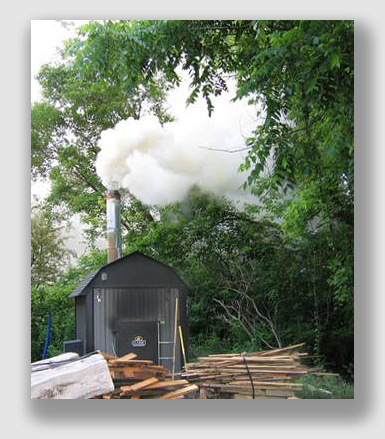
They weren’t using tobacco, or even pot (this not being Colorado). Instead, they both installed rather old-fashioned but new-fangled outdoor wood furnaces. The Clarks were true early adopters, having used a wood-burning furnace since 1984. (Being tree trimmers, they had an abundant supply of fuel). The Nelsons installed their high-tech outdoor wood-burner in 2008.

smokeB160601Choking on the enveloping smoke, the Haffners sued, alleging that the Nelsons’ and Clarks’ furnaces “generated smoke, soot, noxious fumes, and fly ash, which damaged their property, caused them physical injury, and reduced the value of their property, as well as infringed on their use and enjoyment of the land.” The Haffners asked for an injunction from the court ordering the neighbors to quench their fires, along with some money to ease their suffering.

The case should have been a dead bang winner for the Haffners. Iowa law requires that people use their own property in a manner that will not unreasonably interfere with or disturb their neighbors’ reasonable use and enjoyment of their property.” In fact, Iowa Code § 657.2 specifically defines “[t]he emission of dense smoke, noxious fumes, or fly ash in cities [as] a nuisance …”

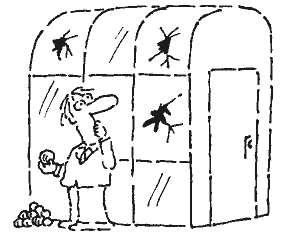
glass-houseBut their victory went up in smoke. It turned out that the Haffners were living in a glass house, having operated their own wood furnace for 20 years. They couldn’t very well prove any damage to their property or health arising from the Nelsons’ and Clarks’ wood furnaces when they were generating smoke with their own furnace like a politician on the hustings.  The medical maladies the Haffners said were caused by the smoke existed year around, even when the furnaces were stone-cold during the summer. Other neighbors who lived nearby testified that they had not been bothered by the Clarks’ and Nelsons’ furnaces.

We know what you’re thinking: there must be a backstory here. Indeed. There was some evidence of animosity between the Haffners and their neighbors that had nothing to do with smoke.

Haffner v. Clark, 795 N.W.2d 99 (Court of Appeals, Iowa, 2010). The Haffners lived between the Clarks and the Nelsons. In about 1984, the Clarks installed a wood-burning furnace to help heat their home. The Nelsons installed an outdoor wood-burner in 2008.

The Haffners sued, alleging that smoke, soot, fumes, and fly ash infringed on their use and enjoyment of their land. The Haffners asserted claims of nuisance, negligence, assault, and trespass, and sought a court order that the Clarks and Nelsons stop using their furnaces, and for damages.

The trial court found that the furnaces were not a nuisance and that the Haffners delayed unreasonably in suing (which is to say it accepted the defense of laches and estoppel).

The Haffners appealed.

Held:  The appellate court held that the Haffners had failed to prove the neighbors’ smoke was a nuisance.

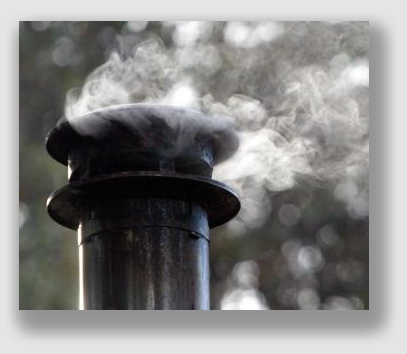
smoke160601The law of nuisance directs that “parties to use their own property in a manner that will not unreasonably interfere with or disturb their neighbors’ reasonable use and enjoyment of the neighbors’ property. A private nuisance is an actionable interference with a person’s interest in the private use and enjoyment of the person’s land.” The definition of a nuisance is “[w]hatever is injurious to health, indecent or unreasonable offensive to the senses, or an obstruction to the free use of property, so as essentially to unreasonably interfere with the comfortable enjoyment of life or property…”

The Court of Appeals observed that in determining whether an activity is a nuisance, the standard is whether normal people in the community would regard the conduct as “definitely offensive, seriously annoying or intolerable.” Under this standard, the Court agreed that smoke, odor, and other attacks to the senses could constitute serious harm. The Court admitted that saving on fossil fuels might be a societal benefit, but it was of minimal utility compared to generating foul smoke.

Nevertheless, the Haffners’ complaints did not a nuisance establish. The Haffners – who themselves had owned their own wood furnace for 20 years – were unable to present evidence proving any damage to their property or health arising from the Nelsons’ and Clarks’ wood furnaces. The medical conditions that the Haffners alleged were caused by the smoke existed year-round, even during the summer. Other witnesses living nearby testified that they had not experienced any smoke infiltration, odors, fumes, or fly ash from the Clarks’ and Nelsons’ furnaces.

The Court found it was material to its decision that the Haffners had waited 20 years before lodging any complaint with authorities, and noted in passing that there was evidence that the Haffners and their neighbors did not get along for reasons that had nothing to do with furnaces.

– Tom Root

TNLBGray

Case of the Day – Wednesday, April 16, 2025

LIKE A GOOD NEIGHBOR

Would you rather have your insurance agent appear? Really?

Would you rather have your insurance agent appear? Really?

The Estes, like the rest of us, probably saw those insipid commercials a few years ago where the insurance-challenged protagonist would sing a major insurance company’s jingle offkey, and his or her local agent magically appears. It never made much sense to us. Meaning no disrespect to insurance – which, after all, is just a transaction in which you bet something bad’s gonna happen to you, and the insurance company bets it won’t – but if we could warble a stanza and make someone appear, it sure wouldn’t be an insurance agent.

Back to our topic. An article we read about an Indianapolis man having his ear bitten off by his neighbor made us think about truly rotten neighbors, you know, the ones without community relations teams and emergency satisfaction 800 numbers. The Estes probably have less of an idea of what a good neighbor is than most people, except to suspect it sure isn’t the people next door to them, the Gertzes. The Gertzes are a little bit weird, and we don’t mean that in a good way.

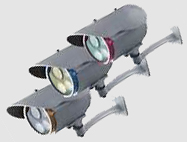
A dispute about a suburban boundary line ended up with the Gertzes training a battery of surveillance cameras on their former friends, the Estes. If that wasn’t enough, Mrs. Gertz began using a loudspeaker to hurl insults — rather graphic ones that left the court blushing — at the Estes daughters. And then there was the fence.

Robert Frost said that good fences make good neighbors, but he hardly had this fence in mind: an 8-foot tall monstrosity painted orange and black, studded with thousands of protruding nails and large warnings against climbing and trespassing painted on the Estes’ side like so much gang graffiti. In fact, the whole thing looked rather more like the Berlin Wall come to Hebron, Indiana.

LlamasThe Estes sued under the “spite fence” statute. The Gertzes protested that they hadn’t built a spite fence, but rather just a modest enclosure to protect some delicate saplings they had planted, as well as to permit the raising of alpacas and llamas. After all, they didn’t want any errantly roaming cattle to gnaw on the young trees or, for that matter, to let the llamas and alpacas flee to return to South America. The Court wasn’t convinced. After all, the Gertzes’ permit application called the fence “residential,” not “agricultural.” Second, the fence didn’t enclose the young trees, making it useless as a cattle barrier. Finally, the cameras, the loudspeaker, and the studded fence — not to mention the testimony of deteriorating relations between the plaintiff and defendant — made it clear to the Court that the fence was erected maliciously.

Alpacas

The Gertzes could hardly let their alpaca herd hotfoot it back to Bolivia, now, could they?

The Gertzes also tried a creative technical argument that because a permit had been issued for the fence, the Indiana “spite fence” statute had been trumped by local approval. The Court noted that the permit was for a 7-foot fence, not the 8-foot plus fence the Gertzes had put up, and anyway, a local permit did not excuse compliance with the statute.

So the court settled matters, and everyone kissed and made up. There were lemonade toasts all around, right? Lest you think that, stay tuned tomorrow for … [drum roll] … Gertz v. Estes, the sequel.

Gertz v. Estes, 879 N.E.2d 617 (Ct.App. Ind., 2008). Oh, the neighbors from hell! David and Nichelle Gertz started out liking their neighbors, Douglas and Susan Estes, but that fell apart. David and Nichelle had multiple surveillance cameras trained on their neighbors — even when they purported to get along — but after the boundary line was disputed, things got so bad that the Estes notified the Gertzses that they intended to install a fence, but before they could do so, the Gertzses built one of their own. The Gertzses applied for and obtained a local permit to build a 7-foot high fence, but the final fence was 8 feet high, 720 feet long, and with thousands of nails protruding on the Estes’ side up to a half inch. The words “NO CLIMBING” and “NO TRESPASSING” were painted in orange and black on the middle horizontal slat, and two more cameras — for a total of seven surveillance cameras — were installed on top of the fence.

cameras

The Gertzes also used a public address system to aggravate the Estes, including making “lewd comments” to the Estes’ daughters, which the Court blushingly refused to repeat in the opinion. The Gertzes called the sheriff at least eighteen times to report various activities of Douglas and Susan Estes.

The Estes sued under Indiana’s “spite fence” statute for the removal of the fence. The Gertzes testified that the fence was necessary to protect eighteen-inch tree seedlings they had planted. The fence did not enclose any area, but the Gertzes said they intended to enclose the fence at some point so that they could raise llamas, alpacas, or sheep. The trial court found that there was “no justifiable or necessary reason for the fence installed by [David and Nichelle] to exceed six (6) feet . . .” Furthermore, it found that “the fence was maliciously erected and now maintained for the purpose of annoying [Douglas and Susan].” The trial court ordered the fence removed, and the Gertzes appealed.

SurveillHeld: The fence had to go. The Court found that the evidence and the reasonable inferences drawn from it fully supported the trial court’s findings. As to the Gertzes’ defense that it was for agricultural purposes, the Court observed that their permit application indicated that the “use” of the fence was “residential” and the fence did not form an enclosure, making it useless for livestock. The Court said that the Gertzes’ conduct and the extraordinary nature of the fence overcame David’s assertion that the 8-foot fence was intended to protect eighteen-inch tree seedlings.

Likewise, the fact that a local permit was granted to build a 7-foot wooden fence parallel to the property line did not trump the “spite fence” statute. That statute defines as a nuisance any fence unnecessarily exceeding a height of six feet and maliciously erected for the purpose of annoying neighbors. This fence exceeded six feet unnecessarily and clearly resulted from a deteriorating, antagonistic relationship between the Gertzes and their neighbors. The nails on the fence protruding between quarter- and one-half inch from the fence and the surveillance cameras clearly supported the finding that the fence was built out of malice, and was, therefore, a nuisance.

The Gertzes wisely didn’t challenge the trial court’s order that the PA system had to go, too.

– Tom Root

TNLBGray140407

Case of the Day – Friday, March 28, 2025

I KNOW IT WHEN I HEAR IT

I don’t know how, but somehow I managed to stay awake in Constitutional Law, despite the fact that the first-year law class was right after lunch in a too-warm lecture hall. My alertness undoubtedly is why I so well recall Justice Potter Stewart’s concurring opinion in the otherwise unremarkable obscenity case Jacobellis v. Ohio.

The Justices were wrestling with how best to craft a working definition of obscenity against which to judge a triple-X movie reel confiscated from alleged porn purveyor Nico Jacobellis. Justice Potter Stewart knew better than to waste time conjuring up limitations on the meaning of “obscenity.” In his now-famous concurrence, he declared that

I shall not today attempt further to define the kinds of material I understand to be embraced within that shorthand description; and perhaps I could never succeed in intelligibly doing so. But I know it when I see it, and the motion picture involved in this case is not that.

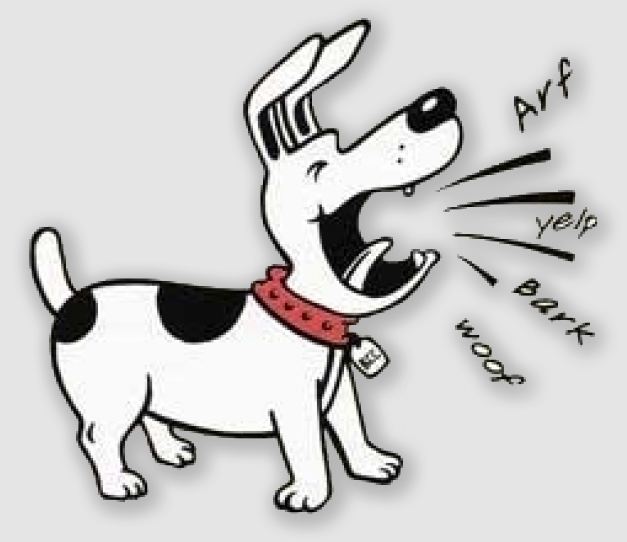
Justice Stewart’s verbal frustration with an evanescent standard came to mind last night when I got a call from long-time reader Wendy Whist, who was being driven to distraction by the neighbor’s dogs. Wendy lives on a quiet residential street in the sleepy little Ohio town of Snoreburg. Well, it was quiet and sleepy, until neighbor Bertha Barkley acquired a pair of noisy little yapmeisters.

It may just be my perception (driven no doubt by the pair of mini-noisemakers my uncaring neighbor Ann leads past my house several times a day), but it seems to me that the smaller the dog, the more annoying the bark. That is certainly the case for Bertha’s little snack dogs: she leaves the pint-sized yappers outside all day in her fenced-in backyard. Wendy reports that the dogs bark at intruders, clouds, insects, leaves, grass, trees, the air, the moon, the sun, light, dark… you get the idea. Wendy says the cacophony is incessant.

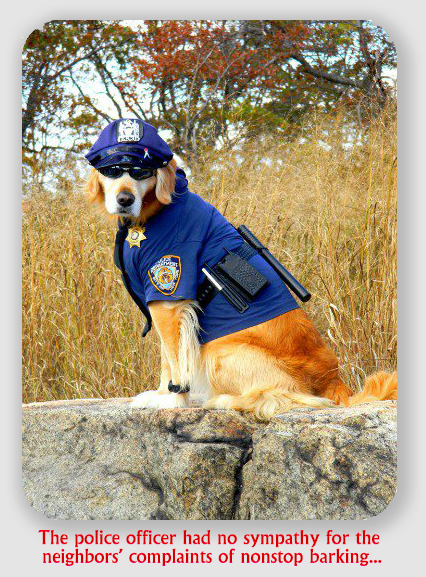
When Wendy complained to her neighbor, Bertha – whose disdain for others makes her much more cat-like than dog-like – retorted that the dogs were in a fenced-in yard, so there was not a thing Wendy could do about the noise. When the neighbor on the other side of Bertha’s place called the police, the responding officer said that because the dogs were fenced in behind Bertha’s place, there was nothing law enforcement could do.

Wendy called me because I write about tree law. Trees have bark. Dogs bark. It’s a logical connection.

The police officer was mistaken. Like many towns, Snoreburg has an ordinance that prohibits people from “keep[ing] or harbor[ing] any animal or fowl in the Municipality which frequently create unreasonably loud and disturbing noises of such character, intensity, and duration as to disturb the peace, quiet and good order of the Municipality.” The ordinance makes the first offense a minor misdemeanor. For a second offense within two years, jail time and an order to get rid of the barking dogs (or chickens, as the case may be) may be imposed.

I suggested that the next time the nice policeman is called, point out the ordinance to him and demand politely that he go and do his best endeavor (which in this case would be to cite Bertha and her dogs).

But the whole episode set me to wondering. This blog’s approach to tree and neighbor law is much more civil and less criminal than just getting your neighbor locked up. Could Bertha’s continual and continuous barking (OK, it’s really her dogs making the noise, but it’s hard to keep Bertha’s uncivil attitude separate from her canines’ caterwauling) constitute a nuisance? Could the long-suffering Wendy sue Bertha, seeking an order requiring Bertha to abate the nuisance, which is legalese for “shut the dogs up?” Those musings reminded me of Potty Stewart wrestling with the definition of obscenity in Jacobellis. At what point does the barking cross that fuzzy line between mere irritation and legally actionable annoyance?

The court in today’s case grappled with that question. Like Justice Stewart, the panel of appellate judges eschewed drawing a bright line. Instead, they delivered the usual nuisance law mush that “the amount of annoyance or inconvenience will constitute a legal injury resulting in actual damage, being a question of degree, is dependent on varying circumstances, cannot be precisely defined, and must be left to the good sense and sound discretion of the tribunal called upon to act.”

But that being said, the appellate judges held, here the defendants’ four dogs had clearly barked themselves well over that line, indistinct though it may be. The Court of Appeals said of the nuisance that ‘they know it when they hear it, and the dogs’ barking was clearly it.’

Zang v. Engle, Case No. 00AP-290 (Ct.App. Franklin Co., Sept. 19, 2000) 2000 Ohio App. LEXIS 4222, 2000 WL 1341326. Charles Zang and his family lived next door to the Engles, who owned four dogs. Charlie testified that since they moved into their house in 1997, the dogs were outside and barked continuously. He could hear the dogs barking from inside his house, both with the windows open and closed. He described the barking in the two years prior to trial as extreme, excessive, and loud, barking that at times affected his ability to sleep, interrupted meals, and interfered with phone calls, television watching, and entertaining. Charlie, who worked from home, had to move his office from the back of his home to the front, yet he still at times heard the barking.

Ms. Zang said that it affected her ability to concentrate, it caused her to become “more stressed out” when the dogs were out and barking excessively, and it affected her mood when she entertained guests. Id. at 150-151. She has not been able to relax, and the barking has interrupted her sleep. She said, “We find that there are times when we are trying to have a normal dinner conversation and the dogs come out barking and we become so frustrated and so upset because we can’t do anything about that that we have to go and shut the windows, or we have felt on many occasions that we don’t want to necessarily be at home and that we will just leave, just to get away.”

The barking had gone on regularly over the past couple of years. Charlie kept a log of the dog barking. Entries were made almost every day from mid-December 1997, to mid-March 1999. Most days, the dogs were described as barking continuously for at least fifteen minutes up to over one hour. The remaining time the dogs were out, they barked periodically. Some of the barking occurred around 11 p.m. and 12 a.m. A lot of the barking was during the evening hours of 5 to 6 p.m. However, the logs as a whole show that the dogs were outside and barking at various times.

Charlie sued the Engles, claiming that barking dogs constituted a nuisance. The trial court agreed and ordered the Engles to abate the nuisance. The Engles appealed.

Held: The barking dogs constituted an absolute nuisance.

An absolute nuisance, for which strict liability (or liability without fault) is imposed by law, is a civil wrong arising or resulting from the invasion of a legally protected interest, and consisting of unreasonable interference with the use and enjoyment of the property of another. It is the doing of anything or the permitting of anything under one’s control or direction to be done without just cause or excuse, the necessary consequence of which interferes with or annoys another in the enjoyment of his legal rights which results in injury to another.

A private nuisance, on the other hand, involves the invasion of the private interest in the use and enjoyment of land. The law of private nuisance is a law of degree, and it generally turns on the factual question of whether the use to which the property is put is a reasonable use under the circumstances and whether there is an appreciable, substantial, tangible injury resulting in actual material and physical discomfort. What amount of annoyance or inconvenience will constitute a legal injury resulting in actual damage, being a question of degree, is dependent on varying circumstances, cannot be precisely defined, and must be left to the good sense and sound discretion of the tribunal called upon to act.

To entitle the Zangs to recover damages for a nuisance, it is not necessary that they be driven from their home or that the Engles create a positive unhealthy condition. Instead, it is enough that the Zangs’ enjoyment of life and property is rendered uncomfortable. In so determining, a trial court must look at what persons of ordinary tastes and sensibilities would regard as an inconvenience or interference materially affecting their physical comfort.

Given all of the facts, the Court held, “there was sufficient competent, credible evidence to support a finding of a private nuisance.”

The permanent injunction issued by the trial court directed in part that the Engles are “permanently enjoined and restrained from permitting any of the dogs they own or harbor, to bark in the manner described in the following paragraph, while said dogs are outside their residence… All parties understand that an infrequent bark is not what this permanent injunction is enjoining; rather, the intent of this Permanent Injunction is to restrain and enjoin the Engles’ dogs from creating an unreasonable amount of noise so as to interfere with the peace, quiet and normal enjoyment to which the Zangs are entitled in the use of their residence… The Engles are to obtain an anti-barking device for the dogs.”

The Court of Appeals held that the injunction was enforceable and proper. “The law of nuisance,” the Court held, “is a law of degree and reasonableness. It does not follow then that an injunction cannot issue which addresses the exact nuisance found to exist. Here, the nuisance is dog barking. While the amount of barking that may be found excessive cannot be measured exactly, there is sufficient evidence in the record as to dog barking that can be looked to if enforcement of the injunction is necessary.”

– Tom Root

TNLBGray140407

Case of the Day – Monday, March 24, 2025

IF A TREE FALLS ON A CAR, AND THERE’S NOBODY TO SUE, DOES IT STILL MAKE A NOISE?

After the Virginia Supreme Court decided in Fancher v. Fagella that Linda Landowner has a duty to ensure her trees don’t become a nuisance to her neighbor Arnie Adjacency, you could be forgiven for reasoning that she also has a duty to be sure that her trees don’t fall on Mortimer and Mildred Motorist. After all, a duty to protect others from physical harm ought to rank higher on the hierarchy of social good than keeping Arnie’s retaining wall from collapsing.
Retain_wall

One of the beauties of the law, however, is that it often does not make sense. The Virginia Supreme Court had an opportunity to underscore that unsurprising phenomenon when it ruled that Fancher’s departure from the old Virginia Rule of Smith v. Holt didn’t extend to a landowner’s duty to the passing public. When a tree in the front yard dies, decays, and falls on the road, let the driver beware …

Cline v. Dunlora South, LLC, 726 S.E.2d 14 (Supreme Ct. Virginia, 2012). Cline was driving on a public road when a tree fell and crushed the roof of his car. Cline suffered severe and permanent injuries, including fractures of his cervical spine.

The tree was located about 16 feet from the edge of the road, on land owned by Dunlora South. At the time of the mishap, the road was traveled by about 25,000 vehicles per day. The tree, about 25 inches wide, was “dying, dead, and/or rotten” at the time it fell. It had been in this condition for “many years,” the Court said, “and exhibited visible signs of decay, which were open, visible and/or obvious.” According to Cline, the tree’s condition was or should have been known by Dunlora, just as the company should have been aware of the hazards presented by trees being next to the public highway. Cline sued, but the trial court held that Virginia law did not provide for recovery of personal injury damages caused by a private tree falling on a public highway. Cline appealed, and the case reached the Virginia Supreme Court.

Another Latin phrase ... this one more familiar ...

Another Latin phrase … this one more familiar ...

Held: The Court held that, even after Fancher v. Fagella, a private landowner was not responsible for damages to a person using a public highway, when that damage was caused by a tree located on the landowner’s property. At common lawthat is, the law imposed and changed incrementally by judicial decisions handed down over the years – a landowner owed no duty to those outside the land with respect to natural conditions existing on the land, regardless of the danger posed by such dangerous conditions. Although Virginia courts had never recognized that principles of ordinary negligence apply to natural conditions on land, in Smith v. Holt, an adjoining landowner was held to have a nuisance cause of action if an injury was inflicted by the protrusion of roots from a noxious tree or plant on the property of such adjoining landowner. The Court observed that the duty it recognized in Smith v. Holt was “in accord with the broad common law maxim: ‘sic utere tuo ut alienum non laedas’ – one must so use his own rights as not to infringe upon the rights of another … The principle of sic utere precludes use of land so as to injure the property of another.”

It was this principle that gave birth to the “Virginia Rule,” a splitting of the difference between the Massachusetts Rule and the Hawaii Rule.

Fancher changed a lot, the Court admitted. It modified Smith’sVirginia rule” by discarding the subjective requirement of “noxious” nature and imposing a limited duty on owners of adjoining residential lots to protect against actual or imminent injury to property caused by intruding branches and roots. Fancher established a rule allowing relief where trees encroaching onto the land of another begin to constitute a nuisance, that is, when they encroach upon the property of another such that they cause actual harm or the imminent danger of actual harm. Fancher recognized that a trial court must determine whether circumstances are sufficient to impose a duty on the owner of a tree to protect a neighbor’s land from damage caused by its intruding branches and roots.

We bet the driver heard this one ...

We bet the driver heard this one …

The Court held here that the Fancher rule imposing a duty on a tree owner to protect a neighbor’s land from damage caused by the tree, only “addresses a narrow category of actions arising from nuisance caused by the encroachment of vegetation onto adjoining improved lands.” The Fancher and Smith duties are dramatically different than imposing a duty on a landowner to monitor the natural decline of his or her trees adjacent to a roadway. Fancher does not impose a duty on a landowner to inspect and cut down sickly trees that have the possibility of falling on a public roadway and inflicting injury.

Instead, the duty owed by adjoining property owners is to not do anything to make the highway more dangerous than it would be in its natural state. In this case, no one suggested that Dunlora engaged in any affirmative act that made its property adjoining the highway different than it had been in its natural state. Cline’s complaint was that Dunlora failed to act, and Virginia common law tort principles do not hold that a landowner owes a duty to take affirmative acts to protect travelers on an adjoining public roadway from natural conditions on his or her land.

– Tom Root


TNLBGray140407

Case of the Day – Friday, March 21, 2025

BRANCHING OUT

Crunch. And after the tree falls, the insurance company adds insult to injury.

Crunch. After the tree falls, the insurance company adds insult to injury.

An unhappy homeowner from urban Cincinnati, Ohio – we’ll call her Sylvia Glade – wrote to us about her neighbor’s oak tree. It seems that one of the oak’s branches was overhanging Sylvia’s home. The branch constantly dropped sticks, and the tree itself has been shedding branches regularly. As far back as the late 1990s, Sylvia thought the tree was dangerous and began asking her neighbor, whom we’ll call Elouise, to do something about it. A tree expert whom Sylvia hired five years ago to inspect her own trees agreed, saying the big oak should go.

The elderly Elouise was unmoved. She gave Sylvia permission to cut down the tree (as long as Sylvia paid for it), but then denied her the right to enter the property to do so. With the property line hard up against Sylvia’s house, Sylvia couldn’t even get a ladder under the branch to cut it away without Elouise’s cooperation (which, it is obvious by now, was not to be forthcoming).

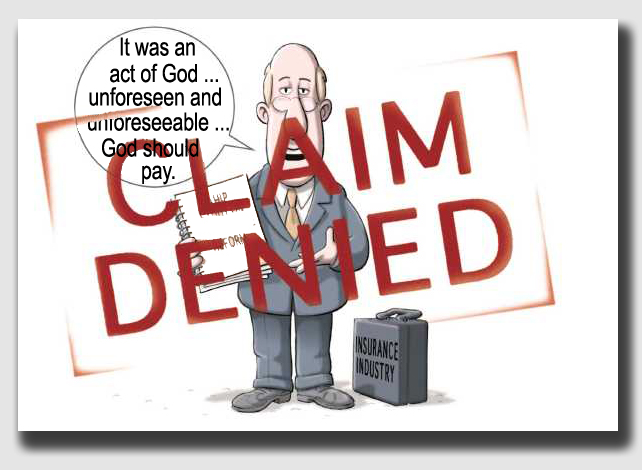
But there’s good news: Sylvia doesn’t have to worry about that branch anymore. Sadly, there’s bad news, too: the branch is no longer a hazard because it fell on a windy day, crushing two floors of Sylvia’s house. Her neighbor’s insurance carrier said, “Oops, looks like an act of God! Not our responsibility.” Sylvia thinks God should be left out of things because the branch — which broke right at the trunk — looked very decayed.

Elouise’s insurance company says Elouise had no idea the tree wasn’t healthy. “She didn’t know, so we don’t owe,” the company’s mantra seems to be. Sylvia complains she told the neighbor on many occasions, and even the neighbor admits she saw decayed branches that had fallen from the tree. Once, Elouise even hired Sylvia’s son to haul away some large branches that the old oak shed in a windstorm. Sylvia asked us what duty of care Elouise owed her under Ohio law.

We start with the evolution of the Massachusetts Rule. Originally, the Rule held that a homeowner usually had no remedy against overhanging branches, other than his or her right to trim the branch back to the boundary line. That Rule has been limited in the last score of years or so, notably in the Virginia Supreme Court case of Fancher v. Faglia (2007) and the North Dakota Supreme Court holding in Herring v. Lisbon Partners Credit Fund, Ltd. (2012). Both of those courts ruled that while a property owner might be limited to self-help where an encroaching tree was only doing what trees do – that is, dropping leaves, nuts, berries, seedpods and twigs – where a tree becomes a nuisance, the owner of the tree is liable for removing it.

The relevant Ohio case is Nationwide Insurance Co. v. Jordan. In that case, Mrs. Jordan’s big maple tree fell, damaging the neighbors’ place. They sued Mrs. Jordan, claiming the tree trespassed.

No dice, the Court said. The trespass claim would only work if the tree were an absolute nuisance, and that isn’t the case. Mrs. Jordan would be liable, the Court held, if she actually knew the tree was dangerous or if she reasonably should have known the tree was dangerous. The Court decided Mrs. Jordan had neither kind of knowledge. The neighbor, although vociferous in her condemnation of the tree to anyone else in earshot, admitted that she never complained to Mrs. Jordan about it.

In Sylvia’s case, the insurance company is wrong. It’s not enough that the neighbor says she didn’t know the branch was dangerous. The other half of the question is this “should have known” business. Was Elouise on constructive notice that the tree was dangerous, that is, should she reasonably have known the decay was making the tree unsafe? If Sylvia is right, the evidence will show the neighbor was told many times the tree was a hazard. Elouise had witnessed the tree drop a number of large branches in the previous years. She had to hire Sylvia’s brawny son to clean up the mess. And Sylvia told her about the danger, even agreeing to pay for the removal of the tree herself.

Several Ohio cases (such as Wertz v. Cooper) suggest that neighbor Elouise – being an urban dweller – has a greater duty to inspect her trees than would a country squire. The evidence suggests Elouise had every reason to be concerned about the tree, and thus had a duty to inspect it to be sure it wasn’t about to collapse Sylvia’s house.

claim140414Elouise’s insurance company may want to rethink its position… and start looking for its checkbook.

Nationwide Insurance Company, et al. v. Jordan, 639 N.E.2d 536 (1994). This action arose between adjoining landowners as a result of the falling of a mammoth maple tree. The insurance company, which had paid the damages to its insured’s place, sued for trespass and negligence. The defendant tree owner testified that she had no notice the tree was susceptible to falling. Her tenant likewise testified that she had no notice of the tree’s danger. The defendant’s tree service manager testified that he worked on the property’s trees every two years and that the tree in question was not unsafe less than two years before it fell. The only person to testify to notice that the tree was rotten and likely to fall was the plaintiff’s insured.

The trespass claim arose because the plaintiff maintained that the falling tree trespassed on the insured’s property. The trial court made short work of this, holding that the only way liability could be imposed on Mrs. Jordan without proof of fault would be if the tree were an absolute nuisance. Healthy trees growing on real property, even urban real property, are not absolute nuisances, the trial judge said. Thus, the insurance company had to prove that Mrs. Jordan either knew or had constructive knowledge that the tree was likely to fall. The insurance company couldn’t prove that, so the trial court found for Mrs. Jordan. The insurance company appealed.

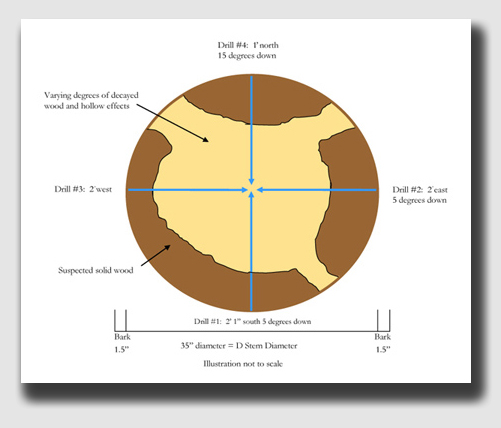
A diagram of one modern method of measuring a tree's decay. Elouise had any number of options - some cheap, some costly, some old school, some high-tech - for verifying the health of her big old oak.

A diagram of one modern method of measuring a tree’s decay. Elouise had any number of options – some cheap, some costly, some old school, some high-tech – for verifying the health of her big old oak.

Held: Mrs. Jordan was not liable. The Court said that there was no evidence that Mrs. Jordan actually knew or had any reason to know that the maple tree was in danger of falling. The neighbor complained that the tree’s propensity to fall was obvious to her, but she admitted he never told Mrs. Jordan. The Court observed that “[h]ad the plaintiff conveyed this knowledge to her neighboring landowner, the danger might well have been obviated, or, alternatively, the plaintiff’s hands would be clean and the defendant would have been on notice and resultantly liable for the fall.”

The Court further held that a tree on an owner’s property was not an “absolute nuisance,” and thus the adjoining landowner could not proceed merely upon strict liability against the owner. Instead, the neighbor was required to prove negligence. To recover on a theory of negligence arising out of a falling tree, a plaintiff’s evidence must establish that the defendant had actual or constructive notice of patent danger that the tree would fall. Here, Mrs. Jordan had neither actual notice nor constructive notice of the tree’s dangerous condition. Both Mrs. Jordan and her tenant testified that they had no notice of the tree’s danger, Mrs. Jordan’s regular tree trimming contractor worked on the property’s trees every two years and found that the tree in question was not unsafe not more than 24 months before it fell.

The Court ruled in favor of Mrs. Jordan.

– Tom Root

TNLBGray140407

Case of the Day – Thursday, March 6, 2025

A DUTY TO HECTOR?

nag150327Today, we continue our consideration of the problem posed by Tracy from Pinebark, New York.

You recall Tracy’s problem from yesterday: the neighbor’s arguably dead tree fell on her car, crushing it. She and her husband are tenants, and her landlady’s insurance carrier won’t cover the damage because it says the tree was dead. The neighbors’ insurance company won’t cover the damage because it says the tree was alive. Tracy’s arborist agrees with her landlady that the tree was quite dead, and the neighbors appear to have had actual knowledge (from work done by a previous arborist they had hired) that the tree was a hazard.

Yesterday, we discussed why Tracy’s local lawyer should argue that the neighbors are liable no matter what their skinflint insurance carrier may say. But Tracy, who understandably is looking for as many deep pockets as she can find, has asked whether her landlady is liable as well because she knew the neighbor’s tree was a hazard, but she never informed the neighbor of that fact. And that raises a very interesting (and rather creative) question.

Once again, we warn Tracy that we are not New York lawyers, and we are not rendering legal advice. She should see her local attorney for that. That being said, there’s not much guidance in New York law for her problem. A landlord who holds her land open to the public is under a legal duty to exercise reasonable care under the circumstances to maintain the premises in a reasonably safe condition. This duty is usually discussed in the context of landlords who don’t keep their premises secure against reasonably foreseeable criminal acts by third parties (locked doors, security cameras, and the like). The duty “imposes a minimum level of care on landlords who ‘know or have reason to know that there is a likelihood that third parties may endanger the safety of those lawfully on the premises’.”

sign150327A landlord must anticipate the risk of harmful acts of third persons, adopting the duty of care set out in the Restatement (Second) of Torts § 344. That is, a landlord must exercise reasonable care to discover that such harmful acts are being done or are likely to be done, give an adequate warning, or otherwise protect the visitors against it.

Most of these principles address the landlord’s duty to warn tenants and invitees of harmful conditions. Even if this created a duty on the part of the landlord to warn Tracy and her husband that the neighbor’s tree might fall, it doesn’t necessarily mean that the landlady had a duty to Tracy that required her to tell the neighbors that they had a dangerous tree on their hands. We just can’t find any holdings that create such a duty.

One part of the reason might be the futility of it. Telling the neighbor that he has a “danger tree” on his land that might someday injure the landlord’s tenant doesn’t really get anyone anywhere because the landlord is without any power to remove or trim the tree herself (it was well within the neighbor’s property boundaries). The landlord might have sued the neighbor for maintaining a private nuisance and might even have won a judgment against the neighbor — especially after limbs fell from other trees last summer, causing damage to the landlord and the tenant — but the likelihood that the suit would have been successful is problematic.

Another part of the reason might be Palsgrafian causation. Just like Mrs. Palsgraf in the famous Long Island Railroad case, the causation link — the landlady’s failure to warn the neighbors led to the tree falling and the injury — is pretty tenuous.

A third problem lies in Tracy’s analysis of her status as a tenant. As a tenant, she has the exclusive right to possession of the property. If the landlady had a duty to tell the neighbor about a “danger tree” on the neighbor’s property, we would be very surprised if Tracy didn’t have as much of a right and duty as did the landlady to tell the neighbor about the tree. Likewise, we would be surprised if Tracy herself couldn’t have maintained the private nuisance action against the neighbor to force removal of the tree. Generally speaking, having the right of possession of a piece of real estate is a powerful club, one which lets the possessor wield nearly as much power as does the titleholder. In this case, we suspect that Tracy herself had the power to do what she complains her landlady didn’t. And clearly, she had as much knowledge of the tree’s condition as her landlady did.

And that brings us to the final point. Tracy makes a compelling case that the neighbors knew all about the condition of the dead tree. Their agent, the tree surgeon, certainly knew as well because he had removed a diseased bough, and that knowledge is imputed to the neighbors. If the neighbors had gotten a report from the arborist on which they refused to act, it’s pretty hard to argue convincingly that things would have changed if the landlady or Tracy had also told the neighbors what they already knew: the tree was dangerous and should be removed.

Causation and foreseeability are often wrapped in the same package. In a New York case we’ll consider today, Mr. Fleury knew that his big ol’ apple tree was pretty close to the power line running to his house. Well, nature’s bounty — a really good apple crop — caused the tree to fall over partially, and the tree touched the wires. Mr. Fleury called the power company and said, “You need to fix this!” The power company said, “Nope, it’s your wiring from the transformer to the house. You fix it.” Mr. Fleury didn’t, and within about 10 days, the tree on the wires caused a short circuit.

appletree150327But, electricity being the capricious thing it is, it didn’t hurt Mr. Fleury. Instead, a “backfeed” went through the transformer and down his neighbor’s lines, setting fire to the neighbor’s place 165 yards away. Should Mr. Fleury be liable? He would have been if it had burned down his own house. The Court said it all depended on whether Mr. Fleury could reasonably foresee that his procrastination at getting the tree trimmed might have the effect it had.

How likely is it that a court would find that the landlady’s failure to hector her neighbor about a tree the neighbor already knew was a hazard would foreseeably lead to Tracy’s car being crushed? Probably not very. Such a holding would open the floodgates, making homeowners everywhere liable to their invitees if they were deemed not to have nagged their neighbors sufficiently over conditions that the homeowner had no power to correct. For example, we live on a side street where a neighbor has a testosterone-driven teenage son. He recklessly speeds his old junker of a car up and down the street. If our houseguest gets run down by the lad, would we be liable on a claim that we had been negligent because we never complained to the boy’s mother about the kid’s speed? It seems an awful lot like “blame the victim.”

Certainly, Tracy should ask her local lawyer about her claim against the landlady. But we think it’s a stretch the courts won’t buy.

Allstate Ins. Co. v. Fleury, Case No. 5:99-CV-1261, 2007 U.S. Dist. LEXIS 29354, 2007 WL 1200137 (N.D.N.Y. Apr. 20, 2007). A fire caused substantial damage to the Thaddeus Jastrzab residence. Allstate Insurance paid the Jastrzab claim and then sued Niagara Mohawk Power Corporation and Jim Fleury, the next-door neighbor. It seems the fire started at the Jastrzab home, but it was caused by a “backfeed” from the NiMo transformer that fed both the Jastrzab and Fleury homes.

Fleury had an apple tree that had grown near the lines for years without trimming. About 10 days before the fire, a large apple crop on the tree partially uprooted it and caused a limb to contact the electric wires feeding Fleury’s house. Fleury asked NiMo to fix it, but NiMo said Fleury owned the electric wires and was responsible for their upkeep. Fleury said he was concerned that the tree limbs touching the wires might cause a fire, but he did nothing more after NiMo passed the buck.

fire150327After the Jastrzab fire, an investigation found that the backfeed was caused by a tree limb that touched the old-style two-wire system, forcing the wires into mutual contact. The contact energized the neutral line owned by NiMo, which dumped excess current through its transformer and down the electric lines supplying the Jastrzab home. The electricity caused the grounding wire to overheat and arc onto Jastrzab’s roof. The fire was intensified by the fact that Jim Fleury’s home was not adequately grounded at the time, sending the electricity to look for a ground at the Jastrzab’s place. The trial court found that neither Fleury nor NiMo liable for the damages caused by the Jastrzab fire. Allstate moved for reconsideration.

Held: Allstate loses. Allstate complained that the Court inaccurately applied the law of negligence and foreseeability to the facts in this case. It argued that the Court was wrong when it found that the fire at the Jastrzab residence was not a reasonably foreseeable consequence of Fleury’s failure to remove the apple tree limb from his power lines. Allstate argued that the “precise occurrence” did not have to be foreseeable in order for liability to be imposed on Fleury. Fleury would have been liable if the fire had started at his house, Allstate said, and therefore, liability should be imposed for the fire that started 165 yards away.

The Court disagreed. The proper focus of the inquiry is on the foreseeability of the risk. This is an essential element of a fault-based negligence cause of action because the community deems a person at fault only when the injury-producing occurrence is one that could reasonably have been anticipated. Although virtually every untoward consequence can theoretically be foreseen “with the wisdom born of the event,” the Court said, the law draws a line between remote possibilities. No person can be expected to guard against harm from events that are so unlikely to occur that the risk would commonly be disregarded.

The precise manner in which the harm occurred need not be foreseeable, but still, the Court held, liability does not attach unless the harm is within the class of reasonably foreseeable hazards that the duty requires one to try to prevent. Here, no fire took place on the Fleury property. Instead, it started 165 yards away. No one reasonably foresaw that happening.

The law draws a line between remote possibilities and those that are reasonably foreseeable. Here, the likelihood that Defendant Fleury could have foreseen the chain of events – that the tree limb touching his power lines might create an electric backfeed fire that damaged the Jastrzab residence – was too tenuous and remote to permit recovery under a negligence cause of action.

– Tom Root

TNLBGray140407