Case of the Day – Monday, March 31, 2025

NEIGHBORS BEHAVING BADLY

There aren’t any winners in today’s neighbor-aggravating-neighbor case, one that had its genesis in one neighbor deciding that encroaching tree branches meant he could hack the trees – which stood on his neighbor’s land – back to mere stumps.

Things fell apart from there. The neighbors alleged two more atrocities in the ensuing year, and they blamed the tree hacker, because… well, why not? The Court, I think, was all too credulous, partly because the tree-cutter was not a native English speaker and was too easily dismissed for that reason.

I suspect that because the all-too-clear video of one altercation has Craig, who portrayed himself as the victim to the court, calling Mr. Cheung things – such as “f—face” – that would have gotten Craig’s teeth relocated in any midwestern bar. And he told Mr. Cheung that he was under arrest, a claim that I would have found amusing. But then, I have three years of law school and many more of law practice behind me. Mr. Cheung is an immigrant, and may well come from a place where arbitrary arrest is the rule rather than the exception.

Old Craig did not seem terribly rattled by Mr. Cheung’s alleged threat to kill him, and as a threat – if that’s what it was – it was dishwater-weak.

The wily Confederate raider (whose conduct in other quarters, I hasten to add, was abhorrent and who has not yet been rehabilitated by the current Administration), General Nathan Bedford Forest, is widely credited with saying that his guiding tactical principle is “getting there firstest with the mostest.” That’s what Craig and his wife did here, it seems, got to court first with a double-barreled assault that the neophyte Hogan Cheung was helpless to fend off.

Still, had Hogan only been a faithful treeandneighborlawblog reader, he would have been well aware of the Massachusetts Rule, and only cut the offending branches to the fence line. And all of the ensuing unpleasantness could have been avoided.

Stolarczyk v. Cheung, 2019 Cal. App. Unpub. LEXIS 2271 (Ct.App. 1st Dist., March 28, 2019). Craig and Shana Stolarczyk and their two young children live on a property that adjoins the parcel on which Hogan Cheung, his wife, two small children, and mother-in-law live in San Mateo. A fence that runs between the Stolarczyks’ backyard and Cheung’s side yard.

The Stolarczyks complained that Hogan Cheung had cut down two trees on their side of the fence a few years ago. Matters escalated from there into general ugliness. At one point, Craig and Shana said, someone dumped gasoline on their backyard, with a dribble that seemed to run from the dump location to the fence. Hogan denied having done so.

Craig’s and Shana’s landlord lived next door. Being aware of the problems, he installed a security camera on his own property that took in the Stolarczyks’ and Cheungs’ backyards. The camera recorded, among other things, a verbal altercation between Craig and Hogan over the camera installation. Craig taunted Hogan with obscenities. Hogan asked Craig to take the camera down. When Craig refused, Hogan covered the camera lens. Craig then told Hogan he was under arrest followed by the same vile epithet first used to address him. Hogan asked Craig if he was threatening him. Craig again told Hogan that he was under arrest, and Hogan responded, “That’s fine, thank you. And I will always come back for you.”

Craig asked Hogan if he ‘want[ed] to do something?” Hogan said, “I already did something.” Craig accused Hogan of pouring gasoline on his yard, to which Hogan replied, “No one put gas, you put your gas and you[‘re] blaming it on people.” Craig asked Hogan if he “want[ed] to settle it,” to which Hogan responded, “You don’t need to settle it, you’re dead.” Laughing, Craig told Hogan he was going to call the police because he was just threatened.

Hogan admitted he cut down overgrown trees planted in the Stolarczyks’ backyard in March 2016. Prior to cutting the trees, Hogan twice requested the Stolarczyks’ landlord manage the trees to no avail. According to Hogan, the trees grew fast, crossed the fence by three feet to four feet, and left limbs over his house and satellite dish. In addition, noise from the trees swaying in the wind and scraping and rubbing against the walls of his house made it difficult to sleep. Hogan stated he did not cut down the trees completely, only the portions rubbing against his house that were overgrown.

Hogan denied pouring gasoline in the Stolarczyks’ yard, and he said he placed tape over the camera lens because his wife was afraid, seeing the camera as “a really bad invasion looking into my house in the bathroom[], whatever [his wife] was doing.” He acknowledged he called the police about the camera before he taped over it and that an officer told him not to touch it. Prior to covering it, he also asked the Stolarczyks to take it down but they threatened and cursed him. Addressing the “you’re dead” statement he made to Craig, Hogan explained that Craig and his companion were cursing and provoking him, that his English was not “too good,” and he did not know what to say. He said his comment was not a threat but his way to end the conversation and signal he no longer wanted to talk. Hogan denied ever threatening to kill Craig.

In 2016, the Stolarczyks suspected herbicide was dumped over the fence into their yard, and in July 2017, Craig was overwhelmed by the smell of gasoline in his backyard. He said he smelled gas in the soil all along the fence line and observed discolored and foul-smelling mulch. The fire department confirmed the presence of a gasoline odor and doused the area with water.

The Stolarczyks filed a petition for a civil harassment restraining order against Hogan Cheung the next month.

The trial court acknowledged Hogan’s right to reasonably trim a neighbor’s trees that cross into his property but held he was not entitled to simply cut off the foliage to a point below the fence line. The court also noted the ongoing and escalating nature of the dispute and found Hogan Cheung to be “not the most believable witness” ever to appear in court. The court found his explanation that he did not understand what he was saying on the video to be “ludicrous” and did not see him as a victim in any way. Based on the video, the court found Hogan was self-confident and assertive when he taped over the camera, which the court said the property owner had every right to place on his property. Nothing suggested the camera was positioned to film the interior of Hogan Cheung’s home. With respect to the chemicals on their property, the court found it was “a reasonable inference to draw that someone else is responsible for that and I think that [the Stolarczyks’] concerns are legitimate that [Hogan Cheung was] responsible for that… I think without question, it has been sufficiently proven that Mr. Cheung damaged their property. He vandalized their property. There is a reasonable inference to be drawn, and it’s for that issue I am still going to issue a restraining order.”

The order required Hogan Cheung to stay five yards away from the Stolarczyks and to refrain from harassing or contacting them, or destroying their personal property. Mr. Cheung appeals.

Held: The restraining order was upheld.

Under Section 527.6 of the California Code of Civil Practice, a person who has suffered harassment… may seek a temporary restraining order and an order after hearing prohibiting harassment.” Harassment is “a knowing and willful course of conduct directed at a specific person that seriously alarms, annoys, or harasses the person, and that serves no legitimate purpose. The course of conduct must be that as would cause a reasonable person to suffer substantial emotional distress, and must actually cause substantial emotional distress to the petitioner.”

Hogan Cheung argued the court erred in granting the restraining order because the Stolarczyks failed to establish several of the required elements of Section 527.6 by clear and convincing evidence. In particular, he contends that the Stolarczyks failed to prove his conduct served no legitimate purposes, caused them substantial emotional distress, or posed any risk of future harm.

The Court of Appeals rejected his argument. “We find no merit to Cheung’s broad contention that his version of what happened was ‘equally likely’ as the Stolarczyks’ and did not amount to harassment.” Hogan claimed the Stolarczyks failed to prove his acts served no legitimate purpose: he said his trimming trees encroaching on his property and covering a surveillance camera directed towards his house were lawful acts with legitimate purposes. But Hogan Cheung cut the trees below the fence line, and not just those portions extending into his property. Also, the video camera was neither located on the Cheung property “nor trained on the inner sanctum of Cheung’s house.” It hardly helped Hogan’s case that he admitted that he was told by police not to touch the camera but did so anyway. “All of this evidence,” the Court said, “supports an implied finding that Cheung’s acts served no legitimate purpose.”

Hogan also claimed his conduct did not cause the Stolarczyks substantial emotional distress. In fact, the trial court rebuked Craig for behaving badly, describing his behavior in the video as “antagonistic and sarcastic and profane.” Nonetheless, the appellate court said, the petition for a restraining order was not filed solely based upon the camera incident nor was Craig the sole petitioner. Despite Craig’s laughter and the potty-mouthed taunting that he displayed that evening, the Court ruled that the “trial court could reasonably infer that both Craig and Shana suffered substantial emotional distress from having their trees chopped down and the debris left in their yard, and from having chemicals poured into their backyard where their small children play.”

The record likewise permitted the finding of likely future harm, supporting “the conclusion that a restraining order was necessary to prevent bad acts from continuing into the future. Cheung initially chopped down the Stolarczyks’ trees in March 2016; the Stolarczyks smelled gasoline along their fence line in July 2017; the altercation over the camera occurred in August 2017; and by the time of the hearing in September 2017, the trees had regrown to twice the height of the fence.” The dispute had not resolved itself in over a year, and the trees were growing large again. “Because we’re talking about trees that were cut in 2016, and Mr. Cheung still, it would appear, has issues with the fact that these trees are on his neighbor’s property and continue to grow and grow tall,” the Court said, the record supported a finding of threat of future harm.

– Tom Root

TNLBGray140407

Case of the Day – Friday, March 21, 2025

BRANCHING OUT

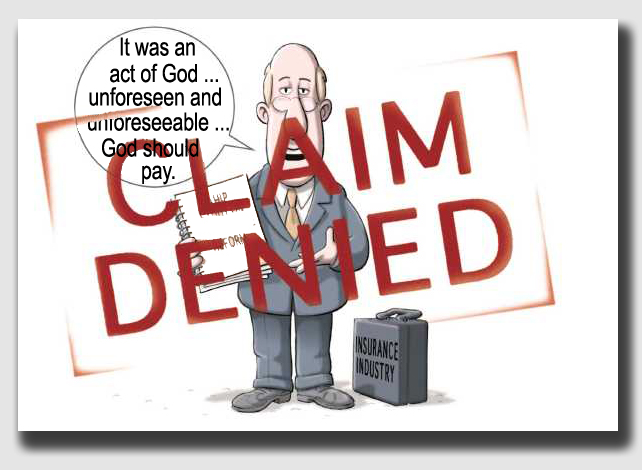
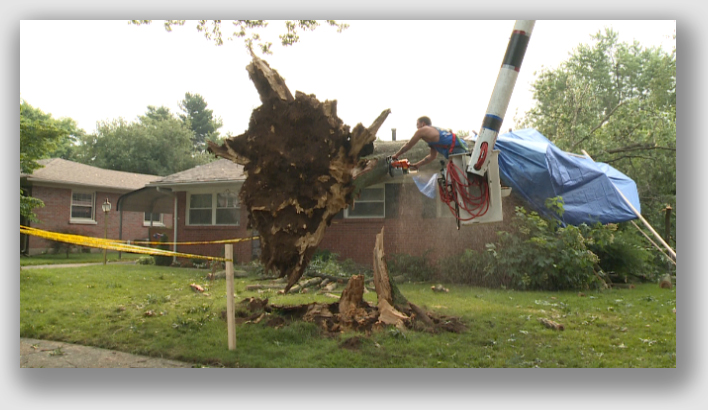
Crunch. And after the tree falls, the insurance company adds insult to injury.

Crunch. After the tree falls, the insurance company adds insult to injury.

An unhappy homeowner from urban Cincinnati, Ohio – we’ll call her Sylvia Glade – wrote to us about her neighbor’s oak tree. It seems that one of the oak’s branches was overhanging Sylvia’s home. The branch constantly dropped sticks, and the tree itself has been shedding branches regularly. As far back as the late 1990s, Sylvia thought the tree was dangerous and began asking her neighbor, whom we’ll call Elouise, to do something about it. A tree expert whom Sylvia hired five years ago to inspect her own trees agreed, saying the big oak should go.

The elderly Elouise was unmoved. She gave Sylvia permission to cut down the tree (as long as Sylvia paid for it), but then denied her the right to enter the property to do so. With the property line hard up against Sylvia’s house, Sylvia couldn’t even get a ladder under the branch to cut it away without Elouise’s cooperation (which, it is obvious by now, was not to be forthcoming).

But there’s good news: Sylvia doesn’t have to worry about that branch anymore. Sadly, there’s bad news, too: the branch is no longer a hazard because it fell on a windy day, crushing two floors of Sylvia’s house. Her neighbor’s insurance carrier said, “Oops, looks like an act of God! Not our responsibility.” Sylvia thinks God should be left out of things because the branch — which broke right at the trunk — looked very decayed.

Elouise’s insurance company says Elouise had no idea the tree wasn’t healthy. “She didn’t know, so we don’t owe,” the company’s mantra seems to be. Sylvia complains she told the neighbor on many occasions, and even the neighbor admits she saw decayed branches that had fallen from the tree. Once, Elouise even hired Sylvia’s son to haul away some large branches that the old oak shed in a windstorm. Sylvia asked us what duty of care Elouise owed her under Ohio law.

We start with the evolution of the Massachusetts Rule. Originally, the Rule held that a homeowner usually had no remedy against overhanging branches, other than his or her right to trim the branch back to the boundary line. That Rule has been limited in the last score of years or so, notably in the Virginia Supreme Court case of Fancher v. Faglia (2007) and the North Dakota Supreme Court holding in Herring v. Lisbon Partners Credit Fund, Ltd. (2012). Both of those courts ruled that while a property owner might be limited to self-help where an encroaching tree was only doing what trees do – that is, dropping leaves, nuts, berries, seedpods and twigs – where a tree becomes a nuisance, the owner of the tree is liable for removing it.

The relevant Ohio case is Nationwide Insurance Co. v. Jordan. In that case, Mrs. Jordan’s big maple tree fell, damaging the neighbors’ place. They sued Mrs. Jordan, claiming the tree trespassed.

No dice, the Court said. The trespass claim would only work if the tree were an absolute nuisance, and that isn’t the case. Mrs. Jordan would be liable, the Court held, if she actually knew the tree was dangerous or if she reasonably should have known the tree was dangerous. The Court decided Mrs. Jordan had neither kind of knowledge. The neighbor, although vociferous in her condemnation of the tree to anyone else in earshot, admitted that she never complained to Mrs. Jordan about it.

In Sylvia’s case, the insurance company is wrong. It’s not enough that the neighbor says she didn’t know the branch was dangerous. The other half of the question is this “should have known” business. Was Elouise on constructive notice that the tree was dangerous, that is, should she reasonably have known the decay was making the tree unsafe? If Sylvia is right, the evidence will show the neighbor was told many times the tree was a hazard. Elouise had witnessed the tree drop a number of large branches in the previous years. She had to hire Sylvia’s brawny son to clean up the mess. And Sylvia told her about the danger, even agreeing to pay for the removal of the tree herself.

Several Ohio cases (such as Wertz v. Cooper) suggest that neighbor Elouise – being an urban dweller – has a greater duty to inspect her trees than would a country squire. The evidence suggests Elouise had every reason to be concerned about the tree, and thus had a duty to inspect it to be sure it wasn’t about to collapse Sylvia’s house.

claim140414Elouise’s insurance company may want to rethink its position… and start looking for its checkbook.

Nationwide Insurance Company, et al. v. Jordan, 639 N.E.2d 536 (1994). This action arose between adjoining landowners as a result of the falling of a mammoth maple tree. The insurance company, which had paid the damages to its insured’s place, sued for trespass and negligence. The defendant tree owner testified that she had no notice the tree was susceptible to falling. Her tenant likewise testified that she had no notice of the tree’s danger. The defendant’s tree service manager testified that he worked on the property’s trees every two years and that the tree in question was not unsafe less than two years before it fell. The only person to testify to notice that the tree was rotten and likely to fall was the plaintiff’s insured.

The trespass claim arose because the plaintiff maintained that the falling tree trespassed on the insured’s property. The trial court made short work of this, holding that the only way liability could be imposed on Mrs. Jordan without proof of fault would be if the tree were an absolute nuisance. Healthy trees growing on real property, even urban real property, are not absolute nuisances, the trial judge said. Thus, the insurance company had to prove that Mrs. Jordan either knew or had constructive knowledge that the tree was likely to fall. The insurance company couldn’t prove that, so the trial court found for Mrs. Jordan. The insurance company appealed.

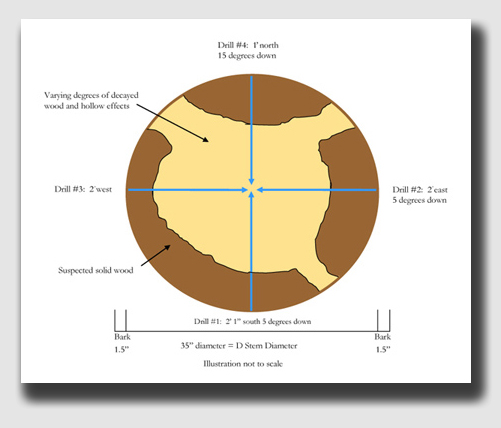
A diagram of one modern method of measuring a tree's decay. Elouise had any number of options - some cheap, some costly, some old school, some high-tech - for verifying the health of her big old oak.

A diagram of one modern method of measuring a tree’s decay. Elouise had any number of options – some cheap, some costly, some old school, some high-tech – for verifying the health of her big old oak.

Held: Mrs. Jordan was not liable. The Court said that there was no evidence that Mrs. Jordan actually knew or had any reason to know that the maple tree was in danger of falling. The neighbor complained that the tree’s propensity to fall was obvious to her, but she admitted he never told Mrs. Jordan. The Court observed that “[h]ad the plaintiff conveyed this knowledge to her neighboring landowner, the danger might well have been obviated, or, alternatively, the plaintiff’s hands would be clean and the defendant would have been on notice and resultantly liable for the fall.”

The Court further held that a tree on an owner’s property was not an “absolute nuisance,” and thus the adjoining landowner could not proceed merely upon strict liability against the owner. Instead, the neighbor was required to prove negligence. To recover on a theory of negligence arising out of a falling tree, a plaintiff’s evidence must establish that the defendant had actual or constructive notice of patent danger that the tree would fall. Here, Mrs. Jordan had neither actual notice nor constructive notice of the tree’s dangerous condition. Both Mrs. Jordan and her tenant testified that they had no notice of the tree’s danger, Mrs. Jordan’s regular tree trimming contractor worked on the property’s trees every two years and found that the tree in question was not unsafe not more than 24 months before it fell.

The Court ruled in favor of Mrs. Jordan.

– Tom Root

TNLBGray140407

Case of the Day – Monday, February 24, 2025

DOING NOTHING IS NOT AN OPTION

“A stitch in time saves nine” is an idiom that’s been around for three hundred years or so. It also is an everyday explanation of the equitable doctrine of laches.

It always seemed a little ironic that English common law needed an entire branch of jurisprudence known as “equity.” Oliver Wendell Holmes, Jr., famously lectured a litigant once that his courtroom was “a court of law, young man, not a court of justice.” It was precisely because there was so much law and so little justice that medieval England developed a parallel judicial system known as courts of equity, where litigants could get just results that were precluded in the courts of law by hidebound rules of pleading and damages.

The basis of equity is contained in the maxim “Equity will not suffer an injustice.” Other maxims present reasons for not granting equitable relief. Laches is one such defense.

snoozeLaches is based on the legal maxim “Equity aids the vigilant, not those who slumber on their rights.” In other words, “you snooze, you lose.” Laches recognizes that a party to a lawsuit can misplace evidence, lose witnesses, and thus forfeit a fair chance to defend himself or herself after the passage of time from the date the wrong was committed. If the defendant can show disadvantages because, for a long time, he or she relied on the fact that no lawsuit would be started, then the case should be dismissed in the interests of justice.

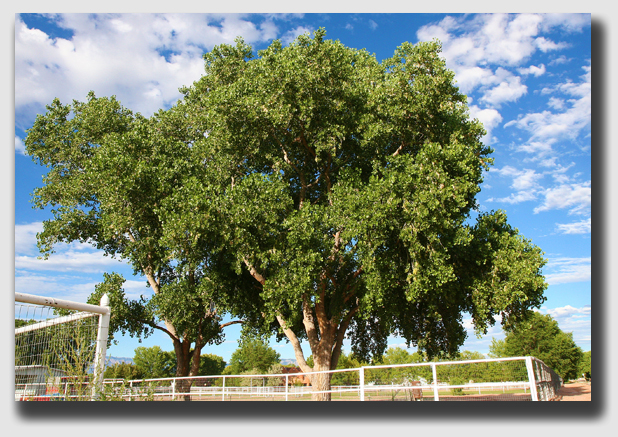
Ms. Garcia suffered encroachment from a copse of boundary-tree elms for a long time, perhaps too long a time, without doing anything about it. She could have trimmed roots and branches that intruded into her alfalfa fields years before – New Mexico law let her do that – but she fretted and stewed in silence. When she finally wanted to take action, the elms were so big that the trunks themselves had crossed the property line. Her “self-help” would have killed the trees.

The lesson? As Ed McMahon used to adjure us, “You must act now.”Act now

Garcia v. Sanchez, 108 N.M. 388, 772 P.2d 1311 (Ct.App. N.M. 1989). This dispute between neighboring landowners involves trees originally planted on the defendant’s property which have overgrown and now encroach upon the plaintiff’s property. By the time Garcia bought her land in 1974, ten elm trees planted some years before near the common property line were well established. Although originally planted inside the defendant’s property line, over the years, the trees had reached full size and had grown so that nine of them were directly on the boundary, with the trunks encroaching onto the plaintiff’s property from one to fourteen inches.

Garcia used her land for growing field crops. Sanchez’s side had a driveway and residence. Garcia didn’t complain about the trees until 8 years after buying her property. Two years after her first complaint, she sued.

The trial court found Garcia’s actions in providing water and nutrients to her crops had caused the trees to grow toward her property, but it concluded that Sanchez negligently maintained the elm trees, allowing the roots and branches to damage the crops on Garcia’s property. The court also found that she had not suffered enough damage to warrant the removal of the trees and that cutting any substantial portion of the trunks of the trees would seriously harm them. The court found that yearly trenching of the roots and trimming of branches on Garcia’s side of the property line would essentially resolve any problems resulting from the encroachment of tree roots and overhanging branches on her property, so it ordered Sanchez to pay $420.80 for damage to Garcia’s alfalfa, to yearly trench the roots and trim the branches of the trees, and to provide water and nutrients to the trees in order to restrict their growth toward plaintiff’s property.

The parties appealed.

Elms make good boundary trees

Elms make good boundary trees

Held: The Court of Appeals reversed and remanded. It held that the trees originally planted inside a property line, which had grown to encroach onto adjoining property along the boundary, were not jointly owned under the common boundary line test absent an oral or written agreement to have the trees form the boundary line between the parties’ property. It agreed that the trial court’s refusal to order that Sanchez remove the encroaching trees was not an abuse of discretion, observing that the trial court had tried to balance equities by weighing the value of trees against the agricultural character of the property involved and the nature of the harm suffered by Garcia.

But the Court of Appeals went further: it ruled that the harm caused to Garcia’s crops by the elms’ overhanging branches and tree roots is not actionable. Instead, following Abbinett v. Fox, the Court held that a plaintiff’s remedies are normally limited to self-help to protect against the encroaching branches and roots. But here, Garcia waited too long: her plan now, after years of suffering in silence, to remove a substantial portion of the root system or trunk of the encroaching trees (her Massachusetts Rule right) may endanger lives or injure Sanchez’s property, and that laches gives a court the right to limit the exercise of her self-help plan under its equitable authority.

The Court sent the case back to the trial court to determine whether Garcia’s failure to exercise self-help to control encroaching roots, branches and tree trunks over an extended period should preclude injunctive relief now.

– Tom Root

TNLBGray

Case of the Day – Friday, February 7, 2024

ONE STATE’S TREE IS ANOTHER STATE’S PEST

Fast growing ... and messy as a 3-year old ...

Fast growing … and messy as a 3-year-old child …

Long before the Virginia Supreme Court’s decision in Fancher v. Fagella, a little-noticed New Mexico decision grappled with the problems caused by cottonwood trees. Cottonwoods can be majestic, and they were welcome enough to the tired and thirsty pioneers that the cottonwood became the state tree of Kansas. But at the same time, there are some arborists (and more than a few homeowners) who label them as dangerous, messy and a tree that should “be removed from most residential property.

Mr. Fox had a cottonwood tree he loved dearly. His neighbors didn’t fall into the same category, however. They hated the constantly shedding tree with the invasive and prolific root system. Like the banyan tree in Whitesell v. Houlton, there was a lot about Mr. Fox’s cottonwood not to like.

I have often mentioned the time-honored legal maxim that “hard cases make bad law.” It bears repeating here. Like the Whitesell v. Houlton banyan tree, Mr. Fox’s cottonwood generated sufficient horror stories in the trial transcript to explain the trial court’s decision that Mr. Fox’s tree had to go. A more level-headed weighing of the competing property and societal interests was undertaken by the Court of Appeals.

It's beginning to look a lot like Christmas ...except it's June, and the cottonwood is shedding cotton like a plantation in a tornado.

It’s beginning to look a lot like Christmas … except it’s June, and the cottonwood is shedding cotton like a plantation in a tornado.

None of that changed the outcome for Mr. Fox. He had to pay damages, and Abbinetts were free to hack away at the tree’s root system to the full extent of the Massachusetts Rule. But for those of us who admire the process, the Court of Appeals’ thoughtful opinion was a breath of fresh air.

Abbinett v. Fox, 103 N.M. 80, 703 P.2d 177 (Ct.App. N.M. 1985). The Abbinetts and Fox formerly owned adjoining residences in Albuquerque. The Abbinetts sued, alleging that while Fox owned his place, roots from a large cottonwood tree on his property encroached onto their land and damaged a patio slab, cracked the sides of a swimming pool, broke a block wall and a portion of the foundation of their house, and clogged a sprinkler system.

The Abbinetts asked for an injunction against Fox. The trial court found against Fox for $2,500.00 but denied injunctive relief to force Fox to remove the tree roots. Instead, the Court entered an order authorizing the Abbinetts to utilize self-help to destroy or block the roots of the cottonwood trees from encroaching on their land. The Foxes appealed the decision.

Cottonwoods are known for their intricate and aggressive root systems

Cottonwoods have intricate and aggressive root systems …

Held: The New Mexico Court of Appeals grappled for the first time with the Massachusetts Rule, the Hawaii Rule and the Smith v. Holt-era Virginia Rule. Instead, it adopted a modification of all of these, finding that when overhanging branches or protruding roots of plants actually cause – or there is imminent danger of them causing – “sensible harm” to property other than plant life, the damaged or endangered neighbor may require the owner of the tree to pay for damages and to cut back the endangering branches or roots. Such “sensible harm” has to be something more than merely casting shade or dropping leaves, flowers or fruit. In so doing, the New Mexico Court anticipated the Virginia Supreme Court’s Fancher v. Fagella holding by about 22 years.

The New Mexico Court also opined that it is the duty of a landowner to use his property in a reasonable manner so as not to cause injury to adjoining property. This is the Hawaii Rule. And the landowner who suffers encroachment from the tree of another may — but is not required to — “abate it without resort to legal proceedings provided he can do so without causing [a] breach of [the] peace.” This, of course, is the heart of the Massachusetts Rule. The New Mexico Court called all of these holdings a “modified Virginia Rule,” as indeed it was.

The Court held that a trial court may grant both damages for already incurred injuries and injunctive relief to prevent future harm where there is a showing of irreparable injury for which there is no adequate remedy at law.

– Tom Root

TNLBGray140407

Case of the Day – Thursday, February 6, 2025

ENCROACHMENT, NUISANCE … AND THE MARCH OF TIME

camelhorse140429Encroachment – not the football kind, the tree kind. Encroachment governs the rights of adjoining property owners when the trees on one of the properties encroach on the property of the other. Overhanging branches, invasive root systems, falling debris … those kinds of problems.

Monday, we explored one of the two different approaches to encroachment under American law, the “Massachusetts Rule” that landowners are limited to self-help – but not lawsuits – to stop encroaching trees and roots. Yesterday, we looked at the other end of these 50 United States, and the “Hawaii Rule,” a holding that a landowner could sue for damages and injunctive relief when a neighbor’s tree was causing actual harm or was an imminent danger to his or her property.

Between the two competing rules, Virginia found herself firmly straddling the line. The fair Commonwealth may be for lovers but it is also for equivocators. The landmark Old Dominion case on the issue, Smith v. Holt, hailed from the 1930s, holding that the Massachusetts Rule applied unless the tree in question was (1) causing actual harm or was an imminent danger; and (2) “noxious.” This holding brings to mind the maxim, “A camel looks like a horse designed by a committee.” Frankly, Smith v. Holt had “committee’ written all over it. It seemed to hold that the Massachusetts Rule applied except where it didn’t. And what did “noxious” have to do with anything?

hoist140715The Virginia Supreme Court finally addressed the confusing situation in Fancher v. Fagella. There the Court found itself hoisted on its own “noxious” petard. Everyone could agree that poison ivy was noxious, and most people could agree kudzu was noxious. But how about a cute little shade tree? Shade trees are definitely not in the same league with poisonous or entangling pests, but yet, a cute little shade tree can come out of the ground harder and do more damage than poison ivy or kudzu ever could.

Take the tree in Fancher. It was a sweet gum, a favored landscaping tree as well as a valuable hardwood. But for poor Mr. Fancher, it was Hydra covered in bark. Only halfway grown, Fagella’s sweet gum’s roots were already knocking over a retaining wall, kicking up patio stones, breaking up a house foundation and growing into sewers and even the house’s electrical system. Fancher sued for an injunction, but the trial court felt obligated to follow Smith v. Holt. There was just no way that a sweet gum tree could be noxious, the local court held, and thus, it would not help the frustrated Mr. Fancher. But the Virginia Supreme Court, wisely seeing that the “noxious” standard was of no help in these cases, abandoned the hybrid rule of Smith v. Holt, an unwieldy compromise that had already become known as the “Virginia Rule.” The Court – noting that the “Massachusetts Rule” was a relic of a more rural, bucolic age – decided that the “Hawaii Rule” was the better fit for modern, crowded, helter-skelter suburban life. It sent the case back to the trial court, instructing the judge that the court should consider whether an injunction should issue.

This decision fits neatly into what we have been considering for the past week on negligence and nuisance. Here, the tree had become a nuisance, possibly because Fagella had not cared for the tree before it began damaging the neighbor’s property. All the tree had ever done is what trees do – it grew. And grew and grew. It was healthy, perhaps amazingly so, but Fagella was ordered to shoulder the cost of damages caused not because it was dangerous or dead or anything other than an inconvenience.

Like the decision or hate it, you could see this coming. From an age in which trees grew and lived and died, and effects of the life cycle were not chargeable against the landowner, we may be arriving at a point where trees aren’t much more than big, woody pets, with their owners responsible for whatever the tree may naturally do.

Fancher v. Fagella, 650 S.E.2d 519, 274 Va. 549 (2007). Fancher and Fagella were the owners of adjoining townhouses in Fairfax County, Virginia (a largely urban or suburban county west of Washington, D.C., and part of the Washington metropolitan area). Fagella’s property is higher in elevation than Fancher’s, and a masonry retaining wall runs along the property line to support the grade separation. Fancher has a sunken patio behind his home, covered by masonry pavers.

treeonhouse160322Fagella had a sweet gum tree located a few feet from the retaining wall, about 60 feet high with a 2-foot diameter trunk at its base. Sweet gums are native to the area and grow to 120 to 140 feet in height at maturity, with a trunk diameter of 4 to 6 feet. The tree was deciduous, dropping spiky gumballs and having a heavy pollen load. It also has an invasive root system and a high demand for water.

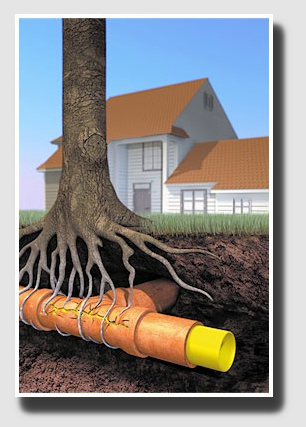
In the case of Fagella’s tree, the root system had displaced the retaining wall between the properties, displaced the pavers on Fancher’s patio, caused blockage of his sewer and water pipes and had begun to buckle the foundation of his house. The tree’s overhanging branches grew onto his roof, depositing leaves and other debris in his rain gutters. Fancher attempted self-help, trying to repair the damage to the retaining wall and the rear foundation himself, and cutting back the overhanging branches, but he was ineffective in the face of the continuing expansion of the root system and branches. Fancher’s arborist believed the sweet gum tree was only at mid-maturity, that it would continue to grow, and that “[n]o amount of concrete would hold the root system back.” The arborist labeled the tree “noxious” because of its location, and said that the only way to stop the continuing damage being done by the root system was to remove the tree entirely.

Fancher sued for an injunction compelling Fagella to remove the tree and its invading root system entirely and asked for damages to cover the cost of restoring the property to its former condition. Fagella moved to strike the prayer for injunctive relief. The trial court, relying on Virginia law set down in Smith v. Holt, denied injunctive relief. Fancher appealed.

Held: The Supreme Court abandoned the “Virginia Rule,” adopting instead the “Hawaii Rule” that while trees and plants are ordinarily not nuisances, they can become so when they cause actual harm or pose an imminent danger of actual harm to adjoining property. Then, injunctive relief and damages will lie. The Court traced the history of the encroachment rule from the “Massachusetts Rule” — which holds that a landowner’s right to protect his property from the encroaching boughs and roots of a neighbor’s tree is limited to self-help, i.e., cutting off the branches and roots at the point they invade his property — through the modern “Hawaii Rule.” The Court noted that Virginia had tried to strike a compromise between the two positions with the “Virginia Rule” set out in Smith v. Holt, which held that the intrusion of roots and branches from a neighbor’s plantings which were “not noxious in [their] nature” and had caused no “sensible injury” was not actionable at law, the plaintiff being limited to his right of self-help.

Invasive_rootsThe Court found the “Massachusetts Rule” rather unsuited to modern urban and suburban life, although it may still work well in many rural conditions. It admitted that the “Virginia Rule” was justly criticized because the classification of a plant as “noxious” depends upon the viewpoint of the beholder. Just about everyone would agree that poison ivy is noxious. Many would agree that kudzu is, too, because of its tendency toward rampant growth, smothering other vegetation. But few would declare healthy shade trees to be noxious, although they may cause more damage and be more expensive to remove, than poison ivy or kudzu. The Court decided that continued reliance on the distinction between plants that are noxious and those that are not imposed an unworkable and futile standard for determining the rights of neighboring landowners.

Therefore, the Court overruled Smith v. Holt, insofar as it conditions a right of action upon the “noxious” nature of a plant that sends forth invading roots or branches into a neighbor’s property. Instead, it adopted the Hawaii Rule, finding that encroaching trees and plants are not nuisances merely because they cast shade, drop leaves, flowers, or fruit, or just because they happen to encroach upon adjoining property either above or below the ground. However, encroaching trees and plants may be regarded as a nuisance when they cause actual harm or pose an imminent danger of actual harm to adjoining property. If so, the owner of the tree or plant may be held responsible for harm caused to adjoining property, and may also be required to cut back the encroaching branches or roots, assuming the encroaching vegetation constitutes a nuisance. The Court was careful to note that it wasn’t altering existing law that the adjoining landowner may, at his own expense, cut away the encroaching vegetation to the property line whether or not the encroaching vegetation constitutes a nuisance or is otherwise causing harm or possible harm to the adjoining property.

The Court warned that not every case of nuisance or continuing trespass may be enjoined, but it could be considered here. The decision whether to grant an injunction, the Court held, always rests in the sound discretion of the chancellor and depends on the relative benefit an injunction would confer upon the plaintiff in contrast to the injury it would impose on the defendant. In weighing the equities in a case of this kind, the chancellor must necessarily first consider whether the conditions existing on the adjoining lands are such that it is reasonable to impose a duty on the owner of a tree to protect a neighbor’s land from damage caused by its intruding branches and roots. In the absence of such a duty, the traditional right of self-help is an adequate remedy. It would be clearly unreasonable to impose such a duty upon the owner of historically forested or agricultural land, but entirely appropriate to do so in the case of parties, like those in the present case, who dwell on adjoining residential lots.

– Tom Root

TNLBGray140407

Case of the Day – Wednesday, February 5, 2025

YESTERDAY CHOCOLATE, TODAY VANILLA

chocolate160325The law of encroaching trees runs a continuum from total self-help to the exclusion of any judicial remedy (theMassachusetts Rule,” which we discussed yesterday) – to tree owner liability (the “Hawaii Rule”), with many variations in between. If the law of encroachment were administered by Baskin Robbins, the Massachusetts Rule would be chocolate ice cream, and the Hawaii Rule would be vanilla.

In Whitesell v. Houlton, a Hawaiian appellate court first adopted what is generally known as the “Hawaii Rule,” which held that when there is imminent danger of overhanging branches causing “sensible” harm to property other than plant life, the tree owner is liable for the cost of trimming the branches as well as for the damage caused.

Maybe the court’s holding that the Whitesell v. Houlton tree was a nuisance arose from the hard facts of that case: the tree was a massive banyan tree, with a 12-foot trunk and 90-foot height.

There is an old legal maxim that “hard cases make bad law,” and the banyan tree in this case was pretty clearly monster flora, sort of the kudzu of trees. Perhaps it is that the laid-back political and cultural nature of the Sandwich Islands is too far removed from the flintier New Englanders and the type of self-reliance embraced by the “Massachusetts Rule.

banyan160325For whatever reason, if a branch from a healthy tree in Massachusetts is in danger of falling into a neighbor’s yard, that neighbor may trim it at his or her own expense … but that’s it. In Hawaii, overhanging branches or protruding roots constitute a nuisance when they actually cause, or there is imminent danger of them causing, sensible harm to property other than plant life, in ways other than by casting shade or dropping leaves, flowers, or fruit. Then, the damaged or imminently endangered neighbor may either use self-help to cut back on the encroaching tree or may require the owner of the offending tree to pay for damages and to cut back endangering branches or roots. If such is not done within a reasonable time, the neighbor may even have the trimming done at the tree owner’s expense.

As we said, nothing in this ruling prevents a landowner — at his or her own expense — from cutting any part of an adjoining owner’s trees or other plant life up to his property. It’s just that the Massachusetts Rule says that’s all a landowner may do. Hawaii thinks differently. Tomorrow, we’ll see that Hawaii may be on the right side of history in this debate.

Whitesell v. Houlton, 632 P.2d 1077 (App. Ct. Hawaii, 1981). The Whitesells and Mr. Houlton lived next to each other. Mr. Houlton owned a 90-foot-tall banyan tree with foliage extending 100 to 110 feet from the trunk. The tree overhung the Whitesells’ property. and the two-lane street fronting both properties. The Whitesells asked Mr. Houlton repeatedly over a two-year period to trim the tree, and they took it upon themselves to do so at various times. Their VW microbus – probably chartreuse – was damaged by low-hanging branches, their garage roof was damaged by some intruding branches from the tree, and they identified storm-damaged branches that were in danger of falling.

Despite their entreaties, Mr. Houlton did nothing. Finally, the Whitesells hired a professional tree trimmer who cut the banyan’s branches back to Houlton’s property line and then sued Mr. Houlton to get him to pay.

The trial court sided with the Whitesells and ruled that Mr. Houlton had to pay. He appealed.

Held: Mr. Houlton had to pay. The court surveyed different approaches taken by other states, identifying the “Massachusetts Rule” holding that Mr. Houlton had no duty to the Whitesells or the “Virginia Rule” that said Mr. Houlton had a duty to prevent his tree from causing sensible damage to his neighbor’s property.

nuisance160325The Court agreed with Mr. Houlton that “the Massachusetts Rule is ‘simple and certain’. However, we question whether it is realistic and fair. Because the owner of the tree’s trunk is the owner of the tree, we think he bears some responsibility for the rest of the tree. It has long been the rule in Hawaii that if the owner knows or should know that his tree constitutes a danger, he is liable if it causes personal injury or property damage on or off of his property… Such being the case, we think he is duty bound to take action to remove the danger before damage or further damage occurs.” This is especially so, the Court said, where the tree in question was a banyan tree in the tropics.

Thus, the Court adopted what it called “a modified Virginia rule.” It held that “overhanging branches which merely cast shade or drop leaves, flowers, or fruit are not nuisances; that roots which interfere only with other plant life are not nuisances; that overhanging branches or protruding roots constitute a nuisance only when they actually cause, or there is imminent danger of them causing, sensible harm to property other than plant life, in ways other than by casting shade or dropping leaves, flowers, or fruit; that when overhanging branches or protruding roots actually cause, or there is imminent danger of them causing, sensible harm to property other than plant life, in ways other than by casting shade or dropping leaves, flowers, or fruit, the damaged or imminently endangered neighbor may require the owner of the tree to pay for the damages and to cut back the endangering branches or roots and, if such is not done within a reasonable time, the damaged or imminently endangered neighbor may cause the cutback to be done at the tree owner’s expense.”

The Court pointed out that this rule did not strip a landowner of the right, at his or her expense, to trim a neighbor’s overhanging tree or subterranean tree roots up to the property line. It’s just where the Massachusetts Rule limits you to helping yourself, the Hawaii Rule lets you enlist the courts to do the heavy lifting.

– Tom Root

 TNLBGray140407

Case of the Day – Tuesday, February 4, 2025

ENCROACHMENT – MASSACHUSETTS STYLE

The tree crew we hired seemed sort of smallish, but they had really cool trucks ...

The tree crew our neighbor hired seemed sort of smallish, but they were always smiling and had these really cool trucks …

We’ve got some new neighbors, nice folks who bought a house that, while substantial, has been badly neglected. Since moving in a few months ago, they’ve been working like beavers to fix the place up.

During the warm snap that followed last week’s frigid temps, they had a tree service cut down a number of trees, large and small. We have a couple of big pine trees – which I love but my wife doesn’t – that have branches overhanging the new neighbors’ back yard.

Our neighbor came over to inquire whether we minded that he trim some of the long, spindly branches encroaching over the stockade fence into his yard. We were surprised to be asked.

“But surely you know the Massachusetts Rule,” we said. “You don’t need permission to trim the oak branch back to the property line. That’s well-settled law!” Our neighbor was pleased if a little skeptical. He was sure he couldn’t touch the branch – even though it extended well into his property – without our OK.

To assuage our neighbors’ concern (and that of their tree service), we provided the foreman with the web address of the most comprehensive tree law site in the entire solar system – this one. We confidently predicted that the site just happened to plan to cover encroachment issues the very next day.

Are we ever prescient! As it happens, today we are going to talk about encroachment… not the series of four neutral-zone penalties that nearly cost the Commanders an awarded score in their loss to the Eagles. That’s for football season, now a single game away from an interminable six-month hiatus. The encroachment we care about is different.

Beginning140714Encroachment is what happens when your neighbor’s tree roots break into your sewer system, when leaves and nuts are dumped into your gutters, or when the branches rain down on your car or lawn. The law that governs rights and responsibilities when a neighbor’s tree encroaches on your property only developed in the last 80 years. Before that time, a simpler time perhaps, people didn’t resort to the courts quite so much.

In the beginning, there was the “Massachusetts Rule.” That Rule, something we talk about so much you’d think everyone would have heard of it by now, arose in Michalson v. Nutting, 275 Mass. 232, 175 N.E. 490 (Sup.Jud.Ct. Mass. 1931). This is the granddaddy of all encroachment cases, the Queen Mother. The Massachusetts Rule is the self-help mantra of neighbors everywhere.

In Michalson, roots from a poplar growing on the Nuttings’ land had penetrated and damaged sewer and drain pipes at Michalson’s place. As well, the roots had grown under Michalson’s concrete cellar, causing cracking and threatening serious injury to the foundation. Michalson wanted the Nuttings to cut down the tree and remove the roots. They said, “Nutting doing.”

Encroaching tree roots can sometimes be unsightly

Encroaching tree roots can sometimes be unsightly…

Michalson sued, asking the court to permanently enjoin the Nuttings from allowing the roots to encroach on his land. Besides an order that the Nuttings essentially stop the tree from growing, Michalson wanted money, too, to ease the pain of leaf raking and root cutting. The trial judge found the Nuttings were not liable merely because their tree was growing. He threw Michalson’s lawsuit out, and Michalson appealed.

Held: In what has become known as the “Massachusetts Rule,” the Supreme Judicial Court of Massachusetts held that a property owner’s remedies are limited to “self-help.” In other words, a suffering property owner may cut off boughs and roots of a neighbor’s trees that intrude into another person’s land. But the law will not permit a plaintiff to recover damages for invasion of his property by roots of trees belonging to the adjoining landowner. And a plaintiff cannot obtain equitable relief — that is, an injunction — to compel an adjoining landowner to remove tree roots invading the plaintiff’s property or to restrain such encroachment.

Our takeaway today, therefore, would be the two concepts embodied in the Massachusetts Rule. The first is that you, the neighbor, need no permission from the tree owner to trim away roots and branches that overhang your property. That rule survives to this day just about everywhere. The second – which has been questioned to a much greater extent – is that you can’t sue your neighbor for the effects of encroachment by one of his or her trees.

Hold those concepts close, because tomorrow, we’ll see how things work on the other end of the country – Hawaii – where the law developed somewhat differently. Some say that size matters. We’ll see how true that is when the tree is a little too much for the court to ignore.

– Tom Root

TNLBGray140407