Case of the Day – Wednesday, May 20, 2026

SHORT AND SWEET

There have been more than a few recurring themes in our posts over the past decade-plus. Some of the most repeated are (1) hire a lawyer when you should have one, such as anytime you feel the need to sue someone; (2) courts follow prior decisions – called stare decisis – in order to bring certainty to the law; and (3) the Massachusetts Rule has traditionally been the law of the land, and while that has been changing, it is still the “go to” rule in most places.

Alas, Virginia Scott is not one of our regular readers. Had she been back in 2010 (and yes, we were around then, when people were still surfing the Web with their Packard Bell 286s sporting 56K modems), she would have consulted a lawyer about the mess that trees belonging to her neighbor, Julie, were making in her yard. She would have told the lawyer that she wanted damages for the dropped leaves and twigs, and compensation for what she had paid tree trimmers to cut the offending branches and roots back to her property line.

The lawyer would have said, “Nothing doing,” or words to that effect, which would have saved Virginia the cost and aggravation of trying a do-it-yourself lawsuit against Julie. As well as having her hat handed to her by the trial court and the court of appeals.

“But,” Virginia wailed, “the law is stupid. It should be changed.” Notably, that argument has worked some places – Virginia, Hawaii, North Dakota – but Virginia had no idea how to press for modification of the rule, and the Court was unimpressed.

At least the Court of Appeals kept it short and sweet. As we will be…

Scott v. McCarty, 41 So.3d 989 (Fla.App. 4 Dist. 2010). Virginia Scott owned property next to Julie McCarty’s place. Dr. Julie had some pretty lush trees – this being Florida, plants like to grow there – and eventually some of the branches were overhanging Virginia’s place, and the roots were intruding underground.

Virginia sued the Doc for the damages Julie’s trees caused her property and for the cost of trimming the branches back to the property line and digging up the intruding roots. Apparently, having spent so much on damage repair and tree trimming, Virginia decided to save money on a lawyer and represented herself.

The trial court dismissed her complaint forthwith, citing the Florida common law rule that “a possessor of land is not liable to persons outside the land for a nuisance resulting from trees and natural vegetation growing on the land. The adjoining property owner to such a nuisance, however, is privileged to trim back, at the adjoining owner’s own expense, any encroaching tree roots or branches and other vegetation which has grown onto his property.”

This rule not seeming right to Virginia, she appealed.

Held: Virginia’s case was properly dismissed. The Court of Appeals said that the reason for Florida’s common-law rule “was that it was wiser to leave the individual to protect himself than to subject the other to the annoyance of actions at law which would likely be innumerable.”

On appeal, Virginia acknowledged that the common-law rule, first adopted in the 1987 Florida appellate case Gallo v. Heller, was the prevailing law, but she asked the Court to “take a different course.” The Court refused to do so, saying that “the Gallo view is the predominant view in the country… [and] departing from the precedent would invite further litigation between neighbors on this issue, which as a public policy matter should be avoided.”

– Thomas L. Root

TNLBGray140407

Case of the Day – Wednesday, May 13, 2026

A PRESCRIPTION FOR TROUBLE

We all know about adverse possession, that peculiar legal doctrine that holds, in essence, that if you’re brazen enough to trespass on someone else’s land continuously for a period prescribed by statute, the property becomes yours. In most places, such as Pennsylvania, the period is 21 years long. So for 20 years, 11 months and 31 days, you’re a squatter. The next day, you’re landed gentry.

It seemed to me like judicially-sanctioned theft when I learned about adverse possession in law school (so long ago that over twice the statutory period has passed since I walked those hallowed halls). The theory, my property professor droned, was that public policy favored productive use of the land, and taking over a piece of land from an owner careless enough to let you take it over put it to more productive use,\ and thus should reward the taker. So if I like my piece of country property as a preserve for the birdies and little critters, and you want to bulldoze it for a new Starbucks, you win. The whole notion seems as cockeyed to me now as it did when I was a well-scrubbed and wide-eyed first-year law student back in the halcyon days of the 1970s.

To claim adverse possession, you have to show that your occupation of the land was open, notorious, hostile and adverse to the interest of the owner for a continuous period of whatever the statute prescribes, say 21 years as an example. Some might say that if you built your Starbucks on my forest plot, and I did nothing about it for that long, I deserve to lose my land. To which I might reply that the law does not seem to offer much protection to someone when his or her property can be lost to another person simply because the thief gets away with it for long enough.

But if I thought adverse possession was screwy, I was hardly prepared for its little brother, a prescriptive easement. Adverse possession is occupation of the land. A prescriptive easement is a mere use of someone else’s land without exclusive occupation. My kids cut through the neighbor’s side yard for years as a shortcut to the church. I still do it when I’m running late. If now, 28 years after the neighbor’s house was built, he put up a fence to stop us, should we be able to claim a right to have the fence removed so that we can continue to save five minutes getting to worship? What we would have, we could argue, was a prescriptive easement.

I once had a client who was about to build a garage on a piece of his land. The power company sued because lines that had gone behind his property for years had been slightly rerouted so that they crossed a corner of his place. The electric company said it had moved the lines a convenient 23 years before, and now it had a prescriptive easement, which limited my client’s use of a quarter of his property to a vegetable garden.

We stared down Reddy Kilowatt in that case because we located an aerial photo of the town from 20 years earlier that showed the electric company was bluffing and that the lines had not been moved as of that date. My client sold the electric company an easement over 50 feet of backyard for about $30,000. Happy ending.

As much as I dislike the whole notion of prescriptive easements, I admire creativity. I always thought of such easements as created by deliberate human action. My kids cut across the neighbor’s lawn. The power company restrung its lines. But the plaintiffs in today’s case showed creativity I lack. Here, they claim a prescriptive easement not because of what they did, but because of what their tree did. Because the limbs and roots of a tree they owned grew into a neighboring property and remained there for more than 21 years, they argued, they had thus obtained a prescriptive easement that would prevent the neighbor from doing anything to the tree.

It’s as if the Massachusetts Rule had an expiration date.

At first blush, it seems to ring all the prescriptive easement bells and to be pretty doggone clever. But after thinking about the whole notion for long enough, the appeals court wisely said it simply did not make sense.

Koresko v. Farley, 844 A.2d 607 (Pa.Cmwlth. 2004). The Koreskos bought property with a line of trees on one boundary, all of which had been there for more than 21 years. The trees hang over the boundary with the neighboring property, which contains a house owned by M.J. Farley Development Co., Inc. Farley had submitted a subdivision plan to divide the property into two plots and build a second residence on the newly formed plot. 

The subdivision plan proposed placing a water line and driveway near the boundary trees. Upon learning of the proposal, the Koreskos sued in equity seeking injunctive relief and, of course, money damages. In their complaint, the Koreskos claimed the driveway and trench would damage the root systems of the boundary trees. Among their claims, the Koreskos alleged unreasonable interference with their prescriptive easement. They claimed that because their trees’ roots and branches encroached on the subdivided property for over 21 years, a prescriptive easement existed for the tree roots and branches, and that development of the property would unreasonably interfere with that easement; and

After the trial court held that “Pennsylvania does not and will not recognize an easement for tree roots or overhanging branches,” the Koreskos appealed.

Held: Pennsylvania will not recognize a prescriptive easement created by the growth of a tree.

A prescriptive easement is a right to use another’s property that is not inconsistent with the owner’s rights and is acquired by open, notorious, and uninterrupted use for 21 years. A prescriptive easement, once acquired, may not be restricted unreasonably by the possessor of the land subject to the easement.

The law holds that overhanging tree branches are a trespass. In Pennsylvania, a landowner has the right either to compel the removal of overhanging branches or to engage in self-help. However, the Restatement notes that a continuing trespass is not a trespass at all if the actor causing the trespass has obtained an easement by adverse possession, and ponders openly whether the continued presence of encroaching tree branches, held openly, notoriously, hostilely, and continually for 21 years, would create a prescriptive easement in the airspace which they hang.

If this were the case, the Court said – noting it could find no Pennsylvania law which would indicate that a prescriptive easement was not available in this situation – a landowner who suffers actual harm for the first time during the tree owner’s 22nd year of hostile ownership would be precluded from seeking any remedy whatsoever, even self-help. However, the Court said, if an action is available without a showing of damage – and a trespass action assumes damages, so it can be brought whether the trespasser has actually injured the victim’s property or not – the landowner has no reason to complain if a neighbor’s tree causes damage after the prescriptive period has run because he or she could have sued at any time during the 21-year period.

The Court held the Koreskos failed to state a claim for prescriptive easement as a matter of law. No Pennsylvania case has held that such easements are cognizable, the Court said, and other jurisdictions have reasoned that such should not be recognized. Finally, the potential of widespread uncertainty occasioned by such easements convinced the Court that they should not be recognized as a matter of public policy.

The Restatement holds that to be adverse, a use must be open and notorious, for the protection of those against whom it is claimed to be adverse. It enables them to protect themselves against the effect of the use by preventing its continuance. This requirement may be satisfied by a showing that either the landowner against whom the use is claimed has actual knowledge of the use or has had a reasonable opportunity to learn of its existence.

Encroaching tree parts, the Court held, by themselves do not establish “open and notorious” use of the land. Neither roots below the ground nor branches above the ground fairly notify an owner of a neighbor’s claim for use at the surface. In the absence of additional circumstances, roots and branches alone do not alert an owner that his or her exclusive dominion of the ground is challenged. This is no different from prior legal decisions that already held that the known presence of windows near a lot line does not create a prescriptive easement for light and air.

In a Kansas decision, an appeals court in the Sunflower State held that an easement by prescription cannot be acquired by overhanging tree branches, said:

The result reached here will be distasteful to all who treasure trees. The philosophy of the law is simply that whenever neighbors cannot agree, the law will protect each owner’s rights insofar as that is possible. Any other result would cause landowners to seek self-help or to litigate each time a piece of vegetation starts to overhang their property for fear of losing the use or partial use of their property as the vegetation grows.

The Koresko Court said, “We agree with this reasoning and holding… and we expressly adopt it in Pennsylvania.”

Finally, the Court considered the consequences of the holding urged by Koreskos. Trees growing over property boundaries and streets, around utility lines, and under sidewalks are common in Pennsylvania. “A decision suggesting that the prolonged presence of these tree parts assures their unreduced continuation could cause uncertainty,” the Court held. “Both the extent of the prescriptive easement and its effect on public and private use are problematic. As a matter of sound public policy, we decline to recognize a new estate which offers uncertainty and invites clarification through litigation.”

– Tom Root

TNLBGray

Case of the Day – Friday, May 8, 2026

INJUNCTION JUNCTION

To a nonlawyer, nothing sounds as enticing as running to a judge who will immediately express shock and dismay at the shoddy treatment being dumped on the complaining plaintiff, and then issue a thundering injunction to stop the defendants in their tracks.

OK, we’re wrong. To a nonlawyer, a lot of things sound more enticing… a cold beer after a long, hot day of work, the only winning ticket in a $140 million Powerball drawing, watching your neighbor wrap his new Porsche – a car you lust after but could never afford – around a utility pole.

But when a person feels wronged, the urge to have his or her lawyer blast the defendants with both barrels right out of the gate is almost irresistible. So let’s get a temporary restraining order, followed by a preliminary injunction, followed by a first-class trial and a hanging.

But getting a preliminary injunction is not all that easy a thing. First, you have to show that without it, you will be irreparably harmed. That’s not easy, because almost any harm can be repaired, usually by a liberal application of money. Then, you have to show that you’re “likely to succeed on the merits,” a fancy term for proving that you’re going to win when you go to trial. Inasmuch as a trial is when you put on all of your evidence, winning a preliminary injunction means you have to try the case twice, and at the injunction stage, you have not had the benefit of perusing your opponent’s files and harassing him or her in a deposition.

Finally, you have to show that equity is on your side. That’s a fairly squishy concept, but generally, it measures how big a pain it’s going to be for the other party if the injunction is granted. If the injunction is, for example, do not cut down my trees in your easement before we work out whether you have the right to do so, that’s not tough. The cost to the other guy of not cutting them down is not that great, and the cost to you if he does certainly is great, probably irreparable harm.

On the other hand, if – like plaintiff John Haverland in today’s case – you want a mandatory injunction, one which does not prevent something from happening but instead orders that the other guy do something, that’s a much taller order.

Two things to remember: First, getting a preliminary injunction does not mean that you’re going to win the case. We have no idea how John Haverland made out after the trial, or even if there was a trial. Second, because this is New York State, where everything is upside down, the “Supreme Court” is a trial court. New York’s highest court is the New York Court of Appeals.

Go figure.

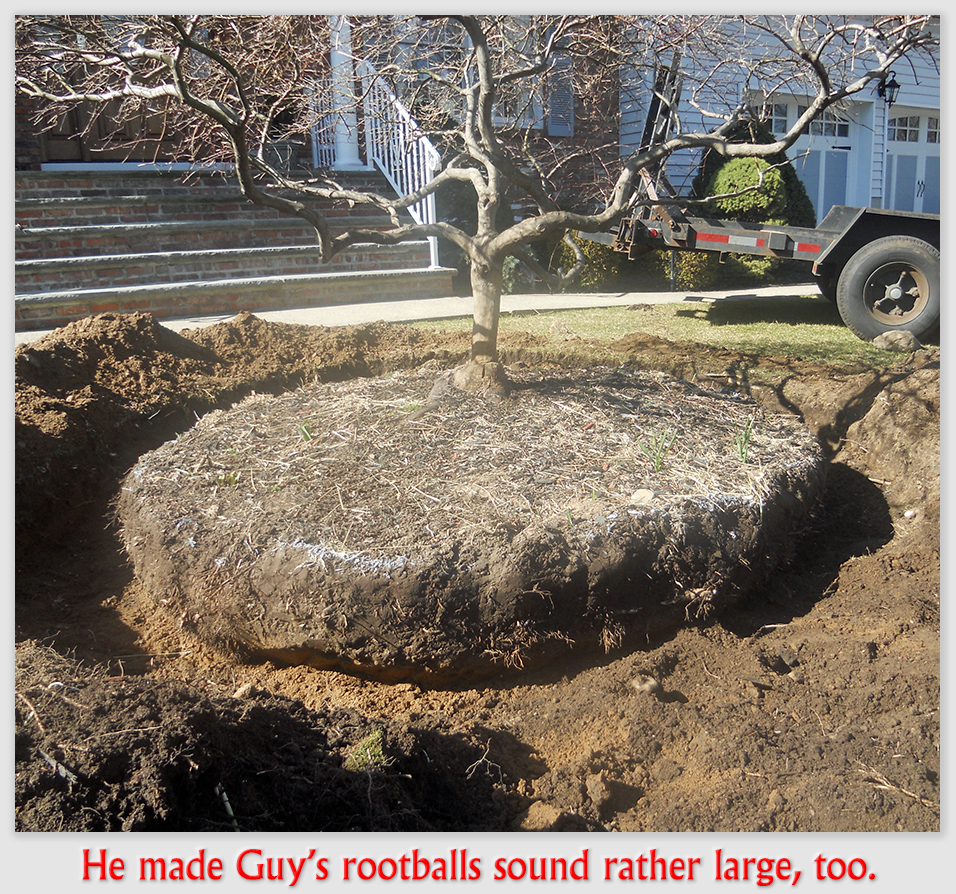
Haverland v. Lawrence, 800 N.Y.S.2d 347 (Supreme Ct. Suffolk Co., Dec. 1, 2004): Mike Haverland sued his neighbor, Guy Lawrence, and his landscaper. The suit was brought because Guy had his landscaper plant an 80-foot line of 13-foot-tall pine trees along the boundary between the two homes. Mike said the trees were so close to the boundary line that, although their trunks did not cross the line, the root balls (which, of course, were well buried) did.
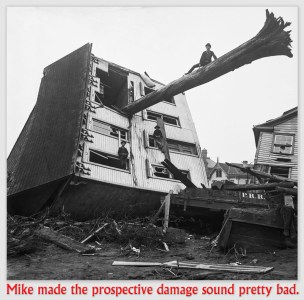
Mike complained that, besides the root balls, the trees had been staked, and some of the stakes were in his yard. He said Guy’s contractor crossed onto his land while planting the trees and knocked down five of his oak trees and construction stakes marking the site of his new house. Finally, he argued that the pine trees changed the grade slightly, so that water accumulates and floods in a 22-foot strip of his property after a hard rain. This, Mike said, would result in a foot of standing water, making this part of his land unusable.

Mike’s real complaint was that this flooding and the fast-growing roots of the trees would undermine the integrity of the foundation of his house, which had not yet been built. He asked for a preliminary injunction directing that Guy Lawrence and East Hampton Bayberry, Inc., his contractor, remove the pine trees, rootballs and stakes from his land and restore the previous natural grade and surface water flow on Mike’s property.

Mike’s surveyor, David L. Saskas, said he had placed surveyor stakes on Mike’s property to enable Mike’s general contractor to mark the location of the foundation of Mike’s new house. In the course of this survey, he determined that ten large evergreen trees had been planted very near the boundary line with Mike’s property. The trunks of five of these trees were within six inches of the line. and the holes and root balls for these trees extended up to 2½ feet onto Mike’s land. Only two of these ten trees were planted entirely on Guy’s property. The metal stakes and guy wires for the trees extended as much as four feet into Mike’s property. Finally, David said, the planting of the new trees created a small berm that raised the grade of the land extending into Mike’s yard. David offered his opinion that the change of grade altered the run-off pattern of surface water and “contributed” to the flooding on Mike’s land.
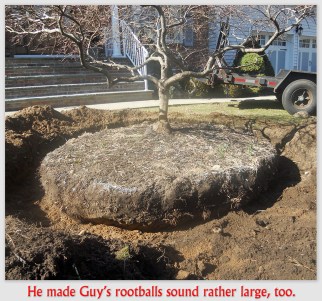
Mike’s first cause of action in the complaint was for trespass, and the second alleged commission of a nuisance based on a violation of the East Hampton Town Code Section 255-10-50. Mike also wanted a permanent injunction forcing Guy to restore the old grade so as to return the runoff to its prior state and to remove all trees, stakes and rootballs that were encroaching on his land.

Guy’s contractor argued there was no trespass because Mike’s own surveys showed that all of the tree trunks were on Guy’s land. The contractor said it was conjectural to believe that the tree roots would someday undermine the foundation of Mike’s house. The contractor said any flooding that might occur did not constitute irreparable injury. Instead, the condition was minor and easily remedied.

Guy agreed that the tree trunks did not encroach and argued Mike was just guessing as to the size of the buried rootballs. He said Mike’s claims of flooding were exaggerated, and Mike had no proof that the newly planted trees were responsible for it. He also argued that Mike failed to show how any of the East Hampton Town Code had been violated and that equity is not balanced in Mike’s favor “since removal of the trees and re-grading of the land is a drastic remedy and there are other and less drastic remedies available.” Guy alleged that Mike never said anything about the grade or flooding, but only brought it up after he hired an attorney.

Mike responded that this is a case where the planting of the trees, as opposed to their natural growth, caused the encroachment. Self-help is not an appropriate remedy, Mike argued, because trimming the encroaching part of the trees would kill them. He said it was hardly unfair to make Guy and his contractor “pay for what they would have had to pay originally but for their illegal trespass.”

Held: The Court denied Mike his preliminary injunction.
For a preliminary injunction, Mike had to show (1) a likelihood of ultimate success on the merits; (2) irreparable injury unless the preliminary injunction was granted; and (3) that a balancing of equities favors Mike’s position.” Preliminary injunctive relief is a drastic remedy that will not be granted unless a clear right to the injunction is established under the law and the undisputed facts. The burden to show that an undisputed right rests upon the movant.

The Court held that Mike’s allegation that Guy’s contractor drove across his yard, tore out construction stakes and killed five oaks was enough to show he was likely to prevail on a trespass action. Any unauthorized entry upon the land of another constitutes trespass. The Court said that Mike, to the extent he has alleged (and Guy admitted he had told the contractor to drive over Mike’s land) that the contractor drove over Mike’s land and destroyed property, “has established the likelihood of success on the merits. However, as to the remainder of the complaint, defendants’ submissions in opposition to the application raise numerous and significant triable issues of fact which preclude such a finding.”

Mike’s real problem, the Court ruled, was that he had not shown that he would suffer an irreparable injury if the preliminary injunction was not granted. Mike’s claim that the newly-planted trees have fast-growing roots that will undermine the foundation “lacks specific evidentiary support and is merely speculative and conclusory.” His claim that the foundation will suffer irreparable damage should the flooding continue is contradicted by his admission that the integrity of that foundation will be gradually undermined. The fact that Mike claimed he was temporarily deprived of the use of part of his property because of flooding after heavy rain was not an irreparable injury. Anyway, the Court said, “there is also a sharp factual dispute with regard to the cause of the flooding as well as the frequency and extent of the flooding.”

Finally, the Court held that Mike did not show that equity was on his side. First, the Court said, Mike was seeking a preliminary injunction directing not that Guy abstain from some conduct, but rather that he and his contractor actively do something: remove planted trees and re-grade Mike’s property to restore the previous pattern of surface water runoff. As a general rule, the Court observed, “mandatory injunctions are not favored and will be granted in only the most extraordinary circumstances.” This is especially so where, as here, Mike sought to get the same injunctive relief he sought in the final, permanent injunction. In such a case, “a preliminary injunction will not be granted unless the plaintiff demonstrates, upon clear and undisputed facts, that such relief is imperative and because without it, a trial would be futile.”

The Court weighed the drastic nature of the relief sought against Mike’s conjecture that the tree roots might eventually reach his foundation, as well as the “sharply disputed claim” that Guys’ planting of the trees and re-grading of his property caused extensive flooding, is not enough to prove the existence of the “extraordinary circumstances which would tip the balance of equity in his favor.”

– Tom Root

TNLBGray

Case of the Day – Friday, April 10, 2026

DOING NOTHING IS NOT AN OPTION

Among our favorite meaningless aphorisms is the admonition that “doing nothing is not an option.”

Who are these guys kidding? Doing nothing is always an option, which helps explain why so many people do it so often and so well. We admit that sometimes doing nothing brings unpleasant results. But a lousy outcome does not mean that doing nothing is not an option. It only means that it may not be a wise option.

In a lot of legal decisions, you can sense some of the undercurrents at work behind the law that’s being applied, like you’re getting a glimpse of the litigants’ B-roll. In today’s case, you have the good guy defendants – Ev and Marie Walsh, who happily occupy their snug little home – and then there’s the ogre plaintiff, the absentee owner of the rental house next door.

How do we know this? First, when landlord Ed Scannavino noticed his retaining wall starting to tilt and break apart, he didn’t stop by at the Walshes’ for a pleasant chat. Instead, he sent the neighbors a letter complaining that their trees were knocking down his wall. The nice-guy neighbors ignore the impersonal slight that the letter represents and hire contractors to professionally trim their trees along the wall.

The trimming did not help because the problem was encroaching roots. So a few months later, Ed ramps it up with a certified letter, so the Walshes would have to sign for it. How often have you ever gotten a certified letter containing good news? In the letter, Ed complains again, but this time he adds that if the Walshes try to fix the problem he had demanded they fix – like the dutiful neighbors they are – they had better not let their contractors step on his land unless they first prove they have insurance and permits.

This time, the Walshes detected Ed’s condescension, or at least sensed the futility of trying to make this guy happy. In response to the certified letter, they did nothing. Which, it turns out, was as good an option as anything.

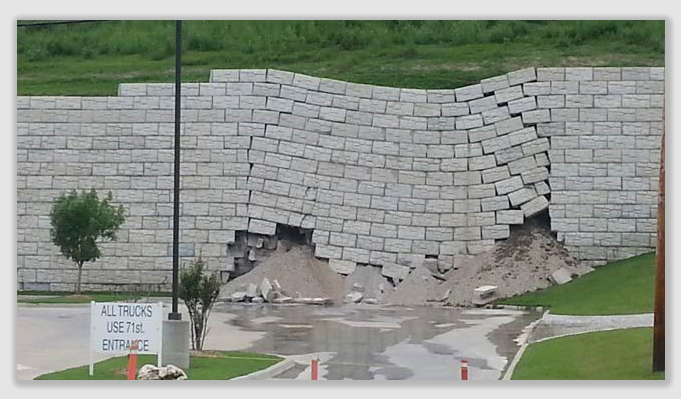
Face it – absentee landlord Ed was spoiling for a fight right from his first letter. How did that work out for Ed? Well, as the Good Book says, sow the wind, reap the whirlwind. Ed got a fight all right, and when the smoke cleared, Ed’s retaining wall lay in small chunks in his yard.

Ed had to rebuild the wall, and he had to pay for it. Donald Trump could be inspired by such an outcome.

Scannavino v. Walsh, 445 N.J.Super. 162, 136 A.3d 948 (N.J.Super.A.D. 2016). Ev and Marie Walsh had a house next to \one owned by Ed Scannavino. Ed was a landlord, with a tenant occupying his parcel. The Walsh family moved into their home in 2004.

The properties were separated by a cinder-block retaining wall, about 4 feet high and 100 feet long. Sometime after the Walshes moved in, a mulberry tree and some shrubs began growing on their property near the retaining wall. No one knew how the tree got there, and the trial court held it was a natural occurrence.

Once the tree and shrubs began growing, Marie or her son trimmed the trees every year, but never trimmed any of the roots below ground level. No evidence was presented that trimming trees above ground affected root growth.

Ed said he first noticed damage to the retaining wall in January 2012, and he asserted roots from the mulberry tree and shrubs caused the retaining wall to tilt. He sent a letter to Marie expressing concern about the damage. She hired some guys to trim the trees and bushes near the retaining wall. But 10 months later, Ed sent Marie a second letter, this one by certified mail, complaining again that “the trees on your property have caused excessive damage to my retaining wall.” In a spirit of accommodation, Ed also warned Marie not to have any workers she hired enter his property to remove the trees without first supplying him with proof of insurance and permits. Marie did not respond.

Nine months later, Ed sued the Walshes, alleging that their careless, negligent, and grossly negligent maintenance of their property caused damage to the retaining wall. He demanded $12,750 in damages.

At trial, the Walshes argued that improper installation, or “simple wear, tear, and deterioration,” could have caused the damage to the retaining wall. Marie also asserted that when she and her husband moved onto the property, the retaining wall was already tilting and had some cinder blocks missing.

The trial court found that the trees near the wall were a “naturally occurring condition and therefore defendants cannot be held liable for the condition of the wall.”

Ed appealed.

Held: The mulberry and shrubs were not a nuisance, and the Walshes were thus not liable. The Court noted that the Restatement (Second) of Torts held that “neither a possessor of land, nor a vendor, lessor, or other transferor, is liable for physical harm caused to others outside of the land by a natural condition of the land.” A natural condition of the land includes the natural growth of trees, weeds, and other vegetation upon land not artificially made receptive to them.

Thus, the Court said, “we have recognized that the Restatement (Second) of Torts ‘draws a distinction between nuisances resulting from artificial and natural conditions of land. The former are actionable; the latter are not’.” But here, Ed was claiming that Marie and Ev were liable “not because of the natural process of the growth of the tree roots. Instead, it is the positive act — the affirmative act — of the property owner in the actual planting of the tree which instigated the process.”

The Court disagreed. “The fact that the affirmative act is helped along by a natural process does not thereby make the condition a natural one within the meaning of the traditional rule.” Here, the trial court found the tree roots that grew and allegedly damaged the retaining wall were a natural condition. It is true, the Court said, that the Restatement (Second) of Torts may permit liability for damage caused by a tree not planted by the possessor of land where the possessor has “preserved” the tree. However, the preservation envisioned by the comment “means some sort of affirmative action on the part of the defendant and not its failure to act.” There was no evidence that Marie took affirmative action to preserve the trees or engaged in any “nurturing” like fertilizing, or in any other maintenance “designed to keep the trees alive or growing.” Rather, she and her son simply trimmed the trees.

The Court rejected the notion that it needed to explore whether evidence of trimming or pruning that improves the health or growth of a tree would be sufficient to convert a “natural” tree into an “artificial condition.” Ed had not introduced any evidence that Marie’s trimming had improved the tree’s health or accelerated root growth, and the trial court had found nothing else in the record that suggested that “Marie or her agent caused the damage to the wall.” Even Ed admitted on appeal that he was not suggesting that Marie’s trimming back the trees had increased root growth.

Instead, Ed argued that the mere fact she had trimmed the trees made her responsible for whatever damage the tree caused. The Court rejected this, pointing out that “the rule of non-liability for natural conditions of land is premised on the fact that it is unfair to impose liability upon a property owner for hazardous conditions of his land which he did nothing to bring about just because he happens to live there.” Because Marie’s trimming did not bring about root growth, she could not be blamed for the damage to the retaining wall. Besides, the Court said, Ed’s proposed rule of liability would “lead to the anomaly of imposing liability upon one who cuts back wild growth ‘while precluding liability of an adjacent landowner who allows the natural condition of his property to run wild’.”

The Court wanted to be sure it did not send the signal that doing nothing was an option.

– Tom Root

TNLBGray140407

Case of the Day – Thursday, February 19, 2026

ACORNS KEEP FALLIN’ ON MY HEAD…

It started as a simple idea: establish a court without lawyers, a place where people with a beef could be heard, where small-scale justice could be dispensed, and where people could find common-sense answers to problems. And thus, small claims court was born, having its origin – ironically enough – as the “court of conscience” in medieval England.

The rules are simple, the docket is swift: usually, from the filing of the action to the hearing, not much more than a couple of weeks pass. There is no fancy-Dan pleading, no arcane procedures, no onerous discovery. Just two people with a problem and one judge to listen and decide.

Many years ago, long before law school interrupted my life, I sent roses by FTD to a girl in another state on Valentine’s Day. I thought it strange when she thanked me for the “flowers.” People would normally say, “Thanks for the roses.” After about the third time she said “flowers” instead of “roses,” I thought to ask her what she had received from me. It turned out that I paid for roses, and got a mixed-flower arrangement suitable for a funeral… but not a valentine.

When I complained to my local florist, he told me dismissively that if the receiving florist in the other state was out of roses, he or she could substitute “another arrangement of equal value.” Getting no satisfaction there, I filed a small claims complaint. On the day of the hearing, the flower shop owner stalked into the courtroom and gave me my money back.

Sweet justice!

So I love small claims court. But I recognize its principal drawback: lawyers can still show up and make a mess of things. That’s what happened in today’s case.

Daphne Kohavy, a savvy resident of Gotham, rented a parking space in a lot next to her co-op apartment building in the Bronx. The co-op had a management company, Veritas, running the lot. Daphne’s car was parked under an oak tree that rained acorns on her ride. This should not seem surprising to many of us who understand that those funny little acorns hanging on oak trees like to drop. But Daphne was a New Yorker and had only the most fleeting acquaintance with green things that grow from the earth. The acorn rain surprised her, and – according to her complaint – caused over $1,500 in damage to her wheels.

She sued in small claims court. Veritas brought its lawyers (in its defense, the law required it appear through lawyers because it was a limited liability company). Its lawyers started milking the case for fees, filing motions to dismiss for all sorts of reasons.

The court was not amused. Small claims court is supposed to be easy, where parties air their claims instead of tying each other up in “gotcha” motions. The court scolded the defendants, holding that because Daphne said the tree was defective, she should have a chance at trial to prove it.

We don’t think much of Daphne’s lament. Oak trees drop acorns. That’s no surprise. But on the other hand, Veritas tried to muck up the small claims process (forcing poor Daph to go out and hire her own lawyer). Perhaps distributive justice – where the right thing gets done for what nominally is the wrong reason – triumphed.

Kohavy v. Veritas Management, LLC, 2017 N.Y. Misc. LEXIS 1380 (Civil Ct. Bronx County, 2017): Daphne Kohavy leased a parking space next to her apartment building on a parking lot owned by defendant 511 W. 232nd Owners Corp. Veritas Management, LLC was the lot’s managing agent. While parked there, Daphne’s car was damaged by acorns falling from a tree overhanging her parking space. It sounds like classic encroachment and sensible harm. She sued in small claims court for $1,500.

Veritas, through its lawyers, moved to have Daphne’s claim dismissed because it was just the manager, not a party to the contract for her space between Daphne and the Co-op, and not the owner of the lot or the oak tree. What’s more, Veritas claimed, it did not maintain exclusive control of the premises, and even if it did, the law does not recognize a cause of action in negligence for damage due to falling acorns.

The motion to dismiss also claimed that the Co-op could not be held liable as the damage to Daphne’s car was caused by a healthy tree, and even it was not, the Co-op lacked notice of any such defect.

Held: The court began by scolding Veritas for gumming up the court’s processes with dispositive pretrial motions, noting that the “informality and convenience of small claims practice is necessarily frustrated by requiring pro se litigants to respond to formal motion practice…” But in the interest of moving things along, the Court addressed Veritas’ motion.

The Court found that there was a question of fact (because Daphne had said so) regarding the condition of the overhanging oak tree that had damaged her car. While the Court said there was no privity of contract between Daphne and Veritas, “questions of fact with regards to defendant Veritas’ control over the parking lot, as per the terms of the management agreement between defendant Veritas and defendant Cooperative, exist.” If Daphne could show that Veritas maintained exclusive control over the parking lot under the management agreement between it and the Co-op, and that Daphne’s damages were the result of Veritas’ negligence, she might be able to recover in negligence from Veritas.

The Court noted that Daphne “commenced this Small Claims action as a pro se litigant. It was not until the plaintiff was served with this instant motion that the plaintiff retained counsel to represent her. Accordingly, in this case, the filing of this instant motion prior to a hearing has indeed frustrated the purpose of New York City Civil Court Act § 1804 and its concern for protecting inexperienced pro se litigants and providing them with an expeditious and inexpensive forum to resolve small claims.”

– Tom Root

TNLBGray140407

Case of the Day – Tuesday, January 27, 2026

LIFE IS A BOWL OF BERRIES

Who knows how neighbor feuds that simmer for years and years suddenly explode? Maybe Tom Schwendeman knows.

Tom lives next to the Roaches (who are people, not insects). About 14 years ago, the Roaches surrounded their property with a chain-link fence, which was clearly on their land. They even had a surveyor lay down pins before the fence went up. Since that time, the Roaches have engaged in such loathsome activities as building campfires in their backyard on as many as five, yes, FIVE occasions, and even spraying herbicide on poison ivy growing along the fence.

Oh, the humanity!

We get a sense of how things were going with the Roaches, given that grumpy neighbor Tom called the EPA to complain about the campfires (which occurred at a frequency of about one every two years – if our math skills remain sharp). Being busy creating environmental disasters of its own, the EPA apparently declined to intervene. Also, Tom liked to pick berries that grew along the fence. The herbicide on the poison ivy was the last straw for Tom. Convinced that his next blueberry smoothie would be his last, Tom tried to kick the fence down.

You, of course, have heard the Miranda warning on countless police shows. You know the schtick: “You have the right to remain silent….” Heed it well. Tom should have. As we like to tell clients, remaining silent is not just your right: usually, it’s a damn good idea, too.

Tom did not remain silent but instead vented his spleen in the presence of the deputies who responded to the call. He admitted the fence belonged to the Roaches and was on their land, but… well… the campfires! And the berries! How much is a man supposed to endure?

When it came time for Tom’s misdemeanor trial, his lawyer did not have much to work with, other than Tom’s frivolous argument that the fence was already in bad shape, and his tirade did not make it materially worse. For good measure, Tom threw in the woof story that he was only trying to get the fence off his land. The last defense might have worked… if Tom had kept his mouth shut when the cops had first shown up.

State v. Schwendeman, Case No. 17CA7 (Ct.App. Athens Co., Jan. 17, 2018) 2018 Ohio App. LEXIS 242. The state charged Tom Schwendeman with criminal damaging, a misdemeanor, because he damaged a chain-link fence between his property and that of his neighbors, Dawn and Gordon Roach.

The Roaches installed the fence about 13 years ago. One day last summer, Tom – apparently furious because the Roaches had sprayed herbicide along the fence to kill poison ivy – began yelling, kicking, and showing “a lot of anger towards the fence,” as a witness put it. Someone called the sheriff, and Tom admitted to a deputy that he knew it was not his fence, that the Roaches liked to have campfires in their backyard, which bothered him, and that they had sprayed herbicide for poison ivy along the fence line. Tom said he picked berries along the fence.

By the time he got to trial, Tom had an explanation that was a little more congruent. He complained about his problems with the five or six fires the Roaches had built in their backyard and argued that because the fence was 12 years old, the only damage he saw to it was “wear and tear that’s happened over the period of twelve years. More than twelve years it’s been there.” He claimed he witnessed tree branches falling onto the fence and the Roaches’ children climbing it, causing it to come apart. On  more than one occasion, Tom claimed, the kids made “the fence pull loose and collapse…. when they were climbing it.” He said he carefully disconnected the cyclone fence from the posts because it was on his property and he wanted to move it. Tom claimed the Roaches knew it was on his land, but they refused to move it unless Tom had the property surveyed and took them to court.

But on cross-examination, Tom admitted he was angry when he began dismantling the fence. “I had been poisoned,” Tom testified. “My berries had been poisoned… my food had been poisoned, and my next smoothie would make me very ill.” Tom admitted he did not “own” the fence, but he continued to press his claim that “it was on my property.”

Tom’s lawyer argued that children, dogs, and trees caused the damage to the Roaches’ fence. However, Tom’s defense counsel did not seek a jury instruction that Tom was exercising a privilege to remove an obstruction on his own land and did not object to the court’s jury instructions.

The jury found Tom guilty. He was ordered to pay restitution and a fine. Tom appealed.

Held: The conviction was upheld. Tom claimed on appeal that he had the right to remove obstructions from his land, but he never asked the court to instruct the jury on that defense.

When a party fails to object in the trial court, generally, he or she cannot make a claim on appeal that was not raised below unless he or she can show “plain error” that affects substantial rights. It’s a tough standard to meet.

Ohio law indeed holds that a landowner has the right to use self-help to remove encroachments on his property, provided he acts with reasonable care. That is what is called an “affirmative defense” to the criminal damaging charges that were brought against Tom. But a defendant is not entitled to have the court give the jury that instruction unless he has come forward with at least some evidence that, if believed, raises the affirmative defense. Otherwise, the court is not permitted to give a jury instruction on the affirmative defense.

Tom testified that the fence was on his land, but he didn’t offer any evidence that that was so. He could have shown a deed, a survey or even a plat map. But he had to show something. What’s more, not only did Tom offer nothing at trial, but his testimony that the fence was on his land directly contradicted his statements to two sheriff’s deputies. Without providing a rationale for the inconsistency with his prior admissions to the deputies, the Court said, Tom’s trial testimony was not credible. Because there was no credible evidence supporting his contention that he owned the land, the trial court – as a matter of law – could not properly give a jury instruction on the affirmative defense.

Tom also argued to the court of appeals that his defense attorney was a putz. The 6th Amendment to the Constitution guarantees all criminal defendants effective assistance of counsel. Here, Tom fumed, his attorney was ineffective because he failed to request the jury instruction on Tom’s privilege to remove an encroachment from his land. The appellate court said no dice: based on the lack of evidence supporting the claim, the court properly would have refused to give the instruction. Tom’s trial counsel cannot be deficient for failing to request an unwarranted jury instruction. Anyway, the Court of Appeals observed, Tom’s lawyer was pursuing a “wear and tear” defense at trial, making a decision not to argue that Tom also had the right to move it off his property fairly sound trial strategy.

Trial counsel cannot be found deficient, the Court of Appeals said, for failing to request an unwarranted jury instruction or for exercising sound trial strategy.

– Tom Root

TNLBGray140407

Case of the Day – Wednesday, January 7, 2026

TREES GONE WILD

Emily Dickinson had something to say about today’s case. The Belle of Amherst wrote,

The Wind does not require the Grass
To answer Wherefore when He pass
She cannot keep Her place.

Today’s problem was slow to develop, but like a winter storm undergoing bombogenesis, it just got bigger and bigger. Marie’s property was separated from her charming neighbor Ed’s by a 100-foot-long cinder block retaining wall. In about 2004, “a mulberry tree and some shrubs began growing” – note the passive voice, as though the growth was mere happenstance, not brought on by anyone’s actions – in Marie’s property near the retaining wall.

Everyone agreed that Marie had nothing to do with the mulberry tree. She didn’t plant it, mulch it, stake it, or fertilize it. It just grew. And grew. And grew. About eight years later, its roots began toppling Ed’s beautiful wall.

To be sure, Marie diligently trimmed the mulberry branches every year, but unsurprisingly, she did not excavate around it to trim the tree’s roots. Who does that? When the wall began showing damage in 2012, Ed wrote Marie a letter (evidence enough that their relationship must have been too frosty for him just to mosey on over and say something), expressing concern about the damage. Marie, ever the good neighbor, hired some guys to trim back the trees and bushes. That wasn’t good enough for Ed, who then sent Marie a certified letter complaining that her tree was tipping over his wall but warning that she better not let any of her workers step on his property in an attempt to fix it unless they were insured and had permits.

At this point, Marie’s interest in jumping through Ed’s hoops appeared to have waned. She did nothing more, and Ed sued.

He accused Marie of carelessness, negligence, and gross negligence, complaining that the “maintenance of her property” – which is to say, suffering the tree to grow – caused the damage to the retaining wall. Of course, he wanted money.

At trial, Marie said Ed’s wall had been installed by morons and thus was falling down of its own accord. Ed said that Marie should have taken care of the tree to ensure that it did not crumble his wall. The court, it turns out, did not care about either argument: instead, it held that a tree growing near the wall is a naturally occurring condition. As such, Marie is not liable for what the tree does.

We are constrained to note that this is not the law everywhere. The Hawaii Rule, as brought up to date by decisions such as Fancher v. Fagella, holds that when a naturally occurring tree becomes too much of a nuisance, the owner can be forced to do something, regardless of how the tree got there or how little the owner’s role in nurturing it. But not in New Jersey.

Like Emily’s grass, Marie’s mulberry could not keep its place. And the court, like Emily’s wind, did not require Marie to answer for the tree’s peripatetic roots. Oh, the poetry of it…

Scannavino v. Walsh, 445 N.J. Super. 162 (Superior Ct. N.J., 2016). Marie’s naturally growing mulberry tree got big enough that its roots started causing her neighbor’s retaining wall to tilt and collapse. Neighbor Ed sued her for damages the tree caused to the wall, but the trial court held she was not responsible for the naturally occurring growth of a tree she had not planted.

Ed appealed.

Held:  The Superior Court sided with Marie. It held that a cause of action for private nuisance derives from the defendant’s “unreasonable interference with the use and enjoyment of the plaintiff’s property.” Under the Restatement (Second) of Torts, “neither a possessor of land, nor a vendor, lessor, or other transferor, is liable for physical harm caused to others outside of the land by a natural condition of the land,” which includes the natural growth of trees, weeds, and other vegetation “upon land not artificially made receptive to them.” Similarly, “a possessor of land is not liable to persons outside the land for a nuisance resulting solely from a natural condition of the land,” including “trees, weeds, and other vegetation on land that has not been made artificially receptive to it by act of man.”

New Jersey courts have held that injury to an adjoining property caused by the roots of a planted tree can be actionable as a nuisance. The rationale for the property owner’s liability in that case was not because of the natural process of the growth of the tree roots, but instead due to the affirmative act of the property owner in planting the tree that caused the damage. But here, Marie did not plant the tree, and while she trimmed it from time to time, she engaged in no positive acts like fertilizing or maintenance to encourage growth. Had she done so, that might have converted a naturally growing tree into one for which the landowner was liable. However, the Court said, “simply cut[ting] back the trees above the ground” was not a positive act to encourage growth.

The record contained no evidence that Marie’s trimming had improved the tree’s health or accelerated the growth of the roots. As well, the trial court found that Ed had failed “to demonstrate that any actions undertaken by [Marie] or her agent caused the damage to the wall.” Finally, even Ed himself told the Court he was not asking the judges to infer that cutting back the trees had increased root growth.

Instead, all that Ed argued was that by cutting back the trees, Marie became liable for the damage caused by the roots. That is contrary to the law, the Court said, and seeks unfairly to “impose liability upon a property owner for hazardous conditions of his land which he did nothing to bring about just because he happens to live there.” Because Marie’s cutting back of the tree did nothing to “bring about” the root growth, neither the trees nor the damage was “brought about” or “precipitated by the property owner’s affirmative act.”

The Court observed that Ed’s argument would lead “to the anomaly of imposing liability upon one who cuts back wild growth while precluding liability of an adjacent landowner who allows the natural condition of his property to ‘run wild’.” What’s more, some of Marie’s trimming was in response to Ed’s belly-aching, and the Court was not about to sandbag Marie because she tried to be a good neighbor.

Ed suggested that if Marie was not held to be liable, then landowners like Ed might have to use self-help and trespass on her land to cut down the tree himself. The Court dismissed the argument. Ed’s own letter suggested he could abate the nuisance from his side of the property line, which is consistent with the Massachusetts Rule (which fully applies in New Jersey). At any rate, the Restatement (Second) of Torts provides that “entry onto a neighboring property to abate a private nuisance is permissible under certain circumstances.”

Notably, the Restatement (Third) of Torts might have held Marie liable if she failed to exercise reasonable care by allowing the tree’s roots to damage the retaining wall. But the Supreme Court of New Jersey has directed that the Restatement (Second) of Torts is the law, and until that changes, Marie’s tree is on its own.

– Tom Root

TNLBGray140407