Case of the Day – Friday, September 26, 2025

THE LAW OF UNINTENDED CONSEQUENCES – PART 2

I had a secretary once, a delightful country girl who careened from being sharp as a tack to dumb as a stump. One of her expressions, when she would be nattering on about something for what seemed to be hours on end, was, “Never mind me. I’m just talking out loud.”

Courts are constantly getting in trouble for “talking out loud,” saying more in a decision than is necessary. When an opinion, aside, observation or frolic unnecessary to the decision is included in an opinion, it is known as obiter dictum, Latin for “by the way.” Obiter dictum is a concept derived from English common law, wherein a judgment is comprised of only two elements: ratio decidendi and obiter dicta.

One of the early lessons law students learn in their first year is that for the purposes of judicial precedent, ratio decidendi (which means the rule of law on which a decision is based) is the only part of the decision that is binding. Any statement that is obiter dictum is persuasive only.

By the way, lawyers usually call obiter dictumdictum” for short. If there is more than one piece of dictum in a case, they are pluralized as “dicta.” (That previous “by the way” – in itself a perfect example of dictum – comes to you courtesy of my late and beloved Latin instructor, the incomparable Emily Bernges of Sturgis, Michigan. I had her a half-century ago, but in the firmament of unforgettable teachers, she is the brightest star).

Now to brush up on a little law: if I trespass on your land, you can sue to have me ejected. If you do nothing, and suffer my trespass and bad manners for long enough (usually 21 continuous years, but this can vary by state), I can sue you to quiet title, and the land becomes mine by adverse possession.

Now, instead of squatting on your place, I string a power line across a corner of it. You don’t give me permission, but again, you suffer in silence. It is not adverse possession, because you could continue to use the land under the power line. It’s just that I have taken the right to use your property without your permission, but in a way that is not inconsistent with your rights. If I maintain my power line for 21 consecutive years (at least in Pennsylvania, although different states specify different terms of years), I have not acquired ownership of the land, but I have acquired a prescriptive easement. A prescriptive easement, once acquired, may not be restricted unreasonably by the possessor of the land subject to the easement.

So that’s the progression. If I use your real estate without permission, I am a trespasser. If I remain a trespasser openly and continuously for a long enough period, I either wrest ownership of the land from you or, at the very least, obtain the right to an easement that you cannot revoke.

As we saw in yesterday’s case, Jones v. Wagner, a Pennsylvania court addressed encroaching tree branches and roots. This is unsurprising. Forty-nine other states have followed suit. But where everyone else is content with the Massachusetts Rule or the Hawaii Rule, the Virginia Rule or some amalgam of the three, the Pennsylvania court boldly went where no court had gone before. It decided that the owner of the encroaching trees became a trespasser when the branches overhung or the roots entered the subsurface. Such a holding was as contrary to common sense as it was unnecessary: trees grow, their owner does not control the growth, and simple rules allocating cost and responsibility work for everyone else with the need to resort to pounding the round peg of trespass into the square hole of encroachment.

But the Pennsylvania court did just that. And the holding begs the question: if a tree can trespass (or, more to the point, if the owner of a tree is a trespasser because of how the tree grows), might the owner also acquire a prescriptive easement if the encroachment persists long enough?

And here came the dictum. After foolishly applying trespass to tree encroachment, the Jones v. Wagner opinion speculates whether prescriptive easements could be acquired by tree trespass. That was not an issue in the case. It was pure dictum, talking out loud. But it did not take too long for another party to take the Jones v. Wagner idle musings and run with them.

Koresko v. Farley, 844 A.2d 607 (Commonwealth Ct. Pa. 2004). John and Bonnie Koresko bought a piece of property in Tredyffrin Township in 1986. Several trees, over 21 years old (which is important), grew on their property very near one property line. Branches hang over the boundary with the neighboring property.

That land was owned by Ollie Bower, who sold it to a developer in 1999. The developer wanted to subdivide the property into two lots and build two houses. The subdivision plan proposed the installation of a water line and the construction of a driveway near the boundary trees. Upon learning of the proposal, the Koreskos sued, seeking injunctive relief and money damages. The Koreskos claimed unreasonable interference with an easement. Specifically, they alleged that because their trees’ roots and branches encroached on the subdivided property for over 21 years, a prescriptive easement existed for the tree roots and branches. They assert that the development of the property would unreasonably interfere with that easement.

The trial court rejected the Koreskos’ claim, holding that “Pennsylvania does not and will not recognize an easement for tree roots or overhanging branches.”

The Koreskos appealed.

Held: Encroaching branches and roots cannot create a prescriptive easement.

A prescriptive easement is a right to use another person’s property that is not inconsistent with the owner’s rights and which is acquired by a use that is open, notorious, and uninterrupted for at least 21 years. A prescriptive easement, once acquired, may not be restricted unreasonably by the possessor of the land subject to the easement.

In Jones v. Wagner, a Pennsylvania Superior Court held that overhanging tree branches constitute a trespass. A landowner has the right to compel his or her neighbor to remove of overhanging branches, or the landowner may use self-help to cut the branches back himself or herself.

In discussing the appropriateness of self-help, the Wagner Court mused in a note:

An adverse possession action can often devolve into a pissing contest …

The Restatement notes that a continuing trespass is not a trespass at all if the actor causing the trespass has obtained an easement by adverse possession. Restatement (Second) of Torts § 161, comment d. We cannot help but wonder whether the continued presence of encroaching tree branches, held openly, notoriously, hostilely, and continually for 21 years would create a prescriptive easement in the airspace which they hang. If this would be the case, and we can find no Pennsylvania law which would indicate that a prescriptive easement is not available in this situation, a landowner who suffers actual harm for the first time during the tree owner’s twenty-second year of hostile ownership, might very well be precluded from seeking a judicial, or even self-help, remedy. This result, while not entirely unforeseeable, is anomalous. However, if an action is available without a showing of damage, the landowner has no reason to complain if a neighbor’s tree causes damage after the prescriptive period has run.

Citing this language, the Koreskis argued that their amended complaint sufficiently pleads a cause of action for unreasonable interference with a prescriptive easement. In contrast, the developer argued the Koreskis had not shown that such an easement existed. Specifically, the developer claimed, the encroachment of the tree roots and branches is not “open and notorious” conduct sufficient to create an easement.

The Commonwealth Court ruled that the Koreskis had failed to state a claim for prescriptive easement as a matter of law, for several reasons. First, encroaching tree roots and limbs by themselves cannot notify a landowner of a claim to use the ground. Second, Pennsylvania has never recognized the existence of such an easement. Third, the Court said, “well-reasoned authority from another jurisdiction persuades us that such easements should not be recognized.” Finally, the potential of widespread uncertainty such easements would cause “convinces us that they should not be recognized as a matter of public policy.”

“The requirement that, to be adverse, a use must be open and notorious is for the protection of those against whom it is claimed to be adverse,” according to Restatement of Property, Servitudes § 458, comment h. The requirement enables owners to protect themselves against the effect of the use by preventing its continuance.” To prove that an adverse use is ‘open and notorious,’ a claimant may show that either the landowner against whom the use is claimed has actual knowledge of the use or has had a reasonable opportunity to learn of its existence.

But encroaching tree parts, by themselves, do not establish “open and notorious” use of the land. Neither roots below ground nor branches above ground fairly notify an owner of a claim for use at the surface, the Court said. In the absence of additional circumstances, such as the use of the ground for maintenance or collection of leaves or fruit, roots and branches alone do not alert an owner that his exclusive dominion of the ground is challenged.

The philosophy of the law is that whenever neighbors cannot agree, the law will protect each owner’s rights to the extent possible. Any other result would cause landowners to seek self-help or litigate each time a piece of vegetation starts to overhang their property, fearing the loss of use or partial use of their property as the vegetation grows.

Finally, the Court said, “We consider the consequences of the holding urged by the Koreskis here. Judicial notice can be taken that trees growing over property boundaries and streets, around utility lines, and under [sidewalks are common in Pennsylvania]. A decision suggesting that the prolonged presence of these tree parts assures their unreduced continuation could cause uncertainty. Both the extent of the prescriptive easement and its effect on public and private use are problematic. As a matter of sound public policy, we decline to recognize a new estate which offers uncertainty and invites clarification through litigation.”

– Tom Root

TNLBGray

Case of the Day – Tuesday, September 9, 2025

YOU DON’T KNOW, JACK

Louisiana alone among the fifty states has a diverse (some might say muddled) legal history. Due to its heritage of French ownership for 81 years, then Spanish ownership for 38 years, and finally French for a few more (until Thomas Jefferson bought the place), Louisiana law between private parties, principally contracts and torts, is based on French and Spanish codes and ultimately Roman law, with only a few common law influences.

Rather than relying on stare decisis and law by accretion – that is – judicial decisions on real conflicts following prior cases and in some cases expanding on the principles that controlled the resolution of the conflicts, Louisiana has a comprehensive civil code, sort of like a binding version of Restatement of Torts and Restatement of Contracts.

Not everything is different, however. Louisiana’s laws, like those of other states, occasionally establish legal presumptions. All a presumption does is tilt the scales one way or the other, depending on the public convenience or good. And presumptions are doggone useful: For instance, a child born of a husband and wife living together is presumed to be the natural child of the husband. A person who has disappeared and not been heard from for seven years is presumed to be dead. And the one we all know from TV, an accused person in a criminal proceeding is presumed innocent until proven guilty.

Presumptions can also be useful in tree law. If a tree is growing on the boundary between your property and your neighbor’s, it can be pesky and difficult to prove who planted it, when it was planted, and what arrangements the people then owning the properties may have made regarding the sapling. Some states resolve this issue simply: if it straddles the boundary, it is commonly considered to be owned by both landowners, and neither can interfere with it without the other’s consent. Others make it more difficult: whether the tree is commonly owned depends on whether the neighbors claiming part ownership can jump through hoops to prove they (or their predecessors-in-interest) helped plant or nurture the tree, or treated it as the boundary line.

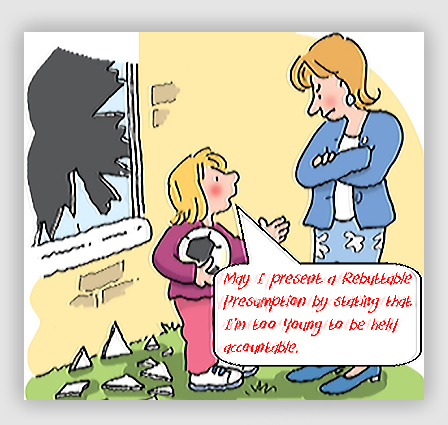
Louisiana splits the difference: it presumes that if the tree is on the boundary, it is commonly owned. However, either neighbor may rebut that presumption by offering evidence that the tree is not commonly owned.

In today’s case, the plaintiffs – Mark and Catina Jack – were unable to prove that the tree was not commonly owned. They could not show who planted it, when it was planted, or what arrangements had been made. The court declared the presumption to control the case, saying that as far as any evidence to the contrary went, “You don’t know, Jack.”

Jack v. Successions of Albert, 2019 La.App. LEXIS 1512 (La.App. 1 Cir. Sept. 4, 2019):  The Jacks and the Alberts are neighbors. A large oak tree stands on the boundary between their properties. The Jacks complained that the roots of the tree were heaving the concrete in their driveway. The Jacks alleged that the Alberts owned the tree, and demanded that they pay to remove the tree and fix the driveway.

Louisiana Civil Code article 688 gives a landowner the right to demand that the branches or roots of a neighbor’s trees that extend over or into the landowner’s property be trimmed at the neighbor’s expense, provided that the roots or branches interfere with the enjoyment of the landowner’s property. The Jacks sought to recover the costs and expenses to repair the driveway, as well as damages for inconvenience and mental anguish.

At trial, the Jacks offered evidence of the extent of the damage to the driveway. The Alberts, on the other hand, offered the testimony of a surveyor who testified that the tree is located on the boundary between the Jacks’ and the Alberts’ properties. The Alberts argued that under Civil Code article 687, trees on the boundary are commonly owned unless there is proof to the contrary. Article 687 gives an adjoining landowner the right to demand the removal of a tree on the boundary that interferes with the enjoyment of his or her estate, but that owner must bear the expense of the tree’s removal. Based on these articles, the Alberts argued that the oak, located on the boundary of the two properties, is presumed to be the common property of the parties. Because the Jacks offered no evidence to rebut the presumption of common ownership, the Alberts contended, the Jacks must pay to remove the tree and fix their own driveway.

The trial court found for the Jacks, expressing its belief that the tree started growing on the Alberts’ property. The court ruled that the absence of evidence regarding how the tree arrived was irrelevant. Instead, it found that the Jacks’ photographs showed that most of the tree was on the Alberts’ property. The trial judge said he would be “hard-pressed” to find the tree was a boundary tree commonly owned by the Jacks and the Alberts.

Concluding that the oak was originally the Alberts’ tree, the court awarded $8,500.00 damages to the Jacks.

The Alberts appealed.

Held: The trial court holding was reversed because the Civil Code’s presumption that the boundary tree was commonly owned carried the day.

The record showed the tree was already on the boundary when the Jacks bought their property in 2003. The Alberts called Charles St. Romain, a civil engineer, whose testimony was less than stellar. He testified that the tree was “smack dab” on that line, but admitted on cross-examination that it was not really “smack dab” in the middle, and when it was a small tree, it probably was not a boundary tree at all.

But shaky testimony is better than no testimony at all. Under Louisiana law, trees belong to the owner of the soil on which they stand, regardless of their proximity to the property line. A landowner has the right to demand that the branches or roots of a neighbor’s trees, bushes, or plants that extend over or into his property be trimmed at the expense of the neighbor. An adjoining owner has the right to demand the removal of boundary trees, bushes, or plants that interfere with the enjoyment of his estate, but he or she must bear the expense of the removal.

Under Louisiana Civil Code article 687, trees, bushes, and plants on the boundary are presumed to be common unless there is proof to the contrary. Here, the Court of Appeals said, everyone agreed the oak tree is located on the boundary between the Jack and Albert properties. And everyone agreed that the oak tree’s roots had encroached under the Jacks’ driveway, causing damage and thus interfering with their enjoyment of their property. If Civil Code article 688 applied, the Alberts had to pay for the Jacks’ driveway and tree removal. If Civil Code article 687 applied, the Jacks would have to bear their own costs and damages.

The appeals court held that the correct interpretation of the Civil Code 688 assigned the Jacks the burden to prove that the offending tree was located on a neighbor’s property. However, Civil Code article 687 establishes a presumption that a tree located on the boundary between two properties is commonly owned. The section permits the presumption of commonness to be overcome by proof to the contrary, but that placed on the Jacks the burden to convince the trial court that their proposed conclusion is more correct than the presumed one. The presumption does not have any probative value in and of itself, but it does provide the factfinder with a conclusion in the absence of proof to the contrary.

If there is no proof to the contrary and the presumption of commonness stands, an adjoining landowner may have a common tree removed from the property but must do so at his or her own expense. The location of the oak tree on the boundary between the Albert and the Jack properties triggered Civil Code article 687′s presumption that the tree is a common one. “The Jacks,” the Court said, “who are claiming that the tree on the boundary is not common but is in fact owned by the Alberts, bore the burden of offering proof sufficient to overcome the presumption that the tree is commonly owned.”

The trial judge was wrong. The absence of evidence as to how the tree got there was very relevant. There is no evidence, the appeals court ruled, as to who planted the oak or when it was planted. While a photograph shows that years ago, a young tree may have been solely on the Alberts’ property, “the photograph is not conclusive since there is no expert testimony presented by the Jacks as to the exact location of the property line in said photograph. The only established fact is that the tree in question is located on the property line. Therefore, it is presumed to be common under Civil Code article 687.

The Jacks had an opportunity at trial to present proof that the tree is not a common one, but they failed to do so. Because the tree is presumed to be common, and the presumption of commonness was not rebutted by the Jacks, the Jacks and the Alberts are deemed to be co-owners of the tree.

– Tom Root

TNLBGray140407

Case of the Day – Monday, August 11, 2025

FISTS, NOSES AND TREES

punch50720Everyone’s heard the old saw that “the right to swing my fist ends where your nose begins.” Imagine your nose is a 65-foot tall maple tree, and my fist is a backhoe. Good luck with that – most imaginations aren’t quite that agile.

Here’s the problem. We all know about “self help,” the venerable old Massachusetts Rule that limits a landowner to trimming away encroaching branches and roots from a neighbor’s tree up to the property line. Michalson v. Nutting – and virtually every encroachment case decided in the eight decades since that decision – has given a property owner the right to trim back a neighbor’s tree to the boundary without any limitation.

At the same time, we all know about boundary trees, those trees whose trunks enter the earth smack on the property line, so that tree is attached to the ground in both properties. Boundary trees are special, and the general rule is that neither property owner may trim the tree without the consent of the other.

But what happens when a neighbor’s tree is not on the boundary, but so encroaches on a landowner’s property – both above ground and below ground – that the practical effect of the landowner’s Massachusetts Rule self-help will be to kill the tree?

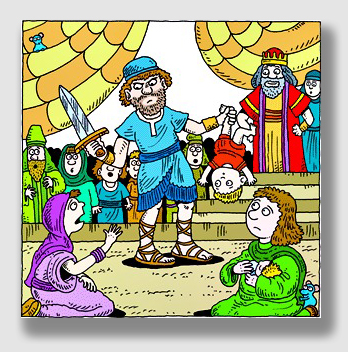
solomon150720Remember King Solomon? When two women appeared in front of him arguing over who was the mother of a baby, he proposed to settle it by cutting the baby in half so that each woman would get 50 percent of the child. That threat was enough to smoke out the imposter. In today’s case, dividing the tree in half would have had the same effect as cutting up the infant (albeit with less blood).

The Alvarezes own a nice place in Vermont, complete with a view of Lake Champlain. They have a 65-year-old maple tree next to the property line of their neighbors, the Katzes. It was close, but the base of the tree was completely on the Alvarezes’ property, so this was no boundary tree the parties were dealing with.

The tree had been standing for almost seven decades. In fact, when the Alvarezes bought the property 20 years ago, the maple had already sent roots and branches across the boundary between the two parcels.

The Katzes, who also enjoy a view of Lake Champlain, have planned for a number of years to add to their house, essentially doubling its size with a two-story addition. The only problem – or at least, the only problem we care about – was the maple tree. To add on, the Katzes would have to cut away about half of the maple tree’s branches and roots, in all likelihood killing the tree.

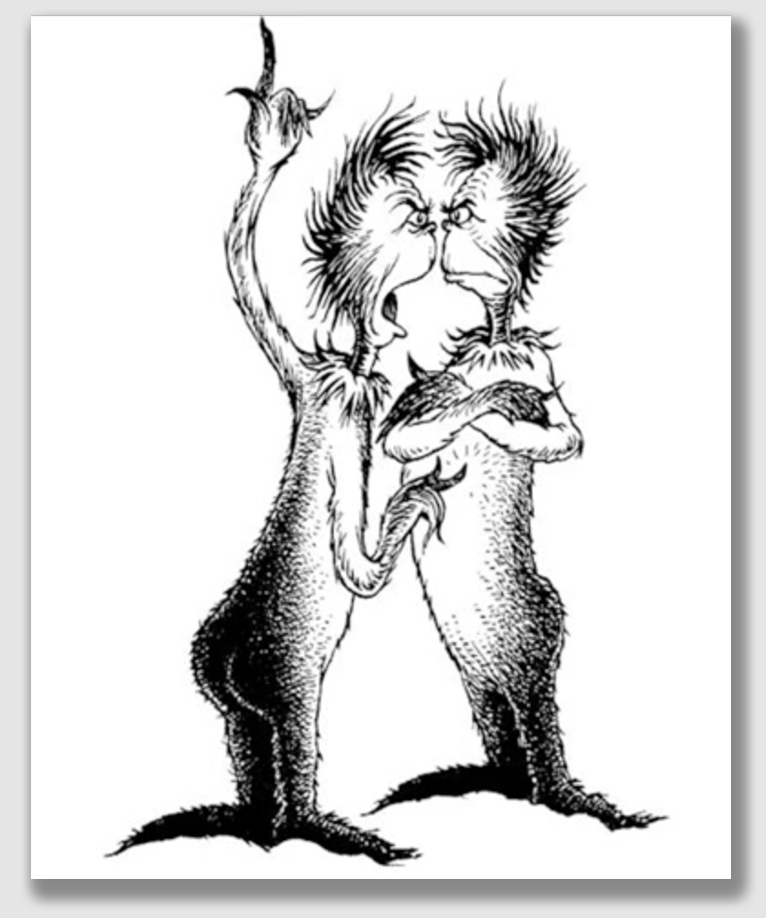
The Alvarezes and Katzes tried to resolve the problem amicably, but – just as happened with the women in front of King Solomon – there really wasn’t any middle ground. Either the Katzes would get their way, building onto their house and killing the tree, or the Alvarezes would have it their way. Like Dr. Seuss’s north-going and south-going Zax, neither neighbor would budge.

But then Katz somehow learned all about the Massachusetts Rule. It dawned on him that he could cut back the offending maple tree to the property line, both roots and branches. Sure, the tree might die, but the Massachusetts Rule said nothing about what happened to the tree after a neighbor used “self-cutting” trimming on it.

The Alvarezes ran to court and obtained an injunction against Katz. The trial court found that trimming the tree as Katz proposed doing would probably kill it. The injunction prohibited cutting away only about 25 percent of the tree, about half of what the Katzes needed for their ambitious plans.

The Katzes appealed, and the Vermont Supreme Court threw out the injunction. It held that the Massachusetts Rule was a blunt object, and had always been one. A landowner owns everything above and below ground level, and that owner can cut anything he or she wants to cut, without regard for the effect of the cutting. The Court said that was the law in Vermont and just about everywhere else.

The Zaxes wouldn't budge, either ...

The Zaxes wouldn’t budge, either …

The Supreme Court seemed a little uncomfortable with its decision, but it ruled in essence that the law is the law, and that’s the way Vermont had always done it. It noted, in a hint that was as subtle as an anvil, that cases where Massachusetts-style self-help had been limited – such as in Booksa v. Patel – the theory that had been advanced was that of nuisance. In other words, the Alvarezes could have argued that Katz’s proposed trimming would so endanger the tree that it would interfere with their enjoyment of their property. Recall in Booksa, the court ordered the defendant to trim the encroaching tree reasonably. The Vermont Supreme Court telegraphed that it would probably have done the same if the Alvarezes’ lawyer had only thought to make the argument. Oops.

Alvarez v. Katz, 199 Vt. 510, 124 A.3d 839 (Supreme Ct. Vermont, 2015). The Katzes own property in South Burlington around the Shelburne Bay area. The Alvarezes own the adjoining lot just to the north of the Katzes. The Alvarezes have a 65-foot-tall maple tree, the trunk of which is located entirely on their property. About half of the branches and roots from the tree cross the property boundary and encroach onto the Katz lot. Some roots extend under the Katzes’ existing deck.

For several years the Katzes have sought to expand their home by adding a two-story addition on the rear. The plans for the construction of the addition would require cutting the roots and branches that are encroaching on their property. This could encompass up to half of the tree’s roots and branches.

The Alvarezes and the Katzes have been unable to amicably resolve the problem of the maple tree. In 2013, when the Katzes considered taking unilateral action to trim the tree’s roots and branches, the Alvarezes filed for an injunction. The superior court found it more likely than not that removal of 50% of the tree’s roots and branches would result in the premature death of the tree, perhaps within five years and probably within ten from the time of cutting. The court employed what it called the “urban-tree rule,” under which trimming the roots or branches of an encroaching tree may be proscribed if the trimming will destroy the tree. The injunction barred the trimming of more than 25% of the roots and branches of the tree.

The Katzes appealed.

Held: The injunction was vacated. The Supreme Court reaffirmed “Vermont’s long-standing right of a property owner to trim branches and roots from an encroaching tree without regard to the impact that such trimming may have on the health of the tree.”

Vermont has long recognized ownership of property to include the ownership of that which is below the ground and that which is attached overhead. The right has been clear for almost 100 years, since Cobb v. Western Union Telegraph Co., (a 1916 decision that stated the Massachusetts Rule before there ever was a Massachusetts Rule). Cobb held that “it is a sound principle that where a tree stands wholly on the ground of one and so is his tree, any part of it which overhangs the land of an adjoining owner may be cut off by the latter at the division line.” The Supreme Court criticized the trial court for conjuring up an “urban-tree rule” that would be an exception to Cobb. The trial court had considered this case to be one of first impression in Vermont because of the anticipated adverse – and likely fatal – effect the root-and-branch cutting would have had on the encroaching tree. The Supreme Court held that any attempt to “distinguish” Cobb, that is, to find that the Cobb case was somehow different just because the Cobb tree was located in a rural setting, was wrong.

Further, the Supreme Court said, the “urban-tree rule” does not enjoy the support attributed to it by the trial court. Outside of two cases, the California decision in Booksa and one obscure New York decision, the Massachusetts Rule (which maybe we should have called the “Vermont Rule”) enjoys extremely widespread support. What’s more, the Court reasoned, the Vermont legislature has had 99 years to modify the Cobb holding by statute, and it has not bothered to do so. The Supreme Court concluded that the “right to cut encroaching trees where they enter the land of another, without regard to the impact on the encroaching tree by such cutting, is well-established under Vermont law.”

The Supreme Court noted that at common law, the right to cut encroaching boughs and roots historically counterbalanced a landowner’s right to grow shade trees on his land, regardless of the impact those trees may have in casting shade or encroaching upon the neighboring property. Common law provided no claim for damages caused by encroaching roots or branches. Instead, the remedy was one of self-help, allowing the cutting of roots and branches to the extent of encroachment.

Where other jurisdictions have departed from the common-law rule and allowed actions for damages as a result of encroaching roots or branches, they have generally relied upon nuisance principles. Even where such actions have been permitted, those jurisdictions continue to recognize the right to self-help. In this case, the Alverezes did not raise a nuisance claim, so “the issue of whether a nuisance claim might exist for the encroachment of roots and branches from the Alvarezes’ tree is not presently before the Court.”

The Supreme Court subtly suggested that the proper way for the Alvarozes to address the problem would be through the law of nuisance ...

The Supreme Court subtly suggested that the proper way for the Alvarozes to address the problem would be through the law of nuisance …

The Supreme Court defined the conundrum as follows: “[T]his case presents the competing interests of neighboring property owners. On the one hand, [the Katzes] have an interest in using their land, which they have purchased and upon which they pay taxes, as they see fit, within permissible regulations, free from limitations imposed by encroaching roots and branches from the neighbors’ tree, which they did not invite and for which they receive no benefit. The Alvarezes seek to restrict the use of the Katz property by preventing the removal of branches and roots on land that is not theirs and for which they have given nothing of benefit to [the Katzes] for suffering the encroachment. On the other hand, the Alvarezes wish to continue to enjoy their tree, which has been there for many years, without placing its viability in peril due to the construction that [the Katzes] wish to undertake.”

The Court observed that if the Alvarezes had the right to have their tree encroach onto the neighboring property, the obvious next question would be to what extent the encroached-upon property owner must suffer such an encroachment. The Supreme Court admitted that on some occasions the “exercise of self-help may result in the immediate or eventual loss of an encroaching tree, given the long-recognized rule in Vermont and its widespread support elsewhere, we decline to depart from the common-law rule in favor of the approach adopted by the superior court.”

– Tom Root

TNLBGray140407

Case of the Day – Friday, August 1, 2025

WHEN GOOD TREES GO BAD

The tree was just doing what trees do.

The tree was just doing what trees do.

Your tree is growing, man. Do something!

That was Ed Chandler’s lament to his neighbors, the Larsons. The nerve of those Larson people, owning a tree growing near the boundary with Ed’s place. What’s worse, they had the unmitigated gall to permit the tree to drop its leaves on Ed’s property, and to let the tree’s roots grow up to his garage foundation. Ed complained mightily, but to no avail.

Ed could have stood for merely mitigated gall, but not this unmitigated kind. Oh, the humanity! So, this being America in general and Illinois in particular, Ed sued. He claimed that “as a consequence of the growth of that tree, plaintiff’s garage had been severely and greatly damaged from the roots of the tree so that ‘the foundation has been broken, walls damaged and the roof coming apart’.”

The trial judge, being a flinty, self-reliant sort, threw out the suit, holding that the tree was doing what trees do – growing – and the Larsons weren’t responsible for that. The Court of Appeals disagreed, citing Professor William L. Prosser’s gold-standard treatise on tort law:

“[I]t is scarcely suited to cities, to say that a landowner may escape all liability for serious damage to his neighbors, merely by allowing nature to take its course. A different rule accordingly has been developing as to urban centers. * * * [W]hen the tree is in an urban area, * * * the landowner now has a duty of reasonable care, including inspection to make sure that the tree is safe. Recent decisions have extended the right to reasonable protection from travelers on the street to adjoining landowners as well.”

Like it or not, the Massachusetts Rule increasingly seems to be a relic of a bygone era. The Illinois courts still seem to discount normal tree problems – falling leaves, sap, and the like – but when genuine harm (we call it “sensible harm”) results to an adjoining landowner from a tree’s natural development, the tree’s owner may be liable for repairs and removal of the tree.

eviltree160815Chandler v. Larson, 148 Ill.App.3d 1032, 500 N.E.2d 584 (Ct. App. Ill. 1986). Chandler complained that his next-door neighbor, Larson, had a tree that for some time had been growing over and onto Chandler’s property, with the roots growing under his garage and the leaves growing above his property. As a result of the tree’s growth, Chandler’s garage foundation has been broken, with the walls damaged and the roof coming apart. Chandler asked the Larsons to cut down their tree, but they refused. Chandler asked for an injunction ordering that the tree be destroyed. The trial court refused.

Held: The appeals court ruled that an urban property owner owed his adjoining landowner the duty of reasonable care, which necessarily would include taking reasonable steps to prevent damage to the adjoining landowner’s garage caused by roots of the urban property owner’s trees. A complaint that alleged that the adjoining landowner had placed the urban property owner on notice that the roots from his trees were causing considerable damage to the adjoining landowner’s garage and alleged that although the urban property owner had received the notice, he refused to uproot the tree or to use other methods which would prevent further harm, stated a good cause of action for negligence.

The ruling is substantially at odds with the traditional Massachusetts Rule that an owner of land is entitled to grow trees on any or all of his land and that their natural growth reasonably will result in the extension of roots and branches onto adjoining property, and the adjoining landowner’s only remedy is to trim back the roots and branches. The appeals court in this case held urban landowner Larson to a higher “city dweller” standard. This standard is generally known as the Hawaii Rule, which imposes liability upon the adjoining landowner if the trees, plants, roots, or vines cause harm in ways other than by casting shade or dropping leaves, flowers, or fruit.

– Tom Root

TNLBGray140407

Case of the Day – Monday, July 7, 2025

NOW LOOK WHAT YOU’VE DONE!

Rarely (as in “I don’t recall when I’ve ever said this before”) do I caution that the prevailing law in any particular state is wrong, and likely to be cruisin’ for a bruisin’ the next time an appellate court has to think about it. But I feel comfortable issuing that warning about today’s case.

From Ohio (home of rock ‘n roll, pro football, the first guy to walk on the moon, the brothers who turned a bicycle into the first airplane, and a ton of other cool things), comes a case that pretty much runs smack into Fancher, Herring, the Hawaii Rule, and a raft of other cases reflecting the modern view that a homeowner whose tree is wreaking havoc on the neighbor’s property may be ordered by a court to fix the damage at his expense.

To be fair, this case may be proof of the old legal aphorism that “hard cases make bad law.” Even the most cursory reading of the facts suggests that Dave Rababy may well have been a horse’s ass, hounding his neighbor because a tree dropped leaves and twigs on his property. Speaking as a guy who owns all of my five southern neighbors’ leaves every fall – and these things are the size of dinner plates – I understand how it can be irritating to have other peoples’ leave on your lawn. But I would never sue them over it. I don’t think I would…

Dave had no such compunction, and his emesis of woe delivered to the court made him the boy who cried wolf. He howled so loudly about leaves and twigs and the fact that his trimming crew was not allowed to trespass on Roy’s property and hack away at the offending tree, and minutiae of a similar nature, that his real complaint – his driveway was being heaved and foundations dislodged by the roots – got lost in the underbrush. In Fancher, Whitesell, and even Iny, such damage was enough to get the neighbor’s tree declared a nuisance. If Dave had exercised a little plaintiff self-control, he might have gotten there, too.

We are too urban and too suburban, and our properties are too developed for the Massachusetts Rule to be the exclusive remedy for genuine harm done by a neighbor’s tree. That is the way the law is trending throughout the civilized world, and it is bound to reach Ohio sooner or later.

Rababy v. Metter, 30 N.E.3d 1018 (Ct. App. Cuyahoga Co., 2015). David Rababy and Roy Metter were next-door neighbors. Dave’s driveway abutted Roy’s property in certain places and nearly abuts in others. A fence separated the properties, and a stand of mature trees ran along the fence on Roy’s side of the boundary line.

Dave sued Roy for negligence, nuisance, trespass, and interference with a business contract. Dave asserted that trees at the edge of Roy’s property extended over his own property, and dropped leaves, needles, sap, and branches onto his car and home. Some of the trees, Dave complained, were rotten. He whined that the trees cast shadows over his property and cause mold growth on his roof, as well as damaged his driveway and foundation.

Dave groused that he had hired a company to trim the overhanging branches, but Roy’s daughter prevented the unnamed landscape service company from properly performing this work. The complaint alleged the trees constituted an ongoing nuisance and trespass, and that Roy negligently maintained the trees. Dave asked for $52,500: $37,000 for future tree trimming services and $15,000 in compensatory damages.

Both parties filed motions for summary judgment. Dave argued that on “an ongoing basis, Roy’s trees encroach onto my property, specifically over my home and driveway. His trees deposit leaves, debris, and sap onto my property, causing damage.” Dave also repeated the claim about Roy’s daughter running off the tree trimmers.

Roy argued that he owed no duty to Dave to trim otherwise healthy trees on his property. He claimed the trees were mature and preexisted either party’s ownership of the property. He said that a year before, Dave hired Cartwright Tree Service to trim the row of pine trees that ran along the driveway. He said no one complained when Cartwright trimmed the overhanging branches from Dave’s property free, but when Cartwright began trimming branches and trees back further than the property line, Roy’s daughter objected. Roy said that he has no objection to Dave trimming the overhanging branches back to the property line.

Dave replied with new allegations that the trees in question were decaying or dead. Attached to the reply was a new affidavit that averred that the trees were decaying and dangerous and that one had fallen on his property. He included a picture of a tree that appears to have fallen across a driveway. However, the affidavit was neither signed nor notarized.

The trial court granted Roy’s motion for summary judgment and denied Dave’s. Dave appealed.

Gen. Robert E. Lee – a man recently consigned to the ash heap of history – knew something about duty … and even he couldn’t have found that Roy owed one to Dave.

Held: Roy owed Dave no duty, so the trial court’s dismissal of the case was upheld.

In order to succeed in a negligence action, the Court said, Dave must demonstrate that Roy owed him a duty, that Roy breached the duty, and that he suffered damages that proximately resulted from Roy’s breach. Here, Dave offered evidence that falling pine needles, leaves, sap, and sticks have damaged his car, driveway, and roof. He also alleges, without evidentiary support, that encroaching tree roots damaged his driveway and home.

While he showed damage, Dave was unable to show that Roy owed him any duty. A landowner is generally not responsible for the losses caused by the natural condition of the land. Instead, the Court observed, states generally allow one impacted by such growth the remedy of self-help. A privilege existed at common law, such that a landowner could cut off, sever, destroy, mutilate, or otherwise eliminate branches of an adjoining landowner’s tree that encroached on his land. But, the Court said, whether a separate remedy exists is an open question.

The Massachusetts Rule provides that in almost all circumstances, the sole remedy for damages resulting from the natural dropping of leaves and other ordinary debris from trees is the common law remedy of self-help. The rule does provide a limited exception for dead trees, just as Ohio has established a duty for urban landowners of reasonable care relative to the tree [hat overhangs a public street, including inspection to make sure that it is safe.” Where constructive or actual knowledge of an unreasonably dangerous condition exists on the land of an urban landowner, such as a dead tree, the duty prong of a negligence claim may be satisfied.

The reasoning set forth in support of the Massachusetts Rule, the Court said, is apt to the facts of this case: “[T]o grant a landowner a cause of action every time tree branches, leaves, vines, shrubs, etc., encroach upon or fall on his property from his neighbor’s property, might well spawn innumerable and vexatious lawsuits.” The Court thus adopted the Massachusetts Rule as the law of this jurisdiction.

But Dave also argued that in Ohio a “landowner in an urban area has a duty to exercise reasonable care to prevent an unreasonable risk of harm to others from decaying, defective or unsound trees of which such landowner has actual or constructive notice.” Dave contended Roy’s trees were in such a defective condition and thus constituted a nuisance. Dave also argued that Roy, an urban landowner, had a duty to inspect his trees and protect others from a dangerous condition created by any unsound trees. Even if such a duty existed, the Court said, it only is breached when the owner has actual or constructive notice of a dangerous condition.

Leaves – often a pain in the arse, but seldom a nuisance

The Court held that Dave put forth no evidence that any of the trees constituted a dangerous condition of which Roy was aware or should have been aware. He presented no evidence that the trees are dead, decaying, or unsound, and cited no case holding that “the normal yearly life-cycle of a tree and the natural shedding of leaves, twigs, and sap constituted a nuisance. Thus, he provided no compelling justification for a court to hold that Roy’s trees case constituted a nuisance or a dangerous condition. The problems Dave had experienced with the trees “are the natural consequence of living in an area beautified by trees. Dave’s remedy is to trim tree limbs that overhang his property back to the property line, to which Roy averred he has no objection.”

The trees at issue, in this case, do not constitute a nuisance, and Roy is not negligent in regard to them.

Dave also asserted that the trees on Roy’s property constituted a trespass. But the elements of a successful trespass claim include an unauthorized intentional act and entry upon land in the possession of another. Here, there is no intentional act. Dave claimed that Roy’s actions of not removing or trimming the trees constitute an intentional act. But, the Court said, as it explained, Dave’s remedy for intrusion by vegetation is to trim it back to the property line.

In sum, Dave’s claims that detritus falling from trees from the neighboring property constituted a trespass, a nuisance, and negligence were simply not actionable. The Court cited a Maryland case that “it is undesirable to categorize living trees, plants, roots, or vines as ‘nuisances’ to be abated. Consequently, we decline to impose liability upon an adjoining landowner for the ‘natural processes and cycles’ of trees, plants, roots, and vines.”

– Tom Root

TNLBGray140407

Case of the Day – Friday, June 27, 2025

HOW MUCH IS ENOUGH?

A eucalyptus tree, similar to the one that offended Ms. Cannon

A eucalyptus tree, similar to the one that offended Ms. Cannon.

There was a time, back when people of grit populated the land, that a landowner only had one choice when his neighbor’s trees encroached – to cut ‘em back. The Massachusetts Rule was the coin of the realm: if you didn’t like your neighbor’s tree overhanging your eaves, or its roots wrapping around your sewer line, you only had one option. The courts didn’t want to hear about it. Self-reliance was what it was all about.

Then along came the Hawaii Rule, which suggested that a naturally growing tree could be or could become a nuisance, and that an aggrieved landowner could sue for an order requiring its removal. One rule does not necessarily negate the other. So when does one oil up the chainsaw, and when does one fire up the word processor?

The Massachusetts Rule is, generally speaking, a blunt instrument. It’s one thing to cut away branches that pose a threat (or even an inconvenience) to your property. But what if cutting a limb back to the property line leaves a 15-foot leafless stub extending from the branch to the boundary. That’s not necessarily according to ANSI Standard A-300, but on the other hand, you don’t have the right to trim it properly unless your neighbor consents to you coming onto his or her land to do so.

Or, more dangerously, what if you cut back roots to the extent that the tree loses too much subsurface support, and falls on your neighbor’s new Bugatti Chiron? Are you liable? After all, you did no more than what the Massachusetts Rule permitted you to do.

The Hawaii Rule, on the other hand, is Doug Lewellyn’s dream. What an All-American solution – let’s sue! When is harm sensible? When your foundation walls collapse? When a dead branch falls on your Bugatti? When leaves clog the filter on your swimming pool? How much harm is enough?

Joan Cannon lived next to Lamar Dunn. Joan was unhappy with the roots from the Dunns’ eucalyptus tree, which were encroaching underground onto her land, as roots are wont to do. After all, a tree will quite often send roots out 35 feet or more from the base of the trunk, and the root system has little regard for some lines drawn on a recorder’s map.

We’re not sure why Joan was so exercised. Maybe she was naturally crotchety. Perhaps she was unusually territorial. Maybe her neighbor had a nice Bugatti, while Joan drove a Yugo. What we can be sure of is that the eucalyptus roots weren’t really causing any harm.

encroach160715

Sometimes encroaching roots can be an inconvenience.

That didn’t stop Joan from suing the Dunns.  The trial court denied an award of any damages and refused to order Lamar the appellee to remove the offending roots and tree. Joan appealed.

The Court of Appeals considered the classic Restatement of the Law trespass approach, which held simply that if a neighbor owns something that trespasses, he or she has to remove it if there is a duty to remove it, regardless of whether it causes harm or not. That’s the rub, the court said. When does such a duty arise?

The court found guidance in the Restatement on nuisance and held that a duty to remove offending branches or roots arose when some actual and sensible or substantial damage has been sustained. Joan’s general objection to the unseen eucalyptus roots did not equate to harm. Thus, the roots could remain.

Cannon v. Dunn, 145 Ariz. 115, 700 P.2d 502 (Ariz.App. Div. 2 1985). This case involves the liability of Lamar Dunn, an adjoining landowner, for roots from a eucalyptus tree that invaded the subsurface of land belonging to his neighbor, Joan Cannon. The trial court found that the roots had caused no actual damage, and denied an award ordering the Dunns to remove the offending roots and tree.

Joan appealed.

Held: Dunn did not have to remove the roots. The Court of Appeals rejected Cannon’s argument that it should apply the Restatement (Second) of Torts § 158 (1965), which stated that “one is subject to liability to another for trespass, irrespective of whether he thereby causes harm to any legally protected interest of the other if he intentionally… fails to remove from the land a thing which he is under a duty to remove.”

The Court said that it was “obvious that one must first determine whether there is a duty to remove the object and that in this case § 158(c) really begs the question.” More to the point, the Court observed, was the Restatement (Second) of Torts § 840 (on nuisances), which held that a possessor of land is not liable to his adjoining landowner for a nuisance resulting solely from a natural condition of the land.

Ms. Cannon could not prove any damages flowing from the alleged encroachment ... unlike this guy.

Ms. Cannon could not prove any damages flowing from the alleged encroachment … unlike this guy.

The Court paid lip service to the Massachusetts Rule, noting that Arizona law permitted a “landowner who sustains an injury by the branches or roots of a tree or plant on adjoining land intruding into his domain, regardless of their non-poisonous character may, without notice, cut off the offending branches or roots at the property line.” At the injured landowner’s expense, of course.

But when some actual and sensible or substantial damage has been sustained, the Court said, the injured landowner may maintain a nuisance action for abatement of the nuisance, and compel the removal of the branches or roots at the tree owner’s expense. However, where no injury has been sustained, no lawsuit be brought for either an injunction or damages.

– Tom Root
TNLBGray140407

Case of the Day – Thursday, June 12, 2025

SLAPP-HAPPY

California and free speech… How times have changed! Time was, 50 years ago or so, Cal Berkeley gave birth to the Free Speech Movement. Now, some allege the Golden State hates free speech. The California Democratic Party says the First Amendment should not protect speech minority groups find offensive or hateful, Grande Dame of politics, Nancy Pelosi, once mau-mau’ed Facebook over a fake video of her in what some say was a dangerous affront to the First Amendment.  It is no surprise that only in the California Republic could a tree-trimming case end up as a free speech issue.

bureaucracy140923Last week, we explored the question raised by our faithful reader Rock Maple of Thousand Oaks, California, who wondered whether his neighbor could trim the branches from Rock’s pine that were overhanging the neighbor’s place. We concluded that self-help was available to the neighbor, within limits. Today, we look at what happens when good old-fashioned common law self-help runs into bureaucracy.

The Dilbecks wanted to add a second story to their house, but their neighbors’ oak tree had extended its branches so close to the Dilbecks’ place that they had to be trimmed back in order to make room. No problem, right? We all know that self-help is available to the Dilbecks anywhere in California. Sure, but it turns out the Los Angeles isn’t just anywhere. In LA, oak trees are “protected,” and before trimming the oak, the Dilbecks had to get a permit from the County. And the County wouldn’t issue a permit unless the tree’s owner signed onto it.

So much for self-help. The Dilbecks sued, asking that the County be ordered to issue the permit and that their neighbors be found liable in trespass for the tree (the theory being that the neighbors let the branches intrude over the Dilbecks’ lawn). And here’s where it got even more complicated. California has a statute addressing litigation known as “strategic lawsuits against public participation,” the so-called anti-SLAPP statute. This mouthful with the catchy name is intended to prevent oppressive lawsuits intended to keep people from exercising their rights to free speech. There’s a whole cottage industry in the Golden State surrounding SLAPP actions. And as with a lot of other good ideas (such as RICO), the anti-SLAPP statute is another tool in the canny lawyer’s arsenal, something else with which to bludgeon a plaintiff.

Here, the neighbors complained that the Dilbecks were trying to force them to petition the County to let the tree get trimmed, and the suit should be thrown out as violating the anti-SLAPP statute. The trial court refused to dismiss the action. The Court of Appeals agreed, holding that the Dilbecks weren’t demanding that the neighbors do anything. They were asking the County to do something, and they were suing the neighbors for trespass because of the tree. California law would let them collect money damages if the encroaching tree was a nuisance (Bonde v. Bishop held as much). So whether the Dilbecks win on the merits or not, the action was not a SLAPP suit, and it wouldn’t be dismissed.

Oaktree140923Whew! Makes you long for the simple, ol’ Massachusetts Rule… no permits, no lawsuits, just an aggrieved landowner with a chainsaw.

Dilbeck v. Van Schaick, 2007 Cal. App. Unpub. LEXIS 7718, 2007 WL 2773986 (Cal.App. 2 Dist., Sept. 25, 2007). The Dilbecks owned a place in Altadena, next door to the Van Schaicks. The Dilbecks planned to remodel their home by adding a second story. However, the branches of an oak tree located on the Van Schaicks’ property have grown over the Dilbecks’ home, rendering the Dilbecks’ plans unworkable unless the tree was pruned.

Oak trees are protected by California state law. The County of Los Angeles had adopted regulations to preserve and protect oak trees, requiring a permit to cut down mature oak trees or to prune their larger branches. The Dilbecks applied to the County for a permit, but the County had not approved it because it took the position that only the owner of the tree may obtain a pruning permit, and the Van Schaicks had not acquiesced. So the Dilbecks brought suit against the Van Schaicks and the County for declaratory relief and trespass. They alleged the oak tree growing on the Van Schaicks’ property had encroached onto their land and interfered with their ability to add a second story to their home. The suit said the County refused to grant the permit because the Dilbecks were not the owners of the tree. The trespass cause of action alleged the oak tree branches were encroaching on the Dilbercks’ land and asked for an order permitting the Dilbecks or an independent contractor to prune the tree.

The Van Schaicks filed a special motion to strike pursuant to the anti-SLAPP statute, Code of Civil Procedure §425.16, asserting that the complaint was based on their refusal to support the Dilbecks’ oak tree permit application and therefore attacked their right to free speech. They further argued that the trespass claim lacked merit because the law forbade the Van Schaicks to prune the offending oak tree branches.

The Dilbecks contended that their action did not fit within the definition of a SLAPP suit and that, in any event, their complaint had merit. They denied that the complaint sought to compel the Van Schaicks to support or sign the oak tree permit. The trial court denied the Van Schaicks’ motion to strike, finding that they had not demonstrated that they were being sued for engaging in protected activity. Instead, the trial court held, they were just being sued for trespass. The Van Schaicks appealed the court’s denial of their motion to strike.

Freespeech140923Held: The Dilbecks’ complaint did not arise from acts undertaken in furtherance of the Van Schaicks’ rights of free speech or petition, and the Van Schaicks’ attempt to get it dismissed was rejected. The California Legislature enacted the anti-SLAPP statute in response to its perception that there has been an increase in lawsuits brought primarily to chill the valid exercise of the constitutional rights of freedom of speech and to petition for the redress of grievances. The anti-SLAPP statute provides a procedure for the court to dismiss at an early stage non-meritorious litigation meant to chill the exercise of free speech rights. The statute requires the trial court to engage in a two-step process when determining whether a motion to strike should be granted, first, whether the defendant has made a threshold prima facie showing that the acts of which it complains were ones taken in furtherance of its constitutional rights of petition or free speech in connection with a public issue, and two, whether there is a probability that the plaintiff will prevail on the claim.

The issue here, the Court said, was whether the complaint arose from conduct in furtherance of the exercise of the constitutional right of petition or the constitutional right of free speech in connection with a public issue or an issue of public interest. The Van Schaicks contended the suit sought to compel them to petition the County for discretionary relief from the oak tree statutes. The Court disagreed, holding that their characterization of the complaint was wrong. In fact, the Court said, the suit merely sought to compel the County to review the merits of the permit application submitted by the Dilbecks and requested an order permitting the Dilbecks or their arborist to prune the tree. The complaint did not seek to compel the Van Schaicks to become personally involved in the permit application process in any way, and thus did not violate the anti-SLAPP statute.

The Van Schaicks contended that the complaint would indirectly force them to speak because a judgment in favor of the Dilbecks on the trespass action would necessarily require the Van Schaicks to petition the County of Los Angeles for discretionary relief from the Oak Tree statute. The Court rejected that argument, finding that the Van Schaicks’ position was based on the incorrect assumption that the only remedy available for trespass was injunctive relief. However, California law held a party over whose land overhanging branches extend may either cut them off or maintain an action for damages and abatement, as long as he or she can prove the branches constitute a nuisance.

The prospect that the Van Schaicks could eventually be faced with an order to abate the nuisance and could do so only by seeking a permit from the County did not transform the Dilbecks’ lawsuit into a SLAPP action. The Court ruled that the thrust of the Dilbecks’ complaint was the injury caused to their property by the encroaching tree, not the Van Schaicks’ decision to refrain from involvement in the permitting process. The permit, although obtainable only by petitioning a governmental entity, principally concerned and affected the remodeling of a private home by private individuals.

– Tom Root
TNLBGray140407