Case of the Day – Friday, November 14, 2025

I THINK, THEREFORE I OWN

My wonderful and sainted Latin teacher, the late Emily Bernges of Sturgis, Michigan, would have shaken her head in dismay, correcting me that I should say, Cogito, ergo sum.

Non hoc tempus, Mrs. Bernges. That was that Descartes fellow who said that. Today’s case departs from his admittedly excellent philosophical proposition, being more in the vein of, “I think it’s mine. Therefore, it is mine.” The facts are kind of pedestrian: two rectangular home lots, with the owner of one, Dolfo Otto, suffering the real estate version of “mission creep.” His mowing, trimming and planting expanded incrementally until what he thought was the boundary between the parcels had wandered several feet into the neighbors’ yard. Being a green thumb kind of guy, Dolfo planted a row of maples to mark what he thought was the property line. The trees served a boundary purpose, and Dolfo liked how they looked.

The neighbors changed over the years, and whatever institutional knowledge the earlier ones may have possessed about the original property line was lost. So it was well over 20 years after the Cornells, the latest owners of the place next door, had a survey done. They discovered that the strip with the maple trees did not belong to Dolfo at all. Dolfo, surprised at the situation, dug in his heels, got a lawyer and sued to quiet title in his favor because he had adversely possessed the land all those years.

Belatedly trying to assert dominion over land he never knew he owned, neighbor Richard Cornell cut down Dolfo’s maples. This unwise escalation of the existing tension only threw legal gasoline on the fire. Courtroom hijinks ensued.

What I found particularly interesting about this case was that while mowing and general upkeep of a piece of property generally is insufficient to establish possession, the Court found that Dolfo’s planting and nurturing four maple trees was more than enough to establish his possession of property to which he held no title. I guess that when your trees set down roots, so do you.

Otto v. Cornell, 119 Wis.2d 4 (Wis.App. 1984). Dolfo Otto owned a 50’ x 150’ lot next to a similar lot owned by Richard and Dorothy Cornell. Dolfo Otto had maintained a fence on what he believed was the southern boundary of his lot for many years prior to 1945. That year, he removed the fence and planted four maple trees to mark the boundary. Since then, Dolfo mowed and maintained the lawn around the trees and to the north.

The house next door was rented to the Wilsons in 1949. Their driveway was located close to the maple trees. When Mrs. Wilson hit one of the trees with her car and destroyed it in 1951, Dolfo replaced it.

The Cornells bought the next-door lot in 1963. After the land was surveyed 16 years later, the Cornells first realized that the true lot line between their lot and Otto’s lay some feet north of the line on which Dolfo had planted the trees. Dolfo refused to accept the survey results, and in 1980, he sued to establish his title to the property up to the tree line. A few months later, Richard Cornell cut down Dolfo’s four maple trees.

The trial court found that Dolfo had acquired the strip of land on which his maple trees had stood by adverse possession and awarded him damages for the destroyed trees.

The Cornells appealed.

Held: Dolfo had title to the disputed property and was entitled to punitive damages.

Dolfo based his claim to the disputed property on Wisconsin Ch. 893, Stats., which allows a person who has had uninterrupted adverse possession of land for 20 years to bring an action to establish title. Adverse possession under this section requires enclosure, cultivation, or improvement of the land and physical possession that is hostile, open and notorious, exclusive and continuous for the statutory period.

“Hostility” means only that the possessor, in this case, Dolfo, claimed an exclusive right to the land possessed. The parties’ subjective intent is irrelevant to the determination of an adverse possession claim.

The requirement of continuity is satisfied by activities that are appropriate to seasonal uses, needs and limitations, considering the land’s location and adaptability to such use. The true owner’s casual reentry on the property does not defeat the continuity or exclusivity of an adverse claimant’s possession unless it is a substantial and material interruption and a reentry for the purpose of dispossessing the adverse occupant.

An adverse possession action can often devolve into a pissing contest …

Here, the Court found that the trial judge’s findings were sufficient to support its conclusion that Dolfo established title by adverse possession. The Court found he had planted ornamental trees in 1945 and 1951 to establish the southern boundary of his lot; that at all times he claimed, maintained, and occupied the land around the trees; and that he posted a thermometer on one of the trees. The Court found that the Cornells first became aware of where the boundary was located when the property was surveyed in 1979, and that Dorothy Cornell knew for 17 years before that Dolfo claimed the disputed property. The evidence showed that the Cornells never used the disputed property.

The Court of Appeals said Dolfo’s acts in planting the ornamental trees more than 25 years before the lawsuit and in maintaining the land around the trees since then constituted possession of the land by usual improvement, in the same manner that a true owner might have manifested possession of land of this character and location. Regardless of his subjective intent in occupying the land – in this case, the belief that he owned the property – Dolfo’s possession was legally hostile, open, and notorious.

As well, his possession was continuous and exclusive. The Cornells never tried to dispossess Dolfo until after he sued and his adverse possession had been established. Although the Cornells testified at trial that they had used the property and were not aware that Dolfo claimed it until the lawsuit, they also admitted that they gave conflicting answers about the extent of their claim and their knowledge of Dolfo’s claim in their pretrial depositions. Apparently, the Cornells raked leaves and their children played on the disputed strip from time to time, but these uses were casual, the Court said. It was unnecessary for Dolfo to be belligerent if his neighbors happened to step across a particular line.

The trial court awarded Dolfo the replacement cost of maple trees. The Cornells argued on appeal that damages could only be assessed based on the diminished value of Dolfo’s land as a result of the destruction of the trees.

The evidence indicated that the trees were planted in a row on a small residential lot. Dolfo maintained the lawn around the trees, and when one was damaged, he replaced it. The trees could be ornamental even though they marked a boundary. Had his sole purpose been to mark a boundary, Dolfo could have replaced the fence that existed before the trees, or he could have installed metal stakes or monuments.

The Court cited a Wisconsin Supreme Court decision in which the High Court said, “An owner of real estate has a right to enjoy it according to his own taste and wishes… yet the arrangement… of buildings and trees selected by him might be no considerable enhancement of the sale value of the premises… and the disturbance of that arrangement, therefore, might not impair the general market value… While the owner may be deprived of something valuable to him… he might be wholly unable to prove any considerable damages merely in the form of the depreciation of the market value of the land. The owner of property has a right to hold it for his own use as well as to hold it for sale…”

The same applies here. The diminished land value rule is not exclusive. Rather, Dolfo is entitled to have his land returned to the configuration that suited him.

The trial court determined that the property line went through the trees. The Cornells argued that they were entitled to credit for half the value of the tree, but the Court rejected the claim. “Regardless of where the trial court set the boundary after the trees were cut down,” the Court of Appeals said, Dolfo “possessed both the trees and the land around the trees since the time he planted them.” The trees belonged to Dolfo, and he was entitled to all the damage done to them.

– Tom Root

TNLBGray140407

Case of the Day – Monday, November 3, 2025

HURTS SO BAD

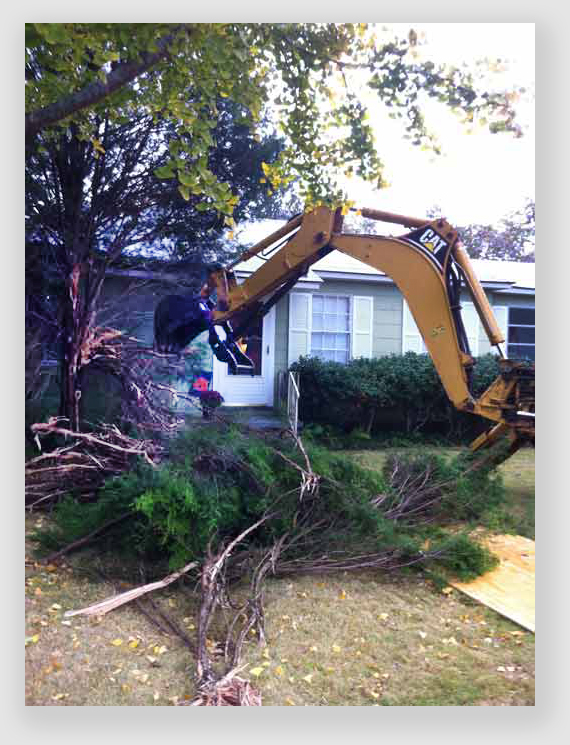
In case you missed it the past two days, this is a trackhoe removing a tree.

In case you missed it the past two days, this is a trackhoe removing a tree.

Today is our last day down on Dick Lavy’s Darke County farm. As you recall, we helped Dick’s faithful employee Sylvester trim the trees along a fencerow that separated one of the Lavy from land belonging to his neighbor, Jim Brewer.

We were fairly impressed to watch Sylvester run a trackhoe down the Lavy side of the fencerow, smacking down branches with the machine’s bucket. It was not pretty, but it got the job done effectively and cheaply.

Jim Brewer, however, wasn’t very happy with the result and sued Dick Lavy Farms. Farmer Lavy argued the Massachusetts Rule let him trim overhanging trees any way he liked, that Sylvester wasn’t negligent or reckless, and that the damage – if there even was damage – didn’t amount to much. The jury thought it was arboricide and socked Farmer Lavy for $148,350.

Last Thursday, we watched the Court of Appeals for Darke County, Ohio, fillet Dick Lavy’s argument that the Massachusetts Rule was a license to butcher. The Court affirmed a landowner’s right to trim encroaching trees and roots to the property line but held that such trimming had to be done in a reasonable manner so as not to injure the adjoining owner’s trees.

On Friday, we saw the Court compare the various means of trimming a fencerow, comparing for ease of use, custom in the area, and cost. It concluded that the trial court was right to find DLF negligent in trimming part of the fencerow and reckless in continuing after a sheriff’s deputy advised Dick Lavy to get legal advice before continuing (advice the farmer ignored).

Today, the Court delves into the $148,350 damage award. Clearly, the Court is troubled that Jim only paid $170,000 for the whole 70 acres, and provided no evidence that the value of the land fell a farthing because of Sylvester’s trimming activities. The Court felt hard-pressed to see Jim get almost $150,000 when no trees other than some saplings were destroyed.

Jim didn’t help his cause by admitting (as he had to) that he only visited the land about eight times a year to hunt and picnic, and the trimming didn’t interfere with those activities. He argued that he planned to build a house there in another 14 years or so, but the Court couldn’t see that the damaged fencerow trees had any impact on those plans.

Usually, the measure of damages for a trespass where trees are cut is the difference in the land’s value after the cutting versus before the cutting. There are times when this measure does not capture the real loss: a family loses a cherished ornamental tree, for example, or the landowner nurtures trees for their ecological value.

hurtsobad160929

That’s what Jim Brewer claimed, too…

In this case, however, it’s hard to see how Jim was hurt at all, not to mention hurt as badly as he claimed to be. Indeed, that’s how the Court of Appeals seems to read it, too. Come with us now on a detailed and thoughtful journey through all of the matters a court (and aggrieved party) should consider in setting the amount of loss. Although the Court sends the damage award back for the trial judge to deal with, it’s quite clear that the appellate panel is disinclined to turn the case into a winning lottery ticket for Jim Brewer.

Brewer v. Dick Lavy Farms, LLC, 2016-Ohio-4577 (Ct.App. Darke Co., June 24, 2016)

(These facts are repeated from the previous two days: If you don’t need the refresher, skip to the holding)

In 2007, James Brewer bought about 70 acres of rural property for $180,000. About 30 acres of the land were tillable, and 40 acres were wooded. The only access to the tillable and wooded property was a 25-foot wide lane of about 3,600 feet in length.

The former owner had allowed his neighbor Dick Lavy Farms to farm the property, and the lane had not been used. Brewer cleared the lane of undergrowth in order to access the rest of the property. The lane ran west to east, and had trees on both sides of the lane, with the trees on the south side forming a fencerow between Brewer’s property and land owned by Dick Lavy Farms. The trees in the fencerow were a woodland mix; none of the trees were ornamental or unique.

In January 2013, Dick Lavy ordered an employee to clear the fencerow between the two properties. At the time, Lavy understood that he could clear brush straight up and down the property line and that such clearing was important for crop production, yield and safety of farm equipment. Using a track hoe, which had an arm that could reach about 15 feet in the air, the employee reached up, grabbed limbs, and pulled on them, trying to break them off cleanly. Although the employee tried to keep the trackhoe on DLF’s side of the property, occasionally a branch would snap off or tear the tree on Brewer’s side. Occasionally, a branch would fall on Brewer’s side, and the employee would reach over to grab the branch Sylvester stated that he never consciously reached over with the bucket to try and break a branch at the tree trunk that was on Brewer’s side of the property.

When Brewer learned that DLF was clearing the fencerow, he went out to look at the operation and called the sheriff. At that point, the track hoe was about halfway down the fencerow, destroying trees. A Darke County sheriff’s deputy told Lavy that a complaint had been made, and expressed his concern that civil or criminal issues could be involved in what he was doing. Lavy said that he had a right to take down any branches that were hanging over his property. In addition, Lavy said he would let Brewer remove the branches if Brewer wanted to do so, but he wanted the branches removed before crop season began in March or April.

Or, if you're Sylvester, don't use a chainsaw at all...

Or, if you’re Sylvester, don’t use a chainsaw at all…

The deputy told Brewer that Lavy said that he was allowed to take tree branches from his side and that if Brewer did not like the way he was doing it, Brewer could cut them himself. Brewer told the deputy that he was going to have an expert look at the trees. The deputy filed a report with the prosecutor’s office, but no charges were brought.

Although the deputy suggested that Lavy obtain legal advice before continuing, Lavy continued clearing the fencerow. Knowing that Brewer was upset, Lavy told his employee not to clean up branches that fell on Brewer’s side.

Within days after the damage occurred, Brewer’s wife took photos of the damaged trees. Three months later, Brewer and an arborist counted 326 damaged trees.

Brewer sued Dick Lavy Farms, alleging a violation of O.R.C. § 901.51, reckless trespass, and negligent trespass. Prior to trial, the court held that Brewer was not limited to damages for diminution in value, and the court would apply a standard that allowed recovery of the costs of restoration.

DLF argued that it had a common law privilege to cut off, destroy, mutilate or otherwise eliminate branches from Brewer’s trees that were overhanging DLF land. The Farm also argued that if it was liable, the proper measure of damages should be the diminution of Brewer’s property value; in the alternative, the court’s holding on the issue of damages was against the manifest weight of the evidence. Finally, DLF claimed it had not negligently or recklessly trespassed on Brewer’s property.

The Court found for Brewer, awarding him $148,350 in damages, including treble damages of $133,515.

Dick Lavy Farms appealed.

(If you remember the facts from the previous two days, start here)

Held: It was Halloween for Jim, and he got a trick, not a treat. The $148,350 in damages was set aside because Jim’s property really didn’t diminish in value.

The Court observed that in a previous case, it had held that where the trespasser could not reasonably foresee that trees had a special purpose or value to the landowner, and where the trespasser “cuts trees that are part of a woodland mix and not unique, the ordinary measure of the harm is the difference in the fair market value before and after the cutting.” The trial court, however, had relied on a different standard:

It was all trick and no treat for Jim…

In an action for compensatory damages for cutting, destroying and damaging trees and other growth, and for related damage to the land, when the owner intends to use the property for a residence or for recreation or for both, according to his personal tastes and wishes, the owner is not limited to the diminution in value (difference in value of the whole property before and after the damage) or to the stumpage or other commercial value of the timber. He may recover as damages the costs of reasonable restoration of his property to its preexisting condition or to a condition as close as reasonably feasible, without requiring grossly disproportionate expenditures and with allowance for the natural processes of regeneration within a reasonable period of time.

At trial, Jim’s expert arborist testified that the cost of removing the trees Sylveste3r had damaged would cost $55,000, and the cost of replacing them would be $138,000, plus tax. Jim did not offer any evidence that his 70-acre property’s fair market value had fallen by so much as a penny. DLF’s arboriculture expert testified the life expectancy and service life functionality of the fencerow were not affected by the manner in which the trees were pruned. He valued the fencerow as a woodland edge fence and argued that real estate or fair market value would be the proper way to assess damages. Another DLF expert also testified that the fair market value of Brewer’s property was the same before and after the incident.

The trial court found that removal of the damaged trees was unnecessary, and thus discounted that $55,000 cost. In addition, the court concluded that the $138,000 estimate for tree replacement was excessive, and reduced that amount by 50%. The court also deducted 14% for ash tree disease, which had already caused the death of a number of trees on both sides of the lane. The trial court thus arrived at $59,340 in compensatory damages.

Next, the trial judge decided that DLF had negligently trimmed one-fourth of the property (or about 1,000 feet), and recklessly trimmed the remaining three-fourths of the fencerow. The trial court awarded $14,835 for negligence, and $44,505 for DLF’s recklessness. Pursuant to O.R.C. § 901.51, the court trebled the recklessness amount to $133,515. This brought the total damages to $148,350.

The Court of Appeals noted Ohio’s general rule that “recoverable restoration costs are limited to the difference between the pre-injury and post-injury fair market value of the real property,” The courts have carved out an exception, however, that permits restoration costs to be recovered in excess of the decrease in fair market value when real estate is held for noncommercial use, when the owner has personal reasons for seeking restoration, and when the decrease in fair market value does not adequately compensate the owner for the harm done. This restoration cost exception has been applied, for example, where the damaged trees have been maintained for a specific, identifiable purpose (like recreation, or a sight, sound, or light barrier), when damaged trees are essential to the planned use of the property, or when the damaged trees had a value that can be calculated separate from ornamental trees have been destroyed, or where the trees form part of an ecological system of personal value to the owner.

Even where the restoration exception is applied, the Court said, “the proposed cost [cannot be] grossly disproportionate to the entire value of the injured property.”

The Court said that the damage to Jim Brewer’s trees was “temporary” (meaning, apparently, that the damaged limbs would grow back), and that the Ohio rule is that “damages for temporary injury to property cannot exceed the difference between market value immediately before and after the injury, is limited. In an action based on temporary injury to noncommercial real estate, a plaintiff need not prove diminution in the market value of the property in order to recover the reasonable costs of restoration, but either party may offer evidence of diminution of the market value of the property as a factor bearing on the reasonableness of the cost of restoration.”

The trial court seemed certain that Dick Laye was a deep pocket, and that may have driven its damage award.

The trial court seemed certain that Dick Lavy was a deep pocket, and that may have driven its damage award.

“Viewing the trial court’s award of damages from the perspective of reasonableness,” the Court of Appeals said, “we must conclude that the award for restoration was objectively unreasonable.” First, the application of O.R.C. § 901.51 “almost exclusively involves situations where trees have been completely cut down, making it considerably easier to determine the full extent of the damage to the plaintiffs’ property.” Here, Jim Brewer admitted that other than a few small saplings, he was not claiming that any large trees had been removed from his land. Instead, he contended only “that 326 trees had been damaged in some manner and would ultimately die, even though pictures of the area taken in June 2014 depict a substantial canopy of foliage… Brewer also testified that a number of trees had died, but he did not give any specific number.”

The Court found that Jim Brewer’s trees were not ornamental and were not located at his residence. Instead, they were native trees that were just part of a fencerow. Jim testified he used the property for hunting only about six times a year, and for family get-togethers maybe twice a year. He also admitted the removal of branches had not had any effect on these activities or his ability to rent tillable land to farmers. Jim intended to put a house on the property after his 4-year-old child graduates from high school, but he didn’t claim that DLF’s tree trimming affected his plans to do so.

The Court found it noteworthy that Jim Brewer paid $180,000 for all 70 acres, yet claimed the restoration cost (including removal and replanting of trees) for a very small part of that property was more than $200,000.

Jim did not present any proof that the fair market value of the land had fallen because of the tree trimming. The Court agreed that he was not required to present such evidence, bur said “it would have been helpful, particularly since two defense witnesses indicated that removing vegetation from the fence row did not impact the fair market value of the land.” Additionally, the Court found that much of the trial judge’s calculations “were based on speculation or were incorrect. For example, the court concluded that one-fourth of the fence row was trimmed negligently, but the plaintiff’s own evidence showed that more like 1,800 feet had been trimmed when Jim Brewer first complained. “The trial court could have chosen to disregard [the DLF employee’s] testimony,” the Court said, “but there is no logical reason to disregard the plaintiffs’ own admission about how far the fence row had been cleared.”

The Court of Appeals was not inclined to see Jim Brewer get a winning lottery ticket...

The Court of Appeals was not inclined to see Jim Brewer get a winning lottery ticket…

The trial court also gave no particular reason for its 50% discount on damages. What’s more, the Court of Appeals complained, “The trees on the fence row were a woodland mix of native trees, not ornamental trees. A number of the trees were undesirable, and there was no evidence of special value. In addition, the fence row had been unmaintained for 10 or 29 years. Even though these facts no longer require damages to be limited to diminution in value, they are still points that should be considered in deciding whether an award is reasonable.”

The Court of Appeals vacated the damages, and directed the trial court on remand to consider the reasonable restoration costs, taking into consideration the decrease in the fair market value of the land; the fact that the trees were a common woodland mix, not ornamental trees or trees that Jim had planted for a particular purpose; the fact that the fence row was not maintained for many years, and had undesirable and dead trees on each side of the row; the extent to which the trees have regenerated since the date of the 2013 trimming; the lack of impact on Jim’s intended home site; and the fact that Jim’s use of his property is “sporadic and is not impacted by any injury to the trees.”

The detailed list of evidence the trial court is to consider pretty much tells the trial judge how the Court of Appeals expects this to turn out.

– Tom Root

TNLBGray140407

Case of the Day – Thursday, October 23, 2025

THAT EQUITY MAY PREVAIL

A barricuda in one of its habitats - the other is a courtroom.

A barracuda in one of its habitats – the other is a courtroom.

Sometimes you really wish you knew the back story of a lawsuit. Merely reading the recitation of facts and the application of the law in some cases leaves you wondering – why is this case even in the courtroom?

Today’s case is a perfect example. The Mannings lived in a housing development. Behind their well-manicured lawn lay some scrubby, undeveloped woods. Their neighbors had a back lawn that was about 30 feet deeper, and the Manning family mistakenly thought that their own lawn must be that long, too. So they cleaned and chopped weeds, took down some saplings, and installed a park bench and baseball batting cage.

But it turned out that the land wasn’t theirs. Presently, they got a letter from some limited liability company’s lawyer, telling them to cease and desist forthwith, govern their actions accordingly, and all of that legal mumbo-jumbo. Chastened, the Mannings withdrew to their own boundary.

End of story? Nope. The owner of the land, CUDA Associates, LLC — “CUDA” undoubtedly being short for “barracuda” — sued the Mannings for the grievous harm they obviously had done to its rather decrepit piece of real estate. The ‘Cuda sued for trespass, for intentional and wrongful cutting of timber in violation of Connecticut law, and for “unjust enrichment.”

OK, fo technically, the Mannings did commit a trespass ... but they left the land in better shape than they found it.

OK, so technically, the Mannings did commit a trespass … but they left the land in better shape than they found it.

And exactly who was unjustly enriched? You have to wonder why CUDA would have sued at all. After all, there was no damage to the CUDA land. In fact, the Court suggested the Mannings had improved it. What’s more, the trespass was an honest mistake, and the trespassers withdrew as soon as their attention was called to the error. We’ll never know the whys. But the trial court pretty clearly agreed with us that the whole thing was a tempest in a teapot: the judge dryly observed that “[t]he equities in this claim clearly rest with the defendants, and as such must be balanced with the nominal losses that the plaintiff has suffered.” In other words, the Mannings’ trespass was pretty minor and done honestly enough, and CUDA didn’t really suffer for it. In fact, it was better off for the trespass, because its property was left in better shape than it would have been in had the Mannings stayed home. The whole case seemed like a monumental waste of the court’s time.

However – and we should all know this by now – litigants are allowed to waste the court’s time, and they do so daily. As maligned as lawyers are, sometimes the fees they charge are the only brakes ever applied to the wacky legal claims their clients want to press in the courtroom. Unfortunately for the Mannings, no cooler heads prevailed in the offices of CUDA’s counsel, so the suit was litigated to judgment.

The court recognized that Connecticut law dictated that damages had to be awarded, even where the trespass was trifling. So it awarded CUDA $1,500, an amount which (we hope) was probably much less than its attorney’s fee. So some justice prevailed in the end, even if it was only found in a lawyer’s pocket.

CUDA Associates, LLC v. Manning, 2008 Conn. Super. LEXIS 93, 2008 WL 249974 (Conn.Super., Jan. 8, 2008). CUDA Associates owned 3,000 square feet from which the Mannings cleared trees, removed underbrush and in effect extended the back boundary of their property line by approximately 30 feet along the entire easterly line of their backyard. All of the surrounding land owned by CUDA or its successor was undeveloped. The Mannings’ house was located in a developed residential area with housing on both sides of White Avenue, and abutting the plaintiff’s property to the east and south. The Mannings installed a park bench, a baseball practice apparatus and the cutting of certain trees and undergrowth, an intrusion into the CUDA’s property that ended when CUDA wrote to them. The Mannings were operating under a mistaken belief that the property that they had encroached upon was theirs and roughly matched the back property line of their neighbor. This mistaken belief led them to do certain clearing and cutting of trees and underbrush and to use the property for their own benefit. CUDA sued for trespass, removal of timber in violation of statute and unjust enrichment.

CUDA could have erected a sign that warned against trespassing and spouted a lot of legal nonsense, like this one ...

CUDA could have erected a sign that warned against trespassing and spouted a lot of legal nonsense, like this one …

Held: The Court found that the Mannings committed a trespass upon a portion of CUDA’s property for their own use and benefit, but any loss of use for CUDA was not measurable. The trespass was negligent and not intentional and, therefore, only minimal damages were awarded. As for the cutting of trees, timber or shrubbery in violation of Connecticut General Statute §52-560, while the Mannings did cut trees, CUDA failed to establish the quantity or the value of any of the trees that had been removed. In fact, the Court said, the cutting may have actually improved the overall site appearance for CUDA’s benefit. Nothing more than reasonable and ascertainable value under the statute can be awarded.

As for unjust enrichment, the Court held that the non-permanent intrusion by the Mannings was unintentional. What’s more, any benefit derived by them from the CUDA land was coincidental to the use of their own backyard property and was of a de minimis nature. The Court said that equities in this claim clearly rested with the Mannings and had to be balanced against the nominal losses that CUDA suffered. The Court awarded CUDA $400 for the common-law trespass, $600 for the timber statute violation, and $500 for unjust enrichment.

– Tom Root
tnlbgray140407

Case of the Day – Friday, October 10, 2025

BROWN GETS A MULLIGAN

doover160921It’s been a while, a long while, since we were young pups in law school. But we still seem to recall that when a plaintiff complains that she’s been damaged by a trespass, she has to put on some sort of evidence as to the amount of the damage. If the trial record closes and the plaintiff hasn’t done so, thereb was a time when she would be out of luck. No do-overs, no mulligans. One and done, as the sports guys say.

Well, apparently that’s no longer true in Mississippi. When Martha Murrell decided to build a fence in front of her house without checking her subdivision restrictions first, her neighbor Jeanette Brown took exception. It seems the restrictions prohibited building anything within 25 feet of the property boundary, and Martha crowded that a little – by about 23 feet. In fact, she put the fence so close to the property line that she had to hack off a few branches from one of Jeanette’s trees in order to finish the project.

Jeanette sued Martha, asking the trial court to order her to remove the fence and to give her $30,000 in damages because she had hindered Jeanette’s enjoyment of her property. Admittedly, we enjoy our property, too, especially sitting on the deck with an appropriate legal beverage, but $30,000? That’s a lot of hindrance being compensated.

The trial court granted the injunction because the fence violation was pretty clear. Martha must have figured that showing the trial court her snapshots of the “mutilated” tree was good enough. The trial court must have found the pictures compelling, although not $30,000 worth of compelling. It awarded Jeanette $5,000.

mulligan160921The Court of Appeals was made of more skeptical stuff. It ruled that while the picture was good enough to show that Martha or her minions had trespassed onto Jeanette’s land, and had hacked up her tree, it was not good enough to show how much damage Jeanette had suffered. Despite a strenuous dissent from a judge who thought Jeanette had had ample opportunity to prove the amount of damages, the Court sent the case back to the trial court to give Jeanette a second bite of the apple.

Murrell v. Brown, 202 So.3d 287 (Ct.App. Mississippi, 2016). Jeanette Brown filed a complaint against their next-door neighbor, Martha Murrell, for constructing a fence in violation of their subdivision’s protective covenants. The North Colony subdivision covenants state that “[n]o fence shall be constructed nor any other structure be constructed within 25 feet of [the] front property line.” Brown complained that Murrell built a fence within a few feet of the front property line in violation of this covenant, thereby diminishing the value of Brown’s property and “hindering her use and enjoyment of her property.” Brown wanted the fence taken out and damages of $30,000.

After a hearing, the trial court found Murrell in violation of the subdivision’s covenants and ordered her to remove the fence. The court further held that because Murrell or her agents mutilated Brown’s tree and came onto Brown’s property to do so, Brown was entitled to $5,000 in damages.

Murrell appealed.

butchered160921

Jeanette made out her damaged tree to look something like this, but while a picture’s worth a thousand words, it’s not worth five thousand bucks.

Held: The damage award was reversed. The Court of Appeals said that in awarding Brown $5,000, the trial court reasoned that Murrell or someone on her behalf “mutilated [Brown’s tree] by chopping off these limbs in such a way that I don’t know what it would look like when it grows back. And [the person] came several feet over onto [Brown’s] property to do it.”

Murrell asserted that the trial court abused its discretion in awarding damages for the tree because Brown never mentioned the tree damage in her complaint. The Court, however, noted that while the complaint did not reference the tree damage, pictures of the tree were entered into evidence at the hearing, showing that the tree’s branches had been cut at the fence line, and Brown’s lawyer had written to Murrell about the damage before the case was filed.

Murrell also claimed that Brown failed to prove that Murrell or her agent caused the damage to the tree. Brown asserted at the hearing that Murrell “took a power saw and cut [her] tree to build the fence,” but Brown conceded that she did not personally witness Murrell, or anyone acting on her behalf, cut the tree. She simply testified that she “was informed [Murrell’s] father had cut the tree.” The appeals court, however, was satisfied that the trial judge, “as the fact-finder, clearly determined that Murrell or her agent cut Brown’s tree.” Circumstantial evidence, after all – such as limbs cut at the fence line – supported the trial court’s finding that someone acting on Murrell’s behalf cut the limbs during the construction of the fence. That was good enough.

The heart of Murrell’s appeal was that the award of $5,000 “for the mutilation of the tree” did not address the fair market value of the tree before and after the cutting. After all, the tree in question was not a fruit-bearing tree “and the cost of complete life maturity is no more [than] two hundred and fifty dollars.”

The appellate court held that while the trial court properly found Brown’s tree suffered some damage, and Murrell (or her agent) likely trespassed on Brown’s property to cut the tree, the award of $5,000 for the tree damage was excessive and not supported by substantial evidence. “Brown’s tree was not cut down,” the Court observed, but rather “the tree’s branches were merely cut back at the fence line. While the pruning was unsightly, there was no evidence presented that the tree was permanently damaged.”

apple160921Proof of actual damages must be shown in order to recover more than nominal damages, and Brown made little in the way of such a showing. The Court, however, held that Brown showed photos of a “mutilated” tree and those photos were enough to let the judge ascertain damages. Once a judge is “presented clear evidence that [the plaintiff] owned the property and that the trees had been cut without [her] consent, the [judge] was obliged under the circumstances to award damages in some form.” So something is to be paid, but there has to be some evidence of what.

A dissenting judge complained that “Brown did not even establish what kind of tree is at issue in this appeal. It was Brown’s burden to prove her damages, and having failed to present any evidence of actual damages, she should not be given another opportunity to do so. “A litigant is entitled to but one bite at the damages apple…,” he wrote.

– Tom Root

TNLBGray140407

Case of the Day – Thursday, October 9, 2025

ONE CROWDED HOUR

A British army officer and poet, Thomas Osbert Mordaunt, wrote in his poem, “The Call,” a line now misattributed to Sir Walter Scott: “One crowded hour of glorious life is worth an age without a name.”

It’s so much fun to be nasty. Even for just one glorious, crowded hour. It’s just not so much fun when the age without a name knocks on the door, seeking payment. Just ask John and Anne Estes.

Everything started when John and Anne tried to extend the Massachusetts Rule to cut some branches from their neighbors’ trees. The problem was that the trees and branches were both on the neighbors’ properties.

Then they built a fence. So far, so good, at least until the fence they built was on their neighbors’ property, too. The neighbors, Matt and Rachel Milcic, objected. After mediation, the Estes fence was removed.

Obviously, John and Anne were sore at having been upbraided for their brazen trespasses. So they rebuilt the fence, and on the Milcics’ side, painted in large block letters, “PULL YOUR WEEDS.”

“Hah!” You can imagine John and Anne giving each other high-fives at their in-your-face cattiness. They sure showed those jerk neighbors, who thought they were so cool that they could stop John and Anne from trespassing. Their snickers and winks lasted for one crowded hour of glorious fun.

Maybe the neighbors really did need to weed. It’s hard to say. Certainly, Matt Milcic did some landscaping in response to the fence. After he had done so, and after he asked John to remove the sign, John said he might. But petulantly, he did not.

Cute, John… at least until the Milcics sued. Then, John offered to paint out the words if the Milcics would drop the suit. But that horse had left the barn…

The Esteses’ conduct was brazen enough that the trial court granted the Milcics summary judgment. But then, the battle continued over damages. By the time the court was done, the Esteses’ cruel prank had cost them northward of $10,000.00. Not nearly what the Milcics wanted, the award nevertheless undoubtedly deterred the juvenile conduct.

You’d better find your checkbook, John. You and Anne enjoyed your crowded, glorious hour. The age without a name (but with a dollar sign) has now arrived.

Milcic v. Estes, 2018 Wash. App. LEXIS 1798 (Ct. App. Wash., Aug. 6, 2018). The Milcics and Estes are next-door neighbors. In 2013, the Estes cut branches off trees located on the Milcics’ property and began to build a fence along the parties’ common boundary.

When a dispute regarding fence encroachments arose, the parties submitted it to mediation. In April 2014, the parties executed a settlement agreement in which the Estes agreed, among other things, to remove both the excess dirt from the Milcics’ property and portions of fence footings that were visible above ground.

In July 2014, the Estes painted the words “PULL YOUR WEEDS!” in white, 10-inch block letters on the Milcics’ side of the Estes’ fence. The Milcics threatened a lawsuit unless the Esteses removed the sign. The words remained, and the Milcics sued.

The Milcics’ complaint alleged private nuisance, trespass, timber trespass, spite fence, quiet title and damages to land and property. Shortly after the Milcics filed, the Estes offered to remove the painted message if the Milcics dismissed their complaint. The Milcics rejected the offer, telling the Estes, “If you were willing to do so voluntarily… you could have removed the sign at any time for the past nine months.”

The Milcics moved for partial summary judgment, alleging there were no issues about the Estes’ branch cutting, fence encroachments, and dumping of fill dirt on the Milcics’ property. The trial court granted relief, including ordering the Estes to the fence encroachments. The court awarded the Milcics some but not all, of their requested damages, but denied them reimbursement of their legal fees.

The Milcics appealed the adverse ruling on damages and fees.

Held: The appeals court upheld the damage award, and sent the case back to the trial court for a legal fee award.

In January 2017, the matter proceeded to trial solely on the issues of damages and attorney fees and costs. Rachel Milcic testified that the Estes cut branches off their trees and put fill dirt on their property without their permission. She said the branch removal ruined the beauty and privacy of the Milcics’ property. The loss of the branches upset her and she did not sleep well. She also testified that the Milcics were not sure where the property line was when the branches were cut.

She also testified that she was “shocked,” “horrified,” and “scared” when the Estes painted the “PULL YOUR WEEDS!” message on the fence facing the Milcics’ property. She had trouble sleeping and no longer felt that she and her children were safe. She testified that before the painted message appeared, her family spent around 12 hours per week in her yard. After the message appeared, they spent less than an hour a week in the yard. She valued her use of the yard at $40 per day. She testified that the message was visible for 922 days.

Matt Milcic testified that after the painted sign on the fence, the Milcics installed a surveillance system to “protect our property” and to “capture any trespasses by the Esteses on our land.” Matt also testified that the fence message could be seen from roughly a quarter of their property and prevented the Milcics from enjoying their yard. Their dreams and aspirations for landscaping the yard “got instantly crushed into a reminder of, you don’t get to enjoy this part of your property that you had hopes and dreams for.” He estimated that the affected portion of his property had a market value of $152,500.

Matthew conceded that he had not seen a doctor or any medical professional for his emotional distress and had no medical bills related to that distress. Matthew also conceded that he did not accept the Estes’ April 2015 offer to remove the fence message.

John Estes testified that he painted the “PULL YOUR WEEDS!” message to protest the “weeds and invasive vegetation coming onto my property.” He conceded that Matt told him in August 2014 that he had pulled the weeds and that he wanted the message removed, but he did nothing for nine months, at which time John offered to remove the message if the Milcics dismissed the lawsuit.

The court ruled that the Milcics were entitled to some, but not all, of their alleged damages. It awarded them $3,557, which it trebled to $10,673. However, it denied damages for the installation of the surveillance system, for lost enjoyment of property, for emotional distress, and for legal fees.

On appeal, the Milcics argued the court erred in awarding no damages for their alleged lost enjoyment of their property on their trespass and private nuisance claims. They claim they were entitled to such damages due to the significant length of time — 922 days — that the fence message remained in place. But the Court of Appeals held that the trial court was free to discount or reject the Milcics’ testimony regarding their alleged lost enjoyment. “On this record, and in light of our deference to the trial court’s view of the weight and credibility of the evidence,” the Court held, “we cannot say the court abused its discretion in declining to award damages for the Milcics’ claimed lost enjoyment of their property.”

The Milcics also contended that the trial court abused its discretion in failing to award them damages for emotional distress caused by the Esteses’ fence message and branch cutting. A plaintiff who proves liability for intentional wrongful conduct is entitled to damages for emotional distress upon a showing of actual anguish or emotional distress. The distress need not be severe and a plaintiff “need not demonstrate objective symptomology, medical bills, or a medical diagnosis.”

Here, the trial court found the Esteses engaged in intentional wrongful conduct, including nuisance, timber trespass, and a spite fence. The trial court also found, however, that the Milcics “have not provided sufficient evidence to establish that they have suffered emotional distress.” The Milcics pointed to their testimony that they suffered initial shock and distress, trouble sleeping for a week, and ongoing feelings of insecurity and fear of further invasions. “But,” the Court of Appeals held, “the trial judge’s evaluation of the sufficiency of the evidence includes determinations as to the weight and credibility of the evidence – matters that require our deference.”

The Milcics also contended the trial court erred in concluding that the Estes’ conduct was not the legal cause of their purchase and installation of a surveillance system. To determine if legal causation exists, a court considers whether “‘as a matter of policy, the connection between the ultimate result and the act of the defendant is too remote or insubstantial to impose liability.” The Court said that the judge’s determination rests on ”mixed considerations of logic, common sense, justice, policy, and precedent.”

Here, the Court of Appeals ruled, “the Milcics offer no relevant precedent supporting their argument regarding legal causation. Nor do they advance any persuasive arguments supporting their claim that logic, common sense, justice, and policy favor the imposition of liability for the surveillance system. There was never any doubt as to who had trespassed onto the Milcics’ property. The Estes readily admitted cutting the branches, painting the message, and installing the fence. There was therefore no need for a surveillance system to catch the perpetrators, and no reason to believe that a surveillance system would act as a deterrent to future incursions. In addition, except for the branch cutting, the trespasses were de minimis incursions. Thus, the trial court did not err in concluding that the Estes’ conduct was not a legal cause of the Milcics’ surveillance system expenses.”

– Tom Root

TNLBGray140407

Case of the Day – Tuesday, August 5, 2025

IF A TREE FALLS IN THE FOREST …

venezuelastore160816

Island Realty’s coffers were as empty as a Venezuela grocery store’s shelves.

Taking a philosophical bend, a New York trial court asked “[i]f trees are cut in a forest that were going to be removed anyway does the owner have compensable damages?”

The Mottas couldn’t stand the overgrown and scrubby condition of unimproved land next door to their place, property owned by Island Realty. When another neighbor took matters into his own hands and cut back some of the offending saplings on the vacant land, the Mottas — bothered by falling leaves and insects, not to mention fears of West Nile virus — hired their own landscaper to cut back some other trees and vegetation on the Island Realty property.

The landscaper attacked the job with enthusiasm, and a neighbor — worried about the cutting because the Mottas weren’t home — called the cops. The police came and — this being New York City — everyone got a ticket because no permits to cut trees or park dumpsters had been obtained. One of the police officers reported the matter to Island Realty, too.

Island Realty had a case of the “shorts.” It wanted to develop the lot for housing, but its bank account was emptier than a beer cooler in CaracasSo it sued the Mottas for treble damages under New York law and brought in an expert who tried to sell the Court the amazing woof story that the one-third acre of cut saplings would cost $190,000 to replace.

The Mottas’ expert pointed out that the Island Realty development plan called for the removal of the trees that the Mottas had cut. In other words, far from damaging Island Realty, the Mottas had saved the developer a few bucks by doing what the developer would have had to have paid to have done.

The Court was a bit vexed. It didn’t much cotton to the Mottas’ form of self-help in clear-cutting the neighboring land, but it couldn’t really find any damage, either. It ruled that under New York law, the lesser of the diminution of value of the land or restoration costs was used to set damages. The Mottas had pretty well shown that the land wasn’t worth a dime less with the scrub cut. In fact, an aerial picture taken during the litigation (three years after the cutting) showed that the scrub was nearly all back.

show150714The Court held that because Island Realty intended to cut the trees itself, damages were nominal, and it ordered the Mottas to pay $100, trebled to $300. In fact, the Court gave credence to the Mottas’ suggestion that the whole reason Island Realty sued to begin with was to raise a pot of money to start the development that it was too cash-starved to pull off by itself.

333, Island Realty Assoc., LLC v. Motta, 21 Misc.3d 554, 863 N.Y.S.2d 866 (Sup.Ct., Aug. 22, 2008). Island Realty was a land developer that owned a large tract of unimproved wooded land along the south shore of Staten Island. Joseph and Joan Motta owned a house next door. The Mottas had often complained that the unattended trees on the Island Realty land had created a nuisance because some of the trees hung over their property, and falling leaves had clogged their pool drains.

Motta’s neighbor – whose property also abutted the Island Realty land – exercised a little self-help by cutting a swath of Island Realty trees to create a 100-foot buffer zone between his backyard and the tree line. He did so without any permission or objection from the real estate firm. Seeking to create a similar buffer zone to safeguard his own property, Joseph Motta had a landscaper cut the trees that overhung his land and create a buffer zone away from the unattended trees for fear of insects and West Nile Virus, which was prevalent in Staten Island around that time.

While the Mottas were not home, the landscaper and his crew went to work but became overzealous, cutting down various trees without Island Realty’s consent and without any supervision from the Mottas. A nosy neighbor called the police to inform them that trees were being cut while the Mottas were not home. Because the complaint involved tree cutting, police officers from the New York City Department of Environmental Protection responded to the premises and observed a wood chipper feeding into an open container. Upon confronting the landscaper, the police officers learned that Joseph Motta authorized him to clear out some trees. The police officers originally estimated that 100 to 200 trees were cut in an area about half the size of a football field, but later admitted they were not certain how many trees were cut down. The police issued Motta five summonses for cutting down trees without permission and for placing a container on the street without a permit. All of those charges were dismissed by the criminal court, except for the container charge, for which the defendants paid a $250 fine.

Officer Friendly responded to a call from a nosy neighbor ... and stopped by the Mottas for a chat.

Officer Friendly responded to a call from a nosy neighbor … and stopped by the Mottas for a chat.

Island Realty was not immediately aware of the felling of the trees but soon learned of it from the police. The company had planned to develop the wooded tract into a large development of houses, and in order to do so, it would have had to clear large sections of trees to comply with an approved plan. Ironically the Mottas argued that they rendered a benefit to Island Realty in removing trees at no expense to the company that ultimately would have to have been removed in order to complete the building project.

Nevertheless, Island Realty sued Motta under New York Real Property Actions and Proceedings Law § 861, which authorizes treble damages for the wrongful cutting of trees.

Held: Motta was liable for damages, but the damages awarded were nominal, $100 trebled to $300. The Island Realty expert estimated that 483 saplings would have to be planted to replace what was cut, at a price of $190,000. The trial court rejected the estimate as “incredible” and “preposterous.” Motta’s expert, on the other hand, testified that Island Realty was under no legal requirement to replace the trees, which it was going to cut down itself anyway. The Court accepted this opinion.

The Court followed the New York law principle that the measure of damages for permanent injury to real property is the lesser of the decline in market value or the cost of restoration. A plaintiff may demonstrate the costs of restoration, but then it becomes the defendant’s burden to prove that a lesser amount than that claimed by the plaintiff will compensate for the loss.

Here, the Court said, Island Realty only presented speculative testimony of the value of the restoration and disregarded balancing that testimony with the other evidence in this case, namely, that there was no decrease in the value of the land, especially when it was to be cleared for development anyway.

The Court warned that it did not condone the Mottas’ actions in cutting down Island Realty’s trees without permission. However, applying the rule of taking the lesser of the values between restoration —which was most speculative — and no diminution of the value of the land, the Court held it was clear that there was no diminution in the value of the land.

It was noteworthy, the Court said, that Mottas tried to buy the land from Island Realty after the cutting, and Island Realty wouldn’t adjust the price downward because the trees were gone. This suggested, the Court said, that even Island Realty didn’t think the land was worth less with the trees gone. Rather, it suggested that Island Realty’s lawsuit was only about getting startup capital for a building project from the Mottas instead of being about the value of the lost trees that would never be replanted.

– Tom Root

TNLBGray140407

Case of the Day – Wednesday, July 30, 2025

MEANWHILE, BACK AT THE RANCH …

ranch

… that confounded sodbuster neighbor just done cut our power line with his plow. In the ensuing fire that swept across the plain, the trees planted in our windbreak went up like Roman candles, and the ranch hands couldn’t stop the conflagration. Sure, the farmer was negligent, but to what extent?

One of the first things new law students learn is the lesson of Hawkins v. McGee, the “case of the hairy hand,” in which we find that the measure of damages is the difference between the value before the breach or the negligence, and the difference after the breach. Nebraska law in this case held that if the trees were used for residential or recreational purposes, the damages are the replacement cost of the trees up to the value of the real estate. But if they were just used for agricultural purposes, the Hawkins v. McGee formulation is fine.

hairyhandHere, replacement of the trees would cost over $270,000, but the reduction in the value of the farmland was only $30,000. David Spicer, the owner of the ranch, tried to bootstrap himself into qualifying for the “recreational” formulation by arguing that not only did he use the windbreak for the usual agricultural purposes, but he relied on it for recreational purposes as well, including for his kids’ 4-H projects. The 4-H projects argument was especially touching, except that David Spicer’s youngest kid was 25 years old. And we thought AI was fake from time to time…

The trial court granted summary judgment on the damages question, holding that the replacement cost exceeded the value of the land and that $30,000 was adequate to compensate for the loss of the trees. The Court of Appeals ruled, however, that whether the trees were recreational in nature or agricultural in nature was a question of fact, and the trial court was wrong to resolve that question without a trial.

The issue of how to value the loss of trees – especially where the value of the tree to the homeowner is due to noneconomic reasons such as beauty, sentimentality or recreational value – arises often, and for good reason. The aphorism in real estate is that the value of a home depends on location, location, location. Much could be said of trees as well. The mighty oak that shades the plantation house is worth far more than its identical twin standing a quarter mile into the woods behind the fields. Determining exactly how much more may require juries to consider not so much stumpage prices as the quality of 4-H projects.

Spicer Ranch v. Schilke, 734 N.W.2d 314 (Neb.App., 2007). Schilke farmed leased land next to the Spicer Ranch. While he was plowing one day, he cut a power line leading to some irrigation pumps. A fire resulted, which, before it burned out, destroyed a windbreak on Spicer Ranch consisting of red cedar and juniper trees, and located about five hundred yards from the ranch house. Spicers used the windbreak, which was on a 110-acre tract of land, in the normal fashion of slowing the wind, providing shelter for cattle, for calving, for horses and for general farm use. David Spicer – mindful of how damages were figured in cases such as these – also maintained that he used the trees for recreational purposes, including his kids’ cataloging the trees for 4-H projects (except it turned out that his youngest child was 25 years old). Spicer sued for negligence, which was pretty much conceded.

Claiming the windbreak was worth $270,000 was just so much puffery ...

The Court found that Spicer’s claim that the windbreak was worth $270,000 was just puffery …

In an affidavit to the trial court, Spicers’ expert valued the windbreak at $270,000 for replacement of the trees. But the trial court granted summary judgment to Schilke, finding that to value the trees on the 110-acre tract at $270,000 far exceeded the value of the real estate involved. The trees included only made up a small percentage of the tract, the Court found, and that small percentage of land likewise would not be permanently damaged because of the loss of the trees. The trial court awarded Spicer Ranch $30,000 as the highest amount of damages suffered by Spicer Ranch.

The sodbuster was relieved. The rancher was not… and appealed.

Held: Summary judgment was reversed on the damages issue. Spicer Ranch argued the district court erred in using a “before and after” measurement of damages. Instead, it said, to determine compensatory damages for destroying trees and for related damage to the land – where the owner of land intends to use the property for residential or recreational purposes – the owner is not limited to the difference in value of the property before and after the damage or to the stumpage or other commercial value of the timber, but instead may recover the cost of reasonable restoration of the property to its preexisting condition or to a condition as close as reasonably feasible.

The Court of Appeals noted that the trial court’s implicit rationale for its calculation of damages is that the land was used for the farming business, not for any recreational purposes, apparently because of the age of the youngest child was then 25 years old. The trial court’s finding failed to account for the material question of fact as to whether the windbreak was used for residential and recreational purposes, as stated in David’s affidavit, or whether the windbreak was simply a “normal and average farm windbreak,” as could be implied from David’s deposition testimony and as stated in the affidavit of a real estate appraiser. The Court of Appeals noted that the measure of a plaintiff’s damages would depend upon the evidence presented at trial and might require alternative instructions, depending upon the jury’s determination of contested factual issues. Because a material issue of fact existed, the Court of Appeals held, summary judgment with respect to damages was improper.

Even under the “before and after” theory of damages used by the trial court, the evidence revealed a range of damages — not just a fixed, undisputed figure of $30,000. The trial judge made a factual finding when he awarded Spicer Ranch $30,000, which he said “is the highest amount of damages suffered by the Ranch according to the before and after damage appraisal.” He should have simply determined whether a material issue of fact existed with respect to damages, and – if one did – set the case for trial. The matter had to be returned to the trial court.

– Tom Root
TNLBGray140407