
YOU’LL GET NOTHING AND LIKE IT
 We’ve all had it happen to us. Our next-door neighbor gets drunk and rams his bulldozer into our best shade tree, gouging it up pretty badly. Then we have to sue, and while the torn-up grass he left behind and shrubs he rolled over get paid for, we get nothing for the tree. All because he wounded it but didn’t kill it.
What? You say it hasn’t happened to you? OK, but it did happen to Mike and Melissa in Huron County, Ohio. When neighbor Bob Tite got a little tight and rammed their tree, the trial court told them they’d get nothing for the wounded walnut, because it’s not dead. Dead trees we can figure the cost of, but a wounded tree… Well, it may die sooner instead of later, but who can say? The trial court said the damage is “speculative.”
Speculative? If Mike or Melissa had been rammed by the tight Mr. Tite, they would have been able to collect for their injuries without having to die first. And trees are people, too, right? Well, maybe not, but a tree probably shouldn’t have to die before a property owner can get compensation for damage to it.
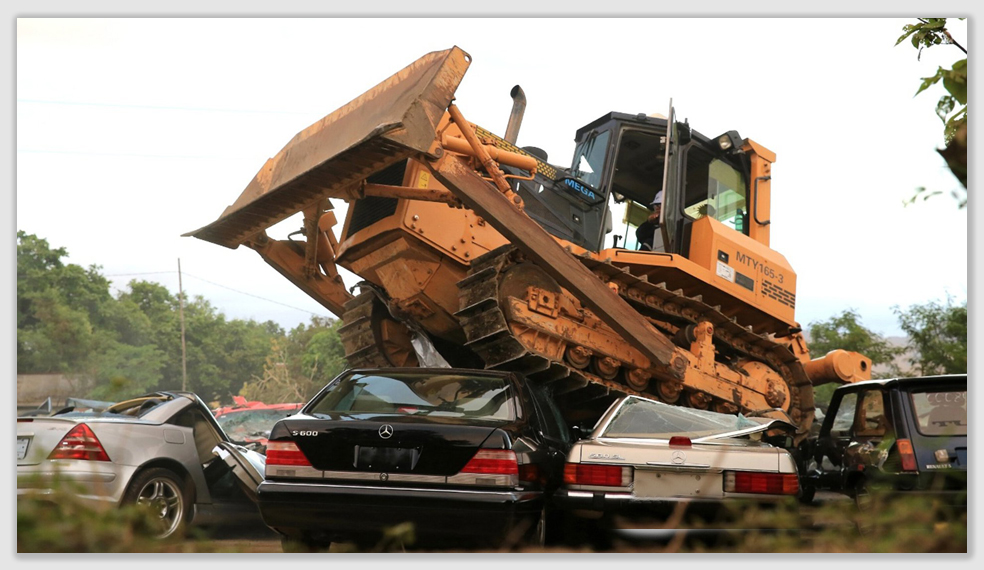 Tinney v. Tite, 2012-Ohio-2347 (Ct.App. Huron Co. 2012). One summer day, Mike and Melissa Tinney heard a loud noise outside of their house. When they looked out through the window, they saw their across-the-road neighbor, Bob Tite – quite inebriated at the time – sitting on his bulldozer lodged hard up against a sizeable black walnut tree in their back yard. Deep ruts across their lawn and two smaller trees splintered on the ground marked the path the bulldozer had taken.
The Tinneys sued Bob for the damage. Their certified arborist expert said damage to the walnut covered 25 to 30 percent of the circumference of the tree. He testified the extent of the damage “ruined” the tree because, although it would not kill the tree immediately, it would result in “a slow decaying process” that would eventually compromise the structural integrity of the tree and cause it to become a hazard. The arborist was unsurprised that the tree was still producing leaves one year after the incident. He said the wound was starting to develop a callus as the healing process proceeded, but the tree would weaken over time because the wound would not heal completely before decay set in. He could not say that the tree would die from the wound, but he said that the structural integrity of the tree is likely to become a dangerous factor in the future.
 The Tinneys also called a witness who had a degree in landscape horticulture. He said the severity of the damage would probably stress the tree out, and eventually, the old walnut would die. He testified that as the years progressed, the Tinneys could expect more decay and more branches showing signs of decline. He said the tree’s declining and potentially dying was “not an immediate thing. It’s going to take some time” because “it’s a long process for this tree to decline.”
Bob’s sister testified in support of her brother, however, testifying that she saw the damaged black walnut the summer after the incident, and it looked “healthy, green, and alive” despite the wound on the trunk.
The Tinneys won a judgment of $3,410.00. The award covered the lawn and the saplings but included nothing for the wounded but still living walnut tree because the trial court found that giving them damages for the walnut tree’s injury would be “potentially temporary and speculative at best” since “its appearance remains the same.”
The Tinneys appealed.
Held: The Tinneys were entitled to damages for the injured walnut tree.
The Court observed that most decisions involving O.R.C. § 901.51 – the Buckeye State’s statute on wrongful cutting of trees – involve situations where trees have been completely cut down, making it considerably easier to determine the full extent of the damage. In this case, the tree is still alive, even if it is not necessarily guaranteed to stay that way for decades to come. Nevertheless, the Court said, temporary damages to vegetation are recoverable, because it is a “fundamental rule of the law of damages is that the injured party shall be fully compensated.”
 As a general rule, speculative damages are not recoverable. An award of damages must be shown with a reasonable degree of certainty and in some manner other than mere speculation, conjecture, or surmise. However, the Court ruled, if an appellant “establishes a right to damages, that right will not be denied because the damages cannot be calculated with mathematical certainty.” Even when permanent damages are awarded for trees that were cut down, temporary damages may still be awarded if the permanent damages alone do not fully compensate the plaintiff.
Both of the Tinneys’ experts testified it was reasonably certain that the tree was permanently damaged because it would not heal before decay set in. The Tinneys furnished precise calculations on the reasonable restoration value of the property. Therefore, the Court ruled, they had shown “with a reasonable degree of certainty what would be required to reasonably restore their property. The damages to the tree must have had some value, but the plaintiffs were awarded nothing, even if just a nominal amount for the temporary trespass onto their property.”
The Court of Appeals sent the case back to the trial court for a calculation of damages to the wounded walnut tree.
– Tom Root



 Tree and Neighbor Law For Homeowners and Professionals