Case of the Day – Friday, September 13, 2024

TREE TRESPASS LOTTERY

There are a lot of moving parts to today’s case. First, we have the classic setup for treble damages. A neighbor is told repeatedly that his beliefs as to his property boundaries were wrong, but he pigheadedly ignores the news he does not want to hear. After the inevitable trespass results in the butchering of hundreds of trees, the unhappy victims – who don’t want justice as much as a pound of flesh – decide to pile on with multiple experts, each describing the loss a little differently. Finally, we have a plaintiff’s lawyer who screws up on a minor and rather technical rule of pleading, costing his clients some money in the process.

In any fair contest, the Linebargers should have gotten treble damages from their neighbor George. How many times do you have to be put on notice that your purported property lines place you at risk of committing a whopper of a timber trespass before you check your figures, just to be safe?

Still, the punishment ought to fit the crime. Like the Alaska case we considered a few months ago, compensation for loss is one thing. But a lottery ticket that would score you two-thirds of the fair market value of your 30-acre spread for the loss of 4 acres of trees just seems wrong.

No one should quibble with the Linebargers getting treble damages. Pigheaded George had it coming. But their lawyer somehow forgot to ask for treble damages in his complaint, or even at trial. A basic tenet of procedural due process is that a defendant should get notice of what the plaintiff wants to stick him or her with, and an opportunity to put on as good a defense as the defendant can muster and the law allows.

In today’s litigious world, the Linebargers would have gone after their lawyer’s malpractice policy the day after the appeals court ruled.

Linebarger v. Owenby, 79 Ark.App. 61, 83 S.W.3d 435 (Ark.App. 2002). George Owenby’s property lies south of a heavily wooded, 30-acre tract owned by Jerry and Margaret Linebarger. The Linebargers bought the northern 20 acres of their property in 1976, where they built a weekend cabin. They bought the southern 10 acres in 1993 to serve as a buffer between their cabin and neighboring lands.

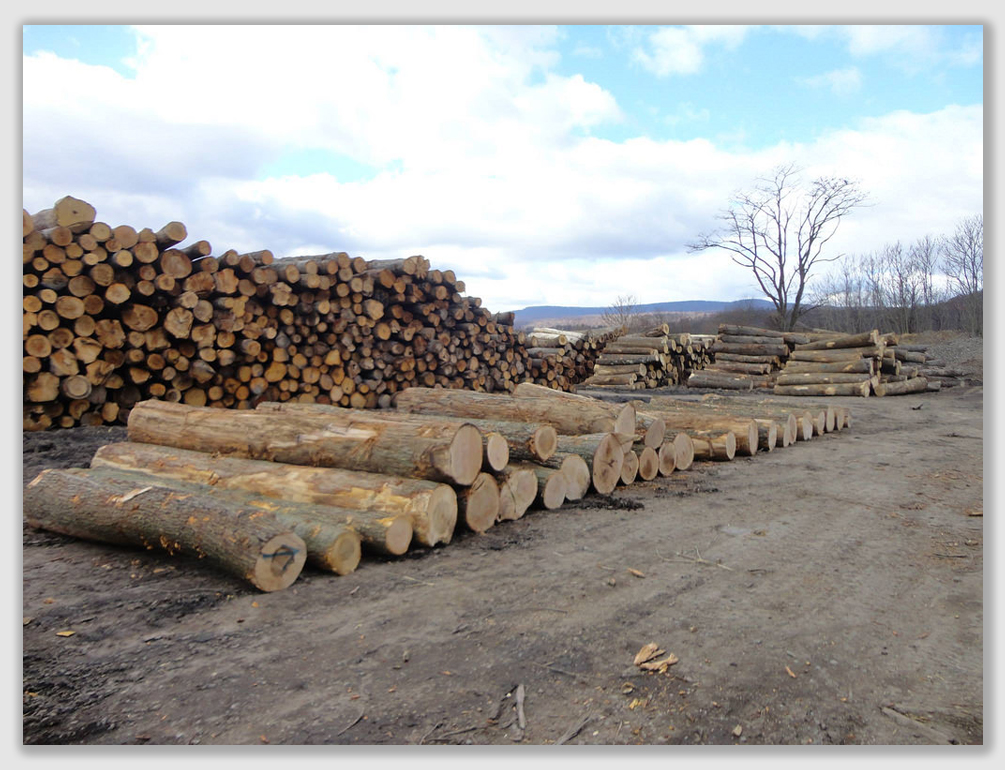
In 1998, George sold the timber on his tract to Canal Wood Corporation. Canal Wood began cutting in the fall of 1998 and, in the process, cut 329 trees from the southern 10 acres of the Linebargers’ land. Jerry complained that he had tried to tell George for years that a 1987 survey George used to establish his boundary was wrong, and that there was a more recent survey available.

As late as December 1997, when George told Jerry he was thinking of selling his timber, Jerry reminded George of the boundary problem and asked George to call him before proceeding. Heedless of this good advice, George made his deal with Canal, and, when Canal noticed some evidence of a boundary different than the one George had indicated, George provided Canal with the 1987 survey. In reliance on the wrong survey, Canal marked the acreage in such a manner that some of the Linebargers’ trees were cut.

Jerry and Marge finally got George’s attention by suing him and Canal for trespass and destruction of trees “that had been used for shade and beauty.” They asked for damages that would allow them to replace the lost trees, for attorney fees and costs, and for anything else to which they might be entitled. At trial, the Linebargers offered the testimony of three experts as to the amount of damages they had suffered. One expert, Bill Kelly, said the stumpage value of the cut trees was $1,081.60 and that it would cost $643.50 to prepare the site for re-planting. Another expert, real estate appraiser Wayne Coates, testified the market value of appellants’ property was $68,000 before the cutting and $62,000 afterward (which included $3,000 in clean-up costs). A third expert, Al Einert, placed a value on every tree that had been cut and determined the total value of the trees to be $44,702. Naturally, the Linebargers liked Al’s number the best.

The trial judge found that Canal had failed to obtain a survey prior to cutting the trees and had trespassed on the Linebarger’s land as the result of George’s intentional failure to disclose the correct survey. However, the judge found that the $44,702 damage figure testified to by Al was disproportionate in relation to the fair market value of the land. He awarded the Linebargers $5,000 for the reduction in value of their land, based on Wayne Coates’s testimony, plus $1,081.60 stumpage value and $643.50 in clean-up costs, based on Bill Kelly’s testimony.

The Linebargers appealed.

Held: The replacement value of the trees was grossly disproportionate to the diminution of the land value, and would be a windfall for the Linebargers.

The Linebargers complained that the trial court should have awarded them the $44,702 replacement value of the trees. Arkansas courts have recognized that when ornamental or shade trees are injured, the use made of the land should be considered, and the owner should be compensated for the cost of replacing the trees. However, fact situations may arise in which recovery of the replacement cost of trees would yield a result grossly disproportionate to the fair market value of the land and thus would be an inappropriate measure of damages. The evidence in each case determines what measure of damages is to be used.

Here, the trial judge acknowledged the Linebargers had used their trees for screening and shade, and he gave due consideration to the replacement measure of damages. However, he found that most of the trees cut were behind and over the crest of a hill from Jerry and Marge’s cabin, which tended to reduce the harm they suffered. After all, you can’t derive shade from trees you can’t see. He also found that the replacement cost of the trees would be disproportionate in relation to the fair market value of the land.

The Court of Appeals agreed. “We cannot say that the trial judge abused his discretion in making the damage award,” the Court wrote. “Although he recognized that an award of replacement value might be possible, he declined to use that measure of damages because 1) the cut trees were behind and over a crest from the cabin, and 2) the replacement value would be disproportionate to the land value. The location of the cut trees in relation to the cabin is a legitimate factor to consider. The trees provided only minimal shade, ornamental, or landscaping value to the appellants’ residence.”

It was obviously meaningful to the appellate court that if George paid the Linebargers the full replacement value of $44,702 for trees cut on 4.29 acres, Jerry and Marge would have received 67% of the value of the entire 30 acres as a whole (including the cabin). Such an award would exceed the stumpage value of the cut trees by over $43,000.

The Linebargers cited Ark. Code Ann. § 18-60-102 (a), which provides that if a person cuts down another’s tree, he may be liable for treble damages. Here, the Court replied, the trial judge found that the wrongful cutting in this case occurred through George’s intentional conduct. In cases of intentional wrongdoing involving the cutting of trees, the victim may recover treble damages. But despite his finding of intentional conduct, the judge declined to award treble damages in this case, based on the idea that a court of equity cannot award treble damages.

The judge was right, the appellate court said, but for the wrong reason. Jerry and Marge did not include a request for treble damages in their pleading, nor does the record reveal that they notified George and Canal at trial that they would be seeking exemplary (punitive) damages. A defendant is entitled to be given adequate notice of the remedy he or she will be confronting. An award of treble damages would have been inappropriate in the absence of the Linebargers pleading for them or the issue being tried with the express or implied consent of the parties.

– Tom Root

TNLBGray140407

Case of the Day – Tuesday, September 10, 2024

WASHINGTON STATE – GREAT COFFEE, GREAT VISTAS… AND GREAT CONFUSION

I have to confess that, although I am a proud Midwesterner, I love the State of Washington. Temperate rain forests, soaring mountains, beautiful lakes, great coffee, greater beer, and Seattle in the sunlight.

OK, not so much about the sunlight. But for that, Washington is two fantastic states, the first being a lush and moist paradise west of the crest of the Cascades, and the other being a sprawling, sunny and semi-arid plain east of the mountains.

Despite my love of the place, I was unstinting in my criticism yesterday about how the Mustoe court had sanctioned an “anything goes” culture in Washington, in which a landowner could misuse the Massachusetts Rule to kill a neighbor’s tree by the indiscriminate cutting of roots and branches, regardless of effect. As long as you stay on your own property, you can trim branches and roots with a backhoe bucket, if you so choose.

Today’s case is every bit as puzzling as is Mustoe, but in quite the opposite direction. One set of neighbors hacked branches off a boundary tree to the point that the other set legitimately feared that it was so unstable it would fall. The second set of neighbors then retaliated, taking the rest of the branches off the tree. That stabilized the tree trunk but had the unfortunate side effect of killing the tree.

Neighbor One, who lacked not for chutzpah, sued Neighbor Two for timber trespass. The courts found Neighbor Two liable for treble damages under the State’s timber trespass statute, regardless of the fact that Neighbor One’s reckless trimming created a hazard tree and the need for the drastic remedy that killed the tree.

The Court, in today’s case, candidly “acknowledge[s] that under Mustoe and our holding here, it would appear that a property owner has greater rights with respect to trimming a neighboring tree than a tree standing on a common property line with a neighboring property. This outcome is the result of applying a statute to a situation that was not likely contemplated upon the statute’s drafting. Our legislature may clarify the statute’s applicability to boundary trees in future legislation.”

Of course, part of the problem may be that the lawyer for the Pelayos (Neighbor Two) failed to remember that the best defense is often a good offense. He did not file a timber trespass claim against the Herrings (Neighbor One), which would have placed their misconduct into play. To be sure, in any fair world, the Herrings’ conduct in removing all the branches overhanging their property also violated RCW 64.12.030 and should have mitigated, if not outright excused, the Pelayos’ cutting in response.

Herring v. Pelayo, 397 P.3d 125 (Wash.App. Div. 2, 2017). The Herrings and Pelayos are neighbors. In December 2011, the Herrings hired a tree trimmer to remove some branches from a tree located on the common property line. The Herrings did not discuss their plan to remove branches from the tree with the Pelayos prior to the work. When they discovered the trimming, the Pelayos believed that the work had caused the tree to become unbalanced, constituting a danger to their home. Three weeks after the Herring trimming, the Pelayos had a tree trimmer remove all the remaining branches from the boundary tree, causing the boundary tree to die. Like the Herrings, the Pelayos did not discuss their plans with the neighbors before the work was done.

The Herrings sued, claiming a timber trespass in violation of RCW 64.12.030 or, in the alternative, regular garden-variety trespass in violation of RCW 4.24.630. At trial, Jose testified that he knew the tree at issue was on the common property line, he told the tree trimmer to remove all of the remaining branches from the tree, he did not discuss his plan with the Herrings, (4) the tree was alive prior to the removal of the remaining branches, and (5) he believed that removing the remaining branches would kill the tree, which it did.

The Pelayos’ tree trimmer, Tim Jones, testified that he believed the tree was a danger to the Pelayos, and he had recommended that they remove the entire tree or, at least cut off all the remaining branches. But Tim also told the Pelayos that they could remove a top portion of the tree to balance it, and Tim admitted that he might have been able to remove some of the remaining branches to render the tree safer without killing it.

The trial court held that the Pelayos committed timber trespass under RCW 64.12.030, and their defense of mitigating circumstances, allowed by RCW 64.12.040, did not apply.

Held: The Pelayos had to pay.

Jose and Blanca Pelayo argued that the trial court failed to find that their conduct in removing the branches from the boundary tree was both (1) willful and (2) without lawful authority. Without those findings, they contended, they could not have violated RCW 64.12.030.

RCW 64.12.030 provides that “whenever any person shall cut down, girdle, or otherwise injure, or carry off any tree… on the land of another person… without lawful authority, in an action by the person… against the person committing the trespasses… any judgment for the plaintiff shall be for treble the amount of damages claimed or assessed.” Washington law is clear that there must be an element of willfulness on the part of the trespasser to support treble damages under RCW 64.12.030. In this context, the Court said, “willful” simply means that the trespass was “not casual or involuntary.” The burden of proving that a trespass was casual or involuntary is upon the defendant once the fact of trespass and the damages caused thereby have been shown by the plaintiff.

Here, the Court said, the Pelayos never argued and no evidence ever suggested that the trespass was casual or involuntary. Under those circumstances, it was not necessary for the Herrings to prove willfulness.

Jose admitted at trial that he knew the Herrings had an ownership interest in the boundary tree and that he had ordered the remaining branches to be removed from the tree knowing that such removal of branches would kill the tree. The Court said his testimony “was tantamount to a concession” that the conduct in removing the branches was willful. No other evidence would have let the trial court infer that this conduct was casual or involuntary. Therefore, no specific finding as to willfulness was required.

Next, the Pelayos argued that they were lawfully authorized to remove branches from the boundary tree that were overhanging their property. The Court made short work of that argument as well.

RCW 64.12.030 applies only to people acting without lawful authority. A landowner has the legal authority to engage in self-help and trim the branches and roots of encroaching onto his or her property. On the other hand, a landowner does not have the legal authority to cut down an encroaching tree. But here, the issue was whether a landowner may trim the branches of a tree standing on a common property line in a manner that a defendant knows will kill the tree.

The Court began by holding that trees standing directly on the property line of adjoining landowners are the common property of both landowners. The Pelayos contended that landowners had an unfettered right to trim branches that overhang their property regardless of whether the tree is situated entirely on a neighboring property or, instead, is situated on a shared property line.

Despite Washington State’s rather cavalier treatment of a tree owner’s rights vis-à-vis the neighbor in the Mustoe decision, the Court concluded that where the tree stood on a common property line, both the Pelayos and the Herrings had undivided property interests in the tree. This was consistent with the only other relevant decision on the matter, a Washington appellate decision in Happy Bunch LLC. Because the Pelayos have a property interest in the tree at issue, the Court reasoned, portions of the tree overhanging their property could not be said to be “encroaching” in the same way that the branches and roots were encroaching in Mustoe.

The Pelayos and Herrings owned the tree as tenants in common, and thus each couple was entitled to use, maintain, and possess the boundary tree, but not in a manner that “interfered with the coequal rights of the other cotenants.” Unlike a landowner engaging in self-help to trim branches overhanging his or her property from a tree situated entirely on the property of another, the Court ruled, a cotenant owning a boundary tree had a duty not to destroy the common property and thereby interfere with the rights of the other cotenants.

After all, the Court argued, if landowners had an unfettered right to cut away the portions of a common boundary tree that stand on their property, without any regard for whether such cutting would injure or destroy the tree, the timber trespass statute could become inapplicable to neighbors sharing a property interest in a boundary tree. Under the Pelayos’ argument, the Court complained, a neighbor sharing a property interest in a boundary tree could effectively destroy the tree and escape liability under the timber trespass statute if the neighbor destroys the tree in a manner that does not physically trespass on the portion of the tree situated on the neighboring property. “This result cannot withstand the plain language of RCW 64.12.030,” the Court said, “which imposes liability on ‘any person… [who] cut[s] down … or otherwise injure[s] … any tree… on the land of another person’.”

The Court observed that it also had to “give effect to language in the statute shielding from liability conduct that is taken with ‘lawful authority’… In recognition of the long-recognized lawful authority to trim overhanging vegetation, the lawful authority to use and maintain property held in common with a cotenant, and the plain language of the timber trespass statute, we hold that where a tree stands on a common property line, the common owners of the tree may lawfully trim vegetation overhanging their property but not in a manner that the common owner knows will kill the tree.”

Because the Pelayos admitted they directed the removal of the remaining branches of the boundary tree, knowing that the removal would kill the tree, they were liable under RCW 64.12.030.

The Pelayos tried to avoid being hit with treble damages under RCW 64.12.040 by arguing that mitigating circumstances applied to their conduct. They said that because they cut the tree branches while standing on their property, they had probable cause to believe that they owned the land where such conduct took place.

The Court rejected that argument, too, holding that RCW 64.12.030 violations involve direct trespass to a tree, not trespass to the land on which the tree grows. The timber trespass statute applies when a defendant commits a direct trespass that causes immediate, not collateral, injury to a plaintiff’s timber, trees, or shrubs, even if the defendant is not physically present on a plaintiff’s property.

– Tom Root

TNLBGray140407

Case of the Day – Thursday, July 25, 2024

IT TAKES A THIEF

It was perhaps the last of the 60s-era TV spy genre series: It Takes a Thief featured the adventures of cat burglar, pickpocket, and thief Alexander Mundy, suavely played by Robert Wagner, who stole to finance his life as a polished playboy and sophisticate. He ends up in prison, which is where the story begins. A U.S. spy agency proposes a deal to Mundy: steal for the government in exchange for his freedom.

Real life thieves are not so accomplished, and seldom so handsome and cosmopolitan. Which brings us to Logan County, Ohio, and Lowman Lumber Company.

We’re not calling company owner Sturgil Lowman a thief. The courts of Logan County have already done that for us. Sturgil was in the timber harvesting business. Over 40 years, he seems to have developed what the criminal justice people call a modus operandi: Cut a few corners, cross a few boundary lines, and wherever possible, take some timber from the neighbor’s land as well as the tract you’ve bought the right to harvest.

Sometimes you get caught. Then, you affect your most self-deprecating head shake and chuckle, admit you made a dumb mistake, and compensate the victim for the trees you unlawfully took. When you balance the books at the end of the year, the timber you got away with is enough to make the timber you got caught taking worthwhile. Cost-benefit, baby.

The problem is that word spreads – especially at the courthouse, where every lawsuit record is preserved. After awhile, the “oops, I goofed” schtick gets old. That’s what happened to Sturgil.

He finally crossed someone who filed a criminal complaint, and he was convicted of receiving stolen property (the trees). He paid restitution and did a little probation for the misdemeanor. But at the same time, another timber trespass case was playing out across the hall in a different courtroom.

Sturgil was logging Dale’s place under contract. While doing so, he busted the boundaries with the Shanklin’s wooded tract, and proceeded to butcher 15 of the prettiest acres in Logan County (which is a rather pretty place to begin with). This time, the owners pursued him with a vengeance, and Sturgil’s history of being private property-challenged – as well as the grossness of his violation of the Shanklin land – was enough for the jury to inflict real pain on him. Sturgil was ordered to not just pay for the damage to the Shanklins, but to pay treble damages for recklessness and punitive damages on top of that for malice.

Sturgil especially contested the trial court’s award of punitive damages on top of treble damages, and frankly, it is rare for a Court to approve both. But this case, if any, proves the old maxim that “hard cases make bad law.” The jury and the courts knew a bad actor when they saw one, and they used the tools at hand to dissuade him from continuing his malefaction. The final ticket was $45,000 in compensatory damages, increased by another $90,000 under ORC § 901.51, and an additional $33,500 in punitive damages, and $35,600 in the Shanklins’ attorney fees. A bill of $204,100 for $30,600 in stolen timber.

How’s that cost-benefit analysis looking now, Sturgil?

Shanklin v. Lowman, 2011-Ohio-255 (Ct.App. Logan Co., Jan. 24, 2011). Sturgil Lowman, a lumber company owner, harvested some timber for landowner Dale Kauffman. Dale identified the fence line that marked the boundary between his land and that of the Shanklin family, next door.

The Shanklins were retirees living in Florida, who used the wooded tract they owned solely for recreational purposes. The man who looked after the land for them, Tom Stacey, said that it was an “old growth area” with a beautiful high canopy, completely shading when leaves were present, and with tall, straight trees. He described it as having “the most lush undergrowth” he had seen anywhere in Ohio, and that the east edge of the back parcel had a dramatic, deep, narrow ravine that was about forty or fifty feet deep, with rich wildlife.
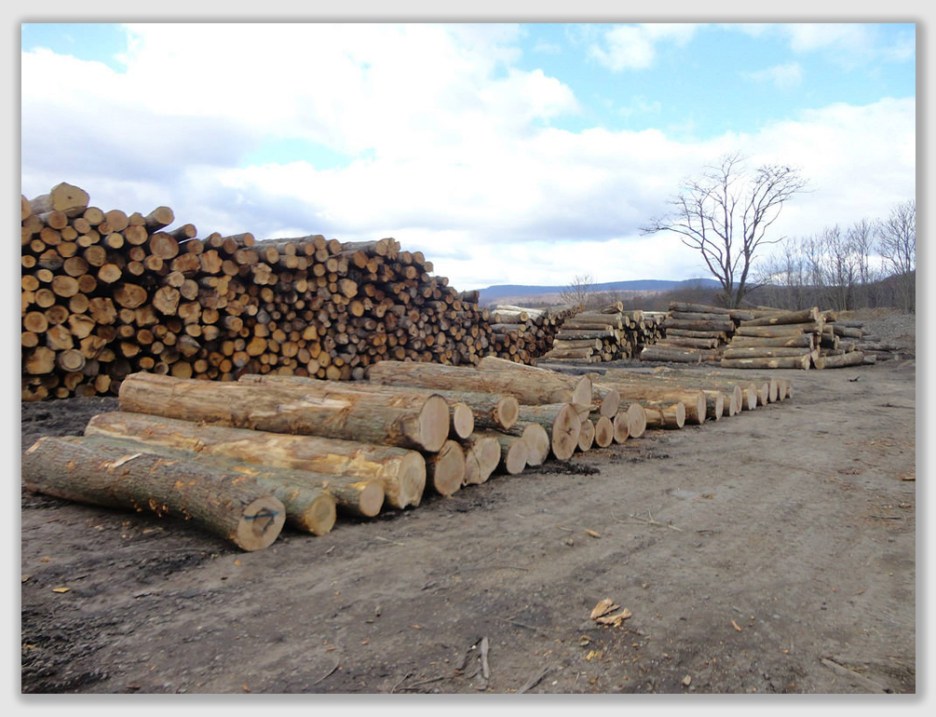
In the spring of 2006, Tom was cleaning up the Shanklin property due to an ice storm. As he walked the back of the property near the ravine, he discovered a road and bulldozer tracks. About twelve to fifteen acres of the property had been clear-cut, except for some stumps, and a logging road had been cut nearly a quarter mile into the property from the Kauffman property line. There two points of entry into the property, with the main logging road going through the fence line, with the fence cut off and rolled up. In addition to the removed trees, Tom found damage to trees that were not taken, including scars and “chunks” resulting from equipment being moved through the area.

It did not take long to connect it to Sturgil. Sheepishly, he admitted that Dale had shown him the property line, that he never hired a surveyor to confirm the property lines, that he never consulted any maps or real estate records to determine the property lines, but instead had an employee “mark the lines with ribbons,” and that neither he nor his employees kept any documentation about how many trees or what types of trees were cut.

This was not Sturgil’s first rodeo. He had been sued perhaps five times in his 40 years of operation for trespass to timber, and he was convicted of the felony of receiving stolen timber, for which he paid restitution and was sentenced to probation. Even more troubling, Tom reported that a Lowman employee had approached him a year earlier to learn who owned the Shanklin land. Tom walked the man through the property, whereupon the man offered him $10,000 if he could convince the Shanklins to let Lowman cut the timber. Tom refused and told the man that if the Shanklins were interested, they would contact Sturgil’s company directly.

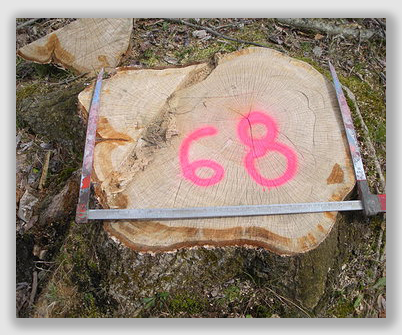
James Bartlett, a consulting forester, performed a stump count for the Shanklins, identifying species and estimating the value of the wrongfully cut trees at the time they were cut. He found 282 stumps, and – using a United States Forest Service formula – found the aggregate value of the timber to be at least $30,671. He said he could not put a value on the “loss of beauty” to the property or the loss of enjoyment of the property.

A professional registered surveyor testified that he had examined the property line, and it “seemed very straightforward to him where the property line was.” He said that if Sturgil had hired a surveyor prior to the cutting, the line between the properties would have been easily determined.
A licensed realtor who had lived in Logan County his entire life testified that the property was unique because it was directly across from the highest point of Ohio, and was the most scenic ground in Logan County. He estimated that the value of the area that had been harvested, prior to the cut, would have been about $6,000 an acre, or $90,000 for the 15 acres affected. He estimated the value after cutting was about $3,300 an acre.

The jury returned a verdict awarding the Shanklins compensatory damages of $45,000, resulting in trebled damages of $135,000, and punitive damages of $33,750.

Sturgil appealed.

Held: The $168,750 damages award was upheld.

The Court found that the compensatory damages were amply justified by the testimony that the 15 acres fell in value from $90,000 to about $49,000. Additionally, the evidence showed that the timber was worth at least $30,671, but possibly more, because the Shanklins could have put the timber out for competitive bidding. Thus, the Court ruled, the record contained “competent, credible evidence supporting the jury award of compensatory damages.”

Sturgil complained that the evidence did not show that the timber trespass had been reckless, which is necessary under ORC § 901.51 in order for treble damages to be assessed. The Court of Appeals made mincemeat of this argument:

Evidence showed that a man identifying himself as representing Lowman Lumber approached Tom Stacey and inquired about harvesting the timber on the Shanklin property. The man offered Tom $10,000 if he could convince the Shanklins to let his company harvest the timber, but Tom declined the offer and gave no indication that the Shanklins were willing to sell timber to Lowman. Tom eventually discovered that twelve to fifteen acres of the Shanklin property had been cut, that a logging road had been cut nearly a quarter of a mile into the Shanklin property from Dale Kauffman’s property line, and that there were two points of entry into the Shanklin property with about twenty branches off the main logging road. A fence marked the property line between the Shanklin property and Dale’s property, but the main logging road went through the fence line, with the fence itself cut off and rolled up.

A professional surveyor identified the property line between the Kauffman and Shanklin properties and observed that cutting had taken place across the line onto the Shanklin property. The cutting extended five or six hundred feet across the property line.  Lowman did not hire a surveyor before cutting on the property, but Dale had showed him the corners of the property. Sturgil Lowman admitted he had previously been convicted of receiving stolen property and criminal damaging involving tree trespass in August 2007, and that there had been several judgments in civil cases against him for cutting onto neighboring property without authorization.

The foregoing litany, the Court ruled, was “credible evidence that Lowman perversely disregarded a known risk with heedless indifference to the consequences.”

Sturgil argued that the trial court should not have awarded both punitive damages and treble damages.

The Court disagreed. “An award of punitive damages in a tort case may be made only upon a finding of actual malice on the part of the defendant,” the Court said. “‘Actual malice’ for these purposes is ‘(1) that state of mind under which a person’s conduct is characterized by causing substantial harm’… When ordering punitive damages, the trier of fact is to make a “reasoned  determination… of an amount that fairly punishes the tortfeasor for his malicious or malevolent acts and that will deter others from similar conduct.”
The Court held that an award of punitive damages “will not be overturned unless it bears no rational relationship or is grossly disproportionate to the award of compensatory damages.”

The Court easily found that the long list of horribles that supported a finding of recklessness also rose “to the level required to demonstrate ‘a conscious disregard for the rights… of other persons that has a great probability of causing substantial harm’.” There can be little doubt that the jury, and later the Court of Appeals, saw Sturgil as a serial trespasser who had long ago concluded that the cost-benefit analysis of stealing timber was such that it was worth getting caught now and then, passing it off as a “mistake,” given all the times he could get away with it.

– Tom Root
TNLBGray140407

Case of the Day -Wednesday, July 24, 2024

ACT IN HASTE, REPENT IN LEISURE

Many years later, we can still see Mom shaking her head at us kids over some blunder or another, asking us, “What were you thinking?”

The answer, of course, is that we were kids, so of course, we weren’t thinking at all.

But you wonder how a guy who has been in the timber business for 30 years, has been shown the property boundaries and has a clear visual cue – a line of trees – to remind him, can nonetheless overshoot by three acres, and commit an expensive timber trespass on someone else’s land. So what was he thinking?

The issue was whether Cameron Klinck (no known relation to Colonel Wilhelm Klinck) was merely negligent or instead forged on heedless of the consequences (which is the very essence of recklessness). The difference is crucial because mere negligence would cost Klinck about what he sold the Shanghai’ed trees for, and thus leave his wallet smarting only a bit. Recklessness, on the other hand, will trigger ORC § 901.51, and entitle aggrieved tree owner Ishan Judeh to three times the compensatory damages – in this case, the stumpage value of the trees – what we call “treble damages.”

Judeh v. Mahoning Valley Timber & Land Co., Case No. 03-MA-138, 2004-Ohio-4819 (Ct. App. Mahoning Co., Aug. 31, 2004), 2004 Ohio App. LEXIS 4353, 2004 WL 2029136 (2004). Ishan Judeh owned land next to acreage owned by Gene Pyle, portions of which were wooded. Cameron Klinck, a logger who owned Mahoning Valley Timber & Land Co., contracted to remove timber from Pyles’ land. Pyles described the location of the boundary dividing his and Judeh’s property.

Klinck removed trees from Pyles’s land as arranged, but also removed trees from about three acres of Judeh’s land. Judeh sued Mahoning Valley Timber for trespass, conversion, and wrongful taking of timber from his land. The trial court awarded Judeh $6,000, representing the stumpage value of the wrongfully cut trees, and trebled the damage to $18,000 under ORC § 901.51, finding that Klinck had been reckless in harvesting the trees from Judeh’s property.

Klinck appealed.

Held: The record showed Klinck had been reckless.

The Court of Appeals reviewed the decision with a deferential standard. It “indulge[d] every reasonable presumption in favor of the lower court’s judgment and finding of facts” and “[i]n the event the evidence is susceptible to more than one interpretation, [the court] construe[d] it consistently with the lower court’s judgment.”

In this case, evidence showed that Klinck knew where the property boundaries lay. The line was clearly visible by virtue of a tree line that extended 416 feet from south to north between the two parcels. Klinck admitted he knew where the boundary line was located, had maps and had walked the boundary line. Although he did not have the land surveyed, Klinck admitted that it was good business to survey the area of the property to be logged and that he used a surveyor 98% of the time. He had been in the timber business for over thirty years and was aware of the risks of failing to survey the property. In addition, the Court said, the magnitude of the trespass – being two to three acres – suggested recklessness.

– Tom Root

TNLBGray140407

Case of the Day – Monday, July 8, 2024

IT DOESN’T TAKE THAT MUCH TO BE RECKLESS

Today, my bride of 45 years and I are climbing up an ash-covered glacier (in Iceland, where else?), doing things with an ice axe and crampons that seem kind of reckless for grandparents of 4.66 grandchildren to be doing. It’s a great segue into today’s topic.

We all have some sense of what kind of conduct is reckless. At least, to channel the late Justice Potter Stewart, we’re pretty good at knowing it when we see it. Riding a motorcycle into a wall at 100 mph while drunk? Yeah, probably reckless. Standing on a ledge at the top of a skyscraper for a selfie? You bet. Lying between railroad tracks while a train passes? We’ll give you that one, too.

But when the law uses the term “reckless,” in fact when the law adopts any standard, the term has to have a specific definition. If not, laws punishing conduct that did not meet the standard would be arbitrary (as well as falling short of their goal of causing people not to be reckless in the conduct of their affairs).

I’m sorry, Justice Stewart. ” Knowing it when [you] see it” is trenchant, but it’s not a good way to regulate conduct.

In today’s case, a Buckeye State classic, a car repair business trespassed on a neighboring business’s land to hack away at some spruce trees. The car repair manager thought the trees belonged to his company, but his belief – which flew in the face of the facts – was so heedless of the consequences that the court found him reckless.

We have seen worse cases that were considered to be  mere negligence, and we cannot discount that the trial court in this case was influenced by the extent of the damage to the “visual barrier” between the professional building (populated with the offices of lawyers, doctors and engineers) and the seamy oil-change-and-lube joint next door.

“Recklessness” let the trial court grant treble damages under Ohio law to the office building owner. Unsurprisingly, recklessness is what the trial court found. Maybe cynicism is creeping into our analyses as we age (we prefer the expression “as we get wiser”), but if the real estate owner had made the same unsupported surmise about the grease monkey’s trees, we suspect his misfeasance would be found to fall somewhere short of “reckless.”  Just sayin’.

ALH Properties, P.L.L. v. Procare Automotive Service Solutions, LLC, Case No. 20991, 2002-Ohio-4246 (Ct.App. Summit Co., Aug. 21, 2002) 2002 Ohio App. LEXIS 4412. ProCare and ALH were adjoining landowners. ALH had an office building on its property, and ProCare operated an auto repair facility. Between the two properties stood a row of large Norway spruce trees, providing a visual buffer between the two businesses. The trees are on ALH’s property, although some of the branches extend over ProCare’s property. ProCare cut branches off of the lower ten feet of the spruce trees, destroying the visual buffer. The branches will not grow back.

ALH sued, alleging reckless injuring of the trees under Ohio Revised Code 901.51. The trial court entered judgment against ProCare for $34,200.

ProCare appealed.

Held: ProCare was liable to ALH.

Do you see any recklessness here?

Section 901.51 of the Ohio Revised Code provides that “[n]o person, without privilege to do so, shall recklessly cut down, destroy, girdle, or otherwise injure a vine, bush, shrub, sapling, tree, or crop standing or growing on the land of another… “In addition to a criminal, the statutes subject a violator to treble damages for the injury caused.”

The Court held that as used in the statute, the term “recklessly” has the same meaning in a civil claim for treble damages as it does in a criminal proceeding for violation of the statute. A person acts recklessly when, with heedless indifference to the consequences, he perversely disregards a known risk that his conduct is likely to cause a certain result or is likely to be of a certain nature. A person is reckless with respect to circumstances when, with heedless indifference to the consequences, he perversely disregards a known risk that such circumstances are likely to exist.

The Court acknowledged that a privilege exists at common law for a landowner to cut off branches of an adjoining landowner’s tree that encroached on his land. But here, ProCare trimmed not just branches of the trees that faced its property, but also branches facing ALH’s property as well. ALH’s president testified he had not given anyone permission to trim the trees, and that he had previously trimmed branches that hung over his parking area and had removed one of the trees entirely because it died.

ALH offered a videotape its president had made on the day ProCare trimmed the trees, which included his running commentary on the damage done to the Norways.  All the while, the property line marker – a large post – was clearly visible. Pictures taken both before and after ProCare trimmed the branches were admitted into evidence. ProCare stores old tires, oil cans, and a dumpster in the area near the trees, and the photos showed how the trees had created a visual buffer from ProCare’s property and alleviated some traffic noise.

Martin Long, a ProCare manager, testified he thought the spruce trees were on ProCare’s property and that he assumed the trees were ProCare’s because “nobody ever took care of them.” He said he trimmed other branches hanging over ProCare’s property on two previous occasions with no negative consequences. He admitted that on one occasion, one of the Norways — which was dying — had been removed by someone other than a ProCare worker. However, he pointed out, in the spring ProCare would mulch the trees, and no one ever told him that the trees were not on ProCare’s property.

Long believed that only limbs that faced a direction other than toward ALH’s property were cut off. He said that when Myers approached him about ProCare trimming the trees, it was the first indication he had that the trees were not on ProCare’s property. Long admitted that when the spruce that was dying was removed, he did not know who removed it, but he did know that he, personally, had not directed anyone to remove it, nor did he have to pay for its removal. He stated that he thought ALH had removed it because of the risk it posed to ALH’s buildings.

The trial court found that the removal of the tree branches was reckless because Long had reason to know facts that would lead a reasonable person to question whether the trees belonged to ProCare. The trial court held that the complete removal of a large spruce tree in this row of trees at no expense or trouble to ProCare was an indication that ProCare did not own the trees nor was it responsible for maintaining them. The trial court also noted that Long’s testimony that the only branches cut were those that overhung ProCare’s property was disputed by the videotape and photographs, which clearly showed other branches were cut that did not overhang ProCare’s property.

The Court of Appeals found that the trial court’s conclusion that ProCare was reckless was not against the weight of the evidence. The Court held adequate evidence showed ProCare disregarded a known risk with heedless indifference to the consequences when it trimmed branches of trees that were clearly on ALH’s property.

ProCare also argued the trial court’s calculation of damages is against the manifest weight of the evidence.

ALH’s president testified that soon after ProCare trimmed the trees, he contacted two landscaping companies to install arborvitae to replace the barrier. A landscaper submitted a quote for $3,850 to plant 35 arborvitae, although he said planting arborvitae was inadvisable. He also said it was impractical to replace the spruce trees with ones of a similar size, given their 60-foot height. The landscaper provided a separate quote of $18,923 to remove the spruce trees, grind the remaining stumps, and plant a row of Colorado spruce.

A different landscape contractor testified for ProCare and said $3,750 to plant a row of arborvitae was appropriate, and that the shrubs would provide an adequate screening between the properties. He quoted $12,200 to remove the Norway spruce, grind the stumps, and plant Colorado spruce. He thought, however, that Colorado spruce would not provide an adequate barrier because they cannot be pruned properly. He recommended planting White Pine instead because White Pine can be pruned and trimmed more easily than spruce. His estimate to plant a row of White Pine was $11,400.

The trial court found that the best solution to replace the visual screening between the two properties was to replant trees, but that planting Colorado spruce was a disproportionate expense. It ruled that White Pine was a reasonable tree type for restoration, and awarded damages of $11,400. The amount was trebled pursuant to O.R.C. 901.51, for a total award of $ 34,200.

The court of appeals held that the trial court’s decision was reasonable.

– Tom Root

TNLBGray140407

Case of the Day – Monday, July 1, 2024

I CHANGED MY MIND… I GUESS

Doug Van Dyne had big plans for getting folks back to nature. He wanted to build a nature trail along a ravine that split his property and that of his waffling neighbor, Eunice North. People could enjoy the birds, the babbling brook, the scent of pine… that kind of thing.

If you ever wonder whether it’s a good idea to get agreements in writing, Doug’s $70,000 mistake will settle that question for you. Because Doug’s nature path would meander a bit onto Eunice’s side of the ravine, he told her about his plans for the trail. Eunice, who admitted that she really had no idea what Doug was talking about, said she just “shrugged my shoulders” and replied that “I guess it would be okay.”

To Doug, that was like the green flag at Indy.  But little did he know that Eunice promptly began to fret about her confused acquiescence. She had trouble sleeping for her worry, and finally asked a friend about the plan. Her friend told Eunice the trail idea was a mistake. Armed with this advice, Eunice said, she reneged. She claimed she told Doug that she didn’t want him around.

“No probalo,” Doug – who had no intention at all of honoring Eunice’s change-of-heart – allegedly responded. Regardless of his actual intentions, Doug promised Eunice that he “would go to a different plan.”

That different plan seems to have involved having his contractor run the bulldozers at full throttle instead of half throttle. By the time the diesel fumes cleared, 20 of Eunice’s trees had been ground under Caterpillar treads and the trail encroached on her land.

Eunice sued Doug for trespass, loss of lateral support, and loss of trees. The jury awarded Eunice $50,000 on the trespass and lateral support claims and $20,100 in treble damages on the loss-of-tree claim. It mattered little that Doug and the contractor both told a different story, the bulldozer operator testifying that Eunice had agreed to Doug’s plan. The jury believed Eunice.

Juries do that, often buying one side of the story and not the other, many times against common sense. We don’t know that that happened here, but it sure did not help Doug that he had not bothered to have the property boundaries surveyed before the ‘dozers started dozing.

Much of Doug’s appeal focused on damages. The jury agreed that Doug’s dozing had made Eunice’s side of the ravine unstable. Eunice’s expert testified that there were three ways to repair the damage, but none of the tree would restore the ravine to its pristine state. Doug argued that said because the land could not be repaired to the way it was before the bulldozers rolled through, then the diminution of the fair market value of the ravine was all that matters.

Not so, the court said. The law does not require that the evidence show that the damage can be repaired so as to make the property as good as new. While it is a general rule of Iowa law that the cost to repair property is the fair and reasonable cost of repair not to exceed the value of the property immediately prior to the loss or damage, all Eunice was required to do was to establish a fair and reasonable cost to fix things up in order to arrest further deterioration and make the place as good as it can be made. In this case, Eunice showed that she had three means of stabilizing the steep bank after Doug’s earth-moving frolic, and only one of those made any sense. She established the cost of that repair, and the value of the property before the damage.

Because the damages did not exceed her expert’s $129,000 repair price tag, it was clear the jury fulfilled its function in weighing the evidence.

Next time, Doug, get the landowner’s OK in writing. Call a surveyor. Stake the property boundaries. Surely that’s cheaper than $71,000.

North v. Van Dyne, Case No. 16-0165 (Ct.App. Iowa, Sept. 13, 2017). Douglas Van Dyke hired Heck’s Dozer, Inc., to build a trail along a ravine between his property and adjacent land owned by Eunice North. Twenty of North’s trees were removed during the trail’s construction, and a portion of the completed trail encroached upon North’s property. Doug said Eunice gave him permission. Eunice said she initially sort of equivocated, but later told Doug in no uncertain terms that he was to stay off her land.

Doug said he would do so, but he never had the land surveyed or staked, and his guess as to the location of the property line was by guess and by gosh. Doug’s contractor said he met with Eunice, and she approved the plans. Eunice said she had never met the contractor.

Eunice testified that after she told Doug to steer clear of her property, she heard a “‘loud commotion.’ Standing on her deck, she saw ‘two pieces of heavy equipment’ below and ‘trees… flying.’ She decided not to go into the ravine to check on the commotion because she was ‘afraid’ she would get ‘hit with something,’ and she had physical difficulties getting ‘down there.’ Suspicious of an encroachment on her land, she commissioned a survey. The surveyor confirmed her fears.”

Eunice sued Doug for trespass, loss of lateral support, and loss of trees. The jury awarded her damages of $50,000 on the trespass and lateral support claims and $20,100 in treble damages on the loss-of-tree claim, Doug appealed.

Held: Eunice amply proved that Doug should pay treble damages under Iowa Code § 658.4 (2013). The statute requires the damage to trees be committed willfully or without reasonable excuse.” The term “willfully” has been characterized as an intentional and deliberate act without regard to the rights of others. Here, the Court of Appeals said, a reasonable juror could have believed that Eunice said “no” the jurors could have found Van Dyke “acted… without reasonable excuse.”

The jury additionally could have found that Doug’s failure to commission a survey before building the trail denied him any reasonable excuse for the trespass. The testimony established that Doug relied on an “old fence,” “old posts,” a “shed,” and a “roofline” to gauge the boundary.

The measure of damages is the cost of repair, as long as that cost does not exceed the value of the property prior to the damage. Doug complained that because Eunice’s expert testified only that the continued deterioration of the property could be stopped by stabilizing the steep bank, she was not able to show that the property could be repaired to its original state.

The Court of Appeals held that nothing requires that the repair estimate be enough to restore the land to its state before the damage. As long as Eunice provided evidence of the fair market value of the land before and after the damage, and a repair cost that is less than the value of the place before the damage – which she did – she met her obligation. Here, the damages awarded by the jury were higher than Doug’s estimate of $2,500.00 to fix it, but well below Eunice’s estimate of $127,000. Plus, the jury’s $50,000 award for trespass and lateral support was well below Eunice’s evidence that the land was worth $250,000.

The damage to the trees was assessed separately, with the value of the lost timber found to be $6,700, trebled to $20,100.

– Tom Root

TNLBGray140407

Case of the Day – Friday, April 19, 2024

I NEED THE MONEY, MAN

The old fence marked something ... just not the boundary.

The old fence marked something … just not the boundary.

Poor (and we mean that quite literally) Mr. Hartshorne. He and next-door neighbor Coldsnow had had some disagreements about the property boundary about 25 years ago or so, and it’s fair to conclude that the Hartshornes probably don’t ask the Coldsnows over for tea and crumpets all that often.

In the late 90s, Mrs. Hartshorne went to her reward. Her death left Mr. Hartshorne saddled with debts, and he sold some of his timber to pay for it. He probably should have had his property surveyed (which would have cut into the timber profits, meager though those might be). Instead, Widower Hartshorne just told the logger that he could log to the old fence, which the Hartshornes had always thought was the property boundary.

It wasn’t. You know how these things go.

Sadly, had the timber sale been enough to cover Mr. Hartshorne’s debts, no one would ever have discovered that some of the trees he sold had actually belonged to his neighbor. But the proceeds were a little light. Thus, Mr. Hartshorne divided his property in order to sell some of it off.

When you divide property, you have to line up a surveyor to measure things out. The survey showed Mr. Hartshorne that the old fencerow was not the boundary after all.

His neighbor, Coldsnow (perhaps aptly named for all the sympathy he showed a poor widower), found out the same and realized that this meant that some of the trees Hartshorne’s logger had cut were on his land. Coldsnow sued for trespass, asking the court to treble the damages under the Ohio treble-damage-for-timber-trespass statute. The jury agreed with Coldsnow that the cost to restore or replace the timber was $11,500.00 and that Hartshorne was reckless. The damage award trebled to $34,500.

Hartshorne complained that the proper measure of damages should have been the decrease in value of Coldsnow’s land, and anyway, he wasn’t reckless. He had just made a mistake, and regular negligence did not support treble damages under the statute.

The Court of Appeals didn’t buy it. Coldsnow’s successful conflation of a few isolated border skirmishes over an eight-year period into a boundary war convinced the Court that Hartshorne — knowing of Coldsnow’s prior aggressiveness in enforcing the boundary — should have gotten a survey. Frankly, we suspect that Mr. Hartshorne must not have cleaned up very well for court, because there’s very little in the written decision that supports a conclusion that he acted recklessly, and thus, no other reason the Court should have oppressed him so.

work_for_freeWe don’t think much of this decision. The Court is saying, in essence, that the more unreasonable your neighbor is, the more careful you’re required to be. It certainly makes it hard to define a community-wide standard of care. Because I live next to a sweet old lady who would let me sell her front door if I wanted to, I should be held to a lower standard of reasonableness? That simply does not make sense.

Knowing that your neighbor is a curmudgeon is hardly a basis for saying that your failure to take his cantankerousness into account is reckless conduct.

Coldsnow v. Hartshorne, 2003-Ohio-1233, 2003 WL 1194099, 2003 Ohio App. LEXIS 1163 (Ct. App. Columbiana Co., Ohio, March 10, 2003). Coldsnow sued Hartshorne for cutting down some of the trees on Coldsnow’s property. Hartshorne began to cut down some trees, one of which was near the fence line between his and Coldsnow’s property, in 1991. At the time, Coldsnow complained to Hartshorne about cutting down that tree and Hartshorne stopped cutting down trees near the fence line. In 1995, Hartshorne had problems with people trespassing on his land to hunt. In response, Hartshorne bought some “no trespassing” signs and placed them all around his property. He also spray-painted orange circles on trees near the signs to bring them to people’s attention. Some of the trees he spray-painted were on Coldsnow’s property. Coldsnow complained about the signs and the spray paint to the Hartshornes. In 1997, Hartshorne’s wife died, and to pay the bills from her illness, Hartshorne decided to log and sell some of the trees on his property. He hired a forester, to do the logging and agreed to evenly split the profits with the forester.

Lawyers always advise their clients to dress well for court. Maybe Mr. Hartshorne ignored his attorney's advice. What else would account for this whacked decision?

Lawyers always warn their clients to dress well for court. Maybe Mr. Hartshorne ignored his attorney’s advice. What else would account for this whacked decision?

Hartshorne asked the forester to selectively harvest the forest, in order to thin out the canopy to allow smaller trees to grow more quickly. He also showed the forester the property lines and asked him to only log trees more than 15-20 feet away from those lines. He did not have his property surveyed before hiring the forester, instead just showing him an old fence line which Hartshorne believed was the property line. Coldsnow became aware of the tree harvesting when Hartshorne’s property was being surveyed so a portion of it could be sold as another means of paying off his wife’s debt. Coldsnow hired a surveyor, who found that some of the stumps from trees that had been harvested were on Coldsnow’s property. Coldsnow sued, claiming trespass and a violation of §901.51 of the Ohio Revised Code, and Hartshorne claimed adverse possession, a claim that was dismissed before the end of the trial. The jury returned a verdict in favor of Coldsnow in the amount of $11,500 as the cost of restoration or replacement and found Hartshorne had acted recklessly. Accordingly, the trial court granted judgment in the amount of $34,500. Hartshorne appealed.

Held: The jury verdict was upheld. The Court found the jury’s damages award was reasonable and its conclusion that Hartshorne acted recklessly was not against the manifest weight of the evidence. Hartshorne argued that the proper measure of damages was the diminution of the value of the real estate because of the logging. But in a case involving a violation of O.R.C. § 901.51, the Court said, the restoration/replacement cost of the trees is a proper measure of damages when the injured party intended to use the property for residential and/or recreational purposes, according to their personal tastes and wishes. As Coldsnow used his property in this way, the Court held, he did not first need to show a diminution in the value of the land before receiving restoration damages. The Court found that the jury’s conclusion that Hartshorne acted recklessly was not against the manifest weight of the evidence, because the evidence showed that Hartshorne had a history of ignoring the boundary line between the properties.

– Tom Root

TNLBGray140407