Case of the Day – Wednesday, April 23, 2025

TESTING THE BOUNDARIES

forgot150430Before I forget to do this, I’d like to report on a case of a conveniently forgetful property owner from the Land of 10,000 Lakes.

Mr. Meixner made an agreement with his neighbor, a sawmill, to replace some boundary fences. The first several fencelines were replaced according to the parties’ agreement, with Meixner and the sawmill sharing the costs. Everything seemed hunky-dory, as they like to say in Minnesota..

Out of nowhere, Mr. Meixner sued, claiming that the sawmill had cut down 73 trees on his land before replacing the second of the three fences.

The sawmill said, “Yup. Sure did.” These Minnesotans are people of few words, when they’re not saying things like “hunky-dory.” But the sawmill employee did say, “Had to cut down the trees to build the new fence. Meixner agreed.” Those words were plenty, and the jury found for the sawmill.

On appeal, the Court agreed with the level-headed jurors. It first adopted the general principle that trees on a boundary line are owned in common by the property owners, and neither may cut down a boundary tree without the consent of the other. But here, the Court said, it’s pretty clear that the sawmill employees had Mr. Meixner’s OK to axe the trees. After all, the Court observed, Mr. Meixner had given the sawmill permission to build the new fence, and he even shared the cost. If permission is given to enter onto the property to build a new fence, that permission implies authority to do all acts necessary to the completion of the task.

Don't you believe it ...

Don’t you believe it …

The sawmill employee said the trees had to go if the new fence was to be built. That evidence was good enough for the Court. Mr. Meixner wanted a fence, so he necessarily wanted the trees cut in order to build it.

Meixner v. Buecksler, 216 Minn. 586, 13 N.W.2d 754 (Sup.Ct. Minn. 1944). Meixner owned property next to a lumber company. He had an agreement with the company to replace old fences standing on the common boundary line.

Meixner and Buecksler, a tenant and employee of the company, built a new east-west fence in September 1938. Pursuant to the lumber company’s direction, Buecksler then cleared out the brush and cut down some trees in preparation for building a new fence to replace the old one that marked the boundary between Meixner’s south forty and the company’s north forty. A survey was made of this line, and thereafter Meixner and Buecksler constructed the replacement fence. A third fence was later completed, marking the east-west boundary.

Meixner contended that Buecksler and the company unlawfully cut 73 trees on his property prior to building the north-south fence, and that such acts were done without his knowledge or consent, and constituted trespass. The lumber company claimed Meixner had consented to clearing away the brush and cutting the trees, and that such acts were necessary in order to carry out the mutual plans to build the fence. The jury found for the defendants.

Meixner appealed.

Held: The appeals court upheld the verdict. It found that trees on the boundary line are the common property of the adjoining landowners, neither of whom may destroy without the consent of the other. However, trespass is not committed if there is permission or consent to do acts complained of, which consent may be implied from circumstances, and the jury was entitled to find that the Defendants had Meixner’s consent.

Generally, the Court said, permission to do a particular act carries with it authority and right, by implication, to do all that is necessary to effect principal objects and to avail the licensee of his rights under the license. Meixner’s agreement with Buecksler and the company for building a line fence between the adjoining properties carried with it by implication the right to do such things as were reasonably necessary in order properly to build the fence, including the cutting of trees on the boundary line.

Meixner had asked the court to award him treble damages under the Minnesota statute on wrongful cutting. The court declined, pointing out that there had to be damages in order to treble them, and Meixner simply had none.

– Tom Root

TNLBGray

Case of the Day – Tuesday, April 8, 2025

HEAD IN THE SAND

ostrich150416When Dominick Cristino and his brother got sued for cutting down a silver maple and a couple of elms on his neighbor’s land, Don’s bro hired a lawyer. But Dom wasn’t worried. His brother was a nervous Nellie. What did Dom need a high-priced lawyer for?

He soon found out. Acting as his own attorney, Dom had a fool for a client. He missed the deadline for pleading, and he couldn’t figure out that the judge was throwing him a life ring when he suggested Dom work something out with the plaintiff’s attorney. When Dom did not, the court entered a default against him. When the judge ruled that the tree damage was about $12,000, Dom thought that maybe having a mouthpiece wasn’t such a bad idea.

The new solicitor asked the court to set aside the judgment because Dom thought his brother’s lawyer was his lawyer, too. Horse-puckey, the Court said. Then Dom said he and his brother hadn’t cut the trees down willfully, meaning that treble damages could not be assessed under state law. The Court had to balance justice and judicial efficiency, fairness, and the public interest in finality. Dom had had his chance to argue that he hadn’t deliberately chopped down the trees. He sat on his rights.

The judge may have been no Solomon, but he did all right: he decided that justice demanded that Dominick not be hammered with treble damages — which, after all, are punitive in nature — without a chance to be heard. So the court told the plaintiff he could take the $12,000 and run, or the Court would decide the treble damage issue on the merits.

The judge was not Solomon, and he kept the swords out of the courtroom - but he brokered a balanced, efficient and fair result.

     The judge was not Solomon, and he kept the swords out of the courtroom – but he brokered a balanced, efficient, and fair result.

Still, Dominick would have done a lot better if he had hired counsel at the outset.

Bontempo v. Cristino, 2007 Mass. Super. LEXIS 407, 2007 WL 3014707 (Mass.Super., Sept. 6, 2007).  Bontempo sued the Cristino brothers for the harm caused when Dominick Cristino cut down three trees located on the Bontempo property without permission.

One brother settled, but Dominick Cristino did not bother to defend the action. A default judgment was entered against him, despite the fact he was in court when it occurred. He declined the court’s invitation to talk to the plaintiffs to settle and offered no reason why a judgment should not enter against him.

At a damages hearing, Noel Bontempo and Dominick Cristino both testified. An expert estimated the replacement cost of the silver maple that had been cut down at $30,000 and two other elms at $7,000 each. The court determined that damages in the amount of $12,000 should be awarded against Dominick Cristino.

After the hearing, Dominick Cristino hired a lawyer and moved to set aside the default on the grounds that Dominick Cristino was misled into thinking that the law firm representing his brother also represented him. Also, Dominick and his brother Antonio filed affidavits that maintained they acted on the mistaken but good-faith belief, that the trees in question were located on their land.

chop150416Held: The default judgment would stand because Dominick Cristino had admitted that he cut down trees on Bontempo’s land without license in violation of Massachusetts G.L. Chapter 242, §7. What was in dispute, according to Dominick Cristino, was whether he acted willfully. If he did, the Court held, he would be liable to the owner for three times the amount of the damages assessed. The Court held that the interests of justice required that Bontempo should be given the opportunity to offer evidence in rebuttal to Dominick’s affidavit, and then the Court would decide the issue of willfulness on the merits, that is, whether the damages should be trebled or not.

If Bontempo was satisfied with the $12,000 award, the Court would uphold that and everyone could go home.  To Cristino’s relief, Bontempo took the deal.

– Tom Root

TNLBGray140407

Case of the Day – Friday, April 4, 2025

VIRTUAL TRESPASS

More today from the annals of good neighboring. Out in Washington State, where some mighty big trees grow, the Herrings shared a boundary tree with their next-door neighbors, Jose and Blanca Pelayo.

What do we know about boundary trees, trees that grow with part of the base in each of two or more properties? First and most important, states generally hold that the trees are owned by all of the property owners as a tenancy in common. For the purpose of tree ownership, “tenancy in common” is a fancy way of saying that no one owner may do anything to the tree without the permission of all of the owners.

In 2011, the Herrings trimmed some of the branches from the boundary tree, branches that were overhanging their property. They did not ask permission of the Pelayos before they did so.

That, of course, was so wrong. But rather than suing the Herrings – the Pelayos may have considered their response restrained on this point – Jose and Blanca decided to go tit for tat. They called their own arborist to look at the tree. He told them the tree seemed unbalanced and dangerous with the branches on the Herring side removed. He suggested a few options, including cutting all of the remaining branches off. Amazingly, the Pelayos thought that sounded like a good idea.

Just as had the Herrings, the Pelayos did not discuss their plans with the neighbors. After the arborist left what was essentially a very dead telephone pole standing on the boundary line, the Herrings (with no sense of irony) sued the Pelayos for trespass to trees, asking for treble damages under state law for wrongful cutting. The trial court found the Pelayos liable, awarding $10,475 to the Herrings.

On appeal, the Pelayos argued that they could not have possibly trespassed in cutting the tree, because they had never stepped off their own property when they butchered the tree, and anyway, under the Massachusetts Rule, they had every right to trim branches that were overhanging the property. They also argued they could not be liable for treble damages, because the trial court had not made a finding that the cutting was willful.

The appeals court made short work of the Pelayos’ arguments. Yes, the court said, you can trespass on timber without necessarily trespassing on the underlying land (I guess that’s virtual trespassing). No, the Massachusetts Rule does not let you cut overhanging branches from a boundary tree in which you have an ownership interest. And no, the trial court does not have to make a willfulness finding unless you have argued that the cutting was casual and involuntary. No one contended the cutting had not been willful.

There is a certain irony that the Herrings had done exactly what the Pelayos had done, except for merely mauling the tree rather than killing it. But the Pelayos apparently figured they could get even simply by replicating the Herrings’ bad conduct. The law does not work that way.

Herring v. Pelayo, 198 Wn. App. 828, 397 P.3d 125 (Ct. App. Washington, May 2, 2017). The Herrings and Pelayos are neighbors who share a common property line. In early December 2011, the Herrings hired a tree trimmer to remove some branches from a tree located on the common property line. The Herrings did not discuss their plan to remove branches from the tree with the Pelayos. The Pelayos thought the trimming done by the Herrings unbalanced the tree, constituting a danger to their home. So four weeks later, the Pelayos’ own tree trimmer removed all of the remaining branches, without first discussing their plan with the Herrings. The tree obligingly died.

The Herrings sued the Pelayos, claiming timber trespass in violation of RCW 64.12.030 or RCW 4.24.630. At trial, Jose Pelayo admitted he knew the tree was on the common property line, he told his tree trimmer to remove all of the remaining branches from the tree, he did not discuss his plan with the Herrings, the tree was alive prior to the removal of the remaining branches, and he figured that removing the remaining branches would kill the tree.

The trial court found the Pelayos liable for timber trespass under RCW 64.12.030 and awarded treble damages.

The Pelayos appealed.

Held: The Pelayos committed timber trespass. Although the Pelayos argued the trial court never specifically found their conduct to be willful, the court noted that Jose’s testimony “was tantamount to a concession that his conduct in removing the branches was willful, and there was no other evidence presented at trial from which the trial court could infer that this conduct was casual or involuntary. Therefore, no specific finding as to willfulness was required to conclude that the Pelayos were liable under RCW 64.12.030.”

The Pelayos also argued they couldn’t be liable for trespass “because they were lawfully authorized to remove branches from the boundary tree that were overhanging their property.” The Court agreed a landowner has the authority to “engage in self-help and trim the branches and roots of a neighbor’s tree that encroach onto his or her property.” A landowner does not, however, have the right to cut down an encroaching tree.

The Court held that the right of self-help, derived from the Massachusetts Rule, does not apply where the landowner using self-help owns an interest in the tree because the portions of the tree overhanging his or her property cannot be said to be “encroaching.” You simply cannot encroach upon yourself.

What’s more, the Court said, as tenants in common, the Pelayos and Herrings were each entitled to use, maintain, and possess the boundary tree, but not in a manner that “interfered with the coequal rights of the other cotenants.” Unlike a landowner engaging in self-help to trim branches overhanging his or her property from a tree situated entirely on the property of another, a cotenant to a boundary tree has a duty not to destroy the common property and thereby interfere with the rights of the other cotenants.

The Court said, “We discern no meaningful distinction between cutting down a tree and trimming a tree in a manner intended to kill the tree.”

The Pelayos argued that because they cut the tree branches while standing on their property, they had probable cause to believe that they owned the land where such conduct took place. Their argument was based on the mistaken belief that the trebling provisions of RCW 64.12.030 don’t apply when the defendant’s conduct resulting in the destruction of a tree occurs while the defendant is on his or her own property. The Court held that even if the conduct resulting in the tree’s death occurred solely on the Pelayos’ own property, the trial court would not be required to conclude that mitigating circumstances applied to reduce the damages award. Instead, when determining whether mitigating circumstances applied, the relevant inquiry for the trial court was whether the Pelayos proved that their trespass on the common property tree was casual or involuntary.

At trial, the Pelayos did not claim, let alone prove, that the trespass upon the tree was casual or involuntary. Thus, they were liable for treble damages.

– Tom Root

TNLBGray140407

Case of the Day – Friday, March 7, 2025

THE TROUBLE WITH TREBLES

No .. our troubles are with "trebles."

No .. our troubles are with “trebles.”

Most states have statutes on the books that increase the damages due for the wrongful cutting of trees when that cutting is intentional. As we have seen in Johnson v. Tyler, statutory treble damages are intended to be applied instead of punitive damages. The treble damages are meant to punish a wrongdoer and deter misconduct.

But rare is the case where Charlie Chainsaw runs amok in your backyard, cutting down trees just for the thrill of watching them fall on your house. Now that would be “willful.” Usually, things are not – forgive the pun – that clear-cut.

That’s the trouble with “treble.” The statute seems so limited in its coverage. Fortunately (that is, unless you’re the malefactor), courts have defined “willful” expansively. You might think that “willful” means “intentional.” But you would be wrong. While “willful” is certainly more than mere “inadvertence,” probably more than just “negligent,” it certainly encompasses “reckless.”

Whew! The whole concept’s kind of squishy. Listen to the Court of Appeals in today’s case: It said “willfulness” under Iowa’s treble damage statute is “under conditions that may be said to indicate something more than mere carelessness or recklessness. Of course, there was no personal malice against the owner. But there was a loose disregard for the rights of others… Certainly, there was something more than mere inadvertence.”

Got it?  Good for you, because we don’t.  More than “mere inadvertence” could be “gross negligence.” But what is “loose disregard for the rights of others?”  Generally, the law follows a continuum from strict liability – that is, liability without any fault at all – through negligence, gross negligence, recklessness, and intentional misconduct. “Loose disregard” is nowhere on the list.

We’re tempted to suspect that the Court of Appeals found Lionberger’s and Norton’s conduct sufficiently outrageous that it was unwilling to let them off for a mere $1,500.00. Perhaps it believed the legislature intended that even negligence in the identification of boundaries should give rise to punitive damages. Whatever the Court’s rationale, it provided guidance to the definition of “willful” that shows a “loose disregard” for precision.

reckless150310Drew v. Lionberger, 508 N.W.2d 83 (Iowa App. 1993). Drew owned land that was surrounded by property owned by Lionberger. Codefendant Norton Lumber Company is in the logging business. In the fall of 1989, Lionberger hired Norton to log some trees on his land. Lionberger helped Norton in determining the boundaries of his land, but Lionberger never contacted Drew about the proper boundaries between the respective properties. As a result of improperly marked boundaries, Norton logged twenty-eight trees from Drew’s land. The trees were mature, some of them being as old as 150 years.

During trial, Drew testified that he and his family used the land for hunting and hiking. He also produced testimony from an arborist that the trees were worth $17,053. Lionberger said the trees were worth between $535 and $1,500. The defendant’s expert based these figures on the market value of the lumber cut from the trees.

The trial court determined that Lionberger and Norton were jointly and severally liable for the market value of the lumber produced from the trees in the amount of $1,473.

Drew appealed, claiming the trial court erred by using the market value of the lumber produced from the trees to measure damages, by not awarding treble damages for the willful cutting of the trees, and by failing to find that codefendant Norton Lumber Company trespassed on Drew’s land and wrongfully logged trees.

Held:  The district court was correct that the current market value of the lumber produced from the trees is the correct measure of damages. However, the trial court was wrong to conclude that treble damages were not warranted.

The Court of Appeals, relying on Laube v. Thomas, held that because Drew’s trees had no special use, the measure of damages was the commercial market value of the trees at the time of taking. The Court of Appeals held that the district court’s finding that Drew was entitled to the market value of the trees – a princely sum of $1,473 – was right.

If you're dropping trees this close to the neighbor's house, you just may be in lines for paying some treble damages.

If you’re dropping trees this close to the neighbor’s house, you just may have a bill for treble damages in your future.

Drew also argued that Iowa Code § 658.4, which addresses treble damages, should have been applied. That statute provides that “[f]or willfully injuring any timber, tree, or shrub on the land of another, or in the street or highway in front of another’s cultivated ground, yard, or city lot, or on the public grounds of any city, or any land held by the state for any purpose whatever, the perpetrator shall pay treble damages at the suit of any person entitled to protect or enjoy the property.”

The Court of Appeals agreed. It found no substantial evidence to support the district court’s conclusion that Lionberger’s and Norton’s actions were not willful. The Court held that the trees were cut and removed “under conditions that may be said to indicate something more than mere carelessness or recklessness. Of course, there was no personal malice against the owner. But there was a loose disregard for the rights of others … Certainly, there was something more than mere inadvertence.”

Lionberger and Norton, on their own, had measured and marked what they thought was the Drew property. Because no boundary markers existed at the time the measurements were taken, they knew a question existed as to the boundaries of Drew’s property. Despite knowing this, the defendants never contacted Drew to determine whether or not the boundaries they measured were acceptable to him. Furthermore, neither Lionberger nor Norton communicated any intention to cut trees from the area in question to Drew prior to logging the trees.

Their failure to contact Drew or to obtain his input as to the existing boundaries before logging the trees, the Court concluded, was “clearly intentional. This conclusion is further supported by the fact that the defendants did their own measuring and then proceeded to cut the biggest and oldest trees from the area in question. Because we find the cutting of Drew’s trees to be willful in accordance with § 658.4, we conclude Drew is entitled to treble damages under the statute.”

Drew’s damage award thus went up from $1,473 to $4,418.

– Tom Root

TNLBGray140407

Case of the Day – Wednesday, February 26, 2025

SHOWING UP

Denise Pevarnek’s agent chopped down her neighbors’ trees so she’d have a better view of the river. The neighbors complained (surprisingly enough), but Denise steadfastly ignored their remonstrances. The neighbors then sued, but Denise ignored the summons. She finally decided to start paying attention after a default was entered against her and the trial court intended to assess treble damages against her in the amount of $77,000.

YouSnoozeYouLoseDenise tried futilely to undo the consequences of her earlier indolence. Alas, a stitch in time saves nine. The Court ruled that she had had plenty of notice, but her decision to ignore the lawsuit was her problem, and undoing the default she so richly deserved would have turned her problem into her neighbors’ problem. And they were already smarting from the loss of their trees.

Of interest in the case — one argument Denise included in her scattershot but untimely defense — was her contention that the cost to replace the trees wasn’t the right measure of damages and that the trial court was wrong to rely on an affidavit of an arborist that didn’t explain in detail how he had arrived at the damage costs. The Court rejected this, saying that in the case of trespass, the measure of damages is either the reduction in the value of the property or — where the property can be repaired — the cost to fix things. The goal of the damage award, according to the Court, is to come as close as possible to compensating the owner for the damages, and trial courts have a lot of latitude to choose the method that seemed more reasonably calculated to do so.

The affidavit, the Court noted, laid out the expert’s education and experience, showed that he had inspected the damaged real estate, and proposed a reasonable strategy for repairing the harm. The arborist listed what had to be done and how much he’d charge to do it. It might not be perfect, but perfection is often the enemy of “good enough.” The affidavit, the Court ruled, was “good enough.”

Stitch2The Court reminded the defendant that if she really had found the damage showing to be flawed and superficial, she could have come to the hearing and contested it. Snooze and lose, indeed.

Bologna v. Pevarnek, 2007 Mich. App. LEXIS 2689, 2007 WL 4207801 (Mich.App., Nov. 29, 2007). Denise Pevarnek hired Chester Damiani to clean up her property. He was zealous to a fault, deciding to improve the view of the Detroit River from her adjacent lot by cutting down trees belonging to her neighbors, the Bolognas. Believing that Denise and Chester’s conduct was baloney, the Bolognas sued for trespass, alleging that the destruction reduced the value of their property and exposed a view to Pevarnek’s unsightly neighboring property and asking for $28,000, trebled by Michigan’s wrongful cutting statute to $84,000.

Denise Pevarnek was served with the lawsuit, but she didn’t answer. As is customary when that happens, the Bolognas got a default judgment. Thereafter, they presented the affidavit of a certified arborist who opined that the cost of landscape restoration was $24,050. At this point, Denise took notice, and began taking action to defend, seeking to have the default undone. The trial court refused, and it entered judgment against her for $77,730. Pevarnek appealed.

Held: The judgment was upheld. Much of the case revolves around whether Denise should be relieved from her default judgment. The Court of Appeals ruled, in essence, that she knew about the suit and did nothing. In other words, “you snooze, you lose.” But of interest in the area of tree law was Denise’s claim that the trial court was wrong in using the cost of replacing the trees as a measure of the damages the Bolognas suffered. The Court of Appeals said where the wrong consists of a trespass to property resulting in an injury to the land that is permanent and irreparable, the general measure of damages is the diminution in value of the property. If the injury is reparable or temporary, however, the measure of damages is the cost of restoration of the property to its original condition (if less than the value of the property before the injury).

perfectThe rule is, however, flexible in its application. The ultimate goal is compensation for the harm or damage done. Thus, a court may apply whatever method is most appropriate to compensate a plaintiff for his or her loss. Here, the Court said, given the fact that the Bolognas’ trees could be restored, it was proper for the trial court to use the cost-of-restoration method.

Pevarnek argued that the trial court erred by adopting without question the assertion of alleged damages without sufficient foundation. The plaintiff had filed an affidavit of arborist Steve McCollum, who swore that – in order to return the property to its pre-trespass condition, that is, with no view of Pevarnek’s property – 12 new trees had to be planted, some existing trees had to be replanted, the over-pruned trees had to be removed, and the lawn had to be repaired. He stated that the total cost of this work was $24,050. The trial court awarded plaintiffs damages of $77,730, equal to three times the sum of the cost of work proposed by McCollum and $1,860 for the cost of a privacy fence. Although McCollum’s affidavit didn’t explain how he calculated the damages, he stated his qualifications and education, he said he had personally inspected the Bologna property, assessed their needs, specifically listed the work to be done, and listed the cost for his business was to complete it. The Court said the expert affidavit put forth a reasonable basis for the damage computation, and that was enough.

– Tom Root
TNLBGray

Case of the Day – Tuesday, February 25, 2025

THIS ONE IS FOR MY WONDERFUL WIFE

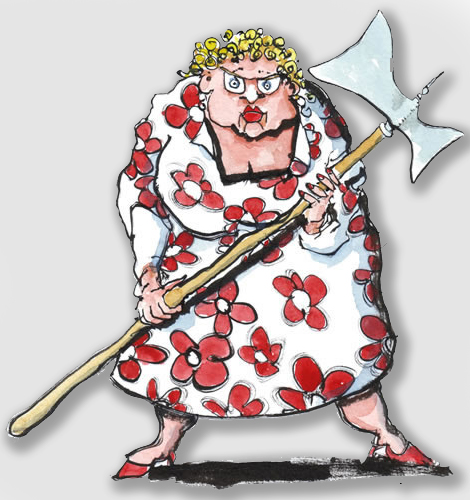
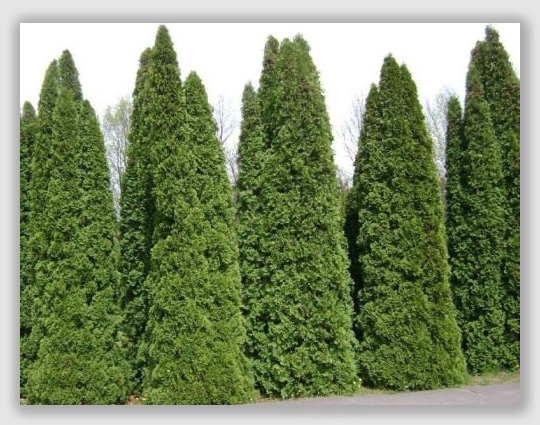
Years ago, our neighbor Olwen – who, if she had not passed away (meaning, of course, that we cannot speak ill of her), we would have described as a battleaxe – surrounded two sides of her property with 2-3’ arborvitae. It didn’t really look that bad, but… well, they grew.

And grew, and grew and grew. Our neighbor never trimmed them before she departed this mortal coil. And the two families who lived there subsequently never trimmed the trees/shrubs/whatever-the-hell-they-are, either.

Consequently, the arborvitae are 25 feet tall and still growing. We finally had to move our vegetable garden about 20 yards to the west because of the shade they were throwing. Exercising our Massachusetts Rule rights last fall, we hacked about ten of them back to the property line in order to install a new shed. We then built a fence to try to keep the monsters in check.

My wife mutters about the arborvitae daily. I have no problem understanding Nancy – the protagonist in today’s case – who must have loved neighbor Pnita’s arborvitae as much as my wife loves Olwen’s. But while my wife just glowers at the arborvitae, Nancy – a woman of action – did something. She brought in a trimming crew and topped the neighbor’s trees.

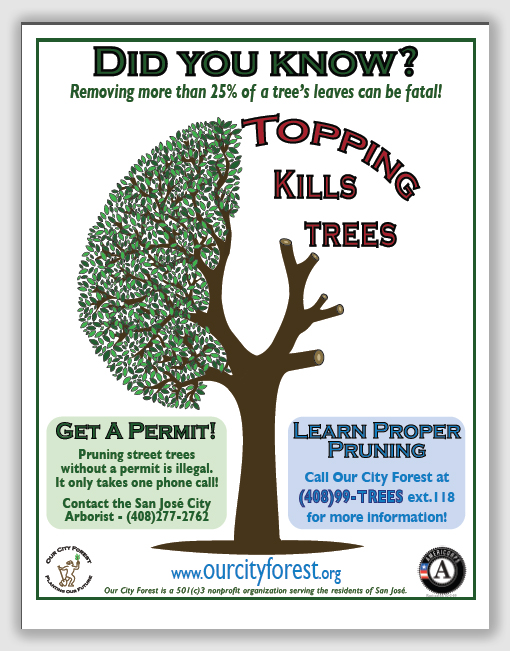
She didn’t kill them, just sort of knee-capped them. Who knew that so much visceral pleasure could end up being so expensive?

So this post is for my wife, a cautionary tale lest she decides to take matters into her own hands on the next-door arborvitae. Take a deep breath, honey…

Joseph v. Nathanson, 87 Mass. App. Ct. 1102, 23 N.E.3d 151, 2015 Mass. App. Unpub. LEXIS 37 (Ct.App. Mass. Jan. 16, 2015). Pnina Joseph and Nancy Ellen Nathanson owned abutting properties and shared a property line. Pnina planted thirty-five arborvitae trees on her property close to the property line to serve as a privacy screen. In October 2012, Nancy directed her landscaper to go onto Pnina’s property and “prune” the trees. The landscaper “topped” the trees by cutting about five to six feet from the tops.

Pnina sued under Massachusett’s tree-cutting statute, G. L. c. 242, § 7, and a jury returned a verdict in Pnina’s favor, awarding her $35,000. The award was trebled under the statute. Nancy appealed, arguing that her actions did not violate the tree statute because the trees were not “cut down” or “destroyed” as required by the statute.

Held: “Topping” the trees so that they would no longer grow any higher justified application of the Massachusetts wrongful-cutting statute.

General Law c. 242, § 7 provides for liability on the part of anyone who “without license willfully cuts down, carries away, girdles or otherwise destroys trees.” Nancy asserts that under the tree statute, Pnina’s trees had to be completely destroyed or cut down in order for the plaintiff to recover. She argues that the evidence showed that the trees were alive, growing, and healthy after the topping of the trees and, therefore, could not possibly have been “destroyed.”

The Court said it would interpret a statute to give effect “to all its provisions, so that no part will be inoperative or superfluous.” The statute here requires that the trees be “cut down, carried away, girdled or otherwise destroyed.” G. L. c. 242, § 7. “The phrase “otherwise destroyed” includes,” the Court said, “but is not limited to, the preceding phrases including ‘cut down’.” In other words, “cut down, carried away,” and “girdled” are examples of how a tree may be destroyed; they are not exclusive.

The judge instructed the jury that the word “destroy” has a commonly understood meaning, which includes “to ruin completely, to ruin the structure, organic existence or condition of a thing, to demolish, to injure or mutilate beyond the possibility of use.” The Court held that this definition given to the jury correctly provided a broader meaning to the term destroy than the examples in the statute.

Pnina’s expert testified that the “topping” of the trees meant that they would never grow vertically again and were no longer functional as a privacy screen. The jury was entitled to credit that testimony, to agree with Pnina that the trees were “mutilated beyond the possibility of use” as a privacy screen, and therefore to find in Pnina’s favor.

– Tom Root

TNLBGray

Case of the Day – Monday, February 10, 2025

HERE WE CUT DOWN THE MULBERRY BUSH…

When Mamie’s lights went out, she called the electric company to fix them. The linemen tracked down the problem and fixed it while Mamie was off at Wal-Mart. But while they were there and Mamie wasn’t, the electric workers saw an excellent opportunity to saw… and to get rid of some trees in the utility’s easement across Mamie’s yard that they thought were in the way of the distribution line to Mamie’s house.

Mamie returned, shopping bags in hand, to find her mulberry tree had been cut down and cherry tree topped. Naturally, she sued. After all, her trees had not caused the power outage. Nevertheless, the electric company said the tree could have caused the power loss, but for the grace of God, and it relied on its easement to support its right to remove the one tree and permanently stunt the other out of concern that someday they might pose a hazard.

I would have bet a new chainsaw that the electric company was going to win this one, and I can only conclude that it may have been “homered” by the local judge. After all, Mamie was a neighbor, and the big, bad electric co-op was just some faceless out-of-towner. I know of no other way (than possibly an inability to read precedent and engage in reasoned thought) to justify a holding that while the utility had an easement, as well as the duty to maintain the reliability of its lines, it nonetheless could not merely be liable for overzealous trimming but even be socked with treble damages.

Treble damages are only appropriate in Missouri if the malefactor lacks probable cause to believe it owned the land the tree stood on. That test should have been modified to comport with the facts. Consolidated had an easement for the electric lines to cross Mamie’s property, and whether its decision to trim or remove the trees near its lines was correct or not, the decision should have been accorded deference.

Tomorrow, we’ll look at a subsequent Missouri electric company case, where we will see the utility get clobbered despite its desperate reliance on today’s holding.

Segraves v. Consolidated Elec. Coop., 891 S.W.2d 168 (Ct.App. Missouri, 1995). Mamie Segraves sued Consolidated Electric Co-op – her electricity provider – after one of its linemen cut down her mulberry tree and “topped off” her cherry tree.

One summer day, Mamie awoke to find that her electricity was off. She left to go shopping at 9 a.m., and when she returned two hours later, the lights were back on. However, the mulberry and cherry trees in her front yard had been cut down and one branch of her elm tree had been cut off.

Mamie testified these trees had never interfered with her electrical service before. In the past, Consolidated had asked to trim the trees around her electric lines, and she had always agreed, but it had not done so in the past six years. Mamie estimated the value of the mulberry tree was $2,000.00, and the value of the cherry tree was $500.00.

Mitch Hurt, a senior lineman with Consolidated, testified he was called to handle an electrical outage. He tracked the outage to a problem with one of the lines near Mamie’s home, but he could not pinpoint the problem. He had to drive down the road and look at the individual lines to try to find the problem. When he passed the line leading up to her house, he could not see the transformer pole. He stopped and went to inspect her service. He noticed her mulberry tree was very close to the transformer, and so he cut it down “to get it away from the transformer pole.” He also cut off the entire top of a nearby cherry tree because its branches had all grown towards the line. He felt these branches presented a safety hazard because children could easily climb them and reach the power lines. Mitch admitted it may not have been necessary to cut down either of these trees to reinstate electrical service.

Bob Pogue, Jr., Mitch’s boss, testified he told Mitch to trim as much of the trees as he thought was necessary. Bob Jahn, Consolidated’s general manager, testified Mamie knew about the location of the electric lines when she bought the place.

The trial court found in Mamie’s favor and assessed treble damages. Consolidated appealed.

Held: The Co-op had no right to cut the trees, and treble damages were proper.

The trial court did not find Consolidated to be a trespasser because it had the right to enter onto Mamie’s premises to maintain the electric lines. The right to remove limbs that have fallen onto the lines, however, “does not extend to cutting down trees or ‘topping’ trees that are not presently interfering with electrical service without prior consultation with the property owner.” While the mulberry and the cherry trees probably needed to be trimmed, the trial court said, there was no evidence that the mulberry “needed to be cut to a stump and that the cherry needed to be cut back to its major trunks, eliminating all of the fruit-bearing branches.”

Section 537.340 of the Revised Statutes of Missouri allowing for treble damages for the destruction of trees, does not require that a party wrongfully enter upon the property. In fact, the Court of Appeals said, Mamie can recover for wrongfully cutting down trees if she can establish either that Consolidated wrongfully entered her land and cut down the trees, or Consolidated entered her land with consent but exceeded the scope of the consent by cutting down the trees without permission.

While it is true, as Consolidated argued, that a license may be converted into an easement by estoppel if the license holder can establish it spends a great deal of time and money to secure enjoyment of its use, the scope of such an easement nevertheless will be determined by the meaning and intent that the parties give to it. The Court found no history between the parties of cutting down trees, and nothing from which such a right to cut down trees can be implied. Thus, even if Consolidated did acquire an easement by estoppel, it exceeded the scope of the easement by cutting down Mamie’s mulberry and cherry trees.

The utility also argued it was required by law to trim or remove the trees to ensure safety. Under the National Electrical Safety Code, Consolidated argued, it was required to trim or remove trees that may interfere with ungrounded supply conductors should be trimmed or removed, and where that was not practical, the conductor should be separated from the tree with proper materials to avoid damage by abrasion and grounding of the circuit through the tree. Consolidated maintained it had the authority to remove Mamie’s trees according to the Code because there was substantial evidence showing limbs of both trees had been burned by electricity, the mulberry tree was blocking the transformer pole, and the children living nearby could have easily climbed either tree and reached the live electric wires.

The Court rejected that, holding that Consolidated failed to show that the Code applied here because it failed to present evidence that the electrical wires leading to Mamie’s home were “ungrounded supply conductors.” Further, even if the Code applied, it gives electric companies two options, to trim or to remove the trees. The trial court found it was unnecessary to remove the trees in this case.

Not to be deterred, Consolidated also argued it was obligated to remove the trees because it had a non-delegable duty to maintain a safe clearance around its electrical lines. “Although Consolidated was required to exercise the highest degree of care in maintaining its electrical wires,” the Court said, “it was not required to remove the trees surrounding them, and it exceeded its authority by doing so.”

Section 537.340 of Missouri Revised Statutes holds that if any person shall cut down, injure, or destroy or carry away any tree placed or growing for use, shade, or ornament, or any timber, rails, or wood standing, being or growing on the land of any other person, the person so offending shall pay to the party injured treble the value of the things so injured, broken, destroyed, or carried away, with costs.

The Court noted that a person can only fell trees wrongfully in one of two ways: he can enter the land wrongfully and fell the trees, or he can enter with the landowner’s consent and then exceed the scope of that consent by felling trees without permission. While the statute limits damages recoverable to single damages in certain cases, such as where it appears the defendant has probable cause to believe that the land on which the trespass is alleged to be committed, or that the thing so taken, carried away, injured, or destroyed, is his own. It was up to Consolidated to prove it had such probable cause.

The determination of whether the defendant proved probable cause existed rests with the trial judge. Here, the Court said, “the trial judge did not abuse his discretion in finding Consolidated did not have probable cause” to believe it had the right to cut down Mamie’s trees.

– Tom Root

TNLBGray140407