Case of the Day – Monday, November 3, 2025

HURTS SO BAD

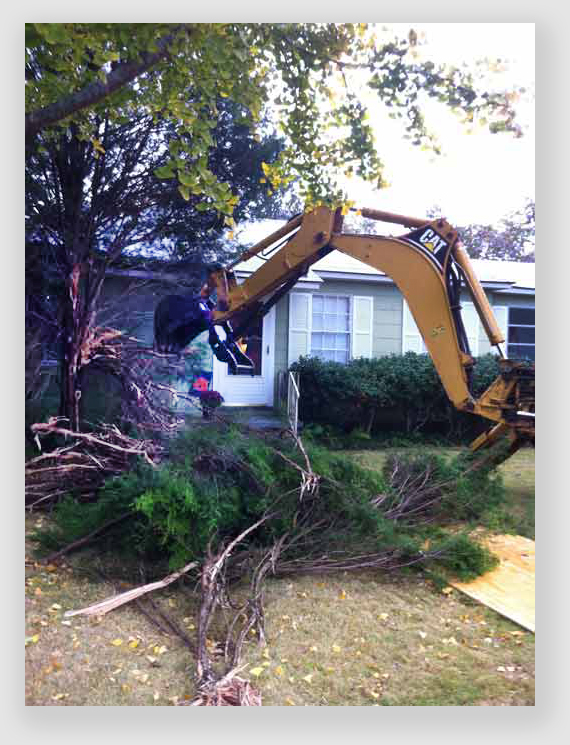
In case you missed it the past two days, this is a trackhoe removing a tree.

In case you missed it the past two days, this is a trackhoe removing a tree.

Today is our last day down on Dick Lavy’s Darke County farm. As you recall, we helped Dick’s faithful employee Sylvester trim the trees along a fencerow that separated one of the Lavy from land belonging to his neighbor, Jim Brewer.

We were fairly impressed to watch Sylvester run a trackhoe down the Lavy side of the fencerow, smacking down branches with the machine’s bucket. It was not pretty, but it got the job done effectively and cheaply.

Jim Brewer, however, wasn’t very happy with the result and sued Dick Lavy Farms. Farmer Lavy argued the Massachusetts Rule let him trim overhanging trees any way he liked, that Sylvester wasn’t negligent or reckless, and that the damage – if there even was damage – didn’t amount to much. The jury thought it was arboricide and socked Farmer Lavy for $148,350.

Last Thursday, we watched the Court of Appeals for Darke County, Ohio, fillet Dick Lavy’s argument that the Massachusetts Rule was a license to butcher. The Court affirmed a landowner’s right to trim encroaching trees and roots to the property line but held that such trimming had to be done in a reasonable manner so as not to injure the adjoining owner’s trees.

On Friday, we saw the Court compare the various means of trimming a fencerow, comparing for ease of use, custom in the area, and cost. It concluded that the trial court was right to find DLF negligent in trimming part of the fencerow and reckless in continuing after a sheriff’s deputy advised Dick Lavy to get legal advice before continuing (advice the farmer ignored).

Today, the Court delves into the $148,350 damage award. Clearly, the Court is troubled that Jim only paid $170,000 for the whole 70 acres, and provided no evidence that the value of the land fell a farthing because of Sylvester’s trimming activities. The Court felt hard-pressed to see Jim get almost $150,000 when no trees other than some saplings were destroyed.

Jim didn’t help his cause by admitting (as he had to) that he only visited the land about eight times a year to hunt and picnic, and the trimming didn’t interfere with those activities. He argued that he planned to build a house there in another 14 years or so, but the Court couldn’t see that the damaged fencerow trees had any impact on those plans.

Usually, the measure of damages for a trespass where trees are cut is the difference in the land’s value after the cutting versus before the cutting. There are times when this measure does not capture the real loss: a family loses a cherished ornamental tree, for example, or the landowner nurtures trees for their ecological value.

hurtsobad160929

That’s what Jim Brewer claimed, too…

In this case, however, it’s hard to see how Jim was hurt at all, not to mention hurt as badly as he claimed to be. Indeed, that’s how the Court of Appeals seems to read it, too. Come with us now on a detailed and thoughtful journey through all of the matters a court (and aggrieved party) should consider in setting the amount of loss. Although the Court sends the damage award back for the trial judge to deal with, it’s quite clear that the appellate panel is disinclined to turn the case into a winning lottery ticket for Jim Brewer.

Brewer v. Dick Lavy Farms, LLC, 2016-Ohio-4577 (Ct.App. Darke Co., June 24, 2016)

(These facts are repeated from the previous two days: If you don’t need the refresher, skip to the holding)

In 2007, James Brewer bought about 70 acres of rural property for $180,000. About 30 acres of the land were tillable, and 40 acres were wooded. The only access to the tillable and wooded property was a 25-foot wide lane of about 3,600 feet in length.

The former owner had allowed his neighbor Dick Lavy Farms to farm the property, and the lane had not been used. Brewer cleared the lane of undergrowth in order to access the rest of the property. The lane ran west to east, and had trees on both sides of the lane, with the trees on the south side forming a fencerow between Brewer’s property and land owned by Dick Lavy Farms. The trees in the fencerow were a woodland mix; none of the trees were ornamental or unique.

In January 2013, Dick Lavy ordered an employee to clear the fencerow between the two properties. At the time, Lavy understood that he could clear brush straight up and down the property line and that such clearing was important for crop production, yield and safety of farm equipment. Using a track hoe, which had an arm that could reach about 15 feet in the air, the employee reached up, grabbed limbs, and pulled on them, trying to break them off cleanly. Although the employee tried to keep the trackhoe on DLF’s side of the property, occasionally a branch would snap off or tear the tree on Brewer’s side. Occasionally, a branch would fall on Brewer’s side, and the employee would reach over to grab the branch Sylvester stated that he never consciously reached over with the bucket to try and break a branch at the tree trunk that was on Brewer’s side of the property.

When Brewer learned that DLF was clearing the fencerow, he went out to look at the operation and called the sheriff. At that point, the track hoe was about halfway down the fencerow, destroying trees. A Darke County sheriff’s deputy told Lavy that a complaint had been made, and expressed his concern that civil or criminal issues could be involved in what he was doing. Lavy said that he had a right to take down any branches that were hanging over his property. In addition, Lavy said he would let Brewer remove the branches if Brewer wanted to do so, but he wanted the branches removed before crop season began in March or April.

Or, if you're Sylvester, don't use a chainsaw at all...

Or, if you’re Sylvester, don’t use a chainsaw at all…

The deputy told Brewer that Lavy said that he was allowed to take tree branches from his side and that if Brewer did not like the way he was doing it, Brewer could cut them himself. Brewer told the deputy that he was going to have an expert look at the trees. The deputy filed a report with the prosecutor’s office, but no charges were brought.

Although the deputy suggested that Lavy obtain legal advice before continuing, Lavy continued clearing the fencerow. Knowing that Brewer was upset, Lavy told his employee not to clean up branches that fell on Brewer’s side.

Within days after the damage occurred, Brewer’s wife took photos of the damaged trees. Three months later, Brewer and an arborist counted 326 damaged trees.

Brewer sued Dick Lavy Farms, alleging a violation of O.R.C. § 901.51, reckless trespass, and negligent trespass. Prior to trial, the court held that Brewer was not limited to damages for diminution in value, and the court would apply a standard that allowed recovery of the costs of restoration.

DLF argued that it had a common law privilege to cut off, destroy, mutilate or otherwise eliminate branches from Brewer’s trees that were overhanging DLF land. The Farm also argued that if it was liable, the proper measure of damages should be the diminution of Brewer’s property value; in the alternative, the court’s holding on the issue of damages was against the manifest weight of the evidence. Finally, DLF claimed it had not negligently or recklessly trespassed on Brewer’s property.

The Court found for Brewer, awarding him $148,350 in damages, including treble damages of $133,515.

Dick Lavy Farms appealed.

(If you remember the facts from the previous two days, start here)

Held: It was Halloween for Jim, and he got a trick, not a treat. The $148,350 in damages was set aside because Jim’s property really didn’t diminish in value.

The Court observed that in a previous case, it had held that where the trespasser could not reasonably foresee that trees had a special purpose or value to the landowner, and where the trespasser “cuts trees that are part of a woodland mix and not unique, the ordinary measure of the harm is the difference in the fair market value before and after the cutting.” The trial court, however, had relied on a different standard:

It was all trick and no treat for Jim…

In an action for compensatory damages for cutting, destroying and damaging trees and other growth, and for related damage to the land, when the owner intends to use the property for a residence or for recreation or for both, according to his personal tastes and wishes, the owner is not limited to the diminution in value (difference in value of the whole property before and after the damage) or to the stumpage or other commercial value of the timber. He may recover as damages the costs of reasonable restoration of his property to its preexisting condition or to a condition as close as reasonably feasible, without requiring grossly disproportionate expenditures and with allowance for the natural processes of regeneration within a reasonable period of time.

At trial, Jim’s expert arborist testified that the cost of removing the trees Sylveste3r had damaged would cost $55,000, and the cost of replacing them would be $138,000, plus tax. Jim did not offer any evidence that his 70-acre property’s fair market value had fallen by so much as a penny. DLF’s arboriculture expert testified the life expectancy and service life functionality of the fencerow were not affected by the manner in which the trees were pruned. He valued the fencerow as a woodland edge fence and argued that real estate or fair market value would be the proper way to assess damages. Another DLF expert also testified that the fair market value of Brewer’s property was the same before and after the incident.

The trial court found that removal of the damaged trees was unnecessary, and thus discounted that $55,000 cost. In addition, the court concluded that the $138,000 estimate for tree replacement was excessive, and reduced that amount by 50%. The court also deducted 14% for ash tree disease, which had already caused the death of a number of trees on both sides of the lane. The trial court thus arrived at $59,340 in compensatory damages.

Next, the trial judge decided that DLF had negligently trimmed one-fourth of the property (or about 1,000 feet), and recklessly trimmed the remaining three-fourths of the fencerow. The trial court awarded $14,835 for negligence, and $44,505 for DLF’s recklessness. Pursuant to O.R.C. § 901.51, the court trebled the recklessness amount to $133,515. This brought the total damages to $148,350.

The Court of Appeals noted Ohio’s general rule that “recoverable restoration costs are limited to the difference between the pre-injury and post-injury fair market value of the real property,” The courts have carved out an exception, however, that permits restoration costs to be recovered in excess of the decrease in fair market value when real estate is held for noncommercial use, when the owner has personal reasons for seeking restoration, and when the decrease in fair market value does not adequately compensate the owner for the harm done. This restoration cost exception has been applied, for example, where the damaged trees have been maintained for a specific, identifiable purpose (like recreation, or a sight, sound, or light barrier), when damaged trees are essential to the planned use of the property, or when the damaged trees had a value that can be calculated separate from ornamental trees have been destroyed, or where the trees form part of an ecological system of personal value to the owner.

Even where the restoration exception is applied, the Court said, “the proposed cost [cannot be] grossly disproportionate to the entire value of the injured property.”

The Court said that the damage to Jim Brewer’s trees was “temporary” (meaning, apparently, that the damaged limbs would grow back), and that the Ohio rule is that “damages for temporary injury to property cannot exceed the difference between market value immediately before and after the injury, is limited. In an action based on temporary injury to noncommercial real estate, a plaintiff need not prove diminution in the market value of the property in order to recover the reasonable costs of restoration, but either party may offer evidence of diminution of the market value of the property as a factor bearing on the reasonableness of the cost of restoration.”

The trial court seemed certain that Dick Laye was a deep pocket, and that may have driven its damage award.

The trial court seemed certain that Dick Lavy was a deep pocket, and that may have driven its damage award.

“Viewing the trial court’s award of damages from the perspective of reasonableness,” the Court of Appeals said, “we must conclude that the award for restoration was objectively unreasonable.” First, the application of O.R.C. § 901.51 “almost exclusively involves situations where trees have been completely cut down, making it considerably easier to determine the full extent of the damage to the plaintiffs’ property.” Here, Jim Brewer admitted that other than a few small saplings, he was not claiming that any large trees had been removed from his land. Instead, he contended only “that 326 trees had been damaged in some manner and would ultimately die, even though pictures of the area taken in June 2014 depict a substantial canopy of foliage… Brewer also testified that a number of trees had died, but he did not give any specific number.”

The Court found that Jim Brewer’s trees were not ornamental and were not located at his residence. Instead, they were native trees that were just part of a fencerow. Jim testified he used the property for hunting only about six times a year, and for family get-togethers maybe twice a year. He also admitted the removal of branches had not had any effect on these activities or his ability to rent tillable land to farmers. Jim intended to put a house on the property after his 4-year-old child graduates from high school, but he didn’t claim that DLF’s tree trimming affected his plans to do so.

The Court found it noteworthy that Jim Brewer paid $180,000 for all 70 acres, yet claimed the restoration cost (including removal and replanting of trees) for a very small part of that property was more than $200,000.

Jim did not present any proof that the fair market value of the land had fallen because of the tree trimming. The Court agreed that he was not required to present such evidence, bur said “it would have been helpful, particularly since two defense witnesses indicated that removing vegetation from the fence row did not impact the fair market value of the land.” Additionally, the Court found that much of the trial judge’s calculations “were based on speculation or were incorrect. For example, the court concluded that one-fourth of the fence row was trimmed negligently, but the plaintiff’s own evidence showed that more like 1,800 feet had been trimmed when Jim Brewer first complained. “The trial court could have chosen to disregard [the DLF employee’s] testimony,” the Court said, “but there is no logical reason to disregard the plaintiffs’ own admission about how far the fence row had been cleared.”

The Court of Appeals was not inclined to see Jim Brewer get a winning lottery ticket...

The Court of Appeals was not inclined to see Jim Brewer get a winning lottery ticket…

The trial court also gave no particular reason for its 50% discount on damages. What’s more, the Court of Appeals complained, “The trees on the fence row were a woodland mix of native trees, not ornamental trees. A number of the trees were undesirable, and there was no evidence of special value. In addition, the fence row had been unmaintained for 10 or 29 years. Even though these facts no longer require damages to be limited to diminution in value, they are still points that should be considered in deciding whether an award is reasonable.”

The Court of Appeals vacated the damages, and directed the trial court on remand to consider the reasonable restoration costs, taking into consideration the decrease in the fair market value of the land; the fact that the trees were a common woodland mix, not ornamental trees or trees that Jim had planted for a particular purpose; the fact that the fence row was not maintained for many years, and had undesirable and dead trees on each side of the row; the extent to which the trees have regenerated since the date of the 2013 trimming; the lack of impact on Jim’s intended home site; and the fact that Jim’s use of his property is “sporadic and is not impacted by any injury to the trees.”

The detailed list of evidence the trial court is to consider pretty much tells the trial judge how the Court of Appeals expects this to turn out.

– Tom Root

TNLBGray140407

Case of the Day – Tuesday, October 28, 2025

HE’S A CAD, NOT A TRESPASSER

It does not take very many years in the general practice of law for an attorney to see people at their worst. There’s nothing like watching a loving family, united in grief over the death of a loved one, get torn apart by greed and jealousy when the time comes to probate the will. A close second, however, has to be divorce.

Early on in my career, I witnessed a wife who threw her husband’s expensive shotgun collection into a swamp and refused – even on pain of jail for contempt of court – to tell anyone where she had bogged the prized Purdeys. Then there was the husband who hid all the money over a three-month period before announcing, “Surprise, I’m divorcing you!” His wife had been diagnosed with inoperable cancer, and he could not understand why he should spend all of their money on her healthcare when she was just going to die anyway.

One of my favorites was the couple who had agreed to an amicable divorce. They owed about $10,000 on credit cards, so they agreed to jointly borrow the money from the bank to pay off the high-interest debt with a loan that they would share in paying down. The day before the final divorce hearing, the husband called the bank and convinced the loan officer that his soon-to-be ex had asked him to pick up the check. He did, and then forged his wife’s name on the back, took the $10,000, and fled for Florida.

Shortly after he got to the Sunshine State, his mother died and left him $500,000. Using some of the money to get drunk and high, the still-the-husband ran his Harley into a bridge abutment at 95 mph. Since he had never gone through with the divorce, he was still married. Of course, the knucklehead had no will, so his brother – next in line for the money – got nothing, while my client, the wife (who had been furious at being stuck with the $10,000 loan obligation), got it all. She went to Florida, picked up his new $40,000 truck, all sorts of expensive tools, and the remainder of the money he had inherited (about $420,000). It took two cops to go with her to dead hubby’s family compound to pick up the property from the enraged family.

Karma is a bitch, sayeth… someone, I’m sure.

So why the family law lesson? Because, as we will see in today’s case, trying to screw your ex is never a very good idea. A moment’s visceral pleasure, followed by years (or a lifetime) of regret. Still, the ex-husband, whose in-your-face ripoff of the ex-wife even went to the extent of having her share paid to the new girlfriend, got off easy. When he sold 400,000 board feet of jointly-owned timber – cheating the ex out of $52,600, the former wife originally got her share plus treble damages under Louisiana’s timber trespass statute (and another $63,000 in legal fees). But the Cajunland Supreme Court ruled that whatever the ex-husband might otherwise be, he was not a trespasser to whom the treble damage statute applied.

Sullivan v. Wallace, 51 So.3d 702 (Supreme Ct. Louisiana, 2010). During their marriage, defendant Bruce Sullivan and plaintiff Janice Sullivan bought a 120-acre tract of land in Claiborne Parish. The couple divorced in 1990, but they retained the community tract in co-ownership and listed it as an asset in the divorce proceeding. The divorce judgment prohibited the parties from doing anything to sell or diminish the value of community property.

In 1994 and 1995, however, Bruce cut, stacked and sold some of the timber on the property. The checks for the 1994 timber he sold were payable to Priscilla Wallace, the defendant’s girlfriend at the time (now his wife). The checks for the 1995 timber were made payable to Bruce. In all, Bruce sold over 254,000 board feet, worth over $105,000.

In 1995, Janice learned that Bruce had been cutting and selling timber from their jointly-owned tract. She advised the timber buyer that the property was in litigation, and the buyer immediately ceased removing timber from the property. When Bruce told the buyer there was another 40,000 board feet of timber awaiting pickup, the buyer declined to have anything to do with it.

Janice sued Bruce, his girlfriend Priscilla and the timber buyer, claiming trespass, negligence, and conversion, and seeking treble damages and attorney fees under La. Rev. Stats. 3:4278.1 and 3:4278.2. At trial, Bruce argued the timber had come from his separately owned but adjoining tract, and that the timber had been damaged by an ice storm and had to be cut. The trial court, noting that the sale receipts predated the ice storm, didn’t believe him. Imagine that.

Instead, the Court ruled for Janice, finding that her share of the cut timber was about $52,600.00. To that figure trial court applied La. Rev. Stat. 3:4278.1 to award treble damages, or about $157,800.00, and to award attorney fees in the amount of 40% of the treble damage award, about $63,000.00.

The court of appeal affirmed that Janice was entitled to damages, but it reversed as to the treble damages and attorney fees. The appellate court agreed with Bruce that the timber trespass statute does not apply to co-owners of property, holding that the co-ownership articles of the Louisiana Civil Code provide adequate recourse among co-owners of real property. The appellate court cut Janice’s award to $52,600.00, representing one-half of the value of the lost timber, and vacated the portion of the judgment awarding attorney fees.

Janice petitioned the Louisiana Supreme Court for review.

Held: The treble damage statute for trespass to timber does not apply to co-owners who cut timber without the consent of the other owners.

The Court observed that the fundamental question in cases of statutory interpretation such as this one is legislative intent and determining the reasons that prompted the legislature to enact the law. The starting point in statutory interpretation is the language of the statute itself. When a law is clear and unambiguous and its application does not lead to absurd consequences, the Court said, the law is to be applied as written.

When the language is susceptible to more than one meaning, however, the Court held, it must be interpreted as having the meaning that best conforms to the purpose of the law, and the words of the law must be given their generally prevailing meaning. When the words of a law are ambiguous, their meaning must be sought by examining the context in which they occur and the text of the law as a whole, and laws on the same subject matter must be interpreted in reference to each other.

La.Rev.Stat. 3:4278.1, commonly referred to as the “timber trespass” or “timber piracy” statute, provides that it “shall be unlawful for any person to cut, fell, destroy, remove, or to divert for sale or use, any trees, or to authorize or direct his agent or employee to cut, fell, destroy, remove, or to divert for sale or use, any trees, growing or lying on the land of another, without the consent of, or in accordance with the direction of, the owner or legal possessor, or in accordance with specific terms of a legal contract or agreement.” Although the statute is directed to “any person” who cuts, fells, destroys, removes, or diverts for sale or use any trees, the Court said, the statute is facially ambiguous with regard to co-owners of the timberland, neither expressly including nor excluding these persons from its provisions.

When viewed strictly, the statute is violated only when “any person” acts with respect to trees growing or lying “on the land of another” and when this action is taken without “the consent of … the owner or legal possessor.” The timber trespasser owes the penalty to “the owner or legal possessor of the trees,” a phrase the Court said more logically describes a person other than the wrongdoer as described in the statute. What’s more, the timber trespass statute is found within the title of the Revised Statutes entitled “Agriculture and Forestry,” the chapter entitled “Forests and Forestry” and the part entitled “Protection and Reforestation.” Given this context, the Court held that the legislative purpose behind La. Rev. Stat. 3:4278.1 is to protect those with an interest in trees from loggers who enter their property without permission to harvest timber illegally. Thus, with the proper construction in mind, the Court said, “The focus of the statute is on an actor other than an owner.”

The Court said the fact that La.Rev.Stat. 3:4278.1 is not directed to co-owners who act without the permission of their co-owners was further supported by considering it in context with La. Rev. Stat. 3:4278.2, the 80% rule, which allows a timber buyer to cut standing timber when the buyer has the consent of co-owners holding 80% or more of the ownership interest. If 3:4278.1 applies to co-owners, then one co-owner who holds more than 80% of the ownership interest and permits timber to be cut in accordance with La. Rev. Stat. 3:4278.2 would nevertheless be liable to the other co-owners for treble damages under 3:4278.1 despite the fact the timber “buyer” would escape the penalty because of La. Rev. Stat. 3:4278.2(B). “Such a contradiction.” The Court reasoned, “cannot be what the legislature intended in enacting these statutes.”

Therefore, Janice was entitled only to her share of the cut timber.

– Tom Root

TNLBGray140407

Case of the Day – Friday, October 24, 2025

TRESPASS

Remember that kid when you were small, the neighborhood schemer who would convince everyone else to do something fun (which quickly became something stupid)? In our small Ohio town, the local instigator-in-chief was a jug-eared kid named Rick.

Rick’d talk us into going into the Smiths’ strawberry patch and make off with a quart or more of the biggest, reddest, juiciest berries… At least, until grumpy old Mr. Smith would catch us. Like he always did.

Everyone knows that trespass is an intentional invasion of a property owner’s interest in the exclusive possession of property. Pretty simple, huh? We were all trespassers, but back then, the penalty was meted out by our parents after they got an earful from Mr. Smith.

Rick? He was no trespasser. He never stepped foot in the strawberries, although he had every intention of sharing in the berry spoils we brought back. We were liable. He was not.

Does that seem right? It did not seem so to us at the time. It does not seem that way to the Washington Supreme Court, either.

Porter v. Kirkendoll, 2019 Wash. LEXIS 588, 2019 WL 4683940 (Supreme Ct. Wash. Sept. 26, 2019). Pepper and Clarice Kirkendoll hired loggers to harvest their trees. They owned a parcel of timberland abutting the western edge of a 60-foot-wide easement. The easement was located on land owned by Jerry Porter and Karen Zimmer.

A private access road, Madison Drive, ran within the easement. A strip of land west of the access road but east of the Kirkendolls’ land belonged to Jerry and Karen. Nevertheless, when Pepper hired G & J Logging Inc. to harvest timber, he told the loggers that he and Clarice owned all the land west of Madison Drive. G & J Logging and Boone’s Mechanical Cutting, Inc., harvested 51 Douglas firs located on Jerry’s and Karen’s land.

Jerry and Sharon sued the Kirkendolls and the loggers for waste under RCW § 4.24.630 and for timber trespass under RCW § 64.12.030. The loggers settled with Jerry and Karen, paying $125,000 and assigning their indemnity and contribution claims against the Kirkendolls as part of that settlement. The settlement was pretty slick. Jerry and Karen figured they would score another one-third of $125,000 by taking the loggers’ right to get contribution from the Kirkendolls ($41,666.67).

The Kirkendolls replied with their own slickness. They argued that the settlement with the loggers effectively released them from liability under the principles of vicarious liability. The trial court agreed with the Kirkendolls and dismissed the case.

The Court of Appeals reversed, holding that the settlement did not release the Kirkendolls from potential liability for directing the timber trespass. And it held that Jerry and Karen were precluded from recovering under the waste statute because relief is available under the timber trespass statute.

The Kirkendolls appealed to the Washington Supreme Court, renewing their argument that the settlement agreement released them from liability under principles of vicarious liability. They also argued that they are not liable for indemnity as a matter of law. In their answer, Jerry and Karen sought review of whether the timber trespass statute precludes them from recovering under the waste statute.

Held: The settlement did not release the Kirkendolls from liability, but Jerry and Karen are precluded from recovering under the waste statute.

In contrast to direct liability, which is liability for the breach of one’s own duty of care, vicarious liability is liability for the breach of someone else’s duty of care. A principal – like the Kirkendolls – may be vicariously liable as a matter of public policy to ensure that the plaintiffs have the maximum opportunity to be fully compensated. That public policy does not apply when a plaintiff has accepted a release from the primarily liable party who committed the tort and who was financially capable of making the plaintiffs whole. When a plaintiff settles with a solvent agent from whom he or she could have received full compensation, the very foundation of the principal’s liability is undermined. In at least some situations, then, a plaintiff releases a vicariously liable principal by settling with a solvent agent.

But, the Court said, that was not the case here. Pepper Kirkendoll misrepresented his boundaries and thus directed G & J Logging and Boone’s to commit a timber trespass. Therefore, it did not matter that the loggers separately settled with Jerry and Karen for their trespass. Pepper and Clarice were independently liable for their “culpable misfeasance” in directing the loggers to cut the wrong trees.

Under RCW § 4.24.630, the waste statute, more expansive remedies are available to a party. In addition to treble damages, the injured party may recover reasonable costs, including but not limited to investigative costs, reasonable attorneys’ fees, and other litigation-related costs. However, the waste statute explicitly states that it does not apply in any case where liability for damages is provided under § 64.12.030, the timber trespass statute.

– Tom Root

tnlbgray140407

Case of the Day – Tuesday, September 30, 2025

A RATHER SURPRISING HOLDING FROM A DELAWARE TRIAL COURT

In this tree law gig, I read a lot of cases. After a while, reading between the lines gets a lot easier.

Today’s case, which I decided was nothing special, was just about some neighbors who were over-the-top haters of the defendant. The defendant seems like a guy whose crime was that he apparently had the effrontery to move in next door and then fix up the place.

The trial court’s long opinion had flushed away most of the plaintiffs’ breathless and frantic complaint – and “flushed” is the correct verb for most of the claims the tin-foil-hatted neighbors made against the defendant– when I got to their claim that defendant Bill Collison had “damaged a maple tree near the property line by shaving the trees directly up from the property line.”

“Holy Massachusetts Rule!” I muttered to myself. Everyone knows that this claim should be summarily tossed, because the Massachusetts Rule is as universally accepted as is turkey at Thanksgiving. Assuming Bill did “shave” the tree at the property line, that’s perfectly within his rights.

Much to my shock, the Court disagreed. It held that the right of “self-help” trimming of encroaching branches is not established in Delaware, and if this court was going to do it, it would not do it on summary judgment. It became obvious to me that whatever else Judge Calvin Scott, Jr., of Newark, Delaware, reads with his morning coffee, it sure isn’t this blog.

It did not take long to find reason to question the Judge’s refusal to grant summary judgment on this issue. In the 1978 Delaware Chancery Court decision Etter v. Marone, the court ruled

At the same time, certain generally accepted principles obtain with regard to encroaching trees or hedges. Regardless of whether encroaching branches or roots constitute a nuisance, a landowner has an absolute right to remove them so long as he does not exceed or go beyond his boundary line in the process. 2 C.J.S. 51, Adjoining Landowners § 52; 1 Am.Jur.2d 775, Adjoining Landowners § 127. He may not go beyond the line and cut or destroy the whole or parts of the plant entirely on another’s land even though the growth may cause him personal inconvenience or discomfort. 2 C.J.S. 51, supra.

So the Judge seems to be wrong: Delaware is firmly in the Massachusetts Rule camp.

What with allegations of underground tanks, clogged drainpipes and extreme mental anguish contained in the messy and unsupported complaint, Judge Scott pretty clearly had his hands full. By and large, he acquitted himself masterfully in the opinion, carefully deconstructing the plaintiffs’ complaints. But I’m betting that in about nine weeks, the Judge will be sitting down to a turkey dinner with all the trimmings. When he does, he should reflect that as many of us accept the Massachusetts Rule as will be dining on the same meal that day.

Dayton v. Collison, C.A. No. N17C-08-100 CLS (Super. Ct. Del. Sept. 24, 2019), 2019 Del. Super. LEXIS 446. Margaret Dayton and Everett Jones clearly had it out for their neighbor, Bill Collison. They claimed that since 2014, Bill had removed a significant number of standing trees and about 5,000 square feet of naturally growing plants from the City of Newark’s natural buffer zone, removed a 30-year-old drainage pipe located on his property and filled the remaining pipe with rocks and debris, intentionally altered the natural grade of his property so as to interfere with the natural flow of water, and trimmed a maple tree located on Maggie and Ev’s property along the boundary line. Additionally, they claim that an underground storage tank Bill installed – apparently your garden-variety propane tank – violates Newark’s municipal ordinances.

Maggie and Ev allege Bill’s property is a public nuisance, and that they have suffered “extreme mental anguish and damages of at least a $50,000 loss in the value of their home” because of flooding caused by Bill’s alteration of the grade’ invasion of privacy due to the removal of the buffer zone, being forced to live next to a hazardous condition because of the propane tank, and “damage or potential damage” (guess they’re not sure which) to the structural integrity of their property’s foundation.

They also claim Bill trespassed on their property multiple times to “alter the natural drainage flow of water, construct a berm, cut Plaintiffs’ trees, and take pictures or otherwise spy on Plaintiffs. From this, Plaintiffs claim they have suffered and continue to suffer damages and mental anguish in a sum to be determined at trial.”

Bill moved for summary judgment, claiming that Ev and Maggie cannot bring claims based on the alleged violation of city ordinances, and showing that their claims were baseless.

Held: Summary judgment in Bill’s favor was granted on all claims except the tree-trimming claim.

The Court held that a public nuisance is one which affects the rights to which every citizen is entitled. The activity complained of must produce a tangible injury to neighboring property or persons and must be one that the court considers objectionable under the circumstances.

To have standing to sue on a public nuisance claim, an individual must be capable of recovering damages and (2) have standing to sue as a representative of the public, “as in a citizen’s action or class action.” Here, Maggie and Ev have no right to bring a claim against Bill for alleged violations of the Code and thus, no standing to sue as representatives of the public. The Newark Code creates no rights enforceable by members of the public, and thus, it presents no basis upon which the requested relief may be granted.

To determine whether an implied private right of action exists, Delaware courts ask, among other things, whether there is any indication of legislative intent to create or deny a private remedy for violation of the act. Under the Newark City Charter, the City possesses “all the powers granted to municipal corporations by the Constitution and laws of the State of Delaware, together with all the implied powers necessary to carry into execution all the powers granted..” The city manager is responsible for administering all city affairs authorized by or under the Charter and may appoint individuals to enforce specific ordinances of the Code. The Court held that these reservations showed that the City of Newark intended for it to be solely responsible for enforcing its ordinances and did not intend to create a private right of action based upon ordinance violations.

Claims that Bill’s tree cutting was creating a public nuisance on the floodplain, likewise alleged violation of City ordinances, and thus were claims that Ev and Maggie lacked any standing to bring. As well, their claim that Bill’s propane tank had been installed without a permit alleged a violation of the City Code, a claim only the City could make.

Finally, Ev and Maggie claimed Bill created a public nuisance because he allegedly removed a drainage pipe from his property and filled the remaining pipe with rocks and debris. Outside of the fact that they were able to cite no evidence that any drainpipe had ever existed on Bill’s property, only the City of Newark had jurisdiction and control over drainage.

But Ev and Maggie claimed that Bill created private nuisances, too. A private nuisance is a nontrespassory invasion of another’s interest in the private use and enjoyment of their land. There are two types of private nuisance recognized in Delaware: nuisance per se and nuisance-in-fact. A claim for nuisance per se exists in three types of cases: 1) intentional, unreasonable interference with the property rights of another; 2) interference resulting from an abnormally hazardous activity conducted on the person’s property; and 3) interference in violation of a statute intended to protect public safety. A claim for nuisance-in-fact exists when the defendant, although acting lawfully on his own property, permits acts or conditions that “become nuisances due to circumstances or location or manner of operation or performance.” Plaintiffs allege claims under both the theory of nuisance per se and the theory of nuisance-in-fact.

But saying it doesn’t make it so. The Court granted Bill’s motion for summary judgment on the private nuisance claims because Ev and Maggie did not provide sufficient evidence supporting their nuisance per se claim, and did not submit expert reports to show the necessary elements of their claims.

Ev and Maggie also argued that Bill’s destruction of certain trees on their property and his failure to respect known boundary lines also constitute a continuing nuisance. They alleged that they suffered a diminution in the value of their home, in an amount of at least $50,000, as a result of the “nuisance created and maintained by” Bill. Ev and Maggie estimated the value of their home and the loss they had suffered. They argue that, as landowners, they may offer an opinion on the value of real estate. The Court disagreed: “Although Plaintiffs might know the fair market value of their property based on what they paid for it and based on a comparison of their property to other homes in the area, Plaintiffs do not know how each of Defendant’s alleged actions changed the value of their property. To establish how each of Defendant’s actions changed the value of Plaintiffs’ property, Plaintiffs would need to identify and submit an expert report from an expert witness; Plaintiffs have not done so.”

Those tin hats really work — it’s just that THEY want you to think there’s something wrong with wearing ’em …

Ev and Maggie allege that they have suffered “extreme mental anguish” as a result of Bill’s alleged nuisances. The Court ruled that Ev and Maggie “needed to show proof of the ‘extreme mental anguish’ they allegedly suffered through a medical expert. Without expert testimony, the Court is not able to find that Plaintiffs suffered this type of harm or that Defendant’s conduct caused such harm. Plaintiffs have neither identified an expert witness to testify to this matter nor submitted an expert report regarding this matter.”

Ev and Maggie’s only victory came on their claim that Bill damaged their maple tree. They alleged that he damaged a maple tree near the property line by shaving the trees directly up from the property line. Ev and Maggie have identified and submitted a report from an arborist, Russell Carlson, detailing the manner in which the maple tree was damaged by Bill’s alleged cutting back of the branches. The report shows the damage done to the maple tree and estimates the cost of that harm.

Bill responded to their report, arguing that he has a right to engage in “self-help” to the property line. The Court held that “it remains unclear in Delaware whether a defendant has a right to engage in ‘self-help’ by cutting tree limbs that extend onto his property. The Court declines to make a determination on this issue in a motion for summary judgment. Therefore, Defendant has not shown, in the face of Mr. Carlson’s report, that he is entitled to judgment as a matter of law. Accordingly, summary judgment on this allegation is not proper.”

Ev and Maggie argued they are entitled to treble damages pursuant to 25 Del. C. § 1401, Timber Trespass. The Court may award treble damages for timber trespass when the plaintiff establishes that a trespasser “fells or causes to be cut down or felled a tree or trees growing upon the land of another”; 2) that plaintiff’s property was established and marked by permanent and visible markers or that the trespasser was on notice that the rights of the plaintiff were in jeopardy; and 3) that the trespass was willful.

Because Ev and Maggie only alleged that Bill damaged the tree, and did not cut it down altogether, they are not entitled to treble damages.

Finally, Ev and Maggie alleged that Bill intentionally trespassed on their property. The elements of a claim for intentional trespass are that the plaintiff has lawful possession of the land, the defendant entered onto the plaintiff’s land without consent or privilege, and the plaintiff shows damages. The Court held that there was a factual dispute as to whether Bill ever entered Ev’s and Maggie’s land. Thus, Bill was denied summary judgment on the trespass count.

Still, the Court pretty much savaged Ev’s and Maggie’s rather shrill and frantic claim, leaving their all-encompassing nuisance broadside a rather puny trespass and trim of a single tree.

– Tom Root

TNLBGray

Case of the Day – Tuesday, August 5, 2025

IF A TREE FALLS IN THE FOREST …

venezuelastore160816

Island Realty’s coffers were as empty as a Venezuela grocery store’s shelves.

Taking a philosophical bend, a New York trial court asked “[i]f trees are cut in a forest that were going to be removed anyway does the owner have compensable damages?”

The Mottas couldn’t stand the overgrown and scrubby condition of unimproved land next door to their place, property owned by Island Realty. When another neighbor took matters into his own hands and cut back some of the offending saplings on the vacant land, the Mottas — bothered by falling leaves and insects, not to mention fears of West Nile virus — hired their own landscaper to cut back some other trees and vegetation on the Island Realty property.

The landscaper attacked the job with enthusiasm, and a neighbor — worried about the cutting because the Mottas weren’t home — called the cops. The police came and — this being New York City — everyone got a ticket because no permits to cut trees or park dumpsters had been obtained. One of the police officers reported the matter to Island Realty, too.

Island Realty had a case of the “shorts.” It wanted to develop the lot for housing, but its bank account was emptier than a beer cooler in CaracasSo it sued the Mottas for treble damages under New York law and brought in an expert who tried to sell the Court the amazing woof story that the one-third acre of cut saplings would cost $190,000 to replace.

The Mottas’ expert pointed out that the Island Realty development plan called for the removal of the trees that the Mottas had cut. In other words, far from damaging Island Realty, the Mottas had saved the developer a few bucks by doing what the developer would have had to have paid to have done.

The Court was a bit vexed. It didn’t much cotton to the Mottas’ form of self-help in clear-cutting the neighboring land, but it couldn’t really find any damage, either. It ruled that under New York law, the lesser of the diminution of value of the land or restoration costs was used to set damages. The Mottas had pretty well shown that the land wasn’t worth a dime less with the scrub cut. In fact, an aerial picture taken during the litigation (three years after the cutting) showed that the scrub was nearly all back.

show150714The Court held that because Island Realty intended to cut the trees itself, damages were nominal, and it ordered the Mottas to pay $100, trebled to $300. In fact, the Court gave credence to the Mottas’ suggestion that the whole reason Island Realty sued to begin with was to raise a pot of money to start the development that it was too cash-starved to pull off by itself.

333, Island Realty Assoc., LLC v. Motta, 21 Misc.3d 554, 863 N.Y.S.2d 866 (Sup.Ct., Aug. 22, 2008). Island Realty was a land developer that owned a large tract of unimproved wooded land along the south shore of Staten Island. Joseph and Joan Motta owned a house next door. The Mottas had often complained that the unattended trees on the Island Realty land had created a nuisance because some of the trees hung over their property, and falling leaves had clogged their pool drains.

Motta’s neighbor – whose property also abutted the Island Realty land – exercised a little self-help by cutting a swath of Island Realty trees to create a 100-foot buffer zone between his backyard and the tree line. He did so without any permission or objection from the real estate firm. Seeking to create a similar buffer zone to safeguard his own property, Joseph Motta had a landscaper cut the trees that overhung his land and create a buffer zone away from the unattended trees for fear of insects and West Nile Virus, which was prevalent in Staten Island around that time.

While the Mottas were not home, the landscaper and his crew went to work but became overzealous, cutting down various trees without Island Realty’s consent and without any supervision from the Mottas. A nosy neighbor called the police to inform them that trees were being cut while the Mottas were not home. Because the complaint involved tree cutting, police officers from the New York City Department of Environmental Protection responded to the premises and observed a wood chipper feeding into an open container. Upon confronting the landscaper, the police officers learned that Joseph Motta authorized him to clear out some trees. The police officers originally estimated that 100 to 200 trees were cut in an area about half the size of a football field, but later admitted they were not certain how many trees were cut down. The police issued Motta five summonses for cutting down trees without permission and for placing a container on the street without a permit. All of those charges were dismissed by the criminal court, except for the container charge, for which the defendants paid a $250 fine.

Officer Friendly responded to a call from a nosy neighbor ... and stopped by the Mottas for a chat.

Officer Friendly responded to a call from a nosy neighbor … and stopped by the Mottas for a chat.

Island Realty was not immediately aware of the felling of the trees but soon learned of it from the police. The company had planned to develop the wooded tract into a large development of houses, and in order to do so, it would have had to clear large sections of trees to comply with an approved plan. Ironically the Mottas argued that they rendered a benefit to Island Realty in removing trees at no expense to the company that ultimately would have to have been removed in order to complete the building project.

Nevertheless, Island Realty sued Motta under New York Real Property Actions and Proceedings Law § 861, which authorizes treble damages for the wrongful cutting of trees.

Held: Motta was liable for damages, but the damages awarded were nominal, $100 trebled to $300. The Island Realty expert estimated that 483 saplings would have to be planted to replace what was cut, at a price of $190,000. The trial court rejected the estimate as “incredible” and “preposterous.” Motta’s expert, on the other hand, testified that Island Realty was under no legal requirement to replace the trees, which it was going to cut down itself anyway. The Court accepted this opinion.

The Court followed the New York law principle that the measure of damages for permanent injury to real property is the lesser of the decline in market value or the cost of restoration. A plaintiff may demonstrate the costs of restoration, but then it becomes the defendant’s burden to prove that a lesser amount than that claimed by the plaintiff will compensate for the loss.

Here, the Court said, Island Realty only presented speculative testimony of the value of the restoration and disregarded balancing that testimony with the other evidence in this case, namely, that there was no decrease in the value of the land, especially when it was to be cleared for development anyway.

The Court warned that it did not condone the Mottas’ actions in cutting down Island Realty’s trees without permission. However, applying the rule of taking the lesser of the values between restoration —which was most speculative — and no diminution of the value of the land, the Court held it was clear that there was no diminution in the value of the land.

It was noteworthy, the Court said, that Mottas tried to buy the land from Island Realty after the cutting, and Island Realty wouldn’t adjust the price downward because the trees were gone. This suggested, the Court said, that even Island Realty didn’t think the land was worth less with the trees gone. Rather, it suggested that Island Realty’s lawsuit was only about getting startup capital for a building project from the Mottas instead of being about the value of the lost trees that would never be replanted.

– Tom Root

TNLBGray140407

Case of the Day -Tuesday, July 29, 2025

WE ONLY GET WHAT WE GIVE

It seems like only last week, but it was well over 20 years ago that my daughter, then an Ivy League freshman but now a mom and Ph.D., introduced me to the very short-lived, corporation-hating New Radicals. I guess I was supposed to be scandalized by the band’s criticism of society and the frequent references to drugs and sex that permeate the band’s one and only album. Sorry, Sweetie, I told her, but I came of age in the 60s (I dimly recall). Nothing scandalizes me.

I think she was disappointed that I added the New Radicals’ only hit to my snazzy white iPod (remember those?). I liked the rather anti-Marxist sentiment of “you only get what you give.”

The defendants in today’s case found out a bit late that a corollary to that aphorism is “you only get what we give.”

McCammon's excuse - the dog chewed off the boughs - didn't cut it with the jury.

McCammon’s excuse – an arboriculture version of “the dog ate my homework” – didn’t really resonate with the jury.

In many ways, a civil action is little more than a gladiatorial contest, with the court serving as the referee, applying procedural rules, interpreting the law when necessary, and correcting inequities only in the most egregious circumstances. That’s sort of what happened when the McCammons – garden center owners who were buying tree boughs wholesale from “Trees 4U” – cut the boughs they needed not only from the trees Reicosky had designated but also from some landscape trees they had been told not to damage (sounds kind of like Adam and Eve and the tree of knowledge, doesn’t it?).

The owners of “Trees 4U” — the Reicoskys — told McCammon that those trees were definitely not for him, and sued. They claimed that McCammon had destroyed $35,000 worth of trees, and they sought treble damages under Ohio law. McCammon claimed that Mr. Reicosky had given him permission to cut boughs from the landscape trees. Mr. Reicosky denied it. It was up to the jury to decide whose story to believe, and it believed Mr. Reicosky.

There may not have been any compelling basis for believing the one story over the other, but when the jury makes its decision, it has pretty much settled things. It’s sort of how pro football was before instant replay: what the official said happened was what had happened. (Cursed instant replay … but that’s a rant for another day, )

The other problem the McCammons faced came with jury instructions. A trial court gives a jury detailed instructions on what the law is so that jurors can decide how the facts they find (such as determining that McCammon cut boughs from Reicosky’s landscape trees after Reicosky said not to) will lead to the legal outcome (McCammon thereby committed a trespass and was reckless). Both sides may suggest jury instructions to the Court. Here, McCammon didn’t think things through, foolishly agreeing with an instruction that the jury should figure damages by adding the market value of the tree times the number of trees. Later on, McCammon realized that the real measure of damages should be lost profits, that is, the market value of the trees minus the cost of producing and selling them. After all, even kids running a lemonade stand know that you only get to keep the money you’re paid minus what it cost you to buy the lemonade and handmade sign. McCammon complained that he should receive a new trial because the jury hadn’t considered the costs of production when calculating damages.

The Court of Appeals said McCammon was out of luck. The jury had made its decision on his liability, and whether it was what the Court agreed with or not, there was enough evidence for a rational jury to reach its finding. And as for the damages, well, Mr. McCammon, “we get what we give.” The instruction might have been flawed, even unfair to the McCammons, but the McCammons were happy enough with it when it was given. A party can’t make a mistake, and then cry foul that the mistake happened.

Bough? Wow.

Bough? Wow.

Reicosky v. McCammon, Case No. 2006 CA 00342, 2008-Ohio-2775, (Ct.App. Ohio, Feb. 19, 2008), 2008 WL 442567, 2008 Ohio App. LEXIS 2344. The McCammons ran a garden center, from which they sold, among other things, tree boughs to cover gravesites. They had trouble getting enough boughs and began buying them from the Reicoskys, who operated “Trees 4U.” The Reicoskys delivered them one year, but in subsequent years, let the McCammons come to the “Trees 4U” tree farm and cut the boughs they needed. The first year the McCammons did so, the Reicoskys instructed them not to take any boughs from trees east of a particular drainage ditch, because those were landscape trees to be resold.

The McCammons limited their cutting to the west side of the ditch one year, but the next year came back, and this time cut boughs from the landscape trees on the east side of the ditch as well. The McCammons said Mr. Reicosky had given them permission to do so on trees taller than 16 feet east of the ditch. Mr. Reicosky denied doing so and claimed he lost 211 trees, worth over $35,000. The Reicoskys sued.

There's an old legal aphorism - never trust the judgment of twelve people who aren't smart enough to know how to get out of jury duty.

There’s an old legal aphorism – never trust the judgment of twelve people who aren’t smart enough to know how to get out of jury duty.

At trial, the jury heard both sides and then found for Reicosky, holding that he had suffered $35,000 in damage. The trial court trebled this under Ohio’s treble damages statute. The McCammons’ motion for a directed verdict – in which they argued that no evidence supported the finding of recklessness that was needed for treble damages – was denied by the trial court. Likewise, the McCammons’ motion for a new trial – based on the fact that the jury considered the market value of the destroyed trees without deducting any of the costs associated with selling the trees — was turned down. The McCammons appealed.

Held: The treble damages were upheld. The Court of Appeals observed that it was limited to determining whether there was any evidence that could have convinced a rational juror that the McCammons had been reckless. The evidence, because the Reicoskys were the winners, had to be construed in favor of the Reicoskys.

The Court concluded that the jury simply chose to believe Mr. Reicosky’s version of what happened — that he had never given permission to cut east of the ditch and had previously made clear that the trees there were off limits — and to reject Mr. McCammon’s version. The jury is the fact finder, and its determinations as to who to believe are entitled to great deference by reviewing courts. The jury having accepted that the McCammons trespassed on the east side of the ditch without permission, the Court of Appeals was not entitled to decide that it might like Mr. McCammon’s recitation of events better.

As for the faulty calculation of damages, the Court said that McCammons’ complaint was too little, too late. The McCammons had the opportunity to ensure that the jury instructions accurately described how to deduct costs from the market price to determine lost profits. Instead, they submitted a jury instruction that was identical to the one the Court used, which omitted any direction on how to calculate damages by deducting costs from the market price. The Court found that “any error in the jury’s determining of damages was invited by [the McCammons]. Under the invited error doctrine, ‘a party will not be permitted to take advantage of an error which he himself invited or induced’.”

– Tom Root

TNLBGray140407

Case of the Day – Thursday, July 17, 2025

SUDOKU, ANYONE?

sudoku150624The story’s not new, but it’s new to us … four jurors playing sudoku during a drug conspiracy trial in Sydney, Australia, caused a mistrial to be declared after three months and 100 witnesses. We feel for them – a lot of what goes on in the courtroom is deadly dull, and occasionally, rather foolish as well.

This is one of those cases that makes our point. The Wisemans had an access easement along the boundary of their property and their neighbor, Mr. Greenfield. They sold some land to a developer, and part of the deal was that the developer would install a driveway. The developer hired a company to do it. After the job was done — and the driveway was indeed properly within the access easement — Mr. Greenfield said that some branches had been cut from a pine tree of his that stood along the drive.

This being America, he sued his new neighbors.

Mr. Greenfield had no witness that his neighbor-or anyone else, for that matter—had cut off the branches. He had no evidence that the tree’s value had been lessened (except for his own claim that his property was worth $25,000 less, pretty steep for a couple of pine boughs). But the lack of evidence didn’t bother him that much.

It did, however, bother the Court. First, the Court noted, the fact that the branches were missing didn’t mean the Wisemans had cut them. Second, the subcontractor for the developer wasn’t the Wisemans’ agent, even if he had cut the branches (and Greenfield had no evidence he had done so). Third, there was no unbiased evidence as to the extent of damage, and the Court wasn’t going to sit still to hear Mr. Greenfield speculate as to how much he ought to get in damages.

Most important for us students of the Massachusetts and Hawaii rules, the Court said even if the Wisemans had trimmed the branches back to the limits of the easement, they had the right to do so, and any damages Greenfield could recover were only for any extra branch that might have been taken beyond the property line.

This action was truly a waste of everyone’s time… Ready for a hand of Old Maid?

Sometimes, trimming trees next to driveways is a darn good idea ...

Sometimes, trimming trees next to driveways is a darn good idea …

Greenfield v. Wiseman, 2008 Conn. Super. LEXIS 198, 2008 WL 344606 (Conn.Super., Jan. 17, 2008). David Greenfield owned property next to that belonging to Carter and Eileen Wiseman. The Wisemans had access to a portion of their land only by means of a 20-foot-wide corridor running across the Greenfield land. When the Wisemans sold some of their land to a development company, part of the deal was that the developer would build a gravel driveway along the access corridor. The company hired a subcontractor to perform the task.

Shortly after the driveway was built, Greenfield sued, claiming breach of covenants and trespass. He abandoned all claims except the trespass claim, arguing that the development company and the Wisemans trespassed while the driveway was being built, by cutting some limbs off a large pine tree on the corner of his land. No one witnessed the actual cutting of the trees, nor was any testimony presented from those who actually cut the limbs. The uncontradicted testimony was that neither of Wisemans personally cut any of the branches or witnessed the actions of those responsible. Nevertheless, Greenfield claimed damages under a Connecticut treble damage statute.

Held: Greenfield’s case was thrown out. The Court observed that the essential elements which must be proven to sustain an action for trespass were ownership or possession of an interest in land by the plaintiff, an invasion, intrusion or entry by the defendant affecting the plaintiff’s exclusive possessory interest, done intentionally, and causing direct injury. Here, the Court said, the evidence failed to show any intentional intrusion or invasion of Greenfield’s possessory interest by either of the Wisemans. The treble damage statute does not provide a new or independent cause of action. Instead, it merely provides a measure of damages applicable in situations where compensatory damages, absent the statute, would be recoverable.

This was just a stupid case to bring in the first place ...

This was just a stupid case to bring in the first place … That’s why Greenfield lost. Because he was a knucklehead, and his lawyer wasn’t any better …

But Greenfield said that the Wisemans were liable because the subcontractor was their agent. In order to demonstrate the existence of an agency relationship between the defendants and the unknown individual or individuals who cut the limbs from the plaintiff’s pine tree, the Court held, the evidence must establish a manifest action by the principal that the agent will act for him, an acceptance by the agent of the undertaking, and an understanding between the parties that the principal will be in control of the undertaking. Here, neither of the Wisemans controlled the means by which the driveway would be installed, and both were unaware of the name of the person or entity engaged by the development company to perform the actual installation work. There was no agency relationship.

Finally, Greenfield produced no evidence concerning the value of the cut branches, and all of the photographs revealed a healthy pine tree that did not have to be cut down as a result of the branches being removed. Besides, the Court said, the Wisemans or anyone acting as their agent would be fully justified in cutting any portion of the branches which extended beyond the stake onto their property.

– Tom Root
TNLBGray140407