Case of the Day – Monday, September 15, 2025

FOLLOWING DIOGENES (AND OTHER ANCIENT LIGHTS)

I found myself reading a revealing scientific (well, a “social scientific”) paper once about pseudo-profound bullshit.

No bullshit. I am not making this up. The study asked people to rate the profundity of randomly-generated sentences of touchy-feely crap (such as “wholeness quiets infinite phenomena”). The authors concluded, among other things, that “a bias toward accepting statements as true may be an important component of pseudo-profound bullshit receptivity.”

I was impressed because up to the time I read the study, I firmly believed that wholeness really does quiet infinite phenomena. Guess not, huh?

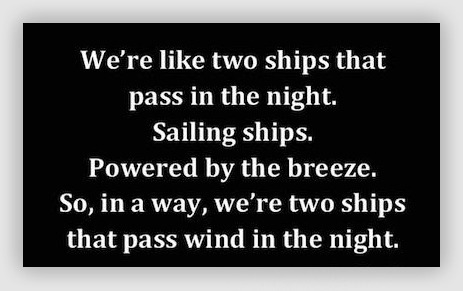
Unsurprisingly, when I considered today’s case – which illuminates the old doctrine of “ancient lights” – I looked for the type of bogus profundity that Professor Pennycook and his colleagues were writing about. As you can see to the left, finding something that was suitably bullshit was not hard.

“Ancient lights” was decidedly not bullshit. The name refers to, of all things, windows that have been around for awhile but eventually the name was loaned to an English doctrine of “presumptive title to light and air, received over land of another person, arising from the uninterrupted enjoyment of it for twenty years and upward, through the window of a dwelling house” (as described in Clawson v. Primrose). But America, being a land of opportunity and progress, was unwilling to tie the hands of property owners by implying easements of light and air in favor of countless neighbors.

Still, some found need for the “ancient lights” doctrine, and – because the doctrine was unavailable to them – tried the “side door.” The “side door” did not work for Rick Singer and the parents who bribed their kids’ way into college. And it didn’t work too well for the plaintiffs in today’s case.

Mohr v. Midas Realty Corporation, 431 N.W.2d 380 (Supreme Court, Iowa, 1988). Erick Mohr owned an office building situated on a commercial “strip” along Highway 20 in Fort Dodge, Iowa, with parking in front for use by tenants and customers. In 1983, Mohr’s neighbors to the west, Midas Realty Corporation and the Stan and Lynn Building Partnership, built a muffler shop on the front of their property with parking in the rear.

The muffler shop complied with zoning restrictions and setback lines, but it blocked the view of the Mohrs’ building to traffic approaching from the west.

Erick sued Midas for “unreasonable interference with Plaintiff’s lawful use and enjoyment of his private property.” He claimed damages and sought abatement of the alleged nuisance, that is, removal of the muffler shop.

Midas moved for summary judgment, arguing that Erick could not win under existing law. The trial court agreed, holding that Iowa nuisance law did not allow a suit for interference with view.

Erick appealed.

Held: Iowa law does not recognize a right to a view, and therefore, interference with a neighbor’s view does not a private nuisance make.

A private nuisance is generally defined at common law as “a substantial and unreasonable interference with the interest of a private person in the use and enjoyment of his land,” Not every interference with a person’s use and enjoyment of land is actionable, however. Here the trial court focused on a preliminary determination of whether Midas’ construction of the building, whether reasonable or unreasonable, interfered with a legally protected interest belonging to Erick Mohr.

Although the petition alleges interference with light, air, and view, Erick admitted at oral argument that the heart of his claim was that the Midas Muffler shop blocked the motoring public’s view of Erick’s building, thereby diminishing its value as a commercial property. Thus, he argued, Midas had enhanced its property at Erick’s expense, giving rise to a private nuisance action, where the parties’ competing interests in the use and enjoyment of land are weighed according to a reasonableness standard.

Midas argued that while Erick tried to pigeonhole his claim into a nuisance action, it was really a claim under the old English common law doctrine of “ancient lights.” Under that doctrine, a landowner acquired a negative prescriptive easement for sunlight across an adjoining landowner’s property and could prevent the adjoining landowner from obstructing the light once the easement was established by the passage of time.

The only problem with the “ancient lights” doctrine, Midas argued, was that every state considering the doctrine, including Iowa, repudiated its premise as inconsistent with the needs of a developing country. In fact, Iowa’s legislature passed a law in 1873 prohibiting the implied acquisition by adjoining landowners of “any easement of light or air, so as to prevent the erection of any building on such land.” Iowa Code § 564.2.

Mohr vigorously argued that his claim of nuisance had nothing to do with any claim of prescriptive easement for light and air, but the Court was unpersuaded: “We recognize,” the Court ruled, “that while disavowing any cause of action for interference with light, air, and view unless granted by express contract, our prior cases have left unanswered the question whether such claim might be sustained under the doctrine of nuisance. Squarely confronted with the question, however, we are convinced that giving vitality to such a cause of action in nuisance would be the same thing as granting a prescriptive easement.”

In other words, recognizing Erick’s right to enforce a nuisance claim for intentional interference with light, air, or view as something other than enforcement of the doctrine of “ancient lights” would be a distinction without a difference. “For a variety of reasons,” the Court said, “we think such an expansion of the law of nuisance would be unwise, at least in regard to the interference with view claimed here.”

Extending the law of nuisance to encompass obstruction of view due to lawful construction of a neighboring building would unduly restrict a property owner’s right to the free use of his or her property, interfere with established zoning ordinances, and result in an endless flood of litigation. Every new construction project is bound to block someone’s view of something, opening every landowner up to a claim of nuisance. The practical implication of such a right would be the need of every servient owner to obtain a waiver of the view easement from the “dominant” landowner. This would reduce development decisions to being made by a committee of all owners with sightlines to the project.

The Court found “no compelling reason to recognize an enforceable right of view over private property. Accordingly, we hold there can be no cause of action grounded in nuisance for blocking that view.”

– Tom Root

TNLBGray140407

Case of the Day – Friday, September 12, 2025

SPITE FENCE TAFFY PULL

Trust an angry plaintiff and a clever lawyer to stretch a useful concept like “spite fence” – which we have been talking about the last few days – like a salt water taffy pull.

We have established that a spite fence requires unreasonable height and a malicious motive. We have also figured out that a spite fence can be something other than a fence, such as the Maine widow woman’s “spite trees.”

It was probably inevitable that someone would go after a neighbor for planting plants that may someday be too tall. Add a complaint that the neighbor refused to knuckle under when the plaintiff tried to boss him and her around regarding their landscaping, and, voilà, you have malice.

Just as the cops in Minority Report arrested people who would someday commit a crime (surely a useful idea), this theory holds people liable because their plantings might someday be a natural spite fence.

Fortunately, the Mississippi courts that heard this one all made short work of it.

Blackwell v. Lucas, 271 So. 3d 638 (Ct. App. Mississippi, Nov. 20, 2018): The Lucases planted some plants and shrubs in the front yard of their Ocean Springs, Mississippi, home. The Blackwells believed that if allowed to grow, the plants and shrubs would at some indeterminate time in the future block their view of the ocean, the sunsets and the beautiful areas normally and typically available to property owners in the Oak Bluff Subdivision.

Thus, the Blackwells asked the Lucases to remove the plants and shrubs or to retard their growth so that their view of the ocean and surrounding area would not be impaired. The Lucases, being your average, reasonable American homeowners, declined courteously.

Actually, it may not have been “courteously.” The Blackwells argued that the Lucases were being mean: “The shrubs and plants installed by Mr. & Mrs. Lucas have no beneficial use and were installed and maintained by them for the purpose of annoying the Blackwells and preventing them from enjoying their property.”

The Blackwells, also being your all-too-common American homeowners, sued the Lucases for planting shrubs that “will unreasonably block the view of the Blackwells.” The term “unreasonably,” in this case, apparently meant anything that might alter the status quo in any manner the Blackwells found objectionable: “The actions of Mr. & Mrs. Lucas,” the Blackwell’s complaint alleged, “amounts [sic] to and/or equates [sic] to an invasion of the Blackwells’ interest in the use and enjoyment of their land and the invasion is intentional and unreasonable or negligent.”

Strong words, indeed! But the trial court was unimpressed and tossed the suit out on its ear. Not taking the hint, the Blackwells appealed.

Held: The trial court’s dismissal was upheld.

The Blackwells had no common law or statutory right to an unobstructed view across the Lucases’ property, nor did they have a right to dictate the type or placement of the Lucases’ plants and shrubs. The Blackwell complaint failed to state a cause of action for a nuisance or to allege any present injury or an imminent threat of irreparable harm for which there was no adequate remedy at law.

The Court of Appeals observed that a cause of action arises out of a pre-existing primary legal right with which the law invests a person. The right to maintain an action depends upon the existence of a cause of action which involves a combination of a right on the part of the plaintiff and the violation of such right by the defendant. Thus, the existence of a legal right is an essential element of a cause of action, inasmuch as a plaintiff must recover on the strength of his own case instead of on the weakness of the defendant’s case. It is the plaintiff’s right, not the defendant’s wrongdoing, that is the basis of recovery.

That right or duty must be a legal right or duty, and not a mere moral obligation that is enforceable neither in law nor in equity.

Applying the general notion to this case, the Court of Appeals observed that property owners have a legal right to cut and remove any part of a plant or shrub that grows on or overhangs their property. They have a legal right to sue to abate a nuisance. But property owners have no legally cognizable right to a view across their neighbors’ property. Nor do they have a right to dictate the type or placement of the neighbors’ shrubs.

The shrubs were not a nuisance. The Lucases would be subject to liability for a private nuisance only if their conduct is a legal cause of an invasion of the Blackwells’ interest in the private use and enjoyment of land. Again, without a legal right to a view across the property, there simply is no such interest to be invaded.

But the Blackwells tried to bootstrap their claim into a “spite fence” argument. They argued that the plants and shrubs would someday obstruct their view, and this fact gave them a viable cause of action for a “spite fence” nuisance.

The Court of Appeals held that the Blackwells’ “spite fence” claim had no basis in Mississippi law. Because the one Mississippi case on “spite fences” was decided by an evenly divided Court, “there is still no precedent for such a claim under Mississippi law. Moreover, we decline to recognize a new cause of action for a “spite fence” in a case that does not even involve a fence,” but instead only “some unspecified ‘plants and shrubs’ that, “[i]f allowed to grow,” allegedly may obstruct the Blackwells’ view.

– Tom Root

TNLBGray140407

Case of the Day – Monday, August 18, 2025

GIVE ‘EM AN INCH …

fence150722We continue our tour through the House of Bad Neighbor Horrors today (see our post from Wednesday) with a look at neighbors Paula A. Luckring and Christopher Blair.

An old legal adage holds that “a bad settlement is better than a good lawsuit.” Paula Luckring sued her neighbor, arguing that branches from his trees overhung her property, and that they were doing all the kinds of things trees do – you know, dropping twigs and leaves, leaking sap, growing roots, just normal tree stuff. Paula insisted that she was entitled to something north of $13,000 because the trees were “trespassing” on her property, making claims that sounded a lot like her lawyer had read Fancher v. Fagella.

Neighbor Chris Blair counterclaimed, pointing out that if Paula wanted to really get technical, her deck – which she claimed was being damaged by his trees – was built partly on his property, and it should be removed.

The case looked like the trial would be the Saturday night main event, but alas … before trial, the parties settled. There’s nothing wrong with that. Civil actions are just a formalized means of settling disputes, a little more complex and fact-driven than “rock, paper, scissors,” but often, it seems, just as random. When the parties find a means short of a full-blown trial to resolve things, time and money are saved, and people are able to get on with their lives.

That must be what Chris thought, because he settled the case with Paula before trial. He agreed to give Paula title to an 11-foot strip of his own land and to build, at his own expense, a fence marking the new boundary line between their properties.

appease150722We have to hand it to Chris. He apparently was a Bible scholar, and remembered Matthew 5:39 – 40: “But I say to you, do not resist an evil person; but whoever slaps you on your right cheek, turn the other to him also. If anyone wants to sue you and take your shirt, let him have your coat also…” For that matter, Neville Chamberlain thought that giving Hitler Czechoslovakia would keep the brown shirts out of Paris.

We’re not saying Ms. Luckring was evil, nor would we ever equate her territorial ambitions with those of the Third Reich. For a concession to be effective, however, the party being appeased has to be acting in good faith. This is rarely the case. Rather, the problem is that the party being appeased has probably acted in bad faith in order for affairs to get to the point that appeasement is necessary. Hitler had the “Anschluss.” Without it, Chamberlain wouldn’t have needed to make a deal. Putin started by taking South Ossetia from Georgia. Then, he grabbed Crimea, and now he is busy trying to take Ukraine (if not Moldova, Estonia and the other Baltic states as well). History has shown us that appeasement doesn’t work because appeasement only convinces the appeased party that bad conduct pays. And just two years ago today, notwithstanding years of negotiations, the Taliban just went ahead and took it all.

Ask Chris Blair about appeasement. Chris thought he had bought peace by giving away a piece of this land. But when Chris hired a fence company to build the agreed-upon fence along the new boundary, Paula Luckring refused to let the contractor set foot on her property during the construction process. It’s hard to build a fence from one side only. To further appease Ms. Luckring, the contractor built the fence 13 inches into Chris’s side of the boundary. After that, when Chris’s caretaker (Chris himself had severe Parkinson’s, a condition that undoubtedly only goaded Ms. Luckring into further predations) would try to use a weed whacker on the grass growing in the 13-inch space between the new boundary and the fence, Ms. Luckring demanded that he do the cutting without setting foot on her property. However, she magnanimously conceded, she would cut the grass on the 13-inch strip… if Chris gave her an easement for the 13 inches of space.

nomans150722The trial court was drawn back into what it called the “predictable drama” that arose from Ms. Luckring’s demands. It told Paula that she had to pay to have the fence moved and reinstalled right along the boundary. No 13-inch “no man’s land.” No easements. No more trespassing actions.

Naturally, Ms. Luckring appealed. The appellate panel was having none of it. It held that “a mere cursory review of the Plaintiff’s pleadings and her own testimony … adduces an ongoing pattern of bullying of a Defendant who granted her the moon and the stars in acquiescing to her unceasing demands, and yet was confronted with demands for more …” It’s not unheard-of for a plaintiff to cripple her case by her own testimony, but to prove yourself to be a bully?

Under the circumstances, making Paula pay to relocate the fence seemed to the court to be a lot like justice. Approximate justice, but still justice.

Luckring v. Blair, 2014 Pa. Dist. & Cnty. Dec. LEXIS 3 (Com.Pl.Ct. Pennsylvania, Dec. 3, 2014). Paula Luckring sued neighbor Christopher Blair, alleging that his pine and sycamore trees trespassed onto her property, causing public safety issues that had been presented to the local township authorities. She additionally complained of damage caused by “tree sap, needles, branches, cones, roots” constituting a “nuisance” because the trees overhung, fell upon, and grew under her property which caused damage such as a broken window, damage to a deck and stamped concrete, as well as clogging a sewer line and causing landscape damage. She demanded $13,369 for cutting down or trimming the offending trees and restoring her property to its previous condition.

trespass150722Blair countered that he had given Luckring permission to trim the sap-dripping white pine tree all the way back to its trunk, but her trimming caused the sap to drip excessively because there were no tree branches remaining to catch and absorb its flow. He also said that she had previously accepted his written permission and cut down the encroaching white pine tree at her own expense. He argued she should not now be able to renegotiate that contract. He also counterclaimed, alleging that Luckring was trespassing on his property with her deck and retaining wall.

The parties settled the case before trial by signing a settlement agreement that called for Blair to grant title to Luckring, free of charge, to an 11-foot strip of his own land and to build, at his own expense, a fence marking the new boundary line between their respective parcels. Nevertheless, the parties were back in court a year later seeking to resolve the predictable drama ensuing from the Plaintiff’s abject and literal refusal to allow the fence company to set foot on her newly acquired property in order to erect the structure. The contractor then built the fence thirteen inches inside the Blairs’ side of the new property line in order to appease the Plaintiff in that regard. Adding further insult to injury to Blair, who suffered from severe Parkinson’s Disease, Luckring demanded that when Blair cut the tall grass and weeds on the 13-inch strip of his property on Luckring’s side of the fence, such work must be accomplished without setting foot on her land. She offered to cut the grass and weeds herself, but only if Blair granted her an easement to that additional piece of his property.

The appellate court enforced the settlement agreement by ordering Luckring to move the fence to the boundary line of the respective properties at her own expense.

Luckring appealed.

Held: The enforcement of the settlement agreement was upheld.

The appellate panel noted with disdain that after Blair applied for a building permit for the fence in May 2013, Luckring made multiple calls to Haverford Township officials to note her opposition to the fence despite having agreed in the settlement not to oppose in any manner the erection of the fence and to waive any and all objections thereto. She also erected signs on her property pointing in the direction of Blair’s residence that said “No Trespassing,” and put up a sign on her property ordering the fence company not to install the fence all the way to the sidewalk, contrary to Blair’s instructions. She also initiated a verbal confrontation with Mary Blair, in which she accused the Blairs of being “too cheap to get their own survey”, even though the settlement agreement required Luckring to bear the expense; and she hammered stakes into the ground on Blair’s property and – after the fence was built – she entered Blair’s property to “wash” the brand new fence.

Whatever Ms. Lucking might do for a living, we're betting it's not driving the Welcome Wagon.

Whatever Ms. Lucking might do for a living, we’re betting it’s not driving the Welcome Wagon.

The Court noted that when Luckring was asked at the hearing to expound upon her belief that the parties must strictly adhere to the terms of their settlement agreement regarding the need to care for the portion of the Blairs’ land outside the fence line and abutting her property, she replied that if the caretaker stepped on her property during this process, he would be trespassing and that she would sue.

The Court concluded that a “mere cursory review of the Plaintiff’s pleadings and her own testimony at the Hearing on the Defendant’s Petition to Enforce Settlement adduces an ongoing pattern of bullying of a Defendant who granted her the moon and the stars in acquiescing to her unceasing demands, and yet was confronted with demands for more. The parties’ Settlement Agreement and Release provided for a fence to be built by the Defendant on his side of the new boundary line of the neighboring properties, albeit without trespassing on the Plaintiff’s land. A reasonable interpretation of this requirement would result in the edge of the fence being placed on the edge of the Plaintiff’s new property line and not crossing this point of demarcation. Moreover, the momentary intrusion involved in its construction would be of no concern whatsoever with regard to the fence contractor’s presence on the Plaintiff’s side of the boundary line in order to complete the effort. However, the Plaintiff took the extreme position that enforcement of these provisions must be strict, and refused to permit the fence installer to step on her property to undertake its construction in the place designated by the Defendant in express accordance with the parties’ stipulated Agreement. As a result, the fence contractor took it upon itself to erect the structure thirteen inches inside the Defendant’s side of the boundary line, instead of on the line itself, in order to placate the Plaintiff. The Plaintiff then added to this mix of unreasonableness and bad faith by complaining that the Defendant’s landscaper was stepping on her property when clearing weeds and high grass growing on the 13-inch strip on her side of the fence that remained in the ownership and possession of the Defendant.”

Calling Luckring’s conduct “obdurate and [in] bad faith,” the Court concluded that Luckring had not acted in good faith, and the trial court’s order that she pay to move the fence “was warranted and necessary to achieve justice in this case.”

– Tom Root

TNLBGray140407

Case of the Day – Wednesday, August 13, 2025

PEOPLE BEHAVING VERY BADLY

The late Jeffrey Epstein, Ye, Vladimir Putin, Yahya Sinwar, George Santos, Robert Menendez, even President Trump (whose increasingly shrill insults blast people who are (or were) supporters)… we’ve had a belly full of people behaving badly irecently.

Like we need this, here are a few more:

Welcome to the neighborhood ...

Welcome to the neighborhood …

Meet the Cooleys, neighbors who were so bad as to drive the Court to write a plaintive plea that everyone should try to get along. How bad, you ask? Well, Mrs. Cooley tried to run down her neighbor with her car. She built a chicken-wire spite fence. Her son threatened to beat up his elderly neighbor (who had just had a heart transplant). Yes, that bad…

This case is one of those rare fact-driven trial court decisions worth reading just to get the flavor of the Court’s incredulity that people could carry on like this. At one point, the judge observes that “[o]ne could almost use that well-worn lawyer’s expression ‘I rest my case’ after merely viewing Mrs. Cooley’s Exhibit 12, which in gruesome detail sets out the ‘this is my property’ syndrome.” The court finally issues a 15-point injunction ordering the Cooleys to stop doing 12 acts of malice, and the Quarantas to refrain from three others. It found application for a seldom-used Connecticut statute prohibiting structures built out of malice, banning a chicken-wire monstrosity erected by the Cooleys as a “spite fence.” Finally, it found the often-alleged but seldom-proven “intentional infliction of emotional distress” tort to have been shown here and ordered the Cooleys to pay the Quarantas’ legal fees.

At the end of its opinion, the Court ordered each party to read his final words out loud. Those were a plea by the Court for these people to rewind the clock to the beginning and try to get along. The Court’s frustration and sense that no matter what the law said, nothing would stop the bickering, is evident in the opinion. Not great moments in the development of the law … just a neighbor law tale worth reading.

There was even a

There was even a “spite fence” in the story …

Quaranta v. Cooley, 2007 Conn. Super. LEXIS 3199, 2007 WL 4577942 (Conn.Super. 2007). People behaving very badly. You know how the opinion’s going to go when the Court begins by quoting an old Supreme Court opinion that “… it is the bickerings, spite, and hatred arising from neighborhood quarrels; it is difficult for any legislation to remedy such evil.”

The Quarantas were senior citizens who had lived in the same home for 26 years. Mr. Quaranta was on a life support system and eventually had a heart transplant. The Cooleys were younger than the Quarantas, but had a 25-year-old son and health considerations of their own. When the original landowner subdivided his property into the lots which became the homes of the Cooleys and Quarantas, there was an existing paved driveway to the Quarantas’ home from the street, bordered with a split rail fence and a grassy area on each side. The landowner created by deed two 25’ easement roads (for a total width of 50 feet) over the same area on which his driveway existed. Each lot owned 25’ of the road, and each owner had the right to pass over the 25 feet owned by the other. The practical effect of these easements is to allow all three parcels of land to share access to the public street with one common driveway. Although the neighbors couldn’t see each others’ homes, they ended up in a continuing vitriolic spat in which each side accused the other of using the “F” word, raising the middle finger on numerous occasions, and other immature and harassing behavior, such as the noisy racing of vehicles, the blowing of car horns and trash placement fights.

ass150721The Court held that the Cooleys, who were New York City dwellers unused to suburban life, utterly lacked credibility on the stand. It found that the battle began with Mrs. Cooley delivering a letter to the Quarantas within 30 days of her having moved in, in which she told them their lampposts and driveway sat on the Cooley property. Then, the Cooley son began throwing keg parties at the Cooley home, with noisy partygoers parking all along the right-of-way. The parties were noisy and annoying, and afterward, the Quarantas found themselves cleaning up empty bottles and cigarette butts. The parties were held about four times a month. The Quarantas complained without effect. The grand finale was the Cooley Halloween Party in 2005. When Mrs. Quaranta went out in her nightgown to ask for peace and quiet, the partygoers cursed her – one exposing himself to her – and urinated toward her. After this, Mrs. Cooley and her daughter, took to riding at high speed over the grassy area, even leaving deep tire tracks. Although the Cooleys’ trash pickup was on Friday, they would put their trash out all week long, at a spot where it was viewable only from the Quarantas property. Animals got to the trash during the week, and the Quarantas did the cleanup. Mrs. Cooley would drive fast down the mutual passage raising dust and her middle finger while blowing her horn the entire distance. She overdosed her own lawn with weedkiller, killing all of the grass ostensibly so she wouldn’t have to mow. Her lawn, of course, fronted on the Quarantas’ lush and meticulous yard.

badneighbora140204There were countless verbal confrontations as well. The Cooley son yelled at Mr. Quaranta, a man past 65 with a heart transplant, “Hit me! I’ll wipe the ground up with you.” Previously, another judge had ordered the parties to refrain from intimidating, threatening, harassing, stalking, assaulting, or attacking each other, and to refrain from entering the property of the other, until the dispute was tried and resolved on the merits. After that, the Cooleys built an ugly chicken wire fence on the side of the passage that fronts the Quarantas’ house only. The trial court was called upon to mediate the dispute.

Held: The Court found for the plaintiffs, the Quarantas. It held that Mrs. Cooley’s testimony was so bad that it noted that “[o]ne could almost use that well-worn lawyer’s expression ‘I rest my case’ after merely viewing Mrs. Cooley’s Exhibit 12, which in gruesome detail sets out the “this is my property” syndrome. The court found it unsurprising that she took an axe to – and threatened to destroy – anything, even things of beauty, found on her property. These items included a lamppost, (that provided her light with the Quarantas paying for the electricity), fences (that enhanced the entrance to both their properties), a beautiful birch tree (with no professional evidence that it had to be cut down), a ceramic nameplate, (which her son admitted smashing) and even shrubbery. “Such warmth!” the Court said. “And it shows in the fifty-plus exhibits.”

The Court held that the chicken wire fence was maliciously erected, based on its character, its location, and the obvious state of mind and motive of the defendant. It ordered the fence removal pursuant to §52-480 of the Connecticut Statutes. It found that the Cooleys had exceeded the use of the right of way in a vindictive and malicious manner so as to harm the Quarantas, rather than just for ingress and egress. It held that a number of the Cooleys’ activities on this simple right-of-way were, “in layman’s terms, ludicrous, and in legal terms harmful, unnecessary, illegal and unreasonable.” It issued a detailed injunction spelling out 12 acts in which the Cooleys were not to engage, and 3 acts in which the Quarantas were not to engage.

A happy ending? Not with these folks ...

A happy ending? Not with these folks …

Based upon the totality of the evidence, the Court held that the Cooleys directly and indirectly negligently and intentionally caused severe emotional distress to the Quarantas, and knew or should have known that their acts would result in severe emotional distress to the plaintiffs. In the case of Mr. Quaranta, the distress was found to be life-threatening. The Cooleys evidenced a reckless indifference to the Quarantas’ rights and showed an intentional and wanton violation of these rights. The injury was inflicted maliciously, with evil motive and violence. The Court awarded the Quarantas their legal fees as damages.

The Court took the unusual step of ordering a final statement to be personally read by the parties. It begged both parties to “go back to the day the Cooleys moved in and put everything back the way it was. Let us dig a hole and bury all of the ill feelings and hatreds that are all consuming.” The Court, writing this on Thanksgiving Eve, ended by noting that “[t]he person whom many people honor in this Holiday Season forgave everyone. Isn’t it time that the Quarantas and the Cooleys caught the spirit of the Season?”

Postscript: They did not. Rather, they were back in court repeatedly between 2007 and 2013, arguing over contempt motions filed against each other. Oh, the humanity …

– Tom Root

TNLBGray140407

Case of the Day – Monday, August 11, 2025

FISTS, NOSES AND TREES

punch50720Everyone’s heard the old saw that “the right to swing my fist ends where your nose begins.” Imagine your nose is a 65-foot tall maple tree, and my fist is a backhoe. Good luck with that – most imaginations aren’t quite that agile.

Here’s the problem. We all know about “self help,” the venerable old Massachusetts Rule that limits a landowner to trimming away encroaching branches and roots from a neighbor’s tree up to the property line. Michalson v. Nutting – and virtually every encroachment case decided in the eight decades since that decision – has given a property owner the right to trim back a neighbor’s tree to the boundary without any limitation.

At the same time, we all know about boundary trees, those trees whose trunks enter the earth smack on the property line, so that tree is attached to the ground in both properties. Boundary trees are special, and the general rule is that neither property owner may trim the tree without the consent of the other.

But what happens when a neighbor’s tree is not on the boundary, but so encroaches on a landowner’s property – both above ground and below ground – that the practical effect of the landowner’s Massachusetts Rule self-help will be to kill the tree?

solomon150720Remember King Solomon? When two women appeared in front of him arguing over who was the mother of a baby, he proposed to settle it by cutting the baby in half so that each woman would get 50 percent of the child. That threat was enough to smoke out the imposter. In today’s case, dividing the tree in half would have had the same effect as cutting up the infant (albeit with less blood).

The Alvarezes own a nice place in Vermont, complete with a view of Lake Champlain. They have a 65-year-old maple tree next to the property line of their neighbors, the Katzes. It was close, but the base of the tree was completely on the Alvarezes’ property, so this was no boundary tree the parties were dealing with.

The tree had been standing for almost seven decades. In fact, when the Alvarezes bought the property 20 years ago, the maple had already sent roots and branches across the boundary between the two parcels.

The Katzes, who also enjoy a view of Lake Champlain, have planned for a number of years to add to their house, essentially doubling its size with a two-story addition. The only problem – or at least, the only problem we care about – was the maple tree. To add on, the Katzes would have to cut away about half of the maple tree’s branches and roots, in all likelihood killing the tree.

The Alvarezes and Katzes tried to resolve the problem amicably, but – just as happened with the women in front of King Solomon – there really wasn’t any middle ground. Either the Katzes would get their way, building onto their house and killing the tree, or the Alvarezes would have it their way. Like Dr. Seuss’s north-going and south-going Zax, neither neighbor would budge.

But then Katz somehow learned all about the Massachusetts Rule. It dawned on him that he could cut back the offending maple tree to the property line, both roots and branches. Sure, the tree might die, but the Massachusetts Rule said nothing about what happened to the tree after a neighbor used “self-cutting” trimming on it.

The Alvarezes ran to court and obtained an injunction against Katz. The trial court found that trimming the tree as Katz proposed doing would probably kill it. The injunction prohibited cutting away only about 25 percent of the tree, about half of what the Katzes needed for their ambitious plans.

The Katzes appealed, and the Vermont Supreme Court threw out the injunction. It held that the Massachusetts Rule was a blunt object, and had always been one. A landowner owns everything above and below ground level, and that owner can cut anything he or she wants to cut, without regard for the effect of the cutting. The Court said that was the law in Vermont and just about everywhere else.

The Zaxes wouldn't budge, either ...

The Zaxes wouldn’t budge, either …

The Supreme Court seemed a little uncomfortable with its decision, but it ruled in essence that the law is the law, and that’s the way Vermont had always done it. It noted, in a hint that was as subtle as an anvil, that cases where Massachusetts-style self-help had been limited – such as in Booksa v. Patel – the theory that had been advanced was that of nuisance. In other words, the Alvarezes could have argued that Katz’s proposed trimming would so endanger the tree that it would interfere with their enjoyment of their property. Recall in Booksa, the court ordered the defendant to trim the encroaching tree reasonably. The Vermont Supreme Court telegraphed that it would probably have done the same if the Alvarezes’ lawyer had only thought to make the argument. Oops.

Alvarez v. Katz, 199 Vt. 510, 124 A.3d 839 (Supreme Ct. Vermont, 2015). The Katzes own property in South Burlington around the Shelburne Bay area. The Alvarezes own the adjoining lot just to the north of the Katzes. The Alvarezes have a 65-foot-tall maple tree, the trunk of which is located entirely on their property. About half of the branches and roots from the tree cross the property boundary and encroach onto the Katz lot. Some roots extend under the Katzes’ existing deck.

For several years the Katzes have sought to expand their home by adding a two-story addition on the rear. The plans for the construction of the addition would require cutting the roots and branches that are encroaching on their property. This could encompass up to half of the tree’s roots and branches.

The Alvarezes and the Katzes have been unable to amicably resolve the problem of the maple tree. In 2013, when the Katzes considered taking unilateral action to trim the tree’s roots and branches, the Alvarezes filed for an injunction. The superior court found it more likely than not that removal of 50% of the tree’s roots and branches would result in the premature death of the tree, perhaps within five years and probably within ten from the time of cutting. The court employed what it called the “urban-tree rule,” under which trimming the roots or branches of an encroaching tree may be proscribed if the trimming will destroy the tree. The injunction barred the trimming of more than 25% of the roots and branches of the tree.

The Katzes appealed.

Held: The injunction was vacated. The Supreme Court reaffirmed “Vermont’s long-standing right of a property owner to trim branches and roots from an encroaching tree without regard to the impact that such trimming may have on the health of the tree.”

Vermont has long recognized ownership of property to include the ownership of that which is below the ground and that which is attached overhead. The right has been clear for almost 100 years, since Cobb v. Western Union Telegraph Co., (a 1916 decision that stated the Massachusetts Rule before there ever was a Massachusetts Rule). Cobb held that “it is a sound principle that where a tree stands wholly on the ground of one and so is his tree, any part of it which overhangs the land of an adjoining owner may be cut off by the latter at the division line.” The Supreme Court criticized the trial court for conjuring up an “urban-tree rule” that would be an exception to Cobb. The trial court had considered this case to be one of first impression in Vermont because of the anticipated adverse – and likely fatal – effect the root-and-branch cutting would have had on the encroaching tree. The Supreme Court held that any attempt to “distinguish” Cobb, that is, to find that the Cobb case was somehow different just because the Cobb tree was located in a rural setting, was wrong.

Further, the Supreme Court said, the “urban-tree rule” does not enjoy the support attributed to it by the trial court. Outside of two cases, the California decision in Booksa and one obscure New York decision, the Massachusetts Rule (which maybe we should have called the “Vermont Rule”) enjoys extremely widespread support. What’s more, the Court reasoned, the Vermont legislature has had 99 years to modify the Cobb holding by statute, and it has not bothered to do so. The Supreme Court concluded that the “right to cut encroaching trees where they enter the land of another, without regard to the impact on the encroaching tree by such cutting, is well-established under Vermont law.”

The Supreme Court noted that at common law, the right to cut encroaching boughs and roots historically counterbalanced a landowner’s right to grow shade trees on his land, regardless of the impact those trees may have in casting shade or encroaching upon the neighboring property. Common law provided no claim for damages caused by encroaching roots or branches. Instead, the remedy was one of self-help, allowing the cutting of roots and branches to the extent of encroachment.

Where other jurisdictions have departed from the common-law rule and allowed actions for damages as a result of encroaching roots or branches, they have generally relied upon nuisance principles. Even where such actions have been permitted, those jurisdictions continue to recognize the right to self-help. In this case, the Alverezes did not raise a nuisance claim, so “the issue of whether a nuisance claim might exist for the encroachment of roots and branches from the Alvarezes’ tree is not presently before the Court.”

The Supreme Court subtly suggested that the proper way for the Alvarozes to address the problem would be through the law of nuisance ...

The Supreme Court subtly suggested that the proper way for the Alvarozes to address the problem would be through the law of nuisance …

The Supreme Court defined the conundrum as follows: “[T]his case presents the competing interests of neighboring property owners. On the one hand, [the Katzes] have an interest in using their land, which they have purchased and upon which they pay taxes, as they see fit, within permissible regulations, free from limitations imposed by encroaching roots and branches from the neighbors’ tree, which they did not invite and for which they receive no benefit. The Alvarezes seek to restrict the use of the Katz property by preventing the removal of branches and roots on land that is not theirs and for which they have given nothing of benefit to [the Katzes] for suffering the encroachment. On the other hand, the Alvarezes wish to continue to enjoy their tree, which has been there for many years, without placing its viability in peril due to the construction that [the Katzes] wish to undertake.”

The Court observed that if the Alvarezes had the right to have their tree encroach onto the neighboring property, the obvious next question would be to what extent the encroached-upon property owner must suffer such an encroachment. The Supreme Court admitted that on some occasions the “exercise of self-help may result in the immediate or eventual loss of an encroaching tree, given the long-recognized rule in Vermont and its widespread support elsewhere, we decline to depart from the common-law rule in favor of the approach adopted by the superior court.”

– Tom Root

TNLBGray140407

Case of the Day – Wednesday, July 16, 2025

THE BOUNDARY TREES OF WALTER PRIDDY


mitty140808You know how free association goes. It’s summer, hot and humid, and we face a string of 90-degree plus days in our future, so we’ve been groovin’ (a 60s term, kiddies) on an old Lovin’ Spoonful hit, “Summer in the City.

Although operating without a lot of the mental stimulants that were so freely available during the Summer of Love, we nonetheless started pondering the line “Back of my neck gettin’ dirty and gritty.” “Gritty” rhymes with “pretty,” which rhymes with “Priddy.” And there you have it. Thinking a lot about tree law (as we do), we recalled Walter Priddy.

“Oh, yeah,” you say, “that guy James Thurber wrote about. The secret life and all … The Ben Stiller movie …” No, not ‘Mitty.’ We’re talking ‘Walter Priddy.’ No “secret life” that we know of, but something just as fascinating – a line of boundary trees, an unhappy neighbor, a homeowner’s association, counterclaims. Our meat and potatoes, you know.

It ought to be rather obvious — a court can only decide issues that have been placed before it, and can only order remedies that address the causes of action that it has found to have merit. Courts sometimes lose their way, though, as did the California trial court in today’s case. The Boussiacoses (pronounced “them”) complained that the Priddys’ shade trees along their common boundary were a nuisance, messed up the Boussiacoses’ deck, and violated the homeowner’s association’s rules. The Priddys argued that the trees did no such things, and anyway, the Boussiacoses’ deck had been built without the homeowner’s association’s permission, constituted a nuisance itself, and violated the rules.

The trial court ruled that neither side was entirely correct. Now, your average observer would conclude that the decision meant that the Boussiacoses kept their deck and the Priddys kept their trees. But the trial court decided that the Boussiacoses must have reached an oral “understanding” (and we don’t know how an “understanding” surrounded by quotation marks differs from one that isn’t in quotes) with the owners before the Priddys that the trees would be kept trimmed. Now, mind you, the Boussiacoses hadn’t argued that there was such an “understanding,” or that if there was it should be treated like some kind of enforceable agreement. But the trial judge – quite proud of his “solution” – decided that the phantom “understanding” should bind the Priddys anyway. He crafted a decision that let the Boussiacoses keep their deck provided the Priddys got to keep their trees, but the trees had to be hacked off at the height of some wrought-iron fence that was apparently part of the landscape.

Solomonic, you say? Not really. Remember that King Solomon never really intended to cut the baby in half. Plus, that decision at least directly addressed the issue the two warring women had placed before the King and no more – that question being exactly whose baby the subject infant was. Here, the trial court found that there was nothing wrong with the trees and nothing wrong with the deck, but he ordered the trees trimmed anyway. It’s kind of like being charged with bank robbery, being found not guilty by the jury, but being sentenced to 5-10 years in the pen anyway because the judge thinks you probably cheated on your taxes.

In this dramatic re-enactment, King Solomon faces a tough decision.

In this dramatic and plastic re-enactment, King Solomon faces a tough decision – how to divide the bambino.

The Court of Appeals thought as little of the trial court’s decision as I do. It made short work of the trial court’s order. Because no one had raised the issue of whether there had been an understanding (or “understanding”) about the trees between the plaintiffs and the prior owners of the defendants’ place, the trial court couldn’t find that there had been one and entered an order accordingly.

Boussiacos v. Priddy, 2007 Cal. App. Unpub. LEXIS 9979, 2007 WL 4306835 (Cal.App., Dec. 11, 2007). The Boussiacoses sued their next-door neighbors, the Priddys, for statutory nuisance and violation of their mutual homeowners’ association’s covenants and rules. They alleged the Priddys maintained trees that blocked the Boussiacoses’ view along the parties’ shared property line. The Priddys counter-sued, alleging nuisance and violation of the covenants and rules, because the Boussiacoses had apparently built their deck without the homeowners association’s approval.

Following a bench trial, the trial court found that neither party had proved any of the claims raised in the pleadings. However, the trial court entered judgment anyway, requiring the Priddys to maintain the trees at specified heights in accordance with an “understanding” allegedly entered into by the Boussiacoses and the previous owners of the Priddys’ property. He also ruled that the Boussiacoses could keep their deck. The Priddys appealed, arguing that the trial court couldn’t enter a judgment where it hadn’t found the Boussiacoses’ underlying claims to have any merit.

No pruning for the Priddys

No pruning for the Priddys

Held: The trial court’s “judgment” was thrown out. The Boussiacoses had asserted only two claims against the Priddys: statutory nuisance and violation of the homeowners’ association’s covenants and rules. Because the trial court concluded on the record that the Boussiacoses failed to prove either claim, the Court of Appeals said, the judge was without any legal authority to make findings regarding an “understanding” between the Boussiacoses and the previous owners of the Priddys’ property. Such an “understanding” wasn’t alleged in the pleadings. The judge could not conclude that this understanding was enforceable against the Priddys and could not enter a judgment that imposed tree-trimming maintenance obligations on the Priddys.

The Court of Appeals held that a trial court’s award of relief must be based on a pleaded cause of action. Trial courts are more arbiters than gods. Here, the trial court transcended the limits of its authority. Because the record did not show that the enforcement of any agreement between the Boussiacoses and the previous owners of the Priddys’ property was before the court, the trial court erred by awarding the Boussiacoses relief on that basis.

A groovy appellate decision, I must say.

– Tom Root

Case of the Day – Monday, July 7, 2025

NOW LOOK WHAT YOU’VE DONE!

Rarely (as in “I don’t recall when I’ve ever said this before”) do I caution that the prevailing law in any particular state is wrong, and likely to be cruisin’ for a bruisin’ the next time an appellate court has to think about it. But I feel comfortable issuing that warning about today’s case.

From Ohio (home of rock ‘n roll, pro football, the first guy to walk on the moon, the brothers who turned a bicycle into the first airplane, and a ton of other cool things), comes a case that pretty much runs smack into Fancher, Herring, the Hawaii Rule, and a raft of other cases reflecting the modern view that a homeowner whose tree is wreaking havoc on the neighbor’s property may be ordered by a court to fix the damage at his expense.

To be fair, this case may be proof of the old legal aphorism that “hard cases make bad law.” Even the most cursory reading of the facts suggests that Dave Rababy may well have been a horse’s ass, hounding his neighbor because a tree dropped leaves and twigs on his property. Speaking as a guy who owns all of my five southern neighbors’ leaves every fall – and these things are the size of dinner plates – I understand how it can be irritating to have other peoples’ leave on your lawn. But I would never sue them over it. I don’t think I would…

Dave had no such compunction, and his emesis of woe delivered to the court made him the boy who cried wolf. He howled so loudly about leaves and twigs and the fact that his trimming crew was not allowed to trespass on Roy’s property and hack away at the offending tree, and minutiae of a similar nature, that his real complaint – his driveway was being heaved and foundations dislodged by the roots – got lost in the underbrush. In Fancher, Whitesell, and even Iny, such damage was enough to get the neighbor’s tree declared a nuisance. If Dave had exercised a little plaintiff self-control, he might have gotten there, too.

We are too urban and too suburban, and our properties are too developed for the Massachusetts Rule to be the exclusive remedy for genuine harm done by a neighbor’s tree. That is the way the law is trending throughout the civilized world, and it is bound to reach Ohio sooner or later.

Rababy v. Metter, 30 N.E.3d 1018 (Ct. App. Cuyahoga Co., 2015). David Rababy and Roy Metter were next-door neighbors. Dave’s driveway abutted Roy’s property in certain places and nearly abuts in others. A fence separated the properties, and a stand of mature trees ran along the fence on Roy’s side of the boundary line.

Dave sued Roy for negligence, nuisance, trespass, and interference with a business contract. Dave asserted that trees at the edge of Roy’s property extended over his own property, and dropped leaves, needles, sap, and branches onto his car and home. Some of the trees, Dave complained, were rotten. He whined that the trees cast shadows over his property and cause mold growth on his roof, as well as damaged his driveway and foundation.

Dave groused that he had hired a company to trim the overhanging branches, but Roy’s daughter prevented the unnamed landscape service company from properly performing this work. The complaint alleged the trees constituted an ongoing nuisance and trespass, and that Roy negligently maintained the trees. Dave asked for $52,500: $37,000 for future tree trimming services and $15,000 in compensatory damages.

Both parties filed motions for summary judgment. Dave argued that on “an ongoing basis, Roy’s trees encroach onto my property, specifically over my home and driveway. His trees deposit leaves, debris, and sap onto my property, causing damage.” Dave also repeated the claim about Roy’s daughter running off the tree trimmers.

Roy argued that he owed no duty to Dave to trim otherwise healthy trees on his property. He claimed the trees were mature and preexisted either party’s ownership of the property. He said that a year before, Dave hired Cartwright Tree Service to trim the row of pine trees that ran along the driveway. He said no one complained when Cartwright trimmed the overhanging branches from Dave’s property free, but when Cartwright began trimming branches and trees back further than the property line, Roy’s daughter objected. Roy said that he has no objection to Dave trimming the overhanging branches back to the property line.

Dave replied with new allegations that the trees in question were decaying or dead. Attached to the reply was a new affidavit that averred that the trees were decaying and dangerous and that one had fallen on his property. He included a picture of a tree that appears to have fallen across a driveway. However, the affidavit was neither signed nor notarized.

The trial court granted Roy’s motion for summary judgment and denied Dave’s. Dave appealed.

Gen. Robert E. Lee – a man recently consigned to the ash heap of history – knew something about duty … and even he couldn’t have found that Roy owed one to Dave.

Held: Roy owed Dave no duty, so the trial court’s dismissal of the case was upheld.

In order to succeed in a negligence action, the Court said, Dave must demonstrate that Roy owed him a duty, that Roy breached the duty, and that he suffered damages that proximately resulted from Roy’s breach. Here, Dave offered evidence that falling pine needles, leaves, sap, and sticks have damaged his car, driveway, and roof. He also alleges, without evidentiary support, that encroaching tree roots damaged his driveway and home.

While he showed damage, Dave was unable to show that Roy owed him any duty. A landowner is generally not responsible for the losses caused by the natural condition of the land. Instead, the Court observed, states generally allow one impacted by such growth the remedy of self-help. A privilege existed at common law, such that a landowner could cut off, sever, destroy, mutilate, or otherwise eliminate branches of an adjoining landowner’s tree that encroached on his land. But, the Court said, whether a separate remedy exists is an open question.

The Massachusetts Rule provides that in almost all circumstances, the sole remedy for damages resulting from the natural dropping of leaves and other ordinary debris from trees is the common law remedy of self-help. The rule does provide a limited exception for dead trees, just as Ohio has established a duty for urban landowners of reasonable care relative to the tree [hat overhangs a public street, including inspection to make sure that it is safe.” Where constructive or actual knowledge of an unreasonably dangerous condition exists on the land of an urban landowner, such as a dead tree, the duty prong of a negligence claim may be satisfied.

The reasoning set forth in support of the Massachusetts Rule, the Court said, is apt to the facts of this case: “[T]o grant a landowner a cause of action every time tree branches, leaves, vines, shrubs, etc., encroach upon or fall on his property from his neighbor’s property, might well spawn innumerable and vexatious lawsuits.” The Court thus adopted the Massachusetts Rule as the law of this jurisdiction.

But Dave also argued that in Ohio a “landowner in an urban area has a duty to exercise reasonable care to prevent an unreasonable risk of harm to others from decaying, defective or unsound trees of which such landowner has actual or constructive notice.” Dave contended Roy’s trees were in such a defective condition and thus constituted a nuisance. Dave also argued that Roy, an urban landowner, had a duty to inspect his trees and protect others from a dangerous condition created by any unsound trees. Even if such a duty existed, the Court said, it only is breached when the owner has actual or constructive notice of a dangerous condition.

Leaves – often a pain in the arse, but seldom a nuisance

The Court held that Dave put forth no evidence that any of the trees constituted a dangerous condition of which Roy was aware or should have been aware. He presented no evidence that the trees are dead, decaying, or unsound, and cited no case holding that “the normal yearly life-cycle of a tree and the natural shedding of leaves, twigs, and sap constituted a nuisance. Thus, he provided no compelling justification for a court to hold that Roy’s trees case constituted a nuisance or a dangerous condition. The problems Dave had experienced with the trees “are the natural consequence of living in an area beautified by trees. Dave’s remedy is to trim tree limbs that overhang his property back to the property line, to which Roy averred he has no objection.”

The trees at issue, in this case, do not constitute a nuisance, and Roy is not negligent in regard to them.

Dave also asserted that the trees on Roy’s property constituted a trespass. But the elements of a successful trespass claim include an unauthorized intentional act and entry upon land in the possession of another. Here, there is no intentional act. Dave claimed that Roy’s actions of not removing or trimming the trees constitute an intentional act. But, the Court said, as it explained, Dave’s remedy for intrusion by vegetation is to trim it back to the property line.

In sum, Dave’s claims that detritus falling from trees from the neighboring property constituted a trespass, a nuisance, and negligence were simply not actionable. The Court cited a Maryland case that “it is undesirable to categorize living trees, plants, roots, or vines as ‘nuisances’ to be abated. Consequently, we decline to impose liability upon an adjoining landowner for the ‘natural processes and cycles’ of trees, plants, roots, and vines.”

– Tom Root

TNLBGray140407