Case of the Day – Wednesday, February 18, 2026

WATCH OUT FOR THAT TREE!

The old ‘60s cartoon George of the Jungle featured an earworm theme song that always warned George to “watch out for that tree!” just before he collided with an unforgiving trunk. Tom Kranz discovered that life imitates art.

Grandpa Tom should have watched out for that tree, too. As he pushed his granddaughter’s stroller past the Perkinses’ house, he noticed a limb from one of their trees was overhanging the sidewalk. He moved onto the tree lawn to sidestep the branch, but somehow managed to skewer his eardrum with a twig.

Ouch. But in a case with parallels to yesterday’s coffee-shop debacle, Tom sued the Perkinses, claiming they owed him a duty to be sure he did not run into a branch he could clearly see and avoid. And just like yesterday, the court said (albeit it with some legalese), “C’mon, man!”

Even when someone is just walking past your house, they are a licensee, entitled to use the public sidewalk, and you have a duty not to engage in willful or wanton conduct that cause them harm. But an untrimmed branch does not rise to such willful or wanton conduct, and that’s especially so where the pedestrian is perfectly able to see the danger. Tom admitted to an accident investigator that the tree was “easy to go around.” Where a licensee has equal knowledge of the dangerous condition or the risks involved, the court told Tom, “there is no willful or wanton action on the part of the owner and there is no liability to the licensee.”

Common sense… parents, mind your kids. And Tom, for heaven’s sake, watch out for that tree.

Perkins v. Kranz, 316 Ga.App. 171 (Ct.App. Georgia, 2012). While walking in a Gwinnett County subdivision, Thomas Kranz’s eardrum was punctured by a branch from a tree overhanging the sidewalk. Kranz sued Jerry and Nyda Perkins – on whose property the tree was located – claiming negligence. The Perkinses asked the trial court to throw out Tom’s complaint, but it refused.

The Perkinses appealed.
Held: Tom’s case was thrown out. After all, he saw the tree, with its limbs extending over the sidewalk, obstructing his path. To avoid them, Tom moved off of the sidewalk onto the strip of grass between the sidewalk and street. But as he passed the tree, he felt a sharp pain, and eventually realized that a twig had entered his ear and pierced his eardrum.

The essential elements of a negligence claim are the existence of a legal duty, breach of that duty, a causal connection between the breach and the plaintiff’s injury, and damages. The threshold issue is whether the Perkinses owed a legal duty to Tom Kranz. The Perkinses argued that Tom was, at best, a licensee, but Tom said he was an anticipated licensee and argued the Perkinses had to exercise ordinary care to prevent injuring him.

But the Court said it did not matter what Tom was. Pretermitting any decision on Kranz’s potential status as a licensee, anticipated licensee, or invitee, he may not recover as a matter of law because the evidence establishes that he had equal knowledge with the Perkinses of the potential danger posed by the tree.” In other words, the Court said, Tom could see the branch. If he was negligent enough to walk into a tree branch he could easily observe and avoid, he had no one to blame but himself.

An owner, the Court held, “has no duty to a licensee to keep the premises up to any standard of safety, except that [the property] must not contain pitfalls, mantraps, and things of that type.” Here, the tree and its overhanging branches were “in no way a pitfall, mantrap, or hidden peril.” Tom should have avoided the danger. He did not. Tough luck.

– Tom Root

TNLBGray140407

Case of the Day – Tuesday, February 17, 2026

TEACH YOUR CHILDREN WELL

This is hardly a law school final exam question: Two parents and a couple of hellion-spawn walk into a Starbucks. The kids promptly begin running amok, using the furniture and fixtures like a jungle gym. Specifically, the whelps start swinging from ropes and climbing stanchions used to mark off the line for coffee. After taking plenty of abuse from the ankle-biters, one of the stanchions falls, injuring one of the kids.

Quick: Who’s liable?

If you said Starbucks, we congratulate you, because you have a wonderful future ahead of you as a plaintiff’s attorney. If you said the parents should be responsible for their offspring’s monkeyshines, you have a future, too… as a judge.

The Roh family, a father and mother, and a pair of boys – ages 3 and 5 – visited a newly-opened Chicago Starbucks. This one had some fancy line dividers (as the line-divider industry calls them), made from repurposed 19th-century ironwork. The dividers were mounted on concrete plugs to prevent tipping.

You’ve probably seen parents like these two, maybe focused on their smartphones, perhaps lost in conversation, perhaps just tuned out… the kids run wild, and their folks remain oblivious. But when the inevitable disaster befalls, it becomes anyone’s fault except the kid’s. Or the parents’…

But contrary to breathless Internet stories and hand-wringing commentators, America remains a land of individual responsibility. To be sure, a landowner who invites kids onto the premises is liable for dangerous conditions where the risk to the child is reasonably foreseeable. But while this rule applies when a kid is on his or her own. But where the child is with a parent, the landowner may be relieved of his or her duty to the child because parents are primarily responsible for their child’s safety, because it is their “duty… to see that his behavior does not involve danger to himself.”

What a refreshing concept! Parents are responsible for their kids…

Roh v. Starbucks Corporation881 F.3d 969 (7th Cir. 2018): The Roh family was visiting a recently opened Starbucks store in downtown Chicago, consisting of two parents and their sons, Marcus, age three, and Alexander, age five. The store had custom metal stanchions placed near the main counter to direct customer traffic, made from posts fabricated from 1800s-era iron fences or stair posts. The stanchions were freestanding but mounted on heavy concrete bases and connected with ropes to control shopper traffic.

As the family was leaving, the parents heard their son Marcus begin crying. The father, who had heard a loud noise immediately preceding Marcus’s cries, saw that one of the stanchions had been knocked to the ground, striking the boy and pinning his hand. Marcus lost his left middle finger and seriously injured his index finger.

Neither parent witnessed what had happened, but the boys admitted to swinging on the ropes, running around the dividers, and climbing the stanchions.

Naturally, the Rohs sued Starbucks, claiming it was negligent by failing to safely maintain the premises, to adequately secure the stanchion, to properly inspect it to ensure its stability, to warn patrons of the potential danger posed by the stanchion, or to realize that minor patrons would not appreciate the risk posed by the unsecured stanchion. The district court granted summary judgment for Starbucks, holding that the boy’s parents, not Starbucks, bore the responsibility to protect Marcus from the obvious danger posed by playing on the unsecured stanchions.

The Rohs appealed.

Held: The Rohs collect nothing, because any duty owed to Marcus by Starbucks was abrogated by his parents’ presence with him in the store that day.

Whether a duty exists in a given case turns on the foreseeability and likelihood of the injury, the difficulty of guarding against it, and the consequences of laying the burden to guard against the danger on the defendant.

Generally, landowners or occupiers in Illinois owe no greater duty to small children than the duty owed to adults. In premises-liability cases involving injury to a child, “the true basis of liability [is] the foreseeability of harm to the child.” The Court said that a child’s injury will be deemed foreseeable to the landowner if (1) the owner or occupier knows or should know that children habitually frequent the property; (2) a defective structure or dangerous condition is present on the property; (3) the defective structure or dangerous condition is likely to injure children because they are incapable, due to their age and immaturity, of appreciating the risk involved; and (4) the expense and inconvenience of remedying the defective structure or dangerous condition is slight when compared to the risk to children.

However, things change when children are accompanied by their parents. This is because “the responsibility for a child’s safety lies primarily with its parents, whose duty it is to see that his behavior does not involve danger to himself.” A landowner’s duty to a child is abrogated if “the child was injured due to an obvious danger while under the supervision of his or her parent, ‘or when the parents knew of the existence of the dangerous condition that caused the child’s injury’.”

Both parents admitted they saw the heavy stanchions. The Court stated the obvious, that “it is a matter of common sense that serious injury could result from climbing on the stanchions and swinging from the ropes connecting them together.” Maybe the parents did not foresee Marcus getting his finger crushed, but they didn’t have to foresee the particular injury. It is enough that the Rohs saw the stanchions, which were plainly very heavy. Any parent could foresee that a child hanging from the rope connecting the stanchions or otherwise playing on and around them could be injured, the Court said, and that is “sufficient to support the conclusion that Starbucks did not breach any duty to Marcus, who was engaged in an activity while under his parents’ supervision that could obviously lead to injury of some kind.”

What the Court was saying was they should have known better. “It was plainly evident to the Rohs that the heavy stanchions were intended to control traffic flow in the store; their failure to prevent their sons from climbing and playing on them led to Marcus’s injury, not the breach of any duty on Starbucks’ part.”

– Tom Root

TNLBGray140407

Case of the Day – Thursday, February 12, 2026

SECRET AGENT MAN

I have written from time to time about recreational user statutes – state laws that grant immunity to landowners who make their lands available without charge to the public for recreational purposes. To encourage landowners to do so, the law exempts them from liability for unsafe conditions on the land.

The statutes vary from state to state, but the principle is generally the same: to help forestall “the continual shrinkage of the public’s access to recreational land in the ever more populated modern world.”

Sometimes, the best-intended laws have strange consequences. Today’s case is a perfect example. Conference Point Center is a venue on Lake Geneva, Wisconsin, available for religious retreats, camps and conferences. The public may wander the wooded paths and enjoy the lake view at no charge.

Conference Point had some trees badly in need of trimming or removal, so it hired Creekside Tree Service to do the work. When Jane Westmas and her son, Jason, came walking along a path and rounded a blind corner, a badly decayed limb being removed by Creekside fell, killing Jane and seriously injuring Jason.

Conference Point was immune from liability because it was shielded by the Wisconsin recreational immunity statute, Wis. Stat. § 895.52. Creekside argued that although no one knew it, it was really acting as Conference Point’s agent in removing the trees, so it was immune as well. Sort of a secret agent…

A secret agent? The idea returned me to the thrilling days of my boyhood, when I longed to live the mystery-, intrigue- and action-packed lives of Patrick McGoohan and the Robert Vaughn/David McCallum team from U.N.C.L.E.

I have gone on at length before about the difference between an independent contractor and an employee, and how owners want to be sure that tree contractors fall on the independent contractor side of the line. Among other things, an owner is not liable for the negligence of an independent contractor in most cases, so Harry and Harriet Homeowner are better off if Tommy Treetopper drops a tree on the neighbor’s car. But being an independent contractor can be a double-edged sword. Under Wisconsin law, if a landowner is immune, so are the landowner’s employees, officers, directors, and agents. Clearly, an independent contractor is the obverse of an employee. But is it an agent?

The answer to that question – whether Creekside was Conference Point’s agent or not – would decide whether Jane’s estate could even sue for negligence. Whether there was actual negligence or not was an issue for another day.

Westmas v. Creekside Tree Service, Inc., 2018 WI 12 (Supreme Ct. Wisconsin, February 7, 2018). Jane Westmas was killed when a tree branch cut by Creekside Tree Service, Inc., fell on her while she and her adult son were walking on a public path through the property of Conference Point Center. Conference Point had contracted with Creekside to trim and remove trees from its property. Jane’s husband, John Westmas, and her son, Jason Westmas, sued Creekside and its insurer, Selective Insurance Company of South Carolina.

Creekside moved for summary judgment on the ground that the recreational immunity statute, Wis. Stat. § 895.52 (2013-14), barred claims against it. Creekside argued it was an agent of Conference Point, or in the alternative, an occupier that qualified as a statutory owner for immunity purposes.

The circuit court agreed and threw out the case. The court of appeals reversed.

Creekside appealed to the Wisconsin Supreme Court.

Held: Creekside was not Conference Point’s agent, and thus was not immune from suit. Generally, owners of property, under Wis. Stat. § 895.52, do not owe a duty of care to keep their properties safe for entry or recreational use. In fact, not only are owners immune, but their employees, directors, officers, agents and “occupiers” of the land are protected as well.

Creekside claimed that it was Conference Point’s agent. To determine whether this was so for the tree-cutting that caused the injury, the Court said, the focus had to be on the level of control that Conference Point had the right to exert over the tree-cutting task that caused the injury. Neither the contract between Conference Point nor any evidence in the record suggested that Creekside had any special, fiduciary duty toward Conference Point.

An agent has a fiduciary relationship with his principal, a consensual relationship in which the agent voluntarily places the principal’s interests before his own. Likewise, where a principal (such as Conference Point) has the right to control the acts of a contractor (such as Creekside) performed within the scope of the agency, an agency relationship is more likely to exist. When an independent contractor has no fiduciary obligations to and is not subject to control by the principal, the court ruled, no agency relationship has been formed. The Court concluded that “an agent is one who acts on behalf of and is subject to reasonably precise control by the principal for the tasks the person performs within the scope of the agency.”

Here, Conference Point neither controlled nor attempted to control the conduct of Creekside’s employees. Control over how trees would be trimmed or removed was retained by Creekside, especially (and crucially) the tree removal occurring at the time of the accident. Therefore, Creekside was an independent contractor rather than an agent and was not covered by the recreational immunity statute.

Creekside still had time for one more play, a “Hail Mary.” It claimed that it was an “occupier” of the Conference Point property and thus entitled to immunity. The Court said the definition of “occupy” in the context of recreational immunity is “to take and hold possession.” The purpose of the recreational immunity statute is to encourage landowners to open land for public use, and, thus, defining a party as an occupier subject to the statute’s protection should advance “the policy which underlies the statute.”

Here, the property was already open for public use, and defining Creekside as an “occupier” would do nothing to advance that. Rather, Creekside’s presence on the property was “mere use” and did not approach “a degree of permanence,” nor did it have any effect on whether Conference Point’s property would be open to the public for recreational purposes. In the few days it was on the property, Creekside moved “from temporary location to temporary location for the limited purpose of trimming trees as needed to satisfy its contract with Conference Point. Creekside was “not responsible for opening up the land to the public,” and indeed had no authority to do so.

– Tom Root

TNLBGray140407

Case of the Day – Wednesday, February 11, 2026

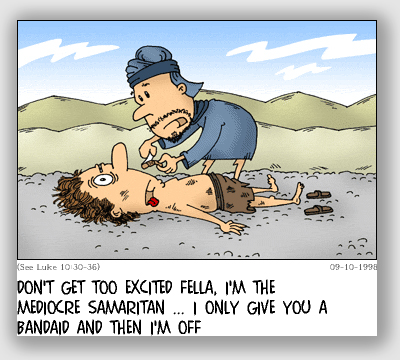
A MEDIOCRE SAMARITAN

One of the most popular parables in the New Testament was one that Jesus told in answer to a disciple’s question, “Who is my brother?” The tale of the Good Samaritan (and mind you, the Samaritans and Jews mixed like Bad Bunny fans and Kid Rock supporters), who found a Jewish man beaten by robbers and left for dead, is taught to countless Sunday School students. The term has even entered the lexicon. Many states have what are known as “Good Samaritan” statutes, laws that prevent a rescuer who has voluntarily helped a victim in distress from being successfully sued for wrongdoing.

Some states have gone further, passing “duty to assist” laws that require people to assist crime victims or those in distress where special circumstances are present.

In today’s case, a woman checked into a hotel. Her husband spoke to her by phone several times during the early evening but then was unable to reach her by cellphone or room phone. He finally called the hotel, and the front desk agreed to send a maintenance worker to check on her. Alas, the maintenance man was unskilled at this kind of welfare check. He opened the room door, saw the room was dark, called out, got no answer, and concluded no one was there.

When the husband drove some distance to the hotel and entered the room hours later, he found his wife on the floor, having suffered a brain aneurysm. Quicker treatment would have led to a much easier and better recovery.

What happens when a person has no legal duty to come to the aid of another, but does so anyway? Does the existence of a duty matter? The trial court thought it did, and threw out Mrs. O’Malley’s claim. The appellate court, however, found that duty did not matter as much as voluntariness.

O’Malley v. Hospitality Staffing Solutions, Case No. G054724 (Ct.App. California, Jan. 31, 2018), 2018 Cal. App. LEXIS 83. A woman checked into a hotel room in the early evening. She did not answer her husband’s calls for several hours. He suspected that she may have been injured. The husband called the hotel, and the front desk sent maintenance worker Ramos to check the room. Ramos reported that no one was there. Hours later, the husband went to the hotel room and found his wife lying on the floor. She had suffered a brain aneurysm. 

The couple sued the hotel and Ramos’ employer (a staffing agency) for negligence. The agency filed a motion for summary judgment, arguing that it owed no legal duty to the couple. The trial court granted the motion and the couple appealed (the hotel itself was not a party to the appeal).

Held: The case could proceed to trial. The Court of Appeals held that maintenance worker Ramos’ argument that he had no duty to Mrs. O’Malley that would require him to check the room was correct but irrelevant. The general rule is that a person who has not created a peril is not liable for failing to take action to protect another unless the person has some relationship that gives rise to a duty to act. However, one who undertakes to aid another is under a duty to exercise due care in acting and is liable if the failure to do so increases the risk of harm or if the harm is suffered because the other relied on the undertaking.

For Mrs. O’Malley to make a claim of “negligent undertaking,” she had to show that: (1) the maintenance man agreed to render services to her; (2) the services rendered were of a kind he should have recognized as necessary for her protection; (3) he failed to exercise reasonable care in the performance of his undertaking; (4) his failure to exercise reasonable care resulted in harm to Mrs. O’Malley; and (5) his carelessness increased the risk of harm.

While under negligence, a legal duty of care gives rise to an obligation to act, under the negligent undertaking theory, acting where not obligated to act gives rise to a legal duty. Here, the court said, there were disputed facts regarding precisely what maintenance worker Ramos may have undertaken to do. The clerk at the front desk said that she told Ramos “to knock on Mrs. O’Malley’s room . . . and if she did not answer the door, to open the door and look in and see if she was in there.” Ramos said the clerk had told him simply “to go check on her, to go to her room and see if she’s there.”

Those conversations and Ramos’ knowledge that Mrs. O’s husband was worried she might be injured or sick were enough to permit the inference that Ramos may have understood the apparent urgency of the situation. The risk that Mrs. O’Malley may have been lying incapacitated somewhere in the hotel room (beyond the threshold of the front door) may have been reasonably foreseeable. “Therefore,” the appellate court said, “the scope of Ramos’ duty may have been more than simply opening the door and peering inside what Ramos claimed was a dark room.”

The appellate court said that “a reasonable trier of fact might infer that Ramos assumed a duty to check on whether Mrs. O’Malley was in her hotel room, and if she was there, why she was not answering the phone. If Ramos had such a duty, the scope of his duty would depend on the nature of the harm that was foreseeable. That question must be resolved at trial.

– Tom Root

TNLBGray140407

Case of the Day – Tuesday, February 10, 2026

ROADBLOCKS

HP150921When we were kids, we watched Broderick Crawford in that black-and-white police classic “Highway Patrol.” Every week, the full-figured, squinty-eyed Crawford — as highway patrol chief Dan Matthews — would pursue the bad guys in his finned Plymouth police coupe interceptor, usually catching the malefactors after setting up roadblocks all over California and barking “10-4” into his mic several times.

We loved that show. But Dan Matthews and his troopers had nothing on the political subdivisions in today’s case. When Mr. Bright’s car was crushed by a tree limb while he was driving down a road in the Village of Great Neck Estates, he got himself a lawyer and sued the town and the county. They immediately set up roadblocks worthy of the best 50s-era cop show.

The case seemed pretty straightforward. The plaintiffs argued that the county and village had had notice that the tree was defective. That hardly matters, the defendants retorted, because you, Mr. Bright, never gave us written notice that the tree was defective. The Administrative Code of Nassau County requires that you do so. As for your passenger, who also sued, she had not shown that she had suffered a serious injury, as required by the state’s insurance law. Not very bright, Mr. Bright, the defendants argued smarmily.

Fortunately, the plaintiff was Bright enough. The appellate court made short work of the county’s motion. The county’s prior-notice requirement, it ruled, related to physical deficiencies in roads and bridges, obvious problems that nonetheless might not be known to county officials. If such a requirement were applied to the trees alongside the road, there might as well be no duty imposed on an owner to inspect trees to begin with. Motorists would have had to pick the tree likely to fall on them and write to the county about it before it fell. Lots of luck with that.

Besides, while a gaping pothole in the road is obvious to passing motorists, the same can’t be said for a diseased tree, which is not especially susceptible to drive-by inspections.

As for the state insurance law, the requirement that a passenger prove serious injuries is intended to cut down on suits against other drivers. This case wasn’t about a county employee being reckless behind the wheel, but instead, the case was a simple one of premises liability. The County owned the highway and the tree next to it; the tree was defective. Voila, a lawsuit.

The county's lawyers set up roadblocks that would put the cops to shame ...

The county’s lawyers set up roadblocks that would put the cops to shame …

So the Court cleared the first set of roadblocks for Plaintiff Bright. So, this is Broderick Crawford, saying, “See you in court.”

Bright v. Village of Great Neck Estates, 863 N.Y.S.2d 752, 54 A.D.3d 704 (N.Y.A.D. 2 Dept., 2008). Mr. Bright suffered personal injuries when a tree limb fell on the car in which he was traveling in the Village of Great Neck Estates. Bright and his passenger sued, alleging that the accident was proximately caused by Nassau County’s negligence in failing to remove a dead or diseased tree.

The County moved for a summary judgment dismissing the complaint on the grounds that Bright had not complied with the prior written notice requirement set forth in § 12-4.0(e) of the Administrative Code of Nassau County and that the County lacked both actual and constructive notice of the purported hazard. The County also sought to dismiss the complaint by Bright’s passenger on the ground that she did not sustain a serious injury within the meaning of Insurance Law §5102(d). The trial court denied the County’s motion for summary judgment.

After Mr. Bright's car got crushed, the county tried to do the same to his lawsuit ...

After Mr. Bright’s car got crushed, the county tried to do the same to his lawsuit …

Held: Denial of the summary judgment motion was proper. The Court observed that prior written notice statutes are intended to apply to actual physical defects in the surface of a street, highway, or bridge of a kind that do not immediately come to the attention of the municipal officials unless they are given actual notice. Here, the Court held, the defect was no more obvious to the motorist than it was to the county, and probably much less so. The prior written notice statute was held not to apply to trees.

Furthermore, the Court said, the County failed to establish that it lacked actual and constructive notice of the hazard tree alleged to exist in this case.

Finally, the Court said, Mr. Bright’s passenger was not required to establish that she suffered a serious injury because she did not allege the County was negligent in the use or operation of the car (which is what the statute addresses). Instead, the allegations against the County related to premises liability. The County doesn’t qualify as a covered person within the meaning of the Insurance Law, which was written to stop the flood of staged car accident lawsuits clogging New York courts.

– Tom Root

TNLBGray140407

Case of the Day – Friday, February 6, 2026

“SQUIRREL!”

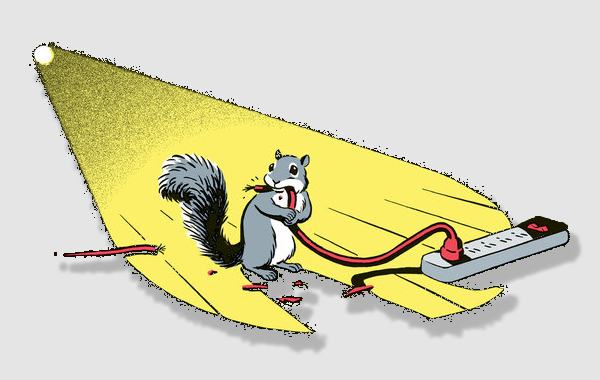
Squirrel - before ...

Squirrel – before …

Last June, we looked at a case in which a squirrel frightened a Massachusetts resident who was taking out her garbage. Today, it’s deep-fried southern squirrel… or at least that’s what the plaintiff had on her hands.

Mrs. Pardue was talking on her cordless phone when a squirrel jumped onto a power company transformer and closed the circuit. The squirrel got zapped (it happens, you know) when it jumped from an untrimmed tree to the transformer. The power went out, and an “acoustical shock” — which the plaintiff called an explosion — came from the cordless phone and injured Ms. Pardue.

She, of course, sued the power company for not trimming the trees. That was a little too much for the trial court, which threw out the case. The Court of Appeals agreed. Remember that Louisiana civil law is a little different: down in bayou country, the standard is “ease of association,” the likelihood that the complained-of conduct could have been foreseen to cause the damage. It bears a resemblance to Palsgrafian causation.

A reasonable person can imagine a lot of bad things happening as a result of power companies not trimming trees.  However, the Court held, loud noises coming out of cordless phones wasn’t one of them. Rube Goldberg would have been proud.

Squirrel - after ...

Squirrel – after …

Pardue v. AT&T Telephone Co., 799 So.2d 710, 2001-0762 (La.App., 2001). Louise Pardue was at her cordless phone at home when there was a sudden explosion in the handset and, simultaneously, the electricity went out at her home. After Central Louisiana Electric Company (CLECO) was notified of the outage, its personnel fixed the problem, later reporting to Ms. Pardue that a dead squirrel was found on the line.

According to Ms. Pardue’s expert, the squirrel’s presence on the lines caused an electrical surge into the ground system that was shared by the telephone line. Although the expert admitted it would have been “a very difficult thing” to get an electrical shock from a cordless telephone, he opined that the electrical surge created an acoustical shock, that is, a loud noise. As a result of the incident, Ms. Pardue immediately developed a headache and experienced ringing in her ear, followed by problems in her neck, shoulder, arm, and foot.

Ms. Pardue sued the phone manufacturer (who was dismissed) and CLECO, seeking damages related to the alleged injuries. She claimed that the power company was negligent in failing to adequately trim the trees around the line so as to prevent the squirrel’s interference with the transformer. CLECO filed a motion for summary judgment, which the trial court granted.

The court held that “we don’t know that the squirrel came from the tree, or whether it climbed the pole that the transformer was on, or it climbed another tree, or another pole. I think that when you do the first analysis, the ‘but for’, you can’t answer that; and when you can’t answer it, under the jurisprudence, then the plaintiff’s action fails, and a motion for summary judgment in this instance is warranted.”

cia150924Disagreeing with this sage analysis, Ms. Pardue appealed.

Held: Ms. Pardue’s suit was dismissed. The Court of Appeals observed that negligence cases require consideration of the duty/risk analysis. A plaintiff must prove the defendant had a duty to conform his conduct to a specific standard, the defendant failed to conform to the appropriate standard, the substandard conduct was a cause-in-fact of the plaintiff’s injuries, the defendant’s substandard conduct was a legal cause of the plaintiff’s injuries and actual damages. For the purposes of negligence analysis, the risk cannot be held to be within the scope of a duty where the circumstances of that particular injury or of the plaintiff could not reasonably be foreseen or anticipated, because there was no “ease of association” between that risk and the legal duty.

Cause-in-fact determinations are factual in nature, while the legal cause or scope of the duty determination is a legal one. Here, the Court ruled that CLECO — the electric utility — did not owe a duty to protect Ms. Pardue a duty. Even assuming CLECO had a duty to maintain the trees surrounding its lines, the Court said, the scope of that duty did not extend to protect Ms. Pardue under the particular facts of this situation.

Ms. Pardue was at home talking on a cordless telephone (and the Court emphasized the word “cordless”). Not only did an animal gain access to the transformer, but the resulting outage caused an “acoustic” shock — not an electric shock — sufficient to result in serious injury. In the least, the Court held, under the particular facts and circumstances of this case, there was simply no “ease of association” between that risk and the legal duty.

– Tom Root –
TNLBGray140407

Case of the Day – Monday, February 2, 2026

ELECTRIC BOOGALOO

There are all sorts of ways that tree trimmers can die. They can cut an artery, fall from a bucket truck, or even get walloped by a branch (and sometimes, the whole tree). On occasion, they even get fried by electric lines.

None of it is pretty, either before or after the funeral. After the dust settles, the decedent’s estate (that is, the people the dead guy left behind) looks for someone to sue. Usually, the pickings are sparse. Maybe the bucket truck was defective, and the employer, the manufacturer and the mechanic who serviced it can be sued. Maybe it was a defective saw, and everyone who touched it could be a defendant. But negligence actions are expensive, and contrary to legend, they pay out a jackpot less often than a rigged lottery. Those lawyers on the back of phonebooks (there are still phonebooks, aren’t there?) and in the late-night ads? They won’t charge plaintiffs upfront, but they’re pretty picky about which cases they’ll take.

You would think that an electric utility would be the toughest nut to crack of all the potential defendants out there. What, you’re going to sue because the overhead wires had electricity in them? C’mon, man.

But every once in a great while, the utility is found to be liable for essentially having done nothing. Such is the case in today’s decision, which – while it does not involve a tree – gives us an excellent principle to apply to arboriculture activities.

Cyril Cronk lost his life by electrocution while digging a ditch for a water main on the south side of Park Avenue in Des Moines, Iowa. Iowa Power and Light had electric transmission lines running overhead, and a backhoe boom got close to one of the lines. It turned out that the boom did not have to touch the line for high voltage to jump the air gap. When it did, and Cyril (down on the ground) touched the backhoe, he became the ground wire. Not good.

The three lower wires on IPL’s poles were not insulated, a condition that was permitted by the applicable electrical code (although insulating material was available for such lines).

As it turned out, IPL was on notice of the water main work, or as the court put it, “It was reasonably to be anticipated and the defendant either knew or should have known that men would likely be working in the streets with modern machinery, such as was used in this instance, for the purpose of excavating or digging ditches or trenches for the laying of water mains.”

But the power lines were clearly visible to the guys on the ground. And the lines were necessary for the public good, and the danger that would result from coming in contact with such lines was hardly unknown. So the court’s conclusion that IPL was responsible for Cyril’s death is surprising. Maybe it was because the electric company had a deep pocket.

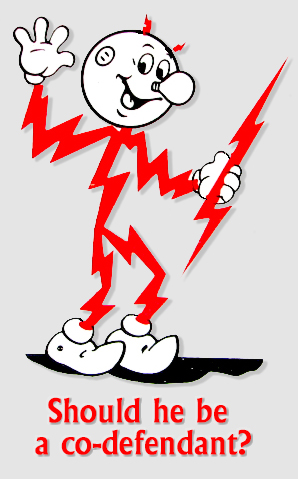
Tree trimmers frequently work near power lines. Would putting the power company on notice in advance make Reddy Kilowatt a codefendant if the unthinkable happens? Regardless of whether it did or not, it would probably be a good idea, just for the extra level of safety that power company participation in the project might bring.

Cronk v. Iowa Power and Light Company, 138 N.W.2d 843 (Supreme Court, Iowa, 1966). The deceased plaintiff, on whose behalf the suit was brought, Cyril Cronk, had been a waterworks employee. He was working on the ground helping free a crane bucket when the boom came in contact with a high-voltage transmission line, and he was electrocuted.

The trial court found liability strictly on the utility company’s failure to warn of the danger or insulate the wires after the utility company was fully aware the work was going to be done near the line, and the company had time to give a warning or insulate the wires. Defendant Iowa Power and Light (“IPL”) appealed.

Held: The Iowa Supreme Court held that the electric utility was liable. Compliance with the safety code is relevant to the question of due care, but not determinative. Proof of compliance with the standards furnished by the National Electrical Safety Code is not conclusive proof on the question of IPL’s due care. Actionable negligence may exist even if the utility company complied with the safety code requirements.

It was IPL’s duty to use reasonable care to prevent the escape of electricity in such a way as to cause injury to persons who might lawfully be in the area of danger incident to the escape of electricity from such lines. One who furnishes electricity, while not an insurer, is nevertheless held to the highest degree of care consistent with the conduct and operation of the business. A person or corporation maintaining and controlling wires for the furnishing of electricity to others must insulate their wires at all places where there is a likelihood or reasonable probability of human contact by people whose business or duty or rightful pursuit of pleasure brings them, without contributory fault on their part, into the zone of danger. However, in the absence of statute, this duty does not compel the electric company to insulate or adopt safeguards for the wires everywhere, but rather only at places where people may reasonably be expected to come in proximity to them.

The Supreme Court held that the evidence supported finding the utility company had been negligent in failing to insulate wires at such a point, and that this negligence had been the proximate cause of Cronk’s death.

– Tom Root

TNLBGray140407