Case of the Day – Tuesday, December 17, 2024

DUMB AND DUMBER

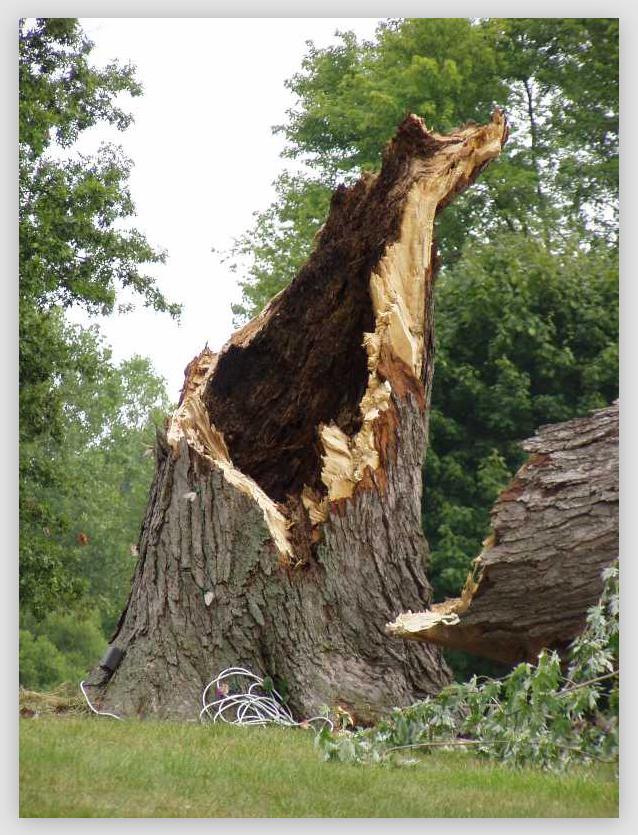
What do you call a guy who volunteered to help his father-in-law cut down a tree and who witnessed first-hand the risk that a branch would bounce back and endanger the workers, but then went ahead and clobbered himself by – guess what – letting a branch bounce back and hit him?

So what do you call a guy who breaks both wrists doing that, and then sues his father-in-law?

This case illustrates the various rungs of the guest ladder that a person standing in your front yard might occupy. The bottom rung, of course, is a slimy trespasser. The top would be the owner. In between are a business invitee, a social invitee and a licensee.

Dumber thought he could promote himself to the status of licensee as though he were an employee of his father-in-law (who must have been a tolerant soul to let his daughter marry this guy). The Arkansas Supreme Court knocked him down a few rungs but undoubtedly made him feel better by explaining that the rung did not matter. The very patient father-in-law had not just warned him of the danger, but he had shown him the danger and how to ensure it did not come to pass.

Some people simply won’t learn.

Young v. Paxton, 316 Ark. 655, 873 S.W.2d 546 (Supreme Court of Arkansas, 1994). Don Young brought a negligence action against his father-in-law, Gerald Paxton, for injuries that he sustained on Gerald’s land as a result of trimming limbs from a tree. Gerald successfully moved for summary judgment. Don appealed, arguing that material issues of fact remained to be decided, including whether he held the status of a licensee or invitee on Gerald’s property, and whether Gerald’s negligence was the proximate cause of his injuries.

On a fine June Saturday, Don walked over to his father-in-law’s house in Saline County. There he found Gerald trimming the limb of a hardwood tree with a chainsaw while standing on a 20-foot extension ladder. The tree was over 15 feet tall with limbs drooping to the ground. Gerald had previously cut three or four limbs down.

The ladder Gerald was using rested against the limb which he was attempting to trim. As he began to cut the limb which the ladder was leaning against, the limb began to rise as the weight from the severed part fell away. Gerald asked Don to get a rope from his shop. Don located a rope and returned to the tree, and at Gerald’s request, he threw him the rope.

Gerald then wrapped the rope around the limb. Don held the rope while standing on the ground to prevent it from “bucking” and dislodging the ladder when the cut part of the limb fell away. As Don held the limb securely with the rope, Gerald cut the end of the limb and climbed down the ladder.

Gerald then showed Don where to place the ladder in order to cut another limb. The ladder was placed against the designated limb, and Don climbed up with the chainsaw and proceeded to cut it. This occurred five minutes after Gerald cut the limb with Don’s help. When the weight of the cut part fell away, the limb rose and the ladder lost its support, causing Don to fall. Because of the fall, Don badly hurt both wrists.

Don sued Gerald for $25,000 in damages, alleging that Don was a licensee on Gerald’s property and that his injuries were proximately caused by Gerald’s failure to supply proper tools to use to perform the task that he asked Don to perform; failure to properly supervise the cutting; and failure to secure the limb.

Gerald filed for summary judgment, arguing that Don had admitted that he was a licensee on Gerald’s property and that there was no proof that Gerald had violated any duty owed Don by acting willfully or wantonly towards him. Gerald argued that Don knew or should have known the dangers posed by cutting branches from the tree. In the alternative, the motion stated that as a matter of law, Don had failed to present any proof that Gerald’s conduct proximately caused his injury.

Don then filed an amended complaint, alleging that Don came onto Gerald’s property at Gerald’s express or implied invitation and acted for the parties’ mutual benefit by cutting the branches. Don further alleged that as an invitee Gerald failed to use ordinary care to avoid injury to him because Gerald knew or reasonably should have known that danger existed.

The trial court granted Gerald’s motion for summary judgment, and Don appealed.

Held: Don will collect not a dime.

The Court noted that an invitee may be a public invitee or a business invitee. A business visitor is one who enters or remains on land for a purpose connected with the business dealings of the owner. A public invitee is invited to enter or remain on land as a member of the public for a purpose for which the land is held open to the public.

However, one who goes upon the premises of another with the consent of the owner for his own purposes and not for the mutual benefit of himself and the owner is not an invitee but a licensee. The Supreme Court declined to extend the invitee status to persons on the premises of another primarily for social reasons.

The law of negligence requires as essential elements that a plaintiff show that a duty was owed and that the duty was breached. A property owner owes his or her licensee the duty to refrain from causing the licensee injury by willful or wanton conduct, and as well owes a duty to warn of hidden dangers or risks. To constitute willful or wanton conduct, there must be a deliberate intention to harm or utter indifference to, or conscious disregard of, the safety of others.

But, the Court ruled, the duty to warn does not extend to obvious dangers or risks that the licensee should have been expected to recognize. Indeed, there is no obligation to protect the invitee against dangers that are known to him, or which are so apparent that he may reasonably be expected to discover them and be fully able to look out for himself.

The Court said an invitee may be a public invitee or a business invitee; a business visitor is one who enters or remains on land for a purpose connected with the business dealings of the owner, while a public invitee is invited to enter or remain on land as a member of the public for a purpose for which the land is held open to the public. However, one who goes upon the premises of another with the consent of the owner for his own purposes and not for the mutual benefit of himself and the owner is not an invitee but a licensee; invitee status has not been extended to persons on the premises of another primarily for social reasons.

Where there was no evidence that Don was invited onto the property, he was not visiting his father-in-law for any stated business purpose and expected no pay for his assistance, no reasonable jury could have found otherwise, and, thus, no material issue of fact existed on this point. What’s more, the Court found, there was no evidence that Gerald acted willfully or wantonly to cause Don any injury. In fact, the evidence showed that Gerald advised Don that the limb would have a tendency to rise as the weight from a severed branch fell away, and Don had even seen it happen a few minutes before when he helped Gerald when faced with the same risk. Even if Don had not known of the risk when he arrived, the court said, that risk was brought to his full attention before the accident.

It is a landowner’s duty to use ordinary care to maintain the premises in a reasonably safe condition for an invitee, the Court said, but that duty usually is satisfied when the danger is either known or obvious to the invitee. There is no obligation to protect an invitee against dangers that are known to him, or which are so apparent that he may reasonably be expected to discover them and be fully able to look out for himself.

So, the Court concluded that regardless of Don’s status as a licensee or invitee, Gerald did not breach the duty of care owed. He perpetrated no willful or wanton injuries on Don, who was well aware of the danger involved in the limb cutting.

Because breach of a duty owed is an essential element in a cause of action for negligence, and that element was lacking, Gerald was fully entitled to summary judgment.

– Tom Root

TNLBGray140407

Case of the Day – Monday, December 16, 2024

AT THE ZOO

Dick, Jane and Mom have fun at the Zoo ... as long as they can dodge the falling trees.

Dick, Jane and Mom have fun at the Zoo … as long as they can dodge the falling trees.

Simon and Garfunkel told us that the monkeys stood for honesty, the giraffes were insincere, and the elephants were kindly but dumb. We don’t know about that, but they were right when they sang that “it’s all happening at the zoo.”

Just ask Ms. Cherney. She’d tell you that Simon and Garfunkel failed to mention the ficus trees. One ficus tree at the Zoo — the North Carolina Zoological Park — fell on poor Ms. Cherney, injuring her. That began an eight-year legal odyssey through the North Carolina legal system, through the Industrial Commission (which hears tort claims made against the state), the Court of Appeal, the Supreme Court, back to the Commission, and again to the courts.

In the penultimate chapter, the North Carolina Court of Appeals ruled that Cherney had no evidence that the Zoo personnel had any basis to believe the ficus was about to fall. Of course, the evidence also suggested that the whole idea of having a ficus growing too large in an indoor setting and not being properly maintained was rather daft. And whose fault was that? The beavers, perhaps?

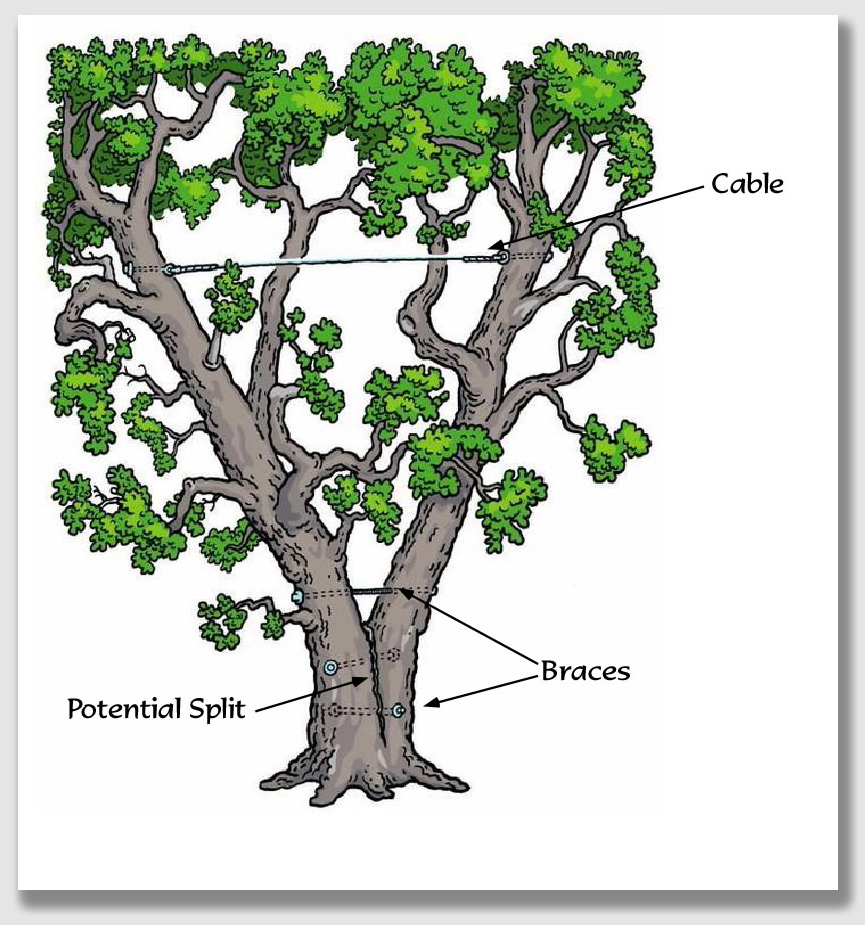
A dissenting judge vigorously disputed this, pointing out that the tree had been cabled to a wall to help support it. The very fact that the Zoo believed that cables were needed was evidence that they knew the tree was a hazard, the dissenter argued.

Usually, dissenting opinions are little more than curiosities. On three-judge appellate panels, 2-1 majorities carry the day. Despite the fact the dissenter probably thought he was talking to himself, he nonetheless explained in detail how the record supported finding the Zoo liable. This time, however, the dissenting judge found that he had some fans – the justices on the North Carolina Supreme Court.

The Supremes reversed the Court of Appeals in a terse per curiam opinion (that means “by the court,” usually a shorter decision on a non-controversial issue not signed by an individual judge) agreeing with Judge Wynn’s analysis.

bracing150225This kind of thinking does raise a conundrum. Bracing or cabling a tree is a well-established practice in arboriculture. There’s even an ANSI standard for it. Could it be that cabling a tree may be prudent from an arboriculture standpoint but legally dangerous? A careful tree professional would probably take from this decision the notion that he or she would be well advised to tell any client for whom a tree is cabled or braced that the very fact the tree was braced means it should be considered to be a hazard tree. That, of course, would bring with it responsibilities for regular inspection and – just ask Ms. Cherney – notice to people who could be affected if the tree falls.

Cherney v. North Carolina Zoological Park, 648 S.E.2d 242 (N.C.App., Aug. 7, 2007), reversed, 362 N.C. 223, 657 S.E.2d 352 (N.C. Supreme Court, 2008). Tinya Cherney was in the enclosed African Pavilion at the North Carolina Zoological Park near the center when a large ficus tree fell hitting a palm tree. Both trees then fell on her, pinning her to the floor of the walkway in the African Pavilion. The impact caused vertigo, broke her right femur, cracked three ribs, broke her back and wrenched her knee.

The injury occurred because the ficus tree — which was indoors – had been permitted to grow too large for its roots or, alternatively, had not been properly maintained to prevent it from becoming unsafe. The ficus tree was under the exclusive control of the Zoo’s personnel and not subject to wind or any other natural force. A hearing examiner at the North Carolina Industrial Commission awarded Cherney $500,000 in damages. Unhappy at the result, the Zoo appealed.

If your tree needs to be cabled like this, it's time to let it go - preferably not onto a passerby.

If your tree needs to be cabled like this, that could mean it’s time to let it go – preferably not onto a passerby.

The full Commission reversed the award and found for the Zoo. Cherney appealed to the North Carolina Court of Appeals, which affirmed the Commission’s claim. She took it to the North Carolina Supreme Court, which reversed and remanded the case for fresh consideration. The Commission then entered a second decision denying Cherney’s claim. She again appealed.

The Court of Appeals held that the Commission’s second decision denying Cherney’s claim was proper, even though the Supreme Court had ruled in her favor on her appeal from the first decision of the Commission denying her claim. The Court of Appeals agreed with the Commission that the evidence showed that neither the zoo’s curator of horticulture nor her staff knew or should have known that the ficus tree that fell in the zoo exhibit was likely to fall and that there was no showing that any member of the curator’s staff violated any applicable standard of care.

In a carefully crafted dissent, Judge Wynn observed that the evidence showed that when the ficus tree was replanted, “six, seven-strand 3/8″ cables going in four directions were looped around the tree and attached to the planter walls” in order “to aid the tree in keeping it upright and to assist in monitoring the tree.” The cables were inspected monthly by the Zoo staff. Two of the four cables had snapped when the tree fell on Ms. Cherney. The judge argued that the “very fact that the tree was cabled to the planter walls illustrates that the Zoo and its employees had “express or implied knowledge” that the tree might fall; if there had been no danger, then the tree would not have needed to be cabled in such a fashion, nor would the Zoo employees have needed to monitor it so closely.”

bracingb150225The dissent argued that the question was not whether the tree was likely to fall, as the Commission thought it was. Rather, the issue was whether a Zoo visitor – such as Ms. Cherney or one of the tens of thousands of kids who passed through each year – was unnecessarily exposed to danger and was not warned of a hidden hazard. The dissent believed that they were, and the Zoo had a duty to warn visitors of the possibility that the tree might fall.

The North Carolina Supreme Court reversed the appellate panel and specifically adopted Judge Wynn’s reasoning as its basis for doing so.

– Tom Root

TNLBGray140407

Case of the Day – Wednesday, December 11, 2024

HIGHWAYS, BYWAYS AND WATERWAYS

By now, we all know that the modern arboriculture negligence rule places a duty on urban landowners to use reasonable care to inspect trees that could otherwise injure the public if they fell onto public highways, sidewalks and the such.

Today’s case has a twist, however, in that the owner’s tree fell onto a boat on the Cape Fear River, not a highway at all. Or was it?

This is where the courts try to honor the intent of the rule, whether they say so or not. Here, the boaters were waiting to use the landowner’s public boat ramp, which the landowner had installed to benefit its bait shop, located right next to the ramp. The court did not expressly say so, but it clearly believed that the duty owed to an “invitee” – someone whose presence was desired for the benefit of the owner – was higher than it might be to a casual passer-by, even if North Carolina law said all comers – invitees, licensees and trespassers – were entitled to the same protection.

The other interesting aspect of the decision was the blurring of the old rural-urban distinction. Sure, the Court said, the land was undeveloped and out in the middle of nowhere. But it was developed, at least for tree inspection purposes, around the boat ramp, which was good enough.

Wallen v. Riverside Sports Ctr., 173 N.C. App. 408, 618 S.E.2d 858 (Ct.App. N.C., Sept. 2, 2004). Since 1977, brothers John and Sol Rose operated Riverside Sports Center. Riverside leases 25 acres of undeveloped land fronting the Cape Fear River next to Person Street in Fayetteville, North Carolina. On a portion of the leased property, Riverside operates a small bait and tackle shop and a boat repair business. Riverside held a permit from the Army Corps of Engineers to build a boat ramp by the repair shop.

As part of the construction of the boat ramp, Riverside installed wooden “pylons” in the river. These pylons, also called “fender piles,” were placed both upstream and downstream from the boat ramp to prevent logs floating downstream from harming the boat dock or ramp. Customers often tied their boats to the pylons while waiting to use the ramp.

In late August 2001, Tim met Rick George and his son at Riverside to go fishing. At about 4:00 p.m., George paid the access fee and launched his pontoon boat using Riverside’s ramp. After the party had fished for a while, the wind picked up and dark clouds rolled in. They decided to get off of the river until the storm passed. By the time Tim and Rick got back to the Riverside boating facility, it was raining and there were four boats ahead of them waiting to use the ramp to get off the river. Rick tied his boat to one of the downstream pylons. Tim and Rick began putting a tarp over the boat to keep it dry. Rick said he heard a loud noise, like an artillery round, and felt something hit the boat. When he turned, he saw Tim on his back, unconscious.

A box elder tree had fallen and struck Tim, rendering him a paraplegic.

Tim sued Riverside, alleging he was injured by their negligence. He asserted that Riverside failed to exercise reasonable care to keep the premises in a reasonably safe condition and more specifically, that they failed to properly inspect their property and remove dead trees around the pylons. As a result of their negligence, Tim said, he was injured. Riverside filed for summary judgment, contending Tim (a) failed to show Riverside owed any duty to him; (b) failed to show the defendants were negligent; and (c) failed to show that his injury was reasonably foreseeable to Riverside. The trial court granted Riverside’s motion for summary judgment.

Tim appealed.

Held: Tim had raised a genuine issue of fact about Riverside’s duty to him and whether it was negligent, and the case must proceed to trial.

The Court of Appeals began its analysis skeptically, noting that summary judgment is seldom appropriate in a negligence action. In order to establish a prima facie case of negligence against a defendant like Riverside, a plaintiff like Tim must show (1) the defendant owed the plaintiff a duty of care; (2) the defendant’s conduct breached that duty; (3) the breach was the actual and proximate cause of the plaintiff’s injury; and (4) the plaintiff suffered damages as a result of the injury.”

In North Carolina, the Court observed, the law had evolved to hold that a landowner has a duty to exercise reasonable care regarding natural conditions on his land, which lies adjacent to a public highway, in order to prevent harm to travelers using the highway. A landowner is subject to liability only if he has actual or constructive notice of a dangerous natural condition.

To impose liability upon property owners, plaintiffs must show not only that the tree constituted a dangerous condition to users of the adjacent public road, but that the landowners had actual or constructive notice of the dangerous condition.

The Court ruled that Riverside “had a duty to exercise reasonable care with respect to natural conditions on their land, which was adjacent to a public highway.” However, Riverside would be shown to be negligent only if it had actual or constructive notice of a dangerous natural condition existing upon its property.

At the time Tim was injured, he was on the Cape Fear River, a navigable waterway. Under North Carolina law, the river is a “public highway,” since navigable waters constitute a public highway.

The record contained no evidence that Riverside or its principals had actual notice of the decayed condition of the box elder tree. Thus, the Court looked for evidence that Riverside had constructive notice of the tree’s condition sufficient to withstand its motion for summary judgment. Each party offered affidavits from expert arborists expressing opinions about the condition of the box elder tree, and those affidavits directly contradicted each other. The evidence, taken in the light most favorable to Tim (the non-movant for summary judgment) showed that Riverside Sports Center has been in business since 1977, the principals knew that customers routinely tied their boats to the downstream pylons to prevent the boats from drifting downstream while they waited to use the boat ramp, that there were trees along the riverbank, the limbs of which hung over the river in the area of the downstream pylons, and that Riverside had had employees previously trimmed the trees on both sides of the ramp.

Tim’s expert said the trunk of the box elder that had fallen had snapped off 13 feet above the ground about two years earlier, and a portion of the upper tree trunk had broken off 6 to 10 years before that, causing the tree bark to be stripped, and created a V-shaped wound on the tree, which accelerated decay. The trunk was leaning at a “very pronounced angle, from the top of the bank” out over the river in the direction of the pylon where Rick had tied his boat. The expert said in his affidavit that the tree was about 40′-60′ feet in length and was definitely capable of striking Rick’s boat. The expert also said that he believed that the box elder “had been extensively decayed for many years prior to its breaking, that it exhibited a number of conspicuous dead branches and external trunk decay, and that these obvious symptoms of decline and hazard-potential (dead branches and trunk decay), should have been observed with considerable concern by the owners of the property (particularly because of the strong lean of the tree towards the water) …”

The Court held that this opinion presented a genuine issue of material fact on the issue of constructive notice.

Finally, the Court ruled that in order for a defendant to be liable for a negligence claim, the injury must be reasonably foreseeable. A plaintiff must show that a person of ordinary prudence would have known that Tim’s injury or some similar injurious result was reasonably foreseeable. The Court wrote that “given the facts as recited above in our discussion of duty, constructive notice, and negligence, we hold that the evidence taken in the light most favorable to plaintiff demonstrates there existed a genuine issue of material fact on the issue of foreseeability.”

– Tom Root
TNLBGray140407

Case of the Day – Thursday, December 5, 2024

MAKIN’ BACON

piggies150220Running a swine farm is a smelly but serious business. When a tree fell onto a power line on his neighbor’s land and interrupted his electricity, farmer Timmerman was glad that Northern States Power came out to his neighbor’s place and promptly trimmed the tree and fixed the lines.

But his relief turned to dismay when 10 minutes after the trimmer left, the remainder of the same tree collapsed onto the power line. It turned out the tree that had caused the first outage was completely rotten and even after being trimmed, it remained a hazard.

The first power failure was an inconvenience. The second power failure was a catastrophe: it cut off the ventilation to Timmerman’s hog barn, and 160 pigs met an untimely demise.

Timmerman sued both his neighbor for not having inspected the tree — which had been rotten for at least five years — and the power company for being grossly negligent in trimming the tree. He claimed gross negligence because Northern States Power’s tariffs excluded it from liability except for gross negligence. The trial court turned him down.

The Court of Appeals agreed. It noted that gross negligence is a pretty serious dereliction of duty, and Timmerman’s saying it didn’t necessarily make it so. The neighbors didn’t have a duty to Timmerman, the Court held, because he wasn’t an invitee (or even a trespasser) onto its land. It noted that NSP had trimmed the tree to the national code, and meeting a national standard was performance enough.

It’s fairly well established that an owner has a duty to inspect trees (with a degree of care that varies according to whether the land is urban or rural). If Timmerman had been driving by and the tree had fallen onto his truck, there might have been liability. Why not when the damage isn’t an F-150, but instead 160 hogs’ worth of bacon?

Hard to believe the trees can interfere with the wires.

It’s hard to believe the trees can interfere with wires …

Timmerman v. Manguson1996 Minn. App. LEXIS 599, 1996 WL 266404 (Minn.App. 1996). Timmerman owned and operated a hog farm, to which Northern States Power provides electrical power. The power lines run north across the Mangusons’ farmland and continue onto Timmerman’s land. One afternoon, limbs on a willow tree located on the Mangusons’ land broke, striking the power line and causing a power outage on Timmerman’s farm.

NSP investigated the site, found the burned tree limb that had struck the power line, and trimmed some branches back. The tree trimmer investigated the trunk of the tree from his position on the power pole, but he did not see any signs of cracking or damage to the tree trunk. Ten minutes after he left the area, the power went out a second time. The trimmer returned to the site and trimmed back the tree sufficiently so that, if it continued to topple over, the tree would not hit the power lines again. The next morning, he called another NSP representative to report the outages and suggested that they send in the tree trimming crew to clean up the area.

The second power outage left about 160 pigs in Timmerman’s barn without ventilation, and despite Timmerman’s efforts, nearly all of the pigs in two of the five rooms in the barn died. The tree turned out to be rotten and, according to Timmerman’s expert witness, “undergrown … or there was a lot of trees in that area.” The expert determined that the tree had been rotting for at least the past five years and posed a significant hazard to the power lines.

Timmerman sued NSP for gross negligence and the Mangusons for negligent maintenance and inspection. Both NSP and the Mangusons moved for summary judgment. The district court granted both motions, finding, as a matter of law, that NSP had not been grossly negligent and that the Mangusons owed Timmerman no legal duty.

Timmerman appealed.

sweating150220Held: The decision in favor of the Mangusons and NSP was upheld. The Court held that gross negligence was substantially and appreciably higher in magnitude than ordinary negligence. It was materially more want of care than constitutes simple inadvertence, an act or omission respecting the legal duty of an aggravated character as distinguished from a mere failure to exercise ordinary care.

Timmerman presented evidence that the tree and power lines at issue could not be viewed properly from the road, but required an on-site, on-foot inspection. He also presented evidence that NSP failed to trim the tree near the lines and allowed them to become overgrown with vines and vegetation.- But the Court said that this evidence did not rise to the level of gross negligence. NSP did not demonstrate an “indifference to present legal duty” nor did it act without “scant care” or “slight diligence.”

NSP had most recently trimmed this tree within NSP’s policy of trimming every four years. Since 1990, NSP had routinely checked the power lines at issue here in accordance with the National Electric Safety Code (NESC). NSP representatives have viewed the power lines and trees from the road when driving through the area. NSP also trimmed portions of the tree after the first power outage to restore service. Although the evidence suggests that NSP could have more diligently exercised its duties, the Court ruled, that evidence only raises the question of ordinary negligence, for which NSP is not liable under its own tariffs.

As for the Mangusons, the Court held that they had no legal duty to protect Timmerman because they did not have a “special relationship” in which Timmerman had entrusted his safety to the Mangusons. The parties’ relationship as neighboring farmers does not fall into any of the limited numbers of “special relationships” that the Minnesota Supreme Court has recognized. Although Timmerman contended the Mangusons had a duty to inspect and repair the tree or else warn him of the dangers on their land, the Court held that the theories of duty and liability don’t apply here because Timmerman was not an “invitee” or “licensee” on the Mangusons’ property. Furthermore, the Court said that even if the Mangusons knew the old tree was near the power lines, knowledge of a dangerous condition, by itself, without a duty to protect, was not sufficient to establish liability for negligence.

Given that no legal duty existed, Timmerman’s negligence claim against the Mangusons could not stand.

– Tom Root

TNLBGray140407

Case of the Day – Wednesday, December 4, 2024

THAT DOES NOT MAKE SENSE

I drove past beautiful Elkhart, Indiana, the other day, which made me recall a news report a few years ago about a resident of The City With a Heart who got up one morning.

Of course, arising in the a.m. is not especially noteworthy. But when this denizen of the RV Capital of the World awoke, he discovered that the City had rather heartlessly cut down a beautiful 33-foot spruce in his tree lawn – that strip of grass between the sidewalk and street – for use as the municipal Christmas tree.

The report was troubling to me. No, more than troubling. It simply did not make sense. Unless Indiana is different from most of the other states in the nation, a property owner whose property lies along a highway (known as an “abutting landowner”) is deemed to own the land to the middle of the highway, with the highway and portions beyond it merely reserved to the City or State (or whatever political subdivision it might be) as a “right-of-way.”

The thing about a right-of-way (which is simply one flavor of an easement) is this: the political entity (we’ll just say “City” here because that’s the bad guy in this news report) is entitled to use the right-of-way for an intended purpose, that is, a highway. If there comes a time when it ceases being a highway, the right-of-way is extinguished, and the landowner is free to use the property all the way up to the centerline of the old road as he or she wishes.

And that’s what bothered me so. No one would question the City’s right to remove a tree that somehow created a hazard to the public using the highway. That is a reasonable exercise of the City’s privileges under the easement. But here, the City decided to save a few bucks by cutting down a free Christmas tree, not to facilitate use of the highway but instead to decorate another part of town.

The article suggested that maybe the whole episode resulted because a prior owner had asked that the tree be removed. Elkhart Building and Grounds Department head Mike Lightner said, “We thought we were doing a good thing by getting a tree removed from the tree lawn for a resident who wanted it removed and being able to repurpose it as a Christmas tree for other people to enjoy it instead of hauling it away while saving the city some money.”

That may be so, but the City should not be imperiously telling people that it owns the trees in the tree lawn. It can do what it likes with the tree lawn as long as the act is reasonably related to the purpose of its right-of-way. But it does not “own” the trees.

While I was researching the issue, I stumbled across the obverse situation, where a homeowner who was hurt by a falling tree in the tree lawn blamed the City for not reasonably using its right-of-way, more particularly, not properly discharging its duty to inspect.

Czaja v. Butler, 604 N.E.2d 9 (Ct.App. 3rd Dist. Indiana, 1992). Karen and Joseph Czaja lived along U.S. Highway 6 in Butler, Indiana. There were three trees on the State of Indiana right-of-way in the front yard of their home. On January 25, 1990, two severe storms blew through the city, causing severe damage and blowing over several trees. The first storm dropped a 12” diameter limb from one of the trees in Czajas’ front yard onto U.S. 6. The City removed it after the first storm passed through.

But later in the day, a second storm hit. Karen was returning from picking her children up from school during the storm. As she was waiting to turn into her driveway from the street, the tree closest to her driveway fell on top of her car, injuring her.

The storms that day caused extensive damage. Roughly eight whole trees were uprooted or broken off, and many others lost large limbs or parts of their trunks.

The Czajas sued the City, alleging city employees were negligent in failing to inspect the tree in front of the Czaja home and in failing to remove the tree, which the city knew, or should have known, was dangerous. The City moved for summary judgment, which the trial court granted.

The Czajas appealed.

Held: The City was not negligent.

The City’s evidence described the storms’ intensity that day, including the fact that eight trees were blown over, four other cars were struck by fallen trees, and an uprooted tree fell onto the roof of the Butler Quick-Mart. In addition, it filed deposition testimony of the City superintendent that he inspected the Czajas’ tree the following day and found that while the core was rotten to within four inches of the outside diameter of the tree, there were no outwardly visible signs that any part of the tree was dead or rotten. The evidence showed that before the tree fell, the superintendent had no actual notice that the tree was rotten. The tree had green foliage two years before when Joe Czaja asked him about removing it so the Czajas could widen their driveway.

In their depositions, the Czajas both admitted that before the tree fell, they had no reason to believe it was likely to fall. Nevertheless, at the trial court, they pressed the argument that the City had an absolute affirmative duty to maintain an inspection procedure concerning all the trees located in its right-of-way along the highway.

The appellate court rejected the Czajas’ position, holding that while the City has a duty to keep its streets reasonably safe, the duty is only triggered when it has actual or constructive knowledge of the dangerous or defective condition. Here the City’s established it neither had knowledge that the tree was defective nor did it have any reason to know the dangerous condition of the fallen tree.

All the Czajas could show was that during the years they had lived there, dead branches occasionally fell from the tree, the sidewalk buckled from tree roots, and some erosion showed next to the curb near one of the trees.

The Court held that the Czajas’ evidence was insufficient to raise a genuine issue of fact requiring a trial. “We take it to be common knowledge that mature trees, as these were described to be, have limbs and branches that die and occasionally fall from the tree,” the Court ruled. “It is also a common experience that the root systems of such trees buckle and crack cement sidewalks laid too close to the tree. Indeed, the city superintendent stated in his deposition that he attached no particular significance to these conditions. The Czajas have not pointed to any evidence supporting the notion that the city should have been forewarned in this particular instance that the tree was in danger of falling. It would be nothing but sheer speculation to draw that conclusion from the evidence relied upon. It follows that the summary judgment was properly granted.”

– Tom Root

TNLBGray140407

Case of the Day – Friday, November 29, 2024

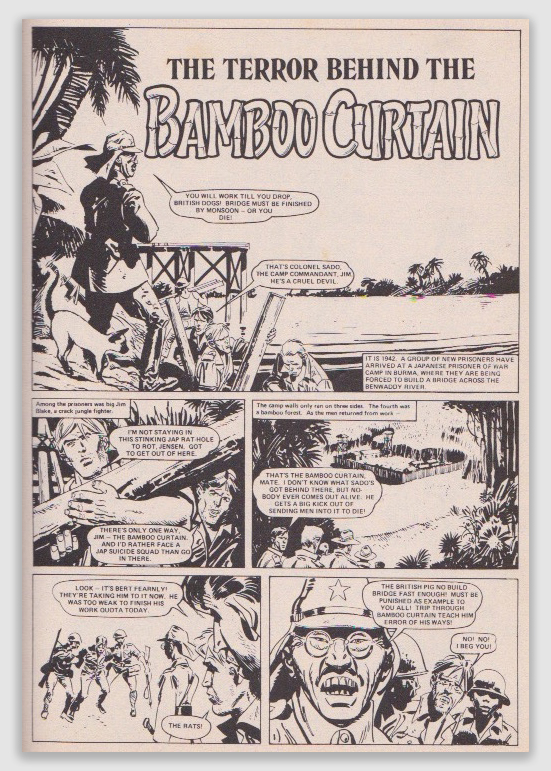
BEHIND THE BAMBOO CURTAIN

I admit to being old enough to remember the Bamboo Curtain, the Cold War political demarcation between the Communist states of East Asia – particularly the People’s Republic of China – and the capitalist and non-Communist states of East, South and Southeast Asia.

It seemed for a while that the Iron Curtain, Cactus Curtain, Bamboo Curtain and others of that ilk were now relics of unpleasant history. But we still have nine-dash lines, 38th parallels, Crimea, the Donbas, and other examples of countries acting badly, so we’re hardly out of the woods yet. Let’s not get started on Russia and Ukraine

But “bamboo curtains,” literally enough, are still with us. Every so often, I am reminded of that when I come across a case involving a stand of bamboo, encroachment that usually started when some well-meaning homeowner (who maybe anticipates an attack of hungry pandas) plants a little stand of bamboo in his backyard.

The problem is that the owner has a “little stand of bamboo” only for a minute or so. The stuff is pernicious and fecund. Bamboo, which is a giant grass and not a tree, has fairly been called one of the world’s most invasive plants. Once established, it is next to impossible to control. The sprouts that shoot up from the ground each spring can grow 12 inches a day. The underground roots of common running “fishpole” bamboo, which can easily reach 15 feet tall, can travel as far as 20 feet or more from the original clump. The experts suggest you control it by digging a two-foot deep trench and lining it with aluminum. Or lead. Or titanium. Or concrete. But whatever you use, leave a portion of it sticking up above ground, because bamboo roots can jump barriers like Superman leaps buildings.

Bamboo: the Asian carp of grasses. As one homeowner site puts it: When you need a concrete bunker to contain a plant, you know you’re in trouble.

Bamboo is not a very good idea. Unless, of course, you’re like Mike and Roberta Komaromi, who simply did not give a rip that their bamboo stand was galloping across neighbor Caryn Rickel’s lot. Usually, we complain about people foolish enough to represent themselves, but here, we grudgingly admit that pro se litigant Caryn was holding her own.

The Komaromis were smug, arguing that they had no duty to corral the bamboo. Well, as is usually the case when hard facts collide with justice, courts find a way to recompense the victim. So it did here, ruling (and right on the Bay State’s south border, too) that the Massachusetts Rule cut no ice in Connecticut.

Rickel v. Komaromi, 2011 Conn. Super. LEXIS 5254 (Superior Ct. Conn., July 13, 2011): Caryn Rickel, bringing her case without a lawyer, complained that her neighbors Mike and Roberta Komaromi planted bamboo in their yard without any plan for containment. As a result, her backyard has been overrun by invasive bamboo.

Mike and Bobbi, who did hire a lawyer, filed a motion to strike the complaint as legally insufficient. That is to say, they claimed that if everything Caryn said in the complaint was true, she still was entitled to no relief.

Mike and Bobbi complained that Caryn had not alleged they had any legal duty to her.

Held: Connecticut would follow the Hawaii Rule, and under that Rule, Caryn had adequately claimed her neighbors had a duty to her which they violated with the bamboo. “The essential elements of a cause of action in negligence are well established,” the Court said, “duty; breach of that duty; causation; and actual injury.” There can be no negligence without there first being a cognizable duty of care.

The test for the existence of a legal duty of care, the Court said, entails (1) a determination of whether an ordinary person in the defendant’s position, knowing what the defendant knew or should have known, would anticipate that harm of the general nature of that suffered was likely to result, and (2) a determination, on the basis of public policy analysis, of whether the defendant’s responsibility for its negligent conduct should extend to the particular consequences or particular plaintiff in the case.” (Internal quotation marks omitted.

So, how did Caryn do? First, she alleged the Komaromis planted bamboo without any plan for containment and watched while the non-native plant fully invaded Caryn’s backyard. She also alleged the Komaromis failed to take action to alleviate the situation even though the bamboo growth was readily visible. This, the Court ruled, sufficiently alleged that the damage to Caryn’s property was reasonably foreseeable to the Komaromis.

Second, the Court held, the Komaromis’ responsibility for their negligent conduct should extend to Caryn on public policy grounds. The Court looked at (1) the normal expectations of the participants in the activity under review; (2) the public policy of encouraging participation in the activity, while weighing the safety of the participants; (3) the avoidance of increased litigation; and (4) the decisions of other jurisdictions. Considering these four factors, the Court said, “supports the conclusion that the court should impose a duty on a property owner to refrain from planting bamboo without a containment plan in order to avoid harming an adjacent property.”

First, property owners are normally expected to refrain from engaging in conduct that would cause damage to an adjacent property. Although landowners may reasonably expect some level of discomfort from having adjacent property owners, it does not mean that property owners should reasonably expect bamboo belonging to an adjacent landowner to fully invade their property.

For the second factor, as a matter of public policy, it is desirable to promote property ownership, and the ability to live free of the concern of encroaching vegetation from adjacent properties directly impacts this goal. Allowing a landowner to cultivate his or her land “should be fairly balanced against the rights of adjacent landowners, and imposing a duty on the cultivating landowner whose vegetation harmfully invades another’s property would be in accord with public policy.”

Turning to the third factor, it is true that imposing a duty like this one could encourage other property owners suffering from the same problem to bring similar actions. On the other hand, however, establishing such an affirmative duty may deter potential defendants from engaging in this type of activity.

Finally, the Court rejected the Massachusetts Rule. That rule provides that a defendant has no duty to prevent his trees from causing damage to his or her neighbor’s property and that “a landowner’s right to protect his property from the encroaching boughs and roots of a neighbor’s tree is limited to self-help, i.e., cutting off the branches and roots at the point they invade his property.” The Hawaii Rule, by contrast, grants the landowner a remedy for damages caused by the encroaching vegetation of an adjacent property owner.

The Court adopted the Hawaii Rule, it said, for two main reasons. First, the Rule serves as a gatekeeping mechanism in that it imposes a requirement of actual harm to the property, discouraging trivial suits while simultaneously providing a cause of action for deserving plaintiffs. The Massachusetts Rule, by comparison, “deprives deserving plaintiffs of any meaningful redress when their property is damaged.” Second, the Massachusetts Rule is not “realistic and fair… Because the owner of the tree’s trunk is the owner of the tree,” the Court opined, “we think he bears some responsibility for the rest of the tree. It has long been the rule in Hawaii that if the owner knows or should know that his tree constitutes a danger, he is liable if it causes personal injury or property damage on or off of his property… Such being the case, we think he is duty bound to take action to remove the danger before damage or further damage occurs.”

In addition, the Court said, Caryn had linked the breach of the Komaromis’ duty, the damages she suffered and the causation between the breach and the damages suffered. She alleged that the Komaromis planted the bamboo and that their subsequent inaction as to the bamboo growth “directly caused the harmful condition and continual damage” to her property. Accordingly, the Court said, Caryn has successfully set forth a cause of action in negligence.

So does Caryn win an injunction to get the bamboo eradicated? Stay tuned Monday…

– Tom Root

TNLBGray140407

Case of the Day – Monday, November 25, 2024

LINES OF AUTHORITY

Oldsters with droopy pants - not pleasant to contemplate.

Oldsters with droopy pants – not pleasant to contemplate.

A county park had a contract with Green View — a nonprofit company with the goal of putting our shiftless senior citizens to work cleaning up parks — to maintain the grounds. This is a good thing. Otherwise, retirees with their pants drooping to show their underwear and their “tatts” and funny flat-brimmed baseball caps worn sideways on their heads just hang around and ride their little electric carts up and down streets and… you know what trouble they can be.

Green View’s people were busy staying out of trouble when a tree branch broke off a tree and struck a park patron during a summer storm. Aware that a branch would never break off in the middle of a storm unless someone was negligent, the injured woman sued the county and, for good measure, went after the old people, too. She argued that the elderly working for Green Tree had a duty to inspect the park for branches that might fall off in storms. They had been too preoccupied with talking about their regularity to carry out their obligations.

In depositions, the Green View people admitted that they had looked for dead trees, but they explained that the county employees were responsible for removing hazards like that. At least one deponent might have even denounced the plaintiff as a “young whippersnapper.”

The young whippersnapper was, to use an obscure legal term, whippersnapped. The Court ruled that neither Green View’s contract with the county nor the job descriptions for its workers included any duty to inspect the trees or warn of their dangers. The county employees — who were immune from suit (just in case you are wondering why the old folks at Green View were being picked on to begin with) — all agreed that it was the county’s duty to inspect trees and warn of dangers.

The injured plaintiff couldn’t find any duty that Green View or its senior citizen workers owed her. Without the duty, there could be no negligence.

Senior citizen humor aside, it is this kind of litigation — and the legal fees Green View undoubtedly had to shoulder to defend an action for which there was no factual basis — that drives beneficial programs like this one (intended to provide meaningful work and activity for seniors) out of business. While an injury like the one the plaintiff suffered was lamentable, the reason branches fall in summer storms is fairly well understood.

Sometimes stuff happens, and suing anyone who happened to be nearby when the stuff happens seldom makes anything better.

stuff150213Rolfhus v. County of Wright, 2001 Minn. App. LEXIS 319, 2001 WL 290525 (Minn.App. 2001). Dawn Rolfhus was seriously injured at a Wright County park in 1997 after a tree branch broke and struck her head during a summer storm. She and her husband sued the county and respondent Green View, Inc., a nonprofit organization that provides senior citizens with maintenance and custodial work at state and county parks. Green View had a contract with the county to maintain the park at which Rolfhus was injured.

The county park manager testified that the Green View employees, without discussion, undertook to remove the tree that had fallen on Ms. Rolfhus. Harold Johnson, a Green View employee, admitted to looking for dead trees in the park but stated that it “isn’t our job to chop down trees or anything like that.” Another employee, Frank Duncan, conceded that he never saw any county employees in the park inspect trees but that he “knew they did it.” The county employees all testified that it was the county’s duty to inspect trees and warn of dangers, and the Green View employees all testified that it was not their duty to inspect trees or warn of their dangers. The district court granted summary judgment to the county based on immunity and to Green View based on a determination that Green View had no duty to inspect trees or warn park patrons of dangerous trees. Rolfhus appealed the grant of summary judgment to Green View.

brokenbranch150213Held: The grant of summary judgment was upheld. The elements of a negligence claim include a duty, a breach of that duty, proximate cause, and injury in fact. Even where no duty otherwise exists, a person who voluntarily assumes a duty may be liable for failing to exercise reasonable care in performing the duty. One who assumes to act, even though gratuitously, may thereby become subject to the duty of acting carefully, if he acts at all.

The Court ruled that neither the language of the contract between the county and Green View nor the pertinent job descriptions created a duty for Green View employees to inspect trees or warn of their dangers. Furthermore, the county employees all testified that it was the county’s duty to inspect trees and warn of dangers, and the Green View employees all testified that it was not their duty to inspect trees or warn of their dangers. No issue of fact remained, and judgment was appropriately entered for Green View.

– Tom Root

TNLBGray140407