Case of the Day – Thursday, September 19, 2024

RIGHT THING, WRONG REASON

The right things usually get done for the wrong reasons. The Internet, which knows all (or soon will) attributes the aphorism to James Carville, but I remember the exact line being penned by Washington columnist Drew Pearson in a political potboiler of his, The President, which I read as a lad in the summer of 1971.

Sorry, James, When it comes to credit for this particular witticism, you didn’t build that.

Today’s case is a reminder to all the states that claim the Massachusetts Rule, the Hawaii Rule, the Virginia Rule and so on that there is nothing new under the sun. Well before those rules came into being, the Washington State Supreme Court grappled with the encroachment issue and reluctantly decided an early version of the Hawaii Rule: where there is encroachment that causes “sensible harm,” the adjoining landowner may either trim back the offending growth or sue to force the tree’s owner to do it.

Ironically, settling the law (the right thing to do) probably got done for the wrong reason (bad blood between neighbors). We have seen how the Massachusetts Rule began in Michigan. Now, it seems the Hawaii Rule may have started in Washington.  Sorry, Hawaii, you didn’t build that.

Truly, there’s nothing new under the sun.

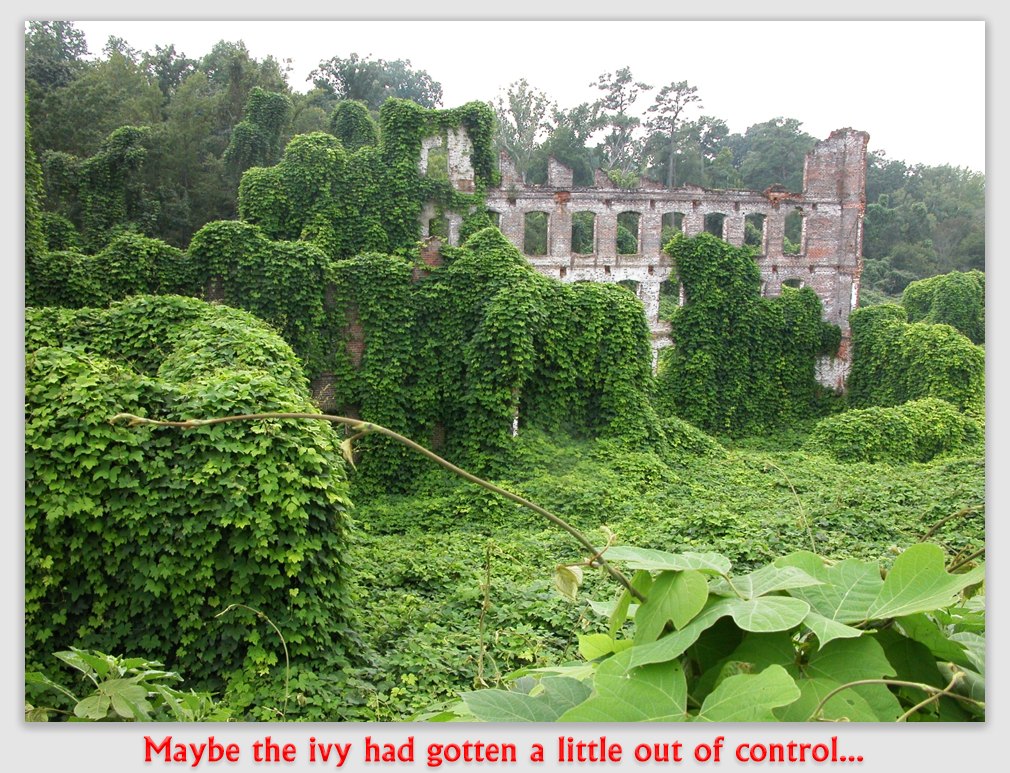
Gostina v. Ryland, 116 Wash. 228, 199 P. 298 (Supreme Ct. Wash. 1921). A.L. Ryland had owned his place for many years when new neighbors, the Gostinas, moved in next door. A.L. had a Lombardy poplar tree growing about two feet from the Gostina property and a fir tree in the rear of the property, also about two feet from the division fence. On top of that, A.L. maintained a creeping vine, growing in a rustic box on top of a large stump, a few feet from the division fence, and some raspberry bushes and a rosebush growing near the property line.

About a year after they moved in, the Gostinas had their lawyer write to A.L. to tell him the branches of his fir tree were overhanging the Gostina property and dropping needles and that A.L.’s ivy was running under the fence and onto the Gostinas’ lawn. The lawyer demanded that A.L. cut off the fir tree branches at the point where they crossed the boundary line, remove the ivy from the Gostinas’ property, and keep the tree and ivy from encroaching ever again.

A.L. was unimpressed, so the Gostinas brought a suit for abatement of a nuisance. (And we thought frivolous litigation was a recent phenomenon!) A.L. argued that the lawsuit was merely for spite and vexation, and that the Gostinas knew the tree and ivy were there when they moved in. Only after a neighborly disagreement, A.L. claimed, did the Gostinas sue.

The trial court did not care about such nonsense, holding that where branches of trees overlap adjoining property, the owner of the adjoining property has an absolute legal right to have the overhanging branches removed by a suit of this character.

The Gostinas appealed.

Held: A.L.’s tree and ivy were a nuisance, and the Gostinas’ claimed damages, although ridiculously minor, were enough to permit them to maintain a nuisance action against A.L. Ryland.

The Court agreed that under Washington law, trees and plants growing into the yard of another constituted a nuisance, “to the extent to which the branches overhang the adjoining land. To that extent they are technical nuisances, and the person over whose land they extend may cut them off, or have his action for damages, if any have been sustained therefrom, and an abatement of the nuisance against the owner or occupant of the land on which they grow; but he may not cut down the tree, neither can he cut the branches thereof beyond the extent to which they overhang his soil.”

From ancient times, the Court said, it has been a principle of law that the landowner has the exclusive right to the space above the surface of his or her property: “To whomsoever the soil belongs, he also owns to the sky and to the depths. The owner of a piece of land owns everything above it and below it to an indefinite extent.” On the same principle, the Court held that the branches of trees extending over adjoining land constitute a nuisance, at least in the sense that the owner of the land encroached upon may himself cut off the offending growth.

A property owner may not “maintain an action against another for the intrusion of roots or branches of a tree which is not poisonous or noxious in its nature. His remedy in such cases is to clip or lop off the branches or cut the roots at the line.” What it came down to, the Court held, was that “the powerful aid of a court of equity by injunction can be successfully invoked only in a strong and mischievous case of pressing necessity” and there must be “satisfactory proof of real substantial damage.”
Here, the Court said, what the Gostinas complained of was “so insignificant that respondents did not even claim them or prove any amount in damages–but simply proved that the leaves falling from the overhanging branches of the poplar tree caused them some additional work in caring for their lawn; and that the needles from the overhanging branches of the fir tree caused them some additional work in keeping their premises neat and clean, and fell upon their roof and caused some stoppage of gutters; and that sometimes, when the wind blew in the right directions, the needles blew into the house and annoyed the occupants. We cannot avoid holding, therefore, that these are actual, sensible damages, and not merely nominal, and, although insignificant, the insignificance of the injury goes to the extent of recovery, and not to the right of action.”

Since the Gostinas had the statutory right to bring an action for abatement of a nuisance and had shown some “actual and sensible damages, although insignificant,” they are entitled to go forward with the suit. “The remainder of the trees will doubtless shed their leaves and needles upon the respondents’ premises,” the Court prophesied, “but this they must endure positively without remedy.”

The Court was not really that fooled: this was a spite suit, but that alone was not disqualifying. While the Gostinas’ action against A.L. “has some appearance of being merely a vexatious suit,” the Court said, A.L. did “admit that the tree boughs do overhang respondent’s lot to some extent. There is sufficient foundation in fact to sustain a case…”

– Tom Root

TNLBGray

Case of the Day – Thursday, September 12, 2024

FISTS, NOSES AND TREES

punch50720Everyone’s heard the old canard that “the right to swing my fist ends where your nose begins.” Imagine your nose is a 65-foot tall maple tree, and my fist is a backhoe. Good luck with that – most imaginations aren’t quite that agile.

Here’s the problem we’ve been looking at the past several days. We all know about “self-help,” the venerable old Massachusetts Rule that limits a landowner to trimming away encroaching branches and roots from a neighbor’s tree up to the property line. Michaelson v. Nutting – and virtually every encroachment case decided in the eight decades since that decision – has given a property owner the right to trim back a neighbor’s tree to the boundary without any limitation.

At the same time, we all know about boundary trees, those trees whose trunks enter the earth smack on the property line, so that tree is attached to the ground in both properties. Boundary trees are special, and the general rule is that neither property owner may trim the tree without the consent of the other.

But what happens when a neighbor’s tree is not on the boundary, but so encroaches on a landowner’s property – both above ground and below ground – that the practical effect of the landowner’s Massachusetts Rule self-help will be to kill the tree?  Well, like many things in life, that depends… In Washington State, the tree’s death is just so much collateral damage and tough luck to the tree’s owner. In California and New York, on the other hand, it’s Mr. Rogers’ Neighborhood: the Massachusetts Rule yields to the imperative that the tree not be harmed.

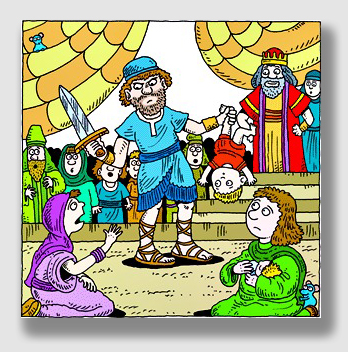
Remember King Solomon? When two women appeared in front of him arguing over who was the mother of a baby, the King proposed to settle it by cutting the baby in half so that each woman would get 50 percent of the child. That threat was enough to smoke out the imposter. In today’s case, dividing the tree in half would have had the same effect as cutting up the infant (albeit with less blood).

The Alvarezes own a nice place in Vermont, complete with a view of Lake Champlain. They have a 65-year-old maple tree next to the property line of their neighbors, the Katzes. It was close, but the b                                                                                                                                                                                                                                         ase of the tree was completely on Alvarez’s property, so this was no boundary tree the parties were dealing with.

The tree had been standing for almost seven decades. In fact, when the Alvarezes bought the property 20 years ago, the maple had already sent roots and branches across the boundary between the two parcels.

The Katzes, who also enjoy a view of Lake Champlain, have planned for a number of years to add on to their house, essentially doubling its size with a two-story addition. The only problem – or at least, the only problem we care about – was the maple tree. To add on, the Katzes would have to cut away about half of the maple tree’s branches and roots, in all likelihood killing the tree.

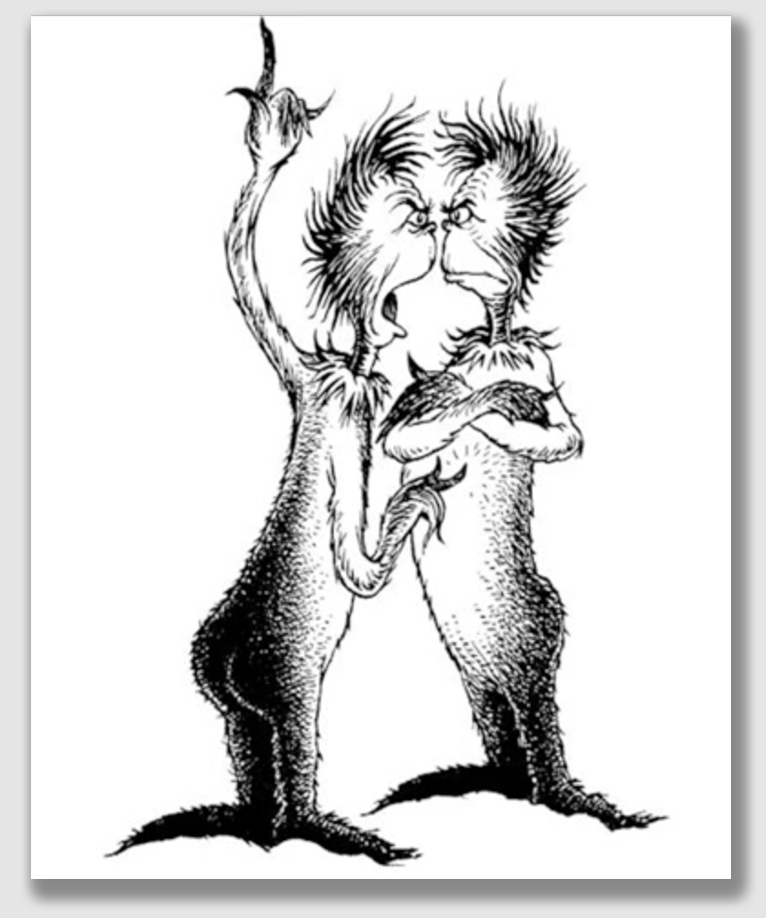
The Alvarezes and Katzes tried to resolve the problem amicably, but – just as happened with the women in front of King Solomon – there really wasn’t any middle ground. Either the Katzes would get their way, building onto their house and killing the tree, or the Alvarezes would have it their way. Like Dr. Seuss’s north-going and south-going Zax, neither neighbor would budge.

But then Katz somehow learned all about the Massachusetts Rule. It dawned on him that he could cut back the offending maple tree to the property line, both roots and branches. Sure, the tree might die, but the Massachusetts Rule said nothing about what happened to the tree after a neighbor used “self-cutting” trimming on it.

The Alvarezes ran to court and obtained an injunction against Katz. The trial court found that trimming the tree as Katz proposed would probably kill it. The injunction prohibited cutting away only about 25 percent of the tree, about half of what the Katzes needed for their ambitious plans.

The Katzes appealed, and the Vermont Supreme Court threw out the injunction. It held that the Massachusetts Rule was a blunt object, and had always been one. A landowner owns everything above and below ground level, and that owner can cut anything he or she wants to cut, without regard for the effect of the cutting. The Court said that was the law in Vermont and just about everywhere else.

The Supreme Court seemed a little uncomfortable with its decision, but it ruled, in essence, that the law is the law, and that’s the way Vermont had always done it. It noted, in a hint that was as subtle as an anvil, that in cases where Massachusetts-style self-help had been limited – such as in Booksa v. Patel – the theory that had been advanced was that of nuisance. In other words, the Alvarezes could have argued that Katz’s proposed trimming would so endanger the tree that it would interfere with their enjoyment of their property. Recall in Booksa, the court ordered the defendant to trim the encroaching tree reasonably. The Vermont Supreme Court telegraphed that it would probably have done the same if the Alvarezes’ lawyer had only thought to make the argument. Oops.

Alvarez v. Katz, 124 A.3d 839, 199 Vt. 510 (Supreme Court of Vermont, 2015). The Katzes own property in South Burlington in the Shelburne Bay area. The Alvarezes own the adjoining lot just to the north of the Katzes. The Alvarezes have a 65-ft. tall maple tree, the trunk of which is located entirely on their property. About half of the branches and roots from the tree cross the property boundary and encroach onto the Katz lot. Some roots extend under the Katzes’ existing deck.

For several years the Katzes have sought to expand their home by adding a two-story addition on the rear. The plans for the construction of the addition would require cutting the roots and branches that are encroaching onto their property. This could encompass up to half of the tree’s roots and branches.

The Alvarezes and the Katzes have been unable to amicably resolve the problem of the maple tree. In 2013, when the Katzes considered taking unilateral action to trim the tree’s roots and branches, the Alvarezes filed for an injunction. The superior court found it more likely than not that removal of 50% of the tree’s roots and branches would result in the premature death of the tree, perhaps within five years and probably within ten from the time of cutting. The court employed what it called the “urban-tree rule,” under which trimming the roots or branches of an encroaching tree may be proscribed if the trimming will destroy the tree. The injunction barred the trimming of more than 25% of the roots and branches of the tree.

The Katzes appealed.

The Zaxes wouldn’t budge, either …

Held: The injunction was vacated. The Supreme Court reaffirmed “Vermont’s long-standing right of a property owner to trim branches and roots from an encroaching tree without regard to the impact that such trimming may have on the health of the tree.”

Vermont has long recognized ownership of property to include the ownership of that which is below the ground and that which is attached overhead. The right has been clear for almost 100 years, since Cobb v. Western Union Telegraph Co., (a 1916 decision that stated the Massachusetts Rule before there ever was a Massachusetts Rule). Cobb held that “it is a sound principle that where a tree stands wholly on the ground of one and so is his tree, any part of it which overhangs the land of an adjoining owner may be cut off by the latter at the division line.” The Supreme Court criticized the trial court for conjuring up an “urban-tree rule” that would be an exception to Cobb. The trial court had considered this case to be one of first impression in Vermont because of the anticipated adverse – and likely fatal – effect the root-and-branch cutting would have had on the encroaching tree. The Supreme Court held that any attempt to “distinguish” Cobb, that is, to find that the Cobb case was somehow different just because the Cobb tree was located in a rural setting, was wrong.

Further, the Supreme Court said, the “urban-tree rule” does not enjoy the support attributed to it by the trial court. Outside of two cases, the California decision in Booksa and one obscure New York decision, the Massachusetts Rule (which maybe we should have called the “Vermont Rule”) enjoys extremely widespread support. What’s more, the Court reasoned, the Vermont legislature has had 99 years to modify the Cobb holding by statute, and it has not bothered to do so. The Supreme Court concluded that the “right to cut encroaching trees where they enter the land of another, without regard to the impact on the encroaching tree by such cutting, is well-established under Vermont law.”

The Supreme Court noted that at common law, the right to cut encroaching boughs and roots historically counterbalanced a landowner’s right to grow shade trees on his land, regardless of the impact those trees may have in casting shade or encroaching upon the neighboring property. Common law provided no claim for damages caused by encroaching roots or branches. Instead, the remedy was one of self-help, allowing the cutting of roots and branches to the extent of encroachment.

Where other jurisdictions have departed from the common-law rule and allowed actions for damages as a result of encroaching roots or branches, they have generally relied upon nuisance principles. Even where such actions have been permitted, those jurisdictions continue to recognize the right to self-help. In this case, the Alverezes did not raise a nuisance claim, so “the issue of whether a nuisance claim might exist for the encroachment of roots and branches from the Alvarezes’ tree is not presently before the Court.”

The Supreme Court subtly suggested that the proper way for the Alvarozes to address the problem would be through the law of nuisance ...

The Supreme Court subtly suggested that the proper way for the Alvarezes to address the problem would be through the law of nuisance …

The Supreme Court defined the conundrum as follows: “[T]his case presents the competing interests of neighboring property owners. On the one hand, [the Katzes] have an interest in using their land, which they have purchased and upon which they pay taxes, as they see fit, within permissible regulations, free from limitations imposed by encroaching roots and branches from the neighbors’ tree, which they did not invite and for which they receive no benefit. The Alvarezes seek to restrict the use of the Katz property by preventing the removal of branches and roots on land that is not theirs and for which they have given nothing of benefit to [the Katzes] for suffering the encroachment. On the other hand, the Alvarezes wish to continue to enjoy their tree, which has been there for many years, without placing its viability in peril due to the construction that [the Katzes] wish to undertake.”

The Court observed that if the Alvarezes had the right to have their tree encroach onto the neighboring property, the obvious next question would be to what extent the encroached-upon property owner must suffer such an encroachment. The Supreme Court admitted that on some occasions the “exercise of self-help may result in the immediate or eventual loss of an encroaching tree, given the long-recognized rule in Vermont and its widespread support elsewhere, we decline to depart from the common-law rule in favor of the approach adopted by the superior court.”

– Tom Root

TNLBGray140407

Case of the Day – Wednesday, September 11, 2024

A KINDER, GENTLER MASSACHUSETTS RULE

We saw last week that they’re some pretty tough nuts out in Washington. Ironically known as “The Evergreen State,” Washington law holds that if I hack off the roots or branches of your tree up to my property line, even if it ensures that your tree will end up in a “never-green state” (which is to say, dead, dead, dead), that’s just fine.


Today, we’re looking at the other side of the country and, for that matter, the other side of the coin. New York State takes a much more liberal view of things. Every homeowner still has the first prong of the Massachusetts Rule at his or her fingertips (or the tip of the chainsaw). That is, a landowner may trim branches or roots up to the property line.

However, there is a caveat. New York has codified some of its common law. That is, it has tried to distill some of the court-made law from years and years of jurisprudence into its statutes. One such code relates to real estate law, and is called New York Real Property Actions and Proceedings Law.

Called the RPAPL, an unpronounceable acronym if ever there was one, that code contains § 861, which makes a landowner liable for “despoiling” a neighbor’s tree without the neighbor’s permission. In today’s case, the court let the Fliegmans go forward with their complaint that construction contractors hired by their neighbors, the Rubins – while not setting foot on their land – nevertheless caused three Fliegman trees to topple by cutting roots that had grown into the Rubins’ property. The Rubins had the right to cut encroaching roots, the court held, but not so as to harm the tree’s support structure.

Fliegman v. Rubin, 781 N.Y.S.2d 624 (S.Ct. 2nd Dist., Nov. 20, 2003). After three large trees located on Agi and Mendel Fliegmans’ property fell, damaging their home, they sued their next-door neighbors Liebel and Dorothy Rubin, as well as their contractors. The Fliegmans argued that the trees fell because of an excavation on the Rubins’ property as part of a house construction project.

They sued, claiming negligence, trespass and violation of New York Real Property Actions and Proceedings Law § 861, Action for cutting, removing, injuring or destroying trees or timber, and damaging lands thereon.

The trial court threw out the Fliegmans’ suit, and they promptly appealed.

Held: The Fliegmans could recover damages.

The fallen trees at issue were located on the Fliegmans’ property, but their roots and branches encroached onto the Rubins’ property. At common law, adjoining property owners – such as the Rubins – are permitted to trim tree branches and roots which encroach onto their property from a neighboring lot. However, the appellate court said, the right to self-help is limited – in that an adjoining landowner’s right to engage in self-help “does not extend to the destruction or injury to the main support system of the tree.”

New York RPAPL 861(1) provides that “if any person cuts down or carries off any wood, underwood, tree… or otherwise despoils a tree on the land of another, without the owner’s leave… an action may be maintained against him by the owner…” This is in accordance with common law principles, the Court held.

RPAPL 861 does not require that a trespass occur in order to impose liability. Instead, damages may be recovered under the common law and pursuant to RPAPL 861 if a tree is, among other things, “cut down or despoiled even if the defendants herein did not enter onto the plaintiffs’ property.”

– Tom Root

Case of the Day – Monday, September 9, 2024

FOOTBALL IS (NOT SO) BACK!

It’s supposed to be the most wonderful time of the year… high school games every Friday night, our beloved Ohio State Buckeyes (and how those Wolverines?) on Saturday, and the Super Bowl-bound Cleveland Browns on Sundays.

In honor of the gridiron season, we resort to cheap metaphors today while considering an unusual and (to us) troubling tree law case. Change the fact pattern by about three feet, and the outcome would have been the opposite of what the court ruled. That is, if Jennifer’s trees had been growing a yard or so south of where they were rooted, they would have been boundary trees. Neighbors Tony and Xiaoye couldn’t have touched them. But because the trunks and root flares of the conifers were all on Jennifer’s land, Tony got away with whacking away so much root support that Jennifer had to take the three trees down.

“Can they do that?” you ask, because you seem to remember a California case that said otherwise. Good recall, tree law fan. Unfortunately, the answer is pretty much, “Yeah, in Washington, they can do that.” But somehow it seems that the answer ought to be otherwise, that your right to Massachusetts Rule-style hacking at your neighbor’s tree should be informed by some kind of a duty not to kill the tree in the process.

Trigger warning: the outcome of this case is tragic for the trees involved, and those sensitive readers among us who cower at the sound of chainsaws might be needlessly upset.

Mustoe v. Ma, 371 P.3d 544 (Wash.App. 2016). Jennifer Mustoe had two large Douglas fir trees located entirely on her property, about three feet from the property line. Her neighbors were Anthony Jordan and Xiaoye Ma. In October 2013, Tony dug an 18-to-20-inch deep ditch on his property along the border of Jennifer’s lot. In the process, he exposed and removed the trees’ roots, leaving them to extend only 3-4 feet from the trunks, a loss of nearly half of the trees’ roots, all from the south side of the trees. The trees were thus exposed to southerly winds with no support, making the damaged trees likely to fall on Jennifer’s home.

The landscape value of the trees was estimated to be $16,418; the cost of their removal was estimated to be $3,913.

Jennifer filed suit against Xiaoye and Tony, asserting that Tony had negligently, recklessly, and intentionally excavated and damaged her trees. The trial court dismissed Jennifer’s claims, holding that Tony was entitled to remove those portions of roots that had encroached onto his and Xiaoye’s property and that in so doing, he did not owe Jennifer a duty of due care to prevent damage to the trees.

Jennifer appealed.

Held: The Court rejected Jennifer’s claims.

Jennifer started out a field goal behind, because she was compelled to acknowledge that Washington law lets an adjoining landowner engage in self-help and trim the branches and roots of a neighbor’s tree that encroach onto his or her property. Yet, Jennifer argued, the right to self-help does not extend to removing the tree itself, and the State’s common “does not immunize a landowner against liability for damage to the trimmed trees” and argues that the Court should hold that in exercising self-help, a landowner owes a duty of care to prevent damage to the trees themselves.

Jennifer thought she’d put one through the uprights and tie the score, but the Court played Lucy to her Charlie Brown. The law was clear, the Court said, that an adjoining landowner may trim only those branches or roots that encroach on his own property, but it did not hold that a landowner owes a duty to act in good faith or reasonably to prevent damage to the trees.

Jennifer also claimed that under state law, all members of society owe a broader legal duty to their fellow citizens and must not use their own property in such a way as to cause injury to others. She cited an exception to the common enemy doctrine in water trespass cases as an example of this duty. The common enemy doctrine allows landowners to dispose of unwanted surface water in any way they see fit, without liability for resulting damage to their neighbors, but a “due care” exception requires that a landowner change surface water flow in good faith and in such a way as not to cause unnecessary damage.

The Court rejected Jenn’s comparison, observing that no court had ever extended the “due care” exception beyond surface water. The Court said, “Surface water is a common enemy precisely because it is a force of nature which may indiscriminately affect any landowner. As such, each landowner may defend against it so long as he or she does not do so in a manner that unnecessarily redirects the wrath of the common enemy upon a neighbor. Unlike surface water, tree roots and branches are not a force of nature that indiscriminately wreak havoc among adjoining landowners. Instead, they are an encroachment upon the land of one’s neighbor.

Jennifer, facing second and long, argued that Booska v. Patel, a California case, found that adjoining landowners had a duty to act reasonably in trimming encroachments where neighbors’ trees were concerned. Citing a decision from the other end of the country, Jennifer argued that in Fliegman v. Rubin, a New York court – relying on Booksa – reversed the trial court’s summary dismissal of a plaintiff’s claims for damages to his trees allegedly resulting from the defendant’s severance of roots that had encroached on to his property. The Fliegman court held there was an issue as to whether severance of the trees’ roots damaged the plaintiff’s trees because “the right to self-help is limited, in that an adjoining landowner’s right to engage in self-help ‘does not extend to the destruction or injury to the main support system of the tree… .'”

Jennifer’s court was unswayed, holding that Booska and Fliegman appeared to be “outliers.” In Alvarez v. Katz, the Vermont Supreme Court rejected the holdings in Booska and Fliegman, finding that the “right to cut encroaching trees where they enter the land of another, without regard to the impact on the encroaching tree by such cutting, is well established under Vermont law.”

Here, the Court was likewise persuaded that the law in Washington was consistent with the general rule as applied in Vermont.

Pinned deep in her own territory on third down, Jennifer aired it out. She contended that her nuisance action against Tony and Xiaoye should go forward because Tony’s excavation and removal of tree roots was unreasonable in relation to the harm it caused to her trees. A nuisance is an unreasonable interference with another’s use and enjoyment of property. RCW 7.48.010 defines an actionable nuisance as “whatever is injurious to health or indecent or offensive to the senses, or an obstruction to the free use of property, so as to essentially interfere with the comfortable enjoyment of the life and property.

The fundamental question in a nuisance issue is whether the use to which land is put can be considered reasonable in relation to all the facts and circumstances. Tony argued that Jennifer had no action for nuisance because she had no legally recognized right. The Court agreed that Jennifer had not established that she had any legal cause for complaint or interference with the lawful removal of the roots on Ma’s property.

A nuisance claim will fail if it is nothing more than a negligence claim “in the garb of nuisance” unless the negligence claim has merit. Where the alleged nuisance is a result of the alleged negligent conduct, the rules of negligence are applied.

Here, Jennifer’s nuisance claim arose from Tony’s actions that damaged the trees; the nuisance is the result of his alleged breach of duty. But there was no breach of duty: because Jennifer’s negligence claim failed, her nuisance claim did, too.

On fourth down and a mile, with only a few seconds left, Jennifer threw the Hail Mary. She complained that she was entitled to damages under the timber trespass statute, RCW 64.12.030. The statute reads, “Whenever any person shall cut down, girdle, or otherwise injure, or carry off any tree… timber, or shrub on the land of another person, … without lawful authority, in an action by the person, city, or town, against the person committing the trespasses or any of them, any judgment for the plaintiff shall be for treble the amount of damages claimed or assessed.”

Alas, the ball fell short. By its own terms, the Court said, the timber trespass statute applied only to persons acting without lawful authority. Because Tony did not act unlawfully when he removed roots that encroached onto his property, the claim fails.

– Tom Root

TNLBGray140407

Case of the Day – Tuesday, July 30, 2024

TREE GONNA DO WHAT A TREE GONNA DO

When I was a kid, we had a cottonwood in the far backyard that my father christened “The Mess Tree.” It was not a sobriquet of affection.

The Mess Tree seemed to shed leaves and twigs all 12 months of the year. It was stubbornly marcescent, slow rolling its autumnal leaf drop from late August through February. Its twig production was prodigious: we all knew never to walk barefooted anywhere near the drip line. And when it released its seeds in June, the backyard looked as though it had been dusted with an early November snow.

Until I became responsible for my own yard, I could not understand my father’s disgust at The Mess Tree. But I am now responsible for a pair of cottonwoods in my own side yard, and I have empathy – a little late in coming, I admit – for Dad’s frustration.

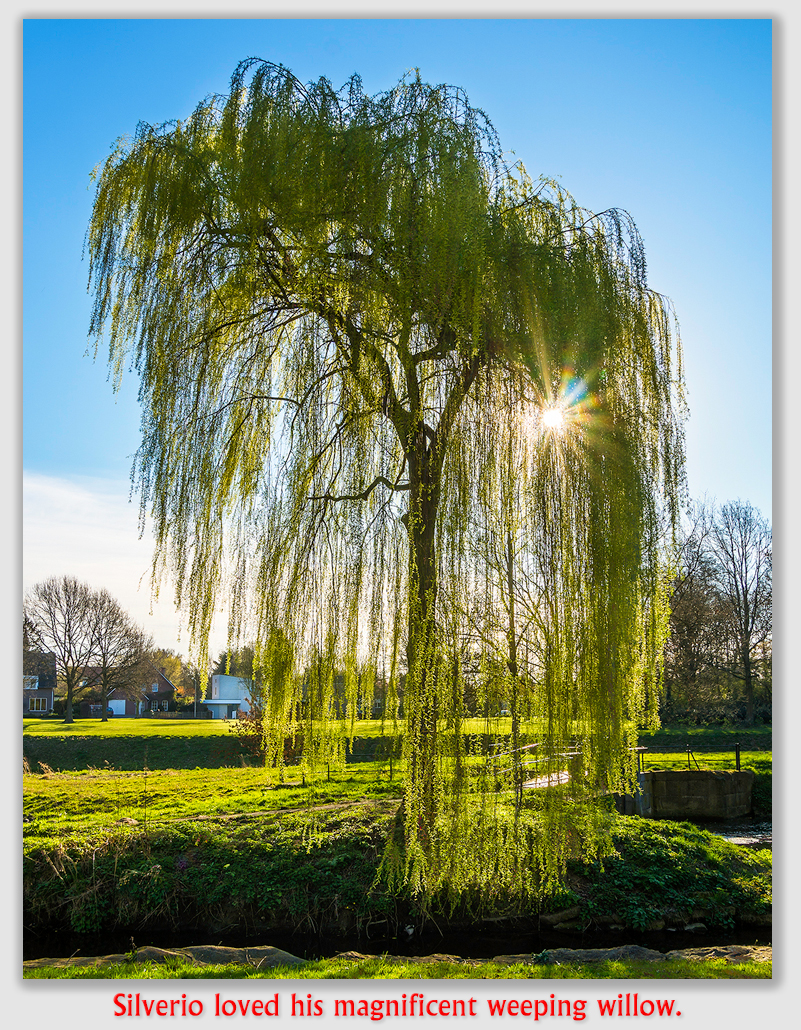
For that matter, like many people, I understand Helena and Joe Ponte’s vexation at Silverio DaSilva’s weeping willow. As unhappy as Dad was at his cottonwood, it was his cottonwood: he could remedy the problem with a single call to our neighborhood tree service. But when Silverio’s tree rained its ration of sap, twigs and other debris onto the Pontes’ lawn and driveway, all they could do is demand that Silverio cut it down.

He would not.

Finally, when Helena slipped on some wet leaves and twigs, breaking her ankle, the Pontes brought in their lawyer.

Satisfaction did not follow. Silverio’s weeping willow was a fine, healthy tree. It was just doing what trees do. And that, the Court said, was fine. A tree gonna do what a tree gonna do, and the law won’t get in its way.

Ponte v. DaSilva, 1982 Mass.App.Div. 6 (1982). Helena Ponte lived next to Silverio DaSilva and his magnificent weeping willow tree. The tree, standing about four feet from Silverio’s boundary with Helena, overhung the picket fence and Helena’s driveway.

Helena began noticing all of the leaves, sap and branches that fell from the tree onto her driveway about two years before the accident. She complained to Silverio, demanding he cut down the tree. Leaves and debris were clogging Helena’s gutters and swimming pool filter. Sap and tree debris (leaves and twigs, no doubt, inasmuch as willows don’t have much fruit) fell on Helena’s Studebaker. And of course, Helena darkly foretold, there was the ever-present slip-and-fall risk.

Helena’s attorney then wrote to Silverio, complaining that Helen’s husband had already fallen on the leaves and debris. The letter portended similar incidents unless the tree was removed.

Sure enough, about 10 days later, Helena fell due to the leaves and sap, breaking her ankle. She sued.

The trial court found that the tree was not diseased and that the leaves, sap and debris which fell were due to the natural characteristics of weeping willow trees. They do, after all, “weep.” Nevertheless, the trial court awarded Helena $15,000 and her husband another $3,000 for loss of consortium (which we will not endeavor to describe here).

Silverio appealed.

Held: Helena and Joseph got nothing, and the tree kept on being a tree.

The crucial issue, the Court of Appeals said, was whether under the circumstances Silverio owed a legal duty to Helena and Joseph to remove the tree. If so, then he would be liable for the damages caused by a breach of that duty.

The Pontes claimed essentially that the weeping willow was a nuisance because it bothered them. But the test for nuisance, the Court held, was not whether the conduct or activity would be objectionable to a hypersensitive person, but rather whether a normal person in the community would find the conduct at issue clearly offensive and annoying.

The Court observed that the tree had been there for some time, and it was obviously quite alive. No evidence in the record showed the tree to be a hazard (beyond Helena’s ankle, of course) to life or property. Trees “whose roots or branches extend beyond the boundary line,” the Court said, “have been held not to constitute a nuisance in themselves.” In fact, the Court noted, “the Restatement of Torts suggests that where the tree is a part of the natural condition of the land, there is no liability for private nuisance.”

The Court characterized Michalson v. Nutting (the case that was the origin of the Massachusetts Rule) as addressing the notion, albeit obliquely, of a tree as a nuisance. There, the Court said, “the Supreme Judicial Court held that the natural and reasonable extension of the roots and boughs of trees into adjoining property was damnum absque injuria.” The rationale given for this approach “is that to allow recovery in such situations would inundate the courts with frivolous and vexatious suits.”

But Helena argued that the underpinnings of the Michalson case had eroded to the point that a new theory of liability would and should make the defendant legally responsible in a case such as this. The Court dismissed her argument for a change in the law, noting that the line of cases she relied on to make her point all involved trees that were diseased, decayed or dead. Silverio’s weeping willow, on the other hand, was very healthy.

The right of a landowner to use and enjoy it for lawful purposes, the Court said, must be weighed against the likelihood of substantial harm to a neighboring landowner in cases of private nuisance. A dead, diseased or decayed tree has little or no utility to its owner and poses a foreseeable threat to adjoining landowners from falling limbs. A live tree, on the other hand, provides shade and will generally enhance the landowners’ property. The fact that leaves or other debris will naturally fall from live and healthy trees that are harmless in and of themselves and that such falling leaves and twigs might cause some inconvenience or annoyance to neighbors does not render the tree’s owner liable for damages.

– Tom Root

TNLBGray140407

Case of the Day -Tuesday, July 2, 2024

NOW LOOK WHAT YOU’VE DONE!

Rarely (as in “I don’t recall when I’ve ever said this before”) do I caution that the prevailing law in any particular state is wrong, and likely to be cruisin’ for a bruisin’ the next time an appellate court has to think about it. But I feel comfortable issuing that warning about today’s case.

From Ohio (home of rock ‘n roll, pro football, the first guy to walk on the moon, the brothers who turned a bicycle into the first airplane, and a ton of other cool things), comes a case that pretty much runs smack into Fancher, Herring, the Hawaii Rule, and a raft of other cases reflecting the modern view that a homeowner whose tree is wreaking havoc on the neighbor’s property may be ordered by a court to fix the damage at his expense.

To be fair, this case may be proof of the old legal aphorism that “hard cases make bad law.” Even the most cursory reading of the facts suggests that Dave Rababy may well have been a horse’s ass, hounding his neighbor because a tree dropped leaves and twigs on his property. Speaking as a guy who owns all of my five southerly neighbors’ leaves every fall – and these things are the size of dinner plates – I understand how it can be irritating to have other peoples’ leave on your lawn. But I would never sue them over it. I don’t think I would…

Dave had no such compunction, and his emesis of woe delivered to the court made him the boy who cried wolf. He howled so loudly about leaves and twigs and that his trimming crew was not allowed to trespass on Roy’s property and hack away at the offending tree, and minutiae of a similar nature, that his real complaint – his driveway was being heaved and foundations dislodged by the roots – got lost in the underbrush. In Fancher, Whitesell and even Iny, such damage was enough to get the neighbor’s tree declared a nuisance. If Dave had exercised a little plaintiff self-control, he might have gotten there, too.

We are too urban and too suburban, and our properties are too developed for the Massachusetts Rule to be the exclusive remedy for genuine harm done by a neighbor’s tree. That is the way the law is trending throughout the civilized world, and it is bound to reach Ohio sooner or later.

Rababy v. Metter, 30 N.E.3d 1018 (Ct.App. Cuyahoga Co., 2015). David Rababy and Roy Metter were next-door neighbors. Dave’s driveway abutted Roy’s property in certain places and nearly abuts in others. A fence separated the properties, and a stand of mature trees ran along the fence on Roy’s side of the boundary line.

Dave sued Roy for negligence, nuisance, trespass, and interference with a business contract. Dave asserted that trees at the edge of Roy’s property extended over his own property, and dropped leaves, needles, sap, and branches onto his car and home, and that some of the trees were rotten. He said the trees cast shadows over his property and cause mold growth on his roof, as well as damaged his driveway and foundation.

Dave complained he had a company to trim the overhanging branches, but Roy’s daughter prevented the unnamed landscape service company from properly performing this work. The complaint alleged the trees constituted an ongoing nuisance and trespass and that Roy negligently maintained the trees. Dave asked for $52,500: $37,000 for future tree trimming services and $15,000 in compensatory damages.

Both parties filed motions for summary judgment. Dave argued that on “an ongoing basis, Roy’s trees encroach onto my property, specifically over my home and driveway. His trees deposit leaves, debris, and sap onto my property, causing damage.” Dave also repeated the claim about Roy’s daughter running off the tree trimmers.

Roy argued that he owed no duty to Dave to trim otherwise healthy trees on his property. He claimed the trees were mature and preexisted either party’s ownership of the property. He said that a year before, Dave hired Cartwright Tree Service to trim the row of pine trees that ran along the driveway. He said no one complained when Cartwright trimmed the overhanging branches from Dave’s property free, but when Cartwright began trimming branches and trees back further than the property line, Roy’s daughter objected. Roy said that he has no objection to Dave trimming the overhanging branches back to the property line.

Dave replied with new allegations that the trees in question were decaying or dead. Attached to the reply was a new affidavit that averred that the trees were decaying and dangerous and that one had fallen on his property. He included a picture of a tree that appears to have fallen across a driveway. However, the affidavit was neither signed nor notarized.

The trial court granted Roy’s motion for summary judgment and denied Dave’s. Dave appealed.

Gen. Robert E. Lee – a man rapidly being consigned to the ash head of history – knew something about duty … and even he couldn’t have found that Roy owed one to Dave.

Held: Roy owed Dave no duty, so the trial court’s dismissal of the case was upheld.

In order to succeed in a negligence action, the Court said, Dave must demonstrate that Roy owed him a duty, that Roy breached the duty, and that he suffered damages that proximately resulted from Roy’s breach. Here, Dave offered evidence that falling pine needles, leaves, sap, and sticks had damaged his car, driveway, and roof. He also alleges, without evidentiary support, that encroaching tree roots damaged his driveway and home.

While he showed damage, Dave was unable to show that Roy owed him any duty. A landowner is generally not responsible for the losses caused by the natural condition of the land. Instead, the Court observed, states generally allow one impacted by such growth the remedy of self-help. A privilege existed at common law, such that a landowner could cut off, sever, destroy, mutilate, or otherwise eliminate branches of an adjoining landowner’s tree that encroached on his land. But, the Court said, whether a separate remedy exists is an open question.

The Massachusetts Rule provides that in almost all circumstances, the sole remedy for damages resulting from the natural dropping of leaves and other ordinary debris from trees is the common law remedy of self-help. The rule does provide a limited exception for dead trees, just as Ohio has established a duty for urban landowners of reasonable care relative to the tree [hat overhangs a public street, including inspection to make sure that it is safe.” Where constructive or actual knowledge of an unreasonably dangerous condition exists on the land of an urban landowner, such as a dead tree, the duty prong of a negligence claim may be satisfied.

The reasoning set forth in support of the Massachusetts Rule, the Court said, is apt to the facts of this case: “[T]o grant a landowner a cause of action every time tree branches, leaves, vines, shrubs, etc., encroach upon or fall on his property from his neighbor’s property, might well spawn innumerable and vexatious lawsuits.” The Court thus adopted the Massachusetts Rule as the law of this jurisdiction.

But Dave also argued that in Ohio a “landowner in an urban area has a duty to exercise reasonable care to prevent an unreasonable risk of harm to others from decaying, defective or unsound trees of which such landowner has actual or constructive notice.” Dave contended Roy’s trees were in such a defective condition and thus constituted a nuisance. Dave also argued that Roy, an urban landowner, had a duty to inspect his trees and protect others from a dangerous condition created by any unsound trees. Even if such a duty existed, the Court said, it only is breached when the owner has actual or constructive notice of a dangerous condition.

Leaves – often a pain in the arse, but seldom a nuisance

The Court held that Dave put forth no evidence that any of the trees constituted a dangerous condition of which Roy was aware or should have been aware. He presented no any evidence that the trees are dead, decaying, or unsound, and cited no case holding that “the normal yearly life-cycle of a tree and the natural shedding of leaves, twigs, and sap constituted a nuisance. Thus, he provided no compelling justification for a court to hold that Roy’s trees case constituted a nuisance or a dangerous condition. The problems Dave had experienced with the trees “are the natural consequence of living in an area beautified by trees. Dave’s remedy is to trim tree limbs that overhang his property back to the property line, to which Roy averred he has no objection.”

The trees at issue in this case do not constitute a nuisance, and Roy is not negligent in regard to them.

Dave also asserted that the trees on Roy’s property constituted a trespass. But the elements of a successful trespass claim include an unauthorized intentional act, and entry upon land in the possession of another. Here, there is no intentional act. Dave claimed that Roy’s actions of not removing or trimming the trees constitute an intentional act. But, the Court said, as it explained, Dave’s remedy for intrusion by vegetation is to trim it back to the property line.

In sum, Dave’s claims that detritus falling from trees from the neighboring property constituted a trespass, a nuisance, and negligence were simply not actionable. The Court cited a Maryland case that “it is undesirable to categorize living trees, plants, roots, or vines as ‘nuisances’ to be abated. Consequently, we decline to impose liability upon an adjoining landowner for the ‘natural processes and cycles’ of trees, plants, roots, and vines.”

– Tom Root

TNLBGray140407

Case of the Day – Thursday, June 27, 2024

HOW MUCH IS ENOUGH?

A eucalyptus tree, similar to the one that offended Ms. Cannon

A eucalyptus tree, similar to the one that offended Ms. Cannon.

There was a time, back when people of grit populated the land, that a landowner only had one choice when his neighbor’s trees encroached – to cut ‘em back. The Massachusetts Rule was the coin of the realm: if you didn’t like your neighbor’s tree overhanging your eaves, or its roots wrapping around your sewer line, you only had one option. The courts didn’t want to hear about it. Self-reliance was what it was all about.

Then along came the Hawaii Rule, which suggested that a naturally growing tree could be or could become a nuisance and that an aggrieved landowner could sue for an order requiring its removal. One rule does not necessarily negate the other. So when does one oil up the chainsaw, and when does one fire up the word processor?

The Massachusetts Rule is, generally speaking, a blunt instrument. It’s one thing to cut away branches that pose a threat (or even an inconvenience) to your property. But what if cutting a limb back to the property line leaves a 15-foot leafless stub extending from the branch to the boundary. That’s not necessarily according to ANSI Standard A300, but on the other hand, you don’t have the right to trim it properly unless your neighbor consents to you coming onto his or her land to do so.

Or, more dangerously, what if you cut back roots to the extent that the tree loses too much subsurface support, and falls on your neighbor’s new last-of-its-kind Bugatti Chiron? Are you liable? After all, you did no more than what the Massachusetts Rule permitted you to do.

The Hawaii Rule, on the other hand, is Doug Lewellyn’s dream. What an All-American solution – let’s sue! When is harm sensible? When your foundation walls collapse? When a dead branch falls on your Tourbillon? When leaves clog the filter on your swimming pool? How much harm is enough?

Joan Cannon lived next to Lamar Dunn. Joan was unhappy with the roots from the Dunns’ eucalyptus tree, which were encroaching underground onto her land, as roots are wont to do. After all, a tree will quite often send roots out 35 feet or more from the base of the trunk, and the root system has little regard for some lines drawn on a recorder’s map.

We’re not sure why Joan was so exercised. Maybe she was naturally crotchety. Perhaps she was unusually territorial. Maybe her neighbor had a nice Bugatti, while Joan drove a Yugo. What we can be sure of is that the eucalyptus roots weren’t really causing any harm.

encroach160715

Sometimes encroaching roots can be an inconvenience.

That didn’t stop Joan from suing the Dunns.  The trial court denied an award of any damages and refused to order Lamar the appellee to remove the offending roots and tree. Joan appealed.

The Court of Appeals considered the classic Restatement of the Law trespass approach, which held simply that if a neighbor owns something that trespasses, he or she has to remove it if there is a duty to remove it, regardless of whether it causes harm or not. That’s the rub, the court said. When does such a duty arise?

The court found guidance in the Restatement on nuisance and held that a duty to remove offending branches or roots arose when some actual and sensible or substantial damage had been sustained. Joan’s general objection to the unseen eucalyptus roots did not equate to harm. Thus, the roots could remain.

Cannon v. Dunn, 145 Ariz. 115, 700 P.2d 502 (Ariz.App. Div. 2 1985). This case involves the liability of Lamar Dunn, an adjoining landowner, for roots from a eucalyptus tree that invaded the subsurface of land belonging to his neighbor, Joan Cannon. The trial court found that the roots had caused no actual damage, and denied an award ordering the Dunns to remove the offending roots and tree.

Joan appealed.

Held: Dunn did not have to remove the roots. The Court of Appeals rejected Cannon’s argument that it should apply the Restatement (Second) of Torts § 158 (1965), which stated that “one is subject to liability to another for trespass, irrespective of whether he thereby causes harm to any legally protected interest of the other, if he intentionally… fails to remove from the land a thing which he is under a duty to remove.”

The Court said that it was “obvious that one must first determine whether there is a duty to remove the object and that in this case § 158(c) really begs the question.” More to the point, the Court observed, was the Restatement (Second) of Torts § 840 (on nuisances), which held that a possessor of land is not liable to his adjoining landowner for a nuisance resulting solely from a natural condition of the land.

Ms. Cannon could not prove any damages flowing from the alleged encroachment ... unlike this guy.

Ms. Cannon could not prove any damages flowing from the alleged encroachment … unlike this guy.

The Court paid lip service to the Massachusetts Rule, noting that Arizona law permitted a “landowner who sustains injury by the branches or roots of a tree or plant on adjoining land intruding into his domain, regardless of their non-poisonous character may, without notice, cut off the offending branches or roots at the property line.” At the injured landowner’s expense, of course.

But when some actual and sensible or substantial damage has been sustained, the Court said, the injured landowner may maintain a nuisance action for abatement of the nuisance, and compel the removal of the branches or roots at the tree owner’s expense. However, where no injury has been sustained, no lawsuit be brought for either an injunction or damages.

– Tom Root
TNLBGray140407