Case of the Day – Thursday, January 16, 2025

SITTING ON YOUR RIGHTS

Equity is a beautiful thing.

There was a time, back in merry olde England, went the courts of law had gotten so hidebound and formalistic that your average aggrieved peasant couldn’t catch a break. So people who needed something more than what the law could provide would petition the Lord Chancellor.

Thus began the courts of chancery, known more commonly as courts of equity. A court of equity is authorized to apply principles of equity, as opposed to those of law, to cases brought before it.

Equity courts hear lawsuits and petitions requesting remedies other than damages, such as writs, injunctions, and specific performance. Most equity courts were eventually merged with courts of law, but some American states, including Delaware, Mississippi, New Jersey, South Carolina, and Tennessee, preserve the distinctions between law and equity and between courts of law and courts of equity.

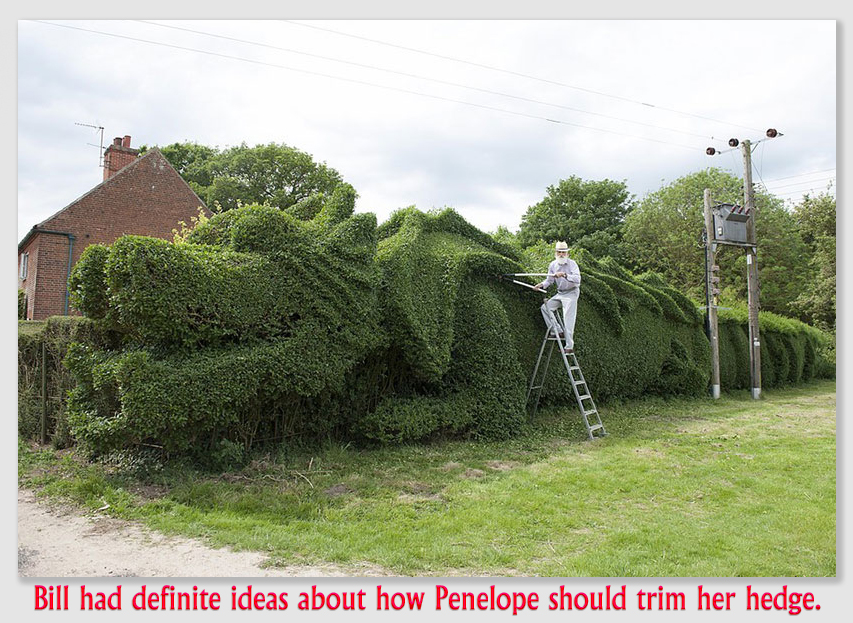
Today’s case, being from Tennessee, started with a Chancellor (something like this fellow), because what the plaintiffs really wanted was an injunction, a court order that the owner of the hedge trim it. But it ended up in the Tennessee Supreme Court.

At its root, equity is nothing more than fairness. Note how equity creeps into this case, not only in the application of the Massachusetts Rule – and how much a creature of equity is that? – but in the observation at the end of the decision that laches should prevent Bill Granberry from getting any relief from his claim.

Bill sat on his rights. If he had sued Penelope when the hedge was still short and young, the outcome might have been different.

Granberry v. Jones, 188 Tenn. 51, 216 S.W.2d 721 (Supreme Ct. Tenn. 1949): Bill Granberry and Penelope Jones each owned a residence on adjoining lots in Tullahoma. Due to the narrow frontage, Bill’s residence is a little less than five feet from the boundary line between the properties.

Penny planted an evergreen shrubbery hedge entirely on her side and within a few inches of the boundary line. The hedge has grown to a height of about twenty feet and its branches and foliage have grown over the boundary line and over Bill’s property to the extent that they rub the side of his house and enter his open windows.

Bill sued for an injunction that would require Penny to trim the hedge back to the boundary line. For good measure, he also asked for a decree requiring her to move the hedge entirely or at least to cut it down to a height of not more than 24 inches and to keep it that way, and for damages.

Penny demurred (which is legalese for saying to the court, “Even if everything he says is true, Bill’s got nothing coming). Penny argued that she had the legal right to grow the shrubbery on her own property to any height she desired, and if any of the branches or foliage protruded onto Bill’s land, his remedy was only to cut the hedge to the extent of the protrusion. The trial court overruled her demurrer, and Penny appealed.
Held: Penny’s demurrer was correct: Bill’s remedy was limited to self-help.

The court reversed the lower court’s decree which had overruled the defendants’ demurrer to the complainant’s bill, seeking inter alia to enjoin the defendants from permitting their hedge to extend onto his land. The court dismissed the bill.

Noting that it could “find no Tennessee case where resort to a Court of equity has been attempted on the facts alleged by this bill,” the Supremes ruled that every owner of land has dominion of the soil, and above and below to any extent he or she may choose to occupy it. As against adjoining property owners, the owner of a lot may plant shade trees or cover the grounds with a thick forest, and the injury done to them by the mere shade of the trees is damnum absque injuria.

No landowner has a cause of action from the mere fact that the branches of an innocuous tree belonging to an adjoining landowner overhang his or her premises. The afflicted owner’s right to cut off the overhanging branches back to the property line is considered a sufficient remedy, the Court said, citing the Massachusetts Rule.

The principle, the Court said, is that an owner of land is at liberty to use his land, and all of it, to grow trees. Their growth naturally and reasonably will be accompanied by the extension of boughs and the penetration of roots over and into the adjoining property of others.
Bill argued that the overhanging branches and foliage had caused the outside wall of his home to rot and decay, and the sills and woodwork have been caused to rot to such an extent that they will have to be replaced by reason of the constant leaning against them of the hedge.

The Court was a mite troubled that it obviously had taken many years for the hedge had grown to its current size. Bill could have taken action when the hedge was much smaller, and the damage to him and burden to Penny – were she to be required to cut the hedge – would have been much less. “The long acquiescence and laches upon the part of [Bill] without any notice to [Penny] and with no attempt to aid himself,” the Court wrote, “is clearly the cause of the damage for which he seeks equitable relief. Of course, the Courts are open to [Bill] if, in legally aiding himself, he is improperly interfered with by [Penny] or her brother. Our conclusion, also, is without prejudice to whatever rights, if any, [Bill] may have for recovery of the expense to which he may be put now or hereafter in cutting the overhanging branches or foliage.”

– Tom Root

TNLBGray

Case of the Day – Tuesday, January 14, 2025

MISSION CREEP

It pretty much stands to reason that landowners whose trees and shrubs overgrow signs along the road, thus endangering motorists, might have a duty to trim their trees.

That’s the law in Florida. But what happens when the vegetation merely creeps up over an extended period of time? That happened on a country road in Dade County, where pine tree roots over 50-70 years submarined a roadway and turned the pavement into corduroy. Of course, it did not help that, at some point, the County widened the road, so that trees that were once well away from the road ended up uncomfortably close to the shoulder.

I once had a dapper contracts law professor – an adjunct with an alternative life as a litigation partner in a downtown law firm – who explained to us well-scrubbed first-year students that the law was a seamless web. We would never, he explained, have a case that was exactly like a case that had already been decided. Instead, our fact patterns and legal issues would fall somewhere in between cases and legal principles that had been settled by courts and lawyers who had gone before. Our job as attorneys, he said, was to convince the judge that our clients’ cases fell closest to the legal principle that best served our client’s interest.

That’s what the lawyer for injured passenger Mary Sharon Sullivan tried to do when he sought to convince a Florida appellate court that if a landowner can be dinged because its trees overgrow a stop sign, it certainly ought to be liable when roots from the landowner’s trees grow beneath a public street, breaking up the pavement.

Silver Palm Properties, Inc. v. Sullivan, 541 So.2d 624 (Ct.App. Florida, 1988). Bob Stevens was driving with a passenger, Mary Sullivan, on a two-lane county paved road in an agricultural section of Dade County. Bob’s car hit a series of bumps submerged in rainwater, and he lost control, swerved to the left and crashed into a tree several hundred feet away. Both Bob and Mary were injured.

Mary sued Silver Palm, the owner of the property next to the accident site, complaining that the company had a duty to maintain the trees on its property so that “subterranean growth” would not cause dangerous bumps, cracks, and protrusions in the road. She argued Silver Palm was negligent in allowing the trees to grow in such a manner as to damage the road, and in failing to inspect, discover, or repair the area. She said Silver Palm knew or should have known of the condition of the road “and therefore had a duty to take action reasonably calculated to correct the dangerous conditions created by its actions or inactions.”

Since 1974, Silver Palm has owned the avocado grove adjacent to the road where the accident occurred. About 50 to 70 years earlier, a prior owner planted Australian pine trees alongside the grove as windbreaks to reduce wind damage to the avocados. Silver Palm had never trimmed or pruned the trees. The trees were not originally located right next to the road, but when the county widened the highway in 1974, they ended up much closer than they had been before.

Mary’s expert witness, a mechanical engineer, said that about three and one-half to four feet of pavement had been uprooted and broken up to a height of five or six inches because of the pine tree roots. Another expert witness corroborated the engineer’s testimony. The expert explained that four methods were generally employed to prevent the growth and spread of tree roots. Two of the methods would kill the tree outright. In a third method – topping – limbs are cut away to reduce the height of the pine tree from about 30 feet to six feet. In a fourth method, root trenching, a trench is dug parallel to the roadway, severing the roots.

The horticulturist admitted that locally, he never seen had any owner other than Dade County perform root trenching, and he had never known of any company, individual, or landowner who had done root work on pine trees within 15 feet of a roadway. No one testified as to when in the past the topping method would have had to have been performed in order to retard the root growth enough to prevent the pavement from buckling and cracking.

The horticulturist also testified that when the County widened the road in 1974, its workers merely scraped over the tops of the existing roots instead of root trenching, which would have been the proper means of controlling the root problem. Had the county root-trenched in 1974, he testified, the trenching would have retarded root growth for about ten years, well beyond the date of the accident.

Dade County admitted it had prior knowledge of the condition of the road, and it admitted it had had the responsibility to maintain and repair it. It settled for $50,000 just after the jury had retired for deliberation.

Silver Palm did not, and the jury found it 22.5% negligent; Dade County, 15% negligent; and Bob (the driver) 62.5% negligent. The trial court entered a final judgment against Silver Palm and its insurer for $200,000.

Silver Palm appealed.

Held: Silver Palm was not liable to Mary.

Florida law holds that users of a public right-of-way have a right to expect that the roadway will not be unreasonably obstructed. Thus, a landowner may incur liability for damages caused by something which grows on private property but which obstructs the public right-of-way.

The Court distinguished the situation from other cases where obvious conditions created hazards, such as vegetation obscuring traffic signs. In those cases, “common sense required that a duty be imposed upon the landowner to remove landscaping which obstructed critical traffic signage. Vegetation that overhangs and blocks out a traffic control device constitutes an obvious condition and presents an imminent danger of uncontrolled traffic. The offending branch, moreover, need only be clipped away, a straightforward remedy.”

In this case, however, “the offending vegetation was anything but obvious. The root growth was slow and subterranean; the defect in the right-of-way became noticeable only after a considerable passage of time; and the remedy was known only to horticulturists and practiced only by a governmental entity.” Everyone agreed that Dade County, not Silver Palm, owned and maintained the roadway shoulder and surface in the area of the accident. Silver Palm had no right, the Court observed, to repair or alter the surface of the roadway.

To hold a landowner liable for failing to clip back vegetation that has overgrown a traffic control device is reasonable. To impose upon a landowner a duty to undertake root trenching or tree topping purely in anticipation that subterranean growth may alter the surface of a public right-of-way at some indeterminate time in the future is both burdensome and unreasonable.

– Tom Root

TNLBGray140407

Case of the Day – Tuesday, January 7, 2025

MASSACHUSETTS RULE – THE OLD IS NEW AGAIN

Yeah, we talk about the Massachusetts Rule all the time, but really, how relevant is it to our modern, digitized, frenetic world?

Ask Pete Kirk and Bryan Johnson. These unhappy landowners did not think much of an affordable housing development going in next to their parcels. Their stated complaint was that drainage would be altered and eight Norway maples on or near the boundary lines might be harmed.

I have no reason to suspect that Pete and Bryan objected to the nature of the development, or what all of those people needing “affordable housing” might do to their property value. But they were mightily unhappy that regrading or excavation could to their trees, and they sought to get the zoning board’s approval withdrawn.

Sorry, the court said to Pete and Bryan. This being Massachusetts, the Massachusetts Rule reigns supreme. The developer had the right to do with his property as he wished, even if it cut or affected tree roots that had encroached on his land. Strangely, the Court seems to have engrafted a specific intent requirement on the developer. He could cut roots or change the grade (which would bury the roots too deep in the soil), even if he knew it would kill the trees. The only limitation is that he could not do so with the intent to kill the trees.

Come again? I have read Michalson v. Nutting repeatedly without being able to find scienter anywhere in the ruling. Is the Court saying that what you do as a landowner to exercise your self-help rights under the Massachusetts Rule is somehow regulated by the purity of your motives? Outside of the obvious difficulty in proving what the landowner intended to accomplish in any given act on his or her property, what does motive have to do with the reasonableness of an act?

Forgive me for thinking of the Tin Man in a yoga class.

Kirk v. Li, 2019 Mass. LCR LEXIS 2 (Mass. Land Ct., Jan. 7, 2019).  Developer 269 North Ave, LLC got a comprehensive permit from the Weston Zoning Board of Appeals (Board) for a 16-unit housing project on a one-and-a-half-acre parcel. The property, severely sloped in the rear, presented tough challenges to satisfying the requirement that the project not result in an increase in stormwater runoff, because all of the stormwater from 16 acres surrounding the site accumulates on the property. Because of the particularly porous soils on the property, all of this stormwater recharged into the ground, with none of it running off. Construction of the project would increase the impermeable surfaces on the property, such as buildings and parking lots, which meant a decrease in open land available to recharge stormwater.

To satisfy stormwater regulations, the developer designed a system to collect and discharge all stormwater into the ground. The Board was satisfied and issued the comprehensive permit.

Peter Kirk and Bryan Johnson owned land that abutted the developer’s property on the south and north respectively. They complained to the Board that the developer’s stormwater system would not handle the stormwater flow onto its property, resulting in flooding on their land. Additionally, Pete and Bryan argued that the housing development would harm or even kill trees that straddle the boundary or are on their properties. When the Board disagreed, they sued.

Held: The Court held that Board did not act unreasonably or arbitrarily or capriciously in accepting the developer’s stormwater management plan or its measures for protecting the trees.

This review focused only on Pete and Bryan’s complaints about their trees. Pete identified three trees on his property or on the common boundary line with the developer’s property, and Bryan cited five trees on his land or on the common boundary line they asserted would be adversely affected by the project. Their experts testified that the root systems of the eight trees, all Norway maples, would be harmed by the roots being cut or by adding more than one to three inches of soil above the existing surface grade. The cutting and grading would all take place on the developer’s property, but would – according to Pete and Bryan – harm or even kill the trees.

The Court admitted there was “no bright line delineating what unilateral actions regarding a shared tree are or are not permitted.” To be sure, a property owner cannot act to intentionally destroy a shared tree without the consent of the others who share an ownership interest therein. Yet, the growth of roots and branches into a neighbor’s land, the Court said, “no matter how essential to a tree’s survival, cannot vest in the tree’s owner some indomitable nonpossessory interest in the space the tree occupies.”

Here, the developer did not want to remove the trees. As a matter of law, the Court ruled, the developer would be entirely within his rights to pursue the project even if it has the effect of harming some of the trees’ roots. With respect to trees situated entirely on Pete’s or Bryan’s property, the Massachusetts Rule provides that the developer has an unfettered right to cut the roots and branches of such trees back to the property line. With respect to the trees situated on shared property lines, the Court held, the developer similarly has the right to cut roots and branches situated on the developer’s property. The only limitation is that the developer may not do so with the intent of killing those trees.

The Court found that the expert testimony made it clear that some level of activity within the area immediately surrounding the trunks of the trees could have the effect of killing them. “However,” the Court noted, “the testimony does not speak to where the roots of the… trees are actually located or what harms to the trees are certain or even reasonably certain… Here, where the applicable law makes it doubtful that [Pete and Bryan] have a claim to demand any protections for [their] trees, the level of speculation in the resulting harms renders these risks too remote to bear on whether the Board’s Decision was improper.

– Tom Root

TNLBGray140407

Case of the Day – Friday, January 3, 2025

SELF-HELP WEEK

Quite unintentionally, 2024 (slogan “At Least It’s Not 2020”) – as it slunk out the door in well-deserved shame – is ending with an orgy of self-reliance versus resorting to the courts. On New Year’s Eve, we reviewed a Florida case, Balzer v. Maxwell, in which the court held that the fact that an aggrieved landowner has no remedy but self-help means that when he or she exercises that right, the tree owner has no claim for what might become of the tree. Yesterday, we read a Massachusetts court holding that, on the other hand, when a city takes over an abandoned property for taxes, it assumes liability for hazard trees on the property.

In today’s case, Pennsylvania applies the Massachusetts Rule principles of self-reliance to encroaching tree roots.

Keiper v. Yenser, 1967 Pa. Dist. & Cnty. Dec. LEXIS 171 (Common Pleas Ct, Carbon County, Pa., January 23, 1967). Bill and Becky Keiper complained that for more than five years, the roots of Yensers’ willow tree have been extending into their land and penetrating their sewer line, which has cost the Keipers $166.07. They seek reimbursement for the money they have spent and a court order for the permanent abatement of the root encroachment (that is, an order that the Yensers remove the roots at their expense).

The Yensers filed a demurrer; in the alternative, they argued that laches prevented the Keipers from winning, and contended that abatement should not be ordered because the Keipers had an adequate remedy at law.

Held: The Keipers claim had to be dismissed.

Pennsylvania has no statute that would permit the Keipers to claim that the Yensers’ tree was a nuisance. Nor was there any case precedent.

However, looking at other states, the Court noted that in Gostina v. Ryland, a Washington state case, the court held that “were it not for our statute of nuisances, the respondents herein would not be accorded any judicial relief”. And Michalson v. Nutting, the Court said, held in very similar circumstances that “the neighbor, though without right of appeal to the courts if harm results to him, is nevertheless, not without remedy. His right to cut off the intruding boughs and roots is well recognized. His remedy is in his own hands. The common sense of the common law has recognized that it is wiser to leave the individual to protect himself, if harm results to him from this exercise of another’s right to use his property in a reasonable way than to subject that other to the annoyance, and the public to the burden, of actions at law, which would be likely to be innumerable and, in many instances, purely vexatious.”

Thus, the Court held that while the Keipers could cut the offending roots themselves, they had no cause of action to compel the Yensers to do so. “It is a principle well settled by many adjudicated cases, that an action does not lie for a reasonable use of one’s right, though it be to the injury of another. For the lawful use of his own property, a party is not answerable in damages, unless on proof of negligence…”

– Tom Root

TNLBGray140407

Case of the Day – Tuesday, December 3, 2024

BLAMING THE VICTIM

Just when I think I have seen all of the chutzpah that it is humanly possible to muster, someone impresses me with an Olympian performance.

Take Henry and Angela D’Andrea, for example. When the roots of their maple tree, after 14 years of impressive growth, began to eat a lightweight concrete-block fence – made with Waylite Superock® blocks, something new to me but apparently a material of note a generation or two ago – Hank and Angie did not offer to fix their neighbor’s wall. They did not even keep their mouths shut, which you might expect the tree’s owners to do under the circumstances.

Not these brawlers. The D’Andreas sued their neighbors, the Gugliettas, demanding that they remove the cracked and decayed fence because… well, because the D’Andreas’ tree had caused the fence to become cracked and decayed. It was a sort of “because I made the mess, you need to clean it up” argument.

Cosmic justice has a way of getting done. The neighbors did the only thing they could do (lawfully, that is), and counterclaimed against the D’Andreas. The trial court agreed that the fact that the Guglietta fence was unsightly was not enough to make it a nuisance. (Good thing, too… imagine the precedent that would be set for all of the unsightly people in this world if their unsightliness made them a per se nuisance). The court did, however, award damages to the Gugliettas for the damage that the D’Andrea maple roots had done to the fence.

The appellate court strained to justify the award, but justify it the court did. The Superior Court held that while the Massachusetts Rule addressed both branches and roots in dictating that self-help was the only remedy available to an afflicted neighbor, it could not possibly mean it. Really, the Court ruled, roots were quite different from branches. For instance, roots grow differently than branches, vertically, horizontally, every which way. Plus, the roots are underground: you can see branches and can trim them when needed, the Court opined. But you never see a root until it has caused damage.

Does any of this make sense? That hardly matters… cosmic justice requires that sometimes logic and precedent yield to its demands.

D’Andrea v. Guglietta, 208 N.J. Super. 31, 504 A.2d 1196 (Superior Ct. N.J. 1986). Henry and Angela D’Andrea’s maple tree had been planted about three feet from the boundary about 14 years before. As healthy trees are wont to do, it grew, extending both branches above ground and roots below, until it cracked a Waylite block boundary fence owned by John and Pat Guglietta. The D’Andreas sued the Gugliettas on the grounds that the fence was cracked and falling down – an unsightly mess – and a nuisance, asking that the trial court order that it be removed.

The Gugliettas counterclaimed, arguing that the fence was fine, but the D’Andreas’ maple tree was the true nuisance.

The trial court dismissed the D’Andreas’ action because their only proof was that the boundary fence was aesthetically displeasing to them. Mere homeliness, the Court ruled, is not enough to support a finding of a nuisance. As for the Gugliettas’ claim, however, the trial court held that the D’Andreas were liable for the unforeseen damage to their neighbors’ wall arising out of root growth from the maple tree.

The maple tree was planted around 1970, about the same time the Gugliettas installed a chain link boundary fence. Three years later, they removed the chain link fence, and replaced it with their Waylite block fence; the maple tree roots were nowhere near the wall when the Gugliettas dug down to put in foundation footings.

Eleven years later, things had changed. The Gugliettas noticed a crack in the wall. Or several cracks. They dug along the wall’s foundation and discovered “gigantic” maple roots up to 30 feet long coming through the wall. A masonry contractor estimated repair would cost about $ 3,000.

The D’Andreas never argued the obvious defense, that the Gugliettas could have avoided the injury to their masonry wall by self-help, that is, by digging down, severing and removing the maple tree roots on their side of the common boundary. The trial court awarded judgment for the Gugliettas on their counterclaim and gave them damages but no specific relief (like an order that the D’Andreas do something about their tree.

The D’Andreas appealed.

Held: The maple tree was a nuisance and had to go.

Under common law principles, the Gugliettas were entitled to cut off invading tree roots by exercising self-help, under the Massachusetts Rule. In fact, the trial court held that overhanging tree branches may constitute a nuisance for which an action for damages lies, and that a landowner may exercise the common law right of self-help to lop off overhanging branches to the property line but no further. “As a matter of logic,” the trial court ruled, “no distinction can be made between roots and branches.” It nevertheless awarded damages to the Gugliettas.

The Superior Court, needing to bolster the damage award it obviously agreed with, disagreed. The approach that roots and branches are the same “overlooks real distinctions between the two,” the Court held. “Unlike tree branches, tree roots are largely underground and evident only upon digging down; their extent and girth may be uncertain and unpredictable; they are not commonly pruned or otherwise tended; their severance may endanger the tree’s stability in high winds and rainstorms. A tree root system may extend vertically downward or may spread laterally close to the surface. The relatively uncomplicated law governing invasion of adjoining  property by tree branches may not be fairly applicable under all circumstances to tree roots.”

There is general agreement, the Superior Court said, that tree roots extending under a neighbor’s land are owned by the owner of the land on which the tree trunk stands; that the owner of a tree has no right to its sustenance from adjoining land; and that a neighbor may resort to self-help to remove invading tree roots. The Court acknowledged that the Massachusetts Rule is that damage caused by tree roots spreading from an adjoining property is damnum absque injuria and that the only redress is self-help.

Other reported decisions, however, have recognized a cause of action for damages for injury caused by tree roots from a tree or trees planted by the owner of the adjoining property or his predecessor. As well, they have barred recovery of damages for tree root injury by applying the defense of avoidable consequences. In fact, the Court observed that the Hasapopoulos court in Missouri viewed as decisive the evidence that the tree involved was “healthy and undecayed” and that the plaintiff had failed to resort to self-help.

The Superior Court noted that the Restatement of Torts draws a distinction between nuisances resulting from artificial and natural conditions of the land. The former set is actionable, while the latter set is not.

Here, the Superior Court ruled that the trial court was right to hold that injury to an adjoining property caused by the roots of a planted tree was actionable as a nuisance, irrespective of the absence of proof of prior notice of the nuisance to D’Andreas. Damages were recoverable, even in the absence of any proof that the damages were avoidable or that defendants had “come to the nuisance.”

When the Gugliettas dug down for foundation footings for their masonry wall in 1973, roots from the D’Andreas’ maple tree planted three years before were nowhere about. Nothing in the record, the Superior Court said, suggests that the maple tree’s roots heaved up or were in any way evident in the vicinity of the masonry wall between 1973 and 1984, when the wall cracked, or that the Gugliettas should have foreseen the direction and extent of the tree roots’ growth.

– Tom Root

TNLBGray140407

Case of the Day – Wednesday, November 27, 2024

TRIFLES

There is a wonderful doctrine in the law – and the law is a place where we do not really expect to find anything wonderful – that is known as the rule of de minimis.

Mentioning de minimis gives me an excuse for another shout-out to my sainted Latin teacher from days of yore, Emily Bernges (who instilled in me a love of, if not fluency in, that grand Mother of Languages). But more to the point, the de minimis rule is a necessity: if it didn’t exist, we would have to invent it. Simply put, the rule of de minimis holds that some wrongs we suffer are so slight to be unworthy of recompense.

De minimis is the shortened form of “de minimis non curat lex,” which Emily would have told us means that “the law does not concern itself with trifles.” Queen Christina of Sweden, who occupied the throne in the mid-17th century – and who may have studied under Emily, too, for all we know – favored the more colorful adage, “aquila non captat muscas,” that is, “the eagle does not catch flies.”

We sometimes think too many plaintiffs want to sue over trifles. The plaintiffs in today’s case, the Bandys, sure did. The neighbors’ trees dropped sap and leaves on their property, and their roots clogged a sewer line. The Bandys did not find that dandy, and so they sued.

The court was aghast. A tree dropping leaves and sap! Who had ever heard of such a thing?

Besides everyone, that is. Trees drip sap and drop leaves and grow roots all the time. It’s just what trees do. Once the law starts making tree owners pay for that, there will be no end to the litigation.

The neighbor’s leaves fell in your yard? Here’s a rake. Deal with it.

Bandy v. Bosie (1985), 132 Ill. App. 3d 832, 477 N.E.2d 840. Edith and Chuck Bandy sued their neighbors, Jim and Becky Bosie, complaining that the Bosies’ maple and elm trees dropped sap and leaves on the Bandy’s property, and roots from the trees had damaged the Bosies’ sewer line, causing water to back up in their basement.

The Bosies moved for dismissal, arguing that the Bandys had no cause of action. The court agreed and dismissed the complaint.

The Bandys appealed.

Held: The Bandy complaint failed to allege a nuisance. The court found the Bosies were entitled to grow trees on any or all of their land and their natural growth reasonably resulted in the extension of roots and branches into the adjoining property.

The Bandys argued first that the Bosies should be made to cut down the trees because there was no adequate remedy at law, and the trees were a nuisance. Bosies rejoined that the trees did not constitute a nuisance and that, in any event, the Bandys were not entitled to equitable relief.

Illinois courts have previously held in Merriam v. McConnell (1961), 31 Ill. App. 2d 241, 175 N.E.2d 293, that equity could not be used to control or abate natural forces as if they were a nuisance. Illinois follows the Massachusetts Rule, and holds that an owner is entitled to grow trees on any or all of the land, and their natural growth reasonably will result in the extension of roots and branches into adjoining property. The effects of nature such as the growth of tree roots cannot be held within boundaries; the risk of damage from roots on other lots is inherent in suburban living, and to allow such lawsuits as this one would create litigation over matters that should be worked out between the lot owners.

But in another Illinois decision,  Mahurin v. Lockhart (1979), 71 Ill. App. 3d 691, 390 N.E.2d 523, the plaintiff sued an adjoining lot owner for damages resulting from a dead limb falling from the defendant’s tree onto the plaintiff’s property, injuring the plaintiff. The defendant contended she had no liability for damages occurring off of her land resulting from the existence of natural conditions on her land. The appellate court rejected that view, holding that defendant’s theory arose in an era when most land was heavily wooded and sparsely settled, and when the burden of inspecting those larger properties for natural defects would have been unreasonable. In a more modern urban setting, the court considered the burden of inspecting for unsound trees which might injure persons off of the owners’ property to be reasonable.

Here, the complaint is silent as to when and how the trees gained life. That is one reason, the Court said, why the complaint failed to allege a nuisance.

In addition, the Court said, even if counts I and II had stated that the defendant had planted the trees, the counts would still have failed to state a cause of action for injunctive relief. The Court said, “We do not consider trees that drop leaves on neighboring lands or trees that send out roots that migrate to neighboring lands and obstruct drainage to necessarily constitute a nuisance. We recognize that some decisions in other States are to the contrary. We agree with the Merriam court that, under the circumstances here, to permit the falling of leaves or the migration of the roots to give rise to injunctive relief would unduly promote litigation over relatively minor matters. Usually, the damage from the offending leaves would be minimal, and the accurate locating of the source of the offending roots would be difficult and expensive.”

– Tom Root

TNLBGray

Case of the Day – Tuesday, November 26, 2024

WHEN LIFE GIVES YOU LEMONS …

lemonsup160302Lemon and Curington were neighbors. Things were neighborly when Curington planted a pair of poplar trees — fairly fast-growing and tall things — near the property line.

Over the years, things became less so, as several legally significant events occurred. First, the trees got big. As they did, the trunks ended up crossing the boundary line so that the trees were growing on both Curington’s and Lemon’s land. Second, the root systems expanded and began putting the squeeze on Lemon’s foundation. Third, Lemon discovered that if he used self-help, trimming back the roots and topping off the trees, he would make them unstable, turning the poplars into topplers. So Lemon — who was completely soured on the trees by this point — sued Curington, asking that the trees be declared nuisances and that Curington be made to remove them.

Life had given Curington a Lemon, but he tried to make lemonade. He argued that the Massachusetts Rule gave Lemon no aid and that he was limited to self-help. However, the court relied on the Idaho nuisance statute (noting in passing that the Massachusetts Rule didn’t really apply to a tree growing in both properties at once, a fascinating observation we wish it had explained a bit better), ruling that the trees were nuisances for having damaged Lemon’s foundation. It also seemed important to the Court that Lemon couldn’t trim the tree and roots himself without making the poplar a “danger” tree that was likely to fall.

founda160302This case is a gallimaufry of issues — the interplay of nuisance statutes with common law and the interplay of boundary trees with encroachment — as well a rather poorly-thought out dismissal of the Massachusetts Rule for reasons that were unnecessary. After all, the Massachusetts Rule was specific in its limitation to non-nuisance encroachment, twigs and leaves and that sort of thing. The Lemon decision, remarkably similar to the Hawaii Rule (but decided 14 years before the Hawaii Rule was adopted), is also quite similar in its fact pattern to Fancher v. Fagella, a 2007 Virginia Supreme Court decision. In fact, a real argument can be made that this Idaho case was entirely unnecessary in its treatment of the venerable Massachusetts Rule.  Michalson v. Nutting, in our view, is a “big tent” with enough room for all of the poplars, sweet gums and banyan trees that followed.

Lemon v. Curington, 78 Idaho 522, 306 P.2d 1091 (1957). Lemon and Curington owned adjoining land with a common boundary, on which two poplar trees had been planted over 50 years ago. The trees had grown to approximately four to five feet in diameter at the base, and the trunks and branches extended across the boundary line. The roots were surface feeders and, in one case, extended from the boundary line to and against the foundation of Lemon’s house, cracking the house’s foundation. pushing the wall of the plaintiffs’ house inward.

lemondown160302If Lemon topped the trees and cut the roots extending onto his land, the trees are likely to fall over. Lemon sued, alleging the trees to be a nuisance, and asked for the authority to remove the offending trees.

The trial court authorized the destruction of the tree damaging the foundation but held the other tree was healthy and mature, and thus not a nuisance. Curington appealed, arguing that the Massachusetts Rule limited Lemon’s remedies to self-help, that is, to Lemon’s trimming the tree and roots himself.

Held: The tree is a nuisance, and the Court may order Curington to remove it. The Supreme Court held that the Massachusetts Rule was not dispositive where a nuisance had been shown to exist.

roots160302The Court said, “[w]e think the condition here shown to exist constitutes a nuisance under the provisions of Idaho Code § 52-101.”  That statute defined a nuisance to be “[a]nything which is injurious to health … or an obstruction to the free use of property, so as to interfere with the comfortable enjoyment of life or property.” Here, not only had the tree made a mess of Lemon’s foundation, but the evidence showed that if Lemon cut the roots and topped the tree, the whole thing was likely to fall over. The Court said that the statute authorized an action by any person “whose property is injuriously affected or whose personal enjoyment is lessened by the maintaining of a nuisance to have it abated.”

Without explaining its reasoning very far, the Court also said that the fact the tree was a boundary tree, on the properties of both parties, made the Massachusetts Rule inapplicable. So while Lemon reserved the right of self-help, the courts were also available to him to abate the nuisance tree.

– Tom Root

TNLBGray