Case of the Day – Tuesday, March 31, 2026

THE CURE IS TOO MUCH BETTER THAN THE DISEASE

I had a call recently from a North Dakota lawyer, who was involved in a tree case where the standard for measuring damages being considered was the “cost to cure.” He wondered whether I was familiar with the concept.

In losses due to wrongful cutting of trees, we traditionally see damages being applied as diminution of value of the property (noncommercial trespass), the value of the timber (in commercial trespass cases), and, occasionally, restoration value (the cost to restore that which was lost). The ultimate goal, as we once noted, “is compensation for the harm or damage done. Thus, a court may apply whatever method is most appropriate to compensate a plaintiff for his or her loss.”

The question posed by our attorney friend from the Flickertail State left me scratching my head, (not a good idea, because it dislodged some of the little hair I have remaining): it sounded to me that “cost-to-cure” was being used in the case as a fancier name for restoration costs (sometimes called replacement costs). The only place I had seen the term “cost to cure” used was in condemnation cases. A Texas appellate decision in such a case defined the “cost-to-cure” approach as “an appraisal technique used to arrive at the taken property’s market value and the diminished market value of the remainder, which included the cost to replace improvements taken, damaged, or destroyed after they have been appropriately depreciated.

The attorney asked me whether I could verify “that the Cost of Cure Method has been accepted by the Courts.” Not really. My problem is that “cost of cure” has been accepted by the courts in condemnation cases, where the government decides to take your property for some more-or-less debatable public “good.” But I have never seen it called “cost of cure” in a tree damage case, where “cost of restoration” is the term applied when that measure of damage is called for.

Nevertheless, I found a condemnation case from Michigan that tangentially involves trees (and thus meets my exacting standards for this blog). So, as a consolation prize, let’s see how a fruit farmer tried to jack up the value of the loss of 20% of his acreage with a “cost to cure” analysis, and how the court – quite appropriately channeling Publilius Syrus – told him the cure couldn’t be better than the disease.

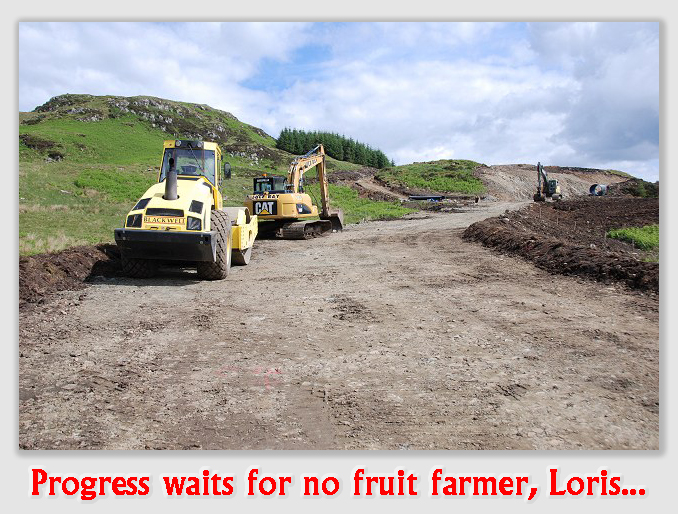
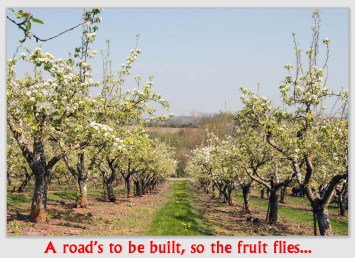
Dept. of Transportation v. Sherburn, 196 Mich.App. 301, 492 N.W.2d 517 (Mich.App. 1992). Loris Sherburn was a fruit farmer along Lake Michigan. When the Michigan Dept. of Transportation decided to extend U.S. 31 in Berrien County, it took 28 acres of Loris’ 124-acre farm. A court battle ensued, as it often does, over the value of the property taken. The State argued the value of the 28 acres was $47,200. Farmer Sherburn argued the property carved off his farm was worth closer to $183,000, claiming that this was the cost to cure the loss caused by the loss of the acreage.

The trial court found Loris was entitled to $56,600 for the condemnation of 28 acres of the farm.

Loris appealed.

Held: Loris was only entitled to $56,600. The Court of Appeals acknowledged that in a condemnation case like this one when only part of a larger parcel is taken, the owner is entitled to recover not only for the property taken but also for any loss in the value to his or her remaining property. The measure of compensation is the difference between the market value of the entire parcel before taking and the market value of what is left of the parcel after the taking.

Loris’ expert witness used the “cost to cure” method of calculating damages. The appellate court agreed that the cost-to-cure method is a measure of damages that may be considered by the jury, provided the cost to cure does not exceed that difference between the market value of the entire parcel before the taking and the market value of what is left of the parcel after the taking.

MDOT’s expert witness, an independent real estate appraiser, calculated the value per acre of the farm, which made the place worth $122,800 for all 124 acres. Using the same method, he found the 96-acre parcel remaining after condemnation to be worth $75,600. Thus, he concluded that Loris Sherburn’s damages were $47,200, the difference between the value of the entire parcel and the value of the remaining parcel after condemnation.

Farmer Sherburn had different ideas. His first expert witness, a real estate appraiser, using a comparable sales method, testified that the market value of the farm before condemnation was $215,000. He also estimated it would cost the farmer about $183,000 to replace the mature vineyards, peach and apple trees, and buildings lost in the condemnation. The witness contended that Loris, in addition to retaining possession of the remaining 96 acres, should recover the $183,000 cost-to-cure damages.
Loris’ second witness, an independent fee appraiser, testified that using the market data approach, the market value of the defendants’ farm before the taking was $345,000, while the market value of the remaining 96-acre parcel after the taking was $139,000, leaving a difference of $206,000.

The Court of Appeals agreed with Loris that where a partial taking occurs, it is possible for the property not taken to suffer damages attributable to the taking. “These damages have been described as ‘severance damages’,” the Court held, “which may be measured by calculating the difference between the market value of the property not taken before and after the taking. Where severance damages have occurred, it may be possible for the property owner to take steps to rectify the injuries in whole or in part, thus decreasing the amount of severance damages and correspondingly increasing the parcel’s market value.” These actions constitute a “curing” of the defects, according to the Court of Appeals, and the financial expenditures necessary to do so constitute the condemnee’s cost to cure.

However, the Court held that the cost-to-cure damages in a given case are not unlimited. Where the market value of the property taken, the value of the property remaining, and cost-to-cure expenses exceed the market value of the land before condemnation, cost-to-cure damages will not be awarded. “An owner is not to be enriched because of the condemnation,” the Court said.
This leaves “cost-to-cure” damages as a valid measure of damages “only when it is no greater in amount than the decrease in the market value of the [remainder] property if left as it stood.” Thus, the Court concluded, “where there is no claim of severance damages, the maximum damages recoverable equal (the market value of the entire parcel before the taking) minus (the market value of the remainder after the taking). Where severance damages are claimed, the maximum damages recoverable equal (the market value of the parcel taken) plus (the market value of the remainder after the taking) plus (the cost-to-cure expenses); however, the total damages awarded may not exceed the fair market value of the whole parcel before the taking.”

For Farmer Sherburn, the trial court correctly concluded that cost-to-cure damages are not recoverable to the extent that they exceed the market value of the entire property before the taking.

– Tom Root

TNLBGray140407

Case of the Day – Wednesday, March 18, 2026

CLIVEN BUNDY HAS A GUN… OHIO HAS THE COURT OF CLAIMS

Recently, we had a kerfuffle in our home county over pipeline company employees giving notice to people that they would be coming onto private land to survey for a new underground pipeline. The nature lovers on the left united with the libertarians and assorted wingnuts on the right to argue that the state could not let these pipeline renegades trespass on our sacred private homesteads in order to plan an environmentally cataclysmic pipeline. Think “pipeline construction equals K-T extinction event,” and you get the idea.

You may remember that famed anti-government rancher Cliven Bundy had a similar problem – government functionaries trespassing on his land just because he was letting his cattle trespass on government land. His approach was much more direct, employing caliber .223 (essentially 5.56 mm, although there are differences between the cartridges and loadings we won’t get into here) and ending up with two criminal trials in two different federal courtrooms (and two “not guilty” verdicts, we hasten to add). Clive’s approach was every bit as effective as that of our home county protesters… which is to say “not very.”

Our ad hoc coalition of pipeline opponents lost, of course. They, like many landowners, were unhappily surprised to learn that state laws – written by state legislators, after all – permit state employees, agents, and even employees and agents of public utilities to come onto private land at any time to conduct surveys for public works projects.

That’s what happens when you get in the way of progress. You get both disappointment and a pipeline through your sideyard. But sometimes, some landowners can bite back.

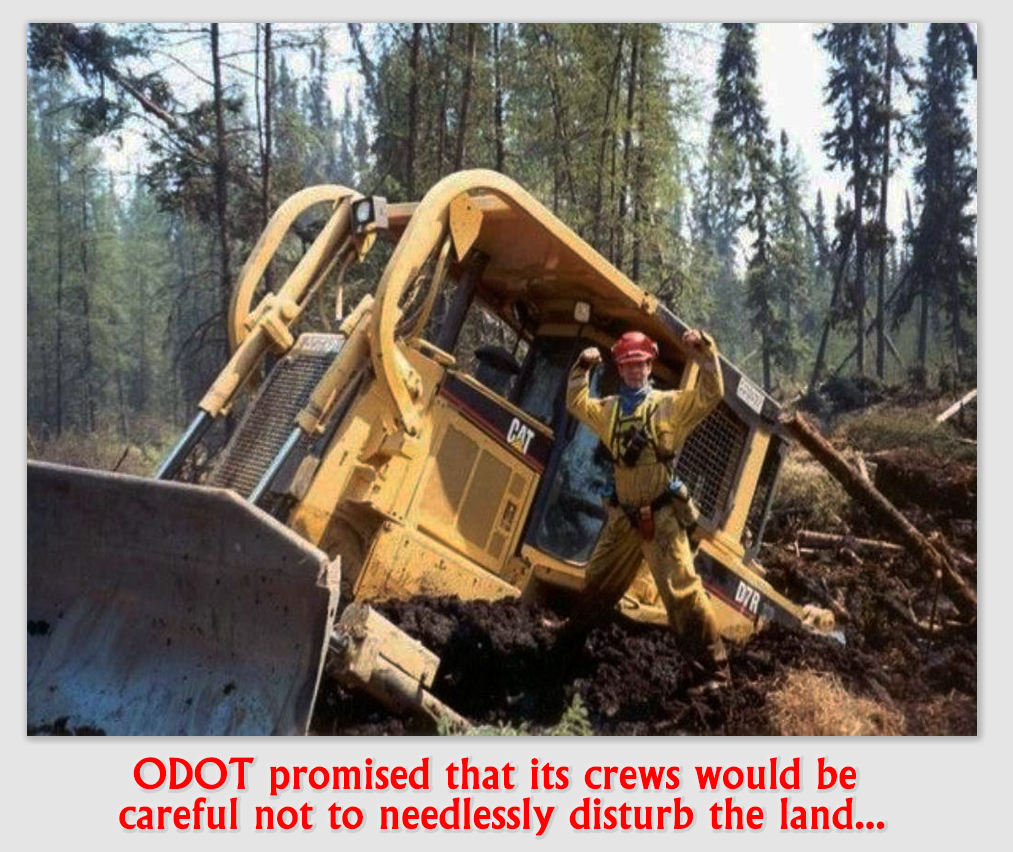
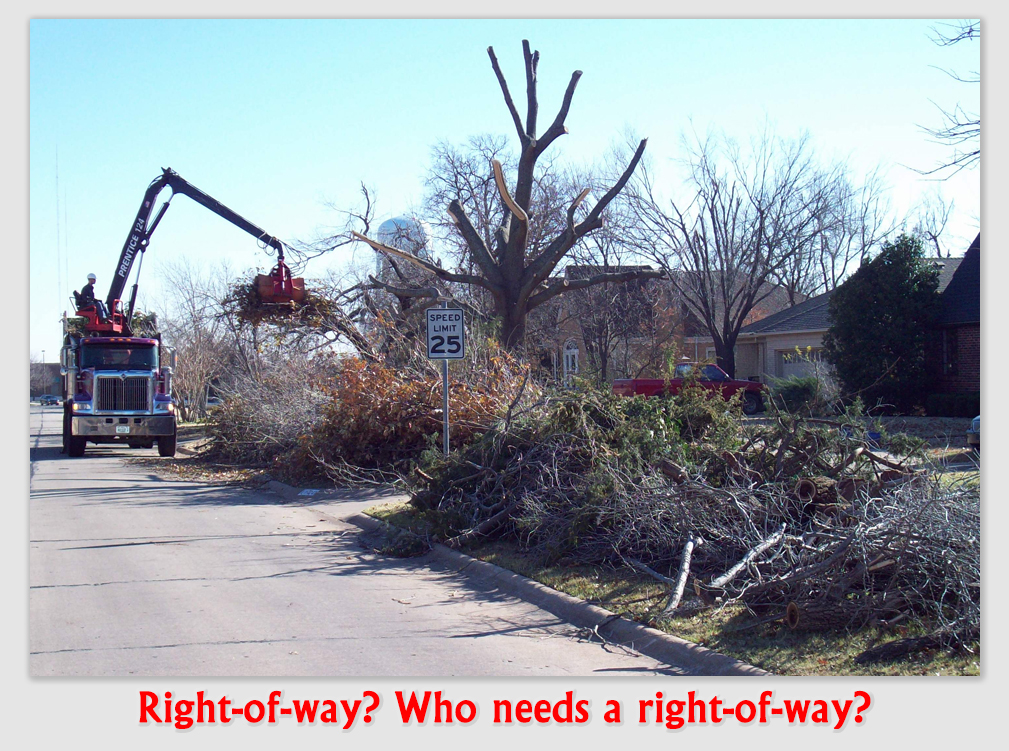
Ron and Maggie bit back, maybe not hard, perhaps just nipped back a little, when the Ohio Dept. of Transportation sent some local yokels onto their land to remove three trees believed to be in a highway right-of-way. But no one checked the R-O-W to be certain, and half of the three trees – yes, your math is right, 1.5 of the 3 trees – were not ODOT’s to cut. What’s more, the county boys seemed to have run bulldozer races through Ron’s and Maggie’s protected wetlands, laying waste to a fragile ecosystem, harming the habitat of the woolly salamander (or something like that), and pissing off the landowners.

Ron and Maggie demanded justice in the Ohio Court of Claims. By the time the Court was done whittling down their claims, they got their measure of justice – but it was a small measure, indeed.

Kerns v. Ohio Dept. of Transportation, 2017-Ohio-7154 (Ct. of Claims, July 25, 2017): Ronald Kerns and Margaret Ruth Leslie owned 18 acres of mostly wooded property, including federally protected wetland with vernal pools that provide a habitat for salamanders. When the State of Ohio had to replace a bridge on a road in front of the property, the State notified the owners that its representatives would be coming onto the land to survey, that they would use due care in doing so, but if there was any damage to the land, the State would pay for it. Like most states, Ohio had laws that authorized state employees to come onto private property for such purposes.

The day after Christmas 2014, crews from the Portage County Engineer’s Office came onto the property and laid waste, cutting down trees inside and outside of the state right-of-way, running heavy equipment across the property, dumping wood chips in the vernal pools (resulting in ecological damage to the wetlands on the property); and leaving large drag marks where larger trees were removed. Ron and Maggie asserted that trees and vegetation on their property were damaged or removed without either their permission or the permits required by the EPA.

The engineer testified he asked Portage County to remove a hickory tree that was larger than 18″ wide, a swamp white oak that was over 50” wide, and a dead tree trunk. He thought the three trees that he had marked to be removed were all within the right-of-way. When he learned that more than those three trees had been removed, he sent an assistant to check on the damage. The assistant found that heavy equipment had been on the property, that the wetland was disturbed, that wood chips had been cast into the vernal pools, that many more trees had been cut down, and that vegetation had been disturbed.

Jason Knowles, a certified arborist, used the Trunk Formula Method to calculate a core value for each type of tree. According to Knowles, Ohio has its own guide for what the value of a tree should be. Knowles examined the tree stumps to determine the species and size of the trees that were removed. Knowles determined that a total of 18 trees were removed, in an area that was 60 feet long by 60 feet wide. Although Knowles observed damage to the vernal pools from the wood chips and damage to the soil due to the heavy machinery tracks, he did not determine a value for either soil compaction or vegetation that was removed. Knowles testified that the value of the trees that were removed totaled $18,200.

ODOT’s expert, Charles Flagg – a real estate appraiser – testified the damage to the plaintiffs’ property had no impact on its market value in that the property was densely wooded and the loss of trees was not substantial and had no effect on the market value of the property.

Held: The Court first concluded that the Portage County Engineer did not trespass on the property. A trespass occurs when a person, without authority or privilege to do so, physically invades or unlawfully enters the private premises of another. Because state law granted ODOT the privilege to cut, trim, or remove any grass, shrubs, trees, or weeds growing or being within the limits of a state highway, and enter private land to conduct a survey for plans and specifications for proposed projects, the agency and its representatives had a privilege to enter plaintiffs’ property and, therefore, did not commit a trespass.

Although ODOT could not be liable for cutting down vegetation within the right-of-way, the Court ruled, plaintiffs could prevail if they were to prove that ODOT removed trees outside of the right-of-way. Here, ODOT directed Portage County to remove three trees in what it assumed was the right-of-way. But the bitternut hickory was not within the right-of-way, and the swamp white oak straddled the right-of-way boundary. ODOT thus trespassed when its agents removed those trees. Accordingly, the magistrate recommends judgment in favor of the plaintiffs on their claim of trespass with regard to the swamp white oak and the large bitternut hickory tree.

While Ron and Marge could not prove that ODOT was liable for treble damages under O.R.C. § 901.51 – because they could not prove ODOT was reckless – ODOT nevertheless was responsible for the removal of one and a half trees on plaintiffs’ property outside of the right-of-way (one of the trees straddled the right-of-way boundary line, although it is not clear how ODOT could have removed only its half). Still, the Court said, the removal of those trees “was not so extreme as to amount to a substantial deprivation of all of the rights of ownership of plaintiffs’ property” and thus did not rise to an unconstitutional “taking” of property in violation of the 5th and 14th Amendments.

What’s more, because ODOT only told the County to remove three trees, it was not responsible for the additional trees, including two green ash trees, two 12” wide bitternut hickory trees, and twelve saplings, that the County Engineer destroyed.

When a party trespasses and cuts trees that are part of a woodland mix and not unique, the ordinary measure of the harm is the difference in the fair market value before and after the cutting. However, the Court said, “there is an exception… in which restoration costs may be recovered in excess of diminution in fair market value when real estate is held for non-commercial use, when there are reasons personal to the owner for seeking restoration, and when the diminution in fair market value does not adequately compensate the owner for the harm done.” The Court held that “destruction of trees that form part of an ecological system of personal value to the owner justifies restoration cost as a measure of damages. In addition, in an action based on temporary injury to noncommercial real estate, a plaintiff need not prove diminution in the market value of the property in order to recover the reasonable costs of restoration, but either party may offer evidence of diminution of the market value of the property as a factor bearing on the reasonableness of the cost of restoration.” Diminution in value is a factor to be considered in determining whether restoration costs are reasonable, but it is not itself an element of damages that must be considered. Finally, in cases involving trespass that results in the removal of trees or other vegetation, “a landowner is entitled to recover reasonable restoration costs, plus the reasonable value of the lost use of the property between the time of the injury and the restoration.”

Plaintiffs’ expert arborist testified that the swamp white oak had an appraised value of $8,498.00 and that the large hickory tree had an appraised value of $4,345.00. The Court found that the Trunk Formula Method is an acceptable way of determining damages in the case.

The appraised value of the trees may not necessarily be the same as restoration cost, the Court said. While there was no change in the market value of plaintiffs’ property as a result of the tree cutting, certainly, the Court said, the three trees “had some value, especially the swamp white oak, in that it was located in a federally protected wetland on plaintiffs’ property, and plaintiffs testified credibly that the trees form part of an ecological system of personal value to them.” The Court found the plaintiffs were entitled to $12,843.00 in reasonable restoration costs and reasonable value of the lost use of the property between the time of injury and the restoration.

– Tom Root

TNLBGray140407

Case of the Day – Tuesday, February 3, 2026

DOING DAMAGE

Most of the time, the object of a civil lawsuit is to collect damages. Damages may either be compensatory – intended to compensate or to put the victim in the same place he or she would have been had the wrong not occurred – or punitive, intended to punish the wrongdoer.

Today, we’re going to talk about compensatory damages. How much has an injured party been damaged by loss of or damage to trees? The first question to be answered is whether the trees were commercial or “ornamental” in nature.

If the tree taken was commercial timber, the calculation is straightforward. Courts use either the stumpage value or the timber value. Stumpage value and timber value estimates depend upon timber volume estimates, which in turn are based upon the raw data collected in the field by timber cruisers. Put another way, estimating the value of timber taken in a trespass involves a three-step process. First, a timber cruise is conducted, and measurements are taken in the field. Timber cruising includes identifying a tree species, taking measurements of the stump diameter and from the stump to the top of the tree left on the ground, measuring any logs left on the ground, and recording measurements on a tally sheet. Second, the collected measurements are converted into volume estimates using established mathematical formulas. Third, those volume estimates are then converted into value estimates.

The distinction between timber and stumpage value only comes into play during the third step of the process. Stumpage value is the value of standing trees or what one might pay for the right to cut and remove trees. Timber value is the value paid by mills for cut logs. If timber value is used, it would be fair to argue to the Court that a deduction should be included for the cost of cutting and hauling the lumber. But where the timber trespass was especially egregious, don’t hold your breath waiting for compensatory-damage compassion from the bench.

But what about where the tree is not commercial timber, like that 80-year-old oak that used to shade your front yard before a confused tree service company employee cut it down, thinking he was supposed to be at your house instead of a place two streets away. The single oak’s commercial value won’t begin to compensate you for the loss.

There’s always a tension between the value a lover of the land places on his or her trees and the price tag affixed to those same trees by bean counters testifying in some cold courtroom. That’s why courts in many states apply different rules when the wrongfully taken tree was a stately old elm shading the farmhouse, a tree with maybe $1,000 in timber value but much greater value to the wronged property owner. The fact is that the wronged owner just plain likes the trees that had been taken, and the fact that his or her enjoyment of the trees might not be quantifiable in a real-estate-value analysis makes little difference.

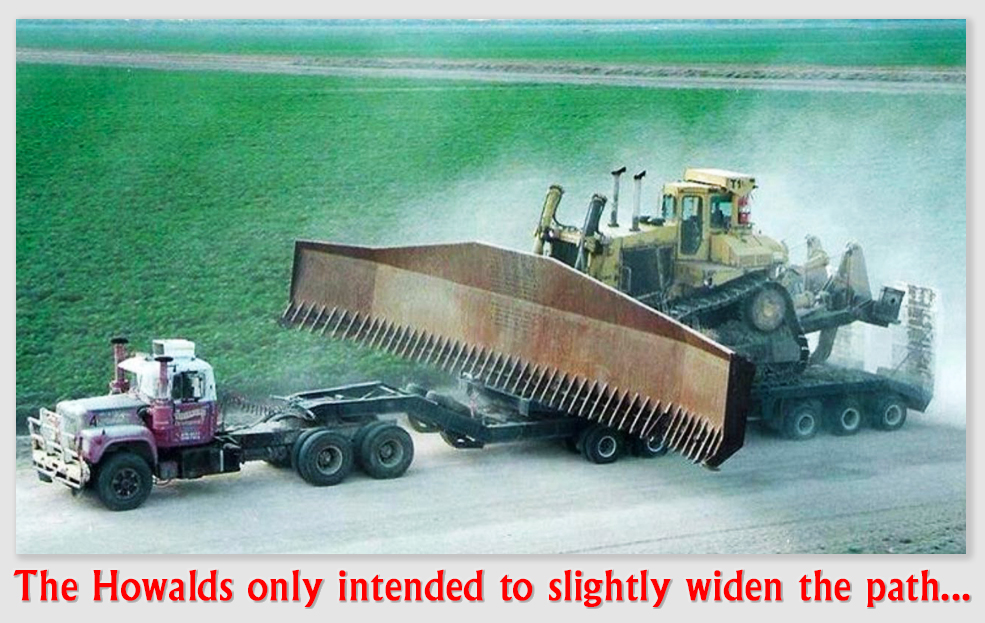
Anderson v. Howald, 897 S.W.2d 176 (Court of Appeals of Missouri, 1995). Melba Anderson discovered the limits of gratitude. For 40 years, she had let her neighbors, the Howalds, use a 7-foot-wide path across the corner of her land to get to their property. In 1991, the Howalds – apparently deciding that they shouldn’t settle for free use of a mere path where a free superhighway could be installed – brought bulldozers onto the Anderson land to “improve” the path. They knocked down trees, dug up rocks, and gouged things out but good.

Ms. Anderson sued and won an injunction, throwing the Howalds and their bulldozer out, but the trial court only gave her $6.40 in damages.

She appealed.

Held: The puny damage award was reversed. The Court of Appeals noted that “ordinarily, the measure of damages… is the market value of the property at the time it was removed from the land.” In this case, the trees being shade and ornamental trees of no commercial value, their value was slight. That seemed to offend the Court, especially when it saw the photos in the record of the extensive damage done by the Caterpillars.

The Court held that “in at least one instance, this court approved the use of before and after values of the real estate as a measure of damages… where the things taken, injured, or destroyed by a willful trespass have no substantial market value when considered in their severed state. The “general rule is that the measure of damages for trees that are not valuable for timber is the injury to the land caused by destroying them. This rule is based on the obvious reason that the value of such trees considered apart from the land would not be adequate compensation for the trespass.”

Courts, then, generally apply a measure of damages that considers the fair market value of the property with the tree and without the tree (which can be substantial for a single huge specimen that is the signature tree on the property). More often, the courts hold that the proper measure of damages is the replacement cost of trees rather than the value of real estate, even if the property owner cannot prove that the destruction of trees diminished the value of the property as a whole.

Courts often permit consideration of such replacement costs where the trees have aesthetic value to the owner as ornamental or shade trees, or for purposes of screening sound and providing privacy, in determining damages. Because one simply cannot replace a 50-year-old sugar maple tree with a similar tree, the courts apply a multiplier to the replacement cost to account for the number of years it will take for a replacement tree to reach the size and maturity of the tree that was removed.

– Tom Root

TNLBGray140407

Case of the Day – Monday, January 5, 2026

RECKLESS ABANDON

Blink-182 – You have any daughters? Look what they could bring home ...

     Blink-182 – What fine-looking lads!  You have a teenage daughter? Speaking of recklessness, look what she could bring home …

On and on, reckless abandon, something’s wrong, this is gonna shock them …” The velvet tones of Blink-182, so reminiscent of the Kingston Trio!

OK, not velvet tones, just some teenage angst and a little toilet humor. But today’s protagonist might have had the punk rockers blaring on Spotify while he was wielding his chainsaw with… well, with reckless abandon.

One day last winter, complains loyal reader Jeff Phylum of Maple Falls, Ohio, he went to work as usual. In the middle of the day, his neighbor called him to report that some tree cutters had cut the top 60 feet off his prize 75-foot-tall silver maple tree. His neighbor, the kind of nice old lady who every kid in the ‘hood can’t stand, had carefully noted the name of the tree trimming service in a little spiral notebook. She gave the name to Jeff, and Jeff called the service.

“Ha, ha,” the owner exclaimed, “what a gaffe! Boy, is our face red! We had an order to cut down a silver maple, and we went to the wrong house! Isn’t that just the funniest thing?”

Jeff didn’t think so. The owner sent a representative over to look at the forlorn 15-foot trunk still standing, admitted the crew had come to the wrong address, and offered $1,000 to forget the whole thing. But Jeff loved that tree, which shaded the house, provided nesting for squirrels and birds, and offered a canopy for family picnics. Jeff’s arborist figured that replacement of the tree with the most comparable silver maple available would cost somewhere around $25,000.

Section 901.51 of the Ohio Revised Code lets an injured party collect treble damages from a party who “recklessly cut down, girdle, or otherwise injure a vine, bush, shrub, sapling, tree or crop growing on the land of another.” Jeff wondered whether the tree trimming service had been reckless and whether his $25,000 might be tripled to $75,000. If it did, he might even afford a fill-up.

The tree service owner was red-faced ... somehow, that didn't make Jeff feel much better.

The tree service owner was red-faced … but somehow, that didn’t make Jeff feel much better.

A person acts recklessly when, with heedless indifference to the consequences, he perversely disregards a known risk that his conduct is likely to cause a certain result or is likely to be of a certain nature. A person is reckless with respect to circumstances when, with heedless indifference to the consequences, he perversely disregards a known risk that such circumstances are likely to exist.

In Collins v. Messer, a woman hired a tree trimmer to clear some of her land. She told the trimmer to only clear to a fencerow, which she later said she believed was the property line. It was not, and the other property owner was unhappy. Mrs. Messer tried to settle with him, but things broke down and led to a lawsuit.

The trial court found Mrs. Messer’s testimony about her mistaken belief that the fence marked the boundaries credible, as well as her statement that she told the trimmers not to go beyond the fence. Based upon those findings, the trial court determined that Messer’s actions were not reckless and she was not liable for treble damages under the statute. In assessing damages for the trespass, the court held that the measure of damage is the cost of reasonable restoration of property to the pre-existing condition or to a condition as close as reasonably feasible without requiring grossly disproportionate expenditures and with allowance for the natural processes of regeneration within a reasonable period of time.

What does this mean for Jeff? Whether the tree trimmer was reckless depends on what led him to the wrong house, and what steps he might have taken to verify the address. Cutting down a healthy 75-foot-tall hardwood shade tree is a pretty final act. The industry standard directs the tree-trimming employee who performed the estimate and pre-work inspection to be on-site when the work begins. The irrevocability of cutting down a large tree on a residential lot in the city is such that the trimming company is presumed to have understood the known risk that if the work was performed at the wrong house, the consequences would not be pretty.

One might think that the tree-trimming company would want to settle this one for the cost of restoration rather than roll the dice on whether it will have to pay triple that amount. It is pretty clearly liable for the blunder. When its best hope is to convince a jury that the blunder was just negligence, there isn’t much upside in litigation. As Ronald Reagan once said, “If you’re explaining, you’re losing.”

Collins v. Messer, 2004-Ohio-3007 (Ct.App. Butler Co., June 14, 2004) 2004 Ohio App. LEXIS 2666, 2004 WL 1301393 – Collins sued his neighbor, Messer, for having trees and vegetation removed from Collins’ residential property.

The rear of Collins’ home abuts the rear of Messer’s property in a residential subdivision. Mrs. Messer hired Wilson Garden Center to clear vegetation up to an old farm fence, which she thought was the property line. She was not present when the Garden Center employees cleared the vegetation. Mrs. Messer had never met Mr. Collins, and she didn’t speak to him before the Garden Center performed the work. The vegetation, with the exception of a few trees, was cleared up to and beyond the farm fence at a time when neither party was at home. It turned out that Messer’s property line did not extend to the old farm fence and that most of the vegetation cleared was on Collins’ property. Mr. Collins testified that he was “devastated” when he learned of the destruction of the vegetation.

Collins and Messer split the $1,647.91 cost of hiring a landscaper to plant some pine trees in the area between the properties, but the relationship between the parties deteriorated during the year that followed. Finally, Collins sued Messer in trespass, seeking treble damages under O.R.C. §901.51.

Treble damages ... when

Treble damages … when “uh-oh” just isn’t good enough.

Held: The Court found that the evidence was sufficient to support the finding that Mrs. Messer’s actions were not reckless, and thus Mr. Collins was not entitled to treble damages. She testified that she was mistaken in thinking the fence constituted the boundary, and that she never told the Garden Center workers to go beyond it. Mr. Collins had no evidence to rebut Messer’s claim of mistake, and the trial court may have been swayed by Mrs. Messer’s willingness to share the cost of the mistake before things deteriorated into a lawsuit.

Also, because the parties had already agreed on splitting the costs of planting replacement trees, Mr. Collins wasn’t entitled to additional trespass damages for loss of vegetation. In assessing damages for the trespass, the trial court held that the measure of damage is the cost of reasonable restoration of property to the pre-existing condition or to a condition as close as reasonably feasible without requiring grossly disproportionate expenditures and with allowance for the natural processes of regeneration within a reasonable period of time.

The appeals court agreed with the trial court that Mrs. Messer compensated Mr. Collins for his damages by paying $823.00 for the pines planted on Mr. Collins’ land.

– Tom Root
TNLBGray

Case of the Day – Friday, December 5, 2025

NO GOOD DEED GOES UNPUNISHED

Have you ever wondered why this blog is named “tree AND neighbor law?” Primarily, it’s because when I set it up, someone had already taken “Google” and “Amazon.” I had to settle for what Internet domains were left.

All right, not really. But you may have noticed by now that there are many tree cases that never would have been brought but for the fact that neighbors were involved, or maybe just N-I-N-Os, “neighbors in name only.”

Today’s case is one of those cases. Reading between the lines, the Fleeces and Kankeys appeared to be congenial next-door neighbors. They had agreed on their property boundary, marked as it was by a common fence. When the fence deteriorated, they agreed to share the cost of replacement.

But when the Kankeys bulldozed the old fence and put in a sparkling new edifice, everything went south. It seems that some scrubby trees along the old fence were destroyed in the process. Suddenly, the Fleeces became the aggrieved parties, and not only did not want to contribute to the fence project, but demanded $17,500 to replace trees that lacked any market value. They apparently were anxious to try out Arkansas’s double and treble damage statutes as well.

The trial court made short work of the Fleeces’ attempted fleece, but the court of appeals grudgingly admitted that yes, replacement value counted (even for trees that lacked any market value). The appeals judges seemed to suggest that it would be (or should be) pretty hard to prove the intent needed for an application of the multiple damage statutes.

Nevertheless, the court seemed to say that no matter Bill Kankey’s good intentions in moving the project along, some of those trees – we don’t know how many – appear to have been boundary trees. Thus, the Fleeces and the Kankeys owned those trees as tenants in common. Neither owner had the right to destroy the tree without the consent of the other.

Fleece v. Kankey, 77 Ark. App. 88, 72 S.W.3d 879 (Ct. App. Ark. 2002). Harlan and Nancy Fleece were Bill and Charlotte Kankey’s neighbors. For some time, they had agreed that an old fence was the boundary line between them. When the fence began falling down, they agreed to share the cost of replacing the fence. Bill and Char bulldozed the old fence separating the properties, along with some trees that stood alongside it.

That’s when the deal fell apart. Harlan and Nancy sued Bill and Char for trespass and for destruction of the trees. The trial court found that, except for two posts that needed to be moved south two feet, the new fence was located in the same position as the old fence. The court held that Harlan and Nancy suffered no loss over the destroyed trees because the trees had no market value.

Harlan and Nancy appealed, arguing that they should have been awarded damages for the replacement value of the destroyed trees. Bill and Char replied that because they had no market value and because the removal of the trees and installation of the new fence actually improved the area, Harlan and Nancy had nothing coming.

Held: The case was reversed and sent back to the trial court for consideration of Harlan and Nancy’s damages due to the trees’ loss.

Arkansas Code Annotated § 18-60-102(a) provides, in part, that “if any person shall cut down, injure, destroy, or carry away any tree placed or growing for use or shade… on the land of another person… the person so trespassing shall pay the party injured treble the value of the thing so damaged, broken, destroyed, or carried away, with costs.” The treble-damages remedy requires a showing of intentional wrongdoing, although intent may be inferred from the carelessness, recklessness, or negligence of the offending party. Less-than-intentional conduct may support double damages under Ark. Code Ann. § 20-22-304, but must be pled in order to give a defendant adequate notice of the remedy he would be confronting.

Harlan and Nancy argued that the statute did not require that a tree have a market value in order for a landowner to be entitled to replacement value damages. Larry Morris, a registered forester, gave expert testimony that 35 trees had been bulldozed on the east/west side and 25 more on the north/south side. He explained that the destroyed trees included Post Oak, Black Oak, and Black Jack Oak. He calculated that the replacement value of the trees was $ 17,531.00.

The trial court dismissed Morris’s testimony because it focused on replacement value, not market value. The trial court held that “in view of the rural nature of this area, and the location of the lane over which the Fleeces travel, it seems absurd to award damages on a replacement estimate because the removal of the old fence and the installation of the new fence has actually improved the area.”

The appellate court found this ruling clearly erroneous, one that suggested that the trial judge failed to consider the number of trees cut down and their replacement value. The appellate court said that the Arkansas rule is that when ornamental or shade trees are injured, the use made of the land should be considered, and the owner compensated by the damages representing the cost of replacement of the trees.

Damages awarded for the loss of a shade tree cannot include both replacement costs and consequential damages, but clearly, replacement costs are a proper measure of damages.

“Because the trial court appears to have relied entirely on the question of market value,” the appeals court said, “we are unable to determine whether the court considered other factors besides the market value in assessing appellants’ damages, including replacement value and the number of trees lost. Therefore, we reverse and remand.”

The appeals court included a final observation, “that it appears uncontroverted that many of the trees were located in the boundary line. Other jurisdictions have held that owners of boundary line trees are considered tenants in common, and neither tenant possesses the right to destroy the commonly held property without consent of the other.”

– Tom Root

TNLBGray140407

Case of the Day – Thursday, November 20, 2025

SIR, YOU ARE NO GEORGE WASHINGTON

solong161006Today, we conclude our consideration of the trespass problems faced by our New Hampshire landowners Larry and Laura Littoral. If you have followed along to this point (and can remember what transpired even after the news broke that Kim Kardashian did so well in the California bar exam that she has been invited to take the second half next year), you know that the Littorals’ pastoral cottage getaway –  situated on a classic New England pond – has been disrupted by neighbor Wally Angler.

Compared to Wally, Donald Trump would prefer Nancy Pelosi as a neighbor. Wally –  a NINO (neighbor-in-name-only) – is an angler, and asked the Littorals to chop down some dead trees on their property to create a trout habitat in the pond for the primary (and sole) purpose of adding to Wally’s piscatorial pleasure.  You can hear him now: “Thanks for all the fish!”

The Littorals preferred that their dead timber remain standing. When Wally asked them to cut down the trees, they said, “So long,” refusing to dump their tree into the pond. Apparently reasoning that it’s easier to ask forgiveness than permission – especially where permission has already been denied – Wally then took advantage of the Littorals’ weekend absence by bringing in a tree service to cut the trees down for him. According to the Littorals, Wally affirmatively misled the tree cutters that the dead trees were on his property, and the tree service cut down the timber with alacrity.

gw161006For the record, Wally denies having anything to do with the felling of the dead trees. He seemingly maintains that he turned around one day, and mirabile dictu, the trees were on the ground. If George Washington had tried a similar woof story on his father about a downed cherry tree, we’d probably all be speaking English and enduring a manchild national leader whose conduct is concerning for dementia. As every schoolchild knows, however, Little George ‘fessed up, telling his father, “I cannot tell a lie.” Channeling Lloyd Bentsen, our observation is this: Wally, we served with George Washington, George Washington was a friend of ours. Wally, you’re no George Washington.

Our analysis this week has assumed that unless Wally can produce the elves responsible for the tree cutting (and their saws), the Littorals will easily meet their burden of proof.

So far this week, we have concluded that the Littorals may bring a double-barreled complaint, alleging a statutory violation of New Hampshire’s trespass-to-tree statute, R.S.A. § 227-J:8, and a common-law trespass count. The § 227-J:8 count carries some rather serious penalties, from three to 10 times the market value of the trees. The catch is that the penalties must be based on a multiple of market value. Market value may be the stumpage value of the wood – what it is worth on location to a lumber buyer – or on the cost to replace the tree, minus transportation and planting costs.

We’re assuming for the sake of this column that a few dead trees probably are not going to have much stumpage value. The Littorals could find an expert to establish how much replacement of the trees would cost, but replacement value has traditionally been used because everyone assumes that the destroyed trees would have continued to flourish but for the actions of the defendant. Here, the defendant’s expert would have a good argument that those trees were going to fall in the next strong wind anyway, and awarding the Littorals new live trees to replace their old dead ones would give the plaintiffs a “windfall” for what was only windfall to begin with.

Wally suspects elves.

Wally suspects elves.

Given Wally’s underhanded approach to getting what he wanted (and what the Littorals did not want), we don’t have much trouble with the Littorals receiving a windfall. The law in New Hampshire and elsewhere does, however, hold instead that damages should be limited to compensating for the actual injuries suffered. For that reason, the Littorals can take the confluent approach that under the common law of trespass, their real property has suffered a decrease in value because of Wally’s conduct, both because of where the dead trees are no longer standing and because of where they are currently laying.

Even then, the Littorals might have a problem because the usual assumption underlying damages for loss of trees is that standing timber will continue to stand for the indeterminate future. That assumption may be challenged where the standing timber is already dead. Nevertheless, there is ample evidence that dead trees standing have value. As we noted the other day, dead trees provide shelter or sustenance to over 40 percent of all birds, to amphibians, and to lichens and moss. Dead trees create “snow fences” that slow wind-driven snow. The snow that is trapped melts in place and saturates the ground, providing additional moisture to live trees. Dead trees create hiding cover and thermal cover for big game as well.

Even more counterintuitive, dead trees – after dropping their needles and bark – may reduce fire hazard. Their flammability is greatly reduced compared to green trees containing flammable resins.

stumps161006In the Connecticut decision we’re examining today, the plaintiff relied on standing dead timber to help maintain privacy from his neighbor. The court appeared to recognize that the elimination of the standing dead trees contributed to a substantial diminution of her property value, even while acknowledging that the trees themselves had no value. It’s not a New Hampshire case, but then there is a dearth of cases nationwide where the wrongfully cut trees were ornamental in nature and yet very dead even before tasting the ax. We were glad enough to find this one. The decision suggests that an action alleging loss of privacy may be the strongest case of all.

Caciopoli v. Lebowitz131 Conn.App. 306 (Court of Appeals, Connecticut, 2011). Dominic Caciopoli was a man who liked his privacy. He bought his place because it was isolated and private, surrounded by forest on all sides except for one area of the lot through which his driveway passed. A short while later, Jeffrey Lebowitz bought the place next door. His house was about 100 yards from Dom’s, and the area between the residences was wooded, affording each privacy from the other.

A few months after moving in, Jeff hired a tree service to clear standing dead trees from the wooded area between the two homes. Jeff believed the dead trees were on his land, but he didn’t check that carefully. The tree service removed all the dead timber, both standing and on the ground, some small saplings, and a few larger trees to provide more sunlight and enlarge the areas surrounding his house. Of course, it turns out that virtually all of what was cut really belonged to Dom.

When Dom came home to find that his natural privacy barrier had been clear-cut, he was not happy. He went to Jeff’s front door and expressed his displeasure, pointing out the actual property line in the process. Nevertheless, the next day, the tree service returned and finished the job. The removal of the trees and brush left Jeff with an unobstructed view of Dom’s house.

Jeff tried to make amends. He sent Dom a letter admitting his error and planted some trees on Dom’s property to replace what had been taken. Dom was not happy with the results and undertook his own extensive landscaping project in a failed attempt to restore his lost privacy.

Give a man a fish, and feed him for a day. Give a man a chainsaw, and watch trouble ensue.

Give a man a fish, and feed him for a day. Give a man a chainsaw, and watch trouble ensue.

Dom sued Jeff for common-law trespass and for treble damages pursuant to Connecticut General Statutes § 52-560 (the Connecticut adjunct to R.S.A. § 227-J:8). The trial court found that Dom had proven the elements of an intentional trespass action and awarded him $150,000. for the diminution in the value of his property caused by the trespass. Notably, the trial court declined to award any damages for the value of timber that had been removed.

Jeffrey Lebowitz appealed, alleging a lot of infirmities with the trial judgment. Of interest to the Littorals is Jeff’s appeal of the damage award.

Held: The trial court’s award of $150,000 was proper. The trial court found that after the cutting, Dom’s place was worth $675,000, according to an appraisal performed by a certified general real estate appraiser. The appraiser opined that prior to the cutting, Dom’s market value was $825,000. The Court of Appeals noted that Jeff could have presented his own expert testimony on the diminution of value, but he did not. Applying the ancient legal doctrine, et dormiat, ne perdatis (“you snooze, you lose”), the court said Dom’s expert was found to be credible and competent, and absent Jeff making an expert showing at all, that was good enough.

But, Jeff complained, Dom’s expert was not qualified to give an opinion as to the effect of the removal of certain trees from Dom’s property on its market value. He argued the expert had no relevant experience and was considered an expert only because she had a real estate appraiser’s license. However, the Court of Appeals said, the trial court relied on the fact she had conducted 1,500 appraisals before, and when the trial judge asked her whether she was able to testify as to the value of the property before and after the removal of the trees, she said she could. (This is rather like finding that she was an expert because she asserted she was, a rather bizarre ipse dixitbut the Court of Appeals was loathe to disturb a verdict and thus give Jeff a second bite of the apple on remand).

Jeff also argued that the court made no finding whether there was an adequate factual foundation for a “retrospective appraisal” – an appraisal after the fact of the value of the property before the cutting – and that Dom did not ask the court to find there was an adequate foundation for allowing the opinion evidence. The Court of Appeals pointed out that it was Jeff’s burden to object to the testimony on those grounds at the time of trial. Again, et dormiat, ne perdatisThe expert testified she visited the property in January and February 2009 and had determined the lot enjoyed a high degree of privacy prior to the incident. She also had studied photographs of the lot prior to the trespass and after the trespass, and noted that the pictures depicted more clearing of trees than she had imagined, thus strengthening her opinion as to diminution in value.

No one contests that trees in the water are a good habitat for fish... but Wally should have used his own trees.

No one contests that trees in the water are a good habitat for fish… but Wally should have used his own trees.

The Court observed that Jeff pointed to no authority to suggest that the expert’s personal observation of the property, her reliance on the plaintiff’s descriptions of the prior conditions of the property, and her review of photographs of the property in its prior conditions, was insufficient to form an inadequate factual foundation. The Court said the expert’s personal observation of the property “complemented by the plaintiff’s descriptions of the property in its prior conditions, is not impermissibly speculative…” After all, the Court said, Dom – as the owner – was undoubtedly familiar with his property (if perhaps lacking disinterest in the outcome), and no one was more competent than he to describe to the expert what it had looked like before the cutting.

The Court held that the fact that the expert “could not give a logical explanation for how she arrived at her opinion and did not articulate or apply methodology suitable to determining any diminution in value caused by the clearing of trees” was not fatal to her testimony. She testified that she examined real estate in the area, found comparable properties, estimated degrees of privacy and made adjustments, positive or negative, for the differences in the properties in order to “equal everything out.” She also noted that an appraisal is not based on science, but it is just an opinion as to value, and the Court accepted that.

Jeff had to pay the $150,000. That’s a lot of money for some dead trees that had no stumpage value.

– Tom RootTNLBGray140407

Case of the Day – Wednesday, November 19, 2025

SOMETIMES PLAIN VANILLA TASTES PRETTY GOOD

Today, we continue to examine the situation faced by our Granite State tree victims, Larry and Laura Littoral. If you read yesterday’s post prior to your third Arnold Palmer martini, you recall that the Littorals have both a cottage on a pond – which is beautiful –and a pesky neighbor, Wally Angler – who is not so beautiful.

cuibono161005Fisherman Wally’s entreaties to the Littorals that they cut down some dead trees on their property, dropping them into the pond where they will provide a habitat for the fish Wally loves to catch, fell on deaf ears. It seems the Littorals liked the contribution the standing dead timber made to their cottage ecosystem. So when the Littorals were absent one fall weekend, Wally took matters into his own hands, hiring a tree service to cut down the trees. Wally, of course, denies having any role in the tree’s mysterious felling, but for the sake of our analysis – and because we recall Marcus Tullius Cicero’s incisive question, cui bono? (that is, “who benefits?”) – we reasonably assume that proving Mr. Angler was the only guy with the motive, opportunity and means to cut down the trees will be child’s play.

Yesterday, we considered New Hampshire’s trespass to trees statute, R.S.A. § 227-J:8, which has been around in some form since the early 19th century. It’s a pretty solid statute, providing that no person shall negligently cut, fell, destroy, injure, or carry away any tree or part thereof on the land of another person. If someone violates the statute, he or she is liable for a forfeiture to the aggrieved landowner of anywhere from three to ten times “the market value of every such tree, timber, log, lumber, wood, pole, underwood, or bark cut, felled, destroyed, injured, or carried away.”

Notice that we used quotation marks in the foregoing paragraph. They’re there for a reason. You see, the rub in 227-J:8 is that the statute turns on the market value of the trees. That worked very well when the kind of timber trespass going on was limited to a lumberman taking a thousand trees from the wrong side of the boundary marker. Indeed, that was precisely the kind of conduct at which the statute was aimed. But 227-J:8’s a tougher fit where only two or three trees are cut, not for their market value but rather for some noncommercial reason. The Littorals could sue under 227-J:8, but what would the market value be of a few dead trees (or even a few live ones)?

In a stretch perhaps dictated by necessity, below we discuss a case before the New Hampshire Supreme Court held that “market value” may be measured as the cost of a replacement tree of comparable value. Sadly, even that might not get the Littorals very far. Such an analysis would bring them fairly quickly back to a measure of the fair market value of the dead tree itself.  To get any traction, the Littorals have to get beyond the value of the dead tree qua tree, and instead find a measure of damages that focuses on the value of the dead trees to the property.  We’ll be looking at that tomorrow, but for now, we need some legal vehicle that will let them be compensated adequately for Wally’s selfish attack on their property.

Fortunately, the common-law remedy of trespass continues to enjoy vitality in New Hampshire. Assuming the Littorals lost three dead trees, and assuming that they could find an expert who would testify that the stumpage value of those trees was $300.00 apiece, they would not quite get to $1,000.00 in damages (before 227-J:8’s multiplier was applied). But the three trees – referred to in the tree law world as “ornamental trees” – were worth much more to the Littorals (and their real estate).

Common-law trespass - the "plain vanilla" tort still tastes pretty good.

Common-law trespass – the “plain vanilla” tort still tastes pretty good.

Where the trees lost are not commercial timber, but rather trees with aesthetic or some other specialized value, New Hampshire courts will permit the injured party to sue in trespass, and for damages to show either that the market value of the real estate has fallen because of the loss or that the cost of replacing the lost trees rises to some ascertainable figure.

Here, although the Littorals are entitled to (and will probably want to) include an R.S.A. § 227-J:8 claim, they will also want to allege the good old plain-vanilla tort of trespass, showing that Wally’s transgression damaged their property as a result. After all, New Hampshire lets the injured homeowner include both the time-tested common-law trespass claim and an R.S.A. § 227-J:8 claim in the same complaint. Common-law trespass may be plain vanilla, but it’s survived as a cause of action for centuries because it works.

The Littorals report that they have evidence that Wally moved the iron-pin boundary markers before the tree service arrived, so as to fool otherwise cautious tree workers that he owned the land on which the dead trees in question stood. As it is in most states, moving property markers is a misdemeanor in New Hampshire, not to mention being pretty compelling evidence of the willfulness of Wally’s conduct. Indeed, in most places, this would probably be enough to win punitive damages against Wally, which are extra amounts meant not to compensate a plaintiff for his or her injury, but rather to exact a pound of flesh from the misbehaving defendant.

heresy161005

Burning a beer at the stake? Now that would be a “monstrous heresy.”

But New Hampshire isn’t “most places.” Rather, “the punitive function of exemplary damages has been rejected in forceful and colorful language” by the New Hampshire Supreme Court. “‘The idea is wrong,” the Granite State Supremes thundered well over a century ago. “It is a monstrous heresy. It is an unsightly and an unhealthy excreascence, deforming the symmetry of the body of the law’.”

Fortunately or otherwise, modern New Hampshire jurists have left their aggrieved litigants an out. While punitive damages are forbidden, the courts agree that in cases “where the acts complained of were wanton, malicious, or oppressive, the compensatory damages for the resulting actual material loss can be increased to compensate for the vexation and distress caused the plaintiff by the character of defendant’s conduct.”

So if the Littorals sue for trespass, and show that the trespass and subsequent loss of their trees resulted because Wally was a guy who charged ahead fully aware he was in the wrong, their compensatory damages may rise well beyond even what they could get even if the court set the R.S.A. § 277-J:8 multiple at 10 times the market value of the dead wood.

But we’ve still left the question of exactly how much a dead tree is worth, either as marketable timber or for aesthetic purposes. We’ll take up that problem tomorrow.

Woodburn v. Chapman I, 116 N.H. 503 (New Hampshire Supreme Ct., 1976); Woodburn v. Chapman II, 117 N.H. 906 (New Hampshire Supreme Ct., 1977).  Chapman removed a single maple tree, 18 inches in diameter, which stood on Woodburn’s land. He never imagined that cutting down one tree would result in two trips to the New Hampshire Supreme Court. But it did.

The trial evidence showed replacement of a 30-inch maple would cost $3,600.00. Taking this figure and applying a treble multiplier taken from the tree trespass statute, the court entered judgment for $10,805.00 in favor of Woodburn.

Chapman appealed.

Held: In Woodburn I, the Supreme Court held that the trial court’s use of the tree’s replacement cost as the basis for the statutory penalty was wrong. The Court admitted that “in some circumstances, replacement cost may be the proper measure of damages for the destruction of a tree.” But the tree trespass statute (then R.S.A. § 539:1, replaced later with R.S.A. § 227-J:8) “takes the value of the tree by itself,” the Court said. The severity of the statutory penalty varies with the tree’s productive quality. Indeed, the whole purpose of the statute is to protect marketable resources.

The Court held that “where a tree confers other benefits on the plaintiff in the enjoyment of his property, he may join a count for compensatory damages with his count to recover the statutory penalty. The ordinary measure of damages in these circumstances is the difference between the value of the land before the harm and the value after the harm. In this case, the plaintiff introduced evidence of special circumstances which might justify the award of the replacement cost of an eighteen-inch maple.”

On remand, Woodburn’s expert testified that the tree’s value by itself was $2,173.00. He arrived at this figure by deducting from the tree’s replacement cost the expenses associated with digging, transporting and replanting the tree, resulting in an estimate of the value of the tree itself. The trial court accepted the evidence and awarded treble the amount as a penalty.

On appeal from the remand, Chapman complained that the base figure from which any statutory penalty is to be calculated must be stumpage value. He argued that the statute is designed to protect marketable timber, and thus only the tree’s value as timber should be used in computing the penalty. Since Woodburn produced no evidence of the tree’s stumpage value, Chapman complained, there can be no recovery under the statute.

The Littorals should have gotten this sign with special wording, "And don't cut down our trees, Wally, whether they're dead or not!"

The Littorals should have gotten this sign with special wording, “And don’t cut down our trees, Wally, whether they’re dead or not!”

The Supreme Court disagreed, holding that the statute applies to “whoever shall cut… any tree…” The statute’s application is not restricted to trees with stumpage value. Instead, the statute applies to any tree, whether its value is as timber or some other marketable commodity.

So, the Court said, where the tree is valuable only as timber, stumpage value should be used to assess the penalty. But, “this rule obviously cannot be applied to fruit, shade, and ornamental trees which have a measurable value but no stumpage value.” In this case, the Supreme Court ruled, the trial court “determined the value of the tree by subtracting from its replacement cost the cost associated with digging, transporting and planting the tree. This was an appropriate method of arriving at the ‘value of the tree by itself’.”

Additionally, Woodburn introduced evidence that the tree had special value to the real property as a boundary marker. That, the Supreme Court ruled, warranted the trial court’s award of $577.00 as compensatory damages in addition to the statutory penalty.

– Tom Root

TNLBGray140407