Case of the Day – Thursday, September 5, 2024

WHEN A TREE GROWS ACROSS A BOUNDARY – AND CAUSES A NUISANCE

Trees often don’t start out straddling property lines. Rather, they sprout as carefree saplings, but later grow above and below the ground without regard for metes and bounds.

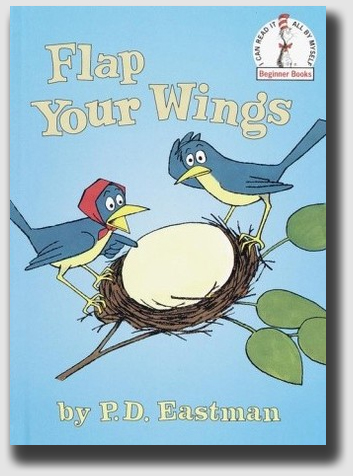
Do you remember Flap Your Wings? It’s a great children’s book by P.D. Eastman, a favorite of my 6-year-old grandson Ezra, a story in which Mr. and Mrs. Bird suddenly find an oversize egg in their nest, placed there by a well-meaning stranger who found the orb on the ground and wrongly deduced it had fallen from the tree. They love and care for the egg, but it hatches into something that unexpectedly becomes a real nuisance in their nest. A great book with a happy ending… but no spoiler alert is needed here. We won’t tell you what hatched.Flap
When the Bergins planted a tree on their land in 1942, they had little idea that it would grow into a big problem. The tree thrived over 25 years, a great oak from a little acorn having grown, so to speak. (All right, it was an elm, but you take the point…) It expanded from its modest plot toward and across the boundary line with their neighbors, in the process knocking the neighbors’ chain link fence out of line, raising the sidewalk and causing drainage problems.

The Holmbergs argued that the tree was a nuisance, and demanded that the Bergins remove it. The Bergins argued that the tree was a boundary tree, and it thus belonged to both the neighbors and to them commonly. They thus could not be seen to be maintaining a nuisance.

The Court disagreed with the Bergins’ defense, ultimately adopting the rationale of the Colorado case of Rhodig v. Keck. The intent of the parties, the Court ruled, rather than the location of the tree that governed whether the tree was a boundary tree.

Little trees don't stay little

Little trees don’t stay little…

Here, the Bergins planted and maintained the tree exclusively. They and the Holmbergs neither treated nor intended the elm to be a boundary tree. Instead, the tree ended up straddling the boundary only by an accident of growth. No matter where the tree had grown to encompass, it remained the Bergins’ tree, and the court found it to be a nuisance.

The damage wrought by the tree makes an interesting comparison to the 2007 Virginia decision in Fancher v. Fagella on encroachment and nuisances. The tree’s shallow root system made remedies short of removal infeasible, and the roots seemed to run just about everywhere. The case is an excellent illustration of how the facts of the particular growth at issue can drive a court’s decision.

Holmberg v. Bergin, 285 Minn. 250, 172 N.W.2d 739 (Sup.Ct. Minn. 1969). The Bergins and Holmbergs were adjoining landowners in Minneapolis. In 1942, the Bergins planted an elm tree on their property about 15 inches north of the boundary line, and they have maintained the tree and have exercised sole control over it since that time. The Holmbergs bought their place 10 years later and constructed a chain-link fence on their property 4 inches south of the common boundary line. When the fence was completed, the tree was 6 inches away from it and 2 inches away from the boundary line, so the tree did not touch or interfere with the fence.

By 1968, the tree was 75 feet high, with a trunk diameter of 2 1/2 feet, and it was protruding about 8 inches onto the Holmbergs’s property. Its roots extended onto Holmberg’s property and pushed the fence out of line, making the use of a gate in the fence impossible. The tree was close to both houses and the roots, being cramped for room, have pushed up a large hump in the ground around the base of the tree. The roots raised the ground level from the base of the tree to the Holmbergs’ sidewalk and caused it to tip toward their house, resulting in drainage into their basement.

To fix the problem, the Holmbergs were forced to construct a new sidewalk, which promptly cracked as well because of the tree’s roots. If the tree were removed, the Bergins’ property value would depreciate by $5,000.

Over the Bergin’s complaint that the tree was a boundary tree, the trial court found that the tree was a nuisance and ordered it removed by the Bergins at their own expense. No damages were awarded to the Holmbergs due to their failure to take advantage of earlier opportunities to remove roots. The Bergins appealed.

The parties had never agreed that the tree would mark their boundary - and this was important to the court

     The parties had never agreed that the tree would mark their boundary – and this was important to the court.

Held: The tree was a nuisance. The Supreme Court held that something more than the mere presence of a portion of a tree trunk on a boundary line is necessary to make the tree itself a ‘boundary line tree’ so as to bring it within the legal rule that it is owned by adjoining landowners as tenants in common.

Whether the tree marks the boundary depends upon the intention, acquiescence, or agreement of the adjoining owners or upon the fact that they jointly planted the hedge or tree or jointly constructed the fence.

Nothing in the record discloses any intention of the parties that the tree should mark a boundary line between the properties. Minnesota law is clear that one cannot exercise his right to plant a tree in such a manner as to invade the rights of adjoining landowners. When one brings a foreign substance onto his land, he must not permit it to injure his neighbor. And, the Court held, an injunction against the continuance of a nuisance — such as the one issued by the trial court — may be proper if necessary to effect a complete and comprehensive abatement of the nuisance.

– Tom Root
TNLBGray

Case of the Day – Wednesday, September 4, 2024

THE MORE BOUNDARY TREE YOU OWN, THE FEWER RIGHTS YOU HAVE

The rule regarding ownership of boundary line trees is a strange and malleable one. We often call it a tenancy in common, but it really is something different. In a tenancy in common, one of the owners can partition the property, taking a piece of it and leaving other pieces for the others. The owner can force a sale of the property.

An owner of an undivided piece of the tree can’t partition the tree, cannot sell the tree, and cannot destroy the tree. In fact, under the generally-accepted boundary tree rule, neither landowner can do anything to the tree without permission of the other.

Thus, a tree growing on Landowner A’s property, but with branches overhanging Landowner B’s property can have its branches trimmed, hacked and cut by Landowner B back to the property line. But the day the tree’s trunk crosses the property line, suddenly Landowner B can’t take the puniest bough with the permission of the other.

A landowner has more right to trim an encroaching tree when the trunk is entirely in someone else’s yard than she does when a part of the trunk is in her own yard. In other words, the more of the tree you own, the fewer rights you have with respect to the tree.

That does not make sense.

Strangely enough, about the only place that recognizes how nonsensical that result can be is Connecticut, a state where a lot of what goes on is illegal, such as selling pickles that don’t bounce, disposing of used razor blades, or crossing a street while walking on one’s hands. In a case that is now over 110 years old, the Connecticut Supreme Court held that where a tree is commonly owned – and the Court did not want to call it a tenancy-in-common – each owner retains Massachusetts Rule-type right to trim overhanging branches. It is only the trunk that is sacred.

Robinson v. Clapp, 32 A. 94, 65 Conn. 365 (Supreme Court Connecticut, 1895). Through a convoluted chain of purchases, sales, partitions and events, the boundary line dividing two urban residential properties in turn-of-the-century New Haven, Connecticut, belonging to John Robinson and John Clapp bisected a 40-year-old maple tree.

The tree was valuable to Mr. Robinson as an ornamental tree that also served to shade a part of his premises. Mr. Clapp intended to build a house to extend down along the boundary line for a distance of 58 feet from a point about 6 feet from said Bradley Street, which would require removing the part of the maple tree in his yard. The proposed tree cutting would kill the tree.

At the time both men bought their respective properties, there was no fence or other visible sign of demarcation marking the boundary line. However, Mr. Clapp had previously lived within 100 feet of the premises and was fully acquainted with the boundaries.

The trial court granted Mr. Robinson an injunction preventing Mr. Clapp “from such interference with the tree mentioned in the complaint as will destroy or injure the same…”

Mr. Clapp appealed.

Held: Mr. Clapp could be enjoined from cutting any of the trunk, but he was free to trim all limbs that overhung his property.

The Court held that trees that stand wholly within the boundary line of one’s land belong to him, although their roots and branches may extend into the adjacent owner’s land. However, the adjacent owner may lop off the branches or roots of such trees up to the line of his land.

However, if the tree straddles the boundary line, the Court observed, prior law held that “the same is the property in common of the landowners. And neither of them is at liberty to cut the tree without the consent of the other, nor to cut away the part which extends into his land if he thereby injures the common property in the tree.”

The Court thought this was balderdash. “It must be apparent that the very nature of things differentiates such a so-called common interest in a tree from an ordinary tenancy in common, either of real or of personal property. In the case of a tree like the one in question, yielding no fruit, of trifling value for wood, if cut, of no value while standing, except for ornament or shade, what relief by any remedy, legal or equitable, provided for ordinary tenants in common, can a part owner of such tree, to whom its continued existence is of no advantage but an injury, obtain? Can he call upon the other part owner to account for the benefit which he has derived from such ornament or shade? Could he, in this state, procure a partition of the growing tree as real estate, under Gen. St. § 1304? And if he did, would not the lines of his own and the adjacent land divide the tree as they did before, leaving the rights of the parties identical in effect with what they were before? Could he obtain a sale of the tree under section 1307, either as real estate or personal property, that would carry the right to have it destroyed or removed? If it be conceded, as it must be, that he could do none of these, it will be evident, we think, that the tenancy in common in a tree is of a peculiar nature, if there be such a tenancy at all.”

Rather, the Court concluded that each of the landowners upon whose land any part of a trunk of a tree stands has an interest in that tree equal to the part of the tree which is upon his land. Each owner retained the right to demand that the owner of the other portion use his part as not unreasonably to injure or destroy the whole.

The Court decided that this right did not include any hacking away at the trunk. Instead, the Court ruled that “where the branches of a tree extend over an adjacent owner’s land, he may lop them off up to the line, even though that was practically to the trunk of the tree.” Thus, “the injunction should not extend further than to restrain the defendant from cutting any portion of the trunk and any further cutting of the branches or of the roots than he might lawfully have done had the trunk stood wholly upon the plaintiff’s land, but reaching to the defendant’s line.”

– Tom Root

Case of the Day – Tuesday, September 3, 2024

LOVE, BOUNDARY TREE STYLE

Tree law fans (and I consider myself to be a fan) waited for a long time for the Colorado Supreme Court to decide Love v. Klosky, and do away with the clunky old Rhodig v. Keck rule. The Rhodig rule holds that a tree that has grown up to be a boundary line tree is not owned by both property owners unless the neighbors claiming part ownership can jump through hoops to prove they (or their predecessors-in-interest) helped plant or nurture the tree, or treated it as the boundary line. The Court acted in 2018, and we duly reported on the matter at the time.

I was quite disappointed by the missed opportunity the Love decision turned out to be, and we said so.

Today, I’m reviewing the ruling, because, for the next week or so, I will be talking about the strangeness that is the boundary-tree rule. Brushing up on current events, weirdly enough, is a good place to start.

In the rest of the civilized world (except for Minnesota, where, ironically enough, I am sitting writing this), a tree that straddles a boundary line is owned by both property owners, usually as tenants-in-common but – as we will see next week – sometimes as something more or less. The general rule is that one owner can’t mess with the tree without the other one’s permission.

As 1970s television cooking personality Chef Tell would have said, “Very simple, very easy.” No messy litigation, no one keeping tree-feeding logs, garden shop receipts, or detailed journals of joint plantings of years gone by. Just a simple, binary rule: If the tree crosses the property line, both landowners have an interest. If it does not cross the line, only one does.

Unfortunately, the Colorado Supreme Court’s love affair with stare decisis – the legal doctrine that holdings of prior cases should govern the outcome of present and future cases – has led it to a tortured defense of Rhodig. Everyone has it wrong, the Court said: Rhodig doesn’t apply to all boundary trees, just trees that started growing on one side of the property line and grew across the line to encroach on the other property.

It is more than a little ironic that a cartoon set in Colorado, South Park, once featured the Chewbacca defense, spun out by a Johnny Cochrane caricature. As Johnny put it in his closing, “That does not make sense.”

Johnny could have been talking about this decision. We all learned in 7th-grade math that a line segment stretches between points A and B and has no thickness. Unless that tiny little sprig of an oak tree in your backyard has the dimensions of, say, Flat Stanley, the odds that it will not start growing on one side of the boundary or the other approach zero. And 10, 20 or 50 years down the road, proving that the tree began its arboreal life straddling a boundary line of no thickness will require legal and arborist legerdemain that will make the Chewbacca defense sound like a Supreme Court argument.

The effect of Love v. Klosky could well be to start a real cottage industry for Colorado lawyers and arborists, proving where young maple or catalpa shoots began their lives. The only trees that are not subject to this nonsensical rule would be those old enough to have been standing in the 19th century when Colorado was first platted.

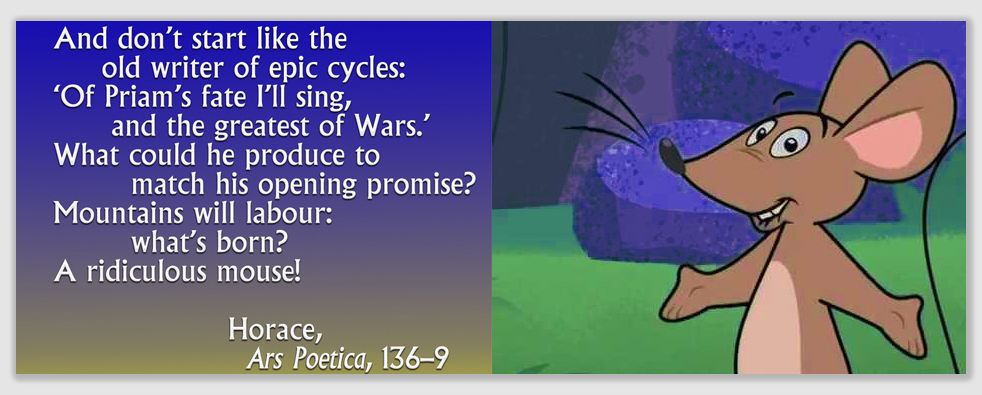
The Colorado Supreme Court had a chance to clean things up by running Rhodig through the tree chipper of legal history. Instead, it labored mightily… and brought forth a mouse.

Love v. Klosky, 413 P.3d 1267 (Supreme Court Colo., 2018). Carole Bishop and Mark Klosky and Shannon and Keith Love own adjacent parcels of land in Denver’s Washington Park neighborhood. A 70–foot tall catalpa tree towers over two adjacent properties. At the base of its trunk, the tree sits roughly three-quarters on the Kloskys’ property and one-quarter on the Loves’ property. The tree began growing on the lots well before the parties moved in, and no one knows who (if anyone) planted it. Whatever its origin story, the tree shed its leaves, seed pods, and branches on both properties without favoritism.

Catalpa tree

Unhappy with the debris, the Kloskys want to cut the tree down. The Loves unsuccessfully tried to convince their neighbors not to do so. When persuasion failed, they sued. The trial court ruled for the Kloskys, holding consistent with the Colorado rule enunciated in Rhodig v. Keck that unless the Loves could prove that they or their predecessors had helped in planting or maintaining the tree, or that they and the Kloskys’ predecessors had treated the catalpa tree as the boundary, the tree belonged solely to the Kloskeys.

On appeal, the Loves argued that Rhodig should be overturned, but the court held it was bound by Rhodig, which it interpreted to mean that “boundary trees are held as common property only if the landowners jointly planted, jointly cared for, or jointly treated the trees as a partition between the properties.” Two of the appellate judges, however, called on the Colorado Supreme Court to overturn Rhodig and require instead that any time a tree straddles two lands, the adjacent property owners jointly own the tree as tenants-in-common.

The Loves asked the Colorado Supreme Court to review the case.

Held: The Supreme Court, refusing to overturn Rhodig v. Keck, held that the Kloskys could remove the tree because it remained the sole property of the owner of the land where the tree first grew unless the tree was jointly planted, jointly cared for, or treated as a partition between the two properties. Because the Loves could not prove any shared property interest in the tree, they could not prevent the Kloskys from removing it.

The Loves argued that Rhodig should be overruled and that the Court should automatically make them tenants-in-common with the Kloskys for no other reason than the catalpa tree had crossed the property line. The Kloskys, on the other hand, argued that Rhodig holds that even when a tree crosses over a boundary line, it remains the property of the owner of the land on which the tree originally grew unless one of the joint-action situations enumerated in Rhodig applies.

The Court said there was no sound legal basis for abandoning Rhodig, surmising that “our ambiguous precedent caused the lower courts to conflate the common law rule for true boundary-line cases and the test for encroachment trees.” Instead, it clarified that Rhodig only governs “encroachment trees,” trees that begin life entirely on one property only to migrate partially to another. Under Rhodig, a landowner may remove such a tree without first securing the approval of his neighbor, unless the landowners jointly planted, jointly cared for, or jointly treated the trees as a boundary marker. The Court said that Rhodig does not represent some weird minority rule on boundary trees. Indeed, the Court lectured, the common law rule regarding true boundary-line-tree cases – where the tree sits squarely on a property boundary with no evidence of migration – is not implicated by Rhodig. In such a case, a tree standing on the division line between adjoining landowners is generally considered the common property of both landowners, even in Colorado. 

Thus, the Court ruled, Rhodig only applied when a tree originally growing on one property grew and encroached on another. Having clarified what Rhodig means, the Court concluded it was correctly decided and remains sound. “And, we see no conditions that have changed to make the above reasoning any less compelling today than when we decided Rhodig.”

The Court ruled that the Loves did not show other circumstances that would create joint ownership. “Just as the Rhodigs had no property interest in the trees that had encroached onto their land because there was not sufficient evidence the parties jointly planted the trees, jointly cared for the trees, or intended for the trees to serve as a boundary,” the Court wrote, “here, the Loves have no property interest in the tree that has encroached onto their land because they have not shown such joint activity implying shared ownership.”

– Tom Root

TNLBGray140407

Case of the Day – Friday, August 30, 2024

HEDGE FUN

The other day, we found ourselves reading a fascinating brief – and only a lawyer can employ the adjective “fascinating” to describe the noun “brief” – that argued against what the writer called the “common-hedge rule.” Under the common-hedge rule, the argument went, vegetation growing on or near a boundary might be regarded as property held in common, meaning that adjoining landowners would have to protect the vegetation from harm.

To the initiated among us (and because you’re reading this, you are among the initiated), this merely sounds like something close to the rule in Rhodig v. Keck. To the brief writer, however, the common-hedge rule was an un-American mischief-maker that would spawn vexatious litigation, engender confusion, and threaten the freedom-loving people of Earth. What was worse, the writer argued, it would interfere with the first prong of the Massachusetts Rule (that is, the doctrine that a landowner may trim overhanging branches and encroaching roots up to his or her property boundary).

Alas, the brief was for naught: the case in which it was filed, an Arizona hedge encroachment action, was decided on an arcane procedural question regarding the timeliness of a post-judgment motion under Arizona Civil Rule 60(c)(1). But the whole notion of a “common-hedge rule” was interesting.

But on closer examination, the common-hedge rule appears to be nothing special, at least, nothing we could not divine with what we know of the Massachusetts Rule and boundary-tree law. The highlights:

First, a person on whose land a hedge is located is the owner of it, although the roots and branches thereof extend into and over a neighbor’s land.

Second, a landowner whose property is invaded by the boughs of a hedge growing on adjoining premises may cut them at the point where they enter her property. However, the fact that a landowner trims branches overhanging her property from a hedge growing on an adjoining landowner’s land is not evidence that she has any ownership in the hedge, or that it is a boundary between the properties.

Third, if a hedge constitutes a boundary between adjoining lands, it is the common property of the owners of the lands, but neither has a right to cut, injure, or destroy the hedge without permission of the other.

This is pretty basic stuff. It appears the rules we know and love will apply whether the vegetation in question is a tree, a hedge or even a beanstalk.

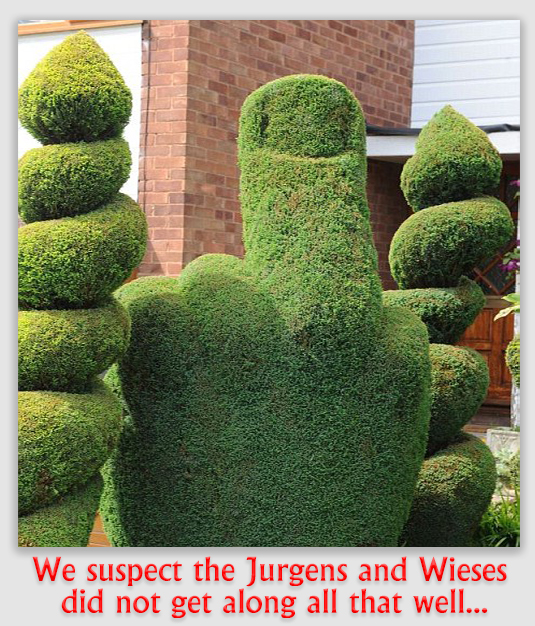
Jurgens v. Wiese, 151 Neb. 549 (Supreme Court of Nebraska, 1949). Martin and Anna Jurgens sued John and Tena Wiese to stop them from destroying a hedge located entirely on the south boundary of the Jurgens’ and Wieses’ properties, and for damages suffered because of John’s partial cutting of the hedge.

The Jurgens and the Wieses (and the people who owned the properties before them) had for more than 10 years recognized the boundary between their lands to be the center of the hedge. The Wieses trimmed it on their side, not claiming to own the whole thing but rather just the part they trimmed.

The trial court found that the row of hedge trees was completely on the Jurgens’ land and awarded them damages for the Wieses interference with the hedge. The Wieses appealed.

The hedge had been there about 78 years. The owner prior to the Jurgens, John Lenners, maintained the hedge and claimed it was his. In about 1936, John complained he was running into trouble with Lenners, and said, “I want to take that hedge from the old gentleman.” When Lenners died, the Jurgens bought the western 133 acres of the property.

John’s father, George, had owned John’s tract previously. George never made any claim to the hedge, but he did complain that it was too close to the line. More than 30 years before the trial, George said, “To my notion it ain’t right. Lenners has got that big hedge so close… it is damaging my land…. by sapping and they had to go along it every so often and cut branches.”

After John and Tena acquired the land, they did not make any claim that the hedge was on their land or that it was on the boundary line, but they did complain that the hedge was sapping his ground and causing damage. After the Jurgens bought their land, John told Martin he could get “damage off you” because the hedge damaged his land and that he wanted to have some damage for the injury done to his land. The hedge was so close to the line, he said, it sapped some of his ground. When Martin asked him how much he wanted, John said, “Half of it.”

Held: The hedge belonged to the Jurgens, but John and Tena were entitled to trim the part that overhung their property.

The Supreme Court found that the hedge clearly was planted and the trunks of the trees within the hedge were wholly upon the Jurgenses’ land. The Court said the hedge was the Jurgenses’ property, and no part of it has ever been owned by the Wieses. The Court held that ownership of trees standing wholly on the land of one owner, although their roots or branches extend into or over the land of another, is vested in the person on whose land the trees stand, and the adjoining owner has no property in them.

The fact that the Wieses trimmed branches from trees and the hedge which extended over their property was not evidence that they had any interest in or ownership of any part of the hedge, the Court held. One whose property is invaded by the boughs of trees growing on adjoining premises, the Court ruled, may cut them at the point where they enter his property. The act of cutting the branches to the extent they have entered the adjoining property is the exercise of a right, but it is not evidence of the ownership of a tree or trees from which the branches grew.

The Wieses admitted they were cutting the hedge but claimed they were cutting within their legal rights thereby to protect their property in it, that they were the owners of at least one-half of it. They had cut about 20 yards of the hedge and more than 20 hedge trees, and were continuing to cut the hedge at the time the suit was filed. Because a substantial portion of the hedge they cut was on Jurgens’ land, an injunction was a proper remedy. One who has trespassed upon the land of another, and threatens to continue such trespass may be enjoined from so doing. The owner of real estate is not required to permit the devastation of his hedge by a trespasser and seek relief in an action at law for damages, the Court said, but instead may resort to an action to prevent such trespasses.

– Tom Root

Case of the Day – Wednesday, August 14, 2024

LIS BLUDGEONS

dancing-nuns140606If you’re suing a neighbor because you claim title to a piece of her property, the last thing you want to see happen is for her to sell it to the Little Sisters of the Poor before your lawsuit is completed. The neighbor makes off with the money from selling your property, and when you finally win, you have the sticky PR problem of the bailiff dragging a gaggle of nuns off your land while TV crews report your heartlessness live on CNN.

It was for precisely this reason — well, maybe not precisely for this reason — that the law has developed a mechanism known as lis pendens. A lis pendensliterally, “lawsuit pending” – is a filing with the office of the county responsible for deeds (often the county recorder) that places the world on notice that litigation is going on that relates to ownership of the piece of land at issue. Practically speaking, the filing will send prospective buyers and lenders fleeing for the next county.

The purpose of lis pendens is laudable: it keeps wily defendants from transferring interests in land that is subject to a lawsuit, so a plaintiff doesn’t have to endlessly sue new buyers and lessees in order to collect on a judgment. But like with any reasonable and necessary mechanism, there are those who — as the legendary trickster Dick Tuck would have said — want to run it into the ground.

In today’s case, the plaintiff sued the defendant over a large tree on the boundary between their properties, alleging that it had been negligently trimmed to lean onto their property, that it constituted a “spite fence,” and that its size and location constituted a nuisance. Of interest to us was the last allegation, that in a prior lawsuit between the parties, the defendant’s lawyer had filed a lis pendens on the plaintiff’s lot that caused a sale to fall through. The plaintiffs said that the lis pendens — which a court had later thrown out — constituted a tort known as “slander of title.” This was so because the underlying litigation had nothing to do with whether the defendant claimed title or the right to possess the plaintiff’s property. Defendant’s lawyer filed it simply as a club with which to bludgeon the plaintiffs, as part of a take-no-prisoners litigation strategy.

kkdk73106pet1140606The defendant’s lawyer argued the slander of title had to be dismissed because as counsel for the other side, he owed no duty to the plaintiffs. The California court conceded that he didn’t, but said that was irrelevant: slander of title is an intentional tort (like a judge hauling off and slugging a public defender). Unfortunately, the Court said, the plaintiffs’ pleading wasn’t very well written, and the Court couldn’t be sure that they had alleged malice. The more prudent course, the Court thought, was to offer them a chance to amend their complaint to make clear that they were alleging the defendant’s attorney had acted maliciously.

Castelanellis v. Becker, 2008 Cal. App. Unpub. LEXIS 165 *, 2008 WL 101729 (Cal. App, Jan. 10, 2008). The Castelanellis owned real estate in Humboldt County. They sued the owner of the neighboring home, Kristine Mooney, and her lawyer Thomas Becker, alleging that on the border between their unimproved lot and Mooney’s property, “a large tree” curves from the bottom portion of its trunk toward the Castelanellis’ property and takes up so much space that “the subject property cannot reasonably be developed as a residential property.” They also claimed that Mooney’s house tree blocked light to the tree and caused the tree to grow almost exclusively over their property and that Mooney had trimmed or negligently maintained the tree to contribute to its “odd and unusual angle.”

The complaint maintained that the tree constituted a spite fence within the meaning of California law, and was “maliciously maintained for the purpose of annoying the plaintiffs and in an attempt to gain ownership of plaintiffs’ land at less than fair value.” The complaint alleged nuisance, trespass, tortious interference with contractual relations, and tortious interference with economic relations. The Castelanellis alleged that Mooney sought to “purchase plaintiffs’ property at below fair market value” and had “threatened legal action if plaintiffs trimmed the subject tree in order to make their property capable of being developed and sold.” Finally, they alleged that Mooney and Becker published “false statements” in a lis pendens filed as to the Castelanellis’ property, and this lis pendens — later thrown out by another court — had prevented the Castelanellis from selling the property. The trial court agreed that because Mooney and Becker owed the Castelanellis no duty, there could be no slander.

The Castelanellis appealed.

Held: The Castelanellis had made out an adequate cause of action against Attorney Becker. A party to an action who asserts a real property claim may record a notice of pendency of action in which that real property claim is alleged, called a lis pendens. Such a notice places a cloud on the title and effectively keeps any willing buyer from wanting to close on a transaction until the lis pendens is cleared. In order to be privileged, so that no party may later sue a party or its attorney for filing such a notice, a notice of lis pendens must both (1) identify a specific action “previously filed” with a superior court and (2) show that the previously-filed action affects “the title or right of possession of real property.

In this case, the notice of lis pendens clearly identified that it was signed and filed in conjunction with litigation involving a tree growing upon a shared property line. But nothing in the record enabled the Court to determine that litigation involved the “right of possession” of either of the two properties involved in that litigation. If it did, a litigation privilege clearly applied, and the action against Attorney Becker could not stand.

Becker argued that he had no duty to the Castelanellis, and he could, therefore, not be sued by them. The Court pointed out that this would be true if the action were based on negligence. However, the action was an intentional tort, like the tort of malicious prosecution, and there need not be a duty of care owed to the victim by the perpetrator before an intentional tort can be inflicted. The Court said that while an attorney cannot be liable for negligence to a formerly adverse party, that rule does not exempt the attorney from liability for malicious prosecution.

The tort of slander of title does not rise to the level of either malicious prosecution or abuse of process. The elements of the tort have traditionally been held to be publication, falsity, absence of privilege, and disparagement of another’s land which is relied upon by a third party and results in a pecuniary loss. Slander of title does not include express malice as an intrinsic factor. Here, while the Castelanellis did not specifically plead malicious prosecution in their amended complaint, that complaint does include allegations that the actions “were done knowingly, willfully, and with malicious intent.” The allegations seemed to the Court sufficient to inject into the slander of title cause of action an allegation of malice, even as to attorney Becker.

punchIn any event, the Court said, the law is clear that in evaluating a complaint against a general demurrer, it is not necessary that the cause of action be the one intended by the plaintiff. The test is whether the complaint states any valid claim entitling the plaintiff to relief. Thus, the plaintiff may be mistaken as to the nature of the case, or the legal theory on which he or she can prevail. But if the essential facts of some valid cause of action are alleged, the complaint is good against a general demurrer.

The Court held that the absence of any suggestion in the Castelanellis’ opposition to Becker’s demurrer that they either wished to amend or intended to plead some sort of intentional tort via their fifth cause of action left the Court reluctant to rule that the trial court abused its discretion by sustaining the demurrer without leave to amend. Under all the circumstances, the Court thought the better course of action was to remand this matter to the trial court with instructions to consider whether any intentional tort — as distinguished from a claim of negligence — was in fact pled by the Castelanellis and (2) if not, whether the Castelanellis wish to and can plead a valid intentional tort cause of action against Becker regarding the allegedly improper lis pendens.

– Tom Root

TNLBGray

Case of the Day – Tuesday, July 23, 2024

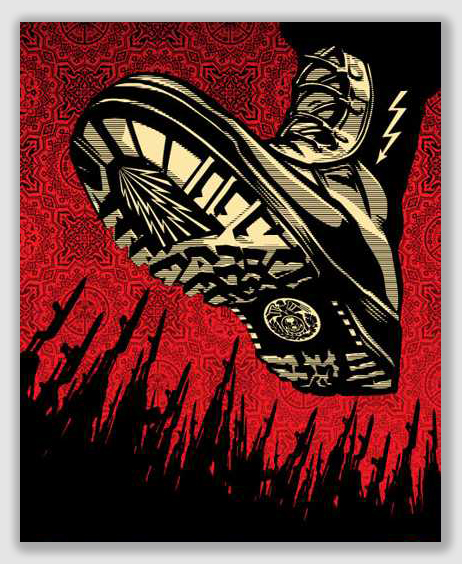
HOBNAIL BOOTS

I spent about 13 years living in suburban Washington, D.C., where everything that happened on Capitol Hill and at the White House was a local news story. Still, until I decamped for small-town and rural-county America, I didn’t really understand how heavy-handed and ugly politics could be until I observed local politics up close and personal. By comparison to county, municipality and township governance, a Trump rally is tame enough to be put to music.

Today’s case could be Exhibit A. A three-member township board of trustees approves a sewer improvement project. As the job progresses, the chairman of the board decides on his own that he’s going to modify the plans to have some trees along the highway right-of-way removed. He is on the site supervising the work when two homeowners approach to complain that one of the trees the chairman intends to have cut down belongs to them.

Here’s where big politics and little politics diverge. If that happened on a federal project (or even a state project), the bureaucrats in charge would stop everything until the engineers and surveyors who had planned the work verified that the subject tree was or was not within the right-of-way. But Uncle Joe was not some pusillanimous bureaucrat: he was the “go-to” guy who had neither qualms nor the time to listen to the petitions of lowly citizens, and he was not about to let the complaints of the hoi polloi get in the way of his government’s work.

Police power” is a constitutional concept, the power of the government to regulate behavior and enforce order within its territorial jurisdiction for the betterment of the health, safety, morals, and general welfare of the inhabitants. But in the real world, Joe showed us what “police power” is all about: a small-town cop ready to arrest homeowners on the say-so of a government functionary, solely because they are defending their property against the unlawful taking by the state. The cop needs say nothing: he’s got a potsie on his check, handcuffs on his belt and a Glock 22 in his holster that say it all.

But we still have courts, and to court is where the homeowners repaired. It turned out the tree straddled the right-of-way boundary line, which helped Uncle Joe not at all: citing the Ohio Jurisprudence legal encyclopedia (which passes for primary authority in Ohio, or so I learned in law school), the court of appeals joined courts in an overwhelming majority of states that hold a boundary tree is owned by the property owners on both sides of the boundary line. As property of the tenants-in-common, the tree may not be removed without the consent of both parties. 

Pinkerton v. Franklin Township. Board of Trustees, Case No. 83AP-946 (Ct.App. Franklin Co., July 17, 1984), 1984 Ohio App. LEXIS 10484, 1984 WL 13994. Joe Donovan, Chairman of the Franklin Township Board of Trustees, was a no-nonsense, get-it-done guy. Plus, he had the power of the state (or at least the township) behind him.

When Joe’s three-member Township Board of Trustees authorized a storm sewer improvement along the west side of Gladstone Avenue, Joe was the guy who would see that the job was done right. When it turned out that the sewer improvement project would be facilitated by the removal of several trees, Joe was the guy who made the decision on his own that the trees would go. Two of the trees were in the highway right-of-way, but the third – a stately oak – straddled the boundary between the Gladstone Avenue right-of-way and the Pinkertons’ property.

Unfortunately for everyone involved, the Pinkertons strenuously objected to removal of the boundary tree. Joe, however, was not a guy who needed anyone’s approval, so he did not bother to consult the other two Trustees about removing the trees. Instead, he forged ahead, ignoring the Pinkertons’ objection. He even directed a local police officer to be present in case the Pinkertons tried to intervene.

The tree was removed just as Joe ordered. The Pinkertons’ complaints, however, were not as easily dispatched as was the oak. They sued the Township Board for trespass, demanding compensatory and punitive damages. The jury agreed, awarding them $2,000 for the tree, and trebled it to $6,000 due to Joe’s willfulness.

Joe appealed.

Held: Joe, acting in his official capacity, caused the trespass and wrongful cutting, entitling the Pinkertons to $6,000.00 in damages.

The Court of Appeals made short work of Joe’s claim that the evidence showed no wrongful cutting. It held, citing Ohio Jurisprudence 3rd, that “[a] tree standing on the boundary line between adjoining landowners, so that the boundary passes through the trunk or body of the tree, is the common property of both proprietors as tenants in common.”

Likewise, the Court ruled that given that Joe steamrolled the Pinkertons’ legitimate objections, even bringing in the police to stifle their complaints of trespass, it was not error for the trial court to tell the jury it could assess punitive damages.

Finally, because the Pinkertons testified the tree was worth $6,000, there was evidence in the record to support the damage award.

– Tom Root

TNLBGray140407

Case of the Day – Friday, June 7, 2024

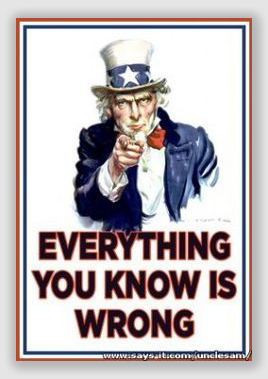
EVERYTHING WE KNOW IS WRONG – PART 1

If there are two basic building blocks of tree law, they are the Massachusetts Rule – that New England rock of individualism and self-reliance – and the Hawaii Rule – that piece of creeping socialism that lets a property owner use the courts to force a neighbor to remove a tree that was a bother (we said that tongue-in-cheek).

After running out of gas and the funds needed to pay for it, I was homebound. For something to do, I went on a quest to identify the legal precedent in every state that addresses the issue of the encroachment of overhanging limbs and subsurface roots, so that we could present a state-by-state compendium of encroachment law. It was either that or cut the grass on my hands and knees with a pair of scissors (no gas for the mower). Wisely, I opted to go the encroachment route.

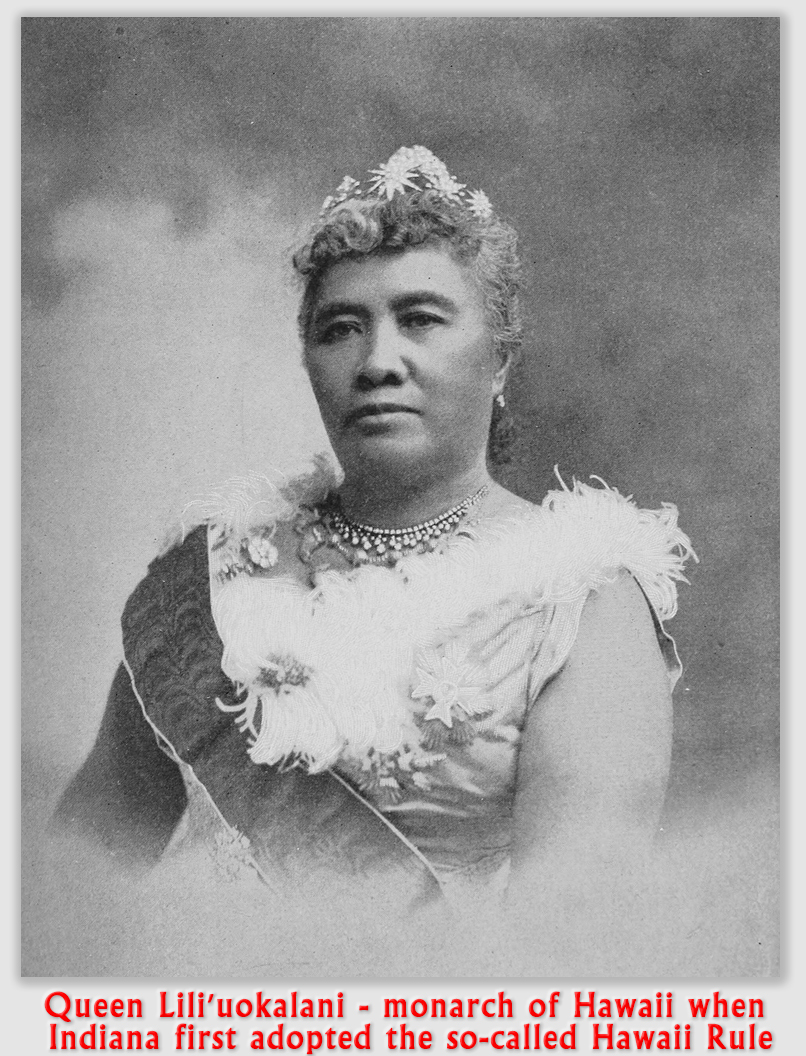
I had not even gotten out of the Northwest Territory – remember what that is? – when I found that the Massachusetts Rule did not start in Massachusetts. What’s more, as we see today, the Hawaii Rule was the law of the land in the Hoosier State back when Hawaii still had a queen, and the Americans had yet to diddle in the affairs of the Kingdom in order to engineer annexation.

Indiana’s rule can be summed up as this: a tree that encroaches on a neighbor’s property and creates a nuisance – producing such a condition that in the judgment of reasonable persons is “naturally productive of actual physical discomfort to persons of ordinary sensibility, tastes, and habits” – has to be removed at the expense of the tree’s owners.

A tough place, Indiana… In today’s case, a tree that had once belonged to the plaintiff – who had sold the property to the defendant – had grown into the boundary fence, damaging it. The roots raised some sidewalk slabs on a walkway the plaintiff maintained near the boundary. The plaintiff, unwilling to fix the rather minor damage ($2,500 in 2010, not a princely sum), went to small claims court to make the other guys pay.

It seems to us that as a matter of equity, the plaintiff knew something like this would happen when he let the tree sprout years before, at a time when he owned the parcel on which the tree was growing. But equity appeared not to have any place in the courtroom that day.

But back to my basic point: the Hawaii Rule did not originate in Hawaii at all. What we thought we knew about that Rule turns out to be wrong. What next? Is the Massachusetts Rule equally mislabeled? Tune in tomorrow…

Scheckel v. NLI, Inc., 953 N.E.2d 133 (Ind.App. 2011). Steve Scheckel owned a piece of property separated by a chain-link fence from a plot belonging to NLI, Inc. Steve has a walkway paralleling the fence that runs about five feet from the boundary line. Steve had previously owned both his land and the NLI property, and – when he had – a tree grew on the NLI property near the fence. After he sold the land to NLI, the tree continued to grow, as trees are wont to do, until it grew into the fence and its roots grew under the walkway, leaving the gate in the fence unusable and the walkway badly cracked and buckled. Steve spent $2,500 fixing the mess.

Steve complained to NLI about the damage, but the corporation took no action. He then sued NLI for negligence and nuisance in small claims court. The court found for NLI on the grounds that while the size and placement of the tree damaged the fence and walkway, a landowner is not liable for harm caused beyond property boundaries by a natural condition of the land.

Steve appealed.

Held: The Court of Appeals reversed, and ordered that the trial court find NLI liable.

Steve contended that the trial court erred in applying the “natural condition” rule. The natural condition rule, as set out in which provides that a landowner was not liable for harms caused to others outside of his land caused by a natural condition of the land, arose “at a time when land was largely unsettled and the burden imposed on a landowner to inspect it for safety was held to exceed the societal benefit of preventing possible harm to passersby.”

Over the years, the rule has been subject to exceptions when landowners had actual knowledge of a dangerous natural condition, regardless of location, and – in an urban area – when he or she fails to exercise reasonable care to prevent an unreasonable risk of harm arising from the condition of the trees on the land near the highway. The rationale for imposing such a duty on urban landowners is that the risk of harm to highway users is greater and the burden of inspection on landowners is lighter in such populated areas.

Most recently, the Indiana Supreme Court observed that the natural condition rule, as stated in the Restatement of Torts § 363(2), has little or no utility in an urban setting. A landowner in an urban or residential area “has a duty to exercise reasonable care to prevent an unreasonable risk of harm to neighboring land owners, arising from the condition of trees on his or her property.”

Here, the Court of Appeals said that

[s]trictly applying the Restatement rule in these settings would leave landowners powerless in the face of a neighbor who refuses to remove or secure an obviously decayed and dangerous tree simply because it is a natural condition of the land. As a result, Indiana, along with several of our sister states, has retreated from strictly applying the Restatement rule in urban or residential settings where the landowners have actual or constructive knowledge of the dangerous condition.

Here, the small claims court held that the condition of NLI’s tree did not pose an unreasonable risk of harm to neighboring landowners, but rather the placement and size of the tree that caused the damage. The Court of Appeals, however, disagreed, seeing “no meaningful difference between the two situations. Indeed, it may be difficult to determine whether a tree is decayed to such an extent that it poses an unreasonable risk of harm to an adjoining property owner, but a tree upon one’s property that is growing into a structure on an adjoining property is readily observable.”

The Court applied a three-part duty analysis it adopted from an Indiana Supreme Court ruling, concluding that a landowner in a residential or urban community owes a duty to prevent an unreasonable risk of harm to adjoining property owners or their property resulting from trees growing upon the landowner’s property. Those three factors – relationship, foreseeability and public policy – all support its conclusion that NLI owed Steve a duty:

The relationship is significant in that it is between the owners of adjoining property, and will often be that of next door neighbors. There is a high degree of foreseeability of harm where one’s tree is growing into a structure on an adjoining property. Finally, the landowner is best situated to prevent or minimize the harm by trimming the tree upon the landowner’s property. Accordingly, we conclude that the trial court erred in applying the natural condition rule to bar Scheckel’s negligence claim.

The Court also said the natural condition rule did not bar Steve’s private nuisance claim, either. A nuisance is defined as whatever is injurious to health, indecent, offensive to the senses, or an obstruction of the free use of property, such that it essentially interferes with the comfortable enjoyment of life or property. Ind.Code § 32-30-6-6. A public nuisance affects an entire neighborhood or community, while a private nuisance affects only one individual or a determinate number of people, arising when it has been demonstrated that one party has used his property to the detriment of the use and enjoyment of another’s property.

Nuisance actions may either be nuisances per se (at law) or nuisances per accidens (in fact). A nuisance per se occurs when the use itself is unlawful. A nuisance per accidens, a nuisance-in-fact, is not a nuisance in itself but becomes one by the manner in which it operates. In determining whether a private nuisance per accidens is actionable, the inquiry is whether the alleged nuisance produces such a condition that, in the judgment of reasonable persons, is “naturally productive of actual physical discomfort to persons of ordinary sensibility, tastes, and habits.”

Ever since 1894, the Court said, Indiana has recognized the right of landowners to recover damages to their property caused by trees growing on an adjoining property as a private nuisance. In the 1894 Toledo, St. Louis & Kansas City Railroad Co. v. Loop decision, the Indiana Supreme Court held that in the event of trees growing so close to the boundary line between two properties that their branches encroach on the adjoining premises, the adjoining landowner may have an action for damages in nuisance if injury were shown.

The Court of Appeals concluded that the trial court erred by applying the Restatement’s natural condition rule to Steve’s cause of action.

– Tom Root

TNLBGray140407