Case of the Day – Friday, October 25, 2024

ILLEGAL CONTACT

RefWhat would October be without football? Pop Warner football, middle school football, high school football, college football, pro football, backyard football… and the promise of the rivalry games of November, then Ohio State-_ichigan, Army-Navy, and the bowl games starting with the dull thrum of the Celebration Bowl and Camellia Bowl on December 14th, building up to the thundering crescendo of the Sugar, Cotton, Orange and Rose Bowls, and, of course, the new 12-team college playoffs that will add spice to the major bowl games.

So, in honor of football, more football, and even more football, we’re looking at one of the Cardinal rules of trespass – illegal contact.

Usually illegal contact, that is, trespass to trees — where someone enters someone else’s land and cuts down trees without any right to do so — is pretty cut and dried. But not all trespasses are clear-cut (to turn a pun).

In today’s case from Louisiana, a party bought a piece of land from the tree owner’s sister but conditioned the purchase on being able to get rid of some trees on the boundary line with the tree owner. The owner – no doubt a Patriot – signed a contract entitling the buyer to cut down trees on the boundary. The problem was that the contract was imprecise as to how many, or where exactly the trees were. The only thing that was clear was that the parties agreed that wild Broncos couldn’t pull him over to cut down the tree owner’s prize old live oak.

Too bad the owner didn’t watch the tree-cutting crew like a Seahawk. The buyer’s contractor was no Saint. In fact, he was kind of a Buccaneer. He cut down 12 trees and, although he was told not to, he trimmed the live oak pretty aggressively. The owner cried “Deciduous foul!” and lawsuits flew like yellow hankies. Being unable to Bear the mess, the owner raced like a Jet to the courthouse and slapped a Giant lawsuit on the buyer, Raven that he hadn’t given permission to do anything like that, and the contractor was Lion if he said otherwise. He wanted treble damages for the wrongful cutting.

The court awarded about 5,000 Bills in damage for the cut branches on the live oak, but it disagreed on the treble damages. The Court said that the ambiguous contract seemed to contemplate that the 12 trees would be cut down, and there was no basis for any recovery on those. As for the injured live oak, it was damaged but still standing. The statute awarded treble damages for cutting down trees, and the trimming — although a violation of the contract — wasn’t something for which treble damages could be awarded.

The plaintiff felt deflated over the whole episode.

Distefano v. Berrytown Produce, LLC, 973 So.2d 182 (La.App. 1 Cir., 2007). Distefano owned a 2-acre vacant tract of land along Church Street. Berrytown Produce, LLC sought to buy a piece of land next to the Distefano tract to operate a produce business. That land was owned by Rose Millican, DiStefano’s sister.

A line of trees on Distefano’s land blocked the view of the Millican tract approaching it from the highway. Berrytown conditioned its purchase on obtaining Mr. Distefano’s permission to remove trees from his property. So Distefano authorized Berrytown in a written agreement to remove all trees on the property line dividing the Distefano and Millican tracts, except for a live oak tree. Berrytown hired Kemp Richardson to perform the clearing work. Richardson cut and removed 12 trees from the Distefano and Millican tracts, and he cut a significant number of branches from the live oak tree on Mr. Distefano’s tract.

Eisfeld should have gotten this sign with special wording, "And don't cut down my trees, Martin!"

     This means you, Berrytown!                   Trespassing – kind of like the real property version of offsides.

Distefano filed a timber trespass action against Berrytown and Richardson, saying the defendants cut and removed five trees from his property and cut branches off the live oak tree without his permission. Distefano tried to recover damages under Louisiana Revised Statute 3:4278.1, commonly referred to as the “timber trespass” statute, which imposes a penalty of three times the fair market value of trees on people who unlawfully cut, fell, destroy, remove, or divert trees from a landowner’s property. Distefano also claimed restoration damages and damages due to the decrease in the value of his land and further urged that the defendants’ cutting activities caused him to suffer non-pecuniary damages.

At the conclusion of a bench trial, the court found that the agreement between Distefano and Berrytown contemplated the cutting and removal of all trees on the Distefano property that had been actually cut down. The court found that the parties clearly understood that the live oak tree was not to be cut, and awarded Distefano $6,045.00 for the unlawful removal of branches from his live oak tree, accepting expert testimony setting the fair market value of the live oak tree at that amount. The court declined to award treble damages, finding the treble damage provision inapplicable because the tree itself had not been cut down and removed, and because there was insufficient evidence of the fair market value of the limbs removed from the tree.

Distefano appealed, challenging the court’s finding that he consented to the cutting down of five trees from his property and the denial of his treble damage claim.
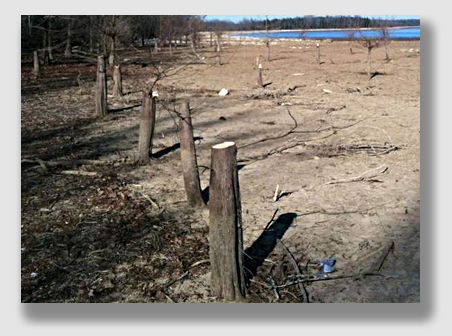
Held: The trial court’s decision was upheld. The Court found that the contract called for the cutting of “all trees on the dividing property line” between the Distefano and Millican tracts, “with the exception of the live oak tree located on or near the property line.” A witness attested there were no trees on the property line itself, but there were trees close to the property line that hung over the property line, and those were the trees Berrytown wished to have removed. Distefano contended that the parties never contemplated the removal of any trees not located exactly on the common property line, but other witnesses disagreed, and the trial court’s findings of fact were found to be reasonable.

Distefano contended that the trial court should have ordered the defendants to pay treble damages. Louisiana Revised Statute 3:4278.1 imposes a penalty of three times the fair market value of the trees on those persons who unlawfully cut, fell, destroy, remove, or divert trees from a landowner’s property without the landowner’s consent. But, the Court said, no tree was cut down without permission. Instead, the oak tree was trimmed without permission, and the cut trees were taken pursuant to the agreement. Although contrary to the contract, the Court ruled, because the oak tree was not cut down, the statute did not authorize treble damages under the facts of this case.

– Tom Root

TNLBGray

Case of the Day – Wednesday, September 25, 2024

“WHOSE WOODS THESE ARE…

I do not know,” wrote Robert Frost in Stopping in the Woods on a Snowy Evening. That appears to have been precisely the problem for neighboring rural landowners in Kentucky, one the titleholder to pasture and the other owning a large glade of trees.

The neighbors, Marv and Gene, had a common boundary on the edge of the forest, populated by some pretty nice hardwood specimens. When Gene decided he wanted to cut down and sell some of the timber, he asked Marv for permission to come onto his land to cut down the first of some eight trees he wanted to sell. Marv thought the trees all straddled the boundary, and so belonged to the both of them. He let Gene cut them down and haul them away, naturally believing that Gene would come back around to hand Marv a share of the cash.

Marv may have been the kind of guy who went through junior high school with a “kick me” sign taped to his back. It turned out, of course, that while there may be a Santa Claus, it wasn’t Gene. Gene came back from selling the trees, asking for permission to come onto Marv’s to cut down some more trees, all without offering Marv a farthing. Still, Gene cut down four more trees before Marv gave him the heave-ho.

Unwilling to be fooled again and unwilling to let Gene get away with selling commonly-owned trees as his own, Marv sued. And here’s where he let his fury get ahead of his common sense (which was his lawyer’s job, by the way, to talk his client off the ledge when prudence dictated he get his facts straight first).

It turned out that the first four trees Gene cut down were, in fact, completely on Gene’s property, but the second four were not. After the dust settled and Marv had a definitive survey done, Gene had to pay Marv $7,168.15. That was not a lot of money in 2008, at least for all of the litigation that ensued. The legal bills alone were probably bigger than that.

Gene’s attorney, however, might have been worth it. He was pretty crafty, throwing plenty of legal roadblocks in the way of the courts. The appellate panel, sad to say for Gene, swept them all away, and – rather piqued at Gene’s attempts to limit his liability after selling trees that only half belonged to him – said treble damages were only Gene’s due for selling the neighbor’s trees, especially when he had just been told not to cut them.

Smith v. Unger, Case No. 2007-CA-000318-MR (Ct.App. Kentucky, June 6, 2008). Marv Unger and Gene Smith owned adjacent properties in Lincoln County, Kentucky. Unger bought his place in 1997, and Smith purchased his in 2003. Marv’s property was primarily pastureland, while Gene owned some prime woodland.

Gene removed eight trees from the area of the common boundary line, in which Marv asserted part ownership. Gene said he believed the trees were on his land when he cut them down. Marv sued Gene for trespass and demanded treble damages for wrongful cutting under KRS 364.130.

A lot of the dispute arose from the presence of a fence running along the boundary between the properties. Gene and Marv agreed the fence in question had been there as long as Marv had owned his land, but they disagreed as to how many years prior to that time the fence had been there. Everyone agreed neither Marv’s nor Gene’s deed referenced the fence. Gene admitted he did not have the boundary line surveyed before cutting, but he said Marv told him the fence was the boundary. Marv says he never told Gene any such thing, and that he always determined the boundary line by some stakes that had been there at least since Gene bought his place.

Just before Marv purchased his property in 1997, the former owner had a survey of what became the Unger property performed. The surveyor placed stakes in the ground to mark the boundaries, and those stakes his property extended beyond the fence.

Gene never questioned the location of the boundary from the time he bought his land in 2003. However, Marv said that about a month after Gene bought his wooded tract, the two men discussed the trees located near the fence line between the properties. Marv said he understood the true boundary line between the properties to run according to the stakes, and not according to the fence. Gene disagreed, believing the fence to be the boundary line between the properties.

Marv testified he told Gene before the trees were cut they were “line trees” and, as such, he deserved a portion of any money made from their sale. Marv admitted that after the conversation, he allowed Gene and his assistant onto his property for the purpose of removing the first four of the eight trees. After the first four trees were removed, Marv waited for Gene to share the wealth. When Gene offered nothing, but instead tried to come back onto the property to cut more trees, Marv told him to leave, and Gene did, but not before cutting four more trees.

Marv then had the property resurveyed. The survey showed that the prior survey was somewhat off and that Gene owned four of the eight trees that had been cut.

A master logger valued the four trees that were not Gene’s “on the stump” and “at the market,” which was twice the stumpage value. The trial court entered a judgment for Marv for $4,614.90 plus, consisting of $1,538.40 in compensatory damages (representing the stump value of the trees) trebled (as set forth in KRS 364.130(1) and (2)), costs in the amount of $1,399.25, and attorneys’ fees in the amount of $1,154.00, for a total of $7,168.15.

Gene appealed.

Held: Judgment in favor of Marv was upheld.

Gene argued that KRS 372.070(1) declared Marv’s deed void to the extent that it purported to convey land within Gene’s boundary, including the timber upon it. That statute provided that any conveyance of any land of which any other person has adverse possession at the time of the sale or conveyance is void. Here, the Court said, Gene never disputed Marv’s proof of the boundary and never sought to quiet title. It was too late for Gene to argue that he had all along been claiming to hold the land up to the fence by adverse possession.

Under Kentucky law, land held by adverse possession only ripens into title when it has been held for 15 years openly, hostilely and notoriously to a well-defined boundary, giving others who may claim an interest notice of the adverse claim. The adverse holder’s intent at the time the possession begins is key: where one through ignorance, inadvertence, or mistake as to the true location of his boundary line enters into neighboring land up to a certain line in the belief that it is the true line, the occupancy is deemed amicable, mistaken perhaps, but not hostile.

In this case, Gene did not intend to possess land beyond his true boundary. He never formally disputed or questioned the boundaries as they existed, and at no time did he approach Marv to request the survey stakes be moved to establish what Gene believed to be the correct boundary between the two properties. The Court said it was clear Gene did not intend to establish actual adverse possession.

Gene also complained about the award of treble damages. The Court disagreed.

KRS 364.130 governs damages for cutting timber from another person’s land. The statute provides that a person is liable for treble damages for cutting the timber from another person’s land only if the person cutting the timber did not have at least “color of title” to the land. So, in order for Marv to receive treble damages, the evidence must show that Gene did not have color of title to the disputed property from which the timber was cut. Color of title is “that which gives the semblance or appearance of title, but which is not title….” It is color of title in appearance only and not title in fact.

Any deed or instrument that purports to convey land and shows the extent of the grantee’s claim may afford color of title. Thus, even a deed or instrument of conveyance that is defective or invalid is sufficient to afford color of title. But in this case, Gene conceded that his deed makes no mention of the fence as the appropriate boundary line, and the survey stakes marking Marv’s boundary were in place at the time Gene purchased the land.

Ultimately, the question, the Court said, was whether the jury determined that the trees themselves were on the boundary, as opposed to whether or not the trees were entirely on one property or the other. If the jury decided that the trees were boundary line trees and that notice had been given to both parties that they were boundary line trees, then the taking of the trees by either party would be against the basic title held by either property owner and constitute the unlawful taking of timber from “the land of another”.

Here, the jury found that at least four of the trees at issue were boundary line trees taken by Gene without color of title. This being the case, it is clear that the statute entitled Marv to treble damages.

The Court said the jury’s function was to determine whether or not Gene damaged Marv’s land, and, if so, what amount of money would compensate Marv up to the amount of the stump value. After that determination was made, the duty fell to the trial court to enter a judgment for triple the amount assessed by the jury.

The jury did not award Marv the entire value of the trees. The value of the trees was twice the stump value. The jury award of “stump value” actually amounted to only half the value of the standing trees. However, the Court reasoned, the jury awarded a sum of money to Marv, and implicit in that award was the finding that Gene was a tortfeasor while Marv was in the right. Gene removed the trees and, thereby, the physical evidence of the location of the trunk, the limbs, the shade the tree produced and any other benefit the tree would have had to the landowners that were provable by the physical presence of each individual tree. Certainly, there is no dispute that where each of these trees once stood, only stumps remain.

Gene, the Court said, was trying to benefit from the value of the trees both as the landowner and as tortfeasor but he could not have it both ways. Based on the testimony of the logger, it is customary that one who cuts and removes trees is paid at the rate of one-half the value of the trees, which is equal to the stump value. Gene was seeking to acquire half the value of the trees on the basis of his tortious conduct, namely, cutting and removing the trees without permission. Further, as a landowner, Gene attempts to assert that he is entitled to a proportional share of the stump value. As a matter of policy, a tortfeasor should not be allowed to benefit from his wrong to the detriment of the injured party.

– Tom RootTNLBGray