Case of the Day – Monday, July 22, 2024

LET’S GET THIS STRAIGHT – JOYCE KILMER WAS NOT A GIRL

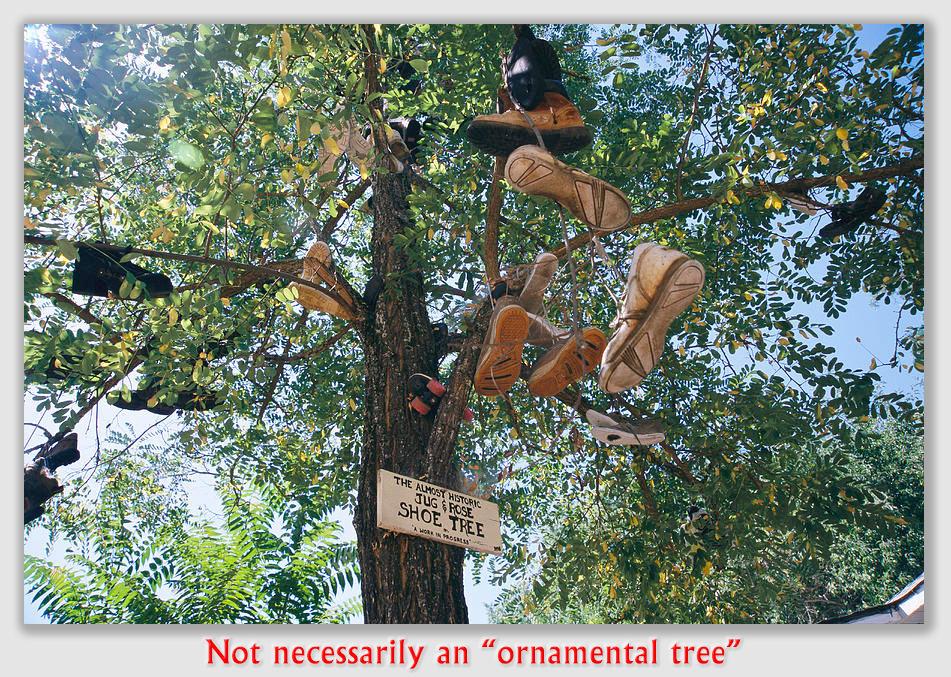
Today’s case reminded me of the love many of us have for trees because of all of the intangible benefits they deliver – shade in the summer, shelter from the rain, a windbreak, a place on which to mount our birdhouses and hammocks and tires on a rope for the kids…

What all of these have in common is that none of them is accounted for when a tree is cut down, stripped of branches and run through the sawmill. The stumpage value – the worth of the tree’s harvestable wood to the mill on the ground in the woods – doesn’t tally up the value of all of what we like about our ornamental trees.

That reminded me of Joyce Kilmer, who was among the first to calculate the noncommercial value of ornamental trees (after a fashion), writing, “I think that I shall never see a poem as lovely as a tree…”

And that in turn reminded me to be proactive in telling everyone that Joyce Kilmer was not a girl. Not that there’s anything wrong with girls or girl poets (I’m a big Emily Dickinson fan myself), but I regularly come across knuckleheads who say “Joyce Kilmer wrote those words because she…”

Nope, nope, nope. Joyce was a boy, and later a young man, His poetry and writing career was cut short when he fell, killed in action in France 106 years ago this month.

In the case we’re talking about today, it’s a cinch that Gordon Lamb – who is also a boy – didn’t read much Joyce Kilmer. He was probably more a William Blake fan, because he sure hit his logging assignment like a “tiger, tiger burning bright…” He cut all of the trees he was supposed to, and then, for good measure, cut or destroyed about 400 more.

The trial court held that the homeowners whose trees fell victim to the tigrine Mr. Lamb were limited to stumpage value. It was a sweet outcome for the defendant: 400 trees ended up costing Gordon about $7,000, well less than $20.00 per tree destroyed. But then the court of appeals stepped in, applying what is by now universally recognized as the proper measure of damages: noncommercial trees are generally worth more than an equal number of commercial trees.

Denoyer v. Lamb, 490 N.E.2d 615 (Ct. App. Hamilton Co., Ohio, December 5, 1984). Murphy Development Company marketed subdivided lots from a wooded parcel it owned. It sold five parcels, of which four had homes built on them. The parcels were cleared except for a mature woodland behind them (which Murphy still owned), which growth extended onto the rear of the five lots.

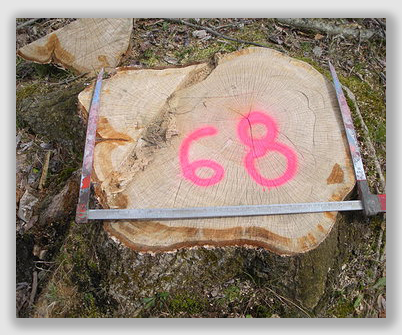
Murphy Development hired Gordon Lamb to harvest mature timber from the woods the development company still owned. Gordon Lamb set off like a tiger, cutting not only trees from the Murphy acreage, but sawing into the woodlands on the five private lots. When the sawdust settled, Gordon’s crew had cut 68 trees that did not belong to the Murphy company and destroyed 331 more.

The afflicted property owners whose trees were decimated, including the Denoyer family, sued.

The trial court limited the Denoyers’ compensatory damages to the stumpage value of the cut and destroyed trees. It also restricted their recovery to either punitive damages or treble damages, but not both. The jury awarded the Denoyers $7,412.00 in compensatory damages but found no grounds to award punitive damages.

The Denoyers appealed.

Held: The trial court judgment was reversed, and the Denoyers were permitted to claim restoration damages

The Court of Appeals laid the framework for assessing when replacement damages should be awarded. “In an action for compensatory damages for cutting, destroying and damaging trees and other growth, and for related damage to the land,” the Court wrote, “when the owner intends to use the property for a residence or for recreation or both, according to his personal tastes and wishes, the owner is not limited to diminution in value (difference in value of the whole property before and after the damage) or to the stumpage or other commercial value of the timber.”

Instead, the Court ruled, an owner may recover as damages the costs of reasonable restoration of the property to its preexisting condition or (because regaining the preexisting condition of often not possible) to a condition as close as reasonably feasible. “Reasonably feasible” means that the courts should not order grossly disproportionate expenditures, and allow for natural regeneration within a reasonable period of time.

Where cut trees have been used for a specific purpose – such as a sound barrier and screen from highway traffic or shade or even mere ornamentation – restoration cost is the proper measure of damages. Additionally, the cost of restoration should be used as the measure of damages where “the owner’s personal use is neither specific nor measurable by commercial standards, and when the trees form a part of an ecological system of personal value to the owner.”

The Court reasoned that in the present case, stumpage value could be determined in several ways, but all of those methods would yield a much smaller amount than the cost of replacement. To limit the Denoyers’ and their fellow lot owners’ recovery to stumpage value would be to enforce a timber harvest the plaintiffs never contracted for or even wanted. It would fail to account for their intended use or real loss.

The Court of Appeals thus held that the trial court erred in excluding evidence of reasonable restoration costs, including cleanup, repair and regrading.

– Tom Root

TNLBGray140407

Case of the Day – Monday, July 8, 2024

IT DOESN’T TAKE THAT MUCH TO BE RECKLESS

Today, my bride of 45 years and I are climbing up an ash-covered glacier (in Iceland, where else?), doing things with an ice axe and crampons that seem kind of reckless for grandparents of 4.66 grandchildren to be doing. It’s a great segue into today’s topic.

We all have some sense of what kind of conduct is reckless. At least, to channel the late Justice Potter Stewart, we’re pretty good at knowing it when we see it. Riding a motorcycle into a wall at 100 mph while drunk? Yeah, probably reckless. Standing on a ledge at the top of a skyscraper for a selfie? You bet. Lying between railroad tracks while a train passes? We’ll give you that one, too.

But when the law uses the term “reckless,” in fact when the law adopts any standard, the term has to have a specific definition. If not, laws punishing conduct that did not meet the standard would be arbitrary (as well as falling short of their goal of causing people not to be reckless in the conduct of their affairs).

I’m sorry, Justice Stewart. ” Knowing it when [you] see it” is trenchant, but it’s not a good way to regulate conduct.

In today’s case, a Buckeye State classic, a car repair business trespassed on a neighboring business’s land to hack away at some spruce trees. The car repair manager thought the trees belonged to his company, but his belief – which flew in the face of the facts – was so heedless of the consequences that the court found him reckless.

We have seen worse cases that were considered to be  mere negligence, and we cannot discount that the trial court in this case was influenced by the extent of the damage to the “visual barrier” between the professional building (populated with the offices of lawyers, doctors and engineers) and the seamy oil-change-and-lube joint next door.

“Recklessness” let the trial court grant treble damages under Ohio law to the office building owner. Unsurprisingly, recklessness is what the trial court found. Maybe cynicism is creeping into our analyses as we age (we prefer the expression “as we get wiser”), but if the real estate owner had made the same unsupported surmise about the grease monkey’s trees, we suspect his misfeasance would be found to fall somewhere short of “reckless.”  Just sayin’.

ALH Properties, P.L.L. v. Procare Automotive Service Solutions, LLC, Case No. 20991, 2002-Ohio-4246 (Ct.App. Summit Co., Aug. 21, 2002) 2002 Ohio App. LEXIS 4412. ProCare and ALH were adjoining landowners. ALH had an office building on its property, and ProCare operated an auto repair facility. Between the two properties stood a row of large Norway spruce trees, providing a visual buffer between the two businesses. The trees are on ALH’s property, although some of the branches extend over ProCare’s property. ProCare cut branches off of the lower ten feet of the spruce trees, destroying the visual buffer. The branches will not grow back.

ALH sued, alleging reckless injuring of the trees under Ohio Revised Code 901.51. The trial court entered judgment against ProCare for $34,200.

ProCare appealed.

Held: ProCare was liable to ALH.

Do you see any recklessness here?

Section 901.51 of the Ohio Revised Code provides that “[n]o person, without privilege to do so, shall recklessly cut down, destroy, girdle, or otherwise injure a vine, bush, shrub, sapling, tree, or crop standing or growing on the land of another… “In addition to a criminal, the statutes subject a violator to treble damages for the injury caused.”

The Court held that as used in the statute, the term “recklessly” has the same meaning in a civil claim for treble damages as it does in a criminal proceeding for violation of the statute. A person acts recklessly when, with heedless indifference to the consequences, he perversely disregards a known risk that his conduct is likely to cause a certain result or is likely to be of a certain nature. A person is reckless with respect to circumstances when, with heedless indifference to the consequences, he perversely disregards a known risk that such circumstances are likely to exist.

The Court acknowledged that a privilege exists at common law for a landowner to cut off branches of an adjoining landowner’s tree that encroached on his land. But here, ProCare trimmed not just branches of the trees that faced its property, but also branches facing ALH’s property as well. ALH’s president testified he had not given anyone permission to trim the trees, and that he had previously trimmed branches that hung over his parking area and had removed one of the trees entirely because it died.

ALH offered a videotape its president had made on the day ProCare trimmed the trees, which included his running commentary on the damage done to the Norways.  All the while, the property line marker – a large post – was clearly visible. Pictures taken both before and after ProCare trimmed the branches were admitted into evidence. ProCare stores old tires, oil cans, and a dumpster in the area near the trees, and the photos showed how the trees had created a visual buffer from ProCare’s property and alleviated some traffic noise.

Martin Long, a ProCare manager, testified he thought the spruce trees were on ProCare’s property and that he assumed the trees were ProCare’s because “nobody ever took care of them.” He said he trimmed other branches hanging over ProCare’s property on two previous occasions with no negative consequences. He admitted that on one occasion, one of the Norways — which was dying — had been removed by someone other than a ProCare worker. However, he pointed out, in the spring ProCare would mulch the trees, and no one ever told him that the trees were not on ProCare’s property.

Long believed that only limbs that faced a direction other than toward ALH’s property were cut off. He said that when Myers approached him about ProCare trimming the trees, it was the first indication he had that the trees were not on ProCare’s property. Long admitted that when the spruce that was dying was removed, he did not know who removed it, but he did know that he, personally, had not directed anyone to remove it, nor did he have to pay for its removal. He stated that he thought ALH had removed it because of the risk it posed to ALH’s buildings.

The trial court found that the removal of the tree branches was reckless because Long had reason to know facts that would lead a reasonable person to question whether the trees belonged to ProCare. The trial court held that the complete removal of a large spruce tree in this row of trees at no expense or trouble to ProCare was an indication that ProCare did not own the trees nor was it responsible for maintaining them. The trial court also noted that Long’s testimony that the only branches cut were those that overhung ProCare’s property was disputed by the videotape and photographs, which clearly showed other branches were cut that did not overhang ProCare’s property.

The Court of Appeals found that the trial court’s conclusion that ProCare was reckless was not against the weight of the evidence. The Court held adequate evidence showed ProCare disregarded a known risk with heedless indifference to the consequences when it trimmed branches of trees that were clearly on ALH’s property.

ProCare also argued the trial court’s calculation of damages is against the manifest weight of the evidence.

ALH’s president testified that soon after ProCare trimmed the trees, he contacted two landscaping companies to install arborvitae to replace the barrier. A landscaper submitted a quote for $3,850 to plant 35 arborvitae, although he said planting arborvitae was inadvisable. He also said it was impractical to replace the spruce trees with ones of a similar size, given their 60-foot height. The landscaper provided a separate quote of $18,923 to remove the spruce trees, grind the remaining stumps, and plant a row of Colorado spruce.

A different landscape contractor testified for ProCare and said $3,750 to plant a row of arborvitae was appropriate, and that the shrubs would provide an adequate screening between the properties. He quoted $12,200 to remove the Norway spruce, grind the stumps, and plant Colorado spruce. He thought, however, that Colorado spruce would not provide an adequate barrier because they cannot be pruned properly. He recommended planting White Pine instead because White Pine can be pruned and trimmed more easily than spruce. His estimate to plant a row of White Pine was $11,400.

The trial court found that the best solution to replace the visual screening between the two properties was to replant trees, but that planting Colorado spruce was a disproportionate expense. It ruled that White Pine was a reasonable tree type for restoration, and awarded damages of $11,400. The amount was trebled pursuant to O.R.C. 901.51, for a total award of $ 34,200.

The court of appeals held that the trial court’s decision was reasonable.

– Tom Root

TNLBGray140407

Case of the Day – Tuesday, June 25, 2024

DISHONORABLE NON-DISCHARGE

prison151202Our topic today is an institution built on second chances – bankruptcy. It’s about to become very popular, with a lot of tight-margin businesses – after a couple years of being beaten down by the pandemic, flogged by supply-chain issues, plagued with labor shortages and high interest rates – are being pushed over the edge by the coming recession.

They’re all going to be headed for bankruptcy court. And that’s good… maybe not for the business, certainly not for the creditors, but for the economic engine that is America, bankruptcy is a storied and crucial cog in wheel of commerce.

Bankruptcy is one of the important developments of our modern society, a means to give people who have made a lot of financial mistakes a fresh start. You’d be surprised who’s gone down. P.T. Barnum went banko, and then got into the circus business. Walt Disney got wiped out in bankruptcy, losing his Laugh-o-Gram business. He went to Hollywood and got into animation. For that matter, Donald Trump is the old Boffin of Bankruptcy himself (four times to the courthouse for companies he controlled). Abe Lincoln went bust in 1833. Ulysses S. Grant was financially embarrassed after he left the presidency, and wrote his memoirs to pay off the debts. Harry Truman’s haberdashery failed, and it took him years to pay off his creditors (he refused the dishonorable but efficient bankruptcy route).

There are those who persuasively argue that American bankruptcy laws encourage the kind of risk-taking that benefits the economy. Nevertheless, it’s not all roses: some try to take advantage of the bankruptcy laws. The statutes provide protection against bad apples wanting to use bankruptcy to regain undeserved polish. We’ll look at one such bulwark today, the Act’s prohibition against debtors discharging debts resulting from willful and malicious injury to someone else.

busted151202The difference is important. A debtor who injured someone else because he or she negligently ran into that someone’s tree with a car could have the debt discharged. But if he or she deliberately came on someone else’s land, for example, to cut down a Christmas tree and carry it home, the debt that misconduct represented would not be forgiven.

Sometimes the line isn’t that clear, such as in today’s case. The debtor, Ken Harper, got sued because when he had 47 acres of his own timber harvested, the crew he hired also harvested trees on 30 acres belonging to his neighbor. A state court jury had found him liable for trespass and conversion of timber, and had awarded punitive damages and treble damages. The Bankruptcy Court found that the debt couldn’t be discharged, because trespass was an intentional tort (in that the trespassing party intended to go where his feet took him, whether he knew it was his neighbor’s land or not) and because timber conversion required a willfulness to exercise ownership over the property (whether or not the actor knew it was someone else’s to begin with).

fico151202As for the maliciousness of the injury, the Bankruptcy Court found that it was enough that the state court jury had assessed punitive damages against Harper. The jury couldn’t have done that, the Bankruptcy Court said, unless it was clear that Harper knew his conduct was likely to cause harm. And as for the treble damages, the Court said, those are part of the judgment, and those aren’t dischargeable either.

In re Harper, 378 B.R 836 (Bankr. E.D.Ark., 2007). Ken Harper owned Real Estate Development, Inc. (“REDI”). REDI bought about 47 acres of land from Quadrangle, leaving Quadrangle with about 1,200 acres of land surrounding REDI’s purchase. REDI hired Arkansas Timber & Logging to log timber on REDI’s land. On or about the same time that this logging occurred, Arkansas Timber logged several acres of Quadrangle’s property. Quadrangle sued Harper, REDI and Arkansas Timber for trespass and malicious conversion of timber on 30 acres, asserting that Harper hired Arkansas Timber to cut timber on REDI’s own lands and that this agreement became a collusive effort to harvest and convert timber from Quadrangle’s land.

The jury did not find that the defendants acted in collusion, but it did return a verdict finding that Harper was guilty of trespass and conversion. The jury was instructed that trespass required that the defendants be found to have intentionally entered Quadrangle’s property. It held that Harper continued his trespass conduct with malice or in reckless disregard of the consequences, or that Harper intentionally pursued a course of conduct for the purpose of causing injury or damage. Quadrangle was awarded compensatory, treble and punitive damages against Harper, who went bankrupt without paying the judgment.

Quadrangle filed a complaint in the bankruptcy to determine whether Harper could discharge its judgment against him in bankruptcy.

pig151202Held: The judgment could not be discharged in bankruptcy. Quadrangle argued that the judgment obtained against Harper was nondischargeable under 11 U.S.C. § 523(a)(6) as a debt for a “willful and malicious injury by the debtor to another entity.” Here, the issue was whether Harper’s actions constituting trespass and conversion of timber were willful and malicious, as required to except a debt from discharge under § 523(a)(6).

Quadrangle argued that the jury instructions, jury questionnaire and judgment supported a finding of willful and malicious injury on their face. Harper argued that the mens rea requirement of intent was missing from the state court proceeding, and the issue should be tried in the bankruptcy court. The Court said that a “willful” act was “deliberate or intentional,” and the “willful” element is satisfied if the injury is the result of an intentional tort. The malicious element is satisfied if, in committing the intentional tort, the perpetrator intended the resulting harm, or the harm was substantially certain or nearly certain to result. In this case, the Court said, the jury instructions regarding trespass and conversion clearly established that the element of willfulness was presented to the jury. The jury instruction regarding the intent necessary for a finding of trespass specifically stated, “[t]he intent necessary to commit a trespass is that to be on a particular piece of land that does not belong to you.”

With respect to conversion, the jury was instructed that Harper must have had the “intent to exercise dominion or control over the goods that is, in fact, inconsistent with Quadrangle’s rights.” Finally, the jury instruction for “malicious conversion of timber” requires a finding that the Debtor “acted with intentional and deliberate disregard for the plaintiff’s property rights.” All of these standards describe a willful injury, the Court said, the purposeful invasion of another’s legally protected interests. Also, trespass and conversion are considered intentional torts under Arkansas law and are, therefore, willful acts. The Bankruptcy Court found that the jury’s findings with respect to trespass and conversion established that Harper’s actions were willful but not necessarily malicious. But because the jury awarded punitive damages — that the action was taken with either the intent to cause harm or with the knowledge that harm was substantially certain to occur — it was clear that the likelihood that Harper knew that harm was substantially certain to occur as a result of his intentional actions, was decided by the jury.

Although Harper argued that the treble damages were dischargeable, the Supreme Court determined that treble damages are encompassed by the term “debt” as it is used in the Bankruptcy Act.

– Tom Root

TNLBGray140407

Case of the Day – Monday, June 17, 2024

TRESPASS, GEORGIA STYLE

fromgvt170111When the Upper Oconee Water Authority started building a new reservoir, its consulting engineer needed to use the Walls’ property to let its subcontractor have access to a drainage pipe. “Just a little easement, ma’am,” the engineering firm told Mrs. Walls. “And we promise not to cut down any trees.”

Of course you promise not to. And we believe you. Right?

You guessed it — the contractor promptly started cutting down the Walls’ trees. Then – adding insult to injury – after the contractor was done with the drainage pipe, the Walls’ property flooded. After repeated complaints to the engineer got no satisfaction, the Walls sued.

The trial court threw the case out without a trial. But on appeal, the Walls won back their trees (or at least their right to fight for them at trial).

Initially, it didn’t sound like a win. The appellate court began by ruling that the Walls failed to prove that the engineer and its contractors caused the pooling water. Instead, the Walls only proved the water appeared after the contractors’ work, not that the contractors’ work caused the standing water. The Walls had engaged in the classic logic fallacy of post hoc, ergo propter hoc. Just because the water followed the contractors doesn’t mean the water was caused by the contractors.

Classic "post hoc ergo propter hoc" reasoning ... but then, he's a dog. What can you expect?

Classic “post hoc ergo propter hoc” reasoning … but then, he’s a dog. What can you expect?

But as for the trees, the Court said, the Walls had a right under Georgia law to be secure in their property. The engineers were responsible for supervising their contractors, given that the engineering firm’s representative told Mrs. Walls that he would stop the tree-cutting. A jury could have found that the engineering firm was liable for the damages arising from the trespass. Therefore, the Court sent the case back for trial.

Walls v. Moreland Altobelli Associates, Inc., 290 Ga.App. 199 (Ga.App. 2008) The Walls live on a large piece of land along Highway 330 in Jackson County. In 1999, the Upper Oconee Basin Water Authority bought the land across the highway from the Walls’ residence to build a water reservoir. The Water Authority hired Moreland, a civil engineering firm, to manage the reservoir construction.

Hank Collins, a construction manager with Moreland, began overseeing several construction projects to be completed by Maxey Brothers Construction. One of those involved replacing a drainage pipe under Highway 330 and re-grading the area to allow proper drainage from the Walls’ property to the reservoir side of the road. Before the project began, a Moreland representative asked the Walls to grant the Water Authority a temporary easement along the front of their property to permit workers to complete the drainage work. The representative assured Mrs. Walls that the construction would not disturb any trees on the property and would only minimally affect the land. Based on these assurances, Mrs. Walls signed the easement.

Imagine the Walls' surprise ...

Imagine the Walls’ surprise … could it be that the contractor was somehow a little less than candid?

But when Maxey Brothers began work on the Walls’ property, the contractor promptly started cutting down trees. Mrs. Walls immediately called Collins, who apologized, stating that the trees should not have been cut and that “he would stop it immediately.” Collins also promised that Moreland would replace or pay for the cut trees. Although Mrs. Walls discussed the trees with Collins several times over the next year, Moreland did not pay for the tree loss. In the meantime, the Walls noticed that during heavy rains, standing water would accumulate on their property near the opening to the new drainpipe. The Walls had never experienced standing water before the construction. Mrs. Walls wrote to Moreland about both the water and tree removal, but Moreland did not remedy her concerns. Instead, it referred her complaints to the Water Authority, which investigated the situation. The Water Authority offered to repair the drainage area that ran next to the Walls’ property and pay $100 to settle the tree claim.

The Walls sued Moreland for trespass and nuisance, alleging that a work crew supervised by Moreland cut trees on their property without permission, improperly installed the drainpipe, and created a standing water nuisance. The Walls sought compensatory and punitive damages and attorney fees. The trial court tossed the case out. The Walls appealed.

Held: The Court of Appeals split the case, upholding the trial court on dismissing the nuisance claim but reversing the damage to trees claim. As for the standing water claim, the Walls offered no evidence that the work overseen by Moreland caused the water problem. To be sure, the Walls said they hadn’t had the problem before the construction, but the mere fact that one event chronologically follows another is alone insufficient to establish a causal relation between them.

Moreland also produced evidence that following the project’s completion, a utility company laid underground cable in the area and Jackson County installed a water line along the road, both of which altered the grade. Also, Collins testified that Mrs. Walls first complained about the water problem after the utility company worked in the area. Because the Walls failed to link the work performed by Maxey Brothers and Moreland to the drainage problem, they did not establish causation.

AidAbet140415However, the trial court shouldn’t have booted the Walls’ claim for trespass based on the tree cutting. Georgia statutes provide that because the right of enjoyment of private property is an absolute right of every citizen, every act of another that unlawfully interferes with such enjoyment is a tort for which an action shall lie. Cutting trees on property owned by another, the Court ruled, may result in a trespass under OGCA § 51-9-1. The evidence showed that the Walls objected to any tree cutting, and a Moreland representative assured Mrs. Walls that the work would not affect any trees. Mrs. Walls also testified that when she confronted Collins about the tree cutting, he stated that trees should not have been cut. Under these circumstances, a jury could find that the tree-cutting exceeded the permitted entry onto the Walls’ property.

While Maxey Brothers actually felled the trees and committed the trespass, Moreland was responsible for overseeing Maxey Brothers’ work and ensuring that it complied with the project plans, which, according to at least some evidence, did not involve tree cutting. Moreover, Collins knew that Maxey Brothers planned to cut trees on the Walls’ property, but did nothing to stop the work.

Based on this evidence, the Court said, a jury could find Moreland liable for trespass. One who aids, abets, or incites, or encourages or directs, by conduct or words, in the perpetration of trespass is liable as much as are the actual trespassers themselves.

This is an important expansion of liability for trespass. Often the trespasser is a mere functionary. The party who put the wheels in motion to cause the trespass – and, incidentally, who may have the deep pockets – is the aider or abettor. Being able to reach such a defendant is crucial.

– Tom Root

TNLBGray140407

Case of the Day – Thursday, June 13, 2024

THE DEVIL MADE ME DO IT

You know the guy I’m talking about. Nothing is ever his fault. (No, I did not suggest a certain former inhabitant of the White House or the current inhabitant, either – we stay above politics around here).

But… that guy. The blame always lies with someone else. Think of John Belushi in the Blues Brothers, groveling at the feet of an assault rifle-toting Carrie Fisher, explaining all the reasons he had left her standing at the altar and ending with the plaintive wail, “It’s not my fault!”

Today’s defendants have something in common with the pathetic Jake Blue. For reasons unexplained (but I suspect, given this occurred on breathtaking Kodiak Island, Alaska, that it was intended to enhance their view), Joel and Darlene wanted to remove some trees on the downslope of the hill they lived on, out to about 400 feet. Most of the trees – beautiful 100-foot plus Sitka spruces – were not on their property. A minor detail.

Darlene called her neighbor, Lisa, and asked whether she and her husband could cut down a few trees on Lisa’s land, you know, just trees that might pose a hazard if they were to fall in a windstorm across the property line and strike Joel and Darlene’s cabin. Lisa was at work when Darlene called her, and she didn’t really have a well-formed idea of what her neighbors had in mind. This was understandable, given that Darlene misled Lisa into believing they were talking about a few sickly boundary trees. Lisa, thinking that thinning the woods there would probably let more light in and spur growth, said that she did not mind at all.

When Lisa got home that evening, she discovered a denuded hill, with trees clear-cut from the boundary line toward her cabin for almost 400 feet. Hyperion itself couldn’t have fallen from that point and hit Joel and Darlene’s. Lisa was furious and called Darlene (who had the good sense not to answer the phone). Lisa told Darlene’s voicemail that there would be no more tree cutting.

Now for the fly in the ointment: Lisa had always thought that her land extended all the way from her cabin to Joel and Darlene’s property line. But it did not. Her brother, Paul, who had subdivided a larger parcel years before and sold Lisa one of the plots – the one with his old cabin on it – had reserved for himself a plot between Lisa’s and Joel and Darlene’s place. After selling in 1992, Paul had left for an extended sojourn (well over a decade) in Washington state and Hawaii. When he finally came home from wandering the Lower 48, some two years after the tree-cutting incident, he was not pleased. Paul demanded Lisa tell him who had cut all of his trees. That was when Lisa found out that much of the property between her cabin and the land up to Joel and Darlene’s property line belonged to Paul.

Naturally, Paul went after Joel and Darlene. Who wouldn’t? But they sniveled, “It’s not our fault! Lisa told us we could cut your trees!” Well, they did not exactly snivel, not audibly, but they promptly brought Lisa into the lawsuit as a third-party defendant. They maintained that because Lisa gave them permission to cut some trees without telling them that some of the intermediate land between their property and her cabin was Paul’s (and that they could not cut his trees), she was negligent. Joel and Darlene whined that if Paul had been damaged, Lisa owed Paul some of those damages. They argued Lisa had breached her duty to inform them, that she had made misrepresentations to them, and that she had breached her duty to Paul as well as a general duty she had to her neighbors.

The Alaska Supreme Court cut through Joel and Darlene’s arguments like a hot knife through butter. Lisa got nothing out of the tree-cutting episode, and she thus owed nobody nuthin’. Joel and Darlene had no right to rely on Lisa’s permission without checking the boundaries themselves. The Court’s finding might have been a blessing for the defendants, too, because it avoided the sticky question of whether – given Darlene’s obvious fraudulent misrepresentation to Lisa as to their tree-cutting – Lisa could possibly be liable at all. After all, if Darlene asked Lisa, “Hey, mind if we clear-cut 400 feet in the direction of your shanty so that we can improve our magnificent view?”, we suspect Lisa would not have been so forthcoming with permission.

Clearing up the issue of Lisa’s liability let the Alaska Supreme Court get to the meat of the case, which was the amount of damages owed to Paul. We’ll take up that part of the holding tomorrow.

Wiersum v. Harder, 316 P.3d 557 (Supreme Court of Alaska, 2013). Paul Harder owned a pretty nice piece of Alaskan wilderness near Kodiak. He built a cabin on it and lived happily for quite a stretch. But when wanderlust set in back in 1992, he subdivided the land, sold the plot with the cabin on it to his sister Lisa and kept one for himself, and set off for parts unknown.

Not completely unknown, however. Paul spent the next 15 years living in Washington state and Hawaii, but he returned every so often to visit his plot of land and enjoy the hunting, fishing and recreation opportunities it afforded. It was, after all, overlooking Monashka Bay on Kodiak Island – it would be hard to stay away from home when it was as beautiful and wild as that.

About nine years after Paul went south, Joel and Darlene Wiersum bought some land at the top of a hill adjacent to the Harder tracts. Looking down the hill, they could see Lisa’s cabin several hundred yards below, and they assumed she owned everything between their home and hers. One day, Darlene called Lisa at work, and asked whether they could cut down some trees on Lisa’s property that Darlene thought might “come down with the wind” and fall on their land, damaging their home. Lisa readily gave them permission, because she thought the removal of some trees might “let a little more light in.”

Darlene was not being exactly straight with Lisa. She and Joel never intended to thin out some hazard trees. Instead, they intended to clear-cut the entire hill, out to more than 300 feet beyond their property line. When Lisa returned home from work later that day, the deed had been done; she discovered that bare naked hillside. Upset by the number of trees that had been cut, Lisa immediately called the Wiersums and left a message instructing them not to cut any more trees.

Paul did not return to the Last Frontier for about two years. When he did, he discovered the clear-cut hillside. Paul asked Lisa who had cut the trees, and then explained to her that the trees had been on his plot, not hers. After that, he promptly sued the Wiersums for timber trespass.

The Wiersums, apparently a couple not lacking chutzpah (just look at the clear-cutting escapade), filed a third-party complaint blaming Lisa for the trespass. They sought to apportion fault onto Lisa, claiming that she had negligently misrepresented that she owned the property where the trees were cut when she gave them permission to remove trees from her property. The trial court granted Lisa’s summary judgment motion and dismissed the claim against her. The Wiersums and Paul went to trial, and a jury awarded Paul $161,000 in compensatory restoration damages along with statutory treble damages.

Held: Lisa was not liable for the Wiersums’ trespass, but the case had to be sent back to the trial court, because the damages were excessive. Today, we’ll talk about Lisa’s “duty” to the Wiersums and her own brother.

The Wiersums contended that fault must be apportioned to Lisa because she was negligent when she failed to disclose to Darlene that she did not know exactly where her property lines were and that Harder also owned property in the area. In essence, their negligence claim was based on the theory that Lisa had negligently misrepresented or failed to disclose information to the Wiersums, and her negligence thus caused them to trespass on Paul’s property and remove his trees.

However, the Court held, negligent misrepresentation requires a showing that a party made a misrepresentation in the course of her business, profession, or employment, or in any other transaction in which she has a pecuniary interest.” Likewise, a person is liable for failure to disclose information when there is an affirmative duty to do when someone “fails to disclose to another a fact that he knows may justifiably induce the other to act or refrain from acting in a business transaction.” Lisa had no financial interest in what the Wiersums did with their land and thus owed them no duty under a theory of negligent misrepresentation or failure to disclose information when she had an affirmative duty to do so.

But did Lisa owe a duty to Paul? The Wiersums argued that Lisa owed a broad duty of care to her neighbors – both themselves and Harder – and was liable for any unreasonable risk of harm to them that stemmed from her own conduct. They supported this assertion with references to the Restatement (Second) of Torts § 158 and § 165, and they cited decisions from other states in support of the rule that a “landowner who intends to have timber cut on his land owes a duty to an adjoining landowner to ascertain the boundary line of the adjoining land with diligence and care.”

None of these arguments carried the day. The Court held that sections 158 and 165 of the Restatement (Second) of Torts were inapplicable because they applied only where the person intentionally causes a third person to enter the property, that is, “commands or requests” a third person to enter the land of another. Lisa never commanded the Wiersums to do anything. Section 165 similarly provided no support for the Wiersums’ position but rather imposes liability where someone recklessly or negligently enters land in possession of another or causes “a thing or third person so to enter,” and thereby harms the land. Comment (a) to this section indicated that the rule applies where “the conduct of the actor either… involve[s] an unreasonable risk of invading the possessor’s interest in his exclusive possession of the land, or… [is] caused by an abnormally dangerous activity carried on by the actor.” Lisa’s act of giving the Wiersums permission to cut trees on her own land did not present an unreasonable risk that the Wiersums would enter Paul’s land and cut his trees.

The Wiersums also argued that a Texas case held that landowners who intended to cut timber on their own land owed a duty to adjoining landowners to ascertain the boundary lines of the adjoining land. But Lisa did not seek out the Wiersums to remove trees from her land, nor did she affirmatively offer inaccurate information about her property boundaries. The Wiersums did not ask her for this information and because this was not a business transaction, she was under no legal obligation to provide it. Thus, the Court said, she did not assume a duty to give accurate information to the Wiersums when they asked permission to remove her trees.

Finally, the Wiersums relied on Prosser and Keeton’s treatise on tort law for the rule that a landowner owes a broad duty “to cause no unreasonable risks of harm to others in the vicinity.” The Court was unimpressed. “Our prior decisions recognize that landowners have a duty to use due care to guard against unreasonable risks created by dangerous conditions existing on their property. We have also held that a landowner must act as a reasonable person in maintaining his property in a reasonably safe condition in view of all the circumstances. But we have never previously gone so far as to hold that a landowner has a broad duty to prevent the unreasonable risk of harm to her neighbors caused by third parties.”

Foreseeability of harm is the most important factor in whether Lisa had a duty to Paul, the Court said, and “there can be no duty where the harm is unforeseeable, but foreseeability alone is insufficient to establish a duty if the burden of taking care or the effect on society is too harsh.”

The foreseeability of harm to Paul resulting from Lisa’s conduct was low. Lisa made no active representation to the Wiersums to imply that the trees on the hillside near their property were hers and not Paul’s. She merely gave the Wiersums permission to cut trees on her own land. It was thus foreseeable that the Wiersums would cut trees on Lisa’s property, but it was not foreseeable that they would remove 70 large trees from Paul’s hillside – some of which were located between 300 and 400 feet from their own land – “without conducting proper due diligence to identify the true property owner and then seeking that person’s permission. No person,” the Court said, “can be expected to guard against harm from events which are not reasonably to be anticipated at all, or are so unlikely to occur that the risk, although recognizable, would commonly be disregarded.”

– Tom Root

TNLBGray

Case of the Day – Thursday, May 2, 2024

DOUBLE, DOUBLE DOIL, AND TROUBLE

My apologies to Bill Shakespeare, despite the fact he and the three witches of MacBeth probably are not regular readers of this blog. Today we meet Aynne Doil, a hapless landowner who gets slapped with double damages under an unusual Maine law requiring the marking of property boundaries, but who dodges much greater liability for the misfeasance of her independent contractor, Matt McCourt.

Aynne is the Doil. And, pretty clearly, Matt is the trouble.

This is not the first time, and it won’t be the last, that I emphasize the importance of written agreements, and (for you homeowners especially), the importance of ensuring that your timber harvesters, tree trimmers and arborists are and remain independent contractors.

At trial (where Aynne’s timber harvester and co-defendant, Matt McCourt, proved himself to be “Matt SkipCourt” and did not bother to show up), the court bonked Aynne over the head with about $120,000 in damages for the mess Matt had made in denuding the Stocklys’ 20 acres of woodland. Lucky for Aynne she had signed a written agreement with Matt that was sufficient under Maines’ Bonk v. McPherson factors to make him an independent contractor.

The Maine Supreme Court unbonked Aynne, because – as we all know – a landowner is only responsible for the intentional or negligent acts of his or her independent contractor if the landowner reserved the right to control the manner of the contractor’s performance. Aynne knew from nothing about timber, a fact pretty evident from her rather simple negotiation of the agreement. But for its failings, the contract was good enough in the end to make Matt an independent contractor, Aynne was not responsible for the $119,000 in damages, but rather only for about $14,000 for failing to mark her property, which was doubled by statute to $28,000.

Matt promised in the contract to indemnify Aynne from any liability, which should have protected her from even the $28,000 in damages, but we’ll leave it to you to imagine how reliable a promised indemnity might be from a guy who did not even show up in court to defend himself.

Some time I’ll talk about performance bonds, people. For now, we’ll call Aynne “Double Doil,” but concede that she nevertheless may have avoided $119,000 worth of real trouble.

Stockly v. Doil, 870 A.2d 1208 (Me. 2005). The Stocklys owned 20 acres of undeveloped land in Falmouth. Aynne Doil’s 30 acres of land abutted the Stockly property. Neither Aynne nor the Stocklys cleared their properties, which were naturally forested with a mix of mature hardwoods and softwoods, prior to Spring 2001.

It was then that Aynne hired Matt McCourt to selectively harvest timber on her property. Matt did the paperwork with the State and helped Aynne get a copy of the tax map of her property. Aynne, who was not especially cartographically inclined, understood that Matt would determine the boundary of the property from the tax map, an impossible task.

No matter, because Matt told Aynne he would indemnify her in the event that he trespassed on any land she did not own. The indemnification provision in the agreement was to protect Aynne, who didn’t want to be liable for “anything that might… happen.”

Stone walls marked the boundary between the western and southern edge of the Stockly property and the eastern edge of Aynne’s land. The eastern, northern, and southern edges of the Stockly property, which abutted the Doil property, had previously been surveyed and flagged, but no other markers indicated the boundary between the two properties. Aynne knew Matt had identified the stone wall boundaries on at least one edge of the property, and she thought he had all the information he needed to determine the boundary of her property. Unfortunately for Aynne, she didn’t know Maine law required her to mark her boundaries, something that Matt – being the pro here – should have told her. At trial, she conceded liability under 14 MRSA § 7552-A, which requires the owner of 10 acres or more being cut to mark the property lines or pay double damages for any resulting injury to another property.

Pretty complete clearcut: Matt did a complete job, but it wasn’t pretty.

During the spring and summer of 2001, Matt “selectively” cut trees on 30 acres of Aynne’s property and on all 20 acres of the Stockly property, much the same way the locusts “selectively” descended on Egypt. The Stocklys lost about 725 trees to Matt’s saw, mostly large hardwoods and softwoods (the good stuff). The Stocklys obviously did not authorize the cutting and were not aware of it until after it occurred. Matt paid Aynne $18,000 for the trees he cut.

The trees cut on the Stockly property had a fair market or “stumpage value” of $14,127.00. The forfeiture value of the trees, pursuant to Maine’s unlawful cutting statute, 17 MRSA § 2510(2), was $59,525.00. The cost to clean up the debris and slash left behind from the timber harvesting was $35,750. To restore the property would have cost about $370,000. The cutting, however, did not have a significant impact on the fair market value of the Stockly property, but the Stocklys understandably contended that their property was 95% clear-cut and was of little or no value to them, as they could no longer use it for recreational purposes.

The Stocklys sued Aynne and Matt, seeking damages for (1) breach of statutory duties pursuant to 14 MRSA §§ 7552 and 7552-A; (2) negligence; (3) nuisance; and (4) negligent infliction of emotional distress. Aynne filed a cross-claim seeking indemnification from Matt. Matt failed to appear, and a default judgment was entered against him. The Superior Court found Aynne responsible for damages of $28,254.60 (double the stumpage value) under § 7552-A, for failing to mark her property line; and (2) finding Aynne and Matt responsible for damages of $119,050 (double the forfeiture value of the trees), pursuant to 14 MRSA § 7552, for negligently cutting, destroying, damaging, and carrying away trees from land without the property owner’s permission, but reduced Aynne’s share to $35,750 pursuant to 14 MRSA § 7552(3)(B). To add insult to injury, the Stocklys got $45,000 in attorney fees and $1,537.00 in other costs pursuant to § 7552(5).

Aynne and the Stocklys both appealed.

Held: Aynne was not liable for Matt’s trespass. The Maine Supreme Court examined 14 MRSA 7552, and found that it “simply provides that “a person” may not “cut down” someone else’s trees and that “a person” who violates this prohibition is liable to the owner of those trees. “Nothing in this statute indicates that the language ‘a person’ and ‘cut down’ was intended to also include one who engages an independent contractor to cut down someone’s trees,” the Court held, “especially because 14 MRSA § 7552-A already creates such liability.”

The Court said the statute’s history supported its interpretation. In legislative history accompanying a 1977 amendment, the legislature said that the “new draft clarifies the purpose of the original bill. It increases the damages for which the trespasser himself is liable, in section 1 of the new draft. Section 2 of the new draft clarifies the law with regard to the landowner who authorizes cutting, but fails to mark his property lines, with the result that timber is cut on the abutting owner’s land.”

In 1992, the Supreme Court considered a case, Bonk v. McPherson, 605 A.2d 74, 79 (Me.1992), that applied 14 MRSA § 7552 in a case where a landowner hired an independent contractor. There, the Court held that the statute was ordinarily applicable only to the actual trespasser and that liability may extend back to an employer for the trespass of his independent contractor only under very narrow circumstances:

a party can be held liable for the trespass of an otherwise independent contractor if the trespass was [1] authorized as part of the contract, [2] or was the natural result of the work contracted to be done, [3] or the trespass was somehow directed or part of a common purpose, or [4] the trespass was ratified.

Here, Aynne’s contract with Matt provided that Matt would “assume all responsibility for the cutting of wood on adjacent properties and shall indemnify and hold the Seller harmless from all claims of trespass and damage and further shall be responsible for complying with all applicable governmental regulations.”

The Court noted that the trespass was not authorized under the contract and was not the natural result of the riskiness of the work contracted to be done. Aynne did not direct Matt to enter the Stocklys’ property and cut down their trees, and she did not subsequently ratify the trespass. Aynne’s acceptance of Matt’s payment could ratify his acts only if she was aware of all the material facts relating to the trespass. Here, there was no evidence in the record that suggests Aynne knew at the time she accepted payment that Matt had cut Stockly trees. “Common sense,” the Court said, “suggests the opposite.”

Aynne was liable for the damages caused by her own failure to mark her boundaries. “However,” the Court ruled, “it only makes sense to hold her responsible for the intentional or negligent act of Matt if she reserved the right to control the manner of his performance somehow. Because Matt was an independent contractor, the only opportunity Aynne had to exert control over the manner of his performance was during the formation of the contract when she was deciding what exactly it was that she wanted him to perform. Consequently, that is the point in time that we look to.” An independent contractor’s employer has a say-so only about whether the end product is acceptable, not about the exact manner or means used to achieve it.

Meanwhile, the Stocklys complained that the trial court erred by awarding them damages pursuant to 14 MRSA § 7552-A based only on the value of the severed trees, or the “stumpage value.” In Maine, an owner can claim the diminution in value of the land or treat the timber as personal property and claim the value of the severed trees as his damage. However, nothing prevented the trial court from considering the cleanup costs, which Aynne and the Stocklys agreed totaled $35,750, “to remove the debris left by” the cutting. “Those cleanup costs,” the Court said, “which may be necessary to reduce risks of fire, erosion and sedimentation of streams, and to restore use of trails and roads on the property, are recoverable as an element of damages pursuant to section 7552-A.” The issue was sent back to the trial court.

Because Aynne is no longer liable for the $119,050 in trespass to tree damages, the attorneys’ fees awarded to the Stocklys were mooted.

– Tom Root

TNLBGray140407