
I CHANGED MY MIND… I GUESS
 Doug Van Dyne had big plans for getting folks back to nature. He wanted to build a nature trail along a ravine that split his property and that of his waffling neighbor, Eunice North. People could enjoy the birds, the babbling brook, the scent of pine… that kind of thing.
If you ever wonder whether it’s a good idea to get agreements in writing, Doug’s $70,000 mistake will settle that question for you. Because Doug’s nature path would meander a bit onto Eunice’s side of the ravine, he told her about his plans for the trail. Eunice, who admitted that she really had no idea what Doug was talking about, said she just “shrugged my shoulders” and replied that “I guess it would be okay.”
To Doug, that was like the green flag at Indy. But little did he know that Eunice promptly began to fret about her confused acquiescence. She had trouble sleeping for her worry, and finally asked a friend about the plan. Her friend told Eunice the trail idea was a mistake. Armed with this advice, Eunice said, she reneged. She claimed she told Doug that she didn’t want him around.
“No probalo,” Doug – who had no intention at all of honoring Eunice’s change-of-heart – allegedly responded. Regardless of his actual intentions, Doug promised Eunice that he “would go to a different plan.”
 That different plan seems to have involved having his contractor run the bulldozers at full throttle instead of half throttle. By the time the diesel fumes cleared, 20 of Eunice’s trees had been ground under Caterpillar treads and the trail encroached on her land.
Eunice sued Doug for trespass, loss of lateral support, and loss of trees. The jury awarded Eunice $50,000 on the trespass and lateral support claims and $20,100 in treble damages on the loss-of-tree claim. It mattered little that Doug and the contractor both told a different story, the bulldozer operator testifying that Eunice had agreed to Doug’s plan. The jury believed Eunice.
Juries do that, often buying one side of the story and not the other, many times against common sense. We don’t know that that happened here, but it sure did not help Doug that he had not bothered to have the property boundaries surveyed before the ‘dozers started dozing.
Much of Doug’s appeal focused on damages. The jury agreed that Doug’s dozing had made Eunice’s side of the ravine unstable. Eunice’s expert testified that there were three ways to repair the damage, but none of the tree would restore the ravine to its pristine state. Doug argued that said because the land could not be repaired to the way it was before the bulldozers rolled through, then the diminution of the fair market value of the ravine was all that matters.
Not so, the court said. The law does not require that the evidence show that the damage can be repaired so as to make the property as good as new. While it is a general rule of Iowa law that the cost to repair property is the fair and reasonable cost of repair not to exceed the value of the property immediately prior to the loss or damage, all Eunice was required to do was to establish a fair and reasonable cost to fix things up in order to arrest further deterioration and make the place as good as it can be made. In this case, Eunice showed that she had three means of stabilizing the steep bank after Doug’s earth-moving frolic, and only one of those made any sense. She established the cost of that repair, and the value of the property before the damage.
Because the damages did not exceed her expert’s $129,000 repair price tag, it was clear the jury fulfilled its function in weighing the evidence.
Next time, Doug, get the landowner’s OK in writing. Call a surveyor. Stake the property boundaries. Surely that’s cheaper than $71,000.
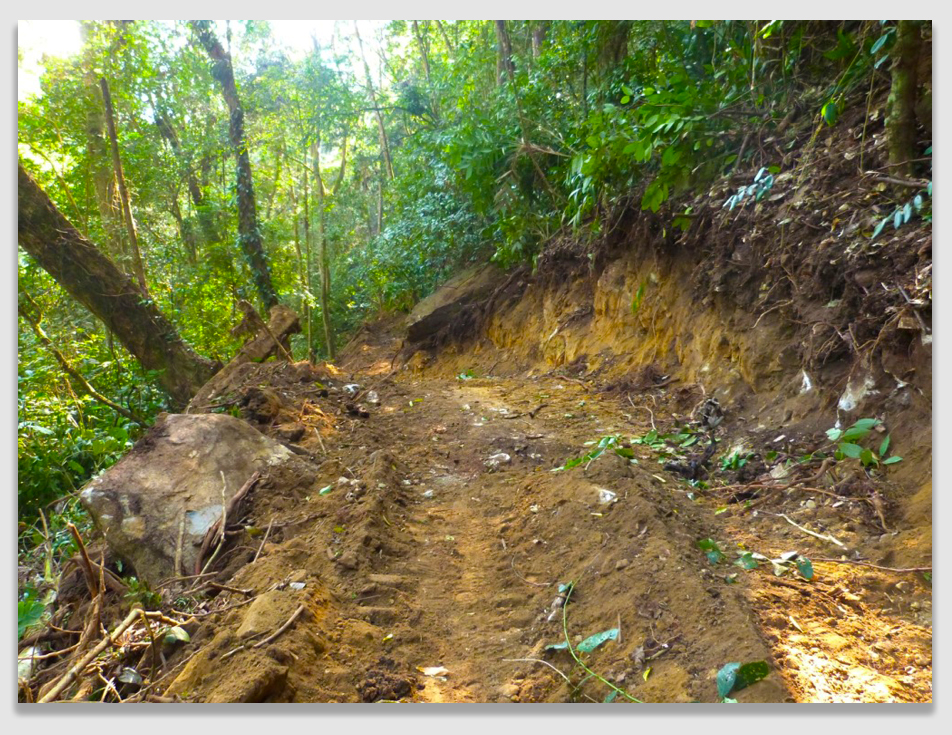 North v. Van Dyne, Case No. 16-0165 (Ct.App. Iowa, Sept. 13, 2017). Douglas Van Dyke hired Heck’s Dozer, Inc., to build a trail along a ravine between his property and adjacent land owned by Eunice North. Twenty of North’s trees were removed during the trail’s construction, and a portion of the completed trail encroached upon North’s property. Doug said Eunice gave him permission. Eunice said she initially sort of equivocated, but later told Doug in no uncertain terms that he was to stay off her land.
Doug said he would do so, but he never had the land surveyed or staked, and his guess as to the location of the property line was by guess and by gosh. Doug’s contractor said he met with Eunice, and she approved the plans. Eunice said she had never met the contractor.
 Eunice testified that after she told Doug to steer clear of her property, she heard a “‘loud commotion.’ Standing on her deck, she saw ‘two pieces of heavy equipment’ below and ‘trees… flying.’ She decided not to go into the ravine to check on the commotion because she was ‘afraid’ she would get ‘hit with something,’ and she had physical difficulties getting ‘down there.’ Suspicious of an encroachment on her land, she commissioned a survey. The surveyor confirmed her fears.”
Eunice sued Doug for trespass, loss of lateral support, and loss of trees. The jury awarded her damages of $50,000 on the trespass and lateral support claims and $20,100 in treble damages on the loss-of-tree claim, Doug appealed.
Held: Eunice amply proved that Doug should pay treble damages under Iowa Code § 658.4 (2013). The statute requires the damage to trees be committed willfully or without reasonable excuse.” The term “willfully” has been characterized as an intentional and deliberate act without regard to the rights of others. Here, the Court of Appeals said, a reasonable juror could have believed that Eunice said “no” the jurors could have found Van Dyke “acted… without reasonable excuse.”
The jury additionally could have found that Doug’s failure to commission a survey before building the trail denied him any reasonable excuse for the trespass. The testimony established that Doug relied on an “old fence,” “old posts,” a “shed,” and a “roofline” to gauge the boundary.
The measure of damages is the cost of repair, as long as that cost does not exceed the value of the property prior to the damage. Doug complained that because Eunice’s expert testified only that the continued deterioration of the property could be stopped by stabilizing the steep bank, she was not able to show that the property could be repaired to its original state.
 The Court of Appeals held that nothing requires that the repair estimate be enough to restore the land to its state before the damage. As long as Eunice provided evidence of the fair market value of the land before and after the damage, and a repair cost that is less than the value of the place before the damage – which she did – she met her obligation. Here, the damages awarded by the jury were higher than Doug’s estimate of $2,500.00 to fix it, but well below Eunice’s estimate of $127,000. Plus, the jury’s $50,000 award for trespass and lateral support was well below Eunice’s evidence that the land was worth $250,000.
The damage to the trees was assessed separately, with the value of the lost timber found to be $6,700, trebled to $20,100.
– Tom Root



 Tree and Neighbor Law For Homeowners and Professionals