Case of the Day – Thursday, October 9, 2025

ONE CROWDED HOUR

A British army officer and poet, Thomas Osbert Mordaunt, wrote in his poem, “The Call,” a line now misattributed to Sir Walter Scott: “One crowded hour of glorious life is worth an age without a name.”

It’s so much fun to be nasty. Even for just one glorious, crowded hour. It’s just not so much fun when the age without a name knocks on the door, seeking payment. Just ask John and Anne Estes.

Everything started when John and Anne tried to extend the Massachusetts Rule to cut some branches from their neighbors’ trees. The problem was that the trees and branches were both on the neighbors’ properties.

Then they built a fence. So far, so good, at least until the fence they built was on their neighbors’ property, too. The neighbors, Matt and Rachel Milcic, objected. After mediation, the Estes fence was removed.

Obviously, John and Anne were sore at having been upbraided for their brazen trespasses. So they rebuilt the fence, and on the Milcics’ side, painted in large block letters, “PULL YOUR WEEDS.”

“Hah!” You can imagine John and Anne giving each other high-fives at their in-your-face cattiness. They sure showed those jerk neighbors, who thought they were so cool that they could stop John and Anne from trespassing. Their snickers and winks lasted for one crowded hour of glorious fun.

Maybe the neighbors really did need to weed. It’s hard to say. Certainly, Matt Milcic did some landscaping in response to the fence. After he had done so, and after he asked John to remove the sign, John said he might. But petulantly, he did not.

Cute, John… at least until the Milcics sued. Then, John offered to paint out the words if the Milcics would drop the suit. But that horse had left the barn…

The Esteses’ conduct was brazen enough that the trial court granted the Milcics summary judgment. But then, the battle continued over damages. By the time the court was done, the Esteses’ cruel prank had cost them northward of $10,000.00. Not nearly what the Milcics wanted, the award nevertheless undoubtedly deterred the juvenile conduct.

You’d better find your checkbook, John. You and Anne enjoyed your crowded, glorious hour. The age without a name (but with a dollar sign) has now arrived.

Milcic v. Estes, 2018 Wash. App. LEXIS 1798 (Ct. App. Wash., Aug. 6, 2018). The Milcics and Estes are next-door neighbors. In 2013, the Estes cut branches off trees located on the Milcics’ property and began to build a fence along the parties’ common boundary.

When a dispute regarding fence encroachments arose, the parties submitted it to mediation. In April 2014, the parties executed a settlement agreement in which the Estes agreed, among other things, to remove both the excess dirt from the Milcics’ property and portions of fence footings that were visible above ground.

In July 2014, the Estes painted the words “PULL YOUR WEEDS!” in white, 10-inch block letters on the Milcics’ side of the Estes’ fence. The Milcics threatened a lawsuit unless the Esteses removed the sign. The words remained, and the Milcics sued.

The Milcics’ complaint alleged private nuisance, trespass, timber trespass, spite fence, quiet title and damages to land and property. Shortly after the Milcics filed, the Estes offered to remove the painted message if the Milcics dismissed their complaint. The Milcics rejected the offer, telling the Estes, “If you were willing to do so voluntarily… you could have removed the sign at any time for the past nine months.”

The Milcics moved for partial summary judgment, alleging there were no issues about the Estes’ branch cutting, fence encroachments, and dumping of fill dirt on the Milcics’ property. The trial court granted relief, including ordering the Estes to the fence encroachments. The court awarded the Milcics some but not all, of their requested damages, but denied them reimbursement of their legal fees.

The Milcics appealed the adverse ruling on damages and fees.

Held: The appeals court upheld the damage award, and sent the case back to the trial court for a legal fee award.

In January 2017, the matter proceeded to trial solely on the issues of damages and attorney fees and costs. Rachel Milcic testified that the Estes cut branches off their trees and put fill dirt on their property without their permission. She said the branch removal ruined the beauty and privacy of the Milcics’ property. The loss of the branches upset her and she did not sleep well. She also testified that the Milcics were not sure where the property line was when the branches were cut.

She also testified that she was “shocked,” “horrified,” and “scared” when the Estes painted the “PULL YOUR WEEDS!” message on the fence facing the Milcics’ property. She had trouble sleeping and no longer felt that she and her children were safe. She testified that before the painted message appeared, her family spent around 12 hours per week in her yard. After the message appeared, they spent less than an hour a week in the yard. She valued her use of the yard at $40 per day. She testified that the message was visible for 922 days.

Matt Milcic testified that after the painted sign on the fence, the Milcics installed a surveillance system to “protect our property” and to “capture any trespasses by the Esteses on our land.” Matt also testified that the fence message could be seen from roughly a quarter of their property and prevented the Milcics from enjoying their yard. Their dreams and aspirations for landscaping the yard “got instantly crushed into a reminder of, you don’t get to enjoy this part of your property that you had hopes and dreams for.” He estimated that the affected portion of his property had a market value of $152,500.

Matthew conceded that he had not seen a doctor or any medical professional for his emotional distress and had no medical bills related to that distress. Matthew also conceded that he did not accept the Estes’ April 2015 offer to remove the fence message.

John Estes testified that he painted the “PULL YOUR WEEDS!” message to protest the “weeds and invasive vegetation coming onto my property.” He conceded that Matt told him in August 2014 that he had pulled the weeds and that he wanted the message removed, but he did nothing for nine months, at which time John offered to remove the message if the Milcics dismissed the lawsuit.

The court ruled that the Milcics were entitled to some, but not all, of their alleged damages. It awarded them $3,557, which it trebled to $10,673. However, it denied damages for the installation of the surveillance system, for lost enjoyment of property, for emotional distress, and for legal fees.

On appeal, the Milcics argued the court erred in awarding no damages for their alleged lost enjoyment of their property on their trespass and private nuisance claims. They claim they were entitled to such damages due to the significant length of time — 922 days — that the fence message remained in place. But the Court of Appeals held that the trial court was free to discount or reject the Milcics’ testimony regarding their alleged lost enjoyment. “On this record, and in light of our deference to the trial court’s view of the weight and credibility of the evidence,” the Court held, “we cannot say the court abused its discretion in declining to award damages for the Milcics’ claimed lost enjoyment of their property.”

The Milcics also contended that the trial court abused its discretion in failing to award them damages for emotional distress caused by the Esteses’ fence message and branch cutting. A plaintiff who proves liability for intentional wrongful conduct is entitled to damages for emotional distress upon a showing of actual anguish or emotional distress. The distress need not be severe and a plaintiff “need not demonstrate objective symptomology, medical bills, or a medical diagnosis.”

Here, the trial court found the Esteses engaged in intentional wrongful conduct, including nuisance, timber trespass, and a spite fence. The trial court also found, however, that the Milcics “have not provided sufficient evidence to establish that they have suffered emotional distress.” The Milcics pointed to their testimony that they suffered initial shock and distress, trouble sleeping for a week, and ongoing feelings of insecurity and fear of further invasions. “But,” the Court of Appeals held, “the trial judge’s evaluation of the sufficiency of the evidence includes determinations as to the weight and credibility of the evidence – matters that require our deference.”

The Milcics also contended the trial court erred in concluding that the Estes’ conduct was not the legal cause of their purchase and installation of a surveillance system. To determine if legal causation exists, a court considers whether “‘as a matter of policy, the connection between the ultimate result and the act of the defendant is too remote or insubstantial to impose liability.” The Court said that the judge’s determination rests on ”mixed considerations of logic, common sense, justice, policy, and precedent.”

Here, the Court of Appeals ruled, “the Milcics offer no relevant precedent supporting their argument regarding legal causation. Nor do they advance any persuasive arguments supporting their claim that logic, common sense, justice, and policy favor the imposition of liability for the surveillance system. There was never any doubt as to who had trespassed onto the Milcics’ property. The Estes readily admitted cutting the branches, painting the message, and installing the fence. There was therefore no need for a surveillance system to catch the perpetrators, and no reason to believe that a surveillance system would act as a deterrent to future incursions. In addition, except for the branch cutting, the trespasses were de minimis incursions. Thus, the trial court did not err in concluding that the Estes’ conduct was not a legal cause of the Milcics’ surveillance system expenses.”

– Tom Root

TNLBGray140407

Case of the Day – Friday, September 12, 2025

SPITE FENCE TAFFY PULL

Trust an angry plaintiff and a clever lawyer to stretch a useful concept like “spite fence” – which we have been talking about the last few days – like a salt water taffy pull.

We have established that a spite fence requires unreasonable height and a malicious motive. We have also figured out that a spite fence can be something other than a fence, such as the Maine widow woman’s “spite trees.”

It was probably inevitable that someone would go after a neighbor for planting plants that may someday be too tall. Add a complaint that the neighbor refused to knuckle under when the plaintiff tried to boss him and her around regarding their landscaping, and, voilà, you have malice.

Just as the cops in Minority Report arrested people who would someday commit a crime (surely a useful idea), this theory holds people liable because their plantings might someday be a natural spite fence.

Fortunately, the Mississippi courts that heard this one all made short work of it.

Blackwell v. Lucas, 271 So. 3d 638 (Ct. App. Mississippi, Nov. 20, 2018): The Lucases planted some plants and shrubs in the front yard of their Ocean Springs, Mississippi, home. The Blackwells believed that if allowed to grow, the plants and shrubs would at some indeterminate time in the future block their view of the ocean, the sunsets and the beautiful areas normally and typically available to property owners in the Oak Bluff Subdivision.

Thus, the Blackwells asked the Lucases to remove the plants and shrubs or to retard their growth so that their view of the ocean and surrounding area would not be impaired. The Lucases, being your average, reasonable American homeowners, declined courteously.

Actually, it may not have been “courteously.” The Blackwells argued that the Lucases were being mean: “The shrubs and plants installed by Mr. & Mrs. Lucas have no beneficial use and were installed and maintained by them for the purpose of annoying the Blackwells and preventing them from enjoying their property.”

The Blackwells, also being your all-too-common American homeowners, sued the Lucases for planting shrubs that “will unreasonably block the view of the Blackwells.” The term “unreasonably,” in this case, apparently meant anything that might alter the status quo in any manner the Blackwells found objectionable: “The actions of Mr. & Mrs. Lucas,” the Blackwell’s complaint alleged, “amounts [sic] to and/or equates [sic] to an invasion of the Blackwells’ interest in the use and enjoyment of their land and the invasion is intentional and unreasonable or negligent.”

Strong words, indeed! But the trial court was unimpressed and tossed the suit out on its ear. Not taking the hint, the Blackwells appealed.

Held: The trial court’s dismissal was upheld.

The Blackwells had no common law or statutory right to an unobstructed view across the Lucases’ property, nor did they have a right to dictate the type or placement of the Lucases’ plants and shrubs. The Blackwell complaint failed to state a cause of action for a nuisance or to allege any present injury or an imminent threat of irreparable harm for which there was no adequate remedy at law.

The Court of Appeals observed that a cause of action arises out of a pre-existing primary legal right with which the law invests a person. The right to maintain an action depends upon the existence of a cause of action which involves a combination of a right on the part of the plaintiff and the violation of such right by the defendant. Thus, the existence of a legal right is an essential element of a cause of action, inasmuch as a plaintiff must recover on the strength of his own case instead of on the weakness of the defendant’s case. It is the plaintiff’s right, not the defendant’s wrongdoing, that is the basis of recovery.

That right or duty must be a legal right or duty, and not a mere moral obligation that is enforceable neither in law nor in equity.

Applying the general notion to this case, the Court of Appeals observed that property owners have a legal right to cut and remove any part of a plant or shrub that grows on or overhangs their property. They have a legal right to sue to abate a nuisance. But property owners have no legally cognizable right to a view across their neighbors’ property. Nor do they have a right to dictate the type or placement of the neighbors’ shrubs.

The shrubs were not a nuisance. The Lucases would be subject to liability for a private nuisance only if their conduct is a legal cause of an invasion of the Blackwells’ interest in the private use and enjoyment of land. Again, without a legal right to a view across the property, there simply is no such interest to be invaded.

But the Blackwells tried to bootstrap their claim into a “spite fence” argument. They argued that the plants and shrubs would someday obstruct their view, and this fact gave them a viable cause of action for a “spite fence” nuisance.

The Court of Appeals held that the Blackwells’ “spite fence” claim had no basis in Mississippi law. Because the one Mississippi case on “spite fences” was decided by an evenly divided Court, “there is still no precedent for such a claim under Mississippi law. Moreover, we decline to recognize a new cause of action for a “spite fence” in a case that does not even involve a fence,” but instead only “some unspecified ‘plants and shrubs’ that, “[i]f allowed to grow,” allegedly may obstruct the Blackwells’ view.

– Tom Root

TNLBGray140407

Case of the Day – Wednesday, September 10, 2025

A TALE OF TWO TALES

It is often tempting to consider only one side of a story. It makes for humor, it fuels rage, often it titillates. Indeed, it is the very basis of social media fury.

I remember the story about Dan Quayle lamenting that, “I regret I didn’t study Latin harder in school so I could converse with people in Latin America.” Great yarn, illustrating just how vapid and shallow the Vice President really was. The story became much less interesting when you heard the other side.

There was another side? Well, yes. During a speech in April 1989, Representative Claudine Schneider of Rhode Island told a gathering of Republicans that she had recently attended an event at the Belgian embassy, also attended by Vice-President Quayle. They spoke to each other, and the Veep complimented the Congresswoman on her command of French.

Then, Schneider told the group, the vice president said, “I was recently on a tour of Latin America, and the only regret I have was that I didn’t study Latin harder in school so I could converse with those people.” Ms. Schneider intended to make a joke, something she explained at the conclusion of her speech. Somehow, the media missed the disclaimer and presented her joke as fact.

Reading today’s case reminded me of the dangers of uncritical acceptance of one version of reality. The majority describes a mean old woman who was willing to go to great lengths to mete out woe to her nice neighbors. The dissent, on the other hand, tells about a nice widow woman who had lived in harmony with her neighbors for 40 years, until a pair of boorish neighbors upset the neighborhood, stole her property, denuded the landscape and let their dogs take dumps all over Patty’s yard. To protect herself, the widow tries to restore nature, only to be sued by the Philistines next door.

What is at once puzzling and disheartening is that the judges are reaching their conclusions from the same pool of evidence.

Tranfield v. Arcuni-English, 2019 ME 135 (Supreme Ct. of Maine, Aug. 15, 2019): A nasty neighbor, an old battleaxe octogenarian named Patricia Arcuni-English, took an immediate disliking to her new neighbors, the Tranfields. The day the Tranfields moved in, Richard knocked on Patty’s door, seeking to borrow a bit of firewood. She refused to open it. Richard took a few logs, intending to replace them later. Patty, watching from behind the curtains, saw him take the wood.

[We can stop the recitation of facts right there, as far as I’m concerned. We have a term for people who take the property of others without permission, even when they later claim that they had always intended to replace it at a later time. We call them “thieves.” Apparently, things are different in Maine. At any rate, imagine the gall of that old woman, disliking her new neighbors because she saw them stealing her wood!]

Of course, the real factual recitation does not end there. Instead, it continues…

Later, Richard was removing a tree near a shed on his property and limbing dead branches on his property along the property boundary line. Patty approached him, furious that he would dare to cut his trees without discussing it with his neighbors first. She threatened to install a 10-foot fence to block the Tranfields’ view of the ocean. At the same time, she chewed Richard out for the Tranfields having removed a koi pond on their property and for letting their dogs do their business in her yard.

Later, while Patty was traveling, a local landscaper who works for both parties sent Patty a photo of the parties’ boundary line. The Tranfields had cleared much of the deadwood and debris on their property, opening up a view of their house to Patty. She was devastated by the Tranfields’ having cleaned up their property and called the landscaper. She told him she needed trees and privacy, and they discussed how to do it.

A few months later, the landscaper planted 24 arborvitaes along the boundary line. The trees were 10-12 feet tall, with some shorter trees installed to create an additional row to fill in any gaps. The landscaper also installed seven 4-6’ tall pine trees near a structure on Patty’s property.

The Tranfields sued Patty, alleging that the plantings were nothing but a spite fence. They asked for damages and injunctive relief. The trial court found that Patty’s “dominant motive was to install a continuous green barrier between the two properties along the boundary line. The trees were installed without any advance notice to the Tranfields, along the portion of the boundary that would block their view and without considering other types of vegetation that could provide her privacy without blocking entirely the slot view that the Tranfields had or without totally closing in their back yard.”

The trial court thus concluded that the mean old lady had constructed a spite fence, albeit one made of trees. It ordered Patty to remove every other pine tree along the boundary line, remove the trees that were planted as an additional row to fill in gaps and trim all of the arborvitae to a height no greater than 10 feet. Additionally, the court prohibited her from replacing any of the arborvitae that might die off.

Patty appealed, and the case ended up before eight judges of the Maine Supreme Court.

Held: A seven-judge majority of the Court said Patty’s arborvitae had to go.

The Court cited 17 M.R.S. § 2801, which stated, “Any fence or other structure in the nature of a fence, unnecessarily exceeding 6 feet in height, maliciously kept and maintained for the purpose of annoying the owners or occupants of adjoining property, shall be deemed a private nuisance.” The Tranfields, as the plaintiffs, bore the burden of demonstrating each of these elements by a preponderance of the evidence. However, they did not have to prove that “malice, the purpose to annoy, was the sole motive for building the fence. The plaintiff needs only to prove that such was the dominant motive, meaning that without that malicious motive, the fence would not have been erected or maintained.”

The Maine Supreme Court held that the Tranfields met their burden. The finding of malice, the Court said, “is supported by the history of animosity between the parties,” the fact that Patty’s “claimed reason for building a fence was not credible,” the fact that Patty installed the fence without advance notice to the Tranfields, and “the size, extent, and anticipated growth of the trees.”

The Maine Supreme Court conceded that it did “not doubt that her privacy was part of her concern,” it determined that Arcuni-English’s motive was malicious and without that motive, she would not have installed the trees as she did, even to vindicate her privacy interest.”

Patty argued the court should not have assigned a malicious motive to her because she deferred to the landscaper on decisions about what to plant and where. The trial court disagreed, noting that its analysis of whether this was a spite fence was informed by the acrimonious encounters between the parties that had occurred before any decisions concerning what to plant were made. Finally, she argued that the court erred by finding that the height of the trees unnecessarily exceeded six feet because she presented the landscaper’s uncontradicted testimony that trees of this height were necessary to protect her privacy. Simply enough, the court refused to believe the landscaper, as it had the right to do.

At the start of the trial, the court visited the property to inspect the arborvitae in question. Thus, as the Maine Supreme Court put it, the trial court “was able to weigh the testimony it heard during the trial in light of the information it acquired during that view. As its judgment indicates, the court specifically considered the number and size of the plantings, as well as Patty’s malicious motive, in finding that the trees were “unnecessarily” taller than six feet.

Thus, the Supremes held, the trial court “did not err by determining that Patty’s installation of trees on the parties’ boundary line constituted a spite fence pursuant to § 2801 because her installation of more than thirty trees, which created a dense and continuous wall, was done with malice.”

But what if Patty wasn’t a nasty old woman? A dissenting judge took a decidedly different view of the evidence, finding that “from the time they moved onto their property, Richard Tranfield and Karla Doremus-Tranfield provoked, promoted, and continued an adverse relationship with their elderly neighbor, Patricia Arcuni-English… The trial court failed to sufficiently consider the role the Tranfields’ provocations played in Ms. Arcuni-English’s efforts to restore her privacy after the Tranfields had eliminated the privacy barrier between the two properties.” Further, “the trial court’s finding that Ms. Arcuni-English requested her landscaper to plant trees “to ensure her privacy” and did not tell him “to block their view,” is inconsistent with its finding that malice – a purpose to annoy-was the dominant motive in planting the trees at issue.”

The dissenting judge seemed to me to be right on point when he said Patty, “a woman in her eighties, lives alone in the Camden residence she has occupied for more than forty years.” The very day in January 2016 the Tranfields moved in, Patty returned home to find “Mr. Tranfield apparently stealing firewood from her home. The trial court found that the Tranfields “left a note on her door” indicating that they had taken the firewood. That finding has no support in the record evidence. In any event, a note, if there ever was one, would have done little to ameliorate the bad first impression already created. The Tranfields followed up the negative start to the neighborly relationship by releasing their dogs to urinate and defecate on Ms. Arcuni-English’s property. Then, without notifying Ms. Arcuni-English, they cut a couple of trees near her property.”

After Patty threatened to build a fence to block the Tranfields’ view of the ocean, while she was away from her residence, the Tranfields chopped down the barrier of greenery on their property that had provided privacy to Patty’s home for several decades. When Patty found out, she was “devastated.” So, as the dissent put it, “She called the landscaper and said, ‘I need trees’.”

The dissent complained that the trial court specifically found that Patty “never told [the landscaper] to block their view…” The landscaper “was her agent when he sent the photo to her of the trees cut down. She only said she needed trees and privacy and directed [the landscaper] to install trees but left to him decisions concerning what trees and where to place them to ensure her privacy.” Even the trial court found that it “does not doubt that her privacy was part of her concern.”

The dissent complained that the spite fence statute “does not appear to contemplate the situation, as occurred in this case, where the adversity in the relationship that the court found led to the planting of the trees was provoked, at least in part, by the hostile actions of the plaintiffs, and where the ‘fence or other structure’ only replaced a barrier that previously existed.

Additionally, the dissent wondered how the majority “could find malice the ‘dominant motive’ in planting the trees when it also found that ‘she never told [the landscaper] to block their view’ and ‘left to him decisions concerning what trees and where to plant them to ensure her privacy’.”

The question will remain rhetorical because the wood-taking Tranfields convinced a majority of the judges that Patty was a mean old woman and they were well-meaning, innocent neighbors.

– Tom Root

TNLBGray140407

Case of the Day – Monday, September 8, 2025

SPITE THROUGHOUT HISTORY

Last Friday, we looked at the problem with spite fences. Spite fences, we noted, are usually defined by statute. But not always.

In some places, a spite fence was defined the same way that Justice Potter Stewart defined pornography when he quipped in Jacobellis v. Ohio: “I shall not today attempt further to define the kinds of material I understand to be embraced within that shorthand description; and perhaps I could never succeed in intelligibly doing so. But I know it when I see it…”

In today’s case, the record seemed pretty clear that what the court was dealing with was a spite fence. There was animosity, an overly tall fence, and apparently no good reason why a rational homeowner would have built it.

Yup. A spite fence. The trial court knew it when it saw it, even without a statute defining it. The judge held it to be a spite fence.

But what to do about it? The only law on Montana’s books was from back in the day when men were men and women were afflicted. No, not 1991, but 1899. And that ruling held that a landowner could pretty much do whatever the tarnation he (and they were mostly “he” back then) wanted to do. The trial court had to rule that the spite-fencer could get away with it but urged the appeals court to rule the other way.

And rule the other way it did. With all of that clap-trap about whether the Supreme Court eviscerated the doctrine of stare decisis in order to reverse Roe v. Wade and the Chevron doctrine, this case demonstrates the obverse of the stare decisis debate: sometimes, a slavish adherence to the ways things have always been done is not all that it’s cracked up to be. Imagine if the Supremes had decided that Plessy v. Ferguson‘s “separate but equal” doctrine should control the outcome of Brown v. Board of Education

Haugen v. Kottas, 307 Mont. 301, 37 P.3d 672 (Supreme Ct. Mont, 2001). When his parents died, Bill became sole owner of the property. In 1999, he removed the chain link fence. Don was upset over the fence’s removal and wanted to build a replacement wall and have Bill pay for it. Bill refused, but he ordered a survey. The survey found that the chain-link fence had always been on Bill’s land. The survey also determined that Bill’s flagpole and several of his lawn sprinklers were located on Don’s property. What’s fair is fair: Bill removed those.

Don was not mollified. The next summer, he dredged his pond and moved it a few feet to the east. He then built a wooden fence about 200 feet long and 7 and a half feet tall. The back side of the wooden fence faces Bill’s property and obstructs his view to the east of Upper Spring Creek.

Now it was Bill who was unhappy. He sued, asking the court to issue an injunction ordering Don to tear down that wall, alleging that it was a spite fence. The trial court agreed that Don’s monstrosity was clearly a spite fence, but concluded that there was no remedy under Montana law for a spite fence, basing its decision on an 1899 Montana holding, Bordeaux v. Greene, that a person having a legal right to property can enforce the enjoyment of it without anyone being able to question his motive. The trial judge did not much like having to reach that conclusion, and asked “the appellate court to revisit Bordeaux in light of the significant changes in property law made during the past 100 years.”

Bill appealed.

Held: Bordeaux was yesterday’s news, and was overruled. Don’s spite fence had to go.

Bill argued that this Court should overrule Bordeaux based on the many changes that have occurred in property law since 1899, citing an Idaho holding that a property owner cannot erect a structure for the sole purpose of injuring his neighbor. The Supreme Court of Montana agreed, holding that Bordeaux no longer expressed the modern approach to property rights. Under that modern approach, the Idaho Supreme Court case held in the 1973 case of Sundowner, Inc. v. King, “one may not erect a structure for the sole purpose of annoying his neighbor. Many courts hold that a spite fence which serves no useful purpose may give rise to an action for both injunctive relief and damages… No man has a legal right to make a malicious use of his property, not for any benefit or advantage to himself, but for the avowed purpose of damaging his neighbor.”

The Court agreed with the Idaho Supreme Court’s analysis in Sundowner. The Court ruled, “We hold that no property owner has the right to erect and maintain an otherwise useless structure for the sole purpose of injuring his neighbor. We further hold that such an action will give rise to an action for both injunctive relief and damages.”

Don argued that Bill chose the wrong remedy by not stating a claim for nuisance. The Court rejected that claim. “Nuisance,” the Court said, “includes all wrongs which have interfered with the rights of a citizen in the enjoyment of property… A spite fence is defined as one which is of no beneficial use or pleasure to the owner but was erected and is maintained for the purpose of annoying a neighbor… Many courts characterize a spite fence as a nuisance. Although Bill could have filed a nuisance claim, he was not required to.”

– Tom Root

TNLBGray140407

Case of the Day – Friday, September 5, 2025

DESPITE THE SPITE, IT’S THE WRONG HEIGHT

Over the next few days (with time off for the weekend), we’re going to talk about “spite fences,” structures one neighbor erects because he or she does not like the other neighbor. Often creative, always ugly, spite fences are traditionally not prohibited by common law (the court-made rules of conduct that have evolved over the centuries). For that reason, just about all states have statutes that address the problem.

The law in the 49 common-law states (sorry, Louisiana, not you) disfavors statutes that are contrary to common law. Anyone who has ever watched a state legislature in action may understand the origin of this common-sense presumption. Flowing from the presumption is the general rule that when a statute is contrary to common law, it must be interpreted strictly and literally.

In today’s case, one neighbor accuses another of anti-Semitism, general nastiness, and such animus that the neighbors have teamed up with the homeowners’ association to run the plaintiff neighbor out of town. No one knows whether the plaintiff’s neighbor’s allegations are correct: in fact, if seven decades have taught me anything, it has taught me to look very skeptically at such broad-brush allegations. Usually, the more outrageous the alleged conduct, the less credible the allegation.

At this point in the lawsuit, the Court assumes that the plaintiffs’ allegations are entirely correct and provable. It asks, in deciding the defendants’ motions to dismiss, whether the complaints, if true, state a claim that would justify granting the plaintiffs the relief they seek.

Here, most of the plaintiffs’ complaints didn’t hold water. We’re going to focus on only one of those beefs, the count on spite fences.

Small v. Anchorage Homeowners Ass’n, LLC, Case No. 1:18-cv-01605 (S.D.Ind. March 21, 2019), 2019 U.S. Dist. LEXIS 47842; 2019 WL 1317636. Art and Lynette Small bought a condo in a development overseen by the Anchorage Homeowners Association. They bought the condo through a limited liability company they had set up, Executives LLC. Their neighbors were Trudy and Brad Johnson.

The Smalls’ overarching complaint was that Trudy and Brad embarked on a campaign to force the Smalls out because the Johnsons thought (1) the Smalls were Jewish; and (2) the Smalls were renters, not owners. It must be a doozy of a complaint, alleging as it does all manner of slights, humiliations and vigilantism, all intended to run the Smalls out of the development. But the count we’re focusing on today is the allegation that the Johnsons erected a “spite fence.”

The Smalls sued the Johnsons and the Homeowners Association in federal court, alleging a number of federal claims. In such a case, under what is known as “pendant jurisdiction,” a federal court may also hear state claims arising from the same facts. One such state claim brought by the Smalls was that in May 2016, Trudy accused Art “of being a racist, of engaging in Fair Housing Act violations, and repeatedly called him an extremely offensive anti-Semitic slur” – specifically, “Jew Face” – in front of his friends and potential clients. A few days later, the Smalls alleged, the Johnsons installed a “large wooden wall” which obstructed the Smalls’ view and interfered with their enjoyment of their property. The Smalls claimed the Homeowners Association approved the wall despite the fact that it did not comply with the Homeowners Association and Hamilton County restrictions.

The Johnsons and the Homeowners Association both moved to dismiss the count.

Held: The claim that the Johnsons built a “spite fence” was dismissed.

Under Indiana Code 32-26-10-1 – the state’s “spite fence” provision – a “structure in the nature of a fence unnecessarily exceeding six (6) feet in height, maliciously: (1) erected; or (2) maintained; for the purpose of annoying the owners or occupants of adjoining property, is considered a nuisance.” An owner or occupant who is injured in their comfort or enjoyment of their property that adjoins such nuisance may bring an action for: “(1) damages in compensation for the nuisance; (2) the abatement of the nuisance; and (3) all other remedies for the prevention of a nuisance.” Indiana Code 32-26-10-2.

Common law recognizes no such right, and thus, the statute, which is “in derogation of the common law… [must] be strictly construed.” If the fence in question does not meet the strict requirements of the statute, the Court held, it is merely subject to the common law of nuisance, under which a fence is only a nuisance if it encroaches on the adjoining landowner’s property.

The necessary elements of a claim under the spite fence statute are that: 1) the fence must exceed six feet, 2) the excessive height must be unnecessary, and 3) the fence must have been maliciously erected to annoy adjoining property owners or occupants. No matter how malicious or excessive a fence is, the Court said, it does not violate the statute if it is six feet or less in height. On the other hand, a maliciously erected fence that is more than six feet tall is not cured by a local permit because state law trumps municipal ordinances and regulations.

Here, the Court ruled, the Smalls’ complaint is facially deficient because it fails to allege the wall exceeds six feet. In fact, the complaint does not include any height allegation, only that the wall comes to roughly 13 feet from the Smalls’ front porch.

“Thus,” the Court held, “the allegations fail to meet the statutory height requirement or the encroachment requirement of common law nuisance. For this reason, [the Smalls’] claim is dismissed.”

– Tom Root

TNLBGray140407

Case of the Day – Wednesday, August 13, 2025

PEOPLE BEHAVING VERY BADLY

The late Jeffrey Epstein, Ye, Vladimir Putin, Yahya Sinwar, George Santos, Robert Menendez, even President Trump (whose increasingly shrill insults blast people who are (or were) supporters)… we’ve had a belly full of people behaving badly irecently.

Like we need this, here are a few more:

Welcome to the neighborhood ...

Welcome to the neighborhood …

Meet the Cooleys, neighbors who were so bad as to drive the Court to write a plaintive plea that everyone should try to get along. How bad, you ask? Well, Mrs. Cooley tried to run down her neighbor with her car. She built a chicken-wire spite fence. Her son threatened to beat up his elderly neighbor (who had just had a heart transplant). Yes, that bad…

This case is one of those rare fact-driven trial court decisions worth reading just to get the flavor of the Court’s incredulity that people could carry on like this. At one point, the judge observes that “[o]ne could almost use that well-worn lawyer’s expression ‘I rest my case’ after merely viewing Mrs. Cooley’s Exhibit 12, which in gruesome detail sets out the ‘this is my property’ syndrome.” The court finally issues a 15-point injunction ordering the Cooleys to stop doing 12 acts of malice, and the Quarantas to refrain from three others. It found application for a seldom-used Connecticut statute prohibiting structures built out of malice, banning a chicken-wire monstrosity erected by the Cooleys as a “spite fence.” Finally, it found the often-alleged but seldom-proven “intentional infliction of emotional distress” tort to have been shown here and ordered the Cooleys to pay the Quarantas’ legal fees.

At the end of its opinion, the Court ordered each party to read his final words out loud. Those were a plea by the Court for these people to rewind the clock to the beginning and try to get along. The Court’s frustration and sense that no matter what the law said, nothing would stop the bickering, is evident in the opinion. Not great moments in the development of the law … just a neighbor law tale worth reading.

There was even a

There was even a “spite fence” in the story …

Quaranta v. Cooley, 2007 Conn. Super. LEXIS 3199, 2007 WL 4577942 (Conn.Super. 2007). People behaving very badly. You know how the opinion’s going to go when the Court begins by quoting an old Supreme Court opinion that “… it is the bickerings, spite, and hatred arising from neighborhood quarrels; it is difficult for any legislation to remedy such evil.”

The Quarantas were senior citizens who had lived in the same home for 26 years. Mr. Quaranta was on a life support system and eventually had a heart transplant. The Cooleys were younger than the Quarantas, but had a 25-year-old son and health considerations of their own. When the original landowner subdivided his property into the lots which became the homes of the Cooleys and Quarantas, there was an existing paved driveway to the Quarantas’ home from the street, bordered with a split rail fence and a grassy area on each side. The landowner created by deed two 25’ easement roads (for a total width of 50 feet) over the same area on which his driveway existed. Each lot owned 25’ of the road, and each owner had the right to pass over the 25 feet owned by the other. The practical effect of these easements is to allow all three parcels of land to share access to the public street with one common driveway. Although the neighbors couldn’t see each others’ homes, they ended up in a continuing vitriolic spat in which each side accused the other of using the “F” word, raising the middle finger on numerous occasions, and other immature and harassing behavior, such as the noisy racing of vehicles, the blowing of car horns and trash placement fights.

ass150721The Court held that the Cooleys, who were New York City dwellers unused to suburban life, utterly lacked credibility on the stand. It found that the battle began with Mrs. Cooley delivering a letter to the Quarantas within 30 days of her having moved in, in which she told them their lampposts and driveway sat on the Cooley property. Then, the Cooley son began throwing keg parties at the Cooley home, with noisy partygoers parking all along the right-of-way. The parties were noisy and annoying, and afterward, the Quarantas found themselves cleaning up empty bottles and cigarette butts. The parties were held about four times a month. The Quarantas complained without effect. The grand finale was the Cooley Halloween Party in 2005. When Mrs. Quaranta went out in her nightgown to ask for peace and quiet, the partygoers cursed her – one exposing himself to her – and urinated toward her. After this, Mrs. Cooley and her daughter, took to riding at high speed over the grassy area, even leaving deep tire tracks. Although the Cooleys’ trash pickup was on Friday, they would put their trash out all week long, at a spot where it was viewable only from the Quarantas property. Animals got to the trash during the week, and the Quarantas did the cleanup. Mrs. Cooley would drive fast down the mutual passage raising dust and her middle finger while blowing her horn the entire distance. She overdosed her own lawn with weedkiller, killing all of the grass ostensibly so she wouldn’t have to mow. Her lawn, of course, fronted on the Quarantas’ lush and meticulous yard.

badneighbora140204There were countless verbal confrontations as well. The Cooley son yelled at Mr. Quaranta, a man past 65 with a heart transplant, “Hit me! I’ll wipe the ground up with you.” Previously, another judge had ordered the parties to refrain from intimidating, threatening, harassing, stalking, assaulting, or attacking each other, and to refrain from entering the property of the other, until the dispute was tried and resolved on the merits. After that, the Cooleys built an ugly chicken wire fence on the side of the passage that fronts the Quarantas’ house only. The trial court was called upon to mediate the dispute.

Held: The Court found for the plaintiffs, the Quarantas. It held that Mrs. Cooley’s testimony was so bad that it noted that “[o]ne could almost use that well-worn lawyer’s expression ‘I rest my case’ after merely viewing Mrs. Cooley’s Exhibit 12, which in gruesome detail sets out the “this is my property” syndrome. The court found it unsurprising that she took an axe to – and threatened to destroy – anything, even things of beauty, found on her property. These items included a lamppost, (that provided her light with the Quarantas paying for the electricity), fences (that enhanced the entrance to both their properties), a beautiful birch tree (with no professional evidence that it had to be cut down), a ceramic nameplate, (which her son admitted smashing) and even shrubbery. “Such warmth!” the Court said. “And it shows in the fifty-plus exhibits.”

The Court held that the chicken wire fence was maliciously erected, based on its character, its location, and the obvious state of mind and motive of the defendant. It ordered the fence removal pursuant to §52-480 of the Connecticut Statutes. It found that the Cooleys had exceeded the use of the right of way in a vindictive and malicious manner so as to harm the Quarantas, rather than just for ingress and egress. It held that a number of the Cooleys’ activities on this simple right-of-way were, “in layman’s terms, ludicrous, and in legal terms harmful, unnecessary, illegal and unreasonable.” It issued a detailed injunction spelling out 12 acts in which the Cooleys were not to engage, and 3 acts in which the Quarantas were not to engage.

A happy ending? Not with these folks ...

A happy ending? Not with these folks …

Based upon the totality of the evidence, the Court held that the Cooleys directly and indirectly negligently and intentionally caused severe emotional distress to the Quarantas, and knew or should have known that their acts would result in severe emotional distress to the plaintiffs. In the case of Mr. Quaranta, the distress was found to be life-threatening. The Cooleys evidenced a reckless indifference to the Quarantas’ rights and showed an intentional and wanton violation of these rights. The injury was inflicted maliciously, with evil motive and violence. The Court awarded the Quarantas their legal fees as damages.

The Court took the unusual step of ordering a final statement to be personally read by the parties. It begged both parties to “go back to the day the Cooleys moved in and put everything back the way it was. Let us dig a hole and bury all of the ill feelings and hatreds that are all consuming.” The Court, writing this on Thanksgiving Eve, ended by noting that “[t]he person whom many people honor in this Holiday Season forgave everyone. Isn’t it time that the Quarantas and the Cooleys caught the spirit of the Season?”

Postscript: They did not. Rather, they were back in court repeatedly between 2007 and 2013, arguing over contempt motions filed against each other. Oh, the humanity …

– Tom Root

TNLBGray140407

Case of the Day – Thursday, April 17, 2025

THEY’RE BA-A-A-ACK!

Yesterday, we reported on the 2008 Gertz v. Estes decision, in which the Gertzes were told to remove their 8-foot-tall “spite fence.” Why anyone thought that people who (a) built nail-studded fences; (b) peered at their neighbors with an array of surveillance cameras that the NSA would covet, or (c) heckled the Estes family with a PA system, would be impressed with a court order is a good question. After all, more august people than the Gertzes seem these days to be unimpressed with judicial authority.

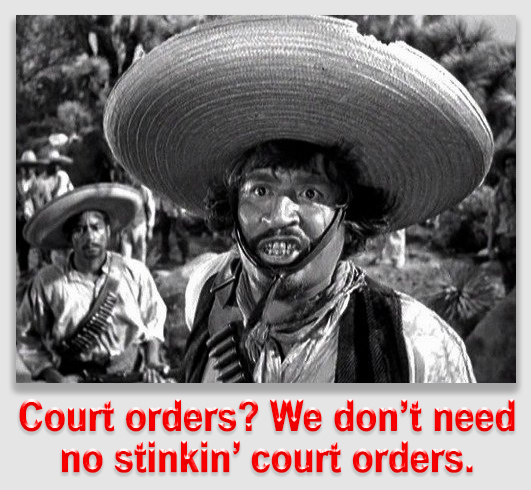
You can just hear the Gertzes, their dismissal of legal process amplified by loudspeakers: “Court order? We don’t need no stinkin’ court order.”

A “spite fence,” after all, isn’t something that one constructs accidentally, or even negligently. Why the Gertzes should be expected to pay attention to some old fool in a black robe …

Hadrian's Wall - Did the Picts think it was a "spite fence?"

Hadrian’s Wall – Did the Picts think it was a “spite fence?

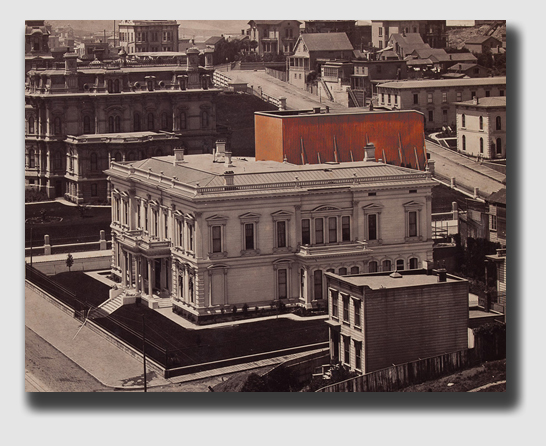
Ever since the first recorded “spite fence” – not including Hadrian’s Wallwas first used by San Francisco millionaire Charles Crocker to try to force a neighbor to sell his property for the construction of the Crocker Mansion – “spite fences” have required intent.

You have to intend to harass a neighbor with the fence. And if you set out to harass and oppress, it’s not terribly likely that you’re going to be brought up short by some man or woman in a fancy black robe.

Charlie Crocker's fence (highlighted in orange) - definitely a "spite fence."

Charlie Crocker’s fence (highlighted in orange) – definitely a “spite fence.”

The Gertzes ignored the 2008 court order until the Estes family dragged them back into court. That was when the Gertzes suddenly announced that they had lopped off the top two feet of the fence. Now it was only six feet tall, studded with nails and festooned with more surveillance devices than a Uighur family reunion. “Gee,” the Gertzes told the trial court, “now it’s under seven feet – guess it’s not a ‘spite fence’ anymore.”

The Court did what courts do – used procedural rulings to achieve substantive ends. The Court ruled that the Gertzes were trying an “end run” on the prior decision, when they should have raised the reduced height on appeal. Thus, the Gertz motion was thrown out. The Court made clear that the Gertzes’ real problem was that they hadn’t read the 2008 order carefully: it wasn’t the height of the fence alone, it was the intent and the ugliness that made it a “spite fence.” It was still a “spite fence,” albeit a shorter one. The fence still had to go.

Gertz v. Estes, 922 N.E.2d 135 (Ind.App. 2010). The unsavory neighbor Gertzes had been told to take down the “spite fence” which separated their home from the Estes property. The fence was a doozy, too – while the Gertzes had gotten permission from the town to build a 7-foot tall fence, they had put up an 8-foot fence just a few inches from the property line, studded it with thousands of nails protruding on the Estes side, painted “no trespassing” and “do not climb” notices all over the fence, and equipped the structure with surveillance cameras. There was a PA system, too, which the Gertzes used to make disparaging comments to and about the Estes family on various occasions.

The Berlin Wall - President Reagan could have said, "Mr. Gorbachev - tear down this 'spite fence'!"

The Berlin Wall – President Reagan could have said, “Mr. Gorbachev – tear down this ‘spite fence’!”

After a bench trial, the trial court found that the “fence was maliciously erected and now maintained for the purpose of annoying the Estes family” based upon the “course of conduct exhibited by Gertze [sic] toward Estes.” Holding that the fence was thus a nuisance, the court ordered the Gertzes to remove it. For good measure, the judge found that the “surveillance of the Estes property and the use of a loudspeaker to harass and annoy Estes constitute[d] an invasion of privacy” and said that all had to go, too.

The Gertzes appealed the trial court’s order, arguing that: (1) the trial court erred by applying the “spite fence” statute to them because they had obtained a local permit for the fence; and (2) the trial court erred by finding that the fence was unnecessary and that the public address system was used to make disparaging comments about the Estes family. The trial court was upheld in Gertz v. Estes, 879 N.E.2d 617 (Ind.Ct.App.2008), and the Indiana Supreme Court denied further review.

On September 12, 2008, the Esteses filed a petition for rule to show cause. The Esteses alleged that the Gertzes had failed to remove the fence, cameras, or public address system and had continued to harass and threaten them. The Gertzes answered by asking the trial court to let them remove the top one foot of the fence rather than the entire fence. The Gertzes said they had already removed the top two feet of the fence, so it was no longer a “spite fence.”

The trial court found that cutting a foot off the top of the fence didn’t comply with the prior order, because the fence’s height was only one of the factors making it a spite fence. The trial court concluded that the “fence is, and remains, a nuisance.” The Gertses appealed.

Held: The Gertzes’ reduction of the fence’s height didn’t matter: the fence had to go. The Court noted that Indiana Code Section 32-26-10-1, which governs ”spite fences,” provides: “A structure in the nature of a fence unnecessarily exceeding six (6) feet in height, maliciously: (1) erected; or (2) maintained; for the purpose of annoying the owners or occupants of adjoining property, is considered a nuisance.”

The Court held that the Gertzes were just asking for a mulligan. Their petition was really just a motion for relief from the 2008 judgment under Indiana Trial Rule 60(B), and that rule won’t serve as a substitute for a direct appeal. The Gertzes filed a direct appeal of the trial court’s order requiring them to remove the fence. Although the trial court’s remedy of removal of the fence was an issue available to them, they did not raise any argument on appeal about keeping the fence if they only reduced the height.

What’s more, the trial judge’s order that they remove the fence was not based solely upon the height, but instead on a variety of factors. The appellate court held that the Gertzes showed nothing justifying the extraordinary remedy of modification of the trial court’s judgment.

Meanwhile, the Estes, who had had enough of the expensive litigation, argued that they were entitled to appellate attorney fees because the Gertzes’ appeal was meritless. The court was hesitant to award such fees where the appeal was not “utterly devoid of all plausibility.” The Court said that although “the Gertzes’ brief fails to fully comply with the Appellate Rules and that their argument on appeal fails, we cannot say that their arguments were ‘utterly devoid of all plausibility’.” It refused to order the Gertzes to pay the Esteses’ fees, but cautioned “the Gertzes that future court filings against the Estes family could be considered harassment and result in various sanctions, including but not limited to an award of attorney fees.” The Court “encourage[d] the Gertzes to fully comply with the trial court’s order and protective orders.”

Good luck with that.

– Tom Root

TNLBGray140407