Case of the Day – Thursday, July 10, 2025

ZOOM, ZOOM, DING

An alert reader sent us a link to an old sports car forum recently in which the proud owner of a Mazda RX-8 bemoaned the fact that his car had been hit by a limb that fell from his landlord’s tree. The owner wondered whether his landlord was liable for the deductible on his insurance. The post may be old, but the question is timeless.

Collisions with trees can be harrowing, whether in a care or on a bicycle.

Collisions with trees can be harrowing, whether in a car or on even just riding a bicycle.

Good question! Because the RX-8 and the tree are both from South Carolina, we looked first at Staples v. Duell. In that case, Ms. Staples was driving down a rural road when she came upon one of Mr. Duell’s trees, which had fallen across the road. She came upon it rather suddenly, because she collided with it. She sued Mr. Duell, who was a landowner of some magnitude (about two miles worth of real estate along each side of the road).

Mr. Duell had an employee who was assigned the task of checking the security of the estate, including looking for dead trees, on a daily basis. Somehow, he must have missed this 100-foot pine’s condition. Ms. Staples sued Mr. Duell for negligence.

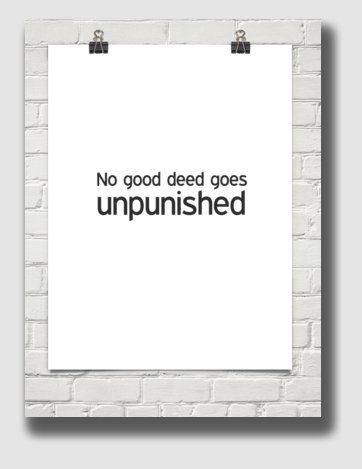
The Court found for Mr. Duell. It held that in South Carolina, rural landowners have no duty to others to inspect and improve their land. The fact that Mr. Duell voluntarily did so by sending an employee around didn’t create a duty where none existed. And that makes sense: if voluntarily performing a good deed created a legal duty to perform such deeds, no one would ever perform a good deed, that is, to go beyond the minimum the law requires for fear they would become liable for a good deed.

This doesn’t exactly answer our driver’s lament. After all, the landlord may be an urban landowner, and the Court suggests that an urban owner’s duty is different. Also, as a landlord, the tree owner’s duty may be greater. We’ll consider that tomorrow.

Meanwhile, good news from the Mazda front… the hapless sports car owner later reported that his landlord’s insurance covered his deductible.
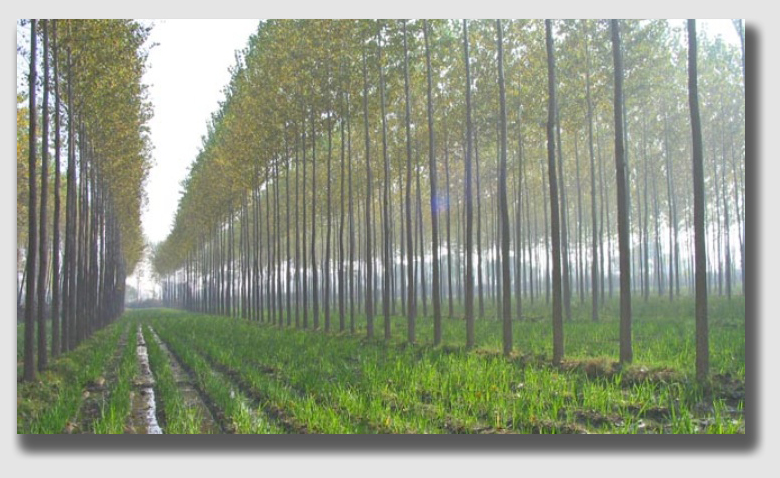
Mr. Duell owned a lot of trees ...

Mr. Duell owned a lot of trees …

Staples v. Duell, 329 S.C. 503, 494 S.E.2d 639 (S.Ct. S.C. 1997). Ms. Staples was driving from Charleston toward Summerville on Highway 61 when she encountered a dead pine tree in the road. She swerved but collided with the tree, a 100-foot long-dead pine.

The tree fell about sixty feet from the roadway and was located on Mr. Duell’s land, a plantation that stretched for about two miles along both sides of the road. In this area, only one residence – a cabin – stood. About 13,500 vehicles a day passed by Duell’s two-mile stretch of land on Highway 61. Duell owned Middleton Place National Historic Landmark, a tourist attraction that received about 100,000 admission-paying visitors a year. The only public entrance or exit to Middleton Place is on Highway 61. Duell maintained a 250-foot buffer zone of trees on both sides of the highway to protect the scenic beauty of the road. Duell’s employee, James Woddle, took care of the woodlands at Middleton Place. Woddle’s job duties included twice a day driving around the perimeter of Middleton Place to inspect the premises. During his inspections, he looked for trespassers, abandoned vehicles, and dead trees.

Staples sued Duell for negligence in permitting the tree to become a hazard. The trial court directed a verdict for Duell, holding that because the land from which the tree fell was rural, he had no common-law duty to discover and prevent the dangerous condition caused by the dead pine tree. Even if Duell had a policy of searching for dead trees along the roadway, his voluntary practice did not create a duty. Duell could have abandoned it at any time and it did not increase the risk.

Staples appealed.
gooddeed140925Held: The Court found for Mr. Duell. To prevail on her theory of negligence, Ms. Staples had to establish that (1) Duell owed her a duty of care, (2) that by some act or omission, he had breached that duty, and (3) that as the proximate result of his breach, she had been injured. The Court ruled that as an owner of rural property adjacent to a highway, Duell did not owe a duty of care to motorists on the highway to inspect and improve his land. Rural landowners have different duties and responsibilities from city dwellers, the Court said, based on the different levels of risk posed by defects on rural land and the burden of maintaining larger tracts of real estate. Thus, unlike urban landowners, rural landowners do not have a duty to inspect and improve the land.

Mr. Duell’s policy of searching for dead trees on his property was good stewardship, but it did not result in his assuming a duty to motorists for injuries resulting from trees falling onto the road. His policy of examining his trees didn’t increase the risk of harm to motorists. The people driving by had no prior knowledge of the policy and thus did not detrimentally rely on it. This of course makes one wonder – if people did rely on Mr. Duell’s perspicacity and gumption, would the Court have turned his voluntary good deed into a duty? A scary thought…

– Tom Root

TNLBGray140407

Case of the Day – Monday, July 7, 2025

NOW LOOK WHAT YOU’VE DONE!

Rarely (as in “I don’t recall when I’ve ever said this before”) do I caution that the prevailing law in any particular state is wrong, and likely to be cruisin’ for a bruisin’ the next time an appellate court has to think about it. But I feel comfortable issuing that warning about today’s case.

From Ohio (home of rock ‘n roll, pro football, the first guy to walk on the moon, the brothers who turned a bicycle into the first airplane, and a ton of other cool things), comes a case that pretty much runs smack into Fancher, Herring, the Hawaii Rule, and a raft of other cases reflecting the modern view that a homeowner whose tree is wreaking havoc on the neighbor’s property may be ordered by a court to fix the damage at his expense.

To be fair, this case may be proof of the old legal aphorism that “hard cases make bad law.” Even the most cursory reading of the facts suggests that Dave Rababy may well have been a horse’s ass, hounding his neighbor because a tree dropped leaves and twigs on his property. Speaking as a guy who owns all of my five southern neighbors’ leaves every fall – and these things are the size of dinner plates – I understand how it can be irritating to have other peoples’ leave on your lawn. But I would never sue them over it. I don’t think I would…

Dave had no such compunction, and his emesis of woe delivered to the court made him the boy who cried wolf. He howled so loudly about leaves and twigs and the fact that his trimming crew was not allowed to trespass on Roy’s property and hack away at the offending tree, and minutiae of a similar nature, that his real complaint – his driveway was being heaved and foundations dislodged by the roots – got lost in the underbrush. In Fancher, Whitesell, and even Iny, such damage was enough to get the neighbor’s tree declared a nuisance. If Dave had exercised a little plaintiff self-control, he might have gotten there, too.

We are too urban and too suburban, and our properties are too developed for the Massachusetts Rule to be the exclusive remedy for genuine harm done by a neighbor’s tree. That is the way the law is trending throughout the civilized world, and it is bound to reach Ohio sooner or later.

Rababy v. Metter, 30 N.E.3d 1018 (Ct. App. Cuyahoga Co., 2015). David Rababy and Roy Metter were next-door neighbors. Dave’s driveway abutted Roy’s property in certain places and nearly abuts in others. A fence separated the properties, and a stand of mature trees ran along the fence on Roy’s side of the boundary line.

Dave sued Roy for negligence, nuisance, trespass, and interference with a business contract. Dave asserted that trees at the edge of Roy’s property extended over his own property, and dropped leaves, needles, sap, and branches onto his car and home. Some of the trees, Dave complained, were rotten. He whined that the trees cast shadows over his property and cause mold growth on his roof, as well as damaged his driveway and foundation.

Dave groused that he had hired a company to trim the overhanging branches, but Roy’s daughter prevented the unnamed landscape service company from properly performing this work. The complaint alleged the trees constituted an ongoing nuisance and trespass, and that Roy negligently maintained the trees. Dave asked for $52,500: $37,000 for future tree trimming services and $15,000 in compensatory damages.

Both parties filed motions for summary judgment. Dave argued that on “an ongoing basis, Roy’s trees encroach onto my property, specifically over my home and driveway. His trees deposit leaves, debris, and sap onto my property, causing damage.” Dave also repeated the claim about Roy’s daughter running off the tree trimmers.

Roy argued that he owed no duty to Dave to trim otherwise healthy trees on his property. He claimed the trees were mature and preexisted either party’s ownership of the property. He said that a year before, Dave hired Cartwright Tree Service to trim the row of pine trees that ran along the driveway. He said no one complained when Cartwright trimmed the overhanging branches from Dave’s property free, but when Cartwright began trimming branches and trees back further than the property line, Roy’s daughter objected. Roy said that he has no objection to Dave trimming the overhanging branches back to the property line.

Dave replied with new allegations that the trees in question were decaying or dead. Attached to the reply was a new affidavit that averred that the trees were decaying and dangerous and that one had fallen on his property. He included a picture of a tree that appears to have fallen across a driveway. However, the affidavit was neither signed nor notarized.

The trial court granted Roy’s motion for summary judgment and denied Dave’s. Dave appealed.

Gen. Robert E. Lee – a man recently consigned to the ash heap of history – knew something about duty … and even he couldn’t have found that Roy owed one to Dave.

Held: Roy owed Dave no duty, so the trial court’s dismissal of the case was upheld.

In order to succeed in a negligence action, the Court said, Dave must demonstrate that Roy owed him a duty, that Roy breached the duty, and that he suffered damages that proximately resulted from Roy’s breach. Here, Dave offered evidence that falling pine needles, leaves, sap, and sticks have damaged his car, driveway, and roof. He also alleges, without evidentiary support, that encroaching tree roots damaged his driveway and home.

While he showed damage, Dave was unable to show that Roy owed him any duty. A landowner is generally not responsible for the losses caused by the natural condition of the land. Instead, the Court observed, states generally allow one impacted by such growth the remedy of self-help. A privilege existed at common law, such that a landowner could cut off, sever, destroy, mutilate, or otherwise eliminate branches of an adjoining landowner’s tree that encroached on his land. But, the Court said, whether a separate remedy exists is an open question.

The Massachusetts Rule provides that in almost all circumstances, the sole remedy for damages resulting from the natural dropping of leaves and other ordinary debris from trees is the common law remedy of self-help. The rule does provide a limited exception for dead trees, just as Ohio has established a duty for urban landowners of reasonable care relative to the tree [hat overhangs a public street, including inspection to make sure that it is safe.” Where constructive or actual knowledge of an unreasonably dangerous condition exists on the land of an urban landowner, such as a dead tree, the duty prong of a negligence claim may be satisfied.

The reasoning set forth in support of the Massachusetts Rule, the Court said, is apt to the facts of this case: “[T]o grant a landowner a cause of action every time tree branches, leaves, vines, shrubs, etc., encroach upon or fall on his property from his neighbor’s property, might well spawn innumerable and vexatious lawsuits.” The Court thus adopted the Massachusetts Rule as the law of this jurisdiction.

But Dave also argued that in Ohio a “landowner in an urban area has a duty to exercise reasonable care to prevent an unreasonable risk of harm to others from decaying, defective or unsound trees of which such landowner has actual or constructive notice.” Dave contended Roy’s trees were in such a defective condition and thus constituted a nuisance. Dave also argued that Roy, an urban landowner, had a duty to inspect his trees and protect others from a dangerous condition created by any unsound trees. Even if such a duty existed, the Court said, it only is breached when the owner has actual or constructive notice of a dangerous condition.

Leaves – often a pain in the arse, but seldom a nuisance

The Court held that Dave put forth no evidence that any of the trees constituted a dangerous condition of which Roy was aware or should have been aware. He presented no evidence that the trees are dead, decaying, or unsound, and cited no case holding that “the normal yearly life-cycle of a tree and the natural shedding of leaves, twigs, and sap constituted a nuisance. Thus, he provided no compelling justification for a court to hold that Roy’s trees case constituted a nuisance or a dangerous condition. The problems Dave had experienced with the trees “are the natural consequence of living in an area beautified by trees. Dave’s remedy is to trim tree limbs that overhang his property back to the property line, to which Roy averred he has no objection.”

The trees at issue, in this case, do not constitute a nuisance, and Roy is not negligent in regard to them.

Dave also asserted that the trees on Roy’s property constituted a trespass. But the elements of a successful trespass claim include an unauthorized intentional act and entry upon land in the possession of another. Here, there is no intentional act. Dave claimed that Roy’s actions of not removing or trimming the trees constitute an intentional act. But, the Court said, as it explained, Dave’s remedy for intrusion by vegetation is to trim it back to the property line.

In sum, Dave’s claims that detritus falling from trees from the neighboring property constituted a trespass, a nuisance, and negligence were simply not actionable. The Court cited a Maryland case that “it is undesirable to categorize living trees, plants, roots, or vines as ‘nuisances’ to be abated. Consequently, we decline to impose liability upon an adjoining landowner for the ‘natural processes and cycles’ of trees, plants, roots, and vines.”

– Tom Root

TNLBGray140407

Case of the Day – Monday, June 30, 2025

LET’S BE CAREFUL OUT THERE


crazy160718Summer has officially begun, and it all feels so… so comfortable, like a pair of old shoes. Begun? June is gone already.

Yesterday, my bride and I wandered through Vermilion, Ohio, for some ice cream at Dairy Dock. Tourists were everywhere, the cottages sitting along the Lake Erie shoreline full, boats in and out of the marinas. Hot fun in the summertime, as Sly puts it.

And just for a moment, I felt like that old twinge, a fear really, that summer days are already running through my fingers like the sands of an hourglass. But to all those folks who complained in May about the cold, wet weather… I hope you’re happy now. It’s hot and muggy and bright… perfect for stopping by the old swimming hole, a place where my friends and I had a lot of fun (back when we didn’t worry about how we looked in a swimsuit, if we bothered to wear one at all).

The old swimming hole. Where we had a lot of fun. And, sadly, a place where tragic things can happen.

We must make an extra effort to be caerfull careful. Especially with July 4th upon us, this might be a good time to consider due care, that is, our duty of care to others.

In a negligence action, a plaintiff generally has to show that (1) the defendant had a duty of care in relation to the plaintiff, (2) the defendant failed to conform its conduct to the requisite standard of care, and (3) an injury to the plaintiff was proximately caused by the failure.

Do you really want to be eating food that's staring back at you?

That’s what “fisheye” is all about: Do you really want to be eating food that’s staring back at you?

The duty of care is a moving target, depending to a large extent on the relationship of a defendant to the plaintiff. If someone delivering your double-anchovy pizza and atomic wings falls into an open hole in your front yard, the law treats your liability a whole lot differently than if, say, a thief sneaking around at night trying to steal your garden troll statue falls into the same hole. (But even if the law doesn’t wonder, we’re puzzled that you’d order a double-anchovy pizza).

No-DivingIn today’s case, a young man was paralyzed for life when he dove into the lake at his parents’ house. He had made the same dive countless times before, but the defendant in the case — the non-profit corporation that owned the lake — had recently installed a dredge pipe underwater near the shore. The pipe apparently was just below the surface of the lake.

The lake’s owner argued that the young man was merely a licensee, not an invitee. The difference was crucial because a licensee pretty much takes the property in the condition he or she finds it. The trial court agreed that the plaintiff was much more than that, and after a jury trial, the young man was awarded $1 million (when that was still a lot of money).

The appellate court looked at the corporate purpose of the non-profit lake owner, as well as the terms under which it acquired the lake from the public utility that had owned it previously. Both required that the lake be maintained for public purposes, despite being ringed with private homes, and that evidence convinced the Court of Appeals that the young man wasn’t just someone who was using the lake with the permission of the defendant non-profit corporation. Instead, he was an invitee, someone to whom an invitation had been extended to enter or remain on land for a purpose for which the land was being held open to the public. As such, the landowner had a much higher duty of care to the young swimmer, a duty it violated by not being more careful in installing and marking the dredge pipe.

Not all shallow water is so well labeled.

Not all shallow water is so well labeled.

Shafer & Freeman Lakes Environmental Conservation Corp. v. Stichnoth, 877 N.E.2d 475 (Ct.App.Ind., 2007). Twenty-six-year-old Justin Stichnoth was visiting his parents at their house located on Lake Shafer. During a conversation that day, Justin’s father, Kerry, told Justin about a dredge pipe that Shafer & Freeman had installed in the channel near their dock. Kerry explained that recently he had gotten his boat “hung up” on the dredge pipe. Shortly thereafter, Justin took a running dive off of his parents’ dock into the channel, something he had done often over the years. Justin struck his head on the dredge pipe, which was located on the channel floor about 17 feet from the dock. Justin was left a paraplegic. He sued Shafer & Freeman, alleging that the firm’s negligence caused his injuries because it didn’t warn that there was a pipe underwater, it didn’t mark the pipe so that it would be visible to users of the lake, and it didn’t use reasonable care in dredging the lake.

Shafer & Freeman denied the allegations of negligence. Later, it filed a motion for summary judgment on the issue of whether Justin was a licensee of Shafer & Freeman. The trial court denied it, and a jury found it liable to Justin, awarding $1 million to the injured plaintiff. Shafer & Freeman appealed.

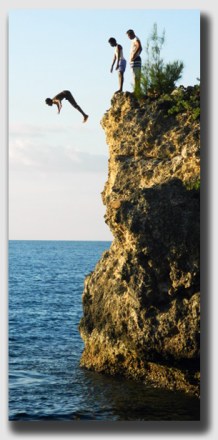
Be careful when diving into unfamiliar water.

Be careful when diving into unfamiliar water.

Held: Justin was an invitee. Indiana law holds that a person entering the land of another comes upon the land either as an invitee, licensee, or trespasser. The person’s status on the land defines the nature of the duty owed by the landowner to the visitor. Licensees have a license to use the land and are privileged to enter or remain on the land by virtue of the permission of the owner or occupier, but they take the premises as they find them. Invitees, on the other hand, are owed a much higher duty of care. The decisive factor with regard to whether a landowner has extended an “invitation” or “permission” is the interpretation that a reasonable man would put upon the owner’s words and actions, given all of the surrounding circumstances. Here, the Court found, the lake was held open to the public, even though it was surrounded by private property, and thus Justin — who dove off a dock and struck his head on a dredge pipe located on the channel floor — was an invitee rather than a licensee for purposes of personal injury action. The Court held that the articles of incorporation of Shafer & Freeman, the non-profit corporation that owned the lake, provided that the corporation would protect and enhance the water quality of the lake in order to facilitate public recreational use and ensure continued public access.

What’s more, the Court said, the agreement by which Shafer & Freeman acquired the title from the electrical utility, provided that Shafer & Freeman would hold the lake for public, charitable, recreational, conservation, and environmental purposes. It is not enough, to hold land open to the public, that the public at large is permitted to enter at will upon the land for their own purposes. As in other instances of invitation, the Court said, there must be some inducement or encouragement to enter, some conduct indicating that the premises are provided and intended for public entry and use and that the public will not merely be tolerated, but is expected and desired to come. When a landowner lets local boys play basketball on his vacant lot they are licensees only. If he installs playground equipment and posts a sign saying that the lot is open and free to all children, there is then a public invitation, and those who enter in response to it are invitees.

– Tom Root
TNLBGray140407

Case of the Day – Thursday, June 26, 2025

THE COURT CHANNELS SHAKESPEARE

Midsummer’s Night fell last weekend, making me feel a little Puckish. So I thought we’d examine two neighbors, neither of whom reacted thoughtfully to a dangerous tree. “Oh, what fools these mortals be!” Midsummer Night’s Dream, Act III, Scene 2.

Traditionally, the Massachusetts Rule – which could be summarized as “I don’t owe you nuthin’ – held that a landowner had no liability to his neighbor for harm done by overhanging branches and encroaching root systems. If the neighbor didn’t like the mess, he or she could trim away the offending branches or roots up to the property line. The courts simply didn’t want to hear about it.

However, courts had traditionally held an urban landowner to a higher standard of care when the people being protected were passing motorists on a public highway. In those cases, an urban landowner was obligated to exercise reasonable care to prevent an unreasonable risk of harm arising from the condition of trees on the land near the highway.

bellyachin140304In today’s case, Lois Lockhart had a decaying tree on her property. Neighbor Carl Mahurin complained about it, primarily because one of the branches was overhanging his property. But Lois did nothing. Neither did Carl – unless belly-aching counts as putting forth an effort.

Finally, the branch broke off and hit Carl, who was standing beneath it. You knew that had to happen, or else why would we be telling you this story? Being injured – and a little piqued that Lois had ignored his entreaties for so long – Carl sued. (You knew that would happen, too.)

Lois tried to get the case thrown out of trial court. She pointed out that Carl had nuthin’ coming from her. The traditional rule – read “Massachusetts Rule” here ­– dictated that she had no duty to protect Carl from the natural condition of her tree.

But as the great bard once wrote, “I do perceive here a divided duty.” Othello, Act I, Scene 3. And so did the trial court. It was troubled that Lockhart’s duty to strangers passing by in their Hudsons and Desotos was greater than to her neighbor. That seems divided, and irrationally so.

Lois said, “Heaven is my judge, not I for love and duty, But seeming so, for my peculiar end.” Othello, Act I, Scene 1. The trial court said that might be so, but it nevertheless sent the case to the Court of Appeals for the appellate court’s opinion as to her duty.

William Shakespeare - he foresaw the problems with the traditional liability rule hundreds of years ago.

William Shakespeare foresaw the problems with the traditional liability rule urged by Ms. Lockhart hundreds of years ago. “Wondrous strange!” indeed.

The appellate panel said, “O day and night, but this is wondrous strange!” Hamlet, Act 1, Scene 5. It could see no reason for the disparate treatment, either. Certainly, just as Lockhart owed a duty to Mordred and Mildred Motorist, she must owe the same duty to her neighbor, Carl. However, the Court of Appeals did allow that Mr. Mahurin could have entered Ms. Lockhart’s place and cut the tree down itself. So he might be contributorily negligent. Likewise, could he have been a knucklehead for standing under a tree he had complained was dangerous?

To Lockhart, the Court said, “There are more things in heaven and earth, Lois, than are dreamt of in your philosophy.” Hamlet, Act 1, Scene 5. Such as… a single duty owed by a landowner to both travelers passing on the road and her next-door neighbor. It sent the case back to trial.

Mahurin v. Lockhart, 71 Ill.App.3d 691, 390 N.E.2d 523 (Ill.App. 5 Dist. 1979). Plaintiff Carl Mahurin brought this action to recover damages for personal injuries he suffered when a dead branch extending over his property fell from a tree belonging to defendant Lois Lockhart, an adjoining landowner, and struck him. In his complaint, Mahurin alleged that Lockhart failed to prune the tree or take other necessary precautions after he warned her of the condition of the tree and the dangers it posed.

Lockhart moved to dismiss the complaint, arguing that a landowner is not liable for physical harm to others outside of her land caused by a natural condition. The trial court denied the motion to dismiss, certified that the question of law raised in Lockhart’s motion presented substantial ground for difference of opinion and that an immediate appeal would materially advance the ultimate termination of the litigation.

Held: The Court held that a landowner in a residential or urban area has a duty to others outside of his land to exercise reasonable care to prevent an unreasonable risk of harm arising from defective or unsound trees on the premises, including trees of purely natural origin.

The narrow issue before the court was to determine the extent, if any, of the duty that a landowner in a residential area owes to persons outside of his premises to remedy some defective or unsound condition of a tree upon his land when the tree and its condition were of a purely natural origin. Mahurin urged the Court to adopt the traditional rule set forth in section 363 of the Restatement (Second) of Torts. This section provided that neither a possessor of land, nor a vendor, lessor, or other transferor, is liable for physical harm caused to others outside of the land by a natural condition of the land. However, if the landowner was in an urban area, he was subject to liability to persons using a public highway for physical harm resulting from his failure to exercise reasonable care to prevent an unreasonable risk of harm arising from the condition of trees on the land near the highway.”

The traditional rule applied even though the landowner is aware of the dangerous natural condition and the expense necessary to remedy the condition is slight.

The Court noted that the traditional rule of non-liability developed at a time when land was mostly unsettled and uncultivated. The landowner – unable to keep a daily account of and remedy all of the dangerous conditions arising out of purely natural causes – was therefore shielded from liability out of necessity.

But, the Court of Appeals asked, if Carl knew the tree was dangerous, why was he standing under it? Duh, Carl ...

But, the Court of Appeals asked, if Carl knew the tree was dangerous, why was he standing under it? Duh, Carl …

The Court disagreed that the duty an urban landowner owed to a neighbor should be less than that owed to people passing in cars and trucks. It thus ruled that a landowner in a residential or urban area has a duty to others outside of his land to exercise reasonable care to prevent an unreasonable risk of harm arising from defective or unsound trees on the premises, including trees of purely natural origin.”

Therefore, Lockhart’s duty to Mahurin should “be defined using the ordinary rules of negligence. It is, therefore, appropriate for the trier of fact to consider… such factors as the nature of the locality, the seriousness of the danger, and the ease with which it may be prevented” in resolving the issue of liability.

The Court noted Lockhart’s argument that Mahurin was contributorily negligent because he stood under a tree that he, by his own admission, knew was dying and dangerous. The Court noted that the Restatement provided that a landowner is privileged to enter upon a neighbor’s land to abate a condition thereon which constitutes a private nuisance. “While this privilege alone does not establish the contributory negligence of plaintiff, it could be considered by the jury in resolving this issue.”

The Court remanded the case for trial, using the standards it had adopted.

Tom Root

TNLBGray140407

Case of the Day – Friday, June 20, 2025

A SQUIRRELY CAUSATION THEORY

Oh, if it were only that easy ...

Oh, if it were only that easy …

In the world of negligence, it’s not enough that the person who screws up – referred to generally as the “actor” – is stupid. After all, the world is chock-a-block with stupidity, and if being an imbecile were enough to make one liable, we’d all walk through life with our checkbooks perpetually open.

No, idiocy is not enough to create liability. Instead, the stupidity must be the “proximate cause” of the damage suffered by the plaintiff. For all of you proponents of chaos theory, you can consider it the obverse of the “Beijing Butterfly Effect.” You remember the illustration: the beat of a butterfly’s wings in Beijing today sets a minuscule air current in motion, which sets other air in motion, and so on nearly ad infinitum, until the air currents set into circulation cause a thunderstorm a week later in New York City. Small changes in input result in big changes in output. Just ask Edward Lorenz.

Lorenz was a scientist, not a lawyer. Had he been an attorney, he might have sued the butterfly because he got wet hailing a taxi at 52nd and 5th Avenue. But the law wouldn’t have been with him, because his damages – a soaking-wet bespoke wool coat and trousers – were not proximately caused by the butterfly’s erratic flight around the Forbidden City seven days prior. It’s the lesson every first-year law student learns in Palsgraf v. Long Island Railroad, a now-legendary tort case from pre-Depression New York.

Chaos isn't such a bad thing ... the theory gave us Benoit Mandelbrot's beautiful and repeating fractals.

Chaos isn’t such a bad thing … the theory gave us Benoit Mandelbrot’s beautiful and repeating fractals.

The facts were almost Rube Goldbergian. Mrs. Palsgraf – the Countess of Causation herself – had just arrived at the station to catch a commuter train. A passenger carrying a package, while hurrying to board a moving train, appeared to two Long Island Railroad employees to be falling. The employee standing on the passenger car steps tried to pull the passenger into the car while the other employee tried to push the rider into the car from behind. Their efforts to aid the passenger caused the unlucky fellow to drop the package he was holding. The box – about 15 inches long and wrapped in newspapers – struck the rails in between the cars.

The package contained fireworks, and it, of course, exploded when it hit the rails. The shock from the blast caused a panicked bystander to stumble into a pair of scales, which fell over, striking Helen Palsgraf. Palsgraf sued the Long Island Railroad (of course, because no one else in the chain of causation had any money), claiming her injury resulted from negligent acts of the Railroad’s employee in pushing the passenger onto the train. The trial court and the intermediate appeals court agreed with Mrs. Palsgraf.

The Long Island Railroad appealed the judgment to the Court of Appeals, New York’s highest court. In a celebrated opinion by then-Chief Judge Benjamin Cardozo, the Court held that there was no way the LIRR employee could have known that the newspaper-wrapped parcel was dangerous and that pushing the passenger would thereby cause an explosion. Without a reasonable perception that one’s actions could harm someone, there could be no duty towards that person, and therefore no negligence for which to impose liability. Whether the Railroad employees had acted negligently toward the passenger they manhandled was irrelevant for Palsgraf’s claim, because the only negligence that a person can sue for is a wrongful act that violates his or her own rights. “If the harm was not willful, [a plaintiff] must show that the act as to him had possibilities of danger so many and apparent as to entitle him to be protected against the doing of it though the harm was unintended.”

palsgraf150611This is known as “foreseeability,” a concept that tends to limit liability to the consequences of an act that could reasonably be foreseen rather than to every single consequence that follows. Otherwise, liability could be unlimited in scope, as causes never truly cease having effects far removed in time and space. (This returns us to the wayward Beijing butterfly). Today’s case is a current illustration of what happens when a plaintiff’s lawyer slept through that particular session of tort law class.

The actors were a dumpster, a black squirrel, and a black hole. OK, not a black hole, more like a tennis ball-sized hole that provided the furry critter with access to the dumpster. Ms. Hansen dumped her garbage in the dumpster. The dumped bags startled the squirrel, which had perhaps gotten in the dumpster through the hole. The squirrel leaped from the dumpster in alarm, and in turn startled Ms. Hansen, who fell and hurt herself.

So, who was at fault? Ms. Hansen naturally blamed the condo association and Waste Management for permitting a hole to remain in the lid (perhaps because both of the defendants had insurance). Being students of Palsgraf, the appellate panel made short work of this one, asking how the defendants could reasonably have foreseen that failing to seal a tennis ball-sized hole in the dumpster lid could cause a condo owner to fall down. They could not, of course. Ms. Hansen was out of court.

The squirrel is still on the loose.

Hansen v. Getchell, 70 Mass.App.Ct. 1101, 872 N.E.2d 840 (2007). Sandra Hansen had been a resident of the Beal’s Cove Village condominiums for nearly 10 years. She fell after being startled by a squirrel that leaped from a garbage dumpster she had opened to deposit some trash.

Hansen has owned a condominium unit at Beal’s Cove since 1997. During her years there, Hansen had actually seen animals such as raccoons and squirrels on the property, which is close to some woods. She also had seen animals at Beal’s Cove near a different dumpster, as well. However, this being America, someone had to be at fault, so she sued Getchell, trustee of the Beal’s Cove Village Condominium Trust, and Waste Management, Inc., the waste removal contractor.

Squirrels can be frightening creatures. Just look at the terror on this victim's face.

Squirrels can be frightening creatures. Just look at the terror on this victim’s face.

Hansen claimed that the dumpster had a hole in the lid the size of a tennis ball, a squirrel-size hole that had been there for weeks and which provided squirrels an unfettered means of access. Her expert opined that the failure to repair the hole in the lid was a substantial contributing cause of her injuries, and she blamed the defendants for not fixing it. The trial court granted summary judgment to the defendants because Hansen failed to establish that the defendants owed her a duty, and she failed to demonstrate a causal relationship between the claimed negligence and her resulting injury.

Held: The dismissal was upheld. The Court of Appeals said that whether the case was analyzed from the standpoint of the defendants’ duty to Hansen or from the standpoint of whether the breach of their duty proximately caused Hansen’s injury, she lost. The requisite foreseeability was absent.

Although there was evidence that the parties were aware that animals frequented the dumpster, the Court held that squirrels and other animals were a naturally occurring condition that the defendants didn’t create. There was no proof that squirrels or other animals that got in the dumpster made a habit of leaping out at unknowing depositors of trash. And even if – given the pesky and mischievous nature of squirrels – the defendants could have foreseen that they would leap from the dumpster, it wasn’t foreseeable that the leap would lead to a condominium tenant becoming injured.

In other words, it was not reasonably foreseeable that, as a direct result of the unrepaired hole in the lid, a person accessing the dumpster would be startled, fall, and become injured. Neither Getchell nor Waste Management, Inc., had a duty to guard against such unforeseeable harm.

– Tom Root

TNLBGray140407

Case of the Day – Tuesday, June 17, 2025

A TREE JUMPED OUT

Watch out for the tree, Mr. Miller ...

Watch out for the tree, Mr. Miller …

It was a dark and stormy night when Mr. and Mrs. Miller drove through a mall parking lot, well after the lights were turned out.

Remember malls? They were places the people of the time would visit to buy their goods in places called department stores, tech-y trinkets at The Sharper Image, these round vinyl objects with scratchings that – when put on a turning wheel and rubbed with a needle – emitted music (people of the day called them “records”), intimate apparel (to be worn under their loincloths) at Victoria’s Secret, and books made of actual paper at Waldenbooks. And there were Orange Juliuses, calorie-bomb rolls at Cinnabon, and big parking lots and confusing signs… The ancients loved their malls.

Well, maybe not if you are Mr. Miller. He missed a sharp turn in a mall boulevard and hit an 8″ wide tree. He and his wife were injured, and while it went unreported, the tree probably didn’t fare that well, either.

Trees seldom sue, but the same can’t be said for the Millers. They went after the mall for negligence. To be sure, the tree showed evidence of having been hit before. The mall, however, argued that Mr. Miller was an idiot for driving too fast on a strange, unlit roadway in bad weather. It said he was contributorily negligent in the accident.

Back when this case was decided, I was driving a pretty sharp four-on-the-floor ’67 Cougar and filling its tank for 25.9¢ a gallon. Ah, those were the days… unless you were a litigant suing for negligence. At the time, contributory negligence was still the law of the land in most states. It was a Draconian doctrine: if the victim was negligent even a teeny bit, then he or she couldn’t recover a dime from the defendant, no matter how bad the defendant’s negligence by comparison. Since that time, contributory negligence has been replaced by “comparative negligence” in most places. Comparative negligence is a percentage game: the jury finds that the defendant was, say, 70% negligent and the plaintiff was 30% negligent. The jury award of, say, $100,000 to the plaintiff would then be reduced by 30%, netting out 70 grand for our afflicted party.

Because contributory negligence was so harsh, courts often worked to find a way around its effect. In today’s case, the Court ruled that although Mr. Miller might have been contributorily negligent, that couldn’t keep the passenger, Mrs. Miller, from winning damages from the mall. The mall argued that Mr. Miller should share its liability to Mrs. Miller, but the state had an automobile guest statute that immunized a driver from liability to his or her passengers for simple negligence.

We miss that old Cougar ... and 25¢ a gallon gas ...

We miss our old Cougar … and 25.9¢ a gallon gas …

The mall should have marked the tree with reflectors or something, the Court said. Something to reflect on… like our old Cougar. Now that was a cherry ride.

Miller v. Baken Park, Inc., 84 S.D. 624, 175 N.W.2d 605 (Sup.Ct.S.D. 1970). Donald Miller’s pickup truck collided with a tree located in the Baken Park Shopping Center auxiliary parking lot. The Millers were injured.

Mr. Miller had entered the Shopping Center from West Main Street intending to drive across the lot to reach Canyon Lake Drive, the street on the south side of the Center. They had never traveled over this area before but had seen others do so. It was a misty, gloomy night with wind and gusty rain. Suddenly, a tree loomed in front of them. A collision ensued.

Miller and his wife sued Baken Park, and Baken Park counterclaimed against Miller for negligence. The evidence showed a driver would have had to swerve to miss the tree, and the conditions that night made it hard to see after the shopping center lights were turned off at 10 p.m. The tree, which had an 8” trunk, bore scars from prior vehicle collisions. The trial court considered the question of Baken Park’s negligence, contributory negligence by Miller and other issues it deemed appropriate. The jury found for the defendant and the plaintiffs appealed.

George of the Jungle could have advised Mr. Miller – watch out for that tree

Held: The trial court was reversed. The Supreme Court held that the evidence was sufficient to authorize finding that Baken Park was negligent in allowing a tree without reflectors or other warning devices to remain in an area that not only served as a parking lot for customers of its lessees, but in the area used by them as a driveway. The Court said that a shopping center owner that maintained control of its parking lots and driveway for the express purpose of serving customers of its lessees owed the business invitees of its lessees a duty to keep the premises in a reasonably safe condition. What’s more, the fact that Miller may have been negligent in driving through the dark lot was not imputable to his wife in the absence of her exerting some control or authority over the operation of the car. His negligence thus would not prevent her from recovering against the shopping center for injuries sustained because of the concurring negligence of her husband and a third person.

The shopping center’s counterclaim against Mr. Miller had been dismissed by the trial court. The Supreme Court agreed that dismissal was proper under South Dakota’s guest statute, which immunizes a driver from liability to a passenger unless he was acting with recklessness or willful conduct. The Court held that the statute applied even to accidents on private property, and thus, Baken Park’s counterclaim against Miller had to be dismissed.

– Tom Root

TNLBGray140407

Case of the Day – Monday, June 9, 2025

LIMITS OF SELF-HELP

School’s out for summer. Yeah, it’s been over half a century since I was a secondary school student but somehow the anticipation of summer vacation whispers to me still, just as it did when the last school bell sounded at the end of a class year. Channel Alice Cooper and Mungo Jerry.

But there’s still time for one more lesson. I trust you recall that last Friday, we tackled a question sent to us by our California correspondent, Rock Maple of Thousand Oaks. His neighbor has demanded that he trim back his 50-year-old pine tree, the branches of which hang over the neighbor’s place, and he wondered whether the neighbor might be able to start the chopping himself, even without Rock’s permission.

We determined that California generally recognizes the Massachusetts Rule, which permits a neighbor to use “self-help,” trimming the branches back to the property line. Of course, California also seems to permit the use of private nuisance laws — something that seems like the Hawaii Rule or Virginia Rule — to let a neighbor force someone like Rock to remove the tree himself if it is a nuisance.

cutdown140922But the Rockster was focused on whether his neighbor could fire up his chainsaw simply because he wanted to do so. While Friday’s case said perhaps he can, today’s case should be a cautionary tale to him – especially because it’s a California case.

Mr. Patel was unhappy that the roots from Mr. Booska’s pine tree had heaved some of Mr. Patel’s sidewalk. He excavated along the edge of his yard down to three feet, severing the roots of the pine tree that had encroached under his sidewalk. The root cutting so weakened the tree that it started dying and was in danger of falling. Mr. Booska had to take the tree down, and he promptly sued.

The lower courts said that Patel had an absolute right to cut the roots on his property, citing the holding in Friday’s case of Bonde v. Bishop. Not so, said the appeals court. Instead, Mr. Patel had an obligation to cut the roots in a reasonable manner that would achieve his aims — to stop sidewalk heaving — without undue harm to the tree. The Court held that “no person is permitted by law to use his property in such a manner that damage to his neighbor is a foreseeable result.”

Unfortunately, this isn’t the final answer. The Booska court was swayed by testimony that Mr. Patel could have protected his sidewalks with a much less aggressive method. We don’t yet know what the result would be if the only means of protecting Mr. Patel’s sidewalk would have required root cutting that would necessarily be fatal.

In the situation Rock presented to us, he didn’t report why his neighbor wanted the pine tree trimmed back. In discussions with his local lawyer, Rock will have to consider whether the tree could be found to be a nuisance (as in Friday’s case), a finding that Bonde suggests can be easily made in California. Even if it is not a nuisance, Rock’s neighbor can probably start hacking away on his side of the property line, but the hacking has to be done in a way that weighs the neighbor’s legitimate aims — whatever they are — against the health and safety of the tree.

Oh, the complexity! And to make it worse, tomorrow we’ll look at a Kafkaesque result where a neighbor’s right to cut back a tree can’t be exercised without the approval of the property owner, resulting in an old-fashioned California SLAPP-down.

Fool Booska v. Patel, 24 Cal.App.4th 1786, 30 Cal.Rptr.2d 241 (Ct.App. Div.1, 1994). Attorney Booska, representing himself in this action, sued his neighbor, Mr. Patel. The roots of a 40-year-old Monterey pine tree owned by Mr. Booska extended into Mr. Patel’s yard. Mr. Patel hired a contractor to excavate along the length of his yard and sever the roots of the tree down to a level of about 3 feet. Mr. Booska complained that Mr. Patel’s actions were negligently performed, and the tree became unsafe, a nuisance, unable to support life, and had to be cut down at Mr. Booska’s expense. The complaint alleged causes of action for negligence, destruction of timber, and nuisance. The trial court granted summary judgment for Mr. Patel, holding that under Bonde v. Bishop, Mr. Patel had an absolute right to sever the roots without regard to the effect on Mr. Booska. Mr. Booska appealed.

Held: The Court of Appeals reversed. It held that adjoining landowners do not have an absolute privilege to sever encroaching tree roots without regard to the reasonableness of their action or consequences to neighbors. Instead, neighbors act reasonably, and failure to do so could be the basis for recovery of damages. The Court distinguished the rulings in Bonde v. Bishop and Grandona v. Lovdal, noting that neither of those cases discussed the limits on what an adjoining property owner could do.

The Patels and Booskas apparently hadn't gotten this word ...

The Patels and Booskas apparently hadn’t gotten the memo on this…

The Court observed that “[i]n the instant case, Patel has not addressed the issue of negligence in his summary judgment motion but contends that he has an unlimited right to do anything he desires on his property regardless of the consequences to others. No authority so holds. ‘No person is permitted by law to use his property in such a manner that damage to his neighbor is a foreseeable result.’”

The appeals court was apparently disturbed that these neighbors hadn’t found the time or inclination to be neighborly about the dispute. It cites language from Bonde v. Bishop: “‘Apparently this is one of those rows between neighbors in which the defendants are standing on what they erroneously believe to be their strict legal rights to the exclusion of any consideration of the fair, decent, neighborly and legal thing to do’.”

The Court then pointedly said, “It seems, in the instant case, that neither party has considered what would be the neighborly thing to do to resolve this problem. While we express no opinion on the appropriate outcome of this case, we find that there are disputed factual issues to be resolved.”

The Court reversed the decision and sent the case back to the trial court to resolve the issue of negligence.

– Tom Root
TNLBGray140407