Case of the Day – Tuesday, August 12, 2025

OUTTA SIGHT

You know the kind... never owned a saw, never used a set of hedgeclippers.

You know the kind… never owned a saw, never used a set of hedgeclippers. Woodstock happened 54 years ago, but this guy’s head is still on Yasgur’s farm.

It’s getting toward late summer now. The high school football season is about to start, Labor Day is approaching, Christmas ads will begin in a fortnight…  but the grass, trees, shrubs and weeds are still growing.

You, of course, being a conscientious type, have been taking care of your yard. Your grass is cut, your trees are trimmed, your sidewalk is neatly edged. But you’ve got a neighbor – we all have that kind of neighbor – who’s not as diligent.

His or her grass is high, green plants are growing in the house gutters, and bushy branches overhang sidewalks, streets and yards. We know – we’ve whacked our heads on more than one branch that should have been trimmed before it became a hazard on the sidewalk.

So what kind of duty does Joe Sixpack have to people passing on the sidewalks or streets?

Iowa says not much. Low-hanging limbs obscured sightlines on a curve, and motorist Marilyn Fritz claimed the obstructed line of sight caused her to run into another car. She sued the County for not maintaining clearance so drivers could see where they were going. The County, in turn, sued landowners Eugene and Doris Norton for having an inoperable chainsaw (that is, for not trimming their trees).

The Court grappled with the question of who had the duty to maintain the sightlines. It noted that Iowa had a policy of encouraging safe travel on the roads, but also had a policy of encouraging trees. So that analysis wasn’t very helpful. Although Dallas County urged the Court to stick the Nortons with the duty to trim, the Court was clearly troubled that if it obligated the owners to maintain the sight lines, those folks – having no expertise in determining what sight lines were appropriate – would have no idea what was right and what was wrong.

The County, on the other hand, did have the expertise, having as it did a highway department staffed with trained professionals. The Court ruled that the fact convinced it that the County should be the party that is most responsible for maintaining highway sightlines.
cynicism160822Plus, given its taxing authority, the County undoubtedly had more money. Cynical of us, you say? Cynicism is not a synonym for the word “wrong.”

It was important to the Court that the Nortons had not planted the trees, but rather they were “natural.” Also, while the branches were obscuring sightlines, they were not actually blocking anyone’s way down the road.

Fritz v. Parkison, 397 N.W.2d 714 (1986). Trees growing on the property of Eugene and Doris Norton limited the sight distance of two drivers whose vehicles collided on the curve. Plaintiff Marilyn Fritz sued Dallas County for failing to trim vegetation on the inside of the curve that obstructed the vision of each driver of the colliding vehicles. Dallas County, in turn, sued Eugene and Doris Norton, alleging that trees, bushes, and shrubs growing on Norton’s land blocked the view of each oncoming motorist and that the Nortons were liable for failing to remove the sight obstruction caused by this vegetation. The question presented to the court is whether landowners whose property abuts a curve on a rural road are potentially liable in tort when trees growing on their property limit the sight distance of drivers whose vehicles collide on the curve.

Held: The Court agreed that, but for the trees growing on the Nortons’ land, motorists approaching the curve from the north and from the east would be able to see each other for a longer period of time before meeting. The Court found that limbs on a few older trees growing on the Nortons’ land overhung the road’s right-of-way but not the traveled portion of the curve and that the Nortons had planted a few fruit trees along the roadway.

sightlines160822The Court identified two well-developed and clearly recognized public policies implicated in this case. First, in light of the increasingly mobile society, highways must be kept free from obstructions and hazards. Indeed, courts have at various times imposed liability against individuals for allowing a highway to become obstructed or hazardous. The second policy implicated by this action is the well-established state goal to encourage the growth and cultivation of trees and discourage their wanton destruction.

Here, the Court found that Nortons’ trees did not physically obstruct or intrude upon the traveled portion of the road, and neither directly impeded nor constituted any kind of latent defect that without warning might fall across the road or onto a passing vehicle. In this case, the Court held that the owner of land abutting curved highways owed motorists no duty to remove trees located on the landowner’s property where the trees did not actually obstruct the right-of-way, even if the trees were planted by the landowner.

The Court further held that naturally occurring or artificially created conditions on a landowner’s property should be taken into consideration in deciding the case, and whether the property is located in an urban or rural area is an additional consideration to determine liability.

– Tom Root

TNLBGray140407

Case of the Day – Friday, August 8, 2025

FUN DOWN AT THE OLD SWIMMING HOLE

After reading a report a few years ago about a Pennsylvania town cutting down its “rope-swing tree,” I reflected on the good old days (whenever they might have been).

Back at the turn of the century – the last one, not this one – no old swimming hole at the sweeping turn of a country creek was complete without some old inch-thick length of hemp rope attached to a high cottonwood branch. When the country boys of yore would skinny dip, they would swing high out over the creek, release and plummet into the cool water.

That was then. This is now, as the Town of Chester, New Hampshire, found out in today’s case. The town had a pretty nice park with a pond, open to the public without charge. Some time ago, persons unknown attached a rope to a tree overhanging the pond, and people used it to do exactly what country kids did a century ago (except clad in bathing suits). To make the game more interesting, sometimes a second person would stand near the rope to slap the feet of the person swinging on the rope before the swinger splashed into the water.

The Town Selectmen were concerned that the rope was unsafe. At this point, the logical response would be to remove it. Instead, the Town talked about erecting a “no swimming” sign, but that never happened. The Selectmen asked the police what was being done to stop things. The Chief said the cops kept a list of people seen using the swing.

The rope appeared about nine years ago, which is when the complaints started. Town residents voiced their concerns again in 2013, 2014 and 2015. Nothing happened.

Except for the inevitable, that is. On August 20, 2015, 12-year-old Christopher Kurowski was at the pond, trying to touch the feet of a person swinging on the rope. The two collided, and Christopher was seriously injured.

Naturally, the town was sued. And just as naturally, it defended under the New Hampshire recreational use immunity statute – RSA 212:34. That statute provides that “a landowner owes no duty of care to keep the premises safe for entry or use by others for outdoor recreational activity or to give any warning of hazardous conditions, uses of, structures, or activities on such premises to persons entering for such purposes, except… [t]his section does not limit the liability which otherwise exists: (a) For willful or malicious failure to guard or warn against a dangerous condition, use, structure or activity… (d) When the injury suffered was caused by the intentional act of the landowner.

The whole idea behind recreational use statutes like this one is to encourage private landowners to make their land available for public recreational uses by limiting their liability.

Chris’s lawyer gave the Town a run for its money, ending up in the New Hampshire Supreme Court. While the Town won, the frugal Selectmen probably wish they had just cut the swing down when it first appeared. Hardly an elegant solution, but a final one. And cheap.

Kurowski v. Town of Chester170 N.H. 307, 172 A.3d 522  (Sup.Ct.N.H., 2017). The Town owns and maintains the Wason Pond Conservation and Recreation Area, which includes walking paths and Wason Pond, open to the public free of charge. Since 2012, a rope swing has been attached to a tree overhanging the pond. No one knows who put it there.

A local resident told the Town Board of Selectmen that she was concerned about the safety of the rope swing. She asked the Board to install “no swimming” signs near the swing area. During the meeting, one Board member observed that the swing was a hazard. The police chief reported that police practice when trespassers were found using the swing was just to take their names and list them in a report.

The Board heard similar safety complaints in the following years, but it did not remove the swing or post any signs.

One hot day in August 2015, young Chris Kurowski was playing at the pond, standing in the path of a person using the swing. When Chris tried to touch the feet of his friend, who was swinging on the rope, the two collided, and Chris was badly hurt.

Chris’s father sued Town on Chris’s behalf, claiming the Town negligently or willfully or intentionally failed to remove the rope swing or post warning signs. The Town filed a motion to dismiss, arguing that the plaintiff’s suit was barred by one or both of New Hampshire’s recreational use immunity statutes – RSA 212:34 (the state tort claims statute) and RSA 508: 14 (the recreational use statute).

The trial court granted the Town’s motion to dismiss, holding that RSA 212:34 barred both of the plaintiff’s claims and that additionally, RSA 508:14 barred the plaintiff’s negligence claim.

Chris’s father appealed.

Held: Assuming that both RSA 212:34 and RSA 508:14 apply to municipalities (an issue the court did not rule on), the New Hampshire Supreme Court ruled that under the state tort claims statute, RSA 212:34, the Town was immune from liability on all of the plaintiff’s claims. Therefore, the Court did not rule on whether RSA 508:14 applied as well.

RSA 212:34 provides that “[a] landowner owes no duty of care to keep the premises safe for entry or use by others for outdoor recreational activity or to give any warning of hazardous conditions, uses of, structures, or activities on such premises to persons entering for such purposes,” except for liability which otherwise exists [f]or willful or malicious failure to guard or warn against a dangerous condition, use, structure or activity; [or w]hen the injury suffered was caused by the intentional act of the landowner.”

The issue, the Court said, was whether young Chris was engaged in an “outdoor recreational activity,” as that term is used in the statute. The Court said he was. An “outdoor recreational activity” is defined in the statute as “outdoor recreational pursuits including, but not limited to, hunting, fishing, trapping, camping, horseback riding, bicycling, water sports, winter sports, snowmobiling… operating an OHRV [off-highway recreational vehicle]… hiking, ice and rock climbing or bouldering, or sightseeing upon or removing fuel wood from the premises.” The list in the statute is not exhaustive, and activities not specifically enumerated – but similar in nature to the activities listed in the statute — may be an “outdoor recreational activity.”

The Court said that Chris’s activity was similar in nature to the enumerated activity of “water sports.” In fact, the Court had previously held that RSA 212:34 barred an action against a landowner for injuries sustained by a plaintiff who dove into a lake, striking his head on a submerged rock.

“Here,” the Court wrote, “the activity at issue involved a person launching herself over and into the water – using a rope swing. Christopher was attempting to slap the feet of the person using the swing before that person hit the water. We hold that Christopher was actively engaged in an outdoor recreational pursuit sufficiently similar in nature to the enumerated activity of “water sports” to constitute an “outdoor recreational activity” under RSA 212:34, I(c).”

Chris’s dad argued Chris was not engaged in “outdoor recreational activity” because the swing was man-made. The Court said that had no bearing on the issue. Likewise, the fact that the Town did not install or maintain the swing made no difference. “[T]he identity of the person or entity providing the equipment or structure used in an outdoor recreational activity is immaterial,” the Court ruled. “Indeed, many of the enumerated outdoor recreational activities, for example, hunting, camping, hiking, bicycling, and snowmobiling… involve the use of equipment or structures that could be owned or provided by anyone, including the landowner, a third party, or the injured party.”

In an argument that demonstrated some chutzpah, Chris’s dad argued his son’s conduct did not constitute an “outdoor recreational activity” because it was prohibited by the Town and was identified as hazardous. In other words, if someone ignores your rules, you may be liable, but if they follow the rules, you won’t be. Really? The Court sure didn’t buy it. “[T]he statute specifically contemplates that immunity will apply even if the activity at issue involves a known hazardous condition.”

Chris’s father also asserted that, because the Town knew of the hazard posed by the swing and took no action to remove it or post warning signs, the Town willfully failed to guard or warn against “a dangerous condition, use, structure or activity,” RSA 212:34, V(a). Chris’s dad said three elements had to be present for the landowner’s actions to constitute willful misconduct: “(1) actual or constructive knowledge of the peril to be apprehended; (2) actual or constructive knowledge that injury is a probable, as opposed to a possible, result of the danger; and (3) conscious failure to act to avoid the peril.”

The Court said it was not deciding whether Chris’s definition of “willful,” which he took from a decision interpreting California’s recreational user statute, was the right approach because even under that definition, Chris would lose. The Court ruled he had not alleged that the Town had “actual or constructive knowledge that injury was a probable, as opposed to a possible, result of the danger.” While he complained the Town knew about the swing and did nothing, “an allegation that a landowner knew about a particular hazard and did nothing is insufficient to establish that the landowner knew or should have known that injury would probably result from that hazard… At most, such allegations sound in negligence.

Finally, Chris’s dad argued he had shown that his son suffered injury as a result of the Town’s intentional acts. He said the Town’s conduct constituted an intentional act for the same reasons he asserts the Town’s conduct was willful: because the Town acknowledged that the rope swing was a hazard, was warned about that hazard on three occasions between 2012 and 2015, did nothing to remove it, and did not post warning signs.

The Court disagreed, holding that the “mere knowledge and appreciation of a risk – something short of substantial certainty – is not intent.” At most, Chris’s complaint was that the Town was negligent, that the Town disregarded a substantial risk and failed to act. Negligence is not actionable under RSA 212:34.

– Tom Root

TNLBGray140407

Case of the Day – Wednesday, July 30, 2025

MEANWHILE, BACK AT THE RANCH …

ranch

… that confounded sodbuster neighbor just done cut our power line with his plow. In the ensuing fire that swept across the plain, the trees planted in our windbreak went up like Roman candles, and the ranch hands couldn’t stop the conflagration. Sure, the farmer was negligent, but to what extent?

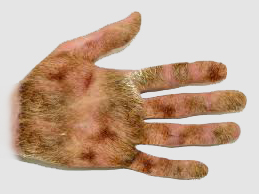
One of the first things new law students learn is the lesson of Hawkins v. McGee, the “case of the hairy hand,” in which we find that the measure of damages is the difference between the value before the breach or the negligence, and the difference after the breach. Nebraska law in this case held that if the trees were used for residential or recreational purposes, the damages are the replacement cost of the trees up to the value of the real estate. But if they were just used for agricultural purposes, the Hawkins v. McGee formulation is fine.

hairyhandHere, replacement of the trees would cost over $270,000, but the reduction in the value of the farmland was only $30,000. David Spicer, the owner of the ranch, tried to bootstrap himself into qualifying for the “recreational” formulation by arguing that not only did he use the windbreak for the usual agricultural purposes, but he relied on it for recreational purposes as well, including for his kids’ 4-H projects. The 4-H projects argument was especially touching, except that David Spicer’s youngest kid was 25 years old. And we thought AI was fake from time to time…

The trial court granted summary judgment on the damages question, holding that the replacement cost exceeded the value of the land and that $30,000 was adequate to compensate for the loss of the trees. The Court of Appeals ruled, however, that whether the trees were recreational in nature or agricultural in nature was a question of fact, and the trial court was wrong to resolve that question without a trial.

The issue of how to value the loss of trees – especially where the value of the tree to the homeowner is due to noneconomic reasons such as beauty, sentimentality or recreational value – arises often, and for good reason. The aphorism in real estate is that the value of a home depends on location, location, location. Much could be said of trees as well. The mighty oak that shades the plantation house is worth far more than its identical twin standing a quarter mile into the woods behind the fields. Determining exactly how much more may require juries to consider not so much stumpage prices as the quality of 4-H projects.

Spicer Ranch v. Schilke, 734 N.W.2d 314 (Neb.App., 2007). Schilke farmed leased land next to the Spicer Ranch. While he was plowing one day, he cut a power line leading to some irrigation pumps. A fire resulted, which, before it burned out, destroyed a windbreak on Spicer Ranch consisting of red cedar and juniper trees, and located about five hundred yards from the ranch house. Spicers used the windbreak, which was on a 110-acre tract of land, in the normal fashion of slowing the wind, providing shelter for cattle, for calving, for horses and for general farm use. David Spicer – mindful of how damages were figured in cases such as these – also maintained that he used the trees for recreational purposes, including his kids’ cataloging the trees for 4-H projects (except it turned out that his youngest child was 25 years old). Spicer sued for negligence, which was pretty much conceded.

Claiming the windbreak was worth $270,000 was just so much puffery ...

The Court found that Spicer’s claim that the windbreak was worth $270,000 was just puffery …

In an affidavit to the trial court, Spicers’ expert valued the windbreak at $270,000 for replacement of the trees. But the trial court granted summary judgment to Schilke, finding that to value the trees on the 110-acre tract at $270,000 far exceeded the value of the real estate involved. The trees included only made up a small percentage of the tract, the Court found, and that small percentage of land likewise would not be permanently damaged because of the loss of the trees. The trial court awarded Spicer Ranch $30,000 as the highest amount of damages suffered by Spicer Ranch.

The sodbuster was relieved. The rancher was not… and appealed.

Held: Summary judgment was reversed on the damages issue. Spicer Ranch argued the district court erred in using a “before and after” measurement of damages. Instead, it said, to determine compensatory damages for destroying trees and for related damage to the land – where the owner of land intends to use the property for residential or recreational purposes – the owner is not limited to the difference in value of the property before and after the damage or to the stumpage or other commercial value of the timber, but instead may recover the cost of reasonable restoration of the property to its preexisting condition or to a condition as close as reasonably feasible.

The Court of Appeals noted that the trial court’s implicit rationale for its calculation of damages is that the land was used for the farming business, not for any recreational purposes, apparently because of the age of the youngest child was then 25 years old. The trial court’s finding failed to account for the material question of fact as to whether the windbreak was used for residential and recreational purposes, as stated in David’s affidavit, or whether the windbreak was simply a “normal and average farm windbreak,” as could be implied from David’s deposition testimony and as stated in the affidavit of a real estate appraiser. The Court of Appeals noted that the measure of a plaintiff’s damages would depend upon the evidence presented at trial and might require alternative instructions, depending upon the jury’s determination of contested factual issues. Because a material issue of fact existed, the Court of Appeals held, summary judgment with respect to damages was improper.

Even under the “before and after” theory of damages used by the trial court, the evidence revealed a range of damages — not just a fixed, undisputed figure of $30,000. The trial judge made a factual finding when he awarded Spicer Ranch $30,000, which he said “is the highest amount of damages suffered by the Ranch according to the before and after damage appraisal.” He should have simply determined whether a material issue of fact existed with respect to damages, and – if one did – set the case for trial. The matter had to be returned to the trial court.

– Tom Root
TNLBGray140407

Case of the Day – Monday, July 28, 2025

SMOKEY’S REVENGE

California, land of perpetual drought, wildfires of Biblical proportions, rivers running down the streets. The news out of California never seems to be good. It’s the kind of thing Smokey Bear always warned us about (and no, his name is not “Smokey the Bear.” I thought it might be interesting to revisit the tale of another large corporation involved in a wildfire, the Great Storrie Fire of 23 years ago.

One hot August day in northern California, a Union Pacific track repair crew let some grass next to the tracks catch fire. They tried to put the blaze out … rather ineffectively, it turns out.

The Bear was not amused.

The Bear was not amused.

By the time it was all over, 81 square miles of national forest burned in the Storrie Fire of August 2000. The Forest Service, which has compiled a poor record of reforestation – chiefly because of a lack of money – sued Union Pacific for the cost to rehabilitate the burned-out area. Smokey Bear would have his day in court.

Before the case was to go on trial, the lawyers tussled over the proper measure of damages. The railroad argued that the correct measure was the diminution of property value caused by the fire. What’s more, the losses had to be mitigated by the value of the timber that could be salvaged from the burned land. The catch was that most of the land was restricted by law and could not be harvested until the law expired several years after the fire. Union Pacific argued that if it could have been sold, it would have fetched so much that the damages only reached about $5.7 million.

The Government cried foul, contending that the traditional measure of damages wasn’t appropriate for natural resources. Instead, it claimed damages to the timber, damages to the soil, reforestation costs and loss of environmental habitat to birds and mammals on the order of $167 million.

Over 71,000 acres were burned by a railroad crew's careless fire.

Over 71,000 acres were burned by a railroad crew’s careless fire.

Big difference! So the crucial battle was joined, well before the trial commenced, when the court was asked to rule on what damages would be allowed. When the decision was handed down, it turned out to be a bad day for the railroad. The trial court showed little sympathy for Union Pacific, holding that California law let the Government pile on the damages – timber, soil, reforestation, and loss of habitat. What’s more, in a double whammy if ever there was one, the District Court ruled that even though the timber on the restricted land couldn’t be sold in 2000 (and couldn’t be for many years thereafter, because the law was extended), the value of the timber was appropriately considered in setting damages. OK, Union Pacific conceded, but then the salvage value of the timber left on the restricted land should be considered in mitigation. No, the Court disagreed, it couldn’t be considered … because it couldn’t be sold. The law, you know.

Having been thoroughly sandbagged by the Court, the railroad knew better than to go to trial. It settled the case for $102 million. And that was real money back then.

For all of the Court’s feel-good rhetoric about the sacred trust of the national forest, the Forest Service hadn’t done very much to remedy the mess the fire left behind in the eight years after the fire. Private landowners who suffered loss have done much more, but then they’re not hamstrung by regulation and interest groups. Once the Union Pacific millions started pouring in, the Forest Service didn’t have any excuse for further sloth.

How about Union Pacific? A settlement of over $100 million has to hurt, right? Take heart — the venerable old railroad had insurance.

As for the national forest, it’s slowly returning to green. But even an untrained eye looking at August 2013 satellite pictures can tell that the timber is gone. To the north and west of Storrie, rising from the Feather River, the unforested land stands in obvious contrast to the rest of the area.

The interesting tree law lesson drawn from today’s case is the Federal District Court’s free-wheeling approach to damages. With a creative lawyer, a political hot potato and a sympathetic court, the sky can be the limit.

United States v. Union Pacific Railway Co., 565 F.Supp.2d 1136 (E.D.Cal., 2008). A Union Pacific (“UP”) track repair crew negligently ignited the fire while repairing a rail, and — not recalling their Boy Scout days — didn’t put it out properly. The resulting conflagration, known as the “Storrie Fire,” destroyed 52,000 acres of National Forest in August 2000. The Government sued UP.

Union Pacific on span northeast of Storrie.

Union Pacific on a span northeast of Storrie.

The issue raised before the Federal district court concerned the proper measures of natural resource damages, whether diminution of the market value of the forest land was the overarching measure of the Government’s damage in the case, and if not, whether the Government may recover as separate injuries timber damages of over $121 million, reforestation costs of $33 million, and loss of habitat and environment during the period of regrowth of $13 million.

Also, some of the National Forest had been specified by Congress as being temporarily exempt from timber harvest. Had the trees on these lands not been wholly destroyed by the fire, the Government could have harvested the trees over time, after the expiration of the law. Similarly, no logging or reforestation was allowed in the Bucks Lake Wilderness at the time of the fire, and the general forest areas were lands where commercial logging may occur, subject to other legal restrictions, such as environmental assessment requirements.

The Government conducted salvage sales of the charred timber that was not located on restricted lands, recovering $335,616. UP contended that a post-fire salvage sale of the burned timber on the restricted lands — had federal law permitted it — would have generated over $73.6 million. UP claimed that at most, the Government incurred only $5.7 in net lost timber value ($79.3 million minus $73.6 million).

Held: The U.S. District Court found that the loss in market value of the land was not the proper measure of damages. Instead, the Government could argue to the jury that it was entitled to recover damages for damages to the trees, the soil and pre-merchantable timber, and its loss of use of habitat and environmental services during the period of forest regrowth. UP would not be allowed to argue at trial that it was entitled to an offset based on the theoretical salvage value of the timber. Finally, the Government’s habitat equivalency damages were legally permissible.

California law applied to the Government’s damage claims. Although UP argued that under California law, the measure of damage for negligent injury was the difference between the value of the property before and after the injury. The Court agreed this was generally correct, but California law also held that [t]here is no fixed rule for the measure of tort damages under Civil Code § 3333 … [and t]he measure that most appropriately compensates the injured party for the loss sustained should be adopted.” The general measure of tort damages under California law is broadly defined as “… the amount which will compensate for all the detriment proximately caused thereby, whether it could have been anticipated or not.”

Don't kid yourself - the case was a political hot potato, and politics undoubtedly influenced the District Court decision.

Don’t kid yourself – the case was a political hot potato, and politics undoubtedly influenced the District Court decision.

Thus, the Court held, the Government – as the injured party here – was entitled to full compensation for all of its damages, considering the unique character of the land at issue and that natural resources have values not fully captured by the market system. Resource damages, including timber damages, rehabilitation, and restoration costs, and environmental and habitat damages, were all recoverable as separate injuries, the Court ruled. In this case, the fire damaged the Government’s property and reduced its value, not only through the destruction of trees used for timber but through damage to the soil. In addition, the USFS was required by law to replant to a certain minimum density, and they incurred expenses in their salvage operation. These, the Court said, were separate injuries.

UP also argued that the Government couldn’t recover damages for the value of the trees located on the restricted lands because commercial logging of those lands was not permitted by law. But, the Court held when the Storrie Fire occurred in August 2000, the restriction was set to expire in 2004. Had the fire not destroyed the trees within the restricted areas, the trees would have been commercially available for harvesting within a few years, and the Government could have recovered their timber market value. Instead, as a result of the damage caused by the fire and the subsequent decay of the burned trees, the trees were dead or dying and no longer had any viable timber value. That the law had been extended post-fire, the Court ruled, was of no consequence because, at the relevant time in 2000, the law had a definite expiration date.

UP argued that in areas where commercial logging is not allowed the reasonable cost of reforestation is the proper measure of damages, but the Court rejected the argument. It said that the Government’s timber damages of $121.9 million were supported by detailed expert analysis of actual timber values. The Court waxed eloquent that UP had wholly ignored the wilderness areas in question “[w]ere national treasures created by Congress ‘to secure for the American people of present and future generations the benefits of an enduring resource of wilderness…’” In such circumstances, the Court held, the Government could recover damages for the timber burned in the wilderness areas. Destroyed timber values were a relevant means to capture at least part of the lost value of the burned lands because there is no available real property market value by which to determine the pre- and post-fire value of thousands of acres of national forest lands that can’t be sold.

UP asserted that if such damages were permitted by the court, it should be allowed to argue to the jury that the damages calculation did not account for the full administrative costs that the Government would have incurred in marketing unburned timber at the prices it claims, including environmental assessment costs and road-building costs. The Court disagreed, holding that the harm in this case was caused by UP’s admitted negligence, which essentially created a “forced sale” of the trees. Thus, the Court said, deduction for administrative costs was not appropriate.

The area of the fire – 23 years later, growth was still sparse.

Finally, UP argued it was entitled to an offset of the timber damages based upon the amount UP contended the Government could have obtained in a theoretical post-fire salvage sale of the timber on the restricted lands, $73.6 million. The Government argued against this, noting that the law prohibited the post-fire salvage sale. UP agreed but pointed out that the law also prohibited a pre-fire sale, and thus, if the Government were permitted damages based in part on the theoretical pre-fire, sale value of the timber on these lands, UP should also receive a corresponding offset to those damages based on a theoretical post-fire salvage sale.

The Court disagreed, holding that salvage value is a question of mitigation after actual damages have been ascertained and then only for amounts that were realized or could have been realized. Thus, assessing the Government’s actual damages is a separate inquiry from assessing the Government’s duty to mitigate its damages after the commission of the tort. Under the doctrine of avoidable consequences (or mitigation of damages), the person injured by another’s wrongful conduct may not recover continuing damages “that the injured person could have avoided by reasonable effort or expenditure.” Thus, the Court said, UP was entitled to an offset of damages only for the salvage value realized by the Government for its salvage sale with respect to timber not located on the restricted lands.

– Tom Root

Case of the Day – Thursday, July 24, 2025

A TREE GROWS IN BROOKLYN – AND THAT’S DIFFERENT

Poster140306Time was, trees were just trees, and what they did, how they lived, grew and died, was out of the control of the property owner. No one blamed little Francine Nolan if the tree growing in Brooklyn fell on a Sabrett’s cart.

About the time little Francine was living in her Williamsburg tenement, an influential group of judges, scholars, and lawyers in Philadelphia formed an organization known as the American Law Institute. They believed, among other things, that they could write comprehensive treatises about all areas of the law – which they called “Restatements” – that would serve as authoritative statements of the principles of common law. No more confusion, no more divergence of holdings, no more contentious arguments! You can just about hear the group, lemonades hoisted (this was during Prohibition, after all), singing “We Are the World.”

I hear the ALI singing ...

I hear the ALI singing …

Alas, Prohibition failed, and so did the ALI’s goal of replacing all of those tedious casebooks and treatises with the Restatement of the Law. Everyone loved the Restatements, but far from replacing state common law, case reporters, and codes of statutes, the volumes became just another secondary source. To be sure, some of the ALI members never really thought an entire law library could be replaced with one shelf of Restatements, notably Benjamin Cardozo. He believed that the Restatement “will be something less than a code and something more than a treatise. It will be invested with unique authority, not to command, but to persuade.”

The Restatement of the Law continues today, with some volumes in their third printing. And courts love them, even if they don’t always follow them.

Today’s case is a good example. When the Browns’ tree fell on Ms. Barker’s property, it made a mess. She sued her neighbors, arguing that they should have recognized that the tree was at risk of falling and done something about it. The Browns pointed out that no less persuasive source than the Restatement (Second) of Torts said that they weren’t responsible for the natural condition of trees on their property. The trial court agreed and threw the case out.

The appellate court disagreed. It rejected the Restatement approach as being outdated and not sufficiently attuned to the differences between urban and rural life. In other words, the Court said, if a tree grows in Brooklyn, little Francine had better keep her eye on it.

Francine - be careful that tree doesn't fall on the hot dog vendor's cart.

Francine – be careful that tree doesn’t fall on the hot dog vendor’s cart.

Barker v. Brown, 236 Pa.Super. 75, 340 A.2d 566 (Pa.Super. 1975). Virginia Barker’s property adjoins that of the Browns. Both are located in a residential district of State College. A large tree stood on the Browns’ property, a tree that Barker said the Browns knew or should have known was in a decayed, rotting, and dangerous condition. Barker alleged that the Browns negligently failed to take steps to avert the danger and, as a result, the tree fell onto her property.

The tree’s fall destroyed two of Barker’s trees, valued at about $600 each. Barker had to have the fallen tree removed from her property at a cost of $147.50, and the process required her to miss two days of work, causing lost wages of $34.00. Finally, the incident resulted in a loss of value to Barker’s property in the amount of $600.00.

The trial court threw out the case on the grounds that section 363 of the Restatement (Second) of Torts (1965) precluded holding the Browns to blame. That section provided:

(1) Except as stated in Subsection (2), neither a possessor of land nor a vendor, lessor, or other transferor, is liable for physical harm caused to others outside of the land by a natural condition of the land.

(2) A possessor of land in an urban area is subject to liability to persons using a public highway for physical harm resulting from his failure to exercise reasonable care to prevent an unreasonable risk of harm arising from the condition of trees on the land near the highway.

Held: The appellate court reinstated the lawsuit.

The court held that the Restatement’s distinction between natural and artificial conditions – a distinction that had never been the focus of prior Pennsylvania court decisions – was outdated. “It may very well be true,” the Court said, “that the distinction between artificial and natural conditions was valid in a time when landowners were possessed of, and hence would have been charged with the care of large quantities of land. It would still be valid today in rural areas where large landholdings are common. [However], we do not believe that the distinction should be applied to land in or near a developed or residential area. Urban living, by altering the purpose for which the land is used, must also bring with it certain responsibilities. A tree growing in an urban or residential area does not have the same natural relation to surrounding land as a tree located in a rural setting.”

Basswood140306While acknowledging that its approach imposed more cost on landowners, the Court nevertheless believed that “the relatively minor expenditures in time and money that it will take to inspect and secure trees in a developed or residential area is not large when compared with the increased danger and potential for damages represented by the fall of such a tree.”

The Court thus held that a possessor of land in or adjacent to a developed or residential area was subject to liability for harm caused to others outside of the land by a defect in the condition of a tree thereon, if the exercise of reasonable care by the possessor would have disclosed the defect and the risk involved, and repair would have made the tree reasonably safe.

In this case, the Court held, Barker alleged in her complaint that the Browns “knew, or should have known, that the said tree was in a decayed, rotting, and dangerous condition.” This is denied by the Browns, but for purposes of this appeal, the Court had to accept the facts alleged in Barker’s complaint as true. On remand, it noted, the question would be one for the fact finder.

– Tom Root

Case of the Day – Friday, July 18, 2025

A LEG TO STAND ON

Did that plaintiff ever have gall ... or gull ... or cojones or something...

      Did that plaintiff ever have gall … or gull … or cojones… or something!  What he didn’t have was any proof.

The plaintiff in today’s case had his foot broken when a branch from his neighbor’s tree fell. So how was he different from this rather odd-looking seagull sitting on a seawall to our left?

Easy – the gull has a leg to stand on.

Our hapless litigant – Rick Meyers by name – lived next to a man named Delaney, who owned a Catalpa tree. The catalpa is a fairly attractive deciduous tree that produces bean pods and leaves in the fall, but little else. It’s a solid Anglo-American tree, flowering in the spring and with large leaves and deep shade in the summer. In fact, it’s the sole food source for the catalpa sphinx moth, a creature favored by southern anglers as bait. Birds love it, caterpillars love it, fishermen love it … and so do most people.

That list would exclude our hobbling protagonist, Rick Meyers. The Delaneys’ Catalpa tree provided shade to Mr. Meyers’ driveway with its overhanging branches. But one day, Rick had run barefooted outside to put up the car windows (we suspect a thunderstorm was about to hit, which would have been accompanied by gusty winds, but the record didn’t say as much). While he was doing so, a branch broke free from the tree and fell on his foot.

A catalpa -beloved by fisherman and fowl - but not by Rick Meyers.

A catalpa -beloved by fishermen and fowl – but not by Rick Meyers.

Rick didn’t have a shred of proof that anyone – including the Delaneys – had reason to know that the branch was going to break. But lack of evidence would not inconvenience our Rick. He sued anyway, claiming that as owners of a tree in a residential area, the Delaneys had a duty to know the branch was going to fall, and never mind how they were supposed to have figured that out. You see, Rick’s foot hurt, and someone had to pay.

The trial court took a more sanguine view, believing that if the Delaneys couldn’t clearly see that the tree was dangerous, then they couldn’t be found to be negligent simply because they had not sleuthed it out. The Iowa Supreme Court agreed. The risk has to be seeable before it can be found to be foreseeable.

A landowner has no affirmative duty to inspect trees where no defect is "readily observable."

A landowner has no affirmative duty to inspect trees where no defect is “readily observable.”

Meyers v. Delaney, 529 N.W.2d 288 (Iowa Sup. Ct. 1995). Meyers and Delaney owned adjoining properties. Standing between their homes but rooted solely on the Delaney homestead was a large Catalpa tree. The tree limbs hung over the Meyers’ driveway. The Meyers family parked cars under the branch each day, and the Meyers kids played around it when outside.

One evening in mid-July 1990, Rick Meyers ran barefoot out to his car to roll up the windows. He heard a large crack, and then a large Catalpa limb fell from the tree, striking and severely injuring his foot. He sued the Delaneys for negligence, claiming they failed to maintain the tree properly, failed to warn him of the tree’s dangerous condition, and failed to protect him from a danger that – had they exercised reasonable care – the Delaneys knew or should have known existed.

The trial court found that the Delaneys neither knew nor should they have reasonably known the tree was dangerous, so they were not negligent. Rick Meyers appealed.

Held: The Iowa Supreme Court agreed that the Delaneys were not liable.

The Meyers v. Delaney rule - it's not foreseeable unless its seeable.

The Meyers v. Delaney rule – a tree’s defects are not foreseeable unless they’re seeable.

The Court noted that the general rule is that one who maintains a tree owes a duty to avoid injuring persons on adjoining premises by permitting the tree to become so defective and decayed that it will fall on them. However, the Court held that there is no duty to consistently and constantly check all trees for non-visible decay. Rather, the decay must be readily observable in order to require a landowner to take reasonable steps to prevent harm. If the decay or infirmity is readily observable, the tree owner may be liable for injuries caused by a defective condition of the tree if he or she had actual or constructive notice of the tree’s defective condition.

In this case, a friend of the Delaneys had removed a dead limb from the Catalpa tree the previous summer. The friend, who had some experience working in trees, testified he observed nothing in the tree to cause him concern about his safety. Furthermore, while Meyers’ expert tree trimmer testified that the tree was dangerous, he conceded on the stand that there was nothing that Delaneys could have observed about the tree before the accident that would have alerted them to be concerned over its safety.

No seeability, no foreseeability, no negligence.

Tom Root

Case of the Day – Friday, July 11, 2025

MORE ON MAZDAS AND BRANCHES

They may just be the best doughnuts on earth ...

They may just be the best doughnuts on earth …

Yesterday, we took up the case of a chagrinned Mazda RX-8 owner. Why was he unhappy? Was it the 18 mpg he got from the rotary engine? Was it the high-priced premium gas he had to burn? Was it the squirrely techniques he had to master for handing the temperamental little Regenesis engine? Of course not! RX-8 owners love their cars. Our guy was unhappy because a limb from his landlord’s tree had fallen on his pride and joy. He wondered whether he could sue.

The answer is, of course, sure he can sue. But, you ask, can he win? That’s a different question altogether. We tried to take up a collection to finance his lawsuit, but we got distracted once we had enough for a box of Lerch’s doughnuts. In the alternative, all we can do is consider his question. And we have an answer — a resounding, 9,500 r.p.m. “maybe!”

The car was damaged, the sandwich was a total loss. A tragedy of epic scale ...

The car was damaged, but Ms. Israel’s sandwich was a total loss. A tragedy that easily rivals the plagues visited on Pharaoh’s Egypt …

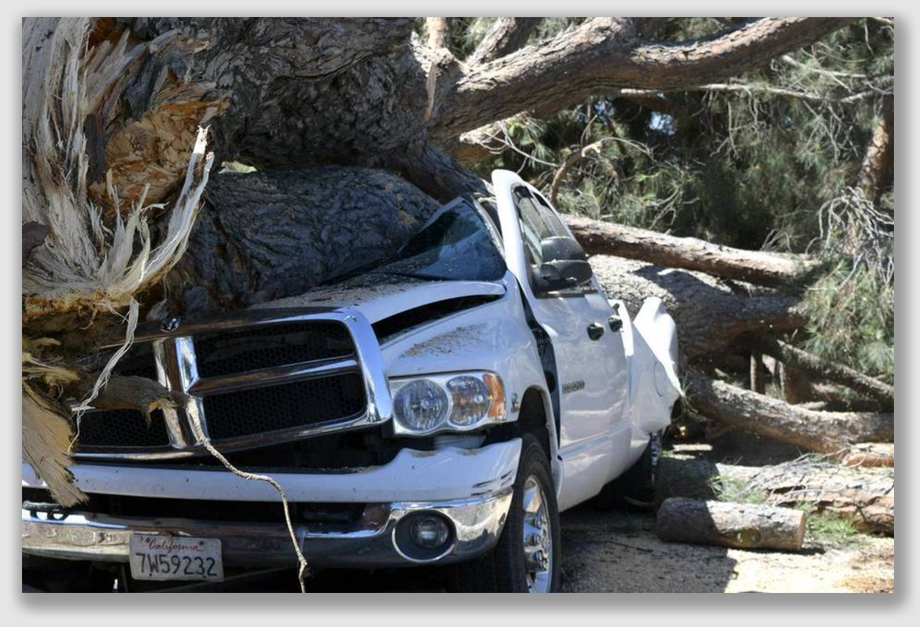
In yesterday’s post, we looked at South Carolina’s duty of care for rural landowners. In today’s case, we see that the duty of care that urban or residential landowners owe to invitees and passersby is much stricter. Ms. Israel was sitting in her car one breezy spring day enjoying what was arguably one of the best barbeque in the South (because people love to argue about this) when a large branch from a neighboring property fell on her car, destroying it and her sandwich. She was troubled about the damage to her car; she was devastated by the loss of the uneaten sandwich. So, naturally, this being the United States of America, she sued everyone.

The trial court awarded her thousands of sandwiches’ worth of damages, but the Court of Appeals reversed. As the owner of property in a residential or urban area, the neighbor had a duty to others outside of his land to exercise reasonable care to prevent unreasonable risk of harm arising from defective or unsound trees on his premises, including trees of purely natural origin. The evidence showed that the decayed tree could be seen from the ground. So the tree’s owner was toast.

But the Court wasn’t willing to serve up any barbeque on the toast. The owner of the pulled pork stand had a duty to his customers to exercise reasonable or ordinary care, measured by his ability to anticipate danger. In the absence of evidence that the restaurant owner either saw or could have seen the decayed limb from his property, he wasn’t liable.

The scene of the mishap - Orangeburg - is n the center of South Carolina "mustard-based" country.

The scene of the mishap – Orangeburg – is in the center of South Carolina’s “mustard-based” barbeque sauce country, a fact probably having nothing to do with the falling tree branch or the subsequent lawsuit …

So, away from the succulent pork (covered in a mustard-based sauce, no doubt) and back to the gutsy little RX-8. The landlord certainly has a duty to his tenants, who are, after all, invitees. And we suppose the house is in a residential area. But was it clear from the ground that the limb was about to let go? If so, the landlord had a duty to fix it. If it was just one of those things, well … that’s what they call anact of God.’

Israel v. Carolina Bar-B-Que, Inc., 292 S.C. 282, 356 S.E.2d 123 (Ct.App. S.C., 1987). Charlotte Israel sued for injuries she received when a large limb from a tree on property owned by Andrew Berry, Trustee, fell over and onto the car in which she was seated and which was parked in the parking area of the Carolina Bar-B-Que. She sued both the owner of the real estate on which the tree was located and the owner of the land onto which the tree fell.

The next-door lot (the “Berry lot”) was 173 by 135 feet, on which there were a number of trees. Some large water oaks, planted about 1911, were located about 25 to 30 feet from the BBQ property line. These trees had received a radical pruning in 1971. Pictures showed visible signs of decay and rot in one of these trees. Some smaller oaks, planted about 1955, were located some 4 to 10 feet from the property line, between the large water oaks and the BBQ parking lot. These trees were bushy with some limbs overhanging the barbeque operator’s property, and having trunks of no more than 12 inches in diameter. A picture showed these trees in relation to the barbeque parking lot. The Carolina Bar-B-Que owner occasionally pruned branches off those trees to the extent they were overhanging his lot. The limb that hit the car came from one of the large water oaks and had a diameter of between 12 and 25 inches. The limb was so large that the Israel car was, in effect, totally destroyed.

The Carolina Bar-B-Que’s manager said that no limbs from the large tree were overhanging his property. He noticed no decayed limbs on these trees. He surmised that the high winds that day “pushed [the limb] out” onto the Barbeque property. When he later removed the trees on this lot, he discovered only one tree in “bad shape,” and it was not the tree from which the limb fell. A police officer who investigated the accident said that the limb was about 25 feet long and that he saw a tree from which the limb apparently came. He admitted that he couldn’t testify that there was a decayed portion of the limb visible from the Barbeque lot. However, the tree could have been inspected from the Berry property.

Ms. Israel sued the trust owning the Berry lot and Carolina Bar-B-Que. The jury awarded an $80,000 verdict (or about 13,333 really good BBQ sandwiches) against both the Barbeque and Mr. Berry. They both appealed.

crush160720Held: The Court reversed the judgment against the Barbeque but affirmed it against the Berry trust. The Court admitted that at common law, Berry would not have been liable for a falling tree or limb. However, the realities of modern life had modified the rule. A landowner in a residential or urban area has a duty to others outside of his land to exercise reasonable care to prevent unreasonable risk of harm arising from defective or unsound trees on his premises, including trees of purely natural origin. Here, the Court said, the evidence supported the finding that Berry, the owner of the land from which the tree limb fell, was negligent. The tree was partially decayed, the limb’s dangerous condition and the likelihood of its falling could have been observed by reasonable inspection, and a reasonable person should have been aware of the danger that the decayed limb posed to persons on the adjoining property.

The Barbeque owed a duty of care to the invitees or business visitors, one of exercising reasonable or ordinary care for the invitee’s safety. Reasonable care required by a business with respect to its invitees is measured by the ability of a reasonably prudent man to anticipate danger under conditions known or reasonably anticipated to exist. In the absence of evidence that the BBQ owner either saw or could have seen a dangerous condition from the Barbeque property with regard to a tree limb on the adjacent property, Carolina Barbeque was not liable to Ms. Israel.

– Tom Root
TNLBGray140407