Case of the Day – Monday, September 16, 2024

NIGHT OF THE ATTACK ROOSTERS

madrooster170227There is little doubt that we in this country enjoy pampering like nowhere else. Animals we once ate for sustenance (or because they tasted good) are now our pets: not only dogs and cats, but Vietnamese pot-bellied pigs, hedgehogs, and even emotional support ducks.

(This has nothing to do with Haitians, dogs and cats, Springfield, Ohio, or the Republican presidential ticket.)

And when we jet off to LA for the Oscars, or Cannes for the movies, or even Munich for Oktoberfest, we need a pet sitter to watch our precious Fluffy. Someone like Josie Gilreath, Professional Pet Sitter.

Come to think of it, Josie – a proud member of the National Association of Professional Pet Sitters (motto: “The ONLY national non-profit organization for professional pet sitters”) – might not be available. She’s still convalescing after a particularly harrowing pet-sitting experience after an encounter with Bruce and Jodi Smith. While watching the Smiths’ chickens, Josie was injured by the Smiths’ attack rooster, who was apparently doing what attack roosters do, which is attack. The kerfluffle left Josie with a serious infection having long-term consequences.

Josie sued, complaining that the Smiths were liable, but the trial court wasn’t buying it. Maybe it was Josie’s 9 years of experience as a professional pet sitter. Maybe it was the sign in the Smiths’ yard that said “CAUTION – AREA PATROLLED BY ATTACK ROOSTER SECURITY CO.” Maybe it was the fact Josie had worked for the Smiths before and had been warned, “Rooster Will Attack!” Of course, it could have been that Jodi Smith had advised Josie to use a garbage can lid for defense against the rooster.

Whatever the reason, the court held Smiths had not withheld any information from Josie, and that by taking the pet-sitting job, Josie had assumed the risk that the rooster would assault her. Thus, she collected nothing.

sign170227Interesting story, one might think, if you own a rooster. True enough, but there’s a tree lesson here. Josie held herself out as a specialist in pet sitting. Like a homeowner who knows she has a danger tree and hires a tree service to remove it, the Smiths had no duty to give Josie any special warnings. Ordinarily, the Court said, “there is no duty to give warning to the members of a profession against generally known risks.”

Josie was a professional pet sitter with nine years of experience, and admitted she had a responsibility to educate herself about the animals she takes care of, yet failed to do so for roosters. The Smiths cannot be blamed, the Court held, if Josie failed to inform herself of those risks.

Likewise, a tree service hired to remove a dangerous tree has no right to expect the homeowner to warn of dangers associated with the job.

Gilreath v. Smith, Case No. A16A1747 (Ct.App. Georgia, Feb. 17, 2017). While pet-sitting for Bruce and Jodi Smith, Josephine Gilreath was attacked and injured by the Smiths’ rooster, which caused a serious infection with long-term consequences. Gilreath sued, but the trial court granted summary judgment in favor of the Smiths on the ground that Gilreath assumed the risk. Gilreath appealed.

Held: Josie Gilreath cannot collect, because she assumed the risk.

For nine years, Josie was self-employed as a pet sitter doing business as Crabapple Critters. During that time, she took care of “horses, dogs, cats, all sorts of animals.” Josie belonged to the National Association of Professional Pet Sitters, an organization so august that it even has a website. Although she had worked briefly on two farms, taking care of horses, prior to working for the Smiths, Josie did not have any training or experience with chickens. As a pet sitter, Josie has a responsibility “to a point” to educate herself about the kind of animals she would be working with, but prior to accepting the job with the Smiths, she had not done any research on how to care for roosters and had not heard anything about their temperament.

For several years before the incident, the Smiths had three dogs and some chickens, including at least one rooster named Sam. The chickens, including Sam, were kept in a coop that had two signs on it, one that said “WELCOME” and one that said “CAUTION AREA PATROLLED BY ATTACK ROOSTER SECURITY CO.” Sam had previously attacked Jodi Smith and her mother, but the Smiths never told that to Josie.
Josie provided pet-sitting services to the Smiths twice before, including taking care of the chickens. Once, the Smiths hired Josie to watch the animals for four days and instructed her on proper feeding the chickens. This included, among other things, opening the door to the coop to fill up the water dishes. Jodi Smith told Josie, “You do not have to fill them up if you feel uncomfortable with Sam the Rooster. I use a garbage can lid to separate myself from him.” Another time, Jodi gave Josie a note to “Just throw food into cages. Rooster will attack!”

The third time, the Smiths gave Josie no further instructions but asked her to collect eggs from the chickens. When she tried to do so, the rooster attacked. It was ugly.

The Court held that Josie assumed the risk of injury because she fully appreciated the danger involved and with her freedom of choice limited by neither circumstances nor coercion, deliberately chose an obviously perilous course of conduct.

The Smiths were obligated to show that Josie had knowledge of the danger, understood and appreciated the risks associated with such danger, and voluntarily exposed herself to those risks. The Court said that “knowledge” does not refer to a comprehension of general, non-specific risks. Rather, the knowledge that a plaintiff who assumes the risk must subjectively possess is that of the specific, particular risk of harm associated with the activity or condition that proximately causes injury.

Here, the Court said, Josie had been warned of the relevant danger during her prior pet sitting, that the rooster would attack and that a garbage can lid was useful for controlling the rooster. Josie claims that if she had known that the rooster had actually attacked Jodi Smith and Jodi’s mother, she “probably” would not have taken the job. But the Court said that was a distinction without a difference: being warned that the rooster will attack is the same as having been warned that the rooster had attacked in the past.
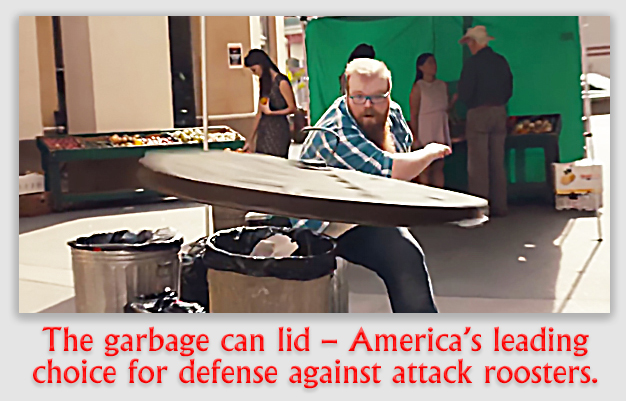
Josie has no evidence the Smiths had superior knowledge of the risks associated with the danger. Although the Smiths knew that the rooster had attacked two people, there is no evidence that they knew that the rooster could cause wounds or infections of the sort that Josie suffered. Ordinarily, there is no duty to give warning to the members of a profession against generally known risks. And Josie, an experienced and professional pet sitter, admitted that she had a responsibility to educate herself about the animals entrusted to her care but failed to do so for roosters. “The Smiths cannot be blamed,” the Court said, “if Josie Gilreath failed to inform herself of those risks.”

Finally, the Court said, Josie admitted that she chose to take the job knowing that she had been told that the rooster would attack. She admitted that she could have turned down the job but chose not to. The Court found she had equal knowledge of the danger and risks and acquiesced in exposing herself to the risk without taking any precautions.

– Tom Root

TNLBGray

Case of the Day – Monday, September 9, 2024

FOOTBALL IS (NOT SO) BACK!

It’s supposed to be the most wonderful time of the year… high school games every Friday night, our beloved Ohio State Buckeyes (and how those Wolverines?) on Saturday, and the Super Bowl-bound Cleveland Browns on Sundays.

In honor of the gridiron season, we resort to cheap metaphors today while considering an unusual and (to us) troubling tree law case. Change the fact pattern by about three feet, and the outcome would have been the opposite of what the court ruled. That is, if Jennifer’s trees had been growing a yard or so south of where they were rooted, they would have been boundary trees. Neighbors Tony and Xiaoye couldn’t have touched them. But because the trunks and root flares of the conifers were all on Jennifer’s land, Tony got away with whacking away so much root support that Jennifer had to take the three trees down.

“Can they do that?” you ask, because you seem to remember a California case that said otherwise. Good recall, tree law fan. Unfortunately, the answer is pretty much, “Yeah, in Washington, they can do that.” But somehow it seems that the answer ought to be otherwise, that your right to Massachusetts Rule-style hacking at your neighbor’s tree should be informed by some kind of a duty not to kill the tree in the process.

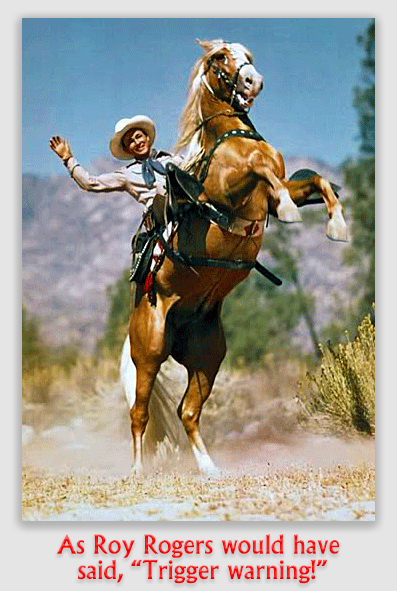
Trigger warning: the outcome of this case is tragic for the trees involved, and those sensitive readers among us who cower at the sound of chainsaws might be needlessly upset.

Mustoe v. Ma, 371 P.3d 544 (Wash.App. 2016). Jennifer Mustoe had two large Douglas fir trees located entirely on her property, about three feet from the property line. Her neighbors were Anthony Jordan and Xiaoye Ma. In October 2013, Tony dug an 18-to-20-inch deep ditch on his property along the border of Jennifer’s lot. In the process, he exposed and removed the trees’ roots, leaving them to extend only 3-4 feet from the trunks, a loss of nearly half of the trees’ roots, all from the south side of the trees. The trees were thus exposed to southerly winds with no support, making the damaged trees likely to fall on Jennifer’s home.

The landscape value of the trees was estimated to be $16,418; the cost of their removal was estimated to be $3,913.

Jennifer filed suit against Xiaoye and Tony, asserting that Tony had negligently, recklessly, and intentionally excavated and damaged her trees. The trial court dismissed Jennifer’s claims, holding that Tony was entitled to remove those portions of roots that had encroached onto his and Xiaoye’s property and that in so doing, he did not owe Jennifer a duty of due care to prevent damage to the trees.

Jennifer appealed.

Held: The Court rejected Jennifer’s claims.

Jennifer started out a field goal behind, because she was compelled to acknowledge that Washington law lets an adjoining landowner engage in self-help and trim the branches and roots of a neighbor’s tree that encroach onto his or her property. Yet, Jennifer argued, the right to self-help does not extend to removing the tree itself, and the State’s common “does not immunize a landowner against liability for damage to the trimmed trees” and argues that the Court should hold that in exercising self-help, a landowner owes a duty of care to prevent damage to the trees themselves.

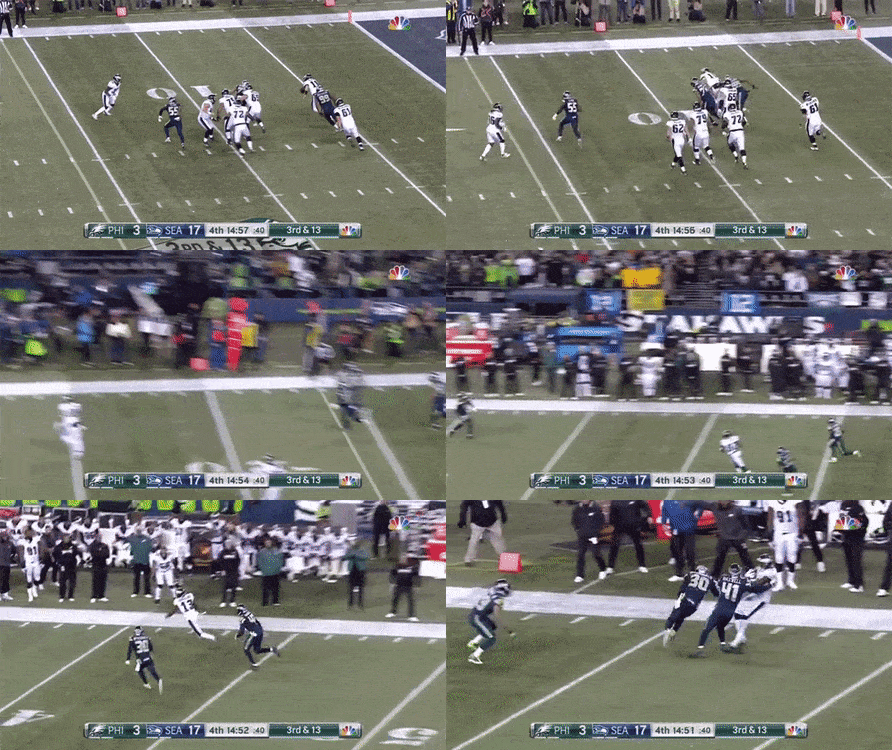
Jennifer thought she’d put one through the uprights and tie the score, but the Court played Lucy to her Charlie Brown. The law was clear, the Court said, that an adjoining landowner may trim only those branches or roots that encroach on his own property, but it did not hold that a landowner owes a duty to act in good faith or reasonably to prevent damage to the trees.

Jennifer also claimed that under state law, all members of society owe a broader legal duty to their fellow citizens and must not use their own property in such a way as to cause injury to others. She cited an exception to the common enemy doctrine in water trespass cases as an example of this duty. The common enemy doctrine allows landowners to dispose of unwanted surface water in any way they see fit, without liability for resulting damage to their neighbors, but a “due care” exception requires that a landowner change surface water flow in good faith and in such a way as not to cause unnecessary damage.

The Court rejected Jenn’s comparison, observing that no court had ever extended the “due care” exception beyond surface water. The Court said, “Surface water is a common enemy precisely because it is a force of nature which may indiscriminately affect any landowner. As such, each landowner may defend against it so long as he or she does not do so in a manner that unnecessarily redirects the wrath of the common enemy upon a neighbor. Unlike surface water, tree roots and branches are not a force of nature that indiscriminately wreak havoc among adjoining landowners. Instead, they are an encroachment upon the land of one’s neighbor.

Jennifer, facing second and long, argued that Booska v. Patel, a California case, found that adjoining landowners had a duty to act reasonably in trimming encroachments where neighbors’ trees were concerned. Citing a decision from the other end of the country, Jennifer argued that in Fliegman v. Rubin, a New York court – relying on Booksa – reversed the trial court’s summary dismissal of a plaintiff’s claims for damages to his trees allegedly resulting from the defendant’s severance of roots that had encroached on to his property. The Fliegman court held there was an issue as to whether severance of the trees’ roots damaged the plaintiff’s trees because “the right to self-help is limited, in that an adjoining landowner’s right to engage in self-help ‘does not extend to the destruction or injury to the main support system of the tree… .'”

Jennifer’s court was unswayed, holding that Booska and Fliegman appeared to be “outliers.” In Alvarez v. Katz, the Vermont Supreme Court rejected the holdings in Booska and Fliegman, finding that the “right to cut encroaching trees where they enter the land of another, without regard to the impact on the encroaching tree by such cutting, is well established under Vermont law.”

Here, the Court was likewise persuaded that the law in Washington was consistent with the general rule as applied in Vermont.

Pinned deep in her own territory on third down, Jennifer aired it out. She contended that her nuisance action against Tony and Xiaoye should go forward because Tony’s excavation and removal of tree roots was unreasonable in relation to the harm it caused to her trees. A nuisance is an unreasonable interference with another’s use and enjoyment of property. RCW 7.48.010 defines an actionable nuisance as “whatever is injurious to health or indecent or offensive to the senses, or an obstruction to the free use of property, so as to essentially interfere with the comfortable enjoyment of the life and property.

The fundamental question in a nuisance issue is whether the use to which land is put can be considered reasonable in relation to all the facts and circumstances. Tony argued that Jennifer had no action for nuisance because she had no legally recognized right. The Court agreed that Jennifer had not established that she had any legal cause for complaint or interference with the lawful removal of the roots on Ma’s property.

A nuisance claim will fail if it is nothing more than a negligence claim “in the garb of nuisance” unless the negligence claim has merit. Where the alleged nuisance is a result of the alleged negligent conduct, the rules of negligence are applied.

Here, Jennifer’s nuisance claim arose from Tony’s actions that damaged the trees; the nuisance is the result of his alleged breach of duty. But there was no breach of duty: because Jennifer’s negligence claim failed, her nuisance claim did, too.

On fourth down and a mile, with only a few seconds left, Jennifer threw the Hail Mary. She complained that she was entitled to damages under the timber trespass statute, RCW 64.12.030. The statute reads, “Whenever any person shall cut down, girdle, or otherwise injure, or carry off any tree… timber, or shrub on the land of another person, … without lawful authority, in an action by the person, city, or town, against the person committing the trespasses or any of them, any judgment for the plaintiff shall be for treble the amount of damages claimed or assessed.”

Alas, the ball fell short. By its own terms, the Court said, the timber trespass statute applied only to persons acting without lawful authority. Because Tony did not act unlawfully when he removed roots that encroached onto his property, the claim fails.

– Tom Root

TNLBGray140407

Case of the Day – Tuesday, August 27, 2024

AS CORNY AS KANSAS IN AUGUST

I am often corny and it is August, but we’re not in Kansas any more, Toto, not that I ever was (instead being full of skibidi Ohio riz). But even in Ohio, I am familiar with the concept of “corn to the corners,” planting corn right up to the fence, even if it makes driving through a country intersection a crap shoot as to whether you’ll get T-boned by an oncoming driver who cannot see you for the cornstalks.

I have written about the visibility problem before, specifically whether a landowner is liable for obstruction of view caused by trees overhanging the right-of-way. It’s something I think about a lot in late August in Ohio, where the corn looks like it’s climbin’ clear up to the sky. Just like it is in Kansas.

A few years ago, the Kansas Supreme Court held off a concerted effort to change its rule that the rural landowner lacked any liability for sightline obstruction.

What made the ruling especially interesting was the Court’s comparison of two different versions of the American Law Institute Restatements on Torts, and the trend proposed in the latest Restatement version that makes any tort duty of care dependent solely on whether the landowner knew or should have known that the risk was obvious. Traditionally, some duties – such as a landowner’s duty of care to people passing by his rural property – were independent of a landowner’s knowledge or, what’s worse, what a reasonable owner’s knowledge should have been. The Restatement (Third) conflates duty and foreseeability into a single element so that anything a landowner could reasonably foresee would establish a duty to avoid.

The Kansas Supreme Court, in a nod to tradition, refused to waltz down that path. Kansas precedent excuses a landowner from a duty to maintain sightlines on highways. And thus, the Court ruled, it still shall be.

Manley v. Hallbauer, Case No. 115,531 (Supreme Court of Kansas, Aug. 10, 2018). Darren Manley died after his truck collided with John Patton’s truck at the intersection of two gravel roads with no traffic signs. Officers investigating the accident found no evidence suggesting that either driver tried to avoid the collision. The officers testified trees located on land abutting the southeast corner made it impossible for northbound traffic to see approaching westbound traffic and for westbound traffic to see approaching northbound traffic.

About five years before the accident, Steven and Kathie Hallbauer purchased the property that included the offending trees. The growth remained unchanged from the time Steve and Kathie bought the property until the accident.

Darren’s estate sued Labette County, John Patton and the Hallbauers. Manley settled with Patton and Labette County, but the case proceeded against the Hallbauers. John testified no one could have had a clear view of Anderson Road south of the intersection because of the tree row and underbrush. John said he did not see Darren before entering the intersection. In the opinion of Darren’s engineering expert, “The lack of proper signage and site distance caused the accident which resulted in the death of Darren Manley.”

Steve and Kathie agreed that the view of the intersection was obstructed from around 50 to 60 feet away when traveling north or west, and they said the intersection would be safer with a stop sign.

The Hallbauers moved for summary judgment, arguing they could not be held liable under Kansas law for the failure to remove trees or other vegetation. The district court agreed, and the court of appeals affirmed, holding that the Hallbauers had no common-law duty to Darren to keep their trees trimmed for visibility purposes.

The appeals panel found that no prior Kansas case governed the outcome and therefore looked to the Restatements of Torts for guidance. But it found the answer differed depending on whether it consulted the Restatement (Second) or the Restatement (Third) of Torts. Under the Restatement (Second), a rural landowner generally is not liable to someone who, while off the property, is injured by a natural condition of the land, like trees. But under the Restatement (Third), a landowner could be held liable if the landowner knew of the risk or if the risk was obvious.

The Court of Appeals followed the older Restatement (Second) view, noting the Restatement (Second) had been applied by the Kansas Supreme Court many times and the Restatement (Third) differs from Kansas law in its analytical approach to negligence. Cases from other states also found no duty under similar circumstances.

The Manley Estate appealed to the Kansas Supreme Court.

Held: Steve and Kathie owed no duty to passing motorists to trim their trees so as not to obstruct visibility on the highway.

Anyone claiming negligence must prove that (1) the defendant owed a duty to the plaintiff, (2) the defendant breached that duty, (3) the breach caused injury to the plaintiff, and (4) the injury resulted in real damages to the plaintiff. Here, the Kansas Supreme Court focused on the first element, duty. Where a duty exists, a person generally has the duty to act as a reasonably prudent person would act in similar circumstances.

The Supreme Court agreed that no Kansas precedent had found such a duty. Kansas law limits the person to whom a duty extends, however, to one who is a foreseeable plaintiff and only to cases where the probability of harm is foreseeable. What’s more, the Supreme Court will recognize a new duty only when the duty is consistent with public policy.

Under the traditional rule applying to the circumstances of this case, “the owner of land is under no affirmative duty to remedy conditions of purely natural origin upon his land.” Instead, the duty is on drivers to “observe obstructions to view and to exercise reasonable care for their own safety and protection.”

The Restatement (Second) of Torts states the traditional rule as being that the possessor of land is not liable for physical harm caused to others outside of the land by a natural condition of the land. ‘Natural condition of the land’ includes “the natural growth of trees, weeds, and may be imposed on an urban landowner “for physical harm resulting from his failure to exercise reasonable care to prevent an unreasonable risk of harm arising from the condition of trees on the land near the highway.” The Restatement (Second) expresses no opinion on whether this exception should apply in rural areas.

The sign’s obscured by a rainforest? That’s fine with Kansas, as long as you didn’t plant it …

Two Kansas cases from the 1920s addressed obstructions to view but established that public policy does not support imposing tort liability on landowners to correct natural conditions occurring entirely on their property that infringe on the visibility of an intersection of public highways. While the Court of Appeals found the cases irrelevant to its analysis in this case, the Supreme Court did not. In fact, the Supreme Court said, the prior decisions recognized Kansas public policy that obstructions caused by woodland or crops ought not to cause the abutting landowners to be liable.

Manley argued that the Supreme Court should depart from traditional Kansas law, and follow the Restatement (Third) of Torts. That rule would impose liability “for natural conditions on land that pose a risk of physical harm to persons or property not on the land… if the possessor knows of the risk or if the risk is obvious.”

The Restatement (Third) criticizes the use of foreseeability in a duty analysis as invading the function of the jury as fact-finder. The Supreme Court decided to “leave for another day the decision whether to adopt other aspects of the Restatement (Third), in particular, whether we should abandon foreseeability as a consideration when analyzing a person’s duty to another.”

Its reasoning was straightforward: it would “adhere to precedent unless clearly convinced that the rule was originally erroneous or is no longer sound because of changing conditions and that more good than harm will come by departing from precedent.”

Here, the Supreme Court was not persuaded to abandon the traditional rule that a landowner owes no duty in the circumstances of this particular case, and thus to weigh into the question of whether Kansas should shift how courts determine a common-law duty. Drivers have a responsibility to drive with caution when conditions result in obstructed visibility. Plus, the traditional rule in premises liability is that landowners have no duty to protect against open and obvious dangers. Instead, individuals have a responsibility to protect themselves from such conditions. “These rules provide strong support for limiting liability under the circumstances of this case,” the Court ruled, “because the active participants in the accident can take steps to avoid a collision given that drivers should drive with caution to protect themselves and others at intersections, especially those with decreased visibility.”

Corn to the corners – and no clear sightline.

The Court noted that “in our state, tall crops and natural conditions often obstruct a driver’s view at a rural intersection. And rural landowners often have many miles of property to maintain. Some of these considerations underlie the distinction between rural and urban landscapes recognized in both the Restatement (Second) and (Third) as influencing court decisions.” Additionally, Kansas statutes confirm that public policy imposes no duty on landowners. Our Legislature has conferred responsibility for the care and maintenance of roads “‘for the safe passage of persons and property on various government entities… Kansas law recognizes landowners have some duty to maintain their property so that trees, plants, shrubs, or other obstructions create no traffic hazard by obstructing the view of passing drivers. However, the responsibility for determining whether a traffic hazard exists falls to the secretary of transportation or local authority. The statute imposes a penalty only if a landowner fails to respond to one of those authorities’ notice.

“Had the Legislature wished to effect a different public policy than that articulated by this court and impose additional civil tort liability on the landowner,” the Court reasoned, “it has had more than 90 years in which to do so.”

To be sure, a different rule may be appropriate for urban areas. Or a different rule may be appropriate when natural growth on the property extends outside the bounds of the property. But the Court was “not faced with those situations today. Here, the accident occurred in a location that is undisputedly rural. There is no indication any part of the trees or overgrowth extend outside the property bounds.”

The Court thus held that a landowner whose property abuts a rural intersection owes no duty to passing drivers to trim or remove trees or other vegetation on the property.

– Tom Root

Case of the Day – Monday, August 26, 2024

MR. NATURAL

natural160111There was an era – back in a time when giants roamed the land – in which a landowner had no duty to protect anyone else from harm resulting due to the natural condition of the land. The judicial thinking was that everyone took the land the way they found it. There’s a century-old oak on the place, and it dies? Well, trees grow and then they die. If it happens to fall on old Zebediah’s cabin next door, that’s just one of those acts of God.

The concept made a certain amount of sense when the land was rural, and no one did much landscaping around the cabin. But as time passed, courts found themselves trying to determine whether that sweet gum that fell on the random horse-drawn wagon passing by had been planted by human agency or just had happened to grow there on its own. Time marched on, the horse gave way to a lot of horsepower, and courts abandoned the “natural condition” rule.  Instead, they simply held that a landowner has a duty of reasonable care over all of the conditions of his or her premises, no matter what their origin.

samara160111

Samara – a botanical term for “whirligig.”

There were a few reasons for the courts’ change of heart. First, if a landowner had a duty to take reasonable care of his or her premises, there was no rational basis for limiting that duty to vegetation that had not been planted by the landowner or those who had owned the place before. After all, when we were kids, we used to break samaras off the backyard maple tree and use them in whirligig contests. Under the old standard, if one of the samaras we dropped during our game took root and grew into a magnificent sugar maple, our folks would have been responsible for the tree. If the wind dropped the same samara, and it took root without our help, the old rule would have absolved our parents of any liability if the tree decayed and then fell on the neighbor boy (an outcome that we, who had been long afflicted by the obnoxious kid next door, would have cheered).

Second, the times, they were a-changin’. America was becoming more urban, and progress demanded that people living in closer proximity to each other with more developed streets and highways, assume more responsibility for injury to each other. Most parcels of property had become smaller – home plots in towns and cities rather than 40-acre and up farms – and the burden placed on landowners to inspect and maintain their premises became less even as the harm that their negligence could cause became greater. The utility and importance of modern roads and the cars and trucks that used them argued for a more responsible approach.

All of that leads to a case like today’s decision, an Indiana decision that asks the philosophical question: If a tree falls in the forest and hits a car, does it sound like a lawsuit?

falls160111That’s certainly the question Stan Valinet was pondering after a tree standing in his forest fell onto Ann Eskew’s car back in 1987.

Robert Frost admitted that “whose woods these are I do not know.”  But Stan Valinet knew.  The woods in Clay Township near 106th and Spring Mill Road were his, and – like most reasonably prudent absentee landowners – Mr. Valinet would occasionally drive through Clay Township to inspect his property. He especially admired a massive oak tree, almost two centuries old, growing about 28 feet from the edge of Spring Mill Road.

One dark and stormy December night, Ann Eskew was driving by this very tree, when 60-mph winds blew the mighty oak onto her car, seriously injuring her. It turned out that the tree had been dead for at least three years, and had been showing signs of decay for at least 8 years before that.

Even in 1991, the Indiana rule held that rural landowners were not liable for physical harm caused to others outside of the land by a natural condition of the land. Mr. Valinet argued that the oak tree had always been there, and its falling on Ms. Eskew – while regrettable – had nothing to do with him.

car160111The Indiana Supreme Court ruled that, regardless of whether the old oak tree was a natural condition of Mr. Valinet’s land or not, he could be liable to Ms. Eskew if his land was located in an area with sufficient population density, and whether the seriousness of the danger is weighed against the ease with which Mr. Valinet could have prevented it. Finding the facts needed to determine the answers to these questions was a job for the jury.

Valinet v. Eskew, 574 N.E.2d 283 (Supreme Court of Indiana, 1991). Stanley Valinet owned wooded land in a residential area of Clay Township, Hamilton County, Indiana, near the intersection of 106th Street and Spring Mill Road. He lived in Indianapolis but testified he would occasionally drive through Clay Township to inspect his property.

Valinet’s land included a large oak tree, perhaps almost 200 years old with a 48” diameter trunk. The tree stood 28 feet from Spring Mill Road. On December 15, 1987, Ann Eskew was driving by the property during a windstorm, when the tree fell onto her car, seriously injuring her. It turned out that the tree had been dead for three years, and had been showing visible signs of decay for eight years before that.

Eskew sued. Valinet argued that the 200-year-old oak was a natural condition of the land, and he was not liable for natural conditions of the land. The jury found him liable to Eskew, and he appealed, first to the Court of Appeals (which agreed with the jury), and then to the Indiana Supreme Court.

Held: The Supreme Court decided that Indiana would follow the general statement of law set out in the Restatement of Law. Restatement (Second) of Torts § 363 provided that while a possessor of land would not be liable for physical harm caused to others outside of the land by a natural condition of the land, if the land is in an urban area, the possessor is liable to people “using a public highway for physical harm resulting from his failure to exercise reasonable care to prevent an unreasonable risk of harm arising from the condition of trees on the land near the highway.”

The Supreme Court acknowledged that the old rule had been no liability for natural conditions on land. That rule, however, had arisen at a time when the land was largely unsettled and the burden imposed on a landowner to inspect was thought to exceed the benefit to society of preventing possible harm to passersby. However, the Court observed, a line of cases had developed since then in which courts imposed a duty on landowners in more heavily populated areas to inspect trees to try to prevent their posing an unreasonable risk of harm to passing motorists. The rationale for imposing the duty on urban landowners is that the risk of harm to highway users is greater there, and the burden of inspection on landowners is lighter.

The Court agreed that the modern approach made more sense, but it underscored that whether the land was in an area of sufficient population density to invoke the rule requires a factual consideration of factors like land use and traffic patterns. Also, whether the landowner exercised reasonable care would require the jury to weigh the seriousness of the danger against the ease with which it could be prevented. The Court noted that a landowner need not continually inspect his or her property for natural dangers, but sometimes fulfilling the owner’s duty to passing motorists “might reasonably require periodic inspections to be sure that the premises do not endanger those lawfully on the highway.”

– Tom Root

TNLBGray

Case of the Day – Wednesday, August 21, 2024

THIS IS WHY YOU SHOULD COME IN OUT OF THE RAIN

duh160901Sad to say, stupidity abounds.

Most of us know – thanks to our mothers – that we should come in out of the rain. One dark and stormy night, Katherine Grigg forgot that life lesson.

Kate was driving on Mount Pleasant Road, in rolling farmland at the foot of the California Sierra Madres. Normally an enjoyable drive, Mount Pleasant Road had become anything but pleasant in the driving rain. She encountered a large tree that had fallen from Dennis Taylor’s yard across the road. Naturally, she got out of her car. Who wouldn’t? Standing in the wind and sheets of rain, she and another weather-challenged motorist, David Eggert, determined the tree was too big for them to move.

As their two-party Mensa meeting continued, a second tree fell, hitting both Grigg and Eggert. This is where you perform a face-slap and say, “D’oh!” You might think these two were Darwin Award contenders, but this was California. So they became plaintiffs instead.

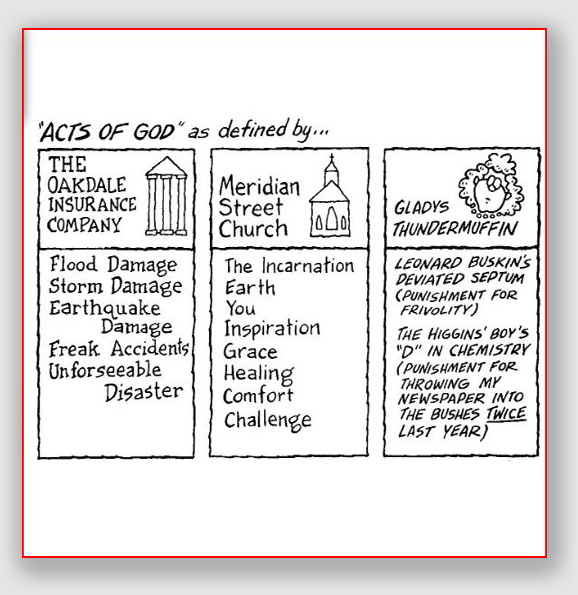
actofgod160901At least Grigg did. The court reports that when she asked Eggert whether they should sue Taylor. Eggert replied, “Why? … this was what I call an act of God.”

Maybe the tree knocked a little sense into him. It had no salubrious effect on Kate Grigg, however. She sued, claiming that Dennis Taylor should have removed the danger trees, and his “conscious choice… to neglect his duties which are prescribed to protect the public, is despicable conduct which is the basis for punitive damages.”

It turned out that Eggert was right. It was an act of God. What’s more, despite the fact that Dennis Taylor had reason to know that this act of God was likely to happen, he nevertheless was found to have done enough – not much, but enough – to discharge his duty to the public. Dennis was found not to be liable.

D’oh, Kate.

Grigg v. Taylor, Case No. C050070 (Superior Ct. Cal. June 28, 2006) 2006 Cal. App. Unpub. LEXIS 5661, 2006 WL 1756843. Plaintiff Katherine Grigg encountered a large tree blocking her way one stormy night on Mount Pleasant Road in Lincoln. The tree had fallen from Dennis Taylor’s property, which was adjacent to the road. Another motorist traveling on the road, David Eggert, parked behind Grigg’s car. Grigg and Eggert got out of their vehicles and determined the tree was too big for them to move. As Eggert was thinking of an alternate route they could take, a second tree fell, striking both Grigg and Eggert.

The tree that had fallen on Grigg and Eggert was one-half of a “V” shaped double-trunk tree. The tree’s other trunk had fallen a few weeks before the accident. When the first trunk fell, Taylor inspected the tree and believed it was not going to fall because several other double-trunk trees on his property were still standing after one trunk had fallen. He decided not to take care of the remaining trunk right away “[b]ecause there w[ere] a series of storms” and he “didn’t feel like getting wet.” Nevertheless, once a week, Dennis checked his property for danger trees. Placer County, California, had no law, ordinance, or regulation requiring landowners to prune their trees.

Grigg sued Taylor for negligence and for maintaining a nuisance by failing to maintain the trees on his property. She wanted compensatory and punitive damages.

The court granted Taylor’s motion for nonsuit regarding punitive damages, and the jury found for Taylor on the remaining claims. Grigg appealed.

daffyduck160901Held: Dennis Taylor was not liable to Kate. On appeal, she complained there was insufficient evidence to support the jury’s verdict that Taylor was not negligent and had not created a nuisance. The Court of Appeals disagreed, citing evidence Taylor had inspected his trees weekly, that he had several double-trunked trees on his property that had lost one trunk but remained safe, and that his neighbor — who had lost a tree in the storm himself — hadn’t seen any hazardous-looking trees on Taylor’s property.

Grigg’s complaint that Taylor had created a nuisance failed on the same evidence. Without Taylor having any liability to Grigg, the complaint that he should have been ordered to pay punitive damages was moot. The Court said, “The jury found Taylor was not negligent in maintaining his property and did not create a nuisance. There was substantial evidence to support those verdicts. Given the jury’s verdicts, any error in granting the nonsuit on Grigg’s theory that Taylor’s conduct was ‘despicable’ was harmless.”

– Tom Root
TNLBGray140407

Case of the Day – Tuesday, August 20, 2024

O TEMPORA, O MORES!

Cicero rails against Cataline in the Senate.

Cicero rails against Cataline in the Senate.

That great Roman senator and statesman, Marcus Tullius Cicero, was raging against Cataline when he uttered the now-famous phrase “O tempora, o mores!”

“Oh, what times, oh, what customs!”

We took Latin in high school, and – thanks in no small part to the late Emily Bernges of Sturgis, Michigan, our magnificent Latin teacher – we developed a great respect for Cicero. Senator Marcus T. had plenty of his own problems to deal with when he gave his first oration against Cataline, but we threw up our hands like he did and asked the same question about today’s case. We have charted how, during the 20th Century, the law governing landowner liability had crept inexorably toward mandating that property owners inspect their trees. In today’s case, a New Jersey court likens trees to product liability, in that a property owner who sells his or her land may remain liable for what happens to the trees well after the new owner takes possession.

“Bull-pucky!” you say. “I sold the place, I’m done with it!” To that we respond first that you need a better class of epithet, and second that you are sadly mistaken.

NBS140428Mr. Narsh had the misfortune to be driving by a wooded lot belonging to a local church when a tree fell on his car. After the funeral, his estate sued the church, as well as the previous owner, the owner before that owner, and the owner before that owner. It’s surprising that the Lenape Indians – who had owned the area back when Giovanni da Verrazzano arrived in 1524 – weren’t co-defendants, too.

It turned out that Zirbser Brothers, Inc., had bought the land three years before the accident. That corporation sold it 18 months later to Zirbser-Greenbriar, Inc. (“ZGI”), which – as its name suggests – was another company owned by the same people who owned Zirbser Brothers, Inc. ZGI built a nursing home on some of the land and conveyed the rest, including the part with the dead tree, to St. Stephen’s Lutheran Church just a few weeks before the accident.

A jury decided that the Estate that had sold the property to Zirbser Brothers, Inc., and the Church were not liable. However, the Zirbser brothers’ two companies were found liable, despite the fact that neither owned the property when the tree fell.

The court first observed that in New Jersey, one who places or maintains in or near a highway anything which, if neglected, will render the way unsafe for travel is bound to exercise due care to prevent it from becoming dangerous. This rule places an affirmative duty on the landowner to prevent trees from becoming dangerous.

We could see that coming from the decisions we reviewed last week. It seems, however, that there was more. The Court said it saw “no reason why an owner who would be liable to a member of the public under the rule … should be absolved from liability by the simple act of the sale of his property.” Calling the rule that a landowner was no longer liable once the property was sold an “[a]ncient distinction,” the appellate court compared the matter to product liability – where manufacturers and everyone else in the supply chain remain on the hook for defects for what seems forever (just ask the general aviation industry) – holding that the landowner could remain responsible for defects even after the land was sold and he could no longer remedy any problems.

The Court found “no support in reason and logic for any distinction between the liability of a vendor of land in an urban area who erects a tower on his land, and one who maintains a rotten tree on his land.” The Court concluded that “[t]he obligation of reasonable inspection which may be involved if a vendor is to be held liable for dangerous conditions existing on his property at the time of its conveyance, is small when compared with the danger posed by a rotten tree poised over a busy highway. The fact that the vendor may have lost the right to go on the property and make repairs is beside the point–the rule is aimed at inducing him to make inspections and guard against dangers before conveyance. The law should be based on current concepts of what is right and just and the judiciary should be alert to the never-ending need for keeping its common law principles abreast of the times.”

Yeah, right. What this means to the prudent homeowner is that any conveyance of real estate should be accompanied by a tree inspection by a certified arborist, that being insurance against the outside chance that someone gets hurt or property gets damaged by a falling tree in the future.

How long in the future? This liability for property that has been sold can’t go on forever, right? After all, the Lenapes didn’t get sued. The Court said that “where an owner of land adjacent to a highway in an urban area, conveys his land, on which is located a tree which he knows, or should know, presents an unreasonable risk of injury to the public, he remains subject to liability for physical harm caused by such condition after his vendee has taken possession … until the vendee has had reasonable opportunity to discover the condition and to take such precautions.”

What’s reasonable? That’s probably for the jury to decide. The problem is, if you’re in front of a civil jury, that means you’re in a trial, and you’ve already lost even if you win. Better to spend the extra money early for an arborist’s inspection at closing.

More cost. More uncertainty. More precautions. Oh, what times! Oh, what customs!

Narsh v. Zirbser Brothers, Inc., 111 N.J.Super. 203, 268 A.2d 46(N.J.Super.A.D. 1970). On April 28, 1967, James H. Narsh met his death when a large tree fell upon him as he was driving his car on North Evergreen Avenue in Woodbury. The plot on which the tree had been standing was heavily wooded with old trees, a number of them being close to the sidewalk. A witness who resided in an apartment across the street heard a cracking noise and saw the tree fall onto the decedent’s car. He had previously noticed that the tree, which was very close to the road, was dead, shedding branches, and appeared quite rotten.

The plot on which the tree had been located had been sold three years before by the estate of Alfred Green to Zirbser Brothers, Inc. Zirbser Brothers, Inc. retained title for two years, then conveyed it to ZGI, a corporation formed by the Zirbser brothers and having the same stockholders, directors and officers as Zirbser Brothers, Inc. ZGI retained a portion of the tract for a nursing home, but on April 20, 1967, sold the remainder – including the portion on which the offending tree was located – to a church. The accident occurred eight days later. All four parties were sued.

The jury exonerated the Green estate and the church, but found both Zirbser Brothers, Inc. and ZGI “guilty of negligence which was a proximate cause of the accident.” The jury awarded $85,000 in damages.

Zirbser Brothers appealed.

Held: Zirbser Brothers, Inc., remained liable for the tree for a reasonable period of time after transfer to the church.

There was ample evidence that the fallen tree, like many others on the property, was rotten, and that any owner should have known it. But Zirbser Brothers, Inc., neither owned nor possessed the lot in question at the time of the accident. Its conveyance to ZGI had taken place almost a year before, although Zirbser was on the property building the nursing home. Some of its construction materials and its construction trailer were still on the land when the accident occurred. Nevertheless, from the time of the sale to the church, Zirbser was without the right to cut down trees or otherwise police the part of the property where the subject tree was located.

The Court held that as of the time of the accident, Zirbser’s presence on the property purchased by the church, standing alone, did not afford an adequate basis for a present duty on its part to guard against the falling of the tree.

Pay the inspector, Shirley ... it's a lot easier and cheaper to do it now.

Pay the inspector, Shirley … it’s a lot easier to do it now … and as a group, they’re cheaper than lawyers.

If one negligently creates a condition on land which is unreasonably dangerous to outsiders, the Court said, there is no good reason why his potential liability should stop either when he transfers possession of that land or when his successor in occupancy becomes liable either because of his possession or because of his fault in negligently omitting to repair the danger. The Court observed that the boundaries of tort liability for dangerous conditions on the land have gradually been extended by our courts in recent years. It held that “[t]he rationale which underlies [a landowner’s] continued liability for a structure on his land would apply equally to a tree which is so close to a highway as to endanger traffic thereon should it fall. In this day and age, with its attendant increase in population, greater use of automobiles and more intense use of land, the presence of a rotten tree along a busy highway poses dangers greatly in excess of those with which the courts were confronted in the cases on which appellant relies. The obligation of reasonable inspection which may be involved if a vendor is to be held liable for dangerous conditions existing on his property at the time of its conveyance is small when compared with the danger posed by a rotten tree poised over a busy highway. The fact that the vendor may have lost the right to go on the property and make repairs is beside the point – the rule is aimed at inducing him to make inspections and guard against dangers before conveyance.”

The Court thus held that where an owner of land adjacent to a highway in an urban area conveys his land – on which is located a tree that he knows or should know presents an unreasonable risk of injury to the public – “he remains subject to liability for physical harm caused by such condition after his vendee has taken possession. If he has actively concealed the condition from the vendee his liability continues until the vendee discovers it and has reasonable opportunity to take effective measures against it, otherwise it continues until the vendee has had reasonable opportunity to discover the condition and to take such precautions.”

The takeaway here: the prudent landowner will have regular inspections of trees done, with written reports, and will follow the reasonable advice of the arborists. When the property is sold, a home inspection may be requested by the buyer, but a grounds inspection should be ordered by the seller.

– Tom Root

TNLBGray

Case of the Day – Friday, August 16, 2024

BUILDING A CASE

Trees falling on vehicles never work out well for the vehicle.

Trees falling on vehicles never work out well for the vehicle.

A family’s Christmas – and for that matter, its future – was ruined on a rural Ohio one dark December night. 

Mike and Traci Reed were driving their two kids home from a Christmas celebration, Traci and her 5-year-old son were in her car, following her husband and their daughter in his, because they had picked up her vehicle at her office, where she had left it earlier. When Mike and daughter Samantha got home, Traci – who had been following them – was no longer behind them. Mike backtracked to find her car crushed by a tree. An EMS worker at the scene told him that his wife was dead and his son was in critical condition.

The wheels of justice ground slowly after the accident. Four years after the accident, the Ohio Court of Claims – which decides questions of the State’s liability – finally decided the question of the Ohio Department of Transportation’s liability. The case is of interest not just because of the dry reduction of human tragedy into the dispassionate allocation of responsibility (although it is interesting for that, too). The findings of fact and conclusions of law handed down by the magistrate (who is kind of an assistant judge) illustrate a well-structured case presented by the plaintiff and a poor rebuttal by ODOT.

One wonders why the State of Ohio didn’t just settle the case if it was going to make such a poor showing. Its own employees made the plaintiff’s case, and its expert pretty much just “phoned it in.” But from the plaintiff’s perspective, the case is a veritable “how to” try a claim of liability against a state agency in a “danger tree” case.

Reed v. Ohio Dept. of Transportation, 2012-Ohio-1244 (Ct.Cl., Mar. 23, 2012). Traci Reed and her young son, Conner, were driving northward through the hilly eastern Ohio countryside when a tree fell on their car. Traci was killed and her son was badly injured.

The tree that fell on Traci had shown as “substantial ‘lean’” in the year prior to the accident, and other trees on the same embankment had fallen during that time. Traci’s husband had observed this, but he had never complained to the Ohio Department of Transportation himself. Rather, he assumed that ODOT knew about the condition because road crews maintained the area throughout the years.

Phoneitin140520

The Court noted that ODOT had a general duty to maintain its highways in a reasonably safe condition for the traveling public, but it is not an insurer of the safety of its highways. ODOT may be held liable for damage caused by defects or dangerous conditions on state highways where it has notice of the condition, either actual or constructive. Actual notice exists where, from competent evidence, the trier of fact can conclude the pertinent information was personally communicated to or received by the party. Constructive notice is that notice that the law regards as sufficient to give notice and is regarded as a substitute for actual notice. Under Ohio law, in order for there to be constructive notice of a nuisance or defect in the highway, that nuisance or defect must have existed for such length of time as to impute knowledge or notice.

The plaintiff (who was the husband of the deceased wife and mother) presented several ODOT employees responsible for vegetation management and hazard abatement along the road in question. He established that some of the employees knew of the tree and believed it to be dangerous, and others – while not recalling the tree ­ – agreed when studying the accident photos that it was dangerous. Plaintiff called a surveyor to establish that the tree had fallen within the state’s right-of-way on the highway and put people on the stand who had lived close to the accident site and who testified that they had seen the tree and thought it was a hazard.

Additionally, the plaintiff produced an urban forestry consultant who was certified by the International Society of Arboriculture as an arborist. The forester prepared for his testimony by reviewing court documents, and photographs, visiting the accident site and examining cut-up tree remnants. He testified that the tree was a 50-year-old red oak and that it contained “reaction wood,” which forms to counter a leaning of the tree. He observed that the pith, the biological center of the tree, was off-center and that the tree’s roots in the embankment showed mild to moderate decay. He concluded that the tree was “hazardous” (as defined by the International Society of Arboriculture Hazard Rating System). His conclusion was based on the tree’s potential to fail and the potential to hit a target, because of its significant lean, its location in a sloped embankment with exposed roots, and the visually obvious deadwood in the crown of the tree. He testified that once a tree is “off vertical” with unstable soil, each progressive year increases the risk of failure. The tree was located on a steep slope, which compromised its stability.

The expert concluded that ODOT failed in its duty to remove a hazardous tree that had several significant defects readily observable from the roadway. He said it was “not a question of if, but a question of when” the tree would fall onto the highway.

ODOT presented the testimony of one of its employees who said he had removed the tree from the road after it fell, and he had been familiar with it prior to that time. He said he had never seen any condition that concerned him, and if he had, he would have reported it. ODOT also presented its own expert, who prepared his testimony in the same manner as did the plaintiff’s expert. He said that the tree has a “classic natural lean,” due to the fact that the tree was on the edge of the woods and it grew toward the sunlight. According to ODOT’s expert, the center of the tree was asymmetric, but there was no indication that the tree was dead or distressed. The State’s expert opined that the tree falling was “natural, it was not predictable.” However, on cross-examination, he conceded that the tree’s center of gravity was “probably not over the roots” and that a tree does not have to be dead, decayed, or diseased in order to be a hazard.

The finder of fact – in this case, a magistrate who heard the evidence for the court ­– found the Reeds’ expert to be more persuasive. The evidence about the tree’s shifted center of gravity carried the day; the court concluded that the red oak tree that fell on Traci Reed’s vehicle was a hazard to the motoring public. As for notice, although ODOT said it had received no complaints from either its staff or the public regarding the tree, two of its employees acknowledged that they were aware that the canopy of the tree extended over the roadway. The court found that ODOT had actual knowledge of the hazardous condition, which had existed for more than a year prior to the accident and which was within the State’s right-of-way.

Actofgod140520

An “Act of God?”

ODOT argued that the property owner where the tree was located was liable for the tree, but ODOT presented no evidence showing that the landowner had actual or constructive notice. As well, it argued that the tree fell due to an act of God. The court rejected that argument. The evidence showed that there was no weather that night that was sufficiently “unusual and overwhelming as to do damage by its own power” to make the falling tree an Act of God. Even if there had been an adverse weather condition on the night of the accident, the Court said, “it has also been the rule of law that, ‘[i]f proper care and diligence [on a defendant’s part] would have avoided the act, it is not excusable as the act of God.'” ODOT’s failure to exercise proper diligence resulted in the tree falling, the Court said, not an act of God.

ODOT was held liable for the falling tree and Traci Reed’s death.

And after considering the damages showing? The Court awarded the family $4 million.

– Tom Root

TNLBGray140407