Case of the Day – Tuesday, November 5, 2024

YOU CAN’T TOUCH THIS

Oh, how good it is to be king!

I recall my shock as a naïve law student when I learned that you couldn’t sue the government unless it gave you permission to do so. Huh? What if you, an individual, could wrap your arms around your man purse and tell a putative plaintiff, “You can’t touch this?” Sweet.

If one had the power to deny someone else the right to sue, who – I wondered in my first-year law cluelessness – would ever give anyone else permission to sue? 

The answer, of course, is the government.

The Federal Tort Claims Act and the various state tort claims acts are wonders of obfuscation. At first reading, it seems the governments are taping a big “kick me” sign to their virtual backs, inviting people to go for the really deep pockets. But then, you read the fine print and slowly comprehend that the right to sue has more holes in it than a cheese grater.

Still, occasionally, a political subdivision will discover that even with all of the exemption loopholes in your typical state tort claims act, it’s still wriggling on the hook. Note in today’s case – in which a motorcycle rider blames some county commissioners for not trimming the trees around a stop sign – how the county tries mightily to hide behind the Oklahoma Governmental Tort Claims Act. Somehow, even with a host of exceptions written into the Act, the Board of County Commissioners could not find a shield against liability.

Lopez v. Board of County Commissioners of Cherokee County, 383 P.3d 790 (Okla.Civ.App. 2016). Teresa Lopez was a passenger on a motorcycle operated by Glen Baker when he turned left, failing to yield to a stop sign. Tom Molloy struck Glen’s Harley, seriously injuring Teresa. She sued Glen and Tom, claiming that the Board of County Commissioners of Cherokee County Board was negligent in failing to trim the vegetation that she said obstructed the view of both drivers. Teresa maintained that the Board “had a duty to maintain advance warning signs and [sight] line vegetation control” at the intersection.

The Board filed a motion for summary judgment, arguing that it was immune from suit for Teresa’s claims under the Oklahoma Governmental Tort Claims Act and that it could not be held liable for any claims related to the placing of traffic control signs at the intersection. Teresa argued that the GTCA exemptions do not apply and that the Board had a duty to maintain foliage around its county road intersections, including its rights of way and beyond.

The trial court granted the Board’s motion for summary judgment, finding the GTCA exemptions applied.

Teresa appealed.

Held: The Board was not immune under the GTCA.

The first exemption the Board relied on for immunity was § 155(4), which states “a political subdivision shall not be liable if a loss or claim results from… adoption or enforcement of or failure to adopt or enforce a law, whether valid or invalid, including, but not limited to, any statute, charter provision, ordinance, resolution, rule, regulation or written policy.”

The Board argued that Teresa complained it had “failed to adopt a policy that would require its mowers to mow beyond the 16½-foot statutory right-of-way.” Teresa responded that she did not claim that a lack of policy was to blame for the overgrown foliage, but rather the “negligent manner in which they cleared the subject intersection.”

The Board asserted as an undisputed fact that the obstructing foliage was located on private property and that it “only mows foliage within its statutory right-of-way, not on the land of other property owners.” The Court held, however, that “evidence in the record does show the Board, as it has in the past, could have sought permission from the landowner to remove the vegetation but did not in this case.” But other evidence suggested that Board employees never mowed over 5 feet on either side of the road because of the width of the mowing equipment. “Based on this record,” the Court said, “the Board has not established that it mowed the entire width of its ‘statutory-right-of-way’ at this intersection.”

Even if the foliage on the intersection’s east side was located on private property outside the right-of-way, the Board did not establish the absence of overhanging limbs or shrub overgrowth within the right-of-way for which it has admittedly assumed responsibility. The Court held Teresa was entitled to the inference that some of the foliage and vegetation obstructing the motorcycle drivers’ views was located in the County’s right-of-way. Therefore, the Court said, a dispute of material fact remains regarding the applicability of this exemption, and summary judgment pursuant to 51 O.S. § 155(4) on this question was improper.

The second exemption the Board relied on is § 155(5), which states “a political subdivision shall not be liable if a loss or claim results from… performance of or the failure to exercise or perform any act or service which is in the discretion of the state or political subdivision or its employees.” The Board argued that the decision to mow the area at all was its discretionary decision.

The state and its political subdivisions are specifically exempt from liability if the loss results from the performance or failure to perform a discretionary act or service. But the discretionary function exemption from governmental liability is limited to initial policy level or planning decisions. On the other hand, the Court ruled, “operational level decisions made in performance of policy are considered ministerial and the government is not exempt from liability with respect to operational decisions.”

Put simply, the Court said, a municipality has discretion whether to do or not to do a public work or improvement… The duty is discretionary up to the time that it is determined to do the work or improvement.” However, “after the work is ordered and involves merely the execution of a set task, nothing remains for discretion: the duty becomes ‘ministerial’ or ‘operational’ and requires the municipality to do the work with reasonable care and in a non-negligent manner.”

Here, one of the board members testified he could refuse to do any mowing district-wide if he so chose, but he admitted he had never refused to do so. In fact, he conceded that “mowing is part of the operational responsibilities of Cherokee County” and that, ordinarily, the County would “try to stick with the right-of-way” because otherwise it would “catch trouble” from property owners.

Neither party disputed that the County had in the past and could have, in this instance sought the property owner’s permission to clear the vegetation and foliage that Teresa claimed was obstructing visibility at this intersection. “These actions do not fall under the County’s discretionary function exemption but constitute operational responsibilities,” the Court held, and thus § 155(5) did not apply to this case.

The third exemption claimed by the Board was § 155(10), which provides, “The state or a political subdivision shall not be liable if a loss or claim results from… natural conditions of property of the state or political subdivision.” The Board argued that “it is clearly undisputed that the growth of vegetation is a natural condition of Board property.” The Board did not cause the vegetation to grow; it was “a natural process of all vegetation throughout the world.” To the extent that Teresa’s claim arose from “the natural growth of vegetation on the statutory right-of-way,” the Board said, it was “exempt from liability from the claim under” § 155(10).

The Court, however, held that “natural conditions” were simply conditions over which a person has no control. “The vegetation here was clearly not a condition ‘over which [a person] has no control’,” the Court ruled, “because the Board admittedly had the responsibility to mow and maintain its statutory right-of-way at the intersection.” Therefore, § 155(10) did not apply.

Finally, the Board contended § 155(13) shielded it from liability because a “claim based on failure to inspect government property at regular intervals is exempt from liability.” The Board characterized Teresa’s claim as being “essentially a claim that the Board did not properly inspect the road to determine whether additional mowing of vegetation needed to be done.”

The Court disagreed, holding that “maintenance of property is not the same thing as inspection of property for § 155(13).” A landowner may be liable for negligent maintenance of property irrespective of its inspection powers or functions, the Court said. Thus, an exemption arising from an inspection power or function could not include becoming aware of circumstances “in a general sense without also bringing many types of negligence cases within the class of exempted claims.” To hold otherwise, the Court said, “would put in doubt the viability of every GTCA claim based upon what a defendant should have known…” and thus expand the application § 155(13) to the point “that many other provisions of § 155 would be superfluous.”

The inspection exemption in § 155(13) describes the exercise of a particular governmental “power” or “function,” not a simple familiarization with one’s own property. Governmental entities exercise inspection powers and functions in many contexts, the Court observed, but not where inspection would merely familiarize the Board with its own property.

The Board seemed to assert that a failure to inspect the road to determine whether additional mowing needed to be done constituted an inspection function covered by § 155(13). The Court said, “Because no particular governmental inspection power or function is at issue in this case, we conclude § 155(13) is not applicable.”

Teresa was able to take the Board to trial.

– Tom Root

TNLBGray140407

Case of the Day – Wednesday, October 30, 2024

YOUR RESPONSE STINKS

aspirin140917This case is the septic equivalent to the old doctor’s advice of “take two aspirin and call me in the morning.”

Mrs. Hubbell was a resident of Xenia, a small city in southeastern Ohio (Motto: One of America’s only cities to start with ‘x’). One unfortunate day, Mrs. Hubbell discovered that ‘x’ didn’t just stand for “Xenia.” It stood for ‘x’crement, too.

When Mrs. Hubbell’s basement, bathroom and kitchen all started filling up with some pretty nasty effluent from the sewer line, she called the emergency helpline the City of Xenia maintained for homeowners with such smelly problems. But it was the weekend, and the sewer department worker on duty wasn’t too keen on going out in the rain to check out her problem. He figured that it was just the rain backing things up, and if it were really bad, Mrs. Hubbell would call again.

Well, it was really bad, and Mrs. Hubbell did call again an hour later, to catalog all of the types of malodorous waste bubbling into rooms all over her house. That time, the worker did come. When he and his assistants pulled a manhole cover off the sewer main around the corner, a fountain of filth erupted and the liquid waste in the Hubbell home started draining away. It turned out that tree roots had jammed up the sewer main, and the City’s maintenance program hadn’t gotten around to clearing them away.

Mrs. Hubbell was unhappy at the Sewer Department’s lackadaisical response to her problem, so she sued. The City claimed it was immune under Ohio’s governmental immunity statute because its inspection program was an exercise in discretion. True, the Court agreed, but there was nothing requiring any special expertise in the lazy worker’s refusal to respond when Mrs. Hubbell reported a problem. The problem, the Court said, is that almost everything required some discretion, and to accept the City’s argument meant that everything a governmental entity did would be immune.

Erupting effluvient …

Here, the City had a kind of a contract with its residents. The City offered an emergency number, and the implied deal was that if a local taxpayer called, the City would respond. The worker’s decision to let the stink build — and to be sure, it was a real problem worthy of his attention on a Sunday afternoon — could easily be negligence. The Court said Mrs. Hubbell was entitled to her chance to prove that to a jury.

Hubbell v. Xenia, 175 Ohio App.3d 99, 885 N.E.2d 290 (Ct.App. Ohio 2008). Water and sewage began flowing into Mrs. Hubbell’s home through drains in a shower, a toilet, and a bathroom sink. Believing that the stinking problem was likely caused by a malfunction in the sewer system maintained by the City of Xenia. She called the City’s emergency services, and the call automatically transferred to the Xenia Police Department. The police paged an on-call sewer and waste maintenance worker, but he refused to do anything, suspecting that the problem was likely the result of heavy rainfall that day.

The sewage and dirty water continued to flow into Mrs. Hubbell’s home, and she desperately placed a second call for help several hours later. This time, the on-call worker decided to respond and investigate the problem, and a service crew was brought in.

Hubbell’s home is located at the intersection of Monroe and Home Avenues. The house is connected to the sewer main on Home Avenue, which in turn connects to the main on Monroe Avenue. The service crew examined the Home Avenue main line and found it was flowing freely, but when they removed the Monroe Avenue manhole cover, the backup into Hubbell’s house promptly subsided. The crew removed tree roots that had invaded the main. Sewer Department officials conceded that the roots may have contributed to the blockage.

Hubbell sued, alleging that Xenia was negligent in maintaining and operating its sewer line because it failed to inspect the Monroe Street main, allowing the line to become obstructed and clogged by tree roots and collected refuse, causing the back-up into her home. She also said the sewer condition constituted a nuisance for which Xenia was liable. Xenia claimed it was immune from liability under the Political Subdivision and Tort Liability Act.

The trial court refused to throw the case out, and Xenia appealed.

Held: The City was not entitled to have the case dismissed without trial. Generally, the Court said, where a municipal corporation assumes the management and control of a sewer, it is required to exercise reasonable diligence and care to keep the system in repair and free from conditions that will cause damage to private property. The municipality’s failure to do so may make it liable for damages caused by its negligence.

However, a municipal corporation’s liability is nevertheless subject to the defense of governmental immunity provided by §2744.01 of the Ohio Revised Code, if any of the five exceptions or one of the defenses to immunity set out in the statute apply.

digging140917Here, the Court ruled, Xenia’s ongoing inspection and cleaning of its sewer lines were entitled to governmental immunity because the execution of the program involved judgment and discretion as to how extensive and in what manner the program would be executed. However, routine decisions requiring little judgment or discretion and which, instead, portray inadvertence, inattention, or neglect, are not covered by the statute’s grant of immunity.

The City maintenance worker’s decision not to respond to Mrs. Hubbell’s call regarding the sewer backup incident, due to his belief that her problem resulted from excess rainfall, wasn’t an act of judgment or discretion for which the city was entitled to governmental immunity. Instead, the City’s contractual agreement with its residents to provide emergency services to those to whom it provided sewer services gave rise to a duty to perform such emergency services with ordinary care.

When one undertakes a duty to perform an act, and another reasonably relies on that undertaking, the act must generally be performed with ordinary care. A genuine issue of material fact existed, the Court said, as to whether the City was negligent in its performance of its duty to provide emergency services to Mrs. Hubbell, and that matter could only be settled at trial.

– Tom Root

Case of the Day – Monday, October 21, 2024

WE ALWAYS MEANT IT

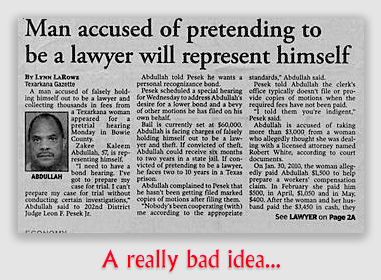
An entire e-cottage industry has grown up around the notion that there are some areas of the law – incorporation, wills, real estate transactions, contracts, divorce – where all you need to do is download some PDF fillable forms, answer a few simple questions, and save yourself a ton of money by representing yourself. When we complain about it, our admonitions are written off as self-interest.

But we always meant it. So, using an argument you might correctly characterize as reductio ad absurdum, we give you Nellie Francis.

Nellie believed she was suffering from some encroaching trees belonging to her neighbor. So she did what any red-blooded American would do: she sued.

After all, how hard can this be? Nellie filed a complaint, sent off a few motions, and called some witnesses. That’s all that a real lawyer would do, after all, and he or she would charge you $10,000 to do it.

Whoa, Nellie! She filed all sorts of motions, kept trying to amend her complaint, and even added damages for which she had been paid, which never happened, or – in one case – which happened to someone else, but she claimed it anyway.

The trial court sanctioned Nellie, requiring her to pay the defendant’s legal fees for a particularly egregious and frivolous filing. Undaunted, Nellie filed a demand that he pay her legal fees as well, not the least inconvenienced by the fact that she was representing herself, that is, she was pro se, and so she had no fees.

For that matter, at trial, she could not even prove that the fallen branches came from defendant Joshua’s trees. That seems kind of basic, the notion that you don’t sue unless you have some proof that the defendant is the one who caused you harm.

Those are the kind of technicalities that lawyers worry about. That’s why, Legal Zoom or not, they continue to be a necessary evil. Just ask Nellie…

Francis v. Brown, 836 A.2d 206 (R.I. 2003). A simple dispute between two abutting landowners and allegations of negligence in maintaining trees running along the property line between them brought Nellie S. Francis, representing herself (never a good idea) and Joshua Brown into court.

Nellie S. Francis lives at 16 Miller Avenue in Providence. The rear of her property is bordered by a 100’ fence, part of which abuts Joshua Brown’s place at 21-23 Verndale Avenue. A row of mature maple trees stands along the boundary between Nellie’s and Josh’s.

Nellie sued Josh, contending he was negligent for failing to maintain the trees or to prune rotted limbs that constantly fell into her backyard, causing injury to herself, her children, her dog and her elderly mother, as well as damages to her fence, two cars, a concrete floor of a torn-down garage, a swing set, and a doghouse. Josh denied all of Nellie’s allegations.

In February 2000, Josh moved to enter on to Nellie’s land to remove any trees belonging to him. She objected to his entry unless he assumed the liability for any damage done by work crews. Nell filed her own motion to compel Josh to cut down the trees on his property. As a result, Josh filed a motion for sanctions based on Nellie having proposed orders inconsistent with prior court rulings, and having filed frivolous motions to compel Josh to do that which she simultaneously had opposed. The hearing justice agreed and further found that Nell had caused unnecessary delay and increased Josh’s cost of litigation. She was ordered to pay $350 to defense counsel by June 9, 2000.

Along with her blizzard of pretrial motions, Nellie found time to move to amend her complaint on more than one occasion to add further damages. She also appealed to try to review an order denying her motion for reconsideration of an order granting Joshua’s motion for assessment of legal fees against Nellie. Undaunted by the prospect of the trial court sanctioning her for her vigorous and unschooled courtroom antics, Nellie sought leave to amend her complaint for a second time, this time incorporating diverse and sundry damages not included in her first amended complaint. The trial court turned her motion down, finding it was “too late [and] inappropriate,” and prohibiting her from bringing forth any incidents not referred to in her first amended complaint. What’s more, the trial justice ruled that Nellie would be precluded from presenting any medical evidence relating to animals or persons not named as complainants. Finally, he ruled that no information regarding insurance coverage would be given to the jury so that the jury would decide the matter on the merits and not on the defendant’s ability to pay.

Neophyte Nellie fared little better at trial. She presented several witnesses, including herself and her daughters, but conceded that she did not know what caused the branches to fall, nor could she state with certainty whether branches shown to her in photo exhibits had come from Joshua’s property or that of the vacant property next door. She admitted that she did not own the two vehicles damaged by trees for which she sought compensation. Neither of her daughters could pinpoint from whose property the fallen branches originated and neither offered testimony as to what caused the branches to fall. Louis Bobola, the director of forestry for the City of Providence testified that the trees were not on city property. He also said that the trees needed pruning, but that he did not see any decay on the trees.

Joshua’s lawyer introduced evidence that six years before, Nellie’s insurance carrier had already paid her for some of the tree damage she had now claimed. At the end of the trial, the judge granted Joshua judgment as a matter of law, holding that Nellie had utterly failed to prove her claim:

“The problem with the entire case is there is no evidence before the jury with regard to any damages sustained in this case by the plaintiff or her property… [T]here is not a scintilla of evidence before this court as to what tree or trees occasioned the alleged injury, on whose property they were located, were they on the defendant’s property or were they on the abutting property on the boarded-up house. And throughout the case, while there are certain inferences that can be drawn that branches do not fall on their own from trees, it simply in this [c]ourt’s view is not sufficient to be able to predicate a finding of negligence on the part of the defendant simply because this event has occurred… Mere ownership of trees that may or may not have caused damages does not impute negligence to the owner.”

The unsinkable Nellie filed for reconsideration, which the judge treated as a motion for a new trial. The court, charitably noting that Nellie had undertaken a difficult task by representing herself in the matter, found that the record was devoid of any objective damage for the jury to consider even if she had satisfied the first two requirements of negligence and proximate cause.

Nellie appealed to the Supreme Court.

Held: The trial court was upheld in every regard.

After reciting a litany of Nellie’s failings, the Court upheld the trial court’s evidentiary rulings, refusal of Nellie’s repeated amendments and judgment for Joshua. As for Nellie’s amendments, the Court agreed with the trial judge that she had been allowed to amend once, the trial date was upon the parties, and the amendment was flawed, with “many of the proposed incidents that plaintiff sought to add occurred several years previously. We believe that plaintiff was aware of their occurrence well before she filed her original complaint.”

After all of that, the trial court’s modest $350.00 sanction of Nellie seemed restrained. Noting that Joshua “was awarded $350 in fees as a sanction against plaintiff for filing motions and making pretrial objections for inappropriate purposes,” the Supreme Court held that “the trial justice awarded a reasonable fee, well below the amount requested by defendant, for the purpose of giving “a warning” to the plaintiff. We believe the sanction was justified and well within the trial justice’s discretion.”

Nellie had made her own demand that Joshua pay her a “pro se” fee for the work she had done on her own case. The Court drily said, “We decline to address the plaintiff’s appeal from the denial of her motion for an award of pro se fees. The plaintiff has not supplied this Court with an adequate record on which to review the issue, and therefore, we deny and dismiss her appeal on this issue.”

– Tom Root

TNLBGray

Case of the Day – Friday, October 11, 2024

SHE SURE GOT HER BELL RUNG

bell160125A young girl and her friend sneaked onto church property to play. While they were doing whatever young kids do when they’re where they shouldn’t be, the girl pushed on a bell. The bell fell, injuring her foot. When kids trespass and do stupid things, how do the parents respond? Why, they sue the landowner, of course.

In this case, it was a local Catholic Church getting sued – unusually enough – for something that had nothing to do with sex abuse. Despite the Diocese’s obvious relief at being sued on behalf of a child plaintiff who wasn’t complaining about a priest, the Church nonetheless argued that it enjoyed immunity under Wisconsin’s recreational use law.

In a strange analysis, the Court of Appeals disagreed. Reba was hurt when she pushed on the bell, and the Court held that her pushing the bell wasn’t related to the game she and her friend had been playing. This, the Court said, was mischief. Plus, the Court said, the Church wasn’t really a recreational property, and the Church didn’t invite people to use it as such. In fact, it took steps to keep kids from playing there. So because Reba was engaging in mischief as a trespasser and because the Church was arguably acting responsibly in trying to prevent this kind of conduct from occurring, it owed Reba a greater duty than had it left the place wide open. This is probably a correct application of the recreational use statute, but it seems not to make a lot of sense as a matter of public policy.

"Trespasser William" the kid was not ...

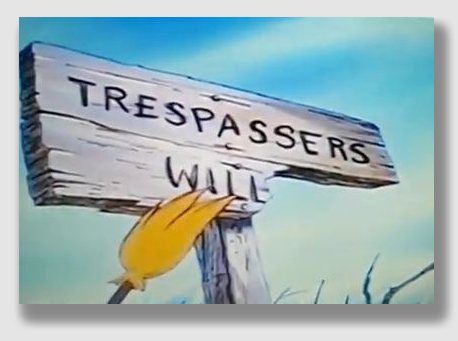
            Remember Winnie the Pooh? “Trespasser William” young Reba was not …

Fortunately, under Wisconsin law, the Church only would have owed a duty to a trespasser to refrain from willful, wanton, or reckless conduct, about the same result the Church would have gotten from application of the recreational use statute. Unfortunately, a jury found the Church had engaged in such conduct and awarded the plaintiff money damages.

You might think that you have no duty to a trespasser wandering onto your property. Guess again.

Fargo ex rel. MacArthur v. United Nat. Ins. Co., 739 N.W.2d 490 (Wis.App., 2007). A child playing house on church property was injured when she tried to push on a bell, which fell and injured her. The girl sued the St. Ignatius Catholic Church through her parents for negligence, and a jury awarded her damages. St. Ignatius appealed, arguing that it was entitled to immunity under the Recreational Use law, Wis. Stat. §892.52.

Daffy160125Held:  The award of damages to young Miss Fargo was affirmed. The recreational immunity statute limits property owners’ liability toward others who use their property for recreational activities. The statute defines recreational activity as “any outdoor activity undertaken for exercise, relaxation or pleasure…” It lists 29 specific recreational activities but instructs that “recreational activity” should be liberally construed in favor of property owners to protect them from liability.

To determine whether a person was engaged in a recreational activity under the statute, the Court said, a fact-finder should consider the totality of circumstances surrounding the activity, examining the intrinsic nature of the activity, the purpose of the activity — including the injured person’s subjective assessment of the activity — and consequences of the activity. A court should also consider the nature of the property, including whether the owner intended the property to be used for recreational activities, and the reason the injured person is on the property.

The Church should have posted this sign. Er ... on second thought, maybe not .

     The Church should have posted this sign.  Um … on second thought, maybe not.

Here, St. Ignatius argued it was entitled to immunity because young Reba Fargo was injured while playing house with a friend on church property, and this was a recreational activity. The Court disagreed. Instead, it ruled that Reba was injured when she pushed the bell, which fell on her foot. The Court held that her act of pushing the bell wasn’t related to the game she had been playing. Rather, viewing the activity objectively, she was attempting to move a large, stationary object by pushing very hard.

The Court concluded that this independent act was mischievous because Fargo was trying to move an object that was not designed to move. Wisconsin law holds that mischievous conduct is not a recreational activity. What’s more, considering the nature of the property, St. Ignatius was a church, not a playground or other place where recreational activity would usually occur. The church made attempts to limit children playing on its property. While not determinative, that fact was an appropriate factor bearing on the recreational use analysis.

Considering all of the factors, the Court concluded that Reba Fargo was not engaged in a “recreational activity” within the meaning of the Recreational Use statute. Thus, St. Ignatius was not entitled to immunity.

– Tom Root
TNLBGray

Case of the Day – Thursday, October 3, 2024

THE EAGLE HAS LANDED

Unlike the kid above, our Ralph wasn't quick like a bunny when the branch fell.

Unlike the kid above, our Ralphie wasn’t quick like a bunny when the branch fell.

When the elder Mr. Eagle volunteered to help trim a tree at his church, his son Ralph tagged along. It seems that Ralphie was anxious to help Daddy.

Ah, the brashness of youth! The lad (he was 50 years old, but he still lived with mom and dad, so he was unquestionably a kid, albeit a big one), shouldered the three septuagenarians out of the way and climbed the ladder himself. Well, one thing led to another, and the group of tree-trimming amateurs lost control of a limb. The limb fell, the 70-year old man holding the ladder jumped out of the way to avoid being hit, and the falling limb knocked the ladder out of the way. Ralphie fell off the ladder and landed — hard.

Having his eye on the collection plate, the litigious Eaglet sued the Church, the other retirees and, of course, his own father (with whom he resided) for negligence. He claimed that the volunteers were acting as agents of the church, making the church liable.

The trial court would have none of this, and threw the case out. The Court of Appeals agreed, finding that as volunteers, the tree-trimming crewmembers owed each other reasonable care at most. And it wasn’t reasonable to believe the man holding the ladder would stand and take a hit when the limb fell. There wasn’t evidence that any of the trimmers were negligent, so the Church couldn’t be liable.

As for premises liability, the Court said, the evidence showed Eagle had volunteered to help three old men do something dangerous: he should have seen it coming. In reading the decision, one gets the impression that neither the trial court nor the appellate panel thought much of the young Eagle, who horned in on the volunteer effort, ignored his father’s request that he not participate, and then — after getting hurt — suing everyone involved.

FallingMan15101Eagle v. Owens, Case No. C-060446, 2007-Ohio-2662, 200y Ohio App. LEXIS 2469 (Ct.App. Hamilton Co., 2007). A small church needed some tree trimming performed. During a Sunday service, the pastor had asked for volunteers to perform the tree-trimming task. The church typically relied on volunteers for landscaping work, including potentially dangerous work such as trimming trees. Merida and Owens volunteered for the task. Both had performed similar tasks for the church on several occasions in the past without incident.

Before leaving the church that day, the two volunteers stood by the tree to examine what had to be done. When Eagle’s father walked by, they recruited him to help them. Eagle’s father was a deacon of the church, an unpaid, rotating position that required him to make decisions for the church’s benefit with the four other deacons. Ultimately, the three men, all over the age of 70, agreed to meet the next morning to perform the task.

When the elder Eagle arrived the next day, he brought his 50-year-old son with him. The son thought the other volunteers were too old, so he took over trimming from a ladder perch. Before the younger Eagle began sawing, his father insisted on changing the position of the rope around the limb. Merida remembered telling Eagle’s father that he did not like the change, but he claimed that he deferred to him because he was a deacon. The limb did not fall cleanly, and its branches knocked over the ladder the younger Eagle was standing on. One of the men who had been holding the ladder ran to avoid being struck by the limb. Eagle fell and was injured.

He sued everyone who was there, as well as the church, alleging that they had “carelessly and negligently caused a tree limb to fall and strike” him. He also alleged that his father, Owens, and Merida were acting as agents or employees of the church when the accident occurred and that the church was responsible for the acts of its agents. The individual defendants moved for summary judgment on the basis that Eagle had assumed the risk of any injury by participating in such an inherently dangerous activity. The church moved for summary judgment on the respondeat superior claim, arguing that it could not be liable where the individual defendants were not negligent and were not agents of the church, and where Eagle had assumed the risk.

The trial court granted summary judgment for the defendants without giving any reasons or issuing a decision. The younger Eagle appealed.

Held: The young Eagle’s wings were clipped. The Court agreed with the trial court’s dismissal, holding that as nonprofessional volunteers, the defendants at most owed Eagle a duty of reasonable care under the circumstances. Eagle did not present any testimony, expert or otherwise, to demonstrate how his father’s, Merida’s, or Owens’ conduct fell below a standard of reasonable care. No one foresaw that the branches on the limb would strike Eagle after breaking off from the trunk, and no one expected Owens to hold the ladder if it swayed while Eagle was on it, because it was obvious that he was physically unable to do so. And if he had stayed to steady the ladder, he likely would have been struck and injured by a large limb.

fallsign150114The Court held that the duty of reasonable care did not require such a foolish act of bravery, despite Eagle’s assertion that he would have steadied the ladder and suffered the blow of the limb if the roles had been reversed. To establish a claim against the church under the doctrine of respondeat superior, the record must demonstrate that a principal-agent relationship existed and that the tortious conduct was committed by the agent while in the scope of his agency.

Here, the Court said, it did not need to determine whether reasonable minds could have concluded that any of the three men were agents of the church and whether Eagle was injured by acts taken within the scope of that agency because the individual defendants did not act tortiously towards Eagle in carrying out the task. Where there is no actionable conduct by an agent, there can be no vicarious liability for the principal. Finally, on the claim of premises liability, the Court held that in determining the duty the church owed to Eagle, it had to focus on Eagle’s status as a participant in the tree-trimming task, because his injury resulted from his participation in this task and not from his status as a person present on the church’s property in general.

It was undisputed that Eagle was warned of the danger, that the church had always used volunteers – including Merida and Owens – to perform similar tree-trimming tasks in the past, and that these volunteers had always performed without incident. Eagle did not present any testimony from a tree-trimming professional to attack the church’s decision to use these same volunteers to remove this limb. The Court concluded that reasonable minds could come to only one conclusion, and that conclusion was that the church did not breach a duty of care owed to Eagle.

– Tom Root

TNLBGray

Case of the Day – Monday, September 30, 2024

TREE HUGS CAR, THEN COURT HUGS TREE

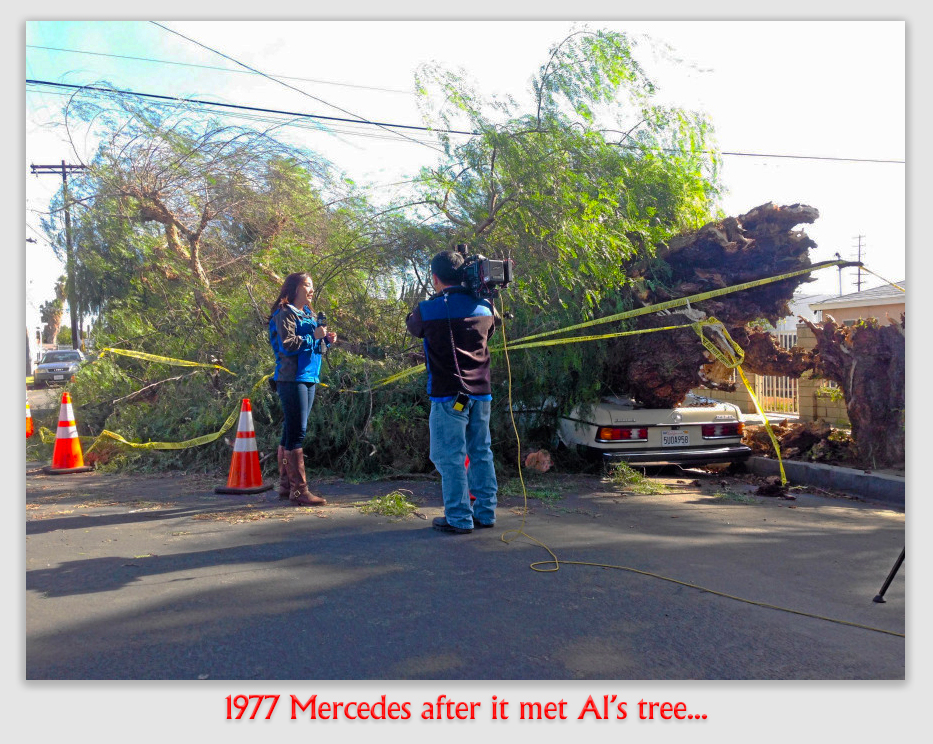
What does the Amazon rainforest have to do with a ’77 Mercedes Benz?

When Vic’s beautiful 1977 Benz was crushed by Al’s tree (while Vic was driving his convertible down the road), Vic knew for a fact that someone had to pay for the damage, and it wasn’t going to be him. Al should have known that the tree was going to fall down, Vic fumed in his lawsuit. That argument lasted until the neighbor, who had extricated Vic from the recently-downsized roadster, provided pictures showing the tree had decayed from the inside, and a reasonable inspection would not have caught the danger.

Never mind, Vic argued, Al should be responsible for what his trees might do regardless of whether he was negligent or not. The concept, strict liability – sometimes called liability without fault – has some utility. If you keep a couple of pet tigers in the backyard and a great white shark in the fishpond, the courts aren’t going to waste a lot wondering if you were negligent when the jungle cats maul the neighbor boy or the great white eats the president of the garden club when she leans over the water to admire the lilies. You do something that is inherently dangerous – keeping wild animals is not just a great example, but is the genesis of the notion of strict liability – was you’re going to be liable for whatever happens.

But for keeping trees? We suspect the judge was an environmentalist on the weekend, because he mused that if landowners were strictly liable for their trees falling onto the highway, then the landowners would start cutting down trees willy-nilly, and the beautiful Virgin Islands would be denuded posthaste. The Court opined that “the community, both local and global, also has a compelling interest in the protection and preservation of the environment. The same concern and sensitivity that we are just beginning to bring to the massive problem of the destruction of the Amazon rainforest, for example, should also apply to the relatively minute and particular circumstances of this case. No reasonable gain would be derived from adopting a rule of strict liability here, particularly when weighed against the potential ecological and aesthetic implications of such a decision.”

So trees would fall like dominoes, and the earth would fry like an egg. So take that, Mercedes 450 SL. You may be fine, but the Amazon is finer.

Marrero v. Gerard, 24 V.I. 275 (Territorial Ct. Virgin Islands, 1989). Victor Marrero was driving his 1977 Mercedes Benz along the East End Road in Estate St. Peters when a tree fell on his car. Before its collapse, the tree stood on Plot 5 St. Peters, owned by Alphonso Gerard.

Norman Nielsen, one of Al’s neighbors and a co-worker with Vic, quickly arrived at the scene. The base of the tree was inside Al’s fence, but the remainder was on the road. Norm described the tree as “dry” where it broke off, “kind of rotten but green on top.” The evidence, which includes Vic’s pictures of the tree (though none showing the top of the tree where there was foliage) failed to show that an external visual inspection of the tree before the fall would have disclosed that it was rotten at its base and in danger of toppling.

Held: The court ruled, therefore, that Vic had not shown Al to be negligent, because there was no evidence Al had reason to know that the tree was unstable or would fall. But Vic argued he didn’t have to show negligence, because Al should be strictly liable for the tree, that is, liable whether he was negligent or not. Vic based his argument on Restatement of Torts (Second) § 363(2), which holds that “a possessor of land in an urban area is subject to liability to persons using a public highway for physical harm resulting from his failure to exercise reasonable care to prevent an unreasonable risk of harm arising from the condition of trees on the land near the highway.” The explanation accompanying § 363 provides that “it requires no more than reasonable care on the part of the possessor of the land to prevent an unreasonable risk of harm to those in the highway, arising from the condition of the trees. In an urban area, where traffic is relatively frequent, land is less heavily wooded, and acreage is small, reasonable care for the protection of travelers on the highway may require the possessor to inspect all trees which may be in such dangerous condition as to endanger travelers. It will at least require him to take reasonable steps to prevent harm when he is in fact aware of the dangerous condition of the tree.”

The Court was unsure whether Al’s land was urban or rural, but it said that was irrelevant. Even if it had been urban, the Court said, the weakened condition of the tree was not apparent upon a visual inspection, “so that it matters not whether the area was urban or rural. Perhaps a core sampling of the tree would have disclosed the problem, but such an effort, particularly when weighed against the likely risk, is far too onerous a burden to place upon a landowner.”

Under the circumstances of this case, the Restatement simply does not impose strict liability, that is, liability without fault. While Restatement § 363(2) may apply a more specific standard of care to an urban landowner, the Court said, that standard is still “within a negligence realm.” Vic suggested the Court should “fashion a rule of strict liability” and thereby to pronounce a previously unexpressed public policy. The Court declined, holding that “Restatement § 363 is entirely consistent with sound public policy. “A landowner should have the duty to inspect for, discover and remedy patently hazardous natural conditions on his or her property which may cause harm to others outside the land,” the Court said. “But in this instance, the rotted condition of the tree was internal, not external, and therefore not discoverable upon reasonable inspection. To impose a rule of strict liability would be to declare, in effect, that any tree which is large enough to fall over the boundary of one’s land will subject its owner to liability in the event that a hidden weakness causes it to topple and cause damages off the land. Such a ruling, if widely disseminated, most likely would encourage prudent landowners to cut down large numbers of trees, thereby accelerating the already lamentable deforestation of the territory.”

No reasonable gain would be derived from adopting a rule of strict liability here, the Court held, particularly when weighed against the potential ecological and aesthetic implications of such a decision. It, therefore, dismissed Vic’s lawsuit.

– Tom Root

TNLBGray

Case of the Day – Thursday, September 26, 2024

A MARMOT IS A VARMINT

Cute ... but varmints

Cute … but varmints

It seems that the furry little critters called marmots dig holes and generally make pests of themselves. At least, that’s what Pam Tessman would tell you.

She and her son spent July 4th one year at a Wyoming RV park. At one point that day, Pam walked through a field and saw a marmot hole. A few hours later, after dark, she tripped over the same hole she had seen earlier.

Of course, the fact she knew the hole was there and that the marmot probably wasn’t in the employ of the park owner, didn’t matter to the limping and litigious Pam — she sued park owner Mary Berry anyway. The alliteratively named Mary Berry might tell you that Pam was something of a varmint herself. Nevertheless, the jury awarded Pam a cool quarter million dollars at trial (reduced by 25% because the jury figured that she should have remembered seeing the hole in the grassy field from earlier that day).

But the Supreme Court of Wyoming had other ideas. Before there can be liability, the Court said, there has to be a duty. And in Wyoming, a landowner isn’t responsible for protecting guests from dangers that were known and obvious. Little furry burrowing animals tend to leave holes that are completely natural, the Court said, as well as open and obvious. There was no reason to hold the RV park owner liable for Pam’s clumsy misfortune or to sting Mary Berry to line Pam’s pocket.

trip150112Berry v. Tessman, 170 P.3d 1243, 2007 WY 175 (Sup. Ct. Wyo., 2007). Pam Tessman was staying at Mary Berry’s RV park. At check-in, Pam asked Mary Berry where she could take her son fishing. Mary Berry pointed Pam to a river just off the property, and Pam followed the directions. She and her son cut behind a bathhouse across several fields, over a broken-down fence and over a set of railroad tracks, to the fishing hole.

Pam saw a lot of adults and kids using the “grassy area” behind the bathhouse to get to and from the river. In fact, on the way back, Pam saw several boys playing by a marmot hole in the field behind the bathhouse. That evening, Pam was watching fireworks when she saw her son had gone up by the railroad tracks with some children who appeared to be setting off fireworks. Concerned for his safety, Pam left the lit pool area and went out into the grassy area behind the bathhouse to call him back. She stumbled into the marmot hole she had seen earlier that day, twisting her ankle.

Pam sued to be compensated for her injuries. The trial court found in Pam’s favor and awarded her $259,000, which it reduced by 25% for her own negligence.

Pam appealed.

Held: The Wyoming Supreme Court reversed the trial court, and Pam got nothing.

The elements of a negligence action are a duty owed by the defendant to the plaintiff to conform to a specified standard of care and a breach of that duty by the defendant. Then, the breach of the duty of care must be shown to have proximately caused injury to the plaintiff. A landowner in Wyoming owes a general duty to maintain his or her property in a reasonably safe condition in view of all the circumstances, including the likelihood of injury to another, the seriousness of the injury, and the burden of avoiding the risk. Landowners have no duty to protect others from known and obvious dangers, even those resulting from natural causes.

However, a plaintiff may prove that an otherwise naturally occurring condition does not fall within this rule by showing that the defendant-landowner created or aggravated the hazard, that the defendant-landowner knew or should have known of the hazard, and that the hazardous condition was substantially more dangerous than it would have been in its natural state. Even a naturally occurring, known and obvious hazard that the landowner had not aggravated could result in liability if the landowner were to create an expectation of heightened safety for people on the premises. The Court saw no reason the known and obvious danger rule should not apply to the ubiquitous hazard posed by the holes of burrowing animals.

slip_and_fall150112However, Pam Tessman hadn’t shown that her circumstances warranted a finding that the marmot hole she stepped in was anything other than a naturally occurring, known and obvious danger, from which Mary Berry had no duty to protect her. She made no showing that Mary Berry owed her any other duty that would support a finding of negligence here. The marmot hole was not a hazard she had created. The marmots weren’t domestic animals or pets but wild animals present in the surrounding area, as well as on the property itself.

Simply enough, the record evidence didn’t suggest that Mary aggravated the danger posed by the marmot hole. To the contrary, the trial court found that Mary tried to minimize the danger from such holes on her property by filling them regularly and by having the animals trapped whenever they became a nuisance. A landowner does not have a duty to protect a guest on her property from a naturally occurring, known and obvious hazard she has not aggravated if she has not, through her own undertaking, created an expectation in her guests that they will be protected from such a hazard.

Mary didn’t create or aggravate the marmot hole that caused Pam Tessman’s injuries, nor did Mary act in any way that could have caused Pam to rely reasonably on a heightened expectation that she would be safe from marmot holes on Mary’s property. Thus, Pam collected nothing.

– Tom Root

TNLBGray