Case of the Day – Monday, January 27, 2025

THE OSTRICH DEFENSE

It is not an especially enviable position in which to find oneself. As Jefferson County Engineer (Metro Louisville, Kentucky), Rick Storm had a laundry list of duties assigned by the legislature. One of them was to see that downed trees were cleared from the road.

Louisville and metro Jefferson County are big places. Over the years, the Department of Public Works had swollen to eight departments and 800 employees. Rick’s County Engineer department was a kind of a backwater, with about 50 people mostly doing planning and oversight of other departments’ projects. The days of the County Engineer showing up with a couple guys and a dump truck were long gone in urban, complex, high-speed Louisville.

As for tree removal, Rick’s boss, the Director of the Department of Public Works had a separate office that handled that.

The problem was that state statutory codes are a lot like Roach Motels. Statutes check in but they rarely check out. One antiquated law on the books required the County Engineer to clean up downed trees.

Rick had no idea the law said that, and in Jefferson County, that wasn’t how they did things, anyway. But when Wally ran his Harley into branches still on the roadway six days after a severe windstorm, he didn’t care what Rick did or didn’t know, or what the Dept. of Public Works did or didn’t prefer to do in cleaning up trees. The law said the inaptly-named Rick Storm was responsible for cleaning up storm-damaged trees, and that was all that Wally needed to know.

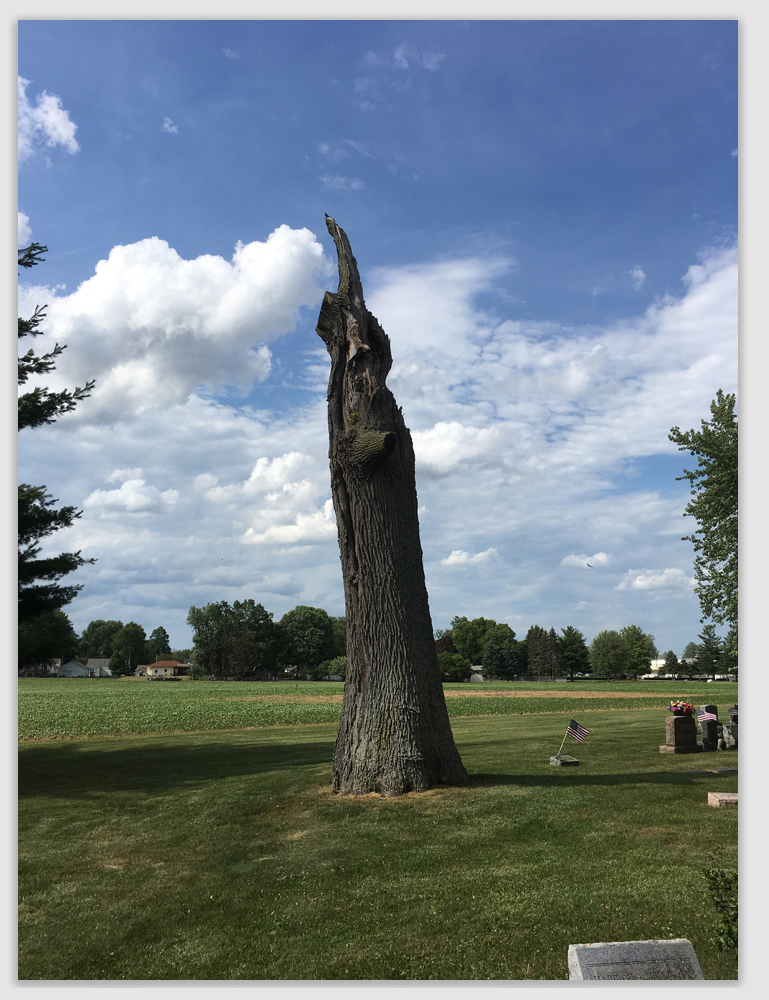
Wales v. Pullen, 390 S.W.3d 160 (Ct. Appeals Kentucky, 2012). On September 14, 2008, Louisville was hit by a significant windstorm that resulted in downed power lines and downed trees across the city. Six days later, Wallace Wales was returning home on his motorcycle after a night out with friends. As he rode down Wilson Avenue, he hit branches of a tree laying in the middle of the roadway and crashed.

Ted Pullen is the Metro Louisville Director of Public Works and Assets, running an agency of almost 800 employees working in eight divisions. Each division has either an assistant director or a manager who supervises the division and reports directly to Pullen. Rick Storm was one of those managers, an Assistant Director of Public Works, overseeing the engineering division. He also served as the County Engineer to represent the Louisville Jefferson County Metro community on the Planning Commission. As the Assistant Director in charge of the engineering division, Storm supervised about 50 employees who managed all manner of engineering, including highway construction and maintenance, Rick also helped Ted run the department.

Following the motorcycle accident, Wally Wales sued Louisville Gas & Electric, Ted Pullen and Rick Storm in their official and individual capacities, for failure to remove the downed trees or place adequate warnings of the trees on Wilson Avenue. Ted and Rick filed a joint motion to dismiss, claiming that the allegations against them in their official capacities were barred by the doctrine of sovereign immunity and that the claims against them in their individual capacities should be dismissed because they were entitled to qualified official immunity.

Wally admitted that Rick and Ted could not be held liable in their official capacities, but argued that they were only subject to qualified official immunity. Kentucky Revised Statutes (KRS) 179.070 require the county engineer to remove trees or other obstacles from the right-of-way when they become a hazard to traffic. The trial court held that appears that Storm’s action or omission of removing a downed tree would be considered ministerial in nature.

Under normal circumstances, when a tree falls onto a Louisville street, someone notifies 911 and 911 will contact the police, the fire department, and the Department of Public Works. A Public Works supervisor is dispatched to the scene, and either the utility company, Public Works or a private contractor (if the job is too big) will cut up the tree. Ted said this is an unwritten procedure that everyone knows from his or her experience in the Public Works Department.

Following the 2008 windstorm, the Public Works Department, feeling “vastly overwhelmed” by the number of calls, put incoming calls about downed trees on a list and distributed those lists to the district areas. Ted’s executive assistant maintained the list and was responsible for making the assignments. Ted admitted he knew Kentucky statutory law placed a duty upon the County Engineer to remove trees in the road that cause a public safety hazard. However, Ted never discussed Rick’s statutory duty with him and never told him that removing trees was included in his official duties.
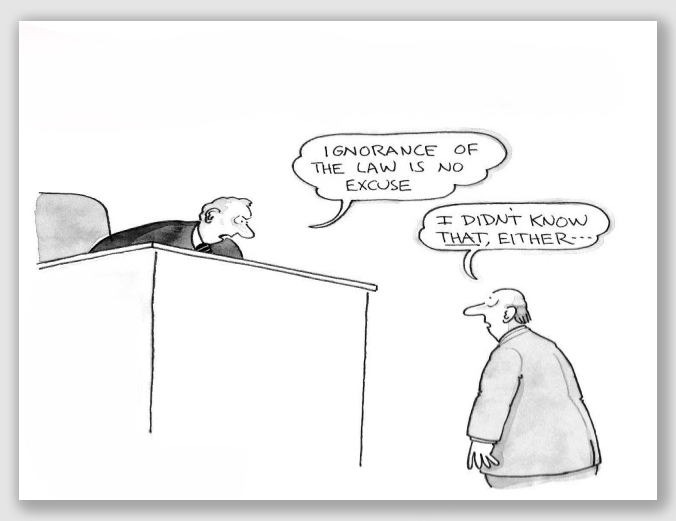
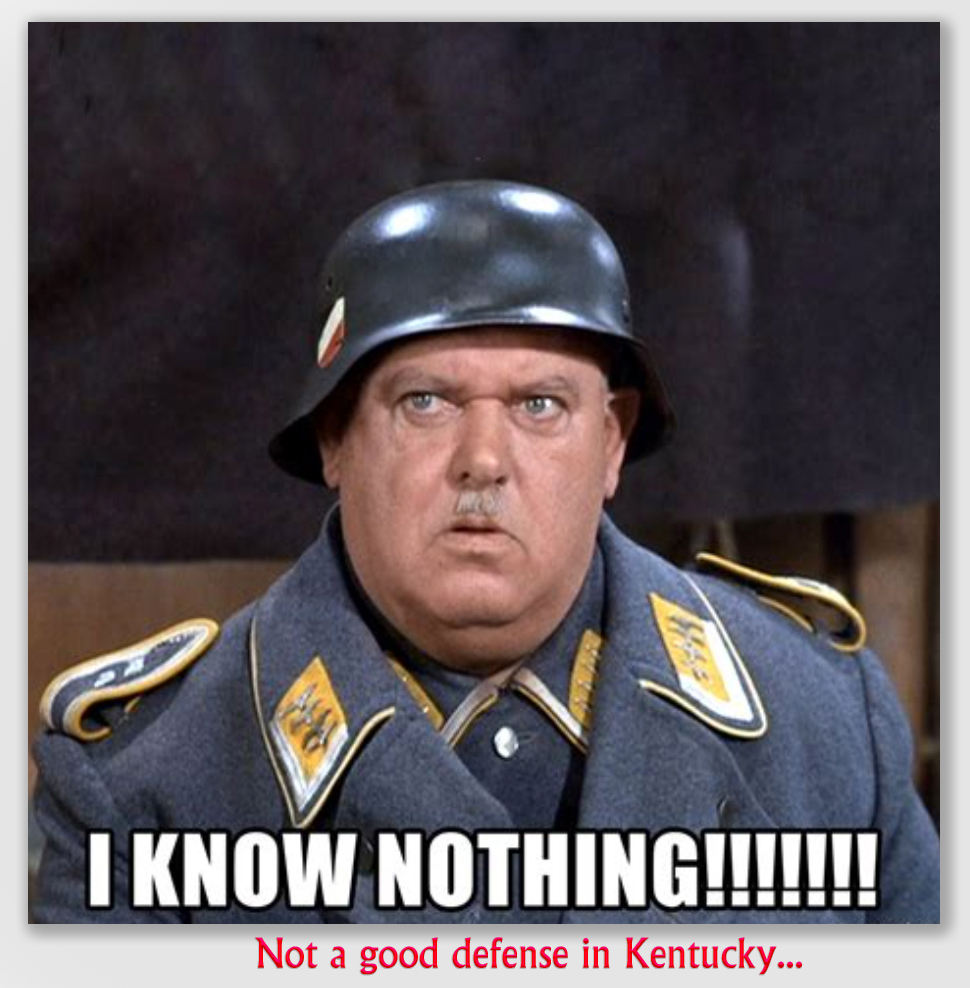
Rick said he never read KRS 179.070 and that no one ever told him that removing trees was part of his job duties. He indicated that Public Works had a sub-department that handled tree removal and that he was simply too busy to have that function as one of his job duties, especially given the size of the city. When asked why he thought the statute did not apply to him, Rick said he was simply not aware of the statute. He admitted he did not remove trees from the roadway during the post-storm cleanup period, and he did not ask anyone to remove any such trees from the roadway during that time.

Ted argued to the trial court that as the head of Public Works, he was only required to supervise his employees and ensure the implementation of the department’s policies. He claimed that he was not personally responsible for removing trees from roadways or otherwise ensuring that roadways were safe. For his part, Rick denied that as the County Engineer, he was responsible for removing trees and other obstacles from the roadways.

The trial court found both Ted and Rick were entitled to qualified official immunity. The judge concluded no one alleged that Ted or the employees he directly supervised were charged with the removal of the tree. The court held that “none of [Pullen’s] duties involve obedience to the orders, or the execution of any specific act, such that they are ministerial in nature.” With respect to Rick, the trial judge overlooked his previous holding that given the language of KRS 179.070, Rick’s “action or omission of removing a downed tree would be considered ministerial in nature.” Instead, the trial court relied on Rick’s own statement that he was never informed of the statute and that he was never told that removing trees was part of his job. Concluding that Rick had no actual authority to direct the removal of storm debris, the trial court held that he did not owe Wally any duty.

Wally appealed.

Held: Under KRS 179.070, the county engineer had the duty and authority to remove a downed tree, and he was liable for any negligence in failing to remove the trees or in improperly removing the trees. Rick was not entitled to qualified official immunity. Ted, however, was entitled to qualified official immunity inasmuch as his duties were discretionary in nature. Nothing in the record suggested Ted acted in bad faith with respect to any of his duties.

While government officials and employees like Ted and Rick may enjoy immunity in their official capacity, they do not enjoy immunity for negligent performance of ministerial tasks when sued in their individual capacity. When a state officer or employee is sued in his or her individual capacity, he or she is protected only by qualified official immunity.

Sovereign immunity is the principle that a sovereign nation is inherently immune from suit unless it has given its consent to be sued. This immunity extends to legislators in the performance of their legislative functions, judges for their judicial functions, and prosecutors for the performance of the prosecutorial functions. The rationale for this is to protect these offices against the deterrent effect of a threat of suit alleging improper motives where there has been no more than a mistake or a disagreement on the part of the complaining party with the decision made.

Questions regarding immunity for other governmental positions are resolved by examining the nature of the functions with which a particular official has been lawfully entrusted and evaluating the effect that exposure to particular forms of liability would likely have on the appropriate exercise of those functions. Absolute immunity of a government official from suit for monetary damages is justified only when the danger of the official being deflected from the effective performance of his or her public duty is great.

Qualified immunity affords protection from damages arising from good faith judgment calls made in a legally uncertain environment. It applies to negligence only where the acts or functions are discretionary, where the acts were taken in good faith; and where the acts are within the scope of the employee or the officer’s authority. Government employees are not afforded qualified immunity for any ministerial act or any discretionary act performed in bad faith.
The decision as to whether acts are discretionary or ministerial must be determined by the facts of each particular case after weighing such factors as the nature of the official’s duties, the extent to which the acts involve policymaking or the exercise of professional expertise and judgment, and the likely consequences of withholding immunity. An act is not discretionary merely because some judgment is used in deciding on the means or method used. Where the law imposes upon a public officer the performance of ministerial duties in which a private individual has a special and direct interest, the officer will be liable to the individual for any injury that he may proximately sustain in consequence of the officer’s failure or neglect to perform the duty at all or to perform it properly. In such a case the officer is liable as well for nonfeasance as for misfeasance or malfeasance.

Wally argued that the trial court disregarded KRS 179.070(1)(j), which stated that county engineers will remove trees from roadways and held that Storm had no actual authority in his position to remove the trees at issue in this case. KRS 179.070 holds that a county engineer shall, among other things, remove trees or other obstacles from the right-of-way of any publicly dedicated road when the tree or other obstacles become a hazard to traffic.”

Given the clear statutory mandate to remove trees, the Court of Appeals said, Rick – as the County Engineer – had “the duty and authority to remove a downed tree.” While the Jefferson County Metro Public Works Department may have chosen to structure its department differently, based on the statutes as written, a member of the public – like Wally – would reasonably expect the county engineer to remove trees, as evidenced by the clear statutory mandate and power to do so. Rick’s duty, the Court found, was not discretionary, but rather ministerial. Therefore, he was personally liable for negligence in failing to remove the trees or in improperly removing the trees.

Parenthetically, the Court noted, “the trial court’s reliance on Rick’s statements that he was never informed of this statutory duty was in error. This Court does not believe this is an adequate defense for a public official or employee seeking the protection of sovereign immunity… [W]here the law imposes upon a public officer the performance of ministerial duties in which a private individual has a special and direct interest, the officer will be liable to such individual for any injury which he may proximately sustain in consequence of the failure or neglect of the officer either to perform the duty at all or to perform it properly.

Ted, however, did have qualified official immunity. As the director of public works, his duties did not involve mere obedience to others and were discretionary in nature.

– Tom Root

TNLBGray140407

Case of the Day – Wednesday, January 22, 2025

TOPPER

We have seen our share of “obstructed view” cases, in which landowners were not liable because their vegetation obscured traffic signs.

But what if the landowner does something to the tree or vegetation to exacerbate the situation? Is that even possible? More to the point for a negligence calculus, does a landowner owe a duty to motorists?

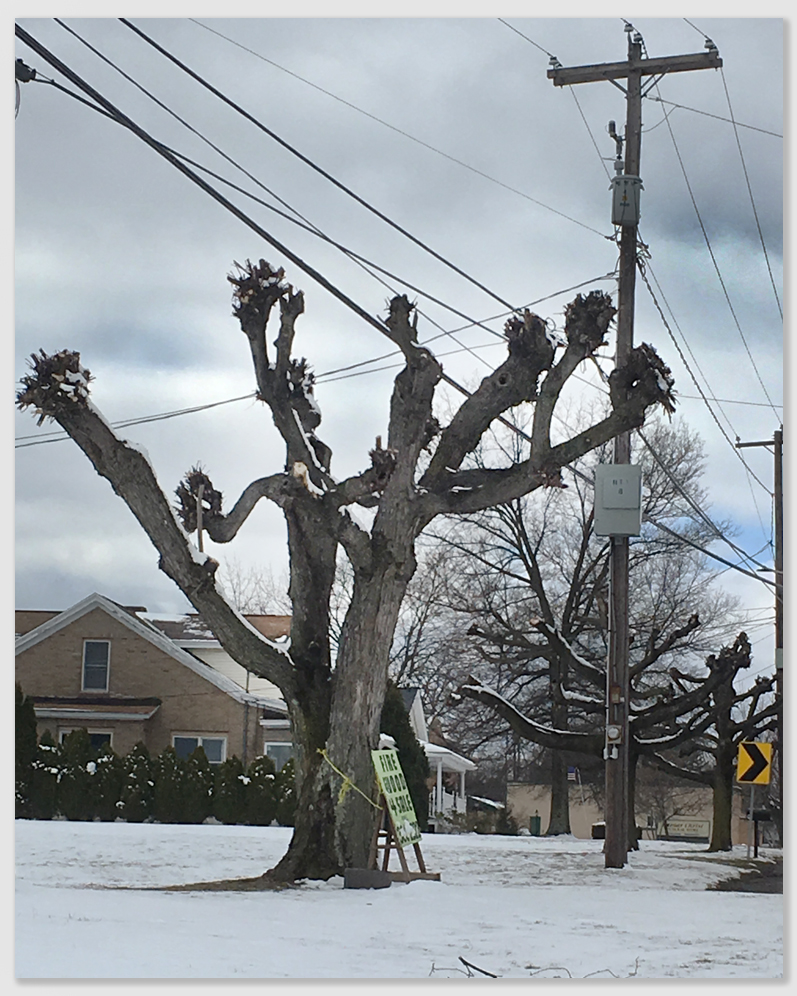
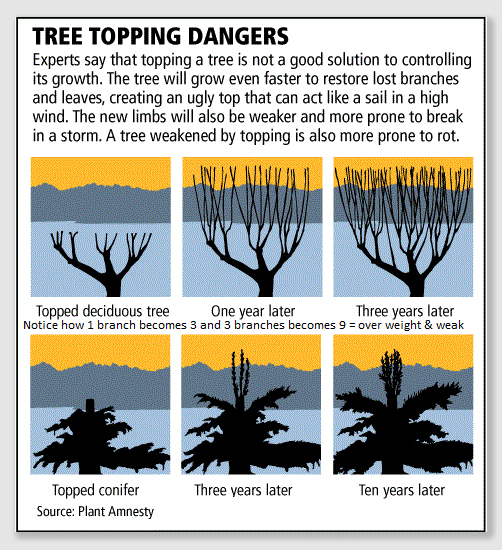
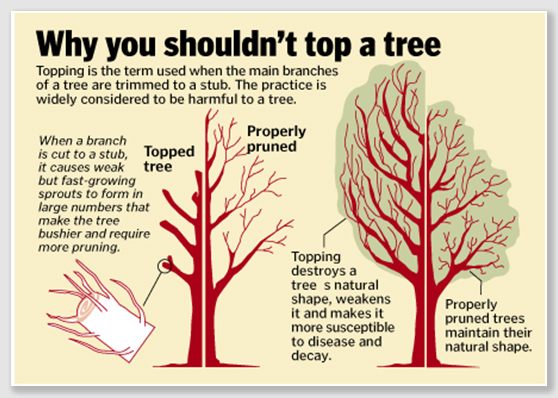
Today’s case asks just that question. A utility company that took the easy way out, and simply topped a pine tree standing under one of its lines. Topping is a lousy way to trim a tree. No self-respecting arborist would have anything to do with it. And, it turns out, that topping did not stop the tree from growing. It simply forced the tree to grow out instead of up.

Iglehart v. Bd. of County Comm’rs, 60 P.3d 497 (Supreme Ct. Okla. 2002). Brenda Iglehart failed to stop at a county road intersection where crossing traffic had the right-of-way. She was broadsided. She sued everyone she could think of, including the Board of County Commissioners for negligent maintenance of the road, and – relevant to this appeal – Verdigris Valley Electric Cooperative. She alleged Verdigris, which owned an easement alongside the road, contending it negligently maintained a white pine tree by “topping” it in order to keep the tree limbs from interfering with electric lines. By so doing, Brenda said, Verdigras caused the tree to grow laterally and more densely, obscuring the stop sign. According to plaintiffs, Verdigras owed a duty of care to motorists traveling on the adjoining roadway, or at least a duty to warn of a hazardous condition within its control, and that its breach of this duty directly caused Brenda’s injuries.

The trial court granted summary judgment to Verdigris and the Commissioners). The Court of Civil Appeals reversed the summary judgment for the Board but upheld summary judgment in favor of Verdigris. The appellate court held that a utility company does not owe a duty of care to travelers on roads adjacent to its power lines which are under its maintenance.

Brenda appealed to the Oklahoma Supreme Court.

Held: A utility company owes a duty of care to traveling motorists on adjoining roads when its substandard maintenance of trees could foreseeably cause danger to the public.

The Court observed that to establish negligence liability for an injury, Brenda must prove that (1) Verdigris owed her a duty to protect her from injury, (2) Verdigris breached that duty, and (3) its breach was a proximate cause of Brenda’s injuries. The burden is not cast upon Brenda to establish that Verdigris was negligent in order to escape its motion for summary judgment. Rather, to avoid trial for negligence, Verdigris must establish through unchallenged evidentiary materials that, even when viewed in a light most favorable to Brenda, no disputed material facts exist as to any material issues and that the law favors Verdigris.

Verdigris contends that (1) no duty existed; that (2) if a duty existed, the company did not breach it, and that even if it had, (3) its actions were not a proximate cause of Brenda’s injuries.

The threshold question for negligence suits is whether a defendant owes a plaintiff a duty of care. “We recognize,” the Court said, “the traditional common-law rule that whenever one person is by circumstances placed in such a position with regard to another, that, if he (she) did not use ordinary care and skill in his (her) own conduct, he would cause danger of injury to the person or property of the other, a duty arises to use ordinary care and skill to avoid such danger.” Among a number of factors used to determine the existence of a duty of care, the most important consideration is foreseeability. Generally, a defendant owes a duty of care to all persons foreseeably endangered by his conduct concerning all risks which make the conduct unreasonably dangerous. Foreseeability establishes a “zone of risk,” which is to say that it forms a basis for assessing whether the conduct creates a generalized and foreseeable risk of harming others.

The question of whether a duty is owed by a defendant is one of law; a breach of that duty is a question of fact for the trier. Here, the Court held that a utility company indeed owes a duty of care to traveling motorists on adjoining roads when its substandard maintenance of trees could foreseeably cause danger to the public. Citing the Oregon Supreme Court’s decision in Slogowski v. Lyness, the Court ruled it was potentially foreseeable to a utility company that a tree it maintained could cause a hazardous condition to motorists on an adjacent roadway. Once having undertaken the task of trimming and inspecting trees within its easement, a party must act reasonably in the exercise of that task.

In this case, the Court said, Brenda has raised a disputed issue of fact regarding the foreseeability of the injuries she suffered, sufficient to avoid summary process. According to the affidavit of her expert witness, James R. Morgan, the white pine tree in question had been “topped.” The main tree trunk has been cut off in the upper quadrant of the tree. Once this occurs, the upward growth is halted, and the tree instead increases density and limb growth. These results, the affidavit stated, are particularly true for the type of pine tree in question and are common knowledge among those who cut trees.

Verdigris challenged the certainty with which the expert made his determination, but at this stage of summary process review, the Court said, “We must view facts in the light most favorable to the plaintiff. Mindful of this rule, we hold that – given the proximity of the tree to the stop sign and the common-sense notion that without a visible stop sign, an intersection, such as that here in question, poses an obvious hazard” Brenda had raised a disputed issue of material fact as to the foreseeability of the accident arising from the action of Verdigris. “Foreseeability must hence be left for a jury evaluation.”

– Tom Root

 TNLBGray140407

Case of the Day – Tuesday, January 21, 2025

THE CONTRACT SAYS WHAT?

springsnow160321Somewhat to my surprise, my snowdrops poked their little green shoots through the cold soil a few weeks ago. But with the arrival of snow last week and an Arctic blast yesterday, they are buried under several inches of white stuff. Which is good, because they are not usually seen until the second week of February here in the Great Lakes Basin just 30 miles south of the Canadian border.

My wonder dog Winnie found this morning’s walk a little nippy, but tomorrow will be worse, with the temp hovering slightly below zero. She’ll still find it fine for chasing deer (she flushed ten of them on Sunday, pursuing them like the 40 lbs. of bad news she can be when chasing game, small and large).

So I walk my dog on a cold day. Who cares? Landscaper Superior Property Management Services, Inc., sure did when Colleen Hill decided to do that. Utah-based Superior had been hired by the Waterbury Homeowners Association to landscape and maintain the grounds at beautiful Shanty Acres. The parties had a standard contract, one that – among other things – called for Superior to mow the grass weekly and edge bi-weekly “throughout the normal growing season.” Elsewhere, the contract directs the landscapers to “trim . . . small and lower branches” on trees.

The contract was just a formality. Superior has been in business since the bristlecones were seedlings, and its crews thus knew exactly what needed to be done. They often went beyond the literal terms of the contract, which – as was typical for landscaping contracts – were not especially detailed. Over the seasons, Superior maintained Shanty Acres very well, and the contract was repeatedly renewed. The Happy Homeowners Association was indeed happy.

Then condominium resident Colleen Hill ventured outside to walk her dog one cold day. When she followed the cavorting canine onto the lawn, she tripped over a basal shoot growing from a tree root, fell, and hurt herself. She sued both Superior and the Association, claiming that Superior owed her a duty of care because of what it agreed to do in the contract. Superior, she alleged, was negligent in not trimming the basal shoots.

But how could Superior owe Colleen Hill a duty? Its contract was with the Association, and the Association thought Superior had done a superior job. True, Superior prided itself on doing more than the contract called for, but that was what a good landscaper did. Thus, Superior’s crews normally trimmed basal roots … but if Colleen’s complaint was to be believed, it appears Superior’s workers may have overlooked the shoots that proved a snare to her feet.

Superior should have trimmed the exposed roots, Colleen said, whether the contract said it should or not ...

Superior should have trimmed the exposed roots, Colleen said, whether the contract said it should or not …

The courts finally concluded that Superior owed Colleen no duty. Its obligations were to the Association, and those obligations were those spelled out in the contract, not what additional services Superior might gratuitously provide. The landscaper won in the end, but only after four years of expensive litigation.

So what does the professional arborist or landscaper learn from Superior’s legal travails? The first lesson is to read the contract form he or she is using. Does it adequately define the services being provided? If the arborist will be performing more services than those described in the contract, those probably should be described in the contract.

At a minimum, the contract should clearly provide that any services provided beyond those required by the contract are being provided as a courtesy only and that the contract does not establish a duty between the arborist and anyone other than the client.

Will this be enough to save the arborist from frivolous lawsuits? Probably not in this society. But an ounce of careful contract drafting now may be worth a pound of lawyers later.

Hill v. Superior Property Management, Inc., 2013 UT 60 (Utah Supreme Ct., 2013). Superior Property Management had held the contract to maintain premises for the Waterbury Homeowners Association for years. The form contract called for Superior to mow the grass weekly and edge bi-weekly “throughout the normal growing season” and to “trim . . . small and lower branches” on trees. After resident Colleen Hill, while walking her dog one early spring day, tripped on a growth from a tree root, she sued Superior for negligence because it had not trimmed the root.

Held: The landscaper didn’t owe Colleen a duty of care. As the Supreme Court of Utah observed, the “law draws a critical distinction between affirmative acts and omissions. As a general rule, we all have a duty to act reasonably in our affirmative acts; but no such duty attaches with regard to omissions except in cases of a special relationship.”

The Court agreed that sometimes, such a special relationship might be rooted in a contract. But it held that neither specific obligation in the contract – the obligation to mow the grass weekly and edge bi-weekly “throughout the normal growing season,” or the obligation to “trim . . . small and lower branches” on trees – created a duty flowing from the landscaping company and the injured property owner.

Lesson: No contract is the ultimate contract, but that doesn't mean you shouldn't try for comprehensiveness in drafting ...

Lesson: No contract can plan for every contingency, but that doesn’t mean you shouldn’t try for comprehensiveness in drafting whenever possible …

The Court noted that “in the first place, it is not at all clear that mere failure to perform would sustain liability in tort. A breach of contract, after all, typically gives rise to liability in contract … Even assuming that Superior’s maintenance contract could sustain a tort duty, moreover, there is still no basis for liability here, as neither of the provisions required Superior to perform the acts it is now charged with omitting.” The Justices analyzed the contract provisions, pointing out that the accident happened in early spring, outside of the “normal growing season.” What’s more, the dictionary definition of “branch” is “a stem growing from the trunk or from a limb of a tree” or a “shoot or secondary stem growing from the main stem.” Therefore, the Court reasoned, “the ‘branches’ to be trimmed under Superior’s maintenance contract are protrusions from the main trunk only, not separate shoots stemming from the tree’s roots. Superior could not be in breach for failing to trim back those shoots.”

Maybe so, argued the homeowner, but regardless of what the contract may have said, the landscaper’s obligations “were not comprehensively detailed in its maintenance contract, but encompassed acts that it habitually engaged in over time.” The Court rejected this dangerous notion, declaring that there “is no room in our law for a tort duty arising from course-of-performance acts that are nowhere provided by contract.” The Justices reasoned that “where a duty is rooted in the express language of a written contract, the parties are on notice of their obligations, and are in a good position to plan their activities around them. That is not at all true for … extracontractual, course-of-performance acts relied on” by Ms. Hill. “If we were to impose a duty in connection with those acts,” the Court said, “we would establish a troubling perverse incentive. A party facing a tort duty in connection with any undertaking not required by contract would be discouraged from such undertaking. And a disincentive for gratuitous service benefiting another is not the sort of conduct that our tort law ought to countenance. In any event, to the extent injuries ensue from negligence in the performance of such activities, liability would properly be governed by a different branch of our tort law – by the standards governing liability for a voluntary undertaking, a theory we … find unavailing.”

– Tom Root

TNLBGray140407

Case of the Day – Monday, January 13, 2025

CONNECT THE DOTS

A negligence action is a lot like a child’s “connect-the-dots” game. If you want to win, you have to connect the dots of “duty” to “breach of duty” to “proximate cause of damages” to “amount of loss.”

Skip a step, and you can walk away empty-handed, or – like the couple in today’s case – with a lot less.

We find it a bit unsettling that a tree service was not alerted to a bigger problem by the 100-lb. concrete plug stuck in the bottom of a tree it was to trim, and that the trimming crew proceeded to “top” the tree in order to make it healthier. Perhaps using animal magnetism on the tree or dousing the roots in snake oil might have helped.

This case has cautionary tales aplenty. First, with digital film as cheap as it is (as in, 80% of Americans have smartphones), take pictures of the trees before and right after trimming. This is true whether you’re Harry and Harriet Homeowner or whether you run Paul Bunyan’s Tree Service.

Second, do not ignore warning signs that a tree has significant problems. Pretending that a concrete plug was not poured into a tree by a former owner and that some simple shaping will keep it strong and healthy, is confusing a dangerous conflation of wishes and facts.

Third, both the homeowners and the tree service should insist on a detailed contract, one that spells out the obligations and expectations of both parties.

Finally, if litigation ensues, take a serious look at your expert’s analysis. Try to poke holes in the expert’s report. Be your own “tiger team.” When you read in the decision that the expert was unable to testify to a crucial element, it’s already too late.

Sandblom v. Timber Tree Service, Inc., 2009 R.I. Super. LEXIS 126, (Super. Ct. Rhode Island, Oct. 27, 2009). Steve and Terri Sandblom hired Timber Tree Services, Inc., to provide tree services to five trees located on their Arlington Street property. Steve told Timber Tree that he and his wife wanted one tree removed and the other four trimmed – two in the backyard and two in the front yard, one of which was a mature silver maple tree.

A concrete patch in a tree… never a good idea.

Even before work commenced, Timber Tree told Steve that total removal of the silver maple tree was an option, due to the fact that the tree appeared to be damaged, with a basketball-sized cement plug in the base of the tree. The concrete suggested rot, which was later confirmed by Timber Tree workers. The plug had been in the tree when the Sandbloms bought the property in 2004. Steve elected to have the tree “topped” instead because Timber Tree’s owner told Steve that after “topping off,” the tree would be healthy and regain a healthy condition similar to a neighbor’s fully-grown silver maple.

Timber Tree gave the Sandbloms a written estimate of the charges for the work to be performed, a total charge of $1,400.00 without itemization. Work began in April 2005.

Late in the day, a Timber Tree worker asked Steve whether he wanted the silver maple tree cut down entirely. Steve examined the tree, and testified later that so much growth had been cut from the silver maple that it only could be described immediately after the work as two bare trunks, totally denuded of any vegetation.

The Sandbloms sued, claiming that as a result of Timber Tree’s negligent services, the silver maple tree in the front yard suffered permanent and irreversible damage, thereby reducing the value of their property as a whole. Pursuant to G.L. 1956 § 34-20-1, they sought twice the value of the tree and three times the value of the wood. Timber Tree counterclaimed for the outstanding balance due for services rendered.

Held: The Court, rejecting Steve’s testimony that the tree was healthy, found that the silver maple was already a diseased tree when it was topped. Steve’s expert was unable to quantify how much of the tree’s condition was caused by existing rot or prior improper pruning. The expert’s damage calculation thus was rejected.

Steve testified that before Timber Tree’s work, the silver maple was “overgrown” with vegetation and needed trimming, but was otherwise healthy. The Court found the testimony not credible in light of the observations of rot made by Timber Tree’s owner and workers. The placement of a cement plug sometime before suggested that rot may have been present for a considerable period of time.

Despite Timber Tree’s suggestion that perhaps the tree was not worth further substantial investment, Steve chose to proceed with the request to “top off” the maple. Steve said he expected the silver maple would be “topped” to get tree growth away from electrical wires. Timber Tree’s owner described the work to be performed as the removal of “sucker growth.”

Instead, Timber Tree trimmed so much growth from the silver maple that was nothing but two bare trunks. However, because there was no photographic evidence of the condition of the silver maple prior to the trimming, the Court could only conclude from the evidence that the silver maple was not healthy before it was topped.

Steve’s expert, John Campanini, testified that Timber Tree’s work was contrary to industry standards in that its workers removed more than 20% of the live wood from the tree. He also testified that Timber Tree failed to adhere to industry standards by pruning or cutting known nodes of the tree, which he found by observing the “cuts” made to the tree.

As for Timber Tree’s other work, John Campanini said some of the work appeared improper in that Timber Tree failed to remove all of the dead wood on one of the trees. On a second tree in the backyard, Timber Tree did not complete the job of thinning out the crown of the tree, in that many branches on the lower canopy were not removed. This, John Campanini described, was “sub-par performance.” John Campanini supplied no testimony to quantify the damage caused by Timber Tree’s errors and omissions.

Mr. Campanini used a formula called the “trunk formula,” whereby the calculation of loss starts with the circumference of the trunk near the ground and continues based on certain objective and subjective factors relative to the tree’s location and condition. According to Mr. Campanini, this mode of calculation is approved by the International Society of Arboriculture. The result of the calculation is to determine an “appraised” value of the tree before Timber Tree’s work, which he concluded to be $5,100.00.

Although it found his testimony credible, the Court declined to rely on Mr. Campanini’s analysis. It noted that, for example, the formula failed to account for the apparent rot of the tree, as evidenced by the concrete plug. Also, the photographic evidence of the current condition of the tree undercut any claim that the silver maple was “totally lost” as a result of Timber Tree’s work. On the contrary, the evidence of the tree’s current condition showed that the silver maple had returned to a tree lush with foliage; indeed, even Mr. Campanini testified that the Silver Maple was not dead and did not need to be replaced.

Mr. Campanini said that damage to the silver maple could be cured by four or five subsequent remedial prunings at $750.00 apiece, to select branches that may develop good supporting unions and help regain the form and shape of a natural silver maple. The tree was about 80 years old, making replacement almost impossible. Such a mature tree would not be available from a nursery for transplantation, leaving the only replacement alternative as a young sapling that would take many years to develop into the stature of the silver maple prior to Timber Tree’s work.

In order to establish a negligence claim against Timber Tree, the Sandbloms had to prove by a preponderance of the credible evidence that Timber Tree was negligent, by showing that Timber Tree owed the Sandbloms a legally cognizable duty, a breach of that duty, proximate causation between the conduct and the resulting injury, and the actual loss or damage. Then, the Sandbloms had to prove that Timber Tree’s negligence caused loss or damage to their property and demonstrate the value of those damages as determined by the reasonable value of the loss or damage. Although mathematical exactitude is not required, the damages must be based on reasonable and probable estimates.

The Rhode Island Supreme Court has held that “the general rule is that where the damage to realty is temporary, the cost of repair measure is proper, and where the damage is permanent, the diminution in value measure is most appropriate.”

Looks good to me…

Although the Court found that Steve proved negligence by Mr. Campanini’s testimony, his evidence on the issues of whether the negligence caused damage and how much those damages were was “somewhat shaky.” The evidence showed that the silver maple was not healthy when it was pruned, meaning that the evidence did not show that Timber Tree’s negligence damaged the tree beyond where it was before the topping. What’s more, the evidence did not show that the silver maple was completely destroyed, such that replacement would be the proper measure of damages. Good thing, too, because an actual replacement cost would be very difficult to calculate, “due to the fact that a similar mature maple would not be available at a nursery for transplantation.”

Because the evidence showed that the tree had made a considerable recovery since it was pruned, the damage it suffered was temporary and the cost of repair would be the appropriate measure of the damages. The only credible testimony concerning the cost remedial measures was Mr. Campanini’s testimony that the silver maple could be restored with four to five remedial prunings, at a cost of $ 750.00 per pruning. The Court awarded the Sandbloms $ 3,750.00 in damages.

The Sandbloms asked for double damages under § 34-20-1. But that section only provides such damages where the cutting or destruction of a tree occurred “without leave of the owner thereof.” Here, Timber Tree performed its services with Steve’s permission. “While the services may not have been to Mr. Sandblom’s satisfaction, “ the Court said, “the Legislature did not intend double damages for negligent services that were performed at Plaintiffs’ request.”

– Tom Root

TNLBGray140407

Case of the Day – Thursday, January 2, 2025

SURE IT’S A NUISANCE, BUT WHOSE NUISANCE?

I live near enough to Cleveland to be aware of the blight of homes abandoned there during the Great Recession. The owners leave, the banks foreclose, the homes decay, the taxes are no longer paid, and the city tries to sell them for tax debts. Many times, the city ends up owning them.

Yet, Cleveland is an enclave of plenty compared to Detroit, where the blight covered mile after mile. A third of all homes in that bankrupt city had been foreclosed on by 2015.

Out of fairness, Detroit has made a real comeback. The Motor City has stabilized its financial condition, improved city services, reversed population losses that saw more than a million people leave since the 1950s and made progress cleaning up blight across its 139 square miles.

In October 2024, Donald Trump told the Detroit Economic Forum that “[t]he whole country will be like — you want to know the truth? It’ll be like Detroit. Our whole country will end up being like Detroit if [Kamala Harris is] your president.” He caught a lot of grief from Detroiters for that. Detroit Mayor Mike Duggan said, “Lots of cities should be like Detroit. And we did it all without Trump’s help.”

So who is responsible for the nuisances that these decaying homes (and untrimmed foliage) create? Generally, it’s the owner or the entity with the right to control the property. In today’s case, decided when I was not yet a teen, a city argued that it owned and controlled an abandoned property for some purposes, but not where abating a nuisance was concerned.

Neighbor Harry Homeowner, who was beaned on the noggin by a branch from a dead tree on the neighboring lot, disagreed. “Hey,” Harry huffed, “if you own it, you own it.”

Kurtigian v. Worcester, 203 N.E.2d 692 (Supreme Jud. Ct., Mass. 1965). Harry Kurtigian was working in his yard one windy October day in 1959 when he was struck by a limb blown from a decayed tree on adjoining property.

A large elm tree was situated in the southeast corner of the lot next to Harry’s, one which had been owned by Beatrice R. Norling. By 1954, Beatrice was dead, and the tree was soon to follow, having been afflicted with Dutch elm disease. By 1956, there were no leaves on the 35-foot tall tree at all, and the bark was peeling from the trunk by year’s end.

Two years later, a large branch fell during a summer thunderstorm, crushing Harry’s fence. He called the City, who sent an inspector to look at the tree. About 15 months later, the tree still standing undisturbed, Harry was walking in his yard when he heard a cracking sound, looked up, and saw a heavy limb falling toward him. He was knocked unconscious, suffering a skull, arm and wrist fracture.

The lot next door was undeveloped and wooded, having been acquired by the City of Worcester in 1950 for nonpayment of taxes. Harry sued the City for negligence and for maintaining a nuisance tree,

The lower court found the City was negligent, but that the tree was not a nuisance. The City appealed.

Held: The tree was a nuisance, and the City was liable to Harry.

Liability for damage caused by the defective condition of premises turns upon whether a defendant was in control, either through ownership or otherwise. The City argued that it did not have title to and control of the real estate. But the records showed that the City recorded in the registry of deeds an instrument of taking in August 1950, pursuant to law for nonpayment of taxes. Three years later, the City recorded a notice of foreclosure, and seven years after that, a “Notice of Disposal in Tax Lien Case” executed by the Land Court was recorded in the registry of deeds, noting that there had been entered in the Land Court a decree foreclosing and barring rights of redemption by the prior owners to the lot. That was enough for the Court to rule that “at all material times the city… to the extent permitted by that chapter, engaged in the operation, maintenance, control, and sale of tax title property

The City said its taking of the property pursuant to vested title, subject only to the right of the owners to redeem the property by paying the taxes, is really more in the nature of security until the right of redemption was foreclosed. In other words, the City complained it did not have absolute title, but rather would have been able to keep only the amount of its lien in the event of a taking by eminent domain. Before the right of redemption was foreclosed, the City said, it could not have collected any rents.

Harry, on the other hand, argued that G. L. c. 60, § 54 grants the City the right to possession as soon as a tax title is issued, as opposed to another statute not letting a private buyer from getting possession for two years after buying at a sale.

The Court said that dispute was irrelevant because the City acquired a tax title nine years before the branch fell so even if the two-year period applied, it had long since passed. “In any event,” the Court said, “the city’s right to possession long preceded the date of injury.”

The City, however, contended that held the property in its “governmental capacity” rather than in its “proprietary capacity.” The collection of taxes is a governmental function, the City argued, and it is not liable for the tortious acts of its officers in fulfilling a governmental function. The Court made short work of that argument. The City was maintaining a nuisance on the vacant lot, the Court ruled and “there is no such immunity, however, where there is a nuisance maintained on real estate owned or controlled by a municipality, and this principle obtains ‘even where the nuisance arises out of the performance by the municipality of a governmental duty in the interests of the general public’.”

The liability of a municipality as the owner of land for a private nuisance on the land is no different than the liability of a natural person, the Court said. Trees can be a nuisance as much as a dilapidated building. “As the limb did not overhang the plaintiff’s land,” the Court said, “we have no occasion to examine the question whether the plaintiff is limited to self-help as in Michalson v. Nutting.” What’s more, the Court said, no one has argued that there should be a distinction between trees naturally on land and those that have been planted, “even assuming it is possible to ascertain the origin of this particular tree.”

The Court held that the evidence showed that there was, as early as 1956, when the tree died, a private nuisance to Harry and his property. While not a public shade tree, the elm was on land owned by and subject to the control of the city. It was obviously decayed. A nuisance came into existence while the City was in control of the land. “Public policy in a civilized community requires that there be someone to be held responsible for a private nuisance on each piece of real estate, and, particularly in an urban area, that there be no oases of nonliability where a private nuisance may be maintained with impunity.”

– Tom Root

TNLBGray140407

Case of the Day – Friday, December 27, 2024

RUNAWAY TRAIN NEVER GOING BACK …

crash150303Mr. Elder drove his dump truck onto the Union Pacific tracks in Nephi, Utah — a town, not a soft drink — where he was promptly hit by what the Utah Supreme Court described as a “ninety-one car train.” It’s unlikely 78 cars or 23 cars or even just a set of GE diesel-electric locomotives would have caused a less deadly result.

Mr. Elder was killed, and his widow set off trying to find someone to pay for it. She sued Union Pacific and the City, suggesting that someone should have trimmed the trees near the tracks so her husband could have seen the train. The UP, which was quite adept in its own right in blaming others for grade-crossing mishaps, had a great excuse: the railroad didn’t own the offending trees to begin with.

It seems that no one ever remembered to give the Union Pacific title to its right-of-way, due to — what else? — a federal government screw-up back in the 19th century. It almost makes you wish Uncle Sam had shut down again However, the ever-resourceful Mrs. Elder argued, the Railroad had acquired all of the land under and around the tracks by prescriptive easement. She was thus in the unusual position of arguing in the lawsuit that UP was entitled to own a big piece of land on which it had been squatting for a hundred years — and was therefore liable for not keeping up the land it had never claimed to own — all at the same time.

Pretty creative lawyering! But the Utah Supreme Court held Mrs. Elder had no standing to claim the UP’s prescriptive easement on its behalf, probably because the Court suspected she didn’t have the Railroad’s best interests at heart. Imagine! As for the City, the Court agreed it had no duty under any statute to trim the trees, but it did observe the City did have a common law duty to Mr. Elder. The case was sent back to figure out whether that duty required it to trim the trees obscuring the crossing.

Elder v. Nephi City ex rel. Brough, 164 P.3d 1238 (S.Ct. Utah, 2007). Shelley Elder was killed on a Union Pacific Railroad railway track in Nephi City, Utah when the dump truck he was driving was struck by a freight train. His widow sued, contending that her husband’s death was caused by the negligence of Union Pacific Railroad and the City of Nephi.

The tracks may have been a little obscured by trees, but not quite like this.

The tracks may have been a little obscured by trees, but not quite like this.

According to Mrs. Elder, her husband would not have lost his life had a line of trees located parallel to the railroad tracks not obscured his vision of the train. The trees were situated on land owned by the City of Nephi, but Union Pacific owned the tracks and operated the train. The Railroad had no recorded property interest in the ground where the trees were located. The trial court summarily dismissed Mrs. Elder’s wrongful death claim, ruling as a matter of law that neither Nephi nor the Railroad owed a duty to Mr. Elder to ensure that the trees did not impair motorists’ ability to observe approaching trains. She appealed.

Held: The Railroad had no property interest in the trees and was under no duty to remove them. While the City of Nephi owed no statutory duty to Mr. Elder, it did owe a common-law duty to him, and the case had to be reversed on that point.

As for the Railroad’s right-of-way through Nephi, the UP route was acquired by prescriptive easement rather than by statute, and thus did not extend to land bordering tracks, including the land on which the offending trees stood. Under the Federal Townsite Act of 1867, the United States conveyed by patent to a probate judge the land within the city limits, including the railroad crossing area. Because this conveyance occurred before Congress passed the Railroad Rights of Way Acts granting railways rights-of-way through public lands, the statute could not have conveyed the right-of-way through Nephi.

Mrs. Elder claimed that the Railroad’s prescriptive easement extended not only to the railbed, however, but also to the land on which the trees stood. The Court ruled that while it wouldn’t rule that out, Mrs. Elder lacked standing to make a prescriptive easement claim on behalf of the Railroad. Standing to bring a quiet title action to perfect title is limited to parties who could acquire an interest in the property created by the court’s judgment or decree. What Mrs. Elder sought to do was to stick Union Pacific with the prescriptive easement as a way-station on the road to making the Railroad liable for her husband’s death.

As for the City of Nephi, the Court said, municipalities owe a duty of reasonable care to ordinary people, and this duty extends to travelers on their highways. The scope of a governmental entity’s common-law duty to persons using roadways under its control extends beyond the boundaries of the thoroughfare. A governmental entity does not undertake a duty to remove vegetation from private land that may obstruct the vision of motorists utilizing its roadways; nor does a private party bear a common-law duty to keep roadways free of visual obstructions caused by vegetation growing on his land.

Crossing 150303The Court ruled that the Utah statute requiring landowners to remove vegetation “which, by obstructing the view of any operator, constitutes a traffic hazard,” did not impose a duty on the City to monitor railroad crossings for visual obstructions. U.C.A. § 41-6-19.  Rather, the City’s statutory obligation to remove the trees would have been triggered by receipt of notice from the department of transportation or a local authority that an investigation had deemed the trees to be a traffic hazard. The City did not undertake any such investigation itself.

Nevertheless, the Court said, a genuine issue of material fact remained as to the allocation of duties between the City — which owned land near railroad tracks that contained irrigation ditch and trees which sprouted from the ditch embankment — and the irrigation company, which maintained irrigation ditch along the land pursuant to an irrigation easement. The common-law duty of a governmental entity to safeguard those who travel its roads may extend to visual hazards located on its land outside the bounds of the roadway itself, and the mere fact that an easement existed did not automatically assign that common-law duty to the servient estate. The issue of whether the City or the irrigation company was responsible for tree trimming, and whether the City breached its duty to the late Mr. Elder, precluded summary judgment.

– Tom Root

TNLBGray140407

Case of the Day – Thursday, December 26, 2024

IT WAS SMALL WHEN I PLANTED IT

       It was such a safe vehicle … so it must have been the tree’s fault.

Times change and trees grow. That’s the lesson in today’s case.

Mr. Paredes was driving along I-805 in the driving rain, transporting his daughters in a superannuated Volkswagen with bald tires. He lost control of the VW and it slid down a bank, colliding with a eucalyptus tree located about 25 feet from an on-ramp. His 6- and 9-year-old daughters died in the accident, and he was badly hurt.

Normally, one would shake his or her head and observe that Mr. Paredes maybe was going too fast, or driving a junker in weather that was too bad, or perhaps engaging in risky conduct by relying on bald tires. But this being America, it had to be someone else’s fault.

Mr. Paredes blamed Caltrans, the California Department of Transportation. It was the agency’s fault because the trees were closer to the on-ramp than should be permitted by Caltrans standards, and in fact, shouldn’t have been there at all. Only problem was when the trees were planted, they complied with all standards. Even today, they were more than 30 feet from the road and 25 feet from the on-ramp. In other words, Caltrans may have set in motion the factors that caused the damage, but it didn’t create it negligently: the construction complied with all standards when built.

Under the law, the agency had to have actual or constructive knowledge of the dangerous condition. Splitting hairs, the Court found that Caltrans knew that the trees were planted where they were planted: after all, Caltrans had planted them. But, the Court said, Caltrans didn’t have knowledge that the trees, located as they were, were dangerous.

It strikes me as maybe parsing things a little too finely. But as has been said before, hard cases make bad law. Here, the jury may have gone off on a frolic, and — notwithstanding all of the expert testimony — figured that Mr. Paredes was a little too much at fault to be entitled to much. The Court of Appeals, which is legally disposed to defend a jury verdict anyway, may have agreed.

Driving 60 mph in a beater of a car with bald tires through heavy rain? So exactly who was negligent here? Some workers who planted a tree 15 years ago or the idiot who jeopardized his most precious possession — two little girls — in his haste to get somewhere?

Mr. Paredes claimed the trees were too close to the road ...

Mr. Paredes claimed the trees were too close to the road …

Paredes v. State, 2008 WL 384636, 2008 Cal. App. Unpub. LEXIS 1262 (Cal.App. Feb. 14, 2008). Marco Paredes was injured and his two daughters killed when Paredes lost control of his vehicle in heavy rain, after which the vehicle slid down an embankment and struck a eucalyptus tree. Paredes claimed that California Department of Transportation (Caltrans) employees created the dangerous condition by creating the slope and planting eucalyptus trees within 30 feet of the on-ramp without protecting them with guardrails, demonstrating negligence per se as well as placing Caldrons on notice of the defect.

The jury disagreed. It found that the property was in a dangerous condition at the time of the accident and was a substantial cause of Paredes’s injury and the death of his children, but it nonetheless concluded that the State did not have actual or constructive notice of the condition in sufficient time before the incident to protect against it. The jury also found the dangerous condition was not caused by a negligent or wrongful act or omission of a State employee acting within the scope of employment.

Paredes appealed.

Held: The verdict against Paredes was upheld. The Court of Appeals observed that California law held that except as provided by statute, a public entity is liable for injury caused by a dangerous condition of its property if the plaintiff establishes that the property was in a dangerous condition at the time of the injury, that the injury was proximately caused by the dangerous condition, that the dangerous condition created a reasonably foreseeable risk of the kind of injury which was incurred, and either a negligent or wrongful act or omission of an employee of the public entity within the scope of his employment created the dangerous condition, or the public entity had actual or constructive notice of the dangerous condition a sufficient time prior to the injury to have taken measures to protect against the dangerous condition.

The law, the Court said, plainly requires a finding that a public entity’s negligent or wrongful acts created a dangerous condition. It does not impose liability for the mere creation of a dangerous condition. In this case, the jury was instructed that the plaintiffs had to establish that negligent or wrongful conduct by a State employee acting within the scope of employment created the dangerous condition. The Court concluded that substantial evidence from State’s expert, as well as Paredes’ own experts, supported the jury’s finding that State did not act negligently or wrongfully in planting the accident trees on the slope along the accident site.

The State’s expert explained that the standard applicable at the time of the planting was Caltrans’s “clear zone principle,” which required only that trees be planted 30 feet beyond the traveled way of the I-805 mainline and 20 feet from the on-ramp. For that matter, Paredes’ expert agreed the accident tree was over 31 feet from the edge of the traveled way of the I-805, and 25 feet from the edge of the traveled way of the nearby on-ramp. Another expert explained that a fixed immovable object under the Caltrans clear zone standard was a tree having a trunk with eight-inch diameters or greater. The State’s expert testified that a guardrail would not have been required at the site of the accident tree applying standards prevalent at the time of trial.

The testimony of a single witness may be sufficient to establish substantial evidence, the Court said, and here, the jury as the exclusive judge of credibility was entitled to believe the defendant’s witnesses.

Someone should have told Mr. Paredes this ...

Someone should have told Mr. Paredes this …

The Court also concluded that substantial evidence supported the jury’s finding that the State did not have actual or constructive notice of the dangerous condition. A public entity has actual notice of a dangerous condition if it had actual knowledge of the existence of the condition and knew or should have known of its dangerous character. A public entity has constructive notice of a dangerous condition only if the plaintiff establishes that the condition had existed for such a period of time and was of such an obvious nature that the public entity, in the exercise of due care, should have discovered the condition and its dangerous character.

Here, State employees planted the accident tree as well as other trees on the embankment. But the Court refused to fault the jury’s finding that the public property was in a dangerous condition at the time of the accident required it to also find the State had notice of that condition. On the evidence here, the jury could have concluded that the planting of the young eucalyptus tree on the embankment was not dangerous in 1979 or 1980 when that project was completed but became dangerous only when its trunk grew to a larger diameter. Thus, while State may have had notice of the physical condition it had created — the presence of trees on the slope — the jury was entitled to conclude it did not have notice that the condition was dangerous. Substantial evidence supported such a conclusion, the Court held.

– Tom Root

TNLBGray140407