Case of the Day – Tuesday, March 24, 2026

THE MASSACHUSETTS RULE GETS FLUSHED

Greed may be good ... but it doesn't get a lot of love from the court.

Greed may be good … but it doesn’t get a lot of love from the court.

Gloria Lane was a down-on-her-luck middle-aged woman who managed to just eke out an existence with her disabled brother in an old house. Their place was next to a rental property, a house equally as old, but owned by a corporate slumlord, W.J. Curry & Sons.

Do you see where this one is going? Hard cases can make bad law. Even where the result isn’t necessarily wrong — and we’re not hard-hearted enough to criticize people who were too poor to afford to fix the bathroom — cases are fact-driven.

We can imagine the scenario: a faceless corporation rolling in dough, too chary to keep up its properties and too avaricious to pay damages inflicted on the impoverished neighbors. That, at least, is the innuendo.

The Curry property included three large, healthy oak trees near the boundary with the Lane homestead. The trees are much taller than either of the houses, and those towering oaks featured limbs that protruded over Gloria Lane’s house and caused manifold problems. First, the court said, she had to replace her roof 15 years before the lawsuit “because the overhanging branches did not allow the roof to ever dry, causing it to rot.” She complained that prior to replacing the roof, “[e]very roof and wall in [her] house had turned brown and the ceiling was just falling down. We would be in bed at nighttime, and the ceiling would just fall down and hit the floor.”

In 1997, one of the oaks shed a large limb, which fell through the Lanes’ roof, attic, and kitchen ceiling. Rain then ruined her ceilings, floor, and the stove in her kitchen. The Lanes were physically unable to cut back the limbs hanging over the house, and they couldn’t afford to hire it done. For that matter, Gloria couldn’t even afford to fix the hole in her roof.
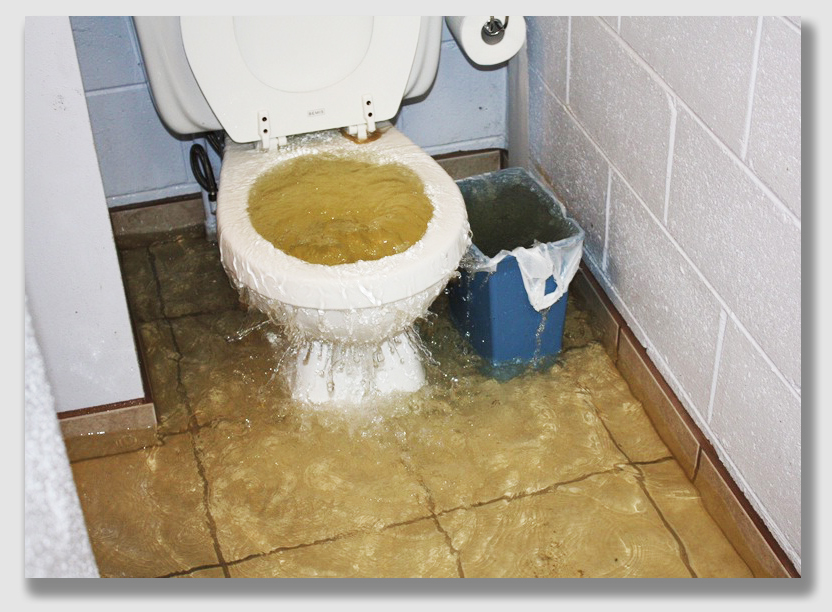
flush151015If that weren’t enough, the oaks’ roots clogged the Lane’s sewer line, causing severe plumbing problems. Gloria tried to chop the encroaching roots away from the sewer over the years, but they kept growing back and causing more plumbing problems. At the time of the lawsuit, she hadn’t been able to use her toilet, bathtub, or sink in two years because of the clogs. Instead, she went to the neighbors’ house (presumably not the Curry rental) to use the toilet. Meanwhile, raw sewage was bubbling into her bathtub, and the bathroom floor had to be replaced due to toilet backups and water spills.

Gloria told the trial court that “everything is all messed up. I can’t bathe. I can’t cook. I don’t want people coming to my house because it has odors in it, fleas, flies, bugs. It’s just been awful for me.” Ms. Lane, already under a psychiatrist’s care, said she “just can’t take too much more.”

After the branch punched a hole in her roof, Gloria asked the owner of W.J. Curry – one Judith Harris, a corporate minion who was neither W.J. nor any of his sons – to do something. She had a tree service trim the lower branches, but not the ones that would have been more expensive to reach. This didn’t solve the problems. When Gloria complained again, Ms. Harris told Gloria that she was on her own.

Now, boys and girls, these are hard facts. We aren’t dealing with the Schwalbachs, who were perfectly fit and reasonably flush, complaining to an underfunded cemetery association about a few twigs and leaves. Here, we have a dramatis personae that includes – as protagonist – a pathos-inducing poor woman caring for an invalid sibling, and – as antagonist – a soulless corporation destroying her happy home, one dropped limb by one dropped limb by one rotten roof by one clogged sewer at a time. And we’ve got some real damage, too. You try knocking on the neighbor’s door eight times a day and night to use the ‘loo, and see how you feel. Did the Massachusetts Rule have any chance of survival in the face of this heart-wrenching tale?

punch151015Of course not. The evil slumlord defendant (and we don’t know that he was evil or even a slumlord, but the story has a life of its own) argued that Tennessee followed the Massachusetts Rule. After all, it pointed out, Gloria was free to fire up her Husqvarna and clamber out onto her roof to cut down the offending limbs herself. Tennessee law firmly established that her remedies were limited to Massachusetts-style “self-help.” That means Gloria should get nothing for the hole in her roof, nothing for her falling plaster, nothing for her waterlogged stove, and nothing for the sewage bubbling in her bathtub.

The trial court agreed with W.J. Curry. It held that while it was “certainly a serious situation that the plaintiff has not been able to use her bathroom for two years … these three trees are alive and living and they do what trees normally do. They produce branches and grow, and they produce a root system. And even though you trim the branches back or you trim the roots back, they are going to produce more branches and more roots.”

Spoken like a judge whose own toilet flushes just fine. The three-judge appellate panel – a trio of jurists who were also not worried about the efficacy of their respective commodes – agreed. They observed that, after all, the trees were not “noxious” (which was a quaint notion championed by Smith v. Holt but since abandoned in Fancher v. Fagella).

The Tennessee Supreme Court reversed, adopting the Hawaii Rule, holding that living trees and plants are ordinarily not nuisances, but can become so when they cause actual harm or pose an imminent danger of actual harm to adjoining property. When that happens, the Court said, the owner of the tree had some responsibility to clean up the mess. No doubt swayed by the extensive record of travail propounded by Ms. Lane, the Court held that W.J. Curry’s trees clearly satisfied the definition of a “private nuisance.” It sent the case back to the trial court for a remedy to be crafted, one that no doubt included money damages and probably an order that the landlord cut down the oversized trees.

Sure, Gloria ... get up there and trim those branches yourself.

Sure, Gloria … get up there and trim those branches yourself.

Lane v. W.J. Curry & Sons, 92 S.W.3d 355 (Tenn. 2002). The long-suffering Gloria Lane sued W.J. Curry and Sons, Inc. a landlord owning a rental property next to her house. Over the years, her roof was damaged by branches overhanging from oaks growing on the Curry property, a branch fell, smashing into the home and causing extensive damage, and the root system substantially damaged her sewer system, rendering her home almost uninhabitable.

Gloria sued, asserting that encroaching branches and roots from the Curry trees constituted a nuisance for which she was entitled to seek damages. W.J. Curry responded that Ms. Lane’s sole remedy was Massachusetts Rule-style self-help, and she could not recover for any harm caused by the trees.

The trial court and Court of Appeals agreed with W.J. Curry and Sons, holding that an adjoining landowner’s only remedy in a case like this one was self-help, and that a nuisance action could not be brought to recover for harm caused by encroaching tree branches and roots.

Ms. Lane appealed to the Tennessee Supreme Court.

Held: Self-help is not an adjoining landowner’s sole remedy when tree branches and roots encroach. A nuisance action may be brought when the encroaching branches and roots damage the neighboring landowner’s property.

The Supreme Court held that although encroaching trees and plants are not nuisances merely because they cast shade, drop leaves, flowers, or fruit, or just because they encroach upon adjoining property either above or below the ground, they may be regarded as a nuisance when they cause actual harm or pose an imminent danger of actual harm to adjoining property. If so, the owner of the tree or plant may be held responsible for harm caused by it and may also be required to cut back the encroaching branches or roots, assuming the encroaching vegetation constitutes a nuisance.

Thumb's down to the Massachusetts Rule.

Thumbs down to the Massachusetts Rule.

The Court engaged in a lengthy discussion of the various theories of liability adopted in various states, including the Massachusetts Rule, the Hawaii Rule, and the old, pre-Fancher Virginia Rule. The Court decided that the Hawaii Rule should be followed, because it “voices a rational and fair solution, permitting a landowner to grow and nurture trees and other plants on his land, balanced against the correlative duty of a landowner to ensure that the use of his property does not materially harm his neighbor,” while being “stringent enough to discourage trivial suits, but not so restrictive that it precludes a recovery where one is warranted.” The Court criticized the Massachusetts Rule, agreeing with the notion that limiting a plaintiff’s remedy to self-help encourages a “law of the jungle” mentality by replacing the law of orderly judicial process with the doctrine of “self-help.” Yet, the Court said, the Hawaii Rule was consistent with the principle of self-help that Tennessee courts had previously enunciated.

The Court was careful to note that it was not altering existing Tennessee law that the adjoining landowner may, at his own expense, cut away the encroaching vegetation to the property line – whether or not the encroaching vegetation constitutes a nuisance or is otherwise causing harm or potential harm to the adjoining property.

– Tom Root

TNLBGray140407

Case of the Day – Friday, March 20, 2026

JUST AN OLD-FASHIONED LOVE SONG …

love151014The other day, I had a faithful reader ask whether he could use the Massachusetts Rule to trim a neighbor’s pesky oak tree back to the property line. “Of course,” I said, with some important caveats.

The question got me thinking last night about the Massachusetts Rule. It’s good sport these days to criticize the Massachusetts Rule — that landowners are limited to trimming tree roots and branches back to the property as the exclusive remedy for encroachment by a neighbor’s tree — as being a relic of a time gone by when everyone lived in a rural or semi-rural area and times were simpler. The more modern Hawaii Rule — that permits a landowner to sue for damages and injunctive relief when the encroachment causes “sensible harm” — makes more sense in urban environments and in our modern-day (and, dare we say, litigious) society.

The Virginia Supreme Court said as much in Fancher v. Fagella. And North Dakota weighed in with Herring v. Lisbon Partners Credit Fund. When it comes to the old Massachusetts Rule, it’s pretty much “you hold him down, and we’ll kick him.”

Call me an apostate, but I’m skeptical that the Massachusetts Rule’s demise is such a good thing. So today, we’ll sing a love song to the Massachusetts Rule. And a reprise of Kentucky’s leading encroachment case provides the perfect illustration. Schwalbach’s neighbor, Forest Lawn Memorial Park, had trees that were dropping leaves and twigs that were as dead as the cemetery’s patrons. When Schwalbach sued, the Court held that the only remedy when branches behave like normal trees – specifically, by dropping twigs and leaves – is Massachusetts-style self-help.

Tennessee criticized the approach 17 years later as old-fashioned in Lane v. W.J. Curry Sons, but the plain fact is that the Hawaii Rule would have had precisely the same outcome: under that rule, branches dropping a normal load of twigs and leaves were not causing actual, sensible harm. No court would have intervened to order any outcome other than the one found in the Schwalbach case.

apostate151014The case is a perfect example of how the facts of the case — be they extreme (such as in Virginia’s Fancher case or North Dakota’s Herring case) or slight annoyance (such as in today’s case) — drive the decisions. It’s not just that hard cases make bad law, as I pointed out yesterday: the law is always driven by the facts of the case. A careful comparison of the decisions establishing the Massachusetts Rule to the decisions favoring the Hawaii Rule suggests that the rules may not be very far apart at all.

Schwalbach v. Forest Lawn Memorial Park, 687 S.W.2d 551 (Ct.App.Ky. 1985). The Schwalbachs owned an apartment building located next to the Forest Lawn Cemetery. They bought the property in 1969. By 1972, they were whining that overhanging limbs from some of Forest Lawn’s trees dropped twigs and leaves and other detritus. What a shocking indignity.

Forest Lawn trimmed some of the branches, but the problem persisted. The Schwalbachs were more into brickbats than chainsaws. They never trimmed any of the overhanging branches themselves but were content to let their mouthpiece do their work for them in court.

Forest Lawn will handle the dead people ... but the Schwalbachs are responsible for the dead leaves.

Forest Lawn will handle the dead people … but the Schwalbachs are responsible for the dead leaves.

The Schwalbachs replaced their flat roof with a pitched one at the cost of $14,300, the result of damage done by an accumulation of leaves and twigs. The trial court found that the damages resulted from normal deadfall of leaves and small debris from the trees. It applied the Massachusetts Rule set forth in Michalson v. Nutting, concluding that the Schwalbachs should have removed the offending limbs back to the boundary line.

The Schwalbachs appealed.

Held: Kentucky follows the Massachusetts Rule. The Court rejected the Schwalbachs’ argument that Kentucky should follow the rule that every owner should be held responsible for private nuisances on real estate, essentially an ordinary negligence rule. The Court observed that “[i]mposing liability upon a landowner for damage resulting from the natural dropping of leaves and other ordinary debris would result in innumerable lawsuits and impose liability upon a landowner for the natural processes and cycles of trees.”

The Court did suggest that were the tree in question dead and likely to fall and cause serious injury, “[a] claim for damages or removal of such a tree might be based on the theory of negligence for damages or nuisance for removal.”

This decision was criticized by the Tennessee Supreme Court in Lane v. W.J. Curry & Sons, 92 S.W.3d 355 (Tenn., 2002) as among those antiquated cases that didn’t permit any remedy for encroaching branches and roots beyond self-help.

– Tom Root

TNLBGray140407

Case of the Day – Monday, March 16, 2026

THINK DIFFERENT

different151009The late Steve Jobs — whose equipment we use in running treeandneighborlawblog.com — exhorted us all to “think different,” by which he meant “buy Apple products.” Since his death, Steve’s life became a best-seller and a major motion picture a decade ago… but like its competitors, Samsung, Google, and Microsoft, Apple’s brand has tarnished a bit as of late. 

Notwithstanding Steve’s Einsteinian advice, my late mother – a retired English teacher – used to lecture me that Apple really meant “think differently.” No matter.

Today, we’re taking a fresh look at the Virginia Supreme Court’s decision in Fancher v. Fagella, the seminal 21st-century case on tree encroachment. In so doing, we re-read the old Smith v. Holt decision credited with first adopting the old Virginia Rule 85 years ago. And we’re “thinking different” about it. Sorry, Ma.

Initially, we confess, we joined with the Virginia Supreme Court and commentators in ridiculing Smith v. Holt’s focus on whether a tree was “noxious” or not. We liked the newer Fancher approach, which the Washington Post, after all, hailed as breaking new ground. But now, after revisiting Smith v. Holt and considering the 19th-century cases on which it was based, we’re wondering why Virginia ever thought the Fancher decision was necessary at all. Thinking different … can a set of Apple Vision Pro goggles be in our future?

Over the years, the law on what a neighbor may do with encroaching trees branched into three or four divisions. The flinty, self-reliant New Englanders have followed the Massachusetts Rule, a holding that landowners may resort to self-help to stop encroaching trees and roots by trimming them back to the property line, but courts are not available to hear encroachment disputes if self-help is not adequate. At the other end of the United States (and 50 years later), Hawaii adopted what is unimaginatively known as the Hawaii Rule, a holding that while Massachusetts Rule-style self-help was always available to a landowner, so were the courts: landowners could sue to collect damages and to force a neighbor to trim or remove a tree when that tree was causing actual harm or was an imminent danger to his or her property.

The disrespected Virginia case on the issue, Smith v. Holt, was in fact forward-looking and logical: in essence, Smith v. Holt adopted the Hawaii Rule years ahead of the Ahola State, and did so with law which — had the Virginia courts not acted so precipitously in Fancher v. Fagella — would still be the law in the Old Dominion.

Smith v. Holt was the 1939 decision — handed down only eight years after the Massachusetts Rule was adopted in the Bay State — that the Virginia Supreme Court repudiated in its 2007 Fancher opinion. In Smith v. Holt, the Virginia Supreme Court reviewed a dispute in which a neighbor’s private hedge had grown over the years to the point that it was growing on the complaining neighbor’s lawn and shading a large portion of it. The Court held that the Massachusetts Rule should apply unless the hedge in question was (1) causing actual harm or was an imminent danger to the neighbor; and (2) was “noxious.” Because Mrs. Smith had not shown that actual harm was being caused, the Supreme Court declined to order Mr. Holt to remove the hedge. The Smith v. Holt holding was seen at the time as a variation on the Massachusetts Rule — although we doubt that it was any real departure from the implied limits of that rule — and became known as the Virginia Rule.

In Fancher v. Fagella, the Supreme Court abandoned the Virginia Rule it adopted in Smith v. Holt. We think this abandonment was unnecessary, premised on a misunderstanding of its own holding 68 years earlier. The adoption of the Hawaii Rule is happening increasingly throughout the United States, and it is probably as inevitable as urban growth. However, the Virginia Supreme Court’s overturning of Smith v. Holt was an overreaction predicated on its own misunderstanding of what is meant by a “noxious” tree. Even in the Massachusetts Rule decision eight years before, the court had cited a 19th-century New York decision that held “[i]t would be intolerable to give an action in the case of an innoxious tree whenever its growing branches extend so far as to pass beyond the boundary line and overhang a neighbor’s soil.” The Massachusetts Rule was never intended to extend noxious trees. And what the Smith v. Holt court meant by “noxious” was clear in the context of that case. The court relied on an 1884 Mississippi case in which a mulberry tree was held to be “noxious” because its roots had penetrated and contaminated a neighbor’s well. There was nothing inherently poisonous about the tree: it was just growing in such a way as to cause real harm to the neighbor, beyond mere shade and encroachment. In fact, in the only Virginia case ever to rely on Smith v. Holt -— the case we’re reviewing today — a trial court found in 1990 that “under the circumstances of this case, the “mock” or “osage” orange trees are noxious.”

So it’s clear that whether a tree is “noxious” has nothing to do with the inherent characteristics of the tree or hedge, but has everything to do with where the tree or hedge is located and what it is doing to the neighbor. And that is the classic definition of a nuisance given by the U.S. Supreme Court in a 1926 case: “merely a right thing in the wrong place, like a pig in the parlor instead of the barnyard.” A noxious tree is a perfectly good tree, but one in the wrong place causing actual, substantial harm, or threatening the same.

But the Fancher Virginia Supreme Court ran off on a tangent, talking about kudzu and poison ivy when it is clear that the courts that first enunciated the “noxious” standard meant nothing more than a tree that was causing or threatening real harm. Ironically, under the Hawaii Rule adopted in Fancher, the plaintiff would have done no better than she did in Smith v. Holt. The hedge she complained about in 1939 wasn’t causing her any harm other than shade and encroachment on her property. That’s not actionable under the Hawaii Rule. If it had been destroying her foundation or choking her sewer, the Smith v. Holt court would have declared it “noxious” and thus a nuisance.

Likewise, Smith v. Holt was all Mr. and Ms. Fancher needed to carry the day. In fact, their arborist understood: he testified that the sweetgum “tree was ‘noxious’ because of its location …” (emphasis added). The arborist and the Fanchers both understood Smith v. Holt. Why the trial court could not, and why the Virginia Supreme Court found it necessary to overrule a perfectly serviceable decision — something courts are traditionally loathe to do — we don’t know. But contrary to the hand-wringing and the editorializing, no new day has dawned on Virginia encroachment law. Under Smith v. Holt, a tree causing actual or imminent sensible harm to a complaining neighbor was a “pig in a parlor.” Under Fancher v. Fagella, it still is.

nuisance151009Arrington v. Jenkins, Chancery 89-173, 1990 WL 751069 (Cir.Ct.Va. Feb. 20, 1990) (unreported). This decision, which relied on Smith v. Holt, a landmark Virginia case which was overruled in September 2007 by Fancher v. Fagella, appears to have concerned a suit by one urban neighbor against another because her Osage orange tree had limbs that were overhanging his yard. The Osage orange, of course, drops round fruit of about 5 inches in diameter, which are green and lumpy and inedible to humans. They are known as “hedge apples.”

Arrington sued for an injunction, asking the Court to order Jenkins to trim the branches that were overhanging the Arrington yard, apparently because of the 5” inedible “hedge apples” the tree dropped on his lawn every fall.

Held: The trial court held that “under the circumstances of this case, the ‘mock’ or ‘osage’ orange trees are ‘noxious’” within the meaning of Smith v. Holt. Because of that fact, the trial court said, the responsibility for the trimming of the trees to avoid the fruit from falling upon Arringtons’ property must rest with Jenkins. The court issued an injunction that restrained Jenkins from allowing the limbs of the Osage orange trees to grow over and above the Arringtons’ land.

– Tom Root

TNLBGray140407

Case of the Day – Friday, January 9, 2026

THE PENNSYLVANIA CHAINSAW MASSACRE

We write a lot about trespass and the wrongful cutting of trees as a civil matter, where courts award money damages and occasionally injunctive relief. So much so, perhaps, that it’s easy sometimes to forget that trespass is also an offense against the public peace that is punishable in every state as a crime.

Darlene Gall’s nickname could have been “Unmitigated.” There is pretty clearly a backstory of neighbor animosity here, but all we get are the facts of the offense: one summer day, while her neighbor Gloria was at work, Darlene drove onto Gloria’s yard and lopped a 20-foot-long branch off an apple tree. She then dragged it back to her place behind her pickup truck.

Darlene already had a driveway, meaning that the easement was not essential to get from her house to the road. But rather than use her Massachusetts Rule rights to trim the tree limb back to the edge of her easement, Darlene went next door and took a bough – the whole bough. Darlene said she did this because the branch scratched her truck cab when she drove by on her easement. And because someday an ambulance might have to get to her house by means other than her driveway. And because Gloria’s people dumped dirt in the easement once. And so on.

When another neighbor saw Darlene cut the branch and tow it away, he reported it, and Darlene got charged with criminal trespass, a misdemeanor. She admitted to cutting the branch but tried to convince the judge she thought she had the right to walk onto Gloria’s land with her chainsaw whirring. Her lawyer argued that it is “a well-settled principle in the civil law that a non-owner of vegetative property, like a tree, is privileged to physically damage the property when it is intruding onto her property.”

Well, not exactly. The Massachusetts Rule lets a landowner cut off boughs and roots of neighbor’s trees which intrude into his or her land when the tree causes “sensible harm.” Darlene could have cut the apple tree branch back to the edge of the easement. But the branch’s encroachments were not a license for her to enter her neighbor’s yard and cut the encroaching limbs all the way back to the trunk.

Commonwealth v. Gall, 2017 Pa. Super. Unpub. LEXIS 1709 (Pa. Superior Ct. 2017). Darlene Gall drove onto her land owned by her neighbor, Gloria Hieter, and used an electric chainsaw to cut down a 20-foot limb from an apple tree. She then threw a rope around it and dragged it behind her truck back to her own property. She did so without asking Gloria’s permission, because she claimed the limb was blocking her use of an easement, making it impossible for her to drive past without scratching the roof of her vehicle. She also rather disingenuously claimed she was concerned about the possibility of an ambulance being able to reach her property by means other than her driveway.

Darlene was charged with the crime of simple trespass, which is a misdemeanor that prohibits a person, knowing that he or she is not licensed or privileged to do so, from entering or remaining in any place for the purpose of (among other things) defacing or damaging the premises. She was found guilty and sentenced to pay a $50.00 fine and costs of prosecution.

Darlene appealed.

Uh… but then, it’s not trespassing.

Held: Darlene was guilty of criminal trespass. She complained there was no evidence to show she knew she was not allowed to go onto Gloria’s land to cut the branch that was interfering with the use of her easement. But the Superior Court agreed with the trial judge that Darlene knew that the base of the apple tree was on her neighbor’s property, that she knew she was entering Gloria’s property, and that she intended to enter the property in order to cut the tree branch.

The trial court found from circumstantial evidence that Darlene knew she was not privileged to be on her neighbor’s property to cut down the apple tree branch. But she argued on appeal that the evidence was insufficient, and anyway, the law permitted her to be on the property for the purpose of removing a personal hazard to her health and that she did not have the specific intent of defacing or damaging the premises.

The Superior Court, however, observed that intent can be proven by circumstantial evidence and inferred from timing. Here, Gloria testified that she drives past the easement, which is on her left, to go to work. A neighbor, Mr. Goldman, heard the chainsaw and the large cracking sound and saw Darlene’s truck going by, towing this huge branch around 11:30 am on a Tuesday. The Superior Court said it was permissible to infer from Darlene’s choosing to cut down the branch at a time Gloria would not be at home that Darlene knew she was not privileged to enter Gloria’s land to cut down the branch. Gloria confirmed that Darlene never asked her about the tree branch.

Darlene took a bough… but not like this.

Mostly, Darlene was heisted by her own petard. She whined that “there was nothing there to say I couldn’t go up there. There was nothing there, no signs or nothing. They posted, actually, their signs into my easement, in other words, with the — may I say something? There was a time when they encroached on my easement there, trying to take it on me, and it cost me thousands of dollars in court to establish that I had the right to that road. They were pushing dirt on my — they built a shed a foot over their property line without a permit, and I have no… other way to explain the need to go on there and just take care of it myself.”

The trial court said Darlene “seems all too aware of where the easement line is and where her property is and where her property isn’t. She acknowledges that she went four steps onto her neighbor’s property.” The Superior Court concluded that Darlene “knew that she was not licensed or privileged to enter onto her neighbor’s property to cut down the apple tree branch. Furthermore, as has already been stated above, [Darlene] has been quite forthright about her entry onto [Gloria’s] land having the sole destructive purpose of removing the apple tree branch that was hanging in the easement.” What’s more, the fact that Gloria’s property was not posted with “No Trespassing” signs was irrelevant for the crime of simple trespass. It was enough that Darlene knew she was trespassing.

Darlene tried to raise necessity as a defense of justification, but the trial court held that “the necessity would be as to why she had to go onto the property as opposed to cutting the limb at the edge of the easement, and that’s not what’s in front of us today.” In other words, for necessity to work, Darlene had to show why exercising her rights under the Massachusetts Rule – that is, to trim the apple tree branch to the edge of her easement – was not good enough.

On appeal, Darlene argued that cutting the limb “was to avoid a ‘harm or evil,’ namely the harm of not being able to receive emergency services at her home,” and therefore, she “was privileged to enter upon [Gloria’s] property to cut the potentially harmful branch.” But before the trial court, all she said was that her “entry upon the alleged victim’s premises was for the sole purpose of maintaining the right-of-way, and not to intentionally deface or damage the alleged victim’s property.” When the issue is not raised before the trial court, the appellate court will not entertain it.

Darlene’s conviction was upheld.

– Tom Root

TNLBGray140407

Case of the Day – Wednesday, January 7, 2026

TREES GONE WILD

Emily Dickinson had something to say about today’s case. The Belle of Amherst wrote,

The Wind does not require the Grass
To answer Wherefore when He pass
She cannot keep Her place.

Today’s problem was slow to develop, but like a winter storm undergoing bombogenesis, it just got bigger and bigger. Marie’s property was separated from her charming neighbor Ed’s by a 100-foot-long cinder block retaining wall. In about 2004, “a mulberry tree and some shrubs began growing” – note the passive voice, as though the growth was mere happenstance, not brought on by anyone’s actions – in Marie’s property near the retaining wall.

Everyone agreed that Marie had nothing to do with the mulberry tree. She didn’t plant it, mulch it, stake it, or fertilize it. It just grew. And grew. And grew. About eight years later, its roots began toppling Ed’s beautiful wall.

To be sure, Marie diligently trimmed the mulberry branches every year, but unsurprisingly, she did not excavate around it to trim the tree’s roots. Who does that? When the wall began showing damage in 2012, Ed wrote Marie a letter (evidence enough that their relationship must have been too frosty for him just to mosey on over and say something), expressing concern about the damage. Marie, ever the good neighbor, hired some guys to trim back the trees and bushes. That wasn’t good enough for Ed, who then sent Marie a certified letter complaining that her tree was tipping over his wall but warning that she better not let any of her workers step on his property in an attempt to fix it unless they were insured and had permits.

At this point, Marie’s interest in jumping through Ed’s hoops appeared to have waned. She did nothing more, and Ed sued.

He accused Marie of carelessness, negligence, and gross negligence, complaining that the “maintenance of her property” – which is to say, suffering the tree to grow – caused the damage to the retaining wall. Of course, he wanted money.

At trial, Marie said Ed’s wall had been installed by morons and thus was falling down of its own accord. Ed said that Marie should have taken care of the tree to ensure that it did not crumble his wall. The court, it turns out, did not care about either argument: instead, it held that a tree growing near the wall is a naturally occurring condition. As such, Marie is not liable for what the tree does.

We are constrained to note that this is not the law everywhere. The Hawaii Rule, as brought up to date by decisions such as Fancher v. Fagella, holds that when a naturally occurring tree becomes too much of a nuisance, the owner can be forced to do something, regardless of how the tree got there or how little the owner’s role in nurturing it. But not in New Jersey.

Like Emily’s grass, Marie’s mulberry could not keep its place. And the court, like Emily’s wind, did not require Marie to answer for the tree’s peripatetic roots. Oh, the poetry of it…

Scannavino v. Walsh, 445 N.J. Super. 162 (Superior Ct. N.J., 2016). Marie’s naturally growing mulberry tree got big enough that its roots started causing her neighbor’s retaining wall to tilt and collapse. Neighbor Ed sued her for damages the tree caused to the wall, but the trial court held she was not responsible for the naturally occurring growth of a tree she had not planted.

Ed appealed.

Held:  The Superior Court sided with Marie. It held that a cause of action for private nuisance derives from the defendant’s “unreasonable interference with the use and enjoyment of the plaintiff’s property.” Under the Restatement (Second) of Torts, “neither a possessor of land, nor a vendor, lessor, or other transferor, is liable for physical harm caused to others outside of the land by a natural condition of the land,” which includes the natural growth of trees, weeds, and other vegetation “upon land not artificially made receptive to them.” Similarly, “a possessor of land is not liable to persons outside the land for a nuisance resulting solely from a natural condition of the land,” including “trees, weeds, and other vegetation on land that has not been made artificially receptive to it by act of man.”

New Jersey courts have held that injury to an adjoining property caused by the roots of a planted tree can be actionable as a nuisance. The rationale for the property owner’s liability in that case was not because of the natural process of the growth of the tree roots, but instead due to the affirmative act of the property owner in planting the tree that caused the damage. But here, Marie did not plant the tree, and while she trimmed it from time to time, she engaged in no positive acts like fertilizing or maintenance to encourage growth. Had she done so, that might have converted a naturally growing tree into one for which the landowner was liable. However, the Court said, “simply cut[ting] back the trees above the ground” was not a positive act to encourage growth.

The record contained no evidence that Marie’s trimming had improved the tree’s health or accelerated the growth of the roots. As well, the trial court found that Ed had failed “to demonstrate that any actions undertaken by [Marie] or her agent caused the damage to the wall.” Finally, even Ed himself told the Court he was not asking the judges to infer that cutting back the trees had increased root growth.

Instead, all that Ed argued was that by cutting back the trees, Marie became liable for the damage caused by the roots. That is contrary to the law, the Court said, and seeks unfairly to “impose liability upon a property owner for hazardous conditions of his land which he did nothing to bring about just because he happens to live there.” Because Marie’s cutting back of the tree did nothing to “bring about” the root growth, neither the trees nor the damage was “brought about” or “precipitated by the property owner’s affirmative act.”

The Court observed that Ed’s argument would lead “to the anomaly of imposing liability upon one who cuts back wild growth while precluding liability of an adjacent landowner who allows the natural condition of his property to ‘run wild’.” What’s more, some of Marie’s trimming was in response to Ed’s belly-aching, and the Court was not about to sandbag Marie because she tried to be a good neighbor.

Ed suggested that if Marie was not held to be liable, then landowners like Ed might have to use self-help and trespass on her land to cut down the tree himself. The Court dismissed the argument. Ed’s own letter suggested he could abate the nuisance from his side of the property line, which is consistent with the Massachusetts Rule (which fully applies in New Jersey). At any rate, the Restatement (Second) of Torts provides that “entry onto a neighboring property to abate a private nuisance is permissible under certain circumstances.”

Notably, the Restatement (Third) of Torts might have held Marie liable if she failed to exercise reasonable care by allowing the tree’s roots to damage the retaining wall. But the Supreme Court of New Jersey has directed that the Restatement (Second) of Torts is the law, and until that changes, Marie’s tree is on its own.

– Tom Root

TNLBGray140407

Case of the Day – Thursday, December 4, 2025

A NICE DAY FOR A FROLIC

apple_tree140217Seems like not so long ago (but it was over 20 years now) that a class of sharp-witted grade school students at Western Reserve Elementary School asked us a question, one which seemed simple but is deceptively complex. Inquisitive kids that they are, they wanted to know whether it would be an act of theft for the owner of an apple tree to go onto neighboring property to retrieve apples that had fallen from the owner’s tree.

Turns out it’s a darn good question. Not much has been decided on this, requiring us to read an 1870 New York case for an answer. In that decision, a logger lost his logs in a flood. They came to rest on the riverbank, making a mess of the riverbank owner’s land. A fast talker convinced the log owner to let him negotiate with the landowner, pay the guy’s damages, and retrieve the logs. He made a deal with the landowner and hauled the logs away, but he never made the promised payment. The Court ordered the logger to pay the damages, holding that the owner of personal property that ends up on the lands of another has a choice: abandon the personal property and have no liability to the landowner, or retrieve the personal property and pay for any damages caused by the property’s coming to rest.

Of interest to our intrepid 6th graders (after whether someone is going to help pay for their lunches) was this: the Court noted in passing that it was settled law that one whose fruit falls or is blown upon his neighbor’s ground doesn’t lose ownership, but instead “may lawfully enter upon the premises to recapture his property.”

There you go, sixth graders! Who says adults don’t listen to you? And as for the rest of us, isn’t it curious how contrary the holding is to the Massachusetts Rule of self-help, which was handed down some 55 years later? At the same time, isn’t it interesting how consistent the New York court’s decision is with the North Dakota Supreme Court opinion in Herring v. Lisbon, that the portion of the tree overhanging a neighbor’s land still belongs to the tree’s owner, thus imposing on the owner a duty to ensure that the tree does not cause harm.

Sheldon v. Sherman, 3 Hand 484, 42 N.Y. 484, 1870 WL 7733 (Ct. App. N.Y. 1870), 1 Am.Rep. 569. Sherman’s logs were swept away in a spring flood on the Hudson River, coming to rest on Sheldon’s property where — Sheldon complained — they caused significant damage. A third party, Mayo Pond, told Sherman he’d pay Sheldon’s damages, have the logs cut into lumber and deliver the boards to Sherman for a set fee. But then the double-dealing Pond told Sheldon he was an agent for Sherman in settling the damages and that Sherman would pay the agreed-upon damages. This was news to Sherman, who refused to pay the damages because he already had a deal with Pond that Pond would pay. Landowner Sheldon sued log owner Sherman for the agreed-upon damages, and the trial court found for Sheldon. Sherman appealed.

upcreek140217Held: Sherman was up a creek without a paddle. The Court of Appeals — New York’s highest court — held that Sherman had a choice. One whose property ends up on the lands of another by an inevitable accident (such as a flood), without the owner’s fault or negligence, may elect either (1) to abandon the property, in which case he is not liable to the landowner for any injury caused by the property; or (2) to reclaim it, in which case he is obligated to make good to the landowner the damages caused by the property. Here, once Pond agreed with Sherman that he’d settle with the landowner and retrieve the logs. Pond’s authority from Sherman to remove the logs was clear, whatever his right to promise payment might have been. Thus, the law implied the existence of a promise by the log owner to pay damages.

The waters receded, but the logs were everywhere ...

The waters receded, but the logs were everywhere …

Of interest in the decision is the Court’s discussion of what it called “a large class of cases” in which injury is suffered by a party, but the law gives no redress. The Court said, “If a tree growing upon the land of one is blown down upon the premises of another, and in its fall injures his shrubbery, or his house, or his person, he has no redress against him upon whose land the tree grew. If one builds a dam of such strength that it will give protection against all ordinary floods, the occurrence of an extraordinary flood by which it is carried away, and its remains are lodged upon the premises of the owner below, or by means whereof the dam below is carried away, or the mill building is destroyed, gives no claim against the builder of the dam.” In this case, the Court said, the logs were carried down the river and deposited on Sheldon’s land without fault on the defendant’s part. Thus, Sherman was not responsible for damages, and any promise he might have made to Sheldon to make it good would be unenforceable.

If Sherman chose to abandon his property, he had the right to do so, and no one could call him to account. He was not compelled, however, to abandon it, but had the right to reclaim it. The Court said the case was “like one whose fruit falls or is blown upon his neighbor’s ground, the ownership is not thereby lost, but the owner may lawfully enter upon the premises to recapture his property. When he does so reclaim or recapture, his liability to make good the damage done by his property arises. He then becomes responsible. Before he can reclaim or recapture the property thus astray, justice and equity demand that he should make good the injury caused by its deposit and its continuance.”

– Tom Root

TNLBGray140407

Case of the Day – Friday, October 31, 2025

RUNNING AMOK WITH A TRACKHOE

amok160928Friday, we began three days down on the farm with Dick Lavy, and his faithful employee, whom we will simply refer to as Sylvester. Now that you’re sitting in your big easy chair, scarfing down Halloween candy you should be saving for those cute little urchins in the neighborhood, immerse yourself in the story of Farmer Lavy and his faithful sidekick Sylvester.

As you recall, Farmer Lavy told Sylvester to trim the trees along a fencerow that separated one of the Lavy farms (and the opinion suggests Dick Lavy had a lot of farms, e-i-e-i-o) from his neighbor, Jim Brewer.

Sylvester did as he was told but with a trackhoe instead of a chainsaw. He crawled down the Lavy side of the fencerow, smacking down branches with the trackhoe’s bucket. It was not a pretty job, but it was effective and cheap.

When Jim Brewer sued, Farmer Lavy argued the Massachusetts Rule let him trim overhanging trees any way he liked, Sylvester wasn’t negligent or reckless, and the damage – if there even was damage – didn’t amount to much. The jury mauled Farmer Lavy as badly as his man Sylvester mauled Jim Brewer’s trees, returning a verdict for Jim Brewer in the amount of $148,350.

Friday, we watched the Court of Appeals for Darke County, Ohio, fillet Dick Lavy’s argument that the Massachusetts Rule was a license to butcher. The Court affirmed a landowner’s right to trim encroaching trees and roots to the property line, but held that such trimming had to be done in a reasonable manner so as not to injure the adjoining owner’s trees. Today, the Court looks at whether Sylvester acted reasonably in chewing up the fencerow.

What’s interesting about the Court’s analysis is its reliance on expert testimony as to the prevailing custom for fencerow trimming in Darke County, the higher cost of using a chainsaw and bucket truck relative to trackhoes, and the dangers of alternative methods of trimming. As for recklessness, the Court was satisfied to learn that a sheriff’s deputy told Farmer Lavy that his neighbor was unhappy, but Lavy bullheadedly went forward without talking to the neighbor or at least checking with his lawyer to be sure what he was doing was legal. The lesson there is that when you’re on notice but choose to ignore it, you may be judged harshly.

After today’s installment, you’d be reasonable to think that Jim Brewer will probably collect that $148,350 in damages. Tomorrow we’ll finish Brewer v. Dick Lavy Farms, and you may be surprised.

Brewer v. Dick Lavy Farms, LLC, 2016-Ohio-4577 (Ct.App. Darke Co., June 24, 2016)

(These facts are repeated from yesterday: If you don’t need the refresher, skip to the holding)

In 2007, James Brewer bought about 70 acres of rural property for $180,000. About 30 acres of the land were tillable, and 40 acres were wooded. The only access to the tillable and wooded property was a 25-foot-wide lane of about 3,600 feet in length.

The former owner had allowed his neighbor, Dick Lavy Farms, to farm the property, and the lane had not been used. Brewer cleared the lane of undergrowth in order to access the rest of the property. The lane ran west to east, and had trees on both sides of the lane, with the trees on the south side forming a fencerow between Brewer’s property and land owned by Dick Lavy Farms. The trees in the fencerow were a woodland mix; none of the trees was ornamental or unique.

trackhoeb160927

A trackhoe –  a blunt instrument for tree trimming.

In January 2013, Dick Lavy ordered an employee to clear the fencerow between the two properties. At the time, Lavy understood that he could clear brush straight up and down the property line, and that such clearing was important for crop production, yield and safety of farm equipment. Using a trackhoe, which had an arm that could reach about 15 feet in the air, the employee reached up, grabbed limbs, and pulled on them, trying to break them off cleanly. Although the employee tried to keep the trackhoe on DLF’s side of the property, occasionally a branch would snap off or tear the tree on Brewer’s side. Occasionally, a branch would fall on Brewer’s side, and the employee would reach over to grab the branch. Sylvester stated that he never consciously reached over with the bucket to try and break a branch at the tree trunk that was on Brewer’s side of the property.

When Brewer learned that DLF was clearing the fencerow, he went out to look at the operation and called the sheriff. At that point, the track hoe was about halfway down the fencerow, destroying trees. A Darke County Sheriff’s Deputy told Lavy that a complaint had been made, and expressed his concern that civil or criminal issues could be involved in what he was doing. Lavy said that he had the right to take down any branches that were hanging over his property. In addition, Lavy said he would let Brewer remove the branches if Brewer wanted to do so, but he wanted the branches removed before crop season began in March or April.

The deputy told Brewer that Lavy said that he was allowed to take tree branches from his side and that if Brewer did not like the way he was doing it, Brewer could cut them himself. Brewer told the deputy that he was going to have an expert look at the trees. The deputy filed a report with the prosecutor’s office, but no charges were brought.

Although the deputy suggested that Lavy obtain legal advice before continuing, Lavy continued clearing the fencerow. Knowing that Brewer was upset, Lavy told his employee not to clean up branches that fell on Brewer’s side.

Within days after the damage occurred, Brewer’s wife took photos of the damaged trees. Three months later, Brewer and an arborist counted 326 damaged trees.

Brewer sued Dick Lavy Farms, alleging a violation of R.C. 901.51, reckless trespass, and negligent trespass. Prior to trial, the court held that Brewer was not limited to damages for diminution in value, and the court would apply a standard that allowed recovery of the costs of restoration.

DLF argued that it had a common law privilege to cut off, destroy, mutilate or otherwise eliminate branches from Brewer’s trees that were overhanging DLF land. The Farm also argued that if it was liable, the proper measure of damages should be the diminution of Brewer’s property value; in the alternative, the court’s holding on the issue of damages was against the manifest weight of the evidence. Finally, DLF claimed it had not negligently or recklessly trespassed on Brewer’s property.

The Court found for Brewer, awarding him $148,350 in damages, including treble damages of $133,515. Dick Lavy Farms appealed.

(If you remember the facts from yesterday, start here)

Held: Friday, we studied the Court’s holding that the exercise of the Massachusetts Rule right to trim vegetation that encroaches on an owner’s property is constrained by the requirement that the trimming be done with reasonable care so as not to damage the neighbor’s property.

Today, the Court considered whether DLF had exercised such care, and unsurprisingly found that it did not.

hierarchy160928

 The hierarchy of mens rea.

In his complaint. Brewer claimed a violation of O.R.C. § 901.51, negligent trespass, and reckless trespass. A common-law trespass to real property occurs when a person, without authority or privilege, physically invades or unlawfully enters the private premises of another, causing damage, even insignificant damage. The act of nonconsensual entry may be intentional or negligent.

The Court admitted the case was unusual because the DLF worker did not actually trespass on Brewer’s land other than when clearing off brush that had fallen, or, on one occasion, when he lost control of the trackhoe bucket. In fact, the worker said he never consciously reached over to snap off a branch at the tree trunk that was on Brewer’s property. The action of clearing debris, the Court said, would not have harmed Brewer, but would actually have benefitted him.

The Court said most instances of trespass occur when people enter onto the land of another, cut down, and remove trees. Still, trespasses can result from people setting in motion actions that intrude on another’s land and cause damage. Thus, the liability could still exist even if DLF workers never actually stepped onto Brewer’s property.

The trial court had previously concluded that DLF was negligent by failing to cut or break the trees above its own land and that DLF breached a duty to ensure that no damage occurred on Brewer’s side of the property line. The trial court discussed two methods of trimming trees, using a track hoe to tear limbs along fences and using a bucket and chainsaw, noting that “the more common but dangerous method of lifting a person” with the scoop bucket on a tractor more clearly respects the property line and causes less damage.

reckless160928To establish actionable negligence, the party seeking recovery must show the existence of a duty, the breach of the duty, and injury resulting from the breach. To determine the extent of the duty, the trial court heard from expert witnesses about common practices in Darke County, Ohio, for cutting limbs. Brewer’s expert naturally said that the common practice is to use a chainsaw, hand saw, or pole pruner, but never a trackhoe (which would cause more damage to a tree). The expert estimated the cost of his recommended type of pruning to be about $16,000 for the length of the fence row.

The Court of Appeals concluded that few farmers could afford such an expense for pruning, a finding echoed by a number of farmers DLF called to testify. DLF’s witnesses said the custom in Darke County was to clear fences using a trackhoe or backhoe. DLF’s expert stated that he had farmed in the county for 45 years and that the common practice for clearing fencerows over the last 15 years had been to use backhoes or trackhoes to remove limbs from overhanging trees. He also named commercial services that used this method. He said that using a bucket truck and a chainsaw is not common because of cost, as well as the danger it presents.

Arcanum, a small town in Darke County, is the former home of the annual Tour De Donut bicycle race (since moved to larger digs in nearby Troy). In the event, over 2,000 participants race their bicycles from stop to stop, where they see who can eat the most donuts the quickest. You know, Darke County may have its own standard for “recklessness.”

Another Darke County farmer in Darke County testified that the farmers he knows stand in a loader bucket and trim trees using a chainsaw, but he admitted the method was dangerous. He admitted he knew no one who used a trackhoe for trimming.

The Court of Appeals said that in light of the record, the trial court’s conclusion that DLF was negligent was not erroneous. “Farmers may face difficult choices if the available methods are either too expensive, or risk damage to surrounding property, or risk the farmer’s safety. However, the issue in this case is simply whether the method in question caused unnecessary harm to the adjoining property. In view of the evidence, we cannot conclude that the trial court erred in the standard it applied, nor can we conclude that the court’s finding of negligence was against the manifest weight of the evidence.“

Likewise, the Court denied DLF’s claim that the trial judge’s finding that it was reckless was against the weight of the evidence. Dick Lavy admitted that sheriff deputies told him that Brewer was unhappy with the trimming and asked him to stop clearing the trees. But Levy neither told his employee to stop clearing the line in order to give Brewer a chance to do so nor did he contact Brewer to discuss the matter. There was no need for speed: Lavy told Deputy Nichols that he wanted to clear the fence row before spring planting, but that was two or three months away.

The appellate court held that a person acts recklessly when – with heedless indifference to the consequences – he or she disregards a substantial and unjustifiable risk that the person’s conduct is likely to cause a certain result or is likely to be of a certain nature. A person is reckless with respect to circumstances when, with heedless indifference to the consequences, he or she disregards a substantial and unjustifiable risk that such circumstances are likely to exist.

The Court of Appeals noted that other defendants had been found reckless where their actions, like Dick Lavy’s, continued after they learned of a dispute about the activity. The same, the Court said, was true here.

– Tom Root

TNLBGray140407