Case of the Day – Thursday, October 30, 2025

DOWN ON THE FARM

Donald Trump carried Ohio in the 2016 presidential election by 8 percentage points. He won by 8.1 percentage points four years later, a result that he did not call fraudulent. In 2024, he carried the Buckeye State by 11.2%. Some of those folks may be wishing they had some of those votes back.
dunce160927We’ll leave politics to the trained professionals, but we think it’s high time Ohio takes you all to school, even if it’s only about tree law. We have some thinking people here (we think). Just to prove our arboreal mettle, we’re going to spend the next three days talking about a single Ohio case, a lengthy decision that’s a veritable final exam in tree law.

The Ohio appellate court decision answers some tough questions. Such as, if the Massachusetts Rule lets me trim encroaching tree branches and roots up to my property line, what duty do I have to the trimmee? Or, how do I maximize my damages (if I’m the plaintiff) or minimize them (if I’m the defendant)? Or, what method do I have to use to trim back to the property line?

Serious questions, indeed. So we’ll leave the tariffs and the questionable indictments and shutdowns and weird midnight Truth Social rants to others, and travel to sunny Darke County, where mega (not MAGA) farmer Dick Levy has just had one of his farmhands trim a property-line fencerow by ripping down offending branches with a trackhoe. He claims the Massachusetts Rule lets him use anything short of tactical nuclear weapons to vindicate his tree-trimming rights. The Court is more cautious…

chainsaw160907Tomorrow, we’ll look at whether farmer Lavy’s trespass onto his neighbor’s land was negligent or reckless. Thursday, we get to the question of damages.

Brewer v. Dick Lavy Farms, LLC, 2016-Ohio-4577 (Ct.App. Darke Co., June 24, 2016).  In 2007, James Brewer bought about 70 acres of rural property for $180,000. About 30 acres of the land were tillable, and 40 acres were wooded. The only access to the tillable and wooded property was a 25-foot wide lane of about 3,600 feet in length.

The former owner had allowed his neighbor, Dick Lavy Farms, to farm the property, and the lane had not been used. Brewer cleared the lane of undergrowth in order to access the rest of the property. The lane ran west to east, and had trees on both sides of the lane, with the trees on the south side forming a fencerow between Brewer’s property and land owned by Dick Lavy Farms. The trees in the fencerow were a woodland mix; none of the trees were ornamental or unique.
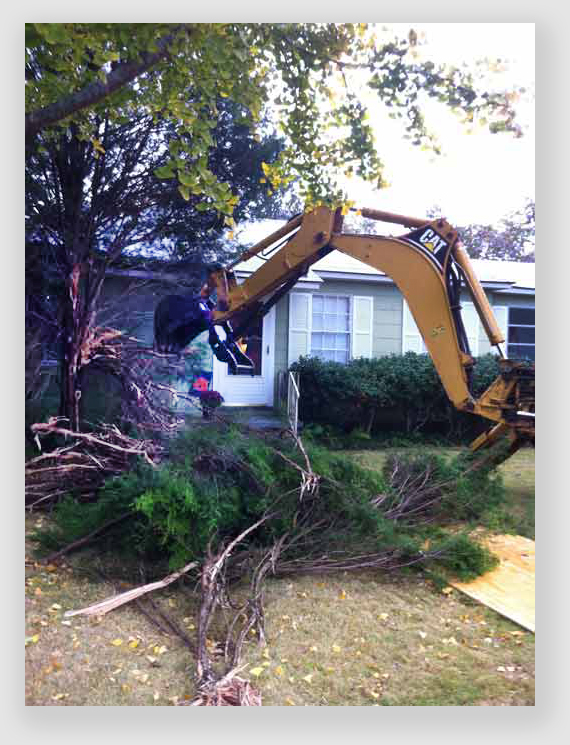
A trackhoe removing a tree... rather a blunt instrument.

A trackhoe removing a tree… rather a blunt instrument.

In January 2013, Dick Lavy ordered an employee to clear the fencerow between the two properties. At the time, Lavy understood that he could clear brush straight up and down the property line and that such clearing was important for crop production, yield and safety for farm equipment. Using a trackhoe with an arm that could reach about 15 feet into the air, the employee reached up, grabbed limbs, and pulled them, trying to break them off cleanly. Although the employee tried to keep the trackhoe on DLF’s side of the property, occasionally a branch would snap off or tear the tree on Brewer’s side. Occasionally, a branch would fall on Brewer’s side, and the employee would reach over to grab the branch, but he never consciously reached over with the bucket to try and break a branch at the tree trunk on Brewer’s side of the property.

When Brewer learned that DLF was clearing the fencerow, he went out to look at the operation and called the sheriff. At that point, the track hoe was about halfway down the fencerow, destroying trees. A Darke County Sheriff’s Deputy told Lavy that a complaint had been made, and expressed his concern that civil or criminal issues could be involved in what he was doing. Lavy said that he had a right to take down any branches that were hanging over his property. In addition, Lavy said he would let Brewer remove the branches if Brewer wanted to do so, but he wanted the branches removed before crop season began in March or April.

The deputy told Brewer that Lavy claimed the right to take tree branches from his side and that if Brewer did not like the way he was doing it, Brewer could cut them himself. Brewer told the deputy that he was going to have an expert look at the trees. The deputy filed a report with the prosecutor’s office, but no charges were brought.

Although the deputy suggested that Lavy obtain legal advice before continuing, Lavy continued clearing the fencerow. Knowing that Brewer was upset, Lavy told his employee not to clean up branches that fell on Brewer’s side.

Within days after the damage occurred, Brewer’s wife took photos of the damaged trees. Three months later, Brewer and an arborist counted 326 damaged trees.

Brewer sued Dick Lavy Farms, alleging (1) a violation of O.R.C. § 901.51; (2) reckless trespass; and (3) and negligent trespass. Prior to trial, the court held that Brewer was not limited to damages for diminution in value, and the court would apply a standard that allowed recovery of the costs of restoration.

A chainsaw would have given a cleaner cut, but they are dangerous.

A chainsaw would have given a cleaner cut, but they are dangerous.

DLF argued that it had a common law privilege to cut off, destroy, mutilate or otherwise eliminate branches from Brewer’s trees that were overhanging DLF land. The Farm also argued that if it was liable, the proper measure of damages should be the diminution of Brewer’s property value; in the alternative, the court’s holding on the issue of damages was against the manifest weight of the evidence. Finally, DLF claimed it had not negligently or recklessly trespassed on Brewer’s property.

The Court found for Brewer, awarding him $148,350 in damages, including treble damages of $133,515.

Dick Lavy Farms appealed.

Held: The Massachusetts Rule is not a license to maim and maul.

DLF argued it had a common law privilege to sever or eliminate Brewer’s overhanging branches in any manner that it desired, and that the trial court nullified the privilege by holding that DLF could not cause breakage that impacts the tree on the other side of the property line. DLF argued this holding “emasculates the common law privilege and creates a conflict between R.C. 901.51 and a property owner’s constitutional rights.”

Section 901.51 of the Ohio Revised Code provides that:

No person, without privilege to do so, shall recklessly cut down, destroy, girdle, or otherwise injure a vine, bush, shrub, sapling, tree, or crop standing or growing on the land of another or upon public land. In addition to the penalty provided in section 901.99 of the Revised Code, whoever violates this section is liable in treble damages for the injury caused.

The Court agreed that “a privilege existed at common law, such that a landowner could cut off, sever, destroy, mutilate, or otherwise eliminate branches of an adjoining landowner’s tree that encroached on his land.” However, the Court said, “Even in situations involving common law privilege, a landowner should not act in a manner as to cause damage to the property of an adjoining landowner. Thus, while a privilege exists, it is not absolute.”

The appellate panel said that “it is a well-recognized principle of common law that a landowner has the right to protect his own land from threatened injury, even though, in doing so, he produces a condition that injures adjoining land, provided he acts with reasonable care. Ohio has recognized the right of a property owner to use self-help in removing encroachments on his property. Other jurisdictions also recognize the right of an owner to remove any encroachment on his property which deprives him of the complete enjoyment of his land.”

The critical phrase, the Court held, is “reasonable care.” DLF’s privilege to remove encroachments was limited by the requirement that it use reasonable care not to injure neighboring property. By imposing a standard of recklessness, which requires a higher degree of fault, the Court said, O.R.C. § 901.51 does not interfere with the common law privilege. Owners have an absolute right to destroy any vegetation on their own side of the property. Liability attaches only where the owners’ actions create harm on the other side of the property line.

Farmer Lavy argued that the Massachusetts Rule meant he didn't have to think.

Farmer Lavy argued that the Massachusetts Rule meant he didn’t have to think.

Thus, an owner must use reasonable care when exercising his or her rights under the Massachusetts Rule.

We should note that two judges concurred in the judgment, arguing that there is no duty of reasonable care required by a property owner when protecting his or her own property from encroaching vegetation. The dissenters said the owner “may cut, mutilate, decimate, pulverize or obliterate branches or roots which infringe upon her property from a neighbor’s trees or plants. Self-help is permitted to remove trees or plants. What she cannot do is intrude into the neighbor’s property in doing so. That is why liability is imposed here. Tearing off branches on the DLF property which extended into the Brewer property and which severed the branches at the trunk, or some other point on the Brewer property, constituted an intrusion and trespass across the property line into the Brewer property, regardless of any degree of care or lack thereof.”

The dissenters drew “a distinction between removal of encroaching vegetation, where self-help is universally accepted, and removal of structures building or fences, where self-help is often unacceptable.” Curiously, they noted that it “seems likely that a landowner could not chemically treat or poison the roots or limbs that encroach upon her property if that method of destruction will migrate to that portion of the vegetation on the neighbor’s yard and destroy the tree or shrub altogether, but that is an issue for another day.”

– Tom Root

TNLBGray140407

Case of the Day – Wednesday, October 15, 2025

MULLIGAN SEASON


I may slip over the border (the border between the U.S.A. and our neighbor to the north) to enjoy turkey and all the fixings. My favorite holiday of the year is Thanksgiving, and thanks to a cultural quirk, our Canadian cousins celebrate it way before we do. Monday may have been Indigenous Columbus Day in the United States, but it’s turkey day in the provinces. Well, turkey and Jiggs’ Dinner and butter tarts.

And then, we get a mulligan, a do-over, on Thanksgiving in 45 days. Life is good. And after that, we’ll get Thanksgiving Day over, and over and over until the leftovers are either eaten or spoil.  As Yogi Berra might have said, today’s case and Thanksgiving dinner will both be déjà vu all over again.

It seems there was trouble in Randolph County, Alabama, up near the Georgia line. The Ledfords had purchased a nice vacation home on a lake, next to a place owned by the Youngs. While the Youngs appreciated the natural setting, the Ledfords were more concerned that nature’s bounty – specifically one large pine tree on the boundary between the Ledford’s land and the Young property – was going to fall on their house. They wanted the tree cut down. The Youngs refused. The matter ended up in court.

Of course, regular treeandneighborlawblog readers know how that should have turned out: if the tree really sits on the boundary line, both landowners have to agree before it can be cut down. The trial court reasoned otherwise. Under the Massachusetts Rule, a landowner can trim parts of a tree that overhang or grow under his or her property, all the way from the center of the earth to the sky. So that meant the Ledfords could cut out half of the tree, the court mused. That would kill the tree, but the court interpreted the Massachusetts Rule to mean that since you’re allowed to hack at the roots and branches of a tree without regard to the damage you cause, then you can take down the whole boundary tree if you like. The trial court gave the Ledfords the go-ahead to take down the tree.

The Youngs appealed, and common sense prevailed. The Court of Appeals explained the proper boundary tree rule, reversing the trial court’s errant ruling. But in so doing, a few judges on the appeal panel wondered aloud (or at least, in the written opinion) why the Ledfords hadn’t argued that they had the right to cut down the pine tree because it was a nuisance. Remember Fancher v. Fagella? One judge went so far as to say that if the record held evidence of nuisance, he would have upheld the trial court, wrong though its reasoning was.

Do we have to spell it out? The trial court was just plain wrong.

Do we have to spell it out? The trial court was plain wrong.

Well, the Ledfords could take a hint. When the case went back to the trial court “for proceedings consistent with this opinion,” as appellate decisions like to say, they asked for a do-over, a second hearing, this one on nuisance. ‘Hold the phone!’ the Youngs cried. ‘The Court of Appeals said the Ledfords lost. The tree stays standing. Game over.’

The trial court gave the Ledfords their mulligan. It ordered a second hearing and afterward found the pine tree to be a nuisance. The Ledfords were told they could cut it down. Again.

The Youngs went back to the Court of Appeals for a writ of mandamus, essentially a request that the Court issue an order telling the trial court that it couldn’t hold the second hearing. The appellate court refused to do so. Applying an obscure rule called the “law of the case” doctrine, the appellate court held that while the trial court was required to apply the ruling the court of appeals had issued, that ruling was just that the Ledfords could not cut down a boundary tree without the agreement of their neighbors. The court of appeals did not say the tree had to remain – just that if it was to be cut down, it couldn’t be on the basis originally articulated by the trial court.

The lessons here? The Ledfords’ attorney should have argued nuisance to begin with. It should have been clear that arguing that his clients could cut down a boundary tree was a loser. Besides, in civil litigation, you argue as many alternative theories as possible to get your clients where they want to end up. Who knows which one will be a winner?

Of course, the Ledfords ended up winning, and the pine tree lost. But as an old judge once cautioned us, you should never dig up more snakes than you can kill. Why buy a second trip to a court of appeals by leaving out an argument, and asking for a mulligan later?

A few too many snakes? The Ledford's lawyer courted procedural trouble.

A few too many snakes dug up here? The Ledfords’ lawyer courted procedural trouble.

Ex parte Young, 79 So.3d 656 (Ala.Civ.App. 2011): The Ledfords owned a vacation house with a pine tree located slightly over 10 feet from Ledford’s house, on the boundary between their property and that of the Youngs. Fearing that [a] strong wind against the tree could cause it to fall on the home and could cause damage to the [house] as well as serious injury to any occupants,’ the Ledfords wanted a court order that they could cut it down.

The Youngs argued that the pine tree was ‘a true boundary line tree’ and contended that it could not be cut down by either property owner without permission of the other. After a hearing in which the Ledfords, the Youngs, and a forester hired by the Youngs all gave testimony, the trial court held that Ledford and her husband could remove the tree at their convenience, taking steps to minimize damage to the Youngs’ lot. The trial court held that because Alabama law let a landowner remove any trees on his or her property up to the property line, and that the right extended to the center of the earth and into the sky, the Ledfords were free to hack into the pine tree up to the property line and then cut from that point down to hell and up to heaven. The Court said that “[s]ince [the Ledfords] unquestionably has the right to remove any portion of the tree that is located on [their] side of the property line and since doing so would likely kill the tree, the Court is of the opinion that [they] should be allowed to completely remove the tree to ensure” that the property and the health of anyone there are protected.

When the case got to the Court of Appeals the first time, it was promptly reversed. Rejecting the trial court’s tortured “center of the earth to the sky” analysis, the appellate court ruled that “[i]n the special case of a boundary-line tree, … each adjacent landowner has ownership rights that cannot be trumped by the other’s desires in the manner suggested by the trial court’s judgment” and that the Ledfords – contrary to the trial court’s judgment – could not properly “‘cut into the tree to the property line and then cut from that point to the center of the earth and into the sky'” without incurring liability to the Youngs.

But the appellate court went a little further. In a concurring opinion, two of the judges on the appellate panel observed that the action had been argued on the basis of the Ledfords’ contention that they were entitled to remove the boundary-line tree at issue merely because its trunk was located in part on their property. The judges noted that whether the “boundary-line tree at issue in this case constituted a nuisance for which an exception to the general rule set forth in the main opinion might apply” had not been litigated. A third judge on the panel said that had the record contained evidence indicating that the tree at issue posed a danger to the Ledfords’ house,” he would have voted to affirm the judgment instead of reverse it.

After the appellate judgment issued, the Ledfords asked the trial court for another hearing to consider whether the pine tree was a nuisance. The Youngs argued that the appeals court had decided in their favor, and the case should be closed. But the trial court had another hearing, and afterward it decided that the tree was a nuisance and that the Ledfords could remove it on that basis.

The Youngs filed a petition for a writ of mandamus, asking the appeals court to order the trial court to enter judgment for them and end the proceeding.

Held: The Ledfords could cut down the tree. A court will issue a writ of mandamus only when the petitioner has a clear legal right to the order sought; the respondent has an imperative duty to perform, accompanied by a refusal to do so; there is no other adequate remedy at law; and the court has jurisdiction of the court.

Mulligan140206Here, the Court of Appeals said, the only real question was whether the trial court had the right to hold a second trial in this matter. The Youngs contended that the prior appellate court’s decision was final as to all matters before it and that the trial court, after that initial appeal, was not allowed to hold another hearing and take additional testimony without permission of the appellate court to do so. The court of appeals agreed with that statement of the law but said that only the particular issue that had formed the basis of the trial court’s judgment – whether Ledfords could unilaterally remove the boundary-line tree simply because the majority of it was located on their side of the common boundary – was addressed. Based upon that conclusion, the court of appeals had reversed the trial court’s judgment letting the Ledfords unilaterally remove the tree,” and remanded the cause “for further proceedings consistent with [that] opinion.”

Because of the limited scope of the trial court’s previous judgment, no one had ruled on whether the boundary-line tree posed a danger to Ledford’s home or amounted to a nuisance. While the prior decision was thelaw of the case,” nothing in the prior opinion limited the trial court from ruling on the nuisance question, which the court of appeals admitted remained open for decision. Deciding to examine the nuisance question did not put the trial court in the position of doing something contrary to what the court of appeals had ordered.

– Tom Root

TNLBGray140407

Case of the Day – Tuesday, October 7, 2025

TRADITION

Sometimes, state law leaves a landowner suffering from invading roots and branches from a neighbor’s tree with no remedy but a chainsaw. As we all know, the Massachusetts Rule – alive and well in a number of states – lets a property owner trim offending branches and roots up to the property line, but that’s it: no lawsuits, no damage awards, no injunctions, and no meddling lawyers.

It’s the traditional approach.

Other states follow variants of the Hawaii Rule and let a property owner sue when a neighboring tree becomes a nuisance, causing “sensible harm,” a weird expression apparently meaning something more than falling leaves and twigs.

Then there’s the approach adopted by a Florida court of appeals of few words.  In the Sunshine State, a ficus tree near a landowner’s property boundary line was wreaking havoc on the neighbor’s house. The ficus is a very old tree, maybe 60 million years old (and possibly as old as 80 million years). It features aerial roots and is pollinated by a single species of wasp known as a fig wasp.

The owner of the tree was General Engineering Enterprises, Inc., obviously a big, faceless corporation with oodles of money. So Mike sued, asking for money damages. Why not? Everyone knows big mega-corporations are nothing but ATM machines, and you activate the cash-dispensing feature by walking through the courthouse door.

The Court was unsympathetic. Mike, you have a saw? Use it, man. Concerned that to permit Mike to get free money because branches from the ficus were overhanging his property might work in derogation of the time-honored principle of self-help, the Court of Appeals followed the Massachusetts Rule, despite the fact that the opinion candidly admitted that most other courts seemed to be headed toward the Hawaii Rule.

Ah, tradition!

Richmond v. General Engineering Enterprises, Inc., 454 So. 2d 16 (Ct.App. Fla. 1984). Mike Richmond sued General Engineering Enterprises, Inc., for money damages based on the company’s “negligence” in permitting branches of a ficus tree growing on its property to extend over and onto Mike’s home lot. The trial court wasted no time in dismissing Mike’s complaint.

Mike, obviously no reader of this blog, appealed.

Held: The Massachusetts Rule prevailed.

While there is substantial authority to the contrary, the Court said, “which may indeed represent the majority rule… we agree with those decisions which hold that in view of the undoubted right of the landowner himself to cut off intruding roots or branches at the property line, no such action may be maintained.”

The Court said that letting Mike proceed with his lawsuit to redress a claimed wrong “which might otherwise be obviated by the time-honored remedy of self-help would represent a wasteful and needless use of the judicial system.”

– Tom Root

TNLBGray

Case of the Day – Tuesday, September 30, 2025

A RATHER SURPRISING HOLDING FROM A DELAWARE TRIAL COURT

In this tree law gig, I read a lot of cases. After a while, reading between the lines gets a lot easier.

Today’s case, which I decided was nothing special, was just about some neighbors who were over-the-top haters of the defendant. The defendant seems like a guy whose crime was that he apparently had the effrontery to move in next door and then fix up the place.

The trial court’s long opinion had flushed away most of the plaintiffs’ breathless and frantic complaint – and “flushed” is the correct verb for most of the claims the tin-foil-hatted neighbors made against the defendant– when I got to their claim that defendant Bill Collison had “damaged a maple tree near the property line by shaving the trees directly up from the property line.”

“Holy Massachusetts Rule!” I muttered to myself. Everyone knows that this claim should be summarily tossed, because the Massachusetts Rule is as universally accepted as is turkey at Thanksgiving. Assuming Bill did “shave” the tree at the property line, that’s perfectly within his rights.

Much to my shock, the Court disagreed. It held that the right of “self-help” trimming of encroaching branches is not established in Delaware, and if this court was going to do it, it would not do it on summary judgment. It became obvious to me that whatever else Judge Calvin Scott, Jr., of Newark, Delaware, reads with his morning coffee, it sure isn’t this blog.

It did not take long to find reason to question the Judge’s refusal to grant summary judgment on this issue. In the 1978 Delaware Chancery Court decision Etter v. Marone, the court ruled

At the same time, certain generally accepted principles obtain with regard to encroaching trees or hedges. Regardless of whether encroaching branches or roots constitute a nuisance, a landowner has an absolute right to remove them so long as he does not exceed or go beyond his boundary line in the process. 2 C.J.S. 51, Adjoining Landowners § 52; 1 Am.Jur.2d 775, Adjoining Landowners § 127. He may not go beyond the line and cut or destroy the whole or parts of the plant entirely on another’s land even though the growth may cause him personal inconvenience or discomfort. 2 C.J.S. 51, supra.

So the Judge seems to be wrong: Delaware is firmly in the Massachusetts Rule camp.

What with allegations of underground tanks, clogged drainpipes and extreme mental anguish contained in the messy and unsupported complaint, Judge Scott pretty clearly had his hands full. By and large, he acquitted himself masterfully in the opinion, carefully deconstructing the plaintiffs’ complaints. But I’m betting that in about nine weeks, the Judge will be sitting down to a turkey dinner with all the trimmings. When he does, he should reflect that as many of us accept the Massachusetts Rule as will be dining on the same meal that day.

Dayton v. Collison, C.A. No. N17C-08-100 CLS (Super. Ct. Del. Sept. 24, 2019), 2019 Del. Super. LEXIS 446. Margaret Dayton and Everett Jones clearly had it out for their neighbor, Bill Collison. They claimed that since 2014, Bill had removed a significant number of standing trees and about 5,000 square feet of naturally growing plants from the City of Newark’s natural buffer zone, removed a 30-year-old drainage pipe located on his property and filled the remaining pipe with rocks and debris, intentionally altered the natural grade of his property so as to interfere with the natural flow of water, and trimmed a maple tree located on Maggie and Ev’s property along the boundary line. Additionally, they claim that an underground storage tank Bill installed – apparently your garden-variety propane tank – violates Newark’s municipal ordinances.

Maggie and Ev allege Bill’s property is a public nuisance, and that they have suffered “extreme mental anguish and damages of at least a $50,000 loss in the value of their home” because of flooding caused by Bill’s alteration of the grade’ invasion of privacy due to the removal of the buffer zone, being forced to live next to a hazardous condition because of the propane tank, and “damage or potential damage” (guess they’re not sure which) to the structural integrity of their property’s foundation.

They also claim Bill trespassed on their property multiple times to “alter the natural drainage flow of water, construct a berm, cut Plaintiffs’ trees, and take pictures or otherwise spy on Plaintiffs. From this, Plaintiffs claim they have suffered and continue to suffer damages and mental anguish in a sum to be determined at trial.”

Bill moved for summary judgment, claiming that Ev and Maggie cannot bring claims based on the alleged violation of city ordinances, and showing that their claims were baseless.

Held: Summary judgment in Bill’s favor was granted on all claims except the tree-trimming claim.

The Court held that a public nuisance is one which affects the rights to which every citizen is entitled. The activity complained of must produce a tangible injury to neighboring property or persons and must be one that the court considers objectionable under the circumstances.

To have standing to sue on a public nuisance claim, an individual must be capable of recovering damages and (2) have standing to sue as a representative of the public, “as in a citizen’s action or class action.” Here, Maggie and Ev have no right to bring a claim against Bill for alleged violations of the Code and thus, no standing to sue as representatives of the public. The Newark Code creates no rights enforceable by members of the public, and thus, it presents no basis upon which the requested relief may be granted.

To determine whether an implied private right of action exists, Delaware courts ask, among other things, whether there is any indication of legislative intent to create or deny a private remedy for violation of the act. Under the Newark City Charter, the City possesses “all the powers granted to municipal corporations by the Constitution and laws of the State of Delaware, together with all the implied powers necessary to carry into execution all the powers granted..” The city manager is responsible for administering all city affairs authorized by or under the Charter and may appoint individuals to enforce specific ordinances of the Code. The Court held that these reservations showed that the City of Newark intended for it to be solely responsible for enforcing its ordinances and did not intend to create a private right of action based upon ordinance violations.

Claims that Bill’s tree cutting was creating a public nuisance on the floodplain, likewise alleged violation of City ordinances, and thus were claims that Ev and Maggie lacked any standing to bring. As well, their claim that Bill’s propane tank had been installed without a permit alleged a violation of the City Code, a claim only the City could make.

Finally, Ev and Maggie claimed Bill created a public nuisance because he allegedly removed a drainage pipe from his property and filled the remaining pipe with rocks and debris. Outside of the fact that they were able to cite no evidence that any drainpipe had ever existed on Bill’s property, only the City of Newark had jurisdiction and control over drainage.

But Ev and Maggie claimed that Bill created private nuisances, too. A private nuisance is a nontrespassory invasion of another’s interest in the private use and enjoyment of their land. There are two types of private nuisance recognized in Delaware: nuisance per se and nuisance-in-fact. A claim for nuisance per se exists in three types of cases: 1) intentional, unreasonable interference with the property rights of another; 2) interference resulting from an abnormally hazardous activity conducted on the person’s property; and 3) interference in violation of a statute intended to protect public safety. A claim for nuisance-in-fact exists when the defendant, although acting lawfully on his own property, permits acts or conditions that “become nuisances due to circumstances or location or manner of operation or performance.” Plaintiffs allege claims under both the theory of nuisance per se and the theory of nuisance-in-fact.

But saying it doesn’t make it so. The Court granted Bill’s motion for summary judgment on the private nuisance claims because Ev and Maggie did not provide sufficient evidence supporting their nuisance per se claim, and did not submit expert reports to show the necessary elements of their claims.

Ev and Maggie also argued that Bill’s destruction of certain trees on their property and his failure to respect known boundary lines also constitute a continuing nuisance. They alleged that they suffered a diminution in the value of their home, in an amount of at least $50,000, as a result of the “nuisance created and maintained by” Bill. Ev and Maggie estimated the value of their home and the loss they had suffered. They argue that, as landowners, they may offer an opinion on the value of real estate. The Court disagreed: “Although Plaintiffs might know the fair market value of their property based on what they paid for it and based on a comparison of their property to other homes in the area, Plaintiffs do not know how each of Defendant’s alleged actions changed the value of their property. To establish how each of Defendant’s actions changed the value of Plaintiffs’ property, Plaintiffs would need to identify and submit an expert report from an expert witness; Plaintiffs have not done so.”

Those tin hats really work — it’s just that THEY want you to think there’s something wrong with wearing ’em …

Ev and Maggie allege that they have suffered “extreme mental anguish” as a result of Bill’s alleged nuisances. The Court ruled that Ev and Maggie “needed to show proof of the ‘extreme mental anguish’ they allegedly suffered through a medical expert. Without expert testimony, the Court is not able to find that Plaintiffs suffered this type of harm or that Defendant’s conduct caused such harm. Plaintiffs have neither identified an expert witness to testify to this matter nor submitted an expert report regarding this matter.”

Ev and Maggie’s only victory came on their claim that Bill damaged their maple tree. They alleged that he damaged a maple tree near the property line by shaving the trees directly up from the property line. Ev and Maggie have identified and submitted a report from an arborist, Russell Carlson, detailing the manner in which the maple tree was damaged by Bill’s alleged cutting back of the branches. The report shows the damage done to the maple tree and estimates the cost of that harm.

Bill responded to their report, arguing that he has a right to engage in “self-help” to the property line. The Court held that “it remains unclear in Delaware whether a defendant has a right to engage in ‘self-help’ by cutting tree limbs that extend onto his property. The Court declines to make a determination on this issue in a motion for summary judgment. Therefore, Defendant has not shown, in the face of Mr. Carlson’s report, that he is entitled to judgment as a matter of law. Accordingly, summary judgment on this allegation is not proper.”

Ev and Maggie argued they are entitled to treble damages pursuant to 25 Del. C. § 1401, Timber Trespass. The Court may award treble damages for timber trespass when the plaintiff establishes that a trespasser “fells or causes to be cut down or felled a tree or trees growing upon the land of another”; 2) that plaintiff’s property was established and marked by permanent and visible markers or that the trespasser was on notice that the rights of the plaintiff were in jeopardy; and 3) that the trespass was willful.

Because Ev and Maggie only alleged that Bill damaged the tree, and did not cut it down altogether, they are not entitled to treble damages.

Finally, Ev and Maggie alleged that Bill intentionally trespassed on their property. The elements of a claim for intentional trespass are that the plaintiff has lawful possession of the land, the defendant entered onto the plaintiff’s land without consent or privilege, and the plaintiff shows damages. The Court held that there was a factual dispute as to whether Bill ever entered Ev’s and Maggie’s land. Thus, Bill was denied summary judgment on the trespass count.

Still, the Court pretty much savaged Ev’s and Maggie’s rather shrill and frantic claim, leaving their all-encompassing nuisance broadside a rather puny trespass and trim of a single tree.

– Tom Root

TNLBGray

Case of the Day – Thursday, September 25, 2025


THE LAW OF UNINTENDED CONSEQUENCES – PART 1

If there’s a Holy Grail of arboriculture law, it’s the Massachusetts Rule, that grand old lady of New England self-reliance. The Massachusetts Rule holds that if a neighbor’s trees’ branches overhang or roots intrude into your land, you cannot sue to have the encroachment removed. All you can do is solve the problem yourself.  As the Massachusetts court put it:

the neighbor, though without right of appeal to the courts if harm results to him, is, nevertheless, not without remedy. His right to cut off the intruding boughs and roots is well recognized [and] in his own hands. The common sense of the common law has recognized that it is wiser to leave the individual to protect himself, if harm results to him from this exercise of another’s right to use his property in a reasonable way, than to subject that other to the annoyance, and the public to the burden, of actions at law, which would be likely to be innumerable and, in many instances, purely vexatious.

But it’s always been a little puzzling to me. When your tree overhangs a neighbor’s property, does “harm” have to “result[] to him” before a self-help remedy is permissible? What if you just don’t like those big honkin’ branches overhanging your yard, leaving your prize roses in the shade? Or they sway in a stiff breeze, turning on your back yard motion-detecting spotlight?

The Massachusetts Rule seems to suggest that if the tree isn’t causing “sensible harm,” you can’t touch it.

Sensible harm? What might that be?  I have a beautiful oak tree standing in the corner of my property. Some of the branches hang over the backyard of my neighbor, a guy who is truly a prince of good humor. In the autumn, my oak leaves fill every inch of his yard (downwind from mine) to a depth of nearly a foot. It seems pretty clear to me that if my neighbor decided to trim back my oak to the property line, I could hardly complain.

But I also have a pair of pine trees that soar majestically, extending nearly half of their branches over the fence and into my other neighbor’s airspace. They drop nothing to speak of, and really cause him no problems whatsoever. Does the Massachusetts Rule extend to him, too, and permit him to lop off the overhanging branches (and thus ruin my trees’ symmetry), simply because the branches hang over some of his lawn?

I like my neighbors, and I am not about to delve into the nuances of the Massachusetts Rule in a lawsuit in the local Court of Common Pleas. But, as we can see in today’s case, there are those who are willing to do so, and who have read the Massachusetts Rule’s “if harm results to him…” language as being a hard requirement that harm must result to a neighboring landowner before he or she can oil up the chainsaw and address the overhanging problem.

For their benefit, Pennsylvania courts went out on a limb 25 years ago by applying the law of trespass to overhanging branches and encroaching roots. Today, we’ll read about how that came to be. Tomorrow, we’ll consider a case where a crafty lawyer took the trespass theory (and an ill-advised piece of dictum from today’s case) and tried to spin it towards its obvious conclusion.

Jones v. Wagner, 425 Pa.Super. 102, 624 A.2d 166 (Pa.Super. 1993). The Joneses and Wagners are adjoining landowners, with a fence separating their properties. The Joneses own a row of tall hemlock trees. While they were on vacation, the Wagners trimmed the branches of the trees to the extent that the branches hung over the boundary line separating the neighbors’ property. The Joneses sued, demanding that the Wagners pay them the replacement value of each of the 26 trees that line the boundary, about $31,000.

The Joneses’ theory was novel. They claimed the Wagners owed them damages because the trees they trimmed were not harming them. They argued that even under the Massachusetts Rule, a landowner is only allowed to trim branches and roots to the property line – that is, exercise a self-help remedy – if the overhanging branches or roots are causing him sensible harm beyond the occasional shedding of leaves and twigs. Because the trees were not doing so, the Joneses claim, the Wagners’ trimming was the pursuit of a remedy without a right, and that made the Wagners liable for damages.

The trial judge was having none of it and held that the Joneses had no cause of action. He dismissed their complaint with prejudice, and they appealed.

Held: The self-help remedy available under the Massachusetts Rule does not require prior injury to the landowner availing himself or herself of the remedy.

While, the Court admitted, there does exist some conflict regarding when a landowner may institute an action for injunctive or monetary relief against an adjoining landowner whose trees overhang the property line, one common thread connects all such cases: the landowner whose land is encroached by the overhanging branches may trim the limbs to the extent of the encroachment. The Court noted another decision that said, “The cases are in agreement that trees ordinarily aren’t nuisances; that overhanging branches which merely cast shade or drop leaves on the land are not nuisances; that if under any circumstances overhanging branches or protruding roots do constitute a nuisance it is only when they do sensible or substantial harm; and that, whether nuisances or not, a landowner may always cut away to his property line branches and roots from trees of the adjoining owner.”

(Note: “Sensible harm” appears to be a term used nowhere in law except with respect to tree encroachment, and has nowhere been defined.  The ten cases or so in which the term appears all seem to assume the reader knows what it is, apparently “harm that can be sensed.”  The question as to its meaning reminds me of Supreme Court Justice Potter Stewart’s famous riff on the meaning of obscenity, in Jacobellis v. Ohio: “I shall not today attempt further to define the kinds of material I understand to be embraced within that shorthand description; and perhaps I could never succeed in intelligibly doing so. But I know it when I see it…”  So what is “sensible harm?” You’ll probably know it when you see it.)

The Joneses’ contention that the Wagners had to suffer “sensible harm” before availing themselves of the Massachusetts Rule remedy “is only relevant if the appellees seek their remedy in a court of law or equity,” the Court ruled. “A showing that encroaching tree limbs, branches, or roots have caused sensible damage is not a precondition to exercising a self-help remedy.”

It is an ancient principle of law, the Court said, that a landowner has the exclusive right to the space above the surface of his or her property, owning everything above and below ground level to an indefinite extent. On the same principle, courts have held that tree branches extending over adjoining land constitute a nuisance – at least in the sense that the landowner encroached on may himself cut off the offending growth.

But whether a suit for injunction and damages may be maintained without proof of actual damage is a point upon which the authorities have not been clear. In some other jurisdictions, damage caused by encroaching branches and roots are never actionable, self-help being the landowner’s only remedy. This is the “Massachusetts Rule.” Others require proof of some “sensible or substantial” damage before an action for damages in trespass is available, while some jurisdictions allow both actions at law and at equity upon this showing. Hawaii allows an action upon a showing of actual damage or upon “imminent danger” of damage (known in the tree law world as the “Hawaii Rule“). Finally, some jurisdictions hold that proof of damage only determines the amount of damages recoverable, and not whether a cause of action exists. These jurisdictions, however, are ones in which statutes, not common law, recognize the existence of the cause of action.

The Court said it is fundamental that a landowner has a cause of action against any person who has committed a trespass upon his or her lands, and it is not necessary for the landowner to allege any actual damage as an element of the cause of action. This is because the harm is not to the physical well-being of the land, but rather to the landowner’s right to peaceably enjoy full, exclusive use of his or her property. In fact, there is a property right in the airspace above the land, which may be invaded by overhanging structures, or telephone wires, by thrusting an arm above the boundary line, or by shooting across the land, even though the bullets hit the surface. Thus, the Court observed, an aggrieved landowner has a cause of action against an adjoining landowner whose trees overhang the boundary line. Otherwise, his or her right to enjoy exclusive peaceable use of the property is diminished.

The continuing presence of the branches and trees overhanging property lines indicates that the nature of the relief afforded to the aggrieved landowner is not simply monetary. The Restatement notes that a continuing trespass is committed by the “continued presence of a structure, chattel, or other thing which the actor has tortiously placed there, whether or not the actor has the ability to remove it.”

A trespass occurs by a mere overhang. Furthermore, given the rather unremarkable observation that trees will tend to grow, the trespass, even if remedied once, is bound to recur just as soon as the trees or shrubbery regenerate. Thus, the trespass is “continuing” and the possessor of land is entitled to pursue a proper remedy.

We are convinced, the Court ruled, that Pennsylvania law “entitles a landowner to protect his property interest by maintaining an action to compel a person who has caused a trespass to remove it.” It is not suggested anywhere that a showing of harm is a prerequisite to recovering in trespass. A landowner may avail himself or herself of every available remedial avenue in an effort to protect the incidents of land ownership. “Anything less, in our view,” the Court said, “is a travesty.”

Thus, the Court concluded that Pennsylvania law affords a full panoply of remedies to a landowner whose property is encroached by overhanging branches or tree limbs (thus following the Hawaii Rule):

• First, an aggrieved landowner may exercise a self-help remedy by either trimming or lopping off the branches to the extent his or her property is encroached;

• Second, if the landowner has incurred reasonable expenses in the course of exercising a self-help remedy, he or she may recoup those expenses from the trespasser; or

• Third, he may, on a trespass theory, seek a court order compelling the trespassing neighbor to remove the trees to the extent of the encroachment and seek appropriate money damages.

Pennsylvania law requires no showing of physical harm or damage to the land before a landowner can enforce his or her right to freely enjoy unencumbered and exclusive use of property he rightfully possesses. The mere “tree trespass” is enough.

The Wagners were only exercising their right to trim the branches and limbs of the Joneses’ encroaching trees. They may not be held liable for doing so.

– Tom Root

TNLBGray

Case of the Day – Thursday, September 11, 2025

HAWAII SINGS HAWAII

Regular readers know that I often write about the Hawaii Rule, easily the second most cited rule in arboriculture law. But for all of that, the great State of Hawaii has not expounded on the seminal holding in Whitesell v. Houlton, the decision that most famously rejected the second prong of the Massachusetts Rule by holding that when a landowner’s tree became a nuisance to his or her neighbor, the neighbor could compel the landowner to abate the nuisance – that’s legalese for remove the tree or at least the part of the tree that was bedeviling the adjoining property owner – at the landowner’s expense.

Whitesell, which adopted a rule from an old Virginia case, Smith v. Holt, held that a tree was a nuisance if it was “noxious” or if there was an imminent danger of it causing “sensible harm” to property (besides plant life) other than by “casting shade or dropping leaves, flowers, or fruit.” “Sensible harm” is a standard not causing much confusion: tree roots heaving basement walls, danger trees about to fall on nearby cars and structures – it has always been reasonably obvious what “sensible harm” might be. But what might Whitesell’s reference to “noxious” trees be all about?

About 35 years after Whitesell, a Hawaii court has finally tackled the question, interpreting Whitesell and providing a rare glimpse at a court admitting that its own precedent, if not wrong, at least was a bit too frisky. Not that I am surprised, it turns out that Whitesell’s reference to noxious trees” was meaningless surplusage, language borrowed without much consideration from a since-discredited Virginia decision.

No one ever expected a litigant to latch on to the “noxious” half of Whitesell’s disjunctive definition in order to make his case. When the plaintiff in today’s case did just that, the appellate court was compelled to admit that Whitesell’s inclusion of ‘noxious’ was “superfluous.” Translation: Whitesell said ‘noxious’, but it did not mean it.

The appellate court in today’s case did the only thing it could: it decided to “modify [the] holding in Whitesell for when a plant can be considered a nuisance. Plants whose overhanging branches cast shade or drop leaves, flowers, or fruit, or whose roots interfere only with other plant life, are not nuisances. Overhanging branches or protruding roots constitute a nuisance when they actually cause, or there is imminent danger of them causing, material harm to a person or to property other than plant life.”

Good idea, even if it’s 35 years late. Get rid of the ‘noxious’ language. If the tree is noxious, it probably already poses an imminent danger to people or property. And that is exactly what a non-noxious tree does when it has become a nuisance.

For heaven’s sake, simply define the tree by the imminent threat it represents, not with some squishy term like ‘noxious’.

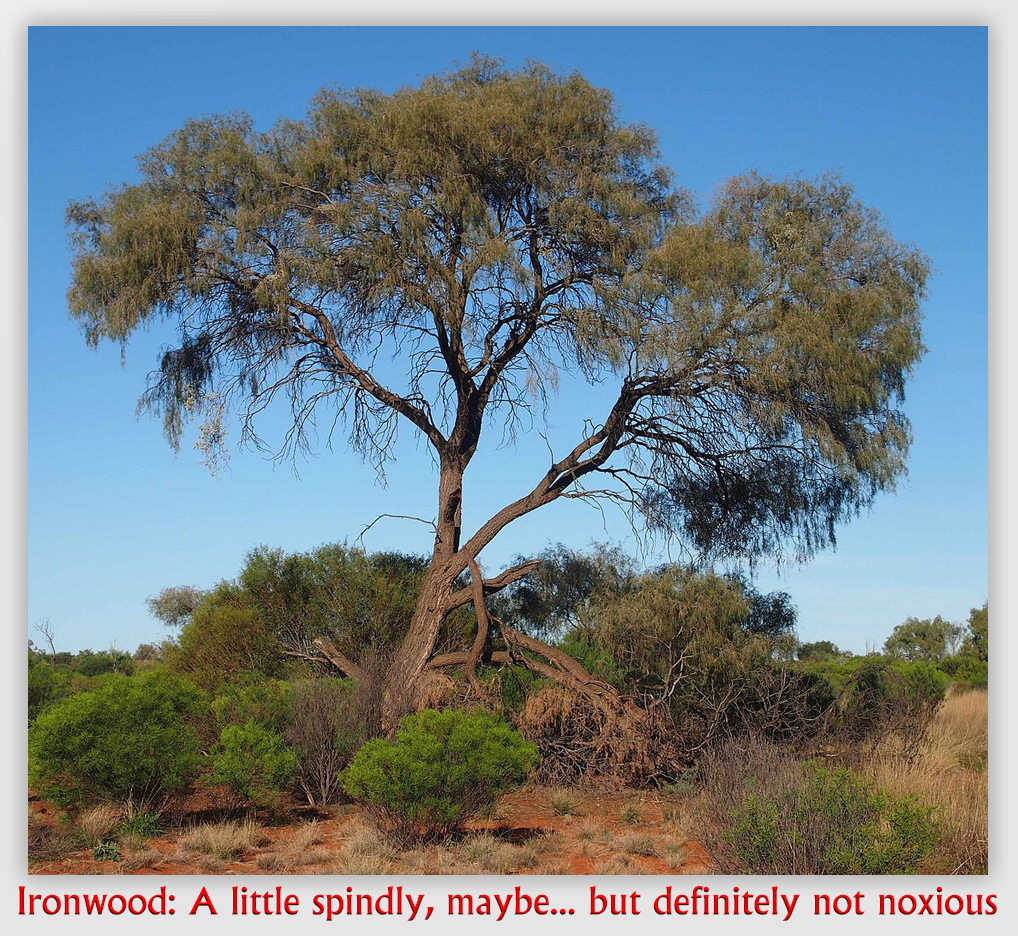
Spittler v. Charbonneau, 145 Haw. 204, 449 P.3d 1202 (Ct. App. 2019). Scott Spittler sued his neighbors, Paul and Janice Charbonneau, raising all sorts of trespass, nuisance and related claims. The claims relevant here is his claim that the Charbonneaus’ ironwood trees, planted in 1983 as windbreaks under a U.S. Dept. of Agriculture program, were dropping leaves and branches on his property, and had “an extensive root system, have created a poor growing environment, and continue to present danger to person, real property, and agricultural products of [Spittler].” For good measure, he also claimed that the trees were ‘noxious,’ based upon a “high risk” rating of “12” set out on the Hawaii Pacific Weed Risk Assessment website. He demanded that the Charbonneaus remove the trees at their expense.

The trial court held for the Charbonneaus, finding that “the intrusion by way of overhanging branches, leaves and roots into Scott’s property that results in damage to plant life is not a nuisance and not compensable.”

Scott appealed.

Held: The trees were neither noxious nor nuisances. What’s more, Whitesell’s reference to noxious trees being nuisances is surplusage that should be stricken from the decision.

The Court observed with some surprise that “in a state known for its lush foliage, there appears to be only one reported appellate decision, Whitesell v. Houlton, addressing when a plant that naturally encroaches upon a neighboring property can constitute a nuisance. Whitesell adopted a modified version of the Virginia rule set forth in Smith v. Holt, which was later overruled in part by Fancher v. Fagella. Borrowing from Smith v. Holt, Whitesell held that “non-noxious plants ordinarily are not nuisances… Overhanging branches or protruding roots constitute a nuisance only when they actually cause, or there is imminent danger of them causing, sensible harm to property other than plant life, in ways other than by casting shade or dropping leaves, flowers, or fruit. When overhanging branches or protruding roots actually cause, or there is imminent danger of them causing, sensible harm to property other than plant life, in ways other than by casting shade or dropping leaves, flowers, or fruit, the damaged or imminently endangered neighbor may require the owner of the tree to pay for the damages and to cut back the endangering branches or roots and, if such is not done within a reasonable time, the damaged or imminently endangered neighbor may cause the cutback to be done at the tree owner’s expense.”

Thus, according to Whitesell, the Charbonneaus’ trees could be considered a nuisance if: (1) they were “noxious”; or (2) they caused, or there was an imminent danger of them causing, “sensible harm” to property other than plant life other than by “casting shade or dropping leaves, flowers, or fruit.”

“In Whitesell,” the Court said, “we did not define the word ‘noxious’ or formulate a test to determine when a plant could be considered ‘noxious.’ The difficulty inherent in characterizing a plant as ‘noxious’ is illustrated by this case. Scott argues that ironwood trees are “noxious” based upon a “high risk” rating of “12” on the Hawaii Pacific Weed Risk Assessment website. That website does not use the word “noxious” and states only that the “small-cone ironwood” is “[u]sed in [Hawai’i] for windbreaks at higher elevations. Wood used for fuel.” It does not indicate that the ironwood is “physically harmful or destructive to living beings,” which is the definition of “noxious” contained in the Merriam-Webster dictionary.” The Court noted that some Hawaii cases had characterized some other flora as being noxious, but ironwood trees weren’t on anyone’s list except for Scott’s.

The Court sheepishly admitted that “[o]ur use of the word “non-noxious” in Whitesell was superfluous. A noxious plant — i.e., one that is “physically harmful or destructive to living beings” — is one that actually causes, or that could pose an imminent danger of causing, material harm to persons or to property other than plant life; conversely, a plant that actually causes, or that poses an imminent danger of causing, material harm to persons or property other than plant life may be considered noxious. We note that certain plants, such as coconut palms, are capable of causing material injury to persons or to property other than plant life just by dropping fronds or nuts. We also note that tree roots can, under some circumstances, pose imminent trip[ping] hazards without damaging property other than plant life. We therefore modify our holding in Whitesell for when a plant can be considered a nuisance. Plants whose overhanging branches cast shade or drop leaves, flowers, or fruit, or whose roots interfere only with other plant life, are not nuisances. Overhanging branches or protruding roots constitute a nuisance when they actually cause, or there is imminent danger of them causing, material harm to a person or to property other than plant life. When overhanging branches or protruding roots actually cause, or there is imminent danger of them causing, harm to a person or to property other than plant life, the damaged or imminently endangered neighbor may require the tree’s owner to pay for the damage and cut back the endangering branches or roots and, if that is not done within a reasonable time, the damaged or imminently endangered neighbor may cause the cutback to be done at the tree owner’s expense.”

The only dispute before the court alleged the ironwoods dropped “overhanging branches which merely cast shade or drop leaves, flowers, or fruit,” and “roots which interfere only with other plant life.” Under those facts, the Charbonneaus’ trees were not a nuisance…

– Tom Root

TNLBGray140407

Case of the Day – Monday, August 11, 2025

FISTS, NOSES AND TREES

punch50720Everyone’s heard the old saw that “the right to swing my fist ends where your nose begins.” Imagine your nose is a 65-foot tall maple tree, and my fist is a backhoe. Good luck with that – most imaginations aren’t quite that agile.

Here’s the problem. We all know about “self help,” the venerable old Massachusetts Rule that limits a landowner to trimming away encroaching branches and roots from a neighbor’s tree up to the property line. Michalson v. Nutting – and virtually every encroachment case decided in the eight decades since that decision – has given a property owner the right to trim back a neighbor’s tree to the boundary without any limitation.

At the same time, we all know about boundary trees, those trees whose trunks enter the earth smack on the property line, so that tree is attached to the ground in both properties. Boundary trees are special, and the general rule is that neither property owner may trim the tree without the consent of the other.

But what happens when a neighbor’s tree is not on the boundary, but so encroaches on a landowner’s property – both above ground and below ground – that the practical effect of the landowner’s Massachusetts Rule self-help will be to kill the tree?

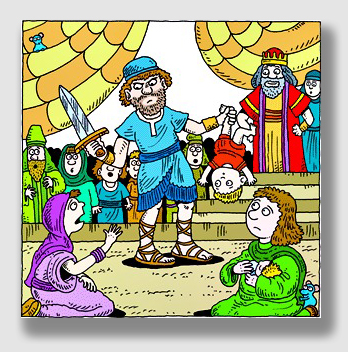
solomon150720Remember King Solomon? When two women appeared in front of him arguing over who was the mother of a baby, he proposed to settle it by cutting the baby in half so that each woman would get 50 percent of the child. That threat was enough to smoke out the imposter. In today’s case, dividing the tree in half would have had the same effect as cutting up the infant (albeit with less blood).

The Alvarezes own a nice place in Vermont, complete with a view of Lake Champlain. They have a 65-year-old maple tree next to the property line of their neighbors, the Katzes. It was close, but the base of the tree was completely on the Alvarezes’ property, so this was no boundary tree the parties were dealing with.

The tree had been standing for almost seven decades. In fact, when the Alvarezes bought the property 20 years ago, the maple had already sent roots and branches across the boundary between the two parcels.

The Katzes, who also enjoy a view of Lake Champlain, have planned for a number of years to add to their house, essentially doubling its size with a two-story addition. The only problem – or at least, the only problem we care about – was the maple tree. To add on, the Katzes would have to cut away about half of the maple tree’s branches and roots, in all likelihood killing the tree.

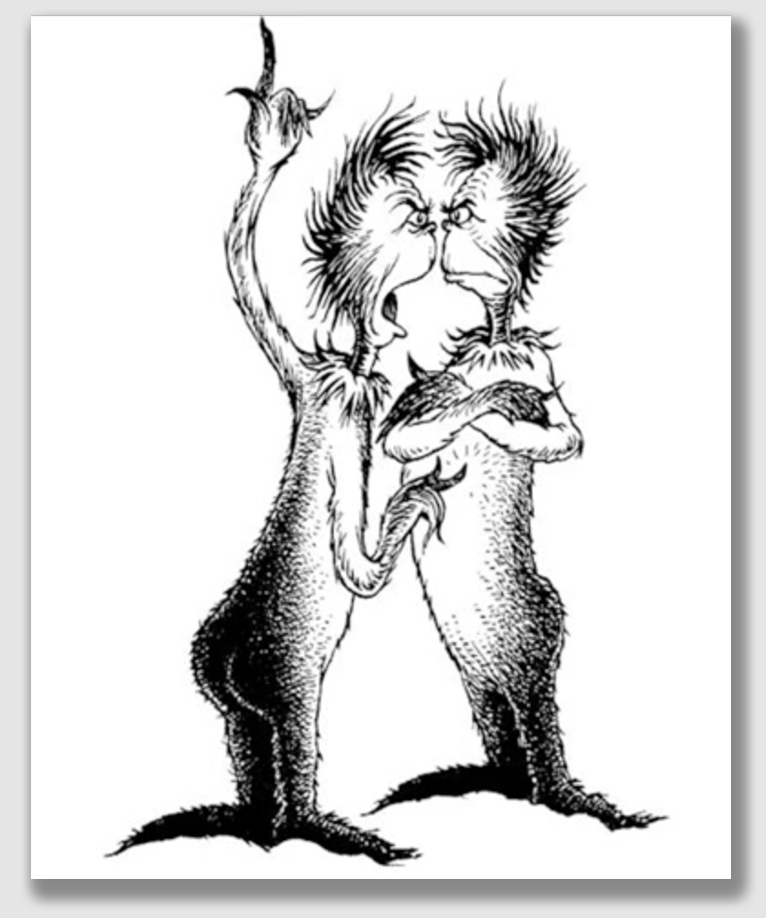
The Alvarezes and Katzes tried to resolve the problem amicably, but – just as happened with the women in front of King Solomon – there really wasn’t any middle ground. Either the Katzes would get their way, building onto their house and killing the tree, or the Alvarezes would have it their way. Like Dr. Seuss’s north-going and south-going Zax, neither neighbor would budge.

But then Katz somehow learned all about the Massachusetts Rule. It dawned on him that he could cut back the offending maple tree to the property line, both roots and branches. Sure, the tree might die, but the Massachusetts Rule said nothing about what happened to the tree after a neighbor used “self-cutting” trimming on it.

The Alvarezes ran to court and obtained an injunction against Katz. The trial court found that trimming the tree as Katz proposed doing would probably kill it. The injunction prohibited cutting away only about 25 percent of the tree, about half of what the Katzes needed for their ambitious plans.

The Katzes appealed, and the Vermont Supreme Court threw out the injunction. It held that the Massachusetts Rule was a blunt object, and had always been one. A landowner owns everything above and below ground level, and that owner can cut anything he or she wants to cut, without regard for the effect of the cutting. The Court said that was the law in Vermont and just about everywhere else.

The Zaxes wouldn't budge, either ...

The Zaxes wouldn’t budge, either …

The Supreme Court seemed a little uncomfortable with its decision, but it ruled in essence that the law is the law, and that’s the way Vermont had always done it. It noted, in a hint that was as subtle as an anvil, that cases where Massachusetts-style self-help had been limited – such as in Booksa v. Patel – the theory that had been advanced was that of nuisance. In other words, the Alvarezes could have argued that Katz’s proposed trimming would so endanger the tree that it would interfere with their enjoyment of their property. Recall in Booksa, the court ordered the defendant to trim the encroaching tree reasonably. The Vermont Supreme Court telegraphed that it would probably have done the same if the Alvarezes’ lawyer had only thought to make the argument. Oops.

Alvarez v. Katz, 199 Vt. 510, 124 A.3d 839 (Supreme Ct. Vermont, 2015). The Katzes own property in South Burlington around the Shelburne Bay area. The Alvarezes own the adjoining lot just to the north of the Katzes. The Alvarezes have a 65-foot-tall maple tree, the trunk of which is located entirely on their property. About half of the branches and roots from the tree cross the property boundary and encroach onto the Katz lot. Some roots extend under the Katzes’ existing deck.

For several years the Katzes have sought to expand their home by adding a two-story addition on the rear. The plans for the construction of the addition would require cutting the roots and branches that are encroaching on their property. This could encompass up to half of the tree’s roots and branches.

The Alvarezes and the Katzes have been unable to amicably resolve the problem of the maple tree. In 2013, when the Katzes considered taking unilateral action to trim the tree’s roots and branches, the Alvarezes filed for an injunction. The superior court found it more likely than not that removal of 50% of the tree’s roots and branches would result in the premature death of the tree, perhaps within five years and probably within ten from the time of cutting. The court employed what it called the “urban-tree rule,” under which trimming the roots or branches of an encroaching tree may be proscribed if the trimming will destroy the tree. The injunction barred the trimming of more than 25% of the roots and branches of the tree.

The Katzes appealed.

Held: The injunction was vacated. The Supreme Court reaffirmed “Vermont’s long-standing right of a property owner to trim branches and roots from an encroaching tree without regard to the impact that such trimming may have on the health of the tree.”

Vermont has long recognized ownership of property to include the ownership of that which is below the ground and that which is attached overhead. The right has been clear for almost 100 years, since Cobb v. Western Union Telegraph Co., (a 1916 decision that stated the Massachusetts Rule before there ever was a Massachusetts Rule). Cobb held that “it is a sound principle that where a tree stands wholly on the ground of one and so is his tree, any part of it which overhangs the land of an adjoining owner may be cut off by the latter at the division line.” The Supreme Court criticized the trial court for conjuring up an “urban-tree rule” that would be an exception to Cobb. The trial court had considered this case to be one of first impression in Vermont because of the anticipated adverse – and likely fatal – effect the root-and-branch cutting would have had on the encroaching tree. The Supreme Court held that any attempt to “distinguish” Cobb, that is, to find that the Cobb case was somehow different just because the Cobb tree was located in a rural setting, was wrong.

Further, the Supreme Court said, the “urban-tree rule” does not enjoy the support attributed to it by the trial court. Outside of two cases, the California decision in Booksa and one obscure New York decision, the Massachusetts Rule (which maybe we should have called the “Vermont Rule”) enjoys extremely widespread support. What’s more, the Court reasoned, the Vermont legislature has had 99 years to modify the Cobb holding by statute, and it has not bothered to do so. The Supreme Court concluded that the “right to cut encroaching trees where they enter the land of another, without regard to the impact on the encroaching tree by such cutting, is well-established under Vermont law.”

The Supreme Court noted that at common law, the right to cut encroaching boughs and roots historically counterbalanced a landowner’s right to grow shade trees on his land, regardless of the impact those trees may have in casting shade or encroaching upon the neighboring property. Common law provided no claim for damages caused by encroaching roots or branches. Instead, the remedy was one of self-help, allowing the cutting of roots and branches to the extent of encroachment.

Where other jurisdictions have departed from the common-law rule and allowed actions for damages as a result of encroaching roots or branches, they have generally relied upon nuisance principles. Even where such actions have been permitted, those jurisdictions continue to recognize the right to self-help. In this case, the Alverezes did not raise a nuisance claim, so “the issue of whether a nuisance claim might exist for the encroachment of roots and branches from the Alvarezes’ tree is not presently before the Court.”

The Supreme Court subtly suggested that the proper way for the Alvarozes to address the problem would be through the law of nuisance ...

The Supreme Court subtly suggested that the proper way for the Alvarozes to address the problem would be through the law of nuisance …

The Supreme Court defined the conundrum as follows: “[T]his case presents the competing interests of neighboring property owners. On the one hand, [the Katzes] have an interest in using their land, which they have purchased and upon which they pay taxes, as they see fit, within permissible regulations, free from limitations imposed by encroaching roots and branches from the neighbors’ tree, which they did not invite and for which they receive no benefit. The Alvarezes seek to restrict the use of the Katz property by preventing the removal of branches and roots on land that is not theirs and for which they have given nothing of benefit to [the Katzes] for suffering the encroachment. On the other hand, the Alvarezes wish to continue to enjoy their tree, which has been there for many years, without placing its viability in peril due to the construction that [the Katzes] wish to undertake.”

The Court observed that if the Alvarezes had the right to have their tree encroach onto the neighboring property, the obvious next question would be to what extent the encroached-upon property owner must suffer such an encroachment. The Supreme Court admitted that on some occasions the “exercise of self-help may result in the immediate or eventual loss of an encroaching tree, given the long-recognized rule in Vermont and its widespread support elsewhere, we decline to depart from the common-law rule in favor of the approach adopted by the superior court.”

– Tom Root

TNLBGray140407