Case of the Day – Wednesday, April 16, 2025

LIKE A GOOD NEIGHBOR

Would you rather have your insurance agent appear? Really?

Would you rather have your insurance agent appear? Really?

The Estes, like the rest of us, probably saw those insipid commercials a few years ago where the insurance-challenged protagonist would sing a major insurance company’s jingle offkey, and his or her local agent magically appears. It never made much sense to us. Meaning no disrespect to insurance – which, after all, is just a transaction in which you bet something bad’s gonna happen to you, and the insurance company bets it won’t – but if we could warble a stanza and make someone appear, it sure wouldn’t be an insurance agent.

Back to our topic. An article we read about an Indianapolis man having his ear bitten off by his neighbor made us think about truly rotten neighbors, you know, the ones without community relations teams and emergency satisfaction 800 numbers. The Estes probably have less of an idea of what a good neighbor is than most people, except to suspect it sure isn’t the people next door to them, the Gertzes. The Gertzes are a little bit weird, and we don’t mean that in a good way.

A dispute about a suburban boundary line ended up with the Gertzes training a battery of surveillance cameras on their former friends, the Estes. If that wasn’t enough, Mrs. Gertz began using a loudspeaker to hurl insults — rather graphic ones that left the court blushing — at the Estes daughters. And then there was the fence.

Robert Frost said that good fences make good neighbors, but he hardly had this fence in mind: an 8-foot tall monstrosity painted orange and black, studded with thousands of protruding nails and large warnings against climbing and trespassing painted on the Estes’ side like so much gang graffiti. In fact, the whole thing looked rather more like the Berlin Wall come to Hebron, Indiana.

LlamasThe Estes sued under the “spite fence” statute. The Gertzes protested that they hadn’t built a spite fence, but rather just a modest enclosure to protect some delicate saplings they had planted, as well as to permit the raising of alpacas and llamas. After all, they didn’t want any errantly roaming cattle to gnaw on the young trees or, for that matter, to let the llamas and alpacas flee to return to South America. The Court wasn’t convinced. After all, the Gertzes’ permit application called the fence “residential,” not “agricultural.” Second, the fence didn’t enclose the young trees, making it useless as a cattle barrier. Finally, the cameras, the loudspeaker, and the studded fence — not to mention the testimony of deteriorating relations between the plaintiff and defendant — made it clear to the Court that the fence was erected maliciously.

Alpacas

The Gertzes could hardly let their alpaca herd hotfoot it back to Bolivia, now, could they?

The Gertzes also tried a creative technical argument that because a permit had been issued for the fence, the Indiana “spite fence” statute had been trumped by local approval. The Court noted that the permit was for a 7-foot fence, not the 8-foot plus fence the Gertzes had put up, and anyway, a local permit did not excuse compliance with the statute.

So the court settled matters, and everyone kissed and made up. There were lemonade toasts all around, right? Lest you think that, stay tuned tomorrow for … [drum roll] … Gertz v. Estes, the sequel.

Gertz v. Estes, 879 N.E.2d 617 (Ct.App. Ind., 2008). Oh, the neighbors from hell! David and Nichelle Gertz started out liking their neighbors, Douglas and Susan Estes, but that fell apart. David and Nichelle had multiple surveillance cameras trained on their neighbors — even when they purported to get along — but after the boundary line was disputed, things got so bad that the Estes notified the Gertzses that they intended to install a fence, but before they could do so, the Gertzses built one of their own. The Gertzses applied for and obtained a local permit to build a 7-foot high fence, but the final fence was 8 feet high, 720 feet long, and with thousands of nails protruding on the Estes’ side up to a half inch. The words “NO CLIMBING” and “NO TRESPASSING” were painted in orange and black on the middle horizontal slat, and two more cameras — for a total of seven surveillance cameras — were installed on top of the fence.

cameras

The Gertzes also used a public address system to aggravate the Estes, including making “lewd comments” to the Estes’ daughters, which the Court blushingly refused to repeat in the opinion. The Gertzes called the sheriff at least eighteen times to report various activities of Douglas and Susan Estes.

The Estes sued under Indiana’s “spite fence” statute for the removal of the fence. The Gertzes testified that the fence was necessary to protect eighteen-inch tree seedlings they had planted. The fence did not enclose any area, but the Gertzes said they intended to enclose the fence at some point so that they could raise llamas, alpacas, or sheep. The trial court found that there was “no justifiable or necessary reason for the fence installed by [David and Nichelle] to exceed six (6) feet . . .” Furthermore, it found that “the fence was maliciously erected and now maintained for the purpose of annoying [Douglas and Susan].” The trial court ordered the fence removed, and the Gertzes appealed.

SurveillHeld: The fence had to go. The Court found that the evidence and the reasonable inferences drawn from it fully supported the trial court’s findings. As to the Gertzes’ defense that it was for agricultural purposes, the Court observed that their permit application indicated that the “use” of the fence was “residential” and the fence did not form an enclosure, making it useless for livestock. The Court said that the Gertzes’ conduct and the extraordinary nature of the fence overcame David’s assertion that the 8-foot fence was intended to protect eighteen-inch tree seedlings.

Likewise, the fact that a local permit was granted to build a 7-foot wooden fence parallel to the property line did not trump the “spite fence” statute. That statute defines as a nuisance any fence unnecessarily exceeding a height of six feet and maliciously erected for the purpose of annoying neighbors. This fence exceeded six feet unnecessarily and clearly resulted from a deteriorating, antagonistic relationship between the Gertzes and their neighbors. The nails on the fence protruding between quarter- and one-half inch from the fence and the surveillance cameras clearly supported the finding that the fence was built out of malice, and was, therefore, a nuisance.

The Gertzes wisely didn’t challenge the trial court’s order that the PA system had to go, too.

– Tom Root

TNLBGray140407

Case of the Day – Monday, December 23, 2024

EVERYONE KNOWS IT’S WINDY


We’re heading into the teeth of the winter storm season, with The Weather Channel continuing its silly practice of naming foul weather systems: we “experienced” Winter Storm Anya way back on November 9th. But so far, we’re only through “Blair.”

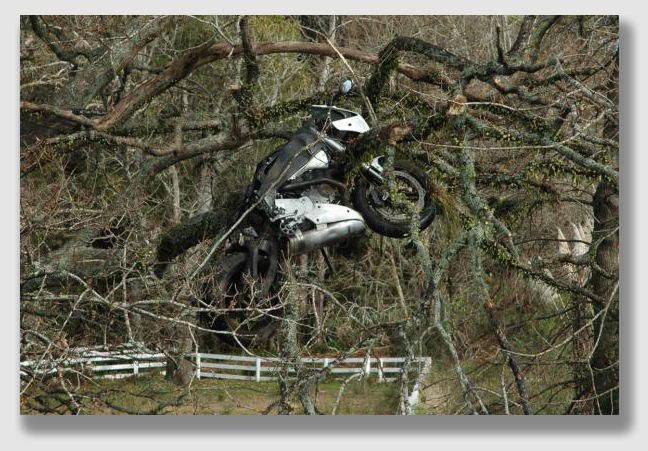
Blair was accompanied by a lot of wind, which reminds us of the case we’re writing about today. We’re not suggesting that the case has an Association to the 1960’s hit. But it was windy one night near the musical instrument capital of the world, and many trees in Elkhart County were blown over. The county crews worked diligently through the night cleaning up the mess, but Marvin Hochstetler rode his motorcycle down a dark county road in the predawn hours, he found a tree the county hadn’t gotten to — and he found it the hard way.

As he recuperated from his injuries, Mr. Hochstetler hired a canny personal injury attorney. The problem was that the Indiana Tort Claims Act had an exemption carved out for conditions arising from inclement weather. Our intrepid cyclist’s response was two-fold: (1) this was so long after the storm (a whopping four hours) that it no longer qualified as storm damages; and (2) if the County hadn’t been negligent in maintaining roads and trees prior to the storm, the limb he hit wouldn’t have been there. He lost in the trial court, but the Court of Appeals agreed with Hochstetler.

The Indiana Supreme Court wasn’t buying, however. It upheld the trial court, finding that the unrebutted evidence told of widespread damage and hard-working repair crews through the nighttime hours. To agree with Mr. Hochstetler that the limb with which he had become intimately familiar should have been removed prior to 5 a.m. was to hold the County to too high a standard.

mccrash150227Hochstetler v. Elkhart County Highway Dept., 868 N.E.2d 425 (Sup.Ct. Ind., June 20, 2007). At around 1 a.m. on June 12, 2001, Elkhart County was hit by a strong storm that produced many fallen trees and limbs. The county started dispatching crews at about 1:30 as calls began coming into the highway garage. There were eventually 56 reports of fallen trees on county roads as a result of the storm.

Among these reports, received about 2 a.m., was a call about a tree down on County Road Four, north of State Road 120. It turns out that County Road Four is some seven miles long, and State Road 120 does not intersect with it. Riding his motorcycle sometime very early that morning, Marvin Hochstetler struck a tree that had fallen across County Road 4.

Hochstetler contended the erroneous report was about the tree he hit. Hochstetler sued the highway department, the county commissioners, and the county sheriff, alleging that they were negligent and careless in maintaining the county road. The county defendants moved for summary judgment on the basis of immunity under the Indiana Tort Claims Act. The trial court granted them judgment.

The Court of Appeals reversed.

The Indiana Supreme Court then heard the case.

association150227Held: The county defendants prevailed. A provision of the Indiana Tort Claims Act provides immunity for losses resulting from temporary conditions of public thoroughfare that result from the weather. The Supreme Court held that the provision applied to county highway, sheriff’s departments and county commissioners insofar as the personal injuries went that Mr. Hochstetler claimed to have sustained when he hit a tree that had fallen on a county road.

The unrebutted evidence showed that the storm produced scores of trees and limbs down on roads, county highway crews were on the job almost immediately, and highway crews were still at work hours after the storm had passed in the middle of the night. The Court agreed that state and local governments may have tort responsibility for damages flowing from negligence, but the Tort Claims Act grants immunity for that negligence under certain specified circumstances. This was one such circumstance, the majority held.

The plaintiff tried to get around the weather exception by arguing that the weather-related hazard went on too long after the storm and that there was an issue of fact whether poor design and maintenance — not the storm — was responsible. One judge thought the plaintiff had enough of a point so as to survive summary judgment, but the majority of the five judges prevailed.

– Tom Root

TNLBGray140407

Case of the Day – Wednesday, December 4, 2024

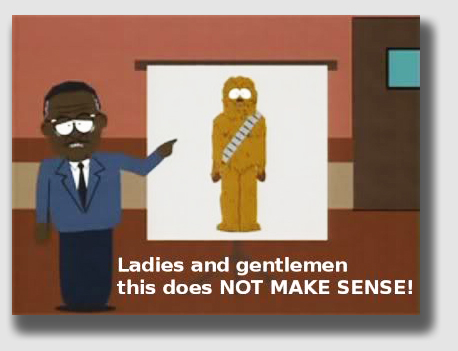
THAT DOES NOT MAKE SENSE

I drove past beautiful Elkhart, Indiana, the other day, which made me recall a news report a few years ago about a resident of The City With a Heart who got up one morning.

Of course, arising in the a.m. is not especially noteworthy. But when this denizen of the RV Capital of the World awoke, he discovered that the City had rather heartlessly cut down a beautiful 33-foot spruce in his tree lawn – that strip of grass between the sidewalk and street – for use as the municipal Christmas tree.

The report was troubling to me. No, more than troubling. It simply did not make sense. Unless Indiana is different from most of the other states in the nation, a property owner whose property lies along a highway (known as an “abutting landowner”) is deemed to own the land to the middle of the highway, with the highway and portions beyond it merely reserved to the City or State (or whatever political subdivision it might be) as a “right-of-way.”

The thing about a right-of-way (which is simply one flavor of an easement) is this: the political entity (we’ll just say “City” here because that’s the bad guy in this news report) is entitled to use the right-of-way for an intended purpose, that is, a highway. If there comes a time when it ceases being a highway, the right-of-way is extinguished, and the landowner is free to use the property all the way up to the centerline of the old road as he or she wishes.

And that’s what bothered me so. No one would question the City’s right to remove a tree that somehow created a hazard to the public using the highway. That is a reasonable exercise of the City’s privileges under the easement. But here, the City decided to save a few bucks by cutting down a free Christmas tree, not to facilitate use of the highway but instead to decorate another part of town.

The article suggested that maybe the whole episode resulted because a prior owner had asked that the tree be removed. Elkhart Building and Grounds Department head Mike Lightner said, “We thought we were doing a good thing by getting a tree removed from the tree lawn for a resident who wanted it removed and being able to repurpose it as a Christmas tree for other people to enjoy it instead of hauling it away while saving the city some money.”

That may be so, but the City should not be imperiously telling people that it owns the trees in the tree lawn. It can do what it likes with the tree lawn as long as the act is reasonably related to the purpose of its right-of-way. But it does not “own” the trees.

While I was researching the issue, I stumbled across the obverse situation, where a homeowner who was hurt by a falling tree in the tree lawn blamed the City for not reasonably using its right-of-way, more particularly, not properly discharging its duty to inspect.

Czaja v. Butler, 604 N.E.2d 9 (Ct.App. 3rd Dist. Indiana, 1992). Karen and Joseph Czaja lived along U.S. Highway 6 in Butler, Indiana. There were three trees on the State of Indiana right-of-way in the front yard of their home. On January 25, 1990, two severe storms blew through the city, causing severe damage and blowing over several trees. The first storm dropped a 12” diameter limb from one of the trees in Czajas’ front yard onto U.S. 6. The City removed it after the first storm passed through.

But later in the day, a second storm hit. Karen was returning from picking her children up from school during the storm. As she was waiting to turn into her driveway from the street, the tree closest to her driveway fell on top of her car, injuring her.

The storms that day caused extensive damage. Roughly eight whole trees were uprooted or broken off, and many others lost large limbs or parts of their trunks.

The Czajas sued the City, alleging city employees were negligent in failing to inspect the tree in front of the Czaja home and in failing to remove the tree, which the city knew, or should have known, was dangerous. The City moved for summary judgment, which the trial court granted.

The Czajas appealed.

Held: The City was not negligent.

The City’s evidence described the storms’ intensity that day, including the fact that eight trees were blown over, four other cars were struck by fallen trees, and an uprooted tree fell onto the roof of the Butler Quick-Mart. In addition, it filed deposition testimony of the City superintendent that he inspected the Czajas’ tree the following day and found that while the core was rotten to within four inches of the outside diameter of the tree, there were no outwardly visible signs that any part of the tree was dead or rotten. The evidence showed that before the tree fell, the superintendent had no actual notice that the tree was rotten. The tree had green foliage two years before when Joe Czaja asked him about removing it so the Czajas could widen their driveway.

In their depositions, the Czajas both admitted that before the tree fell, they had no reason to believe it was likely to fall. Nevertheless, at the trial court, they pressed the argument that the City had an absolute affirmative duty to maintain an inspection procedure concerning all the trees located in its right-of-way along the highway.

The appellate court rejected the Czajas’ position, holding that while the City has a duty to keep its streets reasonably safe, the duty is only triggered when it has actual or constructive knowledge of the dangerous or defective condition. Here the City’s established it neither had knowledge that the tree was defective nor did it have any reason to know the dangerous condition of the fallen tree.

All the Czajas could show was that during the years they had lived there, dead branches occasionally fell from the tree, the sidewalk buckled from tree roots, and some erosion showed next to the curb near one of the trees.

The Court held that the Czajas’ evidence was insufficient to raise a genuine issue of fact requiring a trial. “We take it to be common knowledge that mature trees, as these were described to be, have limbs and branches that die and occasionally fall from the tree,” the Court ruled. “It is also a common experience that the root systems of such trees buckle and crack cement sidewalks laid too close to the tree. Indeed, the city superintendent stated in his deposition that he attached no particular significance to these conditions. The Czajas have not pointed to any evidence supporting the notion that the city should have been forewarned in this particular instance that the tree was in danger of falling. It would be nothing but sheer speculation to draw that conclusion from the evidence relied upon. It follows that the summary judgment was properly granted.”

– Tom Root

TNLBGray140407

Case of the Day – Monday, August 26, 2024

MR. NATURAL

natural160111There was an era – back in a time when giants roamed the land – in which a landowner had no duty to protect anyone else from harm resulting due to the natural condition of the land. The judicial thinking was that everyone took the land the way they found it. There’s a century-old oak on the place, and it dies? Well, trees grow and then they die. If it happens to fall on old Zebediah’s cabin next door, that’s just one of those acts of God.

The concept made a certain amount of sense when the land was rural, and no one did much landscaping around the cabin. But as time passed, courts found themselves trying to determine whether that sweet gum that fell on the random horse-drawn wagon passing by had been planted by human agency or just had happened to grow there on its own. Time marched on, the horse gave way to a lot of horsepower, and courts abandoned the “natural condition” rule.  Instead, they simply held that a landowner has a duty of reasonable care over all of the conditions of his or her premises, no matter what their origin.

samara160111

Samara – a botanical term for “whirligig.”

There were a few reasons for the courts’ change of heart. First, if a landowner had a duty to take reasonable care of his or her premises, there was no rational basis for limiting that duty to vegetation that had not been planted by the landowner or those who had owned the place before. After all, when we were kids, we used to break samaras off the backyard maple tree and use them in whirligig contests. Under the old standard, if one of the samaras we dropped during our game took root and grew into a magnificent sugar maple, our folks would have been responsible for the tree. If the wind dropped the same samara, and it took root without our help, the old rule would have absolved our parents of any liability if the tree decayed and then fell on the neighbor boy (an outcome that we, who had been long afflicted by the obnoxious kid next door, would have cheered).

Second, the times, they were a-changin’. America was becoming more urban, and progress demanded that people living in closer proximity to each other with more developed streets and highways, assume more responsibility for injury to each other. Most parcels of property had become smaller – home plots in towns and cities rather than 40-acre and up farms – and the burden placed on landowners to inspect and maintain their premises became less even as the harm that their negligence could cause became greater. The utility and importance of modern roads and the cars and trucks that used them argued for a more responsible approach.

All of that leads to a case like today’s decision, an Indiana decision that asks the philosophical question: If a tree falls in the forest and hits a car, does it sound like a lawsuit?

falls160111That’s certainly the question Stan Valinet was pondering after a tree standing in his forest fell onto Ann Eskew’s car back in 1987.

Robert Frost admitted that “whose woods these are I do not know.”  But Stan Valinet knew.  The woods in Clay Township near 106th and Spring Mill Road were his, and – like most reasonably prudent absentee landowners – Mr. Valinet would occasionally drive through Clay Township to inspect his property. He especially admired a massive oak tree, almost two centuries old, growing about 28 feet from the edge of Spring Mill Road.

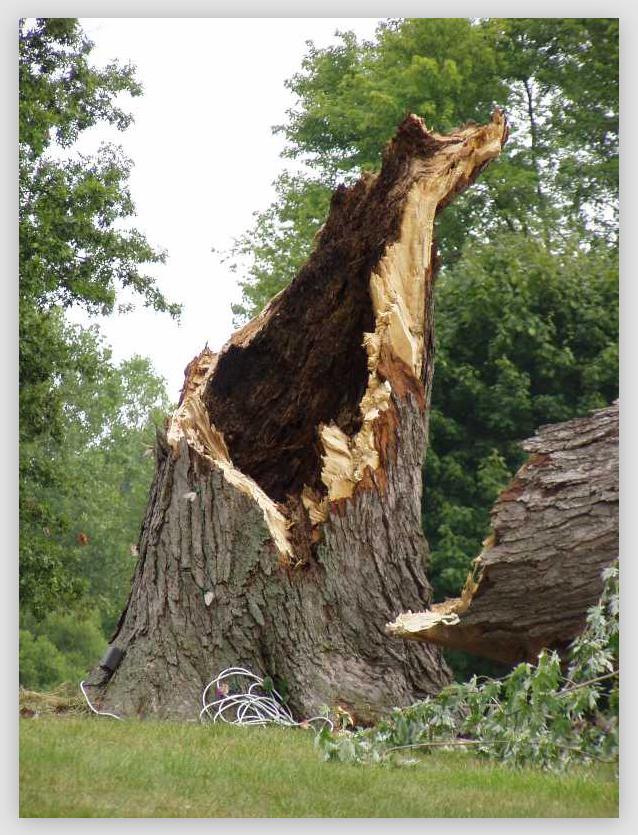
One dark and stormy December night, Ann Eskew was driving by this very tree, when 60-mph winds blew the mighty oak onto her car, seriously injuring her. It turned out that the tree had been dead for at least three years, and had been showing signs of decay for at least 8 years before that.

Even in 1991, the Indiana rule held that rural landowners were not liable for physical harm caused to others outside of the land by a natural condition of the land. Mr. Valinet argued that the oak tree had always been there, and its falling on Ms. Eskew – while regrettable – had nothing to do with him.

car160111The Indiana Supreme Court ruled that, regardless of whether the old oak tree was a natural condition of Mr. Valinet’s land or not, he could be liable to Ms. Eskew if his land was located in an area with sufficient population density, and whether the seriousness of the danger is weighed against the ease with which Mr. Valinet could have prevented it. Finding the facts needed to determine the answers to these questions was a job for the jury.

Valinet v. Eskew, 574 N.E.2d 283 (Supreme Court of Indiana, 1991). Stanley Valinet owned wooded land in a residential area of Clay Township, Hamilton County, Indiana, near the intersection of 106th Street and Spring Mill Road. He lived in Indianapolis but testified he would occasionally drive through Clay Township to inspect his property.

Valinet’s land included a large oak tree, perhaps almost 200 years old with a 48” diameter trunk. The tree stood 28 feet from Spring Mill Road. On December 15, 1987, Ann Eskew was driving by the property during a windstorm, when the tree fell onto her car, seriously injuring her. It turned out that the tree had been dead for three years, and had been showing visible signs of decay for eight years before that.

Eskew sued. Valinet argued that the 200-year-old oak was a natural condition of the land, and he was not liable for natural conditions of the land. The jury found him liable to Eskew, and he appealed, first to the Court of Appeals (which agreed with the jury), and then to the Indiana Supreme Court.

Held: The Supreme Court decided that Indiana would follow the general statement of law set out in the Restatement of Law. Restatement (Second) of Torts § 363 provided that while a possessor of land would not be liable for physical harm caused to others outside of the land by a natural condition of the land, if the land is in an urban area, the possessor is liable to people “using a public highway for physical harm resulting from his failure to exercise reasonable care to prevent an unreasonable risk of harm arising from the condition of trees on the land near the highway.”

The Supreme Court acknowledged that the old rule had been no liability for natural conditions on land. That rule, however, had arisen at a time when the land was largely unsettled and the burden imposed on a landowner to inspect was thought to exceed the benefit to society of preventing possible harm to passersby. However, the Court observed, a line of cases had developed since then in which courts imposed a duty on landowners in more heavily populated areas to inspect trees to try to prevent their posing an unreasonable risk of harm to passing motorists. The rationale for imposing the duty on urban landowners is that the risk of harm to highway users is greater there, and the burden of inspection on landowners is lighter.

The Court agreed that the modern approach made more sense, but it underscored that whether the land was in an area of sufficient population density to invoke the rule requires a factual consideration of factors like land use and traffic patterns. Also, whether the landowner exercised reasonable care would require the jury to weigh the seriousness of the danger against the ease with which it could be prevented. The Court noted that a landowner need not continually inspect his or her property for natural dangers, but sometimes fulfilling the owner’s duty to passing motorists “might reasonably require periodic inspections to be sure that the premises do not endanger those lawfully on the highway.”

– Tom Root

TNLBGray

Case of the Day – Friday, August 9, 2024


UNSNARLING DUTIES

negligence-overviewWhen negligence rears its ugly head, compensation usually depends on the extent of the duty owed the victim by the party whose pocket the injured plaintiff seeks to pick. Take Tim Jones, an experienced cable television installer. One cold day in the bleak midwinter, he climbed an Indiana Bell pole to work on a cable installation. On the way down, he grabbed a phone line instead of a ladder rung. Not being intended as a support structure, the line gave way, and down Mr. Jones went.

Having no evidence that Indiana Bell knew the line was defective and likely to fall away from the pole, Mr. Jones did the only thing he could do – he sued anyway. Finding a defendant with money – always the aim of a negligence action – was a little daunting, because the only target with money was Indiana Bell, the owner of the pole, hadn’t ever hired Mr. Jones. Instead, I-Bell just rented pole space to the cable company, which in turn hired the company that employed Jones. So what duty did the telephone company owe Jones in this totem-pole relationship?

Not that much of one, as it turned out. Mr. Jones lost his case, but the Court of Appeals took the opportunity to clarify the duty an easement holder has to invitees on the easement. The lesson is one that a utility holding an easement for, say, power lines, might owe to the employee of a tree-trimming service brought in to keep the easement clear of vegetation.

Jones v. Indiana Bell Telephone Co., 854 N.E.2d 1125 (Ind.App., 2007). Timothy Jones was performing a cable equipment upgrade for Sentry Cable, a cable TV provider. Jones – who had been doing this type of work for about 20 years and knew the associated dangers of the occupation – was working as a subcontractor on this project. He was wearing the appropriate safety equipment.

The plucky old Field Marshal might have been Jones' lawyer here ... but the attack failed nonetheless.

The plucky old Field Marshal might have been Jones’ lawyer in this case … but the legal attack on the easement holder failed nonetheless.

Jones climbed a telephone pole owned by Indiana Bell, in order to access the cable TV line, which was located about a foot above the telephone line. On his way down, he grabbed the telephone line like it was a ladder rung. It wasn’t. It broke free, and Jones fell 20 feet to the ground, breaking his ankle. Jones sued the phone company for negligence.

At trial, Jones admitted he hadn’t observed any problems with either the telephone line or the clamp assembly. He also admitted he had no evidence that Indiana Bell knew that there was anything wrong with the pole, telephone line, or clamp assembly. Indiana Bell moved for judgment “based upon the … absence of any evidence of a breach of duty as the duty is established in Indiana law.” The trial court found Indiana Bell had no duty to Jones and granted judgment to the phone company.

Jones appealed.

Held: Indiana Bell owed Jones nothing.

The Court observed that to prevail on a theory of negligence, Jones had to show Indiana Bell owed him a duty, it breached the duty, and his injuries were caused by the breach. Whether a defendant owes a duty of care to a plaintiff is a question of law for the court to decide. Whether an act or omission is a breach of one’s duty is generally a question of fact for the jury, but it can be a question of law where the facts are undisputed and only a single inference can be drawn from those facts.

The parties and the Court focused on the Indiana Supreme Court’s opinion in Sowers v. Tri-County Telephone Co., which involved a telephone utility, the employee of an independent contractor, and a discussion of both duty and breach. In Sowers, the telephone company hired Covered Bridge Tree Service to trim trees located near its telephone lines and clear a right of way in order to ease the work of crews mounting cable television lines on the same poles. While trimming trees, a Covered Bridge employee fell into an abandoned manhole.

manhangfromtelephonepole140603The phone company did not own the land on which the manhole was located, but it had a prescriptive easement on the land. Sowers sued Tri-County for negligence, and the trial court granted summary judgment in favor of Tri-County. The Sowers court held that a landowner or occupier is under a duty to exercise reasonable care for the protection of business invitees and that the employees of independent contractors are business invitees. The court held that Tri-County did not have a duty to inspect and warn and that the boundaries of Tri-County’s duty of reasonable care to its business invitees “must be defined from the utility’s own use of the easement.”

But here, the Court said, the facts of Sowers were distinguishable (which means that they make the case different, not that there was anything especially celebratory about them). There, the telephone utility itself hired the tree service company, whose employee was then injured while on the telephone utility’s easement. In this case, however, Indiana Bell just rented space on its telephone poles to the cable company, whose subcontractor was then injured on Indiana Bell’s telephone pole. Still, the Court said, the policy reasons articulated in Sowers apply to this case, making the duties owed the same. Sowers first acknowledged that a telephone utility is a special breed in that it is not a traditional landowner or occupier. In addition, it acknowledged that a telephone utility does not often access its property except for the occasional necessity to effect repairs. Because of these facts, Sowers concluded that a great burden would be placed on a telephone utility if it were required to conduct regular inspections of its property for the sole purpose of discovering possible hazards.

Applying Sowers here, the Court concluded that Indiana Bell owed a duty of reasonable care to its invitees – including Jones – but the duty did not include the duty to inspect and warn. However, to the extent that Indiana Bell learned of dangerous conditions on its poles, it had a duty to warn its invitees. The evidence did not show Indiana Bell had any actual knowledge of the dangerous condition, meaning that the trial court properly entered judgment on the evidence in favor of Indiana Bell.

– Tom Root

Case of the Day – Monday, July 15, 2024

THE RESTATEMENT RULE FALLS AWAY, CHIP BY CHIP

In the development of liability law for danger trees, the “every-dog-for-himself” school of thought has reigned supreme for 150 years. The authoritative Restatement of Torts (2nd) rule says that “a possessor of land is not liable for physical harm caused to others outside of the land by a natural condition of the land, except in an urban area, where the possessor is liable to people using a public highway for physical harm resulting from his or her failure to exercise reasonable care to prevent an unreasonable risk of harm arising from the condition of his or her trees.”

A real mouthful, the Rule said in so many words, “If you live in the country, you owe nobody anything. If you live in the city, you owe a duty to someone on the highway, but no one else.”

The Restatement – which ideally states the law as it generally exists in the 50 states – has instead become the driver. The rule is followed almost everywhere, with the Restatement being cited as the authority. So instead of summarizing what the various state courts have held, the Restatement has made the law in many places. 

But times change, populations shift, and what was a workable (or at least an acceptable) rule suddenly makes little sense. That happened in today’s case from the Hoosier State, in which a neighboring landlord neglected a danger tree. After all, he was a landlord, and what landlord will spend a dime that won’t increase his return?

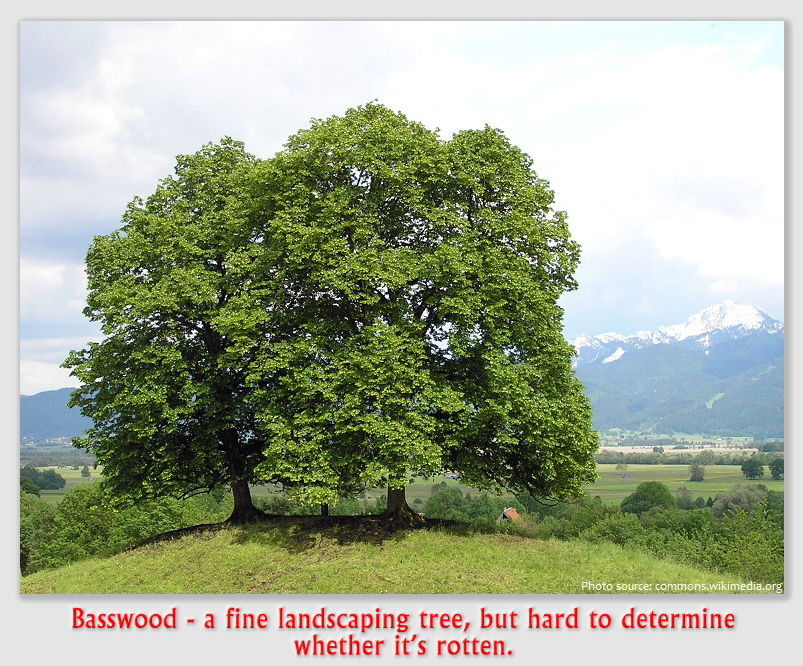
So the neighbor pointed out the decaying tree, the City pointed out the decaying tree, and all the chattering passersby pointed out the decaying tree. And then, the landlord found a drive-by arborist who eyeballed the tree (without even being able to identify the species as a Basswood from his quick “look-see”), and pronounced it fit as a fiddle. A Basswood fiddle.

Except it was not so fit. When the tree fell on the neighbor’s house, her insurance paid for repairs and then (justifiably) came after the landlord. He said, “Tough luck. The Restatement rule says I’m only liable to people on the public street.”

That was what the rule said. So the Court changed the rule. And that, boys and girls, is how the law evolves.

Marshall v. Erie Insurance Exchange, 923 N.E.2d 18 (Ind.App. 2010). John and Marjorie Marshall owned many rental properties, which John supervised. One was a vacant lot next to Cindy Cain’s home.

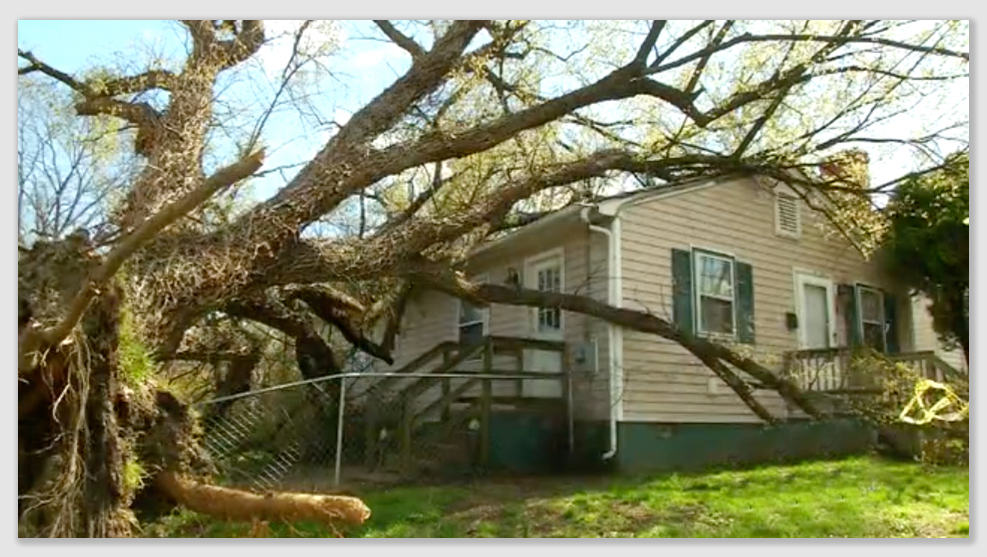
A tree stood on Marjorie’s lot near the boundary of the two parcels. From the time Cindy purchased the home, she worried about the tree’s health and the danger it might pose. Cindy talked to her neighbor about the tree but got nowhere. She talked to a City code enforcement officer about the tree. The officer told Marjorie’s property manager the tree had to come down. He also spoke to John, who said he would have the tree checked. Cindy told a guy who worked for the Marshalls’ maintenance worker and a woman who claimed her husband was the Marshalls’ new maintenance worker about the hazard tree. The man Cindy spoke to agreed that the tree should be taken down and said he would speak to John about it.

On New Year’s Eve, the tree fell onto Cindy’s house, knocking over her chimney and causing damage to the roof and frame. Cindy filed an insurance claim with Erie, which held her homeowner’s insurance policy. Erie reimbursed her for the necessary repairs to her home (minus her deductible, of course). Then, Erie sued the Marshalls for damages stemming from their negligent maintenance of the tree.

Jake Denlinger, a professional arborist, testified that before the tree fell, he had looked at the tree at John’s request. Jake inspected the tree but did not take any samples of the tree’s core. He testified he did not see enough evidence of decay in the tree to warrant removing the tree. His cross-examination must have been withering because Jake – filled with doubt –  Jake returned to the vacant lot after his testimony to look at the tree stump to determine what type of tree had fallen on Cindy’s house. He found it was a Basswood tree, and returned to testify that it is difficult to judge a Basswood’s health without internal sampling because the trees do not show many exterior signs of decay.

The trial court found for Erie, and the Marshalls appealed.

Held: The trial court’s decision in favor of Erie Insurance was upheld.

The Court said that to recover in negligence, a plaintiff must establish a duty on the part of the defendant to conform his conduct to a standard of care arising from his relationship with the plaintiff; a failure on the part of the defendant to conform his conduct to the standard of care; and (3) an injury to the plaintiff proximately caused by the breach.

Absent a duty, there can be no breach and, therefore, no recovery in negligence.

In Valinet v. Eskew, the Indiana Supreme Court adopted the rule in Restatement (Second) of Torts section 363, that a possessor of land is not liable for physical harm caused to others outside of the land by a natural condition of the land, except in an urban area, where the possessor is liable to people using a public highway for physical harm resulting from his or her failure to exercise reasonable care to prevent an unreasonable risk of harm arising from the condition of his or her trees.

The Court of Appeals observed that the Valinet rule seemed to foreclose the issue of whether the Marshalls owed a duty to protect Cindy from the fallen tree. The Court, however, was unwilling to “leave urban or residential landowners essentially powerless in the face of a neighbor who refused to remove or secure an obviously decayed and dangerous tree simply because it was a natural condition of the land.”

The Court concluded that it should depart from “the strict application of the Restatement rule in the context of urban or residential property.” That Rule was adopted when the land was mostly unsettled and uncultivated. In urban or residential areas, however, the Court held, it should not be an undue burden for a landowner to inspect his or her property and take reasonable precautions against dangerous natural conditions. “Living in close quarters with one’s neighbors in an urban or residential setting substantially increases the risk that a falling tree will cause damage to property or injury to persons, and, similar to the problem relating to a highway, the reduced size of property lots in an urban or residential setting makes the burden of time and money to inspect and secure trees on one’s property relatively minor, especially as compared to the potential damage that could result from the tree’s fall.”

Thus, the Court said, an urban or residential landowner has a duty to exercise reasonable care to prevent an unreasonable risk of harm to neighboring landowners, arising from the condition of trees on his or her property. Whether the land in question is of sufficient population density to invoke the rule is a factual question for the fact finder. In addition, in determining whether the landowner exercised the requisite reasonable care, the fact finder must weigh the seriousness of the danger against the ease with which it may have been prevented. In some circumstances, fulfilling this duty may require a landowner to conduct periodic inspections of his or her property.

In this case, the Court said, the trial court applied a duty of reasonable care to the Marshalls with respect to preventing the damage caused by the fallen tree. The trial court heard evidence that the code enforcement officer contacted the Marshalls to inform them of the dangerous tree and the need to remove it, and several witnesses testified to the physical state of the tree. True, the Marshalls provided some evidence they contacted a tree specialist, but he only performed a superficial examination of the tree and recommended its removal. Because reasonable minds could draw different conclusions from the facts in evidence, it was for the trial court to determine whether the Marshalls’ conduct breached the duty of reasonable care. Sufficient evidence supported the trial court’s judgment that the Marshalls did so, and that Cindy’s home was damaged as a result.

– Tom Root

TNLBGray140407

Case of the Day – Friday, June 28, 2024

LET’S BE CAREFUL OUT THERE


crazy160718Summer has just begun, astronomically speaking, although it seems like it’s been here since the first 90-degree day in early May. Not that I’m complaining. Swimming, biking, hiking… summer can hang around as long as it likes.

Yesterday, my bride and I wandered through Vermilion, Ohio, for some ice cream at Dairy Dock (premium-quality soft-serve, with prices to match). Vermilion seems like summer the way summer used to be and always should be. Tourists everywhere, the cottages along the Lake Erie shore full of vacationers, boats cruising in and out of the marinas… Hot fun in the summertime, as Sly puts it.

Just for a moment, I felt that summertime twinge that the days are already running through my fingers like the sands of an hourglass. Oh for the mythical endless summers we almost believed were possible when we were kids!  

To all those folks who complained in April about the cold weather… I hope you’re happy now. It’s hot and muggy and bright… perfect for stopping by the old swimming hole, a place where my friends and I have had a lot of fun. And, sadly, a place where tragic things can happen.

We must make an extra effort to be caerfull careful. With July 4th upon in less than a week, this might be a good time to consider due care, that is, our duty of care to others.

In a negligence action, a plaintiff generally has to show that (1) the defendant had a duty of care in relation to the plaintiff, (2) the defendant failed to conform its conduct to the requisite standard of care; and (3) an injury to the plaintiff was proximately caused by the failure.

Do you really want to be eating food that's staring back at you?

That’s what “fisheye” is all about: Do you really want to be eating food that’s staring back at you?

The duty of care is a moving target, depending to a large extent on the relationship of a defendant to the plaintiff. If someone delivering your double-anchovy pizza and atomic wings falls into an open hole in your front yard, the law treats your liability a whole lot differently than if, say, a thief sneaking around at night trying to steal your garden troll statue falls into the same hole. (But even if the law doesn’t wonder, we’re puzzled that you’d order a double-anchovy pizza).

No-DivingIn today’s case, a young man was paralyzed for life when he dove into the lake at his parents’ house. He had made the same dive countless times before, but the defendant in the case — the non-profit corporation that owned the lake — had recently installed a dredge pipe underwater near the shore. The pipe apparently was just below the surface of the lake.

The lake’s owner argued that the young man was merely a licensee, not an invitee. The difference was crucial, because a licensee pretty much takes the property in the condition he or she finds it. The trial court agreed that the plaintiff was much more than that, and after a jury trial, the young man was awarded $1 million.

The appellate court looked at the corporate purpose of the non-profit lake owner, as well as the terms under which it acquired the lake from the public utility that had owned it previously. Both required that the lake be maintained for public purposes, despite being ringed with private homes, and that evidence convinced the Court of Appeals that the young man wasn’t just someone who was using the lake with the permission of the defendant non-profit corporation. Instead, he was an invitee, someone to whom an invitation had been extended to enter or remain on land for a purpose for which the land was being held open to the public. As such, the landowner had a much higher duty of care to the young swimmer, a duty it violated by not being more careful in installing and marking the dredge pipe.

Not all shallow water is so well labeled.

Not all shallow water is so well labeled.

Shafer & Freeman Lakes Environmental Conservation Corp. v. Stichnoth, 877 N.E.2d 475 (Ct.App. Indiana, 2007). Twenty-six-year-old Justin Stichnoth was visiting his parents at their house located on Lake Shafer. During a conversation that day, Justin’s father, Kerry, told Justin about a dredge pipe that Shafer & Freeman had installed in the channel near their dock. Kerry explained that recently he had gotten his boat “hung up” on the dredge pipe. Shortly thereafter, Justin took a running dive off of his parents’ dock into the channel, something he had done often over the years. Justin struck his head on the dredge pipe, which was located on the channel floor about 17 feet from the dock. Justin was left a paraplegic. He sued Shafer & Freeman, alleging that the firm’s negligence caused his injuries because it didn’t warn that there was a pipe underwater, it didn’t mark the pipe so that it would be visible to users of the lake, and it didn’t use reasonable care in dredging the lake.

Shafer & Freeman denied the allegations of negligence. Later, it filed a motion for summary judgment on the issue of whether Justin was a licensee of Shafer & Freeman. The trial court denied it, and a jury found it liable to Justin, awarding $1 million to the injured plaintiff. Shafer & Freeman appealed.

Be careful when diving into unfamiliar water.

Be careful when diving into unfamiliar water.

Held: Justin was an invitee. Indiana law holds that a person entering upon the land of another comes upon the land either as an invitee, licensee or trespasser. The person’s status on the land defines the nature of the duty owed by the landowner to the visitor. Licensees have a license to use the land and are privileged to enter or remain on the land by virtue of the permission of the owner or occupier, but they take the premises as they find them. Invitees, on the other hand, are owed a much higher duty of care. The decisive factor with regard to whether a landowner has extended an “invitation” or “permission” is the interpretation that a reasonable man would put upon the owner’s words and actions, given all of the surrounding circumstances. Here, the Court found, the lake was held open to the public, even though it was surrounded by private property, and thus Justin — who dove off a dock and struck his head on a dredge pipe located on the channel floor — was an invitee rather than a licensee for purposes of personal injury action. The Court held that the articles of incorporation of Shafer & Freeman, the non-profit corporation that owned the lake, provided that the corporation would protect and enhance the water quality of the lake in order to facilitate public recreational use and ensure continued public access.

What’s more, the Court said, the agreement by which Shafer & Freeman acquired the title from the electrical utility, provided that Shafer & Freeman would hold the lake for public, charitable, recreational, conservation and environmental purposes. It is not enough, to hold land open to the public, that the public at large is permitted to enter at will upon the land for their own purposes. As in other instances of invitation, the Court said, there must be (1) some inducement or encouragement to enter, (2) some conduct indicating that the premises are provided and intended for public entry and use, and (3) some expectation that the public will not merely be tolerated, but is invited and desired to come.

When a landowner lets local boys play basketball on his vacant lot they are licensees only. If he installs playground equipment and posts a sign saying that the lot is open free to all children, there is then a public invitation, and those who enter in response to it are invitees. So it was with the lake.

– Tom Root
TNLBGray140407