Case of the Day – Friday, April 3, 2026

CORNER WITH A VIEW

We’re watching the spring wheat green up along country roads. It’s still doggone cold – we had snow on the ground last weekend – but it is spring. It won’t be long until everything is growing, including at Ohio agricultural affliction, “corn to the corners.”

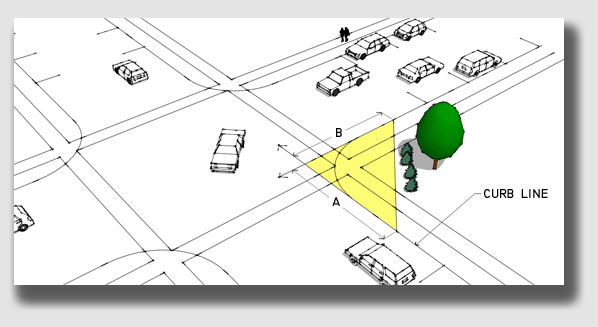
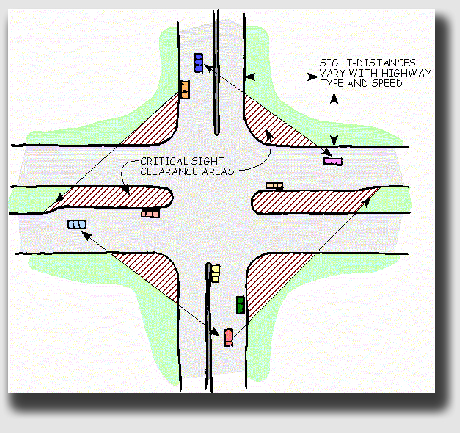
Corn to the corners – and no clear sightline.

We saw a great example of it at a crossroads last fall, the practice of planting right up to the edge of a field. We can hardly blame the farmer, who has to maximize the land’s yield in order to stay in business (and to cover the payments on a $200,000 tractor). But corn to the corners – like planting trees and shrubs near the road – can play havoc with sightlines and pose a real hazard to motorists.

When an accident does happen, lawyers scramble to find as many defendants as possible because each defendant usually has his or her own insurance policy. As one old lawyer we practiced across from years ago used to say, you have to “get the money flowing.” Nothing makes it flow like a whole passel of deep-pocket insurance companies lined up on the defendants’ side of the room.

But what duty does a landowner have to people traveling by? After Margaret Sheley was killed when her automobile collided with Kimberly Cross’s vehicle at an intersection, her family decided to test those limits. They sued Cross, the County and Buryl and Hazel Grossman, who owned the land by the intersection. The Sheley family argued that the Grossmans negligently planted crops on their land such that a motorist’s view of oncoming traffic at this intersection was impaired. The trial court ruled for the Grossmans, holding that they owed no duty to Margaret Sheley.

The Court of Appeals agreed, drawing a distinction between a landowner who creates hazardous conditions on the roadway as opposed to conditions – hazardous or not – wholly contained on the landowner’s property. Like corn to the corners, or perhaps big, bushy trees.

sightline140613Sheley v. Cross, 680 N.E.2d 10 (Indiana Ct. of Appeals, 1997). On October 15, 1992, Margaret Sheley was killed when her car ran into Kimberly Cross’s vehicle at an intersection. Margaret’s survivors sued Kimberly Cross, the County, and Buryl and Hazel Grossman, the farmer who owned the land next to the intersection. The Sheley family argued that Grossmans, as owners of the land next to the intersection, negligently planted crops on their land such that a motorist’s view of oncoming traffic was impaired. The trial court granted summary judgment in favor of the Grossmans, finding that they owed no duty to Margaret. The family appealed.

Held: The Grossmans owed no duty to Margaret Sheley. Admittedly, the planting of vegetation is considered to create an artificial rather than a natural condition. A “natural” condition is limited to land unchanged by humans. The difference is significant since there are differing duties for natural versus artificial conditions.

Nevertheless, to recover under a theory of negligence, a plaintiff must first establish that the defendant had a duty to conform his or her conduct to a standard of care arising from a relationship with the plaintiff. Absent a duty, there can be no breach and, therefore, no recovery in negligence

care161129The Court said that an occupier of land abutting on or adjacent to a public highway owes a duty to the traveling public to exercise reasonable care to prevent injury to travelers from any unreasonable risks created by such an occupier. The landowner has no right to use the property to interrupt or interfere with the exercise of the traveling public’s right by creating or maintaining a condition that is unnecessarily dangerous.

The issue, the Court said, is whether the scope of this duty extends to refraining from creating conditions wholly on a landowner’s property that may impair a traveler’s vision of oncoming traffic at an intersection. The Court ruled that the landowner does, but “that duty is limited to refraining from creating hazardous conditions that visit themselves upon the roadway. Where an activity is wholly contained on a landowner’s property, there is no duty to the traveling public.”

The corn may have extended to the corners, but those corners remained on the Grossmans’ property. Thus, the Sheley family got nothing from the Grossmans.

– Tom Root

TNLBGray140407

Case of the Day – Friday, September 5, 2025

DESPITE THE SPITE, IT’S THE WRONG HEIGHT

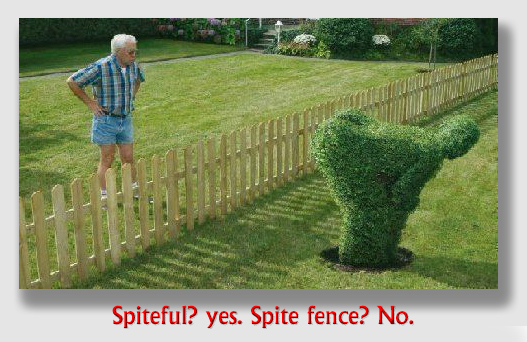
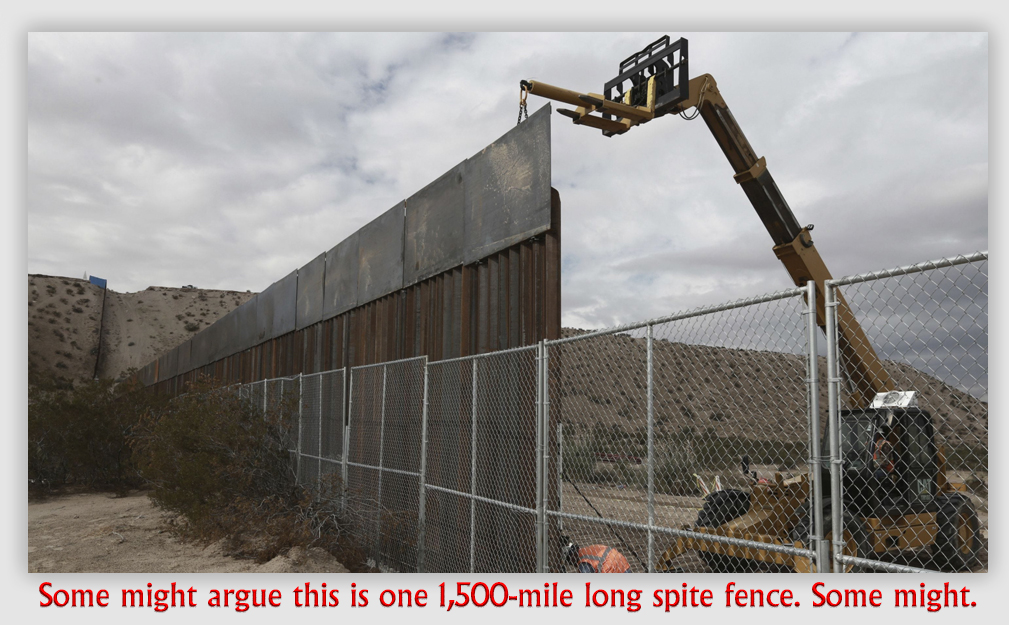
Over the next few days (with time off for the weekend), we’re going to talk about “spite fences,” structures one neighbor erects because he or she does not like the other neighbor. Often creative, always ugly, spite fences are traditionally not prohibited by common law (the court-made rules of conduct that have evolved over the centuries). For that reason, just about all states have statutes that address the problem.

The law in the 49 common-law states (sorry, Louisiana, not you) disfavors statutes that are contrary to common law. Anyone who has ever watched a state legislature in action may understand the origin of this common-sense presumption. Flowing from the presumption is the general rule that when a statute is contrary to common law, it must be interpreted strictly and literally.

In today’s case, one neighbor accuses another of anti-Semitism, general nastiness, and such animus that the neighbors have teamed up with the homeowners’ association to run the plaintiff neighbor out of town. No one knows whether the plaintiff’s neighbor’s allegations are correct: in fact, if seven decades have taught me anything, it has taught me to look very skeptically at such broad-brush allegations. Usually, the more outrageous the alleged conduct, the less credible the allegation.

At this point in the lawsuit, the Court assumes that the plaintiffs’ allegations are entirely correct and provable. It asks, in deciding the defendants’ motions to dismiss, whether the complaints, if true, state a claim that would justify granting the plaintiffs the relief they seek.

Here, most of the plaintiffs’ complaints didn’t hold water. We’re going to focus on only one of those beefs, the count on spite fences.

Small v. Anchorage Homeowners Ass’n, LLC, Case No. 1:18-cv-01605 (S.D.Ind. March 21, 2019), 2019 U.S. Dist. LEXIS 47842; 2019 WL 1317636. Art and Lynette Small bought a condo in a development overseen by the Anchorage Homeowners Association. They bought the condo through a limited liability company they had set up, Executives LLC. Their neighbors were Trudy and Brad Johnson.

The Smalls’ overarching complaint was that Trudy and Brad embarked on a campaign to force the Smalls out because the Johnsons thought (1) the Smalls were Jewish; and (2) the Smalls were renters, not owners. It must be a doozy of a complaint, alleging as it does all manner of slights, humiliations and vigilantism, all intended to run the Smalls out of the development. But the count we’re focusing on today is the allegation that the Johnsons erected a “spite fence.”

The Smalls sued the Johnsons and the Homeowners Association in federal court, alleging a number of federal claims. In such a case, under what is known as “pendant jurisdiction,” a federal court may also hear state claims arising from the same facts. One such state claim brought by the Smalls was that in May 2016, Trudy accused Art “of being a racist, of engaging in Fair Housing Act violations, and repeatedly called him an extremely offensive anti-Semitic slur” – specifically, “Jew Face” – in front of his friends and potential clients. A few days later, the Smalls alleged, the Johnsons installed a “large wooden wall” which obstructed the Smalls’ view and interfered with their enjoyment of their property. The Smalls claimed the Homeowners Association approved the wall despite the fact that it did not comply with the Homeowners Association and Hamilton County restrictions.

The Johnsons and the Homeowners Association both moved to dismiss the count.

Held: The claim that the Johnsons built a “spite fence” was dismissed.

Under Indiana Code 32-26-10-1 – the state’s “spite fence” provision – a “structure in the nature of a fence unnecessarily exceeding six (6) feet in height, maliciously: (1) erected; or (2) maintained; for the purpose of annoying the owners or occupants of adjoining property, is considered a nuisance.” An owner or occupant who is injured in their comfort or enjoyment of their property that adjoins such nuisance may bring an action for: “(1) damages in compensation for the nuisance; (2) the abatement of the nuisance; and (3) all other remedies for the prevention of a nuisance.” Indiana Code 32-26-10-2.

Common law recognizes no such right, and thus, the statute, which is “in derogation of the common law… [must] be strictly construed.” If the fence in question does not meet the strict requirements of the statute, the Court held, it is merely subject to the common law of nuisance, under which a fence is only a nuisance if it encroaches on the adjoining landowner’s property.

The necessary elements of a claim under the spite fence statute are that: 1) the fence must exceed six feet, 2) the excessive height must be unnecessary, and 3) the fence must have been maliciously erected to annoy adjoining property owners or occupants. No matter how malicious or excessive a fence is, the Court said, it does not violate the statute if it is six feet or less in height. On the other hand, a maliciously erected fence that is more than six feet tall is not cured by a local permit because state law trumps municipal ordinances and regulations.

Here, the Court ruled, the Smalls’ complaint is facially deficient because it fails to allege the wall exceeds six feet. In fact, the complaint does not include any height allegation, only that the wall comes to roughly 13 feet from the Smalls’ front porch.

“Thus,” the Court held, “the allegations fail to meet the statutory height requirement or the encroachment requirement of common law nuisance. For this reason, [the Smalls’] claim is dismissed.”

– Tom Root

TNLBGray140407

Case of the Day – Wednesday, September 3, 2025

REALITY BITES

Sure, you can get your land contract out of a box, and save a few bucks. Just ask Mr. Jackson how that's likely to work out for you ...

Sure, you can get your land contract out of a box, and save a few bucks. Just ask Mr. Jackson how that’s likely to work out for you …

Sometimes, reality bites. Not just the movie, but real life. Ask Nestle’s former CEO Laurent Freixe. Or Rudy Giuliani. Or even the Coldplay couple. It especially bites when the very steps a prudent man takes to protect himself become the evidence on which a court relies to put him in the jeopardy he sought to avoid.

So it was with Mr. Jackson. Mr. J simply sold some land by land installment contract (also known as “contract for deed” or installment sale agreement) to Mr. Smith. Pay attention, because land contracts have become much more popular. A land installment contract lets a property owner safely sell land with seller financing. The buyer puts down a small (sometimes no) down payment, with an agreement to make monthly payments for a period of time until the purchase price has been paid. At that time, the seller (sometimes called the “vendor”) transfers the land to the buyer (called the “vendee”).

Once in a blue moon (still nine months away), a land installment contract is necessary for the completion of a real estate deal between two parties of equal bargaining power and sophistication. We recall handling one like that once in our legal career. But only once. Land installment contracts are almost always not very good deals – not just because the terms are oppressive or one-sided (although they often are) – but because the contracts represent transactions that are only financing of last resort. The vendees are often scarcely able to handle the payments, let alone able to manage the rigors of home ownership. In our experience, many if not most land installment contracts fail, resulting in evictions or foreclosure (depending on the state laws).

Perhaps because of the likelihood that the property will fall into disrepair or the vendee will default, many vendors want land contract documents that provide them with as much control over their properties as possible. This is understandable. What is less understandable is that sometimes, the more control a vendor reserves for herself, the less safe she becomes.

In today’s case, the vendor understandably required the vendee to buy insurance on the place that named the vendor as a named insured. That made sense. After all, the vendee only had paid about 17% of the purchase price, meaning he didn’t have a very big stake in the place. But the vendor wanted to be sure the vendee did what he was supposed to, so the vendor drove by the place on a nearly daily basis, and he bought insurance for the place himself. The vendee reimbursed him, but the arrangement was at odds with what the contract required. Partly because the vendee knew how closely the vendor was watching the place, he checked with the vendor about alterations and modifications before he undertook them.

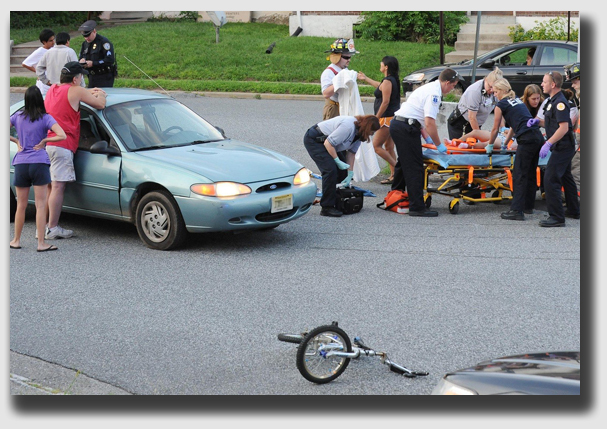
When a 10-year-old boy riding a bike was struck and killed, the boy’s mother blamed obstruction in sight lines caused by untrimmed trees on the property. After a suitable period of mourning, she sued. She went after not only vendee Smith but after Mr. Jackson, too. He was the guy who really controlled the property, she claimed. The trial court disagreed and dismissed Jackson from the suit.

The Court of Appeals reversed. The facts that the vendee had paid so little and Mr. Jackson had cared so much about the condition of the property — especially because he had gotten his own insurance even though the agreement dictated that Smith would do so — suggested to the Court that there was a real question of fact as to whether Mr. Jackson had control of the premises. He just might be to blame, the Court suggested, for the tree that had never been trimmed and which had allegedly obscured the young boy’s view of oncoming traffic. The Court returned the case to the trial court for a jury’s consideration.

Poor Mr. Jackson. Normally, vendors aren’t liable for the conditions of premises they have conveyed pursuant to land installment contracts. But vendors want the best of both worlds, to have control over their property until they’re paid, while not being liable for anything that goes wrong. Mr. Jackson was like that. He probably thought he was being very prudent in approving changes, in making sure insurance was in place, and in driving by like a stalker in Hollywood Hills. Instead, his caution only made the Court suspect that he had retained a lot more control than the typical vendor.

There’s a lesson here. If you sell pursuant to a land contract, get a good lawyer to write as strong a contract as is prudent. Then, enforce the contract. Stick to the deal. If you want to deviate from its terms, sign a written amendment. Don’t start “rewriting” the deal by your conduct.

There's no making light of the sad fact that a 10-year old boy died, the tragedy that set this lawsuit in motion.

There’s no making light of the sad fact that a 10-year- old boy died, the tragedy that set this lawsuit in motion.

Scheible v. Jackson, 881 N.E.2d 1052 (Ct.App. Ind. 2008). Jackson sold a parcel to Smith under a land installment contract. Smith lived on the premises. In early 2005, Jackson received a certified notice from the City of Columbus about saplings growing on the property that had to be removed. Jackson gave the notice to Smith, who took care of the problem.

However, a mature tree on the property hung over the sidewalk, the tree lawn and a part of 7th Street’s westbound lane. Branches of the tree drooped quite low, touching or almost touching the grass. One summer day, Mrs. Scheible’s ten-year-old son, Travis, was riding his bicycle on the sidewalk along the north side of 7th Street. Just west of the tree, Travis started to cross the street. The leaves and branches of the tree obstructed his view. A motorist struck Travis’ bicycle, killing the boy.

Travis’ mother sued Jackson and Smith. She alleged Jackson and Smith both exercised control of the property and that they owed a duty to the traveling public to maintain the property in a reasonably safe condition. Jackson moved for summary judgment, arguing that he owed no duty of care to Travis. The trial court agreed. Mrs. Scheible appealed.

Held: The Court reversed. Noting that young Travis was not on the property when he was struck, the Court conceded that as an initial matter, it appeared that a vendor is not liable for physical harm caused to others outside of the land by a natural condition of the land. However, the law was clear that a possessor of land in an urban area is subject to liability to persons using a public highway for physical harm resulting from his failure to exercise reasonable care to prevent a risk of harm arising from the condition of trees on the land near the highway.

The Court focused much more on control than it did on mere possession. The evidence, taken in a light most favorable to Mrs. Scheible (which it must be when summary judgment is being considered), suggested that Jackson retained substantial control. Smith, who lived on the land and was buying it under a land contract, had paid only a small portion — about 17% — of the total price. He testified he consulted with Jackson on major alterations and discussed removal of the tree that allegedly obstructed Travis’ view before the tree was cut down, after the accident. The Court said it wasn’t clear whether Smith just advised Jackson or actually had to obtain his approval for alterations. To be sure, Jackson maintained a substantial interest in the property as well as a financial stake: he testified he drove by the property often.

Standards for sightlines at intersections are well established. As a general rule, landowners do well to be aware of them.

Standards for sightlines at intersections are well established. As a general rule, landowners do well to be aware of them.

What’s more, the fact that Jackson and Smith deviated from the precise terms of the contract bothered the Court. The contract terms provided Smith would carry insurance on the property, with the Jacksons and Smith being named as insureds. However, Jackson kept his existing insurance policies on the property in place. He paid the premiums and Smith reimbursed him. The Court held that this meant that Jackson’s use of the property was insured, but Smith — the person Jackson asserted to have been the only one with control of the property — had no coverage at all. The Court found it ironic that Jackson sought to avoid responsibility for the condition of the property, yet maintained two insurance policies on which he was the sole insured. Along with other elements of the case, the Court held, that Jackson insured himself to the exclusion of his vendee, Smith, supported the reasonable inference that Jackson controlled the property.

The Court held that where an entity retains control of property, regardless of the contents of the land installment contract, liability may still attach. The Court said that “[o]ne who assumes the control and management of property cannot escape liability for injuries by showing a want of title in himself.” The fact that a land-sale contract exists, the Court said, is not itself dispositive of the question of the vendor’s non-liability.

Summary judgment was reversed and the case was sent to trial.

– Tom Root

TNLBGray140407

Case of the Day – Monday, June 30, 2025

LET’S BE CAREFUL OUT THERE


crazy160718Summer has officially begun, and it all feels so… so comfortable, like a pair of old shoes. Begun? June is gone already.

Yesterday, my bride and I wandered through Vermilion, Ohio, for some ice cream at Dairy Dock. Tourists were everywhere, the cottages sitting along the Lake Erie shoreline full, boats in and out of the marinas. Hot fun in the summertime, as Sly puts it.

And just for a moment, I felt like that old twinge, a fear really, that summer days are already running through my fingers like the sands of an hourglass. But to all those folks who complained in May about the cold, wet weather… I hope you’re happy now. It’s hot and muggy and bright… perfect for stopping by the old swimming hole, a place where my friends and I had a lot of fun (back when we didn’t worry about how we looked in a swimsuit, if we bothered to wear one at all).

The old swimming hole. Where we had a lot of fun. And, sadly, a place where tragic things can happen.

We must make an extra effort to be caerfull careful. Especially with July 4th upon us, this might be a good time to consider due care, that is, our duty of care to others.

In a negligence action, a plaintiff generally has to show that (1) the defendant had a duty of care in relation to the plaintiff, (2) the defendant failed to conform its conduct to the requisite standard of care, and (3) an injury to the plaintiff was proximately caused by the failure.

Do you really want to be eating food that's staring back at you?

That’s what “fisheye” is all about: Do you really want to be eating food that’s staring back at you?

The duty of care is a moving target, depending to a large extent on the relationship of a defendant to the plaintiff. If someone delivering your double-anchovy pizza and atomic wings falls into an open hole in your front yard, the law treats your liability a whole lot differently than if, say, a thief sneaking around at night trying to steal your garden troll statue falls into the same hole. (But even if the law doesn’t wonder, we’re puzzled that you’d order a double-anchovy pizza).

No-DivingIn today’s case, a young man was paralyzed for life when he dove into the lake at his parents’ house. He had made the same dive countless times before, but the defendant in the case — the non-profit corporation that owned the lake — had recently installed a dredge pipe underwater near the shore. The pipe apparently was just below the surface of the lake.

The lake’s owner argued that the young man was merely a licensee, not an invitee. The difference was crucial because a licensee pretty much takes the property in the condition he or she finds it. The trial court agreed that the plaintiff was much more than that, and after a jury trial, the young man was awarded $1 million (when that was still a lot of money).

The appellate court looked at the corporate purpose of the non-profit lake owner, as well as the terms under which it acquired the lake from the public utility that had owned it previously. Both required that the lake be maintained for public purposes, despite being ringed with private homes, and that evidence convinced the Court of Appeals that the young man wasn’t just someone who was using the lake with the permission of the defendant non-profit corporation. Instead, he was an invitee, someone to whom an invitation had been extended to enter or remain on land for a purpose for which the land was being held open to the public. As such, the landowner had a much higher duty of care to the young swimmer, a duty it violated by not being more careful in installing and marking the dredge pipe.

Not all shallow water is so well labeled.

Not all shallow water is so well labeled.

Shafer & Freeman Lakes Environmental Conservation Corp. v. Stichnoth, 877 N.E.2d 475 (Ct.App.Ind., 2007). Twenty-six-year-old Justin Stichnoth was visiting his parents at their house located on Lake Shafer. During a conversation that day, Justin’s father, Kerry, told Justin about a dredge pipe that Shafer & Freeman had installed in the channel near their dock. Kerry explained that recently he had gotten his boat “hung up” on the dredge pipe. Shortly thereafter, Justin took a running dive off of his parents’ dock into the channel, something he had done often over the years. Justin struck his head on the dredge pipe, which was located on the channel floor about 17 feet from the dock. Justin was left a paraplegic. He sued Shafer & Freeman, alleging that the firm’s negligence caused his injuries because it didn’t warn that there was a pipe underwater, it didn’t mark the pipe so that it would be visible to users of the lake, and it didn’t use reasonable care in dredging the lake.

Shafer & Freeman denied the allegations of negligence. Later, it filed a motion for summary judgment on the issue of whether Justin was a licensee of Shafer & Freeman. The trial court denied it, and a jury found it liable to Justin, awarding $1 million to the injured plaintiff. Shafer & Freeman appealed.

Be careful when diving into unfamiliar water.

Be careful when diving into unfamiliar water.

Held: Justin was an invitee. Indiana law holds that a person entering the land of another comes upon the land either as an invitee, licensee, or trespasser. The person’s status on the land defines the nature of the duty owed by the landowner to the visitor. Licensees have a license to use the land and are privileged to enter or remain on the land by virtue of the permission of the owner or occupier, but they take the premises as they find them. Invitees, on the other hand, are owed a much higher duty of care. The decisive factor with regard to whether a landowner has extended an “invitation” or “permission” is the interpretation that a reasonable man would put upon the owner’s words and actions, given all of the surrounding circumstances. Here, the Court found, the lake was held open to the public, even though it was surrounded by private property, and thus Justin — who dove off a dock and struck his head on a dredge pipe located on the channel floor — was an invitee rather than a licensee for purposes of personal injury action. The Court held that the articles of incorporation of Shafer & Freeman, the non-profit corporation that owned the lake, provided that the corporation would protect and enhance the water quality of the lake in order to facilitate public recreational use and ensure continued public access.

What’s more, the Court said, the agreement by which Shafer & Freeman acquired the title from the electrical utility, provided that Shafer & Freeman would hold the lake for public, charitable, recreational, conservation, and environmental purposes. It is not enough, to hold land open to the public, that the public at large is permitted to enter at will upon the land for their own purposes. As in other instances of invitation, the Court said, there must be some inducement or encouragement to enter, some conduct indicating that the premises are provided and intended for public entry and use and that the public will not merely be tolerated, but is expected and desired to come. When a landowner lets local boys play basketball on his vacant lot they are licensees only. If he installs playground equipment and posts a sign saying that the lot is open and free to all children, there is then a public invitation, and those who enter in response to it are invitees.

– Tom Root
TNLBGray140407

Case of the Day – Monday, June 16, 2025

WORKING BACKWARDS

When I was a young, bright-eyed and newly-licensed lawyer, my head full of three years of law school pap topped with a dollop of bar review study, I was befriended by a gnarled old litigator. He dictated his pleadings into one of the old belt-fed Dictaphones late at night, microphone in one hand and a bottle of Fairfax County bourbon in the other. But he sure knew how to litigate.

The second wisest thing he ever told me (the wisest being to drink Fairfax County, which, alas, is available no more) was that a good trial preparation began with writing the jury instructions and working backward. Writing the instructions informed the trial attorney what the jury was going to be told it had to find in order for his client to prevail. Preparation then moved backward, the next step being an outline of his closing argument. Only then, knowing what evidence he would need to have in the record in order to win, did the canny trial attorney assemble the evidence he had and determine what evidence he still needed to find.

It was good advice and great bourbon. Which brings me to Indiana, where they drink whatever Hoosiers drink, and they don’t always start at the end like they should.

For the readers’ sake, I’ll start at the beginning. Eight years ago, in White County, Indiana (about halfway between Chicago and Indianapolis), an Amtrak passenger train on CSX tracks collided with a farm tractor pulling a tank of anhydrous ammonia. Although the tank did not burst, some hoses full of the nasty stuff whipped around, broke the engineer’s window on the locomotive, and sprayed his hand with a small amount of the chemical.

The engineer, Bill Rucker, sued anyone he could find for his injuries, including the driver of the tractor, RDS Farms (which owned the tractor), CSX Transportation, and Amtrak. RDS Farms and the driver argued, among a myriad of other claims, that CSX was to blame for the accident because it violated a state law that required it to keep trees and vegetation trimmed around crossings so that vehicle drivers could see oncoming trains.

Before an actual trial, the issues usually get cut down to size, chiefly through the use of summary judgment. Summary judgment on an issue is granted where there is no genuine issue of fact, and that one party is entitled to judgment as a matter of law.

The tractor driver said he usually stopped unless he could see no train was coming, and he does not know why he did not stop on that fateful day. He said the crossing was a difficult one because trees were “right next to the tracks” and because of the angle at which the tracks intersected the road, it was difficult to see a train approaching from the southeast.”

From this testimony, Bill the Engineer argued that CSX breached its duty to keep the railroad right-of-way clear of obstructions.

Indiana law at the time (but repealed a few years later) required that a railroad ensure that a motorist has an unobstructed view for 1,500 feet in both directions along the railroad right-of-way “subject only to terrain elevations or depressions, track curvature, or permanent improvements.” The law obligated railroads to remove all foliage and obstructions on the right of way that might impair a motorist’s view of an oncoming train. The duty, however, extended only to the railroad’s right-of-way.

Our old-time litigator would have written a jury instruction on the issue of whether CSX Transportation had violated the statute, and thus breached a duty, and he would have noted that his evidence had better include not just proof of the obstructive foliage, but also proof that it was on CSX’s right-of-way. Sadly for Bill the Engineer, his lawyer was not the old-timer. The court found that he had omitted a crucial piece of evidence, that the trees not trimmed were on CSX land.

Bill made the best argument he could make, that CSX had not provided testimony from one of its employees regarding the property boundary lines or right of way. Bill, however, had made the claim that no one could see the oncoming train, and it was thus he was the party with the duty to prove that the trees belonged to CSX.

With no evidence that the trees were on CSX property, there was no proof of a duty to trim or a breach of that duty. Bill’s obstruction claim failed.

Our old friend would be swigging his whiskey and ranting into his Dictaphone: “How could counsel have missed such an easy proof?”

Rucker v. RDS Farms, Inc., Case No. 2:15-CV-272-TLS (U.S. District Ct., N. D. Indiana, August 28, 2017) 2017 U.S. Dist. LEXIS 138363, 2017 WL 3720200: On the morning of June 12, 2013, Dave Allen drove an RDS Farms tractor across a CSX railroad crossing, pulling a disc harrow for tilling soil and an anhydrous ammonia nurse tank. At the same time, an Amtrak train being operated by Bill Rucker was approaching the crossing. Dave did not see or hear the train and drove the tractor onto the crossing.
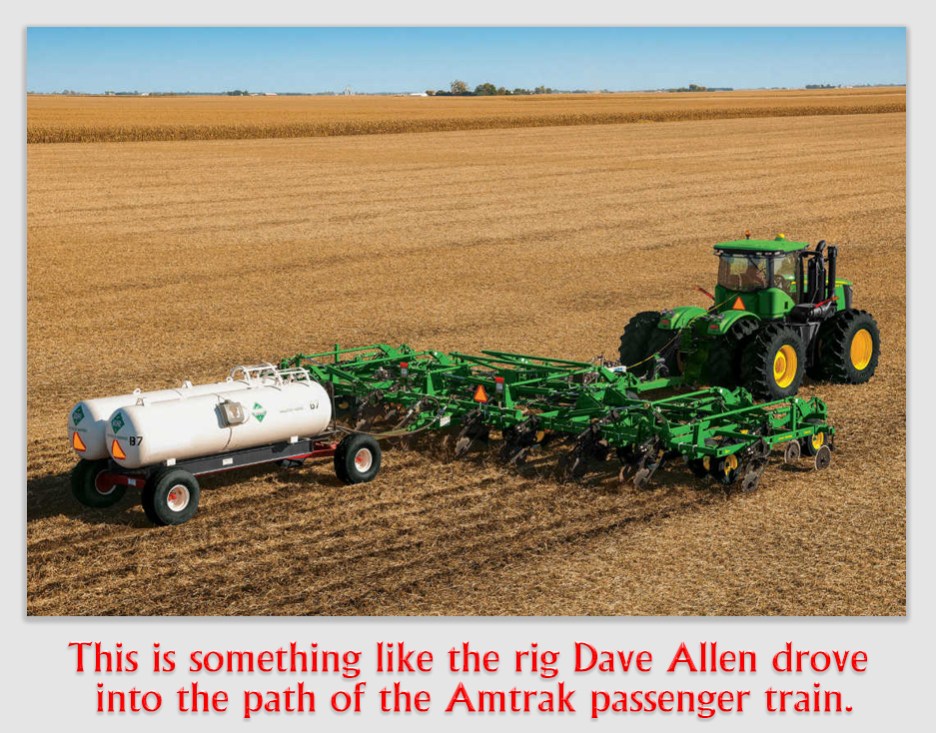
The lead locomotive struck the disc harrow at about 47 miles per hour, and the impact separated the anhydrous ammonia tank. The momentum of the locomotive carried it through the impact without causing an abrupt stop. The anhydrous ammonia tank was not ruptured, but the hoses were filled with ammonia at the time of impact, and one of the applicator hoses broke the engineer-side window of the locomotive. Engineer Bill inhaled the anhydrous ammonia, and it splattered on his right arm, shoulder, and head.

Dave said the crossing, at which the tracks cross the road from the southeast at an acute angle, is one at which it is difficult for a motorist to see because of trees that are “right next to the tracks.”

At the time, Indiana Code § 8-6-7.6-1 provided that “each railroad in the State of Indiana shall maintain each public crossing under its control in such a manner that the operator of any licensed motor vehicle has an unobstructed view for fifteen hundred (1,500) feet in both directions along the railroad right-of-way subject only to terrain elevations or depressions, track curvature, or permanent improvements.” The law only required railroads to remove obstructions on the right-of-way, and not “obstructions of view which are located off the railroad right-of-way.”

Bill leveled the claim against CSX that it was liable because it had breached its duty under Indiana law to trim trees and vegetation to maintain unobstructed views. Bill relied on Dave’s testimony that the trees were right next to the tracks, but he offered no other evidence that the trees were located within the right of way.

CSX Transportation moved for summary judgment, arguing that Bill has not met his burden to present admissible evidence from which a jury could find that the unidentified stand of trees in the southeast quadrant of the crossing was growing on its right of way. CSX Transportation argued it has met its summary judgment burden by showing an absence of evidence to support Bill’s claim. Bill claimed he had shown a genuine issue of fact existed as to the location of the trees.

Held: CSX was granted summary judgment, and the tree obstruction claim was thrown out. The District Court said that once CSX pointed out that none of the evidence supported Bill’s claim that CSX was responsible for the trees, it was incumbent on Bill to dispute those assertions by “citing to particular parts of materials in the record” to establish the existence of a genuine, material, triable issue.

Bill criticized CSX for not providing testimony from one of its employees regarding the location of the right of way, but the Court pointed out that a defendant moving for summary judgment need not produce evidence of its own. Instead, “when a plaintiff fails to produce evidence, the defendant is entitled to judgment.”

There is no doubt, the Court said, that “one of the basic elements of negligence is a breach of duty” and that Bill “would bear the burden of proof on this point at trial.” Without a duty, there can be no breach, and no recovery for the plaintiff in negligence.

Bill argued he had Dave Allen’s testimony that the trees were “right next to the tracks.” But, as the Court pointed out, Dave Allen has no personal knowledge of the property boundary lines or right of ways, nor did he further define the distance he correlated with “next to” or otherwise provide a more precise location. “Even without the precise definition,” the Court said, “the trees that Allen was referencing are probably not a mystery to the parties—they were in the southeast quadrant of the crossing in some proximity to the tracks. But that did not alleviate the need to determine who owned or controlled the property on which those trees were growing.”

Summary judgment is the moment in litigation where the non-moving party is required to show the court evidence on which a reasonable jury could rely to find in his or her favor. Despite CSX’s claim that the trees at issue were not on its right of way, Bill did not provide any evidence to identify the trees that he alleges created an obstruction or to prove that they were on CSX’s right of way. “Without any credible proof upon which a jury could rely to conclude that CSX had a duty, breached that duty, and the breach caused the accident,” the Court said, “CSX Transportation is entitled to judgment as a matter of law.”

– Tom Root

TNLBGray140407

Case of the Day – Tuesday, May 6, 2025

YOU SHOULDA WORN A HAT

Everyone has probably experienced it. Something goes terribly wrong, and the numbskull responsible for the mishap refuses to step up. Instead, he or she points at you and finds a reason it’s all your fault.

It’s a Lucy Van Pelt moment. In one memorable Peanuts strip, Lucy was reprimanded for fighting with her little brother, the blanket-toting philosopher-kindergartner Linus. In response, she pointed at him and argued, “It’s his fault. He hit me back first.”

Juries can be swayed by convincing variations of this theme, where the plaintiff is denigrated as somehow as liable or more liable for the accident than is the defendant. Sometimes it is true. But often it is not. It falls to the trial judge to regulate the flow of evidence to let the relevant stuff in while prohibiting material that might “inflame the passions” of the jury into reaching a verdict that is stupid.

Indiana’s approach is common. There, for example, the law prohibits a defendant from introducing evidence that an injured plaintiff was not using safety equipment, unless the failure to use the equipment somehow contributed to causing the injury.

Today’s case is from the U.S. Court of Appeals for the 7th Circuit, because the negligence action was brought in federal district court. It was what is called a diversity case, allowed in federal court because the plaintiff was a resident of one state while the defendant was a Hoosier. In diversity cases, the federal courts are bound to apply state law, which is how three judges in Chicago can be so focused on Indiana law.

Webber v. Butner, 923 F.3d 479 (7th Cir. 2019): Johnny Webber was helping his friend Roger Butner cut down trees on Butner’s property. Johnny was not a professional logger, and he was not wearing a hard hat while cutting down the trees. The duo agreed that Johnny would operate the chainsaw while Roger would assist by watching out for hazards. While Johnny was cutting into one of the trees, a dead branch fell on his head, causing severe injuries.

Johnny sued Roger, arguing that he had a duty to take reasonable steps to protect Johnny’s noggin, both because he was the landowner and because, while he had agreed to look out for hazards, he failed to warn Johnny of the falling branch. Johnny said his injuries were a proximate result of Roger’s breaches of duty.

The case was tried to a jury. Before opening arguments, Johnny moved to exclude evidence that he had not been wearing a hard hat while he was cutting down the trees. The district court turned him down, ruling that the evidence could be introduced “to show assumption of risk, comparative fault, and whether Johnny Webber acted as a reasonably careful person.” In his closing argument, Roger’s counsel employed the Lucy defense, reminding the jury that Johnny was to blame because he cut the trees “without wearing any safety helmets, any safety equipment,” and that “you can consider that testimony that he didn’t wear a hardhat, so he basically — he assumed the risk of that danger.”

The court instructed the jury: “Evidence relating to the use of a hard hat is offered to show assumption of risk, comparative fault, and whether Johnny Webber acted as a reasonably careful person. You may not consider it to show whether it would have prevented or altered the extent of Johnny Webber’s injuries.”

The jury did not bother to parse things that finely, apportioning 51% of the fault to Johnny and 49% of the fault to Roger. Under Indiana law, this meant Johnny got nothing.

Johnny appealed, challenging the trial court’s admission of evidence that he was not wearing a hard hat and the jury instruction on what it could use that evidence for.

Held: Johnny was entitled to a new trial, because the evidence he was not wearing a hard hat should never have come in and the results were so close that the erroneous admission of the hard hat evidence probably affected the outcome.

The Indiana comparative fault statute, Ind. Code §§ 34-51-2-7(b)(2) and 34-51-2-6, is a type of modified 50% comparative fault law. The Act replaced the common law rule of contributory negligence, under which a plaintiff who was even slightly negligent was barred from any recovery. Instead, the Act allocates fault proportionally, ensuring that each person whose fault contributed to causing injury bears his or her proportionate share of the total fault contributing to the injury.

However, the “modified” part of the Comparative Fault Act is this: If a claimant is deemed to be more than 50% at fault, he or she is barred from recovery. In determining fault, Indiana law also prohibits admission of evidence that an injured plaintiff was not using safety equipment unless the failure to use the equipment contributed to causing the injury. Ind. Code §§ 34-51-2-7(b)(1) and 34-51-2-3.

To prove that Roger was at fault for his injury, Johnny would have to show (1) Roger owed him a duty; (2) Roger breached his duty by allowing his conduct to fall below the applicable standard of care; and (3) Johnny was injured by Roger’s breach of duty.

In the Act, “fault” is defined to include any act or omission that is negligent, willful, wanton, reckless, or intentional toward the person or property of others. The term also includes unreasonable assumption of risk not constituting an enforceable express consent, incurred risk, and unreasonable failure to avoid an injury or to mitigate damages. The phrase “unreasonable failure to avoid an injury or to mitigate damages” applies only to a plaintiff’s conduct before an accident or initial injury. A plaintiff’s post-accident conduct, even if it constitutes an unreasonable failure to mitigate damages, is not to be considered in the assessment of fault.

A broad range of conduct initially may be considered by the jury, but it may allocate comparative fault only to those people whose fault was a proximate cause of the claimed injury.

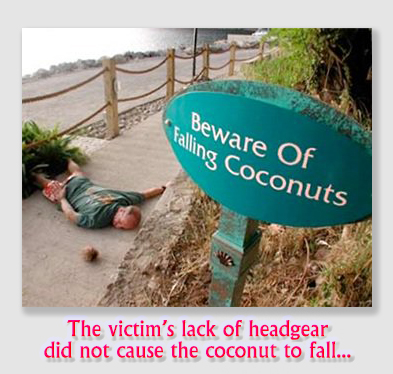
Johnny probably should have worn a hard hat, although it is unlikely that the hard hat would have lessened his injuries much, if at all. But it is clear that Johnny’s failure to wear his hat did not cause the branch to fall, or cause Roger not to be vigilant in seeing the danger. That being the case, the court should not have let in the evidence that Johnny was bare-headed.

Roger’s margin of victory was razor-thin. Two percent the other way, and Roger would have been liable for 51¢ of every dollar of damage to Johnny. As the Court of Appeals put it, “Admitting this evidence and submitting an instruction to the jury that allowed them to consider it in apportioning fault were legal errors. The jury’s apportionment of fault between the parties was so close that we cannot treat the errors as harmless.”

– Tom Root

TNLBGray

Case of the Day – Thursday, April 17, 2025

THEY’RE BA-A-A-ACK!

Yesterday, we reported on the 2008 Gertz v. Estes decision, in which the Gertzes were told to remove their 8-foot-tall “spite fence.” Why anyone thought that people who (a) built nail-studded fences; (b) peered at their neighbors with an array of surveillance cameras that the NSA would covet, or (c) heckled the Estes family with a PA system, would be impressed with a court order is a good question. After all, more august people than the Gertzes seem these days to be unimpressed with judicial authority.

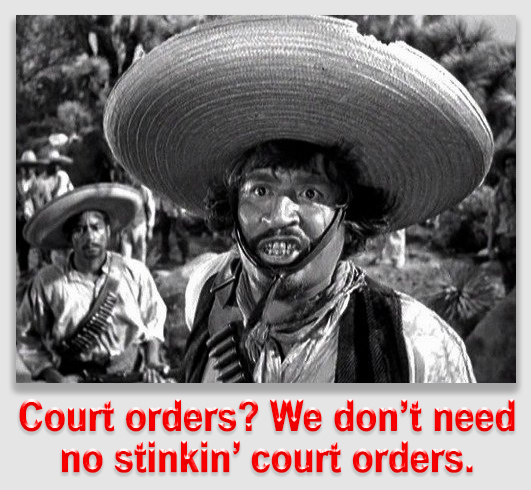
You can just hear the Gertzes, their dismissal of legal process amplified by loudspeakers: “Court order? We don’t need no stinkin’ court order.”

A “spite fence,” after all, isn’t something that one constructs accidentally, or even negligently. Why the Gertzes should be expected to pay attention to some old fool in a black robe …

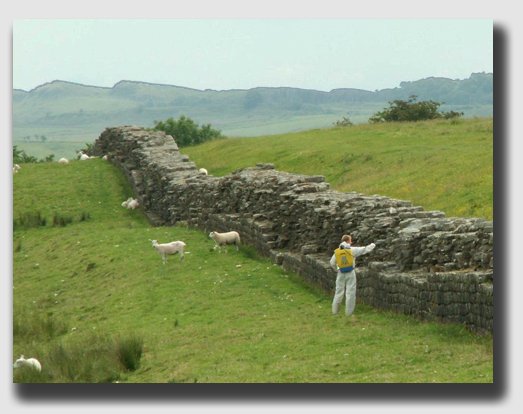
Hadrian's Wall - Did the Picts think it was a "spite fence?"

Hadrian’s Wall – Did the Picts think it was a “spite fence?

Ever since the first recorded “spite fence” – not including Hadrian’s Wallwas first used by San Francisco millionaire Charles Crocker to try to force a neighbor to sell his property for the construction of the Crocker Mansion – “spite fences” have required intent.

You have to intend to harass a neighbor with the fence. And if you set out to harass and oppress, it’s not terribly likely that you’re going to be brought up short by some man or woman in a fancy black robe.

Charlie Crocker's fence (highlighted in orange) - definitely a "spite fence."

Charlie Crocker’s fence (highlighted in orange) – definitely a “spite fence.”

The Gertzes ignored the 2008 court order until the Estes family dragged them back into court. That was when the Gertzes suddenly announced that they had lopped off the top two feet of the fence. Now it was only six feet tall, studded with nails and festooned with more surveillance devices than a Uighur family reunion. “Gee,” the Gertzes told the trial court, “now it’s under seven feet – guess it’s not a ‘spite fence’ anymore.”

The Court did what courts do – used procedural rulings to achieve substantive ends. The Court ruled that the Gertzes were trying an “end run” on the prior decision, when they should have raised the reduced height on appeal. Thus, the Gertz motion was thrown out. The Court made clear that the Gertzes’ real problem was that they hadn’t read the 2008 order carefully: it wasn’t the height of the fence alone, it was the intent and the ugliness that made it a “spite fence.” It was still a “spite fence,” albeit a shorter one. The fence still had to go.

Gertz v. Estes, 922 N.E.2d 135 (Ind.App. 2010). The unsavory neighbor Gertzes had been told to take down the “spite fence” which separated their home from the Estes property. The fence was a doozy, too – while the Gertzes had gotten permission from the town to build a 7-foot tall fence, they had put up an 8-foot fence just a few inches from the property line, studded it with thousands of nails protruding on the Estes side, painted “no trespassing” and “do not climb” notices all over the fence, and equipped the structure with surveillance cameras. There was a PA system, too, which the Gertzes used to make disparaging comments to and about the Estes family on various occasions.

The Berlin Wall - President Reagan could have said, "Mr. Gorbachev - tear down this 'spite fence'!"

The Berlin Wall – President Reagan could have said, “Mr. Gorbachev – tear down this ‘spite fence’!”

After a bench trial, the trial court found that the “fence was maliciously erected and now maintained for the purpose of annoying the Estes family” based upon the “course of conduct exhibited by Gertze [sic] toward Estes.” Holding that the fence was thus a nuisance, the court ordered the Gertzes to remove it. For good measure, the judge found that the “surveillance of the Estes property and the use of a loudspeaker to harass and annoy Estes constitute[d] an invasion of privacy” and said that all had to go, too.

The Gertzes appealed the trial court’s order, arguing that: (1) the trial court erred by applying the “spite fence” statute to them because they had obtained a local permit for the fence; and (2) the trial court erred by finding that the fence was unnecessary and that the public address system was used to make disparaging comments about the Estes family. The trial court was upheld in Gertz v. Estes, 879 N.E.2d 617 (Ind.Ct.App.2008), and the Indiana Supreme Court denied further review.

On September 12, 2008, the Esteses filed a petition for rule to show cause. The Esteses alleged that the Gertzes had failed to remove the fence, cameras, or public address system and had continued to harass and threaten them. The Gertzes answered by asking the trial court to let them remove the top one foot of the fence rather than the entire fence. The Gertzes said they had already removed the top two feet of the fence, so it was no longer a “spite fence.”

The trial court found that cutting a foot off the top of the fence didn’t comply with the prior order, because the fence’s height was only one of the factors making it a spite fence. The trial court concluded that the “fence is, and remains, a nuisance.” The Gertses appealed.

Held: The Gertzes’ reduction of the fence’s height didn’t matter: the fence had to go. The Court noted that Indiana Code Section 32-26-10-1, which governs ”spite fences,” provides: “A structure in the nature of a fence unnecessarily exceeding six (6) feet in height, maliciously: (1) erected; or (2) maintained; for the purpose of annoying the owners or occupants of adjoining property, is considered a nuisance.”

The Court held that the Gertzes were just asking for a mulligan. Their petition was really just a motion for relief from the 2008 judgment under Indiana Trial Rule 60(B), and that rule won’t serve as a substitute for a direct appeal. The Gertzes filed a direct appeal of the trial court’s order requiring them to remove the fence. Although the trial court’s remedy of removal of the fence was an issue available to them, they did not raise any argument on appeal about keeping the fence if they only reduced the height.

What’s more, the trial judge’s order that they remove the fence was not based solely upon the height, but instead on a variety of factors. The appellate court held that the Gertzes showed nothing justifying the extraordinary remedy of modification of the trial court’s judgment.

Meanwhile, the Estes, who had had enough of the expensive litigation, argued that they were entitled to appellate attorney fees because the Gertzes’ appeal was meritless. The court was hesitant to award such fees where the appeal was not “utterly devoid of all plausibility.” The Court said that although “the Gertzes’ brief fails to fully comply with the Appellate Rules and that their argument on appeal fails, we cannot say that their arguments were ‘utterly devoid of all plausibility’.” It refused to order the Gertzes to pay the Esteses’ fees, but cautioned “the Gertzes that future court filings against the Estes family could be considered harassment and result in various sanctions, including but not limited to an award of attorney fees.” The Court “encourage[d] the Gertzes to fully comply with the trial court’s order and protective orders.”

Good luck with that.

– Tom Root

TNLBGray140407