Case of the Day – Tuesday, March 31, 2026

THE CURE IS TOO MUCH BETTER THAN THE DISEASE

I had a call recently from a North Dakota lawyer, who was involved in a tree case where the standard for measuring damages being considered was the “cost to cure.” He wondered whether I was familiar with the concept.

In losses due to wrongful cutting of trees, we traditionally see damages being applied as diminution of value of the property (noncommercial trespass), the value of the timber (in commercial trespass cases), and, occasionally, restoration value (the cost to restore that which was lost). The ultimate goal, as we once noted, “is compensation for the harm or damage done. Thus, a court may apply whatever method is most appropriate to compensate a plaintiff for his or her loss.”

The question posed by our attorney friend from the Flickertail State left me scratching my head, (not a good idea, because it dislodged some of the little hair I have remaining): it sounded to me that “cost-to-cure” was being used in the case as a fancier name for restoration costs (sometimes called replacement costs). The only place I had seen the term “cost to cure” used was in condemnation cases. A Texas appellate decision in such a case defined the “cost-to-cure” approach as “an appraisal technique used to arrive at the taken property’s market value and the diminished market value of the remainder, which included the cost to replace improvements taken, damaged, or destroyed after they have been appropriately depreciated.

The attorney asked me whether I could verify “that the Cost of Cure Method has been accepted by the Courts.” Not really. My problem is that “cost of cure” has been accepted by the courts in condemnation cases, where the government decides to take your property for some more-or-less debatable public “good.” But I have never seen it called “cost of cure” in a tree damage case, where “cost of restoration” is the term applied when that measure of damage is called for.

Nevertheless, I found a condemnation case from Michigan that tangentially involves trees (and thus meets my exacting standards for this blog). So, as a consolation prize, let’s see how a fruit farmer tried to jack up the value of the loss of 20% of his acreage with a “cost to cure” analysis, and how the court – quite appropriately channeling Publilius Syrus – told him the cure couldn’t be better than the disease.

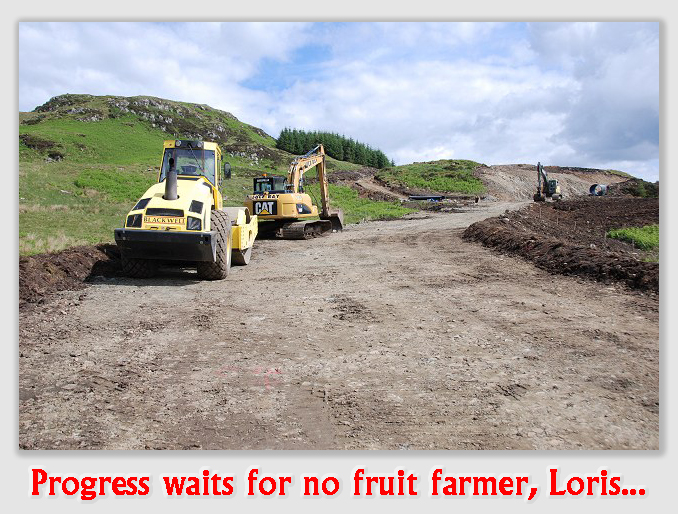
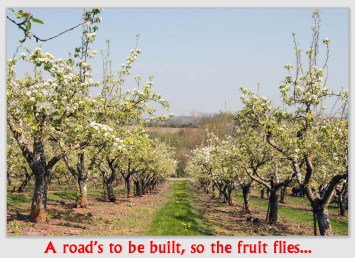
Dept. of Transportation v. Sherburn, 196 Mich.App. 301, 492 N.W.2d 517 (Mich.App. 1992). Loris Sherburn was a fruit farmer along Lake Michigan. When the Michigan Dept. of Transportation decided to extend U.S. 31 in Berrien County, it took 28 acres of Loris’ 124-acre farm. A court battle ensued, as it often does, over the value of the property taken. The State argued the value of the 28 acres was $47,200. Farmer Sherburn argued the property carved off his farm was worth closer to $183,000, claiming that this was the cost to cure the loss caused by the loss of the acreage.

The trial court found Loris was entitled to $56,600 for the condemnation of 28 acres of the farm.

Loris appealed.

Held: Loris was only entitled to $56,600. The Court of Appeals acknowledged that in a condemnation case like this one when only part of a larger parcel is taken, the owner is entitled to recover not only for the property taken but also for any loss in the value to his or her remaining property. The measure of compensation is the difference between the market value of the entire parcel before taking and the market value of what is left of the parcel after the taking.

Loris’ expert witness used the “cost to cure” method of calculating damages. The appellate court agreed that the cost-to-cure method is a measure of damages that may be considered by the jury, provided the cost to cure does not exceed that difference between the market value of the entire parcel before the taking and the market value of what is left of the parcel after the taking.

MDOT’s expert witness, an independent real estate appraiser, calculated the value per acre of the farm, which made the place worth $122,800 for all 124 acres. Using the same method, he found the 96-acre parcel remaining after condemnation to be worth $75,600. Thus, he concluded that Loris Sherburn’s damages were $47,200, the difference between the value of the entire parcel and the value of the remaining parcel after condemnation.

Farmer Sherburn had different ideas. His first expert witness, a real estate appraiser, using a comparable sales method, testified that the market value of the farm before condemnation was $215,000. He also estimated it would cost the farmer about $183,000 to replace the mature vineyards, peach and apple trees, and buildings lost in the condemnation. The witness contended that Loris, in addition to retaining possession of the remaining 96 acres, should recover the $183,000 cost-to-cure damages.

Loris’ second witness, an independent fee appraiser, testified that using the market data approach, the market value of the defendants’ farm before the taking was $345,000, while the market value of the remaining 96-acre parcel after the taking was $139,000, leaving a difference of $206,000.

The Court of Appeals agreed with Loris that where a partial taking occurs, it is possible for the property not taken to suffer damages attributable to the taking. “These damages have been described as ‘severance damages’,” the Court held, “which may be measured by calculating the difference between the market value of the property not taken before and after the taking. Where severance damages have occurred, it may be possible for the property owner to take steps to rectify the injuries in whole or in part, thus decreasing the amount of severance damages and correspondingly increasing the parcel’s market value.” These actions constitute a “curing” of the defects, according to the Court of Appeals, and the financial expenditures necessary to do so constitute the condemnee’s cost to cure.

However, the Court held that the cost-to-cure damages in a given case are not unlimited. Where the market value of the property taken, the value of the property remaining, and cost-to-cure expenses exceed the market value of the land before condemnation, cost-to-cure damages will not be awarded. “An owner is not to be enriched because of the condemnation,” the Court said.

This leaves “cost-to-cure” damages as a valid measure of damages “only when it is no greater in amount than the decrease in the market value of the [remainder] property if left as it stood.” Thus, the Court concluded, “where there is no claim of severance damages, the maximum damages recoverable equal (the market value of the entire parcel before the taking) minus (the market value of the remainder after the taking). Where severance damages are claimed, the maximum damages recoverable equal (the market value of the parcel taken) plus (the market value of the remainder after the taking) plus (the cost-to-cure expenses); however, the total damages awarded may not exceed the fair market value of the whole parcel before the taking.”

For Farmer Sherburn, the trial court correctly concluded that cost-to-cure damages are not recoverable to the extent that they exceed the market value of the entire property before the taking.

– Tom Root

TNLBGray140407

Case of the Day – Tuesday, February 3, 2026

DOING DAMAGE

Most of the time, the object of a civil lawsuit is to collect damages. Damages may either be compensatory – intended to compensate or to put the victim in the same place he or she would have been had the wrong not occurred – or punitive, intended to punish the wrongdoer.

Today, we’re going to talk about compensatory damages. How much has an injured party been damaged by loss of or damage to trees? The first question to be answered is whether the trees were commercial or “ornamental” in nature.

If the tree taken was commercial timber, the calculation is straightforward. Courts use either the stumpage value or the timber value. Stumpage value and timber value estimates depend upon timber volume estimates, which in turn are based upon the raw data collected in the field by timber cruisers. Put another way, estimating the value of timber taken in a trespass involves a three-step process. First, a timber cruise is conducted, and measurements are taken in the field. Timber cruising includes identifying a tree species, taking measurements of the stump diameter and from the stump to the top of the tree left on the ground, measuring any logs left on the ground, and recording measurements on a tally sheet. Second, the collected measurements are converted into volume estimates using established mathematical formulas. Third, those volume estimates are then converted into value estimates.

The distinction between timber and stumpage value only comes into play during the third step of the process. Stumpage value is the value of standing trees or what one might pay for the right to cut and remove trees. Timber value is the value paid by mills for cut logs. If timber value is used, it would be fair to argue to the Court that a deduction should be included for the cost of cutting and hauling the lumber. But where the timber trespass was especially egregious, don’t hold your breath waiting for compensatory-damage compassion from the bench.

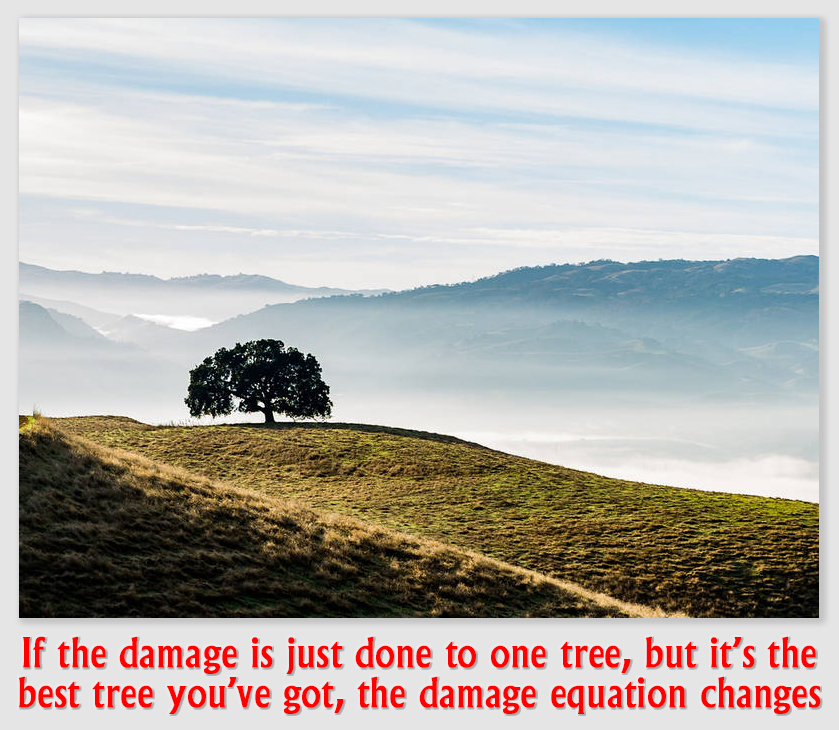
But what about where the tree is not commercial timber, like that 80-year-old oak that used to shade your front yard before a confused tree service company employee cut it down, thinking he was supposed to be at your house instead of a place two streets away. The single oak’s commercial value won’t begin to compensate you for the loss.

There’s always a tension between the value a lover of the land places on his or her trees and the price tag affixed to those same trees by bean counters testifying in some cold courtroom. That’s why courts in many states apply different rules when the wrongfully taken tree was a stately old elm shading the farmhouse, a tree with maybe $1,000 in timber value but much greater value to the wronged property owner. The fact is that the wronged owner just plain likes the trees that had been taken, and the fact that his or her enjoyment of the trees might not be quantifiable in a real-estate-value analysis makes little difference.

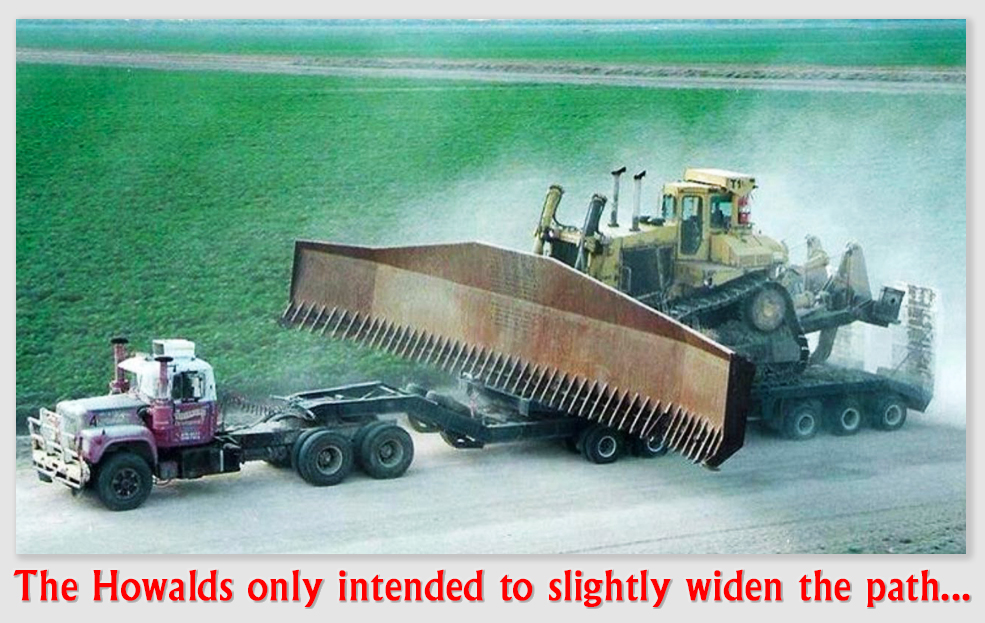
Anderson v. Howald, 897 S.W.2d 176 (Court of Appeals of Missouri, 1995). Melba Anderson discovered the limits of gratitude. For 40 years, she had let her neighbors, the Howalds, use a 7-foot-wide path across the corner of her land to get to their property. In 1991, the Howalds – apparently deciding that they shouldn’t settle for free use of a mere path where a free superhighway could be installed – brought bulldozers onto the Anderson land to “improve” the path. They knocked down trees, dug up rocks, and gouged things out but good.

Ms. Anderson sued and won an injunction, throwing the Howalds and their bulldozer out, but the trial court only gave her $6.40 in damages.

She appealed.

Held: The puny damage award was reversed. The Court of Appeals noted that “ordinarily, the measure of damages… is the market value of the property at the time it was removed from the land.” In this case, the trees being shade and ornamental trees of no commercial value, their value was slight. That seemed to offend the Court, especially when it saw the photos in the record of the extensive damage done by the Caterpillars.

The Court held that “in at least one instance, this court approved the use of before and after values of the real estate as a measure of damages… where the things taken, injured, or destroyed by a willful trespass have no substantial market value when considered in their severed state. The “general rule is that the measure of damages for trees that are not valuable for timber is the injury to the land caused by destroying them. This rule is based on the obvious reason that the value of such trees considered apart from the land would not be adequate compensation for the trespass.”

Courts, then, generally apply a measure of damages that considers the fair market value of the property with the tree and without the tree (which can be substantial for a single huge specimen that is the signature tree on the property). More often, the courts hold that the proper measure of damages is the replacement cost of trees rather than the value of real estate, even if the property owner cannot prove that the destruction of trees diminished the value of the property as a whole.

Courts often permit consideration of such replacement costs where the trees have aesthetic value to the owner as ornamental or shade trees, or for purposes of screening sound and providing privacy, in determining damages. Because one simply cannot replace a 50-year-old sugar maple tree with a similar tree, the courts apply a multiplier to the replacement cost to account for the number of years it will take for a replacement tree to reach the size and maturity of the tree that was removed.

– Tom Root

TNLBGray140407

Case of the Day – Thursday, November 20, 2025

SIR, YOU ARE NO GEORGE WASHINGTON

solong161006Today, we conclude our consideration of the trespass problems faced by our New Hampshire landowners Larry and Laura Littoral. If you have followed along to this point (and can remember what transpired even after the news broke that Kim Kardashian did so well in the California bar exam that she has been invited to take the second half next year), you know that the Littorals’ pastoral cottage getaway –  situated on a classic New England pond – has been disrupted by neighbor Wally Angler.

Compared to Wally, Donald Trump would prefer Nancy Pelosi as a neighbor. Wally –  a NINO (neighbor-in-name-only) – is an angler, and asked the Littorals to chop down some dead trees on their property to create a trout habitat in the pond for the primary (and sole) purpose of adding to Wally’s piscatorial pleasure.  You can hear him now: “Thanks for all the fish!”

The Littorals preferred that their dead timber remain standing. When Wally asked them to cut down the trees, they said, “So long,” refusing to dump their tree into the pond. Apparently reasoning that it’s easier to ask forgiveness than permission – especially where permission has already been denied – Wally then took advantage of the Littorals’ weekend absence by bringing in a tree service to cut the trees down for him. According to the Littorals, Wally affirmatively misled the tree cutters that the dead trees were on his property, and the tree service cut down the timber with alacrity.

gw161006For the record, Wally denies having anything to do with the felling of the dead trees. He seemingly maintains that he turned around one day, and mirabile dictu, the trees were on the ground. If George Washington had tried a similar woof story on his father about a downed cherry tree, we’d probably all be speaking English and enduring a manchild national leader whose conduct is concerning for dementia. As every schoolchild knows, however, Little George ‘fessed up, telling his father, “I cannot tell a lie.” Channeling Lloyd Bentsen, our observation is this: Wally, we served with George Washington, George Washington was a friend of ours. Wally, you’re no George Washington.

Our analysis this week has assumed that unless Wally can produce the elves responsible for the tree cutting (and their saws), the Littorals will easily meet their burden of proof.

So far this week, we have concluded that the Littorals may bring a double-barreled complaint, alleging a statutory violation of New Hampshire’s trespass-to-tree statute, R.S.A. § 227-J:8, and a common-law trespass count. The § 227-J:8 count carries some rather serious penalties, from three to 10 times the market value of the trees. The catch is that the penalties must be based on a multiple of market value. Market value may be the stumpage value of the wood – what it is worth on location to a lumber buyer – or on the cost to replace the tree, minus transportation and planting costs.

We’re assuming for the sake of this column that a few dead trees probably are not going to have much stumpage value. The Littorals could find an expert to establish how much replacement of the trees would cost, but replacement value has traditionally been used because everyone assumes that the destroyed trees would have continued to flourish but for the actions of the defendant. Here, the defendant’s expert would have a good argument that those trees were going to fall in the next strong wind anyway, and awarding the Littorals new live trees to replace their old dead ones would give the plaintiffs a “windfall” for what was only windfall to begin with.

Wally suspects elves.

Wally suspects elves.

Given Wally’s underhanded approach to getting what he wanted (and what the Littorals did not want), we don’t have much trouble with the Littorals receiving a windfall. The law in New Hampshire and elsewhere does, however, hold instead that damages should be limited to compensating for the actual injuries suffered. For that reason, the Littorals can take the confluent approach that under the common law of trespass, their real property has suffered a decrease in value because of Wally’s conduct, both because of where the dead trees are no longer standing and because of where they are currently laying.

Even then, the Littorals might have a problem because the usual assumption underlying damages for loss of trees is that standing timber will continue to stand for the indeterminate future. That assumption may be challenged where the standing timber is already dead. Nevertheless, there is ample evidence that dead trees standing have value. As we noted the other day, dead trees provide shelter or sustenance to over 40 percent of all birds, to amphibians, and to lichens and moss. Dead trees create “snow fences” that slow wind-driven snow. The snow that is trapped melts in place and saturates the ground, providing additional moisture to live trees. Dead trees create hiding cover and thermal cover for big game as well.

Even more counterintuitive, dead trees – after dropping their needles and bark – may reduce fire hazard. Their flammability is greatly reduced compared to green trees containing flammable resins.

stumps161006In the Connecticut decision we’re examining today, the plaintiff relied on standing dead timber to help maintain privacy from his neighbor. The court appeared to recognize that the elimination of the standing dead trees contributed to a substantial diminution of her property value, even while acknowledging that the trees themselves had no value. It’s not a New Hampshire case, but then there is a dearth of cases nationwide where the wrongfully cut trees were ornamental in nature and yet very dead even before tasting the ax. We were glad enough to find this one. The decision suggests that an action alleging loss of privacy may be the strongest case of all.

Caciopoli v. Lebowitz131 Conn.App. 306 (Court of Appeals, Connecticut, 2011). Dominic Caciopoli was a man who liked his privacy. He bought his place because it was isolated and private, surrounded by forest on all sides except for one area of the lot through which his driveway passed. A short while later, Jeffrey Lebowitz bought the place next door. His house was about 100 yards from Dom’s, and the area between the residences was wooded, affording each privacy from the other.

A few months after moving in, Jeff hired a tree service to clear standing dead trees from the wooded area between the two homes. Jeff believed the dead trees were on his land, but he didn’t check that carefully. The tree service removed all the dead timber, both standing and on the ground, some small saplings, and a few larger trees to provide more sunlight and enlarge the areas surrounding his house. Of course, it turns out that virtually all of what was cut really belonged to Dom.

When Dom came home to find that his natural privacy barrier had been clear-cut, he was not happy. He went to Jeff’s front door and expressed his displeasure, pointing out the actual property line in the process. Nevertheless, the next day, the tree service returned and finished the job. The removal of the trees and brush left Jeff with an unobstructed view of Dom’s house.

Jeff tried to make amends. He sent Dom a letter admitting his error and planted some trees on Dom’s property to replace what had been taken. Dom was not happy with the results and undertook his own extensive landscaping project in a failed attempt to restore his lost privacy.

Give a man a fish, and feed him for a day. Give a man a chainsaw, and watch trouble ensue.

Give a man a fish, and feed him for a day. Give a man a chainsaw, and watch trouble ensue.

Dom sued Jeff for common-law trespass and for treble damages pursuant to Connecticut General Statutes § 52-560 (the Connecticut adjunct to R.S.A. § 227-J:8). The trial court found that Dom had proven the elements of an intentional trespass action and awarded him $150,000. for the diminution in the value of his property caused by the trespass. Notably, the trial court declined to award any damages for the value of timber that had been removed.

Jeffrey Lebowitz appealed, alleging a lot of infirmities with the trial judgment. Of interest to the Littorals is Jeff’s appeal of the damage award.

Held: The trial court’s award of $150,000 was proper. The trial court found that after the cutting, Dom’s place was worth $675,000, according to an appraisal performed by a certified general real estate appraiser. The appraiser opined that prior to the cutting, Dom’s market value was $825,000. The Court of Appeals noted that Jeff could have presented his own expert testimony on the diminution of value, but he did not. Applying the ancient legal doctrine, et dormiat, ne perdatis (“you snooze, you lose”), the court said Dom’s expert was found to be credible and competent, and absent Jeff making an expert showing at all, that was good enough.

But, Jeff complained, Dom’s expert was not qualified to give an opinion as to the effect of the removal of certain trees from Dom’s property on its market value. He argued the expert had no relevant experience and was considered an expert only because she had a real estate appraiser’s license. However, the Court of Appeals said, the trial court relied on the fact she had conducted 1,500 appraisals before, and when the trial judge asked her whether she was able to testify as to the value of the property before and after the removal of the trees, she said she could. (This is rather like finding that she was an expert because she asserted she was, a rather bizarre ipse dixitbut the Court of Appeals was loathe to disturb a verdict and thus give Jeff a second bite of the apple on remand).

Jeff also argued that the court made no finding whether there was an adequate factual foundation for a “retrospective appraisal” – an appraisal after the fact of the value of the property before the cutting – and that Dom did not ask the court to find there was an adequate foundation for allowing the opinion evidence. The Court of Appeals pointed out that it was Jeff’s burden to object to the testimony on those grounds at the time of trial. Again, et dormiat, ne perdatisThe expert testified she visited the property in January and February 2009 and had determined the lot enjoyed a high degree of privacy prior to the incident. She also had studied photographs of the lot prior to the trespass and after the trespass, and noted that the pictures depicted more clearing of trees than she had imagined, thus strengthening her opinion as to diminution in value.

No one contests that trees in the water are a good habitat for fish... but Wally should have used his own trees.

No one contests that trees in the water are a good habitat for fish… but Wally should have used his own trees.

The Court observed that Jeff pointed to no authority to suggest that the expert’s personal observation of the property, her reliance on the plaintiff’s descriptions of the prior conditions of the property, and her review of photographs of the property in its prior conditions, was insufficient to form an inadequate factual foundation. The Court said the expert’s personal observation of the property “complemented by the plaintiff’s descriptions of the property in its prior conditions, is not impermissibly speculative…” After all, the Court said, Dom – as the owner – was undoubtedly familiar with his property (if perhaps lacking disinterest in the outcome), and no one was more competent than he to describe to the expert what it had looked like before the cutting.

The Court held that the fact that the expert “could not give a logical explanation for how she arrived at her opinion and did not articulate or apply methodology suitable to determining any diminution in value caused by the clearing of trees” was not fatal to her testimony. She testified that she examined real estate in the area, found comparable properties, estimated degrees of privacy and made adjustments, positive or negative, for the differences in the properties in order to “equal everything out.” She also noted that an appraisal is not based on science, but it is just an opinion as to value, and the Court accepted that.

Jeff had to pay the $150,000. That’s a lot of money for some dead trees that had no stumpage value.

– Tom RootTNLBGray140407

Case of the Day – Monday, November 3, 2025

HURTS SO BAD

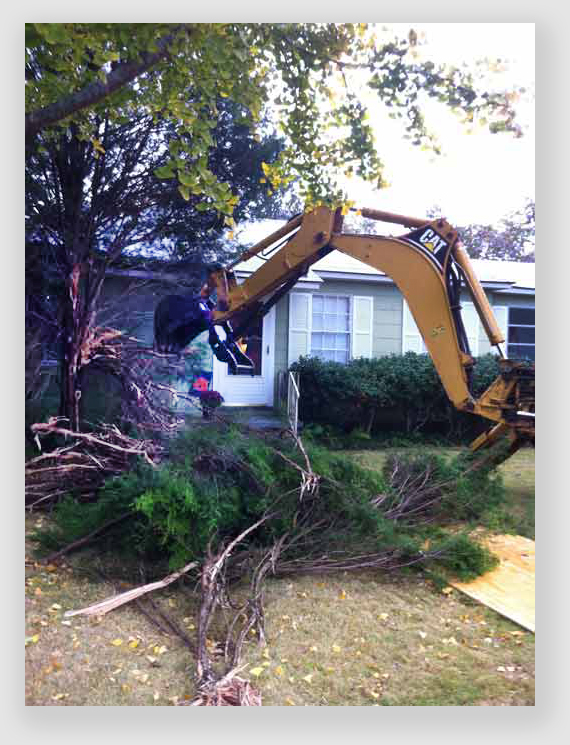
In case you missed it the past two days, this is a trackhoe removing a tree.

In case you missed it the past two days, this is a trackhoe removing a tree.

Today is our last day down on Dick Lavy’s Darke County farm. As you recall, we helped Dick’s faithful employee Sylvester trim the trees along a fencerow that separated one of the Lavy from land belonging to his neighbor, Jim Brewer.

We were fairly impressed to watch Sylvester run a trackhoe down the Lavy side of the fencerow, smacking down branches with the machine’s bucket. It was not pretty, but it got the job done effectively and cheaply.

Jim Brewer, however, wasn’t very happy with the result and sued Dick Lavy Farms. Farmer Lavy argued the Massachusetts Rule let him trim overhanging trees any way he liked, that Sylvester wasn’t negligent or reckless, and that the damage – if there even was damage – didn’t amount to much. The jury thought it was arboricide and socked Farmer Lavy for $148,350.

Last Thursday, we watched the Court of Appeals for Darke County, Ohio, fillet Dick Lavy’s argument that the Massachusetts Rule was a license to butcher. The Court affirmed a landowner’s right to trim encroaching trees and roots to the property line but held that such trimming had to be done in a reasonable manner so as not to injure the adjoining owner’s trees.

On Friday, we saw the Court compare the various means of trimming a fencerow, comparing for ease of use, custom in the area, and cost. It concluded that the trial court was right to find DLF negligent in trimming part of the fencerow and reckless in continuing after a sheriff’s deputy advised Dick Lavy to get legal advice before continuing (advice the farmer ignored).

Today, the Court delves into the $148,350 damage award. Clearly, the Court is troubled that Jim only paid $170,000 for the whole 70 acres, and provided no evidence that the value of the land fell a farthing because of Sylvester’s trimming activities. The Court felt hard-pressed to see Jim get almost $150,000 when no trees other than some saplings were destroyed.

Jim didn’t help his cause by admitting (as he had to) that he only visited the land about eight times a year to hunt and picnic, and the trimming didn’t interfere with those activities. He argued that he planned to build a house there in another 14 years or so, but the Court couldn’t see that the damaged fencerow trees had any impact on those plans.

Usually, the measure of damages for a trespass where trees are cut is the difference in the land’s value after the cutting versus before the cutting. There are times when this measure does not capture the real loss: a family loses a cherished ornamental tree, for example, or the landowner nurtures trees for their ecological value.

hurtsobad160929

That’s what Jim Brewer claimed, too…

In this case, however, it’s hard to see how Jim was hurt at all, not to mention hurt as badly as he claimed to be. Indeed, that’s how the Court of Appeals seems to read it, too. Come with us now on a detailed and thoughtful journey through all of the matters a court (and aggrieved party) should consider in setting the amount of loss. Although the Court sends the damage award back for the trial judge to deal with, it’s quite clear that the appellate panel is disinclined to turn the case into a winning lottery ticket for Jim Brewer.

Brewer v. Dick Lavy Farms, LLC, 2016-Ohio-4577 (Ct.App. Darke Co., June 24, 2016)

(These facts are repeated from the previous two days: If you don’t need the refresher, skip to the holding)

In 2007, James Brewer bought about 70 acres of rural property for $180,000. About 30 acres of the land were tillable, and 40 acres were wooded. The only access to the tillable and wooded property was a 25-foot wide lane of about 3,600 feet in length.

The former owner had allowed his neighbor Dick Lavy Farms to farm the property, and the lane had not been used. Brewer cleared the lane of undergrowth in order to access the rest of the property. The lane ran west to east, and had trees on both sides of the lane, with the trees on the south side forming a fencerow between Brewer’s property and land owned by Dick Lavy Farms. The trees in the fencerow were a woodland mix; none of the trees were ornamental or unique.

In January 2013, Dick Lavy ordered an employee to clear the fencerow between the two properties. At the time, Lavy understood that he could clear brush straight up and down the property line and that such clearing was important for crop production, yield and safety of farm equipment. Using a track hoe, which had an arm that could reach about 15 feet in the air, the employee reached up, grabbed limbs, and pulled on them, trying to break them off cleanly. Although the employee tried to keep the trackhoe on DLF’s side of the property, occasionally a branch would snap off or tear the tree on Brewer’s side. Occasionally, a branch would fall on Brewer’s side, and the employee would reach over to grab the branch Sylvester stated that he never consciously reached over with the bucket to try and break a branch at the tree trunk that was on Brewer’s side of the property.

When Brewer learned that DLF was clearing the fencerow, he went out to look at the operation and called the sheriff. At that point, the track hoe was about halfway down the fencerow, destroying trees. A Darke County sheriff’s deputy told Lavy that a complaint had been made, and expressed his concern that civil or criminal issues could be involved in what he was doing. Lavy said that he had a right to take down any branches that were hanging over his property. In addition, Lavy said he would let Brewer remove the branches if Brewer wanted to do so, but he wanted the branches removed before crop season began in March or April.
Or, if you're Sylvester, don't use a chainsaw at all...

Or, if you’re Sylvester, don’t use a chainsaw at all…

The deputy told Brewer that Lavy said that he was allowed to take tree branches from his side and that if Brewer did not like the way he was doing it, Brewer could cut them himself. Brewer told the deputy that he was going to have an expert look at the trees. The deputy filed a report with the prosecutor’s office, but no charges were brought.

Although the deputy suggested that Lavy obtain legal advice before continuing, Lavy continued clearing the fencerow. Knowing that Brewer was upset, Lavy told his employee not to clean up branches that fell on Brewer’s side.

Within days after the damage occurred, Brewer’s wife took photos of the damaged trees. Three months later, Brewer and an arborist counted 326 damaged trees.

Brewer sued Dick Lavy Farms, alleging a violation of O.R.C. § 901.51, reckless trespass, and negligent trespass. Prior to trial, the court held that Brewer was not limited to damages for diminution in value, and the court would apply a standard that allowed recovery of the costs of restoration.

DLF argued that it had a common law privilege to cut off, destroy, mutilate or otherwise eliminate branches from Brewer’s trees that were overhanging DLF land. The Farm also argued that if it was liable, the proper measure of damages should be the diminution of Brewer’s property value; in the alternative, the court’s holding on the issue of damages was against the manifest weight of the evidence. Finally, DLF claimed it had not negligently or recklessly trespassed on Brewer’s property.

The Court found for Brewer, awarding him $148,350 in damages, including treble damages of $133,515.

Dick Lavy Farms appealed.

(If you remember the facts from the previous two days, start here)

Held: It was Halloween for Jim, and he got a trick, not a treat. The $148,350 in damages was set aside because Jim’s property really didn’t diminish in value.

The Court observed that in a previous case, it had held that where the trespasser could not reasonably foresee that trees had a special purpose or value to the landowner, and where the trespasser “cuts trees that are part of a woodland mix and not unique, the ordinary measure of the harm is the difference in the fair market value before and after the cutting.” The trial court, however, had relied on a different standard:

It was all trick and no treat for Jim…

In an action for compensatory damages for cutting, destroying and damaging trees and other growth, and for related damage to the land, when the owner intends to use the property for a residence or for recreation or for both, according to his personal tastes and wishes, the owner is not limited to the diminution in value (difference in value of the whole property before and after the damage) or to the stumpage or other commercial value of the timber. He may recover as damages the costs of reasonable restoration of his property to its preexisting condition or to a condition as close as reasonably feasible, without requiring grossly disproportionate expenditures and with allowance for the natural processes of regeneration within a reasonable period of time.

At trial, Jim’s expert arborist testified that the cost of removing the trees Sylveste3r had damaged would cost $55,000, and the cost of replacing them would be $138,000, plus tax. Jim did not offer any evidence that his 70-acre property’s fair market value had fallen by so much as a penny. DLF’s arboriculture expert testified the life expectancy and service life functionality of the fencerow were not affected by the manner in which the trees were pruned. He valued the fencerow as a woodland edge fence and argued that real estate or fair market value would be the proper way to assess damages. Another DLF expert also testified that the fair market value of Brewer’s property was the same before and after the incident.

The trial court found that removal of the damaged trees was unnecessary, and thus discounted that $55,000 cost. In addition, the court concluded that the $138,000 estimate for tree replacement was excessive, and reduced that amount by 50%. The court also deducted 14% for ash tree disease, which had already caused the death of a number of trees on both sides of the lane. The trial court thus arrived at $59,340 in compensatory damages.

Next, the trial judge decided that DLF had negligently trimmed one-fourth of the property (or about 1,000 feet), and recklessly trimmed the remaining three-fourths of the fencerow. The trial court awarded $14,835 for negligence, and $44,505 for DLF’s recklessness. Pursuant to O.R.C. § 901.51, the court trebled the recklessness amount to $133,515. This brought the total damages to $148,350.

The Court of Appeals noted Ohio’s general rule that “recoverable restoration costs are limited to the difference between the pre-injury and post-injury fair market value of the real property,” The courts have carved out an exception, however, that permits restoration costs to be recovered in excess of the decrease in fair market value when real estate is held for noncommercial use, when the owner has personal reasons for seeking restoration, and when the decrease in fair market value does not adequately compensate the owner for the harm done. This restoration cost exception has been applied, for example, where the damaged trees have been maintained for a specific, identifiable purpose (like recreation, or a sight, sound, or light barrier), when damaged trees are essential to the planned use of the property, or when the damaged trees had a value that can be calculated separate from ornamental trees have been destroyed, or where the trees form part of an ecological system of personal value to the owner.

Even where the restoration exception is applied, the Court said, “the proposed cost [cannot be] grossly disproportionate to the entire value of the injured property.”

The Court said that the damage to Jim Brewer’s trees was “temporary” (meaning, apparently, that the damaged limbs would grow back), and that the Ohio rule is that “damages for temporary injury to property cannot exceed the difference between market value immediately before and after the injury, is limited. In an action based on temporary injury to noncommercial real estate, a plaintiff need not prove diminution in the market value of the property in order to recover the reasonable costs of restoration, but either party may offer evidence of diminution of the market value of the property as a factor bearing on the reasonableness of the cost of restoration.”

The trial court seemed certain that Dick Laye was a deep pocket, and that may have driven its damage award.

The trial court seemed certain that Dick Lavy was a deep pocket, and that may have driven its damage award.

“Viewing the trial court’s award of damages from the perspective of reasonableness,” the Court of Appeals said, “we must conclude that the award for restoration was objectively unreasonable.” First, the application of O.R.C. § 901.51 “almost exclusively involves situations where trees have been completely cut down, making it considerably easier to determine the full extent of the damage to the plaintiffs’ property.” Here, Jim Brewer admitted that other than a few small saplings, he was not claiming that any large trees had been removed from his land. Instead, he contended only “that 326 trees had been damaged in some manner and would ultimately die, even though pictures of the area taken in June 2014 depict a substantial canopy of foliage… Brewer also testified that a number of trees had died, but he did not give any specific number.”

The Court found that Jim Brewer’s trees were not ornamental and were not located at his residence. Instead, they were native trees that were just part of a fencerow. Jim testified he used the property for hunting only about six times a year, and for family get-togethers maybe twice a year. He also admitted the removal of branches had not had any effect on these activities or his ability to rent tillable land to farmers. Jim intended to put a house on the property after his 4-year-old child graduates from high school, but he didn’t claim that DLF’s tree trimming affected his plans to do so.

The Court found it noteworthy that Jim Brewer paid $180,000 for all 70 acres, yet claimed the restoration cost (including removal and replanting of trees) for a very small part of that property was more than $200,000.

Jim did not present any proof that the fair market value of the land had fallen because of the tree trimming. The Court agreed that he was not required to present such evidence, bur said “it would have been helpful, particularly since two defense witnesses indicated that removing vegetation from the fence row did not impact the fair market value of the land.” Additionally, the Court found that much of the trial judge’s calculations “were based on speculation or were incorrect. For example, the court concluded that one-fourth of the fence row was trimmed negligently, but the plaintiff’s own evidence showed that more like 1,800 feet had been trimmed when Jim Brewer first complained. “The trial court could have chosen to disregard [the DLF employee’s] testimony,” the Court said, “but there is no logical reason to disregard the plaintiffs’ own admission about how far the fence row had been cleared.”

The Court of Appeals was not inclined to see Jim Brewer get a winning lottery ticket...

The Court of Appeals was not inclined to see Jim Brewer get a winning lottery ticket…

The trial court also gave no particular reason for its 50% discount on damages. What’s more, the Court of Appeals complained, “The trees on the fence row were a woodland mix of native trees, not ornamental trees. A number of the trees were undesirable, and there was no evidence of special value. In addition, the fence row had been unmaintained for 10 or 29 years. Even though these facts no longer require damages to be limited to diminution in value, they are still points that should be considered in deciding whether an award is reasonable.”

The Court of Appeals vacated the damages, and directed the trial court on remand to consider the reasonable restoration costs, taking into consideration the decrease in the fair market value of the land; the fact that the trees were a common woodland mix, not ornamental trees or trees that Jim had planted for a particular purpose; the fact that the fence row was not maintained for many years, and had undesirable and dead trees on each side of the row; the extent to which the trees have regenerated since the date of the 2013 trimming; the lack of impact on Jim’s intended home site; and the fact that Jim’s use of his property is “sporadic and is not impacted by any injury to the trees.”

The detailed list of evidence the trial court is to consider pretty much tells the trial judge how the Court of Appeals expects this to turn out.

– Tom Root

TNLBGray140407

Case of the Day – Tuesday, August 5, 2025

IF A TREE FALLS IN THE FOREST …

venezuelastore160816

Island Realty’s coffers were as empty as a Venezuela grocery store’s shelves.

Taking a philosophical bend, a New York trial court asked “[i]f trees are cut in a forest that were going to be removed anyway does the owner have compensable damages?”

The Mottas couldn’t stand the overgrown and scrubby condition of unimproved land next door to their place, property owned by Island Realty. When another neighbor took matters into his own hands and cut back some of the offending saplings on the vacant land, the Mottas — bothered by falling leaves and insects, not to mention fears of West Nile virus — hired their own landscaper to cut back some other trees and vegetation on the Island Realty property.

The landscaper attacked the job with enthusiasm, and a neighbor — worried about the cutting because the Mottas weren’t home — called the cops. The police came and — this being New York City — everyone got a ticket because no permits to cut trees or park dumpsters had been obtained. One of the police officers reported the matter to Island Realty, too.

Island Realty had a case of the “shorts.” It wanted to develop the lot for housing, but its bank account was emptier than a beer cooler in CaracasSo it sued the Mottas for treble damages under New York law and brought in an expert who tried to sell the Court the amazing woof story that the one-third acre of cut saplings would cost $190,000 to replace.

The Mottas’ expert pointed out that the Island Realty development plan called for the removal of the trees that the Mottas had cut. In other words, far from damaging Island Realty, the Mottas had saved the developer a few bucks by doing what the developer would have had to have paid to have done.

The Court was a bit vexed. It didn’t much cotton to the Mottas’ form of self-help in clear-cutting the neighboring land, but it couldn’t really find any damage, either. It ruled that under New York law, the lesser of the diminution of value of the land or restoration costs was used to set damages. The Mottas had pretty well shown that the land wasn’t worth a dime less with the scrub cut. In fact, an aerial picture taken during the litigation (three years after the cutting) showed that the scrub was nearly all back.

show150714The Court held that because Island Realty intended to cut the trees itself, damages were nominal, and it ordered the Mottas to pay $100, trebled to $300. In fact, the Court gave credence to the Mottas’ suggestion that the whole reason Island Realty sued to begin with was to raise a pot of money to start the development that it was too cash-starved to pull off by itself.

333, Island Realty Assoc., LLC v. Motta, 21 Misc.3d 554, 863 N.Y.S.2d 866 (Sup.Ct., Aug. 22, 2008). Island Realty was a land developer that owned a large tract of unimproved wooded land along the south shore of Staten Island. Joseph and Joan Motta owned a house next door. The Mottas had often complained that the unattended trees on the Island Realty land had created a nuisance because some of the trees hung over their property, and falling leaves had clogged their pool drains.

Motta’s neighbor – whose property also abutted the Island Realty land – exercised a little self-help by cutting a swath of Island Realty trees to create a 100-foot buffer zone between his backyard and the tree line. He did so without any permission or objection from the real estate firm. Seeking to create a similar buffer zone to safeguard his own property, Joseph Motta had a landscaper cut the trees that overhung his land and create a buffer zone away from the unattended trees for fear of insects and West Nile Virus, which was prevalent in Staten Island around that time.

While the Mottas were not home, the landscaper and his crew went to work but became overzealous, cutting down various trees without Island Realty’s consent and without any supervision from the Mottas. A nosy neighbor called the police to inform them that trees were being cut while the Mottas were not home. Because the complaint involved tree cutting, police officers from the New York City Department of Environmental Protection responded to the premises and observed a wood chipper feeding into an open container. Upon confronting the landscaper, the police officers learned that Joseph Motta authorized him to clear out some trees. The police officers originally estimated that 100 to 200 trees were cut in an area about half the size of a football field, but later admitted they were not certain how many trees were cut down. The police issued Motta five summonses for cutting down trees without permission and for placing a container on the street without a permit. All of those charges were dismissed by the criminal court, except for the container charge, for which the defendants paid a $250 fine.

Officer Friendly responded to a call from a nosy neighbor ... and stopped by the Mottas for a chat.

Officer Friendly responded to a call from a nosy neighbor … and stopped by the Mottas for a chat.

Island Realty was not immediately aware of the felling of the trees but soon learned of it from the police. The company had planned to develop the wooded tract into a large development of houses, and in order to do so, it would have had to clear large sections of trees to comply with an approved plan. Ironically the Mottas argued that they rendered a benefit to Island Realty in removing trees at no expense to the company that ultimately would have to have been removed in order to complete the building project.

Nevertheless, Island Realty sued Motta under New York Real Property Actions and Proceedings Law § 861, which authorizes treble damages for the wrongful cutting of trees.

Held: Motta was liable for damages, but the damages awarded were nominal, $100 trebled to $300. The Island Realty expert estimated that 483 saplings would have to be planted to replace what was cut, at a price of $190,000. The trial court rejected the estimate as “incredible” and “preposterous.” Motta’s expert, on the other hand, testified that Island Realty was under no legal requirement to replace the trees, which it was going to cut down itself anyway. The Court accepted this opinion.

The Court followed the New York law principle that the measure of damages for permanent injury to real property is the lesser of the decline in market value or the cost of restoration. A plaintiff may demonstrate the costs of restoration, but then it becomes the defendant’s burden to prove that a lesser amount than that claimed by the plaintiff will compensate for the loss.

Here, the Court said, Island Realty only presented speculative testimony of the value of the restoration and disregarded balancing that testimony with the other evidence in this case, namely, that there was no decrease in the value of the land, especially when it was to be cleared for development anyway.

The Court warned that it did not condone the Mottas’ actions in cutting down Island Realty’s trees without permission. However, applying the rule of taking the lesser of the values between restoration —which was most speculative — and no diminution of the value of the land, the Court held it was clear that there was no diminution in the value of the land.

It was noteworthy, the Court said, that Mottas tried to buy the land from Island Realty after the cutting, and Island Realty wouldn’t adjust the price downward because the trees were gone. This suggested, the Court said, that even Island Realty didn’t think the land was worth less with the trees gone. Rather, it suggested that Island Realty’s lawsuit was only about getting startup capital for a building project from the Mottas instead of being about the value of the lost trees that would never be replanted.

– Tom Root

TNLBGray140407

Case of the Day – Tuesday, July 1, 2025

I CHANGED MY MIND… I GUESS

Doug Van Dyke had big plans for getting folks back to nature. He wanted to build a nature trail along a ravine that split his property and that of his waffling neighbor, Eunice North. People could enjoy the birds, the babbling brook, the scent of pine… that kind of thing.

If you ever wonder whether it’s a good idea to get agreements in writing, Doug’s $70,000 mistake will settle that question for you. Because Doug’s nature path would meander a bit onto Eunice’s side of the ravine, he told her about his plans for the trail. Eunice, who admitted that she really had no idea what Doug was talking about, said she just “shrugged my shoulders” and replied that “I guess it would be okay.”

To Doug, that was like the green flag at Indy.  But little did he know that Eunice promptly began to fret about her confused acquiescence. She had trouble sleeping for her worry, and finally asked a friend about the plan. Her friend told Eunice the trail idea was a mistake. Armed with this advice, Eunice said, she reneged. She claimed she told Doug that she didn’t want him around.

No probalo,” Doug – who had no intention at all of honoring Eunice’s change-of-heart – allegedly responded. Regardless of his actual intentions, Doug promised Eunice that he “would go to a different plan.”

That different plan seems to have involved having his contractor run the bulldozers at full throttle instead of half throttle. By the time the diesel fumes cleared, 20 of Eunice’s trees had been ground under Caterpillar treads and the trail encroached on her land.

Eunice sued Doug for trespass, loss of lateral support, and loss of trees. The jury awarded Eunice $50,000 on the trespass and lateral support claims and $20,100 in treble damages on the loss-of-tree claim. It mattered little that Doug and the contractor both told a different story, the bulldozer operator testifying that Eunice had agreed to Doug’s plan. The jury believed Eunice.

Juries do that, often buying one side of the story and not the other, many times against common sense. We don’t know that that happened here, but it sure did not help Doug that he had not bothered to have the property boundaries surveyed before the ‘dozers started dozing.

Much of Doug’s case in the appeals court focused on damages. The jury agreed that Doug’s dozing had made Eunice’s side of the ravine unstable. Eunice’s expert testified that there were three ways to repair the damage, but none of the trees would restore the ravine to its pristine state. Doug argued that said because the land could not be repaired to the way it was before the bulldozers rolled through, then the diminution of the fair market value of the ravine was all that mattered.

Not so, the court said. The law does not require that the evidence show that the damage can be repaired so as to make the property as good as new. While it is a general rule of Iowa law that the cost to repair property is the fair and reasonable cost of repair not to exceed the value of the property immediately prior to the loss or damage, all Eunice was required to do was to establish a fair and reasonable cost to fix things up in order to arrest further deterioration and make the place as good as it can be made. In this case, Eunice showed that she had three means of stabilizing the steep bank after Doug’s earth-moving frolic and only one of those made any sense. She established the cost of that repair, and the value of the property before the damage.

Because the damages did not exceed her expert’s $129,000 repair price tag, it was clear the jury fulfilled its function in weighing the evidence.

Next time, Doug, get the landowner’s OK in writing. Call a surveyor. Stake the property boundaries. Surely that’s cheaper than $71,000.

North v. Van Dyke, Case No. 16-0165 908 N.W.2d 880 (Ct.App. Iowa, 2017). Douglas Van Dyke hired Heck’s Dozer, Inc., to build a trail along a ravine between his property and adjacent land owned by Eunice North. Twenty of North’s trees were removed during the trail’s construction, and a portion of the completed trail encroached upon North’s property. Doug said Eunice gave him permission. Eunice said she initially sort of equivocated, but later told Doug in no uncertain terms that he was to stay off her land.

Doug said he would do so, but he never had the land surveyed or staked, and his guess as to the location of the property line was by guess and by gosh. Doug’s contractor said he met with Eunice, and she approved the plans. Eunice said she had never met the contractor.

Eunice testified that after she told Doug to steer clear of her property, she heard a “‘loud commotion.’ Standing on her deck, she saw ‘two pieces of heavy equipment’ below and ‘trees… flying.’ She decided not to go into the ravine to check on the commotion because she was ‘afraid’ she would get ‘hit with something,’ and she had physical difficulties getting ‘down there.’ Suspicious of an encroachment on her land, she commissioned a survey. The surveyor confirmed her fears.”

Eunice sued Doug for trespass, loss of lateral support, and loss of trees. The jury awarded her damages of $50,000 on the trespass and lateral support claims and $20,100 in treble damages on the loss-of-tree claim. Doug appealed.

Held: Eunice amply proved that Doug should pay treble damages under Iowa Code § 658.4 (2013). The statute requires the damage to trees be committed willfully or without reasonable excuse.” The term “willfully” has been characterized as an intentional and deliberate act without regard to the rights of others. Here, the Court of Appeals said, a reasonable juror could have believed that Eunice said “no” the jurors could have found Van Dyke “acted… without reasonable excuse.”

The jury additionally could have found that Doug’s failure to commission a survey before building the trail denied him any reasonable excuse for the trespass. The testimony established that Doug relied on an “old fence,” “old posts,” a “shed,” and a “roofline” to gauge the boundary.

The measure of damages is the cost of repair, as long as that cost does not exceed the value of the property prior to the damage. Doug complained that because Eunice’s expert testified only that the continued deterioration of the property could be stopped by stabilizing the steep bank, she was not able to show that the property could be repaired to its original state.

The Court of Appeals held that nothing requires that the repair estimate be enough to restore the land to its state before the damage. As long as Eunice provided evidence of the fair market value of the land before and after the damage, and a repair cost that is less than the value of the place before the damage – which she did – she met her obligation. Here, the damages awarded by the jury were higher than Doug’s estimate of $2,500.00 to fix it, but well below Eunice’s estimate of $127,000. Plus, the jury’s $50,000 award for trespass and lateral support was well below Eunice’s evidence that the land was worth $250,000.

The damage to the trees was assessed separately, with the value of the lost timber found to be $6,700, trebled to $20,100.

– Tom Root

TNLBGray140407

Case of the Day – Wednesday, June 18, 2025

YEAH, WELL, THEY WERE UGLY TREES…

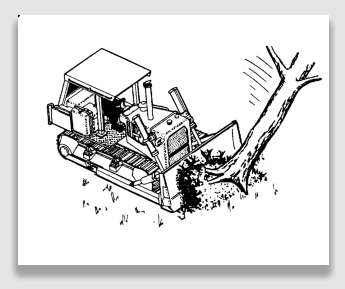
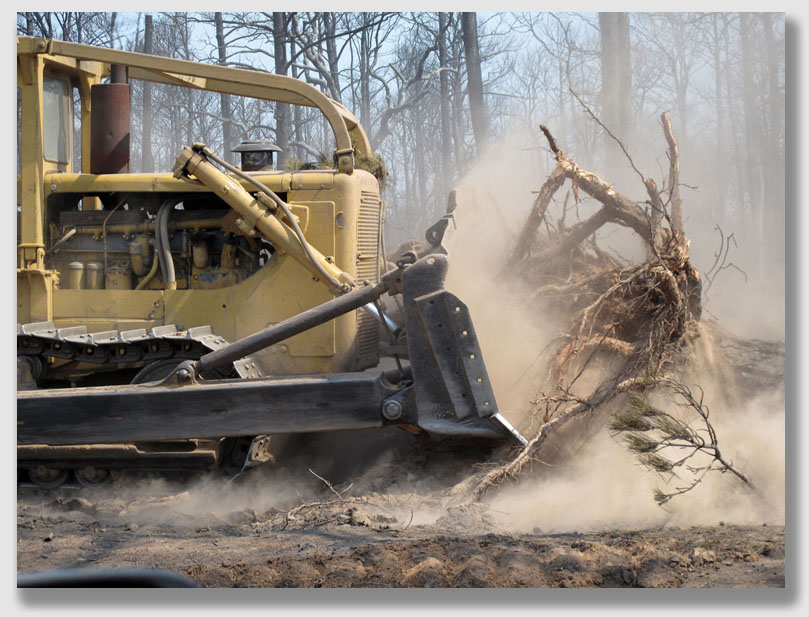
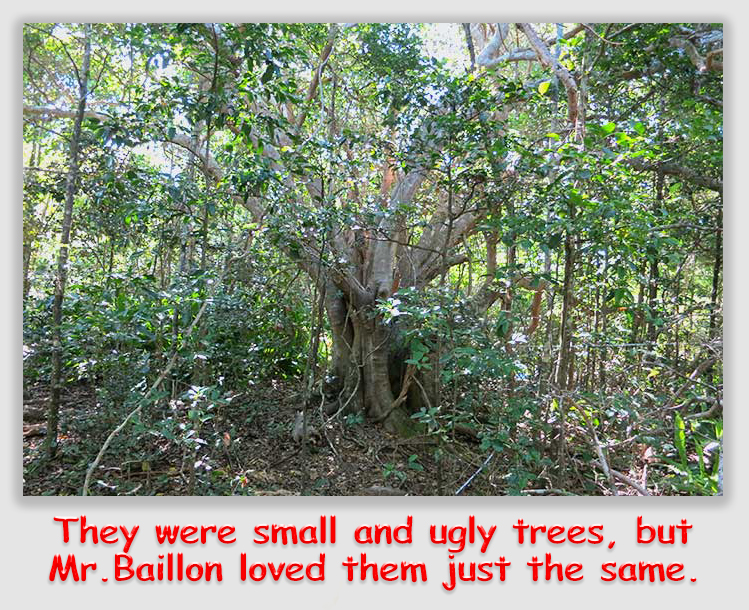
When the contractor building an interstate highway interchange needed some space to park bulldozers, the state highway department asked Mr. Baillon for an easement.  Being justly proud of his scrubby little trees and stunted bushes, he refused.

A couple of volunteer oak trees and some forsythia bushes are no match for a Caterpillar D10, so the contractor, Carl Bolander & Sons Co., went ahead and used Mr. Baillon’s land anyway.  But it turns out a Caterpillar D10 is no match for a Minnesota trial court.  Mr. Baillon sued and won.

But he won what?  The trial court judged his damages by the diminution in value of his land.  That is, how much less is the scrawny strip of real estate worth with the scrub trees gone?  Not much, the Court said, giving Mr. Baillon just $500.00.

Mr. Baillon appealed.  He argued he had wanted the trees and bushes as a sound barrier between himself and the road.  Also, he should have gotten treble damages because of the intentional trespass.

The appeals court sort of agreed.  It held that the measure of damages for the loss of trees — because they weren’t particularly desirable as shade trees or ornamental trees — was the reduction value of the real estate.  Clearly, however, treble damages should be assessed under Minnesota Statute 561.04, Minnesota’s wrongful cutting statute, because the trespass was anything but casual.

This type of damage calculation, well known to contract law students who read Peevyhouse v. Garland Coal Co., is intended to avoid economic waste.  The thinking is that the courts won’t order restoration of the property if the cost exceeds the reduction in value caused by the conduct.  But at what price to freedom?  Mr. Baillon didn’t want to sell his property; he wanted his trees, pathetic though they might be.  The fact that the marketplace might not share his desires shouldn’t matter all that much: it was his land, and he should be able — within broad parameters — to keep it as he likes.  Letting the bulldozer operator off the hook for the intentional trespass by not requiring that the land be restored to what it looked like before the trespass, even if that cost ten times the difference in real property value, seems to us to not accord Mr. Baillon’s rights the respect they deserved.

Baillon v. Carl Bolander & Sons Co., 306 Minn. 155, 235 N.W.2d 613 (Sup.Ct. Minn. 1975).  The Highway Department tried to get Baillon to grant a temporary construction permit, giving the state an easement to go on his property adjacent to where Bolander was constructing I-35.  Although Baillon wouldn’t grant the easement, Bollander’s workers trespassed on the land and destroyed a number of trees and shrubs. Baillon wanted the particular trees, in order to preserve a natural and wild appearance, to abate noise from the highway, and to preserve the beauty of the premises.  The trial court found that Baillon was damaged by the Bolander company’s intentional acts in the sum of $500.00.  

Arguing that the trial court should have applied as a measure of damages the replacement cost of the trees and not, as the trial court held, the diminution in value of the real estate, and that he was entitled to treble damages, Baillon appealed.

Held: The award of damages was upheld in part.  The Supreme Court held that the proper measure of damages for the destruction of trees which, for the most part, were quite small, ill-formed and not particularly desirable as shade trees or ornamental trees, but which served to prevent erosion and acted as a sound barrier, was the diminution in value of the real estate rather than the replacement cost of trees (even though the trespass was willful).

However, treble damages should be awarded. The Court held that where the highway contractor — in the course of building the freeway — intentionally cut the trees, which did not protrude over the highway. The trespass was not necessary for the contractor’s purposes and was not “casual.”  It was clearly the duty of the trial court to order treble damages unless Bolander’s activities came within one of the exceptions specified in the statute, and those activities clearly did not.

– Tom Root

TNLBGray140407