Case of the Day – Monday, March 10, 2025

WHAT IS THIS CASE DOING IN MY COURTROOM?

socks150311

I recall once enjoying the spectacle of a young lawyer squirming during a pretrial hearing. I couldn’t help myself – he represented the opposing party and generally was insufferable. The judge picked through the sharp young attorney’s pleadings like he was sorting a pile of smelly socks, and then demanded to know “what is this case doing in my courtroom?”

schadenfreude150311Ah, schadenfreude! Such a guilty pleasure, chiefly because I have no doubt that I myself have on many occasions given other lawyers opportunities to enjoy schadenfreude at my expense.

Still, there are a lot of cases that ought to never see the inside of a courtroom. Today’s case is a good example. A man named Klemme burned some brush one day. He carefully tended the burn pile, kept water and a phone handy lest the fire gets out of control, and checked for burning embers before he went home that night. He was on the scene the next day, too, and saw no smoldering debris. The next day, however, the wind came up, and somehow, fire burned about 400 young seedlings planted in the neighboring unimproved property, owned by the widow Zech.

The seedlings were fewer than one percent of the 62,000 seedlings planted by the Zechs pursuant to a deal they had made with a federal conservation program. They had bought seedlings for about 30¢ apiece and planted them over a period of years. Then Mr. Zech died, and after that, Mrs. Zech never visited the property. She admitted she couldn’t say for sure that it had been Klemme’s burn pile that had started the fire. She admitted that a lot of other seedlings had died of natural causes and that she hadn’t replaced the seedlings allegedly killed by the fire or the ones that had simply died. Finally, she was unable to show that the fair market value of the real estate had fallen because of the damage to about 0.66% of the seedlings on the premises.

This case was not (to use a Latin phrase), a “slam dunker” for Mrs. Zech. If she felt she had been damaged, why didn’t she spend $120.00 for 400 new seedlings? If she permitted many of the 62,000 seedlings to die without replacement, how seriously had her enjoyment of the property – which she didn’t visit because of the amount of snowfall and because it apparently evoked memories of her late husband – been compromised?

Mr. Klemme’s lawyer filed a motion for summary judgment, asking the Court to grant judgment for the defendant without a trial. Summary judgment is a useful device for economically ridding the court of a dog of a case where there is no genuine issue of fact and where one side is entitled to judgment as a matter of law. The trial court obliged him, holding that the proper measure of damages was the decrease in the value of the property and that Mrs. Zech had provided no evidence that the value of the premises had fallen.

Mrs. Zech appealed, arguing that the measure of damages should have been the replacement value of the seedlings. What, we’re talking $120.00 here? As little sense as that made, the trial court had found that the seedlings were “special purpose” trees because the Zechs were required to plant them as a condition of having the land enrolled in the CRP. Relying on that “special purpose” finding, the Court of Appeals held that the proper measure was indeed the decrease in fair market value, thus agreeing with the defendant.

A priceless Ming vase (note the clear label)

A priceless Ming vase (note the clear label)

This is a peculiarity of the law of negligence. Not only must there be a departure from the standard of care (someone has to be a klutz), but there must be harm flowing from the klutziness. If I drop your priceless Ming vase, but it bounces without breaking, you have no claim against me for negligence. If it breaks, however… that’s another story.

Was Mr. Klemme negligent? Did his burn pile spontaneously combust? We’ll never know because – whatever caused the fire – Mrs. Zech didn’t suffer any loss.

Zech v. Klemme, 803 N.W.2d 128 (Iowa App. 2011). One spring day, strong winds rekindled an ember in a burn pile located on Klemme’s property and started a grass fire that damaged trees on Zech’s property. Several days before, Klemme had burned brush and tree limbs in a burn pile located about 300 feet from the Zech property.

Klemme kept a water hose nearby and used the hose to wet down the adjacent area to prevent the fire from spreading. He also had a cellular telephone available to contact the local fire department if necessary. Klemme said he stopped burning at about 11 a.m. on April 2, and when he left his property at the end of the day, the burn pile had subsided to ashes. He worked on his property on April 3, and observed the pile throughout the day, noting no sign of any smoldering embers. Klemme also said he had no knowledge there would be any strong or sudden gusts of wind on April 4th.

fire150311Zech had enrolled the land where the fire occurred in the federal Conservation Reserve Program (CRP). The CRP required Zech to prevent erosion and provide wildlife habitat on the acreage and prohibited her from harvesting the trees or using the land for grazing livestock or raising crops. In exchange for her enrollment in CRP, Zech received an annual payment starting in 2002 and continuing through 2006. For conservation purposes, Zech and her late husband planted between 2,000 and 3,000 bare-root seedling trees each year. At the time of the fire, about 62,500 trees of various species had been planted on the CRP land.

The Zechs purchased the bare-root seedlings from the Iowa State Forest Nursery at about $0.30 each. Zech asserted that over 400 trees were damaged in the fire. In the ordinary course of nature, wildlife, insects, disease, and climatic conditions have also damaged or destroyed some of the trees on the CRP land. Zech has not removed, replaced, treated, repaired, pruned, trimmed, or cut down any of the trees that have been damaged or destroyed by the fire or by natural causes. She does not live on the CRP property, and the fire did not change her use of the land.

Zech contended in her complaint that the appearance of the burned branches on the trees she planted with her late husband has diminished her emotional enjoyment of the land. However, she did not argue that the fire has diminished the fair market value of the land. The fire did not cause Zech to incur a loss of income, nor did it cause her to incur any additional expense. She also did not argue that the damaged trees had any historic value.

Zech had no personal knowledge as to the cause or origin of the fire, and she did not contend that Klemme acted intentionally to harm the trees.

The trial court held that the trees on the land were “special purpose” trees and that the measure of damages was the decrease in the fair market value of Zech’s property. Because there was no proof of any loss of market value, there were no damages, and Klemme was granted summary judgment.

Zech appealed.

Held: The trial court properly determined what damages should be considered and correctly concluded that Zech had not been damaged.

The Court of Appeals observed that Laube v. Thomas had held 25 years before that “[i]t is impossible to state a simple, all-purpose measure of recovery for loss of trees.” Therefore, trial courts are granted a degree of discretion to select how to assess damages based on the facts of each case.

seedlings150311Zech argued that the appropriate calculation for damages should be the replacement cost of the seedling trees damaged or destroyed by the fire. Where trees can be replaced, a reasonable cost of replacement is the appropriate measurement of damages. Laube, the Court noted, involved the removal of about 100 walnut trees. The Laube court decided that the replacement cost measure “would obviously be inappropriate,” and the trial court in this case – which was dealing with about 400 trees – was likewise right that a replacement calculation would not work. Compounding the problem, Zech admitted she has not replaced or treated any of the damaged trees since the fire in 2005, nor has she expressed an intent to do so in the future.

Instead, the trial court concluded that the appropriate measure of damages for Zech’s loss should be the “special purpose” or “special use” calculation used in Laube. Where trees are put to a “special purpose” or have a “special use” – such as for windbreaks, shade, or ornamental use – damages are based upon the difference between the market value of the land before and after the destruction of the trees. The trial court viewed the conservation use of the trees as required by CRP to be a special purpose and thus concluded that any enjoyment Zech derived from the trees was incidental to the primary purpose of the CRP land. Besides, the Court of Appeals noted, while Zech herself had testified that the burned trees reduced her enjoyment of the land, she admitted she no longer regularly walks on the CRP land, citing the fact that “there has been too much snow for one thing.” She also admitted that she had ceased her custom of walking the land after her late husband passed away.

Zech also admitted that the fire did not cause her to change her use of the land. The trial court concluded that Zech’s deposition testimony did not establish a special use relating to her enjoyment of the land, nor a diminution in her enjoyment due to the fire. Using the “special purpose” market value calculation, the trial court concluded that the issue of damages entitled Klemme to summary judgment because the record did not demonstrate a loss in the market value of the land.

The Court of Appeals approved of these findings and left them undisturbed. Because Zech has not sustained any compensable economic loss as a result of the fire, the Court affirmed the trial court’s summary judgment ruling on damages.

– Tom Root

TNLBGray

Case of the Day – Wednesday, February 26, 2025

SHOWING UP

Denise Pevarnek’s agent chopped down her neighbors’ trees so she’d have a better view of the river. The neighbors complained (surprisingly enough), but Denise steadfastly ignored their remonstrances. The neighbors then sued, but Denise ignored the summons. She finally decided to start paying attention after a default was entered against her and the trial court intended to assess treble damages against her in the amount of $77,000.

YouSnoozeYouLoseDenise tried futilely to undo the consequences of her earlier indolence. Alas, a stitch in time saves nine. The Court ruled that she had had plenty of notice, but her decision to ignore the lawsuit was her problem, and undoing the default she so richly deserved would have turned her problem into her neighbors’ problem. And they were already smarting from the loss of their trees.

Of interest in the case — one argument Denise included in her scattershot but untimely defense — was her contention that the cost to replace the trees wasn’t the right measure of damages and that the trial court was wrong to rely on an affidavit of an arborist that didn’t explain in detail how he had arrived at the damage costs. The Court rejected this, saying that in the case of trespass, the measure of damages is either the reduction in the value of the property or — where the property can be repaired — the cost to fix things. The goal of the damage award, according to the Court, is to come as close as possible to compensating the owner for the damages, and trial courts have a lot of latitude to choose the method that seemed more reasonably calculated to do so.

The affidavit, the Court noted, laid out the expert’s education and experience, showed that he had inspected the damaged real estate, and proposed a reasonable strategy for repairing the harm. The arborist listed what had to be done and how much he’d charge to do it. It might not be perfect, but perfection is often the enemy of “good enough.” The affidavit, the Court ruled, was “good enough.”

Stitch2The Court reminded the defendant that if she really had found the damage showing to be flawed and superficial, she could have come to the hearing and contested it. Snooze and lose, indeed.

Bologna v. Pevarnek, 2007 Mich. App. LEXIS 2689, 2007 WL 4207801 (Mich.App., Nov. 29, 2007). Denise Pevarnek hired Chester Damiani to clean up her property. He was zealous to a fault, deciding to improve the view of the Detroit River from her adjacent lot by cutting down trees belonging to her neighbors, the Bolognas. Believing that Denise and Chester’s conduct was baloney, the Bolognas sued for trespass, alleging that the destruction reduced the value of their property and exposed a view to Pevarnek’s unsightly neighboring property and asking for $28,000, trebled by Michigan’s wrongful cutting statute to $84,000.

Denise Pevarnek was served with the lawsuit, but she didn’t answer. As is customary when that happens, the Bolognas got a default judgment. Thereafter, they presented the affidavit of a certified arborist who opined that the cost of landscape restoration was $24,050. At this point, Denise took notice, and began taking action to defend, seeking to have the default undone. The trial court refused, and it entered judgment against her for $77,730. Pevarnek appealed.

Held: The judgment was upheld. Much of the case revolves around whether Denise should be relieved from her default judgment. The Court of Appeals ruled, in essence, that she knew about the suit and did nothing. In other words, “you snooze, you lose.” But of interest in the area of tree law was Denise’s claim that the trial court was wrong in using the cost of replacing the trees as a measure of the damages the Bolognas suffered. The Court of Appeals said where the wrong consists of a trespass to property resulting in an injury to the land that is permanent and irreparable, the general measure of damages is the diminution in value of the property. If the injury is reparable or temporary, however, the measure of damages is the cost of restoration of the property to its original condition (if less than the value of the property before the injury).

perfectThe rule is, however, flexible in its application. The ultimate goal is compensation for the harm or damage done. Thus, a court may apply whatever method is most appropriate to compensate a plaintiff for his or her loss. Here, the Court said, given the fact that the Bolognas’ trees could be restored, it was proper for the trial court to use the cost-of-restoration method.

Pevarnek argued that the trial court erred by adopting without question the assertion of alleged damages without sufficient foundation. The plaintiff had filed an affidavit of arborist Steve McCollum, who swore that – in order to return the property to its pre-trespass condition, that is, with no view of Pevarnek’s property – 12 new trees had to be planted, some existing trees had to be replanted, the over-pruned trees had to be removed, and the lawn had to be repaired. He stated that the total cost of this work was $24,050. The trial court awarded plaintiffs damages of $77,730, equal to three times the sum of the cost of work proposed by McCollum and $1,860 for the cost of a privacy fence. Although McCollum’s affidavit didn’t explain how he calculated the damages, he stated his qualifications and education, he said he had personally inspected the Bologna property, assessed their needs, specifically listed the work to be done, and listed the cost for his business was to complete it. The Court said the expert affidavit put forth a reasonable basis for the damage computation, and that was enough.

– Tom Root
TNLBGray

Case of the Day – Thursday, January 23, 2025

THAT’S PERSONAL

Reader Paul D. sent a comment yesterday:

Figuring damages for tree loss… I don’t understand why you would use diminution of property value… Unless you were going to soon sell the property or you had a business on the property or your property generated some kind of income. But if the trees were for a personal reason, such as shade or privacy, wouldn’t the better way of proving damages be the current value of trees removed or at least restoration costs?

I think placing a diminution price on a residential property can often be very subjective and inaccurate, especially compared to having a qualified arborist make a value assessment.

Paul asks a good question. Why would anyone prefer a diminution in property value over restoration costs or stumpage value?

Here’s a prime example of someone who might: A few years ago, a tree service company sent a crew to an address in Grove City, Ohio, to remove a maple on the front lawn. Instead of going to 1553 Main Street, the crew mistakenly went to 1533 Main Street. That house, coincidentally, also had a maple tree in its front lawn, a magnificent and healthy specimen that the homeowner loved very much.

You can guess what happened. While the homeowner was obliviously toiling in his office 10 miles away, the tree cutting crew made short work of the beautiful maple. When the owner arrived home that evening, his arboreal pride and joy was nothing but a stump and some sawdust.

There was no question about liability: the tree service company goofed. But how much to pay for the tree? Stumpage value makes no sense. The homeowner wasn’t raising the tree to sell the timber. Replacement cost for the tree might be a fairer measure. However, the largest tree that could be planted for the homeowner – with costs of a few thousand dollars – will not begin to replace the lost tree.

In our homeowner’s case, the measure of damages we finally settled on was a real estate appraisal that concluded that the value of the home had been lessened by about $17,000 by the removal of the mature tree.

Today’s case considers what might happen if the removal of the trees does not diminish the value of the property. A man named Chung bought a parcel of land for a home. When he had a tree-cutting service clear the land for construction, the cutters crossed the line onto Rora Park’s land and removed about 560 trees. The decision only implies this, but it appears that the “accident” might not have been accidental at all. Rather, Chung may have steered the cutters in the wrong direction in order to improve the view from his land.

Whatever the reason, the liability was certain. The problem arose because removing 560 trees didn’t really decrease the value of Rora Park’s land at all. Hard to believe, but then, Alaska is a pretty big place. So Ms. Park demanded restoration damages and payment of the cost of restoring the property by planting new trees. That would have been about $400,000. The trial court granted damages equal to the cost of replanting 50 trees, but the Alaskan Supreme Court reversed.

Chief Justice Oliver Wendell Holmes, Jr.

       Chief Justice Oliver Wendell Holmes, Jr.

It seems that if the wronged property owner doesn’t have a “reason personal to the land-owner for restoring the trees,” an Alaskan court won’t use that measure of damages. In this case, Ms. Park waxed eloquent about how she had once had cancer, and “this natural beauty of my yard is [a] healing spot for me, and . . . after work I come by, see my property and see the natural beauty and the trees and all that[. W]hen I [saw] that all cut out it just [made] me very – [it] just [broke] my heart, and then very angry . . .” Unfortunately for her, she later tried to downplay how often she visited the property.

The trial court wouldn’t let her have it both ways and found that she hadn’t justified restoration damages. But, apparently troubled by Ms. Parks’ neighbor getting away with a fast one, the trial court awarded her restoration damages anyway. It may have seemed like justice, but it wasn’t the law.

The Alaskan Supreme Court said that restoration damages could be awarded only if Park had a “reason personal” for restoring her property. Because she failed to prove she had such a reason, she ended up being entitled to pretty much nothing.

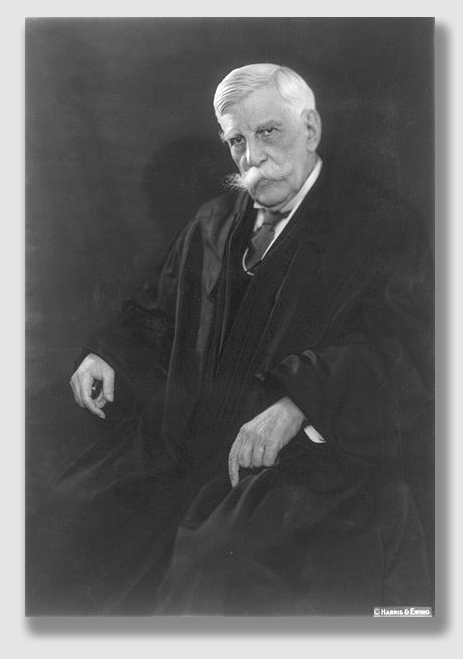
There’s something not right about letting a slippery character like Chung pull a fast one, cut down 50 of the neighbor’s trees for a better view, and not have to pay damages for it. But that’s the system for you. It reminds one of a quotation attributed to Oliver Wendell Holmes, Jr: “This is a court of law, young man, not a court of justice.”

Chung v. Park, 339 P.3d (Sup.Ct. Alaska, 2014). Landowner Rora Park sued her neighbor Christopher Chung for trespass, alleging that he cleared about 50 trees from her property without permission. The trial court found that the tree cutting did not diminish the property value and that there was no reason personal to the landowner for restoring the trees. But the trial judge nevertheless awarded damages equal to the cost of restoring 50 trees on the property.

Ordinarily, a landowner damaged by a trespass may recover either the loss in property value or reasonable restoration costs. But restoration costs are inappropriate if they are disproportionate to the loss in property value unless there is a reason personal to the landowner for restoring the land. We thus conclude that we must vacate this award.

Chung hired a company to build the foundation of his new house. As part of that project, the contractor agreed to clear trees and other vegetation from the lot. Aerial photographs indicate that some trees were removed from Park’s property near the border of Chung’s lot between August 2008 and the end of September 2008, and more trees were removed between 2008 and 2009. The trees appear to have been removed more or less directly behind the house built on Chung’s property. Timber debris, presumably from the cleared trees, was also discovered buried on Park’s property. An expert witness hired by Park estimated that 562 trees were cleared from about a third of an acre of Park’s property. He calculated that it would cost over $400,000 to restore the property to its former condition. But Chung’s expert witness testified that the market value of Park’s property was likely not affected by the removal of trees.

trespasstimber150126The trial court found Chung liable for the trees removed from Park’s property. Although the court acknowledged that Park had not proved that the tree cutting reduced the value of her property and found that Park had no reason personal for replacing the trees, it nevertheless concluded that “it would be reasonable both aesthetically and legally to award damages that would permit replacement of trees on that first portion of the lot that can be clearly shown to have been scraped clean as of September 27th, 2008.” The court, therefore, awarded Park the cost of replacing 50 trees, $23,500. Because the court found that Chung’s trespass was intentional, it awarded treble damages under AS 09.45.730.

Chung appealed.

Held: The Alaska Supreme Court vacated the damage award. It held that a party who is injured by an invasion of his property not totally destroying its value may choose as damages either the loss in value or reasonable restoration costs. But reasonable restoration costs are an inappropriate measure of damages when those costs are disproportionately larger than the diminution in the value of the land and there is no reason personal to the owner for restoring the land to its original condition. A reason personal is one that is “peculiar or special to the owner.” The Court said, “We require the landowner to demonstrate a reason personal because we believe it indicates circumstances where the owner holds property primarily for use rather than for sale and where the owner is likely to make repairs with the restoration costs award rather than to pocket the funds and enjoy a windfall.”

meditation160218

     Ms. Park tried to sell the court that the trees were her “personal healing spot.” New wave… or just trying to pump up her damages?

During the trial of this case, Park tried to establish a reason personal for replacing the trees that Chung had allegedly removed. She talked about having had cancer, and relying on her property as a “healing spot for me.” But later in the trial, she downplayed her visits to the property. As a result, the court found that Park had not established a reason personal for restoring her property.

According to the unrebutted testimony of Chung’s expert witness, the removal of trees from Park’s property did not appreciably affect the value of her property. The trial court accepted that testimony in its findings of fact. Therefore, the Supreme Court concluded that the damages the trial court awarded – $23,500 before trebling – were disproportionate to the diminution of the property value. The Court said that the trial court could award restoration damages only if it found that Park had a reason personal for restoring her property. Because it did not, the trial court’s award of compensatory damages that exceeded the diminution in the market value of Park’s property was not appropriate.

– Tom Root

TNLBGray140407

Case of the Day – Wednesday, November 13, 2024

I FEEL PRETTY, OH SO PRETTY …

Hawkins v. McGee - the case of the hairy hand

Hawkins v. McGee – the case of the hairy hand

There’s always a tension between the value that a lover of the land places on his or her trees and the price tag affixed to those same trees by the green-eyeshade crowd of financial experts testifying in some cold courtroom.

The general rule is that the measure of damages when trees are wrongfully cut should be the difference between the value of the property before the trees were removed and the value after the trees are taken down. Fans of the old case of the hairy hand (Hawkins v. McGee) from law school remember the general diminution of value concept. Notwithstanding this staple of first-year contracts class, courts in many states have carved out exceptions to the rule for situations just like today’s case.

The problem usually arises when only a relatively few trees of limited commercial value are removed or destroyed. In today’s case, an Episcopal Church lost 22 small trees when a contractor dumped too much fill dirt – taken from a road construction project – around their bases. The Church proved in court that replacing the trees — a couple cherry trees and a score of red oaks — would cost just over $17,000. But the trial court threw the case out because it believed that the replacement costs weren’t relevant. Rather, the trial court said, the Church was obligated to prove how much less its land was worth with the trees gone.

The "tree volcano" ... pile dirt around the base, and suffocate the sapling.

The “tree volcano” … pile dirt around the base, and suffocate the sapling. The Church lost 22 trees this way.

Holy birch bark! The problem was that the worth of the property hadn’t fallen much, it being close to a road and of limited use (there’s not that much of a market for church properties). But the Church didn’t want the diminution in property’s value for its collection plate: it wanted its trees back. The Minnesota Supreme Court had mercy on the Church, holding that where the trees served a function that was primarily aesthetic, replacement cost was a fair calculation.

Sometimes justice can’t be done by using the cold, analytical diminution-of-value approach. Occasionally, the wronged owner just plain likes the trees that had been taken, and who’s to say that because the loss may be measured psychologically rather than economically, the damaged party shouldn’t be compensated. We always thought that in such cases, the wrongdoer should be held to lose much of his or her moral standing to complain about how injured the injured party is. In this case, the Court said, that the owner’s enjoyment of the trees might not be quantifiable in a real-estate-value analysis just didn’t matter. (The second case we studied in law school, Peevyhouse v. Garland Coal & Mining Co., has always illustrated the mischief that can be done when a court ignores the aesthetic expectations of the wronged party).

The decision is necessary in the world of tree law because otherwise, too many cases would founder on the rocks of damages: too many malefactors could cut down too many trees, and the likely penalties, even with treble damages available, would not deter the conduct.

Rector, Wardens & Vestry of St. Christopher’s Episcopal Church v. C.S. McCrossan, Inc., 306 Minn. 143, 235 N.W.2d 609 (Sup.Ct. Minn. 1975). When the Minnesota Department of Highways took about 8/10ths of an acre from St. Christopher’s to enlarge the intersection, the church lost its existing access and part of its parking area. The Rector hired C.S. McCrossan to construct a new parking space and access road.

irrelevant150123A grove of trees was located at the north end of the lot. In the process of grading, McCrossan dumped fill around the base of the trees, which the church argued caused the trees — two black cherry trees and twenty red oaks — to suffocate and die. The church’s expert testified that because of the variety, size, and condition of the trees, they had a total value of $17,267.

The church asserted that the grove of trees not only acted to screen the area from heavy traffic on two sides but also gave the area a natural, pleasing, aesthetic, wooded atmosphere. The trial court directed a verdict for C.S. McCrossan on the ground that the church failed to prove damage based on the diminution in value of the real estate.

The church appealed.

Held: The decision was reversed. The Minnesota Supreme Court ruled that the proper measure of damages for negligence in suffocating the trees was the replacement cost of trees rather than merely the loss of value of the real estate, notwithstanding the inability of the church to prove that the destruction of trees diminished the value of the property as a whole. The replacement cost of trees that have an aesthetic value to the owner as ornamental and shade trees or for purposes of screening sound and providing privacy may be considered in determining damage incurred from the destruction of the trees to the extent that the cost is reasonable and practical.

Although the evidence may be presented in rebuttal that the effect on the value of land as a whole is minimal, it is for the jury to balance elements of damage in arriving at a just and reasonable award.

– Tom Root

TNLBGray140407

Case of the Day – Monday, July 1, 2024

I CHANGED MY MIND… I GUESS

Doug Van Dyne had big plans for getting folks back to nature. He wanted to build a nature trail along a ravine that split his property and that of his waffling neighbor, Eunice North. People could enjoy the birds, the babbling brook, the scent of pine… that kind of thing.

If you ever wonder whether it’s a good idea to get agreements in writing, Doug’s $70,000 mistake will settle that question for you. Because Doug’s nature path would meander a bit onto Eunice’s side of the ravine, he told her about his plans for the trail. Eunice, who admitted that she really had no idea what Doug was talking about, said she just “shrugged my shoulders” and replied that “I guess it would be okay.”

To Doug, that was like the green flag at Indy.  But little did he know that Eunice promptly began to fret about her confused acquiescence. She had trouble sleeping for her worry, and finally asked a friend about the plan. Her friend told Eunice the trail idea was a mistake. Armed with this advice, Eunice said, she reneged. She claimed she told Doug that she didn’t want him around.

“No probalo,” Doug – who had no intention at all of honoring Eunice’s change-of-heart – allegedly responded. Regardless of his actual intentions, Doug promised Eunice that he “would go to a different plan.”

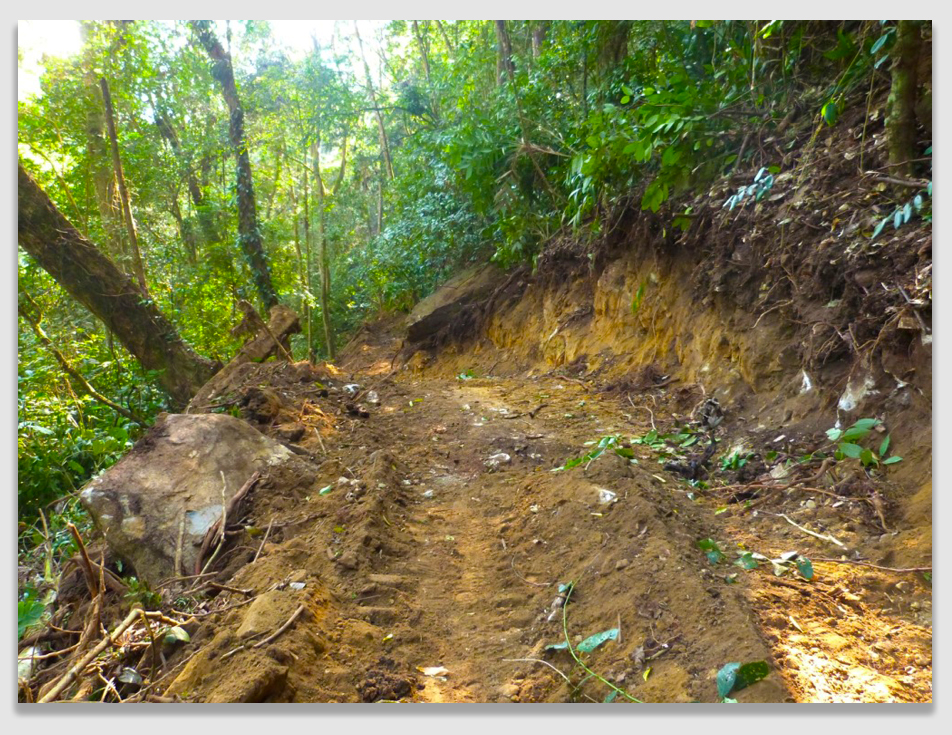
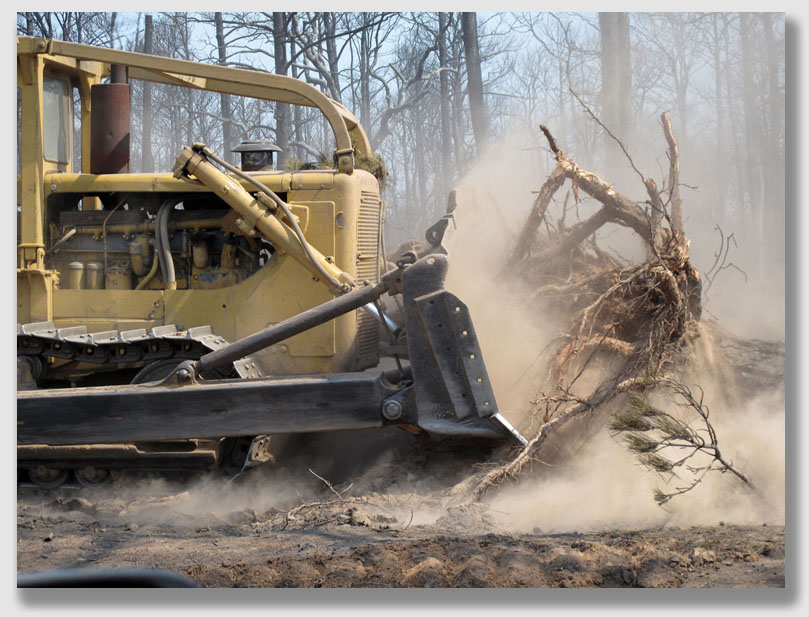
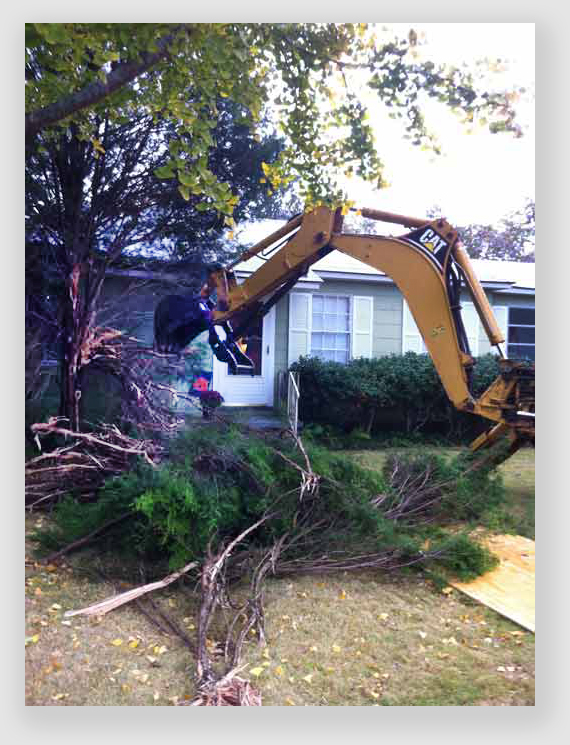
That different plan seems to have involved having his contractor run the bulldozers at full throttle instead of half throttle. By the time the diesel fumes cleared, 20 of Eunice’s trees had been ground under Caterpillar treads and the trail encroached on her land.

Eunice sued Doug for trespass, loss of lateral support, and loss of trees. The jury awarded Eunice $50,000 on the trespass and lateral support claims and $20,100 in treble damages on the loss-of-tree claim. It mattered little that Doug and the contractor both told a different story, the bulldozer operator testifying that Eunice had agreed to Doug’s plan. The jury believed Eunice.

Juries do that, often buying one side of the story and not the other, many times against common sense. We don’t know that that happened here, but it sure did not help Doug that he had not bothered to have the property boundaries surveyed before the ‘dozers started dozing.

Much of Doug’s appeal focused on damages. The jury agreed that Doug’s dozing had made Eunice’s side of the ravine unstable. Eunice’s expert testified that there were three ways to repair the damage, but none of the tree would restore the ravine to its pristine state. Doug argued that said because the land could not be repaired to the way it was before the bulldozers rolled through, then the diminution of the fair market value of the ravine was all that matters.

Not so, the court said. The law does not require that the evidence show that the damage can be repaired so as to make the property as good as new. While it is a general rule of Iowa law that the cost to repair property is the fair and reasonable cost of repair not to exceed the value of the property immediately prior to the loss or damage, all Eunice was required to do was to establish a fair and reasonable cost to fix things up in order to arrest further deterioration and make the place as good as it can be made. In this case, Eunice showed that she had three means of stabilizing the steep bank after Doug’s earth-moving frolic, and only one of those made any sense. She established the cost of that repair, and the value of the property before the damage.

Because the damages did not exceed her expert’s $129,000 repair price tag, it was clear the jury fulfilled its function in weighing the evidence.

Next time, Doug, get the landowner’s OK in writing. Call a surveyor. Stake the property boundaries. Surely that’s cheaper than $71,000.

North v. Van Dyne, Case No. 16-0165 (Ct.App. Iowa, Sept. 13, 2017). Douglas Van Dyke hired Heck’s Dozer, Inc., to build a trail along a ravine between his property and adjacent land owned by Eunice North. Twenty of North’s trees were removed during the trail’s construction, and a portion of the completed trail encroached upon North’s property. Doug said Eunice gave him permission. Eunice said she initially sort of equivocated, but later told Doug in no uncertain terms that he was to stay off her land.

Doug said he would do so, but he never had the land surveyed or staked, and his guess as to the location of the property line was by guess and by gosh. Doug’s contractor said he met with Eunice, and she approved the plans. Eunice said she had never met the contractor.

Eunice testified that after she told Doug to steer clear of her property, she heard a “‘loud commotion.’ Standing on her deck, she saw ‘two pieces of heavy equipment’ below and ‘trees… flying.’ She decided not to go into the ravine to check on the commotion because she was ‘afraid’ she would get ‘hit with something,’ and she had physical difficulties getting ‘down there.’ Suspicious of an encroachment on her land, she commissioned a survey. The surveyor confirmed her fears.”

Eunice sued Doug for trespass, loss of lateral support, and loss of trees. The jury awarded her damages of $50,000 on the trespass and lateral support claims and $20,100 in treble damages on the loss-of-tree claim, Doug appealed.

Held: Eunice amply proved that Doug should pay treble damages under Iowa Code § 658.4 (2013). The statute requires the damage to trees be committed willfully or without reasonable excuse.” The term “willfully” has been characterized as an intentional and deliberate act without regard to the rights of others. Here, the Court of Appeals said, a reasonable juror could have believed that Eunice said “no” the jurors could have found Van Dyke “acted… without reasonable excuse.”

The jury additionally could have found that Doug’s failure to commission a survey before building the trail denied him any reasonable excuse for the trespass. The testimony established that Doug relied on an “old fence,” “old posts,” a “shed,” and a “roofline” to gauge the boundary.

The measure of damages is the cost of repair, as long as that cost does not exceed the value of the property prior to the damage. Doug complained that because Eunice’s expert testified only that the continued deterioration of the property could be stopped by stabilizing the steep bank, she was not able to show that the property could be repaired to its original state.

The Court of Appeals held that nothing requires that the repair estimate be enough to restore the land to its state before the damage. As long as Eunice provided evidence of the fair market value of the land before and after the damage, and a repair cost that is less than the value of the place before the damage – which she did – she met her obligation. Here, the damages awarded by the jury were higher than Doug’s estimate of $2,500.00 to fix it, but well below Eunice’s estimate of $127,000. Plus, the jury’s $50,000 award for trespass and lateral support was well below Eunice’s evidence that the land was worth $250,000.

The damage to the trees was assessed separately, with the value of the lost timber found to be $6,700, trebled to $20,100.

– Tom Root

TNLBGray140407

Case of the Day – Friday, June 14, 2024

I WANT MY TREES BACK…

A long, long time ago, before I was trained to think like a lawyer, I was a neophyte law student and still thinking like a layman, that is to say, “normally.” New law students are first exposed to contract law. Digging into Basic Contract Lawthat boring-looking brown tome that was chock-a-block with fascinating cases, I very quickly ran into Peevyhouse v. Garland Coal Co. (on the second day of class, I recall).

Farmer Peevyhouse signed a deal with Garland Coal Co., to strip mine his land. The land was hilly, and Farmer P thought the strip mining was the ideal time to fix that. So he got Garland Coal to agree to level the land when the company was done strip mining.

Garland Coal left a lot of hills behind…

When the coal was gone, so was Garland Coal, leaving the farm just as hilly as it was before the mining. Farmer Peevyhouse sued for breach of contract. He won, of course, but when it came to figuring damages, the court noted that the diminution in value of the farm because it was still hilly (as opposed to flat) was only about $5,000. But if Garland Coal were required to come back to keep its promise to level the place, Garland Coal would have to spend $25,000 to pull it off. The higher award would constitute economic waste, the court held, and the court was not about to be wasteful with the coal company’s money.

Back then, as a tyro-at-law, I couldn’t understand the decision. Who cared if the damages were wasteful, or if the market value of the farm was only slightly less? To me, Farmer Peevyhouse made a deal, Garland Coal agreed to the deal, and – inasmuch as Garland got all the coal it bargained for – Farmer P should get what he bargained for as well, economics be damned. The economics did not matter to me nearly as much as did the reasonable expectations of the parties.

Now, with many years of practice under my belt, I tend to think like a lawyer. But Peevyhouse still makes no sense to me. The farmer would not have let Garland Coal strip his land without the promise to level the hills. So the promise was material to the farmer. Why reward Garland Coal simply because Mr. Peevyhouse’s legitimate desires might not make great economic sense?

In The Princess Bride, Inigo Montoya ends his years-long quest to avenge his father’s untimely death in a fight to the death with the six-fingered man. At last, Montoya has the tip of his sword at Count Rugan’s throat:

Inigo Montoya:   Offer me money.
Count Rugen:     Yes!
Inigo Montoya:   Power, too, promise me that.
Count Rugen:     All that I have and more. Please…
Inigo Montoya:   Offer me anything I ask for.
Count Rugen:     Anything you want…
[Rugen knocks Inigo’s sword aside and lunges. But Inigo traps his arm and aims his sword at Rugen’s stomach]
Inigo Montoya:   I want my father back, you son of a bitch!

That, on a less dramatic level, was Paul Harder’s complaint. As we read in yesterday’s installment on this case, while Paul was gone from Alaska, Joel and Darlene Wiersum clear-cut his land without permission in order to improve their view. In seeking money to restore his property – a sum that came to something like four times the fair market value of his land before the clear-cutting – Paul told the jury he “didn’t want money,” but rather he only wanted his trees back. Paul, therefore, asked for damages to restore the property by replanting the forested area.

Count Rugen could give Inigo money and power and land. But he could not give Inigo what he wanted the most, a desire that was heartfelt if utterly infeasible (and rather uneconomical). In that regard, Inigo Montoya and Farmer Peevyhouse had something in common. The question is whether they both had something in common with Paul Harder. We’ll find that out now…

Wiersum v. Harder, 316 P.3d 557 (Alaska, 2013). Paul Harder owned a pretty nice piece of Alaskan wilderness near Kodiak. He built a cabin on it and lived happily for quite a stretch. But when wanderlust set in, he subdivided the land, sold the plot with the cabin on it to his sister Lisa, and kept one for himself, and left for a 15-year sojourn in warmer climes.

Paul lived in Hawaii but returned to visit his plot of land occasionally and enjoy the hunting, fishing and recreation opportunities it afforded.

About nine years after Paul went south, Joel and Darlene Wiersum bought some land at the top of a hill, adjacent to the Harder tracts. Looking down the hill, they could see Lisa’s cabin several hundred yards below, and incorrectly assumed she owned it all. One day, Darlene called Lisa at work and asked whether they could cut down some trees on Lisa’s property that Darlene thought might “come down with the wind” and hit their home. Lisa gave them permission because she thought the removal of some trees would “let a little more light in” to the woods.

Darlene and Joel did not just thin out a few hazard trees. Instead, they clear-cut the entire hill, out to almost 400 feet beyond their property line. When Lisa returned home to find that bare naked hillside, she told the Wiersums not to cut any more trees.

When Paul returned a couple of years later, he discovered the clear-cut hillside (which really was on his plot, not that of his sister), and promptly sued the Wiersums for timber trespass. A jury him $161,000 in compensatory restoration damages, which was trebled under Alaska statute AS 09.45.730.

The Wiersums appealed.

Held: The jury’s restoration damage award was reversed and sent back for retrial.

A party who is injured by an invasion of his or her property that does not totally destroy its value may choose as damages either the loss in property value or “reasonable restoration costs.” To determine whether an award of restoration costs is appropriate, Alaska follows the Restatement (Second) of Torts § 929. The Restatement says if a plaintiff is entitled to damages for harm to land resulting from a trespass that does not amount to a total destruction of value, the damages include either (1) the difference between the value of the land before the harm and the value after the harm, or—if the plaintiff so chooses—the cost of restoration that may be reasonably incurred. Damages are measured by the difference between the value of the land before and after the harm only if the cost of restoring the land to its original condition is disproportionate to the loss in the value of the land caused by the trespass “unless there is a reason personal to the owner for restoring the original condition.”

That’s the law for you. A layman untrained in legal niceties would say “a personal reason,” but the legal phrase is a “reason personal.” The distinction is intended to convince you that the law must be complex, and thus you ought to pay that “bill inflated” your lawyer hands you without a whimper.

A “reason personal,” the Court said, is a reason peculiar or special to the owner, where “the owner holds property primarily for use rather than for sale and where the owner is likely to make repairs with the restoration costs award rather than to pocket the funds and enjoy a windfall.” For example, the Court in the past had found a “reason personal” where the damaged property was used by the plaintiff as “a showplace in connection with his nursery business” and, in another case, where the property enjoyed “unique views… abundant trees, and the unusual juxtaposition of the trees, the cabin, and the views,” and its owners, who planned to retire on the property, had testified that “other properties in the area were not comparable.”

To find that a plaintiff had a “reason personal” for restoration, where those costs were much higher than the loss of value to the land, a court should look for evidence showing “a reasonable likelihood that the trees would be restored.”

Paul showed at trial that he held on to the Monashka property for 34 years and that he intended to build a house and live on it once his son graduated from college because “it’s a very beautiful piece of property.” A real estate agent testified that he approached Paul about selling the land, but Paul had refused. Paul testified he “didn’t want money,” but rather he only “wanted his trees back” and was asking for damages to restore the property by replanting the forested area. He said he enjoyed spending time with his children on the property, but that after the trees were cut down, the property “looked totally different,” full of salmonberry bushes… whereas it was just like thick moss before,” and he reported that he had not heard any ravens there since the trees were cut.

The Wiersums argued the award of restoration damages was objectively unreasonable because the total market value of Paul’s property before the timber trespass was only $40,000. A damage award of $161,000, they contended, was disproportionate to the property’s diminution. Besides, peripatetic Paul’s “minimal use of and contribution to the land’s special value would at most justify a marginal award of restoration costs.”

The Court noted it had found in the nursery case that restoration damages were not “grossly disproportionate” where the owner had paid $4,000 per acre for the property, but the jury awarded $12,550 for restoring a quarter-acre of land. Because the principal value of the property stemmed from the creek running through it, and the owner intended to use the property to create “a showplace in connection with his nursery business,” the cost of restoration, although disproportionate to value, was reasonable. Nevertheless, the Court had previously cautioned that “restoration costs exceeding diminished market value may be awarded only to the extent such added costs are objectively reasonable in light of the ‘reason personal’ and in light of the diminution in value.”

The “reason personal” may be a non-commercial one based on the property’s uniqueness, but the restoration award must be limited to the cost that has been or may be reasonably incurred.  The reason for this rule, the Court said, is “to reduce the economic waste that occurs when a party incurs repair costs in excess of the diminished value of the property.” The application of this principle “must ensure that an award of restoration damages does not confer a windfall upon a landowner.” Where proposed replacement costs are excessive in relation to the damage caused by the trespass, “the achievement of a reasonable approximation of the land’s former condition may involve something less than substantially identical restoration… It may be more appropriate to award costs for the planting of saplings, or a few mature trees, or underbrush to prevent erosion and achieve a lesser but, over time, reasonable aesthetic restoration.”

Applying these principles to Paul’s denuded hillside, the Court held that the award of $161,000 in restoration costs was objectively unreasonable in light of the $40,000 pre-trespass total value of the property. Paul’s “reason personal” for restoration, and the absence of any proof of the extent of the decrease in the value of his property, made it more appropriate to award costs “for the planting of saplings or a few mature trees or underbrush to prevent erosion and achieve a lesser but, over time, reasonable aesthetic restoration.” The Court’s conclusion was based on its determination that the “property could be reasonably restored by replacing at least some of the mature Sitka spruce with saplings or smaller trees and that because the property’s large trees were growing in a forested environment where the root zones were intertwined” it was not possible to ” replace that exact tree in that environment.”

The jury must base its award on a finding that the restoration costs were objectively reasonable in light of the value of Paul’s land, the loss of value due to the Wiersums’ trespass, and his “reason personal.” Here, the Court said, no reasonable juror would award restoration costs totaling more than four times the full fair market value of the property before the trespass. Thus, the Court sent the case back for a new trial on damages.

And what’s my take on this case, based upon my decades of thinking like a lawyer? I’m with Inigo Montoya and Paul Harder: “I want my trees back, you son-of-a-bitch,” and economics be damned.

This is a bad decision.

– Tom Root

TNLBGray

Case of the Day – Monday, May 13, 2024

MILLION-DOLLAR BABY

I’ll tell you where the real money is in litigation. It’s not the guy who walks into the lawyer’s office with a tale of woe at the hands of some big, faceless, loaded corporation. It’s not the guy who was busted for pot, and he bonded out on Friday but they didn’t release him until Monday.

It’s right here: I should have a nickel for every would-be client who ever asked me to take a case on contingent fee, because they were sure to get beaucoup bucks in the end with an outraged jury handed them millions in punitive damages for a fender-bender, or a sharp-tongued government clerk, or a badly-written newspaper story, or whatever the injury du jour might be. Total up my nickels, and I ought to be sitting on the veranda of my Caribbean beachfront mansion writing this right now.

Alas, I am at my kitchen table in Ohio. It’s not quite the same…

Few would-be litigants really appreciate that punitive damages, also called exemplary damages, are damages awarded by a jury to punish a defendant for some terrible conduct, because, after all, it’s a civil action, and you can’t throw the malefactors in jail. But contrary to legend, punitive damages have to be tied to some actual harm.

In today’s case, some junior leasing agent for a billboard company (sorry, that’s not the proper term – these days, it’s ‘OOH’ or ‘out-of-home’ advertising) got a little too enthusiastic in clearing the view for the billboard, and when the dust settled, some of the trees that had been felled belonged to the neighbor of the guy who had leased space for the billboard (now there’s someone who should be locked up, the guy who let that eyesore get erected). The leasing agent was sloppy, careless even, perhaps – dare we say? – reckless.

The jury found that the neighbors were harmed in an amount of about $32,000. But it added to that figure an eye-popping $2 million in punitive damages. That was too much for the trial judge, who tried to get the farmer to accept a remittitur, that is, settle for a paltry $550,000. The farmer wouldn’t do it, so the court ordered a new trial. The farmer appealed.

All of $32,000 in damage, and a cool half mil on top of it? Farmer Blust was the living embodiment of the aphorism, “Pigs get fat, but hogs get slaughtered.”

Blust v. Lamar Advertising Company, 157 Ohio App.3d 787 (Ct.App. Montgomery Co., 2004). A Lamar leasing agent signed up Jim Weber in September 1998, leasing a small piece of Jim’s farmland near the property line between his farm and his neighbor, the Blust farm, for a billboard. The two farms were separated by an old wire fence that was largely concealed amid dense brush, vines, and trees. Because Lamar planned to erect its billboard near the tree line and undergrowth separating the two farms, it hired Woody’s Tree Medics to remove some of the trees and vegetation from Jim’s property.

A Woody’s work crew entered the Blust property and cut down 34 trees, 17 of which were more than three inches in diameter. At trial, a jury found Lamar liable in tort for trespassing and removing the trees without permission, and awarded the Blusts compensatory damages of $32,000 and punitive damages of $2.2 million. The trial court denied Lamar’s motion for judgment notwithstanding the verdict on the punitive damages award but indicated that it would grant a new trial on all issues, including liability, unless the Blusts accepted remittitur, that is, a reduction, of the punitive damages award to $550,000.00, with half of that amount going to a nonprofit nature conservancy. The Blusts rejected remittitur, and the trial court ordered a new trial.

The Blusts appealed, challenging the trial court’s holding that the punitive damages verdict was excessive and its decision to grant a new trial on all issues. 

Held: The Court held that the Blusts were entitled to punitive damages, but the award was excessive. Thus, the trial court did not err in ordering a new trial, limited how much should be awarded in punitives.

In order to recover punitive damages, the Blusts had to show that Lamar acted with “actual malice.” Actual malice, the Court said, is a state of mind under which a person’s conduct is characterized either by ill will or by such a conscious disregard for the rights and safety of other persons that its conduct is very likely to cause substantial harm.

The Blusts argued that Lamar’s act of directing their trees to be cut constituted a conscious disregard for their rights that had a great probability of causing them substantial harm. The Court agreed, finding substantial evidence in the record that Lamar’s agent consciously disregarded the Blusts’ property rights by ordering the cutting of trees on their property. Jim Weber told Lamar’s agent about where the property line fell and told her to follow the farm fence as a guide. After the cutting began, a friend of the Blusts appeared at the site to tell the Woody’s crew that it was cutting trees on the wrong property. The Blusts’ tenant farmer, Ted Eby, saw workers clearing trees from the Blusts’ property, and he spoke to the Woody’s crew and the agent, telling them they were cutting the Blusts’ trees.

Despite all of these warnings, the agent told the Woody’s workers to keep the saws humming. A reasonable juror, the appeals court said, could find that Lamar consciously disregarded the Blusts’ property rights.

A closer question, the Court observed, is whether Lamar’s agent was aware that having the Blusts’ trees cut carried with it a great probability of causing substantial harm. “We harbor no doubt,” the Court said, “that clearing the trees had a great probability of causing some harm. Indeed, removing the trees was absolutely certain to cause harm to the extent that the Blusts lost their trees. The crucial issue on appeal is whether the agent knew that this loss of the trees had a great probability of resulting in substantial harm to the Blusts, or more specifically, whether reasonable minds could differ on this issue.”

The Court said “substantial” means “major, or real importance, of great significance, not trifling or small.” Here, the “harm” was obvious: it was the loss of the Blusts’ trees. But in order to determine whether this harm was “substantial,” it was necessary to assign some measure of value to the trees. The Blusts said that someday, they might divide a portion of the farmland into residential plots, and the absence of trees would harm the value of the plots. The Blusts’ expert testified that the trees’ loss would diminish the fair market value of the subdivided property by $51,600.

The Blusts also argued that they hoped to sell the wood from three wild walnut trees someday for veneer. What’s more, the Blusts presented testimony that it would cost $40,566 to purchase and replant all of the trees or $24,335 to replant 11 of the larger trees. Lamar argued, on the other hand, that the stumpage or firewood value of the timber was only $105. Lamar also presented expert testimony that removal of the trees may have caused the Blusts’ property value to decline by at most one percent, or $3,870.

The Court held that most of the measures of damage could be characterized as “substantial.” But the record contained no evidence that Lamar’s agent knew the Blusts might subdivide their farm for residential purposes. The record also contained nothing to indicate that the agent knew of any plans to sell the walnut trees for veneer. Likewise, the agent did not know that the Blusts – who did not live on the parcel – would ever want to replace some or all of the trees. Thus, the agent could not have known that cutting the trees would harm the future value of the land as subdivided plots, frustrate the prospects of marketing veneer, or even just lead to $25,000 – $40,000 replacement costs.

However, fair market value is a different story. Even Lamar admitted that the cutting may have reduced the Blusts’ property value by $3,870. “A reasonable juror,” the Court said, “could find that a loss of this size qualifies as substantial harm and not a trivial loss.” A decline in property value because of losing trees is a “typical measure of the harm, and it is entirely predictable.”

When a verdict is influenced by passion or prejudice, the Court held, a trial court must order a new trial. However, when a verdict is merely excessive, but not influenced by passion or prejudice, a trial court must offer the plaintiff a choice between remittitur or a new trial. If the plaintiff rejects remittitur, a new trial must be ordered.

The Court agreed that the Blusts’ punitive damages award was grossly excessive under constitutional standards, and had to be set aside. Therefore, the judge properly directed the Blusts to choose remittitur or a new trial. However, the only issue tainted by error was the jury’s punitive damages award. The Blusts should not have been required to place in jeopardy their compensatory damages award or the jury’s determination that some punitive damages are warranted by undergoing a new trial on those issues.

The case was sent back to the trial court for a new calculation of punitive damages.

– Tom Root

TNLBGray