Case of the Day – Thursday, April 2, 2026

COLORADO SUPREME COURT BRINGS FORTH A MOUSE

Tree law fans (and we consider ourselves to be fans) couldn’t wait for the Colorado Supreme Court to decide Love v. Klosky, and do away with the clunky old Rhodig v. Keck rule. The Rodig rule holds that a tree that has grown up to be a boundary-line tree is not owned by both property owners unless the neighbors claiming part ownership can jump through hoops to prove they (or their predecessors-in-interest) helped plant or nurture the tree, or treated it as the boundary line. When the Court finally acted six years ago, it brought forth a silly mouse of a rule that tries to save Rhodig by “clarifying” it in the most meaningless way possible.

The story bears repeating.
In the rest of the civilized world (sorry, Minnesota, not you), a tree that straddles a boundary line is owned by both property owners as tenants-in-common. One owner can’t mess with the tree without the other one’s permission. As 1970s television cooking personality Chef Tell would have said, “Very simple, very easy.” No messy litigation, no one keeping tree-feeding logs, garden shop receipts, or detailed journals of joint plantings of years gone by. Just a simple, binary rule: If the tree crosses the property line, both landowners have an interest. If it does not cross the line, only one does.

Unfortunately, the Colorado Supreme Court’s love affair with stare decisis – the legal doctrine that holdings of prior cases should govern the outcome of present and future cases – has led it to a tortured defense of Rhodig. Everyone has it wrong, the Court said: Rhodig doesn’t apply to all boundary trees, just to trees that started growing on one side of the property line and grew across the line to encroach on the other property.

It is more than a little ironic that a cartoon set in Colorado, South Park, once featured the Chewbacca defense, spun out by a Johnny Cochrane caricature. As Johnny put it in his closing, “That does not make sense.”

Johnny could have been talking about this decision. We all learned in 7th-grade math that a line segment stretches between points A and B and has no thickness. Unless that tiny little sprig of an oak tree in your backyard has the dimensions of, say, Flat Stanley, the odds that it will not start growing on one side of the boundary or the other approach zero. And 10, 20 or 50 years down the road, proving that the tree began its arboreal life straddling a boundary line of no thickness will require legal and arborist legerdemain that will make the Chewbacca defense sound like a Supreme Court argument.

Love v. Klosky ought to start a real cottage industry for Colorado lawyers and arborists, proving where young maple or catalpa shoots began their lives. The only trees not subject to this nonsensical rule would be those old enough to have been standing in the 19th century when Colorado was first platted.

The Colorado Supreme Court had a chance to clean things up by running Rhodig through the tree chipper of legal history. Instead, it labored mightily… and brought forth a mouse.

Love v. Klosky, Case No. 16SC815, 2018 CO, 413 P.3d 1267 (Supreme Court Colo., 2018). Carole Bishop and Mark Klosky (the Kloskys), and Shannon and Keith Love (the Loves) own adjacent parcels of land in Denver’s Washington Park neighborhood. A 70–foot-tall catalpa tree towers over two adjacent properties. At the base of its trunk, the tree sits roughly three-quarters on the Kloskys’ property and one-quarter on the Loves’ property. The tree began growing on the lots well before the parties moved in, and no one knows who (if anyone) planted it. Whatever its pedigree, the tree sheds leaves, seed pods, and branches on both properties.

Catalpa tree

Unhappy with the debris, the Kloskys wanted to cut down the tree. The Loves unsuccessfully tried to convince their neighbors not to do so. When persuasion failed, they sued. The trial court ruled for the Kloskys, holding – consistent with the Colorado rule enunciated in Rhodig v. Keck – that unless the Loves could prove that they or their predecessors had helped in planting or maintaining the tree, or that they and the Kloskys’ predecessors had treated the catalpa tree as the boundary, the tree belonged solely to the Kloskys.

On appeal, the Loves argued that Rhodig should be overturned, but the court held it was bound by Rhodig, which it interpreted to mean that “boundary trees are held as common property only if the landowners jointly planted, jointly cared for, or jointly treated the trees as a partition between the properties.” Two of the appellate judges, however, called on the Colorado Supreme Court to overturn Rhodig and instead require that, whenever a tree straddles two parcels, the adjacent property owners jointly own the tree as tenants in common.

The Loves asked the Colorado Supreme Court to review the case.

Held: The Supreme Court, refusing to overturn Rhodig v. Keck, held that the Kloskys could remove the tree because it remained the sole property of the owner of the land where the tree first grew, unless the tree was jointly planted, jointly cared for, or treated as a partition between the two properties. Because the Loves could not prove any shared property interest in the tree, they could not prevent the Kloskys from removing the tree.

The Loves argued that Rhodig should be overruled and that the Court should automatically make them tenants in common with the Kloskys for no reason other than that the catalpa tree had crossed the property line. The Kloskys, on the other hand, argued that Rhodig holds that even when a tree crosses over a boundary line, it remains the property of the owner of the land on which the tree originally grew unless one of the joint-action situations enumerated in Rhodig applies.

The Court said there was no sound legal basis for abandoning Rhodig, surmising that “our ambiguous precedent caused the lower courts to conflate the common law rule for true boundary-line cases and the test for encroachment trees.” Instead, it clarified that Rhodig only governs “encroachment trees,” trees that begin life entirely on one property only to migrate partially to another. Under Rhodig, a landowner may remove such a tree without first securing his neighbor’s approval, unless the landowners jointly planted, cared for, or treated the trees as boundary markers. The Court said that Rhodig does not represent some weird minority rule on boundary trees. Indeed, the Court lectured, the common law rule regarding true boundary-line-tree cases – where the tree sits squarely on a property boundary with no evidence of migration – is not implicated by Rhodig. In such a case, a tree standing on the division line between adjoining landowners is generally considered the common property of both landowners, even in Colorado. 

Thus, the Court ruled that Rhodig applied only when a tree originally growing on one property grew and encroached on another. Having clarified what Rhodig means, the Court concluded it was correctly decided and remains sound. “And, we see no conditions that have changed to make the above reasoning any less compelling today than when we decided Rhodig.”
In this case, the Court held that the Loves did not sufficiently show other circumstances that could create joint ownership of the encroaching tree. “Just as the Rhodigs had no property interest in the trees that had encroached onto their land because there was not sufficient evidence the parties jointly planted the trees, jointly cared for the trees, or intended for the trees to serve as a boundary,” the Court wrote, “here, the Loves have no property interest in the tree that has encroached onto their land because they have not shown such joint activity implying shared ownership.”

– Tom Root

TNLBGray140407

Case of the Day – Monday, March 9, 2026

WE’VE GOT YOUR BACK

We’re not really sure what happened here, only what one neighbor said happened, and what the other denied. But that’s all right, because today’s case is not about who cut down whose trees, but instead whether an insurance company had to step into the dispute to defend Shelly Albert when neighbor Henri Baccouche said she done him wrong.

Henri said Shelly trespassed on his property, built a fence across some of his land, and severely damaged nine olive trees in the process. So his complaint was what we call trespass to trees. Shelly argued that she was obligated to trim the trees because of fire regulations; she had been trimming them for years without Henri complaining, and the trees were boundary trees anyway, so she had a right to trim them.

We all know what can happen when we lose a lawsuit. But the pain in the wallet begins way before that, with the cost of attorneys, experts, filing fees and litigation expenses. That’s a good reason for insurance. Shelley had some, a homeowner’s policy bought from Mid-Century Insurance Company (so named, perhaps, because the middle of the last century may have been the last time the company ever paid a claim).

We’re just kidding, of course. Mid-Century couldn’t wait to start paying for lawyers and depositions and settlements and the like, all on Shelley’s behalf.

Wait. We’re kidding about that, too. Shelley notified Mid-Century as soon as she was sued. She demanded Mid-Century mount a defense for her, but Mid-C said “no dice.” The insurance policy covered accidental occurrences, the Company said, and Shelley, by her own admission, had deliberately hacked up the olive trees.

Shelley was outraged. She fumed that Henri’s “entire complaint is false [and] outrageous… the trespass claim is ridiculous… in those boundary trees were enclosed by me, prior to any survey being done, based on a good faith belief that property encompassing the trees was mine… no intentional tort will lie.” She contended Mid-Century’s decision to deny her claim was “clearly error.”

Shelley’s insurance policy covered her from injury due to accidents. Shelley’s problem, of course, was that she said the accident was that the trees might really be Henri’s and not shared, and that she and her guys might have trimmed more than they were entitled to. But they did not mean to. Fact is, however, the “accident” had to be acidental conduct, not the unintended accidental result of conduct. If Shelley had run over the trees with a bulldozer while she was digging a hole for a pool, that would be an accident. But “accident” is like “intent” in trespass. You don’t have to intend to walk onto someone else’s land. You just have to intend to step where you step. If that land belongs to someone else – whether you knew it or not – you’ve trespassed.

Shelley intended to prune the trees. It was no accident, regardless of whether she was right in believing she could do so. Thus, the insurance company could not possibly be liable, and it did not have to defend her.

So Shelley lost big (and spent a lot on legal fees) before ever squaring off against Henri. Lesson? It might make good reading some evening (when nothing good is streaming on Netflix) to read your homeowner’s insurance policy. Sometimes, it can be scarier than a slasher movie.

Albert v. Mid-Century Insurance Co., 236 Cal.App.4th 1281 (Ct.App. 2nd Dist., 2015). Shelley Albert had a homeowners insurance policy with Mid-Century Insurance Co., which covered “property damage resulting from an occurrence,” including paying the costs of defense “against any suit seeking damages covered under this section…” The policy defined an “occurrence” as “an accident, including exposure to conditions, which occurs during the policy period, and which results in… property damage… during the policy period,” but specifically excluded damages resulting from “an intentional act by or at the direction of the insured.”

Oh, what peace of mind Shelley must have had! At least until she was sued by her neighbor, Henri Baccouche, for damage Shelley was alleged to have caused to his property when she erected an encroaching fence and pruned nine mature olive trees on his property. Shelley called on Mid-Century to provide a defense, but the insurance carrier refused, saying it was not liable under any stretch of the policy. Mid-Century said Henri’s claims “do not meet the definition of occurrence resulting in bodily injury or property damage as defined by your policy,” because protection against Henri’s claims was barred by the policy’s exemption for intentional acts.

Shelley sued Mid-Century, claiming breach of contract and breach of the implied covenant of good faith and fair dealing. The defendant filed a motion for summary judgment. The trial court granted judgment to Mid-Century, holding that Shelley’s conduct in cutting Henri’s olive trees was intentionally undertaken, and there was no evidence whatsoever that the trees were injured in some accident.

Shelley appealed.

Held: Mid-Century had no duty to defend Shelley. The policy was quite clear that it covered property damage resulting from an “occurrence,” and an “occurrence” was an accident. “Accident” in the coverage clause of a liability policy refers to the conduct of the insured for which liability is sought to be imposed on the insured, the Court said. An intentional act is not an “accident” within the plain meaning of the word.

The Court said that an accident “is never present when the insured performs a deliberate act unless some additional, unexpected, independent, and unforeseen happening occurs that produces the damage.” For example, if a driver intentionally speeds and, as a result, negligently hits another car, speeding would be an intentional act. However, the act directly responsible for the injury – hitting the other car – was not intended by the driver and was fortuitous. Accordingly, the occurrence resulting in injury would be deemed an accident.

Shelley deliberately hired a contractor to trim the trees, but she argued that the excessive cutting was not an intended consequence and should be deemed an accident. Specifically, she maintains that the excessive cutting could have resulted from “miscalculation by the independent contractors, or it could have been as a result of a mishap with a motor vehicle… or truck… used in the tree trimming process, or by falling ladders, malfunctioning chainsaws or any number of other instrumentalities. All of these were possible ‘accidents’ causing the alleged excessive cutting.”

Nonsense, the Court said. “It is completely irrelevant that the plaintiff did not intend to damage the trees, because she intended for them to be pruned. Moreover, it is undisputed that the contractor intended to cut the trees, and absolutely no facts exist, in the complaint or otherwise, indicating that some unforeseen accident (such as a slip of the chainsaw) caused the damage to the trees.” It was always Shelley’s position that the trees had not been damaged or pruned excessively (and therefore were not subject to an accident), and that they had been cut in accordance with the City’s brush clearance ordinance. The Court ruled that “an insured may not trigger the duty to defend by speculating about extraneous ‘facts’ regarding potential liability or ways in which the third party claimant might amend its complaint at some future date.”

Even with the most charitable view of the underlying events, the Court said, the trimming of the trees was no accident.

– Tom Root

TNLBGray140407

Case of the Day – Monday, May 19, 2025

NOT A HAPPY BUNCH AT ALL

This bunch is pretty happy ... The Wongs? Not so much.

This bunch is pretty happy … The Wongs? Not so much.

The Wong family, through their company Happy Bunch, LLC, was quite happy indeed with the nice piece of property the family occupied. The Wongs especially liked the 10 trees that lined one boundary. They had planted and nurtured them for 20 years or so, and the trees had gotten big enough that eight of them actually straddled the boundary line with their neighbor.

But what a hot dog the neighbor turned out to be! Grandview North was a developer and planned a Wienerschnitzel franchise on the lot next door. The City required that Grandview add about four feet of fill to the lot, and Grandview was afraid the Wongs’ boundary trees would get in the way. Grandview had a survey done, and the company knew the trees were on the boundary line, with most of the trunks on the Happy Bunch land (two were entirely on the Happy Bunch side of the boundary). So what? After finding itself unsuccessful at getting Mr. Wong to consent to the trees being cut down, Grandview made its view grander by taking out the trees itself. Mr. Wong was done wrong …

Happy Bunch sued. The trial court ruled that Grandview owed $32,000 or so for the trespass to timber, but it refused to impose statutory treble damages, finding them not applicable to boundary trees.

The Court of Appeals, in a case of first impression, disagreed. It ruled that boundary trees in Washington State are owned by both landowners as common property, and neither may cut them down without the consent of the other. The Court ruled that damages resulting from a boundary tree being cut down are the replacement value of the tree, apportioned by the percentage of the trunk on the injured landowner’s property, a method that strikes us as rather artificial and likely to undervalue the tree to the injured property owner. What, Happy Bunch gets half a tree back? There was a little bit of justice, however: the Court of Appeals ruled that the treble damage statute for trespass to timber applied to boundary trees as well as other trees.

Happy Bunch, LLC v. Grandview North, LLC, 173 P.3d 959 (Wash.App. Div. 1, 2007). The Wong family owned land through its limited liability company, Happy Bunch LLC. Grandview was a property development company that purchased a parcel of property next door to the Happy Bunch property to build a Wienerschnitzel drive-through restaurant. The City of Mount Vernon required that four feet of fill be placed on the Grandview property as part of the planned development.

cutdownTwelve mature trees stood either on or near the boundary line between the Happy Bunch and Grandview properties. Some portion of the trunks of 10 of the trees — all originally planted by the Wongs some years before — extended from the Happy Bunch property onto the Grandview property. Grandview believed it couldn’t meet the city’s fill requirement without putting a retaining wall on the Happy Bunch/Grandview property line. Because the roots and trunks of the trees extended onto Grandview’s property, Grandview believed that they would interfere with the construction of the retaining wall and decided to move them, even though Grandview knew a survey showed the trees’ true location on the property line.

The Happy Bunch was not happy, not agreeing with the plan and finding through its own survey that the trees were either on the boundary line or entirely on the Happy Bunch land. Despite Happy Bunch’s opposition, Grandview cut down all ten trees. Happy Bunch sued, claiming that it had acquired title to the land under and around the trees by adverse possession due to the Wongs’ maintenance of the trees and surrounding area. It also sought damages for both the value of the cut trees and the estimated $15,065 cost of digging up the trees’ root systems and repairing damage to the Wongs’ driveway likely to be sustained as a result. Happy Bunch also requested that the entire award be trebled under Washington law because of Section 64.12.030 of the Revised Code of Washington, the state’s timber trespass statute. Happy Bunch was thus happy to seek a total damage award of $168,294.

Hotdogg160610The trial court ruled that Grandview committed timber trespass by cutting the trees on the Wong/Grandview property line. The trial court took the damage figure to the trees of $40,033 and multiplied it by the percentage of the cut trees that had been growing on Happy Bunch’s property, resulting in damages of $32,519.22 to Happy Bunch on its timber trespass claim, as well as $2,500 for the cost of grinding out the remainder of the stumps. The court denied the damages of $15,065 for completely removing the trees’ root systems and repairing the resulting damage. Finally, the trial court ruled that Happy Bunch was not entitled to treble damages as provided by the timber trespass statute “[b]ecause the trees that were cut straddled the common property line.”

Happy Bunch appealed.

Held: Judgment was reversed on most counts. The Court of Appeals concluded that Happy Bunch was only entitled to recover damages for injury to those portions of the trees growing on its land. However, the Court found that RCW § 64.12.030’s treble damages provision did apply.

In most jurisdictions, a tree standing on a common property line is considered the property of both landowners as tenants in common. Although Happy Bunch admitted that courts commonly calculate damages based on the value of each cut tree, apportioned according to the percentage of the tree that was located on the injured landowner’s property, it contended that the proper approach here was the one applied in the Colorado case, Rhodig v. Keck. Rhodig held that absent a showing of an agreement to the contrary, a boundary line tree belongs entirely to the party on whose land the tree was originally planted, with damages calculated accordingly.

The Court of Appeals rejected Rhodig, holding that adoption of its rule would enable Washington landowners to effect boundary line adjustments with trees, creating “an entirely new theory of adverse possession without a basis in either the statutory or common law of this state.” The Court said the Rhodig holding would mean that Happy Bunch acquired title to the land under the trees simply because had once had planted the trees. Therefore, the Court held, a tree standing directly upon the line between adjoining owners so that the line passes through it is the common property of both parties, whether marked or not; and trespass will lie if one cuts and destroys it without the consent of the other. Grandview had an interest in the trees proportionate to the percentage of their trunks growing on Grandview’s property, and thus, the trial court correctly awarded Happy Bunch only that portion of the trees’ value reflecting Happy Bunch’s property interest in them.

Happy Bunch contended that an award of treble damages was mandatory pursuant to RCW § 64.12.030, unless Grandview proved one of the mitigating factors listed in the statute. The Court agreed, holding that the trespasser must allege and prove mitigation, and absent such a showing, treble damages will be imposed. The Court rejected Grandview’s argument that it believed it had a right to remove the trees, noting that Grandview possessed a survey that indicated that the majority of the trees were predominantly located on Happy Bunch’s property, and that at least two of the trees were not located on Grandview’s property at all.

The Court said that where a person has been given notice that another has an ownership interest in trees, and the person nonetheless cuts them down, the actor will be liable for treble damages under the statute. Both the punitive and compensatory policies underlying the statute are implicated with respect to boundary line trees, the Court reasoned, and for that reason, the statute must be applied.

– Tom Root

TNLBGray140407

Case of the Day – Friday, April 4, 2025

VIRTUAL TRESPASS

More today from the annals of good neighboring. Out in Washington State, where some mighty big trees grow, the Herrings shared a boundary tree with their next-door neighbors, Jose and Blanca Pelayo.

What do we know about boundary trees, trees that grow with part of the base in each of two or more properties? First and most important, states generally hold that the trees are owned by all of the property owners as a tenancy in common. For the purpose of tree ownership, “tenancy in common” is a fancy way of saying that no one owner may do anything to the tree without the permission of all of the owners.

In 2011, the Herrings trimmed some of the branches from the boundary tree, branches that were overhanging their property. They did not ask permission of the Pelayos before they did so.

That, of course, was so wrong. But rather than suing the Herrings – the Pelayos may have considered their response restrained on this point – Jose and Blanca decided to go tit for tat. They called their own arborist to look at the tree. He told them the tree seemed unbalanced and dangerous with the branches on the Herring side removed. He suggested a few options, including cutting all of the remaining branches off. Amazingly, the Pelayos thought that sounded like a good idea.

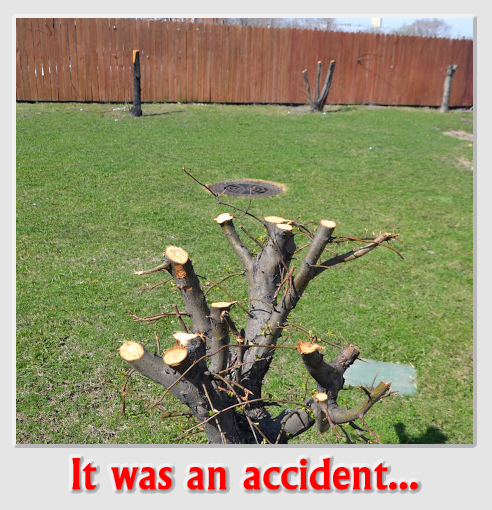
Just as had the Herrings, the Pelayos did not discuss their plans with the neighbors. After the arborist left what was essentially a very dead telephone pole standing on the boundary line, the Herrings (with no sense of irony) sued the Pelayos for trespass to trees, asking for treble damages under state law for wrongful cutting. The trial court found the Pelayos liable, awarding $10,475 to the Herrings.

On appeal, the Pelayos argued that they could not have possibly trespassed in cutting the tree, because they had never stepped off their own property when they butchered the tree, and anyway, under the Massachusetts Rule, they had every right to trim branches that were overhanging the property. They also argued they could not be liable for treble damages, because the trial court had not made a finding that the cutting was willful.

The appeals court made short work of the Pelayos’ arguments. Yes, the court said, you can trespass on timber without necessarily trespassing on the underlying land (I guess that’s virtual trespassing). No, the Massachusetts Rule does not let you cut overhanging branches from a boundary tree in which you have an ownership interest. And no, the trial court does not have to make a willfulness finding unless you have argued that the cutting was casual and involuntary. No one contended the cutting had not been willful.

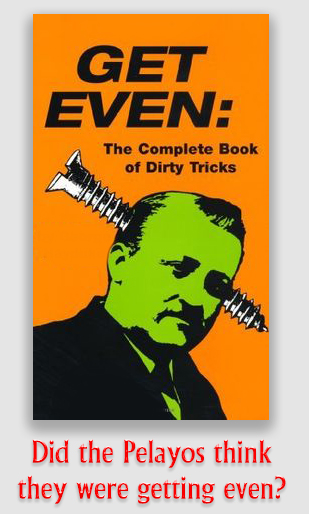
There is a certain irony that the Herrings had done exactly what the Pelayos had done, except for merely mauling the tree rather than killing it. But the Pelayos apparently figured they could get even simply by replicating the Herrings’ bad conduct. The law does not work that way.

Herring v. Pelayo, 198 Wn. App. 828, 397 P.3d 125 (Ct. App. Washington, May 2, 2017). The Herrings and Pelayos are neighbors who share a common property line. In early December 2011, the Herrings hired a tree trimmer to remove some branches from a tree located on the common property line. The Herrings did not discuss their plan to remove branches from the tree with the Pelayos. The Pelayos thought the trimming done by the Herrings unbalanced the tree, constituting a danger to their home. So four weeks later, the Pelayos’ own tree trimmer removed all of the remaining branches, without first discussing their plan with the Herrings. The tree obligingly died.

The Herrings sued the Pelayos, claiming timber trespass in violation of RCW 64.12.030 or RCW 4.24.630. At trial, Jose Pelayo admitted he knew the tree was on the common property line, he told his tree trimmer to remove all of the remaining branches from the tree, he did not discuss his plan with the Herrings, the tree was alive prior to the removal of the remaining branches, and he figured that removing the remaining branches would kill the tree.

The trial court found the Pelayos liable for timber trespass under RCW 64.12.030 and awarded treble damages.

The Pelayos appealed.

Held: The Pelayos committed timber trespass. Although the Pelayos argued the trial court never specifically found their conduct to be willful, the court noted that Jose’s testimony “was tantamount to a concession that his conduct in removing the branches was willful, and there was no other evidence presented at trial from which the trial court could infer that this conduct was casual or involuntary. Therefore, no specific finding as to willfulness was required to conclude that the Pelayos were liable under RCW 64.12.030.”

The Pelayos also argued they couldn’t be liable for trespass “because they were lawfully authorized to remove branches from the boundary tree that were overhanging their property.” The Court agreed a landowner has the authority to “engage in self-help and trim the branches and roots of a neighbor’s tree that encroach onto his or her property.” A landowner does not, however, have the right to cut down an encroaching tree.

The Court held that the right of self-help, derived from the Massachusetts Rule, does not apply where the landowner using self-help owns an interest in the tree because the portions of the tree overhanging his or her property cannot be said to be “encroaching.” You simply cannot encroach upon yourself.

What’s more, the Court said, as tenants in common, the Pelayos and Herrings were each entitled to use, maintain, and possess the boundary tree, but not in a manner that “interfered with the coequal rights of the other cotenants.” Unlike a landowner engaging in self-help to trim branches overhanging his or her property from a tree situated entirely on the property of another, a cotenant to a boundary tree has a duty not to destroy the common property and thereby interfere with the rights of the other cotenants.

The Court said, “We discern no meaningful distinction between cutting down a tree and trimming a tree in a manner intended to kill the tree.”

The Pelayos argued that because they cut the tree branches while standing on their property, they had probable cause to believe that they owned the land where such conduct took place. Their argument was based on the mistaken belief that the trebling provisions of RCW 64.12.030 don’t apply when the defendant’s conduct resulting in the destruction of a tree occurs while the defendant is on his or her own property. The Court held that even if the conduct resulting in the tree’s death occurred solely on the Pelayos’ own property, the trial court would not be required to conclude that mitigating circumstances applied to reduce the damages award. Instead, when determining whether mitigating circumstances applied, the relevant inquiry for the trial court was whether the Pelayos proved that their trespass on the common property tree was casual or involuntary.

At trial, the Pelayos did not claim, let alone prove, that the trespass upon the tree was casual or involuntary. Thus, they were liable for treble damages.

– Tom Root

TNLBGray140407

Case of the Day – Tuesday, November 26, 2024

WHEN LIFE GIVES YOU LEMONS …

lemonsup160302Lemon and Curington were neighbors. Things were neighborly when Curington planted a pair of poplar trees — fairly fast-growing and tall things — near the property line.

Over the years, things became less so, as several legally significant events occurred. First, the trees got big. As they did, the trunks ended up crossing the boundary line so that the trees were growing on both Curington’s and Lemon’s land. Second, the root systems expanded and began putting the squeeze on Lemon’s foundation. Third, Lemon discovered that if he used self-help, trimming back the roots and topping off the trees, he would make them unstable, turning the poplars into topplers. So Lemon — who was completely soured on the trees by this point — sued Curington, asking that the trees be declared nuisances and that Curington be made to remove them.

Life had given Curington a Lemon, but he tried to make lemonade. He argued that the Massachusetts Rule gave Lemon no aid and that he was limited to self-help. However, the court relied on the Idaho nuisance statute (noting in passing that the Massachusetts Rule didn’t really apply to a tree growing in both properties at once, a fascinating observation we wish it had explained a bit better), ruling that the trees were nuisances for having damaged Lemon’s foundation. It also seemed important to the Court that Lemon couldn’t trim the tree and roots himself without making the poplar a “danger” tree that was likely to fall.

founda160302This case is a gallimaufry of issues — the interplay of nuisance statutes with common law and the interplay of boundary trees with encroachment — as well a rather poorly-thought out dismissal of the Massachusetts Rule for reasons that were unnecessary. After all, the Massachusetts Rule was specific in its limitation to non-nuisance encroachment, twigs and leaves and that sort of thing. The Lemon decision, remarkably similar to the Hawaii Rule (but decided 14 years before the Hawaii Rule was adopted), is also quite similar in its fact pattern to Fancher v. Fagella, a 2007 Virginia Supreme Court decision. In fact, a real argument can be made that this Idaho case was entirely unnecessary in its treatment of the venerable Massachusetts Rule.  Michalson v. Nutting, in our view, is a “big tent” with enough room for all of the poplars, sweet gums and banyan trees that followed.

Lemon v. Curington, 78 Idaho 522, 306 P.2d 1091 (1957). Lemon and Curington owned adjoining land with a common boundary, on which two poplar trees had been planted over 50 years ago. The trees had grown to approximately four to five feet in diameter at the base, and the trunks and branches extended across the boundary line. The roots were surface feeders and, in one case, extended from the boundary line to and against the foundation of Lemon’s house, cracking the house’s foundation. pushing the wall of the plaintiffs’ house inward.

lemondown160302If Lemon topped the trees and cut the roots extending onto his land, the trees are likely to fall over. Lemon sued, alleging the trees to be a nuisance, and asked for the authority to remove the offending trees.

The trial court authorized the destruction of the tree damaging the foundation but held the other tree was healthy and mature, and thus not a nuisance. Curington appealed, arguing that the Massachusetts Rule limited Lemon’s remedies to self-help, that is, to Lemon’s trimming the tree and roots himself.

Held: The tree is a nuisance, and the Court may order Curington to remove it. The Supreme Court held that the Massachusetts Rule was not dispositive where a nuisance had been shown to exist.

roots160302The Court said, “[w]e think the condition here shown to exist constitutes a nuisance under the provisions of Idaho Code § 52-101.”  That statute defined a nuisance to be “[a]nything which is injurious to health … or an obstruction to the free use of property, so as to interfere with the comfortable enjoyment of life or property.” Here, not only had the tree made a mess of Lemon’s foundation, but the evidence showed that if Lemon cut the roots and topped the tree, the whole thing was likely to fall over. The Court said that the statute authorized an action by any person “whose property is injuriously affected or whose personal enjoyment is lessened by the maintaining of a nuisance to have it abated.”

Without explaining its reasoning very far, the Court also said that the fact the tree was a boundary tree, on the properties of both parties, made the Massachusetts Rule inapplicable. So while Lemon reserved the right of self-help, the courts were also available to him to abate the nuisance tree.

– Tom Root

TNLBGray

Case of the Day – Wednesday, September 25, 2024

“WHOSE WOODS THESE ARE…

I do not know,” wrote Robert Frost in Stopping in the Woods on a Snowy Evening. That appears to have been precisely the problem for neighboring rural landowners in Kentucky, one the titleholder to pasture and the other owning a large glade of trees.

The neighbors, Marv and Gene, had a common boundary on the edge of the forest, populated by some pretty nice hardwood specimens. When Gene decided he wanted to cut down and sell some of the timber, he asked Marv for permission to come onto his land to cut down the first of some eight trees he wanted to sell. Marv thought the trees all straddled the boundary, and so belonged to the both of them. He let Gene cut them down and haul them away, naturally believing that Gene would come back around to hand Marv a share of the cash.

Marv may have been the kind of guy who went through junior high school with a “kick me” sign taped to his back. It turned out, of course, that while there may be a Santa Claus, it wasn’t Gene. Gene came back from selling the trees, asking for permission to come onto Marv’s to cut down some more trees, all without offering Marv a farthing. Still, Gene cut down four more trees before Marv gave him the heave-ho.

Unwilling to be fooled again and unwilling to let Gene get away with selling commonly-owned trees as his own, Marv sued. And here’s where he let his fury get ahead of his common sense (which was his lawyer’s job, by the way, to talk his client off the ledge when prudence dictated he get his facts straight first).

It turned out that the first four trees Gene cut down were, in fact, completely on Gene’s property, but the second four were not. After the dust settled and Marv had a definitive survey done, Gene had to pay Marv $7,168.15. That was not a lot of money in 2008, at least for all of the litigation that ensued. The legal bills alone were probably bigger than that.

Gene’s attorney, however, might have been worth it. He was pretty crafty, throwing plenty of legal roadblocks in the way of the courts. The appellate panel, sad to say for Gene, swept them all away, and – rather piqued at Gene’s attempts to limit his liability after selling trees that only half belonged to him – said treble damages were only Gene’s due for selling the neighbor’s trees, especially when he had just been told not to cut them.

Smith v. Unger, Case No. 2007-CA-000318-MR (Ct.App. Kentucky, June 6, 2008). Marv Unger and Gene Smith owned adjacent properties in Lincoln County, Kentucky. Unger bought his place in 1997, and Smith purchased his in 2003. Marv’s property was primarily pastureland, while Gene owned some prime woodland.

Gene removed eight trees from the area of the common boundary line, in which Marv asserted part ownership. Gene said he believed the trees were on his land when he cut them down. Marv sued Gene for trespass and demanded treble damages for wrongful cutting under KRS 364.130.

A lot of the dispute arose from the presence of a fence running along the boundary between the properties. Gene and Marv agreed the fence in question had been there as long as Marv had owned his land, but they disagreed as to how many years prior to that time the fence had been there. Everyone agreed neither Marv’s nor Gene’s deed referenced the fence. Gene admitted he did not have the boundary line surveyed before cutting, but he said Marv told him the fence was the boundary. Marv says he never told Gene any such thing, and that he always determined the boundary line by some stakes that had been there at least since Gene bought his place.

Just before Marv purchased his property in 1997, the former owner had a survey of what became the Unger property performed. The surveyor placed stakes in the ground to mark the boundaries, and those stakes his property extended beyond the fence.

Gene never questioned the location of the boundary from the time he bought his land in 2003. However, Marv said that about a month after Gene bought his wooded tract, the two men discussed the trees located near the fence line between the properties. Marv said he understood the true boundary line between the properties to run according to the stakes, and not according to the fence. Gene disagreed, believing the fence to be the boundary line between the properties.

Marv testified he told Gene before the trees were cut they were “line trees” and, as such, he deserved a portion of any money made from their sale. Marv admitted that after the conversation, he allowed Gene and his assistant onto his property for the purpose of removing the first four of the eight trees. After the first four trees were removed, Marv waited for Gene to share the wealth. When Gene offered nothing, but instead tried to come back onto the property to cut more trees, Marv told him to leave, and Gene did, but not before cutting four more trees.

Marv then had the property resurveyed. The survey showed that the prior survey was somewhat off and that Gene owned four of the eight trees that had been cut.

A master logger valued the four trees that were not Gene’s “on the stump” and “at the market,” which was twice the stumpage value. The trial court entered a judgment for Marv for $4,614.90 plus, consisting of $1,538.40 in compensatory damages (representing the stump value of the trees) trebled (as set forth in KRS 364.130(1) and (2)), costs in the amount of $1,399.25, and attorneys’ fees in the amount of $1,154.00, for a total of $7,168.15.

Gene appealed.

Held: Judgment in favor of Marv was upheld.

Gene argued that KRS 372.070(1) declared Marv’s deed void to the extent that it purported to convey land within Gene’s boundary, including the timber upon it. That statute provided that any conveyance of any land of which any other person has adverse possession at the time of the sale or conveyance is void. Here, the Court said, Gene never disputed Marv’s proof of the boundary and never sought to quiet title. It was too late for Gene to argue that he had all along been claiming to hold the land up to the fence by adverse possession.

Under Kentucky law, land held by adverse possession only ripens into title when it has been held for 15 years openly, hostilely and notoriously to a well-defined boundary, giving others who may claim an interest notice of the adverse claim. The adverse holder’s intent at the time the possession begins is key: where one through ignorance, inadvertence, or mistake as to the true location of his boundary line enters into neighboring land up to a certain line in the belief that it is the true line, the occupancy is deemed amicable, mistaken perhaps, but not hostile.

In this case, Gene did not intend to possess land beyond his true boundary. He never formally disputed or questioned the boundaries as they existed, and at no time did he approach Marv to request the survey stakes be moved to establish what Gene believed to be the correct boundary between the two properties. The Court said it was clear Gene did not intend to establish actual adverse possession.

Gene also complained about the award of treble damages. The Court disagreed.

KRS 364.130 governs damages for cutting timber from another person’s land. The statute provides that a person is liable for treble damages for cutting the timber from another person’s land only if the person cutting the timber did not have at least “color of title” to the land. So, in order for Marv to receive treble damages, the evidence must show that Gene did not have color of title to the disputed property from which the timber was cut. Color of title is “that which gives the semblance or appearance of title, but which is not title….” It is color of title in appearance only and not title in fact.

Any deed or instrument that purports to convey land and shows the extent of the grantee’s claim may afford color of title. Thus, even a deed or instrument of conveyance that is defective or invalid is sufficient to afford color of title. But in this case, Gene conceded that his deed makes no mention of the fence as the appropriate boundary line, and the survey stakes marking Marv’s boundary were in place at the time Gene purchased the land.

Ultimately, the question, the Court said, was whether the jury determined that the trees themselves were on the boundary, as opposed to whether or not the trees were entirely on one property or the other. If the jury decided that the trees were boundary line trees and that notice had been given to both parties that they were boundary line trees, then the taking of the trees by either party would be against the basic title held by either property owner and constitute the unlawful taking of timber from “the land of another”.

Here, the jury found that at least four of the trees at issue were boundary line trees taken by Gene without color of title. This being the case, it is clear that the statute entitled Marv to treble damages.

The Court said the jury’s function was to determine whether or not Gene damaged Marv’s land, and, if so, what amount of money would compensate Marv up to the amount of the stump value. After that determination was made, the duty fell to the trial court to enter a judgment for triple the amount assessed by the jury.

The jury did not award Marv the entire value of the trees. The value of the trees was twice the stump value. The jury award of “stump value” actually amounted to only half the value of the standing trees. However, the Court reasoned, the jury awarded a sum of money to Marv, and implicit in that award was the finding that Gene was a tortfeasor while Marv was in the right. Gene removed the trees and, thereby, the physical evidence of the location of the trunk, the limbs, the shade the tree produced and any other benefit the tree would have had to the landowners that were provable by the physical presence of each individual tree. Certainly, there is no dispute that where each of these trees once stood, only stumps remain.

Gene, the Court said, was trying to benefit from the value of the trees both as the landowner and as tortfeasor but he could not have it both ways. Based on the testimony of the logger, it is customary that one who cuts and removes trees is paid at the rate of one-half the value of the trees, which is equal to the stump value. Gene was seeking to acquire half the value of the trees on the basis of his tortious conduct, namely, cutting and removing the trees without permission. Further, as a landowner, Gene attempts to assert that he is entitled to a proportional share of the stump value. As a matter of policy, a tortfeasor should not be allowed to benefit from his wrong to the detriment of the injured party.

– Tom RootTNLBGray

Case of the Day – Monday, September 22, 2024

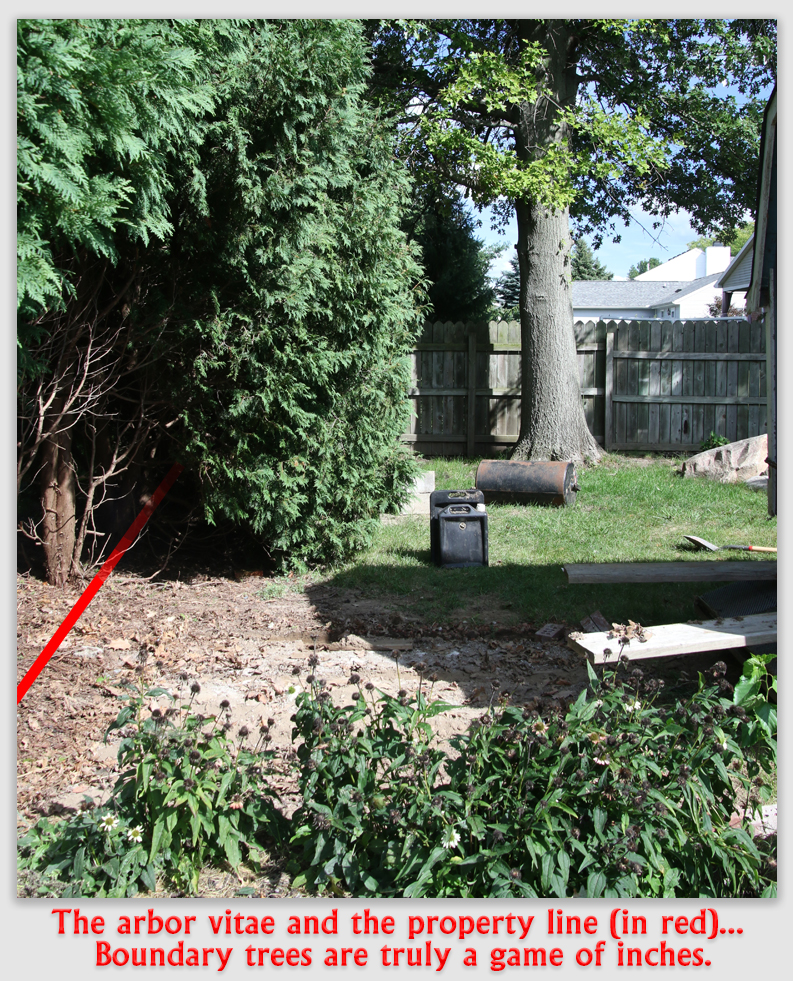
A GAME OF INCHES

Baseball, they say, is a game of inches. So are boundary trees, called “line trees” in the State of Pennsylvania (which, by the way, also calls itself a “Commonwealth” instead of a “State”).

Life imitates art, I guess. Last weekend, I hauled away our 25-year old shed. I am replacing it with a newer, larger shed – complete with electricity, windows, and (if I have anything to do with it) a beer refrigerator. Replacing it will come with a set of problems, specifically a line of arborvitae trees, standing behind the shed along the property line.

The arborvitae were tiny little shrubs when our next-door neighbor (two owners ago) planted them in the late 1990s. Now, they’re monsters.

I need to trim back a few of the arborvitae before the concrete pad for the new shed gets poured. Having read some of what I have written about boundary trees over the past few weeks, I figured I had better be sure I was dealing with some good old-fashioned Massachusetts Rule trimming of branches overhanging my property (and not with some oversized arborvitae that had grown across the property line to become boundary trees).

I found the iron pin on one end of the property line and the post on the other, and I ran a line through the trees. Sure enough, two of them have grown across the property line. Lucky for me, the ones I need to trim are still solidly anchored completely on my neighbor’s land. Those I can trim back, exercising both my Massachusetts Rule rights and my ratcheting loppers.

It seems strange that a matter of inches differentiates the trees I can trim with abandon and the trees that I cannot touch without my neighbor’s permission. (I have a great neighbor, by the way, so it is probably not a problem).  Nevertheless, the perverseness of the interplay between boundary trees and encroaching trees that stand completely on land other than one’s own is puzzling and irritating to me in an academic and legal way.

My situation is similar to the one in today’s case, which pits a car wash against a restaurant over a row of pine trees that may or may not be on the boundary. Because of the vagaries of how the pine trees at the root of the lawsuit grew along the property line, no one really won: the restauranteur wanted the trees gone, and the car wash owner wanted the trees to remain.

In the end, some of the trees stayed, some did not. And it was all a game of inches…

Wolfinger v. Moates, 7 Pa. D. & C.4th 220 (Pa.Com.Pl. 1990). A line of pine trees separated the Wolfinger Car Wash property from the Moats Restaurant property. Bill Moats received complaints from his patrons about the pine trees, that encroached on his parking lot, scratched diners’ cars and dropped pine cones everywhere (even damaging his lawnmower).

Bill decided to cut down the trees. He told his neighbor, “Suds” Wolfinger, what he planned. Suds was shocked. He liked the trees, partly because they served as a barrier between his business and the restaurant. Plus, his customers preferred parking under them, using the shade while they wiped down their cars. Suds asked Bill not to cut them down.

Bill cut them down anyway, taking out four of the 13 trees on his first day wielding his chainsaw. Suds raced to his lawyer, and together they raced to the courthouse for a temporary injunction. After Bill was forced to stop, Suds tried to make the injunction permanent.

The court found that the two tracts of real estate shared a common boundary line, and 13 trees stood on or near the line. A survey showed that the first five trees, including the four Bill had cut down, were all on his property. Lucky Bill. The next three, however, straddled the boundary. The  Court referred to them as “line trees.” Tree No. 9 was on Bill’s land, but some bark on the flare touched the boundary line. The last four trees were all on Bill’s land.

Held: Bill was not allowed to cut the three trees that straddled the boundary.

Pennsylvania law made it unlawful “for any owner or owners of any undivided interest in timber land within this Commonwealth to cut or to remove, or to cause to be cut or removed, from the said land, any timber trees, without first obtaining the written consent of all co-tenants in said premises.”

The Court held that the statute dictated its holding that the owners of adjacent tracts of real estate own all trees growing on their common boundary line as tenants in common. Tenants in common are prohibited from unilaterally cutting down or removing such commonly owned line trees.

Applying the general rules of law governing tenancy in common, the Court held, “We conclude neither adjoining real estate owner may remove a tree growing on a common boundary line. Consequently, in the case at bar, notwithstanding the fact that only inches of the trunks of trees 6, 7 and 8 are on the boundary line between the properties of the plaintiffs and defendants, those trees are jointly owned by plaintiffs and defendants. Therefore, defendants may not remove them.”

Suds was not satisfied. He argued that Tree No. 9 was commonly owned as well because the bark of the tree’s trunk touched the boundary line. Citing the Illinois case Ridge v. Blaha, the Court held that the critical question was “whether any portion of the trunk of the elm tree grows on plaintiff’s property… The law… is determined by the exact location of the trunk of the tree at the point it emerges from the ground.” The fact that the bark of Tree No. 9 touched the line, the Court said, was insufficient to create a tenancy in common.

Trees 1 through 5 and 9 through 13, therefore, were Bill’s sole property. He could cut them down as he wished. But the injunction would become permanent on Trees No. 6 through 8, leaving them to provide both shade and pine cones.

– Tom Root

TNLBGray140407