Case of the Day – Thursday, February 5, 2026

ROCK SOLID

The solid rock on which the many decisions on landowner liability for trees that fall on neighbors’ land, houses, cars and sundry possessions is the unremarkable notion that a landowner is not responsible for damage caused by the natural condition of the land. In other words, if it’s just a tree growing naturally on the property – and not some exotic species you saw on your last safari and just had to plant in your backyard in scenic Bugscuffle, Tennessee – any damage it might cause by shedding its limbs or invading with its roots is pretty much an Act of God.

A monkey on Gibraltar ... but no monkeyshines at Gibralter Fire & Marine Insurance - the company wanted Mr. Griefield to pay.

A monkey on Gibraltar … but no monkeyshines at Gibralter Fire & Marine Insurance. The company wanted Mr. Griefield to pay for the damage that his fallen limb had caused.

Such was the case in 1946, when the Gibraltar Fire & Marine Insurance Co. tried to collect money from Mr. Griefield for the damage his tree had done to its insured. Mr. Griefield told Gibraltar that it had rocks in its head if it thought he was liable for damage caused by a falling limb. But Gibraltar wasn’t monkeying around. It sued, claiming in essence that a landowner was liable whenever one of his or her trees caused harm to a neighbor.

The case didn’t involve questions of whether the tree was diseased, whether Mr. Griefield had a duty to inspect his trees, or whether any defects in the tree were readily apparent. Decisions refining a landowner’s duty – even where the tree is a natural condition of the land – were years in the future. Rather, today’s case established as rock-solid the principle that a landowner has no obligation to trim or take other steps to limit the damages that a tree growing as a natural condition of the land might otherwise cause to a neighbor.”

The Mississippi Supreme Court pondered the issue in 1946. Because the decision – although written with some of the ruffles and flourishes typical of decisions of that era – is fairly short, we set it out in full:

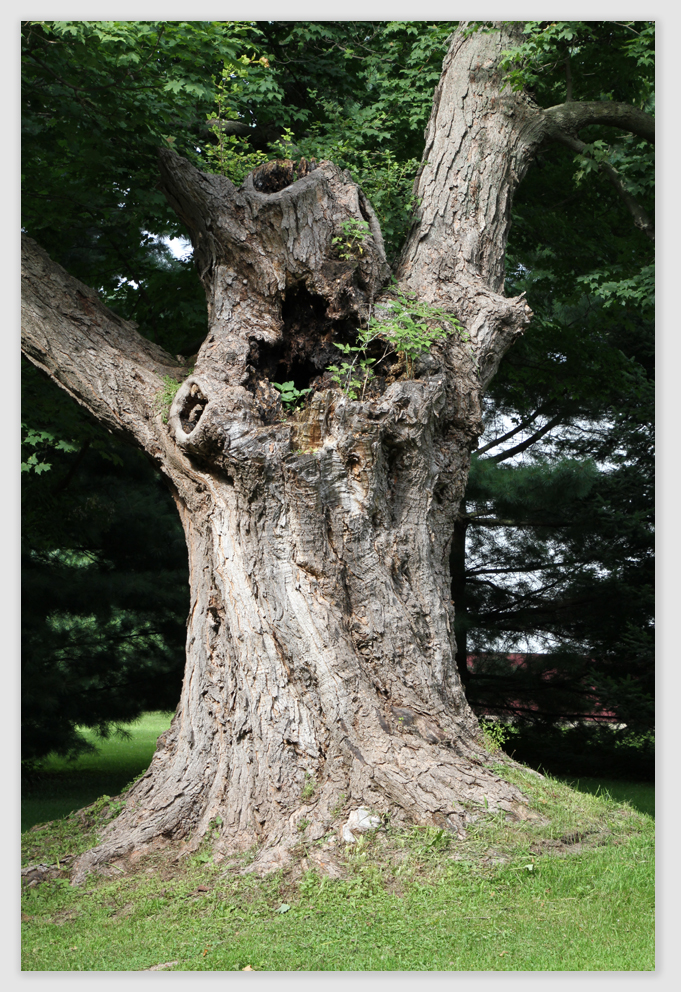
Mr. Griefield's tree was a sturdy, natural, plain vanilla oak.

Mr. Griefield’s tree was a sturdy, natural, plain-vanilla variety oak.

Griefield v. Gibraltar Fire & Marine Ins. Co., 199 Miss. 175, 24 So.2d 356 (Sup.Ct. Miss. 1946).” This action was begun by the appellee in a County Court and was there tried by agreement by the Judge without a jury, resulting in a judgment for the appellant, which was later reversed by the Circuit Court with  judgment rendered for the appellee.

The test of the appellant’s liability vel non is whether the tree from which this limb overhung the land of the appellee’s assignors was of natural growth or had been planted by the appellant or a former possessor of her land. If the latter is the case, liability appears, the court said, citing 4 Restatement, Torts, § 839; Buckingham v. Elliott, 62 Miss. 296, 52 Am.Rep. 188; but if the former is the case the appellant is not liable, 4 Restatement, Torts, § 840, Comment (a). The former is the case here, for there is nothing in the agreed statement of facts to indicate that the oak tree was not of natural growth.

Perhaps an exotic balloon tree in your backyard? Sure ... just remember, it's probably not a "natural growth" on the land.

        An exotic balloon tree in your backyard is probably not a “natural growth” on the land.

“The broad language of the opinion in Buckingham v. Elliott, supra, if given effect, would sustain the judgment of the Circuit Court, but when the authority of that opinion is limited, as it should be, to the issue then before the court, it will be seen that the judgment there rendered is not in conflict with the rule announced in 4 Restatement (Torts), § 840, for the trees there, the roots of which caused the plaintiff’s damage, were not of natural growth but had been planted of the defendant’s land. The appellant was under no obligation to the appellee’s assignors to remove the limb of the tree which overhung their land, and her gratuitous promise so to do was not binding on her, but the appellee’s assignors had the right at all times to themselves remove so much of the limb as overhung their land. 1 American Jurisprudence, Adjoining Landowners, § 56.”

The judgment of the Circuit Court was reversed and the judgment of the County Court was affirmed.

– Tom Root
TNLBGray140407

Case of the Day – Wednesday, February 4, 2026

INTENTIONAL GROUNDING


intent160205Intentional grounding? You can bet that was the call after Mr. and Mrs. Peters bought a lot next to the Kriegs.

The Peters didn’t know where the lot lines were. Their real estate agent didn’t, either. Ah, details, details … That didn’t stop them from hacking down trees on the property as soon as the ink was dry on the deed, in order to build their dream house. You probably know where this is going. Harry Peters, acting as his own tree service, goofed and cut down 29 trees on the Kriegs’ land.

The Peters admitted their honest error. OK, they intended to ground the trees. They just didn’t know that the trees they grounded were the Kriegs’. They were willing to pay for the mistake. But what they were not willing to do was pay the treble damages authorized in the law for wrongful timber cutting.

It was sort of like the intentional grounding foul in football. It’s one thing to get assessed a 10-yard penalty. But on top of that, the team loses the down. Sort of like the double whammy (or triple, if you like) of the statutory multiplier for wrongfully cutting trees.

BMarker140130 C’mon, the Peterses said, there wasn’t any evidence they knew they were cutting Kriegs’ trees. The Court pointed out that the state of the evidence was precisely the problem. It was up to the Peterses to prove that they thought the land was theirs. The wife’s testimony was all they had offered, and it didn’t help: she explained they didn’t really know where the boundaries were, and never bothered to find out. But the biggest problem was what Mr. Peters testified to: nothing. He was the one who cut the trees down, and the Court seemed to expect that he would have material testimony to offer. But he didn’t testify.

Ch 1 Art.xlsThere’s a well-known principle in evidence known generally as the “missing witness instruction.” As the legendary Professor Wigmore put it, the principle holds that “the nonproduction of evidence that would naturally have been produced by an honest and therefore fearless claimant permits the inference that its tenor is unfavorable to the party’s cause.” In other words, if you have particular control of evidence, and you do not bring it forward, a court is allowed to assume it would have been harmful to your cause if you had done so.

The Court didn’t say it here, but it strongly implied that the absence of testimony from Harry Peters led it to conclude that if he had taken the stand, he wouldn’t have helped his cause any.

Krieg v. Peters, 46 A.D.3d 1190, 850 N.Y.S.2d 211 (N.Y.A.D. 3 Dept., 2007). In May 2004, the parties became adjoining property owners when the Peters family purchased the vacant lot next to the Kriegs. The Peterses intended to construct a house on their property, so Mr. Peters began clearing land without consulting the map referenced in their deed or having a survey conducted. He removed 29 trees from Krieg’s property. Following a jury trial, the Kriegs were awarded damages, including treble damages under New York statute for the removal of this timber. On appeal, the Peterses only contest the treble damages award.

Held: The treble damages were upheld. Under RPAPL §861[2], the New York treble damage statute, in order to avoid treble damages, the Peterses had the burden of proving by clear and convincing evidence that when they removed the trees from the Kriegs’ property, they “had cause to believe the land was [their] own.” Their proof in this regard was woefully inadequate. Mrs. Peters was the only defense witness to testify on this critical issue, and the appellate court found that her testimony had been more damning than helpful in sustaining their burden. She said that, before she and her husband purchased the property, she walked it on one occasion with their realtor. At that time, she specifically asked about the boundary lines but the realtor couldn’t answer her question with any certainty. She said she told her husband of the realtor’s uncertainty when they later walked the property together. She also candidly admitted that no steps were taken to obtain a survey or consult the map referenced in their deed before clearing the land. The Court found it significant that, although he had logged the property, Mr. Peters never testified. It found plenty of evidence that the defendants had no cause to know whether the land Mr. Peters was logging belonged to them or not.

The Peterses also argued that the legislature never intended for RPAPL §861 to apply to individuals such as themselves who make “honest” mistakes about boundary lines. The Court disagreed, holding that on its face, the statutory scheme clearly applied to the facts and circumstances of the case and, in the absence of sufficient proof on the defendants’ part to avoid treble damages, it didn’t find the treble damage award to be inconsistent with the law’s purpose or intent.

– Tom Root

TNLBGray140407

Case of the Day – Tuesday, February 3, 2026

DOING DAMAGE

Most of the time, the object of a civil lawsuit is to collect damages. Damages may either be compensatory – intended to compensate or to put the victim in the same place he or she would have been had the wrong not occurred – or punitive, intended to punish the wrongdoer.

Today, we’re going to talk about compensatory damages. How much has an injured party been damaged by loss of or damage to trees? The first question to be answered is whether the trees were commercial or “ornamental” in nature.

If the tree taken was commercial timber, the calculation is straightforward. Courts use either the stumpage value or the timber value. Stumpage value and timber value estimates depend upon timber volume estimates, which in turn are based upon the raw data collected in the field by timber cruisers. Put another way, estimating the value of timber taken in a trespass involves a three-step process. First, a timber cruise is conducted, and measurements are taken in the field. Timber cruising includes identifying a tree species, taking measurements of the stump diameter and from the stump to the top of the tree left on the ground, measuring any logs left on the ground, and recording measurements on a tally sheet. Second, the collected measurements are converted into volume estimates using established mathematical formulas. Third, those volume estimates are then converted into value estimates.

The distinction between timber and stumpage value only comes into play during the third step of the process. Stumpage value is the value of standing trees or what one might pay for the right to cut and remove trees. Timber value is the value paid by mills for cut logs. If timber value is used, it would be fair to argue to the Court that a deduction should be included for the cost of cutting and hauling the lumber. But where the timber trespass was especially egregious, don’t hold your breath waiting for compensatory-damage compassion from the bench.

But what about where the tree is not commercial timber, like that 80-year-old oak that used to shade your front yard before a confused tree service company employee cut it down, thinking he was supposed to be at your house instead of a place two streets away. The single oak’s commercial value won’t begin to compensate you for the loss.

There’s always a tension between the value a lover of the land places on his or her trees and the price tag affixed to those same trees by bean counters testifying in some cold courtroom. That’s why courts in many states apply different rules when the wrongfully taken tree was a stately old elm shading the farmhouse, a tree with maybe $1,000 in timber value but much greater value to the wronged property owner. The fact is that the wronged owner just plain likes the trees that had been taken, and the fact that his or her enjoyment of the trees might not be quantifiable in a real-estate-value analysis makes little difference.

Anderson v. Howald, 897 S.W.2d 176 (Court of Appeals of Missouri, 1995). Melba Anderson discovered the limits of gratitude. For 40 years, she had let her neighbors, the Howalds, use a 7-foot-wide path across the corner of her land to get to their property. In 1991, the Howalds – apparently deciding that they shouldn’t settle for free use of a mere path where a free superhighway could be installed – brought bulldozers onto the Anderson land to “improve” the path. They knocked down trees, dug up rocks, and gouged things out but good.

Ms. Anderson sued and won an injunction, throwing the Howalds and their bulldozer out, but the trial court only gave her $6.40 in damages.

She appealed.

Held: The puny damage award was reversed. The Court of Appeals noted that “ordinarily, the measure of damages… is the market value of the property at the time it was removed from the land.” In this case, the trees being shade and ornamental trees of no commercial value, their value was slight. That seemed to offend the Court, especially when it saw the photos in the record of the extensive damage done by the Caterpillars.

The Court held that “in at least one instance, this court approved the use of before and after values of the real estate as a measure of damages… where the things taken, injured, or destroyed by a willful trespass have no substantial market value when considered in their severed state. The “general rule is that the measure of damages for trees that are not valuable for timber is the injury to the land caused by destroying them. This rule is based on the obvious reason that the value of such trees considered apart from the land would not be adequate compensation for the trespass.”

Courts, then, generally apply a measure of damages that considers the fair market value of the property with the tree and without the tree (which can be substantial for a single huge specimen that is the signature tree on the property). More often, the courts hold that the proper measure of damages is the replacement cost of trees rather than the value of real estate, even if the property owner cannot prove that the destruction of trees diminished the value of the property as a whole.

Courts often permit consideration of such replacement costs where the trees have aesthetic value to the owner as ornamental or shade trees, or for purposes of screening sound and providing privacy, in determining damages. Because one simply cannot replace a 50-year-old sugar maple tree with a similar tree, the courts apply a multiplier to the replacement cost to account for the number of years it will take for a replacement tree to reach the size and maturity of the tree that was removed.

– Tom Root

TNLBGray140407

Case of the Day – Monday, February 2, 2026

ELECTRIC BOOGALOO

There are all sorts of ways that tree trimmers can die. They can cut an artery, fall from a bucket truck, or even get walloped by a branch (and sometimes, the whole tree). On occasion, they even get fried by electric lines.

None of it is pretty, either before or after the funeral. After the dust settles, the decedent’s estate (that is, the people the dead guy left behind) looks for someone to sue. Usually, the pickings are sparse. Maybe the bucket truck was defective, and the employer, the manufacturer and the mechanic who serviced it can be sued. Maybe it was a defective saw, and everyone who touched it could be a defendant. But negligence actions are expensive, and contrary to legend, they pay out a jackpot less often than a rigged lottery. Those lawyers on the back of phonebooks (there are still phonebooks, aren’t there?) and in the late-night ads? They won’t charge plaintiffs upfront, but they’re pretty picky about which cases they’ll take.

You would think that an electric utility would be the toughest nut to crack of all the potential defendants out there. What, you’re going to sue because the overhead wires had electricity in them? C’mon, man.

But every once in a great while, the utility is found to be liable for essentially having done nothing. Such is the case in today’s decision, which – while it does not involve a tree – gives us an excellent principle to apply to arboriculture activities.

Cyril Cronk lost his life by electrocution while digging a ditch for a water main on the south side of Park Avenue in Des Moines, Iowa. Iowa Power and Light had electric transmission lines running overhead, and a backhoe boom got close to one of the lines. It turned out that the boom did not have to touch the line for high voltage to jump the air gap. When it did, and Cyril (down on the ground) touched the backhoe, he became the ground wire. Not good.

The three lower wires on IPL’s poles were not insulated, a condition that was permitted by the applicable electrical code (although insulating material was available for such lines).

As it turned out, IPL was on notice of the water main work, or as the court put it, “It was reasonably to be anticipated and the defendant either knew or should have known that men would likely be working in the streets with modern machinery, such as was used in this instance, for the purpose of excavating or digging ditches or trenches for the laying of water mains.”

But the power lines were clearly visible to the guys on the ground. And the lines were necessary for the public good, and the danger that would result from coming in contact with such lines was hardly unknown. So the court’s conclusion that IPL was responsible for Cyril’s death is surprising. Maybe it was because the electric company had a deep pocket.

Tree trimmers frequently work near power lines. Would putting the power company on notice in advance make Reddy Kilowatt a codefendant if the unthinkable happens? Regardless of whether it did or not, it would probably be a good idea, just for the extra level of safety that power company participation in the project might bring.

Cronk v. Iowa Power and Light Company, 138 N.W.2d 843 (Supreme Court, Iowa, 1966). The deceased plaintiff, on whose behalf the suit was brought, Cyril Cronk, had been a waterworks employee. He was working on the ground helping free a crane bucket when the boom came in contact with a high-voltage transmission line, and he was electrocuted.

The trial court found liability strictly on the utility company’s failure to warn of the danger or insulate the wires after the utility company was fully aware the work was going to be done near the line, and the company had time to give a warning or insulate the wires. Defendant Iowa Power and Light (“IPL”) appealed.

Held: The Iowa Supreme Court held that the electric utility was liable. Compliance with the safety code is relevant to the question of due care, but not determinative. Proof of compliance with the standards furnished by the National Electrical Safety Code is not conclusive proof on the question of IPL’s due care. Actionable negligence may exist even if the utility company complied with the safety code requirements.

It was IPL’s duty to use reasonable care to prevent the escape of electricity in such a way as to cause injury to persons who might lawfully be in the area of danger incident to the escape of electricity from such lines. One who furnishes electricity, while not an insurer, is nevertheless held to the highest degree of care consistent with the conduct and operation of the business. A person or corporation maintaining and controlling wires for the furnishing of electricity to others must insulate their wires at all places where there is a likelihood or reasonable probability of human contact by people whose business or duty or rightful pursuit of pleasure brings them, without contributory fault on their part, into the zone of danger. However, in the absence of statute, this duty does not compel the electric company to insulate or adopt safeguards for the wires everywhere, but rather only at places where people may reasonably be expected to come in proximity to them.

The Supreme Court held that the evidence supported finding the utility company had been negligent in failing to insulate wires at such a point, and that this negligence had been the proximate cause of Cronk’s death.

– Tom Root

TNLBGray140407

Case of the Day – Friday, January 30, 2026

“YO-YO” MA

Don’t ever let your local attorney pull an abscessed tooth. And do not let your dentist practice law.

Dr. Ma needed a new office after he lost his lease to redevelopment. He found a vacant dentist’s office next to a vacant church. The empty dental abattoir was run down and needed work, but otherwise it was perfect. Dr. Ma signed a purchase agreement which expressly advised him not to rely on anything the seller or his broker said, but instead to hire his own consultants to check the place out stem to stern.

But Dr. Ma was a dentist. According to an old ad campaign for Aspen Dental, dentists can fix stalled cars, stop bank robbers in their tracks, free people trapped on an elevator… all sorts of stuff. Sort of like MacGyver with a mouth mirror. Dr. Ma didn’t need any other licensed professionals to check the property out. He could handle it. He was, after all, a dental professional.

Dr. Ma would never miss a cavity. But he did miss the fact that the property’s fenced side yard, which was the only access to the shed in which he had installed the air compressor that ran all of his dentist stuff, was really not his at all. Instead, almost all of it was part of the church. In fact, the 6-foot fence that enclosed the side yard was 3½ feet onto the church land.

A few months and countless fillings later, Dr. Ma got a letter from the church property owner, saying Grace Chinese Alliance Church wanted to buy the church property, but a survey showed Dr. Ma’s shed and fence were on church land. Dr. Ma should have referred the matter to legal counsel right then, but (did I already say this?) he was a dentist. A trained professional. He had this covered, too. The good doctor wrote back, saying, “No problem.” The church property owner could remove the fence whenever it needed to. Based on this answer, Grace bought the vacant church.

However, eight months later, when the Grace Church elders were ready to have the fence moved back to the real property line, Dr. Ma told them to go floss. He informed them that they could not move the fence, and if they tried, he would give them a root canal without novocaine. Or call the police. Or both.

First, Dr. Ma said, “Yes.” Then he said. “No.” Yes and no, up and down… Kind of like a yo-yo. “Yo-yo” Ma, it seemed.

The Church was not about to turn the other cheek. It sued, and Dr. Ma, who by now had a lawyer, claimed he had a prescriptive easement.

Everyone is familiar with adverse possession. If you squat on someone else’s land long enough without their permission, the property may become yours. A prescriptive easement is the easement version of that, a right to use a portion of someone else’s property gained by brazenly using it without permission for a sufficient period of time. If a claimant uses a property owner’s driveway without permission to reach the claimant’s back lot and does it openly, regularly and continuously for long enough, the claimant gets a prescriptive easement. It does not prevent the property owner from using his own driveway; rather, it just lets the claimant use it, too.

To establish a right to a prescriptive easement in California, a claimant must prove use of the property in question for five years.* The use has to be (1) open and notorious; (2) continuous and uninterrupted; (3) hostile to the true owner; and (4) under claim of right. Even where all of these elements are met, “when a claimant cannot satisfy the requirements for adverse possession, the claimant may not receive a prescriptive easement which extends so far that it becomes the equivalent of a fee interest and dispossesses the record title owners of part of their property.”

A true prescriptive easement does not deprive the property owner of the right to use the affected property, but rather just limits that use in favor of whatever rights the claimant has established. Dr. Ma argued he had a prescriptive easement, but his failure to determine the boundaries of his own property when he should have and his promise to let the Church move the fence when it needed to didn’t help him make his case. The real problem, however, was that Dr. Ma wanted exclusive use of the disputed property, and if he got that, it would deny Grace Church the ability to use the disputed property at all and would frustrate Grace’s intended use of the vacant chapel as its place of worship.

That dentist-as-MacGyver ad campaign we mentioned promises a “different kind of dentist.” Dr. Ma should have been a different kind of dentist: the kind who uses surveyors and lawyers early enough that these sorts of problems don’t happen.

Grace Chinese Alliance Church of the Christian and Missionary Alliance of West Covina v. Lin Ma DDS, Inc., Case No. B272415 (Ct. App. California, Second Appellate District, Jan. 25, 2018), 2018 Cal. App. Unpub. LEXIS 511

In 2010, Dr. Ma was looking for a commercial property to which to relocate his dental practice. The property at issue in this case, the Hayden property, had been used as a dental office at one time, but it was vacant and in disrepair.

Dr. Ma met with Hayden’s real estate agent to look at the property. One of Dr. Ma’s concerns was having a place to locate the air compressor used to power his tools. He discovered that the property had a compressor room, accessible only from the outside from a yard along the side of the building, adjacent to the property owned by Grace Chinese Alliance Church. The side yard was completely fenced in; it was about six feet wide from the building to the fence.

Dr. Ma entered into an agreement to purchase the Hayden property. The standard form agreement included provisions allowing Ma 30 days to obtain a survey of the property; acknowledging that Ma was buying the property in its existing condition and that no representations, inducements, promises, agreements, or assurances concerning the property had been made by the seller or his broker, and advising Ma to retain his own consultants to investigate the property. In addition to these standard provisions, the parties added several other provisions, including that “Seller and Buyer have agreed that there will be no credits given to Buyer with regard to the condition and the size of the property”; and “Seller and Buyer acknowledge that Broker has made no representations or warranties regarding the physical condition of the property. Seller and Buyer are relying on their own independent investigation in making or accepting this Agreement.”

After closing, Dr. Ma moved his dental practice into the Hayden property. A few months later, he received a letter from a lawyer for Grace Church, who said the Church property was subject to a sale escrow, and that a boundary survey conducted in connection with the sale showed that a fence and shed along Hayden’s east property line was encroaching into the Church property by about 3½ feet along nearly the entire length of the boundary between the two properties. The letter asked Dr. Ma to agree that the encroachment could be removed, and Ma replied, “We have no problem with whatever you want to do with the fence as long as it is on your property. Please let us know your future plans if the fence is removed, so that we can prepare for any security issues to our office related to this.” In reliance upon Dr. Ma’s friendly response, the Church completed the purchase of the Church property and began renovations.

Eight months later, Grace Church’s pastor wrote to Dr. Ma, telling him that for the Church to comply with City parking lot codes, it had to move the fence to the correct property line and tear out a piece of the encroaching shed. That required the Church to repave the entire parking area. The Church offered Ma $500 to help him defray the costs of compliance.

This time, getting Dr. Ma’s cooperation was like pulling teeth. He wrote back, telling the Church its survey was both unrecorded and bogus. The Church recorded the survey, but Dr. Ma continued to argue. He said the fence had been in its current location when he purchased the Hayden property, and that he had spent more than $50,000 improving the side yard where the encroachment existed. He said his possession and improvement of the property had been open and continuous, and that, therefore, the disputed property was his, or, if not, he at least had an easement by prescription. He threatened to call the cops if the Church tried to remove the fence.

The Church sued Ma to quiet title and get his fence and shed off of its land. Dr. Ma counterclaimed, saying he had a prescriptive easement to use the disputed 3½ feet, or at least an equitable easement. The trial record showed the fence was 6 feet tall, with locked gates on both ends and that the Church did not have access to its property on the other side of the fence. The Church needed to move the fence in order to use the property behind it to comply with certain parking lot requirements for the Church’s conditional use permit. The trial court ruled against the dentist, and Dr. Ma appealed.

To establish a right to a prescriptive easement in California, a claimant must prove use of the property in question for five years.* The use has to be (1) open and notorious; (2) continuous and uninterrupted; (3) hostile to the true owner; and (4) under claim of right. Even where all of these elements are met, “when a claimant cannot satisfy the requirements for adverse possession, the claimant may not receive a prescriptive easement which extends so far that it becomes the equivalent of a fee interest and dispossesses the record title owners of part of their property.”

The problem here is that a true prescriptive easement does not deprive the property owner of the right to use the affected property, but rather just limits that use in favor of whatever rights the claimant has established. If a claimant uses a property owner’s driveway without permission to reach the claimant’s back lot and does it openly, regularly and continuously for long enough, the claimant gets a prescriptive easement. It does not prevent the property owner from using his own driveway: rather, it just lets the claimant use it, too.

Here, if Dr. Ma got a prescriptive easement to use the disputed property, the Church could not use it at all. The fence prevented the Church from getting a permit to build a parking lot. Without a parking lot, Grace could not conduct services for its parishioners. Not only could Grace Church not use the disputed area behind the fence along with Dr. Ma, but its whole intended use of the church property would be frustrated.

The trial court found that Dr. Ma could not be granted a prescriptive easement because to do so would deny the Church of all of its rights to use the property. Thus, even if the court erred in finding that DDS failed to establish that its use of the disputed property was hostile, the court’s denial of the prescriptive easement was proper. The Court of Appeals agreed that in some circumstances, a court could find an exclusive prescriptive easement to be justified. “But those circumstances are very limited, and involve instances where the easement was necessary to allow a utility to provide an essential service, such as water or electricity, or to protect the health and safety of the public.”

The Court of Appeals was probably influenced by the fact that Grace Church only bought the property because of Dr. Ma’s letter saying that the fence could be moved to the correct position. It did not help that, after Dr. Ma told Grace Church he did not believe its survey, all of Ma’s own surveys showed Grace was right. It also did not help that testimony showed the dentist had tried to make a secret deal with the seller to cut out the broker’s fee, or that Dr. Ma tried to get the judge removed from the case on a spurious claim of bias. Whatever else happened, Dr. Ma did not come out of the trial looking entitled to equity, and things did not improve on appeal.

Unsurprisingly, with regard to Dr. Ma’s request for an equitable easement, the court found the equities did not weigh much in his favor. It noted that, on the one hand, the Church was unable to function as it wanted to function because it could not complete its parking lot as required for its conditional use permit without access to the disputed property; on the other hand, Dr. Ma could not show he would suffer any comparable hardship, even if he had to move the compressor or any other equipment from the shed as a result of the fence being shifted to the correct property line.

The Court of Appeals agreed. In order to be awarded an equitable easement, a claimant must be innocent. “That is, his or her encroachment must not be willful or negligent. The court should consider the parties’ conduct to determine who is responsible for the dispute. Second, unless the rights of the public would be harmed, the court should grant the injunction if the plaintiff ‘will suffer irreparable injury… regardless of the injury to defendant.’ Third, the hardship to the defendant from granting the injunction ‘must be greatly disproportionate to the hardship caused plaintiff by the continuance of the encroachment, and this fact must clearly appear in the evidence and must be proved by the defendant.”

The trial court found that the Church would be irreparably injured if an easement were granted because it would be unable to function as it wanted to function. It also found that Dr. Ma failed to show he would suffer hardship if the easement were denied that would compare to the hardship suffered by the Church if the easement were granted. Because Dr. Ma did not even try to show those findings were unsupported by the record, the Court of Appeals denied his request for an equitable easement.

* The length of time needed for an adverse possession or prescriptive easement varies from state to state. California’s 5-year period is actually much shorter than virtually all other states. Talk to a local lawyer.

– Tom Root

TNLBGray140407

Case of the Day – Thursday, January 29, 2026

FOR THE LORD’S SAKE, PEOPLE… STOP!

You would think that a church could get along with its neighbors. Maybe it was the Methodist elders. Maybe the neighbor was a minion of hell. Who can tell from the abbreviated decision in today’s case, handed down by the New York Supreme Court, Appellate Division.

A word of caution here: New York is not like the rest of the world. In New York State, the Supreme Court is a trial court, the Supreme Court Appellate Division is the court of appeals, and the Court of Appeals is the supreme court. There – isn’t that easy? So the next time someone claims to sit on the New York Supreme Court, just say, “Yeah, you and a thousand other judges.”

Today’s decision involved a party wall, hardly a matter of importance to most folks. But the principle is an important one. Trespass is one of those common law torts (consider a tort to be a “wrong”) that can be committed all too easily. You don’t have to intend to commit a trespass. All you have to do is intend to step where you step. So if you trip on the sidewalk and fall onto someone’s front lawn, it’s not a trespass, but if you step off the sidewalk to avoid a puddle, it is.

What’s more, in every trespass, damages are presumed. There have been cases in which people trespassed while all the while believing they were on their own property. Sometimes, they leave the premises on which they trespassed better off than before they arrived.

No matter. The law presumes they damaged it.

Obviously, this can cause all sorts of nonsensical results. For that reason, while the law will always assume damages, it won’t always order the trespass to end. Sometimes, the trespass causes so little inconvenience to the property owner and – if it were ordered to cease – would cause such injury to the trespasser, that an injunction would not make sense. The law will generally avoid ordering a result that is wasteful.

In today’s case, Mr. Kimball installed drip edge and cladding on the party wall, with a small portion of it (we’re talking inches) protruding over the Church’s vacant property. Drip edges prevent rainwater and ice melt from running under the shingles and into the wall. Cladding is a finish, such as vinyl siding, covering the rather ugly concrete block wall. In this case, it protruded onto church property probably 2” beyond where the wall stood.

What would have been the point, other than sheer orneriness, of making Mr. Kimball rip the siding and drip edge off the wall? After all, those additions were needed only because the Church tore down its building, leaving a bare wall exposed to the elements. The court of appeals was not going to demand such a wasteful and damaging result.

The law is not always an ass.

Kimball v. Bay Ridge United Methodist Church, Case No. 2017-03575 (Sup.Ct. New York, Appellate Div., Jan. 24, 2028), 2018 N.Y. App. Div. LEXIS 443. Mr. Kimball and the Bay Ridge UMC owned buildings with a party wall, that is, a common wall along the property boundary that supported and was integral to both buildings.

The Lord only knows what went on between the Church and the Kimballs, but things seemed to start when the Methodists tore down their building a decade ago (leaving the party wall, of course, because it was part of Mr. Kimball’s building, too. About seven years after the church building was razed, Mr. Kimball installed cladding and a drip edge along the church side of the wall.

For reasons not clear in the opinion, Mr. Kimball sued the Church for a declaratory judgment and injunction. The Church rendered unto Caesar itself, and its lawyers counterclaimed for trespass, because Mr. Kimball’s cladding and drip edge extended however so slightly into Church airspace, on the holy side of the party wall. In addition to damages, the Church wanted an injunction requiring Mr. Kimball to tear out the cladding and drip edge.

The trial court granted the Church’s trespass complaint, awarding it damages and ordering Mr. Kimball to remove the offending installation. Mr. Kimball appealed.

Held: The appellate court agreed that there was undoubtedly a trespass, but drew the line at an injunction. New York law provided that an “action may be maintained by the owner of any legal estate in land for an injunction directing the removal of a structure encroaching on such land [but n]othing herein contained shall be construed as limiting the power of the court in such an action to award damages in an appropriate case in lieu of an injunction or to render such other judgment as the facts may justify.”

In order to obtain injunctive relief under the statute, the appellate court said, the Church was “required to demonstrate not only the existence of [an] encroachment but that the benefit to be gained by compelling its removal would outweigh the harm that would result to [the encroaching party] from granting such relief.” Here, the Methodists did not show that the “balance of equities weighed in its favor.” In other words, what it gained by having Mr. Kimball rip out the cladding and drip edge was bupkis, maybe an inch of space eight feet or so off the ground. But by tearing out the cladding and drip edge, Mr. Kimball would lose the ability to keep water from rotting his roof and joists.

So Mr. Kimball had to pay some damages (and they probably amounted to $1.98 or so), but the law would not make him rip out the cladding and drip edge to satisfy the Church elders.

– Thomas L. Root

TNLBGray140407

Case of the Day – Wednesday, January 28, 2026

CLIPPING

The Super Bowl® brand football game (which, as my old friend David Oxenford has made clear, is a registered trademark of the  NFL) will be upon us before we know it. Everyone I know is already excited beyond all reason that the Seattle Seahawks – who brought us one of the worst Super Bowl® brand football games in history the last time they appeared – are willing to risk being deflated by the Belichick-less New England Patriots.  Already, the commercial teasers are airing.

Alas, if Bill Belichick attends the game, he’ll need tickets. The Grumpy Lobster Boat Captain didn’t have a stellar season at the helm of the North Carolina Tar Heels and probably longs for the days of secret video and soft footballs.

But we both honor and follow the rules here at treeandneighborlawblog.com. Today, I review the old 15-yard standby, clipping. The clipping in today’s case was done not by a offensive player, but rather by an electric utility.

Tree trimming along and under an easement to protect power lines is typically done according to standards set by the North American Electric Reliability Corporation, known as NERC. Standards for tree trimming sound dry to you? Maybe a little looting, people trapped in elevators, and a power outage affecting 50 million people will get your attention. The great blackout of August 2003 had many contributing causes, but it all started when power lines – sagging in the heat of the day and under the load put on the system – became entangled in poorly-trimmed trees.

blackout140131OK, tree trimming is important work. And so it was in Louisiana. It seems that a road was widened, and power lines were relocated as a result. The electric utility came along to clip vegetation along the route, but ran into Mr. James, who objected to the vigorous removal of trees and brush. He kept running the crews off, until the utility sued for a ruling that it had an agreement with the city that superseded Mr. James’ complaints.

That’s where things got interesting. Mr. James and the utility signed an agreement that permitted the utility to trim back to the historical trim limits or to an established limit according to the kind of tree. No sooner was the ink dry but Mr. James argued that the utility had violated the deal. He sought all sorts of damages — even emotional distress — for the alleged violations.

The utility of course loaded up at trial with three of four experts, who carefully showed that the trees were cut back to their historical trim point and no more. The trial court found for the utility. On appeal, the Court agreed that despite all of the tort theories and general complaints alleged by Mr. James, because he had signed the deal with the utility, the only question was whether the deal had been kept. And as for that, the utility’s thundering herd of experts trumped Mr. James’ speculation.

With the new NERC reliability standards requiring more aggressive vegetation management, it is likely that clashes as to the extent to which utilities may trim will be more frequent and substantial. Thus, there are likely to be more Mr. James v. Entergy battles throughout the country.

Entergy Louisiana, Inc. v. James, 974 So.2d 838 (La.App. 2 Cir. 2008). In 1991, Highway 143 — located next to Tupaw Manor Apartments — was widened. Entergy’s distribution lines ran along Highway 143 and with the widening of the highway, several poles were relocated. Three poles were placed so that the lines crossed the highway diagonally to the southeast corner of the apartment complex. The distribution lines at issue were contained within what Mr. James, the owner of the apartments, characterized as a “green zone” that buffers the apartment complex from the highway traffic, adding to the aesthetic value of the complex.

Tree trimming - boring. Mass panic - not so boring.

Tree trimming – boring. Mass panic – not so boring.

Entergy hired West Tree Service to trim vegetation encroaching on electrical distribution lines, the work to be done in compliance with Entergy’s “Distribution Vegetation Management Line Clearance Specifications” (“Clearance Specifications”) on file with the Louisiana Public Service Commission. During August 2004, another subcontractor sprayed the area with herbicide. Then, West cleared vegetation that had been sprayed and performed additional trimming on Mr. James’ property as per Entergy’s contract. Mr. James objected, but the West crews made several additional attempts to trim vegetation on the property. Unable to obtain consent from Mr. James, Entergy filed a petition asserting that it had an agreement with the city of West Monroe to operate electric facilities within the city and had a right-of-way easement onto Mr. James’ property for maintenance purposes. Mr. James answered and demanded damages in excess of $410,000. He claimed that Entergy engaged in the clear-cutting of trees, harvesting and removing over 200 trees, far in excess of the allowed or agreed upon width of trimming.

Prior to trial, the parties entered into a stipulated declaratory judgment in which they agreed that Entergy has the right to maintain all of its electric distribution lines and poles by trimming any encroaching trees, limbs, shrubs and other vegetation within 10 feet of Entergy’s lines in accordance with modern arboretum standards and as specifically outlined in Entergy’s Clearance Specifications, and as long as Entergy complied in good faith with the vegetation maintenance standards, Mr. James would have no right to prohibit with Entergy’s reasonable and necessary trimming of encroaching trees, limbs, shrubs and other vegetation along its distribution lines.

The Clearance Specifications provided that at a minimum, all trees would be trimmed back to the previous trim point or according to a table, whichever was greater. The table provided that slow-growth trees in rural settings would be trimmed to 10 feet and fast-,growth trees in rural settings would be trimmed to 15 feet. An exception would be made where there was a customer refusal where procedures outlined in the Clearance Specifications have been followed, provided that the exception would not result in unsafe conditions or jeopardize reliability.

Mr. James argued Entergy could only trim to an indefinite width depending on the extent to which it had actually claimed and used a right-of-way in the past or 10 feet under the Clearance Specifications. Mr. James alleged that Entergy exceeded the allowable width, causing damage to the aesthetic value of the “green zone” around the apartment complex. Mr. James filled out a Tree Cutting Refusal Form expressing his objection to having any trees removed, which he contended requires Entergy to then seek a court order to continue trimming. Entergy’s letter to Mr. James noted that the trimming was necessary to ensure safe, reliable electrical service to the area, including the apartment complex.

Entergy sued to get the court order. At trial, Entergy provided detailed testimony regarding the existence of a prior trim point, and that all trimming was within that point. Mr. James provided testimony that there were log trucks being loaded with cut trees coming and going from the property, which was contradicted by West employees. The trial court framed the issue as whether Entergy had complied with its Clearance Specifications in performing the trimming and found that Mr. James failed to carry his burden of proof and was, therefore, entitled to no damages. He appealed.

Held: Entergy had the right to trim the vegetation. The Court concluded that the stipulated declaratory judgment signed by the parties prior to trial controlled the allowable trimming width of the vegetation on the James property. Thus, the issue was whether Entergy complied with its Clearance Specifications. Entergy produced several qualified witnesses, whose testimony was thoroughly outlined by the trial judge, who found strong evidence of re-sprouts and prior trim points. The Court found no abuse of discretion. Although the Court noted that the Clearance Specifications might, in certain circumstances, lead to unauthorized, increased and unchecked trimming on private property, it concluded that under the specific facts of the case, Mr. James was bound by the stipulated declaratory judgment.

– Tom Root

TNLBGray140407