Case of the Day – Wednesday, December 31, 2025

DOING NOTHING MAY BE A VERY GOOD OPTION

Yesterday, we considered whether my friend, Kirk Piper, was on a slippery slope in letting the sledding public have the run of Logan’s Hill. This peculiarly good winter coasting venue happened to come with the property on which he lived. Being a guy who is comfortable wearing both a belt and suspenders, Kirk had a deal with the City pursuant to which if he permitted recreational use of the hill next to his house, City liability insurance would cover such use of the hill. But, he wondered, what would happen if liability exceeded the insurance limits, or the City dropped coverage, or the Finance Director forgot to mail the premium, or some other calamity led to his being in the defendant’s dock as a result of what happened to the sledders using the hill?

Between cups of mulled wine at Kirk’s Christmas party last week, I told him about the wonders of Ohio’s recreational use statute. Sledding seemed to me to be the type of recreational activity that should be covered by § 1533.181 of the Ohio Revised Code. Naturally, my interest was piqued, and unsurprisingly, I found that the question had already been asked and answered in court.

But, as I noted yesterday, there is an important limiting factor. Land used for recreational purposes often is undisturbed, full of groundhog holes, dead trees, unmarked bogs, crocodile dens, and the like. In fact, the land’s undisturbed nature is often what makes it attractive for recreational use to begin with. For that reason, the recreational use statute exempts guys like Kirk from liability for the condition of the land on which the public may take its recreation.

Hogan’s Hill, for example, has a water hazard, a creek that is easily reached by the faster sleds. Many kids have had to bail out just before sleds topple over the bank into the thin ice and cold water. Suppose Hogan’s Hill was an amusement park attraction, with the creek being a feature rather than a bug. In that case, you can be sure that liability for damaged sleds and injured kids resulting from crashing into the creek would attach to the park operator. But because it is a natural feature of Hogan’s Hill, users are the captains of their own ship.

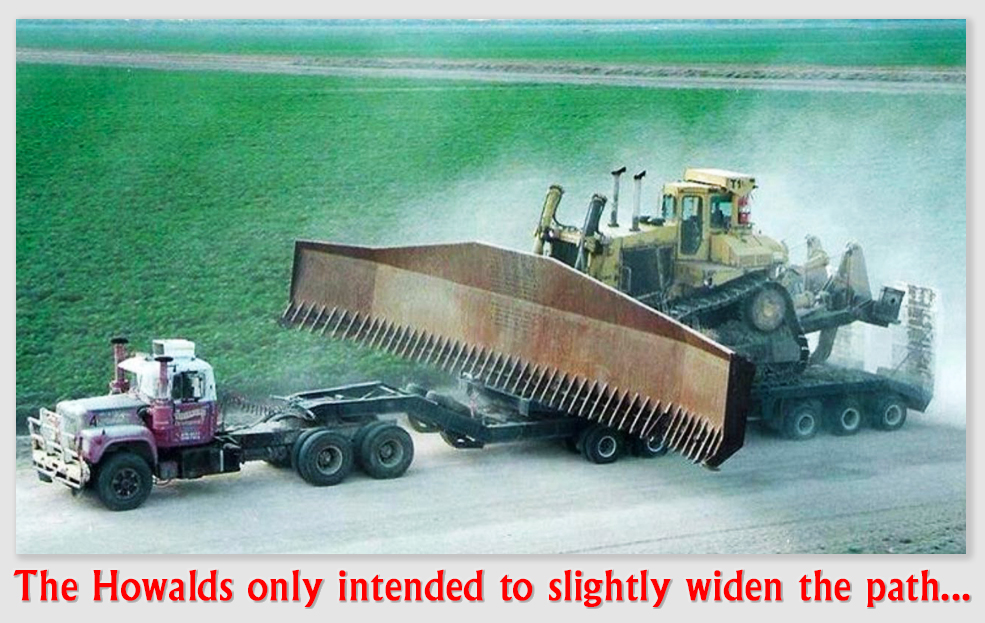
But what if Kirk, in a well-intentioned effort to improve Hogan’s Hill for the public, decided to bulldoze a few moguls or reroute the creek through some concrete culverts? And halfway through the work on a winter’s day. he parks his bulldozer at the bottom of the hill to go inside for a cup of that mulled wine? And while he’s gone, little Johnny and Judy race down the hill on a toboggan and collide with the dozer’s blade?

Or say Kirk used the dozer to dig a 10-foot deep pit just before the creek to stop sleds before reaching the water, and Johnny and Judy run their toboggan into the hole?

In a case like that, the liability issue is murkier. When it comes to the hill, doing nothing to alter or repair its natural conditions – even if the alteration makes perfect sense – might not just be an option, but even perhaps a better option.

Combs v. Ohio Dep’t of Natural Resources (2016), 146 Ohio St. 3d 271. Richard Combs was celebrating his birthday at Indian Lake State Park, which is open to the public without an admission charge. He spent the night fishing and early the next morning walked to Pew Island, where the fishing is better. As Rich walked across the causeway to Pew Island, Jerry Leeth, an ODNR employee, was using a boom mower to cut weeds and brush along the lakeshore. One of the mower blades threw a rock that struck Rich in the eye and face, and caused serious injuries.

Rich sued ODNR in the Court of Claims, alleging that Jerry negligently operated the boom mower and caused his injury. The Court of Claims granted ODNR’s motion for summary judgment, holding that because Rich was a recreational user, ODNR had no duty to keep the park safe for his entry or use, and his negligence claim was thus barred as a matter of law.

The court of appeals reversed the decision, holding that although the recreational user statute abolished a property owner’s duty to keep its premises safe for use by recreational users, it provides immunity only for injuries caused by the defective condition of the premises. The appellate court held that because Rich claimed that he was hurt by an ODNR worker’s negligence and not by a defect in the premises, the recreational user statute did not apply.

Richard appealed to the Ohio Supreme Court.

Held: ODNR was not entitled to immunity under the recreational user statute ORC § 1533.181, because Rich’s injuries did not arise from a defective condition of the premises, but rather from negligent mowing by an ODNR employee, and, as such, ORC § 1533.181 did not apply.

The Court noted that ORC § 1533.181, the recreational user statute, provides that no landowner owes any duty to a recreational user to keep the premises safe for entry or use or extends any assurance in that regard. Under the statute, a landowner is not liable to a recreational user for injuries caused by the defective condition of a recreational premises.

At common law, a landowner owed a duty to those who entered the premises, depending on whether the people were invitees, licensees, or trespassers. A landowner owed an invitee – someone the landowner had invited onto the property – the duty to exercise ordinary care to render the premises reasonably safe. The landowner owed no duty, however, to a trespasser or licensee upon the land except to refrain from wanton, willful, or reckless misconduct which is likely to injure him.

The common law also recognizes that a landowner, being aware of the presence of a licensee, or even a trespasser, is required to use ordinary care to avoid injury to him arising from the active negligence of such owner or his servants. The duty to exercise such reasonable care arises after the landowner knows or should know that a licensee or trespasser is on the land.

The recreational user statute amends the common law rule. Instead of common law distinctions based on the status of the person on the land, the duty owed depends solely on whether the person using the property qualifies as a recreational user. The statute limits landowner liability for injuries to recreational users in three ways: (1) no landowner owes any duty to a recreational user to keep the premises safe for entry or use; (2) granting permission to enter the property is not an assurance that the premises are safe; and (3) a landowner is not liable for injuries caused by the act of a recreational user.

But the statute has its limits. The Court observed that the legislature could have excused a landowner from any duty whatsoever to any recreational user, “but tellingly, it did not do so.” Instead, the statute does not abrogate a landowner’s common law duty to exercise reasonable care to avoid negligently injuring those on the premises, and – in the absence of language clearly showing the intention to supersede the common law – the existing common law continues in full force.

Accordingly, the Court ruled, the recreational user statute does not limit a landowner’s liability for a negligently inflicted injury that does not arise from the condition of the premises. In this case, Rich’s injuries did not arise from a defective condition of the premises but rather from Jerry’s alleged negligent operation of the mower. ORC § 1533.181 simply does not apply in these circumstances.

– Tom Root

TNLBGray

Case of the Day – Tuesday, December 30, 2025

SLIP SLIDING AWAY

A few nights ago, my bride of 46 years and I enjoyed a pre-Christmas open house at a friend’s beautiful hillside stone house on Chestnut Street in our fair city.

To one side of the house is a steep hill about 120 feet wide known throughout town as “Hogan’s Hill.” Over a distance of 90 feet from the top of the hill to the bottom, the hill falls 30 feet, a 33% grade. Ask any trucker: a 33% grade is serious business.

After reaching the bottom, the land is flat for another 150 feet, until it falls three feet into a creek.

In other words, Hogan’s Hill is a perfect sledding venue. You fall like a rock for the first 90 feet of travel and then run over fast snow for another 150 feet. A wise sledder will jump off the sled before careening into the creek.

Hogan’s Hill has been my hometown’s sledding hill of choice – according to our local historian – for over a century. When my wife’s father was young, he sledded on the Hill. So did my wife, and 30 years later, so did our kids. This year, our grandsons would have gotten a run (on a sled with Grandpa Me) down Hogan’s. The weather wasn’t especially willing at 61º, however, despite the promise of a monster winter storm only a few states away.

Now the rub: Hogan’s Hill is part of the property on which the hillside stone house sits. That means it belongs to my friend Kirk Piper.

Any reasonable homeowner owning Hogan’s Hill ought to be scared to death that dozens of strangers would freely gather on his property and race down the hill on sleds, running into the icy creek, into trees and into each other. Over some excellent beef brisket the other night, I asked Kirk about his liability.

Kirk said the City had reached an agreement with him when he bought the property that the Hill would be covered by the City’s liability insurance policy. However, he was not sure whether he might have liability in the event of an accident in excess of the City’s policy, or whether the City could demand contribution from him in the event that something happened on the hill that insurance refused to cover.

Fortunately for Kirk, I read this column regularly (a necessity, because I write it). Because I was enjoying his beef and beer, I felt obligated. So I asked him, “How much do you charge to let people sled?”

“Nothing,” he said.

“What have you done to fix up Hogan’s Hill for sledding?”

“Not a thing,” he replied. “Should I?”

Heavens, no, Kirk. Keep Hogan’s unimproved, don’t sell tickets, don’t do anything. If you follow that advice, those sledders are recreational users, and they are on their own.

Marrek v. Cleveland Metroparks Board of Commissioners, 9 Ohio St. 3d 194 (Supreme Ct. Ohio, 1984). Sally Marrek was sledding in the Hinckley Reservation of the Cleveland Metroparks System, the City’s “Emerald Necklace.” Gary Wascovich negligently struck her face with his foot. As a result, Sally suffered face and eye injuries.

Sally sued the Metroparks and Gary. The trial court granted the park district’s motion to dismiss the complaint based on Ohio’s recreational user statute and governmental immunity.

Sally appealed, and the case ended up at the Ohio Supreme Court.

Held: The Metroparks system is not protected by governmental immunity, but it is immune from liability under Ohio’s recreational use statute.

The court held that the conduct Sally claimed to be the tort of negligence involved the carrying out of previously established policies or plans, thus making the park district liable to the sledders as private corporations and persons. Thus, Sally’s complaint should not have been dismissed on the basis that the park district was protected by governmental immunity.

However, the Court said, Sally was a gratuitous user who entered the premises for sledding, a recreational pursuit.

Section 1533.181 of the Ohio Revised Code, Ohio’s recreational use statute, holds that no owner, lessee, or occupant of premises owes any duty to a recreational user to keep the premises safe for entry or use. Under ORC § 2743.02(A), the recreational use statute applies to state-owned lands. Thus, public landowners are liable to the same extent as private landowners under this statute.

According to ORC § 1533.181(A)(1), no owner of the premises owes a duty to a recreational user to keep the premises safe for entry or use. A recreational user is defined in § 1533.18(B) as a person to whom permission has been granted, without payment of a fee or consideration to the owner, lessee, or occupant of premises – other than a fee or consideration paid to the state or any of its agencies – to enter the premises to hunt, fish, trap, camp, hike, swim, or engage in other recreational pursuits.

Statutory immunity for landowners in situations such as this one, the Court noted, promotes the development and availability of property for recreational use and is consistent with the public policy reflected in the recreational use statute. The purpose of the statute, the Court ruled, is “‘to encourage owners of premises suitable for recreational pursuits to open their land to public use without worry about liability.'”

Sally was a gratuitous user, the Court ruled, and she entered the premises for sledding, a recreational pursuit. Therefore, the requirements of ORC § 1533.181 were met, meaning the park district did not owe a duty to Sally, a recreational user, to keep the premises safe for use.

That’s a wonderful thing for Kirk… provided he does nothing to Hogan’s Hill. We’ll see why doing nothing is not only an option but the smart one, tomorrow.

– Tom Root

TNLBGray

Case of the Day – Monday, December 29, 2025

SUED FOR NOT HAVING LAWS AGAINST SUCH A THING

Looking for the deep pocket is a time-honored tradition in personal injury law. Today’s case, dating from 1931, proves that point.

The first rule of plaintiffs’ advocacy … look for the deep pockets.

A young boy and his uncle were riding in a one-horse open wagon down the center of a public street. A homeowner had hired a couple of guys to cut down a tree along the street. For whatever reason (but probably because the workers were knuckleheads), the tree fell onto the wagon, injuring the occupants.

“Straightforward enough,” you say, “so where’s the catch?” It’s here: before cutting the tree, the contractors went to the mayor to ask about permits. The mayor, a dentist by trade, advised that there were no teeth in the local ordinances and no permit was needed to cut down a tree.

He was right, not that that mattered much. The injured boy’s guardian sued the city for not making sure that the tree cutter cut the tree down safely. Reduced to its essence, the claim seemed to say the City had money, and no other defendant did, so it must be liable somehow.

A jury agreed, but the Supreme Court reversed.

There can be little doubt that the City was sued in this early Depression-era tale, because the City was the only party likely to be able to pay a judgment. Finding someone with money is always a good idea in a personal injury case, but there are technicalities – such as the party with money should somehow be liable to the victim – that should be observed.

Here, the theory seemed to be that the City should have had laws against unsafe tree removal, and its failure to have such ordinances on the books somehow made it responsible for the plaintiff’s injury.

Armstrong v. Waffle, 236 N.W. 507 (Supreme Court, Iowa, 1931). Three-year-old Biff Armstrong sustained personal injuries resulting from a homeowner’s removal of a tree in front of his house along a city roadway. The contractor hired to remove the tree asked the mayor of the City of Marion if a permit was necessary to remove the tree. The mayor said that he knew of no permit that was needed to remove the tree, and there was no ordinance in the City of Marion governing the cutting and removal of trees.

The contractor cut the branches from the tree until he was left with a stump of some 14 or 15 feet in height. Just before the Neffs were ready to saw the tree off, and while they were working with the branches, Joe Armstrong, an uncle of the plaintiff, a drayman by occupation, drove north in a dump wagon. Joe had Reuben, a child of about 3 1/2 years old, on the seat of the wagon with him. The tree suddenly fell across the front of the wagon and crushed him and the child, breaking Joe’s leg and severely injuring the boy.

The boy’s guardian sued the landowner, the contractor and the City of Marion. The jury found in favor of the plaintiff against the City, and the City appealed.

Held: The Court found the contractor to be negligent in felling the tree, but the City of Marion was not liable.

The Court held that the City’s liability was restricted to keeping the streets open and in repair and free from nuisance. Armstrong did not allege any nuisance existed in this case, nor did he claim that the City failed in its duty in not barring travel on the street or otherwise warning him of the danger incident to the removal of the tree.

The City alleged that the claim against it pertained to a governmental function or duties of the City for the breach of which the City is not liable. The City contended that its duty related only to construction, maintenance and repair of the street and that a municipality cannot be held liable for failure to protect citizens against actions occurring on its streets for reasons other than defects therein or by reason of a nuisance.

A municipality does not guarantee its citizens against all causalities incident to humanity, and cannot be called upon to compensate a party for its inability to protect against all accidents and misfortunes. There was no ordinance in the City regulating or prohibiting the removal of the tree. The City had a right to assume that the tree’s owner and his agents would exercise a proper degree of care to prevent injury to people on the street at the moment the tree fell.

– Tom Root

TNLBGray

Case of the Day – Friday, December 26, 2025

WRONGFUL TREES

camelnose141003

For all of the Latin phrases, hidebound traditions, and libraries full of precedent, the law at its essence is nothing more than a codification of policies generally accepted by society. The law doesn’t always get it right – some laws aren’t carefully drafted, others do exactly what the legislature intended but pursue foolish or even repugnant policies – but by and large, the law tries to lay out rules for conduct based on policies generally accepted to be important.

Keeping an eye on the prize – the societal goals to be achieved – often helps courts from going overboard. It’s how the camel’s nose can be allowed into the tent without getting the whole camel in the process.

A good example of this is the “wrongful life” lawsuit. States all allow a “wrongful death” action, in which the survivors of someone killed, say, in a car accident or from medical malpractice sue for damages. This makes good sense. But in the last decade or so, some “wrongful life” suits have been brought, where – for example – a physician misdiagnoses and tells prospective parents that their fetus is healthy, but the doctor is wrong. The child is born with severe birth defects. The “wrongful life” suit claims that but for the physician’s negligence, the child would have been aborted.

Very few courts have permitted such a lawsuit for several very good public policy reasons. The first is that society does not recognize, as a matter of policy, that anyone is better off not having been born, no matter how severe the burdens of congenital disability. Second, the whole idea of tort law is to place the injured party in the same position as he or she would have been in had the negligence not occurred. But for the negligence, the injured party wouldn’t have been born. What can be done to put a living plaintiff in that position, or, ­for that matter, to compensate for having been born instead of never being?

And what would have made Ms. Lewis happy? Perhaps if the Krussels had only clearcut their property ...

Just what would have made Ms. Lewis happy? Perhaps if the Krussels had clearcut their property …

All right, that’s pretty heady stuff, but what does that have to do with tree law? Simply this: in today’s case, the plaintiff, Ms. Lewis, suffered from having a tree belonging to her neighbors Gary and Nancy Krussel fall on her house. Her suit simply claims: the tree fell on her house; the neighbors knew they had a tree; therefore, the tree was a nuisance; and the neighbors were negligent in failing to keep the tree from falling on the house. There was no evidence that the Krussels had any inkling this particular hemlock was going to fall. There was no evidence any reasonable person would have had such an inkling. In fact, there was no evidence that the tree was diseased or damaged. Reduced to its essence, Lewis’s claim was that the tree existed and the tree later fell, and those facts made it a nuisance. The tree was alive, the argument seems to say, and that fact wronged Ms. Lewis.

Fortunately, the Washington state courts made short work of this claim. Ms. Lewis was trying to advance a negligence claim as a nuisance claim, probably because she had no evidence of negligence. But, the courts ruled, public policy was not ready to declare a tree a nuisance merely because it was growing, nor was it prepared to hold that property owners were liable for what became of any naturally-growing, healthy trees on their land.

Without keeping one eye on public policy, the courts’ development of the law might go like this: First, landowners are responsible for damage caused by trees on their property that are diseased or damaged, and about which condition they are actually aware or reasonably ought to be aware. The next step would be for the courts to rule that owners must inspect their trees to avoid liability. Finally, landowners would be strictly liable for any damage caused by their trees, whether they were aware of a problem with the trees or not.

camelnose140310Largely, the law has stopped short of such a draconian rule, because the courts recognize that public policy favors the natural growth of trees, and eschews requiring property owners to devote substantial time and money to inspect trees, where there is no concomitant benefit to the public. By and large, courts have enough policy sense to let the camel’s nose into the tent while keeping the rest of the dromedary outside.

It is this kind of analysis that is illustrated in today’s case.

Lewis v. Krussel, 101 Wash.App. 178, 2 P.3d 486 (Ct.App. Wash. 2000). During a windstorm, two large healthy hemlock trees fell on Dawn Lewis’s house. She sued Gary and Nancy Krussel, who owned the property on which the trees had been growing.

Krussel acknowledged that windstorms had knocked down other trees on his property and other properties nearby in previous years. About a week after the windstorm at issue here, another windstorm knocked a tree onto his mother’s mobile home. But the trees that damaged the Lewis house were natural growth, and Krussel had no reason to believe that they were any more dangerous than any other trees on his property under normal conditions. After the damage to the Lewis house, Krussel cut down other hemlock trees located near his house upon the recommendation of the local utility district.

After Lewis sued for nuisance and negligence, Krussel moved for summary judgment. He supported the motion with evidence from a professional forester who inspected the stump of one of the fallen trees and found no evidence of rot. The forester concluded the tree that fell on the Lewis house was no more dangerous than any other tree standing on the Krussels’ property, and there was no way for the Krusselses to determine beforehand whether any one of their trees would fall over. The trial court dismissed the Lewises’ claim, and Lewis appealed.

Held: The appeals court upheld the dismissal of Lewis’s claim.

Sure Ms. Lewis's house was crushed ... but gravity did not turn the healthy tree that toppled onto her roof into a nuisance.

Sure Ms. Lewis’s house was crushed … but gravity did not turn the healthy tree that toppled onto her roof into a nuisance.

A homeowner is not obligated to remove healthy trees because they might topple in a storm. The Court of Appeals said that just because a negligence claim was disguised as a nuisance suit didn’t mean that the trial court had to consider it as such. Instead, in situations where the alleged nuisance is a result of what is claimed to be negligent conduct, the rules of negligence are applied.

The elements of a negligence cause of action, of course, are (1) the existence of a duty to the plaintiff, (2) a breach of the duty, and (3) injury to the plaintiff flowing from the breach of duty. An owner of property located in an urban or residential area who has actual or constructive knowledge of defects affecting his or her trees has a duty to take corrective action. However, the same is not the case when the tree is healthy. In that case, the owner does not have a duty to remove healthy trees merely because the wind might knock them down.

In this case, the Court agreed, there was no evidence that Krussel had any reason to believe that the hemlock trees posed a hazard, and a professional forester who had inspected the stump of the fallen tree had found that the tree was free of defects. The mere possibility of harm does not mean the probability of harm.

– Tom Root

TNLBGray

Case of the Day – Wednesday, December 24, 2025

Missed you

We’re out until Friday, December 26th, watching early and inconsequential bowl games.

tag

turkey161223

Our turkey, covered with bacon, is being cooked on the grill again this year. Tradition tastes so good…

No heavy lifting for today (unless perhaps a really big present, maybe a new chainsaw or something). We’re being overrun by our three grandsons (ages 7, 3 and a year old). Our two granddaughters are wisely staying in sunny and warm Minnesota. Meanwhile, we’re hunkered down awaiting the jolly old Elf. I’ll see you back on Frieday, December 26th. 

For now, I have an arboriculture law present for you from me.

I really do, a little literary gem, a simple case from That State Up North (Michigan, for you non-Ohioans out there) in which the property owner sued a driver who careered off the road and ran into the landowner’s beloved oak tree. The tree was badly damaged, the plaintiff said, and would need special care for the remainder of its days.

The driver defended on jurisdictional grounds, arguing that Michigan’s “no-fault” insurance law meant that the court could not assess property damages against him for the mishap.

The Court denied the landowner’s case, but it did so in verse (with apologies owed to Joyce Kilmer):

We thought that we would never see
A suit to compensate a tree…
A suit whose claim in tort is prest
Upon a mangled tree’s behest;
A tree whose battered trunk was prest
Against a Chevy’s crumpled crest;
A tree that faces each new day
With bark and limb in disarray;
A tree that may forever bear
A lasting need for tender care.
Flora lovers though we three,
We must uphold the court’s decree.

Doggerel? I don’t think so. Perhaps “poetic justice” instead. Whatever it might be, it makes for more interesting reading, and no doubt amused everyone except the plaintiff, who was left uncompensated for the damage to the oak tree.

May your trees remain healthy, happy, properly trimmed by a professional arborist, and clear of easements, rights-of-way, neighbors, and passers-by for this season and all of 2026.

Merry Christmas to all!

Buffer

Fisher v. Lowe, 333 N.W.2d 67, 122 Mich.App. 418 (Ct.App. Mich., 1983).

The facts:

“A wayward Chevy struck a tree,
Whose owner sued defendants three.
He sued car’s owner, driver too,
And insurer for what was due
For his oak tree that now may bear
A lasting need for tender care.
The Oakland County Circuit Court,
John N. O’Brien, J., set forth
The judgment that defendants sought
And quickly an appeal was brought.”

Held:

“Court of Appeals, J.H. Gillis, J.,
Gave thought and then had this to say:
(1) There is no liability
Since No-Fault grants immunity;
2) No jurisdiction can be found
Where process service is unsound;
And thus the judgment, as it’s termed,
Is due to be, and is,
Affirmed.”

– Tom Root


TNLBGray

Case of the Day – Tuesday, December 23, 2025

IMPEACHMENT IN WASHINGTON, D.C.

Just for something different, I thought I’d write about impeachment and Washington, D.C. You know, of course, what I mean, and her name doesn’t rhyme with Epstein… but some intend that it will.

The District of Columbia – the motto of which is “taxation without representation” – argues that it should have voting representation in Congress like the rest of us. As a voter, I would just as soon not be held responsible for the cretins who cast ballots on Capitol Hill. Being responsible for one level of incompetent boobs managing the city I lived in seems to be plenty.

Am I unfair to D.C. municipal employees? Not according to John Katkish, who accused the Dept. of Public Works Tree and Land Division (“TLD”) of incompetence. He said that when he noticed a tree leaning in on his house, he called the TLD. Nothing happened, and a week later, the tree fell on his residence.

John’s lawyer got flummoxed by the rules of negligence, which require, right out of the gate, you show that there is a recognized standard of care and that the defendant failed to meet it. John’s two experts did not testify as to what the national standard of care might be when a resident calls to say a tree is suddenly leaning toward his house and looking like it’s going to fall. (If you figure that the standard is pretty obvious, you can be forgiven for that burst of common sense… but you’ll never be a lawyer).

John’s second problem was that he insisted he had accurately conveyed the emergent nature of the situation to the TLD guy he talked to on the phone. But when the trial dust settled, the TLD had not put the man – whose name was Alvin – on the stand.

There is a great evidentiary claymore a party can wield on its foes in such instances, called themissing witness instruction.” Where a witness is peculiarly within the control of one party, has particularly first-hand evidence on some element of the case, and yet is not called by the controlling party, the other party is entitled to have the judge tell the jury members that they may infer from the witness’s non-production that had he appeared to testify, his testimony would have been harmful to – that is, would have impeached – the controlling party’s case. Here, had the instruction been given, the jury could have surmised that Alvin would have testified that John screamed into the phone, “The tree is falling! The tree is falling!,” and thus made the emergency nature of the situation clear.

Alas, John missed out on getting a missing witness instruction, because although Alvin worked for TLD, there was no evidence that John’s lawyer could not have called him for a deposition, an interview, or even a cup of coffee.

In the final analysis, it seemed John called the TLD once and then figured that a single call should be enough. As it turns out, “one swallow does not a summer make,” nor does one call define an emergency.

Katkish v. District of Columbia, 763 A.2d 703 (Ct.App.D.C. 2000). When John Katkish, a resident of our nation’s capital, noticed a large tree leaning toward his house, he did what anyone would do in such circumstances: He called the District of Columbia Dept. of Public Works, Tree and Land Division (“TLD”), to complain.

Fat lot of good that did. A week later, the leaning tree fell on his house. That’s when John did a second thing that anyone would have done in such circumstances.  He sued the District of Columbia for negligence.

At trial, John called two expert witnesses. The first, arborist James Biller testified that a 60-foot tall oak tree leaning toward a house with a lifting curb would warrant immediate inspection and possible abatement. The trial court rejected Arborist Biller’s opinion because he failed to define a national standard of care for the maintenance of leaning trees or the response time to notification of that condition. In addition, the trial court complained, Mr. Biller based his opinion on what Virginia municipalities do and lacked familiarity with the District of Columbia’s horticultural situation and how it compared to that in Virginia.

John also called Thomas Mayer, an expert in utility arboriculture. The trial court rejected Mr. Mayer’s testimony because he also did not specify a national standard or one relating to comparable municipalities.

On the first day of trial, Sandra Hill, a TLD employee, testified that Alvin Baltimore was the clerk who took John’s call on May 20. After the close of the evidence, John asked the trial court for an adverse inference against the District under the missing-witness presumption, because the District had offered no explanation as to why it had not called Alvin to testify. The trial court questioned whether Alvin was available to the District but not to John, and ultimately refused to draw an adverse inference from the District’s failure to call Alvin as a witness.

Unsurprisingly, the trial court found that John did not convey the emergency nature of the situation to the TLD when he called on May 20th, and thus held that the government was not negligent.

Equally unsurprisingly, John appealed.

Held: The trial court’s decision was upheld because John failed to present sufficient expert testimony to establish the standard of care the TLD needed to meet in order for it to avoid being found negligent. As for the missing witness Alvin, the trial court did not abuse its discretion by declining to draw an adverse inference regarding the worker who took the report of the leaning tree that the appellant phoned in.

While expert testimony regarding the appropriate standard of care isn’t necessary for acts within the realm of common knowledge and everyday experience, the appellate court ruled, a plaintiff must put on expert testimony to establish the standard of care when the issue in question is so distinctly related to some science, profession or occupation as to be beyond the ken of the average layperson. The expert’s testimony must clearly relate the standard of care to the practices in fact generally followed by other comparable governmental units, or to some standard nationally recognized by such units.

In this case, the Court found, “an average lay person is not capable of discerning when a leaning tree may create a dangerous situation requiring an emergency response and whether the likelihood of the tree falling is related to the condition of the tree, the street, or other circumstances.” Thus, the trial court was not wrong to rule that the standard of reasonable care and maintenance of a dead and leaning tree by a municipality – at least in the non-emergency situation presented in this case – was “beyond the ken of the average person.”

Based on the trial court’s finding that John told the District only that there was a “dead” and “leaning” tree in front of his house, the appellate court agreed that expert testimony was needed to determine the standard of care the District of Columbia had to meet to abate the situation.

The requirements for a missing witness inference are that the party proposing such inference must show the missing witness is (a) able to testify about the transaction such that he might be expected to be called as a witness, and (b) is peculiarly available to the party against whom the inference of unfavorable testimony is made. A trial court must exercise discretion in making its decision whether to give an instruction on the missing witness inference and be “constantly mindful of the dangers inherent in creating evidence from nonevidence.”

Here, John did not show that the trial court abused its discretion in refusing to draw a missing witness inference. John had plenty of chance to take Alvin’s deposition, meaning that Alvin was hardly just available to the Dept. of Public Works. Given the principle that the missing witness inference “need not be applied broadly or rigidly,” the court of appeals wrote, “we cannot conclude that the trial court erred as fact finder in refusing to draw the inference.”

Thus, John could not use Alvin’s absence to ask the jury to infer that he would have impeached D.C.’s defense.

The Court noted that there was plenty of evidence to support the trial court’s conclusions in the case. The record showed John made no follow-up contacts by phone or in writing to anyone in the D.C. government after the May 20th call, despite the fact he testified that he believed the tree was going to fall. In fact, John saw a TLD crew outside his house after he had noticed the leaning tree but before it fell, yet did not contact the crew to have them look at the tree. Therefore, the trial court’s ruling was supported by the evidence.

– Tom Root

TNLBGray140407