Case of the Day – Tuesday, July 9, 2024

YEAH, LITERALLY

literally140423

One of the many badges that marks me as a curmudgeon, according to a recent book, is my preoccupation with proper language. OMG! Am I ever!  I suppose people use slang because YOLO. But because this blog aspires to be the GOAT of tree and neighbor law sites, I’m going to stay frosty and keep it real.

I trust you recognize irony when it smacks you in the face.

I am not ashamed to admit that my gorge rises when people say “irregardless” when they mean “regardless,” say “affect” when they mean “effect,” or use “like” every third word or so. And don’t get me started about made-up nonsense like “ze” or “Mx” or “Latinx.” As far as we’re concerned, “ze” should always precede the word “plane” and be shouted by Tattoo. “MX” will always be a missile program. As for “Latinx,” it’s just wrong. Ask 97% of Latinos what they think.

But what metaphorically drives me batty is the casual and improper use of the word “literally.” The word means “actually” or “without exaggeration.” Believing as I do that the widespread devaluation of like every corner of the English language is like literally going to send us to hell in a handcart, I was surprised to see that today’s case ­– well over 50 years old – featured a witness describing “literally thousands of bees inside the trunk” of the decayed tree.

I was fascinated that, with such a swarm pursuing him, the witness took the time to count the bees, at least until he passed 2,000. That took nerves of steel. Literally.

Beyond my disquiet over the witness’s imprecise and flawed language, I was interested in the application of both Hay v. Norwalk Lodge No. 730, B.P.O.E., 92 Ohio App. 14, 109 N.E.2d 481 (Supreme Court, Ohio, 1951) and Brandywine Hundred Realty Co. v. Cotillo, 55 F.2d 231 (3rd Cir. 1951). While those decisions – which I’ve discussed recently here and here – relate to injury to passing motorists, the court here couldn’t see any practical difference between the landowner’s duty to a motorist and to a parked car. Furthermore, it found that the tree was so obviously dead and dangerous that the landowner was chargeable with knowing about its condition, although he’d only owned the property for a few weeks.

How many bees? Literally thousands ...

How many bees? Literally thousands …

The court said that a few weeks was not so legally insufficient a period of time for him to have gotten over and inspected the place that the factfinder was wrong for finding him liable.

The trend here is clear: the law was moving toward holding that a property owner had an affirmative duty to inspect the land. Actual or constructive knowledge wasn’t enough. The absentee owner should have done a drive-by, the court decided by implication. Thus the evolution of a requirement that an owner affirmatively care for his or her property continued.

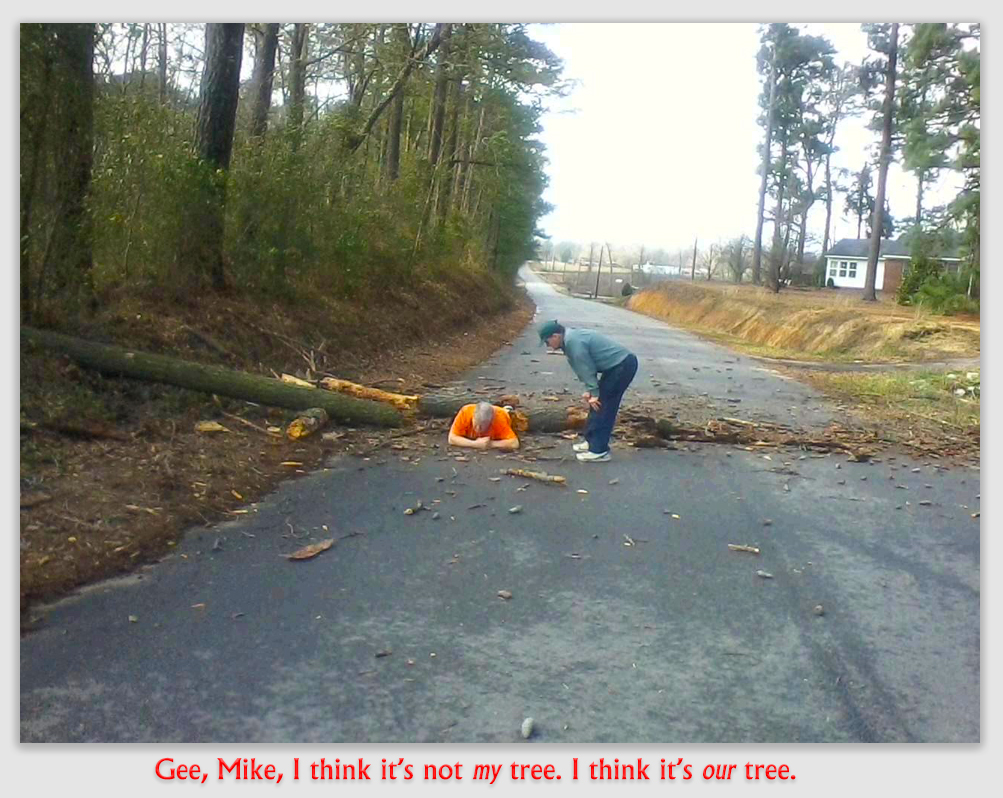
Turner v. Ridley, 144 A.2d 269 (Ct.App.D.C. 1958). Turner owned a house facing a street on which automobiles were regularly parked. The small front yard featured a single large tree. On a fall evening, Ridley’s friend parked Ridley’s car at the curb in from of Turner’s house. Early the next morning, with no inclement weather to blame for the event, the tree toppled and fell across the sidewalk, striking Ridley’s car.

At the time the tree fell, according to the man who had parked Ridley’s car – a man named Reid ­– the tree ‘was rotten and looked like it was dead and had very few leaves on it.’ and on the night before it fell he had remarked to a friend ‘that tree looks like it is going to fall someday.’ The tree in falling broke off even with the ground, and then it was observed that the tree was hollow and badly decayed with ‘literally thousands of bees inside the trunk.’

Turner testified he had purchased the property through an agent at a foreclosure sale a month before the mishap, that the property had been vacant since he purchased it, that he had never seen the property or the tree, and that he had no notice or knowledge that the tree was in a dangerous or rotten condition. The trial court awarded judgment to Ridley for the damages he sustained.

Turner appealed.

Held: Turner was liable for the damage to Ridley’s car. While prior cases diverge somewhat, the Court found the Ohio decision in Hay v. Norwalk Lodge No. 730, B. P. O. E., instructive, holding that “an owner having knowledge of a patently defective condition of a tree which may result in injury to a traveler on a highway must exercise reasonable care to prevent harm from the falling of such tree or its branches on a person lawfully using the highway.”

Knowledge could either be actual or, as held in Brandywine Hundred Realty Co. v. Cotillo, constructive, “if such condition was known or by the exercise of ordinary care could have been known by the defendant.”

The car was the first casualty ... but not the only one.

The car was the first casualty … but not the only one.

The Court admitted that Hay and Brandywine dealt with personal injuries to travelers on the highway, but it observed that there is “no distinction in principle between the case of personal injury to one lawfully traveling on a highway and the case of property damage to a vehicle lawfully parked on the highway.” The issue was whether the owner – who had only owned the property for a few weeks and who had never seen it before – could be charged with constructive knowledge of the tree’s condition. There was no question that the tree was obviously dangerous and quite dead. The Court acknowledged that “[a] three-week period is no great length of time, but we cannot rule that such period was legally insufficient time for appellant to look over his property and observe the condition of the tree and take steps to prevent its fall. We think the evidence presented a factual question as to notice and lack of care.”

“Hard cases are the quicksands of the law,” as an old maxim put it. Here, the intersection of an absentee owner, an obviously defective tree, a fairly minor damage bill, a colorful witness and lack of any defense by Turner, combined to bring about a holding that imposed additional duties on a landowner.

– Tom Root

TNLBGray140407

Case of the Day – Monday, July 8, 2024

IT DOESN’T TAKE THAT MUCH TO BE RECKLESS

Today, my bride of 45 years and I are climbing up an ash-covered glacier (in Iceland, where else?), doing things with an ice axe and crampons that seem kind of reckless for grandparents of 4.66 grandchildren to be doing. It’s a great segue into today’s topic.

We all have some sense of what kind of conduct is reckless. At least, to channel the late Justice Potter Stewart, we’re pretty good at knowing it when we see it. Riding a motorcycle into a wall at 100 mph while drunk? Yeah, probably reckless. Standing on a ledge at the top of a skyscraper for a selfie? You bet. Lying between railroad tracks while a train passes? We’ll give you that one, too.

But when the law uses the term “reckless,” in fact when the law adopts any standard, the term has to have a specific definition. If not, laws punishing conduct that did not meet the standard would be arbitrary (as well as falling short of their goal of causing people not to be reckless in the conduct of their affairs).

I’m sorry, Justice Stewart. ” Knowing it when [you] see it” is trenchant, but it’s not a good way to regulate conduct.

In today’s case, a Buckeye State classic, a car repair business trespassed on a neighboring business’s land to hack away at some spruce trees. The car repair manager thought the trees belonged to his company, but his belief – which flew in the face of the facts – was so heedless of the consequences that the court found him reckless.

We have seen worse cases that were considered to be  mere negligence, and we cannot discount that the trial court in this case was influenced by the extent of the damage to the “visual barrier” between the professional building (populated with the offices of lawyers, doctors and engineers) and the seamy oil-change-and-lube joint next door.

“Recklessness” let the trial court grant treble damages under Ohio law to the office building owner. Unsurprisingly, recklessness is what the trial court found. Maybe cynicism is creeping into our analyses as we age (we prefer the expression “as we get wiser”), but if the real estate owner had made the same unsupported surmise about the grease monkey’s trees, we suspect his misfeasance would be found to fall somewhere short of “reckless.”  Just sayin’.

ALH Properties, P.L.L. v. Procare Automotive Service Solutions, LLC, Case No. 20991, 2002-Ohio-4246 (Ct.App. Summit Co., Aug. 21, 2002) 2002 Ohio App. LEXIS 4412. ProCare and ALH were adjoining landowners. ALH had an office building on its property, and ProCare operated an auto repair facility. Between the two properties stood a row of large Norway spruce trees, providing a visual buffer between the two businesses. The trees are on ALH’s property, although some of the branches extend over ProCare’s property. ProCare cut branches off of the lower ten feet of the spruce trees, destroying the visual buffer. The branches will not grow back.

ALH sued, alleging reckless injuring of the trees under Ohio Revised Code 901.51. The trial court entered judgment against ProCare for $34,200.

ProCare appealed.

Held: ProCare was liable to ALH.

Do you see any recklessness here?

Section 901.51 of the Ohio Revised Code provides that “[n]o person, without privilege to do so, shall recklessly cut down, destroy, girdle, or otherwise injure a vine, bush, shrub, sapling, tree, or crop standing or growing on the land of another… “In addition to a criminal, the statutes subject a violator to treble damages for the injury caused.”

The Court held that as used in the statute, the term “recklessly” has the same meaning in a civil claim for treble damages as it does in a criminal proceeding for violation of the statute. A person acts recklessly when, with heedless indifference to the consequences, he perversely disregards a known risk that his conduct is likely to cause a certain result or is likely to be of a certain nature. A person is reckless with respect to circumstances when, with heedless indifference to the consequences, he perversely disregards a known risk that such circumstances are likely to exist.

The Court acknowledged that a privilege exists at common law for a landowner to cut off branches of an adjoining landowner’s tree that encroached on his land. But here, ProCare trimmed not just branches of the trees that faced its property, but also branches facing ALH’s property as well. ALH’s president testified he had not given anyone permission to trim the trees, and that he had previously trimmed branches that hung over his parking area and had removed one of the trees entirely because it died.

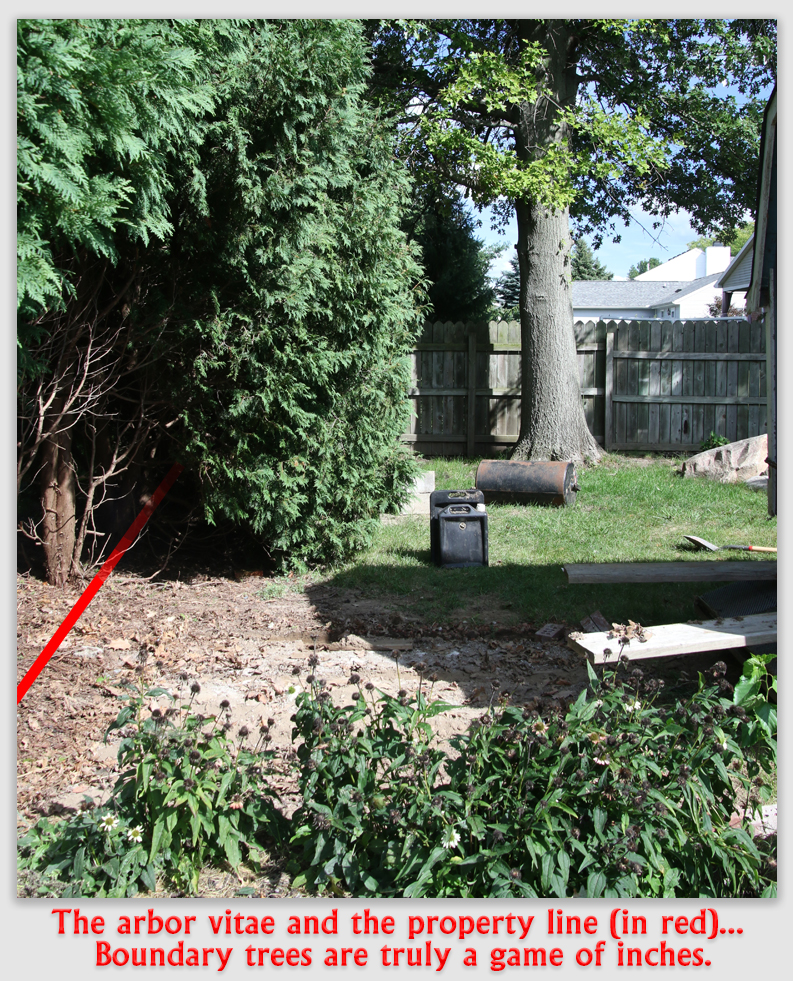
ALH offered a videotape its president had made on the day ProCare trimmed the trees, which included his running commentary on the damage done to the Norways.  All the while, the property line marker – a large post – was clearly visible. Pictures taken both before and after ProCare trimmed the branches were admitted into evidence. ProCare stores old tires, oil cans, and a dumpster in the area near the trees, and the photos showed how the trees had created a visual buffer from ProCare’s property and alleviated some traffic noise.

Martin Long, a ProCare manager, testified he thought the spruce trees were on ProCare’s property and that he assumed the trees were ProCare’s because “nobody ever took care of them.” He said he trimmed other branches hanging over ProCare’s property on two previous occasions with no negative consequences. He admitted that on one occasion, one of the Norways — which was dying — had been removed by someone other than a ProCare worker. However, he pointed out, in the spring ProCare would mulch the trees, and no one ever told him that the trees were not on ProCare’s property.

Long believed that only limbs that faced a direction other than toward ALH’s property were cut off. He said that when Myers approached him about ProCare trimming the trees, it was the first indication he had that the trees were not on ProCare’s property. Long admitted that when the spruce that was dying was removed, he did not know who removed it, but he did know that he, personally, had not directed anyone to remove it, nor did he have to pay for its removal. He stated that he thought ALH had removed it because of the risk it posed to ALH’s buildings.

The trial court found that the removal of the tree branches was reckless because Long had reason to know facts that would lead a reasonable person to question whether the trees belonged to ProCare. The trial court held that the complete removal of a large spruce tree in this row of trees at no expense or trouble to ProCare was an indication that ProCare did not own the trees nor was it responsible for maintaining them. The trial court also noted that Long’s testimony that the only branches cut were those that overhung ProCare’s property was disputed by the videotape and photographs, which clearly showed other branches were cut that did not overhang ProCare’s property.

The Court of Appeals found that the trial court’s conclusion that ProCare was reckless was not against the weight of the evidence. The Court held adequate evidence showed ProCare disregarded a known risk with heedless indifference to the consequences when it trimmed branches of trees that were clearly on ALH’s property.

ProCare also argued the trial court’s calculation of damages is against the manifest weight of the evidence.

ALH’s president testified that soon after ProCare trimmed the trees, he contacted two landscaping companies to install arborvitae to replace the barrier. A landscaper submitted a quote for $3,850 to plant 35 arborvitae, although he said planting arborvitae was inadvisable. He also said it was impractical to replace the spruce trees with ones of a similar size, given their 60-foot height. The landscaper provided a separate quote of $18,923 to remove the spruce trees, grind the remaining stumps, and plant a row of Colorado spruce.

A different landscape contractor testified for ProCare and said $3,750 to plant a row of arborvitae was appropriate, and that the shrubs would provide an adequate screening between the properties. He quoted $12,200 to remove the Norway spruce, grind the stumps, and plant Colorado spruce. He thought, however, that Colorado spruce would not provide an adequate barrier because they cannot be pruned properly. He recommended planting White Pine instead because White Pine can be pruned and trimmed more easily than spruce. His estimate to plant a row of White Pine was $11,400.

The trial court found that the best solution to replace the visual screening between the two properties was to replant trees, but that planting Colorado spruce was a disproportionate expense. It ruled that White Pine was a reasonable tree type for restoration, and awarded damages of $11,400. The amount was trebled pursuant to O.R.C. 901.51, for a total award of $ 34,200.

The court of appeals held that the trial court’s decision was reasonable.

– Tom Root

TNLBGray140407

Case of the Day -Tuesday, July 2, 2024

NOW LOOK WHAT YOU’VE DONE!

Rarely (as in “I don’t recall when I’ve ever said this before”) do I caution that the prevailing law in any particular state is wrong, and likely to be cruisin’ for a bruisin’ the next time an appellate court has to think about it. But I feel comfortable issuing that warning about today’s case.

From Ohio (home of rock ‘n roll, pro football, the first guy to walk on the moon, the brothers who turned a bicycle into the first airplane, and a ton of other cool things), comes a case that pretty much runs smack into Fancher, Herring, the Hawaii Rule, and a raft of other cases reflecting the modern view that a homeowner whose tree is wreaking havoc on the neighbor’s property may be ordered by a court to fix the damage at his expense.

To be fair, this case may be proof of the old legal aphorism that “hard cases make bad law.” Even the most cursory reading of the facts suggests that Dave Rababy may well have been a horse’s ass, hounding his neighbor because a tree dropped leaves and twigs on his property. Speaking as a guy who owns all of my five southerly neighbors’ leaves every fall – and these things are the size of dinner plates – I understand how it can be irritating to have other peoples’ leave on your lawn. But I would never sue them over it. I don’t think I would…

Dave had no such compunction, and his emesis of woe delivered to the court made him the boy who cried wolf. He howled so loudly about leaves and twigs and that his trimming crew was not allowed to trespass on Roy’s property and hack away at the offending tree, and minutiae of a similar nature, that his real complaint – his driveway was being heaved and foundations dislodged by the roots – got lost in the underbrush. In Fancher, Whitesell and even Iny, such damage was enough to get the neighbor’s tree declared a nuisance. If Dave had exercised a little plaintiff self-control, he might have gotten there, too.

We are too urban and too suburban, and our properties are too developed for the Massachusetts Rule to be the exclusive remedy for genuine harm done by a neighbor’s tree. That is the way the law is trending throughout the civilized world, and it is bound to reach Ohio sooner or later.

Rababy v. Metter, 30 N.E.3d 1018 (Ct.App. Cuyahoga Co., 2015). David Rababy and Roy Metter were next-door neighbors. Dave’s driveway abutted Roy’s property in certain places and nearly abuts in others. A fence separated the properties, and a stand of mature trees ran along the fence on Roy’s side of the boundary line.

Dave sued Roy for negligence, nuisance, trespass, and interference with a business contract. Dave asserted that trees at the edge of Roy’s property extended over his own property, and dropped leaves, needles, sap, and branches onto his car and home, and that some of the trees were rotten. He said the trees cast shadows over his property and cause mold growth on his roof, as well as damaged his driveway and foundation.

Dave complained he had a company to trim the overhanging branches, but Roy’s daughter prevented the unnamed landscape service company from properly performing this work. The complaint alleged the trees constituted an ongoing nuisance and trespass and that Roy negligently maintained the trees. Dave asked for $52,500: $37,000 for future tree trimming services and $15,000 in compensatory damages.

Both parties filed motions for summary judgment. Dave argued that on “an ongoing basis, Roy’s trees encroach onto my property, specifically over my home and driveway. His trees deposit leaves, debris, and sap onto my property, causing damage.” Dave also repeated the claim about Roy’s daughter running off the tree trimmers.

Roy argued that he owed no duty to Dave to trim otherwise healthy trees on his property. He claimed the trees were mature and preexisted either party’s ownership of the property. He said that a year before, Dave hired Cartwright Tree Service to trim the row of pine trees that ran along the driveway. He said no one complained when Cartwright trimmed the overhanging branches from Dave’s property free, but when Cartwright began trimming branches and trees back further than the property line, Roy’s daughter objected. Roy said that he has no objection to Dave trimming the overhanging branches back to the property line.

Dave replied with new allegations that the trees in question were decaying or dead. Attached to the reply was a new affidavit that averred that the trees were decaying and dangerous and that one had fallen on his property. He included a picture of a tree that appears to have fallen across a driveway. However, the affidavit was neither signed nor notarized.

The trial court granted Roy’s motion for summary judgment and denied Dave’s. Dave appealed.

Gen. Robert E. Lee – a man rapidly being consigned to the ash head of history – knew something about duty … and even he couldn’t have found that Roy owed one to Dave.

Held: Roy owed Dave no duty, so the trial court’s dismissal of the case was upheld.

In order to succeed in a negligence action, the Court said, Dave must demonstrate that Roy owed him a duty, that Roy breached the duty, and that he suffered damages that proximately resulted from Roy’s breach. Here, Dave offered evidence that falling pine needles, leaves, sap, and sticks had damaged his car, driveway, and roof. He also alleges, without evidentiary support, that encroaching tree roots damaged his driveway and home.

While he showed damage, Dave was unable to show that Roy owed him any duty. A landowner is generally not responsible for the losses caused by the natural condition of the land. Instead, the Court observed, states generally allow one impacted by such growth the remedy of self-help. A privilege existed at common law, such that a landowner could cut off, sever, destroy, mutilate, or otherwise eliminate branches of an adjoining landowner’s tree that encroached on his land. But, the Court said, whether a separate remedy exists is an open question.

The Massachusetts Rule provides that in almost all circumstances, the sole remedy for damages resulting from the natural dropping of leaves and other ordinary debris from trees is the common law remedy of self-help. The rule does provide a limited exception for dead trees, just as Ohio has established a duty for urban landowners of reasonable care relative to the tree [hat overhangs a public street, including inspection to make sure that it is safe.” Where constructive or actual knowledge of an unreasonably dangerous condition exists on the land of an urban landowner, such as a dead tree, the duty prong of a negligence claim may be satisfied.

The reasoning set forth in support of the Massachusetts Rule, the Court said, is apt to the facts of this case: “[T]o grant a landowner a cause of action every time tree branches, leaves, vines, shrubs, etc., encroach upon or fall on his property from his neighbor’s property, might well spawn innumerable and vexatious lawsuits.” The Court thus adopted the Massachusetts Rule as the law of this jurisdiction.

But Dave also argued that in Ohio a “landowner in an urban area has a duty to exercise reasonable care to prevent an unreasonable risk of harm to others from decaying, defective or unsound trees of which such landowner has actual or constructive notice.” Dave contended Roy’s trees were in such a defective condition and thus constituted a nuisance. Dave also argued that Roy, an urban landowner, had a duty to inspect his trees and protect others from a dangerous condition created by any unsound trees. Even if such a duty existed, the Court said, it only is breached when the owner has actual or constructive notice of a dangerous condition.

Leaves – often a pain in the arse, but seldom a nuisance

The Court held that Dave put forth no evidence that any of the trees constituted a dangerous condition of which Roy was aware or should have been aware. He presented no any evidence that the trees are dead, decaying, or unsound, and cited no case holding that “the normal yearly life-cycle of a tree and the natural shedding of leaves, twigs, and sap constituted a nuisance. Thus, he provided no compelling justification for a court to hold that Roy’s trees case constituted a nuisance or a dangerous condition. The problems Dave had experienced with the trees “are the natural consequence of living in an area beautified by trees. Dave’s remedy is to trim tree limbs that overhang his property back to the property line, to which Roy averred he has no objection.”

The trees at issue in this case do not constitute a nuisance, and Roy is not negligent in regard to them.

Dave also asserted that the trees on Roy’s property constituted a trespass. But the elements of a successful trespass claim include an unauthorized intentional act, and entry upon land in the possession of another. Here, there is no intentional act. Dave claimed that Roy’s actions of not removing or trimming the trees constitute an intentional act. But, the Court said, as it explained, Dave’s remedy for intrusion by vegetation is to trim it back to the property line.

In sum, Dave’s claims that detritus falling from trees from the neighboring property constituted a trespass, a nuisance, and negligence were simply not actionable. The Court cited a Maryland case that “it is undesirable to categorize living trees, plants, roots, or vines as ‘nuisances’ to be abated. Consequently, we decline to impose liability upon an adjoining landowner for the ‘natural processes and cycles’ of trees, plants, roots, and vines.”

– Tom Root

TNLBGray140407

Case of the Day – Monday, July 1, 2024

I CHANGED MY MIND… I GUESS

Doug Van Dyne had big plans for getting folks back to nature. He wanted to build a nature trail along a ravine that split his property and that of his waffling neighbor, Eunice North. People could enjoy the birds, the babbling brook, the scent of pine… that kind of thing.

If you ever wonder whether it’s a good idea to get agreements in writing, Doug’s $70,000 mistake will settle that question for you. Because Doug’s nature path would meander a bit onto Eunice’s side of the ravine, he told her about his plans for the trail. Eunice, who admitted that she really had no idea what Doug was talking about, said she just “shrugged my shoulders” and replied that “I guess it would be okay.”

To Doug, that was like the green flag at Indy.  But little did he know that Eunice promptly began to fret about her confused acquiescence. She had trouble sleeping for her worry, and finally asked a friend about the plan. Her friend told Eunice the trail idea was a mistake. Armed with this advice, Eunice said, she reneged. She claimed she told Doug that she didn’t want him around.

“No probalo,” Doug – who had no intention at all of honoring Eunice’s change-of-heart – allegedly responded. Regardless of his actual intentions, Doug promised Eunice that he “would go to a different plan.”

That different plan seems to have involved having his contractor run the bulldozers at full throttle instead of half throttle. By the time the diesel fumes cleared, 20 of Eunice’s trees had been ground under Caterpillar treads and the trail encroached on her land.

Eunice sued Doug for trespass, loss of lateral support, and loss of trees. The jury awarded Eunice $50,000 on the trespass and lateral support claims and $20,100 in treble damages on the loss-of-tree claim. It mattered little that Doug and the contractor both told a different story, the bulldozer operator testifying that Eunice had agreed to Doug’s plan. The jury believed Eunice.

Juries do that, often buying one side of the story and not the other, many times against common sense. We don’t know that that happened here, but it sure did not help Doug that he had not bothered to have the property boundaries surveyed before the ‘dozers started dozing.

Much of Doug’s appeal focused on damages. The jury agreed that Doug’s dozing had made Eunice’s side of the ravine unstable. Eunice’s expert testified that there were three ways to repair the damage, but none of the tree would restore the ravine to its pristine state. Doug argued that said because the land could not be repaired to the way it was before the bulldozers rolled through, then the diminution of the fair market value of the ravine was all that matters.

Not so, the court said. The law does not require that the evidence show that the damage can be repaired so as to make the property as good as new. While it is a general rule of Iowa law that the cost to repair property is the fair and reasonable cost of repair not to exceed the value of the property immediately prior to the loss or damage, all Eunice was required to do was to establish a fair and reasonable cost to fix things up in order to arrest further deterioration and make the place as good as it can be made. In this case, Eunice showed that she had three means of stabilizing the steep bank after Doug’s earth-moving frolic, and only one of those made any sense. She established the cost of that repair, and the value of the property before the damage.

Because the damages did not exceed her expert’s $129,000 repair price tag, it was clear the jury fulfilled its function in weighing the evidence.

Next time, Doug, get the landowner’s OK in writing. Call a surveyor. Stake the property boundaries. Surely that’s cheaper than $71,000.

North v. Van Dyne, Case No. 16-0165 (Ct.App. Iowa, Sept. 13, 2017). Douglas Van Dyke hired Heck’s Dozer, Inc., to build a trail along a ravine between his property and adjacent land owned by Eunice North. Twenty of North’s trees were removed during the trail’s construction, and a portion of the completed trail encroached upon North’s property. Doug said Eunice gave him permission. Eunice said she initially sort of equivocated, but later told Doug in no uncertain terms that he was to stay off her land.

Doug said he would do so, but he never had the land surveyed or staked, and his guess as to the location of the property line was by guess and by gosh. Doug’s contractor said he met with Eunice, and she approved the plans. Eunice said she had never met the contractor.

Eunice testified that after she told Doug to steer clear of her property, she heard a “‘loud commotion.’ Standing on her deck, she saw ‘two pieces of heavy equipment’ below and ‘trees… flying.’ She decided not to go into the ravine to check on the commotion because she was ‘afraid’ she would get ‘hit with something,’ and she had physical difficulties getting ‘down there.’ Suspicious of an encroachment on her land, she commissioned a survey. The surveyor confirmed her fears.”

Eunice sued Doug for trespass, loss of lateral support, and loss of trees. The jury awarded her damages of $50,000 on the trespass and lateral support claims and $20,100 in treble damages on the loss-of-tree claim, Doug appealed.

Held: Eunice amply proved that Doug should pay treble damages under Iowa Code § 658.4 (2013). The statute requires the damage to trees be committed willfully or without reasonable excuse.” The term “willfully” has been characterized as an intentional and deliberate act without regard to the rights of others. Here, the Court of Appeals said, a reasonable juror could have believed that Eunice said “no” the jurors could have found Van Dyke “acted… without reasonable excuse.”

The jury additionally could have found that Doug’s failure to commission a survey before building the trail denied him any reasonable excuse for the trespass. The testimony established that Doug relied on an “old fence,” “old posts,” a “shed,” and a “roofline” to gauge the boundary.

The measure of damages is the cost of repair, as long as that cost does not exceed the value of the property prior to the damage. Doug complained that because Eunice’s expert testified only that the continued deterioration of the property could be stopped by stabilizing the steep bank, she was not able to show that the property could be repaired to its original state.

The Court of Appeals held that nothing requires that the repair estimate be enough to restore the land to its state before the damage. As long as Eunice provided evidence of the fair market value of the land before and after the damage, and a repair cost that is less than the value of the place before the damage – which she did – she met her obligation. Here, the damages awarded by the jury were higher than Doug’s estimate of $2,500.00 to fix it, but well below Eunice’s estimate of $127,000. Plus, the jury’s $50,000 award for trespass and lateral support was well below Eunice’s evidence that the land was worth $250,000.

The damage to the trees was assessed separately, with the value of the lost timber found to be $6,700, trebled to $20,100.

– Tom Root

TNLBGray140407

Case of the Day – Friday, June 28, 2024

LET’S BE CAREFUL OUT THERE


crazy160718Summer has just begun, astronomically speaking, although it seems like it’s been here since the first 90-degree day in early May. Not that I’m complaining. Swimming, biking, hiking… summer can hang around as long as it likes.

Yesterday, my bride and I wandered through Vermilion, Ohio, for some ice cream at Dairy Dock (premium-quality soft-serve, with prices to match). Vermilion seems like summer the way summer used to be and always should be. Tourists everywhere, the cottages along the Lake Erie shore full of vacationers, boats cruising in and out of the marinas… Hot fun in the summertime, as Sly puts it.

Just for a moment, I felt that summertime twinge that the days are already running through my fingers like the sands of an hourglass. Oh for the mythical endless summers we almost believed were possible when we were kids!  

To all those folks who complained in April about the cold weather… I hope you’re happy now. It’s hot and muggy and bright… perfect for stopping by the old swimming hole, a place where my friends and I have had a lot of fun. And, sadly, a place where tragic things can happen.

We must make an extra effort to be caerfull careful. With July 4th upon in less than a week, this might be a good time to consider due care, that is, our duty of care to others.

In a negligence action, a plaintiff generally has to show that (1) the defendant had a duty of care in relation to the plaintiff, (2) the defendant failed to conform its conduct to the requisite standard of care; and (3) an injury to the plaintiff was proximately caused by the failure.

Do you really want to be eating food that's staring back at you?

That’s what “fisheye” is all about: Do you really want to be eating food that’s staring back at you?

The duty of care is a moving target, depending to a large extent on the relationship of a defendant to the plaintiff. If someone delivering your double-anchovy pizza and atomic wings falls into an open hole in your front yard, the law treats your liability a whole lot differently than if, say, a thief sneaking around at night trying to steal your garden troll statue falls into the same hole. (But even if the law doesn’t wonder, we’re puzzled that you’d order a double-anchovy pizza).

No-DivingIn today’s case, a young man was paralyzed for life when he dove into the lake at his parents’ house. He had made the same dive countless times before, but the defendant in the case — the non-profit corporation that owned the lake — had recently installed a dredge pipe underwater near the shore. The pipe apparently was just below the surface of the lake.

The lake’s owner argued that the young man was merely a licensee, not an invitee. The difference was crucial, because a licensee pretty much takes the property in the condition he or she finds it. The trial court agreed that the plaintiff was much more than that, and after a jury trial, the young man was awarded $1 million.

The appellate court looked at the corporate purpose of the non-profit lake owner, as well as the terms under which it acquired the lake from the public utility that had owned it previously. Both required that the lake be maintained for public purposes, despite being ringed with private homes, and that evidence convinced the Court of Appeals that the young man wasn’t just someone who was using the lake with the permission of the defendant non-profit corporation. Instead, he was an invitee, someone to whom an invitation had been extended to enter or remain on land for a purpose for which the land was being held open to the public. As such, the landowner had a much higher duty of care to the young swimmer, a duty it violated by not being more careful in installing and marking the dredge pipe.

Not all shallow water is so well labeled.

Not all shallow water is so well labeled.

Shafer & Freeman Lakes Environmental Conservation Corp. v. Stichnoth, 877 N.E.2d 475 (Ct.App. Indiana, 2007). Twenty-six-year-old Justin Stichnoth was visiting his parents at their house located on Lake Shafer. During a conversation that day, Justin’s father, Kerry, told Justin about a dredge pipe that Shafer & Freeman had installed in the channel near their dock. Kerry explained that recently he had gotten his boat “hung up” on the dredge pipe. Shortly thereafter, Justin took a running dive off of his parents’ dock into the channel, something he had done often over the years. Justin struck his head on the dredge pipe, which was located on the channel floor about 17 feet from the dock. Justin was left a paraplegic. He sued Shafer & Freeman, alleging that the firm’s negligence caused his injuries because it didn’t warn that there was a pipe underwater, it didn’t mark the pipe so that it would be visible to users of the lake, and it didn’t use reasonable care in dredging the lake.

Shafer & Freeman denied the allegations of negligence. Later, it filed a motion for summary judgment on the issue of whether Justin was a licensee of Shafer & Freeman. The trial court denied it, and a jury found it liable to Justin, awarding $1 million to the injured plaintiff. Shafer & Freeman appealed.

Be careful when diving into unfamiliar water.

Be careful when diving into unfamiliar water.

Held: Justin was an invitee. Indiana law holds that a person entering upon the land of another comes upon the land either as an invitee, licensee or trespasser. The person’s status on the land defines the nature of the duty owed by the landowner to the visitor. Licensees have a license to use the land and are privileged to enter or remain on the land by virtue of the permission of the owner or occupier, but they take the premises as they find them. Invitees, on the other hand, are owed a much higher duty of care. The decisive factor with regard to whether a landowner has extended an “invitation” or “permission” is the interpretation that a reasonable man would put upon the owner’s words and actions, given all of the surrounding circumstances. Here, the Court found, the lake was held open to the public, even though it was surrounded by private property, and thus Justin — who dove off a dock and struck his head on a dredge pipe located on the channel floor — was an invitee rather than a licensee for purposes of personal injury action. The Court held that the articles of incorporation of Shafer & Freeman, the non-profit corporation that owned the lake, provided that the corporation would protect and enhance the water quality of the lake in order to facilitate public recreational use and ensure continued public access.

What’s more, the Court said, the agreement by which Shafer & Freeman acquired the title from the electrical utility, provided that Shafer & Freeman would hold the lake for public, charitable, recreational, conservation and environmental purposes. It is not enough, to hold land open to the public, that the public at large is permitted to enter at will upon the land for their own purposes. As in other instances of invitation, the Court said, there must be (1) some inducement or encouragement to enter, (2) some conduct indicating that the premises are provided and intended for public entry and use, and (3) some expectation that the public will not merely be tolerated, but is invited and desired to come.

When a landowner lets local boys play basketball on his vacant lot they are licensees only. If he installs playground equipment and posts a sign saying that the lot is open free to all children, there is then a public invitation, and those who enter in response to it are invitees. So it was with the lake.

– Tom Root
TNLBGray140407

Case of the Day – Thursday, June 27, 2024

HOW MUCH IS ENOUGH?

A eucalyptus tree, similar to the one that offended Ms. Cannon

A eucalyptus tree, similar to the one that offended Ms. Cannon.

There was a time, back when people of grit populated the land, that a landowner only had one choice when his neighbor’s trees encroached – to cut ‘em back. The Massachusetts Rule was the coin of the realm: if you didn’t like your neighbor’s tree overhanging your eaves, or its roots wrapping around your sewer line, you only had one option. The courts didn’t want to hear about it. Self-reliance was what it was all about.

Then along came the Hawaii Rule, which suggested that a naturally growing tree could be or could become a nuisance and that an aggrieved landowner could sue for an order requiring its removal. One rule does not necessarily negate the other. So when does one oil up the chainsaw, and when does one fire up the word processor?

The Massachusetts Rule is, generally speaking, a blunt instrument. It’s one thing to cut away branches that pose a threat (or even an inconvenience) to your property. But what if cutting a limb back to the property line leaves a 15-foot leafless stub extending from the branch to the boundary. That’s not necessarily according to ANSI Standard A300, but on the other hand, you don’t have the right to trim it properly unless your neighbor consents to you coming onto his or her land to do so.

Or, more dangerously, what if you cut back roots to the extent that the tree loses too much subsurface support, and falls on your neighbor’s new last-of-its-kind Bugatti Chiron? Are you liable? After all, you did no more than what the Massachusetts Rule permitted you to do.

The Hawaii Rule, on the other hand, is Doug Lewellyn’s dream. What an All-American solution – let’s sue! When is harm sensible? When your foundation walls collapse? When a dead branch falls on your Tourbillon? When leaves clog the filter on your swimming pool? How much harm is enough?

Joan Cannon lived next to Lamar Dunn. Joan was unhappy with the roots from the Dunns’ eucalyptus tree, which were encroaching underground onto her land, as roots are wont to do. After all, a tree will quite often send roots out 35 feet or more from the base of the trunk, and the root system has little regard for some lines drawn on a recorder’s map.

We’re not sure why Joan was so exercised. Maybe she was naturally crotchety. Perhaps she was unusually territorial. Maybe her neighbor had a nice Bugatti, while Joan drove a Yugo. What we can be sure of is that the eucalyptus roots weren’t really causing any harm.

encroach160715

Sometimes encroaching roots can be an inconvenience.

That didn’t stop Joan from suing the Dunns.  The trial court denied an award of any damages and refused to order Lamar the appellee to remove the offending roots and tree. Joan appealed.

The Court of Appeals considered the classic Restatement of the Law trespass approach, which held simply that if a neighbor owns something that trespasses, he or she has to remove it if there is a duty to remove it, regardless of whether it causes harm or not. That’s the rub, the court said. When does such a duty arise?

The court found guidance in the Restatement on nuisance and held that a duty to remove offending branches or roots arose when some actual and sensible or substantial damage had been sustained. Joan’s general objection to the unseen eucalyptus roots did not equate to harm. Thus, the roots could remain.

Cannon v. Dunn, 145 Ariz. 115, 700 P.2d 502 (Ariz.App. Div. 2 1985). This case involves the liability of Lamar Dunn, an adjoining landowner, for roots from a eucalyptus tree that invaded the subsurface of land belonging to his neighbor, Joan Cannon. The trial court found that the roots had caused no actual damage, and denied an award ordering the Dunns to remove the offending roots and tree.

Joan appealed.

Held: Dunn did not have to remove the roots. The Court of Appeals rejected Cannon’s argument that it should apply the Restatement (Second) of Torts § 158 (1965), which stated that “one is subject to liability to another for trespass, irrespective of whether he thereby causes harm to any legally protected interest of the other, if he intentionally… fails to remove from the land a thing which he is under a duty to remove.”

The Court said that it was “obvious that one must first determine whether there is a duty to remove the object and that in this case § 158(c) really begs the question.” More to the point, the Court observed, was the Restatement (Second) of Torts § 840 (on nuisances), which held that a possessor of land is not liable to his adjoining landowner for a nuisance resulting solely from a natural condition of the land.

Ms. Cannon could not prove any damages flowing from the alleged encroachment ... unlike this guy.

Ms. Cannon could not prove any damages flowing from the alleged encroachment … unlike this guy.

The Court paid lip service to the Massachusetts Rule, noting that Arizona law permitted a “landowner who sustains injury by the branches or roots of a tree or plant on adjoining land intruding into his domain, regardless of their non-poisonous character may, without notice, cut off the offending branches or roots at the property line.” At the injured landowner’s expense, of course.

But when some actual and sensible or substantial damage has been sustained, the Court said, the injured landowner may maintain a nuisance action for abatement of the nuisance, and compel the removal of the branches or roots at the tree owner’s expense. However, where no injury has been sustained, no lawsuit be brought for either an injunction or damages.

– Tom Root
TNLBGray140407

Case of the Day – Wednesday, June 26, 2024

DRAFT ME A VERBAL CONTRACT

Lesprit140422Ah, l’esprit d’escalier! Those biting, snappy comebacks we wish we had said at the time. You know, those retorts that sound like Donald Trump’s tweets.

Today’s case is about something akin to that—not rapier ripostes, but one of those rather important contract terms—how long the multi-year agreement would last—that both parties kind of wished they had discussed when they first made their deal.

And maybe one of them did. To be sure, each probably had what is today called an “exit strategy” in mind. But neither brought it up. And what’s worse, nothing was in writing on the parties’ joint venture to raise and harvest peaches. Samuel Goldwyn was right when he observed that “a verbal contract isn’t worth the paper it’s printed on.”

What’s surprising is that their verbal deal lasted as long as it did. Invariably, however, problems ensued. When Miami Valley Fruit Farm wanted to terminate the deal after about 20 years, Southern Orchards protested that the length of the venture was for the useful life of the trees, meaning that the deal would go on until the trees were worn out. It sort of turns the old Stripes line on its head: you can’t go … until all the plants die.

The Court agreed because that was the only interpretation that made sense to it. You see, without a contract in black and white, everything was pretty gray. Think of how much they saved by not hiring lawyers to write up some boring old detailed contract. Probably less than 5% of what they spent litigating the issue 20 years later …

verbalk140422Miami Valley Fruit Farm, Inc. v. Southern Orchard Supply Co., 214 Ga.App. 624, 448 S.E.2d 482 (Ga.App., 1994). Southern Orchard Supply Co. and Miami Valley Fruit Farm entered into an oral agreement whereby Miami Valley, which owned the 295 acres of land, purchased peach trees, and Southern Orchard planted, cultivated and harvested the trees. Under the agreement, which has been in effect for about 20 years, the parties equally divided the net profits from the sale of each year’s peach crop.

After the 1993 peach crop was harvested and sold, Miami Valley told Southern Orchard that it was terminating the oral agreement and that Southern Orchard would not be allowed to cultivate and harvest the 1994 peach crop. Southern Orchard sued for an injunction, arguing that it had made substantial investments in the planting and cultivation of the peach trees and in equipment and packing facilities based on the mutual understanding of the parties that the agreement would continue for the “economic life” of the peach trees.

The evidence showed that after a peach tree orchard is planted, the trees have to be cultivated for years before they mature enough to bear fruit and begin to produce profitable, full crops. Once mature, the trees have an “economic life” for an indefinite period of years, during which they produce profitable crops each year until their fruit production declines to the point where they are no longer profitable and new trees must be planted. The “economic life” of the trees varies based on factors such as the variety of the peach and cultivation techniques. The trees at issue still had years of “economic life” remaining.

Southern Orchard argued the agreement had to last for the “economic life” of the trees in order to provide for the recoupment of its expenses. Miami Valley argued there was no agreement between the parties for any specific duration of the contract, that the parties considered the agreement to run from year to year, and that in any event, the “economic life” of a peach tree could not provide the agreement with a definite term since the duration of the life cannot be determined with any degree of certainty. Accordingly, Miami Valley argued it had the right to terminate the agreement.

The trial court held that Southern Orchard had an enforceable oral contract to cultivate and harvest the peach trees on the land at issue for the “economic life” of the trees. Because Southern Orchard had no adequate remedy at law for the breach of the agreement, the trial court could grant injunctive relief, ordering Miami Valley not to interfere with Southern Orchard’s performance of the agreement for the 1994 peach crop. Miami Valley appealed.

stitch140422Held: The injunction against Miami Valley is upheld. The Court of Appeals held that the question as to the length of time the contract remains in force is governed by the circumstances of each particular case. Here, the Court said, evidence showed that the parties intended the employment contract to continue for more than a single crop season. Considering the particular circumstances and expenses incurred to plant, cultivate and harvest the peach trees, the Court found that the parties agreed that the employment contract would continue for as long as the trees produced reasonably profitable crops, the “economic life” of the peach trees.

The old aphorism that a “stitch in time saves nine” is worth recalling here. A little consideration to all of the material terms of the agreement at the outset – perhaps a few bucks spent on a lawyer whose forte is thinking about all the “what ifs” that the parties aren’t considering ­– would have saved a lot of time and expense two decades down the road.

– Tom Root

TNLBGray140407