Case of the Day – Thursday, January 22, 2026

SMALL SQUABBLES, BIG PRINCIPLES

We like to deal in broad pronouncements of property law here, but the sad fact is that a lot of litigation about property rights is pretty small-minded. The parties today, Steve and Maggie, had a fairly common arrangement. Steve’s house was landlocked, but he owned an easement to cross Maggie’s place on a driveway.

The easement was 50 feet wide, but the drive itself was only 12 feet wide. We cannot tell who started the sniping. Maybe it was Steve, who piggishly demanded dominion over all 50 feet of the easement, whether he used it or not, banning Maggie from landscaping even where it did not interfere with the driveway. Maybe Maggie set out to harass Steve by installing fences, placing ornamental boulders and planting trees to crowd the driveway.

Clearly, however, things devolved to the point that both Steve and Maggie felt it was worth it to pay lawyers to slug it out in court. Not that we think that’s all bad: lawyers have to eat, too. But the law was pretty settled, and it seems that the lawyers should have dragged their respective clients by the ear into a conference room, where the facts of life (and litigation) could be explained.

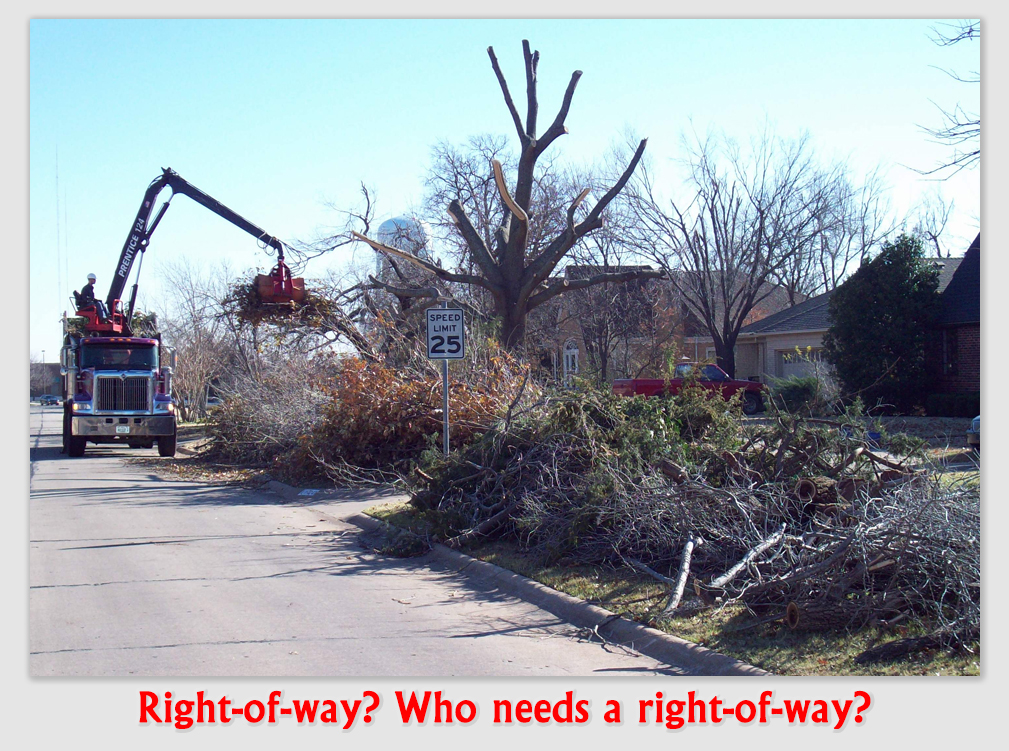
Still, there’s a worthwhile principle here for the many homeowners who complain to us every year about various utilities coming through their yards, trimming or removing trees, tearing up bushes and laying waste to landscaping. The utilities invariably wave their easements at the homeowners and say, “Read it and weep.”

The homeowners angrily ask, “Can they do that?”

Then, we have to explain that the homeowner holds what is called a “servient estate,” which is as subordinate and groveling to the easement holder (the “dominant estate)” as the names imply. The utilities and their marauding contractors can do what is reasonable to permit them to get the benefit of the easement for which they bargained.

As well, there’s a second worthwhile principle in today’s case. If you get into a kerfuffle as a property owner or an easement holder, try to work it out. The old legal aphorism is true: a bad settlement is better than a good lawsuit.

Campbell v. Sullivan, Case No. FSTCV166028793S (Superior Ct. of Connecticut, Dec. 11, 2017) 2017 Conn. Super. LEXIS 5104: Maggie Sullivan is the homeowner at 1 Lennon Lane in Wilton. Steve Campbell owns the abutting property at 2 Lennon Lane. Steve has an easement for a 50-foot-wide strip across Maggie’s property to be used as “a right of way for all lawful purposes of ingress and egress, including public utilities.” The easement is the only way Steve has to get from the street to his property.

The fifty-foot-wide right-of-way described by this easement contains a paved driveway about 12 feet wide known as Lennon Lane.

Steve sued Maggie, claiming that over time, she had placed rocks and erected fencing within the 50-foot right of way, as well as “allowing” trees and other overgrowth to impede ingress and egress through the easement. Maggie argued that any actions she has taken to encroach into the easement are minimal, reasonable, and do not impede Steve’s access to 2 Lennon Lane. For her part, Maggie complained that Steve had trimmed trees and other plants within the 50-foot right-of-way, which are actually located on her property, without her consent. Steve responds that he is entitled to the entire 50-foot right-of-way granted by the easement, and that anything Maggie places within the 50 feet violates his rights.

Held: Steve and Maggie couldn’t work things out for themselves, so the court did it for them, giving each a little and taking from each a little.

To figure out the nature of Steve’s rights, the court started with the deed itself and then looked at the situation of the property and the surrounding circumstances, all in order to “ascertain the intention of the parties…” The language of the grant is given its ordinary meaning in the absence of anything in the situation or surrounding circumstances which indicates a contrary intent.

The principle is that the “holder of an easement… is entitled to use the servient estate in a manner that is reasonably necessary for the convenient enjoyment of the servitude.” This means that the easement holder can use the easement in any way reasonably necessary to fulfill the intent of the parties. The court held that the “right of way is for ingress and egress. This is broad enough to include the ability to turn around, reverse, and enter and exit safely. It does not include the right to park on the right-of-way. On the other hand, merely because the defendant owns the fee in the right of way, she does not have the right to obstruct the plaintiffs’ right for all lawful purposes of ingress and egress.”

The court said it was Steve’s job to maintain the easement, but his maintenance had to be reasonable. “The holder of an easement,” the court said, “is not entitled to cause unreasonable damage to the servient estate or interfere unreasonably with its enjoyment. The law is settled that the obligation of the owner of the servient estate, as regards an easement, is not to maintain it, but to refrain from doing or suffering something to be done which results in an impairment of it.

Under these circumstances, the court said, Steve has no right to compel Maggie to maintain it for his benefit. He had to do it, and do it “in a reasonable fashion.”

Steve spun a tale about expecting “prefabricated modules” that would be used as additions to his house. He said he would need at least 30 feet of the 50-foot easement for the trucks. It turned out, however, that Steve had not exactly ordered the prefabs yet, did not know when he would order them and when he would pay for them. The court was unimpressed, saying, “As of the time of this decision, the plaintiff’s plans to remodel his home are not definitive reasons as to why… he would need access to the entire fifty-foot right-of-way.

The court ordered some of the rocks, fencing and bushes removed. It prohibited Steve from parking in the easement and limited tree trimming to one area where the branches interfered with ingress.

– Tom Root

TNLBGray140407

Case of the Day – Wednesday, January 21, 2026

THE SINKHOLE WAS LINED WITH GOLD AFTER ALL

When we last left our intrepid Air Force Academy cadets, they had just been rescued in the nick of time from the runaway train that was the U.S. District Court for the District of Colorado. At the same time, the dastardly Jim Nelson saw the Tenth Circuit Court of Appeals snatch the cadets’ $7.7 million (it was probably the mortgage money) from his grubby mitts.

OK, that’s both hyperbolic and fictional. The 4,400 USAFA cadets had not been sued individually, but rather the U.S. government was the defendant. What’s more, Jim was not dastardly. His hands may have been grubby, but that was because he fell into a massive sinkhole on what may or may not have been a bike path on the expansive Academy property. The District Court found that the Academy’s management had breached a duty to Jim, whom it ruled was USAFA’s invitee (despite the bike path having signs warning against trespass). But the Tenth Circuit Court of Appeals rode (or flew) to the Academy’s rescue, applying the Colorado Recreation User Statute and holding that USAFA was immune from liability because it had opened up its bike path without charge for the public’s use, whether it intended to (or even knew it had) or not.

But the Tenth Circuit decision had a little “gotcha” right at the end. After finding the RUA applied, the appellate court remanded the case to the District Court to determine if an exception to the RUA’s liability limitations applied — whether the Air Force Academy’s actions constituted a “willful or malicious failure to guard or warn against a known dangerous condition, use, structure, or activity likely to cause harm…” Such a failure is an exception to the RUA’s broad immunity.

Last spring, the case was again in front of the District Court, which seemed just a little too enamored of the bike rider and too dismissive of USAFA management for our tastes. After all, a sinkhole big enough to swallow Jim? We’ve seen the Academy grounds, even the unimproved parts, and they are pretty wide open, sparse of trees and underbrush. How did Jim, who admitted he rode the trail regularly, miss seeing the sinkhole well before he rode into it?

Alas, we’ll never know. What we do know is that the District Court concluded that the Academy folks knew people used the trail although they were not supposed to. A USAFA employee who maintained the 40-square mile grounds saw and photographed the sinkhole a few weeks before the accident, but because he himself did not know that people were using the path despite the signs, he saw no reason to fill the sinkhole.

But thanks to the tort doctrine of respondeat superior, which is a Latin way of saying the company is to blame when its employees are negligent in the course of their employment, the District Court strung together management’s knowledge that people ignored the signs and used the path with the employee’s knowledge of the sinkhole, and found that USAFA willfully failed to guard or warn against a known dangerous condition…”

Voilà! Just like that, the Air Force Academy was back on the hot seat, and Jim rode off on his bicycle with 160 lbs. in his rucksack, which is about what $7.3 million in 100-dollar bills weigh.

Nelson v. United States, 256 F. Supp. 3d 1136 (D.Colo. 2017): James Nelson was seriously injured in a bicycle accident on September 3, 2008, when he encountered a sinkhole/washout on a bike path on United States Air Force Academy land. He sued under the Federal Tort Claims Act for damages. The Tenth Circuit previously determined that the Academy was immune from liability within the limits of Colorado’s Recreational User Statute.

Prior to Jim’s accident, USAFA knew that the path existed on its property and that members of the public used the path where Jim was injured. Upkeep of the property was the Academy’s responsibility. The Academy had a Trails Management Plan that provided guidance about the proper maintenance to be performed on official trails, but the asphalt path on which the biking accident occurred was not on the Academy’s Real Property Record, so maintenance of the path did not fall within the scope of a contract the USAFA had with a maintenance company.

The sinkhole Jim encountered was the result of off-site water flowing onto Academy property that overwhelmed the culvert running under the path, causing a washout. Dr. Brian Mihlbachler, an Academy contractor responsible for grounds maintenance, testified that the sinkhole was large and readily visible during the day. However, a witness who encountered the sinkhole while jogging the morning after Jim’s accident thought the sinkhole was water until he was significantly closer to it.

Dr. Mihlbachler said the condition of the path with the sinkhole would be a safety hazard for path users if it were an official Academy trail. Thus, if it were an official trail, he would have reported the condition of the path to maintenance to get it repaired. He was the only Academy employee actually aware of the sinkhole before the accident and in fact, had photographed the sinkhole two weeks before Jim was injured. However, he did not report the sinkhole or to anyone else before the accident, because the trail management plan did not reference any asphalt-surfaced trails. There was no rule or regulation in the trail management plan or otherwise, that would have required fixing a hole on an unofficial path, such as the asphalt path. Dr. Mihlbachler also said the Academy’s trail management plan contained guidelines about what constitutes a safe trail for the users, and that “criteria would have applied in this situation [to the asphalt path] had I known that it was designed – . . . as a trail, yes.”

The Court held that Dr. Mihlbachler chose not to do anything about the sinkhole when he encountered it (other than to take its picture). His decision was based on his perception that it was not the Academy’s responsibility because he did not think people were using the path for recreational purposes. He “didn’t feel the Air Force Academy considered it to be a trail of any sort” and that the hole was thus unlikely to cause anyone harm.

The Court found the Academy unreasonably failed to exercise reasonable care to protect against a danger – the sinkhole on the path caused by erosion – of which it actually knew. Under the respondeat superior doctrine, “an employer or principal is liable for acts that its employee or agent commits on behalf of the employer or principal within the scope of the employment or agency… based on the theory that the employee acts on behalf of the employer when the employee is acting within the scope of his authority.” The evidence shows that Dr. Mihlbachler knew of the significant erosion problems in the immediate area of the path and its condition prior to Jim’s accident.

The RUA places the risk of injury for recreational activity upon the recreational user rather than the landowner subject to certain specifically enumerated exceptions to its limitations on landowner liability. One of these exceptions to liability is a landowner’s “willful or malicious failure to guard or warn against a known dangerous condition, use, structure, or activity likely to cause harm.”

The RUA does not define the terms “willful” or “malicious,” but the court concluded the phrase had its plain and ordinary meaning of “voluntarily, purposefully and with a conscious disregard for the consequences of the act”. Willfulness does not require that a government employee be consciously aware that his acts or omissions create danger or risk to the safety of the public. It was enough that the Academy knew that the asphalt path existed on its property and knew that persons used the path for recreational purposes, including bicycling, by invitation or with permission.

What’s more, the Court said, the Academy knew that people were using the path for recreational purposes yet chose not to communicate that to its agent, Dr. Mihlbachler, even though he played a safety role at the Academy in connection with his role as Trail Manager. Thus, the court concluded, Dr. Mihlbachler acted “voluntarily, intentionally, and with a conscious disregard for the consequences of the act” when he chose not to make the sinkhole a priority or to do anything to warn about it or guard against its danger.

Despite the immunity normally afforded by the RUA, the Air Force Academy was liable to Jim.

– Tom Root

TNLBGray140407

Case of the Day – Tuesday, January 20, 2026

SOMETIMES, DOING NOTHING IS AN OPTION

We’ve talked before about state recreational user acts, statutes adopted in almost every state that encourage landowners to permit recreational use of their undeveloped land. The notion goes that by shielding property owners from liability when Connie Klutz, out for an afternoon of bird-watching, blunders into a pool of quicksand, they will magnanimously open their lands for free to the litter, noise, and hubbub of the general public.

That’s the theory.

But sometimes, an RUA can ride to the rescue of a landowner who never intended that people traipse across his or her land. Why would that be? Imagine you live in Colorado. And why not? It’s a nice place, Rocky Mountain highs, nowadays from marijuana as much as from taking in the scenic splendor.

One day, some knucklehead ignores the “trespassers will” signs posted around your property, hikes through your fields, and falls in a gopher hole. It could happen, you know. His lawyer shouts, “negligence!” You respond, “I let him take the path that was just as fair, and having perhaps the better claim… Therefore, I am protected by the RUA.”

Your alternative to RUA protection is hardly as pretty. If you invited him onto your premises, and he was not a recreational user, you owed him “the highest duty of care.” Suppose he was a mere licensee, a person “who enters or remains on the land of another for the licensee’s own convenience or to advance his own interests, pursuant to the landowner’s permission or consent.” In that case, you still are liable if there is an “unreasonable failure” on your part to exercise reasonable care concerning dangers you created or failure to warn of hazards you did not create but which “are not ordinarily present on property of the type involved and of which the landowner actually knew.” Even if your clumsy hiker is simply a “trespasser,” a person who “enters or remains on the land of another without the landowner’s consent,” he may recover for damages you willfully or deliberately caused.

How much easier just to make anyone who gets hurt on your land a recreational user. Under Colorado’s RUA, “the owner of land who either directly or indirectly invites or permits, without charge, any person to use such property for recreational purposes” will not be responsible for “any injury to person or property… caused by an act or omission” of the landowner.

In today’s case, the Colorado landowner under the gun is the United States Air Force Academy. USAFA has a sprawling complex of academic buildings, airfields, athletic complexes, housing for support personnel, and a lot of undeveloped land, all nestled up against the Front Range. Within the 40 square miles or so of Academy land was a bike trail, ominously marked at the entrance with a sign prohibiting entrance. Another sign, put up by persons unknown but not removed by Air Force Academy folks, said, “Bicycle Path – No Motorized Vehicles.”

Jim Nelson, a guy who regularly ignored the “Entry Illegal” signs, managed to ride into a “large sinkhole” – what, Jim, you didn’t see it? – and racked himself up rather badly. At trial, he stuck it to USAFA to the tune of millions of dollars. The Tenth Circuit, however, had other ideas. Whether it invited Jim or not (and the Academy was sure it had not), he was a recreational user, and the Academy seemed to be as free as a falcon.

Whoever said, “Doing nothing is not an option?” Certainly not the Tenth Circuit.

Nelson v. United States, 827 F.3d 927 (10th Cir. 2016). Jim Nelson was a regular user of a bicycle path on property owned by the United States Air Force Academy. While riding in 2008, he struck a large sinkhole and severely injured himself.

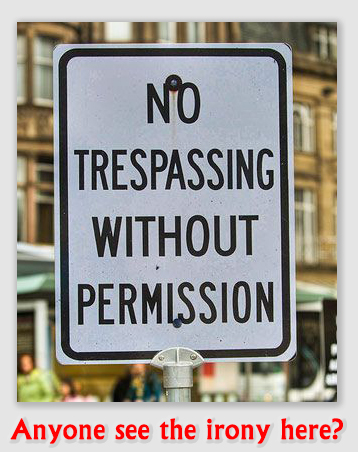
Two signs stood near the path’s entrance. The first sign, erected by the Academy, informed visitors that entry was illegal without permission. The second sign, located closer to the path’s entrance and easier for bikers to read, stated, “Bicycle Path, No Motorized Vehicles.” The Academy did not erect the “Bicycle Path” sign, nor did anyone there know who did or when it was done. But the sign was displayed for at least as long as Mr. Nelson had been using the path.

A year before the accident, the Colorado Department of Transportation offered to remove the sign near the right-of-way on Interstate 25 where the highway crosses Academy property. The Academy, however, never responded to the email offer, and the sign remained in place until Mr. Nelson’s accident the following year. After the accident, the Academy closed the path.

Mr. Nelson sued the United States for his injuries. The district court found the Academy knew the path was used for recreational purposes such as jogging and biking, although USAFA considered bike path users trespassers on Academy land. Nonetheless, the Academy never confronted recreational users or prevented them from using the path. The district court also found that the Academy did not intend for the path to be a recreational trail open to the public.

Based on these findings, the district court held the Academy could not take advantage of the limitations on liability under the Colorado Recreational Use statute because the Academy had not intended to open the path for public recreational use. And since the Academy knew bikers were using the path and was aware of the sinkhole, it breached its duty of care by failing to repair the sinkhole or warn users of the risk.

Held: USAFA is entitled to rely on the Colorado Recreational Use Statute (CRS § 33-41-103). The U.S. Court of Appeals for the Tenth Circuit held that the Academy was shielded from Jim Nelson’s tort claims because it knew the bike path was being used by the public and took no steps to block such usage. Thus, for purposes of the statute, the Academy “indirectly permitted” Jim’s use for recreational purposes. The Court of Appeals said the RUA extends protection to any person the landowner “directly or indirectly invites or permits” to use the property for recreational purposes. Under Colorado law, “permission” is defined as “conduct that justified others in believing that the possessor of property is willing to have them enter if they want to do so.”

No one thought USAFA directly permitted use of the path – in fact, the Academy considered users of the bike path to be trespassers. But the Air Force Academy knew people used the path all the time, knew someone had placed an unauthorized sign at the start of the party, and never removed the sign or otherwise prevented its use. This conduct, the Court said, “can only be seen as indirectly permitting bikers such as Mr. Nelson to use the path for recreational purposes.

The Court said no “subjective intent requirement” was required under the RUA. In other words, you don’t have to intend to offer your land for free recreational use. It’s enough that you don’t stop people.

Here, the Court said, the Academy’s purposeful actions implicitly allowed or acquiesced in Mr. Nelson’s use of the path. USAFA’s knowledge that the path was used by the general public, combined with its knowledge of the sign and its refusal to remove it, was enough to demonstrate permission under the Act. The Court ruled, “Landowners are entitled to protection by knowingly permitting recreational use of their property. Under a plain reading of the statute, the Academy “indirectly permitted” Mr. Nelson’s use of the path through its conduct.”

Sounds like a sweet deal for the Zoomies, right? Just wait until tomorrow…

– Tom Root

TNLBGray140407

Case of the Day – Martin Luther King, Jr., Day 2026

SOME THINGS EVEN A COURT CAN’T DO

The majestic courage shown by the Selma marchers 50 years ago, as well as by countless others who, by acts large and small, defended the equality we now identify as a bedrock principle of our society and legal system, fortunately cannot be undone by knuckleheads like today's plaintiff.

The courage shown by the 1965 Selma marchers 60 years ago, as well as by countless others who, by acts large and small, defended the equality we now identify as a bedrock principle of our society and legal system, fortunately, cannot be undone by knuckleheads like today’s plaintiff.

For a country that was supposed to be sailing into a post-racial world after the election of President Obama in 2008, we’ve had a rough time of it in the last 18 years.  In race relations, 21st century-style, there is the deadly serious (such as Ferguson, Chicago, ClevelandCharleston, Minneapolis, and Brunswick, Georgia)– the merely reprehensible (University of Kentucky senior arrested after screaming racial slurs at black UK freshman) – the head-scratching (trees can be racist?), and of course a former and current President (the same person, by the way), who as recently as a year ago or so told the National Association of Black Journalists that he didn’t know Kamala Harris “was Black until a number of years ago when she happened to turn Black, and now, she wants to be known as Black. So, I don’t know, is she Indian or is she Black?”

This is also the guy who has proclaimed that he’s “been the best president for the Black population since Abraham Lincoln.”

That last declaration and exactly how he may have referred to the governance and economics of Haiti, El Salvador, and some countries in Africa are a suitable launching point for a trip into the absurd. The absurd is something we’ll look at today, on Dr. Martin Luther King’s birthday commemoration and the approximate anniversary of the orange President’s second inauguration.

Sigmund Freud was famously but questionably credited with having said, “Sometimes a cigar is just a cigar.” In today’s case, a matter of trespass to trees was somehow recast into a federal civil rights action by the plaintiff, who was a man with a litany of offenses committed against his ancestors which he wanted to redress.

Mr. Brewer apparently trespassed on Mr. Lance’s property and removed three trees. Rather than an appropriate trespass to trees action (with a request for treble damages) in South Carolina courts, Mr. Lance went for broke, suing Mr. Brewer for violation of his civil rights under 42 U.S.C. § 1983.

A § 1983 action is a powerful one, authorizing a federal court action to be brought against persons who, under color of state law, deprive another of his civil rights. It has been used against those who discriminate in housing, police officers who wrongly kill suspects, employment discrimination, and even in zoning decisions.

But § 1983 doesn’t do everything. Here, Mr. Lance argued that not only had Mr. Brewer falsely claimed to have the County’s permission to cut down the trees, but Mr. Brewer’s grandfather had defrauded Mr. Lance’s cousin in a land deal about 40 years before. When the Federal magistrate judge recommended dismissal of the § 1983 action, Mr. Lance objected, arguing rather ineloquently that ““GOD ALMIGHTY does not like what you Racist people are doing, and GOD will show it very soon by punishment, and Destruction.”

cartoon150313Destruction was something the federal court was willing to risk, holding that no matter how it tried to construe Mr. Lance’s complaint, there just wasn’t a civil rights violation alleged. Of course, he was free to pursue his complaint in state court, and we assume he did so.

Lance v. Brewer, 2007 U.S. Dist. LEXIS 30247, 2007 WL 1219636 (D.S.C., Apr. 24, 2007). In late 2005 Defendant Brewer cut down three large trees and other tree limbs on Plaintiff Lance’s property without permission. Lance asserted that Brewer, who ran a business named Don’s Scrap Metal and Iron, sold these trees for profit but that he and his relatives did not receive any profit. Lance alleged that Brewer told him the county gave him permission to cut down the trees, but according to Lance, a county employee told him that Brewer did not have permission to cut down the trees. In addition to these claims, Lance argued that Brewer’s grandfather purchased the property adjoining his property forty to fifty years ago by “fooling” Lance’s cousin into selling 20 acres of river-front property for $200.00.

Lance alleges Brewer’s actions constitute racism and discrimination under 42 U.S.C § 1983, and he seeks $85,000.00 on behalf of the heirs of his cousin, Willie Lance. A U.S. Magistrate Judge recommended that Lance’s claim be dismissed. Lance disagreed and sought rejection of the Report & Recommendation.

Dr. King stood for equality and justice… not nonsense.

Held: Lance’s tree-cutting-as-civil-rights case was dismissed. The Court noted that Lance had objected to Report and Recommendation because “GOD ALMIGHTY does not like what you Racist people are doing, and GOD will show it very soon by punishment, and Destruction. The United States Court has Federal Jurisdiction, because this is a Civil Rights Violation.” The Court said, “[t]he Plaintiff’s unsubstantiated statement that the Court has federal jurisdiction because this is a civil rights violation does not change the fact that even liberally construing the Plaintiff’s complaint, it fails to state a claim for a federal civil rights violation.” Here, Brewer is a private individual.

What’s more, Lance tried to state a claim pursuant to § 1981. The Court held that Lance has failed to allege an essential element of a § 1981 claim, that there is a contract or property law right enjoyed by white citizens but not by the Plaintiff, who is black. The Court concluded that – tree or no tree – no federal question was raised by Lance’s claim, and thus jurisdiction did not exist.

– Tom Root

TNLBGray140407

Case of the Day – Friday, January 16, 2026

OUT IN THE COUNTRY

A great artifact of a bygone era – besides King Tut’s treasure, of course – is the now increasingly quaint notion that the degree of care a landowner must exercise to be sure his or her trees do not pose a hazard to passersby depends on whether the land is “urban and residential” or “rural and undeveloped.”

Back in the day (as my mother used to say), the law assumed that an urban landowner could more easily inspect his or her trees, and with that relative ease of inspection came a greater duty to people using the highway that passed his or her property, a duty to prevent an unreasonable risk of harm from defective or unsound trees on the premises. Trees of any kind, whether foreign or domestic, native or invasive, planted or naturally growing there since time immemorial…

Rural landowners, however, may have hundreds or thousands of trees lining the back roads and byways. For those folks, that urban duty to inspect does not apply if the trees – as is often the case – are of natural origin growing on rural, undeveloped land. This rule is rooted (if I may make a tree pun) in the commonsense notion that out in the country, inspection of countless trees is utterly infeasible, bordering on impossible.

As we will see in today’s case, what at first blush seems unquestionably rural may really not be so rural. Out in the country… not as simple as it used to be.

Incidentally, many times cases like these settle as soon as the summary judgment motions are decided. Parties can see which facts are to be left for resolution at trial, and often they don’t want to leave the case to chance (which is another word for “jury”). Here, after CSX lost its summary judgment motion, it settled with the victim’s widow for $800,000.00.

Gaines v. CSX Transportation, Inc., 2019 U.S. Dist. LEXIS 11829; 2019 WL 315980 (U.S. District Ct., S.C., Jan. 24, 2019). During a very windy February afternoon in 2016, Mike Gaines was driving his truck on Gilchrist Road in Darlington County. He encountered a broken tree limb blocking the road, parked his truck, walked up to the limb, and began removing it. While Mike was bending down to pick up the limb, a pine tree fell on him and seriously injured him. The pine tree had been standing on an abandoned railbed right-of-way owned by CSX Transportation. The tree had not been planted there, but instead was naturally occurring and indigenous to the area. Mike Gaines died from his injuries about two hours later.

Mike’s widow Cindy sued CSX in a wrongful death and survival action in state court. She alleged the fallen tree was “damaged or diseased” and that CSX had a duty to maintain its property “to make certain trees on its property safe, and a duty of reasonable care to make certain trees on its property are safe for travelers of streets adjoining its land.”

CSX removed the action to federal court and subsequently filed a motion for summary judgment.

Held: CSX was denied summary judgment because questions of fact about the nature of the property – rural or urban – remained to be answered.

Summary judgment is a procedure used where there are no questions of fact to be determined. Instead, the facts are clear and undisputed, and the only question is how the law should be applied to the facts to reach a judgment.

To prove a negligence claim in South Carolina, a plaintiff must show: (1) the defendant owed the plaintiff a duty of care; (2) the defendant breached its duty by a negligent act or omission; (3) the plaintiff suffered injury or damages; and (4) the breach was the actual and proximate cause of the plaintiff’s injury.

South Carolina follows the rule that a landowner in a residential or urban area has a duty to others outside the property to prevent an unreasonable risk of harm from defective or unsound trees on the premises. However, the duty does not extend “to an owner of trees of natural origin growing on rural, undeveloped land.” The sole issue raised in CSX’s motion for summary judgment was whether it owed a duty of care. CSX argued that it was entitled to summary judgment because “South Carolina law does not require an owner of rural land to inspect trees on its property so as to prevent a defective tree from falling onto a public highway causing injury.”

Cindy contended there was a real question of fact whether CSX’s property was residential or urban, or whether it was rural and undeveloped.

Whether the law recognized a particular duty is a legal question normally decided by the court, not the jury. “In some circumstances, however,” the Court said here, “the question of whether a duty arises depends on the existence of particular facts.” Here, the question of whether CSX had a duty to prevent an unreasonable risk of harm from defective or unsound trees depends on whether its property was located on rural, undeveloped land.

CSX showed that only about six vehicles an hour passed by the Gilchrist Road property. The area was “sparsely populated,” CSX said, consisting mostly of farmland and woods. No railroad tracks or trains have been there since the early 1970s. In fact, the only change in the past half-century was that Darlington County paved Gilchrist Road a few years ago.

Cindy claimed the CSX property was residential or urban. She showed that multiple homes are located near CSX’s property; that a large automobile auction storage lot is nearby; that cultivated farmland indicates the area was developed; and that Gilchrist Road is a “frequently traveled roadway.” Plus, Cindy submitted 2013 correspondence between her late husband and CSX about the paving of Gilchrist. Mike had written to CSX on behalf of his neighbors, asking for its cooperation in acquiring the right-of-way. Mike had said, “Given that most of us have resided on this road for multiple decades, the culmination of this activity has been a long-awaited goal. This project offers improvements that will greatly enhance accessibility to our homes, while simultaneously providing better drainage and safer travel.” The letter was signed by Mike and over a dozen other Gilchrist Road residents.

CSX wrote back, referencing “the impact [the road paving] will have on you and your neighbors.” Oops. Who knew a no-account PR letter could come back to haunt the railroad like that?

Finally, Cindy argued CSX’s property cannot be considered undeveloped land, because it consists of a raised railbed onto which various trees later grew, including the one that killed Mike.

“Based on the above evidence,” the Court ruled, “there is a genuine issue of material fact regarding whether Defendant’s property is ‘rural, undeveloped land’ or whether it is ‘in a residential or urban area’.” Whether CSX had a duty to Mike Gaines with respect to defective or unsound trees on its property “depends on facts — rural/undeveloped versus residential/urban — that must be decided by a jury.”

Rather than let a jury of local folks get their hands on the question of whether a big, rich, faceless railroad should write a check to help out the poor widow of a local guy who simply stopped to clear the road for the benefit of his neighbors and the traveling public, CSX wisely settled.

– Tom Root

TNLBGray

Case of the Day – Thursday, January 15, 2026

DANGER TREES AND PIXIE DUST

pixie150916Yesterday, we took up the question of trees on tree lawns, an issue that arose because Jim Busek, once a Norwalk, Ohio Reflector columnist, was up in arms over that city’s plans to cut down 62 boulevard trees that were interfering with the sidewalks.

Instead of removing the trees, Jim proposed that the offending roots be chopped out and the trees then be encouraged not to grow any to replace them. While Jim was busy whispering to trees, we were wondering whether he might be liable if a dead ash tree standing on his tree lawn fell onto a passing motorist. Now, mind you, we don’t know whether Jim even has any trees on his tree lawn, but you know how it is when you hold yourself to the public as a famous columnist. You become a lightning rod. Sorry, Jim… you’re fair game.

In our discussion of Wertz v. Cooper, we delivered the bad news that Jim, as owner of the strip of grass between the public sidewalk and street, may well be liable. As an urban property owner, he has a duty to inspect and remove trees that may reasonably pose a danger to third parties passing on public streets. So Jim’s hanging out there a country mile (or maybe a city mile, because he is an urban landowner, and Wertz tells us they’re different).

But is he hanging out there alone? Although Jim owns the tree lawn, it lies within the 60-foot-wide right-of-way of the street. The Ohio Supreme Court has pointedly said that the “roadway, the space immediately above the roadway, the shoulder, the berm, and the right-of-way are all under the control of the political subdivision … [which] has a duty to keep the areas within its control free from nuisance, i.e., conditions that directly jeopardize the safety of traffic on the highway. Where the [subdivision] fails in its duty, it may be liable for injuries proximately caused by the nuisance.” Manufacturer’s Nat’l Bank of Detroit v. Erie County Road Comm (1992), 63 Ohio St.3d 318, 322-23.

So the City has Jim’s back (or is on the hook, depending on your viewpoint) in case the pixie dust doesn’t work on the tree roots. Of course, the City has to have actual or constructive notice of the defect, just like the landowner in yesterday’s case. However, the City has already noted that 62 trees should be removed, and – if the homeowners balk enough to convince the City otherwise – the City’s previous decision that the trees should go will cut against any denial by the powers-that-be that they were blissfully unaware.

All of which brings us to today’s case. This lawsuit relates to an unfortunate man killed when a dead tree fell onto his car one stormy November night. The tree was on private property out in the country, but it had been dead so long that the landowner may have had liability. We can’t tell, because this case — in the Ohio Court of Claims — was solely against the Department of Transportation. The Court held that ODOT would be liable even though the tree was on private land – if it had breached its duty to inspect the tree.

If "Lance" happens to ride a bike, he might be at risk from the decayed tree, too ...

If Jim happens to ride a bike, he might be at risk from the decayed tree, too …

ODOT had a “drive-by” inspection program, reminiscent of one we considered recently in Commonwealth of Kentucky v. Maiden. The victim’s heirs argued that if ODOT employees had gone around behind the tree (away from the road), they would have seen the decay. Well, yes, the Court said, but that’s beside the point. ODOT has over 40,000 miles of road to inspect, and to inspect every tree in the manner suggested by the plaintiff would be economically infeasible.

Still, the principle we take away from this decision is that the City of Norwalk would not get off the hook just because the tree is on private land. That doesn’t mean that Jim’s going to feel that much better in the defendant’s dock if the mayor has to stand next to him.

Our sad conclusion: Jim may not be the only one liable here. He knows the City has identified the trees as a hazard, and that alone places him on actual notice. If his 98-cent remedy of cutting some roots and hoping for the best doesn’t work, both his homeowners’ insurance and the City’s pocketbook could get a workout.

What a pain in the ash that would turn out to be!

Blausey v. Ohio Dept. of Transportation, 2005-Ohio-1807, 2005 Ohio Misc LEXIS 134, 2005 WL 894878 (Ohio Ct.Cl., 2005).  Dale Blausey was killed during a windstorm when the car he was driving was struck by a falling Norway spruce tree on a U.S. highway in Erie County, Ohio. The tree had been growing on a roadside right-of-way obtained by the defendant on land that was owned by Joe Henry but occupied by a tenant. The primary proximate cause of the fall was the severe deterioration of the roots on the east side of the tree and the high wind that blew the tree onto the highway. The tree had been struck by lightning in 1973, and the damage from that strike led to interior rotting and an infestation of carpenter ants, the combination of which destroyed much of the root system. The deterioration had existed for as long as ten years, gradually weakening the tree to the extent that it became a hazard.

Before it fell, the east side of the tree that faced the highway showed little, if any, evidence of decay. Dead limbs were not clearly visible from the road. Limbs had been removed from the lower part of the tree, which was not uncommon as landowners sought to mow, decorate, or otherwise use the land. Additionally, the lower part of the tree was obscured by bushes and vegetation. The upper growth of both the healthy and the diseased spruce trees was green and quite similar, although, on close inspection, the growth on the healthy spruce appeared to be slightly denser. Cone growth was normal on both trees. Although the 1973 lightning strike had caused the tree to lose its “Christmas tree” shape at the top, the loss was not very noticeable. However, an inspection of the west side of the tree would have revealed evidence of deterioration and of a potential hazard. The State had not inspected the tree except from the highway, and that inspection did not reveal any defect.

Blausey’s executor sued the State for negligence in not identifying and removing the danger tree before the accident and accused it of maintaining a nuisance.

Held: The State was not negligent. To prevail upon a claim of negligence, a plaintiff must prove by a preponderance of the evidence that the defendant owed the plaintiff a duty, that it breached the duty, and that the breach proximately caused the injury. The State has a duty to maintain its highways in a reasonably safe condition for the motoring public, but it doesn’t have to become an insurer of the safety of state highways.

treedown140513To constitute a nuisance, the thing or act complained of must either cause injury to the property of another, obstruct the reasonable use or enjoyment of such property, or cause physical discomfort to such person. In a suit for nuisance, the action for damages is predicated upon carelessly or negligently allowing such a condition to exist. But for liability to attach to a defendant for damages caused by hazards upon the roadway, a plaintiff must show the defendant had actual or constructive notice of the existence of such hazard. The distinction between actual and constructive notice is in the manner in which notice is obtained or assumed to have been obtained rather than in the amount of information obtained. Wherever the trier of fact is entitled to hold as a conclusion of fact and not as a presumption of law that information was personally communicated to or received by a party, the notice is actual. Constructive notice is what the law regards as sufficient to give notice and is regarded as a substitute for actual notice. To establish that the defendant had constructive notice of a nuisance or defect in the highway, the hazard “must have existed for such length of time as to impute knowledge or notice.

The court found insufficient discernible evidence available to the defendant’s inspectors to warrant further investigation of the damaged tree or to determine that it was hazardous before the accident. While a close inspection of the tree would have revealed that it was a hazard, the deteriorated condition of the tree was not apparent through the Department’s routine visual inspections made from the roadway, and with over 40,000 miles of road to inspect, the Department was not — as a matter of social and economic policy —expected to individually inspect the trees.

– Tom Root

TNLBGray140407

Case of the Day – Wednesday, January 14, 2026

SOMEONE’S GOTTA DO SOMETHING ABOUT ALL THESE ASH HOLES


busek150915We read a lot of newspapers. Mostly online these days. Some are truly excellent. Some are pretty good. A few are so-so.

Then there’s the Norwalk, Ohio, Reflector, which we read for reasons too complex to explore here. Suffice it to say, if you have a parakeet, the Reflector is all the newspaper you’ll ever need. 

A few years ago, then-Reflector columnist Jim Busek complained about the city’s plan to ax 62 trees that are accused of wreaking havoc with sidewalks. Jim bemoaned the fact the City had removed a number of ash trees 10 years ago (which he admitted was a “smart ash policy”). Jim was pleading for the 62 targeted trees, publicly and plaintively asking the Norwalk Safety Director whether there wasn’t an alternative to cutting down these old trees. Surely, Jim hypothesized, these at-risk trees are so mature that if the offending roots were cut, no new ones would dare grow, and the sidewalks would thus remain in place. Right?

Maybe if we cut the trees' roots, but ask it real nicely, it won't grow any new ones ...

Maybe if we cut the trees’ roots, but ask them real nicely not to grow any new ones, our problems will be solved …

Sure thing, Jim. While Norwalk arborists are busy looking for the pixie dust that Jim figures will prevent new root growth, let’s consider the strange legal limbo in which property owners find themselves when tussling with municipalities over trees located on tree lawns.

It turns out that Norwalk – known as the Maple City – didn’t rid itself of all of its ash trees. A few still stand on city streets, and ash borers haven’t overlooked them. So who’s responsible for those dead trees? Ironically, we’ve seen the issue arise before, as cities – operating under tight budgets – lean on homeowners to pay for the removal of tree lawn trees (that is, trees between the sidewalk and street, standing inside the city’s right-of-way.

So exactly whose problem is it?

An interesting question… actually, two questions, and we’ll pick on Jim in order to answer them. Let’s say, for example, that the dead ash on Jim Busek’s tree lawn falls on a motorist. Is Jim’s ash in a sling? And might the Maple City be liable as well?

So someone’s gotta do something about the tree. But who – Jim or the Mayor?

The infestation on this ash is pretty obvious.

The infestation on this ash is pretty obvious.

Let’s consider Jim’s liability. There’s no doubt that the tree lawn is Jim’s property, despite the fact that it is subject to the City’s highway dedication. There’s a lot an owner can’t do with a tree lawn because of the City’s highway rights, but it’s still his or her property. Generally, the owner can plant and take down trees. The fact that an owner has the right to add or remove trees suggests that just maybe he or she has a duty to as well.

And what is that duty? In Wertz v. Cooper, one of Cooper’s trees fell onto Wertz’s fence during a storm. When Wertz sued her, she countered that she had no idea the tree was diseased and that the tree’s falling over was an act of God. The Court agreed. It held that in order for a landowner to have a duty, the evidence must establish that he or she had actual or constructive notice of a patent danger that the tree would fall.

There is an exception. Where the tree overhangs the street in an urban area, an owner may be held liable on general negligence principles for injuries or damages resulting from the tree or a limb falling onto the highway. Generally, an urban owner has a duty of reasonable care regarding their trees, including inspecting them to ensure they are safe.

This dying ash stands on a tree lawn in Norwalk. The signature tracks of the ash borer are evident.

This dying ash stands on a tree lawn in Norwalk. The signature tracks of the ash borer are evident.

So Jim may have a problem, beyond the fact that he’ll find no tree-root pixie dust at the nearby Home Depot. The duty to inspect isn’t an issue here. If Jim owns that dead ash tree, he is already on notice that the tree’s dead. The bare branches in mid-summer, the sloughing bark, and the borer tracks looking like spaghetti done in bas relief, are more than enough constructive notice than anyone would ever need. Whether the City does something about the dead tree or not, Jim would do well to hire an arborist to inspect the tree. If the tree should go for safety’s sake, Jim shouldn’t wait for the City to do it.

Would the same apply if tree roots damaged the sidewalk, making pedestrian passage dangerous? Absent any municipal code relieving property owners of liability for the condition of the sidewalks, it would hardly be a stretch for an unfortunate passerby to sue under the law of nuisance. Need an illustration? Look no further than Fancher v. Fagella.

Our next question: Would the Maple City be liable to remove the tree, independent of Jim’s obligation as a landowner?

Wertz v. Cooper2006-Ohio-6844, 2006 Ohio App. LEXIS 6755 (Ct.App. Scioto Co., Dec. 13, 2006). Following heavy rains, a tree that sat on Cooper’s property tore loose from its roots and leaned into Wertz’s fence and into a Shriner Colorado Blue Spruce tree that sat upon Wertz’s property. Wertz sued Cooper, alleging that Cooper failed to remove her tree in a timely manner. Wertz sought damages, including the cost of removing the fallen tree, the expenses to replace the damaged Blue Spruce, and other incidental damages.

Cooper argued that she had no knowledge of a defective condition of the tree, that she could not have been negligent in failing to maintain the tree, and that she could not be liable for the damage when an “act of God” caused the tree to uproot. The trial court agreed that there was no evidence that the tree was deteriorating and that Cooper was not liable for an Act of God.

Wertz appealed.

If the dead tree falls n a car, watch the scramble to avoid liability begin ...

If the dead ash tree falls on a car, watch the scramble to avoid liability begin …

Held: Judgment for Cooper was upheld. A negligence action in Ohio requires a plaintiff to establish that (1) the defendant owed the plaintiff a duty of care; (2) the defendant breached the duty of care; and (3) as a direct and proximate result of the defendant’s breach, the plaintiff suffered an injury. In order for a plaintiff to establish the duty element in a negligence action arising from a fallen tree, the evidence must establish that the landowner had actual or constructive notice of a patent danger that the tree would fall.

There is an exception to the general rule, however, concerning the duty of a property owner relating to growing trees with limbs overhanging a public street or highway. An owner of land abutting a highway may be held liable on negligence principles under certain circumstances for injuries or damages resulting from a tree or limb falling onto the highway from such property. In addition, there appears to have developed a distinction throughout the United States that a lesser standard of care applies to rural, farm, timber, or little-used land than to strictly urban property. Generally, an urban owner has a duty of reasonable care regarding a tree, including inspecting it to ensure it is safe. The duty placed upon the urban landowner, who has only a few trees, is not a heavy burden. This is in contrast to the rural landowner who may have a forest full of trees, which would impose a duty of immense proportions and constitute an onerous burden on the owner.

Despite the heightened standard to be applied to an urban tree, Wertz had no evidence in this record to establish that Cooper had either actual or constructive notice of a defective condition of the tree. While Wertz advanced her belief that the tree was dead or dying, her allegation was conclusory. She presented no evidence to support her claim. What’s more, even if Wertz were right that she believed that the tree was dead or dying hardly establishes that Cooper knew or should have known that the tree was dead or dying.

– Tom Root

TNLBGray140407