Case of the Day – Tuesday, July 22, 2025

UNLIKELY HERO MEETS LIKELY DUNCE

Tequila Isaacson

America has to love this story. It has heroics, action, danger – and an O. Henry twist at the end.

A few years ago, in beautiful Snoqualmie Pass, Washington, truck driver Tequila Isaacson stopped at a rest area to use the facilities. As she returned from the restroom, she saw a family desperately trying to rescue their child from a burning pickup truck.

No worms in this Tequila: she leaped into action and raced over to the glass front door of a coffee shop. The café was closed, but – seeing a fire extinguisher hanging inside – Tequila smashed the glass, seized the red canister, and knocked back the fire.

The fire was extinguished, the child was saved, and Tequila was a heroine.

Then, the Washington State Police showed up. Tequila explained what she did to help save the boy and put out the fire. When she reported how she broke down the coffee shop door to grab the fire extinguisher, the Trooper said, “Oooooh, Tequila!” He told her that using the fire extinguisher without permission is theft no matter how good her intentions. The cop said, “Your choice is fix the window or, Tequila, slammer!”

Fortunately for Tequila, God and Al Gore created the Internet, and social media went wild in her defense. But the whole kerfuffle set us to wondering. Could the cop be right? Of course, Mom told us when we were young that the policeman was our friend, and that suggests that he would never mislead us. But then, we also recall law school, where a professor suggested to us that the policeman was not always our friend and certainly was not always right.

So the following day, will Tequila see the sun rise as a burglar or a hero? That depends, of course, on the law.

Is getting the kid out more important than a broken window?

If you cannot believe that the law is such an ass as to punish someone in Tequila’s position, you’re largely right. Flood waters are rising, so you take that old boat parked in the neighbor’s back yard in order to save Grandma. You commandeer a soccer mom’s SUV to get an injured kid to the hospital. You knock a tainted burrito out of the hands of a Chipotle patron before she can take a deadly bite. At common law (and in many states), you have an affirmative defense to the crimes you committed – trespass, theft, even assault – because it was necessary to serve some greater good.

But consider the standard for a necessity defense, described in the case below. Did Tequila reasonably believe that breaking the coffee shop window was necessary to avoid harm to others? The young boy at risk of becoming a krispy kiddie probably thought so. His parents undoubtedly thought so. And what’s worse, a kid burning to death or a broken window and discharged fire extinguisher? That’s not a hard one, either. Finally, did any legal alternative exist? Tequila said she looked for a fire extinguisher but found nothing besides the one behind the locked door.

If the cop had been successful in finding a prosecutor who didn’t care about keeping his or her job, maybe Tequila would have been charged. But if she had been, the jury would not even have to leave the box to acquit. The necessity defense and common sense would have carried the day.

And it apparently did, as a pro-cop website, Blue Lives Matter, reported that Tequila would not be charged. The site explained that the Washington State Trooper simply was not familiar with burglaries, being a “highway patrol agency” (we derisively call them the “misdemeanor police” where we live). The author opined that “through no fault of his own, this trooper was likely completely unfamiliar with criminal law surrounding burglaries.”

The Trooper’s ignorance, of course, did not keep him from throwing his weight around. Thanks to social media, the Washington State Patrol “will be reviewing the way this case was handled with the trooper, adding they are grateful for Isaacson’s courageous effort to help save the child.” That’s code, meaning “the Trooper is going to get his butt chewed” for his sin, which was making his employer look bad.

State v. Clark, Case No. 74934-0-I (Ct.App. Washington, Sept. 25, 2017) 2017 Wash. App. LEXIS 2196, 2017 WL 4232607. Frank and Rebecca Scott owned two dogs, Ellie and Zalo. The Scotts hired Linda Clark, who owned a dog-walking business, to walk the dogs once a day.

But within a month or two, Linda began walking the dogs several times a day of her own accord, sometimes late at night or in heavy rain. Linda let herself into the garage at all hours to check on the dogs and leave notes regarding what she believed was proper care for them. She even replaced the dogs’ collars with collars that had her own name and phone number instead of the Scotts’.

The Scotts were a little creeped out, and Frank told her that her services were no longer required. Linda did not take it well, telling Frank that he would regret firing her. The Scotts told the sheriff, and a deputy went to Linda’s place to tell her to stay away.

One day, the dogs disappeared. The crime hardly required Sherlock Holmes. After receiving a report that a local citizen had seen Linda with Ellie and Zalo that morning, a deputy went to her house. Linda denied everything, but when Clark told her that Zalo had not received his medication that day, Linda admitted she had the dogs.

The State charged Linda with second-degree burglary. Linda wanted to raise a necessity defense, on the grounds that she took the dogs because she believed the Scotts were not taking good care of them. The trial court ruled that she could request a necessity instruction if the evidence supported it.

At the end of the trial, Linda’s lawyer did not ask for the instruction because he believed it “would be a frivolous motion, frankly, at this point.” A jury convicted her.

Linda filed a motion complaining that her lawyer rendered ineffective assistance during the trial for not asking for a necessity defense instruction.

Held: Linda’s lawyer was right. The court observed that “necessity” is a common-law defense with limited application, a defense “available to a defendant when the physical forces of nature or the pressure of circumstances cause the accused to take unlawful action to avoid a harm which social policy deems greater than the harm resulting from a violation of the law.”

A defendant, however, must produce some evidence to support the defense before a court will instruct the jury. In order to sustain a necessity defense, the defendant must show by a preponderance of the evidence that (1) he or she reasonably believed the commission of the crime was necessary to avoid or minimize a harm, (2) the harm sought to be avoided was greater than the harm resulting from a violation of the law, and (3) no legal alternative existed.

All Linda had was her own opinion that the Scotts did not take proper care of Ellie and Zalo the way she would have preferred. Because she did not testify in her own defense – probably a good idea, given how rickety her case was – nothing in the record supported a necessity defense.

– Tom Root

Case of the Day – Monday, July 21, 2025

SKIN OF HER TEETH

skin150629I’ve seen several mutual acquiescence cases recently, for no apparent reason. “Mutual acquiescence” is the term for a mistake agreed to by the affected parties: a driveway wanders over a property line, a fence gets built a few feet over from where it should be, the parties agree that a couple trees mark the boundary line when they really don’t, but it’s more convenient than looking for buried iron rods or PK nails. Over the years, memories fade… and what usually began as a mistake or a matter of convenience — such as when two parties build a fence that’s not right on the proper boundary line, but decide to let it go — becomes the de facto boundary line.

In today’s case, Ms. Shoemake (she seems to be missing an “r”, doesn’t she?) established that a broken-down fence had become her property’s boundary by mutual acquiescence, but only by the skin of her teeth. The evidence that one of the former neighbors had agreed to the fence as the boundary was remembered only by Ms. Shoemake. The former neighbor remembered the conversation, but not the crucial concession.

The Court of Appeals wasn’t all that sure, but under the relaxed standard of review that appellate courts give the fact-finding by trial courts, it decided by a 2-1 margin that Mrs. Shoemake had shown the fence line to be a boundary by acquiescence. But a plaintiff shouldn’t try too many times to win on such a tissue-thin showing.

There’s always the chance that someone else might remember it differently. And then, the trial devolves into a “swearing contest.”

gvtwork150629Boyster v. Shoemake, 272 S.W.3d 139, 101 Ark.App. 148 (Ark.App. 2008). Teresa Shoemake owned land next to James Boyster. A boundary-line dispute arose in the summer of 2005 when several of Teresa’s hunting dogs went missing on her property. When she went to the disputed area on her four-wheeler to find the dogs, Ms. Shoemake saw that an old fence that had stood there for about 65 years had been cut, rocks had been picked up, and trees had been cut down.

Mrs. Boyster told Teresa that the Boysters had surveyed the property and discovered that the fence line was not on the boundary. Shoemake described the fence as an old, rusty structure that had grown into the trees. She said the fence had been on the property her entire life. Her grandmother acquired the property in 1942.

Ms. Shoemake recalled visiting the property often, and she said that in the 1960s, the property on the other side of the fence was used as pasture. She never saw anyone other than her family use the property south of the fence. Her family’s side of the fence included trees, which had not been used for anything other than Christmas trees and recreation.

This would have been good advice for Ms.Shoemake and her neighbor ...

This would have been good advice for Ms.Shoemake and her neighbor…

Ms. Shoemake said that Bryan Tatum, the Boysters’ immediate predecessor-in-interest, acknowledged the fence line as the boundary line in a conversation with her, and asked if he could dig across her property and install a water line. Others testified that they had always believed the fence line was the boundary. The trial court found that Ms. Shoemake established a boundary line by acquiescence and quieted title to the disputed tract in her name. Boyster appealed.

Held: Ms. Shoemake had proven that the fence line was a boundary by mutual acquiescence. The Court said that the mere existence of a fence or some other line, without evidence of mutual recognition, cannot sustain a finding of boundary by acquiescence. However, silent acquiescence is sufficient, as the boundary line is usually inferred from the parties’ conduct over so many years. A boundary by acquiescence may be established without the necessity of a prior dispute or adverse use up to the line. For a party to prove that a boundary line has been established by acquiescence, that party must show that both parties at least tacitly accepted the non-surveyed line as the true boundary line. The mere subjective belief that a fence is the boundary line is insufficient to establish a boundary between two properties.

Not the kind of "self-serving" the court had in mind ...

Not the kind of “self-serving” the court had in mind …

Here, Boyster complained that Shoemake failed to present any evidence that Boyster or any of his predecessors in interest considered the fence line to be the boundary. But the Court noted Shoemake’s claim that Tatum had acknowledged the fence as the boundary line. While this was rather “self-serving” testimony, it was within the province of the trial court to find whether Teresa’s evidence was credible. Besides, other testimony from Shoemake and her witnesses established that no one north of the fence used the property south of the fence and that property north of the fence was pasture, while property south of the fence was woods. The Court concluded that Ms. Shoemake had presented sufficient evidence – just barely enough – to establish that Boyster and his predecessors in interest recognized the fence line as the boundary between the two properties.

Tom Root

TNLBGray140407

Case of the Day – Friday, July 18, 2025

A LEG TO STAND ON

Did that plaintiff ever have gall ... or gull ... or cojones or something...

      Did that plaintiff ever have gall … or gull … or cojones… or something!  What he didn’t have was any proof.

The plaintiff in today’s case had his foot broken when a branch from his neighbor’s tree fell. So how was he different from this rather odd-looking seagull sitting on a seawall to our left?

Easy – the gull has a leg to stand on.

Our hapless litigant – Rick Meyers by name – lived next to a man named Delaney, who owned a Catalpa tree. The catalpa is a fairly attractive deciduous tree that produces bean pods and leaves in the fall, but little else. It’s a solid Anglo-American tree, flowering in the spring and with large leaves and deep shade in the summer. In fact, it’s the sole food source for the catalpa sphinx moth, a creature favored by southern anglers as bait. Birds love it, caterpillars love it, fishermen love it … and so do most people.

That list would exclude our hobbling protagonist, Rick Meyers. The Delaneys’ Catalpa tree provided shade to Mr. Meyers’ driveway with its overhanging branches. But one day, Rick had run barefooted outside to put up the car windows (we suspect a thunderstorm was about to hit, which would have been accompanied by gusty winds, but the record didn’t say as much). While he was doing so, a branch broke free from the tree and fell on his foot.

A catalpa -beloved by fisherman and fowl - but not by Rick Meyers.

A catalpa -beloved by fishermen and fowl – but not by Rick Meyers.

Rick didn’t have a shred of proof that anyone – including the Delaneys – had reason to know that the branch was going to break. But lack of evidence would not inconvenience our Rick. He sued anyway, claiming that as owners of a tree in a residential area, the Delaneys had a duty to know the branch was going to fall, and never mind how they were supposed to have figured that out. You see, Rick’s foot hurt, and someone had to pay.

The trial court took a more sanguine view, believing that if the Delaneys couldn’t clearly see that the tree was dangerous, then they couldn’t be found to be negligent simply because they had not sleuthed it out. The Iowa Supreme Court agreed. The risk has to be seeable before it can be found to be foreseeable.

A landowner has no affirmative duty to inspect trees where no defect is "readily observable."

A landowner has no affirmative duty to inspect trees where no defect is “readily observable.”

Meyers v. Delaney, 529 N.W.2d 288 (Iowa Sup. Ct. 1995). Meyers and Delaney owned adjoining properties. Standing between their homes but rooted solely on the Delaney homestead was a large Catalpa tree. The tree limbs hung over the Meyers’ driveway. The Meyers family parked cars under the branch each day, and the Meyers kids played around it when outside.

One evening in mid-July 1990, Rick Meyers ran barefoot out to his car to roll up the windows. He heard a large crack, and then a large Catalpa limb fell from the tree, striking and severely injuring his foot. He sued the Delaneys for negligence, claiming they failed to maintain the tree properly, failed to warn him of the tree’s dangerous condition, and failed to protect him from a danger that – had they exercised reasonable care – the Delaneys knew or should have known existed.

The trial court found that the Delaneys neither knew nor should they have reasonably known the tree was dangerous, so they were not negligent. Rick Meyers appealed.

Held: The Iowa Supreme Court agreed that the Delaneys were not liable.

The Meyers v. Delaney rule - it's not foreseeable unless its seeable.

The Meyers v. Delaney rule – a tree’s defects are not foreseeable unless they’re seeable.

The Court noted that the general rule is that one who maintains a tree owes a duty to avoid injuring persons on adjoining premises by permitting the tree to become so defective and decayed that it will fall on them. However, the Court held that there is no duty to consistently and constantly check all trees for non-visible decay. Rather, the decay must be readily observable in order to require a landowner to take reasonable steps to prevent harm. If the decay or infirmity is readily observable, the tree owner may be liable for injuries caused by a defective condition of the tree if he or she had actual or constructive notice of the tree’s defective condition.

In this case, a friend of the Delaneys had removed a dead limb from the Catalpa tree the previous summer. The friend, who had some experience working in trees, testified he observed nothing in the tree to cause him concern about his safety. Furthermore, while Meyers’ expert tree trimmer testified that the tree was dangerous, he conceded on the stand that there was nothing that Delaneys could have observed about the tree before the accident that would have alerted them to be concerned over its safety.

No seeability, no foreseeability, no negligence.

Tom Root

Case of the Day – Thursday, July 17, 2025

SUDOKU, ANYONE?

sudoku150624The story’s not new, but it’s new to us … four jurors playing sudoku during a drug conspiracy trial in Sydney, Australia, caused a mistrial to be declared after three months and 100 witnesses. We feel for them – a lot of what goes on in the courtroom is deadly dull, and occasionally, rather foolish as well.

This is one of those cases that makes our point. The Wisemans had an access easement along the boundary of their property and their neighbor, Mr. Greenfield. They sold some land to a developer, and part of the deal was that the developer would install a driveway. The developer hired a company to do it. After the job was done — and the driveway was indeed properly within the access easement — Mr. Greenfield said that some branches had been cut from a pine tree of his that stood along the drive.

This being America, he sued his new neighbors.

Mr. Greenfield had no witness that his neighbor-or anyone else, for that matter—had cut off the branches. He had no evidence that the tree’s value had been lessened (except for his own claim that his property was worth $25,000 less, pretty steep for a couple of pine boughs). But the lack of evidence didn’t bother him that much.

It did, however, bother the Court. First, the Court noted, the fact that the branches were missing didn’t mean the Wisemans had cut them. Second, the subcontractor for the developer wasn’t the Wisemans’ agent, even if he had cut the branches (and Greenfield had no evidence he had done so). Third, there was no unbiased evidence as to the extent of damage, and the Court wasn’t going to sit still to hear Mr. Greenfield speculate as to how much he ought to get in damages.

Most important for us students of the Massachusetts and Hawaii rules, the Court said even if the Wisemans had trimmed the branches back to the limits of the easement, they had the right to do so, and any damages Greenfield could recover were only for any extra branch that might have been taken beyond the property line.

This action was truly a waste of everyone’s time… Ready for a hand of Old Maid?

Sometimes, trimming trees next to driveways is a darn good idea ...

Sometimes, trimming trees next to driveways is a darn good idea …

Greenfield v. Wiseman, 2008 Conn. Super. LEXIS 198, 2008 WL 344606 (Conn.Super., Jan. 17, 2008). David Greenfield owned property next to that belonging to Carter and Eileen Wiseman. The Wisemans had access to a portion of their land only by means of a 20-foot-wide corridor running across the Greenfield land. When the Wisemans sold some of their land to a development company, part of the deal was that the developer would build a gravel driveway along the access corridor. The company hired a subcontractor to perform the task.

Shortly after the driveway was built, Greenfield sued, claiming breach of covenants and trespass. He abandoned all claims except the trespass claim, arguing that the development company and the Wisemans trespassed while the driveway was being built, by cutting some limbs off a large pine tree on the corner of his land. No one witnessed the actual cutting of the trees, nor was any testimony presented from those who actually cut the limbs. The uncontradicted testimony was that neither of Wisemans personally cut any of the branches or witnessed the actions of those responsible. Nevertheless, Greenfield claimed damages under a Connecticut treble damage statute.

Held: Greenfield’s case was thrown out. The Court observed that the essential elements which must be proven to sustain an action for trespass were ownership or possession of an interest in land by the plaintiff, an invasion, intrusion or entry by the defendant affecting the plaintiff’s exclusive possessory interest, done intentionally, and causing direct injury. Here, the Court said, the evidence failed to show any intentional intrusion or invasion of Greenfield’s possessory interest by either of the Wisemans. The treble damage statute does not provide a new or independent cause of action. Instead, it merely provides a measure of damages applicable in situations where compensatory damages, absent the statute, would be recoverable.

This was just a stupid case to bring in the first place ...

This was just a stupid case to bring in the first place … That’s why Greenfield lost. Because he was a knucklehead, and his lawyer wasn’t any better …

But Greenfield said that the Wisemans were liable because the subcontractor was their agent. In order to demonstrate the existence of an agency relationship between the defendants and the unknown individual or individuals who cut the limbs from the plaintiff’s pine tree, the Court held, the evidence must establish a manifest action by the principal that the agent will act for him, an acceptance by the agent of the undertaking, and an understanding between the parties that the principal will be in control of the undertaking. Here, neither of the Wisemans controlled the means by which the driveway would be installed, and both were unaware of the name of the person or entity engaged by the development company to perform the actual installation work. There was no agency relationship.

Finally, Greenfield produced no evidence concerning the value of the cut branches, and all of the photographs revealed a healthy pine tree that did not have to be cut down as a result of the branches being removed. Besides, the Court said, the Wisemans or anyone acting as their agent would be fully justified in cutting any portion of the branches which extended beyond the stake onto their property.

– Tom Root
TNLBGray140407

Case of the Day – Wednesday, July 16, 2025

THE BOUNDARY TREES OF WALTER PRIDDY


mitty140808You know how free association goes. It’s summer, hot and humid, and we face a string of 90-degree plus days in our future, so we’ve been groovin’ (a 60s term, kiddies) on an old Lovin’ Spoonful hit, “Summer in the City.

Although operating without a lot of the mental stimulants that were so freely available during the Summer of Love, we nonetheless started pondering the line “Back of my neck gettin’ dirty and gritty.” “Gritty” rhymes with “pretty,” which rhymes with “Priddy.” And there you have it. Thinking a lot about tree law (as we do), we recalled Walter Priddy.

“Oh, yeah,” you say, “that guy James Thurber wrote about. The secret life and all … The Ben Stiller movie …” No, not ‘Mitty.’ We’re talking ‘Walter Priddy.’ No “secret life” that we know of, but something just as fascinating – a line of boundary trees, an unhappy neighbor, a homeowner’s association, counterclaims. Our meat and potatoes, you know.

It ought to be rather obvious — a court can only decide issues that have been placed before it, and can only order remedies that address the causes of action that it has found to have merit. Courts sometimes lose their way, though, as did the California trial court in today’s case. The Boussiacoses (pronounced “them”) complained that the Priddys’ shade trees along their common boundary were a nuisance, messed up the Boussiacoses’ deck, and violated the homeowner’s association’s rules. The Priddys argued that the trees did no such things, and anyway, the Boussiacoses’ deck had been built without the homeowner’s association’s permission, constituted a nuisance itself, and violated the rules.

The trial court ruled that neither side was entirely correct. Now, your average observer would conclude that the decision meant that the Boussiacoses kept their deck and the Priddys kept their trees. But the trial court decided that the Boussiacoses must have reached an oral “understanding” (and we don’t know how an “understanding” surrounded by quotation marks differs from one that isn’t in quotes) with the owners before the Priddys that the trees would be kept trimmed. Now, mind you, the Boussiacoses hadn’t argued that there was such an “understanding,” or that if there was it should be treated like some kind of enforceable agreement. But the trial judge – quite proud of his “solution” – decided that the phantom “understanding” should bind the Priddys anyway. He crafted a decision that let the Boussiacoses keep their deck provided the Priddys got to keep their trees, but the trees had to be hacked off at the height of some wrought-iron fence that was apparently part of the landscape.

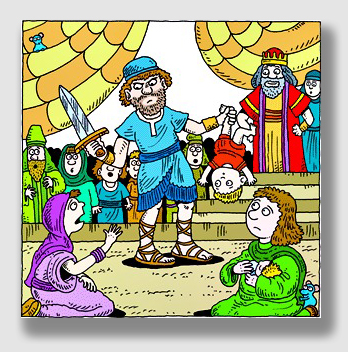
Solomonic, you say? Not really. Remember that King Solomon never really intended to cut the baby in half. Plus, that decision at least directly addressed the issue the two warring women had placed before the King and no more – that question being exactly whose baby the subject infant was. Here, the trial court found that there was nothing wrong with the trees and nothing wrong with the deck, but he ordered the trees trimmed anyway. It’s kind of like being charged with bank robbery, being found not guilty by the jury, but being sentenced to 5-10 years in the pen anyway because the judge thinks you probably cheated on your taxes.

In this dramatic re-enactment, King Solomon faces a tough decision.

In this dramatic and plastic re-enactment, King Solomon faces a tough decision – how to divide the bambino.

The Court of Appeals thought as little of the trial court’s decision as I do. It made short work of the trial court’s order. Because no one had raised the issue of whether there had been an understanding (or “understanding”) about the trees between the plaintiffs and the prior owners of the defendants’ place, the trial court couldn’t find that there had been one and entered an order accordingly.

Boussiacos v. Priddy, 2007 Cal. App. Unpub. LEXIS 9979, 2007 WL 4306835 (Cal.App., Dec. 11, 2007). The Boussiacoses sued their next-door neighbors, the Priddys, for statutory nuisance and violation of their mutual homeowners’ association’s covenants and rules. They alleged the Priddys maintained trees that blocked the Boussiacoses’ view along the parties’ shared property line. The Priddys counter-sued, alleging nuisance and violation of the covenants and rules, because the Boussiacoses had apparently built their deck without the homeowners association’s approval.

Following a bench trial, the trial court found that neither party had proved any of the claims raised in the pleadings. However, the trial court entered judgment anyway, requiring the Priddys to maintain the trees at specified heights in accordance with an “understanding” allegedly entered into by the Boussiacoses and the previous owners of the Priddys’ property. He also ruled that the Boussiacoses could keep their deck. The Priddys appealed, arguing that the trial court couldn’t enter a judgment where it hadn’t found the Boussiacoses’ underlying claims to have any merit.

No pruning for the Priddys

No pruning for the Priddys

Held: The trial court’s “judgment” was thrown out. The Boussiacoses had asserted only two claims against the Priddys: statutory nuisance and violation of the homeowners’ association’s covenants and rules. Because the trial court concluded on the record that the Boussiacoses failed to prove either claim, the Court of Appeals said, the judge was without any legal authority to make findings regarding an “understanding” between the Boussiacoses and the previous owners of the Priddys’ property. Such an “understanding” wasn’t alleged in the pleadings. The judge could not conclude that this understanding was enforceable against the Priddys and could not enter a judgment that imposed tree-trimming maintenance obligations on the Priddys.

The Court of Appeals held that a trial court’s award of relief must be based on a pleaded cause of action. Trial courts are more arbiters than gods. Here, the trial court transcended the limits of its authority. Because the record did not show that the enforcement of any agreement between the Boussiacoses and the previous owners of the Priddys’ property was before the court, the trial court erred by awarding the Boussiacoses relief on that basis.

A groovy appellate decision, I must say.

– Tom Root

Case of the Day – Tuesday, July 15, 2025

AND DON’T FORGET THE LITTLE WOMAN …

I got a call last week from a friend – I’ll call him Arnie Acme – who wanted me to look at a contract he was signing for office space. As a favor, Arnie said. “You know,” Arnie said, “just a quick read-through. After all, I know it’s OK.”

Enamored with the gravitas of a corporate structure, Arnie owns probably a dozen or more corporations or limited liability companies, all organized (I use that word very loosely) in a maze of affiliates, subsidiaries, parents, and joint ventures that would confuse a lab rat.  He forms them online, leaving the tedious work of writing bylaws, naming officers, and drafting minutes of corporate meetings until “later.” You can guess when “later” finally arrives… the day after he discovers he really needs them.

The contract he emailed me was between Office Megapark Corporation and “Acme.” I asked him which “Acme” he had in mind as the contracting party, given that he had “Acme Enterprises, Inc.,” “Acme Management, LLC,” “Acme Services Corporation,” “Acme Systems Limited Liability Company,” “Acme Interplanatery, Inc.” and a gaggle of other Acme variations of entities. He said he was not sure, and he would just put “Acme” in as the leasing party, so he could decide later which company he wanted to be the leaseholder. He planned to have his newly-hired office manager sign the lease, because her name had not yet appeared in any business records, and he could write her name and purported office into whatever corporate or LLC minutes he might need later. 

Arnie’s devil-may-care attitude toward contract and business association law reminded me of a sad fact. Small business owners sometimes (in Arnie’s case, always) skimp on the legal niceties. After all, they reason, paying out $500 to some lawyer for a bunch of forms and a vinyl corporate book doesn’t really “grow the business,” as the buzz phrase puts it. And who wants to squander money on a lawyer? Not Arnie. He just wanted a free and “quick read-through.”

Oops!

Oops! Sometimes, misteaks happen.

That’s rather false economy. In today’s case, a mom-and-pop timber harvesting business was hired to take down trees on one owner’s land, and — predictably enough — the chainsaws wandered onto Mr. Follender’s land, to the tune of 439 commercial-quality trees cut down and removed without permission. Follender lost trees worth $54,500. After trebling and some discounts, he ended up with a $120,000 judgment against Bert Maxim, the defendant.

Unfortunately, the timber harvester had involved his wife in the business, and she did enough of the business paperwork that she had signed the contract for the timber operation that had gone awry. Oh, if they had only incorporated, formed an LLC, done something! And if only Mrs. Maxim hadn’t signed that agreement! But hubby was out cutting down trees, and they were in a hurry …

The Court ruled that her involvement in the unincorporated business was enough to make her liable for the $120,000 judgment as well.

Sure, LegalZippy.com or Lawforms-R-Us can sell you some boilerplate-laden forms over the Internet that’ll purportedly set you right up. However, the best structure for a small business to protect its principals from liability varies from state to state. The legal niceties of the business organization — not just in the formation of the company but in day-to-day management — are best addressed by your local attorney or a specialist to whom he or she might refer you.

corporate_structureBut get the advice now. Usually, by the time you realize you should have spent the money on the legalities of business formation and protection, it’s too late.

Follender v. Maxim, 845 N.Y.S.2d 484, 44 A.D.3d 1227, 2007 WL 3101953 (N.Y.A.D., Oct. 25, 2007). Follender sued Berton Maxim and his wife for “wrongful and/or cutting down/taking of timber” from the purchased property. The Maxims, doing business as Prime Hardwood, had entered into a contract with Follender’s adjacent landowners, Valentine Riedman and Christl Riedman, to log their property. In the process, they inadvertently trespassed on Follender’s property and removed trees. Follender alleged negligence and conversion, with a request for treble damages, against the Riedmans and Maxim. They named his wife as a defendant, too, calling her “Jane Doe Maxim.”

Follender dropped the Riedmans from the suit, but the Maxims failed to answer or defend. After learning that Maxim’s wife’s name was Eileen Tine, Follender filed an amended verified complaint against them both individually and doing business as Prime Hardwood.

hook140806Again, they failed to answer or appear. After Follender got a default judgment against them, the court ordered an inquest. When the Maxims again failed to appear, Follender offered extensive proof which included, among other things, the contract between the Riedmans and Tine (signing on behalf of Prime Hardwood), an affidavit from Valentine Riedman which explained that when Maxim came to log his property, he was given a survey map which showed the Riedmans’ boundary line. Valentine Riedman was unaware that Maxim would remove timber outside of those boundaries. Michael Greason, a professional forester, testified that 439 commercial species trees were cut from Follender’s property, 386 of which had a value of $54,506.68. The Court trebled the damages and assessed damages of $120,000 against Maxim but never mentioned his wife, Eileen. Follender appealed, contending that the failure to include Eileen in the order awarding damages was a mistake.

Held: The judgment was modified, and the order of the trial court awarding treble damages of $120,000 against logger Maxim for negligence and conversion was rewritten to include the logger’s wife in the award of damages. She had signed the contract between Maxim’s business and the landowner’s adjoining property owners, in connection with which the logger had trespassed onto Follender’s property and from which he unlawfully removed trees.

Generally, appellate courts may correct any mistake, defect, or irregularity in a judgment, provided that the correction does not affect a substantial right of a party.

– Tom Root
TNLBGray140407

Case of the Day – Monday, July 14, 2025

I CAN SEE CLEARLY NOW

There’s an old saying that goes something like if you’re not the lead dog, the view never changes. Of course, the obverse of that aphorism is that if you are a lead dog, the view can be stunning indeed.

Appropriately enough, the plaintiffs in today’s case are the Boxers, a pair of top dogs if ever there were any. From their fancy home on South Spalding Drive, they “were accustomed to having an unobstructed view of the hills of Beverly Hills, the Hollywood Hills, and the Los Angeles basin, including the Hollywood sign, the Griffith Observatory, downtown Los Angeles, and – on a clear day – Mount Baldy 50 miles away.”

Up to 1989, in a clearing lived the Boxers. But then, in 1989, the City of Beverly Hills had to spoil things by planting 30 trees in nearby Roxbury Park. And not just any trees: the City planted coastal redwoods, which only grow to be among the tallest trees in the world.

But the Boxers were fighters by their trade. They doggedly complained to the City, and in 2005, Beverly Hills responded by trimming the trees (but not completely restoring the view the Boxers loved so much). In 2013, the Boxers whined again, “but this time, the City simply ignored Plaintiffs’ concerns.”

So the Boxers sued, claiming that by destroying the view they loved so much, the City had impaired their view and decreased the value of their property.

The 5th Amendment prohibits the government from taking your property “without just compensation.” There are regular plain-vanilla takings, such as when the government bulldozes your house in order to let developers build a fancy high-priced neighborhood with houses, a marina, shops, and restaurants.

And then there are inverse condemnations, where the government does not take your land, but just does something else to make it uninhabitable, such as building a sewage treatment plant upwind to your house, planting a freeway embankment in front of your place, or extending a commercial airport runway to your front door stoop.

The Boxers blamed the City’s “plan, design, and maintenance of the redwood trees” for wrecking the view and increasing the risk of fire. The City demurred, which is the legal way of saying “even if everything they say in their complaint is true, they’ve got nothing coming.”

In California, property is taken or damaged, so as to give rise to a claim for inverse condemnation, when it has been physically invaded, or physically damaged, or an intangible intrusion onto the property has that places “a burden on the property that is direct, substantial, and peculiar to the property itself.” But no one has a basic right to an unobstructed view over adjoining property unless they have contracted with the adjacent property owners for it or the legislature provides for it.

Here, despite the Boxers’ rebellion, there had been no physical intrusion onto their property, and the fact that absent the view of the Beverly hills the property wasn’t worth as much does not constitute a taking or damaging. Imagine the mess were the court to agree with the Boxers: your neighbors’ house is painted a garish color that is an eyesore, or a new hotel goes up a block away that spoils your view of the sunrise, or a new grade school is built in the next block, and playground noise upsets your cats. If changes in the use of surrounding property – or, as here, the incremental growth of trees – that affect the character of the neighborhood in a way you don’t like somehow gives you the right to collect money damages from another, progress would grind to a halt. What would be as bad, you would be as restricted in making use of your property as you could restrict others.

Boxer v. City of Beverly Hills, 246 Cal.App.4th 1212 (Ct.App. 2nd Dist., 2016): The Boxers owned a house on Spalding Drive in Beverly Hills. They filed an inverse condemnation action against the City of Beverly Hills, seeking damages and injunctive relief based upon impairment of the views from their backyards by coastal redwood trees the City planted in Roxbury Park. They complained that they were accustomed to having an unobstructed view of the hills of Beverly Hills, the Hollywood Hills, and the Los Angeles basin, including the Hollywood sign, the Griffith Observatory, downtown Los Angeles, and even Mounty Baldy. Since their planting in 1989, the redwood trees had grown to block the previously unobstructed view. The Boxers wanted money and an order that the City had to trim or remove the trees.

The trial court agreed with the City that as a matter of law, inverse condemnation provides no remedy for impairment of view from private property.

The Boxers appealed.

Held: The Boxers went down for the count. The Court held that for inverse condemnation purposes, property is ‘taken or damaged’ within the meaning of the California Constitution when: (1) the property has been physically invaded in a tangible manner; (2) no physical invasion has occurred, but the property has been physically damaged; or (3) an intangible intrusion onto the property has occurred which has caused no damage to the property but places a burden on the property that is direct, substantial, and peculiar to the property itself.”

Where there is no physical intrusion, such as in this case, the plaintiff must allege that the intrusion has resulted in a burden on the property that is direct, substantial, and peculiar to the property itself. The diminution in the value of the property alone does not establish a compensable taking or damaging of the property. Rather, diminution in value of the property is just an element of the measure of just compensation when such taking or damaging has otherwise been proven.

The Boxers did not allege any physical intrusion, occupation, or invasion of their property or any physical damage to their property. The trees about which they complained were not located on their land. The Boxers necessarily relied upon the intangible intrusion theory and argued that because a “property owner’s loss of view is an aspect of compensable damage” in eminent domain cases, the impairment of their views is a harm sufficient to support their inverse condemnation claims.

It is not. While “a compensable visibility interest” has been recognized when the government has physically taken part of someone’s property, that interest is not itself a taking or damaging of the property.

The Court held that the Boxers did not have a property right to an unobstructed view, and they did not allege that either the trees in question or anything associated with the trees physically invaded their property, either tangibly or intangibly. Thus, they could not maintain an inverse condemnation cause of action.

– Tom Root

TNLBGray140407