SUMMARY JUDGMENT
 If the extent of your formal law schooling was gleaned from prime-time television (not that there’s anything wrong with that), then you already know that all lawsuits end up in trial, every trial is a cliffhanger, someone usually falls apart on the witness stand under withering cross-examination, and the winners typically go to a nice place for dinner afterward. With the client picking up the tab.
Congratulations. You are a lawyer.
Real life, unsurprisingly, seldom imitates art. And there is hardly ever a good meal at a white-tablecloth beanery after the win.
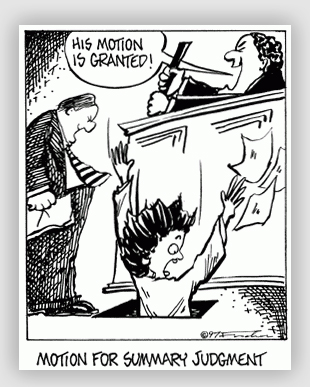
In reality, about 97% of civil cases never make it to trial. One party or the other files motions to dismiss for various reasons or seeks summary judgment, or simply gets out a wallet and settles. In fact, motions and summary judgment practice and settlement go hand in hand. It is usually a court’s action on a dismissal motion or summary judgment motion that throws cold water on one or both parties, causing them to remember that old-but-true legal maxim that “a bad settlement is better than a good lawsuit.”
A motion to dismiss is filed in a case where the defendant argues essentially that even if everything the plaintiff says in the complaint is true, he or she cannot win because of lack of jurisdiction, because he or she filed beyond the statute of limitations, because the statute does not confer on a plaintiff the right of a private cause of action… there are a bunch of great arguments for dismissal.
Summary judgment is a little more complex. It is usually filed after most of the pretrial discovery is complete. Summary judgment depends on one side or the other proving that the evidence shows there is no genuine issue of fact to be decided, only application of the law to the unrebutted facts. For example, I t-bone you in an intersection. You have affidavits from five witnesses that I ran a red light. Your lawyer takes my deposition, and I complain that I don’t know whether the light was red because I was watching a TikTok video on my phone, and you should have been alert for distracted drivers like me.
In that case, who needs a trial? I can’t prove I didn’t run a red light because while you have witnesses who say I did, I have no witnesses (including me) who can say I did not.
 When a party moves for summary judgment, losing does not mean he or she cannot prove the case. It just means that there is a question of fact – whether the jury believes your busload of nuns who say I ran a stoplight or whether it believes the guy who had just staggered out of a bar and says I did not.
Summary judgment is an excellent shortcut for cases in which a party cannot prove its case or defend itself (depending on whether the party moving for summary judgment is the plaintiff or the defendant). It saves a lot of court resources and legal fees. But as today’s case demonstrates, summary judgment is not for everyone. Where there is disputed evidence, even if the dispute is lopsided, a trial must result.
Johnson St. Properties, LLC v. Clure, 302 Ga. 51, 805 S.E.2d 60 (Supreme Ct. Ga., 2017). Cynthia Clure was a tenant of an apartment complex owned by Johnson Street Properties. JSP was owned and managed by Dan and Elaine Cartwright and their two sons, Chris and James.
In early 2013, a limb fell onto JSP’s property from a tree located on a neighboring lot. Other tree limbs had fallen onto the property during prior storms, including some from the adjacent property. The Cartwrights took action to remove those branches when such instances occurred. This time, a limb fell during a storm and became suspended between the gutter of one of JSP’s apartment buildings and some brush. Everyone agreed the suspended limb was an open and obvious condition, yet the length of time the limb remained suspended is unclear, ranging anywhere from a few days to a few months, according to who is telling the story. Cindy and her neighbors knew the limb was dangling from the gutter, and Cindy had even warned other tenants to stay away from the limb because it was dangerous and could fall. Cindy said she left voicemails with the Cartwrights, notifying them of the suspended limb, but they denied ever receiving any such voicemails.
On the day of the accident, Cindy discussed the limb with Steve Wilburn, a fellow tenant who sometimes worked as a JSP maintenance man. Steve and Cindy walked over to the hazard area, at which time he threw a rope over the limb. Cindy testified that she heard the gutter tear and told Wilburn to stop so she could warn the tenant inside the apartment about the loud noise. As she walked out of the apartment, Cindy told Steve, “Hold on. If you’re going to do anything, just wait.” But he did not, pulling on the rope. The limb swung down from its perch and struck Cindy.
Cindy sued JSP, arguing the company failed to maintain safe premises for its invitees. JSP moved for summary judgment, alleging that no genuine issue of material fact existed regarding its negligence.
The trial court denied JSP’s summary judgment motion, finding that genuine issues of material fact existed regarding its negligence.
Both parties appealed.
Held: Issues of fact existed requiring JSP to face a trial on negligence.
JSP argued that it had no knowledge of the dangling tree branch, that Steve – the guy who removed the limb – was not its agent or employee acting within the course and scope of his employment at the time of the incident; and because Cindy had superior knowledge of the hazard, she failed to exercise ordinary care for her own safety and assumed the risk by getting too close to a known hazard.
First, JSP contends that it had no knowledge of the hazard before the incident at issue. But, the Court said, Georgia law places an owner/occupier on constructive notice of what a reasonable inspection conducted in the exercise of ordinary care would have revealed, provided that “one is not chargeable with negligence in failing to discover and remedy a danger in the property which he could not have discovered by the exercise of ordinary care, or which has not existed for a sufficient time to charge him with the duty of discovering it.”
 Construing the evidence in favor of Cindy, as it was obliged to when judging a motion for summary judgment, the Court found there was a genuine issue of material fact as to whether Steve acted as JSP’s agent when removing the limb. If he did, any knowledge about the hazard posed by the limb and its removal that Steve possessed could be imputed to JSP. What’s more, the Court said, there was a question of fact as to whether JSP knew about the limb even aside from Steve’s knowledge, because Cindy testified she left a message with JSP about it. While there was evidence that the owners conducted inspections of the property after major storms, there was a dispute as to whether a reasonable inspection was conducted between the time the limb in question became suspended (which may have occurred after a major storm) and Cindy’s injuries; and whether a sufficient amount of time had passed for JSP to discover the hazard prior to Cindy’s injuries. “Indeed,” the Court said, “the record is filled with contradictory sworn testimony from the parties and lay witnesses concerning these matters, raising credibility issues which cannot be resolved on summary judgment.”
JSP also argued the trial court erred in denying summary judgment because Steve was not its employee acting within the course and scope of his employment at the time he decided to remove the tree limb from the gutter. For that reason, JSP contended, Steve’s actions could not be imputed to JSP under the doctrine of respondeat superior.
But, the Court said, questions of the existence and extent of an agent’s authority are generally for the triers of fact. Here, a question of fact remained as to whether Steve was an employee working within the course and scope of his employment at the time of the incident. It is undisputed that he had an on-again-off-again working relationship with JSP as the maintenance man for the property. In fact, Jim Cartwright admitted that during 2013, JSP would have Steve perform tasks around the property “as needed.” Plus, there was some evidence that Steve held himself out as the apartment complex’s maintenance man to other tenants as late as March 2013. During that same period, Elaine Cartwright instructed at least one tenant that she could “go to Cynthia or Steve” if she had any issues with her apartment.
As to whether Steve was working within the course and scope of his employment, he testified that he would perform odd jobs around the property and would not always ask permission from the owners before beginning a maintenance task if he determined that task was within his job description. Additionally, Cindy testified that she witnessed Wilburn removing tree limbs from the parking lot before this incident. While there was some evidence to the contrary, “such contradictions simply underline the existence of genuine issues of material fact that are for a jury to decide, “ the Court said.
 Finally, JSP argued that Cindy’s knowledge of the hazard created by the suspended tree limb was equal to or greater than that of JSP’s, and that such knowledge precluded her from recovering on her negligence claims. Cindy was clearly aware of the tree limb and testified that she understood the dangers it posed, given that it was suspended in the air. “But it is a plaintiff’s knowledge of the specific hazard which precipitates the injury which is determinative,” the Court said, “not merely her knowledge of the generally prevailing hazardous conditions or of the hazardous conditions which she observes and avoids.” In other words, Cindy was not injured by the random falling of the suspended tree limb — a possibility of which she was aware; instead, she was injured when the limb swung off the gutter while Wilburn was attempting to remove it. Steve had superior knowledge of his own plans and actions concerning removing the limb and the danger posed by such removal, knowledge that would be imputed to JSP if Steve were its agent. Thus, the Court held, although the record shows Cindy had some knowledge of the general hazard, “we cannot conclude as a matter of law that her knowledge of the “specific hazard” was equal to or greater than JSP’s; consequently, a jury question remains as to this issue.”
JSP said Cindy was contributorily negligent. The Court thought that it could be so, but “taking into account all the circumstances existing at the time and place of Clure’s injuries, and construing the evidence in favor of Clure, we cannot say that the evidence of Clure’s alleged contributory negligence is plain, palpable and undisputed.” Cindy’s proximity to Steve and the tree limb when he was attempting to remove the hazard was unclear from competing evidence. Cindy said she was walking away from the hazard when it fell. Steve wasn’t sure that Cindy had enough time to see it fall, raising a question as to whether she could have avoided the falling limb in the first place.
 Finally, JSP argued that Cindy assumed the risks associated with the limb removal by entering “the danger zone” as Steve was removing the limb. Assumption of the risk bars a plaintiff’s recovery when a defendant establishes that a plaintiff, “without coercion of circumstances,” chooses a course of action with full knowledge of its danger and while exercising a free choice as to whether to engage in the act or not.’ To successfully assert this affirmative defense, the defendant “must establish that the plaintiff (1) had actual knowledge of the danger; (2) understood and appreciated the risks associated with such danger; and (3) voluntarily exposed herself to those risks.” Put simply, the Court said, “assumption of the risk means that the plaintiff, in advance, has given his consent to relieve the defendant of an obligation of conduct toward him, and to take his chances of injury from a known risk arising from what the defendant is to do or leave undone.”
Because there are disputes in the evidence as to what occurred immediately preceding the limb’s fall — namely, Steve’s actions, Cindy’s location at the time in question, and whether she could have seen the limb fall from the gutter — the Court ruled that summary judgment was not appropriate as to whether Cindy assumed the risk.
– Tom Root


 Newkirk v. Sabler, 9 Barb. 652 (Sup.Ct. N.Y. 1850). Newkirk had sent his servant with a team and wagon across the defendant’s farm — upon which he entered by taking down the bars — to a neighbor’s house, even though Sabler had forbidden Newkirk from crossing his lands. On his return of the team to the place where it had entered, the servant found the fence bars had been refastened by boards nailed over them. The servant couldn’t break through, so he left the team and wagon on Sabler’s property and returned to Newkirk’s to tell him what had happened.
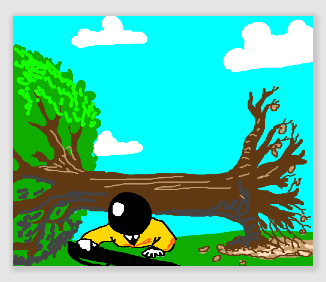
  One example is a landlord’s right to inspect the premises to ensure the tenant is not engaged in waste. Others include a sale of land with a reservation of the timber rights, or if one enters the land of another to prevent the landowner’s livestock from dying, or because the public highway is blocked and he must get around the blockage. And the court held, “If my tree be blown down and fall on the land of my neighbor, I may go on and take it away. And the same rule prevails where fruit falls on the land of another. But if the owner of a tree cut the loppings so that they fall on another’s land, he cannot be excused for entering to take them away, on the ground of necessity, because he might have prevented it.”


















 Tree and Neighbor Law For Homeowners and Professionals