
YOU’RE BREATHING MY AIR
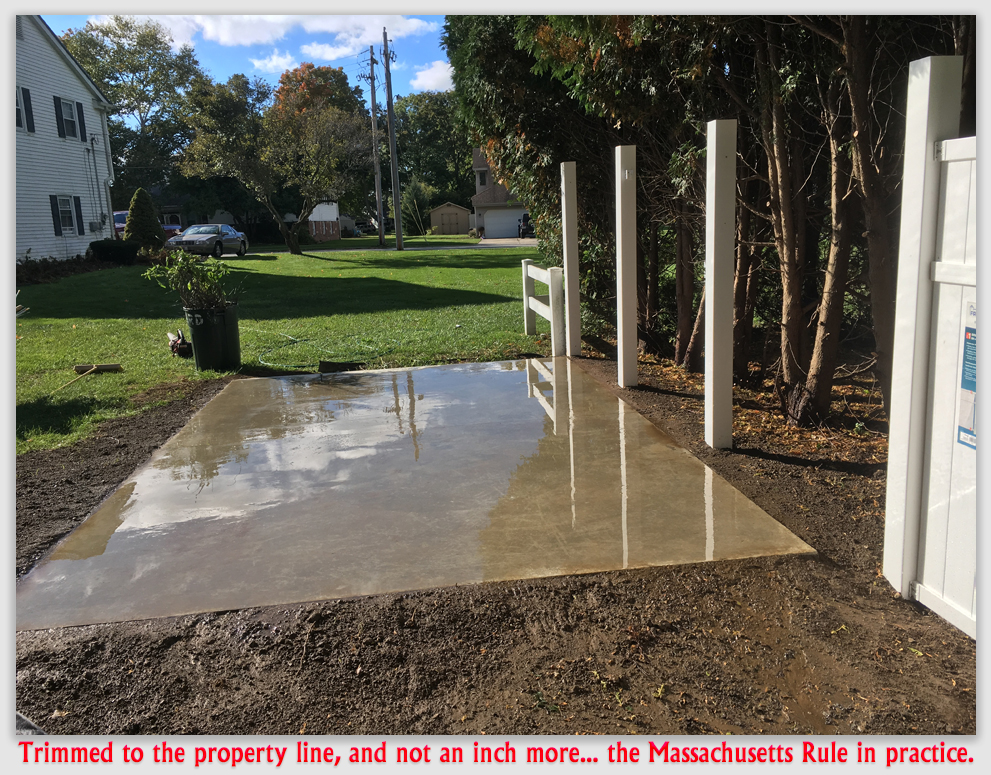 Last summer, I undertook a home construction project (imagined and ramrodded by my wife of 47 years, of course). I found myself trimming back some gargantuan arborvitae belonging to my neighbor, whom I will call “John” because that’s his name. The arborvitae were just puny little bushes when Andy and Allwyn, next-door residents two neighboring homeowners ago, planted them, but in the quarter century since they were mere shrubs planted a foot or so on John’s side of the property line, they’ve grown into towering, misshapen monsters.
On my side of the property line, they have swollen well into my airspace.
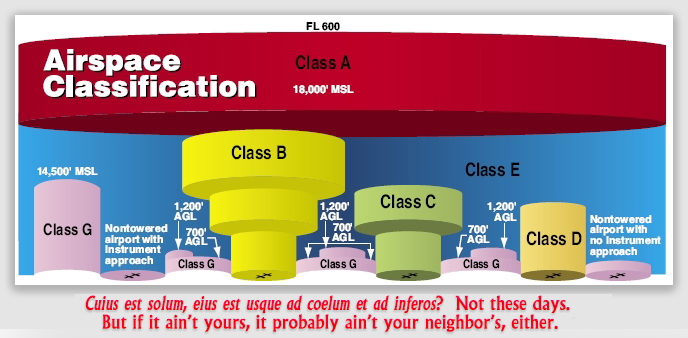
My airspace? Sounds a bit pretentious, doesn’t it? But that’s what we’re really talking about when we discuss overhanging branches and limbs. We all know about adverse possession, where a sufficiently brazen squatter can gain title to your property if he or she waits you out, and even prescriptive easements, where the same trespasser can acquire rights to use your property.
What if my neighbor had stalked out his back door last weekend and claimed his branches had been overhanging my property (and messing up the roof of my shed) for more than 21 years, giving him a prescriptive easement to my airspace? So while it’s still my air, he gets to use it. And breathe it. And there is nothing I can do about it? Whither the Massachusetts Rule?
A prescriptive easement over your neighbor’s airspace is indeed a novel argument. Fortunately for me, if my neighbor stalks out of his back door, he is much more likely to confront me with a basket of zucchini or a big butternut squash than he is with a wacky airspace easement argument. He is a pretty fine neighbor.
But not everyone is blessed with a neighbor as congenial as mine. That’s lucky for me, in a sense, because, as the Kansas Court of Appeals observed, when neighbors cannot get along, the courts protect property rights. And when courts do that, I have something to write about. Neighbor disputes that end up in court happen frequently enough to keep me going five days a week. And there are plenty of cases I never get to.
 But how about that airspace argument? In today’s case, the owner of a tree that leaned over his neighbor’s yard claimed his 75-year-old pecan tree had acquired a prescriptive easement over his neighbor’s airspace. Take that, Massachusetts Rule!
Cuius est solum, eius est usque ad coelum et ad inferos (Latin for “whoever’s is the soil, it is theirs all the way to Heaven and all the way to Hell”), a principle of property law, holds that property holders have rights not only to the plot of land itself, but also the air above and (in the broader formulation) the ground below. (Note to self: insert here a nod of thanks to my sainted Latin teacher of yore, Emily Bernges, or else I couldn’t translate that – I loved that woman!). The principle is often referred to in its abbreviated form as the ad coelum doctrine. So was the airspace claim clever lawyering, or just a lot of hot air? Let’s see whether the Court abrogated the ad coelum doctrine or brought the defendant back down to earth instead.
Pierce v. Casady, 11 Kan.App.2d 23, 711 P.2d 766 (Kansas Ct.App. 1985). Jim Pierce and Paul Casady are adjoining landowners with a 75-year-old pecan tree between them. The pecan trunk and root flare are on Paul’s land – but only a foot from the property line – and the tree leans toward Jim’s place. In fact, Jim says about three-quarters of the tree overhangs his land, ominously, given the substantial split in the tree’s fork (which also overhangs Jim’s property).
The split is four feet on one limb and about two feet on the other. If the tree fell due to the split, it would fall on Jim’s house, garage, and any cars in the driveway. Trimming the tree at the property line is not practical – unless one does not mind killing the tree in the process – because of the tree’s location and the angle at which it leans.
Jim sued for a declaratory judgment that he had the right to cut the overhanging branches back to the property line or, in the alternative, to declare the tree a nuisance to be abated by removal. Paul claimed he had acquired a prescriptive easement to Jim’s airspace. The trial court disagreed, ruling that Paul had no prescriptive right to the airspace the tree occupied and that the tree constituted a nuisance that rightly caused Jim to fear for his safety. Paul was ordered to abate the nuisance by removing the tree either at its base or at the point where it crosses plaintiffs’ property line.
Paul appealed.
 Held: An easement by prescription cannot be acquired by overhanging tree branches. Furthermore, a landowner may trim branches that overhang the landowner’s property even if the trunk is on a neighbor’s land, but the landowner may not enter the neighbor’s land to remove any part of the tree without the neighbor’s permission.
Trees constitute a nuisance if overhanging branches cause substantial harm or create an imminent danger. If a tree is a nuisance, a landowner may compel a neighbor to abate it or, if an injury occurs, seek damages from the neighbor as allowed by law.
The court of appeals rejected Paul’s argument that he had acquired an easement through Jim’s airspace because such an easement cannot be obtained by prescription, that is, by simply occupying the airspace without permission for a long enough period of time.
Jim argued that the tree could not be a nuisance. That did not affect Paul’s right to trim branches that were overhanging his property even though the trunk of the tree was on Paul’s land. The Court said the landowner may not go onto the neighbor’s land and remove the tree, or any part of it, without the neighbor’s permission.
If the tree is a nuisance, the landowner may compel the neighbor to abate it or, if injury occurs, seek damages allowable by law. In this case, the Court observed, it appeared that if the tree is trimmed at the property line it would be killed. The trial court recognized this and gave Paul the option to trim back to the property line or simply remove the whole tree.
The Court held that whether the tree constituted a nuisance was a question of fact. Generally, a tree is a nuisance when it constantly drops branches and requires constant maintenance. Or, a tree is a nuisance when there is a statute so defining it. Finally, a tree becomes a nuisance when it does substantial harm or creates an immediate danger of causing harm, the Court held, relying on Whitesell v. Houlton, the case that defined the Hawaii Rule.
Kansas recognizes that trees constitute a nuisance if the overhanging branches do substantial harm or the overhanging branches create an imminent danger.
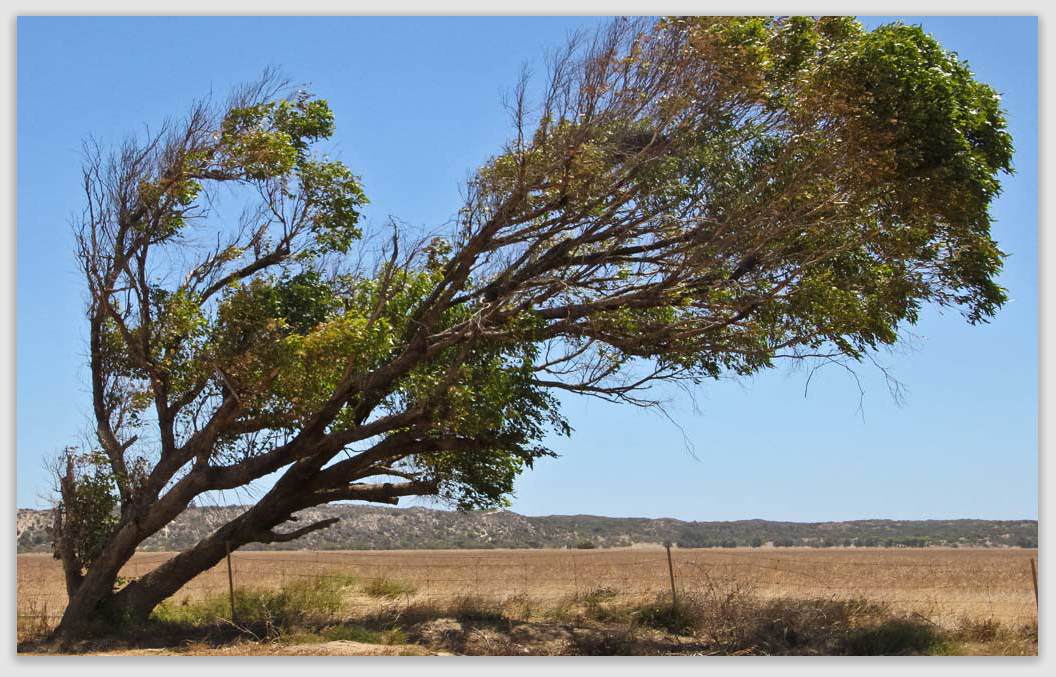 Here, the Court said, the tree was a danger to Jim, reasonably causing him to fear for his safety. The evidence supported the reasonableness of his apprehension: the split in the tree’s fork above his property, the squeaking sound when the wind blows, the angle at which the tree leans toward Jim’s property, and expert testimony.
Paul argued that cables and bolts could make the tree safe. The Court was unimpressed, holding that even that work would have to be done in Jim’s airspace. Paul had no right to enter Jim’s property to do that work for the same reasons Jim had no right to enter Paul’s property to trim or cut down the tree.
Paul was thus ordered to cut the tree off at the property line or remove it altogether.
The Court admitted that “the result reached here will be distasteful to all who treasure trees. The philosophy of the law is simply that whenever neighbors cannot agree, the law will protect each property owner’s rights as far as possible. Any other result would cause landowners to seek self-help or to litigate each time a piece of vegetation starts to overhang their property for fear of losing the use or partial use of their property as the vegetation grows.”
– Tom Root


