
WE ALWAYS MEANT IT
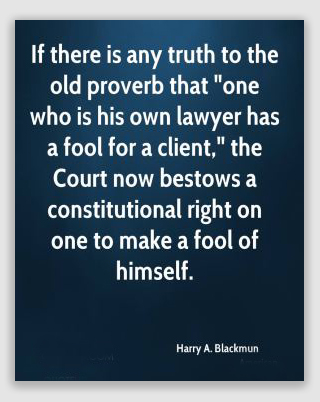
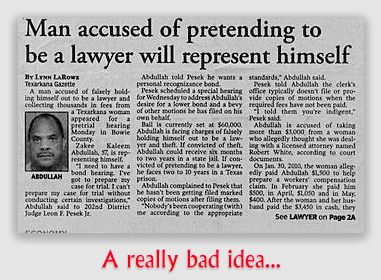
 An entire e-cottage industry has grown up around the notion that there are some areas of the law – incorporation, wills, real estate transactions, contracts, divorce – where all you need to do is download some PDF fillable forms, answer a few simple questions, and save yourself a ton of money by representing yourself. When we complain about it, our admonitions are written off as self-interest.
But we always meant it. So, using an argument you might correctly characterize as reductio ad absurdum, we give you Nellie Francis.
Nellie believed she was suffering from encroaching trees belonging to her neighbor, Joshua. So she did what any red-blooded American would do: she sued.
After all, how hard can this be? Nellie filed a complaint, sent off a few motions, and called some witnesses. That’s all that a real lawyer would do, after all, and he or she would charge you $10,000 to do it.
 Whoa, Nellie! She filed all sorts of motions, kept trying to amend her complaint, and even added damages for which she had already been paid, other damages which she never suffered, or – in one case – damages that happened to someone else, but she claimed it anyway.
The trial court sanctioned Nellie, requiring her to pay the defendant’s legal fees for one particularly egregious and frivolous filing. Undaunted, Nellie filed a demand that the defendant pay her legal fees, not the least inconvenienced by the fact that she was representing herself – that is, she was pro se – and so she had no legal fees.
For that matter, at trial, she could not even prove that the fallen branches had come from defendant Joshua’s trees. That seems kind of basic, the notion that you don’t sue unless you have some proof that the defendant is the one who caused you harm.
Those are the kind of technicalities that lawyers worry about. That’s why, Legal Zoom or not, they continue to be a necessary evil. Just ask Nellie…
Francis v. Brown, 836 A.2d 206 (R.I. 2003). A simple dispute between two abutting landowners and allegations of negligence in maintaining trees running along the property line between them brought Nellie S. Francis, representing herself, and Joshua Brown into court.
Nellie S. Francis lives at 16 Miller Avenue in Providence. The rear of her property is bordered by a 100’ fence, part of which abuts Joshua Brown’s place at 21-23 Verndale Avenue. A row of mature maple trees stands along the boundary between Nellie’s and Josh’s.
 Nellie sued Josh, contending he was negligent for failing to maintain the trees or to prune rotted limbs that constantly fell into her backyard, causing injury to herself, her children, her dog and her elderly mother, as well as damages to her fence, two cars, a concrete floor of a torn-down garage, a swing set, and a doghouse. Josh denied all of Nellie’s allegations.
In February 2000, Josh moved to enter Nellie’s land to remove trees on his property. She objected to his entry unless he assumed liability for any damage the work crews caused. Nell filed her own motion to compel Josh to cut down the trees on his property. As a result, Josh filed a motion for sanctions based on Nellie having proposed orders inconsistent with prior court rulings and having filed frivolous motions to compel Josh to do things that she simultaneously had opposed. The hearing justice agreed and further found that Nell had caused unnecessary delay and increased Josh’s cost of litigation. She was ordered to pay $350 to defense counsel by June 9, 2000.
Along with her blizzard of pretrial motions, Nellie found time to move to amend her complaint on more than one occasion to add further damages. She also appealed to try to review an order denying her motion for reconsideration of an order granting Joshua’s motion for assessment of legal fees against Nellie. Undaunted by the prospect of the trial court sanctioning her for her vigorous and unschooled courtroom antics, Nellie sought leave to amend her complaint for a second time, this time incorporating diverse and sundry damages not included in her first amended complaint. The trial court turned her motion down, finding it was “too late [and] inappropriate,” and prohibiting her from bringing forth any incidents not referred to in her first amended complaint. What’s more, the trial judge ruled that Nellie would be precluded from presenting any medical evidence relating to animals or persons not named as complainants. Finally, he ruled that the jury would not receive any information about insurance coverage, so it would decide the case on the merits rather than on the defendant’s ability to pay.
 Neophyte Nellie fared little better at trial. She called several witnesses, including herself and her daughters, but conceded she did not know what caused the branches to fall, nor could she state with certainty whether the branches shown to her in photo exhibits came from Joshua’s property or the vacant property next door. She admitted that she did not own the two vehicles damaged by trees for which she sought compensation. Neither of her daughters could pinpoint which property the fallen branches came from, and neither testified about what caused the branches to fall. Louis Bobola, the director of forestry for the City of Providence, testified that the trees were not on city property. He also said the trees needed pruning but that he did not see any decay.
Joshua’s lawyer introduced evidence that, six years earlier, Nellie’s insurance carrier had already paid her for some of the tree damage she now claimed. At the end of the trial, the judge granted Joshua judgment as a matter of law, holding that Nellie had utterly failed to prove her claim:
“The problem with the entire case is there is no evidence before the jury with regard to any damages sustained in this case by the plaintiff or her property… [T]here is not a scintilla of evidence before this court as to what tree or trees occasioned the alleged injury, on whose property they were located, were they on the defendant’s property or were they on the abutting property on the boarded-up house. And throughout the case, while there are certain inferences that can be drawn that branches do not fall on their own from trees, it simply in this [c]ourt’s view is not sufficient to be able to predicate a finding of negligence on the part of the defendant simply because this event has occurred… Mere ownership of trees that may or may not have caused damages does not impute negligence to the owner.”
The unsinkable Nellie filed for reconsideration, which the judge treated as a motion for a new trial. The court, charitably noting that Nellie had undertaken the difficult task of representing herself, found that the record lacked any objective damage for the jury to consider, even if she had satisfied the first two requirements of negligence and proximate cause.
Nellie appealed to the Supreme Court.
Held: The trial court was upheld in every regard.
After reciting a litany of Nellie’s failings, the Court upheld the trial court’s evidentiary rulings, its refusal of Nellie’s repeated amendments, and its judgment for Joshua. As for Nellie’s amendments, the Court agreed with the trial judge that she had been allowed to amend once, the trial date was upon the parties, and the amendment was flawed, with “many of the proposed incidents that plaintiff sought to add occurred several years previously. We believe that plaintiff was aware of their occurrence well before she filed her original complaint.”
 After all of that, the trial court’s modest $350.00 sanction of Nellie seemed restrained. Noting that Joshua “was awarded $350 in fees as a sanction against plaintiff for filing motions and making pretrial objections for inappropriate purposes,” the Supreme Court held that “the trial justice awarded a reasonable fee, well below the amount requested by defendant, for the purpose of giving ‘a warning’ to the plaintiff. We believe the sanction was justified and well within the trial justice’s discretion.”
Nellie made her own demand that Joshua pay her a “pro se” fee for the work she had done on her own case. The Court drily said, “We decline to address the plaintiff’s appeal from the denial of her motion for an award of pro se fees. The plaintiff has not supplied this Court with an adequate record on which to review the issue, and therefore, we deny and dismiss her appeal on this issue.”
– Tom Root


