

 Shawano, Wisconsin, New Media, August 27, 2026: Oak wilt threatens Kuckuk Park trees
Shawano’s forester is sounding the alarm about oak wilt being present in Kuckuk Park among trees adjacent to the playground area. Oak wilt is a fungus that attacks the water conducting system. The tree tries to block the fungus by producing gums and resins, which plug the tree’s water processing system. The fungus spreads quickly, and when the tree can no longer get water and nutrients through, it wilts and dies, according to the city of Shawano tree guide. Oak wilt can be spread in two ways, either through root systems connecting infected trees with healthy trees or by insects. According to City Forester Mike Kroenke, it’s the proximity of the oak trees in Kuckuk that’s causing the current infection. Four trees died in the park last year, he said, and two more are in the process of dying. Kuckuk has the largest gathering of oak trees in the city parks, according to Kroenke, so there are trees not showing any sign of infection currently. However, once the trees are infected, it can take less than two months to kill them. “It’s going to be really difficult,” Kroenke said. “We still want to save as many of them as possible, and then we’ll be planting a lot of trees all over the place like bur oak, swamp oak and some white oak…”
Miami, Florida, Axios, August 27, 2026: FDOT investigating tree ‘slaughter’ near Miami highway
Miami’s tree activists are up in arms about the removal of 10 large trees along I-95 near Wynwood. Local activism around preserving and growing the city’s tree canopy has ramped up in recent years as residents use social media, WhatsApp and city data to challenge tree removals. On Aug. 17, an environmental activist posted a video to Instagram showing a tree trimming company loading up freshly cut trees onto a trailer at 652 NW 31st St. Prior to the removals, Northwest Sixth Court near Northwest 31st Street was lined with trees. After the activist said he reported the incident to the Florida Department of Transportation, the agency tells Axios it is “actively investigating.” Spokesperson Maria Rosa Higgins Fallon wrote in an email that the agency “did not issue a permit for the removal of 10 mature Mahogany trees along I-95, and the activity is unrelated to any current FDOT project.” Miami Commissioner Christine King tells Axios that she began looking into the “slaughter of these trees” after residents contacted her…
 Albany, New York, WTEN-TV, August 27, 2026: Arborist discusses insect infecting local hemlocks
If you’re taking a walk in the Capital Region, you’re likely to come across a hemlock tree. If you look close enough, you could see the hemlock wooly adelgid, the invasive species that’s threatening the trees throughout the area. Board certified arborist Joe Oszust said the invasive species can kill a tree in as little as a year, depending on how strong it is when it gets infected. “The insect infects the tree,” said Oszust. “It extracts the nitrogen rich fluid weakening the tree, and then eventually usually a secondary, either pathogen or insect, comes in and takes the tree out.” Oszust said these little bugs are the size of gnats when they hatch from the little white eggs that are laid on the tree among the leaves. Hemlock wooly adelgid, also referred to as its acronym HWA, are very prevalent in the Capital Region…
Salem, Oregon, Capital Press, August 27, 2026: After narrow loss, USDA plans second Christmas tree checkoff election
A majority of Christmas tree farmers voted against continuing the industry’s checkoff program earlier this year, but that election won’t ultimately decide its fate. Though about 50.17% of growers voted against paying 15 cents per tree for research and promotions — compared to 49.83% who voted in favor — the USDA is planning to hold another referendum. According to USDA’s “notice to trade” announcing the second referendum, the original election between May 22 and June 2 provided a shorter voting window than the “standard timeframe” for such decisions. The department’s Agricultural Marketing Services received “numerous late ballots” in the original referendum, which could have changed the election’s outcome had they been counted, according to USDA…
 The Economist, August 24, 2026: Trees are spreading in one of Europe’s least forested countries
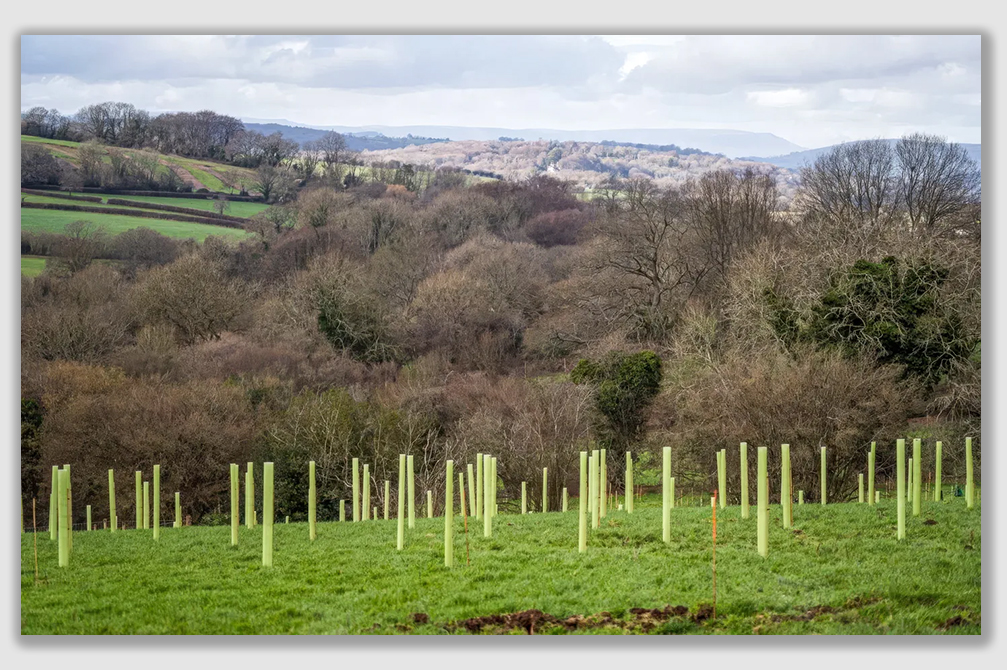
Near Gloucester in western England, some 127,000 saplings are approaching the end of their first summer in their permanent home. Forestry England, a government agency, planted the trees last winter on an 88-hectare (217-acre) site that was recently a farm. Most of the trees are behind wire fences, which extend below ground to thwart wild boar. A deer bounds along, looking for a way in. The infant woodland, known as Hoarthorns, is remarkable for a couple of reasons. It is the first substantial addition to the Forest of Dean, one of England’s oldest large woods, for two centuries. And the saplings, which are planted in neat lines, are enormously varied. Almost 40 species are growing on the site, most of them broadleaf trees such as oak and alder. When the Forestry Commission (a government department of which Forestry England is part) was created after the first world war, it planted a very different sort of woodland. Kevin Stannard, a regional director of Forestry England, gestures towards a monotonous block of mature conifers on a hillside near the saplings. “If this was 1919,” he says, “what you would have seen here is what you see over there…”
Two friends running a small development firm had finally cobbled together the perfect plot of land in Brooklyn. A string of narrow lots on Dikeman Street in Red Hook would give them just enough space to build four high-end townhouses, with room for the side yards and setbacks neighborhood zoning rules required. But something else had gotten there first: a big old tree. It was a silver maple, six stories tall with a trunk five feet in diameter, its rough bark twisting in a spiral pattern as it reached toward the sky. The root system stretched 20 feet across the front yard, right where one of the townhouses needed to go. Ben Krone, an architect and co-founder of the development company Hier, told his partner, Phillip Sulke, that the tree was nice. But it had to go…
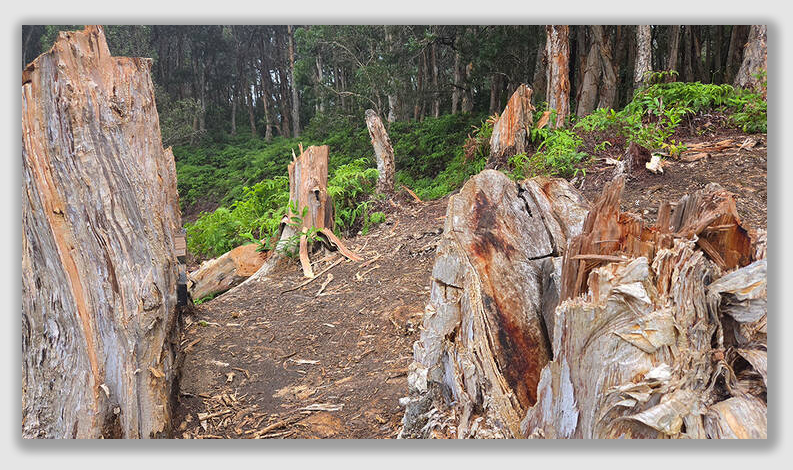
Where a grove of 10 eucalyptus trees once stood, there are now splintered tree stumps — and a bench. The Hawaii Department of Land and Natural Resources said vandals in recent weeks illegally chopped down more than 10 paperbark eucalyptus trees in the Ewa Forest Reserve above Wahiawa. ”The vandals also installed a bench, suggesting that the illegal removal of trees was perhaps intended to establish a scenic viewpoint,” said DLNR in a news release. “Ironically, the situation left by the destruction of the trees is anything but picturesque. The bench, made of wood slats, appears to be installed between two tree stumps, overlooking a view of the forest. DLNR did not elaborate on the vandals or if they have been identified — or caught — but said it is illegal under state law to remove, injure or kill plant life in public forest reserves…”
The high-end real estate agent who cut more than 140 trees in a King County park last year cashed in on the boosted price of his home last month. In the time it took for that agent, Vlad Popach, to sell his luxury home in Issaquah’s private Highlands neighborhood for $6 million, $1 million over an earlier asking price, the government’s case against him has yet to move forward in any meaningful way. King County attorneys sued Popach last summer seeking millions in damages for the illegal cuttings, to which he’s publicly admitted. But the case is held up by a criminal investigation now under the jurisdiction of the state attorney general’s office, which has been looking into the matter for nearly a year now. Some 18 months have passed since Popach hired a mystery company to cut all those trees in King County’s Grand Ridge Park and weeks more will pass until a judge is scheduled to hear a status update on the civil case. A trial remains a possibility for the relatively distant future…

Standing beneath the spreading branches of a massive live oak, historian Garrison Marcoux tries to imagine what this scarred, struggling tree saw 245 years ago. Did one of the British soldiers encamped at this South Carolina crossroad near the end of the Revolutionary War sit in the oak’s shade to recuperate from the series of attacks in American Maj. Gen. Nathanael Greene’s “war of posts?” Did he or his comrades take cover behind its then slender trunk and fire at the onrushing Continental Army? Perhaps a soldier took his last breath beneath its canopy, watering its roots with his blood. “I’m a spiritual person,” Marcoux, with the South Carolina Battlefield Preservation Trust, said as workers clamber among the limbs above. “To say that a place that experienced a lot of violence and intense emotion and things like that doesn’t hold some kind of energy is probably not likely. I think that energy exists where something like this happened.” This is a “witness tree.” And it now faces its own fight for survival…
The emerald ash borer, a metallic green colored invasive wood-boring beetle, has officially been spotted in Washington State, and with it comes the potential for total eradication of Washington’s ash tree population. State agencies confirmed the discovery of an emerald ash borer last week through a news release from the Washington State Department of Agriculture. “We anticipated it would only be a matter of time before emerald ash borer arrived in our state,” Washington State Department of Agriculture Pest Program Manager Sven Spichiger said. “This is yet another example of how alert, observant members of the public help us detect new, invasive pests.” The emerald ash borer was initially discovered on a car windshield in Hazel Dell, a small community just north of Vancouver, Washington, on Aug. 3. A spokesperson for the WSDA told The News Tribune on Friday that the citizens who discovered the beetle took photographs of it and looked it up online. Once they found out that it was invasive, they took the necessary steps to report it to the Washington Invasive Species Council, who then routed the report to the WSDA…

Alexandria officials are working to get to the root of the problem — literally — as they battle the ongoing influx of spotted lanternflies. The city is among those across Northern Virginia working to cull tree-of-heaven, a tree species that serves as a host to the spotted lanternfly, an invasive pest that arrived in the U.S. from China in 2014 and has been wreaking havoc since. Trees can either be removed entirely or treated to make them less conducive to the lanternfly propagation, naturalists said during an Aug. 21 forum sponsored by Virginia Cooperative Extension of Alexandria-Arlington. At the forum, Katrina Napora, Alexandria’s natural resource manager, said control of tree-of-heaven was one priority among many for the city’s natural resources staff. “We do have a limited amount of resources and a lot of tree-of-heaven,” she said. Tree-of-heaven (Ailanthus altissima) was imported to the U.S. beginning in the 1780s from China by way of Europe. Initially prized for their ornamental value, the trees fell out of favor by the late 1800s because of their negative impacts on the overall ecosystem…

 Tree and Neighbor Law For Homeowners and Professionals