

 New York City, The New York Times, August 20, 2026: Climate: Saving Old Trees Might Save Lives
When it comes to urban trees, old is gold. Many cities across the country, including New York, have been planting trees in neighborhoods where cooling shade has been sparse because of neglect in decades past. But a new study has found that simply adding trees is not enough: To get the most from tree cover, communities also have to preserve older ones. “If we take care of trees, they take care of us, and might even help save our lives,” said Harrison C. Garcia, a student at the Northwestern University Feinberg School of Medicine and the lead author on the study. “They’re not just a luxury. They’re not just something to look at.” For their research, published this month in the journal GeoHealth, Mr. Garcia and his co-authors used satellite maps from the U.S. Forest Service National Land Cover Database to track how tree canopies had changed in some of Chicago’s 77 neighborhoods between 2011 and 2021. Disparity in tree cover was wide. Some of those areas, like Forest Glen, have canopies of close to 50 percent. But some lower-income neighborhoods are practically barren of tree cover. Archer Heights, an immigrant enclave on the southwest side, stands at 8 percent tree coverage…
San Francisco, California, SFGate, August 20, 2026: In the best airport in the country, PDX, the trees are suffering
An arboreal ambiance defines the inside of the Portland International Airport in Portland, Oregon, where dozens of trees simulate a Pacific Northwest forest, but the realities of nature are starting to catch up. Last month, the Oregonian reported that some terminal trees were starting to appear sickly. Leaves on the black olive trees in particular were browning beneath the expansive wood-beam ceiling. The ailing Bucidas swung an axe against PDX’s otherwise lush reputation. Since its main terminal reopened in 2024 as part of a $2.15 billion redesign, PDX reached a new altitude for public praise. The Washington Post ranked it the best airport in the country last year and the terminal exterior received recognition from the Prix Versailles, an international architecture and design award. Designer ZGF Architects installed a 9-acre mass timber structure inside the main terminal with skylight pockets over the living trees and cafes and a Columbia Sportswear. The Port of Portland reportedly had a landscaping budget of $2.4 million, and when the Oregonian inquired about the unhealthy trees, the airport’s owner insisted it was not a design flaw; rather, the issue stemmed from human and pet behavior…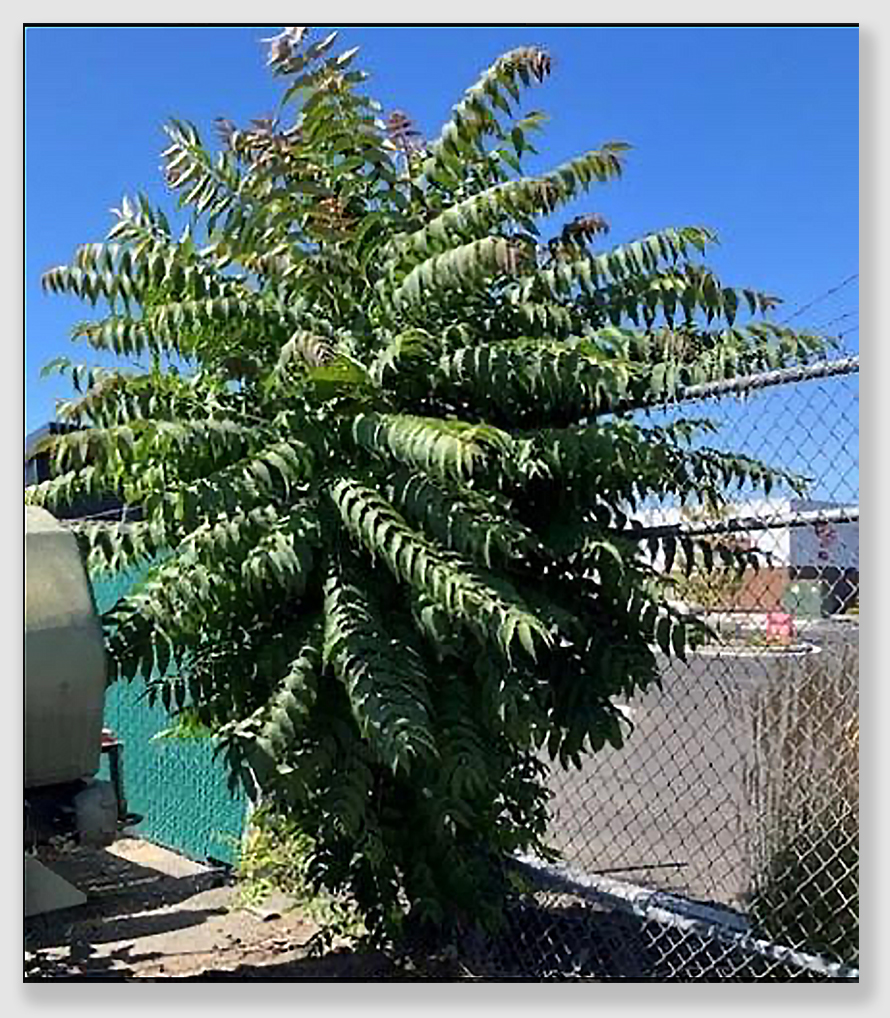 Washington, DC, 51st State, August 20, 2026: Mount Pleasant residents say ‘hell no’ to trees of heaven
A few years ago, a Mount Pleasant parent named Joanna was out walking with her child when she noticed a familiar foe cropping up in the cracks of sidewalks and in her neighbors’ yards: the beautifully named but troublesome tree of heaven. Joanna (who asked to go by her first name in the story for privacy reasons) not only recognized the young trees but understood the threat: her previous apartment building had been at risk of foundational damage due to the aggressive root system of a tree of heaven. She also knew that her neighbors had previously mobilized around other environmental projects, like Mount Pleasant Village’s initiative to plant and care for native plants in the neighborhood. “I thought, ‘Wow — we could actually do something,’” she said. The tree of heaven, a deciduous tree identifiable by its smooth oval leaves with pointy ends and a distinctive burnt peanut butter scent, was originally brought to the United States from China back in the late 1700s and originally valued for its ability to grow nearly anywhere — even in urban areas that were hostile to other greenery…
East Hampton, New York, Star, August 20, 2026: Town Considers Tree Protections, but Cautiously
Beech leaf disease. Southern pine beetles. Laurel wilt. Development. The challenges to trees on the East End are many and protections few. The East Hampton Town Sustainability Committee seeks to change that. Nearly a full year after it made a presentation to the town board about the need for a tree protection ordinance, and after a recent high-profile removal of a century-old, healthy tree at the north end of Newtown Lane in East Hampton Village, on Aug. 11 the committee asked the board to begin drafting legislation. “Tree protection ordinances are municipal bylaws enacted by local governments to protect trees and other important vegetation by establishing legitimate oversight and/or requiring permitting for certain tree-related activities and setting required replanting standards commensurate to the tree loss,” Jaine Mehring, speaking for the sustainability committee, told the board. How to judge what is commensurate with an ancient tree is just part of the challenge of drafting code. Some would say a tree like that is irreplaceable…

You know it’s late summer in Central New York when the days are getting a little shorter, nights a little colder, and you can almost smell the New York State Fair coming around the corner. And lately, maybe you’ve noticed black-spotted leaves falling at an alarming rate from that big Crimson King Norway maple tree in your front yard. That’s not a premature sign of autumn. It’s a phenomenon caused by a combination of two fungal diseases called tar spot and anthracnose. Of the roughly 150 types of maple trees in the world, Norway maples are hit particularly hard by these fungal diseases, according to Don Leopold, distinguished professor at the State University of New York College of Environmental Science and Forestry, and author of Trees of New York State. “It’s only Norway maple, versus all the other maples that are in the landscape which show only occasional blemishes,” Leopold said. “But Norway maples make up probably 15% of all the trees in the urban landscape. So our trees are showing these combined fungal diseases, and it’s pretty common many years.” Norway maples get infected with tar spot and anthracnose every year. But the symptoms typically aren’t noticeable until Halloween, when the tree’s characteristic yellow and orange colors are peaking, highlighting the polka dot effect of the black spots…
A tree fell from a wooded area along US Route 30 in Stark County on Saturday, crushing a Jeep and killing the driver — a 35-year-old mother and local business owner. Bridget Reagan was driving west on the highway in Paris Township just before 6 p.m. when the tree came down on her Jeep Wagoneer, taking her life. She leaves behind three children — a teenager and two younger kids. Nate Meadows, executive director of the Minerva Area Chamber of Commerce, remembered Reagan as a kind and giving person who was proud of her hometown and always looked for ways to bring attention to Minerva. “She was a driving force here in town, just made Minerva a better place,” Meadows said. “She was always positive. Even if things were not going great, she was always looking at what was the next best thing,” Meadows said. Reagan owned Chic Haven, a Minerva shop selling clothing, candles, and other home decor items. The business was awarded Outstanding Small Business in the Minerva area last year. Flowers now line the shop’s front door as family, friends, and fellow business owners struggle to come to grips with her sudden death…

England’s ancient oak trees are dying in the summer’s extreme heat and dry weather, according to the Woodland Trust, with trees and ecosystems unable to adapt fast enough to the changing climate. The heatwaves across much of Europe this summer have had a notable impact on crop growth and plant health. To cope with the extreme conditions, many trees are undergoing “early autumn”, wilting and losing their leaves early. John Parker, the chief executive of the Arboricultural Association, said: “The signs of heat stress and dry weather is visible.” Ed Pyne, a senior conservation adviser at the Woodland Trust, said it was helpful to think of trees like a large pipe constantly transporting water, minerals and nutrients from the soil, through its roots, up its trunk and out to its branches and leaves. “When the trees are losing too much water, it stops this process and that’s when we start seeing the leaves wilting and dying, which can give rise to this early autumn phenomenon where the trees are losing their leaves early,” he said…
Homeowners on Cincinnati’s east side are frustrated, saying their boxwoods are going from green to brown, almost instantly. An invasive species is destroying a well-loved shrub, the boxwood, particularly in the Anderson Township neighborhood. The box tree moth is bothering these shrubs in Greater Cincinnati and homeowners are taking notice. “Last week they were green and then they just had little bits of brown on them,” homeowner Christina Witte said. “And then it felt like overnight they turned, and they were almost all brown.” The problem actually started in Loveland last year and has been invading shrubs this year in other east side neighborhoods. The damage caused to boxwoods can happen fast. “Early on, you might notice some blistering on the leaves, but then you’ll notice the leaves are actually browning and dying,” landscape manager at Native Roots, Cody Douglass, said…

A newly confirmed outbreak of a lethal tree disease in southeastern North Dakota has forestry officials assessing the threat to the state’s windbreaks and shelterbelts. The arrival of pine wilt disease in Ransom and Sargent counties marks the first time the pathogen has been officially confirmed in the state, and experts warn that rising temperatures could help the disease march steadily northward. The discovery of the disease in North Dakota began with a phone call. “We got a sick tree assistance call from somebody down in Forman. They were saying that their Scotch pines were dying,” said Martin Shervey, forest health manager with the North Dakota Forest Service. Because it was too early in the spring to take viable samples, forestry staff scheduled a follow-up visit later in the season. Shortly after, a Forest Service staff member noticed similarly declining trees in the Sheyenne River State Forest. Samples from both locations were sent to the South Dakota State University plant pathology lab, which confirmed the presence of the disease on August 11, 2026. Pine wilt disease is caused by the pine wilt nematode, a microscopic roundworm. Rather than moving on its own, the nematode relies on native sawyer beetles to travel from tree to tree…
Following calls from the community and city leaders for more trees in Bakersfield, the Tree Advisory Group is looking to increase tree planting and urban canopy across the city. The Bakersfield Recreation and Parks Department presented updates on the city’s Tree Advisory Group and its accomplishments and ongoing recommendations during the Safe and Healthy Neighborhoods Committee meeting on Friday. TAG’s goal is to create an urban forest through planting, care and preservation of trees, according to city officials. So far, TAG has recommended a list of trees to be used in public spaces, which was approved by the Recreation and Parks director in December 2025…
 Phys.org, August 17, 2026: How ancient trees are warning us about the next enormous solar storm
Our sun is capable of storms far bigger than we’ve ever recorded. Studying the world’s oldest trees suggests we could soon be due one of these gargantuan events. The first clear sign of exceptionally high solar activity came from Japanese cedar trees. In 2012, Fusa Miyake was studying slices of ancient Japanese cedar taken from a tree felled in the 1950s. It had grown on Yakushima Island, a protected site famed for its long-lived trees, some of which have stood for millennia, laying down one ring of wood after another. These tree rings aren’t just markers of age—they are also annual records of Earth’s atmosphere, and studying them could help us predict and prepare for future disruptive solar storms. While perusing these ancient tree records, Miyake stumbled upon something that gave her pause. The relative proportion of carbon-14 in each tree ring reveals how active the sun was each year…

 Tree and Neighbor Law For Homeowners and Professionals