


Door County Circuit Court Judge Jennifer Moeller ruled Tuesday that a temporary injunction barring additional tree removal in Potawatomi State Park will remain in effect while a lawsuit challenging the project moves forward. Moeller first issued the injunction in June after Potawatomi Advocates for Trees, Conservation and Heritage (PATCH) raised questions about whether the Wisconsin Department of Natural Resources (DNR) and DNR Secretary Karen Hyun complied with state planning laws. At Tuesday’s July 14 hearing, Moeller heard arguments over whether the DNR followed state law when it widened and realigned the southern portions of Shoreline Road and South Norway Road without providing public notice about the project and opportunities to comment on it. About 20 people attended the court hearing, which had been postponed after the state filed a brief the day before the last hearing on June 19. Gabe Johnson-Karp, an assistant attorney general with the Wisconsin Department of Justice, argued for the state, appearing remotely, while Brian Potts, a Madison-based partner with Husch Blackwell, appeared in court, representing the plaintiffs on a pro bono basis. PATCH contends that the DNR and its Secretary violated state planning requirements by widening the park roads, adding bike lanes, removing hundreds of trees and disturbing areas near the Niagara Escarpment without amending the park’s master plan and going through the public notification process…
New York City, The New York Times, July 16, 2026: How a Seed in Space Became a Tree in Madison Square
A tree in a Manhattan park traveled a long way before it got there — to the moon, almost, and back. Some 1.4 million miles, according to NASA. The tree is a sweet gum. It wasn’t actually a tree when it flew in space: It was grown from seeds carried on the Artemis I mission in 2022. NASA was counting on Artemis I to usher in another era of lunar exploration, even though it was years behind schedule and billions of dollars over budget. Artemis I didn’t go all the way to the moon — NASA says that Artemis IV, in 2028, will make the first moon landing since the 1970s. But two lunar flybys did take Artemis I as close as 80 miles from the moon’s surface. Back on earth after re-entry and splashdown, the seeds from Artemis I were inspected and planted, and NASA began distributing seedlings to institutions that had applied to be “moon tree” stewards — schools and colleges, museums and libraries. And Madison Square Park. The park will celebrate its tree today with a “moon tree launch party” beginning at noon. The Madison Square Park Conservancy, which manages the park, worked with the Poetry Society of America and commissioned a poem from Kimiko Hahn, a distinguished professor at Queens College who is the New York State poet laureate… Blacksburg, Virginia, Virginia Tech, July 16, 2026: Finding value in the trees
Kevin Smith ’00 was determined to be a Hokie. The list of universities he applied to while in high school was one: Virginia Tech. That’s it. Virginia Tech and nowhere else. “I was such a diehard Virginia Tech fan that it was the only school I applied to,” Smith said. “I told myself, ‘If I get in, I get in.’” That was 1996 and Virginia Tech boasted a football team coming off a Sugar Bowl win, but it wasn’t just athletic glory that made the university his aspiration. In high school, Smith found a calling in forestry and Virginia Tech offered the only forestry degree program in the commonwealth. Today, as vice president of Big Timber Hardwoods LLC., Smith returns to Blacksburg each April to give back to his alma mater. By spending a day in the field with forestry students, he provides them with a rare industry perspective: appraising the value of standing trees for wood veneer. Veneer is high-quality wood sliced as thin as half a millimeter to cover furniture and paneling. It requires flawless logs. Learning to identify these trees in the forest is a highly marketable, specialized skill…
Interesting Engineering, July 14, 2026: How many trees exist on Earth? A look at the numbers behind our forests
Trees are so common that it’s easy to assume no one has ever counted them. Surprisingly, scientists have. While no one has physically counted every trunk and branch, researchers have combined satellite imagery, artificial intelligence, forest inventories, and more than 400,000 ground-based measurements to estimate the number of trees across our planet. The answer? About 3.04 trillion trees. Roughly 390 trees for every person on Earth. But that’s only the beginning of the story. To understand what that number really means, we also need to look at where those trees are found, how many we’ve lost, and why protecting forests is often more important than simply planting new ones. For decades, estimates suggested Earth contained only around 400 billion trees because scientists relied primarily on satellite images showing forest cover. The problem is that satellites can reveal where forests exist but not how densely trees grow beneath the canopy. In 2015, an international team led by ecologist Thomas Crowther developed the first global tree-density map by combining satellite observations with hundreds of thousands of field measurements collected from every continent except Antarctica. The study estimated that Earth currently hosts approximately 3.04 trillion trees. Almost eight times higher than previous estimates. The work remains one of the most comprehensive assessments of global tree numbers ever conducted…

A tree species planted by the city is causing a stir in the Northwest Calgary community of Cambrian Heights. The Ohio Buckeye is popular for providing shade and changing with the seasons. However, the nut it produces can be toxic to pets if ingested. Several of these trees, which are producing the nuts, are currently planted in the Cambrian Heights dog park. “Some residents have reported in the past that these trees are potentially hazardous to their dogs,” says Daryl Connolly, the president of the Cambrian Heights Community Association. “We’ve passed that comment on to parks, and the response has been that their specialist in tree planting are aware of the issue but obviously don’t think its a major concern or concern enough to do anything about the trees…”
Elizabeth Burrows and Jeremy Rawlinson bought their house in Park Place in April 2020. After meeting as students at Old Dominion University, the couple rented around Norfolk, including Ghent and Colonial Place, before purchasing the house at 31st Street and Llewellyn Avenue. “It was affordable, a great size, plenty of stuff in walking distance,” Burrows said. “So just a good location.” They were also attracted to the vacant lot next door, home to a southern live oak with a canopy that sprawls across the lot and the busy Llewellyn thoroughfare. “From the get-go, I was thinking eventually, if someone buys the lot to try to put a house on there, that tree will get cut down,” Rawlinson said. He and Burrows wanted to buy the city-owned lot: Norfolk could collect tax dollars and conserve limited green space in the neighborhood. But it wasn’t that simple. Over the next six years, the couple went back and forth with the city, to buy the plot or prevent it from being developed. They felt stymied and disheartened by what seemed like ever-shifting rules…

Are giant sinkholes in China’s karst mountains havens or traps for the rare plants that inhabit them? A new study finds they are both—offering refuge from heat and drought while gradually eroding the evolutionary potential of an endangered tree. In a study published in Current Biology on July 14, researchers from the South China Botanical Garden (SCBG) of the Chinese Academy of Sciences (CAS) and the Guangxi Institute of Botany found that colossal karst sinkholes, known as tiankeng in Chinese, can help preserve the endangered tree Magnolia aromatica while also limiting gene flow and diminishing its long-term evolutionary potential. In the karst mountains of southwest China, tiankeng shelter cool, humid forests at the bottom of steep cliffs. These hidden forests shield rare plants from harsh surface conditions. Magnolia aromatica, a rare karst tree distributed across fragmented limestone habitats in Guangxi, Guizhou and Yunnan provinces, grows both inside and outside these sinkholes. But until now, it has been unclear whether the isolation inside tiankeng poses genetic risks that exceed their protective benefits…
The St. Paul City Council is poised on Wednesday to approve new rules meant to protect trees during the street reconstruction projects that tear up roots and take a toll on the canopy. By the numbers: St. Paul has lost nearly one-third of its tree coverage over the last decade, according to new DNR data. Some of the canopy loss was necessary — city-led efforts to contain emerald ash borer account for much of it — but supporters say more thoughtful street project planning could prevent unnecessary losses. Case in point: Ramsey County’s rebuild of Cleveland Avenue four years ago chopped down 160-plus trees. Neighbors argued that different design choices could’ve reduced that total. How it would work: Right now, trees are “literally an afterthought” in St. Paul’s street reconstruction process, City Council President Rebecca Noecker said. Tree experts aren’t consulted until late in the design phase. The ordinance — and a detailed set of accompanying rules — would require arborists to get involved much earlier in city-led projects. Planners would also be required to weigh design options that preserve mature trees…

About 50 miles southeast of St. Louis, in the small town of Tilden, Illinois, the leaves on the burr oak trees looked odd earlier this spring. Some were curled and cupped around the edges, while others were misshapen. These are classic symptoms of drift from potent herbicides like dicamba or 2,4-D, said Kim Erndt-Pitcher, director of ecological health at Prairie Rivers Network. “Once you see it, you can’t unsee it,” Erndt-Pitcher said. The nonprofit has been documenting pesticide drift in Illinois for nine years. In 2024, the group published their findings, reporting 99.6 percent of the 280 sites surveyed statewide had symptoms of drift damage, and 90 percent of the tree tissue samples collected had herbicide in them. “Year after year, we’re seeing decline in numerous species,” Erndt-Pitcher said. “Some of the most concerning are our oak species because they are keystone species in our hardwood forests and really important to our communities as well.” The Environmental Protection Agency’s decision to issue a new set of regulations for the herbicide dicamba in February brought forth a plethora of concerns from fruit and vegetable producers and environmentalists who worry the rules won’t stop the chemical from drifting…
Bloomington wants to preserve trees — by cutting others down. A $20 million project partially funded by a local sales tax will address erosion and invasive species at Nine Mile Creek, a burbling stream that snakes through dense forest in the heart of the southern suburb. A key goal is restoring the once dominant oak savanna, an ecosystem known for fire-tolerant oak trees that shade grasses and wildflowers. But to foster that fusion of prairie and woods, the city will cut down numerous trees that compete with native oaks, incensing some residents who prize the area’s shade. In dense, developed suburbs like Bloomington, debates about trees can quickly become heated. “Do we want to walk through a shady woodland, or do we want to walk through a really hot savanna?” said Michele Lloyd, a Bloomington resident who co-founded the group Save Our Woods to oppose the tree removal. “We don’t want to just be under the beating sun…”
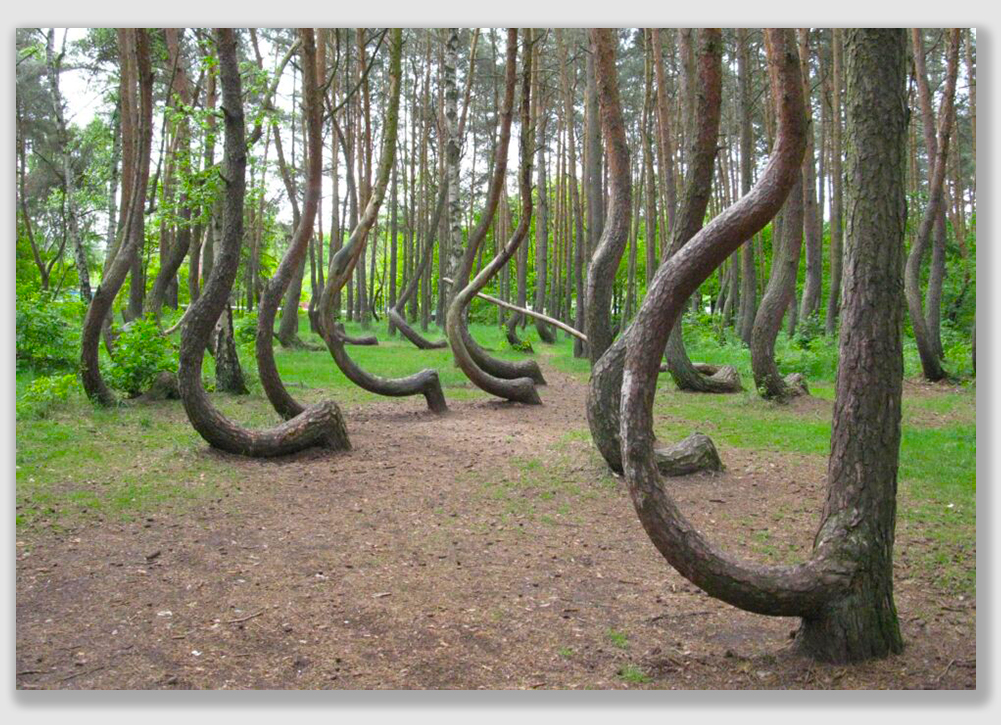
Scientists are seeking to solve the mystery of Poland’s “Crooked Forest” – a set of 90-year-old trees with bizarrely curved trunks – by developing “tree-bending technology” to recreate their unusual growth. The Crooked Forest, located near the town of Gryfino in northwestern Poland, has long intrigued researchers, locals and tourists. Yet the reason why the pine trees have such dramatic C-shaped curves at the bottom of their trunks remains unknown. Efforts to better understand the phenomenon have recently accelerated as some of the trees have been dying out, leading to fears that now is the last chance to unravel the mystery. The researchers and local authorities hope that the new project can create a “Crooked Forest 2.0” for future generations to enjoy. The Crooked Forest is estimated to have been established around 1934 on a plot of land spanning around 1,600 square metres (17,222 square feet), reports the Polish Press Agency’s (PAP) science news service, Nauka w Polsce. It once featured around 400 of the oddly curved trees, though now only around 100 remain. The forest has become a point of curiosity, drawing large numbers of tourists and sparking various theories about how the trees obtained their unusual shape…
Seattle, Washington, Washington Week, July 13, 2026: The PacWest Center Pine Tree Has Died at Age 42
The pine tree on the 25th floor terrace of PacWest Center downtown has died. It was 42 years old. The quirky fixture of the Portland skyline was removed for safety reasons, according to Wyatt Cerny, vice president of real estate at Fountainhead Development, the Fairbanks, Alaska–based company that has owned PacWest Center since October 2025. An exact cause of death was not given, but an arborist evaluated the pine and determined it was “in declining health and no longer viable,” Cerny said. “A new cherry tree has since been planted, and we look forward to it maturing into a new curiosity of the Portland skyline,” Cerny said in an email. A dead tree was spotted on the terrace of 1211 SW 5th Avenue as recently as July 9. The pine tree was planted in 1984, when PacWest was built, and eventually stood about 40 feet tall. Environmental historian Dave Hedberg, author of From Stumptown to Tree Town, had been scoping out the evergreen for the Oregon Heritage Tree Program, but those hopes died with the tree…

 Tree and Neighbor Law For Homeowners and Professionals